Hospital birth data suggests increase in birth tourism, says immigration expert

Globe coverage of my policy options article:

Births in Canada to foreign visitors and other non-residents have risen in the past year, an expert in immigration statistics has found after analyzing hospital data. 

The research, published in a report on Wednesday, shows a small increase in births at Canadian hospitals to temporary residents, such as international students and people here on work permits.

The proportion of births to people who are not settled in Canada is small compared with births in the country overall, but the number of temporary residents in Canada has been dropping as the federal government has reduced immigration.

According to the report, authored by Andrew Griffith, a former director-general at the federal immigration department, the data suggest an uptick in births to women here on visitor visas, otherwise known as birth tourism. …

Source: Hospital birth data suggests increase in birth tourism, says immigration expert, Policy Options Birthright citizenship and the politics of “birth tourism”

C-3 Senate Hearing 17 November: My Submission

My submission, focussing on the Liberal/NDP agreement to remove the recommendations by the House Immigration Committee is below.

While removal and the unlikely to withstand legal challenges to language, knowledge and security/criminality proposals makes sense, removal of a time limit of five-years to meet the residency requirement of 1,095 days does not.

More puzzling is the removal of the requirement for annual reporting on the number of persons reclaiming their citizenship. The Minister and officials appeared weak when discussing the numbers and expected impacts, underlying the need for IRCC to share this data on open data or annual reports as they will be collecting it anyway:

What happened to ‘click once for Canadian citizenship’? The government has (quietly) thought twice

Nice to see that all the efforts from many to stop this hair-brained initiative paved off (quoted):

The Immigration Department has quietly shelved a controversial plan that would have allowed new citizens to take their citizenship oath on their own with a click on the keyboard.

“There is no self-administration of the oath in Canada,” the department said in an email in response to a Star inquiry for an update about the plan. “Implementation of the self-administration of the oath is not actively being pursued at this time.” 

In February 2023, the federal government published the proposed change in the Canada Gazette as part of the modernization and digitalization of immigration and citizenship processing.

The self-attestation option was meant to reduce citizenship processing time and cost, and make it more accessible, because ceremonies are generally scheduled on weekdays during working hours. It was supposed to be launched in June that year. Unlike in a virtual citizenship ceremony, there would be no presiding official.

However, a chorus of prominent Canadian leaders, including former governor general Adrienne Clarkson, former Liberal immigration minister Sergio Marchi and former Calgary mayor Naheed Nenshi, came out to voice their opposition. Critics feared this would further dilute the meaning of Canadian citizenship.

“It’s a fundamental downgrading of understanding of what Canadian citizenship is about and how meaningful it can be,” said Andrew Griffith, a former director general for the federal Immigration Department, who had organized a petition to Parliament opposing what he calls “citizenship on a click.”

“It’s not a driver’s licence. It’s actually something that has some meaning. It gives very significant rights to people, so it shouldn’t be taken lightly.”

While Griffith welcomed the news, he is troubled that the government did not officially note in the Gazette that it had dropped the plan or at least publicly stated a change in policy. The Gazette is the official government publication to inform the public about new and proposed regulations, statues, orders-in-council and appointments. 

“There’s always that risk particularly at a time when the government’s trying to find money, that somebody might revisit it, we’ve got the authority here, we can do that,” said Griffith.

“At least have a press release saying that, ‘After thinking about it carefully, given the importance of the incident, blah, blah blah, we’ve decided against this approach.’”

During the pandemic, citizenship processing time doubled from the prior 12-month service standard, prompting immigration officials to bring in virtual citizenship ceremonies in April 2020. Since then, more than 20,600 virtual ceremonies have been held before a citizenship judge or a presiding official online; processing time is down to 13 months. 

Last year, 2,045 virtual and 1,417 in-person citizenship ceremonies were held. From January to August this year, there were a total of 2,382 citizenship ceremonies, including 1,162 virtual and 1,220 in-person events.

In its email to the Star, the Immigration Department said officials conducted an analysis after public consultation on the self-administration of the oath. It took into consideration the “client experience journey,” measures related to the integrity of the process and “commitment that citizenship ceremonies remain an important part of Canadian tradition.”

“The Government of Canada is committed to continue delivering meaningful, celebratory and inclusive in-person and virtual ceremonies while offering clients a choice” between taking their oath in person or virtually, it said.

The department said it has been moving toward a more “integrated and modernized” working environment to help speed up application processing. Expanding citizenship ceremonies, tests and interviews to an online format was part of its goal of bringing efficiencies and simplifying the citizenship program and process, it added.

The department also said it is “actively” working on updating its citizenship guide, a project that started shortly after the Liberals returned to power in late 2015 when Justin Trudeau became the prime minister. Liberal Mark Carney has been prime minister since March.

The current citizenship guide, last revised in 2012, still uses some outdated information about the country and is short on the Indigenous history and the information about residential schools that were promised. The guide is studied by citizenship applicants, who must pass a knowledge exam as part of the requirement to become naturalized citizens.

Officials said they have engaged a wide range of partners to ensure the revised study guide represents all Canadians and people living in Canada as best as possible, including Indigenous Peoples, minority populations, women, francophone and Canadians with disabilities.

“These extensive consultations will ensure that the guide is historically accurate, more balanced and inclusive of the people that make up this country and its history,” the department said, adding that it has not set a launch date for the new guide.

Currently, the Canadian citizenship application fee is $649.75 for adults over 18 years old and $100 for minors.

Source: What happened to ‘click once for Canadian citizenship’? The government has (quietly) thought twice

Trudeau set a high bar on diversity in appointments. Will Carney match it?

I started collecting this data in early 2016 as I was curious to see how the “because its 2015” cabinet gender parity and the “government’s commitment to transparent, merit-based appointments, to help ensure gender parity and that Indigenous Canadians and minority groups are better reflected in positions of leadership” in ministerial mandate letters would translate in practice. This analysis demonstrates that this is one area where the Trudeau government delivered:

The Trump administration’s assault on diversity in government appointments is undoing years of progress in the United States toward more equitable representation in key positions of power. It stands in sharp contrast to the trend established by the Trudeau government over the last 10 years, which saw diversity in Senate, judicial, governor-in-council and heads-of-mission appointments increase dramatically.

Given this tension, it is fair to wonder what approach Prime Minister Mark Carney will adopt when it comes to diversity in government appointments. What is clear, as we explore below, is that the Trudeau government has given Carney an impressive challenge to match. But will he?

Trudeau delivered on diversity

Nearly a decade after the Trudeau government came to office promising gender parity in cabinet and a commitment to diversity, the data clearly shows that this was a promise largely kept.

Diversity as currently defined and measured by the Government of Canada includes women, Indigenous, visible minorities and persons with disabilities. They also increasingly report on LGBTQ+. Here’s an overview of the Trudeau government’s key contributions to improving diversity in government appointments:

  • Women formed the majority of Trudeau Senate, judicial, and governor-in-council (GIC) appointments.
  • Visible minority representation quintupled among judicial appointments and more than doubled among GIC appointments, tripling for deputy ministers.
  • Senate visible minority appointments only increased slightly compared to the Harper government.
  • Indigenous representation more than quintupled among Senate appointments, more than doubled among judicial appointments and tripled among deputy ministers.

Where readily available, this analysis also shows dramatic increases for LGBTQ+ and moderate increases for persons with disability.

The general benchmark comparisons are the overall percentages of the population: 50.9 per cent women, 26.5 per cent visible minorities, and five per cent Indigenous Peoples. For appointments requiring Canadian citizenship (Senate, judges, the majority of governor-in-council, heads of mission), the benchmark for visible minorities who are citizens is 19.5 per cent.

The following series of tables contrast the 2016 baseline with 2024 data….

Source: Trudeau set a high bar on diversity in appointments. Will Carney match it?

Bill C-3 could open the citizenship doors to people with little connection to Canada

My latest:

When the Mark Carney government tabled Bill C-3 in June, the purpose of the proposed legislation was to reduce citizenship barriers for any foreign-born children of Canadians who were themselves born abroad, including both second and subsequent generations.  

This would address controversy that surrounded the previous first-generation citizenship cutoff, which resulted in cases where Canadian parents born abroad could not pass on their citizenship to children also born outside of the country.  

However, the biggest effect of these Citizenship Act amendments could be to complicate Canada’s citizenship administration and open the door to applicants who have minimal connection with Canada.  

Bill C-3 is largely identical to the previous government’s C-71, which died on the order paper early this year when Parliament prorogued, followed by a new Liberal Party leader and the general election. 

This citizenship reform was sparked after the Ontario Superior Court of Justice, in 2023, ruled as unconstitutional a 2009 law passed by the Stephen Harper government that ended the right of Canadians born abroad to pass down citizenship to any children born outside of Canada. 

After a year of inaction while Ottawa’s political landscape evolved, this past spring the Ontario Superior Court of Justice gave the federal government a deadline of Nov. 20 to pass and implement the new legislation. 

In addressing issues that led the 2009 law being declared unconstitutional, Bill C-3 significantly expands the definition — and the number — of Lost Canadians by not requiring a time limit under which parents born abroad can meet the cumulative physical-presence requirement of 1,095 days (three years).  

If applicants did not have a five-year limit within which to amass three years of accumulated residency (as is the requirement for permanent residents), the new criteria would end up recognizing many as Canadian citizens whose links to Canada are tenuous. 

Speaking last December to a Senate committee that was studying Bill C-71, then-immigration and citizenship minister Marc Miler said the time limit was being eliminated due to a concern that “we would create another series of Lost Canadians.” A senior official from Miller’s department told the committee that eliminating the time requirement was intended to make it easier for qualified recipients to claim citizenship, including those who “come to Canada to study every summer or visit their grandparents so they have built up that connection to Canada over many years and not in a short time frame.” 

Testimony at the Senate committee also revealed that the government was basing the policy change on the relatively low numbers of previous cohorts of Lost Canadians, some 20,000 since 2009, most recently at a rate of about 35 to 40 per year. Miller stated, “It’s sure to go up, but I don’t think there are these wild scenarios where we’ll have hundreds and thousands of people.”  

This casual assertion, however, contrasts greatly with perceptions held abroad, where headlines proclaimed that the new law would open the door to allow thousands of people to claim Canadian citizenship.  

Given that the department of Immigration, Refugees and Citizenship Canada has not provided estimated numbers and impacts beyond broad statements, how many members of the second generation born abroad could avail themselves of Canadian citizenship? 

The potential number of people affected is substantial. 

Of the estimated four million Canadian citizens living outside Canada, about half were born abroad. As of 2017, two-thirds of them lived in the U.S. Another 15 per cent were in the U.K., Australia, France, and Italy. Unsurprisingly the portion living in all other countries has been rising, from 14 per cent in 1990 to 20 per cent in 2017.  

In the context of Bill C-3, this trend is noteworthy. Securing Canadian citizenship may not be a top priority for second- and subsequent-generation expatriates in the U.S., EU, and other politically stable places. But it would be much more of an urgent concern for those in less stable countries.  

Further complicating the issues surrounding Bill C-3, expatriate Canadians are older than those living in Canada – 45.3 years old compared to 41.7. Citizens by descent (i.e. someone born outside Canada to a Canadian citizen) are younger still, at an average age of 31.7. Given their younger ages, citizens by descent are more likely to have children, who will then be able to obtain Canadian citizenship if their parents have met the residency requirement. 

Without an established timeframe, it will be more challenging for applicants to provide citizenship officials with proof of residency, just as it will be challenging for the government to verify residency and predict citizenship acquisition year over year. For example, a person who has studied in Canada continuously for five years would have an easier time providing proof of residency than someone who has visited or worked in Canada at various times for different reasons.  

In terms of protecting Canada’s sovereignty, the porous timeframe could also provide opportunities for long-term foreign interference by countries like China and India in recruiting and exploiting their own expats who have acquired Canadian citizenship. There is currently no security or criminality vetting for Canadians by descent and presumably the same would apply to the second generation born abroad as well. 

Same rights, divergent pathways 

Under current law my own grandson, who was born in Europe, cannot pass down Canadian citizenship to any of his future children. Under Bill C-3 he would gain that right, but only after first spending 1,095 cumulative days in Canada. For people like him, one strategy for achieving that would be to attend a Canadian university or college and accumulate most or all of the 1,095 days while getting a degree. 

However, for a Canadian born abroad who, say, maintains a cottage in Canada and spends eight weeks a year there each summer, it would take nearly 20 years to acquire the right to give their descendants Canadian citizenship. 

The road is even longer for second-generation Canadians who spend most of their life abroad. Even if they make occasional trips to Canada, they would not likely accumulate the 1,095-day requirement unless they return permanently, say, in retirement. 

Descendants who are temporary residents (perhaps through a job transfer, or as spouses of skilled workers or students) would likely achieve the necessary physical-presence threshold, but temporary foreign workers on seasonal or short-term contracts would probably never meet the requirement. 

Estimates of expected numbers needed  

Citizenship officials say that the number of Lost Canadians who want to be found is much smaller, about 20,000 to date, than the “between one and two million” as claimed by some advocates. (Likewise, the low number of expatriates who register and vote at election time is another indicator that the number of Lost Canadians is lower than many suggest.) 

However, Bill C-3’s potential impact could be disproportionately large, significantly affecting government workload and bloating the current processing time of five months or longer for citizenship proofs. Officials from Immigration Refugees and Citizenship Canada need to determine estimates for the number of new citizens expected under the new law and the resources required to handle the increased workload. 

Arguably, Bill C-3 would move Canada closer to being a hybrid jus sanguinis/jus soli regime, making it possible for families to maintain intergenerational Canadian citizenship through different scenarios. This currently is not possible. 

In the broader sense, however, citizenship policy is about striking the balance between facilitation (making it easier to become citizens and fully participate in the political life of Canada) and meaningfulness (ensuring that becoming Canadian is a significant step in the integration journey for both applicants and Canadian society as a whole).  

In my view, the accumulated-physical-presence requirement should be time-limited to five years, just as it is for new Canadians.  As former prime minister Justin Trudeau stated, “A Canadian is a Canadian is a Canadian.” By implementing two time requirements — five years vs. no time limit — the bill would create two categories of Canadians. 

Canadian citizenship is a precious gift. At the committee stage, members of Parliament must be able to fulsomely examine the implications, both good and bad, of an open-ended residency requirement and seriously consider the option of establishing a specific timeframe of five years within which to accumulate the required 1,095 days to qualify for Canadian citizenship.
Source: Bill C-3 could open the citizenship doors to people with little connection to Canada

Todd: The summer job is threatened by Canada’s misguided migration strategy

Good op-ed, featuring comments by David Williams of Business Council of British Columbia, David Green of UBC, Pierre Fortin, Anne Michèle Meggs and food service data compiled by me.

The search for a summer job is a rite of passage.

Filled with anxiety and reward, the quest in Canada offers young people an introduction to the marketplace, where they will spend a large portion of their lives, hopefully leading to independence and self-confidence.

But this summer in Canada, opportunities for people between the ages of 15 and 24 are abysmal. Their hunt is full of dead ends and discouragement. Talk about making hope-filled young people feel unwanted.

What can we make of the contradictory economic signals? Young Canadians are increasingly facing an employment brick wall. But at the same time many corporations say they’re struggling with “labour shortages.”

For clarity, we should listen to the economists, business analysts and migration specialists who say a big part of the problem for young job seekers is Canadian industries are increasingly addicted to low-wage foreign workers, especially of the temporary kind.

There are now 2.96 million non-permanent residents in the country, most of whom work. And that doesn’t count more than half a million who are undocumented or have remained in the country after their visas expired.

In a typical summer of the recent past, young people would look for jobs in the restaurant, hospitality, tourism, retail, landscaping and food and beverage industries.

But Postmedia reporters Alec Lazenby and Glenda Luymes are among those who have noted that unemployment among people between 15 and 24 is at a record 20 per cent across the country. That’s nine percentage points higher than three years ago.

And the real numbers could be worse. In B.C. in the month of June, for instance, more than 21,000 young people simply dropped out of the job market from discouragement.

The Liberal government has been doing young people a terrible disservice through its stratospheric guest worker levels, says David Williams, head of policy for the Business Council of B.C.

“If the government intends to expand the labour supply explicitly to fill low-skill, low-experience, low-paying job vacancies,” like those sought by young people, Williams said, “it is helping to keep Canada on the dismal path” to the lowest income growth among the 38 countries of the OECD.

Rather than trusting in the labour market to resolve wage and price imbalances on its own, Williams said the federal government’s high-migration strategy “is like believing Christmas dinner will be made easier if you invite more people because they can help with the washing up.”

Ottawa’s approach to migration is setting young people up not only for early job disappointment, he said, but long-term stagnant wages.

UBC economics professor David Green, who specializes in labour, is among many who say Canada’s immigration program is moving away from raising all Canadians’ standard of living.

“The research shows that immigration tends to lower wages for people who compete directly with the new immigrants, who often consist of previously arrived immigrants and low-skilled workers” — such as young people, Green says.

As the UBC professor makes clear, high migration rates “can be an inequality-increasing policy.” They hurt inexperienced workers and “improve incomes for the higher-skilled, and business owners who get labour at lower wages.”

To illustrate, it’s worth looking at migration numbers related to the food industry, where many young people in Canada used to find summer jobs.

Figures obtained by a former director in the Immigration Department, Andrew Griffith, reveal a rise in temporary foreign workers in Canada’s food industries since 2015, when the Liberals were first elected.

There has been a 666 per cent jump in a decade in the number of temporary foreign cooks, as well as a 970-per-cent hike in “food service supervisors.” There has also been 419 per cent increase in “food counter attendants” and “kitchen helpers.”

Ottawa approved a 419% jump in foreign “food counter attendants” and “kitchen helpers” in a decade. Those are decent starting positions for inexperienced job seekers. (Source: IRCC / Andrew Griffith)

The problem extends beyond summer jobs, says Pierre Fortin, past president of the Canadian Economics Association. Too many Canadian bosses who don’t find it easy to hire staff, he said, now think it’s their “right” to hire non-permanent migrants.

“But immigration is a public good, not a private toy,” Fortin said. “The employer gets all the benefits and the rest of society is burdened with all the time and costs for the successful integration of the newcomers, in the form of housing, services and social and cultural integration.”

B.C. and Ontario have the highest proportion of temporary residents in Canada. The rate is 9.3 per cent in B.C.; 8.6 per cent in Ontario. The national average is 7.1 per cent. And that level is far above what it was before 2020, when it was just three per cent. 

Canada’s temporary foreign worker, and international experience, programs were initially supposed to provide employers with short-term relief during a specific labour shortage, says Anne Michèle Meggs, a former senior director in Quebec’s immigration ministry who writes on migration issues.

But too many employers now rely on the programs as a long-term strategy, including to keep wages low. Meggs is surprised, for instance, the food-services industry relies so heavily on migrants.

“I admit I was shocked that Tim Hortons would be hiring through the temporary foreign workers program.”

Meggs is also taken aback that so many food chains even find it profitable to hire foreign workers over local ones. “It costs a lot, and there’s considerable bureaucracy,” she said. That includes spending more than $5,000 on each visa worker’s labour market impact assessment, to convince Ottawa a local worker isn’t available for the position.

To make matters worse, guest workers themselves often get exploited by employers, said Meggs. “Many are still expecting to be able to settle in Canada, obtain permanent residency and bring their families. But for those with limited education and language skills, that is very unlikely.” She points to how last year a U.N. report said Canada’s temporary guest worker programs are a “breeding ground” for contemporary slavery.

It’s hard to say if Prime Minister Mark Carney is ready to revise the Liberal party’s long-standing strategy of handing industries what they want: large volumes of low-skilled foreign labour.

Since its peak at the end of last year, the proportion of temporary residents in Canada this June has gone down only slightly, by less than three per cent.

Unless Carney orchestrates a bigger drop, it suggests he is ready to maintain his party’s record migration rates. That will mean young Canadians unable to find summer work will continue to suffer.

And, since migration policies have ripple effects on wages throughout the economy, they won’t be the only ones.

Source: The summer job is threatened by Canada’s misguided migration strategy

Before the cuts: a bureaucracy baseline from an employment equity lens 

As this article is behind the Hill Times paywall, am sharing this analysis on my blog (have added Indigenous hiring, separation and promotion tables):

Treasury Board reports gains on diversity and equity in public service, but will cuts hamper progress?

Good question:

The federal public service continued to increase the number of women, Indigenous people, visible minorities, and people with disabilities in its ranks between 2023 and 2024, according to the latest report on employment equity. But as the federal public service now begins to shrink for the first time in over 10 years, some have raised concerns that job cuts will hamper progress for equity-seeking groups….

Source: Treasury Board reports gains on diversity and equity in public service, but will cuts hamper progress?

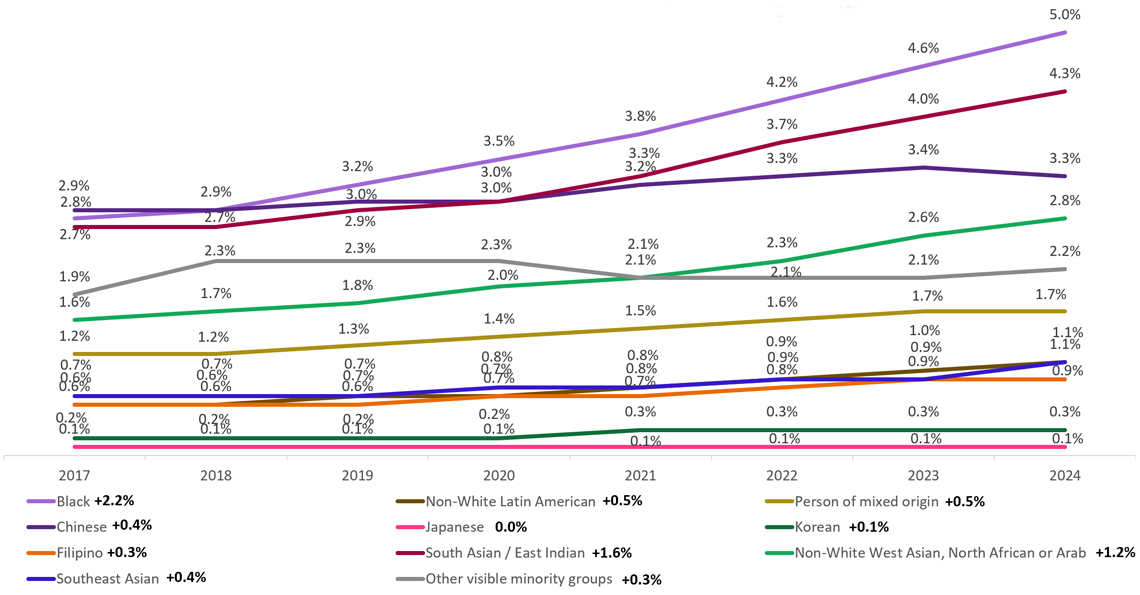
TBS publishes some rich infographics and infographics: Employment Equity Demographic Snapshot 2023–2024

Figure 33: Representation trends for members of visible minorities by subgroup – percentage

Text version below:


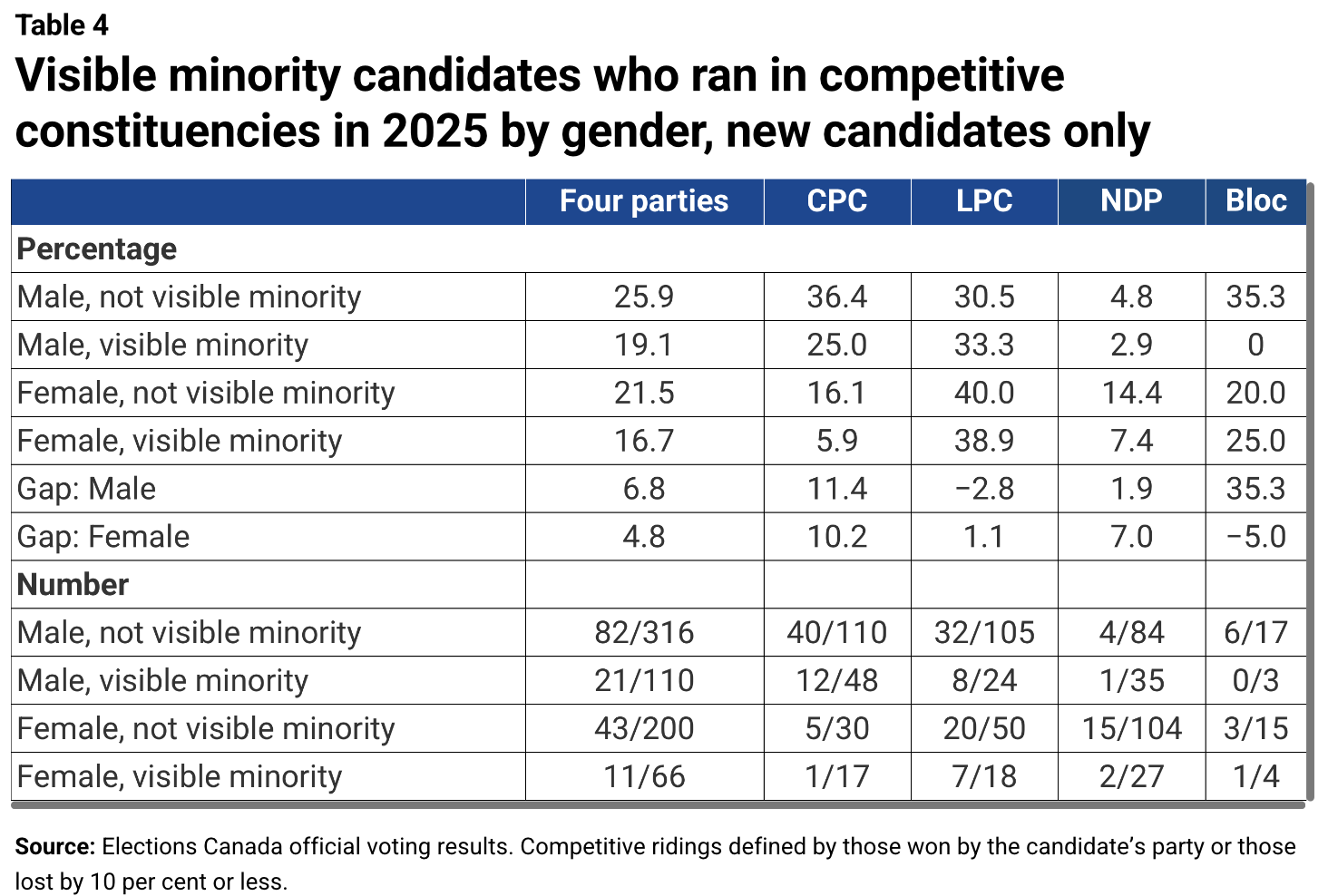
More visible minority candidates ran — and won — in Canada’s federal election. The Conservatives boosted the numbers

Coverage of our study:

More visible minorities ran and were elected in the spring federal election compared to the previous election, an increase that a new report found was driven by representation in parties on the right.

There were 315 visible minorities representing the six major parties, according to the report published by the Institute for Research on Public Policy. The candidates accounted for 20.1 per cent of the 1,568 candidates in the April 28 election. This was an increase from 18.2 per cent in 2021, 16.8 per cent in 2019 and 13.4 per cent in 2015.

While the Liberals, New Democrats and Greens all reported a drop in their visible minority representation from the 2021 race — by 0.9, 3.2 and 1.3 percentage points respectively — Pierre Poilievre’s Conservatives and Maxime Bernier’s People’s Party of Canada saw their numbers up by 5.9 percentage points and seven points, with the Bloc Québécois up 1.3 points. (The People’s Party failed to win a seat.)

The report refers to “visible minorities” as persons, other than Indigenous people, who are non-Caucasian in race or non-white in colour, as defined by Statistics Canada. 

“The Liberals almost seemed to have dropped the ball in terms of candidate recruitment compared to the Conservatives, who obviously were making a fairly concerted effort to recruit a larger number of visible minority candidates,” said Andrew Griffith, who co-authored the report with retired McGill University political science professor Jerome Black.

“They were still building off the Jason Kenney legacy that visible minorities are our natural conservatives,” added Griffith, referring to the former Conservative immigration minister tasked with building bridges with minority communities under the Harper government.

And the deliberate recruitment efforts seemed to yield results, with the proportion of elected visible minority MPs up by 2.4 percentage points, accounting for 17.8 per cent or 61 of the 343 MPs in the new Parliament.

While the number of Liberal MPs who are visible minorities fell by 2.2 percentage points, the Conservatives boosted their visible minority MPs in the House of Commons by 7.5 percentage points. 

The MP breakdown, by ethnicity, was South Asian, 29 seats, Black, 11 seats; Chinese and Arab/West Asian, both seven; Latin American, two; Filipino and Southeast Asian, each with one; and three listed under “other/multiple” backgrounds.

University of Toronto professor Emine Fidan Elcioglu said she was not surprised by the shift as the Conservatives rebranded the party under prime minister Stephen Harper to cultivate support from ethnic communities.

“They wanted to seem like the new party of diversity, so they were very intentional in their ethnic outreach,” said the sociologist, who studies migration politics.

“They were (previously) pushing forward policies that alienated immigrant visible minority communities. They were also reframing themselves as pro-good immigrant, anti-bad immigrant.”

Over the years, she said, visible minority groups have also started to embrace that thinking as shown in recent public debates about the impacts of immigration on the housing and affordability crisis.

Poilievre is “very much looking at these groups as a potential part of his base,” Elcioglu noted. “But I think we need to be really careful to not assume that just because there is more visible minority candidates in the party, that is necessarily going to be fundamental in voter motivation.”

Having more racialized candidates doesn’t necessarily translate to more inclusion, she said, and it could just be a cover for more stringent immigration policies, more austerity measures and more gutting of the social security safety net that affect the society’s most marginalized and vulnerable.

“So, great, you recruit people who are not white men, but what are you doing with that?” asked Elcioglu. 

The report also found the number of women running in the April election down from the 2021 election by 2.4 per cent to 553, and Indigenous candidates by 0.9 per cent to 48. In total, 104 women and 12 Indigenous people were elected.

“It seems like there’s almost a glass ceiling of about 30 per cent for women,” said Griffith. “For Indigenous MPs, it’s a bit different just because of how the population is distributed across the country, but that also has stalled.” 

Candidate profiles and assessments in the analysis are based upon candidate photos, names and biographies, general web searches, and ethnic and other media that focused on particular groups.

Source: More visible minority candidates ran — and won — in Canada’s federal election. The Conservatives boosted the numbers

Is Canadian citizenship mostly a convenience? A new study counters the myth

Another informative and relevant analysis by StatsCan, providing evidence regarding “Canadians of convenience:”

Contrary to public impression, Canadian citizenship turns out to be more a sign of an immigrant’s commitment to the country than a convenience to leave for greener pastures.

In fact, according to a new Statistics Canada report, immigrants from developed countries and those who took longer to become citizens were the ones more likely to leave the country after getting their citizenship.

“Among naturalized immigrants, active presence typically exceeded 90 per cent in the 10th year after immigration,” said the report released on Friday. “It showed minimal variation across educational levels, official language profiles, age at immigration and immigration classes.”

The findings debunk the myth that immigrants are “Canadians of convenience,” who take advantage of citizenship for the privilege of a Canadian passport but have no intention to stay and keep ties with their adopted homeland.

“It demolishes largely the argument that people just get citizenship so they have mobility and they can leave the country to pursue opportunities,” said Andrew Griffith, an expert on Canadian citizenship.

“There aren’t as many citizens of convenience as people might think. That actually is a measure of a longer-term commitment to Canada.” 

Based on immigration and income tax filing data, the Statistics Canada study examined the relationship between citizenship acquisition and the “active presence” of immigrants in Canada. 

While the absence of an individual’s tax record can mean the person either left Canada or remained in the country without filing taxes, it is unlikely an immigrant living in Canada would stop filing taxes after acquiring citizenship because it gives them access to benefits and services here.

Among immigrants admitted from 2008 to 2012, and 25 to 54 years old at admission, 93 per cent of those who became citizens had an active presence in Canada 10 years later, compared to 67 per cent of their counterparts who did not acquire citizenship.

These rates were higher than that of the immigrant cohorts admitted between 2003 and 2007 — 91 per cent for citizens and 58 per cent for non-citizens. This suggests that recent immigrants are more likely to stay in the country.

Immigrants from developed countries had lower active presence in Canada after 10 years than their counterparts from the developing world. Among naturalized citizens, for instance, 97 per cent of those from the Philippines remained active in Canada a decade after immigration — about 10 percentage points higher than their American and French counterparts, and six percentage points above those from the U.K..

However, among immigrants who didn’t acquire Canadian citizenship, whether they stayed or left relates more to other factors. Those with a graduate degree, who spoke English or French or came as economic immigrants have a remarkably lower presence in Canada after 10 years.

Daniel Bernhard, CEO of the Institute for Canadian Citizenship, said the uptake of Canadian citizenship has been on decline, and the real challenge is for Canada to convince immigrants who have “global options” to stay and devote their talents to the country for the long term.

“Highly educated people are mobile and we select more highly educated people, and that’s going to be part of it,” he said. “Circumstances here are also changing. It’s becoming harder to succeed, to buy properties and get ahead. Most people come here to build a better life. If we can’t provide it, they will take their families and their talents elsewhere.”

The report also tracked immigrants with no tax records and found that about 28 per cent of them had Canadian citizenship. About half of inactive immigrants from Iran were citizens, followed by 39 per cent among inactive Pakistani immigrants and 36 per cent from Colombia. In contrast, only 14 per cent of inactive American immigrants were citizens.

To be granted Canadian citizenship, a permanent resident currently must have lived in the country for at least three years out of the last five, demonstrate language proficiency in English or French, pass a citizenship test and take an oath.

The new report suggests those rules are working, said Griffith.

“You can still argue is it meaningful enough and if we have to change the oath and all those things,” he said. “But I think in a grosso modo sense, people are coming and they’re basically staying despite the retention issues. It’s not a big difference between citizens and non-citizens. I think we’ve roughly got the balance right.”

Source: Is Canadian citizenship mostly a convenience? A new study counters the myth