Minister says 300,000 new immigrants a year is Canada’s ‘new normal’ – Home | The House | CBC Radio

Setting the stage for the 2018 levels announcement. Not much suspense in that the number will be higher; some suspense as to whether the government will announce a multi-year plan as long talked about. Some political risks in doing so as steady increase may provoke some reaction, and possible political benefits to the government’s brand.:

Canada’s immigration minister says Canada will welcome at least as many immigrants next year as it is in 2017.

The government’s plan for annual immigration levels, which was set at 300,000 for this year, is expected to be tabled in the House of Commons next week.

Immigration minister Ahmed Hussen told The House that the government will not go below that level next year.

“Three hundred thousand is now our new normal,” he said, while not closing the door to a higher number for 2018.

“As a government we went from 260,000 to 300,000 because of the need to meet the demands of Canadian families who wanted to reunite with their loved ones,” Hussen continued. “But also employers who are asking us to allow them to continue to use immigration more and more as a way to meet their growth needs.”

Hussen added that he’s been in the process of consultations since April to put together the immigration outlook that’s coming soon, and that those consultations focused on the numbers Canada should bring in and what the right mix immigration, in terms of the different classes, should be.

He said the “vast majority” of immigrants coming in will be from the economic class because that’s where the greatest need is.

This will be followed closely by family class immigrants and then refugees, Hussen said.

Statistics Canada census numbers released Wednesday revealed the number of immigrants in Canada has reached its highest rate in a century.

Source: Minister says 300,000 new immigrants a year is Canada’s ‘new normal’ – Home | The House | CBC Radio

Can Canadians learn from world’s largest Muslim country? Douglas Todd

Todd reflects on his recent visit to Indonesia and possible implications for Canada (one could argue that there may be similar risks with regard to more fundamentalist Christians, whether immigrants or not):

When Canadians think about the Islamic world, they tend to focus on quasi-dictatorships in the Middle East, like Saudi Arabia, Egypt and Iran.

But the world’s most populous Muslim nation is actually Indonesia.

This equatorial Southeast Asian country is home to 260 million people, 87 per cent of whom are Sunni Muslims.

It’s been a democracy for two decades, a rarity among Muslim-majority countries.

Canada is a much different country, obviously. Our nation is predominantly Christian, increasingly non-religious, and has been a democracy for at least 150 years.

Indonesia, nevertheless, has surprising similarities to Canada, particularly in the way its moderate Muslim community leaders express commitment to values such as pluralism.

Surprisingly, the Muslim-majority country’s centuries-old motto is: “Unity in diversity,” which sounds a lot like Prime Minister Justin Trudeau’s go-to slogan: “Diversity is our strength.”

I recently attended a conference of the International Association of Religion Journalists (IARJ) in Jakarta, the world’s second-largest metropolitan region.

I was struck by how many times journalists, professors, top Muslim leaders and politicians used words like tolerance, diversity, multiculturalism and interfaith dialogue.

They do so for a reason: Indonesia is at a crossroads.

Its young democracy is increasingly fragile, threatened by rising intolerance and Muslim extremists, particularly those from the authoritarian Middle East.

I lost count of how many times speakers at the conference referred, in an almost casual way, to Indonesian “riots,” largely organized by Muslim radicals, some of which led to killings.

Indonesian journalists who write about religion repeatedly talked about being harassed, threatened, ostracized and having to deal with Muslim-led boycotts.

Journalists from other Muslim-majority countries, like Pakistan and Malaysia, also described backlashes when they tried to write stories about their countries’ laws, which forbid criticizing Islam and treat sodomy as a crime.

The most recent case of mushrooming extremism in Indonesia centres on the once-popular former governor of Jakarta, Basuki Tjahaja Purnama, a Chinese Christian.

Purnama is now in jail after his political opponents’ trumped-up a charge that he blasphemed Islam, merely by saying the Qur’an allows people to vote for non-Muslims.

With moderate politicians living in trepidation of such illiberal Islamists, the latter are taking advantage of democratic freedoms to magnify their power.

Islamists have successfully brought in sharia law in regions of Indonesia, influenced in part by ultra-conservative Muslims from the Middle East.

Scores of drug dealers are being shot on sight. Hardliners in some regions have totally prohibited alcohol, restricted women’s dress, and are punishing homosexuals, adulterers and those who date outside marriage, with whippings.

As these grim examples illustrate, compared to Canada, the stakes are much higher for moderates in countries like Indonesia when they profess a commitment to such things as diversity and pluralism.

Canadians could learn from the courageous Indonesians willing to defend such values, including democracy and cultural sovereignty, from outside religious forces.

Most Canadians take democratic freedoms for granted — in contrast to moderates in Indonesia, like Foreign Minister Retno LP Marsudi.

She told the IARJ conference: “For a diverse country like Indonesia, harmony is a must, otherwise it cannot survive.”

The increasing power of extremists, external and internal, has also led the leader of the moderate Muslim socio-religious group, Muhammadiyah, which has 30 million members, to call on Indonesians to wake up.

“Moderate Muslims are too quiet. We have to become radical moderates,” Abdul Mu’ti, Muhammadiyah’s secretary-general, told conference delegates. “Moderate Muslims have been sleeping. We have kept silent. We have become lazy tolerant.”

Likewise, a founder of The Wahid Institute for democracy, Yenny Wahid (daughter of Indonesia’s former president), urged Muslims to stop ignoring religious extremists, since acquiescence has given them a bigger platform.

“You have to fight back. You have to defend your own boundaries,” Wahid said.

The immense political power held by religious organizations in Indonesia is largely unfamiliar to Canadians.

English-speaking Canada’s once-predominant mainline Protestants have given up a lot of their influence, particularly in the past 50 years.

Noted religion historian Mark Noll says when Canada’s Protestants, and to some extent Catholics, welcomed multiculturalism and pluralism in the 1970s, they eroded their own influence. These denominations are now minor players on the national scene.

And even though Canadian evangelicals tried, mostly through stealth, to shape federal policy during the heyday of Conservative Prime Minister Stephen Harper, they largely didn’t succeed.

Minority religions in Canada — Muslims, Sikhs, Buddhists and Hindus — are now growing faster than Christian denominations.

But they are still relatively small. Muslims make up eight per cent, for instance, of Toronto residents, while Sikhs comprise a roughly equal portion of Metro Vancouver’s population.

As SFU political scientist Sanjay Jeram makes clear, Canadian politicians constantly woo such urban religious groups. But, because they are not majorities, they don’t have the same broad power to sway politics as Muslim groups do in Indonesia.

There is a frank discussion to be had some day over whether hard-line religious organizations, strengthened by their separate schools, may ever really pose a risk to Canada’s democratic values.

There is little doubt many immigrants arrive with more patriarchal practices than domestic Canadians. Polls show religious immigrants generally have a higher aversion to intermarriage and are more critical of abortion and homosexuality.

But the more immediate threat to Canadian democracy, and Canadian values such as equality and fairness, currently has less to do with religion and much more to do with economics.

Witness the housing affordability crises in Metro Vancouver and Toronto. As a result of the globalization of capital and labour, and the anything-goes attitudes of Canadian politicians, locals in these major cities have been priced out of their own housing markets.

Are Canadians prepared to defend their democratic values, including the principle of economic justice? Are Canadians willing to take a stand to protect citizens from trans-national capital and property speculators, domestic and foreign?

Or, as Abdul Mu’ti warns Indonesians, are Canadians instead going to be passive in the face of such threats, the ultimate practitioners of “lazy tolerance”?

Source: Can Canadians learn from world’s largest Muslim country? | Vancouver Sun

Bill 62: The European experience shows us it’s a bad idea: Fahmy

Mihad Fahmy of NCCM on Quebec’s niqab ban.

The issue is more with respect to women wearing niqabs being able to receive or use public services rather than blocking opportunities for them to work in public services as no cases to date have arisen to my knowledge (any case unlikely to go unnoticed). This latter issue has been largely absent from public commentary (not convinced that this would pass a reasonable accommodation test given the needs of an integrated workforce):

To understand the effects of Quebec’s Bill 62, it is important to understand what is going on in Europe. Driving the wedge deeper into an already divided society, Quebec politicians are copying policies that produce predictable results: rising xenophobia, violence against minorities and discrimination.

Historically, Canada has had a more accommodating approach to individual liberty than European countries, where the case law and legal discourse is built on the premise that public spaces and, by extension, public institutions and actors must be made to be religiously “neutral” in both form and substance.

In March, 2017, the European Court of Justice extended this principle when it ruled that private employers, like their public counterparts, can ban Muslim women from wearing the hijab in the workplace, so long as the rule applied to all employees.

The case reached the European court as a result of appeals by an office receptionist in Belgium and a professional design engineer in France, both of whom were fired for refusing to remove their headscarves at work.

In its ruling, the ECJ held that rules banning “the visible wearing of any political, philosophical or religious sign” were not discriminatory so long as they applied to religious garb from all faiths. Activists, lawyers and academics alike agree that this decision is significant, as it marks the first time the neutrality argument has been successfully used to justify restrictions on religious accommodation in the private sector.

European human rights advocates now fear that private-sector employees, predominately Muslim women, but also Sikh and Jewish men who wear religious garb, will be impacted by employers’ newfound entitlement to cloak discriminatory policies in the veil of religious neutrality.

Against this backdrop, the potential ramifications of Quebec’s Bill 62 are magnified. Despite its limited provincial reach, the law’s sweeping internal scope is alarming.

Women who wear the niqab (face veil) will be shut out of public-sector jobs and won’t be able to access municipal and provincial services. This includes going to university or college, registering kids for daycare or school, getting on a bus, applying for social assistance, taking out library books, registering kids for city recreational activities, and the list goes on. And despite their qualifications, niqabi women will also be ineligible for jobs within any of these workplaces, thereby further marginalizing an already vulnerable group of women.

As was evident this week, neutralizing the public sphere is not a straightforward endeavour. In attempting to clarify how this will all work, Quebec Justice Minister Stéphanie Vallée explained that faces need to be uncovered only at the point of contact with the public servant. For example, a woman is required to show her face when signing out library books at the circulation desk but not while browsing new releases; the niqab will have to come off when boarding a bus that requires photo ID, but not once the woman sits down. Such formulaic pronouncements cannot restore the dignity of women seeking to go about living their day-to-day lives and will do little to quell principled public discontent.

Similar guidelines have not been provided with respect to other provisions of the bill that are garnering less attention but are of no less concern – those which seek to regulate not dress, but behaviour. The bill reads: “In the exercise of their functions, personnel members of public bodies must demonstrate religious neutrality.” There is no telling how this vague obligation will be interpreted and enforced.

Quebec employers would do well to heed the advice of the European Network Against Racism (ENAR), when it argues that cultivating workplace neutrality entails turning one’s attention to the actual service being provided rather than the person delivering it. Otherwise, employers risk perpetuating discrimination.

The European experience tells us that nothing good can emerge from Bill 62. The Quebec government’s ill-conceived legislation only strengthens those elements in society pushing a dangerous us-versus-them agenda at the expense of constitutional rights and social cohesion. In a pluralistic society, this does not bode well for the future.

 Source: Bill 62: The European experience shows us it’s a bad idea – The Globe and Mail

Income gap persists for recent immigrants, visible minorities and Indigenous Canadians

The Stars’s highlighting of the recent Census release:

As the face of Canada grows more diverse, the income gap between residents who identify as visible minorities, Indigenous or recent immigrants and the rest of Canadians remains a yawning chasm, data from the 2016 Census shows.

The income gap for these groups barely budged between 2006 and 2016, narrowing by just two percentage points for Indigenous Canadians and recent immigrants and widening by one percentage point for visible minorities, according to census data released Wednesday.

Total income was 26 per cent lower for visible minorities than non-visible minorities and 25 per cent lower for Indigenous Canadians than non-Indigenous Canadians.

But recent immigrants — many of whom are also visible minorities — face the toughest economic challenge with total incomes that fall 37 per cent below total incomes for Canadians born here, the data shows.

It means for every dollar in the pocket of someone born in Canada, a recent immigrant has just 63 cents.

More than 22 per cent of Canadians — including 51.5 per cent of Torontonians — reported being from a visible minority community in 2016, up from 16.3 per cent nationally in 2006.

In Toronto, more than 55 per cent of visible minority residents were living on less than $30,000 in 2016 compared to fewer than 40 per cent of the rest of the city’s population, according to census data provided to the Star.

While almost 14 per cent of non-visible minorities in Toronto reported total incomes of $100,000 or more, just 4 per cent of people from visible minority communities had access to that amount of cash in 2016.

“The latest census data simply confirms the reality that racialized people, recent immigrants, and Indigenous people continue to face discrimination and that income inequality doesn’t just magically reverse itself,” said Sheila Block senior economist for the left-leaning Canadian Centre for Policy Alternatives.

“That takes political leadership,” added Block who crunched the national income gap from the latest census data on immigration, ethnocultural diversity and aboriginal peoples.

“As these populations increase and continue to lag behind, it becomes a bigger issue for everybody,” she said.

“We know this kind of inequality doesn’t only have a negative impact on the population that’s affected, but it has a negative impact on us overall as a society.”

Increases to income support programs such as social assistance, employment insurance and pensions are part of the solution, she said. But labour reform, including more access to unionization and a higher minimum wage are also key.

Nadira Begum, who has a master’s degree in social work from her native Bangladesh, juggles three part-time jobs and numerous volunteer positions in the non-profit sector but still hasn’t been able to land full-time work.

“I have been looking for a full-time job in my field for more than 10 years,” said the Regent Park mother of three. “I have the skills, the experience and the knowledge, but if they don’t hire me, how can I show them? It is a common story in our community.”

Begum’s part-time jobs have often involved substantially similar work as full-time employees, and yet she has been paid a lower wage. Friends with part-time jobs as grocery store clerks who were hired the same time as full-time clerks are paid less and enjoy fewer benefits, Begum added.

“We are not equally paid, even though we do the same work,” she said. “And we can’t complain because we can’t afford to lose our jobs.”

Deena Ladd of the Workers’ Action Centre says Ontario’s planned $15 minimum wage by 2019 will be a huge boost for visible minorities, recent immigrants and Indigenous workers, who are more likely than the rest of Canadians to be toiling for minimum wage.

But changes to the province’s proposed Fair Workplaces, Better Jobs Act are needed to ensure these workers, who like Begum are often stuck in temporary, part-time and contract positions, are paid the same as permanent and full-time staff, Ladd said.

Wording in the proposed minimum-wage legislation currently mandates equal pay for equal work if the job is “substantially the same,” Ladd said. But that allows employers to change one aspect of the job and still be allowed to pay temp, contract and part-time workers less.

Instead, the proposed legislation should be reworded to say these workers are entitled to equal pay if the job is “substantially similar” to work performed by a full-time employee, she said.

Another problem with the proposed law is the definition of seniority. Unlike all other provisions of the Employment Standards Act which measure seniority by the date an employee was hired, the equal pay amendments include a definition of seniority as “hours worked.” If this is not changed, workers from economically disadvantaged groups who are more likely to work part-time, will never achieve equal pay for equal work, Ladd said.

“The new legislation has the potential to address the kinds of inequities highlighted by the census,” she said. “But if we don’t strengthen the language so workers can use the equal-pay protections in their workplaces in a strong way, then it will be just words on paper.”

The legislation, which just passed second reading, is expected to become law later this year.

Ryerson University professor Myer Siemiatycki, who teaches immigration and settlement studies, says the census findings are a wake-up call and a reminder of why the census is important.

“These are worrying statistics,” he said. “They reflect the adverse living conditions of huge numbers of Canadians who fall into these three categories of population . . . It’s an alarm bell and we need to respond.”

Source: Income gap persists for recent immigrants, visible minorities and Indigenous Canadians | Toronto Star

Quebec’s secularism reigns supreme: Michael Adams

Michael Adams on the likely outcome of Quebec’s niqab ban. Not as sanguine as him given how these identity issues continue to poison Quebec politics:

Like Bill 101, Quebec’s (in)famous language law, Bill 62 is likely to be remembered for a long time, both within Quebec and elsewhere in the country. The reason is that the bill highlights differences between Quebec, where secularism reigns supreme, and the multicultural ideology embraced by the majority of those living in the rest of Canada.

Premier Philippe Couillard’s Liberal government is heading into a pre-election period and passed the law, which severely restricts the wearing of niqabs and burqas, to show Quebeckers that it cares about their core values.

A couple of generations ago, Roman Catholic Quebeckers en masse decided to no longer attend weekly service. After centuries under the religious domination of the church, the population flipped to secularism, as if overnight. The pews emptied, and good tee times became impossible to secure on the province’s golf courses on Sunday mornings.

One of the major implications of this radical rejection of traditional religious authority was the consequent embrace of gender equality. No longer would the daughter who could not find a husband be sent off to the convent to spend the rest of her life in service of a patriarchal church, wearing a black-and-white habit that covered her entire body, save her face.

When Quebeckers, especially former Catholics, see a Muslim woman wearing a niqab or a burka that covers the face, either entirely or except for her eyes, they see both their great aunt and a victim of religious patriarchy. And they don’t like it.

In this, they join their compatriots in France (and other Europeans) who have passed laws to ban a woman from wearing such clothing in public spaces, including on beaches where other women choose to go topless.

Canadians living outside Quebec may not like the idea of Muslim women wearing niqabs and burkas in public, but polls have found that a slim majority believe a ban is a bad idea, and no other province seems concerned enough to introduce legislation akin to Bill 62. One Ontario hospital, hoping to draw female talent, released an ad quipping that it cared more about what is in a woman’s head than what’s on it.

In the last federal election, when then prime minister Stephen Harper wished to deny a Muslim woman wearing a niqab the right to be sworn in as a Canadian citizen, public opinion, especially in Quebec, was initially with him. But then the Supreme Court weighed in, ruling that if she exposed her face to an agent of the Crown, she could be sworn in wearing her niqab.

This gesture, together with the “barbaric cultural practices” tip-line proposed by former Harper ministers Kellie Leitch and Chris Alexander, also initially attracted public support. But then many people began to realize that their initial reactions clashed with their deeper-held values of empathy and tolerance. If these few women – and they only number in the few hundred across the country – really want to wear this clothing and they do no one any harm, then why the fuss?

The backlash to the backlash redounded more to the benefit of the crafty Liberals than the moralistic NDP leader Thomas Mulcair. Justin Trudeau sensed in the general public – and especially among the four in 10 of us who are first- and second-generation immigrants – that tolerance of difference was more Canadian than imposing strictures on religious garb. If the courts say it’s okay for a woman to wear a niqab, then so be it. A few years ago, the courts said it was okay for same-sex people to marry, and the rest of us quickly followed suit.

Canadians are generally open to immigration from around the world, believe newcomers are good for the economy, don’t take away jobs from other Canadians and don’t commit more crimes than others. Still, the majority of Canadians also believe that newcomers are not adopting Canadian values quickly enough, and those highly cherished values include gender equality and, in Quebec, secularism.

Where do we go from here? The Liberals passed Bill 62 to show they understand the values of the Québécois. But I imagine latitude will be left in the enforcement of the law, allowing for the kind of reasonable accommodation proposed by philosopher Charles Taylor and sociologist Gérard Bouchard in their report on these issues a few years ago.

Why? Because most people will respect the rule of law as expressed in the Quebec and Canadian charters of rights and freedoms; and because many will also be reminded of the treatment of women such as Rosa Parks in the Jim Crow U.S. South, and may reflect that it isn’t women dressed in niqabs, hijabs or otherwise clad who have done real harm to others, but rather young men of many faiths and no faith with a lot of hate in their hearts and a gun at their disposal. In Canada’s pluralistic liberal democracy, that’s the way values and democratic discourse have tended to mediate strident opinions.

Source: Quebec’s secularism reigns supreme – The Globe and Mail

Canadian media have a blind spot when it comes to so-called ethnic issues: George Abraham

Abraham of New Canadian Media on the challenges of mainstream media in covering ethnic leaders, with particular focus on NDP leader Singh:

Much of the mainstream media is simply out of its depth when it comes to how to cover “ethnic” leaders, often ignoring or being too timid to address the ways their backgrounds inform and influence their political positions. It’s an obvious blind spot.

An exception was the face-off between new NDP leader Jagmeet Singh and senior correspondent Terry Milewski on Power and Politics earlier this month, when Milewski asked Singh about his views on Canada’s worst aviation-related terror attack: the downing of an Air India flight 182, in 1985.

Critics decried Milewski’s line of questioning as unfair — even racist — asking if non-Punjabi leaders would’ve been subjected to the same treatment. But the questions were absolutely necessary — an attempt to bridge the gap between ethnic and mainstream media — and a way to bring an issue of great importance in the Sikh community to the attention of a wider audience.

Grappling with Punjabi politics

This is the first time in our history that a person of colour is on the shortlist to become Canada’s prime minister. Unusually for a federal leader this past half-century, Singh also carries the weight of his immigrant heritage, more specifically his parents’ roots in Punjab – the state in north India from where the bulk of our sub-continental immigrants hail.

The turbaned Sikh joins the ranks of other Punjabis in Canada who have been phenomenally successful in politics at all levels of government, including Herb Dhaliwal, Ujjal Dosanjh and Ruby Dhalla, and more recently, Harjit Sajjan, Navdeep Bains and Amarjeet Sohi.

None of them has had to grapple with Punjabi politics the way the new NDP leader has had to, although Defence Minister Harjit Sajjan was labelled a “Khalistani sympathizer” on a recent visit to this Indian state. (In the run-up to Sajjan’s visit, the Punjab chief minister characterized five members of the Trudeau cabinet as “Khalistan sympathizers.”) This Khalistan movement, a bloody insurrection in Punjab that dates back to the 1970s, was responsible for the 1985 Air India bombing.

This tragedy in the skies mid-way between the two nations linked Canada and India like never before, perhaps forever. It is unique in Canadian history because it brings together international terrorism (in both countries), global diaspora politics and bilateral relations between a G7 nation and an emerging superpower that is India.

Jagmeet Singh’s views on issues relating to his heritage and the Air India bombing perhaps would not have been relevant if he had stayed clear of Punjabi and Indian politics. But he has taken positions – positions that he will have to defend in the public square.

For example, when he was a member of the Ontario legislature, he sponsored a motion to “formally recognize the November 1984 state organized violence perpetrated against Sikhs throughout India as genocide.” Indian newspapers have drawn a straight line between the NDP leader’s support for self-determination in Catalonia and Quebec and the quest for a separate Sikh homeland in India.

Rallying cry for Canadian Sikhs

While the separatist movement may be all but forgotten in the land of its birth, it remains a rallying cry for sections of the Punjabi Sikh community in Canada. Just as there are Canadians who demand a separate Sikh homeland carved out of India, there are others who have either abandoned the cause or just don’t care either way. Where exactly Singh fits within this spectrum is an unknown, and it is because of this ambiguity that further questions are warranted.

This sort of journalism is well suited to a new, multicultural age: one where reporters can act as translator between Canada’s various cultural communities. Indeed, a Canadian reporter’s role when interviewing a leader who wears his heritage on his sleeve is obvious: to ask him about it.

I would expect the same kind of hardball questions to be asked of a leader of Irish heritage if she had taken sides in the Troubles, or someone of Arab origins if he had articulated public positions on the Palestinian question. In these instances, the journalist takes on the role of a cultural interpreter (albeit, an imperfect one).

Unlike most other reporters on Parliament Hill, Milewski has spent years covering the Indian diaspora community in Canada, especially in the context of the Air India bombing. Milewski – like the Vancouver Sun‘s Kim Bolan – has stayed with the story for decades, and helped sear the tragedy into Canadian consciousness.

Readers will recall that the bombing was initially dismissed as an entirely Indian problem – remember the call Prime Minister Brian Mulroney made to his Indian counterpart mourning the deaths? We have belatedly come to accept most of the 329 victims as our very own. Rightfully so, as most of them were Canadian.

Here’s a safe bet: I expect other mainstream-ethnic issues to surface over time, especially as they relate to political religion, meaning when religion is used in the pursuit of political goals.

The Air India tragedy continues to be a test case for Canada, and Singh shouldn’t expect to get a free pass on questions about it either as NDP leader, or as the prime minister of Canada.

Source: Canadian media have a blind spot when it comes to so-called ethnic issues – CBC News | Opinion

Canada stays civil amidst the polarization of American media: John Ibbitson

Good piece by Ibbitson:

CNN has a new commercial that features a picture of an apple. “Some people might try to tell you it’s a banana,” says the narrator. They might even scream that it’s a banana. “They might put BANANA in all caps. … But it’s not. This is an apple.”

The ad was, of course, immediately attacked by right-wing columnists. “Trump Derangement Syndrome has struck CNN and is taking a terrible toll,” wrote Thomas Lifson at American Thinker.

The American media have become so deeply polarized that each side has now lost any ability to listen to the other. Each accuses the other of committing fake news – stories based on false facts that are intended to deceive. But the deeper problem resides in columns and editorials and blogs and tweets that take implacable stands, distorting facts and belittling opponents, ignoring or disrespecting other points of view.

On Thursday, on the RealClearPolitics aggregator website, you could find headlines such as “The Bone Spur Bozo in the White House,” and “Does the Dems Dossier Trick Count as Treason?”

So why aren’t Canadians screaming at each other the way the Americans are?

One answer is that “we don’t have Donald Trump as prime minister,” observes Janni Aragon, who teaches political science at the University of Victoria. The President personifies the anger embedded within American discourse. But Prof. Aragon adds that the differences in media reflect differences in the political cultures of the two countries.

America, she says, is a land divided. In Canada, “divisiveness is not as strong.”

There isn’t a single political leader in Canada whose platform mirrors the nativist, anti-immigrant, authoritarian strains that we see in President Trump and his supporters. Nor, with a few minor, on-the-fringe exceptions (We’re talking about you, The Rebel), do Canadian media cater to racist phobias.

Why not? There could be several reasons.

Since the first Loyalist settlers arrived in the late 1700s, Canadian political culture has been tinged with what has been called a “tory touch,” an upper-class British tradition that stresses collective obligations over individual liberties. This sense of noblesse oblige underlies many of the value assumptions of the mainstream media.

Our small and scattered population also contributes, says Kirk Lapointe, who held a variety of positions in Canadian media (he was once my boss), and who teaches journalism at the University of British Columbia. There are so many Americans, he points out, that fringe publications can profitably publish, giving extremists a voice. But Canadian publications must cater to more moderate views in order to win a large enough audience to make a profit.

Mr. Lapointe hosts a Vancouver radio talk show. In his experience, extremists don’t attract listeners. “I see a fair amount of revulsion when someone like that tries to grab the microphone,” he said in an interview.

Canada’s large immigrant population is also a steadying influence. With four in 10 Canadians either an immigrant or the son or daughter of an immigrant, nativist voices have little hope of dominating the print, broadcast or digital conversation.

Pollster Michael Adams has published a book, Could It Happen Here? that compares Canadian and American political and social values in the age of Trudeau and Trump. To cite just one powerful statistic: According to one poll, 50 per cent of Americans believe that “the father of the family must be the master in his own house.” In Canada, the figure is 23 per cent.

To explain these differences, Mr. Adams refers to a chronic streak of paranoia that has long run through American politics, and Horatio Alger-like belief that anyone can make it to the top – so if you don’t, the system must be conspiring against you. He also cited the baleful influence of evangelical religion, gerrymandered Congressional districts and increasing income insecurity.

“In this paranoid atmosphere, people feel entitled not only to their own opinions but also to their own facts,” he believes. “And now, in the age of the internet, each is his own publisher and editor locked inside an ideological bubble with fellow travellers.”

This paranoid polarization infects the right more than the left in American politics. There is no progressive equivalent to Rush Limbaugh or Breitbart News. But the left is not immune to intolerance.

At the University of California Los Angeles (UCLA) last week, a small group of protesters self-identifying as antifascists interrupted a forum on, of all things, how best to challenge hate speech. “No Trump, no KKK, no Fascist U.S.A.” they yelled, shutting down a question-and-answer session that resumed later in another room.

The discourse in Canadian politics and journalism is far from perfect. Indigenous Canadians, especially, do not see their values and priorities reflected in either Canada’s political culture or its media. Newsrooms are far less diverse than the communities they cover.

And Prof. Aragon warns of the tendency of American cultural influences to “trickle up” across the border. Polarized American media risk polarizing Canadian media through the sheer power of proximity.

Nonetheless, as President Trump sends out one angry tweet after another, Canadians retain deeper wells of moderation and goodwill than their American cousins.

In this country, just about everyone seems to agree that an apple is not a banana.

Source: Canada stays civil amidst the polarization of American media – The Globe and Mail

Canada ‘on track’ to resettle 1,200 victims of ISIS genocide, sexual slavery – Politics – CBC News

Canada is on track to resettle 1,200 survivors of ISIS atrocities by year’s end, and the vast majority of those who have arrived so far are Yazidis:

Critics have accused the Liberal government of hiding details about the special program.

Immigration Minister Ahmed Hussen recently announced that 800 survivors had been brought to Canada but did not specify at the time how many of them were Yazidi.

According to new information provided to CBC News by Immigration, Refugees and Citizenship Canada, 81 per cent are Yazidi. About 38 per cent have come from Iraq, another 36 per cent from Lebanon and 26 per cent from Turkey.

All remaining arrivals are expected to be from Iraq, and the government is “on track” to meet its commitment, said IRCC spokeswoman Nancy Caron.

“We are continuing to conduct interviews, process applications, arrange for approved applicants to travel to Canada and provide settlement supports upon arrival,” she said. “We are continuing to monitor recent political developments in the region and any possible implications this may have on our operation.”

Calls to up intake in 2018

As the special operation continues, there are already calls for the government to boost the number next year.

“I believe that we can do more, to increase the numbers from 1,200, which is such a small little number to the size and the measure of the genocide we saw happening to their community,” said Majed El Shafie, founder of human rights advocacy group One Free World International. “Increasing the number to 3,000 or 4,000 I think is doable; the Canadian government can do that.”

One of the people his organization is helping to resettle is Melkeya, whose last name will not be published to protect Yazidi relatives still in Iraq.

She said she is grateful for the support she has received in Canada but is finding it difficult to live on the monthly allowance of $800.

‘We feel safe here’

“We feel safe here, but we want them to help to bring more Yazidis to the country,” she said in Arabic through a translator. “We are very thankful to the Canadian government, but even the support that we are receiving from them, it’s just enough to pay the rent.”

Melkeya told CBC News reporter Makda Ghebreslassie about the horrific experience of being rounded up, held captive and sold by ISIS militants to a man older than her father who beat and raped her.

She said she would “prefer to die than live this kind of life.” Melkeya managed to escape with the aid of a smuggler her family had paid $12,000 US.

Her sister-in-law, Basema, said she faced a similar fate: sold seven times and raped repeatedly. Her eldest son was captured and held as a child soldier, forced to convert to Islam. And there were other atrocities.

“I witnessed a girl 10 years old, Yazidi girl, who was raped in front of me,” she said, sobbing. “I am 30, I can handle it, but she was 10. She couldn’t even sit down from the pain after they raped her.”

Winnipeg-based Yazidi advocate Hadji Hesso is also urging the government to play a global leadership role by at least doubling this year’s intake to 2,400 next year.

No infrastructure

“To survive in the Middle East is very hard since their entire region has been destroyed,” he said. “There is no infrastructure or foundation, never mind the people who have been raped and killed and enslaved.”

There is no plan to bring in more Yazidis beyond the current federal program.

“At this time, we are focused on fulfilling our commitment to resettle survivors of [ISIS] including Yazidis. We will not speculate on any future commitments at this time,” reads a statement from Hussen’s office.

 ‘It’s a social and cultural shock to be moved away from your own community.’– Jean-Nicolas Beuze, UN refugee agency

On Oct. 25, 2016, MPs unanimously supported an opposition motion sponsored by Conservative MP and immigration critic Michelle Rempel to bring an unspecified number of Yazidi women and girls to Canada within 120 days. In February, Hussen announced that the target would be 1,200 by the end of 2017.

The Yazidis are a religious minority based mainly in northern Iraq, with a culture dating back 6,000 years. ISIS has targeted them in brutal attacks since August 2014.

Massacre, sexual slavery

Last June, a United Nations report declared that the slaughter, sexual slavery, indoctrination and other crimes committed against the 400,000 Yazidi amounted to genocide. Its finding that the militants had been systematically rounding up Yazidis to “erase their identity” meets the definition under the 1948 UN Convention on Genocide.

Jean-Nicolas Beuze, a representative of the UN’s refugee agency in Canada, said every effort should be made to support the Yazidis in Iraq, and only the most vulnerable should be resettled.

“A lot of people choose not to resettle because it’s a social and cultural shock to be moved away from your own community when you have regained a little bit of normalcy, safety and access to services in northern Iraq,” he told CBC News. “We need to keep the resettlement for extremely vulnerable cases, maintain the choice of the person.”

Canada modelled its specialized Yazidi refugee program after the first such project, in the German state of Baden-Wurttemberg. Of the 1,000 survivors in the first phase of that project, an estimated 95 per cent are Yazidis and the other five per cent mostly Christian, spokesperson Christoph Neethen told CBC News.

He said some of the women and children are now living nearly independently and some are working in either paid or volunteer positions. Others rely heavily on supports, including the elderly, who are partially illiterate.

Source: Canada ‘on track’ to resettle 1,200 victims of ISIS genocide, sexual slavery – Politics – CBC News

New figures show just how big Canada’s immigrant wage gap is

One of the first deeper looks at Census data, looking at immigrant status, language and income by Arvind Magesan of U of Calgary. The November release of language at work, education etc will further enrich this analysis:

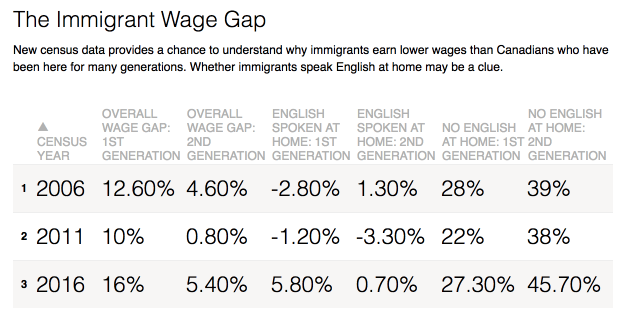
The first thing that surprised me is the gap has not changed much over the past 10 years. Census data from 2006 showed, at a national level, first-generation immigrants earned wages 12.6 per cent less than the average wage of native Canadians. In 2011, the gap dropped slightly to 10 per cent, but the new census data shows it’s climbed significantly to 16 per cent.

wagegap1

Importantly, the gap is a countrywide phenomenon. Looking at the three of the most popular destinations for immigrants in the past decade — Toronto, Vancouver and Calgary — the gap in 2016 sits at 25, 17 and 23 per cent respectively.

Interestingly, the gap doesn’t only exist for first-generation immigrants, but also for the children of immigrants (second generation, i.e. Canadians born to immigrant parents). The new data shows at the national level, second-generation immigrants earn 5.4 per cent less than natives.

Understanding the wage gap

The obvious question that follows then is: What is the source of these gaps?

Canada is an especially interesting case given the “points” system used to screen potential immigrants, where language, education and job skills are key determinants. And for the first time, the census has reported that about six out 10 new immigrants came here under the so-called economic admission category, meaning they have the skills “to enhance and promote economic development.”

Given the way immigrants are screened before entry, one would expect relatively quick integration into the Canadian economy and a convergence in wages. But this is clearly not the case.

The reasons put forward to explain the wage gap range from employer difficulty in assessing immigrant education credentials to outright discrimination. Economists refer to two types of “discrimination” in the labour market context, “statistical discrimination” and “taste-based discrimination.”

In the former, employers use observable traits (such as race) to make inferences about something like productivity. For example, an employer sees a job applicant with brown skin. The employer isn’t prejudiced towards brown people, but is worried (stereotypically) the employee is going to want to take trips “home” to Sri Lanka and would need a lot of vacation time. So the employer hires someone else equally qualified. Taste-based discrimination is more what we think of as prejudice — not wanting to hire someone purely because of skin colour.

Identifying causal factors that explain the wage gap is a difficult task – individuals who immigrate to Canada do so by choice. These choices are a function of a host of factors that could potentially jointly explain the decision to immigrate and labour market outcomes, including personal characteristics, job experience and education, to name just a few. Identifying discrimination in the labour market, and separating between taste-based and statistical discrimination, is even harder.

However, a 2011 study by University of Toronto economist Phil Oreopolous takes an important step in this direction.

In the study, thousands of computer-generated resumes were mailed out to companies that had posted ads searching for employees. The resumes were randomly assigned either a foreign or a “white” sounding last name, and were otherwise identical. The result: The resumes where the applicant had a foreign-sounding last name were less likely to receive a call back than identical looking resumes with a “white” last name.

When the author followed up with some of the recruiters, the overwhelming reason given for overlooking resumes with a foreign-sounding name was that they anticipated difficulty with language. Specifically, recruiters expected a lack of fluency in English, problems with communicating at work and difficulty for customers and co-workers in understanding a foreign accent. In other words, recruiters were statistically discriminating between job candidates based on their names.

Can language proficiency close the gap?

The census presents an opportunity to study the importance of English proficiency for the gap in labour market earnings between immigrants and native Canadians in 2016. The census provides information on wages, immigrant (and generation) status, as well as the language most commonly spoken at home.

Specifically, guided by the findings in Oreopolous’s study, I looked at how the gap in average wages changes when English is spoken at home. (For the purpose of this study, I looked at communities outside of Quebec, where French is the dominant language.) In 2016, 63 per cent of new immigrants living outside of Quebec most often spoke a language other than English or French while at home.

The latest census data says the native-first generation immigrant wage gap is 16 per cent at the national level. Once we examine whether immigrants speak English at home, things change — the wage difference is just 5.8 per cent. But for first-generation immigrants who don’t speak English at home, the gap jumps to 27.3 per cent.

For second-generation immigrants, there is barely any gap for those who speak English at home (0.7 per cent) but it’s still a significant gap for those who don’t speak English at home (a whopping 45.7 per cent).

This pattern also holds in the major metropolitan centres in the English-speaking parts of the country, which attract the most immigrants.

Interestingly, at almost 25 per cent, Toronto has one of the largest city level wage gaps in the country, explained at least in part by the fact that new immigrants tend to land in Toronto first and are more likely to be unemployed for a period of time. The three largest cities in English-speaking Canada, which also attract the most immigrants, also have gaps larger than the national average.

In Ottawa, immigrants of either generation who speak English at home actually earn more than natives on average. While it may be tempting to attribute the major differences across the cities to differences in culture, they are more likely due to regional differences in industrial composition and attendant labour demand.

The wage gap for immigrants who don’t speak English at home is very large. In Toronto and Calgary, first-generation immigrants who don’t speak English at home can expect to earn 37 per cent less than natives. Perhaps even more interesting is the fact that the gap across all cities for is larger for second generation immigrants who don’t speak English at home.

wagegap2

Though these patterns are striking, they should not be interpreted as causal – immigrants can’t necessarily start speaking English at home and expect to see their future earnings increase. There are unobserved qualities of individuals that may correlate both with the tendency to speak English at home as well as with labour market earnings potential. Without holding these fixed in some way, we can’t say whether there is a causal relationship between English skills and the gap in labour market outcomes.

But supposing that the findings here are suggestive of a causal relationship, why does speaking English at home matter so much?

One obvious answer is that individuals who speak English at home speak better English in general — and this would mean better communication at work. This would be consistent with the worries that the recruiters in Oreopolous’s study had when deciding who to call back. Or perhaps individuals of foreign descent that speak English at home tend to have other important skills on average.

The ConversationBut another possibility is the labour market discriminates against individuals with weaker English skills even when English is not important for productivity. Sorting between these different explanations (and others) will require more data and a deeper look.

Source: New figures show just how big Canada’s immigrant wage gap is – Macleans.ca

The Daily — Aboriginal peoples in Canada: Key results from the 2016 Census

The Daily’s summary of the Census findings regarding Indigenous peoples (assume StatsCan will eventually shift to that term):

Today, Statistics Canada is releasing its first results on First Nations people, Métis and Inuit from the 2016 Census of Population. Information about past and future releases from the census can be found through the 2016 Census Program release schedule.

Aboriginal peoples have lived in what is now Canada long before the arrival of the first European settlers. Indeed, the history of Canada would be incomplete without the stories of First Nations people, Métis and Inuit. The same is true of its future.

Past censuses have emphasized two key characteristics of the Aboriginal population: that Aboriginal peoples are both young in age and growing in number. The 2016 Census reaffirmed these trends. New data also reveal both the changing nature and the diversity of the First Nations, Métis and Inuit populations.

In 2016, there were 1,673,785 Aboriginal people in Canada, accounting for 4.9% of the total population. This was up from 3.8% in 2006 and 2.8% in 1996.

Since 2006, the Aboriginal population has grown by 42.5%—more than four times the growth rate of the non-Aboriginal population over the same period. According to population projections, the number of Aboriginal people will continue to grow quickly. In the next two decades, the Aboriginal population is likely to exceed 2.5 million persons.

Two main factors have contributed to the growing Aboriginal population: the first is natural growth, which includes increased life expectancy and relatively high fertility rates; the second factor relates to changes in self-reported identification. Put simply, more people are newly identifying as Aboriginal on the census—a continuation of a trend over time.

The First Nations, Métis and Inuit populations continue to be significantly younger than the non-Aboriginal population, with proportionally more children and youth and fewer seniors. However, they too are aging—in 2016, those 65 years of age and older accounted for a larger share of the Aboriginal population than in the past.

The data provide a portrait of the rich diversity of First Nations, Métis and Inuit populations. More than 70 Aboriginal languages were reported in the 2016 Census. Growth was observed in the Aboriginal population in urban areas, as well as First Nations people living on reserve and Inuit in Inuit Nunangat. Aboriginal children were more likely to live in a variety of family settings, such as multi-generational homes, where both parents and grandparents are present.

Rapid population growth among First Nations people, Métis and Inuit

The Aboriginal peoples of Canada—First Nations people, Métis and Inuit—include a diverse range of histories, cultures and languages.

The First Nations population—including both those who are registered or treaty Indians under the Indian Act and those who are not—grew by 39.3% from 2006 to reach 977,230 people in 2016.

The Métis population (587,545) had the largest increase of any of the groups over the 10-year span, rising 51.2% from 2006 to 2016.

The Inuit population (65,025) grew by 29.1% from 2006 to 2016.

The Aboriginal population is young but also aging

The Aboriginal population is young. The average age of the Aboriginal population was 32.1 years in 2016—almost a decade younger than the non-Aboriginal population (40.9 years).

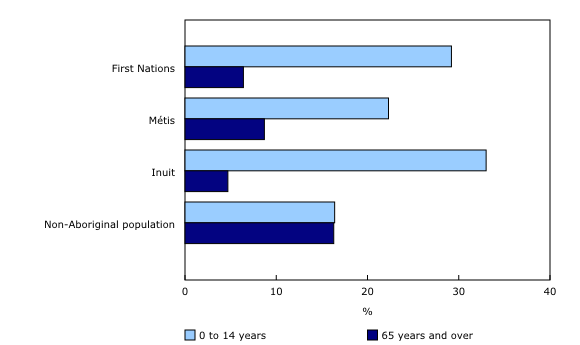
Chart 1  Chart 1: Share (in percentage) of the population aged 0 to 14 years and 65 years and over by Aboriginal identity, Canada, 2016
Share (in percentage) of the population aged 0 to 14 years and 65 years and over by Aboriginal identity, Canada, 2016

Chart 1: Share (in percentage) of the population aged 0 to 14 years and 65 years and over by Aboriginal identity, Canada, 2016

As shown in the 2016 Census release on age and sex, seniors outnumbered children for the first time in Canada. This was not the case among Aboriginal peoples.

Around one-third of First Nations people (29.2%) were 14 years of age or younger in 2016—over four times the proportion of those 65 years of age and older (6.4%). For Métis, 22.3% of the population was 14 years of age or younger, compared with 8.7% who were 65 years of age and older. Among Inuit, one-third (33.0%) were 14 years of age or younger, while 4.7% were 65 years of age and older.

While the Aboriginal population is younger than the rest of the population in Canada, it is also aging. In 2006, 4.8% of the Aboriginal population was 65 years of age and older; by 2016, this proportion had risen to 7.3%. According to population projections, the proportion of the First Nations, Métis and Inuit populations 65 years of age and older could more than double by 2036.

First Nations population growing both on and off reserve

First Nations people possess a rich cultural heritage of diverse languages, histories and homelands. There are more than 600 unique First Nations/Indian Bands in Canada. The First Nations population includes those who are members of a First Nation/Indian Band and those who are not, as well as those with and without registered or treaty Indian status under the Indian Act.

The number of First Nations people with registered or treaty Indian status rose by 30.8% from 2006 to 2016. There were 744,855 First Nations people with registered or treaty Indian status in 2016, accounting for just over three-quarters (76.2%) of the First Nations population. The other 23.8%, which did not have registered or treaty Indian status, has grown by 75.1% since 2006 to 232,375 people in 2016.

Among the 744,855 First Nations people with registered or treaty Indian status, 44.2% lived on reserve in 2016, while the rest of the population lived off reserve. There was growth for both on reserve (+12.8%) and off reserve (+49.1%) First Nations populations from 2006 to 2016.

Over half of First Nations people live in the western provinces

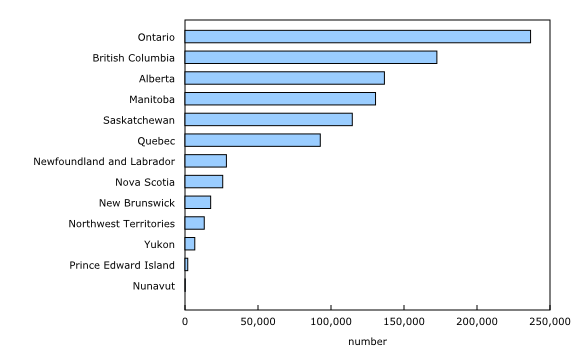
The First Nations population was concentrated in the western provinces, with more than half of First Nations people living in British Columbia (17.7%), Alberta (14.0%), Manitoba (13.4%) and Saskatchewan (11.7%). By comparison, 30.3% of the non-Aboriginal population lived in the western provinces.

Almost one-quarter (24.2%) of the First Nations population lived in Ontario, the largest share among the provinces, while 9.5% lived in Quebec.

A further 7.5% of the First Nations population lived in the Atlantic provinces and 2.1% lived in the territories.

While First Nations people accounted for 2.8% of the total population of Canada, they accounted for one-tenth of the population in Saskatchewan (10.7%) and Manitoba (10.5%), and almost one-third of the population in the Northwest Territories (32.1%).

First Nations people accounted for a smaller share of the population in Quebec (1.2%), Ontario (1.8%) and the Atlantic provinces (3.2%).

Chart 2  Chart 2: First Nations population by provinces and territories, Canada, 2016
First Nations population by provinces and territories, Canada, 2016

Chart 2: First Nations population by provinces and territories, Canada, 2016

First Nations population doubles in Atlantic Canada

While the First Nations population in the Atlantic provinces is relatively small (73,655 or 7.5% of the total First Nations population), it more than doubled (+101.6%) from 2006 to 2016. A significant part of this increase most likely stemmed from changes in self-reported identification, that is, people newly identifying as First Nations on the census.

Over this 10-year period, the First Nations population grew by 48.7% in Ontario and 37.5% in Quebec.

While the First Nations population grew at the slowest pace in Western Canada (+32.2%), the region saw the largest total increase in the First Nations population (+134,550) in Canada.

Ontario has the largest Métis population

Métis hold a unique cultural and historic place among the Aboriginal peoples in Canada, with distinct traditions, culture and language (Michif). Today, the Métis population is present in every province, territory and city in Canada.

There were 587,545 Métis in Canada in 2016, accounting for 1.7% of the total population.

Most (80.3%) of the Métis population lived in Ontario and the western provinces. For the first time, Ontario had the largest Métis population in Canada at 120,585, up 64.3% from 2006 and accounting for one-fifth (20.5%) of the total Métis population.

The Métis population grew by 32.9% in the western provinces from 2006 to 2016, to 351,020 people.

Alberta had the largest Métis population in the western provinces, accounting for 19.5% of the total Métis population. About the same number of Métis lived in Manitoba and British Columbia (15.2%), while Saskatchewan was home to 9.9% of the Métis population.

There were 69,360 Métis living in Quebec in 2016, accounting for 11.8% of the total Métis population. Meanwhile, 7.2% of the Métis population lived in the Atlantic provinces and 0.8% lived in the territories.

Chart 3  Chart 3: Métis population by provinces and territories, Canada, 2016
Métis population by provinces and territories, Canada, 2016

Chart 3: Métis population by provinces and territories, Canada, 2016

The Métis population grew at the fastest pace in Quebec (+149.2%) and the Atlantic provinces (+124.3%) from 2006 to 2016. Meanwhile, the Métis population grew by 64.3% in Ontario and by 32.9% in the western provinces. In the territories, the size of the Métis population was relatively unchanged from 10 years earlier.

Nearly two-thirds of Métis live in a metropolitan area

Of the three Aboriginal groups, Métis were the most likely to live in a city, with 62.6% living in a metropolitan area of at least 30,000 people.

There were eight metropolitan areas with a population of more than 10,000 Métis in 2016: Winnipeg, Edmonton, Vancouver, Calgary, Ottawa–Gatineau, Montréal, Toronto and Saskatoon. Combined, these areas accounted for just over one-third (34.0%) of the entire Métis population.

Winnipeg had the largest Métis population at 52,130 in 2016, up 28.0% from a decade earlier.

Almost three-quarters of Inuit live in Inuit Nunangat

Inuit are the original people of the North American Arctic. In Canada, Inuit have inhabited communities stretching from the westernmost Arctic to the eastern shores of Newfoundland and Labrador for uncounted generations. This area, known as Inuit Nunangat, refers not only to the land, but also to the surrounding water and ice, which Inuit consider to be integral to their culture and way of life. For more information, please visit the Inuit Tapiriit Kanatami website.

There were 65,025 Inuit in Canada in 2016, up 29.1% from 2006. Close to three-quarters (72.8%) of Inuit lived in Inuit Nunangat.

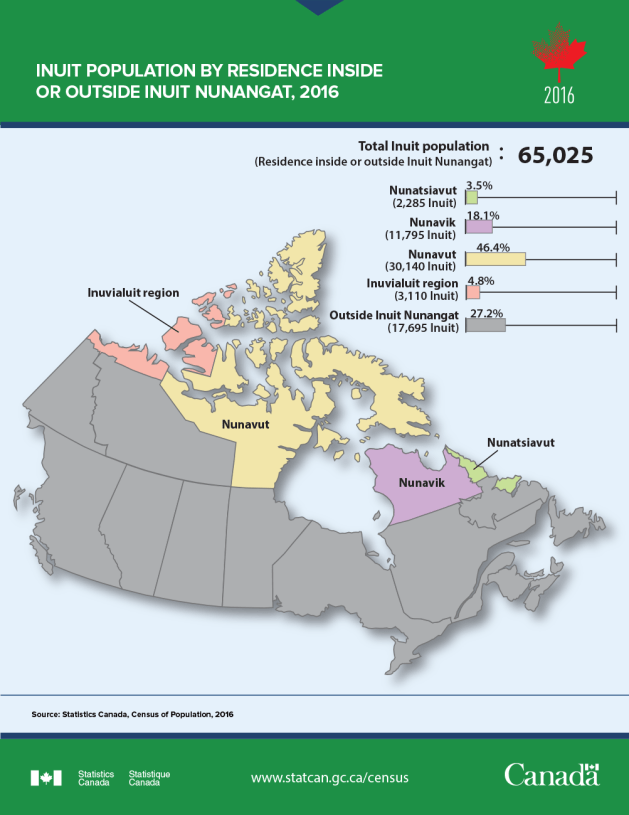
Map 1  Thumbnail for map 1: Inuit population by residence inside or outside Inuit Nunangat, 2016
Inuit population by residence inside or outside Inuit Nunangat, 2016

Thumbnail for map 1: Inuit population by residence inside or outside Inuit Nunangat, 2016

Among Inuit in Inuit Nunangat, the majority (63.7% or 30,140) lived in Nunavut in 2016, while one-quarter (24.9%) lived in Nunavik, whose communities encircle the western, northern and northeastern coastlines of Quebec. Another 6.6% lived in the Inuvialuit region, which is located in the Western Arctic, while 4.8% lived in the communities of Nunatsiavut, along the northeastern coast of Newfoundland and Labrador.

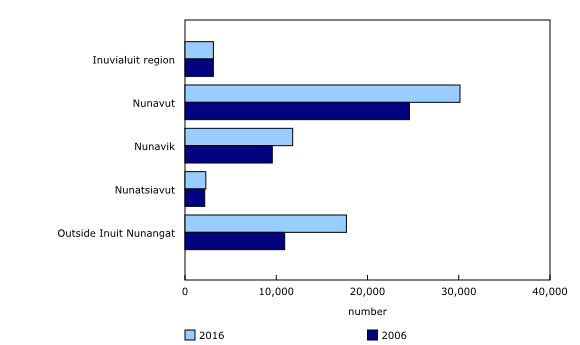
Chart 4  Chart 4: Inuit population by Inuit area of residence, 2006 and 2016
Inuit population by Inuit area of residence, 2006 and 2016

Chart 4: Inuit population by Inuit area of residence, 2006 and 2016

Inuit population growing inside and outside Inuit Nunangat

From 2006 to 2016, the Inuit population grew by 20.1% inside Inuit Nunangat. Outside of Inuit Nunangat, the Inuit population grew by 61.9%.

Among the four regions of Inuit Nunangat, the Inuit population grew the fastest in Nunavik (+23.3%) and Nunavut (+22.5%) over the 10-year period. In Nunatsiavut, the Inuit population grew by 6.0%, while in the Inuvialuit region the population was relatively unchanged.

Outside of Inuit Nunangat, the highest proportion of Inuit lived in the Atlantic provinces (30.6%). Most Inuit in the Atlantic provinces lived in Newfoundland and Labrador (23.5%), which accounted for almost one-quarter of the population of Inuit outside of Inuit Nunangat.

Over one in five Inuit (21.8%) outside of Inuit Nunangat lived in Ontario, while 28.7% lived in the western provinces. Just over 1in 10 (12.1%) lived in Quebec, while 6.8% lived in the Northwest Territories (not including the Inuvialuit region) and Yukon.

Many Inuit, outside of those living in Inuit Nunangat, lived in a city. Outside of Inuit Nunangat, 56.2% of Inuit lived in a metropolitan area of at least 30,000 people. Of Inuit living outside of Inuit Nunangat, the largest Inuit populations were in Ottawa–Gatineau (1,280), Edmonton (1,110) and Montréal (975).

The Aboriginal population living in metropolitan areas is growing

The increase in the urban population of Aboriginal peoples has been taking place for decades in Canada. This change has often been misunderstood simply as the movement by First Nations people away from reserves and into cities. In fact, the First Nations population continues to grow both on and off reserve.

Like the overall population growth of First Nations people, Métis and Inuit, the urbanization of Aboriginal peoples in Canada is due to multiple factors—including demographic growth, mobility and changing patterns of self-reported identity.

In 2016, 867,415 Aboriginal people lived in a metropolitan area of at least 30,000 people, accounting for over half (51.8%) of the total Aboriginal population. From 2006 to 2016, the number of Aboriginal people living in a metropolitan area of this size increased by 59.7%.

The census metropolitan areas (CMAs) of Winnipeg (92,810), Edmonton (76,205), Vancouver (61,460) and Toronto (46,315) had the largest Aboriginal populations. Among all CMAs, Aboriginal people accounted for the highest proportion of the population in Thunder Bay (12.7%), Winnipeg (12.2%) and Saskatoon (10.9%).

Chart 5  Chart 5: Number of First Nations people, Métis and Inuit by selected census metropolitan areas, 2016
Number of First Nations people, Métis and Inuit by selected census metropolitan areas, 2016

Chart 5: Number of First Nations people, Métis and Inuit by selected census metropolitan areas, 2016

The Aboriginal population more than doubled in seven CMAs from 2006 to 2016: St. John’s, Halifax, Moncton, Québec, Saguenay, Sherbrooke and Barrie. Among all CMAs, the Aboriginal population grew the fastest in St. John’s (+237.3%), Halifax (+199.0%) and Moncton (+197.9%).

Over the same period, Aboriginal population growth was slowest in Regina (+26.4%), Winnipeg (+37.1%) and Saskatoon (+45.4%). However, even in Regina, where Aboriginal population growth was the slowest among all CMAs, the Aboriginal population grew at a faster pace than the non-Aboriginal population.

Aboriginal children more likely to live in a family with at least one grandparent

Understanding the characteristics of young children aged 0 to 4 years is important, as early childhood experiences influence not only current but also future well-being.

There were 145,645 Aboriginal children aged 0 to 4 years enumerated in the 2016 Census, accounting for 8.7% of the total Aboriginal population. Of this group, 60.1% lived with two parents.

Just over one-third (34.0%) of Aboriginal children aged 0 to 4 years lived with a lone parent. First Nations children aged 0 to 4 years (38.9%) were the most likely to live with a lone parent, followed by Métis (25.5%) and Inuit (26.5%) children in the same age group. However, many children living with a lone parent also lived with grandparent(s). In 2016, 10.5% of Aboriginal children aged 0 to 4 were living with a lone parent and grandparent(s).

About one in six (17.9%) Aboriginal children aged 0 to 4 lived with grandparent(s) in 2016, either with a parent present or without. Inuit children in this age group were most likely to live with grandparent(s) (22.8%), followed by First Nations (21.2%) and Métis (10.5%) children.

For more information on the family characteristics of young Aboriginal children, see the article “Diverse family characteristics of Aboriginal children aged 0 to 4“.

More than 70 Aboriginal languages reported

Language both shapes and is shaped by the culture to which it belongs. Aboriginal languages—grouped into 12 language families—have been central to the history of First Nations people, Métis and Inuit in Canada and continue to play a vital role to this day.

There is a great diversity of Aboriginal languages in Canada. There were more than 70 distinct Aboriginal languages reported in the 2016 Census, more than 30 of which had at least 500 speakers.

There were 260,550 Aboriginal people who could speak an Aboriginal language in 2016, up 3.1% from 2006.

In general, the number of First Nations people, Métis and Inuit who could speak an Aboriginal language was higher than the number with an Aboriginal mother tongue. This suggests that people are learning an Aboriginal language as a second language.

The article “The Aboriginal languages of First Nations people, Métis and Inuit” contains more information on the diversity of Aboriginal languages in Canada.
Source: The Daily — Aboriginal peoples in Canada: Key results from the 2016 Census