Canadian government comes to the defence of Nazi SS and Nazi collaborators but why?

Good question:

In late April more than 50 members of the U.S. Congress condemned the government of Ukraine’s ongoing efforts to glorify “Nazi collaborators.”

The letter, signed by both Republicans and Democrats, outlined concerns about ongoing ceremonies to glorify leaders of the Ukrainian Insurgent Army as well as 14th SS Galizien Division (aka 1stGalician/Galizien or the 1st Ukrainian Division). “It’s particularly troubling that much of the Nazi glorification in Ukraine is government-supported,” noted the letter to U.S. Deputy Secretary of State John Sullivan. The letter was initiated by Democratic Reps. Ro Khanna of California and David Cicilline of Rhode Island.

Contrast that to how the Canadian government handled a related issue last year when the Russian Embassy in Ottawa tweeted out that, “There are monumets (sic) to Nazi collaborators in Canada and nobody is doing anything about it.”

A monument in Oakville commemorates those who served with the 14th SS Galizien Division. Another monument in Edmonton honors Roman Shukhevych, the leader of the Ukrainian Insurgent Army.

As my Postmedia colleague Marie-Danielle Smith discovered, the Russian tweet sent bureaucrats at Global Affairs Canada into overdrive as they tried to defend the SS unit and Ukrainian Nazi collaborators. Documents she received through the Access to Information law show government officials were under a lot of pressure from the “Centre” (the Privy Council Office and the Prime Minister’s Office) to counter the news about the monuments to Nazi collaborators. The bureaucrats came up with a strategy. The would label the tweet as “disinformation” and they came up with a plan to spread the word to the news media as part of their efforts to defend Ukraine’s Nazi collaborators.

Now as I have written before, the Russians are more than happy to try to embarrass the Canadian government, which has steadfastly stood behind the Ukrainian government in the ongoing conflict in the region. Suggesting that Canada allows monuments to Nazi collaborators seems to fit that bill.

But in this case the Russian tweets aren’t “fake news” or “disinformation.” They are accurate.

As those members of the U.S. Congress have pointed out, the Ukrainians who served in the SS Galizien Division were indeed Nazi collaborators.

So too was Roman Shukhevych.

Before going to the Ukrainian Insurgent Army, Shukhevych was commander of the Ukrainian battalion called Nachtigall. The men of Nachtigall rounded up Jews in Lviv in June 1941, massacring men, women and children. The Simon Wiesenthal Center estimates that the Nachtigall Battalion, along with their German military counterparts, managed to murder around 4,000 Jews in Lviv. Other historians put the estimate at around 6,000.

Shukhevych was later assigned to a new unit whose role in Germany’s war, according to one Holocaust expert, was “fighting partisans and killing Jews.” Shukhevych later turned against the Nazis.

Then there is the SS Galizien Division. They were eager Nazi collaborators. Some 80,000 Ukrainians volunteered to join the SS but only those who could meet the strict requirements were selected.

The SS used some of its most seasoned killers to oversee the development of its new division. SS Gen. Jurgen Stroop, who would later be executed as a war criminal for his brutal destruction of the Jews in the Warsaw Ghetto, was brought on as an advisor.

Other commanders of the division were all versed in the murder of Jews throughout occupied territories in eastern Europe. “Many of the Ukrainian officers, like SS- Haupsturmfuhrer Michael Brygidryr, had previously served in SS Schuma battalions, routinely used to kill partisans, burn down villages and, when the opportunity arose, murder Jews,” wrote award-winning author Christopher Hale in his 2011 ground-breaking book, Hitler’s Foreign Executioners.

SS Galizien Division was used by the Nazis in a variety of operations, one of the most controversial being the 1944 destruction of the village of Huta Pieniacka. Huta Pieniacka was considered a “Polish” village that just months before had been the shelter for several hundred Jews, Hale noted. The SS units surrounded the village. Men, women and children, who had taken refuge in the village church, were taken outside in groups and murdered. Kids were executed in front of their parents, their heads smashed against tree trunks, one witness testified. Others were burned alive in houses. Around 850 people were murdered.

Some Ukrainians dispute that the SS Galizien Division took part in the killings or they argue that only small elements from the unit – and under Nazi command – were involved.

A Ukrainian military board heard testimony in 1944 that members of the Galizien Division did take part in the attack. But that action was justified, the board was told since the inhabitants of Huta Pieniacka had been killing Ukrainian peasants. “By the way, the Jews were hiding in the village,” a Ukrainian officer added in his testimony describing the destruction of the village inhabitants.

Some Ukrainians see Shukhevych and SS Galizien Division members as heroes. They argue that those individuals served the Nazis because they saw them as liberators from the Russians. Their ultimate goal was an independent Ukraine.

But to claim that these individuals were not Nazi collaborators is something else. They served Hitler.

In May 1944, SS leader Heinrich Himmler addressed the Ukrainian SS recruits in a speech.  “Your homeland has become more beautiful since you have lost – on our initiative, I must say – the residents who were so often a dirty blemish on Galicia’s good name – namely the Jews,” said Himmler. “I know that if I ordered you to liquidate the Poles, I would be giving you permission to do what you are eager to do anyway.”

Himmler speech was greeted with cheers from the Ukrainian recruits.

Equally disturbing are the details contained in the book, The Holocaust Chronicle, published in 2003 and written by 7 top scholars in the field of Holocaust studies. They noted that Ukrainian SS were also sent to help kill Jews during the Warsaw Ghetto uprising. The Chronicle published a photo of two of Ukrainian SS members standing over the bodies of Jews murdered during that uprising. See the photo below:

But this issue of Ukrainian collaboration with the Nazis is not new. Since 1986 the Nazi-hunters with The Simon Wiesenthal Center have warned about efforts from those in Ukraine and in the Ukrainian community in Canada who want to deny involvement of the SS Galizien Division with the Nazis.

The Latvian government is also trying to use the “fake news” label to whitewash the reality of Latvian collaboration with the Nazis.

My colleague Scott Taylor has recently written several articles about the Latvian Legion (15th Waffen Grenadier Division of the SS (1st Latvian) et al) and Latvian killers like war criminal Herberts Cukurs as well as the members of the Arajs Kommando, who murdered an estimated 26,000 Jews.

According to Karlis Eihenbaums, Latvia’s Ambassador to Canada, Taylor is spreading “fake news” and “disinformation.” Eihenbaums has also tried to smear Taylor by suggesting that he is under the “influence” of the Russian government.

Taylor’s research into the Latvian SS Legion and the Latvian murderers of Jewish men, women and children is solid.  It is a well-documented historical fact that many of the killers from the Arajs Kommando went to the Latvian Legion. These Latvians served Hitler. No number of claims of “fake news” can change that fact.

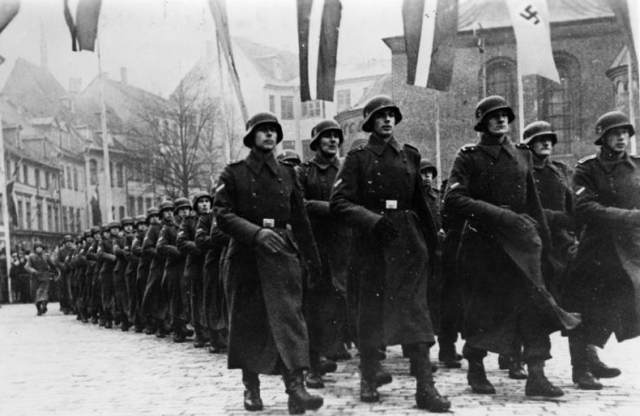
Photo below shows Latvian SS:

The controversy over the Latvian Legion and the annual parade held in Riga to celebrate these Nazi collaborators is well known and has been going on for two decades, long before the term “fake news” was even coined. In 1998 the parade caused a storm of protests around the world, particularly in Israel, where Holocaust survivors couldn’t understand Latvia’s desire to celebrate such ruthless killers. German Chancellor Helmut Kohl and French President Jacques Chirac were among those that year to protest the Latvian parade. The Times of Israel reported on this year’s Latvian SS parade in Riga, which took place mid-March.

So much for “fake news.” Did Helmut Kohl and Jacques Chirac spread “disinformation” when they denounced the SS parade in Latvia? Of course not.

This whole issue isn’t about “fake news” or Russian “disinformation.” It is about nations trying to whitewash their Nazi collaboration and rewrite history, while attacking journalists who don’t want to let that happen.

It is a positive development that members of the U.S. Congress could see through these efforts to glorify members of the SS. They are speaking out.

But in Canada, the federal government is more than happy to play along with defending Himmler’s SS divisions and Nazi collaborators.

What would our soldiers who fought during the Second World War to help rid the world of this scourge think about that?

Source: Canadian government comes to the defence of Nazi SS and Nazi collaborators but why?
Countering the rise of radicalism in private Islamic schools in Indonesia – Opinion – The Jakarta Post

More on increased radicalization in Indonesia and the influence of Islamic schools, with a useful breakdown of the different types:

A series of terrorist acts has rocked Indonesia in the past week. Starting from a clash in a detention centre at the Police Mobile Brigade headquarters in Depok, West Java, last week, attackers then bombed three churches in Surabaya, East Java, last Sunday, followed by another terrorist bombing at Surabaya Police Headquarters. Dozens were killed and wounded.

In response, President Joko “Jokowi” Widodo has reiterated the government’s commitment to exterminate terrorism down to its roots.

We must appreciate Jokowi’s statement. However, terrorism is a complex issue because there is no single factor that can explain why a person becomes a terrorist.

The importance of schools to prevent radicalism

One of the strategies that the government can use to stop terrorism in Indonesia is to take preventive steps using educational institutions to promote tolerance, which can eventually stop the spread of radical thoughts.

But what is happening in Indonesia is the opposite. Many schools in Indonesia have become fertile ground for radicalism.

The latest surveys from the Wahid Institute, Pusat Pengkajian Islam Masyarakat and the Centre for Study of Islam and Society (PPIM) and Setara Institute have indicated the spread of intolerance and radical values in educational institutions in Indonesia.

A student tolerance survey from Setara Institute in 2016 revealed that 35.7% of the students showed a tendency to intolerance in their minds, 2.4% were involved in acts of intolerance, and 0.3% had the potential to become terrorists. The survey was based on 760 respondents who enrolled in public high schools in Jakarta and Bandung, West Java.

Surveys from the Wahid Institute and PPIM have shown the same worrying trend.

The characteristics of schools prone to radicalism

In 2017, I was involved in research on efforts to respond to radicalism at 20 private Islamic schools in Central Java. The research involved academics from Monash University in Australia, Walisongo State Islamic University in Semarang, Central Java, and Gadjah Mada University in Yogyakarta with funding support from the Australia-Indonesia Centre.

We managed to identify three types of schools that are prone to radicalism. In accordance with confidentiality principles, we will not publish the schools’ names in this article.

These three types of schools are:

1. Closed schools

Instead of embracing changes, this type of school offers students a narrow perspective and tends to shut them off from foreign ideas.

We interviewed one of the headmasters from these schools. He explained the importance of Islamic civilisation to protect students against Western values.

Aside from see Islam and the West as being in conflict, closed schools also stress the importance of practising their version of Islamic teachings and reject the moderate Islam that most Muslims adhere to in Indonesia.

2. Separated schools

These schools can be identified from their teacher recruitment system and their limited participation in social activities.

The teacher recruitment process in these schools is very strict, especially the recruitment of religion teachers. In addition, these schools do not want to participate in social activities that they deem to be against their values.

This type of school is very different from other Islamic schools that are affiliated with the country’s more traditional Muslim organisations such as Nahdlatul Ulama (NU) or Muhammadiyah. Whereas separated schools recruit religion teachers from their own groups only and will use their networks to recruit alumni who share the same Islamic values, NU and Muhammadiyah schools will not consider differences in their teachings as an issue. For example, one of the headmasters from a NU-affiliated school stated that his school also recruited teachers from Muhammadiyah.

NU and Muhammadiyah schools are also active in social activities, including interfaith activities. Separated schools are not.

3. Schools with pure Islamic identity

The third type can be identified by the way they create students’ Islamic identity. The schools that are prone to radicalism tend to build in a student a single Islamic identity, refusing other identities.

This understanding is different from other Islamic schools, which tend to consider that a person’s identity as a Muslim is not against his/her other identity. Moderate Islamic schools do not see a conflict between their students’ identity as Muslims and as Indonesian citizens.

When a school builds this single Muslim identity, that school will also foster radical attitudes among students as they only believe in a single Islamic interpretation that is in line with their values.

Headmasters from this type of school usually order their students to follow all religious rituals at schools, despite the students’ different religious background.

A headmaster told us that his students with a NU background must abandon their prayer ritual in the morning called qunut when they are enrolled in his schools.

This policy is different from other schools that allow flexibility for their students in their religious practices.

In addition, the rejection of other identities creates a “we versus them” attitude not only between different religions but also within the larger Islamic community itself.

What we can do

These three types of schools contribute to the growth of intolerance as well as radicalism at schools, which can lead to terrorist acts.

Therefore, we believe that the recent terrorist attacks should give momentum to the government to plan preventive measures to promote diversity, social integrity and diverse identities in various schools across the country.

The government’s campaign on tolerance should reach different educational institutions via the Culture and Education Ministry as well as Religious Affairs Ministry.

The government must also provide platforms and programs to promote tolerance. Apart from that, related government institutions in the regions must develop the capacity to identify schools that are prone to radicalism and apply persuasive approaches to prevent the spread of radicalism in those schools.

via Countering the rise of radicalism in private Islamic schools in Indonesia – Opinion – The Jakarta Post

Hungarian PM Accused George Soros of Fueling Anti-Semitism, MTI Reports – Bloomberg

Might be time for former PM Harper to reconsider his congratulatory message in his capacity as head of the International Democrat Union (IDU):

Hungarian Prime Minister Viktor Orban accused George Soros, the Jewish billionaire philanthropist who survived Nazi persecution, of fomenting anti-Semitism by helping immigrants come to Europe, MTI state news service reported.

Soros and his Open Society Foundations, which funds dozens of NGOs in Hungary, “bear responsibility for the increase in anti-Semitism in Europe,” Orban said in a letter to Ronald S. Lauder, the president of the World Jewish Congress, MTI reported Friday. Soros, 87, who eventually emigrated to the U.S. after World War II, said last year that Orban used Nazi-era propaganda methods to try to discredit him in a national billboard campaign.

Orban has built a border fence to keep immigrants out in a vow to protect Hungary from people he’s called “Muslim invaders.” In the letter, he said immigrants to Europe included those whose “political and religious views markedly increased the sense of insecurity in Jewish communities.”

Orban won a fourth term as prime minister last month and has become a ringleader for anti-immigrant populist forces in Europe. Open Society Foundations said this week that it was moving its staff from Budapest to Berlin, citing a government crackdown on NGOs.

via Hungarian PM Accused George Soros of Fueling Anti-Semitism, MTI Reports – Bloomberg

Andrew Coyne: It’s that time again, when Conservatives say anything to woo Quebecers

Typical acerbic Coyne commentary on CPC flirting with the Quebec nationalist vote:

Certain things recur eternally, in time with the rhythm of the seasons. Flowers bloom in spring. The swallows return to Capistrano. And the federal Conservatives prostitute themselves for the Quebec-nationalist vote.

Well, that’s a bit strong. Prostitutes, after all, expect to be paid. Whereas the Conservatives’ periodic efforts to sell themselves, their principles and their country to people with a proven lack of interest in all three are as notable for their unremunerativeness as they are for their self-abasement.

The Conservatives have been trying this same act now for several decades, most notably — and destructively, to both country and party — under Brian Mulroney, but in their different ways under Robert Stanfield (“deux nations”), Joe Clark (“community of communities”) and even Stephen Harper (“the Québécois nation” resolution).

Occasionally, they manage to attract some attention in the province that has remained largely indifferent to them since 1891. If they are particularly extravagant in their offerings, as under Mulroney, they may even win their votes — but only for as long as it takes to sink in that there is no support in the rest of Canada for what they are proposing, and no possibility of their being implemented.

At which point the whole exercise sinks in a heap of dashed expectations and accusations of bad faith, leaving the country divided and the Tories in ashes. Until, inevitably, some genius gets it into his head to launch the whole routine again.

As, indeed, some genius now has. There were early warning signs during the leadership campaign, with Andrew Scheer’s efforts to prostrate himself before the dairy lobby on the issue of supply management — a policy that is not explicitly about Quebec nationalism, but which only exists because it has been incorporated into the “Quebec consensus,” and is as such, like others of its kind, untouchable.

There were further hints in Scheer’s expressions of interest, as leader, in the Couillard government’s ruinous plan to leap again into the constitutional bog, this time with a set of demands that include entrenching “the Quebec nation” — not the Québécois, as in the Harper resolution, but the province entier, as national proto-state.

But it wasn’t until last weekend’s gathering of the party in Saint-Hyacinthe that we began to see just how far the Scheer Conservatives are prepared to go down this road. We now learn that among the proposals Scheer is considering including in the platform for 2019 is a federal retreat from responsibility for culture and immigration in Quebec, in favour of the provincial government: a longstanding nationalist demand, and another brick in the wall dividing Quebec from the rest of Canada.

As in a growing list of other fields, MPs from Quebec would be setting rules for the rest of Canada that did not apply to themselves, legislating for other provinces in areas over which Quebec reserved all power to itself. To now we’ve been able to paper over the inequities this implies: the levies Quebec MPs voted to impose on other Canadians under the Canada Pension Plan were until lately the same as those imposed under the Quebec Pension Plan. (They are now slightly lower.) But the principles of federalism can only be stretched so far. At some point they’re bound to break.

And there was this gem. In the name of preserving its autonomy, Quebec has long been the only province to force its long-suffering citizens to file their taxes twice: once to Ottawa and a second, entirely separate return to the province, with a separate set of deductions and credits. The Tories now propose to end this silliness — not, as you might expect, by the province agreeing to use the federal tax base in return for the feds collecting its taxes for it, as in the rest of Canada, but by the province collecting both sets of taxes, then remitting the federal portion to Ottawa.

Wonderful: henceforth, the federal government would be dependent on the grace and favour of the government of Quebec for a fifth of its income — even as the government of Quebec depends on federal transfers for about a fifth of its income. (Would it just subtract its share? Or would the two governments send each other cheques?)

And should there arise some dispute between them? That’s a nice little revenue source you have there. Pity if anything should happen to it.

There’s no actual need for any of this, you understand. There never is. The reason Quebec has its own pension plan is not because Quebecers age at different speeds, but because the government of Quebec fancied the cash — and because the Pearson government, with the Quiet Revolution then at its peak, was too unnerved to say no.

So it is with immigration and culture. Believe it or not, the federal government employs many francophone Quebecers. To the extent Quebec has special needs in these areas, they are quite capable of understanding and addressing them. Meanwhile, the province continues to enjoy the greatest degree of latitude in a country whose provinces generally have more powers than many sovereign states.

But then, the interest of Quebec’s political class in protecting the province’s jurisdictional turf seems to ebb and flow. At times, they are only too happy to have the feds intervene — for example, when it comes to covering the costs of the current influx of asylum seekers. Or, in perhaps the most brazen recent example of have-it-both-ways federalism, in the Coalition Avenir Québec’s suggestion that, should it form a government, it would exclude immigrants who did not pass its “values” test — but stick Ottawa with the job of kicking them out of the country.

I get why provincial politicians behave this way. I have no idea why their federal cousins are so eager to enable them. Or rather no, I know exactly why. Certain things recur eternally, after all.

Immigration has been good for Britain. It’s time to bust the myths

Revealing media and other analysis underlying the opinions:

Cut the niceties. Skip the jargon. Let us speak the plain truth, however ugly. What is driving this country headlong into a chaotic and punishing Brexit is a blind desire to cut immigration. That’s why people voted to leave the EU, politicians and pundits tell us. That’s what makes a Norway-style deal impossible, since it would almost certainly allow freedom of movement with mainland Europe – and any prime minister accepting that would be strung up by the press for treachery.

As long as Brexit is a synonym for keeping out foreigners, there can be no hope for meaningful compromise with the rest of the EU. The Lords can inflict endless defeats on Theresa May. An entire dinosaur gallery of has-been politicians can clamber on rice sacks to issue grave warnings. All will be drowned out by this one guttural roar.

Yet the anti-migrant arguments are a toxic alloy of barefaced lies and naked bigotry. None are new. But they were feverishly circulated in the days before the 2016 referendum. This time, crucially, migrants were made scapegoats for the misery caused by the government’s own drastic spending cuts – for a buckling NHS, a cash-starved school system and falling wages.

The definitive guide to how that happened is a study from King’s College London, which analyses almost 15,000 articles published online during the Brexit campaign by 20 news outlets, including the BBC and all the national papers. Despite its thoroughness, the media has barely covered it – perhaps unsurprisingly given what it implies about the state of our press.

Researchers found immigration to be the most prominent issue in the 10 weeks running up to the vote, leading 99 front pages. Of those, more than three-quarters were from the four most virulently leave newspapers: the Sun, the Mail, the Express and the Telegraph. Brexiteers fed their papers’ scare stories about immigration – no matter how scurrilous. Recall how Penny Mordaunt and the Vote Leave campaign claimed that Turkish murderers and terrorists were queueing up to come to the UK. Never mind that David Cameron immediately decried the lie. Never mind that this is the same country for whose tyrant leader Mordaunt, Theresa May and the rest rolled out the red carpet this week. Anything to fling some mud and get a headline.

“When not associated with rape, murder or violence, migrants were often characterised as job stealers or benefit tourists,” observes the academics’ report. So grab-handedly abhorrent were these newcomers that they were simultaneously taking our jobs and stealing our dole money. Or else they were jostling British mothers out of maternity wards and cramming their kids into British classrooms.

Such poisonous stories were happily ventriloquised by Boris Johnson, Liam Fox, Chris Grayling and Michael Gove. Their reward for helping to generate the hatred that will scar this country for years was, naturally, a big job in government. Their targets, on the other hand, have to live in a society in which racial prejudice is not just normalised but tacitly encouraged by cabinet ministers.

Yet time and time again, the politicians’ claims were false. The men and women who have come here from Budapest or Prague are like previous generations of arrivals: young, educated at someone else’s expense and here to work. They aren’t low-skilled labour but what former government economist Jonathan Portes describes as “ordinary, productive, middle income, middle-skilled – the sort of people our economy actually needs”. Study after study has failed to find any evidence of significant undercutting of wages. Far from jumping the queue, analysis published by the Institute for Fiscal Studies shows they are much less likely to be on benefits or in social housing than their UK-born counterparts.

Migrants from eastern Europe pay billions more in taxes to Britain than they take out in public spending. Far from squeezing hospitals and schools, they subsidise and even staff them. Rather than take jobs, they help create them. What has drained money from our public services and held down our wages is the banking crash, and the Tories’ spending cuts. As former Bank of England rate-setter David Blanchflower concludes in a forthcoming book on Brexit and Trump: “Government-imposed austerity has meant their money [migrants’ taxes] has not been used to finance the services they are entitled to, hence the overcrowding.” In one of the most breathtakingly cynical moves of our time, the very same ministers making the cuts looked at the fallout they created – and blamed migrants.

The Tories haven’t created this climate alone, of course. From Tony Blair to Ed Miliband, Labour leaders have marched alongside, muttering about “legitimate concerns” and handing out anti-immigration mugs. Forget about the evidence or leadership or having a backbone. Never mind the surveys showing that however much people dislike immigration in the abstract, they appreciate migrants.

Imagine Labour repealing gay marriage to placate misguided voters, or restricting women from working in order to boost wages for men. You cannot. But torching non-British workers in order to score political points is still deemed acceptable.

As shadow home secretary Diane Abbott observed , the point about pandering to racism – or whatever euphemistic camouflage you want to stick on it – is that it’s a beast whose appetite is never satisfied. One day the target is immigrants without documents; the next it’s a “swarm” of Poles and 100 Indian doctors blocked from taking up their hospital jobs; and by the end of the week it’s 63 of the Windrush generation deported, and countless more plunged into poverty and homelessness.

Having spoken up for migrants during the referendum, Jeremy Corbynthankfully does not share this same soft racism. But neither is he doing enough to challenge it. Among the six tests Labour’s Keir Starmer has set for Brexit is the familiar dog-whistle about “fair management of migration”.

Labour frontbenchers evidently believe they have to promise a Brexit that is sufficiently racist for the press and the hard right. In the old Blairite days, we’d have called this triangulation – take minority-ethnic support for granted, while wooing leave voters. Whatever it’s called, it’s a tawdry tactic that soon gets rumbled.

The point about opinions is that they can be shifted. Just see what Corbyn’s team has achieved on austerity in two years. What was once an economic orthodoxy is now recognised as a failure – because Labour stood up for both the evidence and its own better instincts. There are plenty of parallels here: a policy dreamed up by the Tory right, to which the left shamefacedly paid lip service; a mounting body of evidence that it was wrong; and at ground level a lasting legacy of stunted and broken lives. Austerity was urgent in 2010, essential in 2015 and is a relic in 2018. Much of the credit for that should go to Corbyn’s party. Now it should do the same with immigration.

Or else, as one Corbynite frontbencher admits: “You can’t keep telling West Yorkshire one thing, and Islington another.” And you won’t avert a hard Brexit until you face down the intolerance that is driving it.

Source: Immigration has been good for Britain. It’s time to bust the myths

‘A very critical clash of cultures’: Plea deal over honour killing threats saves Syrian couple from deportation

Interesting case and judgement and some of the integration challenges. On balance, reasonable deal.

Hopefully, lesson learned, both for the family concerned and more broadly:

A Syrian refugee couple who threatened their adult daughter with an honour killing for dating a Canadian man have made a plea deal with New Brunswick prosecutors that will save them from possible deportation back to their war-ravaged homeland.

Ahmad Ayoub, 52, and his wife Faten, 48, were freed this week after 72 days in jail, after pleading guilty to uttering threats as a summary conviction offence, and being sentenced to time served.

If they had been convicted of the more serious indictable offence of uttering threats, for which a trial was scheduled in the summer, they would have faced a sentence in the range of six months to a year, up to a maximum of two years.

More importantly, they would have faced the possibility of also being sent back to Syria, from which they escaped through Jordan, eventually settling in Fredericton in 2016, sponsored by the federal government.

“That’s the main thing that we gained,” said David Lutz, Ahmad’s lawyer. “Nobody who is a refugee wants to be convicted of any indictable offence, because it’s going to bring them under the purview of deportation.”

Lutz called the case a “very critical clash of cultures” that has sent a clear message to the Syrian community in Canada that even empty threats are taken seriously by the police and courts.

“Their words were taken literally instead of figuratively,” Lutz said. “In my interaction with the entire family, I came to the conclusion that this is a manner of speech that they never really intend to carry any of this out, but they do it so to say, ‘You should mind me, because this is what I think’.”

The Ayoubs have one adult child who remains in Jordan, and five others, one as young as 10, in Fredericton. Both have post-secondary education. Ahmad has worked in business, and Faten as a cook, but neither are employed yet in Canada.

No one answered the phone at their home on Wednesday. George Kalinowski, Faten Ayoub’s lawyer, declined to comment.

The threats were made against their daughter Bayan, 25. They were spoken in Arabic, once face to face, otherwise on the phone, and they only came to light when Bayan told her Canadian boyfriend, who encouraged her to go to police. She soon recanted, however, and was described in court by prosecutor Claude Haché as a reluctant participant in the prosecution.

“Throughout the time from which her parents were arrested and detained, (Bayan) was recanting and saying ‘All this is my fault.’ But of course, just like in domestic assaults, the police — and rightly so — don’t take the recanting seriously,” Lutz said.

Or, if they take it seriously, they see it as a symptom of the same problem, he added.

Bayan went to police in February. This prompted the threat by her mother, who urged her to tell police she lied, otherwise she would be killed. This threat was made on a phone call that Bayan recorded.

According to reporting by Don MacPherson of The Fredericton Daily Gleaner, who was in court for the sentencing, the first threat was made in April 2016, soon after the family arrived in Canada. Ahmad was angry that his daughter won an iPad in a contest, and threatened to poison her food. He also said he wanted to limit her contact with local men.

The second threat came last summer, when Bayan’s parents learned she was communicating with a Canadian man on social media, and her father said that “for his own dignity, it would be better to slaughter her,” the prosecutor said.

A third threat from Ahmad was prompted by her use of a smartphone, and his concern she was communicating with people she met at a work placement at a food bank.

Lutz said the more serious indictable offence of uttering threats is generally used in cases where there is evidence the offender had the ability or means to do it. In this case, he said their words were hyperbolic, exaggerated and non-literal.

He said the Ayoubs’ threats were “careless, bordering on reckless, and they have learned from this experience that his kind of language may be acceptable in Syria and Afghanistan, but now they know, better than most, that it’s not acceptable in Canada. And the entire Syrian community in New Brunswick knows it too.”

MacPherson’s report noted that the parents embraced their daughter outside court, and Ahmad shook her boyfriend’s hand. They will be on probation for a year.

Source: ‘A very critical clash of cultures’: Plea deal over honour killing threats saves Syrian couple from deportation

Australia: Citizenship crisis: coalition resists referendum in favour of new rules for candidates

Understandable reluctance giving risks and divisiveness of referendums (and not clear whether winnable) with the unfortunate result that Australian parliaments will continue to be significantly under-representative:

Candidates will have to disclose the birthplace and citizenship of themselves, their parents and grandparents before the next federal election under changes announced by the government to try to put an end to Australia’s citizenship crisis without a referendum.

On Thursday an inquiry examining section 44 of the constitution warned that, without a referendum, elections could be subject to “manipulation” by challenges against candidates with dual citizenship or other disqualifications.

Despite the electoral matters committee’s bipartisan push for a referendum to reform or repeal section 44 of the constitution, the special minister of state, Mathias Cormann, confirmed that the government was “not inclined to pursue a referendum”.

Instead the government will pursue steps “to minimise the risk of a recurrence of the eligibility issues” that have plagued the 45th parliament, in which 14 parliamentarians have resigned or been ruled ineligible since mid-2017 owing to dual citizenship.

The government set up the inquiry into section 44 by the joint standing committee on electoral matters after the high court ruled five senators and MPs ineligible in October.

In a bipartisan report released on Thursday, the committee recommended the government prepare a referendum question to either repeal all the disqualifications for standing for parliament in section 44 or to give parliament the power to set the disqualifications itself.

But the committee acknowledged a referendum “will not be positively received by Australians and the outcome … is uncertain”.

It accepted the “preconditions for a successful referendum on this issue will take time” and cannot be achieved before the “Super Saturday” byelections triggered by the high court’s ruling against Katy Gallagher or before the next federal election.

The committee suggested a series of measures to “mitigate the impact of section 44” including:

  • a requirement that all candidates reveal their family citizenship history at the time of nomination and information relevant to other disqualifications;
  • an “online self-assessment tool” to be developed by the Australian Electoral Commission;
  • improved education for minor parties and independents; and
  • exploring expedited citizenship renunciation processes with foreign governments.

At a press conference in Brisbane Malcolm Turnbull said the government did not have time to deal with a referendum before the next election and the Australian people “expect us to deal with the constitution as it stands”.

Even in the longer term, the prime minister said he “very much doubted” whether Australians would support a change to the constitution.

Cormann said the government would instead “move to improve the existing candidate nomination process for elections”.

In November the government introduced a new citizenship register requiring current and future parliamentarians to reveal their birthplace, that of their parents and grandparents and to produce documents showing renunciation of foreign citizenship 21 days after their election.

Cormann announced those requirements would now be applied to “candidates for election to the Australian parliament” who will provide the information to the AEC “as well as information on other potential disqualifications under section 44 of the constitution”. This is likely to require disclosure of criminal convictions, bankruptcies and interests in contracts with the government.

The committee warned that section 44 opened the electoral system to “the risk of manipulation, where a successful candidate could have their election challenged on the basis of preference flows from an ineligible candidate”.

“This raises the possibility of deliberate manipulation of disqualification rules to overturn an otherwise valid election,” it said.

The committee noted that when all the disqualifications in section 44 are considered – including foreign citizenship, employment in the public service and an “indirect pecuniary interest in an agreement with the commonwealth” – more than 50% of the Australian population is ineligible to run for parliament.

The report argued that the ban on dual citizens caused numerous problems, including uncertainty for parliamentarians who were unsure of the citizenship of their parents or grandparents, and the possibility that foreign governments could manipulate eligibility by not processing renunciation in a timely manner.

“Challenges to sitting members will continue into future elections; disrupting electoral outcomes, causing uncertainty and confusion, and having the potential to undermine the authority of both federal parliament and the constitution itself.”

Despite those dire warnings the chair of the electoral committee, the Liberal senator Linda Reynolds, told Guardian Australia she was “not [so] pessimistic” to suggest it will take further disqualifications to convince Australians of the need for a referendum.

“We need to start a conversation about whether the rules are the right ones for today’s society,” she said.

Reynolds cited the fact that public servants have to give up their jobs to run for parliament, and the citizenship requirements favour “Australians with a long-term unbroken family history” and those who can afford legal advice to remove disqualifications.

via Citizenship crisis: coalition resists referendum in favour of new rules for candidates | Australia news | The Guardian

Further article: Will we actually vote on changing the constitution after the dual citizenship fiasco? – Politics – ABC News (Australian Broadcasting Corporation)

Liberals risk new-Canadian vote with border-crossing response, say pollsters

Some relevant polling data – will see how these numbers shift or remain stable should the trend continue or change:
Politicians and the media are to blame for using needlessly alarmist language on the rise of asylum seekers, when the system has the capacity to manage, says a former Immigration and Refugee Board chair.

The Liberals have switched to more hardline messaging around asylum seekers, say pollsters and observers, as the government’s response has left it open to attack in the face of increasing irregular border crossings and charges from the Conservatives that the Grits are soft on border security.

Politically, the challenge and vulnerability for the Liberals is especially acute among first-generation and new-Canadian communities, said Jackie Choquette, vice-president at Hill+Knowlton Strategies, which both parties have been targeting and fighting over for several elections.

“That’s traditionally been a huge area of support for the Liberal Party,” said the former provincial Liberal staffer, and an area where they could lose votes.

The issue is starting to gain traction as opinions shift within that community, she said.

“That’s a more-difficult, nuanced conversation, I think, for the government to have and that’s why I think it’s the biggest vulnerability.”

Though the Conservatives have been accusing the Liberals of being weak along the border, Summa Strategies senior consultant Kate Harrison said the attack line that’s more “acutely felt” is “on the notion of queue jumping.”

In a move many saw as a way to court new Canadian votes ahead of the 2015 election, Prime Minister Justin Trudeau (Papineau, Que.) promised to make family reunification easier for new immigrants to sponsor relatives coming to Canada.

Those “lofty promises” present a political vulnerability, Ms. Harrison said, as some families still wait for that to happen while hearing messages—accurate or not—that others get to jump the line.

“If they don’t make any progress on family reunification, a lot of those new Canadians that are already here and have family members that have been waiting to [come] here may grow very resentful,” said Ms. Harrison, a former Conservative Party staffer.

No party wants the discussion to devolve into “stoking resentment” within those communities, she said, but it has the danger of heading that way if parties aren’t careful.

All parties are “playing a careful dance” around how they frame the “tricky issue” because it “cuts to the very core of who we are as Canadians,” said Ms. Choquette, particularly as the country tends to pride itself on being welcoming.

Government shifts, sharpens message on asylum seekers

At committee and in Question Period last week, Public Safety Minister Ralph Goodale (Regina-Wascana, Sask.) responded to Conservative questions on what they’ve called “the border crossing crisis” by reiterating international obligations to refugees and stressing the government doesn’t think the situation is acceptable.

“Coming across the border in a way that tries to circumvent the law or defy proper procedure is no free ticket to Canada,” Mr. Goodale told reporters last week.

Observers saw that language from him and other officials as a very different, more stern approach. It was also a necessary shift following documents that showed Mr. Trudeau’s tweet from January 2017 welcoming “those fleeing persecution, terror [and] war,” caused confusion among officials and a flood of inquiries.

Angus Reid Institute executive director Shachi Kurl said there are a couple of outstanding questions.

“We’ve seen that message sharpened in the last little while, but is it enough? Is it enough practically and is it perceived to be enough in the minds of Canadians?” she said, adding the firm plans to poll soon on this issue again.

In a September poll following a summer spike in irregular crossings, Angus Reid found 53 per cent of respondents said the country has been “too generous” to the border crossers.

“I think there’s a narrative—which is not necessarily an accurate narrative—that Canada is an endlessly welcoming and generous country,” she said, but the polls show that’s not the case.

“As we see more individuals arriving at the border I think if anything that concern is only heightened, not lessened,” she said, adding the same goes for general awareness of the issue. “For those who are concerned, they are unlikely to have seen anything in terms of a change of approach that will have lessened or alleviate those concerns.”

‘Alarmist’ language a problem: former IRB chair

Because Canada and the United States are part of the Safe Third Country Agreement, people who cross from the U.S. at regular points of entry along the border or at airports aren’t able claim refugee status. The same does not apply at unofficial entry points, prompting the Conservatives to call on the Liberals to suspend the agreement.

Mr. Goodale has said the government broached the subject and is having “exploratory” talks with the U.S.

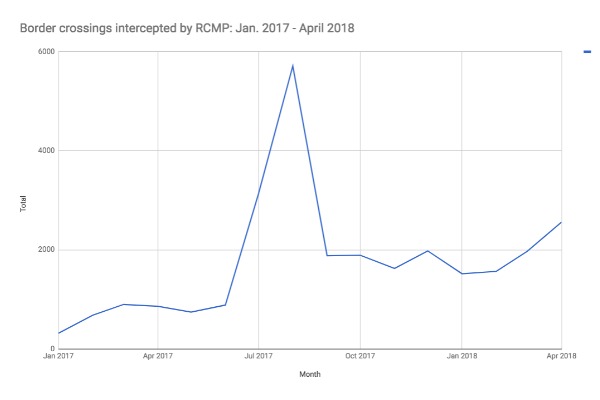
The latest government numbers show 2,560 such entries in April—a 30 per cent increase over the previous month. There were 20,593 irregular crossings from the United States in 2017 and have remained above 1,500 crossings a month since July 2017. The vast majority of those crossings are through Quebec, which observers note is a strategically important province politically in which the Liberals are pouring resources and where Conservative leader Andrew Scheer (Regina–Qu’Appelle, Sask.) has recently spent time courting disenchanted Bloc Québécois supporters. While the Liberals still lead the pack, a new poll showed the Tories are making gains in the province.

Source: Immigration, Refugees and Citizenship Canada

That uptick in border crossings “is only an increase compared to the unusually low numbers of claims in the past few years,” according to the Canadian Council for refugees.

The average number of refugee claims between 2013 and 2015 was 13,300 per year but between 2000 and 2009, it was an annual average of 31,400, the council said, arguing the case could be made that Canada is “returning to more usual numbers.”

Both the “loose language” and discussion around numbers from media and politicians has been “alarmist,” said Peter Showler, former chair of the Immigration and Refugee Board.

“It’s a kind of Chicken Little reporting on the numbers as though … the sky is going to fall,” he said. “The sky hasn’t fallen.”

The claims that came through in the last year “are well within the capacity of the Canadian refugee system,” he said, though agreed it requires more resources.

Part of the problem, he said, is use of the word “illegal” rather than “irregular” in discussing the kind of crossing.

The NDP has also raised this concern, that people have a right to seek protection and there are specific laws and processes in place to determine if someone falls within Canada’s definition of refugee.

The focus instead should be on protection and the legal rights of entrants, Showler said. And just because a claim is determined not to fall within Canada’s definition of refugee, that doesn’t make them fraudulent.

Most importantly, he noted the acceptance rates currently are approximately the same as those of the national average for refugee claims.

“It means that the significant majority of people who are seeking Canada’s protection, the Immigration Refugee Board has reached the conclusion that they are in need of protection,” said Mr. Showler, adding the rate is for the last two to three years is about 65 to 70 per cent—”which historically is quite high.”

Canadians should have a better understanding of the distinct refugee flows, he said, and the impact of U.S. President Donald Trump and his government’s pronouncements, including an executive order last year banning refugees and visitors from Muslim-majority countries.

Last year, many coming to Canada were from Haiti and feared deportation as Mr. Trump announced the 2019 end of the temporary residency program set up to take in those seeking refuge from the 2010 earthquake, he noted. Canada has already ended a similar program. More recently, arrivals are originally from Nigeria and head north soon after they land in the U.S., leading Immigration Minister Ahmed Hussen (York South–Weston, Ont.) to travel to Nigeria this week to meet with officials on the ground.

For the most part, pollsters say opinions on refugees are polarized along political lines, with Conservative voters more likely to say the country is being too generous to asylum seekers.

Pushing border security and painting the Liberals as soft may produce “modest gains” for the Tories but it’s not a strategy that will dramatically increase their support, said Frank Graves, president of EKOS Research Associates.

However, it can provide emotional energy for motivating their base, he said, which are “far more concerned” about the issue.

“Frankly, elections are won on emotional engagement,” he said, and the approach can bring out committed supporters, which can produce higher turnout, better fundraising, and more involvement.

Even so, Mr. Graves said he doesn’t see this issue as “a huge exposed flank” for the government while Ms. Choquette said the Liberals still need a win on the file.

“They need to make a measurable difference on one aspect of this issue, even if it’s a small aspect,” she said, though there’s no easy solution. “The potential for this issue is it hurts them with a number of key constituencies that they rely on or will need to rely on in 2019. They’re running out of time.”

via Liberals risk new-Canadian vote with border-crossing response, say pollsters – The Hill Times

Government has pocketed $1-billion since 2013 increase in passport cost

Good ATIP work by Richard Kurland. Usual bafflegab responses. Should demand decrease because of 10 year passports, presumably so should the size of Passport Canada with unit costs remaining stable.

Particularly hard to see how the fee structure, and surpluses, comply with the Service Fees Act implemented by the current government in 2017:

The federal government has made more than $1-billion in profits from its passport program since significantly increasing the cost of a Canadian passport five years ago, according to newly released documents.

Canadian adults pay anywhere from $120 to $160 for an adult passport, despite the fact that it only cost the government $69.23 to produce the 36-page travel document in the 2016-17 fiscal year, according to immigration documents provided to The Globe and Mail by Vancouver-based immigration lawyer Richard Kurland. The price increase appears to have contributed to hundreds of thousands of dollars in annual surpluses for the passport program from 2013 to 2017, totalling more than $1-billion over four years.

Mr. Kurland, who obtained the data under the Access to Information Act, said it is inappropriate for Ottawa to profit off the backs of Canadian taxpayers.

“A billion dollars made in just four years is a lot of money and the money comes directly from individual Canadians who are overpaying for their Canadian passports,” Mr. Kurland said in an interview.

“Instead of keeping the profit, they should be lowering the passport fee.”

Former prime minister Stephen Harper’s government increased the cost of passports in 2013 in an effort to cover the nearly $5 it was losing every time it issued a passport. In addition to boosting the cost of a five-year passport from $87 to $120, the government also started providing a 10-year passport at a cost of $160, increased the cost of a child’s passport by $20 to $57 and introduced a $45 replacement fee for lost or stolen documents.

Canadians ordering passports from outside of the country face the biggest fees today – $190 for a five-year passport or $260 for the 10-year document.

Immigration, Refugees and Citizenship Canada (IRCC) said in a statement that the passport program operates on a “cost-recovery basis,” meaning it finances its operations entirely from fees charged for passports and other travel documents. IRCC spokesperson Nancy Caron said the program is currently in the middle of its 10-year business cycle, which started in July, 2013, and plans to use revenues from the first half of that period to offset the anticipated drop in demand for passports as a result of the 10-year passport option.

“No changes are currently planned to the passport fee structure. The passport program closely monitors its financial status to ensure that it is in compliance with all relevant authorities governing the program,” Ms. Caron said.

However, NDP immigration critic Jenny Kwan called on the government to conduct a full review of the passport-fee structure.

“The cost of the processing fees for passports should reflect the actual cost itself,” Ms. Kwan said.

Ms. Kwan said high passport costs limit the ability of low-income Canadians to obtain the important travel document. For instance, she said, many seniors in her Vancouver-area riding have complained about the high cost of a passport on a fixed income.

The Conservatives declined to comment on the passport-program profits.

Comparatively, American adults pay US$145 for a new 10-year passport, while British citizens are required to pay the equivalent of about $115.

via Government has pocketed $1-billion since 2013 increase in passport cost – The Globe and Mail

Data disproves the idea that Central American immigrants in the US don’t assimilate

Some good and revealing data:

The Trump administration has cited a variety of reasons to justify its drive to stop illegal immigration. The latest, as explained by White House chief of staff John Kelly in an interview last week: The immigrants who are coming to the US these days are too uneducated and poor to successfully integrate into society.

Kelly, who was speaking to NPR, was referring to Central American immigrants, whose numbers have swelled in recent years as conditions in their home countries have deteriorated. “They’re overwhelmingly rural people. In the countries they come from, fourth-, fifth-, sixth-grade educations are kind of the norm. They don’t speak English; obviously that’s a big thing. … They don’t integrate well; they don’t have skills,” he said.

Many have pointed out that Kelly could have been speaking about his own ancestors, who came to the US from Ireland and Italy. Like the recent Central American arrivals, members of previous immigrant waves to the US were poor and had low levels of education. Many did not speak English. Kelly is a testament to their eventual assimilation.

Data compiled by the Cato Institute, a libertarian think tank, show that Central Americans, too, have integrated into the US. And they are doing so despite facing harsher immigration restrictions than their predecessors.

“Integration of Central American immigrants is occurring despite the best efforts of the United States government to prevent it,” Cato policy analyst David Bier wrote in a report outlining the data.

“They don’t speak English”

It’s true that most Central American immigrants don’t speak English when they arrive to the US, but they tend to learn over time. The share of immigrants who don’t speak English well shrinks with each passing year in the US, as the chart below shows.

“They don’t have skills”

For people with no skills, Central American immigrants get jobs relatively quickly. In 2016, about half of those who had been in the US for less than a year were working. Those who had been in the US for a year or more were working at nearly the same rate or higher than the country’s overall adult population, according to the Cato report.

“Fourth-, fifth-, sixth-grade educations”

About half of the Central American immigrants in the US in 2016 did not have a high school diploma, supporting Kelly’s claim. But the US-born descendants of Central American immigrants had similar years of schooling as other Americans.

And despite their low education levels, many are able to go up the socioeconomic ladder over time. The poverty rate for Central Americans declines the longer they are in the US.

“They don’t integrate well”

It’s hard to measure “Americanness,” but voluntarily enlisting in the military arguably is a telling sign of a person’s commitment to a country. The Cato report shows that Americans of Central American descent are more than twice as likely to be active duty members than other US-born people.

It’s a commitment that should resonate with Kelly, a retired four-star general.

Source: Data disproves the idea that Central American immigrants in the US don’t assimilate