Lost for words: One in every 20 Torontonians can’t speak English or French, study finds

Interesting data, although it appears that in percentage terms, no significant change. As one would expect, lack of official language more prevalent among seniors, women, and low-income.

Will be including this data in my upcoming riding-based analysis:

One in 20 Torontonians can’t speak English or French and the language barrier has greatly impeded their ability to find a job, be active in the community and enjoy a decent life, says a new study.

More than 132,700 Toronto residents are unable to have a conversation in either official language and they account for 20.5 per cent of the 648,970 non-English and non-French-speaking population across Canada, according to the Social Planning Toronto report which is believed to be the first ever to profile this cohort.

Census data collected between 1996 and 2016 found the number of people without knowledge of either official language has increased by more than 175,000 in Canada over the two decades, though it fluctuated only slightly as a percentage of the total population. In Toronto, the number of people who don’t speak English or French shrank by 10,000 in the same period.

In the GTA, Toronto’s percentage of non-English and non-French speakers ranks second to York Region (5.6 per cent) and is followed by Peel (4 per cent), Hamilton (1.8 per cent) and Durham (0.8 per cent).

Within the city, this population mostly resides in the west end of North York, throughout the former city of York, in the old city of Toronto and in northwestern Scarborough, which alone is home to more than 30,000 residents with no English or French.

The report found a total of 43.5 per cent of Toronto residents who do not speak an official language reported a Chinese language as their mother tongue, followed by Portuguese, Italian, Spanish, Tamil, Vietnamese, Korean, Persian, Russian and Arabic. These residents also tend to live in areas where their mother tongue is common, it said.

“There is a range of diversity within the group, but we have an overrepresentation of seniors and women who don’t speak English or French,” said Peter Clutterbuck, interim executive director of Social Planning Toronto, a non-profit group that works to improve equity, social justice and quality of life. “You can’t get employment without some capacity of an official language or access services if you are unable to communicate with others. It limits your ability to be active in the community and to feel connected.”

The report, titled Talking Access & Equity, said women and girls make up almost 60 per cent of Toronto residents who speak neither official language, though they only account for 51.9 per cent of the city’s population.

While only 15.6 per cent of Toronto residents are 65 and above, 44.6 per cent of the city’s non-English, non-French-speaking population belong to this age group.

The report said both women and seniors are more likely to come to Canada as dependants and hence may lack the same official-language skills required of the principal applicants or sponsors.

Fahmeeda Qureshi was sponsored by her husband to Canada from Pakistan in 1972 when she was 18, and never attended English classes because she was busy caring for her three children, parents and in-laws.

“I was too busy to learn English because I had to look after everyone else,” said the now 66-year-old, who spoke little English when she arrived and later picked up the language informally from her husband and children. “It is very important to learn English so you can communicate and do anything you want and be independent.”

Robert Koil, who came to Canada in 1992 and later founded a Tamil seniors group in Rexdale, said older immigrants without English proficiency are forced to rely on their children in their day-to-day lives as they’re often isolated from the world outside of their family.

“They don’t know other people and need help for mobility issues and health issues,” said Koil, 88, whose group organizes monthly seminars and meetings at Rexdale Women’s Centre for non-English-speaking Tamil seniors about health, diet and well-being.

“They speak in their mother tongue at home, stay with their children and are afraid to speak English because they are embarrassed by their English,” added Koil, who unlike many of the people he helps, spoke flawless English when he arrived in Canada.

Jenny Huang moved to Canada from China in 2009 with her daughter and husband.

“I only started learning English in junior high (in China) and knew just a few English words when I came,” Huang said in Cantonese. “I go to English classes but it’s hard to learn a new language as an adult. I can understand better than I speak.”

With limited English, Huang said she also has limited job opportunities and gets by working in restaurants and garment factories.

The report found 35.7 per cent of Torontonians with no English or French had a household income below the poverty line compared to 20.2 per cent of residents overall. The unemployment rate for residents without official-language ability was three percentage points higher than the Toronto average.

Source: Lost for words: One in every 20 Torontonians can’t speak English or French, study finds
Immigrants in Canada are turning to faith for settlement, support and sociability

Interesting research and findings on the generational shifts, with appropriate nuance on trends:

Upon arrival in Canada, newcomers often look to spiritual communities for support, whether for help learning a new language, locking down a job or simply to find a social circle as they make their way in a new country.

And, while some new immigrants find spiritual fulfilment in addition to material help from these communities, firmly held religious views — such as the role religion ought to play in public life — tend to sag over subsequent generations, says new research by the Angus Reid Institute, a non-profit opinion research organization, and Cardus, a non-partisan, faith-based think tank.

“I’m not sure Canadians appreciate the story of what faith communities do,” says Ray Pennings, Cardus’s executive vice-president. “They actually play a pretty significant role in our day-to-day life.”

The report says nearly one-half of those born outside of Canada received material support from a faith-based group, while 63 per cent relied on them to form a social network.

“They don’t know anyone, so they go to their church, synagogue, temple or whatever, and that’s where they find people,” says Angus Reid, chairman of the Angus Reid Institute. The survey, Reid says, didn’t differentiate between services from religiously based organizations and those provided directly from congregations.

“You’re going back to the history of settlement in Canada. Churches always, always played a big role,” says Fariborz Birjandian, who heads the Calgary Catholic Immigration Society, which provides services ranging from child care and transitional shelter to employment services. He says many agencies, including his, started as specifically faith-based organizations and are now more religiously diverse, serving a wide array of religious and cultural backgrounds.

Ray Pennings is vice president of research for the Work Research Foundation, a think tank dedicated to the study of Canada’s social architecture.

“If you look at it deeply, the faith groups, part of the mandate is to help those (who are) vulnerable,” he says.

Birjandian, a Baha’i refugee from Iran, says he was helped by the Baha’i community when he arrived in Canada. “That’s was actually an amazing place for us to go, because we were accepted when we went to our faith group with no questions,” he says. “You want to be accepted … and definitely a faith group plays a big, big role.”

And, yes, 65 per cent of respondents — the sample included 1,509 adults who are members of the Angus Reid Forum, a community of opinion-givers, and 494 members of Ethnic Corner, a research group focusing on ethnic groups and new Canadians — said they found a spiritual home among Canada’s religious communities. The polling includes both refugees and those who immigrated for different reasons.

But the data suggest there is a change in religiosity between generations of immigrants: 20 per cent of those newly arrived, for example, say religion should have a major influence on public life. But among second-generation immigrants, it drops to 14 per cent and, among those the survey calls “third generation+” (those who trace their roots to their grandparents at least – so, most of the rest of us) that percentage drops to just 10 per cent.

Reid says that while “the political implications of all this remain something you can only speculate on,” the belief in the importance of religion in the public sphere could pose a challenge on issues such as abortion or public funding of religious schools.

On other metrics, too, some views fade, such as the importance of a formal welcoming into religious life, such as baptism. 60 per cent of those born outside of Canada say this is very or somewhat important, dropping to 50 per cent for second-generation Canadians and 47 per cent for everyone else.

As for believing in God or a higher power, 65 per cent of immigrants believe this is very or somewhat important for their children, while 57 per cent of the second generation and 51 per cent of the third generation say that’s the case.

Among those surveyed born outside of Canada, 57 per cent said religion has more positive than negative effects on Canada; by the second generation, 54 per cent say it’s a mix of good and bad and just 33 per cent agree with their parents on its positive effects.

Peter Beyer, a University of Ottawa professor who’s researched religion and migration, says these trends aren’t surprising, although he says some research suggests, among certain demographics, trends of declining religiosity among each generation doesn’t always hold true.

Still, he says, “in the history of migration studies … this has been noted again and again: Immigrants do not stay the same.”

Source: Immigrants in Canada are turning to faith for settlement, support and sociability

Canada’s Secret to Escaping the ‘Liberal Doom Loop’

This take in The Atlantic may be a bit too pollyannish, and would have benefitted from some critical voices being included, but nevertheless has the big picture largely right in terms of the reasons for Canada being comparably exceptional:

…In 1971, Prime Minister Pierre Trudeau, the father of the current PM Justin Trudeau, offered an ingenious compromise to assuage all parties. Rather than say that Canada was unicultural or bicultural, he created a policy of multiculturalism. He announced that no one group defined Canada and that the government accepted “the contention of other cultural communities that they, too, are essential elements in Canada.” This had a three-part effect, according to Andrew Stark, a political science professor at the University of Toronto. It appealed to new immigrants by honoring their heritage; it accommodated Quebec by retaining French as an official language; and it placated the west by diluting French-Canadian influence.

One might have expected Canada’s equivalent of the Tea Party to have brewed in its western provinces. But the most successful Canadian populists today aren’t really anti-migrant or anti-globalism. Quite the opposite, Canadian conservatives have seen free trade and multiculturalism as a weapons to take on the political dominion and cultural elitism of the eastern provinces.

“When the right is leading the cause for immigration and saying to the left, you’re not doing enough to welcome immigrants into the country, it creates a competition to see who can do more,” Russell said. “This, of course, increases the size of the immigrant community and the immigrant vote, which becomes an unignorable political force.” In Canada, multiculturalism isn’t a kumbaya song. It’s hard-nosed politics.

Breaking the Doom Loop

Last year, as I saw right-wing populism sweeping the developing world, I offered a “liberal doom loop” theory to unite several trends in fertility, immigration, racism, and liberalism. In this theory, low fertility and the threat of stagnating populations would encourage some governments to accept more immigrants; this diverse influx of people would make certain groups (particularly white, older, and less educated) afraid of economic and cultural threats posed by other ethnicities; the anxious electorate would back illiberal populist movements to preserve whites’ economic and cultural authority; and these votes would ultimately threaten the liberal welfare state.

What lessons can the Canada example offer other countries? Some of its features defy imitation. The U.S. cannot instantly recreate 200 years of inter-state relations. Its legacy of slavery permanently poisons its relationship with race. White Americans still hold fast to old-fashioned, Westphalian notions that a nation-state ought to signify a sovereign monocultural identity—an idea Canada’s government rejected more than 40 years ago.

But there is a clear lesson worth importing from Canada: When a city or province passes a certain threshold of diversity, pro-immigration politics can become a self-sustaining virtuous cycle. International research on xenophobia has found that whites who don’t know many foreign-born people are more likely to fear their presence, while those who actually know immigrants are much more likely to have positive attitudes toward them. This is true even in the U.S., where, despite Trump’s election, immigration is more popular than any period in the last 30 years. A majority of babies born in the U.S. for the last four years have been non-white. Historic ethnic diversity is not a future the U.S. can choose to accept or reject; it’s the only future on its way. And it’s a world where Republicans might finally choose to imitate Canadian conservatives by looking to steal immigrants’ votes, rather than their children.

The physicist Max Planck once said that a new scientific truth doesn’t triumph through persuasion, but rather through attrition, as “its opponents eventually die, and a new generation grows up that is familiar with it.” This generation of Canadians has grown up familiar with the idea that immigrants can be liberal or conservative, and now both liberals and conservatives are fighting for immigrants. If American conservatives recognize the political potential of appealing to the foreign-born, the United States will join Canada in the future that may be spreading, albeit fitfully, around the world. “Multinational, multicultural Canada might offer more useful guidance for what lies ahead for the peoples of this planet than the tidy model of the single-nation sovereign state,” Peter Russell writes. “Canada could replace empire and nation-state as the most attractive model in the 21st century.”

Source: Canada’s Secret to Escaping the ‘Liberal Doom Loop’

Can we avoid bias in hiring practices?


Good analysis of some of the weaknesses in the Treasury Board and selected departments piloting of masking applicant names to remove hiring bias.

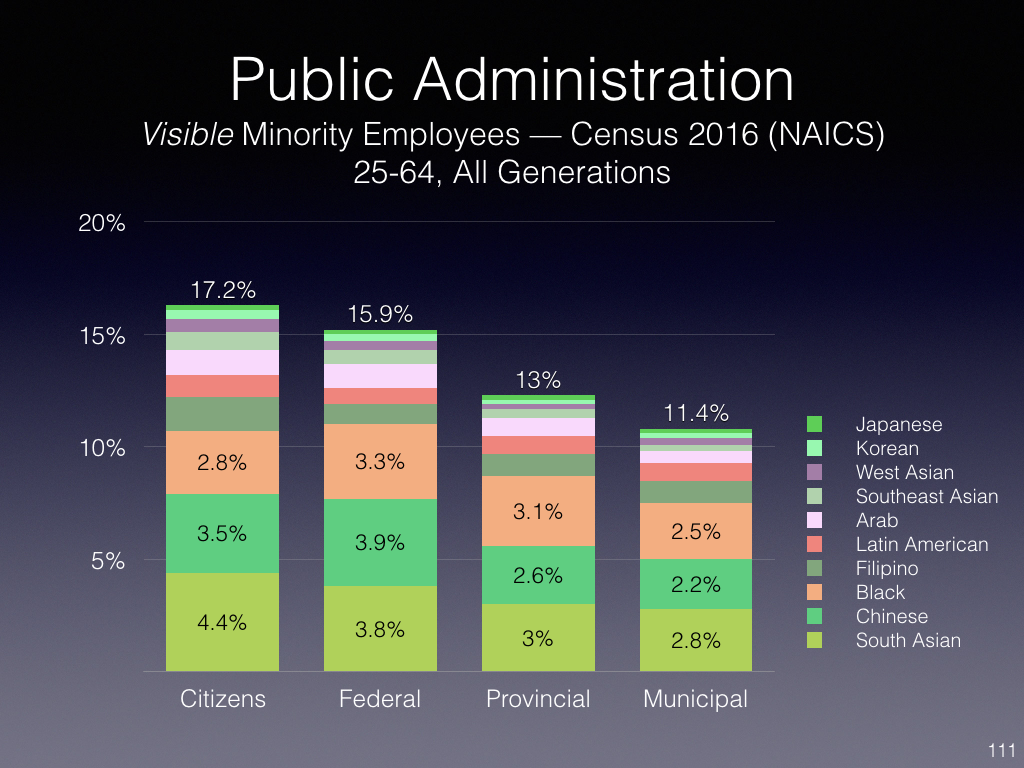
That being said, federal government representation of visible minorities, at 15.9 percent (2016 Census public administration less Canadian Forces, a number slightly higher than the most recent federal employment equity data), is relatively close to the percentage who are also Canadian citizens (17.2 percent, 2016 Census):

Ottawa’s Name-Blind Recruitment Pilot Project was launched in April 2017 to explore whether masking applicants’ names would remove bias in the hiring process for the federal public service. There was a lot to praise in this initiative of the Public Service Commission (PSC). Previous research, including some of our own, has shown that recruiters often react to the name on a resumé, independently of other factors such as education and experience. Our most recent publication (in the March issue of Canadian Public Policy) suggests that much of this discrimination is unconscious and unintentional, so employers actually could benefit from better hires by taking relatively straightforward steps to remove names during the initial stages of the selection process.

One similar and important example is the case of musicians auditioning for positions in popular orchestras in the United States. Traditionally orchestras have been male dominated, and criticized for discriminating against women. Researchers showed convincingly that orchestras that held auditions with the applicants performing behind a screen began to hire more women. Given that auditions are an effective means to observe productivity (music quality), the fact that more women were hired under this method suggests that orchestras previously were missing out on better musicians when gender was known. Most orchestras now audition using screens, showing a desire to avoid discrimination and make better hires. It’s a classic case of win-win-win: a win for women musicians getting more equal opportunity, a win for orchestras tapping a larger talent pool and a win for audiences enjoying better music.

However, the PSC’s hiring bias experiment has yet to yield such positive results. When the project report was released in January 2018, it appeared to show there was in fact “no bias” in federal public service hiring in the first place. This led Treasury Board President Scott Brison to write, “The project did not uncover bias.” National media disseminated this story. The CBC, for example, ran with the headline “No Sign of Bias against Government Job-Seekers with Ethnic-Sounding Names, Pilot Project Finds.” The article states that hiding ethnic-sounding names on resumés was found to have “no real bearing on who’s picked from the pile of applications.”

Unfortunately, this version of the results significantly misrepresents the actual findings of the pilot project. A careful reading of the report indicates that the pilot project was not really designed as a test of discrimination, and the report clearly acknowledged this fact.

The design of the pilot project included two features that would undermine its relevance in assessing the broader use of name-blind hiring. First, the project relied on departments within PSC that volunteered to take part, and within those, job openings were considered for inclusion as they arose; both features introduce a non-random element that undermines the value of the results. Second, and more important, all hiring managers in the project made their decisions knowing that they would be subject to review. For the managers using the traditional method, the awareness that their decisions would be scrutinized and compared with results from name-blind hiring made them more likely to be conscious of bias, and therefore more likely to alter their hiring decisions accordingly.

The procedure in the PSC pilot removed more than the applicant’s name; it also took out all other potentially identifying information — information that might have been useful in assessing the resumé. This was likely why anonymized applications in the pilot were less likely to lead to call-backs.

The report points out that a different study approach used to measure bias, called audit methodology, would have lessened the effect of managers’ awareness of being in a comparative study. Our own study used the audit methodology, in which employers are selected at random and are sent computer-generated resumés for assessment without advance notification. Such a procedure has been employed many times, in a number of countries.

Of course, it’s possible that discrimination against applicants with ethnic-sounding names doesn’t exist in the federal public service. For name-blinding to influence hiring decisions, there must be a problem to begin with. As the report mentions, the PSC is already taking steps to help ensure that the federal government is practising unbiased hiring, and it outlines several important initiatives.

Our research found that bias varies considerably among organizations. We’ve shown in data from Toronto and Montreal that large organizations with over 500 employees practise discrimination against applicants with Asian names about half as often as smaller organizations. This difference may well arise from a tendency for large organizations to have more policies in place to help avoid discriminatory behaviour. The potential benefits from name-blinding may be minimal for the federal government if it is already doing a good job minimizing bias.

However, to conclude that there is no bias in hiring within the federal public service on the basis of the January report — which clearly indicates that the pilot project was not designed to test bias effectively — may move efforts to promote fairness backward rather than forward. There is still a need to follow through on the good intentions that seemed to motivate the name-blind hiring pilot when it was first announced. Ideally, a study on the impact of name-blinding would first identify an organization where clear discrimination occurs, as shown through an audit, and then explore how name-blinding affects the chances of applicants getting an interview, and ultimately getting hired. Tellingly, the report suggested an audit study as a good next step “to improve the understanding of any potential bias during selection of candidates.” In fact, any organization, including the federal public service, that wishes to consider name-blind recruitment as a way to broaden its talent pool would be well-advised to consider an audit as a first step to test for bias.

It can be quite challenging to design an effective name-blind hiring procedure. The procedure in the PSC pilot removed more than just the applicant’s name; it also took out all other potentially identifying information — information that might have been useful in assessing the resumé. This was most likely the reason that anonymized applications in the pilot were less likely to lead to call-backs than traditional applications. One option would be to remove only the name, or only a very limited amount of other information in the resumés that might give away the visible minority status of the applicant. An automated tool for reviewing submitted resumés might be developed to facilitate this approach.

It’s critical that the desire of an organization to burnish its public image not stand in the way of ensuring a fair and equitable process of finding the best candidates for available jobs. It may feel great to say, “We didn’t uncover any bias.” But if bias does exist, it’s better to be able to say, “We found bias and we’ve taken meaningful steps to eliminate it.”

Source: Can we avoid bias in hiring practices?

Douglas Todd: B.C.’s foreign-buyers tax is nothing special and not xenophobic

Agree:

It is hard to find a country that allows foreigners to freely buy its land. It is much easier to find countries that restrict foreigners’ purchases of property.

But that hasn’t stopped Chinese national Jing Li, assisted by some Canadian academics, from launching a lawsuit against the B.C. government’s 20 per cent tax on foreign buyers of residential properties.

Li, an international student who used her family’s money to buy a townhouse in Langley, argues the tax illegally discriminates against people on the basis of their national origin and has been stirred up by “unfair biases and stereotypes.” UBC academics Nathan Lauster and Henry Yu produced affidavits supporting Li’s argument the tax is xenophobic, especially towards Asians and specifically Chinese.

However, based on the logic of Li, Lauster, Yu and others who made their arguments last week before a B.C. Supreme Court judge, most countries of the world are xenophobic and perhaps racist — since most countries have a range of curbs on foreign buyers of property, with Li’s own populous country, China, throwing up some of the toughest controls.

Asian countries with restrictions on foreign buyers include the biggest: China, India, Indonesia, Thailand and the Philippines, plus Singapore, Malaysia and Hong Kong. Australia allows foreign nationals to buy only new dwellings, while New Zealand is developing a surtax.

There are also special constraints on foreign buyers in Mexico and even in the U.S. Many South American nations, including giant Brazil, limit foreign owners. So do many European countries.

While Li, to the applause of some Canadian property developers, has challenged the sovereignty of B.C. and Ontario (and Manitoba and Prince Edward Island) in bringing in restrictions on foreign buyers, most countries have no compunction in limiting foreign investors.

In China, the restrictions on foreign buyers of property are tricky, onerous, costly and always changing. For starters, foreigners might be shocked to find they can never actually own “dirt” in China, because the government maintains complete ownership of all land. Foreigners and citizens can only buy buildings.

Foreign nationals in China have had to prove they have been living in the country a year before they can buy property. It’s just one of hundreds of rules that countries around the world have to control foreign ownership.

A foreign national has had to meet numerous requirements to buy a dwelling in China, including proving they have been living in the country for at least a year. That is a residency requirement Canadian politicians never raise as even a possibility.

China, like most countries, makes no gesture toward a reciprocal arrangement with Canada or anywhere else.

And the laws vary abruptly by region in China. Foreigners who want to buy a house in Shanghai, for instance, have to prove they’re married. In Beijing, foreigners have to pay taxes for at least five years before officials allow them to buy a structure. And, even after that, a foreigner in Beijing can only buy one property, which has to be residential.

China’s regulations, designed to help its own citizens, go on and on.

Since, like most Asian countries, China also allows in extremely few immigrants, it is virtually impossible to become a citizen and then buy property in the country. The foreign-born portion of the population in most Asian countries is typically less than one per cent.

Many Muslim-majority countries also restrict foreign ownership. In Indonesia, the largest Muslim nation, foreigners can’t own land but can lease apartments (though not detached dwellings). Does that mean Indonesian officials are xenophobic, or simply protecting locals?

While the surtax in B.C. and Ontario applies equally to all foreign nationals, Turkey targets specific nations in the name of protection and political strategy. Turkey won’t allow people from neighbouring Russia or Greece to buy land in its popular border regions. Cubans and Nigerians are forbidden from buying anywhere in Turkey, which also places limitations on citizens of China and Denmark while allowing others more access.

European countries have various curbs. Denmark’s housing market is highly regulated; foreign nationals from outside Europe cannot buy real estate unless they prove they are permanent residents and will live full-time in the dwelling. Even European Union citizens cannot buy summer homes on Denmark’s sought-after coast. Britain has its own limits. And though large countries like France and Germany are fairly open, small Switzerland has erected more barriers than Denmark.

Even in North America, where free-market capitalism is said to reign supreme, both of our NAFTA partners have restrictions on foreign buyers.

The U.S. has subtle constraints on foreign ownership, including convoluted tax demands. A foreigner selling real estate in the U.S. must immediately send 10 per cent of the sale value to the Internal Revenue Service, where it’s held to pay capital gains. Foreigners also usually end up paying more death taxes on their U.S. properties than Americans.

Mexico simply doesn’t allow foreigners to directly buy the deed to properties in its so-called “restricted zone,” which covers everything within 100 kilometres of its coastline. Foreigners trying to snag properties in the restricted zone have to go through a knotty legal process.

All of which suggests the foreign-buyers tax in B.C. and Ontario — compared to the incredible range of restrictions around the world — is distinctly middle of the road.

And if critics deem the foreign-buyers tax to be xenophobic or racist, they must be ready to toss the same epithets at most of the world’s nations.

Source: Douglas Todd: B.C.’s foreign-buyers tax is nothing special and not xenophobic

A quiet change in US policy threatens immigrants who apply for a change in status

Yet another example of US tightening of immigration, and removing some of the needed flexibilities for individuals and companies. It also suggests that the Trump administration is systematically going through the various policies in effect and making changes on both highly visible areas (detention) and more subtle but also impactful areas:

It went largely unremarked, just another bland procedural decision from a government agency. But a quiet policy change at the United States Citizenship and Immigration Services last month is the next step toward a nationwide purge of non-citizens.

On June 28, USCIS announced that non-citizens who apply for a “benefit”–such as an extension or change of status, a green card, or citizenship—would be placed in deportation proceedings if that benefit is denied. For years, a criminal conviction has been required to be fast-tracked for deportation. Now, merely losing your petition for visa extension, being charged with a crime, or doing something DHS considers to be criminal (even if never arrested or charged) places you on the same fast-track.

Once in deportation proceedings, the non-citizen must prove she is eligible to stay in the United States. She will not be provided a lawyer; she may be detained, sometimes with no bond. There is no right to a speedy trial, nor trial by jury. Here are a few examples highlighting the full extent of the new rule.

Jack, a foreign student, files for an extension of his visa. He’s always been in status. He moves off campus, and properly files a change of address with USCIS (he even gets the receipt). Later, the agency sends a request for evidence to his old address anyway. Jack never receives it. USCIS denies the extension of status for failure to respond. Jack now faces deportation.

Maria is in the US on a fiancée visa and files for a green card. Her US citizen husband has a good job with health insurance. Before the green card interview, Maria is diagnosed with breast cancer. The officer finds out and denies Maria’s green card, saying she’s likely to become a public charge. Maria now faces deportation.

Sam is a software engineer. His employer sponsors him for a green card—but is then acquired by another firm. USCIS denies the petition, saying there is insufficient proof the new employer can continue the sponsorship in the shoes of the old employer. Sam now faces deportation.

Nancy is disabled and came to the US lawfully on a “medical visit” visa. Her doctors need her to stay for another 6 months of treatment. Once it finishes, she can return home, but leaving early will endanger her health. USCIS denies the extension request, saying doctors didn’t adequately explain the need for her to stay in lay terms. Nancy now faces deportation.

Jen was abused by her spouse and files for protection under the Violence Against Women Act (VAWA). She suffers from severe chronic depression, and misses the deadline for a request for evidence, asking for a doctor’s report detailing the abuse. As a result, her petition is denied. Jen now faces deportation.

It’s not always easy to stay in status. Life happens. Deporting everyone who fails to dot every “i” and cross every “t” is shelling a peanut with a sledgehammer. Under the new USCIS policy change, the United States’ already unforgiving system will become draconian.

While the USCIS has always had some authority to initiate deportation proceedings, the last policy guidance on deportation, issued in November 2011, centered on criminals, fraud, and other negative eligibility indicators. That guidance has been canned. This new policy greatly expands the categories of “enforcement priority” to most of the people trying to navigate a byzantine immigration system.

It is becoming harder and harder to comply with the immigration law. Asylum law is being gutted. Immigration judges are being robbed of the little independence they had, and pressured to order removals. Families have been ripped apart to “send a message” for the “crime” of exercising their human and legal right to seek asylum. There is now a task force dedicated to taking citizenship away from people. Millions of Muslims are now legally banned from entry. The list of countries designated for Temporary Protected Status continues to shrink, and the Dreamers who grew up in this country remain in limbo.

It’s no coincidence that brown and black people bear the brunt of these attacks. This is the result of years of nativist, protectionist rhetoric peddled by groups like the Federation for American Immigration Reform, the Center for Immigration Studies, and NumbersUSA. Their work hasn’t been cheap: hundreds of millions of dollars have been poured into this effort since the inception of FAIR in 1979. Born from white nationalism, such groups have beaten the drums of war against imaginary hordes of brown and black invaders for decades.

Immigration courts currently face a staggering backlog of over 700,000 cases, and the Trump administration has complained extensively about the bureaucracy required to deal with them. Paradoxically, USCIS will now pump in another stream of cases. This system is going to explode. When it does, the next step in the white nationalist agenda will be to replace it with a new version, stripped of the due process of law.

Source: A quiet change in US policy threatens immigrants who apply for a change in status

L’appropriation culturelle, entre deux miroirs

Good discussion of different perceptions and understandings regarding the controversy over cultural appropriation in SLAV, Robert Lepage’s latest production. I found Brault’s comments particularly interesting:

Les houleux débats entourant le spectacle SLĀV, élaboré autour de chants d’esclaves afro-américains par Betty Bonifassi et Robert Lepage, ont fait de l’appropriation culturelle un sujet chaud dans les grands médias québécois ces derniers jours. Les discussions, très polarisées, semblent émerger de points de vue fort différents chez les francophones et les anglophones. Est-ce une résurgence des deux solitudes ? Y a-t-il deux façons de percevoir les questions d’appropriation culturelle au Québec ?

« Les préoccupations relatives à la représentation de la différence constituent un élément récurrent de la recherche et de la critique entourant le travail de [Robert] Lepage ; ces préoccupations ont toutefois été exprimées quasi exclusivement par des auteurs anglophones. » Cette réflexion n’est pas née des commentaires sur SLĀV, mais d’une étude de 2008 sur les Problèmes de représentation dans Zulu Time, signée par Karen Fricker, alors professeure à l’Université de Londres et désormais critique au Toronto Star.

Il y a dix ans, ce cabaret technologique mettant en scène un monde d’aéroports où, forcément, de nombreuses cultures se croisent portait des représentations de personnages de différentes origines – représentations qui avaient suscité des réactions fort différentes selon les milieux.

Plusieurs anglophones et membres de communautés immigrantes avaient réagi négativement à ce qu’ils considéraient comme des visions stéréotypées et réductrices. De leur côté, « les commentateurs [francophones] traitent fréquemment le spectacle en termes d’universalisme ». Une variété de réactions qui, selon Fricker, souligne à quel point il est dur d’établir un consensus sur une valeur universelle, un universel qui ne peut prendre forme que dans un contexte local. « Le fait que des observateurs provenant de contextes autres que le contexte francophone québécois trouvent certaines de ces représentations de la différence problématiques, tandis que ce n’est pratiquement jamais le cas des critiques québécois francophones, souligne la présence de codes et d’attentes spécifiques à la culture québécoise quant à la représentation de la différence. »

Jour de la marmotte ? Dans les protestations entourant SLĀV, surgies durant la dernière quinzaine, certains ont cru voir un fossé entre francophones et anglophones ; entre les chroniques de La Presseet celles de The Gazette ; entre le « Wake Up Quebec, and listen » émis sur Twitter par Win Butler, chanteur d’Arcade Fire, et la lecture de censure qu’a adoptée Robert Lepage lui-même.

Multiculturalisme

Pour le sociologue Joseph Yvon Thériault, le mouvement postcolonial, en raison de son origine même (voir encadré), est marqué par le milieu anglophone. « On peut dire ça aussi de la politique de la reconnaissance du multiculturalisme. Ce sont les pays anglophones qui l’ont inscrit dans leur politique », estime le professeur à l’UQAM.

Simon Brault, directeur général du Conseil des arts du Canada (CAC), admet avoir remarqué une intégration différente de questions d’appropriation culturelle chez les anglophones et les francophones. « J’ai un point de vue personnel, qui n’engage pas le CAC, issu de mes 32 ans [comme directeur] à l’École nationale de théâtre. Au Québec, dans les années 1960, on a développé avec Michel Tremblay et consorts l’idée que l’affirmation identitaire francophone passait par l’art. Et particulièrement par le théâtre. Ça s’est développé dans les années 1970 et 1980, jusqu’à penser que cette vision était universaliste et humaniste ; que la culture québécoise en est une d’affirmation, qui a permis à une nation de surmonter son statut d’opprimée. Ça s’est peut-être fait aux dépens d’enjeux des autres minorités — les autochtones, par exemple. »

Comme s’il était difficile de se voir comme colonisé et colonisateur en même temps, opprimé et oppresseur. Pour M. Brault, il y a un « choc aussi parce que M. Lepage est un immense artiste, et qu’on croit alors qu’il est inconcevable qu’on puisse questionner son travail du point de vue de l’identité. »

Au contraire, Philip S. S. Howard, professeur à l’Université McGill, ne voit pas la pertinence de considérer la différence linguistique, un angle qu’il estime même être un piège. « Ça omet le fait que les manifestants, dans le cas de SLĀV, étaient autant anglophones que francophones, et des Québécois de longue date, et que certains leaders de ce mouvement étaient des francophones — Marilou Craft, Émilie Nicolas, Ali Ndiaye, etc. À moins qu’on ne considère comme francophones québécois seulement des Blancs ? »

Le Québec, minorité francophone, a développé une relation particulière avec les concepts de minorité, de majorité et de pouvoir. Sean Michaels, auteur de Corps conducteurs (Alto) et journaliste musical, croit qu’on s’empêtre souvent dans « l’intention » quand on pense l’appropriation culturelle ou le racisme. « L’idée semble pouvoir s’activer seulement autour d’une intention de cruauté ou de supériorité. Mais il devient clair que le racisme, comme le sexisme, perdure quelles que soient les intentions, car certaines structures de pouvoir sont équivalentes ou plus fortes même que les intentions et volontés individuelles. Même quelqu’un qui veut bien faire, ou “rendre hommage”, il peut en blesser un autre en posant son geste. »

« Si l’intention est d’honorer l’histoire de l’autre, de rendre hommage, poursuit M. Howard précisément à propos de SLĀV, et que l’autre te dit “Non, ça n’honore pas mon histoire”, c’est le signal, il me semble, qu’il faut écouter. Pas s’ancrer dans sa position. »

Source: L’appropriation culturelle, entre deux miroirs

Martin Regg Cohn: Canadians should beware Premier Doug Ford using ‘illegal’ refugee claimants as a wedge to drive us apart

Agree that wedge politics being played here, arguably by both sides, with the more corrosive discourse and approach by Ford. One thing to argue over funding – yes, the federal government is largely on the hook – but another to refuse participation in all three level of government coordination and cooperation:

One week in power, and Doug Ford’s government has declared war against Justin Trudeau.

By taking aim at asylum claimants who cross into Canada.

That was fast. Don’t shed a tear for the prime minister, who can presumably take care of himself — whether rebuffing a Ford missive or repelling a Donald Trump tirade.

But ask yourself what happens to the inevitable casualties of this conflict between Queen’s Park and Ottawa:

No, not just the people crossing the border to claim refugee status. Think about the rest of us, and what this does to us — the way we treat border crossers, and the way we treat each other.

This will test all of us, not just Ontario’s new premier and his federal counterpart.

The rise in migrants slipping across the border has already challenged our border security and police officers, who have comported themselves with Canadian decency and dignity. It is testing our refugee determination system, which (lest we forget) is burdened and bound by due process.

Now, the border-crossing story that landed in Quebec a year ago, and then crossed over into eastern Ontario, has landed hard on Toronto’s doorstep. Just in time for Ford’s new Progressive Conservative team to seize on it as a wedge issue that drives people apart.

Beware the wedge that exploits refugee claimants — for while many may indeed be economic migrants gaming the system, a good number might well be legitimate victims of persecution seeking sanctuary. You never know, until you know for sure (see: due process).

Yet Ford’s government is wagging its finger at “illegal border crossers” in official statements that misstate reality and incite hostility. It is an axiom of international law that desperate refugee claimants often cross borders by hook or by crook, but that doesn’t make them criminals (it’s precisely how both my parents escaped post-war Communist Europe).

Ontario’s new minister of children and social services, Lisa MacLeod, points an accusing finger at Trudeau for supposedly triggering a mass migration when he “tweeted out that everyone was welcome here, and as a result of that, we’ve had thousands of people cross the border illegally.”

Was this truly the tweet that launched a thousand ships? Or dispatched thousands of taxis to our border, there to disgorge their human cargo on our doorstep as per the PM’s precise GPS directions?

Were it so simple, Trudeau need only delete the troubling tweet. But he never offered directions to those unauthorized border pathways, nor invitations to cross over at leisure.

Yes, Trudeau and countless Canadians took turns humble-bragging and boasting about our supposed virtue in welcoming Syrian refugees after Stephen Harper’s Conservatives behaved churlishly and Barack Obama’s America acted ungenerously. But to draw a direct line between a Trudeau tweet and an imagined human stampede to the border is to elevate the prime minister’s Twitter feed to Trumpian influence.

Let’s be clear here. The migrant movement that began last summer emanated not from any misplaced magnanimity by the PM, but from fear of a looming Trump clampdown on Haitians still enjoying sanctuary in the U.S. after a 2010 earthquake.

It bears repeating that Canada had previously ended that sanctuary status — yes, faster than the Americans — and was systematically deporting Haitians who were here back to their homeland. Oblivious to that fact, thousands of Haitians crossed over into Canada, making up 85 per cent of migrants at the outset.

Under an existing bilateral agreement, the U.S. automatically takes back any refugee claimants who show up at our side of official border crossings. But by slipping over out of sight of those official crossings, migrants exploited a loophole by which the Americans wouldn’t take them back.

Since then, there has been a long and awkward debate about what to do to avoid turning a trickle into a tide.

Federal Conservatives have suggested we declare the entire border one big crossing — as if this would force the Americans to take back their asylum claimants. But Trudeau can no more demand that Trump do as we say on refugees than he can insist that the president undo the tariffs he slapped on our steel and aluminum.

Shall we stand our ground and instruct our police to point guns and draw bayonets at asylum-seekers to keep them on the American side? Or heave them back across the border, throwing their bags after them? Do we build a Trump-style wall across our undefended border and demand Mexico pay for it?

Not really so easy, except in the virtual reality of Twitter.

It’s perfectly fair for the provincial and municipal governments to demand that Ottawa come up with the money and plans to deal with the pressure points in local facilities — in Ontario as in Quebec. To his credit, Mayor John Tory has been pressing the case for Toronto’s needs without turning people against migrants in need.

Ford’s government could learn from the mayor’s approach, instead of delegitimizing asylum-seekers as illegal, and demonizing Ottawa for following a legal framework. On Thursday, when Trudeau met him at Queen’s Park, a statement from the premier’s office declared, provocatively:

“This mess was 100 per cent the result of the federal government.”

In truth, there are no easy answers, just the certainty that public support can easily be turned against asylum-claimants if politicians want to press those buttons (see: Europe and America). All the more reason for all levels of government to start working together, rather than driving people apart.

Source: Martin Regg Cohn: Canadians should beware Premier Doug Ford using ‘illegal’ refugee claimants as a wedge to drive us apart

Millions denied citizenship due to ideas of national, ethnic or racial ‘purity’: UN rights expert

Good statement, even if the HRC is fundamentally dysfunctional:

E. Tendayi Achiume, Special Rapporteur on racism, focused on the issue of ethno-nationalism in her first report to the Human Rights Council in Geneva, whose current session ends on Friday.

In it, she highlighted the plight of millions of stateless people worldwide—often members of minority groups—who are victims of long-standing discrimination which sees them as “foreign”, even though they have been resident in a country for generations or even centuries.

Meanwhile, several countries continue to enforce “patriarchal laws” which make it impossible for women to pass down citizenship status to their children or foreign-born spouse.

In some cases, women are even stripped of their nationality upon marrying a foreigner and cannot regain it if the marriage ends.

“This is gender-based discrimination often deployed by States to preserve notions of national, ethnic and racial ‘purity,’” she said.

Ms. Achiume believes prejudice rooted in ethno-nationalism is behind racial discrimination, whether in citizenship or immigration laws.

She recalled that in the past, European colonial powers used the ideology to exclude local populations within colonies from gaining citizenship, while Jews and Roma were targeted on the same grounds, in the 19th and 20th centuries.

Today, she said, migrants are the target of political hate speech and intolerance, again often under the pretext of ethnic purity and religious, cultural or linguistic preservation.

“Countries that have long celebrated immigration as central to their national identity have taken steps to vilify and undermine immigration, with a disproportionate effect on certain racial, religious and national groups,” Ms. Achiume pointed out.

“Islamophobic or anti-Semitic ethno-nationalism undermines the rights of Muslims and Jews irrespective of citizenship status…the case of the Rohingya Muslims offers a chilling example.”

The Rohingya are a mostly Muslim minority in Myanmar, which is a predominantly Buddhist nation.

Though resident there for centuries, Ms. Achiume said many Rohingya have been rendered stateless following a 1982 nationality law that discriminates on the basis of ethnicity.

Waves of violence and discrimination have driven scores of Rohingya to neighbouring Bangladesh. More than 700,000 have arrived in the past year alone in the wake of a violent military crackdown that began in late August.

Source: Millions denied citizenship due to ideas of national, ethnic or racial ‘purity’: UN rights expert

Germany to fight anti-Semitism in schools with new team

Hard to know how effective this approach will be in terms of reach and results but important recognition of a problem, with hopefully follow-up on its effectiveness:

The German government plans to send 170 anti-bullying experts into schools after the summer break to tackle anti-Semitism among children.

“Anti-Semitism in schools is a big problem,” Families Minister Franziska Giffey said.

Last month Germans were shocked by the case of a boy aged 15 taunted by anti-Semitic bullies at the John F Kennedy School in a well-off area of Berlin.

Germany remains haunted by the Nazis’ mass murder of Jews in 1933-1945.

Ms Giffey, a centre-left Social Democrat (SPD) politician, said teachers needed more support to combat anti-Semitism, as the problem went beyond the classroom, involving parents and society at large.

“So in the coming school year, as a first step, we will send 170 anti-bullying experts into selected schools in Germany, funded by the federal authorities,” she told the daily Rheinische Post.

It remains unclear if the Jewish boy bullied at the John F Kennedy School will return there after the summer, the Berliner Morgenpost daily reports (in German). The bilingual school in Zehlendorf teaches German and American children.

Reports say one bully blew e-cigarette smoke in the boy’s face, saying “that should remind you of your forefathers” – a sarcastic reference to the Holocaust.

Bullies also reportedly drew swastikas on post-it notes and stuck them on the boy’s back.

Before 1989, Germany’s Jewish minority numbered below 30,000. But an influx of Jews, mainly from the former Soviet Union, has raised the number to more than 200,000.

How bad is anti-Semitism in Germany?

Berlin’s Anti-Semitism Research and Information Office (RIAS) says anti-Semitism is expressed on various levels, and not only by neo-Nazis, or by Muslim extremists who hate Israel.

“There is overall a worrying development of anti-Semitism becoming more socially acceptable. It has grown over the last couple of years and many cases go unreported,” researcher Alexander Rasumny at RIAS told the BBC.

RIAS documented 947 anti-Semitic incidents in 2017, including 18 physical attacks, compared with 590 in 2016. The watchdog’s annual report (in German) said the increase was partly a result of more Germans reporting such incidents to RIAS, having learnt of its work.

In an interview (in German) with the daily Der Tagesspiegel, the German government’s new anti-Semitism tsar, Felix Klein, spoke of “a brutalised climate now, in which more people feel emboldened to say anti-Semitic things on the internet and in the street”. “Previously that was unthinkable, but the threshold has dropped.”

What other incidents have hit the headlines?

In April two young men wearing traditional Jewish skullcaps (kippahs) were assaulted in Berlin. The attacker, a 19-year-old migrant from Syria, was filmed shouting anti-Semitic abuse.

Later Josef Schuster, president of the Central Council of Jews in Germany, advised Jews to avoid wearing kippahs. But in solidarity, thousands of Berliners wore kippahs on 29 April, declared an “action day” against anti-Semitism.

Two German rappers, Kollegah and Farid Bang, were investigated recently over their gangsta rap lyrics which referred insultingly to Auschwitz victims and the Holocaust.

They were not prosecuted, but were taken on an educational visit to Auschwitz, where the Nazis murdered an estimated 1.1m Jews during World War Two.

Rhetoric from the far-right Alternative for Germany (AfD) has fuelled concern about anti-Semitism. An AfD leader, Björn Höcke, drew strong criticism after he condemned Berlin’s Holocaust memorial.

Why this focus now on schools?

Mr Schuster says schools must take anti-Semitism seriously and not sweep it under the carpet.

“Such incidents happen in all types of school and all over Germany,” he warned.

One boy subjected to anti-Semitic taunts at a Berlin school was given a separate room to use during breaks, as well as a separate entrance, RIAS reported.

Another Jewish boy was removed from a school by his parents after a gang had tormented him for months and threatened him with a realistic-looking toy pistol.

Mr Rasumny told the BBC that anti-bullying action had to involve awareness training for teachers, because “they don’t always recognise current forms of anti-Semitism, or know when and how they should intervene”.

There have been cases of anti-Semitism even among kindergarten children.

There is much under-reporting of incidents in schools, Mr Rasumny said. “There is pressure to conform to the rules, not to be different, and often kids report bullying only if they can’t stand it any more,” he said.

In one case, he said, a Jewish music teacher had left a school after being told by a pupil there that “God wants Jews to die”. It emerged that another teacher had said something similar to the child’s mother.

German schools should teach children about Jewish history and culture as a whole, Mr Rasumny said, in order to tackle anti-Semitism. “It’s very important to educate about the Holocaust, but German Jewish history did not just start in 1933 and end in 1945,” he said.

Source: Germany to fight anti-Semitism in schools with new team