Ottawa cuts off financing to Edmonton centre for newcomers over sexual misconduct allegation

Appropriate:

Immigration Canada has lost its trust in an Edmonton centre for francophone newcomers and is putting an early end to its financing agreement, according to a letter sent to the organization after a sexual misconduct allegation against a former director surfaced.

The government’s decision was taken due to the “inaction” of the board of the Centre d’accueil et d’établissement du nord de l’Alberta (CAE) after it was alleged Georges Bahaya engaged in sexual misconduct toward a client.

Originally from the Democratic Republic of the Congo, the client accused Bahaya of victimizing her in 2010.

Bahaya was fired in June 2018. The CAE told Radio-Canada that Bahaya was fired without cause, in the interest of the people who obtain services from the centre.

The organization offers support and services to French speakers who have recently moved to northern Alberta.

In a letter dated Oct. 18, David Manicom, assistant deputy minister of settlement and integration, suggested that the board failed to adequately investigate the allegations.

“The actions, the statements and the inaction of the CAE’s board have caused the ministry to lose its trust in the organization,” Manicom wrote in the letter.

CBC has obtained a copy of the letter, which was sent to CAE interim director Béda Kaji-Ngulu.

“The board’s president [Paul Dubé] publicly defended the former director [Bahaya], even though no measures were taken to verify the allegations against him,” Manicom wrote.

The CAE hadn’t responded to the multiple concerns raised by the ministry when allegations of  Bahaya’s inappropriate behaviour first surfaced last January, reads the letter.

“Consequently, the ministry is not convinced that the CAE can offer services to newcomers in an environment that is safe and secure.”

Immigration Canada will end its financing of several million dollars in March 2019, according to the letter. The exact value of the current contract isn’t known, but under a three-year deal, from 2013 to 2016, the organization received about $3.5 million.

Manicom wrote that the CAE should start winding down its operations and advise staff that their employment will come to an end.

Community wants to ‘clean house’

Members of Edmonton’s francophone community met on Tuesday to discuss how to continue offering establishment services to newcomers.

“It’s important to have a welcoming organization that is run by and for francophones,” said Marc Arnal, president of the Association canadienne-française de l’Alberta (ACFA), a provincial body that oversees services for the francophone community.

The members of the CAE’s board must be replaced, Arnal said.

“It must be recognized that the situation was not handled the way it should have been.”

Community members hope “cleaning house” will convince Ottawa to reinstate the CAE’s financing.

But Dubé, the board’s president, has no intention of stepping down at this time.

He maintains that the board acted in good faith, and that Immigration Canada is overreacting to the situation.

“Isn’t there a disproportion between the accusations against the board and the punishment imposed?” Dubé said Wednesday at an open community meeting.

“Our intentions were those of responsible people, dedicated to their mandate.”

Source: Ottawa cuts off financing to Edmonton centre for newcomers over sexual misconduct allegation
UK: Sajid Javid apologises to immigration applicants forced to give DNA samples

He almost appears to be the “Minister of Apologies” for the measures instituted under former Home Secretary and current PM May:

The home secretary has apologised to immigrants – including to Afghan nationals who worked for the British armed forces and Gurkha soldiers – who were forced to provide DNA samples under the government’s hostile environment agenda.

People seeking to live and work in the UK on the basis of a family relationship can choose to provide DNA to prove a relationship to support an application.

But Sajid Javid told the House of Commons that in June it became apparent that the provision of DNA evidence had been made a requirement and was “not simply a request” in a number of family visa applications.

A review into the scandal published by the Home Office on Thursday found that at least 449 demands for DNA were issued, including 51 to Gurkha soldiers.

Ministers have previously revealed that 1,150 Afghan nationals, including 700 family members and parents of those employed by UK government, have been relocated to UK under a scheme targeted by the mandatory DNA testing, although the exact number subject to the tests is unknown.

Yvette Cooper, Labour chair of the home affairs select committee, said: “The revelation that the Home Office has been unlawfully requiring DNA tests in hundreds of immigration applications is deeply troubling and, coming after the Windrush crisis, suggests that something has gone very wrong in the Home Office again.”

“Today I want to take this opportunity to apologise to those who have been affected by this process,” Javid said.

Javid said he had set up a new taskforce for anyone who felt they had been wrongly required to provide DNA evidence for an immigration application. But he added he would order a broader review into Home Office processes to ensure the department was “fit for the modern world”.

“I know that the immigration system is operated by many highly committed people but we must make sure that the structures and processes they use are fit for the modern world and fit for a new immigration system which we will be bringing in after we leave the European Union.

“I will be reviewing the structures and processes more broadly, the structures and processes that we have to ensure they [are] fair and humane. I will now consider what form that review will take.”

Javid said he had issued instructions that officials must not mandatorily seek DNA evidence and would be looking to reimburse any individual who experienced financial loss as a result of the problem. He said they would also be examining whether DNA had been illegally demanded in any other area of the immigration system.

The home secretary said the issue came to light over the summer and an internal review was immediately ordered. The review had finished but there was further work to to be done to establish the scale of the problem, Javid said.

“But regardless of the numbers of the people that have been affected, one case is one too many,” he said. “I’m determined to get to the bottom of how and why in some cases people can be compelled to supply DNA evidence in the first place.”

The majority of cases identified were part of a Home Office operation called Operation Fugal, which started in April 2016, to clamp down on alleged fraud in some family and human rights immigration applications.

Almost 400 letters sent as part of the operation incorrectly stated that the applicant had to provide DNA evidence and that not providing such information without a reasonable excuse would lead to their application being refused on suitability grounds.

Javid said 83 applications were refused, including seven solely for the failure to provide DNA evidence. A further six appear to have been refused for failure to provide DNA evidence where this was not the sole reason.

In addition, the home secretary said the illegal requirement to provide DNA had been applied to Gurkha soldiers and Afghan nationals who had worked for the UK government.

In January 2015, a scheme was expanded to allow adult dependant children of Gurkhas discharged before 1997 to settle in the UK, Javid said.

Guidance was published that stated DNA evidence might be required and that applications could be refused if that evidence was not provided without reasonable excuse within four weeks.

“This published guidance was wrong and has now been updated,” Javid said, adding that there were 51 cases identified where DNA evidence was requested from applicants at their own cost.

There were four cases from the same family who had their application refused solely because they did not provide DNA evidence.

In 2013, applications from Afghan nationals formerly employed by the UK government to resettle in the UK were welcomed. But the terms of the scheme included mandatory DNA testing for family groups paid for by the UK government, Javid said.

Investigations suggest that no one making an application under this scheme has been refused because they did not take a DNA test, he said. “Nonetheless mandatory testing should not have been part of this scheme and this requirement has now been removed,” the home secretary continued.

“In particular I would like to extend my apology to the Gurkhas and Afghans that have been affected. The two schemes I’ve described were put in place to help the families of those who have served to keep our country safe. I’m sorry that demands were made of them that should never have been.”

Diane Abbott, the shadow home secretary, said: “Abuses like this don’t fall from the sky. Officials at the Home Office have been carrying out the government’s hostile environment policy, which is also what led to the Windrush scandal. People are being treated as guilty or illegal unless they can prove their innocence.

“We need a fair and robust immigration system, but the hostile environment isn’t it and the government should end it.”

Steve Valdez-Symonds, Amnesty UK’s refugee and migrant rights programme director, said: “The Home Office has once again been exposed as being a law unto itself. The home secretary needs to face up to the fact that problems in his department are systemic, chronic and deep-rooted.”

Source: Sajid Javid apologises to immigration applicants forced to give DNA samples

President Trump Isn’t Breaking Immigration Arrest Records

Cato Institute does some of the better analysis of US immigration policies and practices:

President Trump has made no secret about his intentions to deport illegal immigrants. His statements as well as administrative actions to remove certain guidelines that focused enforcement efforts on criminals has understandably caused a lot of concern among illegal immigrants, their American families, and those concerned with their plight. They should take comfort that the Trump administration’s efforts to boost arrests, the necessary precursor to a deportation, are stymied by limited local and state law enforcement cooperation with the federal government when it comes to identifying illegal immigrants.

Recently released data on the number of arrests by Immigration and Customs Enforcement (ICE) shows that they are arresting many fewer illegal immigrants under Trump’s administration than under President Obama’s, at least through June of 2018.  During the first full 17 months of the Obama administration, from February 2009 through June 2010, ICE arrested 437,671 illegal immigrants.  For the same first full 17 months of the Trump administration, ICE arrested 226,138 illegal immigrants, about half the number arrested during the same period in Obama’s administration.

Relative to the last full month of the previous administrations, the number of ICE arrests under Trump is up by a whopping 37 percent (Figure 1).  Over the same time, President Obama’s ICE was arresting 25 percent more people than under the last full month of the Bush administration, quite a significant increase on its own.  The increase under Trump is larger as a percentage because it started from a low base, but the increase in the number of arrests under Obama was larger.  For instance, the number of arrests under Obama was 5,803 greater in June 2010 than in December of 2008.  At the same point in the Trump administration in June of 2018, the number of arrests was up 8,965 over December 2016.

There are two broad categories of arrests by the ICE.  The first is called custodial arrests, which is when ICE picks up an illegal immigrant arrested by another law enforcement agency such as state or local police departments.  The second is called ICE arrests, which is when ICE itself arrests illegal immigrants on the streets.  Figure 2 shows that the number of custodial arrests have fallen dramatically since October 2008 while the number of ICE arrests has stayed relatively constant.  This means that local and state non-cooperation with ICE works to reduce the number of ICE arrests as between 70 percent and 90 percent of those arrests are custodial over the entire time.

Some states, like Texas, are fully cooperating with ICE when it comes to immigration enforcement while others like California are resisting mightily.  In Texas, there were 3,963 ICE arrests in May 2018 compared to 2,584 in December 2016, a 53 percent increase.  In California, there were 1,587 ICE arrests in May 2018 compared to 1,356 in December 2016, a 17 percent increase.  ICE is more active everywhere in the country, in sanctuary states and non-sanctuary states, but the difference is stark across such jurisdictions.

The federal government under Presidents Bush and Obama convinced virtually every locality in the United States to sign up for the Secure Communities program that essentially turned over the vast majority of the arrested illegal immigrants to ICE for deportation.  Since President Obama was a Democrat, there was little initial political opposition to the massive increase in states and localities cooperating with the feds via Secure Communities – especially in Democratically controlled states with large numbers of illegal immigrants.  However, political reluctance to cooperate via Secure Communities built rapidly.  In 2011 Massachusetts, Illinois and New York requested to opt out of the program.  States like California then limited statewide cooperation with ICE and then President Obama replaced Secure Communities with a less punitive version called the Priority Enforcement Program that targeted criminals, which was in effect from 2015 to 2017.  Today, most states and localities with large numbers of illegal immigrants are not cooperating with President Trump’s ICE nearly as much as they cooperated with President Obama’s ICE – which is preventing Trump from arresting and, eventually, deporting large numbers of illegal immigrants.

There are other, lesser reasons why the Trump administration is unlikely to reach President Obama’s deportation record.  One is bureaucratic incompetence in the Department of Homeland Security, the Department of Justice, and other executive branch chaos that has so far prevented an orderly and organized deployment of law enforcement resources.  As a partial result of those administrative problems, they are incapable of convincing states and localities to enforce federal immigration laws.  Another reason is that illegal immigrants in 2018 are savvier than they were in the past, are better able to avoid law enforcement, and the few who were criminals were deported over the years, fewer new illegal immigrants have taken their place, and those remaining are less likely to come into contact with law enforcement.

State and local government reluctance to enforce federal immigration laws and cooperate with the Trump administration has limited its ability to arrest and, eventually, deport large numbers of illegal immigrants.  At the current rate, ICE under the Trump administration will be able to arrest about half a million fewer illegal immigrants relative to the Obama administration even if President Trump serves two full terms.  Those who are dispirited by the Trump administration’s efforts to deport large numbers of otherwise law-abiding illegal immigrants should take some solace that their efforts to block full local and state cooperation with ICE is bearing fruit.

Source: President Trump Isn’t Breaking Immigration Arrest Records

How to understand Salafism in America: The Economist

Expect similar differences in Canada:

THE word “Salafism” is often used loosely, especially in continental Europe. When the relationship between Islam and jihadist violence is discussed in, say, France or Germany, the assumption is often made that the problem begins and ends with the Salafis—who put overwhelming emphasis on the first three generations of Muslims and who are thought to have professed the faith at its purest. This Franco-German sloppiness can be bewildering to Islam-watchers in Britain where Salafis have at times been encouraged to play a part in countering terrorism.

In fact, as anyone who studies the Salafi phenomenon quickly realises, things are far from simple. Scholars generally distinguish three strands of Salafism. First, there is the apolitical, quietist sort which favours intense conservatism in dress and personal life and eschews most kinds of involvement with the modern world. Then there are more activist Salafis who share the impatience of the Muslim Brotherhood to see the replacement of relatively secular governments in Islam’s heartland by religiously inspired regimes. They are not quite as energetic, or as pragmatic, as the Brotherhood’s members but they are influenced by Brotherhood thinking. And thirdly, there are jihadist Salafis who think the only appropriate response to the decadence of the modern era, and to a lack of zeal in the historically Muslim world, is violence. All three strains share a suspicion of democratic institutions that confer on fallible human beings an authority that, as they see things, should belong only to God.

In a new report, published under the Programme on Extremism at America’s George Washington University, Alexander Meleagrou-Hitchens shows that all three forms of Salafism have flourished, albeit with considerable ebbs and flows in their fortunes, on American soil in recent decades. He agrees that the distinction between the three forms of Salafism should be maintained, but also stresses they are not hermetically sealed categories, and that important individuals have moved between them.

Confusingly, the author notes, Salafist thinking (whose hallmarks include deep suspicion of the modern, secular world) has been disseminated by some people who do not themselves accept the label of Salafi. One such person is Muhammad Syed Adly, an influential imam based in South Carolina who urges Muslims to focus on Islamic education and avoid secular education and worldly politics. He has encouraged American Muslims to consider alternatives to regular public schools where their children might pick up liberal ideas about gender and sexuality.

As an example of quietist Salafism, Mr Meleagrou-Hitchens cites the Quran and Sunnah Society (QSS) which flourished across the United States both before and immediately after its formal incorporation in Ohio in 1995. Its back-to-basics message, driven home with tapes from Saudi clerics, appealed both to Arab students in America and to African-Americans who had embraced Islam in a spirit of black power and wanted to hew close to the faith’s fundamentals. As the author points out, Salafism’s utter rejection of secular institutions appealed to some African-Americans who felt the American system had nothing to offer them. Although the QSS eventually went into terminal decline, its legacies apparently include a contingent of American Muslims who are fiercely protective of Saudi Arabia and its clerics.

To show how jihadist Salafism can be generated on American soil, the report looks at some notorious individuals such as Ali al-Timimi (pictured), who was born in Washington, DC, spent part of his teens in Saudi Arabia and later returned to the United States where he gained a doctorate in computational biology. In 2005 he was jailed on ten charges including enlisting people to wage war against America and helping the Taliban. His case, according to the new report, “is a fascinating case study due to his steady progression across the wider American Salafi milieu: from student of the traditional quietist Saudi sheikhs…to an open promoter of Salafi jihadism.”

But of course, quietist Salafism doesn’t always lead in an extremist direction, as the author also stresses. As an example of that point, he cites a school of “post-Salafis” who “have contributed to the development of Americanised version of Salafism” that combines conservative theology with a constructive engagement with national and international issues.

In other words, American Salafism (for all its professed emphasis on simplicity) is irreducibly prolix. Given how many lives could depend on getting things right, it is worthwhile engaging with that complexity.

Source: How to understand Salafism in America

Signes religieux: le feu sous la cendre

Good commentary:

La mairesse Valérie Plante et le chef de l’opposition à l’Hôtel de Ville de Montréal, Lionel Perez, ont eu la sagesse de refuser de se lancer prématurément dans un débat sur les signes religieux, mais ce n’est que partie remise.

La motion du conseiller indépendant de Snowdon, Marvin Rotrand, qui semble se complaire dans le rôle du boutefeu, était d’ailleurs sans objet. La CAQ n’a jamais évoqué la possibilité d’interdire le port de signes religieux aux élus, que ce soit à l’Assemblée nationale ou au niveau municipal. La charte de la laïcité du gouvernement Marois ne le prévoyait pas non plus.

M. Rotrand soutient avoir obtenu l’assurance que les élus de Projet Montréal et d’Ensemble Montréal auraient appuyé sa motion si celle-ci avait été mise aux voix. Cela est en effet probable, mais quel aurait été l’intérêt d’enfoncer une porte ouverte, sinon d’envenimer un débat qui est déjà suffisamment explosif ?

M. Rotrand n’en est pas à sa première intervention du genre. Au printemps dernier, il avait demandé au Service de police de la Ville de Montréal (SPVM) d’autoriser ses agents à porter le hidjab ou le turban, comme c’est le cas dans de nombreux corps policiers municipaux ailleurs au Canada, que ce soit à Toronto, Vancouver, Calgary ou Edmonton, ou encore dans la GRC.

Aucun policier en service au Québec n’avait manifesté l’intention d’en porter, mais une jeune étudiante en techniques policières du collège Ahuntsic, Sandos Lamrhari, qui souhaite faire carrière au SPVM ou au Service de police de la Ville de Laval tout en portant le hidjab, avait été érigée en symbole par le premier ministre Couillard, qui voyait en elle l’incarnation d’un Québec confiant dans l’avenir, où tout le monde peut participer.

Là encore, il était permis de s’interroger sur l’opportunité de provoquer ce débat, puisque le gouvernement libéral refusait d’interdire à qui que ce soit de porter des signes religieux, pour autant que le visage soit découvert, contrairement à la recommandation de la commission Bouchard-Taylor. Il entendait plutôt laisser à chaque corps policier le soin d’établir son propre code vestimentaire. Or, la direction du SPVM se disait ouverte à toute demande, tout comme la mairesse Plante.

Le changement de gouvernement rend cependant le débat inévitable. Si le premier ministre Legault n’exclut pas que les enseignants puissent échapper au projet de loi que présentera éventuellement le ministre de l’Immigration, de la Diversité et de l’Inclusion, Simon Jolin-Barrette, il n’y aura pas de recul dans le cas des agents de l’État exerçant un « pouvoir de coercition », notamment les policiers.

La constitutionnalité du projet sera contestée à coup sûr. M. Jolin-Barrette se dit convaincu que son projet passera le test des tribunaux. Sinon, M. Legault a réitéré dès le lendemain de l’élection qu’il était prêt à invoquer la disposition dérogatoire (« clause nonobstant ») prévue dans les chartes des droits. D’une manière ou d’une autre, l’interdiction du port de signes religieux finira donc par avoir force de loi.

Ce débat risque d’accentuer encore davantage le clivage entre l’île de Montréal et le reste du Québec, dont la dernière élection a donné une illustration spectaculaire. Le feu couve sous la cendre et il ne faut pas sous-estimer le risque de dérapage. Il y a à peine deux semaines, le maire de l’arrondissement de Pierrefonds-Roxboro, Dimitrios Jim Beis, s’en est pris férocement à la CAQ, dont il dénonçait les « politiques perçues comme racistes ».

« La CAQ instrumentalise la laïcité comme un cheval de Troie pour la mise en oeuvre de politiques d’exclusion et de division. Aucun Québécois ne devrait avoir à choisir entre sa carrière et sa foi », écrivait-il sur Facebook. Des propos qui avaient un désagréable accent de déjà entendu.

On peut légitimement plaider que, dans une ville aussi multiethnique que Montréal, la population fera davantage confiance à son corps policier si sa composition reflète la diversité ambiante. La commission Bouchard-Taylor avait pris cet argument en compte, mais avait néanmoins conclu que la nécessité d’incarner pleinement la neutralité de l’État l’emportait dans le cas des policiers.

À l’Hôtel de Ville de Montréal, on trouvera sans doute cette interdiction excessive, même si le projet de loi de M. Jolin-Barrette sera nettement moins contraignant que l’était celui de Bernard Drainville, qui visait, au terme d’une période de transition, l’ensemble des employés d’une municipalité.

Le gouvernement Couillard accordait aux divers corps policiers, donc aux municipalités, le droit de définir leurs propres règles. On ne parle cependant pas ici d’aménagement urbain, mais d’un principe directeur applicable à toute la société québécoise. L’expression de la neutralité de l’État ne peut pas être à géométrie variable. Que cela leur plaise ou non, il n’appartient pas aux municipalités d’en fixer les paramètres, mais au gouvernement élu par l’ensemble de la population du Québec.

Source: Signes religieux: le feu sous la cendre

Quebec wants to expand religious symbol ban, blocking Muslim garments in civil service

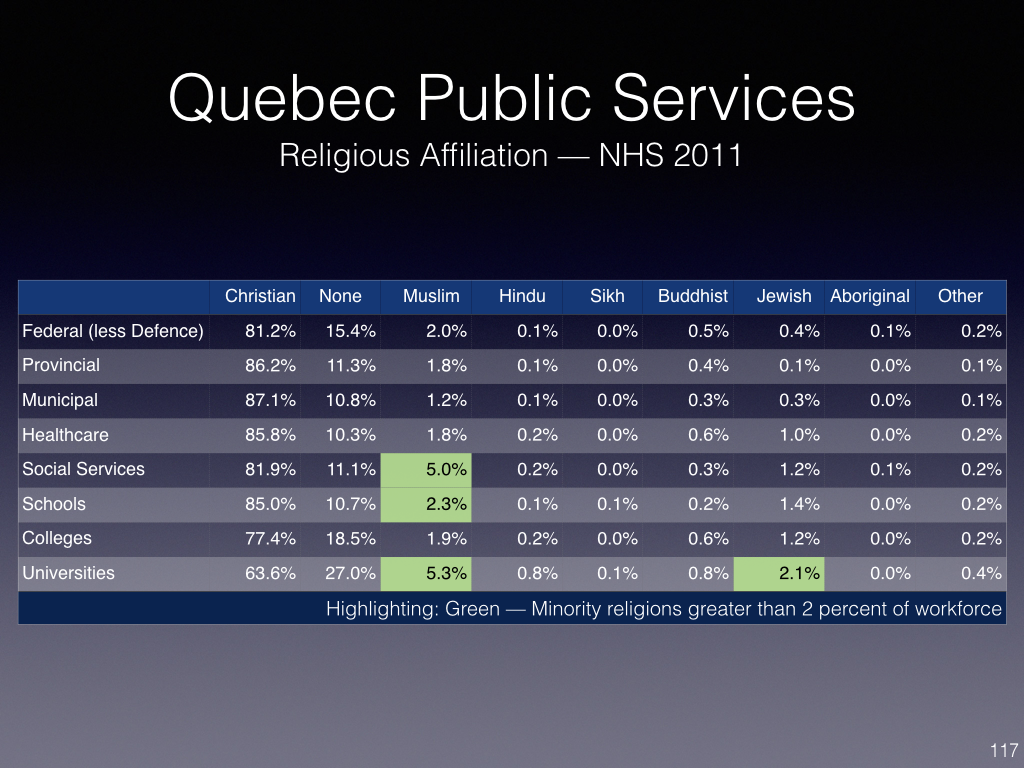
The 2011 National Household Survey, indicated a very small number of Muslim Quebecois in the public service (along with other religious minorities):

Quebec’s new government is planning to block Muslim women who work in the civil service from wearing the chador, a shawl-like piece of clothing that covers the head and body, and the niqab, which also covers the face.

Coalition Avenir Québec ​Premier François Legault has already made clear his intention to prohibit those who hold positions of authority including teachers from wearing religious symbols, such as the hijab, a Muslim headscarf.

The ban on the chador and niqab, however, would extend to all employees in the public sector. A representative from the CAQ couldn’t say how many people such a ban would affect.

Immigration Minister Simon Jolin-Barrette, the government’s point person when it comes to ensuring the secularism of the state, said Wednesday the government plans to “move quickly” to introduce a law.

“It was always our position to prohibit the chador in the public service,” said Jolin-Barrette, in response to questions following a report in the Journal de Montréal about the government’s stance.

There is no mention of banning the garments in the CAQ’s online platform, but the party has played up its commitment to such a policy in the past.

In 2016, the CAQ said on Twitter that it would “defend Quebec values” by banning the chador, unlike its rivals, the Liberals and the Parti Québécois.

Jolin-Barrette said it was too early to provide details on exactly how and when the law would be implemented.

Later on Wednesday, Legault said a law prohibiting religious symbols isn’t “a priority” for the CAQ, which created some confusion about the issue.

“One important value is equality between men and women, so we want to protect that. Now, is this a priority? No,” he said.

‘Surreal’ debate

Montreal lawyer Shahad Salman, who wears a hijab, said she is discouraged the new government — and the media —  continues to focus on identity issues “rather than talking about real issues.”

“It’s so surreal that we’re talking about this again, honestly,” she said. Salman said such debates are counterproductive if politicians want minorities to become more integrated into Quebec society.

As it stands, when it comes to minorities in Quebec’s civil service, the percentage doesn’t reflect the overall population.

Visible minorities made up 9.4 per cent of the province’s public workforce in 2017, although they constitute 13 per cent of the overall population, according to a study by the Institut de recherche et d’informations socio-économiques,

The chador, which covers the head and body but leaves the face exposed, is a garment commonly worn in Iran, where this photograph was taken. (Hasan Sarbakhshian/Associated Press)

The CAQ’s planned ban on religious symbols has been criticized by civil rights advocates who contend the policy will further marginalize vulnerable minorities.

Charles Taylor, author of a landmark 2008 report on the accommodation of religious minorities in the province, called the proposal “either very ignorant or very intellectually dishonest.”

In a recent interview, he pointed out that his report explicitly recommended against including teachers in a ban on the wearing of religious garb.

“We meant it to apply only to people with functions that we called ‘coercive authority’ — police and judges. Functions that can put you in jail,” Taylor said.

Lacking ‘coherent plan,’ Liberals say

The CAQ won a decisive majority in the Quebec election earlier this month, beating out Philippe Couillard’s Liberals.

Pierre Arcand, the interim leader for the Liberals, said the CAQ doesn’t appear to have a “coherent plan” when it comes to religious symbols.

The new government appears to be floating a new trial balloon every day, he said.

Arcand said he would reserve comment until a bill is tabled.

Source: Quebec wants to expand religious symbol ban, blocking Muslim garments in civil service

Australian senator who called for ‘final solution’ to immigration expelled from party

Too extreme even for Pauline Hanson, the leader of the right-wing nativist One Nation party, found his comments too extreme:

Katter’s Australian party has ejected its only senator, Fraser Anning, from the party over his statements about “non-European” migration two months after he made a speech calling for a “final solution” to immigration.

Despite the party leader, Bob Katter, backing Anning’s comments in August, the party drew the line on Thursday, ejecting Anning for ignoring directives not to distinguish between “European” and “non-European” migration because to do so was clearly racist.

The party was under increasing pressure to ditch Anning due to a withdrawal of union support and then a threat by the Labor party to direct preferences away from the Katter party in response to the racial furore.

In his first Senate speech in August, Anning praised the White Australia policy, called for an end to Muslim migration and invoked the term “final solution”. Katter, the federal leader of Katter’s Australian party, declared the speech had his “1,000% support”.

In a statement on Thursday, the president of Katter’s Australian party, Shane Paulger, said that “99% of what Senator Anning has been saying is solid gold” but “1% … is totally unacceptable”.

Paulger revealed that both he and Katter had told Anning “there was to be no more use of words like ‘Europeans’ and ‘non-Europeans’”.

“Clearly that is racist; clearly our policies are anti-racist,” he said.

Paulger said that in the title of his plebiscite (restricting non-European migration) bill and a proposed press release, Anning “used the same racial language” despite warnings of “extreme hostility” if he persisted.

“Clearly his divide of ‘European’ and ‘non-European’ would prevent, for example, Sikhs and Filipinos coming to this country,” he said. “His bill said the people should have the last say and that Australia’s policies should favour European migration. Both these things are true.”

Paulger defended the party’s decision to back Anning after his inaugural speech, noting that its policy supported favouring “people who can integrate into our community” and because they felt they knew “what he was getting at” with his warnings against Muslim migration.

He said that 640,000 people that came to Australia every year “overwhelmingly” come from countries without democracy, the rule of law, industrial awards, egalitarian traditions and “Judeo-Christian spiritual belief systems”.

Paulger said Katter’s Australian party supported bringing “persecuted minorities” from the Middle East and North Africa including Christians, Jews and Sikhs, and there should be “no restrictions” on Pacific Islanders coming to Australia.

“In spite of the most severe and clear warnings, Senator Anning has continued down this pathway and consequently we announce the termination of his endorsement by the KAP,” he said. “Clearly Fraser wants the freedom to pursue his crusade. And we think it is best for he and the party to give him this freedom.”

Anning responded to his expulsion from the party in a statement on Thursday night, saying Katter’s press came as a surprise to him.

“I never asked to join KAP,” Anning said. “Bob and other senior party members repeatedly asked me to do so and I only agreed on the grounds that I was free to speak out on immigration, the United Nations undue influence on Australia, stopping foreign aid and the persecuted white South Africans.

“At the time I made my maiden speech, Bob said he supported it 1,000% and Shane Paulger and KAP backed me. I haven’t changed my position but it seems that they have.”

Anning denied being told not to talk about “European” and “non-European” immigration by his party. “How can calling for a plebiscite on a predominantly European immigration program be ‘pure gold’ when I gave my maiden speech on 14 August and somehow ‘racist’ two months later?”

With the exception of Katter’s Australian party, Anning’s first speech was universally panned. Even Pauline Hanson, the leader of the rightwing nativist One Nation party that helped elect Anning to the Senate, decried it as “straight from Goebbels’ handbook from Nazi Germany”.

The speech was criticised by the then prime minister, Malcolm Turnbull, the current deputy Liberal leader, Josh Frydenberg, Labor and the Greens.

Source: Australian senator who called for ‘final solution’ to immigration expelled from party

Editorial: Trump’s cruel rule to strip H-1B spouses of the right to work

The Trump administration is moving forward with its much-criticized plan to strip working rights from about 100,000 foreign citizens in the U.S., many of whom live in the Bay Area.The Department of Homeland Security has announced that its new rule to ban the spouses of H-1B visa holders from working will be issued next month.

“Some U.S. workers would benefit from this proposed rule by having a better chance at obtaining jobs that some of the population of the H-4 workers currently hold,” the department said in the notice, as way of explanation for its actions.

In other words, this move is part of President Trump’s “Buy American, Hire American” executive order, which was signed in 2017.

The Trump administration has already slowed the flow of H-1B visas,which are a linchpin of the Bay Area’s technology industry.

Trump himself has made it clear that he wants to make major changes to the controversial visa program. But it’s particularly cruel for his administration to launch a broadside against H-1B visa holders by banning their spouses from working.

Researchers at the University of Tennessee have estimated that 93 percent of H-4 visa holders are women from India.

Many of these women are highly educated; most are in their prime working years. By stripping H-4 visa holders of their right to work, the Trump administration is effectively denying a discrete group of women the opportunity to have economic independence and to provide for their families.

The rule change will also have an outsize impact on the Bay Area.

Many Bay Area residents who hold H-4 visas have told news organizations that, should the Trump administration go forward with this rule change, they and their families will probably have to leave the area or even the U.S.

That’s a brain drain this dynamic region can ill afford.

The Trump administration must leave the H-4 visa program alone.

Source: Editorial: Trump’s cruel rule to strip H-1B spouses of the…

Canada deemed U.S. a safe country for asylum-seekers

My assumption is that the review, conducted over a year ago, is likely under continuous review given the ongoing changes in US immigration policies under the Trump administration, as suggested in the article:

Canadian immigration officials have determined that the United States remains a safe country for asylum-seekers, despite the Trump administration’s crackdown on what it terms illegal aliens.

Documents obtained by the Canadian Press under access-to-information law show Canada was concerned about the changes in U.S. immigration policy and conducted a review of its Safe Third Country Agreement with the U.S. from January to March of 2017.

The review came after U.S. President Donald Trump issued a number of executive orders on immigration, including one aimed at beefing up border security to “end the abuse of parole and asylum provisions” that delay and complicate the removal of undocumented migrants to the U.S.

Canada’s analyses of these U.S. policies were redacted from the documents. However, the overall conclusion reached by Canadian officials was that the United States “continues to meet the requirements for designation as a safe third country.”

The Safe Third Country Agreement between Canada and the U.S. is based on the core principle that someone seeking refugee protection must file his claim in the first safe country he arrives in, unless he qualifies for one of a few exceptions.

The other core tenet is that Canada considers the United States a safe country for refugees. So, if an asylum-seeker comes to Canada at an official border crossing from the U.S. and tries to claim refugee protection, she will be refused entry and encouraged to make her claim in the U.S. — the “safe country” from which she just came.

For a country to be designated safe, it must comply with the United Nations Convention against Torture and the UN’s Convention Relating to the Status of Refugees, and it must maintain a good human rights record.

Internal government documents show that in 2015, Canada decided to continue monitoring its designation of the United States as a safe country. Any developments in the U.S. that could prevent it from meeting this designation — notably, any changes to policy or practices that could “significantly weaken asylum protections provided by the United States and its human rights record” — are regularly monitored, according to a briefing note prepared for Immigration Minister Ahmed Hussen in March 2017.

Just one month after completing one of those regular reviews in December 2016, immigration officials undertook another in the wake of Trump’s 2017 executive orders and new guidelines that were issued to U.S. border officials on how to handle asylum-seekers.

As part of this review, detailed policy-directive memos from then-U.S. secretary of homeland security John Kelly were examined.

The memos, which were sent to the heads of all U.S. agencies that deal with immigration and border security, detail strict and heavy-handed enforcement measures that were to be unleashed against asylum-seekers in the U.S., including automatic detention of migrants — whom Kelly refers to as “aliens” and “illegal aliens” — pending a final determination of whether they would be ordered for removal.

Other measures outlined in Kelly’s directive included: a surge in deployment of immigration judges and asylum officers to hasten adjudication of claims; expedited removal processes; and greater scrutiny of those who claim fear of persecution if they are returned to their home countries.

U.S. Homeland Security also suspended privacy rights for non-U.S. citizens and unlawful residents, and ordered that more data on migrants be released to the public, including a requirement to publish the number of “apprehended aliens” who are convicted criminals or gang members, and the nature of their offences.

Canada reviewed these memos and Immigration deputy minister Marta Morgan provided an analysis to Hussen. Details were redacted from the documents released to the Canadian Press.

Ultimately, Canada’s 2017 review concluded that the U.S. continued to meet the necessary requirements to be designated a safe third country.

The Canadian government has faced mounting pressure to suspend the agreement in recent months — calls that escalated over the summer amid concerns about child migrants in the U.S. being separated from their parents and held in detention facilities.

Trump ultimately reversed that policy, but it remains unclear whether ongoing developments in the U.S. have prompted any further internal reviews of the Safe Third Country Agreement.

In response to requests for comment, the immigration department says it has “carefully analyzed recent developments in the United States, including the executive orders related to immigration and refugee matters, and continues to consider the United States a safe country for asylum claimants to seek protection there.”

“Details of assessments are not shared in consideration of our bilateral relationship and the ongoing nature of our analysis,” department spokesperson Beatrice Fenelon added.

Meanwhile, internal emails also obtained through the Access to Information Act show immigration officials have continued to raise concerns about the agreement, and are closely measuring public perceptions about Canada’s irregular migrant influx.

In April of this year, following a 466 per cent increase in irregular migrants crossing irregularly into Canada over the Easter weekend compared to the same period in 2017, immigration officials began deep-diving into statistics to determine why this was happening and to decide how they should publicly respond.

One internal memo pointed to the Safe Third Country Agreement as a key culprit, noting the agreement only applies at official border entry points, which is “creating an incentive for migrants to cross our border illegally between ports of entry.”

“In 2017, Canada intercepted 21,000 migrants who crossed illegally into Canada at the Canada-U.S. land border. This trend continues in 2018 and is a significant concern for the integrity of our shared border,” the internal memo states.

Sections of this document were redacted, but it does say the agreement is “antiquated” and that “there is additional and important work that needs to be done to ensure there continues to be orderly migration within the North American perimeter.”

Source: Canada deemed U.S. a safe country for asylum-seekers

No plans to change citizenship laws for children born in Ireland to foreign parents, says Justice Minister

Consistent with most of Europe:

There are no plans to change citizenship laws for children born in Ireland to foreign parents.

Justice Minister Charlie Flanagan says the current rules that someone born here to foreign parents does not get automatic citizenship were approved by a majority of people in a 2004 referendum.

It follows the case of a Co Wicklow nine-year-old who faces deportation to China after being born and raised here.

Eric Zhi Ying Xue, who is in 4th class in St Cronan’s school in Bray, was born and has lived all his life in Ireland.

His mother has had her application to remain in the State rejected.

Justice Minister Charlie Flanagan says the government won’t be taking another look at the laws around deportation orders.

“I see no plans,” said Mr Flanagan. “I have no plans at present to revisit the 27th Amendment of Bunreacht na hÉireann which was passed by an overwhelming majority of the people back in 2004.

“The changes made to the legislation after the referendum, these were put through the Dáil and the Seanad at the time.

“What they did do, was to bring Ireland into line with the vast majority of states across the European Union.”

Source: No plans to change citizenship laws for children born in Ireland to foreign parents, says Justice Minister