Never liked using this provision for athletes either, but they were wearing the Canadian flag. Hard to justify IMO, and government would have to develop guidelines and principles to define “exceptional circumstances.” But extending her Permanent Resident status may be reasonable given her children are in Canada:
A Pakistani woman wants the federal government to fast-track her citizenship application under an obscure provision of the law that rewards people who provide “services of an exceptional value to Canada.”
In the past, such accommodations have been granted to foreign athletes so they can compete for Canada at the Olympic Games. But in this instance, Bushra Halepota, who has permanent resident status in Canada, says her work with the United Nations to help refugees and efforts to further global peace deserve special consideration.
Halepota’s application was initially rejected by a senior representative of Ahmed Hussen, the federal immigration minister. The representative found that while Halepota’s work was “commendable” and “noble,” awarding her citizenship would invite applications from any person who worked for a humanitarian organization.
But in a decision last week, a Federal Court judge sent the case back for reconsideration after finding that Halepota’s claim was not decided on its merits.
“I strongly believe that Ms. Halepota’s work for the (United Nations High Commissioner for Refugees) should be considered as exceptional value to Canada because her work is consistent with the Canadian mandate to save lives, reduce suffering and help those affected by conflicts,” her Toronto lawyer, Nilofar Ahmadi, told the National Post in an email.
Vancouver lawyer Richard Kurland, who frequently comments on immigration matters, says cases like this one are “rarer than hens’ teeth” but Halepota may have a legitimate argument.
“There are cases where common sense says Canadian citizenship is clearly deserved,” he said. “At stake could be a spot on the Olympic team, or a lifetime career at UNHCR and the person needs their citizenship badly.”
Halepota, whose children and sisters are Canadian citizens and live in Canada, first applied for citizenship in 2009. But in June 2017, a citizenship judge rejected her application on the grounds she had not spent enough time in Canada.
So she applied for special consideration under section 5(4) of the Citizenship Act, which gives the minister discretion to “grant citizenship to any person to alleviate cases of statelessness or of special and unusual hardship or to reward services of an exceptional value to Canada.”
Officials with Immigration, Refugees and Citizenship Canada were unable to provide data on how many people have been granted citizenship under this provision. But media reports over the years indicate these special accommodations have been granted to professional athletes.
In 2013, for instance, citizenship was granted to American ice dancer Piper Gilles in time for her to compete for Canada at the Olympic Winter Games in Sochi.
And in 2012, citizenship was given to Eugene Zhen Wang, a top-ranked, Chinese-born table tennis player, so he could compete for Canada at the Olympic Summer Games in London.
But the immigration minister’s representative earlier this year said while Halepota’s work with the United Nations provides valuable services to vulnerable people and aligns with Canada’s humanitarian assistance goals, “I am not satisfied that this work constitutes exceptional service to Canada.”
In asking the Federal Court to review that decision, Halepota’s lawyer wrote that if Canada was willing to fast-track citizenship to professional athletes, “surely we can provide citizenship to a UNHCR employee who can assist Canada in furthering its peacekeeping goals.”
Halepota has served with the United Nations since 1994 and has been posted around the world, including New York, Armenia, Pakistan and Iraq. She is currently in Nepal.
At times, “she has placed herself in dangerous environments to further global peace and security,” Ahmadi wrote to the court.
Ahmadi went on to write that if Halepota followed the regular path to citizenship, she would “have to quit the only job where she has a substantial amount of experience in and skills that have developed over the years.”
Halepota already faces a risk of losing her permanent resident status because of her frequent travel obligations, her lawyer added.
Federal lawyers countered by saying that Halepota’s work had “no nexus to Canada.”
But in sending the case back to the government for reconsideration, Judge Sebastien Grammond wrote that there is no requirement in the provision that services be provided to the Canadian government or a Canadian entity — they must simply have “value to Canada.”
“Canada values multilateral action through the United Nations. Hence, services rendered to the United Nations must be considered as having value to Canada,” he wrote.
Some good contrasting articles from Andrew Coyne and John Ivison on the Conservative opposition to the Global Compact for Safe, Orderly and Regular Migration, with Andrew Coyne’s, in my view, being the stronger.
Campbell Clark also, correctly I think, how the Conservatives are playing this as a wedge issue, similar to M-103 on Islamophobia, and possibly to counter Bernier, who will be attending a rally organized by the far right on Saturday on Parliament Hill:
Starting with Coyne:
Since he became Conservative leader, it has been a matter of speculation: how far would Andrew Scheer go to pander to the populist-nationalist right, specifically on the matter of immigration?
His predecessor had pulled in both directions at once, one minister building bridges to immigrant communities even as another was blowing them up. But candidates who had courted the pop-nats during the leadership race had not attracted many votes. Perhaps their moment had passed.
But then came the influx of asylum seekers crossing our border. After that came Maxime Bernier’s dramatic departure to found his own party, the one-time libertarian wonk rebranded as an immigration skeptic. And the question returned: how far would Scheer go to keep from being outflanked on the issue?
Well now we have our answer: as far as it takes. Exploiting Liberal discomfort over the border-crossing issue was one thing. But with the Conservative leader’s embrace of far-right fear-mongering over an anodyne UN agreement on immigration, we are deep into the fever swamp. It is disturbing and frankly embarrassing to see.
The document in question is the Global Compact for Safe, Orderly and Regular Migration. Negotiated and drafted over a year and half, the text was agreed to in July by all but one of the UN’s 193 countries, the lone hold-out being the United States. It’s to be formally adopted later this month.
That so many countries saw the necessity for such an agreement is in recognition of the international dimensions of the issue, especially as migration has expanded in recent years. With so many people on the move — some 258 million now live outside their country of birth — there is a pressing need for states to work together. If countries attempt to deal with the pressures of immigration by dumping migrants on each other’s doorsteps, no one’s interests will be served.
Accordingly, the compact sets out a few basic principles to guide states’ actions, with the aim not just of facilitating “safe, orderly and regular migration,” but “reducing the incidence and negative impact of irregular migration.” That’s right: the agreement is as much about reducing immigration as it is facilitating it, specifically by addressing the “structural factors that hinder people from building and maintaining sustainable livelihoods in their countries of origin.”
Among the 23 “objectives” are such not-terribly-shocking ideas as that states should “collect and utilize accurate and disaggregated data as a basis for evidence-based policies,” that they should “ensure that all migrants have proof of legal identity and adequate documentation,” “facilitate mutual recognition of skills, qualifications and competences,” and so on.
Some are admittedly a little more contentious. Maybe not everyone believes states should “provide access to basic services for migrants,” or “establish mechanisms for the portability of social security entitlements.” But here’s the thing. Suppose Canada, or any country, does not live up to these or any other of the agreement’s objectives. What happens then? Answer: nothing. The agreement is entirely and explicitly non-binding, non-enforceable, and non-justiciable.
This point is made at several points in the document. “The Global Compact is a non-legally binding cooperative framework,” it says, whose “authority rests on its consensual nature.” How does it affect national sovereignty? Not at all: “The Global Compact reaffirms the sovereign right of States to determine their national migration policy and their prerogative to govern migration within their jurisdiction in conformity with international law.” It could not be any clearer.
And yet in the months since it was agreed upon, the compact has become one of those bizarre objects of fascination among the conspiracy-minded, in which it has been elevated into a fiendish plot to dictate immigration policies to national governments, if not to eliminate them altogether. As in previous such episodes, what begins on the outer fringes of debate migrates inward: from racist websites to the right-wing press to opportunistic political leaders.
Toronto Sun columnist Candice Malcolm [MALCOLM: The UN Migration Compact – the details are truly worrisome] handily sums up the theory in one breathless sentence: “This dystopian UN plan seeks to erase borders, destroy the concept of citizenship, undermine the rule of law and circumvent state sovereignty.”
It seeks, she claims, “to make immigration a universal human right,” while blurring “the distinction between refugees and migrants.” After all, doesn’t it say right there in the preamble: “Refugees and migrants are entitled to the same universal human rights and fundamental freedoms”?
Yes it does. And in the next sentence says: “However, migrants and refugees are distinct groups governed by separate legal frameworks. Only refugees are entitled to the specific international protection as defined by international refugee law.” The compact is a statement of broad principles, not a body of law.
And yet there was Scheer on Tuesday, claiming the agreement could “open the door to foreign bureaucrats telling Canada how to manage our borders.” The Conservatives, he said “strongly oppose Canada signing” the compact and would “withdraw” Canada from it if elected. To which I suppose the best answer was supplied by Louise Arbour, UN envoy for international migration and former Supreme Court of Canada judge: “There’s nothing to sign. It’s not a treaty.”
Still, Scheer would put us in select company in rejecting the compact: not only Donald Trump, but the right-wing nationalist parties in Europe, such as now govern Hungary, Austria and Poland. I had not thought I would ever see the Conservative Party of Canada among their number, but you learn something new every day.
A final note: on one of the agreement’s objectives, that urging states to “(stop) allocation of public funding or material support to media outlets that systematically promote intolerance, xenophobia, racism and other forms of discrimination towards migrants,” the critics have a point. The threat to press freedom is obvious.
But the answer to this concern is not to give public funding to media outlets — on any side — not to pander to hysterical fears about open borders and shadowy world governments.
The late Christopher Hitchens called conspiracy theories the “exhaust fumes of democracy” — the unavoidable result of large amounts of information circulating among a large number of people.
The latest conjectural haze drifting in from the fringes of the political spectrum is that the United Nations’ agreement on migration, which Canada is set to sign in Morocco next week, will see this country lose control of its borders.
The Rebel’s Ezra Levant called the UN’s global compact on migration “dangerous” — “a done deal cooked up by unelected bureaucrats with no regard for national sovereignty.”
Andrew Scheer, the Conservative leader, said his party strongly opposes Justin Trudeau’s plan to sign Canada onto the compact, saying it will open the doors to foreign bureaucrats to direct immigration policy. He was specifically concerned about an objective in the compact that deals with how media report on migration issues. The section calls for an effort to eliminate “all forms of discrimination” in public discourse about migration issues — which, if enforceable, would be an existential threat to The Rebel.
After question period on Wednesday, Scheer asked for unanimous consent for a statement that urged the government not to sign the compact and which blamed the UN for the torrent of refugees that has crossed into Canada from the U.S. Not surprisingly, he did not get it.
For now at least, Scheer’s fears are overdone. The potential limitations on media reporting, for example, are not enforceable. Chris Alexander, a former Conservative immigration minister, pointed out that the compact is a political declaration, not a legally binding treaty. “It has no impact on our sovereignty,” he wrote on Twitter.
Trudeau made the same point on Wednesday, as he boasted about Canada’s “global leadership” and its adoption of “open policy.”
It’s hard to find anything particularly offensive in the compact — it says refugees and migrants are entitled to universal human rights; that countries should improve co-operation on international migration to save lives and keep migrants out of harm’s way. It is explicit that it is not legally binding and the sovereign rights of states to determine their own migration policy is re-affirmed.
Still, I remain unconvinced that Canada should sign on. The compact also says that states should “determine their legislative and policy measures for the implementation of the global compact.” The very act of signing creates an expectation that the signatories will take action. It’s not nothing.
We have heard in the past about UN declarations being merely “aspirational.” As it turned out, they have become much more than that.
Take the UN Declaration on the Rights of Indigenous Peoples, which was also sold as a non-binding, aspirational document.
When it was introduced in 2006, the Harper government opposed the declaration’s 46 articles, on the practical grounds that previous court decisions had referenced the work of UN bodies and used them to interpret the laws of Canada. One article in the draft version could have been interpreted to mean military activities could not take place on land that had traditionally been Aboriginal.
The late Jim Prentice, who was then Indian Affairs minister, said the declaration was inconsistent with Canadian law and refused to sign. The declaration only received the Canadian government’s unqualified support in 2016 under the Trudeau government. The new prime minister had already agreed to “fully adopt and implement” the UN declaration, even though his justice minister, Jody Wilson-Raybould, called it “unworkable” and a “political distraction.”
Whatever your views on the declaration, it is beyond dispute that it is not merely an “aspirational document.”
In fact, it is now the law, after NDP MP Romeo Saganash’s private members’ bill was passed by the House of Commons last May. The bill required that Canada’s laws be consistent with the declaration.
In the coming months and years, legislation and judicial interpretation will determine whether Canada’s existing jurisprudence on the duty to consult is sufficient to meet the UN declaration’s requirement on the need to secure “free, prior and informed consent” in any given area of policy. Critics argue that the passage into law of the declaration gives Indigenous Canadians rights not enjoyed by other Canadians.
What was presented as a nice thing to do to be onside with a global consensus has now evolved into a situation that could yet result in legislative gridlock, if the declaration’s provisions on the “rights of self-determination” are taken at face value.
The global compact’s intentions may be pure, but there will be consequences to its adoption that could over time impact Canada’s ability to set its own course on migration.
It won’t erase the border but it could erode sovereignty on immigration. You don’t have to inhale the exhaust fumes of the online conspiracy theories to believe that signing the UN global compact on migration is not a great idea.
Lastly, Campbell Clark on the politics and similarity with M-103 tactics:
The Global Compact for Migration is the new motion M-103, held up by anti-immigration right-wingers as a scary monster that is going to radically change Canada even though it won’t do much of anything at all.
Conservative Leader Andrew Scheer stepped out on Tuesday to warn, wrongly, that the Global Compact, a document negotiated by many countries under UN auspices, would force Canada to cede its sovereignty and cede influence to shadowy “foreign entities.”
In fact, the Global Compact – which aims to promote international co-operation on migration flows – is a vague, non-binding document full of long-winded, gobbledygook claptrap that includes a few worthy principles and a couple of dumb ideas. But it won’t force anyone to do anything.
So if Mr. Scheer had opposed the signing of Global Compact on the grounds that Canada shouldn’t put its name to long tracts of big words that don’t have any clear meaning just to make people feel good, he would have deserved a nod of respect.
But the warning the Global Compact will put Canada’s sovereignty in imminent danger is fantasy.
This is the kind of fabricated freak-out we saw in 2017 with M-103, a Liberal MP’s motion asking the Commons to condemn Islamophobia. The motion sparked conspiracy theories – fuelled by the online site the Rebel – that it would restrict free speech, provide “special privileges” to Muslims or somehow lead to sharia law.
It was bunk, because such parliamentary motions don’t lead to anything other than a study. The motion passed, a parliamentary committee issued a bland report last February – and sharia law was not imposed.
Now, the same angst machine is working on the Global Compact for Migration. The Rebel argues it is dangerous, Maxime Bernier, Leader of fledgling right-wing People’s Party, complained about it on Tuesday morning. Then Mr. Scheer followed.
The thing is, the Global Compact is a mess of muddle verbiage, but it is not going to cede immigration policy to the UN or anyone else.
“There is no duty on Canada to implement, enact or enforce anything,” said James Hathaway, a Canadian who is director of the University of Michigan’s program in refugee and asylum law. The compact not only explicitly says it is non-binding, it is also not a treaty, Prof. Hathaway noted. It signs up countries for a discussion process. “No government has to do anything here other than show up for meetings.”
Of course, it’s reasonable to ask whether there’s much real point to the 16,600 words of bureaucratic blah-blah. It is supposed to encourage things such as sharing data on migration. The signatories say they hope to “minimize the adverse drivers and structural factors that compel people to leave their country of origin” – you know, like poverty – but there are no firm commitments.
Some of the criticisms seem to be based on a misreading of the document itself. The Rebel’s Ezra Levant decided that approving references to “regular migration” meant that the compact aims to make mass migration normal and permanent. But regular migration refers to orderly flows of migrants through official border crossings and legal methods – as opposed to irregular migrants. Mr. Bernier echoed Mr. Levant’s words.
One commentator argued that the compact muddies the divide between refugees and migrants, but as Prof. Hathaway noted, it explicitly separates the two. Another commentator alleged it establishes new human rights for migrants, but it doesn’t.
There are flaws: circuitous language and dumb stuff. There’s a section on “promoting independent, objective, and quality reporting” on migration, including cutting off public funds to media outlets that “promote intolerance, xenophobia, racism and other forms of discrimination towards migrants.” Canada certainly shouldn’t want state re-education of the media to be an accepted notion in such documents.
It is worth asking whether this loose collection of words is worthwhile.
Chris Alexander, the former Conservative immigration minister, who tweeted that Mr. Scheer’s warnings were factually incorrect, also opined that there is nothing wrong in setting out some principles for dealing with migration. Prof. Hathaway said there were some ideas in it that made it “a little bit better than nothing.”
Mr. Scheer has every right to think it’s worse – full of misguided notions. But no, next week’s signing won’t give the UN control over Canada’s borders.
Yes another pleasant surprise. And funny how the CPC seems to be using more and more anti-UN language on migration (see Immigration critic Michelle Rempel’s earlier Conservative immigration critique of the levels plan where she singled out UNHCR role in selecting refugees):
Conservative Leader Andrew Scheer is being called out by a former immigration minister in Stephen Harper’s government for factual inaccuracies in a public statement Scheer made Tuesday in which he called on the Liberals to reject a UN agreement on migration.
Speaking in the foyer of the House of Commons Tuesday afternoon, Scheer said his party strongly opposes Prime Minister Justin Trudeau’s “plan to sign Canada on to the UN Global Compact on Migration.”
Scheer said that by signing the compact, Canada would open the door to foreign bureaucrats directing its immigration policy.
“It gives influence over Canada’s immigration system to foreign entities. It attempts to influence how our free and independent media report on immigration issues and it could open the door to foreign bureaucrats telling Canada how to manage our borders,” Scheer said.
“Canadians, and Canadians alone, should make decisions on who comes in our country and under what circumstances.”
Chris Alexander, who once held the post of immigration minister under Harper, pushed back against Scheer’s claim on social media.
“Scheer’s statement is factually incorrect: This Compact is a political declaration, not a legally binding treaty. It has no impact on our sovereignty,” he wrote on Twitter.
According to the text of the agreement, the compact is not a treaty but an agreement charting out how countries around the world can work together to mitigate the impact and stresses of increased global migration.
“The Global Compact is a non-legally binding cooperative framework that recognizes that no state can address migration on its own due to the inherently transnational nature of the phenomenon,” the compact says.
The document goes on to say in the very next section that it “reaffirms the sovereign right of states to determine their national migration policy and their prerogative to govern migration within their jurisdiction in conformity with international law.”
The part of the agreement that deals with how the media report on migration issues is referred to under objective 17 of the compact.
That section calls for an effort to eliminate “all forms of discrimination” in public discourse about migration issues.
The compact calls for the promotion of independent, objective reporting on the issue through the passage of anti-hate speech legislation and the withdrawal of public funding from media organizations that promote intolerance, xenophobia, racism and other forms of discrimination against migrants.
The agreement notes that any actions should always be “in full respect for the freedom of the media.”
Immigration Minister Ahmed Hussen will sign the agreement on Canada’s behalf next week in Marrakech, Morocco.
“We are proud of the leadership role that our government has played to bring countries together to collaborate in order to protect our robust immigration system,” Hussen’s press secretary, Mathieu Genest, told CBC News in an email.
“We recognize that Canada is not alone in facing these issues and believe that a compact to promote safe, orderly and regular migration is an important step in the right direction.”
“Today’s press conference demonstrated to which lengths the Conservatives are willing to go to win over supporters of the Peoples Party of Canada,” he added, referencing break-away former Conservative Maxime Bernier’s new political party.
Every now and then, Tarek Fatah pleasantly surprises me:
Next Monday on December 10, delegates from countries around the globe will converge in Marrakesh, Morocco, to sign the ‘Global Compact on Migration,’ a non-binding United Nations agreement on a common approach to international migration.
Based on the UN Universal Declaration of Human Rights that was first drafted in 1948 by the Canadian jurist John Humphreys, the Global Compact on Migration has drawn unwarranted hostility bordering xenophobia, thanks to Marcel de Graaff, a right-wing politician belonging to Geert Wilders’ Party for Freedom (PVV) in the Netherlands.
Despite the fact that the UN General Assembly — which created the ‘Compact’ — says unambiguously that the document is “a non-legally binding, cooperative framework” and “upholds the sovereignty of States and their obligations under international law,” de Graffe declared at a press conference on October 23:
“The agreement wants to criminalize migration speech. Criticism of migration will become a criminal offense. Media outlets that give room to criticism of migration can be shut down.”
This was a complete fabrication and had no basis in facts, yet de Graaff’s statement and video clip went viral with hysterical anti-immigrant ‘sky is falling’ alarmists barely sounding different than their great-grandparents who lined the shores of Vancouver in 1914 to vent hatred towards what one newspaper described as “Howling masses of Hindus.”
Not content with his alarmist fabrication, de Graffe added fuel to the fire by declaring: “In fact, it will become impossible to criticize Merkel’s welcome migrants’ politics without being jailed for hate speech.”
I read the entire 34-page document that will be signed in Marrakech next week and could not find a shred of evidence that would back the claims made by de Graffe, which have now been shared by a number of Western newspaper columnists.
Nonsense. The Migration Compact merely asks Governments to “Promote independent, objective and quality reporting of media outlets … investing in ethical reporting standards and advertising, and stopping allocation of public funding or material support to media outlets that systematically promote intolerance, xenophobia, racism and other forms of discrimination towards migrants, in full respect for the freedom of the media.”
Of course, we should have concerns about fake refugees arriving from the United States into Canada as Brian Lilley has highlighted, but that is because of the incompetence of the Trudeau government, not the fault of Hondurans or Guatemalans living in cages on the U.S-Mexican border or sub-Sharan Black Africans left to die in the Algerian desert.
So far Austria, Australia, Bulgaria, Croatia, the Czech Republic, Hungary, Italy, Israel, Poland, Slovakia and Switzerland have stated they will not sign the non-binding agreement, but it is not in these countries where the refugee and migrant crisis plays out.
A 40-second clip of children being trafficked in a sealed water tanker on the border of Iran and Balochistan shocked the world last week. Asia Bibi rots in a Third World jail, not in Britain and it is not Canada that is playing host to 10,000 Pakistani Christians abandoned in Thailand.
If refugees and mass migration resulting from wars and genocides in Africa, Asia and Latin America bother de Graffe and his minions in Europe and North America, then trust me, the Marrakech meeting is the first step towards a solution.
One cannot seal the West in a Ziploc bag to lock in our prosperity. Sooner or later the hungry will break open the padlock on the refrigerator.
Heads up, House staff: It may be time to dust off those ballot boxes.
Another battle over backbench business may be brewing after the Commons procedure committee backed a recommendation to bar Bloc Québécois interim leader Mario Beaulieu’s bid to impose new French-language requirements on Quebec residents applying for Canadian citizenship from going to a full House vote.
Introduced on Nov. 1, Beaulieu’s bill would require permanent residents living in Quebec to have an “adequate knowledge of French” in order to obtain Canadian citizenship.
Under the current laws, they only need an “adequate knowledge” of one of Canada’s two official language, a standard that applies across the country — prompting concerns that Beaulieu’s proposal could violate the Constitution.
Last month, the all-party subcommittee charged with vetting private members’ bills and motions in advance of their addition to the House priority list recommended that the proposal be designated non-votable — while Beaulieu would remain free to bring it to the floor for debate. But when the two hours automatically allocated for second-reading consideration ran out, it would be dropped from the order paper.
During the subcommittee meeting, Library of Parliament analyst David Groves told MPs it raised “complex constitutional issues” — but could nevertheless be permitted to go forward without being designed as non-votable, since Quebec has “a great deal more control over immigration than other provinces,” and, as a result, “has some unique powers in that regard.”
The three subcommittee members weren’t so sure.
“My wife speaks five languages. French is not one of them,” Liberal MP David de Burgh Graham said. “When she got her Canadian citizenship, we had just moved to Quebec” — where, he noted, he already lived. “She would have had to return to Ontario or stay in Ontario to get her citizenship, and I think that’s against the values of our Constitution, our charter.”
New Democrat MP Rachel Blaney agreed.
“As a person who ran an organization that served newcomers to Canada for many years, I remember helping people in our very anglophone part of the world, in B.C., who spoke only French, and they would still be able to get their citizenship by using the French language,” she observed.
“I am not going to vote in support of moving forward with this, because it simply is not … well, I don’t think it’s constitutional, and it totally undermines the fact that Canada is a multilingual country. That’s something we should all be proud of.”
Eventually, the subcommittee voted unanimously to recommend the bill be designated non-votable — a decision that prompted Beaulieu to exercise his right to appeal, which he did during a special appearance before the full committee last week.
But despite garnering support from the opposition side of the table for his pitch to let his bill proceed to a vote, Liberal MPs used their majority to side with the subcommittee and approve the recommended course of action, although Liberal MP Scott Simms noted that his vote was cast “with reservations.”
Beaulieu does have one remaining avenue of appeal: If he can secure the support of at least five fellow MPs representing at least two recognized parties, he can ask the Speaker to convene a secret ballot vote on the committee ruling.
That’s exactly what New Democrat MP Sheila Malcolmson did last year when the same subcommittee concluded that her proposal to establish a federal strategy on cleaning up shipwrecks and abandoned vessels was simply too similar to a government-backed bill introduced after her proposal was tabled.
The House ultimately rejected her call, which she blamed on the Liberal government for telling its MPs to block her attempt to revive the bill.
Even if Beaulieu succeeds in getting his bill back on the main House docket, he’ll still face an uphill battle in convincing his Commons colleagues to actually vote for his proposed new rules for hopeful citizens. That’s because the opposition members who supported his right to bring it forward at committee made it very clear they’d be unlikely to support it in the House.
Quebec plans to slash the number of immigrants it accepts next year, delivering on an election promise by Premier François Legault and setting the province on a collision course with Ottawa.
The Quebec government announced targets on Tuesday to reduce the number of newcomers to 40,000 in 2019, 24 per cent fewer than the 53,300 anticipated this year.
The plan is turning into the first major source of tension between the federal Liberals and the new Coalition Avenir Québec (CAQ) government, just three days before a federal-provincial meeting in Montreal.
While the biggest drop in numbers would occur among qualified workers and other economic immigrants, which are under provincial control, Quebec also wants to cut into two streams of newcomers that fall under federal control: family reunifications involving spouses, children and parents, which would see 2,800 fewer immigrants, and refugees and asylum seekers, which would be cut by 2,450 people.
Groups working with immigrants and refugees called the CAQ plan “cruel” and said it is already stirring panic among families in Quebec who fear they will not be reunited with loved ones abroad.
The CAQ is also facing criticism for the cuts because Quebec is struggling with a chronic manpower shortage.
In Ottawa on Tuesday, Prime Minister Justin Trudeau raised questions about the timing of the plan.
“What I hear from business people across Quebec is that companies are worried about a labour shortage. I’m not sure that this is the best moment to reduce the intake of newcomers,” he told reporters.
Mr. Legault campaigned on a pledge to reduce immigration, arguing that one in five immigrants ends up leaving Quebec. He has framed the cuts not just in terms of better matching newcomers to the needs of the labour market, but as a way of safeguarding Quebec’s identity, values and French language.
The federal government said it will continue to hold discussions with the Quebec government on the issue, including defending the integrity of the family reunification program.
“We are disappointed,” Dominic LeBlanc, the federal Minister of Intergovernmental Affairs, told reporters in Ottawa on Tuesday. “We don’t want a two-tier system in which families in Quebec need more time to bring in their spouses and parents than those in New Brunswick or Ontario. That’s not an ideal situation.”
Mr. LeBlanc added that both the Quebec and Canadian governments should make sure they meet their international obligations in terms of taking in refugees.
Mr. Legault said his government was elected after campaigning on lower immigration levels.
“We have a clear mandate from the population,” he said outside the National Assembly. “The population clearly understood that a CAQ government will reduce the number of immigrants to 40,000. … I trust the good judgment of the federal government.”
Quebec says the reduction will be temporary, with Immigration Minister Simon Jolin-Barrette calling it a “transition.”
“Faced with the difficulties of integration for a large number of immigrants, we had to act and have the courage to take the means to favour their long-term settlement in Quebec,” he said at a news conference.
In the legislature, he said: “What we want to do is deploy the resources to ensure each person who chooses Quebec succeeds.”
The government’s plan was denounced by an umbrella organization for groups working with immigrants and refugees in Quebec. The Table de concertation des organismes au service des personnes réfugiées et immigrantes called the plan “cruel” and unprecedented in Quebec’s history of immigration policy.
“This decision of the government is creating a wind of panic among numerous families that we are meeting in our organization,” said Lida Ahgasi, co-president of the Table, in a statement. “It’s a totally counterproductive decision, since we know that successful integration can only be accomplished within the family. If we want to take care of newcomers, we especially have to respect and protect the integrity of their family unit.”
At their first meeting after the Oct. 1 Quebec election, Mr. Trudeau and Mr. Legault tried to negotiate a deal on immigration. However, Quebec decided on numbers without informing the federal government of its intentions ahead of time. Under the 1991 Canada-Quebec immigration deal, federal funding to facilitate the integration of immigrants in Quebec will still go up next year, even though the intake numbers will go down.
Good study on the differences in economic outcomes by gender, coming out just before my presentation at the ACS organized conference, STATISTICS CANADA: 100 YEARS AND COUNTING, looking at visible minorities and outcomes.
Same gender gaps but when one compares visible minority women, Canadian-born, with not visible minority women, a number of visible minority groups have comparable economic outcomes whereas visible minority men, Canadian-born, do relatively worse compared to not visible minority men.:
Even with the same university degree or college diploma, female graduates earn, on average, less than their male counterparts two years after graduation. Results from a new study, based on administrative data, are focused for the first time on the annual employment income of college and university graduates over time in all provinces and territories.
From 2010 up to 2014, over 900,000 students under 35 years of age graduated from a Canadian public postsecondary institution and entered the labour market. Most of these graduates obtained an undergraduate degree (53%) or a college-level diploma (14%). The median employment income two years after graduation was $43,600 for those with an undergraduate degree and $39,100 for college-level diploma holders.
For all graduating cohorts from 2010 to 2014, men with college-level diplomas or undergraduate degrees had higher median employment income than women with the same credentials. The median employment income was $43,900 for men who graduated with a college-level diploma and $36,200 for women who obtained the same qualification. For those who obtained an undergraduate degree, the median employment income was $47,200 for men and $41,300 for women. Gender differences in employment income are influenced by various factors, such as choice of field of study, occupation, and hours of work. The current study cannot identify whether or not the occupation is related to the field of study of the graduate.
The employment income of graduates varies by educational qualification
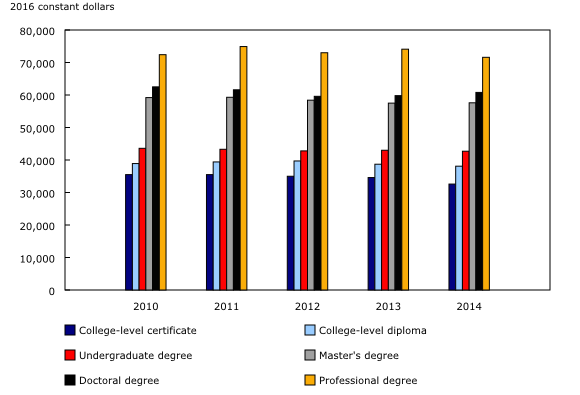
Among graduates who obtained their postsecondary credential from 2010 to 2014, the year of graduation had little impact on their employment income two years after graduation as each cohort of graduates entered a similar labour market environment. However, differences in income were observed by type of qualification for all graduating classes.
Chart 1
Median employment income of postsecondary graduates two years after graduation, by educational qualification, 2010 to 2014 cohorts
For the most recent graduate cohort (students who obtained a credential in 2014), the median employment income two years after graduation ranged from $32,600 for graduates with a college-level certificate to $71,600 for those with a professional degree (which includes graduates from law, medicine, dentistry, veterinary medicine, optometry or pharmacy). The results varied for other qualifications. For example, it was $38,100 for a college-level diploma, $42,700 for those with an undergraduate degree, $57,600 for a master’s degree, and $60,800 for doctoral degree graduates.
Median employment income for men ranged from $35,300 (graduates with a college level-certificate) to $72,800 (graduates with a professional degree). The median employment income for women ranged from $30,400 (college-level certificates) to $70,800 (professional degrees).
Studies in architecture, engineering and related technologies and in health and related fields lead to relatively high median employment income
Graduates from 2014 in architecture, engineering and related technologies, and in health and related fields, had the highest median employment income two years after graduation for college-level diplomas ($47,600 and $44,900, respectively) and undergraduate degrees ($60,000 and $58,200, respectively). Women and men had slightly different results.
For 2014 college-level diploma graduates, the median employment income two years after graduation in health and related fields was $44,000 for women and $50,500 for men. This was followed by architecture, engineering, and related technologies, with women earning $41,100, while men earned $48,900.
Women who obtained an undergraduate degree in health and related fields had the highest median employment income two years after graduation at $60,800, followed by architecture, engineering, and related technologies where the median employment income was $55,900.
Men with an undergraduate degree in architecture, engineering and related technologies had the highest median employment income ($61,000), followed by graduates in mathematics, computer and information sciences ($56,100). Health and related fields programs yielded the seventh highest median employment income for men at $44,100.
Among the 2014 cohort of graduates, women represented 16% of the college-level diplomas and 20% of the undergraduate degrees in the architecture, engineering and related technologies field. In contrast, they accounted for 84% of college-level diplomas and 80% of undergraduate degrees in health and related fields.
For graduates from most provinces, architecture, engineering and related technologies, and health and related fields were also among the top-earning fields of study for both college-level diploma and undergraduate degree graduates.
Employment income increases over time for postsecondary graduates
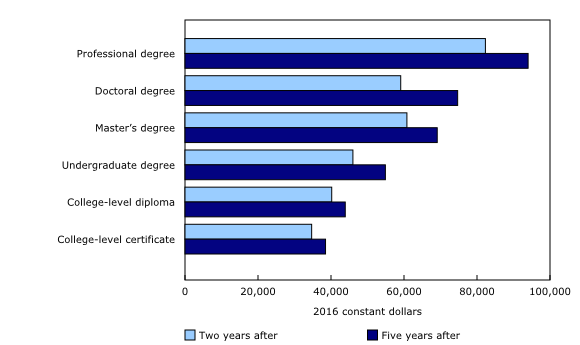
The 2011 graduating class saw their median employment income increase between 9% (for college-level diploma graduates) and 26% (for doctoral degree graduates) when measured first at two years, and then five years after graduation.
Chart 2
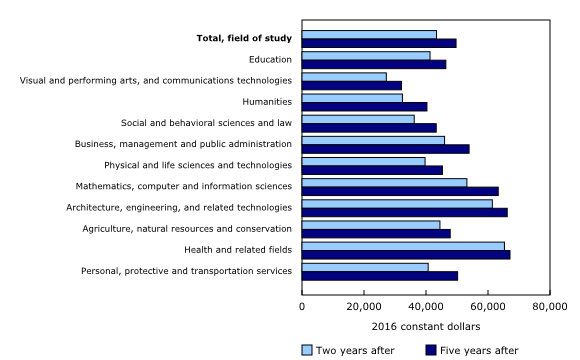
Median employment income of postsecondary graduates two and five years after graduation, by educational qualification, both sexes, 2011 longitudinal cohort
Chart 3
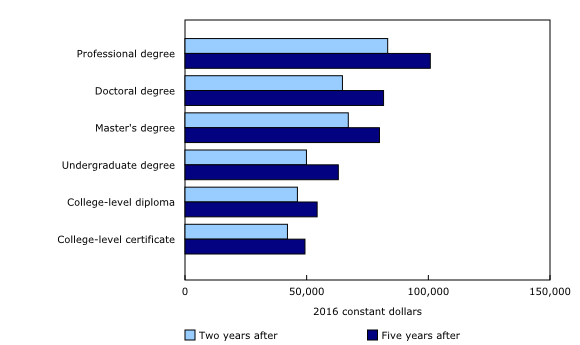
Median employment income of postsecondary graduates two and five years after graduation, by educational qualification, males, 2011 longitudinal cohort
Chart 4
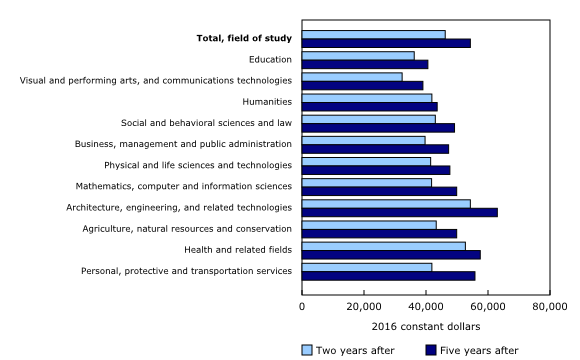
Median employment income of postsecondary graduates two and five years after graduation, by educational qualification, females, 2011 longitudinal cohort
Students who obtained a professional degree in 2011 continued to have the highest median employment income five years after graduation, with an increase of 14% between year two and five. Those with a master’s degree had a slightly higher median employment income two years after graduation than those who earned a doctoral degree, some of whom may have pursued postdoctoral studies. However, five years after graduation, the doctoral degree graduates were earning more.
For graduates who earned a college-level diploma in 2011, the median employment income for males increased by almost 18% between two and five years after graduation. Female graduates, in turn, had a more modest rate of growth of 4% over the same period.
Among male students who earned an undergraduate degree in 2011, overall median employment income increased by almost 26% from years two to five following their graduation. The rate of growth in median employment income for female graduates over the same time period was lower, at 15%.
Median employment income for graduates in health and related fields grows slowly
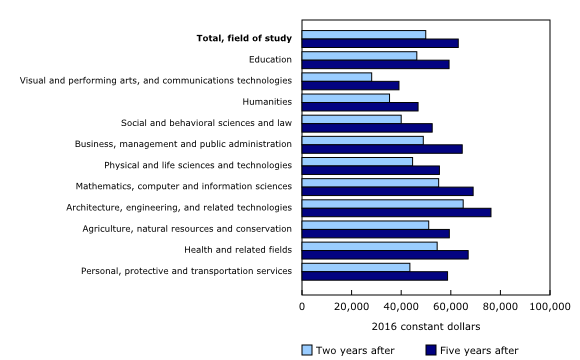
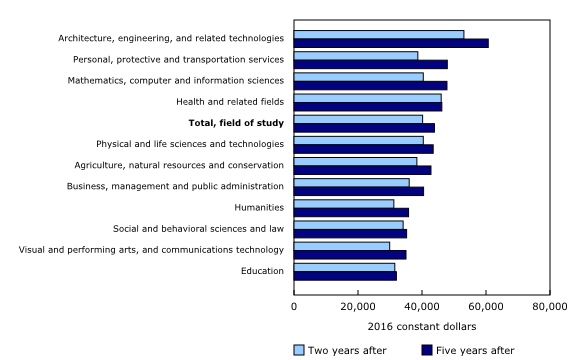
Although median employment incomes in health and related fields had the lowest growth rate among those with an undergraduate degree from years two to five after graduation (at approximately 4%), it was still among the top fields of study in terms of employment income. Graduates from humanities programs had the second highest growth rate of median employment income (28% between year two and five after graduation), however, their income ranked as one of the lowest among graduates from the major fields of study who obtained an undergraduate degree.
Chart 5
Median employment income of undergraduate degree graduates two and five years after graduation, by field of study, both sexes, 2011 longitudinal cohort
Chart 6
Median employment income of undergraduate degree graduates two and five years after graduation, by field of study, males, 2011 longitudinal cohort
Chart 7
Median employment income of undergraduate degree graduates two and five years after graduation, by field of study, females, 2011 longitudinal cohort
Chart 8
Median employment income of college-level diploma graduates two and five years after graduation, by field of study, both sexes, 2011 longitudinal cohort
Chart 9
Median employment income of college-level diploma graduates two and five years after graduation, by field of study, males, 2011 longitudinal cohort
Chart 10
Median employment income of college-level diploma graduates two and five years after graduation, by field of study, females, 2011 longitudinal cohort
As was the case for students with an undergraduate degree, those with a college-level diploma in health and related fields had the lowest rate of growth (less than 1%) from two to five years after graduation, but started with relatively high median employment income. College-level diploma graduates in visual and performing arts, and communications technologies, had larger income growth between two and five years after graduation at 17%, but started with the lowest median employment income.
Frank Graves and Michael Valpy focus on the shifting views of millennial men, visible minorities as well as not visible minority, towards populism and the right. The 2019 election will provide a test of their thesis but certainly the Conservatives seem to mining this resentment in much of their messaging:
As Canadians, we sit atop the continent, watching as our neighbours slide into cultural civil war. It has become easy to just be appalled as America becomesriven, with social media and antagonistic rhetoric on both sides of the political spectrum erasing themiddle ground. There are two Americas, incommensurably separated on the fundamental issues of the day: climate change, the economy, social issues like health and education, employment, the media, immigration in particular, andglobalization and free trade.
We’ve learned more and more about the populism that has fuelled this complicated moment as the fracture in America races like wildfire throughout Western democracies. It is the biggest force reshaping democracy, our economies and public institutions. It is the product of economic despair, inequality, and yes, racism and xenophobia. It is an institutional blind spot, largely denied or ridiculed by the media, and by the more comfortable and educated portions of society.
It is very much alive in Canada. In fact, our populist explosion has already had its first bangs and is likely to have a major impact on next year’s federal election.
The shifts in the democratic world order over the last decade have increasingly prompted social scientists to discard the left-right political spectrum in favour of an “open-ordered axis,” or what The Economist calls drawbridge-down vs drawbridge-up thinking. The former are cosmopolitan-minded people, in favour of diversity, immigration, trade, and globalization, and who are optimistic about the future; they’re guided by reason and evidence-based policy, and believe that climate change is a dominant priority. Drawbridge-up people, with an “ordered” worldview, are largely parochial, and they have reservations about diversity, are deeply pessimistic about the economic future, believe more in moral certainty than reason and evidence, are disdainful of media, government and of scientific expertise, and are convinced that climate change is trumped by the economy and their own survival. It’s ordered thinking that is metastasizing in Western societies, including Canada’s, especially among the political right. EKOS research from 2017 suggests about 30 to 40 per cent of adult Canadians are drawn to it.
Meanwhile, research over the last 10 years has found that Canada, like the United States, is turning into a society fissured along fault lines of education, class and gender. These are social chasms defined by the concentration of wealth at the top of society and, for everyone else, by economic pessimism and stagnation; by a comfortable feeling on one end of the societal teeter-totter, and a fear on the other end that a subscription to the middle-class dream might no longer be available.
Although there has been a recent uptick for the first time in 15 years, the portion of Canadians who self-identify as middle class since the turn of the century has declined from 70 per cent to 45 per cent, a stark number that mirrors America’s—signalling that Canadians have a deeply pessimistic view of their personal economic outlook.Only one in eight Canadians thinks they’re better off than a year ago. Only one in eight thinks the next generation will enjoy a better life. And EKOS finds that, by a margin of two to one, Canadians believe that if present trends with inequality continue, the country — this country! — will see violent class conflicts.
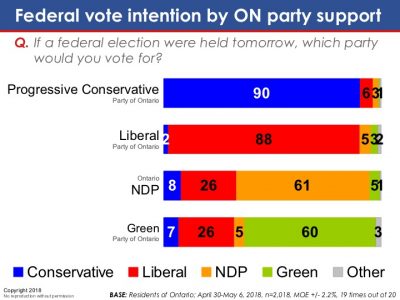
Ordered populism has already become an illusive, misunderstood theme in provincial elections in Quebec, New Brunswick, and Ontario. Indeed, Doug Ford and his Ontario Progressive Conservatives won thanks to a preponderance of working-class, male electoral support—but a closer examination of the vote shows that male millennials, against expectation, supported Ford in significant numbers and had a high turnout. Millennial women, meanwhile, preferred the New Democratic Party by a margin of 25 points, and the millennial women who didn’t vote NDP largely stayed home. Millennial men split their votes between the NDP and Progressive Conservatives, and they led females millennials by 10 points in turning out to cast ballots.
Survey evidence strongly suggests that these are young men angered by the economic realities they face, and they are hit the hardest by what is happening in Ontario’s economy. A joint study by United Way Toronto and York Region and Hamilton’s McMaster University on poverty and employment precarity in southern Ontario reports that only 44 per cent of millennials in the region — the heartbeat of Canada’s economy — have full-time, permanent jobs, that the majority have not found work that provides extended health benefits, pension plans, or employer-funded training, and that formerly high-paying blue-collar jobs there are rapidly vanishing. The lack of good jobs, coupled with the social catastrophe of affordable housing and the resulting need to delay family formation, is resulting in anxiety and depression that disproportionately affects millennial men—making them ideal targets for the appeals of ordered populism.
What is happening challenges the conventional view that the youngest adults of Canadian society—the millennials, now Canada’s largest electoral demographic—operate with roughly similar, progressive views and values.
Another assumption in need of challenging is the idea that Canada’s ordered populism, like its American counterpart, is a besieged white citadel. In fact, our northern brand is as much the choice of multicultural new Canadians as of white native-born Canada. A significant chunk of new Canadians, many of them non-white, indicate they will vote Conservative in next year’s federal election — even though 65 per cent of Conservative supporters told EKOS this year that Canada admits too many non-white immigrants. And while a majority of Canadians are open to immigration, the intensity of the opposition is red-hot, including in other parties: 20 per cent of New Democratic Party supporters and 13 per cent of Liberal supporters also believe too many non-white immigrants are entering the country..
There are two possible explanations for this: First, new Canadians may bring with them into the country strains of social conservatism that make them hostile to issues like same-sex marriage and what they see as immoral, too-liberal sex education, an inflammatory issue in Ontario over the past couple of years. Thus, what they see as an assault on their values may be more important than a party trying to appeal to voters who want fewer of them in the country.
Second, where neighbourhoods are ethnically homogeneous as many are around the core of Canadian cities—white, brown or otherwise—populism holds appeal. Where there’s more diversity, it doesn’t. As social scientists have discovered, communities which have the least contact with with minority groups are the most hostile to them.
The looming federal election could be a spark for all the populist tinder largely being ignored in Canada. In the 2015 federal election, voting differences by gender for all age groups were flat. Now the federal Conservatives hold a 17-point advantage among men from all age groups other than seniors —a huge change in three years. Federal Conservatives also hold an advantage over Liberals and New Democrats with voters who self-identify as working class, and the party has overwhelming support from non-university-educated Canadians, the group most likely to feel left behind by the disappearance of blue-collar industries.
Former Conservative Prime Minister Stephen Harper led a party supported by the economically comfortable. His successor, Andrew Scheer, leads a party of the economically unhappy, of the new economy’s losers, a base increasingly comfortable with raising the drawbridge even as the Liberal government announces Canada will admit an additional 40,000 immigrants by 2021, bringing the annual number of new, mostly non-white arrivals to 350,000. Any campaign rhetoric that confuses this new support with its old party will only exacerbate the anger—and for the angry to find comfort in populism’s temptations.
What we do know is that Ontario’s Progressive Conservative government, with its populist strains and its vague campaign promises, is what many angry young men voted for. Maybe they didn’t vote for its policies; maybe, in their anger, they just voted to burn the house down, even if the history of populist movements show they’ve rarely worked out.
We can try to understand why it’s happening. We can insist that governments tackle inequality and affordable housing. We can build a future that preserves progress for all of us but addresses the real injuries of those who have embraced populism, while also refusing to bend to their fear, anger and ignorance. But letting populism burn the house down benefits nobody—and we can’t just ignore the smell of gasoline in the air.
Race, as a matter of constitutional principle, cannot factor into the selection of jurors for criminal trials. But in the American justice system, anyone with a bit of common sense and a view from the back of the courtroom knows the colorblind ideal isn’t true in practice.
Racial bias largely seeps in through what’s called “peremptory” challenges: the ability of a prosecutor — and then a defense attorney — to block a certain number of potential jurors without needing to give the court any reason for the exclusion.
The number of challenges allowed varies by state, but commonly 15 or more are permitted. Folk wisdom, among those familiar with the song and dance, is that prosecutors use these challenges to remove nonwhite jurors, who are statistically more likely to acquit, while defense attorneys — who can step in only after the pool has been narrowed by prosecutors — typically counteract by removing more white jurors.
For a long time, the opacity of court records rendered the dynamic as only that — folk wisdom — which has made it difficult to articulate the urgent need to reform this understudied aspect of our system. But now, this informal knowledge has been empirically confirmed, and the case for change couldn’t be more compelling.
My recently published research on juror removal in North Carolina conducted with colleagues at the Wake Forest University School of Law proves — for the first time with statewide evidence — that peremptory challenges are indeed a vehicle for veiled racial bias that results in juries less sympathetic to defendants of color.
Based on statewide jury selection records, our Jury Sunshine Projectdiscovered that prosecutors remove about 20 percent of African-Americans available in the jury pool, compared with about 10 percent of whites. Defense attorneys, seemingly in response, remove more of the white jurors (22 percent) than black jurors (10 percent) left in the post-judge-and-prosecutor pool.
The data also show variety within the state: Prosecutors in urban areas, which tend to have larger minority populations, remove nonwhite jurors at a higher rate than prosecutors do in other parts of the state. Finally, we discovered, to our surprise, that judges also remove black jurors “for cause” about 20 percent more often than they remove available white jurors.
When the dust settles at the close of jury selection, defense attorneys’ actions in the last leg of the process do not cancel out the combined skewed actions from prosecutors and judges. The consistent result is African-Americans occupying a much smaller percentage of seats in the jury box than they did in the original jury pool.
This winnowing of nonwhite jurors is not a quirk of just one state. Earlier this year, investigative journalists in Mississippi and Louisiana collected and published jury data from public records that confirmed similar practices in some areas within those states. And given the parallel results identified in county-level studies and in death penalty cases, the pattern probably holds true for jury selection in most states.
It is not possible, even with this new data, to say exactly why a prosecutor, defense attorney or judge decides to remove any particular juror in a single case. But this racially skewed trend, played out across many cases, is persistent. And it has two especially pernicious effects on the quality of criminal justice.
First, the defendant is not judged by a jury that reflects a cross-section of his or her community — a violation of the courts’ interpretation of the Sixth Amendment. In a system that already disproportionately prosecutes people of color, hedging the constitutional rights of defendants can be particularly harmful.
Second, excluded parts of the community become more cynical about the justice system when they repeatedly see barriers to jury service. If people from certain similar neighborhoods are constantly getting booted from juries, then it’s tempting for residents there to view the police — and prosecutors — as hostile occupiers rather than partners in public safety.
In theory, the Equal Protection Clause of the Constitution, as interpreted in Batson v. Kentucky, prevents attorneys from removing jurors on the basis of race. But “Batson claims” rarely succeed because they require the judge to declare the proposed stated reason for removal was only a pretext hiding discriminatory intent — a notoriously steep standard.
To address the problem, state courts could adopt rules such as the one that the Washington Supreme Court approved last April. The new rule makes it easier to stop juror removals rooted in implicit racial bias by outlawing peremptory challenges defended with explanations highly correlated with race, like “prior contact with law enforcement” or “living in a high-crime neighborhood.”
There are now over half a dozen states completely controlled by Democrats, whose ascendant progressive wing would presumably support such nondiscrimination protections.
Another answer — which could gain support in even the toughest of “tough on crime” red states — is simply to publish more information on jury selection. The details of judge and attorney removals of jurors is already public record, but those details usually remain buried in the hard-copy files of court clerks across the country.
While this year’s successful research shows how journalists and scholars can collect these far-flung records into a useful database, the process can take months or years of driving from courthouse to courthouse, digging out the files of cases that went to trial, recording the clerk’s notations from those files and turning to online resources for background information on judges and lawyers.
States could instead — without much work — just plainly make all jury selection information available online and keyword searchable, easing access for journalists and voters alike.
In most states, voters choose their prosecutors and their judges; and with journalists on hand to swiftly analyze digitized public records of the jury selection habits of prosecutors and judges, citizens could evaluate incumbents’ tendencies as a measure of success or failure.
These two reforms alone would greatly aid efforts to hold prosecutors and judges accountable as well as shore up public trust in the criminal justice system.
The status quo shows that a barely enforceable constitutional doctrine isn’t enough. It’s time to bring this vital process of justice from behind closed doors and into the sunlight. It’s the only way to ensure that defendants are judged by a representative cross section of their community, not the filtered few that litigants want to see in the jury box.
Good summary of the latest Scanlon Foundation report and the point about how important perceptions are regarding how well immigration is managed particularly relevant to Canada:
Australia has not lost faith in immigration. The political narrative has darkened but not the fundamental view of ourselves as an immigrant nation. Most of us remain convinced that we are in so many ways better off for newcomers of all races and creeds who have come in large numbers to our shores.
That is the verdict of the Scanlon Foundation’s 2018 Mapping Social Cohesion Report published on Tuesday. The mission of the foundation is to measure how this migrant nation hangs together. Over the last decade 48,000 of us have been polled to fathom the panics that sweep this country and the steady underlying views Australians have of immigration.
“Immigration is a growing concern,” says the author of the report Professor Andrew Markus of Monash University. “But for media commentators and some politicians it has become an obsession. They are in the business of creating heightened concern, of crisis. But what the survey shows is rather a picture of stability.”
Markus is one of Australia’s leading authorities on the politics of race. This is the 11th report he has written for the Scanlon Foundation. Year in year out his reports show about 80% of us believe immigrants are “generally good” for Australia’s economy and that ours is a better society for the “new ideas and cultures” that immigrants bring to this country. Support for multiculturalism in 2018 stands almost as high as ever at 85%.
“A number of international surveys that look at Australia, America, Canada, a range of European countries from eastern Europe to western Europe, and also countries in other parts of the world, have a consistent finding that on attitudes to immigration and cultural diversity, Australia is within the top 10% of countries which are open to and welcoming of immigration,” says Markus
A glance at the Scanlan report 2018
Putting into perspective the renewed political contest over immigration is the underlying purpose of the latest Scanlon report. This year Fraser Anning called for a return to White Australia; the notion of exiling new migrantsfrom Sydney and Melbourne was seriously debated; and political leaders in all parties called for cuts – sometimes savage – to immigration numbers.
“Politicians present their views on immigration as if they are speaking for the nation,” cautions Markus. “The reality is that their words are directed to that segment of voters in marginal electorates that supports their party, or that may be attracted to their party, or may be lost to their party.”
Rising concern about numbers was a particular focus of this year’s report. This has kicked up significantly in the last few years. In 2016 only a third of Australians believed the migrant intake was too high. Now 43% of us are worried.
In the past, concern about numbers has moved up and down in lockstep with employment figures. Not this time. And the Scanlon pollsters set out to identify what was driving fresh fears in 2018.
“The program itself is something that’s marketable, something that finds a receptive audience,” says Markus. “But there’s a growing concern – still a minority position, but growing concern – that the immigration program is not being well managed.
“This is linked to people’s perceptions of overcrowding, public transport, housing costs, and so on. These issues are much more complex than just immigration intake. That’s what we’re picking up. That’s a risk for Australia going forward.”
Our rising national anxiety about numbers has been measured by a number of pollsters. Lowy, Essential and Newspoll all found a majority wish for the intake to be cut. Ipsos and Scanlon reckon the balance is slightly the other way with 52% of us for keeping – or even increasing – the number of migrants we take.
This picture of a country divided but still open to mass immigration comes with a fundamental caveat: the boats have stopped.
“I think that John Howard was very successful in that mantra of ‘we control who comes into this country’,” says Markus. “That clearly resonates very strongly. Australia maintained its White Australia policy – very strictly controlled – for decades beyond other countries who abandoned theirs quite quickly after the second world war. Australia has stuck to that very religiously.
“I think it’s been established that the policy of stopping the boats, whatever people will understand by that, is a very strong buy-in. People in Australia in large numbers will turn their gaze away from what happens at offshore detention.”
Not published in this year’s Scanlon report but made available to Guardian Australia are figures obtained for the first time showing what the nation thinks of penning refugees on Manus and Nauru. They demolish the idea that Australia has fundamentally changed its mind about the Pacific solution. The best that can be said is that we’re split on the issue.
From the start in 2007, the Scanlon reports have been mapping the dark side of this story. The constituency of those worried about immigration is not small but Markus puts the number of us markedly hostile at only about 10% – though a noisy 10%.
“They paint immigration as somehow transforming Australia, making Australia unrecognisable,” he says. “They see multiculturalism as a threat. Within some of these groups, it gets to the level that they see these activities as treasonous.
“One of the stories that goes around within these circles is that somehow the Australian people were never given a choice. Dangers have been foisted upon the Australian people. Australian people never approved of any of the White Australia policy. You need to have a referendum on that.
“It’s Pauline Hanson’s line, but also far-right groups and it’s been there for decades. What these learned commentators on Australian society seem to miss is that we actually have elections in this country every three years. If people were so upset then they would vote the government out of power and they would vote in One Nation or whoever. We would have Fraser Anning as our minister of immigration if people were so upset.”
Markus found that worries about immigration are uppermost in few of our minds. We are far more worried about the economy, the environment and the poor quality of government. Asked to name the most important problem facing the country today, only 7% of respondents in 2018 picked immigration.
But the figure for One Nation voters was 25%.
Longing for a White Australia has died down over the years but has never died out. Once again the Scanlon report reveals a considerable constituency for keeping new arrivals white and Christian – or at least, not Muslim.
In face-to-face interviews in 2018, 15% of Scanlon respondents agreed it should be possible for immigrants to be rejected simply on the basis of their race or ethnicity. And 18% agreed they could be sorted solely by religion.
As well as conducting 1,500 face-to-face interviews, the teams engaged by the Scanlon Foundation quizzed 2,260 people online, respondents who tend, sitting on their own, to be a little more frank about their negative views.
Online, 22% of us supported sorting immigrants by race and 29% of us for sorting them by religion. These figures mark clear minority positions in modern Australia but they are not insignificant, as the report shows by showing support for the Keep Australia Christian brigade within political parties:
It speaks quite well for religion. But the latest Scanlon Report offers not much evidence that the nation is warming to Islam. The online survey reveals only a tiny fall from 41% of us last year to 39% of us this year who admit to very or somewhat negative attitudes to Muslims.
“It is a notable finding that across the two modes of surveying, and with a different range of questions, discriminatory immigration policy fails to gain support from more than 30% of respondents,” writes Markus. “Nonetheless, the level of negative sentiment towards those of the Muslim faith, and by extension to immigrants from Muslim countries, is a factor of significance in contemporary Australian society.”
Year after year the Scanlon reports have mapped national divisions over race and immigration. The pattern is clear. Whether the issue is the sheer numbers coming to our shores or their colour and creed, much the same rifts appear between young and old, city and country, prosperous and struggling, those with higher education and those who never finished school.
Typical is the breakdown for the Keep Australia White brigade.
“That divide between people who have had the opportunity to go on with their education in a formal way at universities and so on, and those who don’t is a very strong divide,” says Markus. “It’s not something unique to Australia. It would be true certainly of western countries that I’ve looked at.”
Markus admits being stumped by the marked – but still minority – hostility to race and immigration shown by people working in trades. And he is not advancing any easy explanation for the relaxed attitudes of graduates. He believes life on multiracial campuses may have a good deal to do with it. But he places greater weight on study itself.
“Respect for reason is at the heart of a university education,” says Markus. “It’s not what you hear down the pub that goes down. You learn there is a discipline. We arrive at conclusions within a discipline whatever you study. Respect for knowledge and respect for reason is perhaps what drives people away from the camp which embraces delusions and xenophobia.”
Markus is heartened by the victory of Daniel Andrews in Victoria. Commentators and politicians were obsessed throughout the campaign with black crime. The fear is there in the Scanlon figures – a third of Australians generally but 41% of Victorians are afraid of becoming victims of crime – but these fears could not be marshalled to deny Andrews victory.
Though Melbourne is the fastest-growing city in the land with immense pressures on infrastructure, Melburnians aren’t calling for cuts to immigration. “And despite the opposition running hard on black gangs etc, the issue didn’t decide the election,” notes Markus.
More than ever, Melbourne looks like the future of this immigration nation.