Undocumented immigrants in the US are increasingly better educated

Always interesting how so much of the debate reflects the past, not the more current situation:

Not much has changed about Washington, DC’s decades-long fixation with illegal immigration—or its inability to do something about it. The profile of immigrants themselves, however, has shifted dramatically.

Consider their education levels. The share of recently arrived undocumented immigrants with a college degree has nearly doubled between 2007 and 2016, according to a recent analysis by the Pew Research Center. Here’s the share of college graduates who’ve been in the United States for five years or less compared with their more established counterparts.

At the same time, the share of recently arrived undocumented immigrants with no high school degree has shrunk, from 44% in 2007 to 31% in 2016. (Pew used government data for its calculations.)

These shifts reflect the changing nature of illegal immigration to the United States. For one, the number of new arrivals has plunged. In 2007, those who had been in the United States for five years or less made up 32% of all undocumented immigrants, according to Pew. By 2016, they accounted for 20%. And while in the past most undocumented immigrants crossed the border illegally, these days the majority are entering the country with legal visas and overstaying them.

The biggest change is the collapse in the number of Mexicans trekking north. Mexicans previously accounted for the lion’s share of undocumented immigrants in the United States. As their numbers have dwindled, the share of Asian immigrants, who tend to be better educated, has grown. In general, improvements in education around the world—including in places like Mexico—mean that immigrants from all regions are arriving to the United States with more schooling, Pew reports.

This new crop of undocumented immigrants is also more likely to speak English. In fact, despite the overall drop in new arrivals, the number of proficient English speakers grew to 3.4 million in 2016 from 2.8 million in 2007, Pew found. A look at Pew’s data on immigrants’ English proficiency and the shifts in their countries of origin help explain why:

Region of origin % English proficient Change in share of recent arrivals 2007-2016 (percentage points)
Mexico 25 -28
Northern Triangle 22 7
Asia 54 9
Other regions 69 12

To be sure, undocumented immigrants are still far less educated than people born in the United States. Only 8% of American adults lack a high school degree, compared with 44% of all undocumented immigrants, for example.

But the changes in undocumented immigration suggest that the gap will continue to shrink in coming years.

Source: Undocumented immigrants in the US are increasingly better educated

In a survey of American Muslims, 0% identified as lesbian or gay. Here’s the story behind that statistic

Interesting:

In the United States, you could count the number of mosques like Masjid al-Rabia on two hands. It’s a small community built on “five pillars of inclusivity,” including pledges to be “women-centered,” anti-racist LGBTQ-affirming and welcoming to a variety of Islamic traditions.

Mahdia Lynn, a transgender woman, helped found the mosque in Chicago in 2016.
For several years, Lynn attended a mosque in a small conservative Muslim community in Oklahoma, where people believed she was a straight, cisgender woman.

“There was always the risk of being outed,” said Lynn, a Shiite Muslim. “But at the time, I just wanted to focus on my faith.”

There are a few mosques like Masjid al-Rabia around the world, notably in Berlin and Toronto. But the number of LGBT-affirming mosques and Islamic centers in the United States remains small.

Muslims for Progressive Values has eight “inclusive communities” in the United States, from Atlanta to San Francisco. Berkeley’s Qal-bu Maryam Women’s Mosque, which calls itself “America’s first all-inclusive mosque,” opened in 2017. Other like-minded mosques have struggled to find consistent congregants in recent years and closed down.

Imam Daiyiee Abdullah, 65, is one of the few openly gay Muslim clerics. For four years, he labored to build a mosque for LGBT Muslims in Washington, DC.

Frustrated, tired and running out of money, Abdullah gave up and moved to the mountains of Colorado, where the nearest inclusive mosque is an eight-hour drive away.

Liberal Muslims say there are hints of change. The percentage of American Muslims who said society should accept homosexuality has doubled in the last decade, to 52%, and is even higher among Millennials.

Still, for many LGBT Muslims, coming out of the closet to their families and religious communities can be a fraught decision.

Ani Zonneveld says she receives calls regularly from young gay and lesbian Muslims who have been threatened by their family or are afraid to reveal their sexual identity.

“I tell them that, unless you have a fantastic relationship with your parents, keep it in the closet until you finish high school and can leave the house,” said Zonneveld, who heads Muslims for Progressive Values.

Religious spaces can be just as alienating, Zonneveld said. “What we have seen is that LGBT Muslims are not comfortable going to a mosque, and if they do, they definitely keep closeted.”

They may even be reluctant to tell anonymous pollsters. According to a recent survey of more than 800 American Muslims, 0% identified as gay or lesbian.

‘Islam is too important to leave anyone behind’

Muslims in the United States are among the most diverse religious communities in the world. While 82% are American citizens, nearly a third have been in the country for less than two decades. A plurality (41%) are white, but no racial or ethnic group makes up a majority of Muslim American adults.

That diversity also applies to attitudes towards gay, lesbian and transgender people. According to a recent survey by the Institute for Social Policy and Understanding, 31% of Muslim-Americans said they hold a favorable opinion of LGBT people, 23% said “unfavorable” and 45% said they had “no opinion.”

Among the Catholics, Jews and Protestants polled, only white evangelicals held less favorable views of LGBT people, the survey found.

Some Muslims have, like Lynn, hidden aspects of their identity for fear of being alienated or even endangered. But she said bigotry is no worse among American Muslims than in society at large.

“To act as if discrimination is unique to American Muslims is to buy into the Islamophobic narrative pushed by the right wing in this country, which is ironic, because it’s the right wing that is systematically erasing transgender people’s rights.”

Lynn transitioned as a teenager, and converted to Islam later on, during a particularly painful period. Islam’s spiritual regimens and rules for living offered a scaffolding on which to rebuild her life, the 31-year-old said.

“Islam saved my life, so I made the decision to give my life over to Islam.”

She founded Masjid al-Rabia with two other Muslims in 2016.

“Part of our role as a community center is to create a space for those healing from spiritual violence,” Lynn said.

This year, it’s celebrating its first Ramadan as a fully operational community center.

Lynn described her community as both idealistic and incremental. It’s small — Friday prayers draw about a dozen worshipers to its downtown Chicago space — but its very existence makes a radical statement.

While pushing for greater inclusivity in American mosques, she said it also provides a hospitable space where Muslims can practice their faith openly, regardless of race, gender, sect or sexual identity.

“We believe that everyone has a right to come to Islam as they are. Islam is too important to leave anyone behind.”

Support in society, but not in mosques

Muslims disagree on how to interpret the Pew survey that showed an increasing acceptance of homosexuality.

Some said it signals growing support for LGBT political rights, but not in religious spaces like mosques and Islamic centers.

LGBT activists have broadly supported Muslim-Americans, rallying to their side in recent years to protest Trump administration policies. Prominent Muslim activists have argued that they need all the political allies they can muster.

“I will fight for anyone who fights for our community,” activist Linda Sarsour said during a contentious panel discussion at an Islamic convention last year.

“And everybody is created by Allah and deserves to be treated with dignity and respect. That is how we Muslims have to show up in these United States of America.”

But Yasir Qadhi, an influential scholar and dean of academic affairs at the new Islamic Seminary of America in Dallas, said pro-LGBT-rights political activists are confusing young Muslims.

“You are sending a mixed message,” he said at the Islamic conference. “Because at the end of the day, we do not believe that it is morally healthy to engage in intercourse outside of the bonds of marriage.”

Contentious questions

In a recent interview, Qadhi said that he is grateful for LGBT Americans’ political support. While he hasn’t changed his theological views, he said he has softened his rhetoric.

“I will be the first to admit that we were overly harsh and perhaps we did marginalize people and make them feel as if they were not human or worthy of love,” the scholar said.

Now, Qadhi often prefaces his remarks about homosexuality by noting that “feelings and inclinations” are not themselves sinful, and that homosexual acts should not be singled out for special condemnation.

LGBTQ Muslims should be welcomed at mosques, he said, but should not push for changes in Islamic theology or practice on mosque grounds.

“Whatever anyone does in their private life is not our business,” Qadhi said. “I am never going to single out anyone in sermons for any sinful conduct. At the same time, in the mosque I am a part of, there is a clear red line: They cannot preach onto others that this is part of Islam, the same way I would not let a person sell liquor on our property.”

The Fiqh Council of North America, a body of scholars who issue legal opinions based on Islamic texts, will take up transgenderism this year, said Qadhi, a council-member. Sexual reassignment surgery is permitted in Shiite Islam, but not among Sunnis, who comprise the majority American Muslims.

In most mosques, the genders are separated, and there have been conflicts about where Muslims in the process of gender transition should sit, Qadhi said. “Gender identity issues will be the big questions for the next several years.”

But external and internal tensions can make it hard for Muslim-Americans to directly address contentious questions, said Dalia Mogahed, director of research for the Institute for Social Policy and Understanding.

“This is a huge source of division in the community right now,” she said. “There are a lot of different opinions and, frankly, there is a lack of space to discuss it.”

“When you have a community that is so under the microscope and being subjected to litmus tests for civility and tolerance, people become afraid and self-censoring”

Mogahed herself came under attack several years ago after a Gallup survey showed that no British Muslims — as in, 0% — said homosexuality was morally acceptable. Right wing provocateurs such as Milo Yiannopoulos seized on the survey to portray Muslims as a threat to gays and lesbians.

But Muslims in the United States and Britain have not mounted political or social campaigns against the LGBT community, Mogahed said.

“To conflate a religious belief with one community being a threat to another is unfair.”

Behind the 0%

Like a lot of pro-LGBT Muslims, Imam Abdullah has migrated to online projects. He now runs the Mecca Institute, an Internet-based program to train a new generation of likeminded clerics. The program has three part-time students.

Because of media attention on his life and work, he said he draws attention when he visits American mosques.

“Sometimes people make derogatory remarks, like: There’s that gay imam,” Abdullah said.

“I’ve been asked in different parts of the country to leave the mosque, which is fine. I’m not going in to any mosque to try to change them. I am going there to pray.”

In Washington, DC, weeks would go by without anyone showing up at his former mosque. Some closeted LGBT Muslims feared of being associated with “the gay mosque,” he said.

“The personal trauma that so many went through made it hard for them to be public about their identity,” Abdullah said.

The ISPU survey provides statistical backing for that sentiment. Of the 804 American Muslims polled, not one identified as gay or lesbian. Four percent identified as bisexual, 2% said they were “something else” and another 2% refused to answer the question.

Asked about the 0% statistic, Mogahed offered a nuanced interpretation. If 92% of American Muslims identified as straight, she said, then the remaining 8% may be lesbian or gay, even if they’re reluctant say so.

“The fact that there is a segment of Muslims who identify as something other than straight means that, even though they may not be acting on that inclination or orientation, they have negotiated a space where they can still be Muslim,” Mogahed said.

“There is enough space within the theology to be able to do that.”

Well-known former imam wins Liberal nomination in Montreal riding, becoming its first non-Italian nominee

Of note. Those of Italian ancestry are 22.5 percent of the population, compared 16 percent Arab and 17.3 percent Muslim (2011).

Full riding demographic, economic and social characteristics can be found here: 24069 Saint-Léonard-Saint-Michel.

A former imam who gained international attention for speaking at a funeral for victims of the Quebec City mosque shooting has won the Liberal nomination in the Montreal riding of Saint-Léonard—Saint-Michel, the first time the party has nominated a non-Italian in the Liberal stronghold.

Hassan Guillet said the Liberals were reluctant to have him run in Saint-Léonard, afraid of antagonizing the large Italian community. But he pushed ahead, and insists that he represents the community “better than everybody else,” pointing out that the riding is increasingly diverse and is now home to sizeable North African and Haitian populations as well.

“The Muslim community is as big as the Italian community,” Guillet told the Post in an interview. “The demographic changed enormously.”

Guillet claims to speak six languages, including Italian, and said he was the only potential candidate who could speak to the majority of the riding’s constituents in their mother tongue, whether it be French, English, Italian or Arabic.

His nomination ahead of the fall federal election marks a dramatic shift in the Montreal riding, which has been represented by members of the Italian community since its creation in 1988. The seat was held until 2002 by Alfonso Gagliano, a central figure in the Quebec sponsorship scandal, followed by Massimo Pacetti, who was expelled from the Liberal caucus in 2015 over accusations of sexual misconduct. The riding went to Nicola Di Iorio in the last federal election, who announced his resignation in April 2018 but didn’t officially resign until the end of January 2019.

Last fall, CBC News reported that Di Iorio had expected to hand-pick his successor, and changed his mind about resigning when he was told there would be an open nomination process. Ultimately, he vacated his seat late enough to prevent a byelection from being held before October’s election.

Guillet said he approached the Liberals when Di Iorio first announced he planned to resign, thinking he would run in a byelection. He doesn’t live in the community, but said much of his family does, and the idea of running in a Liberal stronghold was appealing. “The Liberal party is the party that is closest to my ideals, to my principles, to my way of life,” he said.

Guillet said the Liberals were interested in him, but suggested he run elsewhere. “They had a dilemma. On the one hand, they wanted me to be there,” he said. “But they didn’t want to alienate the Italian community, because historically it was always run by an Italian. … They cannot imagine losing Saint-Léonard.”

But Guillet’s mind was made up. He competed for the nomination against city councillor Patricia Lattanzio and Francesco Cavaleri, a notary and friend of Di Iorio’s. On Monday night, he won the nomination, with more than 1,200 members casting ballots. “Everyone was telling me it was unprecedented,” he said.

In a statement, Liberal Party spokesperson Braeden Caley said Guillet is “well-known for his long record of community leadership” and that “Liberals are looking forward to running a positive campaign focused on Justin Trudeau’s progress to strengthen the middle class, grow the economy, protect a clean environment, and make life better for Québec families.”

Guillet said he’d heard that his competition didn’t take him seriously, and that he remained “nameless” for much of the campaign. “I wasn’t even a person,” he said. “I was ‘the imam.’ ” He said he delivered his speech before the vote on Monday night in six languages, and fought throughout the campaign to prove he was “not the enemy.”

He also said the working assumption in the riding was that Arabic-speaking newcomers don’t vote, in part because many of them have immigrated from countries “where democracy was either non-existent or very badly practised.”

“My job was to open their eyes, to educate them and to make them participate,” he said.

Guillet received worldwide attention after speaking at the funeral of three of the victims of the 2017 shooting at a mosque in Quebec City. Part of his sermon, in which he referred to shooter Alexandre Bissonnette as a victim in his own right, was retweeted by author J. K. Rowling, who said his words were “extraordinary and humane.”

Guillet, who moved to Canada from Lebanon in 1974 and is a retired engineer and lawyer, stopped serving as an imam when he decided to run for federal office. Still, his background may prove a hurdle in a province where secularism is a live political issue. However, Guillet insists he had no religious authority as an imam, and that it shouldn’t stop him from “exercising (my) constitutional right.”

“I think the different facets of my experience will enrich debate in the House of Commons,” he said.

Source: Well-known former imam wins Liberal nomination in Montreal riding, becoming its first non-Italian nominee

Liberals propose changes to citizenship oath to respect Indigenous rights

One really has to wonder about the government’s management of the citizenship guide and other revisions. Introducing a bill in the dying weeks of Parliament smacks both of poor management (why has it taken so long) and cynical political positioning just before the election.

The revised version of Discover Canada, the citizenship guide, has not been released despite it being an early government commitment and in Minister Hussen’s mandate letter in early 2017. Likely too late to be issued now as it will appear overtly political and pre-election positioning.

The Truth and Reconciliation Commission’s recommended revised oath was:

I swear (or affirm) that I will be faithful and bear true allegiance to Her Majesty Queen Elizabeth II, Queen of Canada, her heirs and successors, and that I will faithfully observe the laws of Canada, including treaties with Indigenous peoples, and fulfil my duties as a Canadian citizen.  (four words out of 54: 7.4 percent)

The government’s proposed version:

I swear (or affirm) that I will be faithful and bear true allegiance to Her Majesty Queen Elizabeth the Second, Queen of Canada, her heirs and successors, and that I will faithfully observe the laws of Canada, including the Constitution, which recognizes and affirms the Aboriginal and treaty rights of First Nations, Inuit and Métis peoples, and fulfil my duties as a Canadian citizen. (16 words out of 64: 25 percent)

Appears that the extensive consultations were more additive (e.g., naming the groups rather than just the simple and elegant TRC formulation) and legalistic, without strong direction to keep it as simple and short as possible, focussing on the essence.

Given these changes, there should be a substantive discussion on this wording versus the TRC wording rather than just rushing this through.

Initial reaction from the Conservatives suggest that they may not cooperate in passing the bill quickly (see article below):

The Liberal government is revamping the citizenship oath so that new Canadians make a solemn commitment to respect Indigenous and treaty rights for First Nations, Inuit and Métis peoples.

Immigration Minister Ahmed Hussen said the proposed change to the Citizenship Act will raise awareness of Indigenous rights among newcomers. The change is based on a recommendation by the Truth and Reconciliation Commission more than three years ago.

“Reconciliation is not only an Indigenous issue. It is a Canadian imperative and will take partners at all levels to advance this important journey,” Hussen said today in the foyer of the House of Commons shortly after tabling Bill C-99.

“I swear (or affirm) that I will be faithful and bear true allegiance to Her Majesty Queen Elizabeth the Second, Queen of Canada, her heirs and successors, and that I will faithfully observe the laws of Canada, including the Constitution, which recognizes and affirms the Aboriginal and treaty rights of First Nations, Inuit and Métis peoples, and fulfil my duties as a Canadian citizen.”

With less than a month left in the parliamentary session, Hussen said he hopes the other parties cooperate to pass the bill quickly. Asked why it took so long to table the bill, the minister said that it required consultation with many stakeholders and that the government wanted to “get it right.”

Conservative MP Cathy McLeod, critic for Indigenous and Northern Affairs, said she expects there won’t be time to pass the bill.

“Conservatives support treaty rights and reconciliation, but tabling a bill at the last minute and which is subsequently not likely to get passed, due to the fact that there are only a few sitting days left in this Parliament, is not the way to do it,” she said in a statement to CBC. “Unlike the Liberals, an Andrew Scheer-led Conservative government will take real action to address reconciliation.”

Indigenous Services Minister Seamus O’Regan stressed the significance of the proposed change.

“This is a very important day that new Canadians, when they come in, know they are entering a country that respects Indigenous people in this country, that respects and affirms their rights in Canada,” he said.

(CBC News)

Sen. Murray Sinclair, who chaired the Truth and Reconciliation Commission, issued a statement welcoming the legislation as a way to “better reflect a more inclusive history of Canada.” To understand what it means to be Canadian, it’s important to know about all its founding peoples, he said.

“Reconciliation requires that a new vision, based on a commitment to mutual respect, be developed. Part of that vision is encouraging all Canadians, including newcomers, to understand the history of First Nations, the Métis and the Inuit, including information about the treaties and the history of the residential schools, so that we all honour the truth and work together to build a more inclusive Canada,” Sinclair said.

The Assembly of First Nations, which provided input on the proposed changes, said educating new Canadians about shared history and the rights, cultures and contributions of First Nations is an important part of reconciliation.

National Chief Perry Bellegarde and regional chiefs are reviewing the proposed wording.

Source: Liberals propose changes to citizenship oath to respect Indigenous rights

Sen. Murray Sinclair, who chaired the commission, says he welcomes the government’s legislation to change the oath, saying it reflects a “more inclusive history of Canada.”

As for whether the bill will pass in the brief time left in the parliamentary calendar before this fall’s election, Hussen acknowledged it would require co-operation from all parties in the House of Commons and Senate to allow for speedy passage.

The Conservatives scorned that prospect.

“Conservatives support treaty rights and reconciliation, but tabling a bill at the last minute and which is subsequently not likely to get passed, due to the fact that there are only a few sitting days left in this Parliament, is not the way to do it,” said Cathy McLeod, the Tory critic for Indigenous Affairs, in a statement.

Source: Bill proposes reference to rights of Indigenous Peoples in citizenship oath

More Evidence on Third-Generation Outcomes

While generally not a fan of the work of Centre for Immigration Studies, this study is nevertheless interesting.

There are similar variations among visible minority groups in Canada, admittedly from smaller numbers of third or more generations, younger cohort, for most groups save Black Canadians:

Will the children and grandchildren of low-skill immigrants eventually rise to the same socioeconomic level as natives? In a report published last fall, I investigated this question using the NLSY-97, a survey of people born between 1980 and 1984 that includes their grandparents’ places of birth. The grandparent information helps identify a true “third generation,” meaning U.S.-born people who have two U.S.-born parents but at least one foreign-born grandparent.

Because the largest and most consistently low-skill immigrant group has come from Mexico, my report compared the grandchildren of Mexican immigrants to a reference group of white Americans from the “fourth-plus generation” – meaning U.S. born with two U.S.-born parents and four U.S.-born grandparents. The results indicated that Americans with at least one Mexican-born grandparent lag significantly behind on measures of education and income. In other words, assimilation of this initially low-skill group is still not complete by the third generation.

After the Great Wave of immigration ended in the 1920s, Americans developed some romantic notions about assimilation. No matter where immigrants come from, no matter what skills they bring with them, no matter what circumstances they find themselves in upon arrival, their children and grandchildren will supposedly converge to the socioeconomic level of the pre-existing population. Desirable as that outcome may be, the convergence is often incomplete. The results for third-generation Mexican Americans described above are perhaps the starkest illustration.

Differential levels of assimilation are also evident when comparing the grandchildren of immigrant groups who arrived in the same time period. After the U.S. and Mexico, the most common grandparent place of birth in the NLSY-97 is Europe. (Unfortunately, no specific countries in Europe are identified in the data.) This post provides the results of a new analysis comparing two third-generation groups — the grandchildren of immigrants from Mexico, and the grandchildren of immigrants from Europe.

Based on parental data from the NLSY-97 and year-of-arrival data from the 1970 census, most grandparents of the NLSY-97’s European third generation arrived in the U.S. between 1910 and 1950. Unlike Mexican immigrants, who were almost uniformly low-skill, European immigrants in that time frame were more mixed. They include largely low-skill Southern and Eastern European immigrants who arrived before the 1924 restriction, but also some educated refugees from Central Europe during the Nazi period, along with both skilled and unskilled immigrants from the post-war era.

The table below compares the grandchildren of Mexican immigrants and the grandchildren of European immigrants on measures of educational attainment, test scores, work time, and income. Although the two groups graduated from high school at about the same rate, the grandchildren of European immigrants have more than double the rate of college completion. They also scored higher on the AFQT, which the military uses to assess math and verbal skills. Similarly, although weeks worked are roughly equivalent for both groups, the grandchildren of European immigrants significantly out-earn their counterparts with Mexican-born grandparents.

On most measures, the European third generation even slightly outperforms the reference group of fourth-plus generation whites. Clearly, not all immigrant groups end up in the same place by the third generation.

For details on the data set and the calculations, please see my report from last fall. Also note that for simplicity and sample size considerations, the ethnic and cross-sectional samples of the Mexican third generation are combined in the table above.

Source: More Evidence on Third-Generation Outcomes

Antisemitism: Spell it Without the Hyphen-Please

Uphill struggle but I always use the correct spelling (and urge others to do the same):

Antisemitism should be spelled without the hyphen. It’s something I’ve known for years, even if auto-correct just won’t get the message. Neither will the media, of course, or even most dictionaries.

“What’s the difference?” you might well ask. “It’s just a little mark on the page. Meaningless.”

Ah, but it’s not.

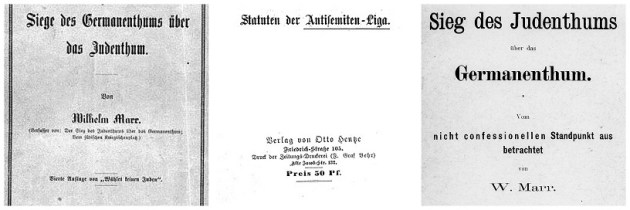
The concept of “antisemitism” (without the dash, thank you) and the term, were introduced by Wilhelm Marr when he founded the Die Antisemitenliga, the League of Antisemites, in 1879. Materials put out by the league often employed the word “antisemitism.” The league, in fact, was the first popular political movement based solely on anti-Jewish sentiment. Marr’s famous and oft-reprinted tract, The Victory of Judaism Over Germandom, made the claim that “the Jewish spirit and Jewish consciousness have overpowered the world.”

Statutes of the Antisemitism League flanked by two of Marr’s antisemitic tracts

Marr wore the title “antisemite” as a badge of honor. From the perspective of Marr and his colleagues, to be an antisemite was to be “woke.” But then, politics with a specifically anti-Jewish flavor and focus were big all over Europe in the years leading up to the 20th century.

The word “antisemitism” had its roots in an 18th-century treatise on languages which analyzed the differences between Aryan and Semitic languages. The terminology that was used led to the false assumption that there were racial groups corresponding to these two groups of languages. The minds of the time made a leap so that “Jew” became synonymous with “semite” in the lexicon of the day.

The interesting thing here is that there was already the perfectly good expression Judenhass, or “Jew hate,” in the popular lexicon. But Marr wanted to make his hatred about race, rather than religion. The new term he coined avoided altogether the question of religion. “Antisemitism” also sounded more scientific, more intellectual, therefore more credible and more acceptable. Also, people just liked it. So the word “antisemitismus” spread like wildfire as a new way to speak about hating the Jews.

But the thing is, there’s no such thing as a “semite” or even a “semitic” people. The terms were invented by some historians in the 1770s to refer to people who speak Semitic languages But in truth, there are only Semitic languages. There is no race or people that are “semites.”

In other words, when you spell the word with a hyphen, the word makes no sense. Because you can’t be against something that doesn’t exist. And there’s no such thing as a semite.

The other problem is that people say that Arabs are semites, too, therefore Arabs can’t be antisemites, because they can’t be against themselves.

Except there’s no such thing as a semite.

The term antisemite, you see, is standalone. It only means “someone who hates Jews.” And that is all it was ever intended to mean.

Antisemitism, as a term, is based on racist claptrap. The word was lifted from the field of linguistics to give weight to the idea of hating the Jews (and only the Jews) as a race (which they aren’t). The pseudoscientific sound of the term gave it loft and validity. Which is stupid.

To be clear: Jews aren’t semites. Neither are Arabs.

Antisemites hate Jews, not Arabs.

So when you use the hyphen you’re unwittingly espousing turn of the century European racism. You’re also ignorant of history. If Marr had meant to include Arabs he would have spelled the word he invented with a hyphen to include them.

Historians, at least those who care about academic rigor, are careful to spell the word without the hyphen. But the media continues to hyphenate the word. And spell-check and the auto-correct function of Word just won’t get the message. Historian Shmuel Almog, in fact, wrote about the problem with the hyphen all the way back in 1989:

“So the hyphen, or rather its omission, conveys a message; if you hyphenate your ‘anti-Semitism’, you attach some credence to the very foundation on which the whole thing rests. Strike out the hyphen and you will treat antisemitism for what it really is—a generic name for modern Jew-hatred which now embraces this phenomenon as a whole, past, present and—I am afraid—future as well.”

Source: Antisemitism: Spell it Without the Hyphen-Please – The Jewish Press

Angus Reid 2019 Crisis of Faith? Even practicing Catholics say Church has done a poor job handling sexual abuse issue

Of interest given the greater shifts of net favourability with respect to Roman Catholics, Sikhs and to a lessor extent, Muslims:

There has been slightly more variation in Canadians’ views of specific religious groups between 2015 and today. Looking at “net positivity” – the percentage of Canadians saying they have a positive view of each group minus the percentage who say they have a negative one – shows Canadians feeling more warmly in 2019 than they did in 2015 toward six of the nine faith groups asked about in this survey.

There has been slightly more variation in Canadians’ views of specific religious groups between 2015 and today. Looking at “net positivity” – the percentage of Canadians saying they have a positive view of each group minus the percentage who say they have a negative one – shows Canadians feeling more warmly in 2019 than they did in 2015 toward six of the nine faith groups asked about in this survey.

The three who are viewed more negatively today are Catholics (a net +26, down from +36 in 2015), Protestants (+33, down from +36), and Buddhists (+32, down from +35). That said, it’s notable that each of these groups is consistently more likely to be viewed positively than negatively, overall.

Indeed, only one religious group – Muslims (-22, up from -29 in 2015) – has a net negative score overall. As seen in the graph that follows, net perceptions of Jews, Hindus, atheists, Evangelical Christians, and Sikhs are all more positive than negative, and have improved at least slightly since 2015.

Source: Crisis of Faith? Even practicing Catholics say Church has done a poor job handling sexual abuse issue

Nancy Pelosi and Fakebook’s Dirty Tricks: This latest doctored video proves that Facebook as we knew it is over.

Hard to disagree:

So, Fakebook it is.

This week, unlike YouTube, Facebook decided to keep up a video deliberately and maliciously doctored to make it appear as if Speaker Nancy Pelosi was drunk or perhaps crazy. She was not. She was instead the victim of an obvious dirty trick by a dubious outfit with a Facebook page called Politics WatchDog.

The social media giant deemed the video a hoax and demoted its distribution, but the half-measure clearly didn’t work. The video ran wild across the system.

Facebook’s product policy and counterterrorism executive, Monika Bickert, drew the short straw and had to try to come up with a cogent justification for why Facebook was helping spew ugly political propaganda.

“We think it’s important for people to make their own informed choice for what to believe,” she said in an interview with CNN’s Anderson Cooper. “Our job is to make sure we are getting them accurate information.”

This is ridiculous. The only thing the incident shows is how expert Facebook has become at blurring the lines between simple mistakes and deliberate deception, thereby abrogating its responsibility as the key distributor of news on the planet.

Would a broadcast network air this? Never. Would a newspaper publish it? Not without serious repercussions. Would a marketing campaign like this ever pass muster? False advertising.

No other media could get away with spreading anything like this because they lack the immunity protection that Facebook and other tech companies enjoy under Section 230 of the Communications Decency Act. Section 230 was intended to spur innovation and encourage start-ups. Now it’s a shield to protect behemoths from any sensible rules.

Mr. Cooper must be less accustomed than some of us to the way Silicon Valley tortures the concept of free speech until it screams for mercy, because Ms. Bickert’s answer left him looking incredulous.

By conflating censorship with the responsible maintenance of its platforms, and by providing “rules” that are really just capricious decisions by a small coterie of the rich and powerful, Facebook and others have created a free-for-all with no consistent philosophy.

The Chewbacca mom video is sure fun, and so are New York Times articles, because classy journalism looks good on the platform. But the toxic stew of propaganda and fake news that is allowed to pour into the public river without filters? Also A-O.K., in the clearly underdeveloped mind of Facebook chief executive Mark Zuckerberg, who has been — try as he might with great earnestness — guiding his ship into dangerous waters.

Don’t believe me? Listen to what came out of his mouth during a podcast interview with me less than a year ago, a comment that in hindsight makes his non-action against the Pelosi video look completely inevitable. We had been talking about the vile Alex Jones, whom Mr. Zuckerberg had declined to remove from Facebook despite his having violated many of its policies. (This month Facebook finally did bar him from the platform). For some reason, presumably to make a greater point, he shifted the conversation to the Holocaust. It was a mistake, to say the least.

“I’m Jewish, and there’s a set of people who deny that the Holocaust happened. I find that deeply offensive,” Mr. Zuckerberg said. “But at the end of the day, I don’t believe that our platform should take that down because I think there are things that different people get wrong. I don’t think that they’re intentionally getting it wrong.”

I was shocked, but I wanted to hear more, so I said briefly: “In the case of Holocaust deniers, they might be, but go ahead.”

Did he ever: “It’s hard to impugn intent and to understand the intent. I just think, as abhorrent as some of those examples are, I think the reality is also that I get things wrong when I speak publicly. I’m sure you do. I’m sure a lot of leaders and public figures we respect do too, and I just don’t think that it is the right thing to say, ‘We’re going to take someone off the platform if they get things wrong, even multiple times.’’

Here was the internal dialogue in my head when he uttered this senseless jumble of words: What? What? What? Mr. Zuckerberg’s own pile of dumb mistakes were the same thing as anti-Semitic lies? The same as the calculatedly demented rantings of Mr. Jones? The same as the wily manipulations of Russia’s Internet Research Agency?

It was at that moment that I knew that Facebook was lost. And it’s been wandering ever since from one ethical quandary to the next. From the outside, the company can seem lazy and cynical, out to make money at the expense of just about anything or anyone, including Speaker Pelosi or an informed national electorate. It feels political too, as if its executives are making calculations based on nothing but what will keep the company free from trouble in these deeply partisan times.

And yet Facebook does remove content, such as posts it determines are a threat to public safety or from fake accounts.

Ms. Bickert, whom I have interviewed too and who certainly has made an effort to tame the platform, gamely tried to make this point to Mr. Cooper. “We aren’t in the news business. We’re in the social media business,” she said plaintively, as if that distinction could erase a thousand crimes taking place on the platform every day.

Not making these hard choices won’t work: The many indignities of being a Facebook user are making the platform a worse and worse place to be. So far, that has yet to infect the business itself, which is making money and continues to grow. But without a steadier hand at the wheel, Facebook cannot outrun a simple fact: It’s still Fakebook, and we already know how that story will end. Badly.

The immigrant groups that make the most money

Neat chart:

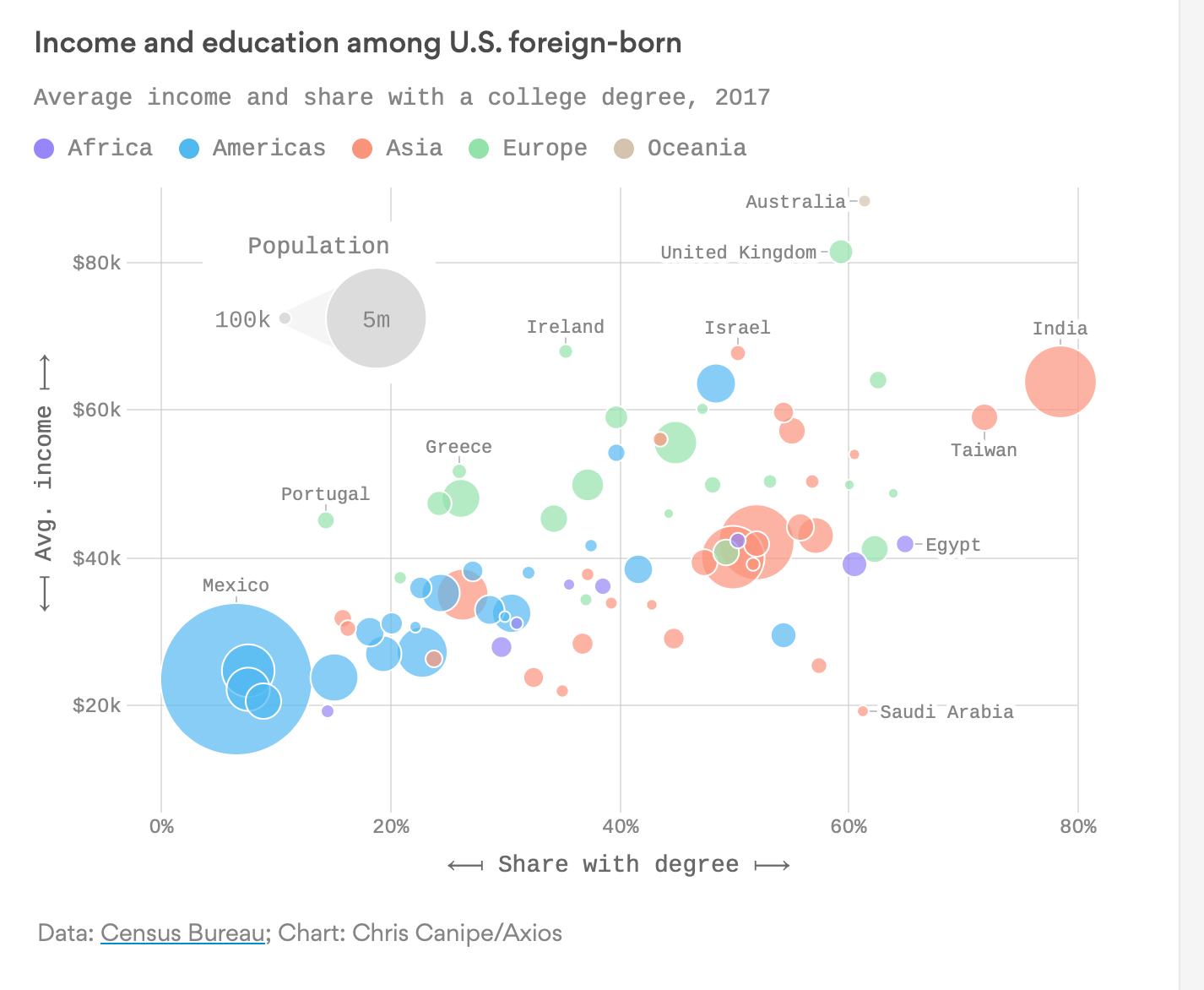
Asians tend to be among the best-educated immigrants to the U.S., and also land in some of the most lucrative careers. But, according to U.S. Census data, the image of privilege is true for only some Asians.

The bottom line: Data shows that income inequality is greater among Asian immigrants than for those arriving from anywhere else.

  • Indians on average earn $64,000 a year, and 78.6% have college degrees.
  • But but but … Compare that to Afghans ($22,000), Nepalis ($25,000) and Laotians ($32,000).

How to read the chart (above), via Axios visual journalist Chris Canipe: The circles represent each country’s population in the United States. Those on the lower left tend to have smaller average annual incomes and are less likely to have college degrees. Those in the upper right have the highest average incomes and are more likely to have degrees.

  • The red circles — representing Asian countries — are spread wider across the chart than circles of other colors, indicating higher inequality.

Source: The immigrant groups that make the most money

Belgian political parties target Turkish community, and also their votes

A bit odd to criticize expulsions on the basis of denying the Armenian genocide:

On Sunday, Belgium not only held an election for Belgian seats in the European Parliament, but also general elections that will end the caretaker government of Prime Minister Charles Michel. From federal to regional parliaments and also the European Parliament, over 8,000 candidates ran for seats in various bodies. Belgium has over eight million eligible voters, and some regions of the country have a large number of people of Turkish origin. From Christian democrats to socialists, liberals to Greens, many parties nominate Turkish candidates to get Turkish votes. However, any sign of loyalty to their Turkish roots is enough for these candidates to be expelled from their parties or receive harsh intraparty criticism.

Belgian parties have a bad record for embracing diversity and multiculturalism with many cases taking place in previous terms. For instance, Brussels regional parliament member Mahinur Özdemir was expelled from her party, the Humanist Democratic Center (CHD), after she refused to recognize the 1915 incidents as genocide. On the other hand, the far-right New Flemish Alliance (N-VA) parliamentarian Zuhal Demir is regarded favorably in the political sphere, and this perception led her to have a ministerial position in the recently dissolved coalition government. Demir regularly picks on the Muslim community and the Turkish minority in the country and announced that she has dropped her Turkish citizenship. She has also said that the state may opt to use “force” to integrate Muslims into society.

Some similar incidents occurred days before Sunday’s election too. Two candidates running for the federal parliament were slammed by various parties for sending campaign leaflets to Turkish voters in the Turkish language. Both of the candidates are from different regions and different political parties. A spokesperson from the party of Prime Minister Michel described the Turkish leaflets as “an act of separation” and called for urgent cancellation of their distribution. In response to the criticisms, Mahmut Temur of Flemish Open VLD said that his party does not treat others differently and slammed those who criticize him, “Our party isn’t like those who use some people for their ethnic background or sexual orientation first, and then expel them once they are used.”

Recently, Yasin Gül of the Christian Democrats (CD & V) was expelled from his party after a video of him was shared on the internet. In the footage, Gül and a group of Belgian Turks are seen singing an Azeri-Turkic song “Çırpınırdı Karadeniz” (“The Fluttering Black Sea”) and making the Grey Wolves sign. Having a Turkish nationalist view was enough for Gül to be expelled by his party. To prevent such action, Gül said the video was shot two years ago and that his views have changed.

Turkish nationalists have not caused trouble in the country and have faced many attacks by members of the PKK terrorist organization. After a series of propaganda attacks by the Flemish nationalist N-VA, Belgian Turkish Federation Chairman Ömer Zararsız spoke to the Belgian news magazine Knack, saying that he is fed up with the negative coverage of the Grey Wolves and that they want to build bridges, not polarization. “I have a Belgian passport, and I feel at home here. But our heart is also in Turkey.”

Having your heart in Turkey as well is a troubling issue for Belgian politics. You are wanted for the votes that you can grab from your community, but your disagreement over the events of 1915 will lead you to be expelled from your party

Source: Belgian political parties target Turkish community, and also their votes