In wake of blackface scandal, actual Black Canadians left in out-of-cabinet cold

Along the lines of the previous post, just phrased more sharply but more rhetorical and easier than reviewing the record and making specific criticisms or proposals:

Justin Trudeau doesn’t care about Black people.

In a post-blackface Canada, with a post-blackface prime minister, Black representation in the House of Commons, the Senate, and the judiciary—much less cabinet—remains abysmal, with only a smattering of chocolate in a sea of mayonnaise. After all of the ostensibly remorse-filled, Lena Dunham-esque apologies, peppered with activist language such as “intersectionality” and “privilege,” one would think Justin Trudeau would’ve learned something. He did not. It was all a ruse to get Black votes, only to shut them out of the important decision-making positions.

He continues to perform in blackface.

The 2015 election seated the most ethnically diverse House of Commons in Canada’s history: five Black MPs were elected, all Liberals, three of whom were newly elected. This election held the total steady, but with four Liberals and one New Democrat. Given that the Liberals usually elect the most Black candidates, and they were the ones caught in blackface, it is more incumbent upon them to practice what they preach. And preach they do. Like Kanye at Joel Osteen’s bible study.

After Time Magazine revealed who our prime minister was, the need to put this behind them was paramount. So what does one do when faced with the revelation of such racially heinous act? You call your Black friend. Enter Greg Fergus.

In the last Parliament, MP Fergus twice held the position of parliamentary secretary, first to the to the innovation minister and then to the Treasury Board president. In the wake of the blackface scandal, Fergus was called upon to do his duty and he did so with alacrity; his was the most prominent Black face imploring Canadians to forgive and move on. He even had the support of prominent cabinet minister Catherine McKenna, who stood by his side, nodding, at a press conference. It was a grotesque display of whiteness, to have a Black man tell other Black people how they should feel about the PM committing such a racist act, flanked by a white woman.

In that moment Greg Fergus made himself an agent of colonialism and allowed himself to be used as window-dressing, or the Black face of a scandal involving blackface.

And what did he get for it? Why wasn’t Fergus awarded a cabinet position like his white counterparts for his unwavering loyalty, especially as someone who has been in the Liberal trenches since he was a tyke (he was president of the Young Liberals of Canada from 1994 to1996)? Tap dancing for whiteness never brings prosperity, especially in the ignominious position Fergus put himself in.

But here is where Black people must take some responsibility.

After Trudeau was caught with his face singed, a private meeting was held between the PM and a myriad of “Black leaders” (whoever they are) to enact Part 2 of the apology tour. While it is not known all of what happened at this meeting, what we do know is that apologies were given, Trudeau was forgiven (by them), and Black people in the 905 and 416 subsequently came out to vote Liberal. Like Greg Fergus, these “leaders” allowed themselves to be used. And that is the problem with Black leadership in this day and age: they are too happy with the crumbs from Massa’s table and are too quick to give up the currency of political power—the vote. And what did these old wise men (and I do mean men) negotiate for the Black community in exchange for their continued votes? Not a damn thing.

And this is where Black people are: no currency, no power, no payoff. We sold out our negotiating power—along with our souls—by keeping that meeting private. The lack of transparency gave Trudeau an out. Since he didn’t have to be accountable to anyone, they got played, meaning the entire community got played.

However, all is not lost. Many of the strides made by the Liberal government came about due to an extraordinary amount of advocacy work done by Black organizations, and not because Trudeau cares about the plight of Black people. Within a minority Parliament situation, Black Canadians have more power and it’s time to toss out these old dudes who can’t figure out the cloud and add younger, more diverse leadership in the Black community—including women, LGBTQ, disabled, poor, and working-class people. We can lift others up instead of the few in Black “leadership” who only act as gatekeepers to power, while rewarding themselves.

Black organizations need to start seeing other people. Every party should be lobbied by Black advocates (except the PPC, because screw them) because loyalty to the Liberal Party has just gotten Black people to the back of the bus.

There needs to be a targeted lobbying plan to address the ministries who have a hand in policies that primarily affect Black people. These ministries need to be diversified and adjusted to benefit Black needs, Black aspirations, and Black dreams. And once these dusty Black leaders finally find the exit, the community may get somewhere because not all skinfolk is kinfolk.

Source: In wake of blackface scandal, actual Black Canadians left in out-of-cabinet cold

‘Disappointing’ cabinet picks show Trudeau still needs to address diversity ‘blind spot’, say advocates

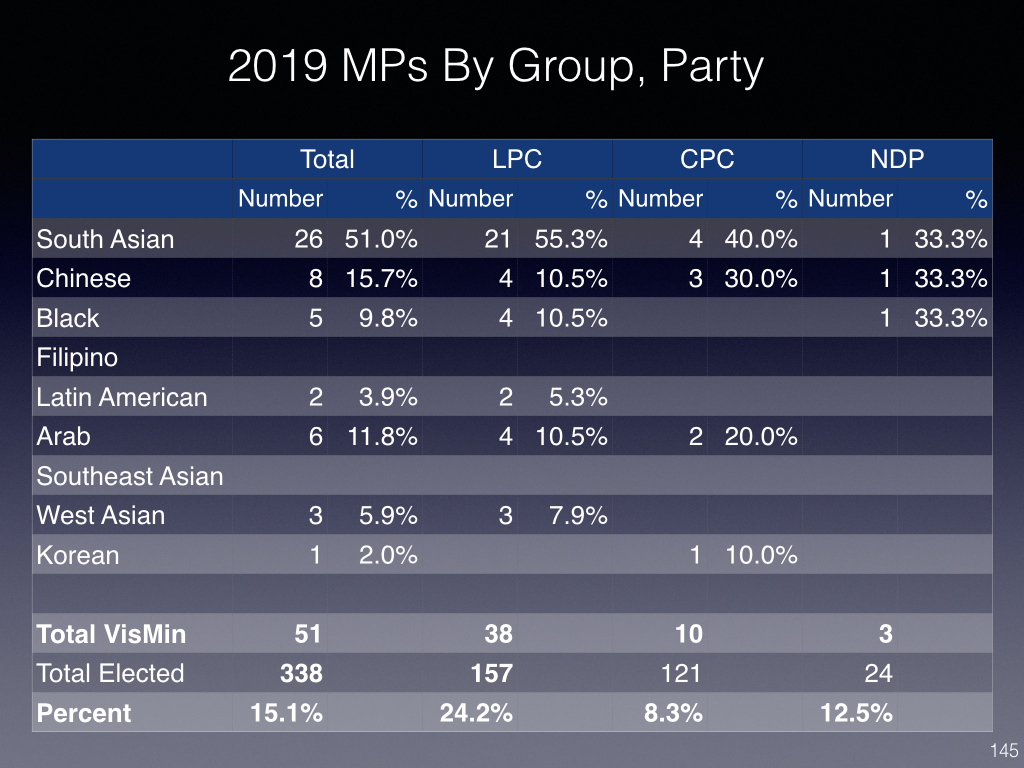
It is always interesting to listen to the advocates. In 2015, if I recall correctly, the complaint was over representation of South Asians (four) and no Black Canadians. In 2019, the complaint is only one Black Canadian without really acknowledging the lack of representation of other groups (e.g., Filipino Canadians, Arab Canadians).

By my count, the current cabinet has four South Asians, one Chinese, one Black, one West Asian and one Latin American (formally speaking, Argentine origins are not classified as visible minorities but nevertheless are perceived as such by the Latin American ethnic media).

The above chart provides a breakdown of MPs by visible minority groups and party (no visible minority Bloc or Green MPs). South Asians form over half of Liberal visible minority MPs.

However, Caesar-Chavannes does acknowledge the geographic, gender and other constraints that are intrinsic in cabinet making.

Aziz, on the other hand, ignores the increased diversity among judges and GiC appointments which is more reflective of the government’s record.

And while I would. be the last to maintain that Cabinet representation is unimportant, I think it is more important to focus on the government’s accomplishments and commitments where the government has a decent record to build upon (e.g., appointments, the increased funding for multiculturalism and anti-black racism and associated initiatives).

Lastly, in terms of benchmarks, the percentage of visible minorities who are also citizens, and thus able to vote and run for office, is 17.2 percent, arguably a better benchmark to use than the total number of visible minorities (:

The latest cabinet picks were disappointing for some advocates of better representation for racialized Canadians in positions of power, including former Liberal MP Celina Caesar-Chavannes who offered a plea to Prime Minister Justin Trudeau to demonstrate he is correcting an admitted blind spot.

She said that didn’t happen during the Nov. 20 cabinet shuffle, which saw one Black minister named among the seven visible-minority cabinet members, and one Indigenous MP receive a post after a seven-month gap since former justice minister-turned Independent MP Jody Wilson-Raybould (Vancouver Granville, B.C.) left cabinet in February last year.

Though Ms. Caesar-Chavannes said she understands it’s sometimes “a numbers game” with few elected to pick from—in this case four Black MPs in the Liberal caucus—she said Mr. Trudeau (Papineau, Que.) missed an opportunity and has yet to demonstrate through his actions that he’s addressing the damage caused in the wake of the racist images of him that emerged during the campaign.

Perhaps he thought naming a second Black MP to cabinet would have been “too obvious” or “fake,” but it would have “symbolized an understanding of the tremendous barriers that still exist within these communities,” she said, invoking Mr. Trudeau’s own assessment of his past decisions to don blackface and brownface, including as a 29-year-old teacher.

Former Liberal MP Celina Caesar-Chavannes says the prime minister has yet to demonstrate he’s learned from his past, but she’s still hopeful the government will address issues that affect racialized communities and address representation in positions of power. The Hill Times photograph by Andrew Meade

“Please pay attention to the blind spot that you said was created by your privilege and do something to correct it,” she said.

During his second attempt addressing the scandal on Sept. 19, Mr. Trudeau (Papineau, Que.) acknowledged “a massive blind spot” he said was born from his upbringing in “a place of privilege.”

Cabinet is only one area to address that, she said, and she still has hope the government will “do things differently.” That includes appointing more persons of colour to senior positions in the public service, and considering who is staffed in the inner circle. It’s “nonsense,” for example, that the government had only one Black chief of staff, Marjorie Michel, who was named in 2019.

Former Liberal foreign policy adviser Omer Aziz, who wasn’t available for a phone interview, offered a blunt assessment of the cabinet over email.

“White men at Finance, Foreign Affairs, and Justice. White men in the inner circle. An overwhelmingly white political staffer class. But there’s not even a pretence of genuine diversity anymore, which I suppose is a positive development since we can all stop pretending,” he wrote, noting it’s “sobering” to think that the Conservatives “would be even worse, but I still believe we can do a lot better.”

Mr. Aziz has been critical of the Liberal government since leaving in January 2018, saying he constantly felt “sidelined” in discussions during his time, and that minority staff voices in government, in general, were not being empowered and listened to.

Former U.S. President Barack Obama’s late-campaign endorsement “was determinative to Trudeau’s victory,” added Mr. Aziz, but the former president also had a Black attorney general, national security adviser, and homeland security secretary. “Perhaps [Mr.] Trudeau could learn something from the former president about representation and power.”

While this cabinet wasn’t a repeat of 2015, when no Black MPs were named, Black Vote Canada’s Velma Morgan said she was “extremely disappointed” that Families, Children, and Social Development Minister Ahmed Hussen (York South–Weston, Ont.) remains the only Black minister.

The United Nations Decade for People of African Descent (UNDPAD) Push Coalition, which advocates for Black people living in Canada and was created to push for budget commitments to that effect, has said the cabinet choices leaves it questioning the Liberal government’s commitment to improving the lives of Black Canadians.

“Our community is not monolithic. We can’t have just one person speaking on behalf of us,” said Ms. Morgan, echoing the call for better representation to occur in the federal service and political staffer class.

Proportionality is not enough to address inclusion: LeMay 

In 2015, Mr. Trudeau declared the creation of “a cabinet that looks like Canada,” but several who spoke with The Hill Times said that’s still not the case. The seven visible-minority MPs represent 19.4 per cent of the cabinet, compared with 22.3 per cent of the Canadian population that identifies that way. He also named one Indigenous person, or 2.7 per cent of cabinet. The Indigenous population of Canada is closer to five per cent. Over Mr. Trudeau’s first four years in office, he appointed seven racialized and two Indigenous MPs to his cabinet. Under former prime minister Stephen Harper’s nearly 10 years, he appointed five visible minority and three Indigenous cabinet ministers.

Of the 61 visible minority and Indigenous MPs elected on Oct. 21, 44 are in the Liberal caucus and the only demographic (of those elected in the Liberal caucus) not represented in cabinet are MPs of Arabic descent.

The cabinet includes four women of colour: Minister of Small Business, Export Promotion, and International Trade Mary Ng (Markham–Thornhill, Ont.), Minister of Diversity and Inclusion and Youth Bardish Chagger (Waterloo, Ont.), Minister of Public Services and Procurement Anita Anand (Oakville, Ont.), who became Canada’s first Hindu minister, and Minister for Women and Gender Equality and Rural Economic Development Maryam Monsef (Peterborough–Kawartha. Ont.), who became Canada’s first Muslim minister in 2015. Cabinet veterans Families Minister Ahmed Hussen  (York South–Weston, Ont.), Defence Minister Harjit Sajjan (Vancouver South, B.C.), and Innovation Minister Navdeep Bains (Mississauga–Malton, Ont.) were also reappointed.

All but Northern Affairs Minister Dan Vandal (Saint Boniface-Saint Vital, Man.)—who is Métis and the lone Indigenous person in cabinet—and Mr. Sajjan are from Ontario in a cabinet that is skewed toward Canada’s biggest provinces, with 11 in Quebec, and 17 in Ontario.

“Our politics suffers from the lack of proportional representation and this cabinet is an example of that,” said Anita Singh, a Canadian political analyst and expert in Indian diaspora politics, noting the one Asian, one Black, and one Indigenous minister, though all three communities “are much larger and much more diverse than the cabinet shows.”

From an inclusion standpoint, one is never enough, said Rose LeMay, CEO of the Indigenous Reconciliation Group, who also writes a column for The Hill Times.

“Too often, in an inclusion debate, when there’s only one person of colour or a different culture, that person unfortunately becomes just becomes a token,” she said. “We will need more than just proportional around the table. We need our voice to be heard strongly and that will not occur even if we have a similar number around the table—we actually would need more to make the change that we need to see.”

That only one of the six Liberal Indigenous MPs were named to cabinet is concerning, but not surprising, she said, especially after a campaign that “hardly touched on reconciliation.”

Given Ms. Wilson-Raybould’s experience and journey trying to “maintain her credibility,” both with First Nations across Canada and in cabinet, Ms. LeMay suggested a role representing the Crown carries “a significant risk” for First Nations, Métis, and Inuit MPs.

“I wonder how difficult that would be for an Indigenous [person] in cabinet, how to maintain, with integrity, both of those roles,” she said.

‘Top-tier’ posts not given to people of colour

The most frustrating part of this cabinet for Ms. Singh is the posts persons of colour take on, she said, echoing Mr. Aziz’s issues.

All but one of the “top-tier” posts—finance, foreign affairs, trade, environment, justice, defence—remain with a white minister. Some contended Mr. Sajjan at defence, though a big file, isn’t as high-profile.

Similarly, there are gaps in portfolios that control the purse strings and involve “high-profile policy making,” like health, transport, and infrastructure, she said.

“We also see that Trudeau continues the tradition of putting inexperienced visible minority MPs in some of the toughest files and under-appreciated files,” she said pointing to rookie Ms. Anand, where she will oversee the Phoenix pay debacle and fighter jets procurement file, in concert with National Defence. Ms. Monsef, initially in charge of democratic reform in the last Parliament, was an example of that in Mr. Trudeau’s first cabinet, she said.

Others, like Ms. Morgan, don’t see it that way, saying a seat at the table is what’s most important.

Though some have viewed Mr. Hussen’s move from Immigration to Families as a demotion (an assessment he disagreed with at the swearing-in), Ms. Caesar-Chavannes pushed back and said she sees it as a high-impact post that directly affects racialized communities.

Angela Wright, a political analyst and former Conservative staffer, saw the move as a red flag and said she’s “not very optimistic” with the cabinet choices, especially given the Immigration and Public Safety portfolios—two files that disproportionately affect racialized people—are overseen by white men.

It was “shocking” to see Bill Blair (Scarborough Southwest, Ont.) elevated to Public Safety Minister, added Ms. Wright, given his reputation in the community from his time as Toronto’s police chief, where he defended the service’s use of carding.

“That’s a very odd choice,” she said, while Ms. Singh said it’s “continually frustrating that his cabinet does not reflect the actual needs of the communities that require them the most—immigration, Indigenous services, even international trade—continue to be held by MPs that do not come from communities of colour.”

Ms. Singh also noted the regional breakdown, saying it suggests the Liberals are “playing from a 1990s playbook,” targeting “ethnic neighbourhoods” to recruit candidates, but not giving the successful MPs a voice in leadership positions, she said, pointing to Brampton and Scarborough in Ontario, and Surrey, B.C. Compare that to Toronto city ridings “as a microcosm,” where she said there were no people of colour on the Liberal roster, with white MPs in Davenport, Danforth, Spadina–Fort York, Toronto Centre, Beaches–East York, and Toronto–St. Paul’s in a city where 50 per cent of all people are visible minorities.

Source: ‘Disappointing’ cabinet picks show Trudeau still needs to address diversity ‘blind spot’, say advocates

Sacha Baron Cohen: Facebook would have let Hitler buy anti-Semitic ads

For the record:

British comedian Sacha Baron Cohen has said if Facebook had existed in the 1930s it would have allowed Hitler a platform for his anti-Semitic beliefs.

The Ali G star singled out the social media company in a speech in New York.

He also criticised Google, Twitter and YouTube for pushing “absurdities to billions of people”.

Social media giants and internet companies are under growing pressure to curb the spread of misinformation around political campaigns.

Twitter announced in late October that it would ban all political advertising globally from 22 November.

Earlier this week Google said it would not allow political advertisers to target voters using “microtargeting” based on browsing data or other factors.

Analysts say Facebook has come under increasing pressure to follow suit.

The company said in a statement that Baron Cohen had misrepresented its policies and that hate speech was banned on its platforms.

“We ban people who advocate for violence and we remove anyone who praises or supports it. Nobody – including politicians – can advocate or advertise hate, violence or mass murder on Facebook,” it added.

What did Baron Cohen say?

Addressing the Anti-Defamation League’s Never is Now summit, Baron Cohen took aim at Facebook boss Mark Zuckerberg who in October defended his company’s position not to ban political adverts that contain falsehoods.

“If you pay them, Facebook will run any ‘political’ ad you want, even if it’s a lie. And they’ll even help you micro-target those lies to their users for maximum effect,” he said.

“Under this twisted logic, if Facebook were around in the 1930s, it would have allowed Hitler to post 30-second ads on his ‘solution’ to the ‘Jewish problem’.”

Baron Cohen said it was time “for a fundamental rethink of social media and how it spreads hate, conspiracies and lies”. He also questioned Mr Zuckerberg’s characterisation of Facebook as a bastion of “free expression”.

“I think we could all agree that we should not be giving bigots and paedophiles a free platform to amplify their views and target their victims,” he added.

Earlier this month, an international group of lawmakers called for targeted political adverts on social media to be suspended until they are properly regulated.

The International Committee on Disinformation and Fake News was told that the business model adopted by social networks made “manipulation profitable”.

A BBC investigation into political ads for next month’s UK election suggested they were being targeted towards key constituencies and certain age groups.

Source: Sacha Baron Cohen: Facebook would have let Hitler buy anti-Semitic ads

It’s the climate, not immigration, that keeps Australians awake at night

Good detailed report on the latest annual survey by the Scanlon Foundation, showing some similarities with Canadian public opinion and divisions:

Something happened in 2017. Australia is second only to Canada in welcoming immigration on a large scale. Our faith in the benefits of accepting newcomers of all faiths and races is rock solid. But a couple of years ago we began to grow impatient about the government’s management of the immigration program, impatient in particular about overcrowding in our cities.

This is the verdict of the Scanlon Foundation’s 2019 Mapping Social Cohesion report, published on Tuesday. The mission of the foundation for the past decade or so has been to measure how this migrant nation hangs together. In that time an extraordinary 50,000 of us have been polled to track the hopes and fears that sweep Australia – and not just about immigration.

The author of the reports, Prof Andrew Markus of Monash University, finds most Australians now share “an underlying concern about the government not properly managing the situation – the impact on overcrowding, house prices, environment”.

But in 2019 Markus fears impatience with government management might imperil majority support for Australia’s immigration program. “This has not yet occurred, but the potential is evident.”

We are not Europe. Asked every year to name the most important problem facing their countries, Europeans have lately nominated immigration. “It’s sort of cooled down a bit now,” says Markus, “but even to the present day when people are asked what’s the main issue for the EU, they still nominate controlling population movement and immigration.”

Not in Australia. We always put the economy at the top of the list. Immigration came in fourth in 2019, nominated by 6% of us. In second place on the list, after an abrupt rise, is the environment and climate change.

Source: It’s the climate, not immigration, that keeps Australians awake at night

Those who toil in low-wage jobs in the GTA more likely to be visible minorities

Of note:

The swelling ranks of Greater Toronto workers who pour coffee, clean offices and toil in other low-wage jobs are more likely to be visible minorities, according to a new report.

Although visible minorities make up just 46 per cent of the Toronto region’s workforce, they account for more than 63 per cent of the working poor, says the report being released Tuesday by the Metcalf Foundation.

Within each of the area’s four largest visible minority groups — Chinese, Black, South Asian and Filipino — the Black community has the highest percentage of working poor, at 10.5 per cent, says the report written by social policy expert John Stapleton, who used the latest census and Statistics Canada income data.

Second- and third-generation Black Canadians are especially vulnerable and often earn less than recent Black immigrants, according to the report.

Working poverty is lowest in the Filipino community, at 5.3 per cent, just above white residents at 4.8 per cent.

“It is striking and concerning that the Black population has the highest percentage of working poverty among both the immigrant population and those born in Canada,” says the report.

The growth in working poverty among and second- and third-generation Black Canadians is “particulary pronounced” among Black Canadian-born females, who saw an increase from 9.7 per cent in 2006 to 12.2 per cent in 2016, the report says.

As highlighted in a recent United Way report, the Toronto region is “coming to the uncomfortable realization that our increasing economic inequality is also highly racialized,” says University of Toronto professor David Hulchanski.

“We knew this, but now we have solid data and evidence,” says Hulchanski, who has been tracking disappearing middle-class neighbourhoods in the GTA and other Canadian cities for almost 50 years.

The report reflects “facts and trends that cannot continue if we want a productive, prosperous and harmonious Toronto region,” he adds.

The report is the second update of Stapleton’s groundbreaking 2012 analysis, which found working poverty in the Toronto region spiked by an alarming 46 per cent between 2001 and 2006, largely due to the demand for entry-level service workers to support the burgeoning high-paid knowledge sector. This includes lawyers, business and finance professionals.

Over the past decade, working poverty grew by another 27 per cent, Tuesday’s report shows.

“Although this slower growth is a welcome trend, the continued growth is troubling,” Stapleton says.

High rates of working poverty along with data that points to “the racialization” of working poverty is a serious public policy concern, he says.

“These trends ought to be considered unacceptable anywhere, and definitely in the wealthiest and most diverse metropolitan area of an affluent nation,” Stapleton says. “We all lose out when a significant part of our labour force cannot make ends meet.”

Black community scholars Carl James and Kofi Hope, who independently analyzed the report’s race-based data, say the findings have to be seen in the context of “the reality of anti-Black racism, and the reluctance of Canadians to acknowledge that this phenomenon has existed in our nation for hundreds of years.”

“This report shows why it is important to collect disaggregated data,” says James, who holds the Jean Augustine chair in education, community and diaspora at York University’s faculty of education. “And it also shows why it is important to disaggregate the visible minority category.”

Soha Mohamed, 29, a decent work project facilitator at the Victoria Park Hub in Scarborough, says the Metcalf report paints a “disappointing” portrait of the experience of Black workers.

“But it doesn’t come as a shock, especially for me, personally, and my own relationship to precarious work,” adds Mohamed, a Black woman whose part-time contract, with no benefits, expires next March.

“Even though my work is to promote stable employment and opportunities for job advancement, health and pension benefits, equality and rights at work for women, it’s also something that I aspire to achieve,” she says.

Mohamed, who has two young daughters, immigrated to Canada with her parents from Sudan when she was 5. Combined with child benefits and her partner’s meagre income as an upholsterer, their household income falls below Canada’s Low-Income Measure of about $47,000 after taxes for a family of four in 2017.

“I am already looking for work because I know my current contract won’t be extended,” she said. “There is always that level of uncertainty. What happens next? How will I pay the rent?”

The report defines the working poor as people between the ages of 18 and 64 who are not students, are living independently and have an annual after-tax income between $3,000 and the Low-Income Measure of $22,133 in 2015, the year the most recent census was taken.

By this measure, 7 per cent of Toronto workers — almost 170,000 — are “working poor.”

The working poor tend to be younger and less educated than the overall working population. And they are more likely to be men, a reflection of the loss of manufacturing jobs in the area that tended to be dominated by male workers.

Although the data doesn’t show why the growth in working poverty has slowed in the past decade, increases to the minimum wage and new and increased income supplements for people living in poverty likely helped, Stapleton says.

“These interventions, which continue to moderate the incidence of working poverty, illustrate that governments have a crucial role to play in assuring adequate incomes for residents,” says the report by the Metcalf Foundation, which is dedicated to equity, sustainability and the arts.

Strategies to reduce working poverty also need to address systemic and structural issues that continue to marginalize the Black community, the report adds.

Society needs to value work done by those in lower-paying jobs and find a way to turn them into full-time, less precarious employment.

“We believe that through higher wages, better job stability, anti-racism strategies, and more effective support programs, Toronto could reduce and even eradicate working poverty,” Stapleton says in the report.

Many of the factors driving working poverty among all GTA residents — including being a young worker, having no post-secondary education, and living outside the downtown core — are common among Black Canadians, say York University’s James and Hope, a senior policy adviser at the Wellesley Institute.

A February 2019 Statistics Canada report says 26.6 per cent of the Black population was under age 15, while only 16.7 per cent of the overall Canadian population was in that age group.

According to the Toronto District School Board, Black students — particularly males — are more likely than other students to be suspended or expelled from school and have a higher dropout rate.

And Black people in Toronto are also disproportionately watched, stopped and “carded” by police, leading to higher rates of criminalization, they add.

As far as intergenerational working poverty, James and Hope say it appears the longer Black families live in Canada and interact with Canadian institutions, “the more difficult it becomes for them to overcome entrenched barriers.”

“Further research is needed to look more closely at the ways anti-Black racism manifests to produce barriers to Black people’s success in the labour market,” they say. “This research is critical to moving forward if we are to get a full picture of what is happening within Black communities, and what policy and community responses are necessary to change this situation.”

Source: Those who toil in low-wage jobs in the GTA more likely to be visible minorities

Ramos and Griffith: Human rights defenders should boycott immigration conference in Beijing

Our op-ed in the Ottawa Citizen (part of the national Postmedia chain for those outside of Canada):

The number of international events being hosted by China is on the rise. At first glance, one might argue that global exchange is a mechanism for the West to normalize democratic values and open science. However, the world is increasingly witnessing repressive regimes, such as that in China, rise in influence at the cost of human rights and democracy. This then raises the question: Does participating in events hosted by such regimes promote engagement or complicity?

The Chinese regime has created a number of quasi-independent groups, such as the Center for China and Globalization (CCG), which bills itself as “China’s leading global non-governmental think tank with more than 10 branches and overseas representatives.” The CCG is in fact part of the United Front Work Department, a branch of the Chinese Communist Party that aims to exert Chinese government influence around the world. Both organizations are key pillars in attracting conferences to China, which means that their events will most likely legitimize the regime on the international stage, rather than curb it through engagement.

One example of how this plays out can be seen through the International Metropolis Conference, which involves government policy makers, academics and non-governmental sector organizations and is set to be held in Beijing this coming June. The CCG was a key stakeholder in wooing the conference’s secretariat and bringing it to China. The conference focuses on immigration and refugee issues and is widely known for promoting multiculturalism, diversity and inclusion. It was founded in 1996 with Canadian government funding and with strong links with Immigration, Refugees and Citizenship Canada which hosted last year’s conference. Its secretariat is currently based at Carleton University. The conference and the “Metropolis” brand are almost synonymous with Canadian immigration.

Does participating in events hosted by such regimes promote engagement or complicity?Holding such a conference in China under the current regime can only legitimize Beijing’s human rights abuses. Both the United Nations and Amnesty International have issued reports warning that China is actively suppressing its ethnic minority populations. Up to one million  Muslim Uighur are being held in “re-education centres,” which are essentially prison camps. It is ironic to hold a conference on refugees in a country that produced them, and doing so is an act of complicity.

Based on past practices of the regime, it is almost certain that Chinese authorities will not permit a free and open exchange of ideas on relevant Chinese policy and practice. Foreign speakers will likely be discouraged from talking about issues that might “offend” the government, or will censor themselves. Chinese participants will be prohibited from doing so. It is also very likely that minders will be present to monitor and intervene in the event of any real or perceived criticism.

Some might argue that participating in the conference is a means to change the regime and that all countries have blemishes. Canada, for instance, still wrestles with ongoing colonialism. But, there is a major difference between countries that have entrenched human rights in their legislation and those, such as China, who do not. It is naïve to think that hosting an event in China will change its practices.

For this reason, more than 150 academics and representatives of non-governmental groups from across Canada and 11 countries signed a petition against both holding and attending the International Metropolis Conference in Beijing. They recognize that it is not too late to do something about the message Canada and other democratic countries send when they fund and participate in events in China, and that it is not too late for individual Canadians to make a difference.

It is time for Canada and other Western countries to recognize they cannot assume that policy and academic exchange will change repressive regimes. Rather it could potentially legitimate them or send the signal that the international community is willing to turn a blind eye. For these reasons it is time to rethink when it is appropriate to participate in events held by repressive regimes. Failing to do so risks compromising Canadian and international human rights values.

Source: https://ottawacitizen.com/opinion/columnists/ramos-and-griffith-human-rights-defenders-should-boycott-immigration-conference-in-beijing

How Racial Bias May Have Saved 14,000 Black Lives

Really interesting study on one of the rare positive impacts of implicit bias and discrimination:

When the opioid crisis began to escalate some 20 years ago, many African-Americans had a layer of protection against it.

But that protection didn’t come from the effectiveness of the American medical system. Instead, researchers believe, it came from racial stereotypes embedded within that system.

As unlikely as it may seem, these negative stereotypes appear to have shielded many African-Americans from fatal prescription opioid overdoses. This is not a new finding. But for the first time an analysis has put a number behind it, projecting that around 14,000 black Americans would have died had their mortality rates related to prescription opioids been equivalent to that of white Americans.

Starting in the 1990s, new prescription opioids were marketed more aggressively in white rural areas, where pain drug prescriptions were already high. African-Americans received fewer opioid prescriptions, some researchers think, because doctors believed, contrary to fact, that black people 1) were more likely to become addicted to the drugs 2) would be more likely to sell the drugs and 3) had a higher pain threshold than white people because they were biologically different.

A fourth possibility is that some white doctors were more empathetic to the pain of people who were like them, and less empathetic to those who weren’t. Some of this bias “can be unconscious,” said Dr. Andrew Kolodny, a director of opioid policy research at Brandeis University.

This accidental benefit for African-Americans is far outweighed by the long history of harm they have endured from inferior health care, including infamous episodes like the Tuskegee study. And it doesn’t remedy the way damaging stereotypes continue to influence aspects of medical practice today. “The reason to study this further is twofold,” Dr. Kolodny said. “It’s easy to imagine the harm that could come to blacks in the future, and we need to know what went wrong with whites, and how they were left exposed” to overprescribing.

The prescription-opioid-related mortality rates of black and white Americans were relatively similar two decades ago, but researchers found that by 2010, the rate was two times higher for whites than for African-Americans.

Because African-Americans were less likely to receive those prescriptions, they were less likely to become addicted (though they were more likely to endure unnecessary and excruciating pain for illnesses like cancer).

The researchers, Monica Alexander, a statistician with the University of Toronto; Mathew Kiang, an epidemiologist at Stanford; and Magali Barbieri, a demographer at the University of California, Berkeley; published their study in the journal Epidemiology.

With additional analysis at The Upshot’s request, Mr. Kiang calculated that had the African-American population’s mortality rates caused by prescription opioids been equivalent to those of whites, black Americans would have experienced 14,124 additional deaths from 1999 to 2017.

It’s a counterfactual analysis that relies on some large assumptions. Among other things, the projection assumes that the public health and medical response to the epidemic would have remained the same even if the African-American mortality rate had been higher. And it doesn’t take into consideration any potential changes in overdoses from heroin and fentanyl had African-Americans had greater access to prescription opioids. Still, Mr. Kiang found the results “fairly remarkable in at least two ways.”

“First, it’s a good example of how more medical care is not necessarily a good thing,” he said. “Second, it’s an extremely rare case where racial biases actually protected the population being discriminated against.”

A crackdown in recent years has reduced opioid prescribing over all, “and the racial/ethnic gap in opioid prescribing has narrowed,” said Mr. Kiang, but he said it was unclear whether the gap had closed entirely.

In recent years, drug overdoses have risen sharply among black Americans, particularly among older heroin users in places where fentanyl has become widespread. One reason that the death rates from heroin and fentanyl have converged between black and white people may be simple: Heroin and fentanyl are readily available outside the health system, so they’re less affected by bias within it.

The public response to drug epidemics also tends to diverge along racial lines. During the crack epidemic, there was a greater emphasis on punishment and incarceration. With the opioid crisis primarily affecting white people, there has been more emphasis on empathy and rehabilitation. (This same disparity was seen in crack versus powder cocaine.) Race played an obvious role in the policy response, Dr. Kolodny said: “From ‘Arrest our way out of it’ to, ‘It’s a disease.’”

UK: Government faces high court challenge over ‘utterly shameful’ £1000 child citizenship fee

As it should. Cost recovery is justifiable (administrative cost), making of government service a money-making enterprise is not:

The Home Office is set to face a High Court challenge over the £1,012 fee it charges to register a child as a British citizen, after a judicial review of the charge was brought by the Project for the Registration of Children as British Citizens.

Amnesty International UK has been supporting the litigation to challenge the profit-making element of the fee, calling for an immediate end to the Government’s “shameless profiteering” off children’s rights. Mishcon de Reya are providing pro bono support to the Project for the Registration of Children as British Citizens on the case.

With the current administrative processing cost at only £372 per application, a profit of £640 is made by the Home Office for the registration of each child.

The landmark case is being brought by two children, known as A and O, and will be heard in the High Court at a three-day hearing on 26-28 November. If successful, the final ruling could have implications for an estimated 120,000 people in the UK.

In a statement submitted as part of the proceedings, O, aged 12, says:

“I was born in England in 2007. I have never travelled to another country. I don’t want to tell my friends that I am not British like them because I’m scared. I worry that if my friends find out, they won’t understand that I really am British like them.

“I enjoy playing netball for my school team. My team have been abroad twice for netball tournaments, but I could not travel because I do not have my British passport.

“I was born here and feel all of me is British. This is my home. I’ve got nowhere else but here.”

Solange Valdez-Symonds, Director at the Project for the Registration of Children as British Citizens, said:

“Tens of thousands of children who were born in this country are being charged exorbitant fees to register their citizenship rights. The futures of these children are slowly and silently being chipped away. Such barefaced profiteering from children by the Home Office is utterly shameful.

“Children’s rights are not for sale. We hope the High Court challenge will rightly bring an end to this injustice.”

Campaigners call on UK Government to stop blocking children’s rights

Ahead of tomorrow’s hearing, campaigners from Amnesty UK’s Children Human Rights Network will hand in 30,000-strong petition to Home Office calling for immediate end to the fee.

The campaigners will be building a wall outside the Home Office with messages of support from activists across the UK [pictures available].

They will be joined by some of the children affected by the profiteering fee, including 16-year-old Daniel, who came to this country with his mother when he was three years-old and was granted his British citizenship last year, he said:

“My mother saved what she could but sometimes she didn’t eat properly so she could do this. At the time we had some support from the council but my mother was not then permitted to work except unpaid as a volunteer with a charity. It has been really difficult for my mother.”

Judicial review

The judicial review claim asks the Home Office to:

i) Set the registration fee at no more than the administrative cost;

ii) introduce a fee waiver for children who cannot afford the fee; and

iii) provide a fee exemption for children in local authority care.

Source: UK: Government faces high court challenge over ‘utterly shameful’ £1000 child citizenship fee

Secret documents reveal inner workings of China’s mass detention camps for Uyghurs, other minorities

No longer any opportunity to deny on the part of China and its supporters. Cultural genocide in practice and the degree of organization, the bureaucratic precision, and the attention to detail are reminiscent of the Nazi Germany’s physical genocide of Jews, Roma and others:

The watch towers, double-locked doors and video surveillance in the Chinese camps are there “to prevent escapes.” Uyghurs and other minorities held inside are scored on how well they speak the dominant Mandarin language and follow strict rules on everything down to bathing and using the toilet, scores that determine if they can leave.

“Manner education” is mandatory, but “vocational skills improvement” is offered only after a year in the camps.

Voluntary job training is the reason the Chinese government has given for detaining more than a million ethnic minorities, most of them Muslims. But a classified blueprint leaked to a consortium of news organizations shows the camps are instead precisely what former detainees have described: Forced ideological and behavioural re-education centres run in secret.

The classified documents lay out the Chinese government’s deliberate strategy to lock up ethnic minorities even before they commit a crime, to rewire their thoughts and the language they speak.

The papers also show how Beijing is pioneering a new form of social control using data and artificial intelligence. Drawing on data collected by mass surveillance technology, computers issued the names of tens of thousands of people for interrogation or detention in just one week.

Taken as a whole, the documents give the most significant description yet of high-tech mass detention in the 21st century in the words of the Chinese government itself. Experts say they spell out a vast system that targets, surveils and grades entire ethnicities to forcibly assimilate and subdue them – especially Uyghurs, a predominantly Muslim Turkic minority of more than 10 million people with their own language and culture.

“They confirm that this is a form of cultural genocide,” said Adrian Zenz, a leading security expert on the far western region of Xinjiang, the Uighur homeland. “It really shows that from the onset, the Chinese government had a plan.”

Zenz said the documents echo the aim of the camps as outlined in a 2017 report from a local branch of the Xinjiang Ministry of Justice: To “wash brains, cleanse hearts, support the right, remove the wrong.”

‘Like a movie’: In Xinjiang, new evidence that China stages prayers, street scenes for visiting delegations

China has struggled for decades to control Xinjiang, where the Uyghurs have long resented Beijing’s heavy-handed rule. After the 9/11 attacks in the United States, Chinese officials began justifying harsh security measures and religious restrictions as necessary to fend off terrorism, arguing that young Uyghurs were susceptible to the influence of Islamic extremism. Hundreds have died since in terror attacks, reprisals and race riots, both Uyghurs and Han Chinese.

In 2014, Chinese President Xi Jinping launched what he called a “People’s War on Terror” when bombs set off by Uighur militants tore through a train station in Urumqi, the capital of Xinjiang, just hours after he concluded his first state visit there.

“Build steel walls and iron fortresses. Set up nets above and snares below,” state media cited Xi as saying. “Cracking down severely on violent terrorist activities must be the focus of our current struggle.”

In 2016, the crackdown intensified dramatically after Xi named Chen Quanguo, a hardline official transferred from Tibet, as Xinjiang’s new head. Most of the documents were issued in 2017, as Xinjiang’s “War on Terror” morphed into an extraordinary mass detention campaign using military-style technology.

The practices largely continue today. The Chinese government says they work.

“Since the measures have been taken, there’s no single terrorist incident in the past three years,” said a written response from the Chinese Embassy in the United Kingdom. “Xinjiang is much safer … The so-called leaked documents are fabrication and fake news.”

The statement said that religious freedom and the personal freedom of detainees was “fully respected” in Xinjiang.

The documents were given to the International Consortium of Investigative Journalists by an anonymous source. The ICIJ verified them by examining state media reports and public notices from the time, consulting experts, cross-checking signatures and confirming the contents with former camp employees and detainees.

They consist of a notice with guidelines for the camps, four bulletins on how to use technology to target people, and a court case sentencing a Uighur Communist Party member to 10 years in prison for telling colleagues not to say dirty words, watch porn or eat without praying.

The documents were issued to rank-and-file officials by the powerful Xinjiang Communist Party Political and Legal Affairs Commission, the region’s top authority overseeing police, courts and state security. They were put out under the head official at the time, Zhu Hailun, who annotated and signed some personally.

The documents confirm from the government itself what is known about the camps from the testimony of dozens of Uyghurs and Kazakhs, satellite imagery and tightly monitored visits by journalists to the region.

Erzhan Qurban, an ethnic Kazakh who moved back to Kazakhstan, was grabbed by police on a trip back to China to see his mother and accused of committing crimes abroad. He protested that he was a simple herder who had done nothing wrong. But for the authorities, his time in Kazakhstan was reason enough for detention.

Qurban told the AP he was locked in a cell with 10 others last year and told not to engage in “religious activities” like praying. They were forced to sit on plastic stools in rigid postures for hours at a time. Talk was forbidden, and two guards kept watch 24 hours a day. Inspectors checked that nails were short and faces trimmed of moustaches and beards, traditionally worn by pious Muslims.

Those who disobeyed were forced to squat or spend 24 hours in solitary confinement in a frigid room.

“It wasn’t education, it was just punishment,” said Qurban, who was held for nine months. “I was treated like an animal.”

WHO GETS ROUNDED UP AND HOW

On February 18, 2017, Zhu, the Han Chinese official who signed the documents, stood in chilly winter weather atop the front steps of the capital’s city hall, overlooking thousands of police in black brandishing rifles.

“With the powerful fist of the People’s Democratic Dictatorship, all separatist activities and all terrorists shall be smashed to pieces,” Zhu announced into a microphone.

With that began a new chapter in the state’s crackdown. Police called Uyghurs and knocked on their doors at night to take them in for questioning. Others were stopped at borders or arrested at airports.

In the years since, as Uyghurs and Kazakhs were sent to the camps in droves, the government built hundreds of schools and orphanages to house and re-educate their children. Many of those who fled into exile don’t even know where their children or loved ones are.

The documents make clear that many of those detained have not actually done anything. One document explicitly states that the purpose of the pervasive digital surveillance is “to prevent problems before they happen” – in other words, to calculate who might rebel and detain them before they have a chance.

This is done through a system called the Integrated Joint Operations Platform or IJOP, designed to screen entire populations. Built by a state-owned military contractor, the IJOP began as an intelligence-sharing tool developed after Chinese military theorists studied the U.S. army’s use of information technology in Iraq and Afghanistan.

“There’s no other place in the world where a computer can send you to an internment camp,” said Rian Thum, a Xinjiang expert at the University of Nottingham. “This is absolutely unprecedented.”

The IJOP spat out the names of people considered suspicious, such as thousands of “unauthorized” imams not registered with the Chinese government, along with their associates. Suspicious or extremist behaviour was so broadly defined that it included going abroad, asking others to pray or using cellphone apps that cannot be monitored by the government.

The IJOP zoomed in on users of “Kuai Ya,” a mobile application similar to the iPhone’s Airdrop, which had become popular in Xinjiang because it allows people to exchange videos and messages privately. One bulletin showed that officials identified more than 40,000 “Kuai Ya” users for investigation and potential detention; of those, 32 were listed as belonging to “terrorist organizations.”

“They’re scared people will spread religion through `Kuai Ya,“’ said a man detained after police accused him of using the app. He spoke to the AP on condition of anonymity to protect himself and his family. “They can’t regulate it … So they want to arrest everyone who’s used `Kuai Ya’ before.”

The system also targeted people who obtained foreign passports or visas, reflecting the government’s fear of Islamic extremist influences from abroad and deep discomfort with any connection between the Uyghurs and the outside world. Officials were asked to verify the identities even of people outside the country, showing how China is casting its dragnet for Uyghurs far beyond Xinjiang.

In recent years, Beijing has put pressure on countries to which Uyghurs have fled, such as Thailand and Afghanistan, to send them back to China. In other countries, state security has also contacted Uyghurs and pushed them to spy on each other. For example, a restaurateur now in Turkey, Qurbanjan Nurmemet, said police contacted him with videos of his son strapped to a chair and asked him for information on other Uyghurs in Turkey.

Despite the Chinese government’s insistence that the camps are vocational training centres for the poor and uneducated, the documents show that those rounded up included party officials and university students.

After the names were collected, lists of targeted people were passed to prefecture governments, who forwarded them to district heads, then local police stations, neighbour watchmen, and Communist Party cadres living with Uighur families.

Some former detainees recalled being summoned by officers and told their names were listed for detention. From there, people were funnelled into different parts of the system, from house arrest to detention centres with three levels of monitoring to, at its most extreme, prison.

Experts say the detentions are a clear violation of China’s own laws and constitution. Maggie Lewis, a professor of Chinese law at Seton Hall University, said the Communist Party is circumventing the Chinese legal system in Xinjiang.

“Once you’re stamped as an enemy, the gloves go off,” she said. “They’re not even trying to justify this legally … This is arbitrary.”

The detention campaign is sweeping. A bulletin notes that in a single week in June 2017, the IJOP identified 24,612 “suspicious persons” in southern Xinjiang, with 15,683 sent to “education and training,” 706 to prison and 2,096 to house arrest. It is unknown how typical this week might be. Local officials claim far less than a million are in “training,” but researchers estimate up to 1.8 million have been detained at one point or another.

The bulletins stress that relationships must be scrutinized closely, with those interrogated pushed to report the names of friends and relatives. Mamattursun Omar, a Uighur chef arrested after working in Egypt, was interrogated in four detention facilities over nine months in 2017. Omar told the AP that police asked him to verify the identities of other Uyghurs in Egypt.

Eventually, Omar says, they began torturing him to make him confess that Uighur students had gone to Egypt to take part in jihad. They strapped him to a contraption called a “tiger chair,” shocked him with electric batons, beat him with pipes and whipped him with computer cords.

“I couldn’t take it anymore,” Omar said. “I just told them what they wanted me to say.”

Omar gave the names of six others who worked at a restaurant with him in Egypt. All were sent to prison.

WHAT HAPPENS INSIDE THE CAMPS

The documents also detail what happens after someone is sent to an “education and training centre.”

Publicly, in a recent white paper, China’s State Council said “the personal freedom of trainees at the education and training centres is protected in accordance with the law.” But internally, the documents describe facilities with police stations at the front gates, high guard towers, one-button alarms and video surveillance with no blind spots.

Detainees are only allowed to leave if absolutely necessary, for example because of illness, and even so must have somebody “specially accompany, monitor and control” them. Bath time and toilet breaks are strictly managed and controlled “to prevent escapes.” And cellphones are strictly forbidden to stop “collusion between inside and outside.”

“Escape was impossible,” said Kazakh kingergarten administrator Sayragul Sauytbay, a Communist Party member who was abducted by police in October 2017 and forced to become a Mandarin camp instructor. “In every corner in every place there were armed police.”

Sauytbay called the detention centre a “concentration camp … much more horrifying than prison,” with rape, brainwashing and torture in a “black room” were people screamed. She and another former prisoner, Zumrat Dawut, also told the ICIJ detainees were given medication that made them listless and obedient, and every move was surveilled.

AP journalists who visited Xinjiang in December 2018 saw patrol towers and high walls lined with green barbed wire fencing around camps. One camp in Artux, just north of Kashgar, sat in the middle of a vast, empty, rocky field, and appeared to include a police station at the entrance, workshops, a hospital and dormitories, one with a sign reading “House of Workers” in Chinese.

Recent satellite imagery shows that guard towers and fencing have been removed from some facilities, suggesting the region may have been softening restrictions in response to global criticism. Shohrat Zakir, the governor of Xinjiang, said in March that those detained can now request time and go home on weekends, a claim the AP could not independently verify.

The first item listed as part of the curriculum is ideological education, a bold attempt to change how detainees think and act. It is partly rooted in the ancient Chinese belief in transformation through education – taken before to terrifying extremes during the mass thought reform campaigns of Mao Zedong.

“It’s the dark days of the Cultural Revolution, except now it’s powered by high-tech,” said Zenz, the researcher.

By showing students the error of their former ways, the centres are supposed to promote “repentance and confession,” the directive said. For example, Qurban, the Kazakh herder, was handcuffed, brought to an interview with a Han Chinese leader and forced to acknowledge that he regretted visiting abroad.

The indoctrination goes along with what is called “manner education,” where behaviour is dictated down to ensuring “timely haircuts and shaves,” “regular change of clothes” and “bathing once or twice a week.” The tone, experts say, echoes a general perception by the Han Chinese government that Uyghurs are prone to violence and need to be civilized – in much the same way white colonialists treated indigenous people in the U.S., Canada and Australia.

“It’s a similar kind of saviour mentality – that these poor Uyghurs didn’t understand that they were being led astray by extremists,” said Darren Byler, a scholar of Uighur culture at the University of Washington. “The way they think about Uyghurs in general is that they are backward, that they’re not educated … these people are unhygienic and need to be taught how to clean themselves.”

Students are to be allowed a phone conversation with relatives at least once a week, and can meet them via video at least once a month, the documents say. Trainers are told to pay attention to “the ideological problems and emotional changes that arise after family communications.”

Mandarin is mandated. Beijing has said “the customs of all ethnic groups and the right to use their spoken and written languages are fully protected at the centres.” But the documents show that in practice, lessons are taught in Mandarin, and it is the language to be used in daily communication.

A former staffer at Xinjiang TV now in Europe was also selected to become a Mandarin teacher during his month-long detention in 2017. Twice a day, detainees were lined up and inspected by police, and a few were questioned in Mandarin at random, he told the AP. Those who couldn’t respond in Mandarin were beaten or deprived of food for days. Otherwise, speaking was forbidden.

One day, the former teacher recalled, an officer asked an old farmer in Mandarin whether he liked the detention centre. The man apologized in broken Mandarin and Uighur, saying it was hard for him to understand because of his age. The officer strode over and struck the old man’s head with a baton. He crumpled to the ground, bleeding.

“They didn’t see us as humans,” said the former teacher, who declined to provide his name out of fear of retribution against his family. “They treated us like animals – like pigs, cows, sheep.”

Detainees are tested on Mandarin, ideology and discipline, with “one small test per week, one medium test per month, and one big test per season,” the documents state. These test scores feed into an elaborate point system.

Detainees who do well are to be rewarded with perks like family visits, and may be allowed to “graduate” and leave. Detainees who do poorly are to be sent to a stricter “management area” with longer detention times. Former detainees told the AP that punishments included food deprivation, handcuffing, solitary confinement, beatings and torture.

Detainees’ scores are entered in the IJOP. Students are sent to separate facilities for “intensive skills training” only after at least one year of learning ideology, law and Mandarin.

After they leave, the documents stipulate, every effort should be made to get them jobs. Some detainees describe being forced to sign job contracts, working long hours for low pay and barred from leaving factory grounds during weekdays.

Qurban, the Kazakh herder, said after nine months in the camp, a supervisor came to tell him he was “forgiven” but must never tell what he had seen. After he returned to his village, officials told him he had to work in a factory.

“If you don’t go, we’ll send you back to the centre,” an official said.

Qurban went to a garment factory, which he wasn’t allowed to leave. After 53 days stitching clothes, he was released. After another month under house arrest, he finally was allowed to return to Kazakhstan and see his children. He received his salary in cash: 300 Chinese yuan, or just under $42.

Long an ordinary herder who thought little of politics, Qurban used to count many Han Chinese among his friends. Now, he said, he’s begun to hate them.

“I’ve never committed a crime, I’ve never done anything wrong,” he said. “It was beyond comprehension why they put me there.”
Source: The directives

Trudeau Turns the Page on #Immigration. About time! : Corriere Canadese

The Corriere Canadese and its editor, former Liberal immigration minister Joe Volpe (Martin government) has been advocating for Hussen’s ouster for some time (the criticisms are overblown IMO).

We will never know whether these concerns played a role in his replacement by an Italian Canadian, but as noted before, there has been tension for some time between traditional and newer immigrant groups supporting the Liberals. For example, the Saint Léonard-Saint Michel Liberal nomination contest between Italian Canadian and non-Italian Canadian candidates being a recent example.

The program actually plays little attention to citizenship or country of origin, contrary to what is asserted in the article. Moreover, Express Entry dramatically improved processing times for economic class immigrants. And visible minorities have formed close to 80 percent of all immigrants over the past 20 years.

But a good example of tension between historic and newer groups of new Canadians, and how they perceive their relative influence on Liberal immigration policies:

The first signs are positive. Justin Trudeau has decided to intervene in the immigration department chaos with the replacement of the now exminister Ahmed Hussen by promoting Marco Mendicino to the delicate post. During these last two years, Corriere Canadese has strongly denounced the systemic inconsistencies in the management of migration flows by the Executive – the Minister -responsible for those flaws, the contradictions and the endemic problems that have permeated the immigration sector in our country.

Our survey of the last two weeks has documented with numbers, data and statistics – all provided directly by the Ministry of Immigration – the poor state of health of the entire system, the absurdity of the results produced, the imbalances among geographic origins of the immigrants, the bizarre bureaucratic, linguistic and regulatory obstacles of the Express Entry.

The question was/is very simple: is the current system able to provide a trained and qualified workforce to meet the needs of the Canadian labour market in a timely fashion? The answer was/ is equally simple: absolutely not.

As it is structured, the system itself pays more attention to the citizenship of the newcomers than to their professional preparation, to their work experience or, above all, to the requirements requested by Canadian companies and businesses. It goes without saying that it is necessary to turn the page, intervening with significant structural changes – and not mere cosmetic operations. If that is not enough, then one should consider a complete repeal of the Express Entry program.

This program, envisioned by Harper conservatives, Jason Kenney and Chris Alexander, Conservative Cabinet Ministers, came into force in January 2015.

It has become quite clear that even the Current Prime Minister has not been overwhelmed with enthusiasm by Ahmed Hussen’s work in the two and a half years in offiŽce. His demotion from a key department of government to a previously non-existent Ministry without a portfolio is a clear signal that even Trudeau realized that the management of migration flows in the previous legislature represented a weak point in government action.

Moreover, it was a source of controversy and internal splits creating friction with many communities, starting with Italian Canadians.

The appointment of Mendicino, Eglinton-Lawrence’s MP of Italian origin, represents a clear and precise response to the complaints we have supported – by giving space – for Hussen’s work.

That said, we must point out that, in our opinion, the decision to appoint Mendicino Minister of Immigration, Refugees and Citizenship is not the goal but a starting point.

He will face a huge amount of work and many problems to solve: the Express Entry, as we have said, but also the thorny issues of undocumented foreign workers – “resolved” by his predecessor with a cynical rise shrug of his shoulders – the inconsistencies of the family reunification system, those of the hasty deportations that violate any principle of common sense and the delicate relationship with the various Provinces on demographic matters.

That sometimes, it is right to point out, they also put their own. Just look at what happened in Ontario, where Prime Minister Doug Ford after the victory of 2018 had the “brilliant idea” – one of many, to tell the truth – to eliminate the Provincial Ministry of Immigration and to entrust its competencies to the Minister for Children and Community and Social Services, a position currently held by Lisa MacLeod.

So, in wishing the new minister good work, we also ask that the government have the strength to turn to ensure that Immigration returns to being one of the strengths of our country’s economic, social and demographic growth.

Source: Trudeau Turns the Page on Immigration. About time!