Caribbean immigrants finally get to say where they’re from in Census. They aren’t alone

Ethnic ancestry has been in the Canadian census for a long time:

When the U.S. Census rolls out on March 12, Caribbean immigrants like Felicia Persaud will get to do something many have wanted to do ever since they filled out their first questionnaire: identify themselves beyond race.

The 2020 Census will mark two firsts: people will be able to primarily fill out online, and will be able to note their ethnic identity or nation of origin while still choosing their race.

“We can actually begin to tell our story in some numbers, which we are not able to do right now, at all. It’s just sort of a guesstimate,” said Persaud, a Plantation resident and Caribbean activist who in 2008 launched CaribID 2010, a lobbying effort to get Congress to add a special Caribbean or West Indian category on the census.

Caribbean immigrants from Haiti, Jamaica and elsewhere have long argued that their communities — often lumped in with African Americans — were under-counted and much more diverse than what was being reflected in the Census. The community’s inability to provide a true count has affected everything from the power of its vote, to organizations’ and businesses’ ability to get sponsorship, advertising or contracts from corporations, Caribbean nationals have noted over the years.

“They dismiss you and say, ‘You’re too small; you’re not part of the mainstream; we can’t tell your numbers,’ “ said Persaud, speaking from personal experience as a Guyanese-born media entrepreneur and founder of Invest Caribbean Now, which connects investors with opportunities in the region. “It leaves us completely disrespected; completely ignored and dismissed.

“You feel it all of the time. You see it in this presidential debate and in every election cycle,” she added. “You never hear anything about the Caribbean voter. You hear consistently about the black voter. But you never hear anything about us at all until [the candidates] come to Florida and decide they need to have these Caribbean people come and join us.”

South Florida is home to one of the fastest growing Caribbean-American populations in the United States. The non-Hispanic Caribbean population is estimated at 861,560 in Miami-Dade County, with Haitians leading the growth followed by Jamaicans, according to the 2017 American Community Survey, the questionnaire run by the U.S. Census Bureau. In Broward County, the estimate is 265,278, with Jamaicans slightly ahead of Haitians, 86,845 to 80,201, respectively.

Further north in Palm Beach County, the Caribbean community’s 150,343 nationals are mostly from Haiti, with 70,197, followed by Jamaicans at 24,212.

“I am hoping that Caribbean nationals will identify themselves,” said Broward County Mayor Dale Holness, the first Jamaican-American to hold the position. “The significance is that we will be counted and recognized as a force that’s here and our numbers will show what we do. It will benefit us to the extent that entities looking to see who we are and what we are about, will be able to then use those numbers to recognize the contributions we’re making to build this great nation.”

Though the Census Bureau first began allowing individuals to self-identify more than one race in its 2000 survey, the fight to get self-identification on ethnicity, similar to what Cubans, Puerto Ricans and Mexicans have been able to do since the 1970 Census, did not come easy.

Throughout their push, Caribbean activists were met with angst and resistance, especially from African Americans. Vocal black activists argued that a separate non-Hispanic Caribbean category would dilute the black community’s numbers and the amount of federal funds they may be entitled to based on Census data, which is collected every 10 years.

“That has not really been the case because Caribbean nationals are not just black,” Persaud said. “There are a whole lot of cultural and mix up that goes on there and the only thing that brings us together is when we say, ‘We are from the Caribbean,’ whether you’re from Haiti, or Guyana or Jamaica.“

The new write-in question, number 9 on the 2020 Census form, which is opened to everyone, is a compromise and was made administratively by the Census Bureau.

“There were a whole lot of problems we had to face in this lobbying effort,” Persaud said. “So we decided we were going to settle for this, and we would accept this. And so this form is coded to read those ancestries or nationalities that are written in there.

“We were just happy to be able to get something to start, especially in this administration, because we weren’t sure it was even going to happen even though the national [Census] committee had approved the form in 2018.”

From concerns about the digital roll-out to questions about a potential under-count, this year’s constitutionally mandated count has not been immune from controversy.

Lawsuits erupted last year when the Trump administration proposed asking, “Is this person a citizen of the United States?” on the survey. Community leaders and immigration activists from around the United States argued that allowing the question would lead to an inaccurate count.

In June 2019, the Supreme Court decided not to allow the citizenship question on the form, a decision that was consistent with the recommendations of every U.S. secretary of commerce dating back to 1950.

Now with the Census just days away — households will begin receiving a card on March 12 inviting them to go online or to call a number with 13 languages available to fill out the form — activists and organizations are pushing people to “stand up and be counted.”

“It’s intense this year and our push is to get people to complete the Census. We are not going to be picky,” said Gepsie Metellus, the executive director of Sant La Neighborhood Center, which provides social services to the Haitian-American community in Miami. “Given the president’s comments and statements, policies and tactics, what we are simply focused on is getting people to count and to count everyone in their household.”

Still, Gepsie, an early supporter of the CaribID 2010 campaign, applauds this year’s write-in opportunity.

“It’s about ensuring that we have a decent texture of the Haitian communities throughout the United States, ensuring that bilingual education and resources are properly allocated, and having an idea how many people are likely to become citizens after they pass their five-year requirements,” she said. “All of these resources’ implications have been at the basis for our push to get people to identify themselves.”

In addition to being used to allocate an estimated $1.5 trillion a year in federal funding based on states’ population counts, Census data is used to redraw voting districts and redistribute congressional seats and votes in the Electoral College.

Households that fail to fill out their forms will receive two additional reminders. Those who still fail to respond will receive a paper form in the mail they can fill out with pen or pencil. By mid-May, volunteers will also be fanning out to collect data.

“Right now, we want people to go online. They can either do it from their smart phone, tablet or laptop,” said Andrea Robinson, a spokeswoman for the U.S. Census Bureau Atlanta region. “We have governments that will also have phone banks, either at their offices or libraries. We are partnering with different civic organizations, churches and community leaders, ministers, priests, imams , rabbis, a host of people who have agreed to help us to make it as easy as possible.”

After years of being in the “other category,” when filling out the form, Persaud, who is black and Asian, said she is looking forward to for the first time also claiming her other identity. “I am Guyanese. That’s my ancestry and nationality.“

Source: Caribbean immigrants finally get to say where they’re from in Census. They aren’t alone

UN seek to join legal challenge against India’s citizenship law

Of note:

The U.N. rights chief sought to join efforts challenging the anti-Muslim citizenship law in India’s highest court, after mounting international criticism for failing to protect minority Muslims. Responding to the U.N. move, the Ministry of External Affairs in India, issued a statement, calling the issue of citizenship amendment law “an internal matter.”

“The High Commissioner seeks to intervene as amicus curiae (third party) in this case, by virtue of her mandate to inter alia protect and promote all human rights and to conduct necessary advocacy in that regard, established pursuant to the United Nations General Assembly resolution 48/141,” the application said.

Last week, the U.N. High Commissioner had voiced “great concern” over India’s amended citizenship law and reports of “police inaction” in the face of communal attacks in Delhi, urging political leaders to prevent violence.

In December, the U.N. human rights office condemned the Citizenship Amendment Act (CAA) for being “fundamentally discriminatory in nature.”

The Indian capital, New Delhi witnessed the killing of Muslims and the arson of mosques by Hindu mobs during days of violent riots last week. The sectarian violence came as a result of the government’s ongoing anti-Muslim policies. As more than 30 people were killed in New Delhi’s streets, there is fear and anger among Muslims as to why they were punished while prudent Hindus are astonished as they are aware that the sectarian escalation may lead to unwanted results.

Revocation of the special status of Jammu and Kashmir, the anti-Muslim citizenship law and the building of detention camps for Bengalis in Assam are the first steps of the current Indian government to create a purified India based on Hindu identity.

Source: UN seek to join legal challenge against India’s citizenship law

Glavin: Weaponizing the term ‘reconciliation’ doesn’t help anyone

Needed commentary:

“Reconciliation is dead.”

Those were the words emblazoned on a mock Canadian flag that went up in flames atop a bonfire blocking the Morice River Service Road, 66 kilometres into the bush from Highway 16, just west of Houston, British Columbia, at a place in Wet’suwet’en country that has come to be called the Unis’tot’en camp. It was Monday, Feb. 10.

For four days running, the RCMP had been making arrests at checkpoints and camps along the road in aid of enforcing an injunction aimed at allowing access to crews working on the right of way for the disputed Coastal GasLink pipeline, which is intended to carry natural gas from the Treaty 8 territory in the Peace River country to a massive new refinery near the town of Kitimat in Haisla territory on the coast.

The pipeline’s transit through the 22,000-sq.-km. traditional territory of the Wet’suwet’en people is opposed by most of the nation’s hereditary chiefs, but the project is supported to one extent or another by the elected Wet’suwet’en councils, and by all the other First Nation communities from Dawson Creek, east of the Rockies, to the Pacific Ocean. The $40-billion megaproject promises construction work for 10,000 people and as many as 950 full-time permanent jobs, and it comes with a variety of job training and benefits packages for the First Nations communities along the route.

There’s really no point in asking whether this vaguely comprehended public good is alive or dead if reconciliation means anything you might want it to mean.

Nevertheless, the call that went out from the Unis’tot’en camp on Feb. 10 was clear and plain. The declaration: Reconciliation is dead. The admonition: Shut down Canada. Circulated and broadcast and replicated on placards and in hashtags and headlines, it was all very melodramatic, and there have been freight train blockades and sit-ins and commuter-rail blockades and highway blockades and on and on, all across the country. Splendid.

At the moment, things have gone a bit quiet while a hastily concluded, confidential and tangentially related concordat between Ottawa, Victoria and the dissenting hereditary chiefs is put to the Wet’suwet’en people for their consideration. So it’s worth taking the opportunity of the interregnum to ask a question or two, in light of all this:

A Toronto Star headline: “RCMP’s dastardly defiling of reconciliation on Wet’suwet’en lands cannot be undone.” The CBC: “’Reconciliation is dead and it was never really alive.” The Globe and Mail: “Reconciliation isn’t dead. It never truly existed.” The National Post: “There isn’t any reason to declare reconciliation dead. Maybe the opposite.” A random placard: “Reconciliation was never alive.”

There’s really no point in asking whether this vaguely comprehended public good is alive or dead if reconciliation means anything you might want it to mean. If that’s the way things are going to be, the term can be weaponized for any old rhetorical purpose you like. Fat lot of good that will do anyone.

But the term does have what you might call objective meaning. The Concise Oxford Dictionary has “reconcile” as “make friendly after estrangement,” which has a nice ring to it, as do its subsidiary meanings. To purify, by special service after profanation or desecration. To make acquiescent or contentedly submissive. To heal, to settle, to harmonize, to make compatible. That kind of thing.

More importantly, and of direct relevance to the current unpleasantness, we have several decisions of the Supreme Court of Canada to draw upon, each of which addresses this business of reconciliation as it relates to aboriginal rights and title. Most useful is the case of Delgamuukw versus the Queen, which – conveniently for our purposes here – involves the hereditary chiefs of the Gitxsan and the Wet’suwet’en.

The whole point of aboriginal rights in Canada – the whole purpose of Section 35.1 of the Constitution Act, which explicitly recognizes and affirms the aboriginal and treaty rights of Canada’s indigenous peoples – is “the reconciliation of the pre-existence of aboriginal societies with the sovereignty of the Crown,” as the Supremes’ Chief Justice Antonio Lamer put it.

And reconciliation doesn’t at all mean that the will of the Wet’suwet’en hereditary chiefs must necessarily prevail over the rights of all those other First Nation communities who want the Coastal GasLink pipeline built. And whatever you or I might want, the very real and enforceable rights of those Wet’suwet’en chiefs are not inviolable.

As for consent, in all dealings where aboriginal rights or aboriginal title might in some way be trespassed upon, a First Nation’s fully free and informed consent should be the overriding objective of the Crown’s good-faith negotiations. That’s been the law for a quarter of a century now.

The Crown can’t outright extinguish aboriginal rights without consent. But the Supreme Court in Delgamuukw was unambiguous: “Constitutionally recognized aboriginal rights are not absolute and may be infringed by the federal and provincial governments,” and there are massive hurdles that the Crown has to surmount in order to infringe upon those rights. But they’re by no means insurmountable. Any infringement of aboriginal rights and title must be constrained by a clear and valid justification. Among the justifications the Supreme Court judges in Delgamuukw identified as being available to the Crown are “the development of agriculture, forestry, mining, and hydroelectric power, the general economic development of the interior of British Columbia, protection of the environment or endangered species, the building of infrastructure and the settlement of foreign populations to support those aims.”

The whole point of aboriginal rights and title is reconciliation, and the whole point of reconciliation is to bridge Crown sovereignty with the ancient and complex laws, customs and traditions of Indigenous communities who have persisted in what is now Canada from time out of mind. Put another way, the point is to simply muddle through. There’s nothing stirring or glamorous or especially exciting about it. As Justice Lamer put it, so succinctly and eloquently: “Let us face it, we are all here to stay.”

So do let us face it, then. The rumpus out at Kilometre 66 on the Morice River Forest Service Road has provided all kinds of thrilling opportunities to shout ourselves hoarse about how reconciliation is dead and Canada is a disgusting racist colonial settler state, or to alternatively make spectacles of ourselves yelling that reconciliation is a hustle and aboriginal rights are “rights based on race.” Either way, it’s vulgar and stupid, it won’t get you a leg to stand on in a court of law, or a ride back into Houston from the Hagwilget Bridge, or even the price of a cup of coffee at the Two Sisters Café in Smithers.

Source: Glavin: Weaponizing the term ‘reconciliation’ doesn’t help anyone

How to Respond to Microaggressions: Should you let that comment slide, or address it head on? Is it more harm than it’s worth? We can help.

Worth reflecting upon and some useful checklists to use. I particularly found the sections on picking your battles and how to disarm microaggressions particularly well done (but welcome, as always, comment):

For many of us, microaggressions are so commonplace that it seems impossible to tackle them one at a time. Psychologists often compare them to death by a thousand cuts.

The metaphor is both the subtitle to a paper that Kevin Nadal, professor of psychology at John Jay College, wrote about the impact of microaggressions on L.G.B.T.Q. youth, and the title of another paper on the health implications of black respectability politics by Hedwig Lee, professor of sociology at Washington University in St. Louis, and Margaret Takako Hicken, research assistant professor at the University of Michigan. The phrase is commonly found in additional studies on the topic.

I felt my thousandth cut a few Novembers ago standing outside a bar as my friend’s boyfriend explained to me the concept of American Thanksgiving. From the time in fourth grade when my teacher made me read the part of “slanted-eyed child” in a play to every time a stranger in the online dating world told me he “loves Asian women,” I have been pressed with the dilemma of how I should react to these seemingly small lacerations. Should I respond? Is it worth it?

When I tell people that I am writing about microaggressions, most — even some of my closest friends who are women of color — ask me why. It’s tempting to ignore microaggressions, considering blatant, obvious discrimination is still a real problem, but the buildup of these “everyday slights” has consequences on a victim’s mental and physical health that cannot be overlooked. The normalization of microaggressions is antithetical to a well-rounded society with equal opportunities for marginalized individuals.

So many of us ask the same questions: Was that really a microaggression? Is this worth tackling? What should I say and how should I cope? Or worse, we’ve convinced ourselves that the questions are not even worth asking. Dancing in circles myself, I weigh in with experts who have witnessed microaggressive acts and had them share their insights based on years of research and data.

Originally coined in the 1970s by Chester M. Pierce, a Harvard psychiatrist, today’s definition of a microaggression can be credited to Derald Wing Sue, a professor of counseling psychology at Columbia University. Since 2007, he has written several books on microaggressions, including “Microaggressions in Everyday Life: Race, Gender, and Sexual Orientation.” In it, Dr. Sue writes that microaggressions are the everyday slights, indignities, put-downs and insults that members of marginalized groups experience in their day-to-day interactions with individuals who are often unaware that they have engaged in an offensive or demeaning way.

Microaggressions are often discussed in a racial context, but anyone in a marginalized group — be it as a result of their gender, sexual orientation, disability or religion — can experience one.

Microaggressions can be as overt as watching a person of color in a store for possible theft and as subtle as discriminatory comments disguised as compliments.

The first step to addressing a microaggression is to recognize that one has occurred and dissect what message it may be sending, Dr. Sue said. To question where someone is from, for instance, may seem fairly innocuous but implicitly delivers the message that you are an outsider in your own land: “You are not a true American.” Subtle actions, like a white person’s clutching a purse closer as a darker-skinned person approaches, are nonverbal assumptions of criminality and examples of microaggressions.

While there has been debate about the definition of microaggressions and how they should be addressed, Dr. Sue says their existence is impossible to dispute. “When I talk about the concept of microaggressions to a large audience of people of color and women, I’m not telling them anything new, but it provides them with a language to describe the experiences and the realization that they’re not crazy,” he said.

Discrimination — no matter how subtle — has consequences. In 2017, the Center for Health Journalism explained that racism and microaggressions lead to worse health, and pointed out that discrimination can negatively influence everything from a target person’s eating habits to his or her trust in their physician, and trigger symptoms of trauma. A 2014 study of 405 young adults of color even found that experiencing microaggressions can lead to suicidal thoughts.

For many members of marginalized groups, it is easy to believe that simply growing a thick skin will provide protection from these experiences. However, Dr. Nadal argues that the consequences of microaggressions are real, whether or not you believe yourself to be numb to them.

“Experiencing the spectrum of racism — from microaggressions to systemic oppression to hate violence, may negatively affect people whether someone is aware of it at all,” Dr. Nadal said. “If the person who committed the microaggression is in your life, it can always be worth bringing up. In the same way that a family member or friend may hurt you and it takes years to recover, the impact of a microaggression can be long-lasting too.”

When discussing microaggressions, people from privileged backgrounds often say marginalized individuals are simply overreacting. Dr. Alisia G.T.T. Tran, an associate professor of counseling and counseling psychology at Arizona State University, disagrees. She says that most people actually ignore and shake off a lot of microaggressions. “They have no choice, they’re so common, and you can’t fight every battle — but these things can stay with you or build up,” she said. She and many other psychologists say that responding to a microaggression can be empowering, but with so many battles, how do you decide which to fight?

To help, Dr. Nadal developed a tool kit called the Guide to Responding to Microaggressions. It lists five questions to ask yourself when weighing the consequences of responding to a microaggression.

  • If I respond, could my physical safety be in danger?

  • If I respond, will the person become defensive and will this lead to an argument?

  • If I respond, how will this affect my relationship with this person (e.g., co-worker, family member, etc.)

  • If I don’t respond, will I regret not saying something?

  • If I don’t respond, does that convey that I accept the behavior or statement?

Diane Goodman, a social justice and diversity consultant, says the process is unfair, but having to decide whether or not to take action is inevitable in today’s society. “The emotional labor should not have to fall on people from marginalized groups. In the real world, people are confronted with microaggressions and people need to decide what they want to do.”

Before moving forward with confronting the microaggression, she recommends you assess the goals of your response: Do you simply want to be heard? Or are you more interested in educating the other person and letting them know they did something wrong?

Even once you have decided that you can respond to a microaggression, knowing what to say or how to behave can be nerve-racking. In his research on disarming microaggressions, Dr. Sue uses the term “microintervention” to describe the process of confronting a microaggression. “Unless adequately armed with strategies, microaggressions may occur so quickly they are oftentimes over before a counteracting response can be made,” he said.

While your response will vary by situation, context and relationship, Dr. Goodman recommends memorizing these three tactics from her list of prepared statements.

Ask for more clarification: “Could you say more about what you mean by that?” “How have you come to think that?”

Separate intent from impact: “I know you didn’t realize this, but when you __________ (comment/behavior), it was hurtful/offensive because___________. Instead you could___________ (different language or behavior.)”

Share your own process: “I noticed that you ___________ (comment/behavior). I used to do/say that too, but then I learned____________.”

One principle underlying these statements is helping the aggressor understand she or he is not under attack for their comment. “If we want people to hear what we’re saying and potentially change their behavior, we have to think about things that will not immediately make them defensive,” Dr. Goodman said.

It happens all the time — a friend of yours likes a racist comment on Facebook or a co-worker shares a meme with misogynist undertones. How can you respond when communicating online seems so visible and permanent?

According to research by Robert Eschmann, an assistant professor at Boston University’s School of Social Work, the visibility of microaggressions also means you can have like-minded allies step in to respond with you. “When you experience a microaggression when you’re by yourself,” Dr. Eschmann said, “there is no one else that can validate that experience for you. When you’re online, you can have lots of eyes on it and more people that can call it out and say that’s wrong.”

Another tactic Dr. Nadal suggests is to send links to articles that identify the microaggression. “It can be exhausting to have to explain microaggressions each time you encounter them; however, copying and pasting a link may be a simple tactic to use.” After you send the link and call out the microaggression, it is also important to identify when the person you are speaking to is actually open to a conversation.

Dr. Sue reminds us that so much of what happens online are monologues and not dialogues. “To me, responding to microaggressions online are a waste of time, because I don’t think — unless I have time to interact with the person on a personal level — I will be able to effect any change,” he said. Knowing when to step away and shut off the screen, especially when you sense a dead end, is crucial to self-care, he adds.

Learning to draw boundaries and find support among allies is one of the most important steps in dealing with microaggressions.

For those looking for an immersive experience, one Psychology Today article suggests a process of radical healing — developing pride in your community, sharing stories with people from it and taking action to make changes on a local and political level, reflecting on the challenges of your ancestors and practicing self-care by staying healthy — physically and spiritually.

Self-care, however, can be as simple as having a few friends to discuss common experiences with. Shardé M. Davis, a professor of communication at the University of Connecticut, has studied supportive communication about microaggressions among groups of black women and finds that talking can facilitate the coping process. Although Dr. Davis’s study was limited to black women, she believes the spirit of what that represents could easily translate to other groups of people.

Source: How to Respond to Microaggressions

Canada shares expertise with Germany on successfully integrating immigrants

Over the years, there has been a steady stream of German politicians and officials coming to Canada to learn about Canadian immigration policies and programs.

Environics and the Konrad Adenauer Stiftung did an interesting comparison of public attitudes between the two countries: Public sentiment toward immigrants and refugees: Current perspectives in Canada and Germany

Immigration Minister Marco Mendicino was in Germany this week to share what Canada has learned from an immigration program that helps newcomers find jobs and learn about life in Canada before they arrive.

At the invitation of German Chancellor Angela Merkel, Mendicino took part in a summit looking at best practices for integrating migrants. Canada was the only foreign country the Germans invited to take part in the summit.

“Our friends in Germany see Canada as a role model, as a country that has achieved success,” Mendicino told CBC News.

Canada’s pre-arrival settlement services provide newcomers with information and supports, including employment assistance, while they’re still overseas. The goal of the program is to better prepare immigrants to ease into Canadian society by educating them about life in Canada and navigating roadblocks they could encounter.

An internal government audit in 2018 found that while the program was valuable in helping newcomers, it had a low uptake due to a lack of widespread awareness about the services available. It concluded there was a “missed opportunity.”In response to that finding, the government set aside $113 million to raise the profile of the program. Mendicino said a recent survey showed that 85 per cent of people who used the services said the program helped them find them a job, and about 88 per cent said the program helped them get foreign credentials recognized in Canada.

Boost for productivity, growth

“If we are able to facilitate integration by speeding up the processes and helping immigrants to land a job, then that will contribute to productivity and growth. It will mean that one more job vacancy is filled and that will contribute to a stronger economy as a whole,” Mendicino said.

The minister said Canada’s pre-arrival settlement services program has been around for about 20 years, undergoing various refinements and adjustments over that period.

Describing Canada and Germany as “like-minded countries,” Mendicino said the two nations have shared values and an understanding that solid integration of immigrants leads to better outcomes for both the newcomers and the country’s economy.

Canada has been praised in past on the world stage for programs that attract and retain workers to communities outside large urban centres, and that link immigration to labour gaps.”What we’re discovering is that some of our strongest G7 partners like Germany are starting to look at Canada as a role model, so that tells me that we certainly have been recognized for having a specific expertise in this area,” he said.

Last year, the OECD praised Canada’s economic migration system as one of the most successful in the world. It said Canada is widely seen as a “benchmark” for other countries.

Programs that assist in successful immigration and attract skilled workers are key to meeting the economic challenges of the future, Mendicino said.

“We will really benefit from continuing to grow our country and our economy through immigration, and that’s part of the narrative that I shared with our friends in Germany,” he said.

Glavin: Religious freedom is under assault. Will Canada be its champion?

Hard to say whether the Office of Religious Freedom had any substantive impact beyond raising the profile of religious freedom issues compared to having religious freedom as part of overall human rights, where it now resides.

The Evaluation of the Office of Religious Freedom conducted by Global Affairs Canada in 2016 was mixed in its review of the Office’s work and impact, providing a rationale for the Liberal government’s closing the office.

The planned evaluation of Partnerships and Development Innovation: Human Rights, Governance, Democracy and Inclusion to be approved February 2021 will give a sense of whether the human rights program effectively included religious freedom in its programming/activities or not:

Monday was a fairly uneventful day for Peter Bhatti, the 60-year-old president of International Christian Voice, a non-denominational organization based in Brampton, Ont. But it was a sad day, as March 2 has been, every year, for nine years. It was on March 2, 2011 that Peter’s younger brother Shahbaz was assassinated in Islamabad.

As Pakistan’s minister for minority affairs, Shahbaz Bhatti had drawn the ire of Islamist extremists for his outspoken advocacy on behalf of Pakistan’s persecuted Christians, Hindus and Sikhs, and the Hazara and Ahmadi Muslim minorities. Bhatti died from 22 gunshot wounds in an attack claimed by the Tareek-e-Taliban only six weeks after he’d visited Ottawa, where his activism served as an inspiration for the establishment of the Office of Religious Freedom.

The high-level diplomatic project was shuttered by former Foreign Affairs Minister Stephane Dion in March 2016. It was a move that Peter Bhatti says was shortsighted and ill-advised, especially now that religious liberty is under such brutal assault around the world.

“You know, we are so lucky here in Canada. We have all kinds of freedom here,” Peter told me on Monday. “But if Canada is going to be a champion of human rights, we should be paying more attention to places where people have no religious liberty at all.”

China is engaged in a brutal campaign involving intensive surveillance and internment without trial in an all-out effort to eradicate the Muslim identity of the Uighur people of Xinjiang. Myanmar continues to evade responsibility for its enforced expulsion of nearly a million Rohingya Muslims from Rakhine state, bordering Bangladesh.

In Pakistan, the blasphemy law that Shahbaz Bhatti fought against not only remains on the books despite international condemnation. It is increasingly deployed to intimidate and persecute religious minorities and liberal intellectuals. Hundreds of people have been prosecuted under the law in recent years.

Shahbaz Bhatti had been particularly outspoken in the notorious case of Asia Bibi, the Christian farmworker who was convicted on a wholly contrived blasphemy charge and languished on death row for eight years before a high court overturned her conviction in November 2018. Several weeks before Bhatti’s murder, on Jan. 4, 2011, Punjab governor Salman Taseer was also assassinated for protesting the obvious miscarriage of justice in Asia Bibi’s case. Taseer was murdered by his own bodyguard.

The judicial reversal of Bibi’s conviction prompted riots across Pakistan. Bibi was placed in protective custody, and it wasn’t until last May that she arrived in Canada—two of her daughters had already relocated here. For the past 10 months, Bibi and her family have been living in Canada on temporary visas, at an undisclosed location and under assumed names for security reasons.

Last week, French President Emanuel Macron invited Bibi to apply for permanent asylum in France, where Bibi is currently promoting her memoir, co-authored by the French journalist Anne-Isabelle Tollet. Last Tuesday, she was presented a certificate of honorary citizenship from the mayor of Paris, Anne Hidalgo. “France is a symbol for me,” Bibi told reporters, adding that Canada’s harsh winters were also a factor in her consideration of France as her permanent home. Besides: [France] was the first country in the world to really support me, and the country from which my name became known.”

While Shahbaz Bhatti’s name has been nearly forgotten in official Canadian circles, his memory lives on among Pakistani minorities and progressive Muslims. Last Sunday, memorial masses in his name were held in Catholic churches across Pakistan. Several commemorations were underway in his honour this week, in the Bhatti family’s home village of Kushpur, and also in the capital, Islamabad. A celebration of Bhatti’s life was planned at the site of Bhatti’s murder in Islamabad, bringing together Muslim and Christian leaders, politicians, diplomats and representatives of the All-Pakistan Minorities Alliance, led by another of the five Bhatti brothers, Paul.

Peter Bhatti’s International Christian Voice (ICV) organization and its supporters will be gathering for a commemorative fundraising dinner in Woodbridge, Ont. on Friday. “But we are no longer mourning,” Peter said. “We are trying to carry on the work of my brother, to continue his legacy.”

A priority for ICV is the resettlement in Canada of Pakistani Christians who have fled to Thailand and are now at risk of arrest and deportation. While it’s easy for Pakistanis to travel to Thailand, the government in Bangkok doesn’t recognize them as genuine refugees. So they end up stuck in limbo in Thailand, and often end up imprisoned in what the ICV calls “intolerable and inhumane conditions” in Bangkok’s Immigration Detention Centre. Working with several churches, the ICV has managed to resettle several dozen Pakistani exiles from Thailand under the federal private-sponsorship program.

The ICV wants Global Affairs and the UN High Commissioner for Refugees to urge Thailand to stop arresting and incarcerating refugees for repatriation back to Pakistan. Ottawa should also pressure the Thai government to provide Pakistani refugees with temporary asylum, at least, the ICV says. The organization has also asked Ottawa to formally recognize Pakistani Christians as bona fide refugee claimants fleeing persecution, and also to expedite claims filed by families.

Meanwhile, back in Pakistan, the country’s three million Christians—whose heritage goes back to a late 16th century Jesuit mission during the reign of the Mughal emperor Akbar the Great—are increasingly singled out for spurious blasphemy prosecutions. Over the past 10 years, Christians have been subjected to several suicide bombings, pogroms, anti-Christian riots and the official demolition of Christian neighbourhoods. But it is the blasphemy law that allows extremists to engage the full force of the state most effectively against Christians and other minorities.

There are at least 25 Christians in prison on blasphemy convictions in Pakistan at the moment. Six are on death row. One of them, Shagufta Kausar, has been awaiting an appeal hearing, along with her husband Shafqat Emmanuel, ever since they were both sentenced to death in 2014.

Kausar was Asia Bibi’s cellmate.

Source: Religious freedom is under assault. Will Canada be its champion?

India: UK expresses concerns over potential impact of Citizenship Act and it’s effects

Contrast with Trump administration:

The UK government has reiterated its concern over the potential impact of the Citizenship Amendment Act (CAA) and said it is continuing to follow the events in India closely.

In response to an urgent question on ‘Recent Violence in India’ tabled by Pakistani-origin Opposition Labour Party MP Khalid Mahmood in the House of Commons on Tuesday, UK’s Minister of State in the Foreign and Commonwealth Office (FCO) Nigel Adams said the UK engages with India at all levels, including on human rights, and also referred to the country’s “proud history” of inclusive government and religious tolerance.

“The UK government also have concerns about the potential impact of the legislation (CAA),” said Adams, the Minister for Asia who was standing in for UK Foreign Secretary Dominic Raab, who is on a visit to Turkey.

“It is because of our close relationship with the government of India that we are able to discuss difficult issues with them and make clear our concerns where we have them, including on the rights of minorities.

“We will continue to follow events closely and to raise our concerns when we have with them,” said the minister.

While Mahmood, who had tabled the urgent question for an FCO statement, described the government response as “facile”, another Pakistani-origin MP Nusrat Ghani called on the government to relay the UK Parliament’s concerns to the Indian authorities.

British Sikh Labour MP Tanmanjeet Singh Dhesi said the violence had brought back “painful personal memories” from the 1984 Sikh riots while he was studying in India and fellow Sikh MP Preet Kaur Gill also referenced 1984 in her intervention.

Other MPs sought to highlight the steps taken by the Indian authorities to restore “peace and tranquillity” in Delhi.

“He will be aware that it is not just Muslims who have been killed; Hindus have also been killed as part of the riots,” said Conservative Party MP Bob Blackman.

Scottish National Party (SNP) MP Alyn Smith sought the UK government’s intervention to share best practice around countering the online disinformation campaign being used in India to “inflame tensions”.

“We are in constant contact on these issues, and we know how important this is to Members of Parliament and their constituents, who may have family in the area,” said Adams, in his response.

Source: UK expresses concerns over potential impact of Citizenship Act and it’s effects

Most of the 23 million immigrants eligible to vote in 2020 election live in just five states

Useful perspective and comparisons:

About one-in-ten people eligible to vote in this year’s U.S. presidential election are immigrants. And most (61%) of these 23 million naturalized citizens live in just five states.

California has more immigrant eligible voters (5.5 million) than any other state, more than New York (2.5 million) and Florida (2.5 million) combined. Texas and New Jersey round out the top five, with 1.8 million and 1.2 million immigrant eligible voters, respectively.

Here is a closer look at immigrant eligible voters in these five states.

How we did this

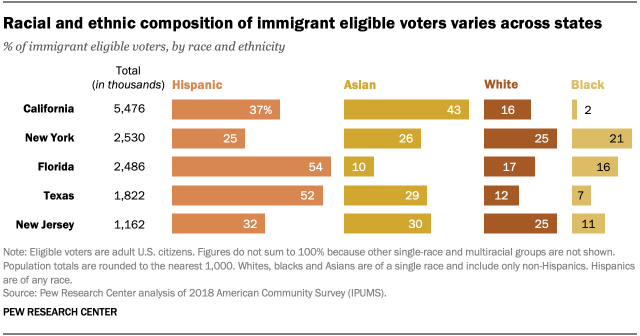
1Asians make up 43% of immigrant eligible voters in California, the highest of any racial or ethnic group.Nationally, Latinos make up a higher share of immigrant eligible voters than Asians (34% vs. 31%), but the reverse is true in the Golden State, where many Latino immigrants are ineligible to vote because they do not hold U.S. citizenship.

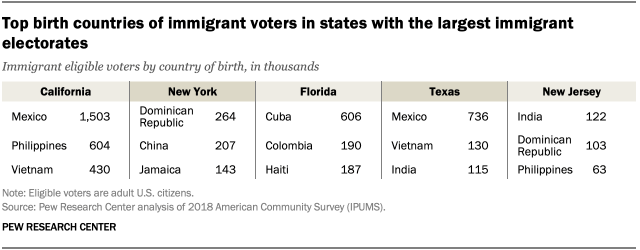
California’s immigrant eligible voters come from many countries. But three origin countries account for 46% of the total: Mexico (1.5 million immigrant eligible voters), the Philippines (604,000 voters) and Vietnam (430,000 voters).

The vast majority of California’s immigrant eligible voters (75%) have lived in the United States for more than 20 years. The share is highest (82%) among California’s Latino immigrant voters. Smaller majorities of Asian (71%), white (71%) and black (59%) immigrant eligible voters in California have lived in the country for at least two decades. English proficiency varies widely among the state’s immigrant eligible voters. For example, 86% of black immigrant eligible voters in California are English proficient, a substantially higher share than among all the state’s immigrant eligible voters (55%).

2New York stands out for the racial and ethnic diversity of its immigrant eligible voters. Asians (26%), Latinos (25%) and whites (25%) make up similar shares of the state’s immigrant eligible voters, while black immigrants (21%) are a slightly lower share.

When it comes to speaking English, black immigrant eligible voters in New York are substantially more likely to be English proficient (89%) than white (66%), Asian (52%) and Latino (47%) immigrant voters.

In New York, no single birth country accounts for a large share of the state’s immigrant eligible voters; about a quarter of foreign-born voters come from the state’s three largest birth countries. Immigrants from the Dominican Republic are the largest single group, with 264,000 eligible voters, followed by China (207,000) and Jamaica (143,000).

3Latinos make up 54% of Florida’s immigrant eligible voters, far higher than the shares of white, black and Asian immigrant voters in the state (17%, 16% and 10% respectively).

Florida’s immigrant voters have varying levels of English proficiency. For example, around half (51%) of Latino immigrant eligible voters are proficient in English, a far lower share than among white (82%) or black (81%) immigrant voters.

With 606,000 voters, Cuban immigrants are the largest group in Florida’s foreign-born electorate. Colombian immigrants, at 190,000, and Haitian immigrants, at 187,000, are the second- and third-largest groups.

4Texas rivals Florida in its share of Hispanic immigrant voters. Roughly half (52%) of all immigrant eligible voters in Texas are Hispanic, a share that trails only Florida (54%) among the top states. Asian immigrants are the second-largest group in Texas at 29%.

Around seven-in-ten immigrant voters in Texas (68%) have lived in the U.S. for more than two decades, similar to the share among all U.S. immigrant voters (68%). However, the share of long-term residents is notably lower among black immigrant voters in Texas (40%).

A high share of black and white immigrant voters in Texas are English proficient (88% and 85%, respectively). Lower shares of Asian (64%) and Hispanic (47%) immigrant voters are proficient. This is similar to the pattern nationally.

By country of birth, Mexican immigrants alone account for 40% of all immigrant voters in Texas, or 736,000 people. The second-largest group, with 130,000 voters, are immigrants from Vietnam, while Indian immigrants, with 115,000 voters, make up the third-largest group in the state.

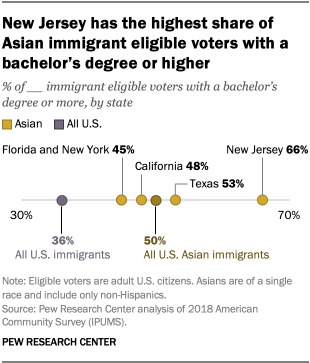
New Jersey has the highest share of Asian immigrant eligible voters with a bachelor’s degree or higher5New Jersey has a high share of Asian immigrant voters with a college degree. About two-thirds of Asian immigrant voters in New Jersey (66%) have a bachelor’s degree or higher. That’s substantially higher than the share among other immigrant voter groups in the state and the share among immigrant voters in the U.S. overall (36%), including those who are Asian.

Among New Jersey’s 1.2 million immigrant eligible voters, 32% are Latino, 30% are Asian, 25% are white and 11% are black.

Meanwhile, the top birth countries for immigrant eligible voters in New Jersey are India (122,000 voters), the Dominican Republic (103,000) and the Philippines (63,000).

See the table below (or open it as a PDF) for detailed characteristics of immigrant eligible voters in California, New York, Florida, Texas, New Jersey and nationally.

Demographics of naturalized citizen eligible voters in select states

Source: Most of the 23 million immigrants eligible to vote in 2020 election live in just five states

The shifting lens through which Canadians see the Wet’suwet’en crisis

Interesting analysis by Michael Adams and Andrew Parkin:

Canadians have lived through many confrontations over Indigenous rights and resource development, but few have had such high stakes as the one that erupted last month and is still unfolding, with a proposed deal newly announced after weeks of rail blockades across the country as Wet’suwet’en hereditary chiefs have protested the Coastal GasLink pipeline that would run through their territory in British Columbia. Hanging in the balance, depending on one’s perspective, are not only the rights of particular First Nations but the coastal environment, the livelihoods of people travelling or shipping by rail, Canada’s reputation as a reliable trading partner, the survival of the federal minority government and the future of reconciliation itself.

Also at stake are the hearts and minds of the Canadian public. Some worry that the prolonged blockades of roads and railways has put public buy-in to the reconciliation agenda at risk — and with good reason. A look back at survey data from 1990 shows that the Oka crisis did erode public support for Indigenous land claims. While few Canadians approved of how the federal and provincial governments handled the crisis, there was little sympathy for the Mohawk barricaders, either. Tellingly, the only actor in the Oka dispute whom the public did support was the army. Two-thirds of Canadians backed the decision to call the army in to deal with the situation.

But Canada is a very different country than it was 30 years ago. Using excessive force to bring down the barricades would likely have been seen by many Canadians as a strategy that is three decades out of date. It would also have set back the clock on years of slow but steady bridge-building.

One big change in the public’s mindset is the emergence of climate change as a major concern. At their heart, both the Oka crisis of 1990 and the current conflict are about Indigenous control over Indigenous lands. But the current conflict can also be framed as being about whether the need to move fossil fuels to market should continue to trump all other concerns. It comes at a time when more Canadians name climate change than name the economy as the most important issue facing the country. The interweaving of Indigenous self-determination with the fight against climate change has shifted the lens through which the public is gauging the federal government’s reaction to the crisis — and, as a result, has affected the government’s room to manoeuvre.

A second change has to do with the bumpy journey toward reconciliation. As distant as the end point of this journey may seem, it would be a mistake to think that the past several decades of public discussion has left Canadians no better informed than before. In fact, most Canadians now recognize the wrongs that Indigenous peoples have faced and support actions to redress those wrongs.

For instance, most Canadians believe that Indigenous peoples experience discrimination in our society and are disadvantaged in their standard of living. And overwhelming majorities support policies such as equalizing funding for Indigenous education and spending more to improve the quality of housing and drinking water in Indigenous communities.

More important, two in three Canadians believe that individuals like themselves have a role to play in efforts to bring about reconciliation. This points to a recognition that reconciliation is not just about what governments do; it is also about broadening understanding and promoting dialogue more widely across society.

Generational change will likely keep the momentum for reconciliation going. Almost two-thirds of non-Indigenous youth in Canada now have an awareness of the history of Indian residential schools. And young Canadians want to know more: over 80 percent agree that everyone will benefit from looking more closely at Indigenous perspectives on community, land and culture, and almost 90 percent agree that it is important to understand the true history of how Indigenous peoples have been treated by governments and society in this country.

None of this is to suggest that the public can be counted on to support those who disrupt the country’s transportation networks. There remains a gap between the public’s strong desire to see improvements in the treatment of Indigenous peoples in Canada, and its uncertainty about the nature and extent of Indigenous rights and what these mean in practice for resource development. And if the lines between peaceful protest, civil disobedience and resistance get more blurred, most may once again side in the short term with those entrusted to reimpose order.

But Canada has moved on from where it was in 1990 — before reconciliation entered the public’s lexicon. Canadians don’t just want things to get back to normal, they want things to get better. That is why the onus is on Indigenous and non-Indigenous leaders alike to find a way out of this crisis that differs from what was done in the past.

Source: The shifting lens through which Canadians see the Wet’suwet’en crisis

Immigration attitudes have barely changed – so why is far right on rise?

Interesting take:

There are three major reasons why voters have become more likely to back far-right parties in Europe

Over the last three decades, far-right parties in Europe have tripled their vote share, from about 5% in the early 1990s to more than 15% today. About one in six Europeans now vote for parties such as Marine Le Pen’s National Rally (previously National Front) in France, Matteo Salvini’s League in Italy, or Viktor Orbán’s Fidesz in Hungary. This is one of the most striking outcomes of a new edition of the PopuList, a research collaboration supported by the Guardian, which launches on Tuesday.

Political scientists have demonstrated that the single most important reason why people vote for far-right parties is their attitude towards immigration. In other words, those who support these parties tend to do so because they agree with them that immigrants are “dangerous others” who form an economic and/or cultural threat to their own native group. This in itself is not remarkable – it just shows that many supporters of far-right parties are rational voters in the sense that they opt for outlets that express ideas they agree with and deem important.

What is remarkable, however, is that people’s attitudes towards immigration have not changed much over the years. On average, people have become neither more positive nor more negative about the influx of immigrants. This confronts us with an interesting puzzle: how is it possible that the electoral successes of far-right parties have increased so much, while at the same time the main determinant of far-right support – anti-immigration sentiment – has remained relatively stable? Let me mention three developments that can help us understand what is going on.

First, far-right parties have learned how to better mobilise voters. Until the turn of the millennium, most far-right parties were generally conceived of as beyond the pale. Voters associated them with fascism and violent anti-democratic skinheads. This has changed as many far-right parties have succeeded in moderating their images. A good example is Le Pen’s “detoxification” strategy. She cut connections to extremists, changed her party’s tarnished name and distanced herself from her father, the more radical previous leader and founder of the party. It is important to emphasise, however, that although various far-right leaders have succeeded in moderating their party’s reputation, when it comes to their actual programmes most of them have remained as radical as ever.

Mainstream parties have also played an important role in this process of reputation moderation. They have legitimised the ideas of far-right parties by incorporating watered-down versions in their own political programmes. Many academic studies have shown that when it comes to their positions on immigration and integration, mainstream parties have moved towards the far right. The Dutch prime minister, Mark Rutte, for instance, wrote a letter to all citizens in the Netherlands, in which he argued they had to actively defend the country’s values against people who refused to integrate or who acted antisocially. “Behave normally or leave,” was one of his letter’s core messages. Similar strategies have been employed by mainstream parties in Austria, Denmark and France.

Second, it is not only political parties that have adapted their behaviour – voters have also changed. Not so long ago the average voter was loyal to their political party; a typical social democrat remained a social democrat forever, and did not even consider voting for a conservative or liberal party. Yet processes of individualisation and emancipation have made people much more whimsical when it comes to their electoral behaviour. Slowly but steadily, loyal voters became floating voters, and many of them started to switch between parties – in particular in multi-party democracies. These voters often have a “choice set” of several parties to which they feel attracted, and base their eventual choice on things such as election promises, the performance of party leaders, or parties’ past behaviour in parliament. Voters have started to actually vote, and have thereby become available for mobilisation by far-right parties.

Source: Immigration attitudes have barely changed – so why is far right on rise?