More pressures from within Quebec regarding more immigration, this time on the part of students and the relatively low number studying in Quebec:
Le nombre d’étudiants étrangers qui entrent au pays a doublé en quatre ans. L’Ontario en profite à plein. Le Québec ? Si peu que la province risque de perdre la course aux talents internationaux.
Selon les données d’Immigration Canada, le Canada a délivré 256 000 permis d’études à des étrangers en 2019, le double d’il y a quatre ans.
La moitié des candidats acceptés au pays étudie en Ontario. Le Québec, pour sa part, accueille seulement 12 % des titulaires de permis d’études, moins que le poids de sa population de 22,5 % dans le Canada.
Cette sous-représentation n’est pas sans conséquence, puisque l’attraction et la rétention des étudiants étrangers constituent un axe stratégique en vue de créer de la richesse et de soulager un tant soit peu la pénurie de main-d’œuvre à moyen terme. Le ministre de l’Immigration du Québec, Simon Jolin-Barrette, a décliné notre demande d’entrevue en nous invitant à communiquer plutôt avec Ottawa.
« La réalité, c’est que l’écart se creuse entre le Québec et les autres provinces dans la course aux talents », déplore Christian Bernard, économiste à Montréal International, organisme de prospection des investissements directs étrangers, qui fait aussi la promotion de Montréal comme ville étudiante internationale.
M. Bernard rappelle que le Canada est en compétition avec la plupart des pays occidentaux dans cette course aux talents.
D’après les chiffres obtenus par La Presse, 51 % des étrangers voulant étudier au Québec se sont vu refuser leur permis d’études par le gouvernement canadien en 2019, contre 38 % dans le reste du pays.
Outre la barrière de la langue française, qui réduit le nombre de demandes à son égard, le Québec est pénalisé par le refus du Canada de laisser entrer au pays un fort contingent d’étudiants francophones en provenance d’Afrique.
Selon Immigration, Réfugiés et Citoyenneté Canada (IRCC), les raisons courantes pour refuser une demande sont que « le demandeur n’a pas prouvé qu’il a assez d’argent pour subvenir à ses besoins pendant ses études ». Ou qu’« il n’a pas convaincu l’agent des visas qu’il quittera[it] le Canada à la fin de sa période d’études », explique, dans un courriel, Peter Liang, conseiller en communication d’IRCC. Pour certains pays, un examen médical est également requis. Dans tous les cas, le candidat ne doit pas avoir de dossier criminel.
« Ce qui est désolant, ajoute Christian Bernard, de Montréal International, c’est la contradiction entre, d’une part, les critères mis de l’avant pour délivrer ou non le permis d’études et, d’autre part, la volonté de tous les paliers de gouvernement qui déploient des initiatives et qui investissent des sous avec l’intention d’attirer et de retenir davantage d’étudiants internationaux au Canada et au Québec. »
Le 31 janvier, l’organisme a recommandé que le Canada réduise le taux de refus des étudiants francophones dans une étude sur la connectivité de la métropole, produite conjointement avec la Chambre de commerce du Montréal métropolitain.
Accepter deux fois plus d’étudiants dans l’espoir de pourvoir les places disponibles
Au trimestre d’automne 2019, à l’Université de Sherbrooke, 37 des 102 places réservées aux étudiants étrangers admis au bac en régime coopératif avec stages de travail rémunérés n’ont même pas pu être pourvues, les étudiants admis ayant été refusés par Immigration Canada. L’institution avait pourtant admis 189 étrangers au départ pour que soient pourvues ces 102 places.
À l’Université Laval, le taux d’inscription des étudiants internationaux préalablement admis a décliné depuis 2014. Il se situait à 67 % en 2018, dernière année pour laquelle la donnée est disponible. « En nombre absolu, le nombre a augmenté de 1100 à 1400 étudiants internationaux. Ce qui nous préoccupe, c’est qu’en pourcentage, ça baisse. On a des étudiants qui ne peuvent pas venir chez nous faute d’obtenir leur permis d’études à temps », dit Yan Cimon, vice-recteur adjoint aux affaires externes, internationales et à la santé et directeur des affaires internationales et de la francophonie.
Ces bourses d’exemption de droits de scolarité pour la francophonie du Sud, au nombre de 235 par an, ont été créées par le premier ministre Philippe Couillard lors du Sommet de la Francophonie tenu au Madagascar en 2016.
En raison de refus de permis d’études, le réseau des cégeps est incapable d’atteindre son objectif, datant de 2012, de 5000 étudiants internationaux. Les 48 cégeps publics accueillent actuellement 4300 élèves étrangers au diplôme d’études collégiales.
Dans le reste du Canada, les collèges d’enseignement professionnel formaient 151 000 étrangers en 2017, d’après un document de 2018 du Bureau canadien de l’éducation internationale. C’est 35 fois plus qu’au Québec.
« On cherche à mieux faire connaître aux agents d’immigration le réseau collégial, avance M. Tremblay, en guise de solution. On leur dit que ça se peut qu’un diplômé universitaire d’Afrique veuille suivre après coup une technique dans un cégep. Il y a un grand attrait pour les formations techniques qui ne sont pas très présentes dans le système d’éducation en Afrique. »
« Dans un contexte de pénurie de main-d’œuvre, l’intégration des étudiants internationaux au réseau collégial représente la solution à la régionalisation de l’immigration, qui est un problème au Québec depuis 40 ans », soutient le patron de la Fédération des cégeps.
Les Africains refusés par dizaines de milliers
Les données d’Immigration Canada montrent que les taux de refus sont particulièrement élevés pour les demandeurs des pays africains, principal réservoir de locuteurs francophones, après la France.
La proportion de refus atteint 90 % pour les Guinéens, 82 % pour les Camerounais, 77 % pour les Algériens et 75 % pour les Sénégalais.
Depuis cinq ans, 16 000 étudiants algériens et 5300 Sénégalais se sont ainsi vu refuser l’entrée au pays.
« Nous n’arrivons pas à nous expliquer cette situation, écrit dans un courriel René Gingras, DG du Cégep de Rivière-du-Loup. Nous espérons qu’il y aura déblocage bientôt. Nous pourrions ainsi accueillir plus d’étudiants qui parlent français, qui s’intègrent dans notre région et qui répondent aux besoins du marché du travail. »
De leur côté, les collèges et universités anglophones du reste du Canada ne rencontrent pas ce problème. Ils recrutent les étudiants de pays anglo-saxons, de pays comme le Japon, la Chine, l’Inde et la Corée du Sud, tous plus riches que les pays africains. Les taux de refus y sont beaucoup plus faibles.
« Les demandes du monde entier sont examinées de façon uniforme et en fonction des mêmes critères. Il n’y a absolument aucune discrimination dans notre processus d’évaluation des demandes », se défend M. Liang, d’Immigration Canada.
Aucune discrimination, mais des objectifs totalement contradictoires avec ceux du Québec, déplore la Fédération des cégeps.
Le fédéral ferme la porte quand il n’est pas convaincu que l’étudiant quittera le pays à la fin des études. Or, ce même étudiant est recruté en se faisant promettre par Québec qu’une fois diplômé, il pourra rester au pays de façon permanente.
Par exemple, des missions de recrutement d’étudiants visent régulièrement le Maghreb, une région pour laquelle Immigration Canada refuse de 40 à 77 % des demandeurs.
Autant de cerveaux qui n’entrent pas au Québec.
Cinq pistes pour hausser la part du Québec
Pour attirer davantage d’étudiants étrangers, le Québec pourrait toujours emprunter un raccourci et imiter la France en proposant des formations uniquement en anglais. Le cégep de Gaspé a choisi cette voie avec son campus de Montréal, qui accueille 2000 Indiens et permet à la maison d’enseignement de faire des profits de 1 million. Des solutions moins controversées existent néanmoins.
Diminuer le taux de refus des permis d’études
« On aimerait voir plus de flexibilité dans le processus de délivrance des permis d’études, confie Yan Cimon, de l’Université Laval. Il y a énormément de pièces justificatives à fournir. C’est difficile de voir des dossiers refusés pour des formalités. »
Si le taux d’acceptation des demandes visant le Québec remontait au niveau du Canada hors Québec, la province aurait accueilli 10 000 étudiants internationaux de plus en 2019. Rapidement, la part du Québec passerait de 12 à 18 % de l’ensemble des étudiants étrangers présents au Canada.
Le fédéral ferait ainsi d’une pierre deux coups. Le pays marquerait plus de points dans la course aux cerveaux qui a cours en Occident tout en diminuant sa dépendance à l’égard de l’Inde et de la Chine, responsables à eux deux de 54 % du flux d’étudiants internationaux au pays.
Instaurer le traitement rapide des permis dans les pays francophones
En 2018, le gouvernement canadien a lancé le Volet direct pour les études (VDE) pour les demandeurs de la Chine, de l’Inde, des Philippines et du Viêtnam, puis en juillet 2019 pour le Pakistan. Le VDE a permis de réduire les délais de traitement.
« Quand vous avez des délais qui interrompent ou qui induisent un report de projets d’études, ce n’est à l’avantage ni de l’étudiant ni de l’université », dit Yan Cimon, de l’Université Laval, où les deux tiers des étudiants étrangers inscrits sont africains.
« Dans le cadre du VDE, les permis d’études des étudiants potentiels peuvent être traités plus rapidement, avance Immigration Canada, dans un courriel, car en faisant leur demande, ceux-ci montrent d’emblée qu’ils ont les ressources financières et les compétences linguistiques. » Le VDE a été élargi au Maroc et au Sénégal en septembre 2019.
Élargir l’admissibilité des diplômés du collégial au PEQ
L’accès rapide à la résidence permanente pour les candidats ayant passé par la filière étudiante contribue à la popularité du Canada comme terre d’études. Au Québec, la voie rapide se nomme le Programme de l’expérience québécoise (PEQ), en révision. Les cégeps voudraient que le gouvernement ouvre le PEQ aux diplômés d’une attestation d’études collégiales, obtenue habituellement après un an d’études, dans les secteurs en pénurie de main-d’œuvre.
Augmenter le nombre de bourses
La France a haussé les droits de scolarité facturés aux étrangers en 2018. La mère patrie cible dorénavant les pays payants comme l’Inde et la Chine. L’Afrique francophone pourrait en subir les contrecoups, elle qui fournissait historiquement 45 % des étudiants étrangers en France, selon un article du Devoir de novembre 2018. Une fenêtre s’ouvre pour le Québec en augmentant le nombre de bourses versées aux Africains. Depuis 2016, le Québec offre 500 bourses d’études aux francophones du Sud qui s’inscrivent au cégep. Encore faudrait-il que les agents d’Immigration Canada considèrent la bourse dans l’examen de la demande de permis d’études.
Entente avec la Belgique et la Suisse
La Fédération des cégeps est en demande auprès du gouvernement pour que celui-ci conclue une entente pour admettre les étudiants de la Belgique et de la Suisse aux mêmes conditions monétaires que les Français dans le réseau collégial. Les étudiants en provenance de l’Hexagone acquittent les mêmes frais que les Québécois. Une entente existe avec la Belgique depuis deux ans pour faciliter l’inscription de ses ressortissants à l’université, mais rien en ce qui concerne le cégep. Aucune entente n’existe actuellement avec la Suisse.
As an environmental journalist, I’ve been covering the frightening acceleration of climate change for more than a decade. As a person who believes in the tenets of liberal democracy, I’ve watched the rise of white-supremacist, anti-immigrant and nationalistic ideologies with similar dread over the past few years.
But I always thought of those two trends — looming ecological dangers and the gathering strength of the far right — as unrelated, parallel crises in a turbulent time. Only recently have I begun to understand that they are deeply interconnected, an ugly pairing of forces drawing power from each other.
From France to Washington to New Zealand, angry voices on the hard right — nationalists, populists and others beyond conventional conservatism — are picking up old environmental tropes and adapting them to a moment charged with fears for the future. In doing so, they are giving potent new framing to a set of issues more typically associated with the left. Often, they emphasize what they see as the deep ties between a nation’s land and its people to exclude those they believe do not belong. Some twist scientific terms such as “invasive species” — foreign plants or animals that spread unchecked in a new ecosystem — to target immigrants and racial and ethnic minorities. And here’s what really frightens me: This dynamic is likely to intensify as climate change creates new stresses that could pit nations and groups against one another.
Although the pressures of a warming planet are new, the deployment of environmental language for racist, nativist and nationalistic ends has a long, dark history. Before environmentalism became a mainstream and progressive cause in the 1970s, many American conservationists were also white supremacists, who argued that those they saw as outsiders threatened the nation’s landscape or lacked the values to care for it properly. Such thinking was common in Europe, too. The Nazis embraced notions of a symbiotic connection between the German homeland and its people.
It is not hard to see why such ideas are making a comeback. As the relentlessness of environmental calamity — epic fires and floods, escalating extinctions, warming oceans — becomes impossible to ignore, the right needs a way to talk about it. Nationalistic framings fit comfortably with a worldview many already hold. And for the so-called alt right, they offer the bonus of a cudgel for bashing establishment conservatives as beholden to globalist, corporate interests.
Some radicals are drawn to apocalyptic climate scenarios, seeing openings for authoritarianism or a complete societal breakdown. “They want to accelerate it,” said Blair Taylor, program director at the Institute for Social Ecology, a left-wing educational center, who has studied such groups. “So after the downfall they can set up their fascist ethno-states, they can be the Übermensch.” Violent actors are grabbing hold of such ideas. The killers accused of targeting Muslims and Mexican immigrants last year in New Zealand and Texas posted online manifestoes weaving white supremacy with environmental statements.
The Australian man who allegedly murdered 51 people at two Christchurch mosques called himself an “ethnonationalist eco-fascist” and wrote that “continued immigration into Europe is environmental warfare.” The suspect in the El Paso shooting that killed 22 — modern America’s deadliest attack targeting Latinos — ranted about plastic waste and overconsumption. “If we can get rid of enough people, then our way of life can become more sustainable,” he concluded.
If there’s one thing Americans have learned in the Trump era, it is that toxic ideas can move between the fringes and the political realm with stunning speed. Marine Le Pen, leader of France’s far-right National Rally — now the country’s main opposition party — has incorporated worries about the natural world into the party’s anti-immigrant, anti-Muslim ideology. She espouses an ideal of the French citizen as “someone rooted, someone who wants to live on their land and to pass it on to their children.” By contrast, she says,those who are “nomadic … do not care about the environment. They have no homeland.”
“Borders are the environment’s greatest ally,” said Jordan Bardella, the party spokesman and a member of the European Parliament. In Hungary, the far-right party Our Homeland accused Ukraine of poisoning Hungarians by dumping waste in the Tisa River. Extremist Polish groups hurl similar charges at Germany.
As climate change reshapes our world, we face a future filled with new pressures and constraints on resources, including arable land, food and water. Droughts, floods and storms are likely to push millions from their homes, some toward the relative safety and security of Europe, Australia and the United States.
The upsurge of anti-Asian discrimination that has followed in the wake of fears about the coronavirus offers a glimpse of the ugly sentiments such external pressures can unleash. Without giving it much thought, I used to accept the framing of environmental problems as shared concerns we would have to work together to solve. Now I can see there is another path too, one in which dark forces wield real dangers as weapons to tear us apart, and scarcity fuels conflict, brutality and racism. Our future in a hotter world of rising seas and more powerful storms already felt terrifying. Unless we come together — and fast — behind serious action to check the existential danger of climate change, it could be darker still.
Will be interesting to see if Canadian parties, following the extension of voting rights to virtually all expatriates, develop comparable approaches to engage expatriates (didn’t see many signs in the 2019 election):
As Americans prepare to vote in the “Super Tuesday” Democratic presidential primaries Tuesday, a lot of attention will be paid to the two biggest states: California and Texas. But Americans living in Toronto and across Canada could have an even bigger impact, proportionally.
Alongside the 14 states and one territory holding their primary on Tuesday, it’s also the start of voting for the Democrats Abroad primary, in which U.S. citizens who live in other countries are able to vote in a separate primary that sends 13 pledged delegates to the nominating convention. That’s only one fewer electable delegates than some states such as North Dakota and Wyoming elect. And because fewer people vote in the international contest — an estimated 9 million American eligible voters live abroad, but less than 35,000 voters participated in 2016 — each vote carries far more weight.
According to a recent message sent out to members by Democrats Abroad Canada, that means the votes of Americans in Toronto has four times the impact of a vote in California.
One campaign trying to take advantage of this is Mike Bloomberg’s, which ran ads in Canadian newspapers — as well as in other countries around the world — this weekend.
“What we’re trying to do is just raise awareness of the campaign, because, you know, we’re really running two campaigns at the same time,” says John Calvelli, who serves double duty as the campaign director for New York State and Democrats Abroad. “One obviously, is to get Mike Bloomberg elected, but the other is to kind of engage the base and identify new people that we could get into the fold so that they would then vote against Donald Trump in November.”
Calvelli says it’s not something many other campaigns devote a lot of resources to. Though, of course, not many campaigns have the financial resources available to them that the billionaire former mayor of New York does. Calvelli says it’s a challenge because there are no lists of members available, so phone banks and door knocking, as in a traditional state primary, are not options. Hence the newspaper ads, alongside a campaign visit to Toronto recently by Bloomberg, and social media and word-of-mouth campaigns.
Calvelli says in 2016 Canadian residents had among the largest vote turnouts for the primary, with 3,260 people voting, just shy of 10 per cent of the total voters in what he calls the “51st state” primary.
Americans in the GTA can register with Democrats Abroad this week if they want to vote in the primary, and then have the option of voting online between Tuesday and March 10, or voting in person at one of two GTA locations. In-person voting will take place starting at 5 p.m. on Tuesday at the East of Brunswick pub in downtown Toronto and at Failte Irish Pub in Mississauga.
I think the title was the most objectionable aspect even if a quote:
The German government’s anti-Semitism commissioner, Felix Klein, has dubbed a planned lecture on Adolf Hitler’s lover Eva Braun as “completely incomprehensible and ahistorical,” according to the Sunday edition of Bild newspaper.
The lecture was expected to be given at the Technical University of Braunschweig (TU) as part of a series about women in world history. TU, however, rejected the accusation that the university was advancing Nazi ideas. “In conclusion, this is a contribution against right-wing extremist legends,” it said in a statement.
The university also said it was “sincerely sorry” for the “ineptly worded” event, titled “‘… I, the mistress of the greatest man in Germany and on Earth … Comments on Eva Braun.'”
The lecture was ultimately canceled due to illness on the part of the lecturer.
The university is also considering how the researcher behind the lecture could manage to explain his role in the event, “namely to critically reflect on why a historically insignificant woman like Eva Braun still receives a lot of media attention to this day.”
Braun, who ate a cyanide pill, and Hitler, who shot himself, died by suicide just 40 hours after they were officially married. The relationship was largely unknown to the public until after their deaths.
During Hitler’s rise to power, Braunschweig — then a regional state in the-then Weimar Republic — was where Adolf Hitler received German citizenship on February 25, 1932, two weeks before running for the role of German president.
The spread of the coronavirus has health officials worried about a potential global pandemic. But while governments and international organizations are rushing to stop the virus, far-right politicians in Europe have been eager to exploit it.
Radical right populists like Italy’s Matteo Salvini and France’s Marine Le Pen are using fear and uncertainty surrounding the virus, believed to have originated in China, to advocate for closed borders and anti-immigration policies ― misleading and panicked messages that health officials warn can hinder efforts to combat the virus.
In Italy, there are hundreds of cases of COVID-19, the disease caused by the virus, as well as multiple towns under quarantine and 17 people dead. Salvini, leader of the far-right Lega Party, has repeatedly attacked the government for its handling of the crisis. He has groundlessly linked Italy’s outbreak to the arrival of migrants from Africa, called for “armor plated borders” and accused Prime Minister Giuseppe Conte of failing to “defend Italy.”
There is no proof for Salvini’s claims: Africa has only three confirmed cases of coronavirus, according to monitoring data from John Hopkins University. But his inflammatory statements are a prime example of the longtime far-right trope of associating migrants with disease ― derogatory rhetoric that has been a prominent feature of Europe’s migrant crisis.
These and other attacks, coming as officials struggle to contain the virus, have put additional stress on the European Union’s ideal of border-free travel. Salvini is calling for Italy to suspend the Schengen Agreement, which allows travel between EU nations without border checks, even though health experts doubt the measures would be effective.
Austria’s Freedom Party echoed Salvini’s calls for immigration controls and suggested that the government had failed to prevent the outbreak, while the Swiss People’s Party wants “strict border control immediately.” (Austria’s health minister countered with the assessment of World Health Organization and EU experts that closing borders “makes no sense.”)
In France, Le Pen, leader of the far-right National Rally, has called for border controls and falsely accused the EU of remaining silent on COVID-19. (EU officials have repeatedly issued statements on the virus and announcedhundreds of millions of euros in health funding.) Le Pen also clashed with Italy’s Prime Minister Conte when she suggested that Italian soccer fans should be barred from entering the country. Spain’s far-right Vox party leader Santiago Abascal similarly blamed open borders for the virus.
Far-right parties tend to thrive in opposition, where their lack of governing experience and extreme policies aren’t tested, allowing them to snipe from the sidelines to gain support. They also feed on periods of unrest and uncertainty, as seen in their fearmongering around events of recent years such as the migrant crisis and ISIS-related extremist attacks. The COVID-19 outbreak gives these parties a chance to both frame governments as ineffective and advocate for the anti-immigration policies they view as a panacea to every societal problem.
Meanwhile, countries with far-right governments in power have taken a slightly different tack, largely downplaying the virus and maintaining that everything is under control.
Hungary’s Prime Minister Viktor Orban claimed that although the virus has garnered the world’s attention, people should not forget that the real threat is from migration. In the United States, President Donald Trump has contradicted health officials and gave a dismissive press conference filled with false information, while Secretary of State Mike Pompeo on Friday refused to say that the coronavirus wasn’t a hoax.
Looking forward to seeing future StatsCan work to see if this pattern is common to both recent and long-term immigrants and region of origin, given that recent Black economic immigrants tend to be more highly skilled/educated than earlier waves. As there are few third generation immigrants for recent immigrants, will take some time to see but second generation outcomes will likely be illustrative:
If statistical data tell us stories in numerical form, new information from StatCan depicts Canada as a nation that’s continuing to fail its Black youth. It also shows that the commonly accepted narrative that immigrants fare better with successive generations simply may not hold true for all immigrant groups.
While these outcomes will not come as a surprise to those who have long observed and studied Black experiences, they make the implications of Statistics Canada’s conclusions inescapable.
“The persistent gaps between the Black population and the rest of the population suggest that other factors not measured by the data used, including discrimination, could have an effect,” concludes Martin Turcotte in the study, titled “Education and Labour Market Integration of Black Youth in Canada.” It was published this week in the journal Insights on Canadian Society and is based on information from the 2006 and 2016 censuses.
The study compares Black Canadian youth with non-Black youth as they transition from childhood or adolescence to adulthood.
Two key data sets show why this latest snapshot has significant implications for the Black community, said York University professor Carl James, who, as a member of the Working Group on Black Communities, offered advice and guidance for this project.
First, the Black population is young and growing. Canada’s Black population doubled between 1996 and 2016, from 600,000 to 1.2 million. In 2016, more than a quarter of the Black population was less than 15 years of age, compared with 16.9 per cent of the total population. Its median age is about 30, while it is 40 years for the total population.
“This means you can understand how the concerns of the Black community are weighted around ‘What’s happening to our young population,’” James said.
Second, about nine per cent of Black people in Canada are at least the third generation to be born in this country — a rate that is higher, he said, than for other racialized minorities.
“There needs to be a serious concern about this generation,” James said. “We’re responsible for their welfare in the Canadian state.”
Because the modern wave of Black immigration to Canada dates back to the 1960s, the outcomes for Black people could serve as a bellwether for minorities who arrived later.
“This is what we see for Black youth now. It is possible as other groups become third-generation you’re going to see more similar patterns,” he said.
The unique experiences of Black people also mean they should be disaggregated from the more general “visible minority” category, he said.
Some of the key StatCan findings include:
Most Black youth aspire to a university degree but are less likely to think they will obtain it. In 2016, although 94 per cent of Black youth aged 15 to 25 said that they would like to get a bachelor’s degree or higher, only 60 per cent thought that they could.
There persists a gap in post-secondary graduation rates between Black youth and their counterparts who are not Black. About half (51 per cent) of Black men aged 23 to 27 in 2016 had a post-secondary qualification, compared with 62 per cent of other men.
There persists a gap in employment rates between Black and non-Black youth. Young Black males were nearly twice as likely as other young males not to have a job in 2016.
It has never been easy for foreigners to come to Germany for work. For many decades, political leaders have insisted the country wasn’t pursuing active immigration policies. But this has changed in recent years due to the fact that Germany is lacking more than a million skilled laborers to keep its economy going.
As of March 1, a new law will facilitate the immigration of qualified workers to Germany. Below is a list of the most important changes for all those who are seeking a job from abroad.
Who is considered a skilled worker?
Contrary to previous legislation, being considered a skilled worker, or “specialist,” is no longer restricted to a person with a university or college degree. Instead, the term now also applies to someone who has acquired a vocational training certificate. The training program must be at least two years in length, and the resulting degree needs to be recognized as equal or similar to a German degree.
If you want to check whether your qualification suits the requirements, you can access an information portal set up by the German Labor Ministry. How this works is explained on the “Make it in Germany” website, where you can also find links to other issues related to working in the country.
The government’s aim is to finish the recognition process of an applicant within three months after all the necessary documents have been provided. A work visa will be issued four weeks later.
Who is allowed to work in Germany?
In principle, applicants from outside the European Union are generally allowed to work in Germany if they have a work contract with a firm based in Germany and the relevant professional qualification for the job. The new law has stripped away a key regulation: That people from outside the EU can only take a job if there is no German or EU citizen who is able to do it instead.
Job seekers with qualifications lower than the vocational training level are, however, excluded by the new law. They can nevertheless apply for immigration if they possess a work contract or a job offer from a German employer. The employer then has to train the applicant and make sure he or she acquires a professional-level certificate within two years.
What else is needed?
All those with a work contract or a specific job offer are granted residency status for four years, or the duration of their contract. After four years, they can apply for a permanent residence status.
If you’re looking for a job, you are also allowed entry into Germany — on the condition that you can prove you’re able to support yourself and that you speak sufficient German (B2 level).
The new law also applies to foreigners seeking professional qualifications or a university degree in Germany. In addition, they must have obtained a diploma from a German school abroad or any other degree that qualifies them for university or professional education, and they must not be older than 25. After working for two years in Germany, people in this category can apply for permanent residence status.
Foreign skilled workers who are older than 45 have to prove they earn a minimum of €3,685 per month in their German job, or possess adequate old-age retirement funds.
Special rules for special skills
In sectors with an acute shortage of skilled professionals, the bar for emigrating to Germany has been lowered as well. Medical doctors, IT specialists or registered certified nurses, for example, don’t need to have their qualifications recognized by German authorities as long as they can prove a minimum of five years of on-the-job experience.
However, employers are obliged to take on financial responsibility for up to one year, including repatriation costs, for an employee whose contract has expired and who refuses to leave Germany voluntarily.
Family members are allowed
Under the new law, qualified workers are also allowed to bring their spouses and minor children to Germany. But they must prove to be able to support their family members financially and must provide them with sufficient living space. They cannot receive state benefits such as social welfare payments.
Welfare organizations including the Catholic charity Caritas have criticized the regulation, saying it would tear families apart. Those foreigners working in social occupations or the care sector wouldn’t be able to meet the requirements for families, they said.
Are refugees and asylum-seekers also welcome?
In principle, the new regulations also apply to asylum-seekers and refugees, although politicians admit only very few of them would qualify for it, namely those granted exceptional leave to remain.
Such foreigners with no residential status but who cannot be deported for various reasons are allowed to start training under certain conditions. They must have been working at least 35 hours a week for 18 months, and need to be able to support themselves. In addition, they must have sufficient command of the German language (B2 level) and must not have committed a criminal offense.
Présentée ce dimanche en première mondiale aux Rendez-vous Québec Cinéma, Maisonneuve – À l’école du vivre-ensemble se veut un message d’espoir. Un exemple concret du fait que « le jeu en vaut la chandelle », « qu’il vaut mieux essayer de s’ouvrir aux autres que d’imposer une vision ou de se replier sur soi-même », même si c’est plus compliqué, avance le cinéaste Nicolas Wadimoff, en entrevue avec La Presse.
Petit retour en arrière avant d’aller plus loin.
En 2015, une dizaine d’élèves du cégep ont quitté ou tenté de quitter le Canada pour aller rejoindre le groupe armé État islamique en Syrie. Deux de ces jeunes, Sabrine Djermane et El Medhi Jamali, ont d’ailleurs eu un procès à Montréal, au terme duquel ils ont été acquittés des accusations de terrorisme qui pesaient sur eux.
Dans la tourmente, le collège de Maisonneuve a reçu l’année suivante une subvention de 400 000 $ pour « mettre en place des mesures d’appui à la diversité ethnoculturelle ».
C’est dans ce contexte que Nicolas Wadimoff et la journaliste Emmanuelle Walter y ont effectué leur incursion, sorte de « laboratoire in vivo », pour reprendre les mots du réalisateur. Ils ont passé deux sessions à Maisonneuve, dont ils nous présentent l’univers à travers le regard d’une dizaine de protagonistes.
Nicolas Wadimoff voit en eux des « chevaliers de la cause du vivre-ensemble ». « C’est une démarche citoyenne pour mieux vivre ensemble aujourd’hui et encore mieux demain. »
Est-ce que ça marche ? Oui… et non.
Il ne faut pas être naïf, dit le cinéaste d’origine suisse : « Le chemin est long et ce n’est pas facile tous les jours. Mais il y a des moments qui donnent de l’espoir. »
Parmi ces moments, notons ceux qui mettent en scène Mohamed Mimoun, Momo pour les intimes, un « travailleur de corridor », sorte de travailleur de rue du collège embauché dans la foulée des événements de 2015. Il joue les modérateurs, apaise les esprits et multiplie les conseils, surtout auprès de membres de l’importante communauté arabo-musulmane.
Les interventions de Momo auprès d’Idir Mazouzi, élève inscrit en comptabilité qui tente en vain de se faire élire à l’association étudiante (SOGEECOM), sont particulièrement révélatrices d’un clivage encore manifeste.
Ce clivage est ici illustré par les interactions entre deux groupes. D’un côté, des membres de l’association étudiante, blancs, ouvertement de gauche, militants antiracistes et impliqués dans la vie du cégep. De l’autre, des élèves arabes qui se sentent mis de côté et qui déplorent, parfois maladroitement, le manque de représentativité de leur association étudiante.
À la recherche de solutions
Malgré les efforts de réconciliation incontestables, le fossé persiste. Le jeune Idir, par exemple, ne comprend pas pourquoi les membres de l’assemblée lors de laquelle il présente sa candidature aiment mieux laisser un poste vacant que de l’élire trésorier, alors qu’il est pourtant inscrit en comptabilité. Les rires de quelques jeunes dans l’assistance quand sa défaite est annoncée font mal.
C’est Momo qui lui soulignera que les reproches formulés à l’endroit de l’exécutif étudiant pendant son discours devant les électeurs ont peut-être été à l’origine de sa défaite. Le travailleur de corridor fait une observation semblable à un autre jeune, Adam Belghadid, lui aussi frustré des positions de l’association. « N’oublie pas, on est dans une société comme le Québec où la confrontation n’est pas quelque chose qui fait partie de la culture. Ça, c’est très méditerranéen. »
Lorsqu’une élève, Rayene Bouzitoun, adopte la stratégie opposée et s’assoit avec la SOGEECOM pour trouver des solutions visant à une meilleure représentativité culturelle, on est surpris de la réponse. « Je suis d’accord que c’est peut-être un problème, la représentativité, mais je ne suis pas d’accord qu’il y a des choses à faire en tant [qu’association]. C’est un syndicat d’application volontaire. Essayer de force d’intégrer des gens de minorités, ça ne serait pas trop une solution. Quand des gens voudront s’impliquer, ils s’impliqueront. »
Malgré ces écueils, la volonté de favoriser l’harmonie est visible. On la sent dans le discours des membres de la direction, mais aussi dans les paroles et les gestes du corps professoral et des élèves. Il y a cette prof de sociologie qui amène ses élèves en technique policière à la mosquée. Il y a ce futur policier qui participe bravement à une discussion sur le profilage racial avec un groupe composé uniquement de membres de minorités. Il y a cet animateur socioculturel qui apprend à jouer d’un instrument de musique pour gagner la confiance des membres d’une minorité.
« Il faut travailler fort. Il faut que tout le monde accepte de sortir de sa zone de confort », conclut le réalisateur. Son film montre que beaucoup l’ont fait au collège de Maisonneuve.
And one wonders why conspiracy theories take hold:
British government propaganda unit ran covert campaigns across the Middle East for several years at the height of the Cold War, distributing Islamic messages in a bid to counter the appeal of communism.
Recently declassified official papers show that the Information Research Department (IRD), a then-secret division of the UK Foreign Office, commissioned a series of sermons that were reproduced and distributed throughout the Arabic-speaking world.
The papers show that the unit also arranged for articles to be inserted in magazines published by Al-Azhar University in Cairo, “to ensure that every student leaves the University a resolute opponent of Communism”.
In an attempt to reach as wide an audience as possible, the IRD also published and distributed across the region a series of Arabic-language romantic and detective novels, within which anti-communist messages were embedded.
These stressed that Soviet communism was essentially atheistic in philosophy and practice, and claimed that Moscow aimed to sow political disorder and economic chaos in the Middle East.
The papers also shed new light on the way in which the British government covertly controlled or influenced many of the radio stations and news agencies in the Middle East from the 1940s to the late 1960s. Some details of these operations became public after the IRD was shut down in 1977.
However, the latest tranche of declassified papers appear to show the IRD to have been particularly sensitive about what its officials termed “religious operations”, in which they attempted to utilise Islam as a bulwark against communism.
Marked Secret or Top Secret, many of the papers are being declassified after 50 or 60 years; nevertheless, some passages were blacked out by government censors before they were made public at the UK National Archives.
Subterfuge, bribery and sermons
The IRD was set up in 1948 in order to continue the work of a wartime body called the Political Warfare Executive. For the next 29 years it ran a number of newspapers, magazines, news agencies, radio stations and publishing houses, in order to spread unattributed anti-communist propaganda across much of the world.
Its favoured method, however, was to place stories in established newspapers and to covertly brief opinion formers. This was achieved on occasion by subterfuge or bribery, although early on, a senior IRD official, John Peck, warned that bribery might not always work.
“I have serious doubts about the value of bribery as a means of getting anti-communist articles in the press,” he wrote.
“I am told that except in Jordan and possibly in Syria the circulation of those Middle East newspapers which are open to bribery is small and their individual influence negligible.”
In the same memorandum, he summed up the reason for IRD material being distributed without attribution: “However valid our arguments may be, the fact that they are our arguments makes them suspect to the Arabs. We can only overcome this difficulty by presenting the same arguments through an Arab intermediary.”
Despite Peck’s wariness, bribery continued to be used as a means of distributing propaganda material across the region.
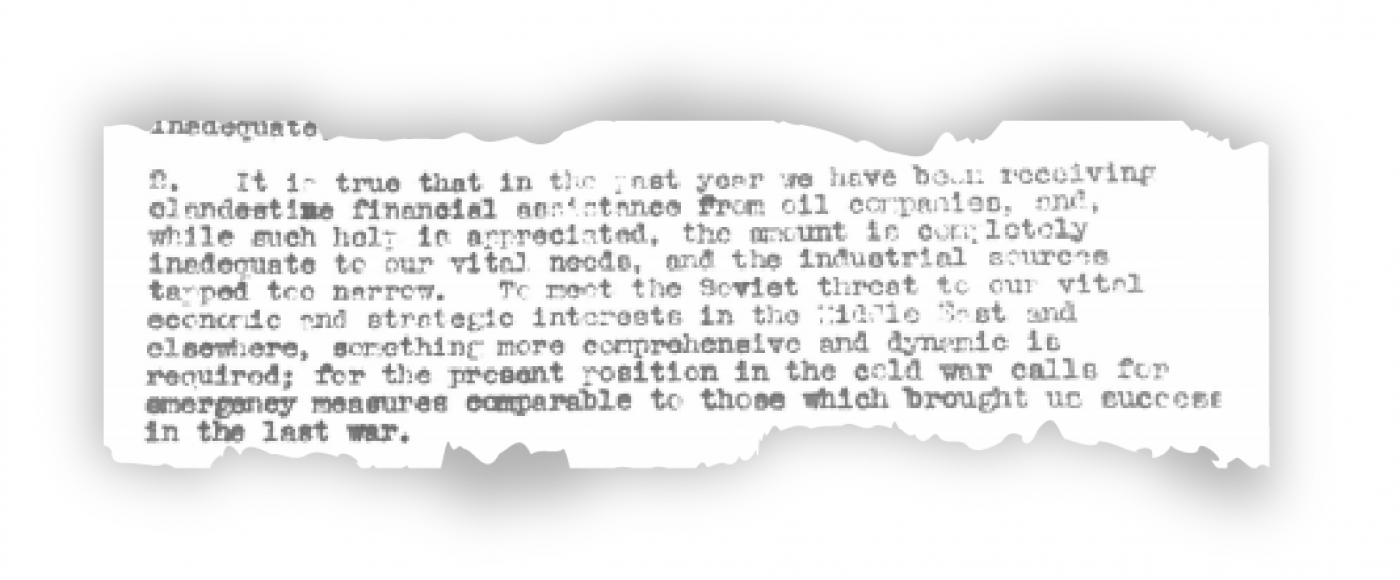
Although financed through the same unpublished budget as Britain’s intelligence services, the newly-released papers show that the IRD also received funding from the oil industry.
“It is true that in the last year we have been receiving clandestine financial assistance from oil companies,” a memo to IRD director Ralph Murray, marked Top Secret, noted in 1954.
But the Middle East was seeing “the emergence of a state of total ideological warfare”, the author claimed. “And while such help is appreciated, the amount is completely inadequate to our vital needs.”
The newly declassified papers contain a number of references to “religious operations”. Frequently these references are concerned with the financing of such propaganda campaigns, rather than the means of delivery. “You will note that we are including new budgetary provision for £1,000 to cover ‘Religious Operations’” is one typical entry.
Some details of the campaigns do emerge, however. In February 1950, for example, two years after the IRD was set up, its representative at the British embassy in Cairo informed London: “The Friday sermon has always been recognised as one of the most important way [sic] of spreading propaganda in the Moslem world.
“We have now devised a scheme for ensuring that anti-Communist themes are adequately dealt with. A series of sermons has been written here.”
This was still happening 10 years later, as a top-secret memo from Beirut from August 1960 makes clear: “We hope to produce two short pamphlets or sermons a month on religious subjects. They will be written by Sheikh Saad al Din Trabulsi, formerly of the Beirut Moslem Tribunal (sharia) and now of Zahle Moslem Tribunal, who is well-known as a pious Moslem.
“Two thousand copies of each would be distributed unattributably … throughout the Arabic-speaking world (less Iraq). Recipients will be Sheikhs, other leading Moslem personalities, Mosques and Muslim education establishments.”
The intermediary between the IRD and Trabulsi is named in the files as a man called Rivera, although this is possibly a codename.
Another intermediary between the IRD and individuals described as “religious operators” is named in the files as Talaat Dajani, a Palestinian refugee living in Beirut. Dajani later moved to London, where he received a medal of honour from the Queen in 1979, and died in 1992.
The whole Trabulsi operation, the IRD representative explained to London, would cost around 8,800 Lebanese pounds, or around £1,000 sterling, a year.
Although Iraq was excluded from that campaign, the country was on occasion the subject of IRD religious operations. In 1953, for example, IRD headquarters wrote to its man in Baghdad, saying: “We would like to know more about your ‘pilot’ scheme for the covert dissemination of propaganda in the Shia holy places since it may suggest ideas which could be used outside Iraq.
“Is the scheme connected with the working party’s proposal to make Friday sermons prepared in Beirut available to certain Shia divines?”
IRD officials saw another chance to make use of “religious operations” in Iraq following the attempted assassination of the country’s prime minister, Abd al-Karim Qasim, as he was being driven through Baghdad in October 1959.
There had been a “remarkable religious revival” following the attempt, the unit noted. “Workmen engaged in demolition work near the site of the attempted assassination had discovered the tomb of a Moslem holy man; this story had been widely publicized and had given substance to the popular belief that the Premier had been miraculously preserved. It was agreed that there would be an advantage in giving wider circulation to the story.
“Religious stickers have been appearing in Baghdad and the possibility of augmenting them is to be considered.”
Disruption and influence operations
The following April, a conference of Middle East-based IRD officers was held in Beirut. The minutes of what was described as a “restricted session on covert propaganda” show that Ralph Murray “listed the targets at which we should aim to disrupt or influence”.
Those to be disrupted included communist parties and hostile propaganda agencies. This was at a time when printing presses inside Soviet embassies were thought to be producing 10,000 copies of a newspaper entitled Akhbar every day.
Those to be influenced, on the other hand, included young people, women, trades unions, teachers’ organisations, the armed forces and religious leaders.
The representative from the British embassy in Baghdad explained that Iraq “was now an important target for religious material”, at which point, the minutes say, IRD officers based in Amman and Khartoum “also pressed strongly for supplies of sermons and religious articles, which they said they could easily place”.
The files make clear that several governments in the region connived with the IRD and would assist in the distribution of sermons and the placement of newspaper and magazine articles.
The IRD’s man in Baghdad also “emphasised that the Iraqi army was an important target” and suggested that arrangements might be made for selected officers to visit the UK, with the trip appearing to be arranged by bodies with no clear connection to the British government.
He also noted that in Basra, the same press was being used to print both communist and non-communist newspapers, and said that “the judicious use of some financial inducement would probably make it possible to put the Communist paper out of business if that were thought to be desirable”.
Delegates were briefed on the propaganda efforts of other members of the Baghdad Pact: the Cold War alliance of Iran, Iraq, Turkey, Pakistan and the UK that was dissolved in 1979. The IRD enjoyed extensive contacts with Baghdad Pact governments, offering both propaganda materials and technical support.
“In practice,” the delegates were told, “only the Turks are really active, having achieved the publication in the Turkish press of 25-30 articles a month prepared by a writers’ panel.”
Finally, the secret conference was informed that HMG [Her Majesty’s Government] was running two newspapers published in Bahrain: al Khalij and its English-language sister paper, the Gulf Times.
One paragraph in the minutes of the session notes that delegates were told that these newspapers were “exceptional”, in that IRD “preferred to work through staff of established newspapers”.
These minutes are among the papers that have been declassified and handed to the UK National Archives. But, 60 years after the conference, the subsequent paragraph remains blacked out.
Nasser and the Suez crisis
From the end of the Second World War to the late 1960s, successive British governments appear to have used intelligence and propaganda in an attempt to preserve strategic and economic interests in the Middle East at a time when they were struggling to retain influence.
Earlier disclosures about the IRD’s activities have shown that while some senior British diplomats in the region were highly enthusiastic, others were sceptical, fearing that exposure would exacerbate anti-British sentiment.
This is exactly what did happen, at a time and place where the British were about to take their last fling of the imperial dice: in 1956, in Egypt.
The IRD had been highly active in Egypt from the organisation’s inception. As an IRD paper written in Cairo in 1950 noted: “Conditions in Egypt are such as to make it eminently suitable breeding ground for Communism.”
The author went on to highlight “acute maldistribution between rich and poor” and the concentration of land in the hands of a small proportion of the population.
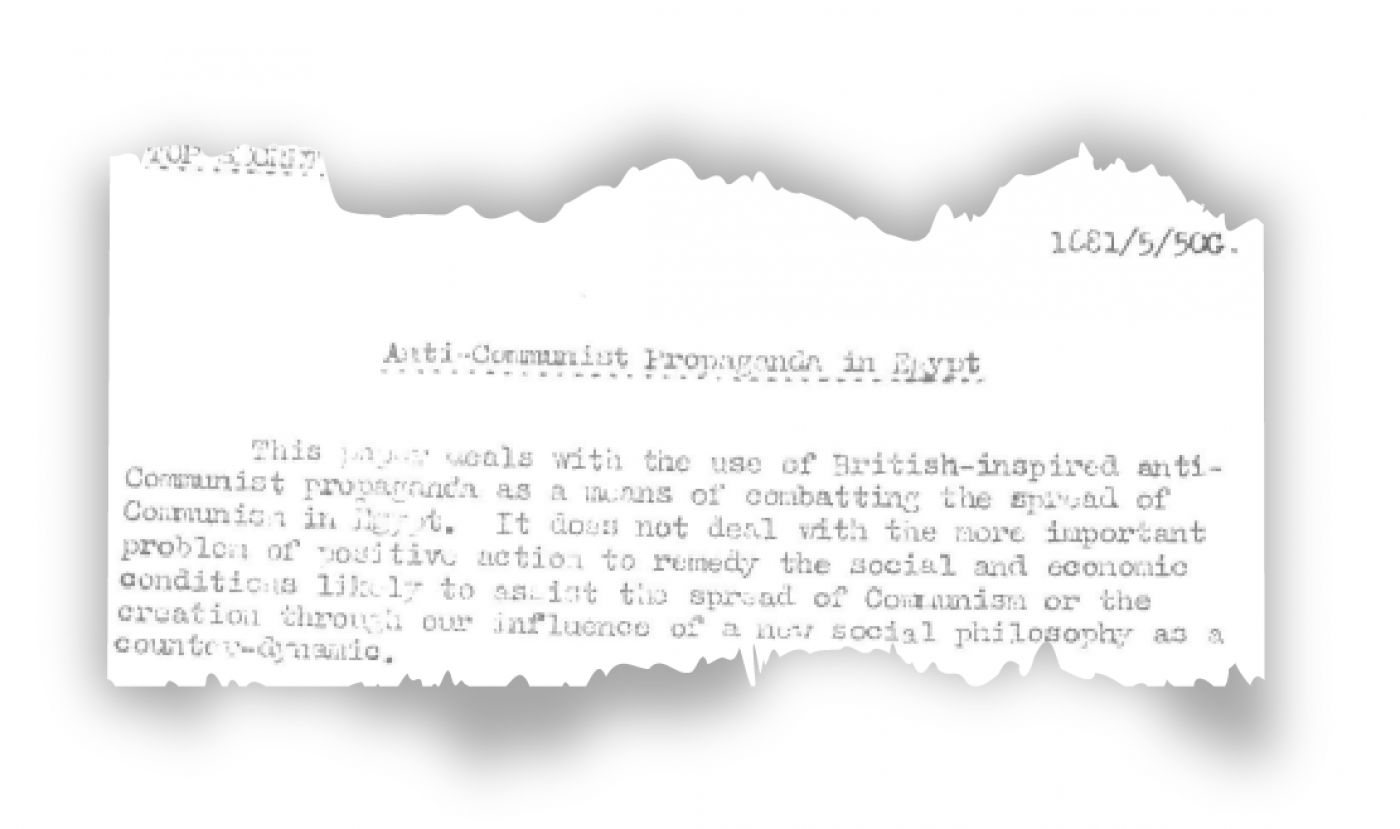
Nevertheless, he wrote: “This paper deals with the use of British-inspired propaganda. It does not deal with the more important problem of positive action to remedy the social and economic conditions likely to assist the spread of Communism.”
Instead, the author explained, the IRD was targeting the students at Al-Azhar University on the grounds that “from among them come the Imams who preach the Friday sermon in every Egyptian Mosque; the teachers of Arabic in the secondary schools and all teachers in the village schools; and the lawyers specializing in Moslem law”.
The organisation was also arranging for “the production in drafts in English of short love or detective novels, or thrillers, embodying anti-Communist propaganda but following their local counterparts as closely as possible in presentation etc.
“The Information Department, Cairo, would arrange for the drafts to be rewritten in Arabic by local hacks, and for them to be published locally.”
The unit would also “investigate the feasibility of producing short love or thriller magazine stories (of about 2,000 words) with an anti-Communist twist”.
The jewel in the IRD’s crown in Cairo was the Arab News Agency (ANA), one of several media organisations that British intelligence had set up during the Second World War.
Like other news agencies and radio stations that had been established in Beirut, Tripoli, Sharjah, Bahrain and Aden, ANA came under the control of the IRD after that organisation was founded in 1948.
To those on the outside, ANA appeared to be part of Hulton Press, a large company owned by Edward Hulton, a Fleet Street media baron. In fact, Hulton had allowed his company to give cover to the IRD and Britain’s overseas intelligence agency, MI6.
As well as distributing genuine news stories, gathered by Egyptian and British journalists, the agency disseminated propaganda produced by IRD, and became a base for MI6 officers masquerading as journalists.
In March 1956, with relations between the UK and Egypt deteriorating sharply, the UK Foreign Office instructed the IRD to switch its focus away from communism and towards the government led by Gamal Abdel Nasser – who had been engaged in propaganda operations against the British for some years.
The following July, after Nasser nationalised the Suez Canal Company – taking control of the waterway that the British considered to be the jugular vein of their empire – the UK’s propaganda and espionage efforts under the cover of ANA rapidly picked up pace.
Anthony Eden, the British prime minister, had long been convinced that Nasser was under the influence of the Kremlin – although the British ambassador in Cairo, Humphrey Trevelyan, disagreed – and MI6 began considering whether the Egyptian president could be assassinated.
Poison gas was one favoured option; an exploding electric razor was another.
Instead, as the Suez Crisis began to unfold, Eden vetoed the murder plot and the British decided to engage in several months of psychological warfare in Cairo, followed by military intervention.
A powerful new radio transmitter was erected in Iraq, broadcasting programmes from Arabic stations around the region that were covertly under British control, an operation that was for a while given the codename Transmission X.
As the British, French and Israelis plotted to invade Egypt and occupy the area around the canal, a steady stream of IRD and MI6 propaganda specialists began to appear at the ANA’s offices in Cairo.
This had not gone unnoticed by the Egyptian government, however, and in August, just weeks before the invasions, all of the agency’s operations – news reporting, spreading propaganda and gathering intelligence – were brought to an abrupt halt.
Egyptian secret police raided its offices and the homes of several of its staff. Eleven Egyptians were accused of being spies working for MI6 officers based at the agency; one, Sayed Amin Mahmoud, a teacher, was executed, and his son, a naval officer, was jailed for life.
Two MI6 agents who helped to manage the agency were subjected to lengthy interrogation and jailed. Others were tried in their absence, and two British diplomats and four journalists were expelled.
However, the British head of the agency – who was also a correspondent for the Economist and the London-based Times newspapers, escaped arrest: it appears that the Egyptian government may have been feeding him disinformation, and wished to continue.
In the event, IRD simply set up a new Arab News Agency, from offices in Beirut, with staff in London, Cairo, Amman and Damascus.
By 1960, according to one of the recently-declassified files, few people working at the agency’s Beirut headquarters were aware that it was controlled by the British government; IRD staff were warned “therefore to be cautious in their dealings” with them.
In March that year the senior IRD officer at the British embassy in Beirut wrote to London to say: “Of our secret information operations, I … attach the greatest importance to the Arab News Agency. There is no doubt they are doing the most useful work throughout the area and they run a good office here.”
Reuters and the BBC
The recently declassified documents also shed new light on the way in which in the 1960s the British government persuaded Reuters, the international news agency, to take over the operations run by two IRD fronts, Regional News Service (Middle East) and Regional News Service (Latin America). The relationship between Reuters and the IRD was first exposed in the 1980s.
The government funded these Reuters operations through the BBC. It began paying the BBC enhanced fees for its World Service operations, and the BBC in turn paid Reuters extra sums for receiving its news feed.
While the IRD accepted that it could not exercise editorial control over Reuters, the declassified papers show it did believe that it would gain “a measure of political influence”.
Some of the IRD’s Cold War activities in the Middle East and North Africa remain secret, however, with many of its old files remaining classified on national security grounds.
Not all of the papers on Reuters and the Arab News Agency have been transferred to the UK National Archive, for example. One dating from 1960, with the catalogue description “renegotiation of contract between Reuters and the Arab News Agency”, is among the IRD files that remain classified.
Another that has been withheld by the UK Foreign Office is known to contain papers from 1960 and is entitled “Information Research Department: Jordanian television”.
Other withheld files concern efforts to distribute IRD material through the Maghreb Arab Press news agency after it was set up in 1959, or have titles like “Information Research Department: Arab trade unions”.
Many of the titles of the classified IRD files are themselves classified: the UK National Archives catalogue simply lists them as “Title withheld”.
Reputational damage?
The United States was also an enthusiastic purveyor of propaganda in the Middle East throughout the Cold War. Material created and distributed by the US Information Service tended to promote the idea of common western and Islamic values rather than attack Communism.
The recently declassified files are all concerned with British campaigns, however.
With the IRD being shut down in 1977 – in part, because too many people had become aware of its existence and activities – two questions remain.
The first is: did their campaigns have an impact on people’s attitudes and behaviour?
Throughout the Cold War, many British diplomats in the Middle East were sceptical about the IRD’s efforts. Some argued repeatedly that communism had only limited appeal in the region, and that Arab nationalism posed a greater threat to the UK’s interests than Moscow.
‘In our experience, it is barely possible to interest the politically conscious Iraqi in the Communist system at all’
– British diplomat, Baghdad, 1955
Even in Iraq – which the IRD appears to have believed to be more susceptible to communist influence than Egypt – some of Britain’s envoys had their doubts.
One diplomat wrote from Baghdad to the IRD in 1955 to explain: “The Arabs have no means of checking the accuracy of our allegations about the iniquities of the Communist system … but they have the means, as they believe, of checking Russian propaganda about French and British wickedness in the Persian Gulf and North Africa.
“In our experience, it is barely possible to interest the politically conscious Iraqi in the Communist system at all.”
Looking back, a number of historians remain equally sceptical.
Vyvyan Kinross, author of Information Warriors, a forthcoming book about the battles for hearts and minds in the Middle East, believes that Eden’s attempts to demonise Nasser in 1956 left him looking hopelessly out of touch, and propelled Britain into disastrous military action.
The failed propaganda war contributed to “a general collapse of Britain’s reputation for honesty and fair dealing in the region”, Kinross says.
James Vaughan, lecturer in international history at Aberystwyth University in Wales, who has extensively studied western Cold War propaganda in the Middle East, concludes: “The history of British propaganda in Egypt demonstrates how the decline of British influence was a well-advanced phenomenon, several years before Nasser’s decision to nationalise the Suez Canal Company.”
The second question is: what happened after the IRD was closed in 1977?
An intriguing answer to this question was provided by Adnan Abu-Odeh, who served as information minister in the government of King Hussein of Jordan.
Abu-Odeh would have been on MI6’s radar at the time. He was Palestinian who had risen through the ranks of the Jordanian secret police and been handpicked for the job by the king.
At the time the kingdom was going through a major crisis, which became known as Black September, when the Jordanian Armed Forces attacked and expelled the PLO under the leadership of Yasser Arafat from the refugee camps in Jordan.
The crisis was resolved when Palestinian fighters known as the fedayeen were escorted to Syria.
In an interview with Middle East Eye in 2018, Abu-Odeh explained how he was sent to England in the early 1970s, to be trained by the IRD.
‘The king was preparing me to become minister of information, on the advice of MI6. The IRD taught me their tactics and methods’
– Adnan Abu-Odeh
While working as an intelligence officer, Abu-Odeh said, he was approached by the country’s newly-appointed director of intelligence. “He said to me: ‘His Majesty wants you to go on a course in London at the IRD.’
“I said to him: ‘What is the IRD? I didn’t know.”
Later, he was sent back to England to study psychological warfare at a military academy.
“The king was preparing me to become minister of information, on the advice of MI6. The IRD taught me their tactics and methods.
“When I became minister of information, I trained one or two people how to do it.”
Although there is no confirmation in the recently declassified IRD files, it seems entirely possible that before it was disbanded, the organisation trained other government officials across the region.
For creators of color, one of the biggest challenges is securing the funding needed to bring our dreams to life. That’s why producer Nina Yang Bongiovi (Fruitvale Station, Dope, Sorry to Bother You) has assembled a super team of film and tech heavyweights to launch the multicultural film fund AUM Group.
Comprised of Bongiovi, Gold House Chairman Bing Che, Twitch Co-Founder Kevin Lin, XRM Media’s Michael Y. Chow, MNM Creative’s Michael K. Shen, and Silicon Valley vets Jason A. Lin and Maggie Hsu, AUM Group will develop and acquire creative IP, finance multicultural motion pictures, and invest in the next generation of storytellers.
“Forest Whitaker and I have been backed by my Asian-American partners in leading the financing on every Significant Productions’ project since Fruitvale Station through Sorry to Bother You when no one else in the marketplace was willing to take the initial risk,” Bongiovi told The Root. “Partnering with an all-star team of business leaders in AUM Group is the next natural evolution in continuing to shift culture, amplify important dialogue, and elevate commercial opportunities.”
AUM Group led the financing of the upcoming suspense-thriller Passing, which stars fan-favorite Tessa Thompson, Ruth Negga and Andre Holland and navigates the complicated intersection of race, class and culture. It’s an adaptation based on the Nella Larsen novel published during the Harlem Renaissance.
For an industry in dire need of more people of color in positions of power in order to exert more control over the content being created, AUM Group is a welcome breath of fresh air. Just last month I wrote about UCLA’s latest Hollywood Diversity Report and…its findings were a bit concerning, to say the least.
But with its producer-led approach and Bongivoi’s track record of launching the careers of several noteworthy filmmakers, AUM Group could create a much-needed paradigm shift in entertainment.
With Asian and Asian American actors and filmmakers gaining prominence in Hollywood — the latest example: Parasite and The Farewell winning top honors at the Oscars and Spirit Awards — their counterparts in the executive suites are stepping up as well.
Nina Yang Bongiovi, who runs Forest Whitaker’s Significant Productions, revealed Feb. 24 that she has teamed with a coalition of film and tech veterans including Bing Chen, chairman of the Asian American nonprofit Gold House, and Twitch co-founder Kevin Lin to launch the film fund AUM Group. Although founded by Asian Americans, the fund will back an array of multicultural film projects, starting with Rebecca Hall’s directorial debut, Passing. Now shooting, the drama is an adaptation of Nella Larsen’s 1929 novel about the evolving relationship between light-skinned black women (played by Tessa Thompson and Ruth Negga).
AUM Group’s announcement came four days after Mary Lee, most recently head of film at Justin Lin’s Perfect Storm Entertainment, unveiled her own banner, A-Major Media, which will focus on producing Asian American film and TV content. The company is backed by a non-exclusive majority investment from The Hollywood Reporter parent Valence Media, meaning that Lee is free to shop her projects to various production partners. Financial terms for A-Major and AUM Group were not disclosed.
Yang Bongiovi will continue to run Significant (Sorry to Bother You, Dope, Fruitvale Station), whose future projects will be supported by AUM Group, as could films from other companies — such as A-Major’s. “I’m excited about the fact that Mary could have support from AUM Group,” Yang Bongiovi tells THR. “We’re here to complement each other on our growth and presence in the business.”
A-Major already has a handful of projects on its slate, including an untitled film set up at New Line produced by John Cho and a TV series produced by Gemma Chan and Franklin Leonard. The company also is developing an adaptation of the 2015 YA novel I Believe in a Thing Called Love, about a teenage girl using K-drama techniques to woo her crush; an autobiographical film from Fresh Off the Boat co-executive producer Kourtney Kang about her high school experiences; and We Stan, a comedy about K-pop fans and friends from Atypical scribe Lauren Moon.
Yang Bongiovi and Lee cited 2018’s Crazy Rich Asians as a watershed moment that sparked faith to start their ventures. There have been Asian American studio toppers (including current DC Films chief Walter Hamada) and artists with their own shingles (Daniel Dae Kim’s 3AD), but few producer-driven companies like Dan Lin’s Rideback. That’s changing, Lee says: “[The presence of Asian Americans] has been good on the talent side, but it’s very important to be on the executive side as well. There have to be people in positions of power to champion these stories.”