More Than a Place of Refuge: Meaningful engagement of Government-assisted refugees in the future of work. An Action Canada Task Force report

From the recent Action Canada report, on ways to improve participation in the workplace for Government Assisted Refugees. Most of these are reasonable but I would question the need for a national anti-racism strategy specific to former refugees as hard to see that anti-Muslim or anti-Black racism is specific to refugees and former refugees:

Recommendation 1: The Government of Canada should support the development of collaborative options in which GARs can access programs to simultaneously improve their language skills while acquiring Canadian work experience and earning wages.

Recommendation 2: The Government of Canada should support the prioritization of creating enhanced social capital for GARs through an emphasis on social bridging/integration.

Recommendation 3: The Government of Canada should reduce the amount of the claw-back on income above 50 percent of the Resettlement Assistance Program amount from 100 percent to 50 percent to encourage former refugees to find full-time employment.

Recommendation 4: The Government of Canada should extend Resettlement Assistance Program eligibility to 24 months.

Recommendation 5: The Government of Canada should direct Statistics Canada to work with federal ministries, provincial governments and settlement agencies to collect and publicly distribute relevant, updated and on-time data regarding newcomer refugees, and especially relating to uptake of different social programs and employment.

Recommendation 6: The Government of Canada should establish a national strategy to combat discrimination against former refugees, with an emphasis on Islamophobia and anti-black racism.

Source: https://ppforum.ca/wp-content/uploads/2020/03/AC-Meaningful-Engagement-Report.pdf

Immigrant Workers: Vital to the U.S. COVID-19 Response, Disproportionately Vulnerable

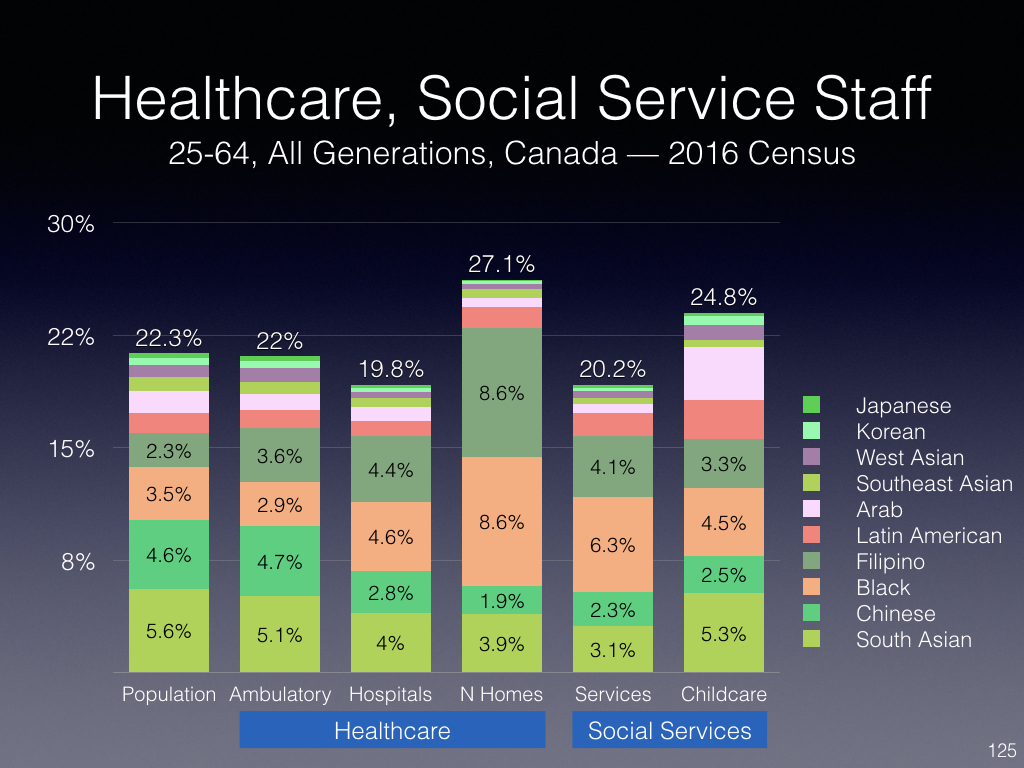
Of note. Haven’t looked at immigrant status but visible minorities provides a similar picture (mix of immigrants and subsequent generations). Some visible minority groups such as Latin American and Blacks are more concentrated in support positions than other groups:

Six million immigrant workers are at the frontlines of keeping U.S. residents healthy and fed during the COVID-19 pandemic. While the foreign born represented 17 percent of the 156 million civilians working in 2018, they account for larger shares in coronavirus-response frontline occupations: 29 percent of all physicians and 38 percent of home health aides, for example. They also represent significant shares of workers cleaning hospital rooms, staffing grocery stores, and producing food.

The foreign born also are over-represented in sectors most immediately devastated by mass layoffs: Restaurants and hotels, office cleaning services, and in-home child care, among them. All told, another 6 million immigrants work in industries that MPI has identified as some of the hardest hit, meaning that collectively 12 million immigrant workers are at the leading edge of the response to and impacts from the pandemic.

As dramatic economic contraction brings hardship to tens of millions in the coming months, the difficulties will be exacerbated for many immigrant workers because of limited access to safety-net systems and to federal relief, both for those who are unauthorized and some who are legally present. The estimated $2 trillion pandemic aid package makes many immigrants eligible for cash relief payments; others, such as most U.S.-citizen or legal immigrant spouses who file taxes jointly with unauthorized immigrants, will not be eligible.

Noncitizens also face restricted access to existing safety-net programs. While green-card holders, those on a temporary work visa, and individuals with Temporary Protected Status or Deferred Action for Childhood Arrivals can access unemployment insurance, most noncitizens cannot turn to the federal, means-tested benefits, including food stamps, that other workers tap in times of need. And immigrant workers face additional vulnerabilities, including smaller incomes and lower rates of health insurance coverage.

Cohen: Why Canada’s response to COVID-19 is so different from that of the U.S.

Another piece on differences:

Comparing the character of nations is risky and imprecise. In the Age of Contagion, though, it offers a window into how the peoples of the world are coping.

Japan, South Korea, Taiwan and Singapore have handled the crisis relatively well. We expect that of people we see as highly disciplined, motivated and organized. Italy is reeling from the contagion. Gregarious, unruly, passionate, creative, independent – this is how we see Italians. It suggests why they were slow to respond.

In Washington, Congress struggles to forge an economic response. The president is erratic and unempathetic. He is widely disbelieved, skeptical of expertise and reluctant to accept responsibility.The media send mixed messages. Fox News, with the highest audience, once denied the pandemic, calling it “a hoax.” One host – before she was fired – claimed the coronavirus was a plot by the Democrats to re-impeach Donald Trump.

The danger is that the medical system will be overwhelmed. On the tenth anniversary of Obamacare, universal health care remains contentious in the United States – undermined by the Republicans, who have tried repeatedly to abolish it, and repeatedly challenged in the courts.

In Canada, a country of 37 million, there were some 2,100 cases and 24 deaths as of early Tuesday. The system is holding, for now. Hospitals have enough masks and respirators, for now. The prime minister appears in public every day, alone, outside his residence. He speaks sensibly, with authority, without hyperbole. This has been his finest hour.Canadians trust him. They may not have voted for him – only about one-third did – but that doesn’t matter now. Nor do we question the competence of his ministers who are the other faces of the crisis – Chrystia Freeland, Marc Garneau, Patty Hajdu, Bill Blair. All are calm, competent and professional. This is what we want.

The provincial premiers, most of whom are not Liberals, have lost their congenital instinct to attack Ottawa. Doug Ford, no admirer of Justin Trudeau, now praises his leadership.All provinces have declared states of emergency, and will not object if the national government does, too. If it must, it will – and we won’t complain.

Opposition parties are not posturing. Andrew Scheer, who called Trudeau “a fraud” last autumn, says this is no time for politics. He is right. His fellow Conservatives, vying to succeed him, have put away their popguns. Some want the leadership vote scheduled for August delayed.

Unlike in America, there is consensus in Canada. No one is saying that the aid package is inadequate, that the government is slow, that money unduly favours corporations. Jason Kenney is not talking about western alienation and the Bloc Québécois is not talking sovereignty. Canadians want only freedom from fear.Mercifully, we have no Fox News. Whatever the CBC’s flaws as national broadcaster, its reporting has been thorough and honest, under trying circumstances. Same with CTV and Radio Canada, and the country’s newspapers and websites.

Why is our response different? It may be a case of identity. Americans celebrate independence, individualism, personal liberty. Many distrust government, resent politicians, court conspiracy and dismiss science. This wasn’t always so – the New Deal and the Great Society expanded the state – but it is now.

Canadians accept big government, which is how we built the social welfare state. Two-thirds of us voted for progressives last year. We defer to authority.Yes, we’ve made real mistakes in the crisis. We didn’t secure airports fast enough or test early and widely enough. Too many are treating physical distancing as a snow day. If we ultimately do better in all this – it’s too early to know or crow – it’s not because we are morally superior. It is because we are smaller, organized, well-led, more united, more measured, more of a community.

It’s a question of character.

Source: Cohen: Why Canada’s response to COVID-19 is so different from that of the U.S.

Terry Glavin: COVID-19: Beware the wartime propaganda as we battle this plague

On the lack of checks and balances regarding Chinese government propaganda:

It’s a terribly imperfect metaphor, and it’s already something of a cliché, but fair enough, too. The global struggle with the disaster of the coronavirus that first emerged last December in the Chinese city of Wuhan is, without question, something very much like war. And almost everybody who’s saying so is relying on pretty well the same formulation.

U.S. President Donald Trump has lately fashioned himself as a ‘wartime president,” determined to defeat a “horrible, invisible enemy.” French President Emmanuel Macron: “We are at war. The enemy is invisible and it requires our general mobilization.” Greek Prime Minister Kyriakos Mitsotakis: “We are at war with an enemy that is invisible, but not invincible.” Israeli Prime Minister Benjamin Netanyahu: “This is a battle for public health … We are at war with an invisible enemy.”

So yes, fair enough. But we should be very careful that we don’t allow the confines of approved terminology and the banalities of official diction to leave us unmoored from the objective realities of the crisis we’ve all found ourselves stumbling through. Because that’s how colossally stupid public policy mistakes get made. It’s also how the powerful get away with occluding the truth and telling outright lies.

It’s how the powerful get away with occluding the truth

The official exertions dozens of nation states are taking to deal with the calamity of the virus are of the kind that are ordinarily made only in wartime. After all, in Canada’s case the statutory antecedent of the Emergencies Act, which Justin Trudeau’s cabinet is quite sensibly considering as a “last resort,” is the War Measures Act, which was invoked only once after the Second World War, during the October Crisis of 1970.

Naming the enemy precisely would help. And this is where things have already got off to a shabby and slightly sinister start.

Strictly speaking, the enemy is not COVID-19, as the disease has come to be named by the World Health Organization’s International Classification of Diseases group, “covi” being the short form of coronavirus, and ‘d” for disease, and 19 for 2019. It’s true enough that the herculean medical research efforts required to find effective treatments for the disease, and of course to develop a vaccine — an undertaking which is expected to take at least a year to complete — should put us all on a war footing. And that effort deserves the rapid marshalling of public resources and whatever measures are necessary to keep our hospitals from crashing and ensuring the safety and security of public health workers.

But the “invisible enemy” that’s showing up in the speeches of presidents and prime ministers, the thing that has forced wartime-type lockdowns and curfews and social mobilization, is the virus that causes the disease. The virus was named SARS-CoV-2 by the International Committee on the Taxonomy of Viruses. The SARS bit in the name comes from the virus’s genetic relation to the virus associated with the SARS outbreak of 2003.

It was perfectly sensible that “Wuhan virus” immediately and quite innocently emerged in the language of common speech, in China and elsewhere, But nobody wants their hometown named after a killer virus, and WHO guidelines are averse to the association of viruses with specific countries. So SARS-CoV-2 it was, and not “China virus.” For naming purposes it didn’t and shouldn’t have mattered that 99 per cent of all the eruptions from the virus at the time were occurring in China.

But then the Chinese Communist Party’s propaganda machinery kicked in. Faced with a population disaffected to a degree without precedent since the time of the nationwide pro-democracy insurrections that were crushed in the Tiananmen massacre of 1989, the CCP’s braintrust began to circulate lurid fictions to the effect that the virus didn’t originate in China at all, but was rather somehow smuggled into Wuhan by the U.S military.

The CCP’s braintrust began to circulate lurid fictions to the effect that the virus didn’t originate in China at all

The CCP was also keen on following Xi Jinping’s Feb. 3 instruction to recast China’s police-state efficiencies as the solution to the world’s hardships, and to recast Xi himself as a global medical-supply benefactor rather than the cold-blooded villain sensible people understand him to be. Because of all this, the regime’s state media and several senior propaganda ministry officials and diplomats were particularly determined to lay in an ambuscade for Trump over his use of the provocatively vulgar term “China virus.”

This all may seem trivial and petty, but it’s worth taking a moment here to notice a couple of things about the way wartime propaganda works.

The first thing is the classic strategy of exploiting divisions and anxieties in an enemy population in order to weaken public resolve and undermine the enemy’s leadership. If you don’t think the CCP sees the U.S.-led global order and the institutions of liberal democracy as the enemy, you simply haven’t been paying attention. And if you don’t think the Chinese Communist Party intends to exploit the coronavirus disaster as an opportunity to advance its interests against its enemies around the world, you’re not taking the CCP at its own word.

It’s the democratic world’s ill luck that the inflammation of domestic divisions and anxieties just happens to be both the cause and the purpose of Trumpism itself, and a significant body of American opinion will not grant Trump the time of day. Neither does it help matters that the Americans are in the bitter throes of an election year, when they all tend to give the impression of being at one another’s throats at the best of times.

The second thing is that controlling the terminology of the conflict and the subversion of vocabulary are crude wartime propaganda methodologies, and Beijing is taking matters to absurd extremes, with its ambassadors around the world instructing everyone in what we are allowed to say and how we are allowed to say it.

China’s embassy in Peru, for instance, has initiated a thuggish attack on the celebrated Peruvian novelist and Nobel laureate Mario Vargas Llosa, a former president of PEN International, owing to a March 14 essay Llosa wrote in the Spanish national newspaper El Pais. Llosa merely noted that the coronavirus originated in Wuhan, and that the Chinese authorities had suppressed early efforts to alert the public about the disease — a catastrophic error that a free society would not so readily make.

The embassy went so far as to deny that the virus even originated in China, and admonished Llosa for having the cheek to criticize the Chinese government. Immediately, Llosa’s novels started getting pulled from China’s e-book platforms.

Every reasonable person understands that Donald Trump is a buffoon, but his torrents of false claims and imbecilities are routinely fact-checked and corrected by a robust American news media, and sometimes even by Trump’s own officials. The Chinese people enjoy no such liberties and China’s brutal state-capitalist system allows no such corrections. With the world divided more or less into two camps, with Xi Jinping on one side and Donald Trump on the other, any retreat into a facile “both-sidesism” would be a mistake the democratic world can’t afford to make.

We’ve had quite enough of that already, to disastrous result, and it would be the height of folly to try to salvage the relics of a broken global order that treated China like a normal country. That world is gone. Besides, it would be a peacetime activity, and as crude as the metaphor is, the predicament we face at the moment, in this time of plague, is very much like war.

Source: Terry Glavin: COVID-19: Beware the wartime propaganda as we battle this plague

The Dos and Don’ts of Online Video Meetings Do your co-workers really need to make their pets or toddlers part of the call? No.

My personal preference. Zoom has a great feature that allows one to choose a virtual background rather than one’s room (see settings):

In the age of coronavirus, many of us have transformed overnight from office workers into telecommuters. And we are increasingly relying on videoconferencing apps like Zoom and FaceTime to correspond with our peers.

But inevitably, with our homes and workplaces merging into one, the boundaries between our personal and professional lives are beginning to erode — and awkward situations have ensued.

By now, you may have had a few video calls with colleagues who took meetings in odd places, like their bathroom or closet, to avoid their children. Then there are the colleagues who surrender their boundaries entirely and let their children and pets be a part of the meeting.

It’s cute and heartwarming. But it can also prolong a meeting or derail it altogether.

“There’s the technical issues and the discomfort of it all — people aren’t used to being onscreen,” said Elaine Quinn, a Chicago entrepreneur who wrote the book “There’s No Place Like Working From Home. “They don’t think to look behind them and see what it is people will see.”

We all get it: No one was really prepared for this transition, and there are limitations to what we can all do. But now feels like an opportunity to bring up how to be kinder to your co-workers in workplace video calls, since they’re the ones the calls are really for in the end.

The bottom line: A bit of preparation goes a long way to making video calls more tolerable for you and your colleagues.

The No. 1 culprit of a painful videoconference is the quality of the call itself. If you can’t see or hear a colleague, what’s the point of a video call?

So before we video-chat with a colleague, the least we can do is a test run to ensure the call looks and sounds good, with minimal tech snafus. A few steps:

  • Preview your webcam. Mac users can launch the Photo Booth app, and Windows users can click the Start button, then Camera. Here, you can check your picture. Adjust your indoor lighting and camera angle to make your face look properly lit. And most important, be mindful of what’s in the background: Anything you wouldn’t want your colleagues to normally see, like your liquor collection or dirty laundry, should be out of the frame.

  • Test the microphone. Make sure you wear a headset with a built-in microphone or use an external microphone — the microphone included on laptops can sound very poor. The easiest way to make sure you sound good is to do a video call with a friend and ask how you sound, then adjust accordingly.

  • Check your internet speeds. Because so many people are staying home and using the internet at the same time, our bandwidth and service are slowing down in many neighborhoods. Visit speedtest.net to gauge your internet speeds. If your speeds are below 20 megabits per second, there’s a high likelihood your video is going to look pixelated and have audio delays. (My last column on the tech headaches of working from home goes over some solutions for slow internet.)

This may seem obvious, but plenty of people forget to mute their microphones before joining a call with multiple people.

That can lead to sounds like barking dogs and screaming children interfering in the call. On video-chatting services like Zoom and Google Hangouts, you have the option to turn off the microphone before joining a meeting, and everyone but the person leading the meeting should do it. Unmute only when it is your turn to speak.

With constrained internet bandwidth, you could even take the extra step and turn off your camera by default until you want to speak to the group. There’s no practical value in people watching you silently look at your camera.

Our families are more important than anyone, but that doesn’t mean our colleagues want to see our partners in their bathrobes, our cats sitting on keyboards or our children throwing toys.

That’s why it’s important to take a video call in a place where you can draw boundaries, if possible. The simplest physical boundary is a room with a door, which can be shut when you are on a video call.

Many of us who are now being required to work from home never had much physical space to begin with. But there are workarounds.

I lack a home office and work on my dining table. On video calls, I have made it a habit to point my web camera at a blank wall, away from common areas like the kitchen and hallway, and my earbuds are a visual cue for being on a video call.

The onus is on managers to make virtual meetings concise and engaging. That was already true for in-person meetings, but for virtual meetings, setting an agenda is even more crucial, said Ms. Quinn, who managed remote employees at pharmaceutical companies before starting the Solopreneur Specialist, a website for remote workers.

“You’re in private, and it’s easy to drift off,” she said.

Managers can take a number of approaches to make videoconferences more organized. For one, they can ask each employee ahead of the meeting to plan to talk about something specific, so that everyone has something to do and can stay engaged.

Conversely, if you have something better to do than be on a video call, it’s more polite to excuse yourself than it is to remain on the call and obviously stop paying attention.

If you do drift off and switch to a different app, like Twitter or Facebook, be aware that people may know. The Zoom app, for example, has a setting that lets hosts see if you have switched away from the Zoom app for more than 30 seconds — a dead giveaway that you aren’t paying attention.

In offices, businesses may feel tempted to rope people into conference rooms for back-to-back meetings. But with remote work, we don’t need to replicate all those meetings into videoconferences, said Jason Fried, a founder of Basecamp, a software company in Chicago that makes remote-working tools.

“That’s not what remote work is about,” said Mr. Fried, who co-wrote the book “Remote: Office Not Required.” “It’s about respecting people’s time and attention and space and giving people room.”

That’s partly because asking your colleagues to join a video call involves more than you might think. Not only do they have to test their tech setups before joining the call, but they have to make other arrangements, like getting a caretaker to take their children on a walk outside.

A good rule of thumb is to book video meetings sparingly. Ideally, reserve them for discussions that require visual aids, like presentations and documents.

There is no universal rule requiring you to use video chat to work from home. The old-fashioned telephone is just as good.

Last year when Mr. Fried’s team used videoconferencing to vet candidates for a marketing position for Basecamp, which is composed of remote workers, their final interviewee joined the call with his camera off. The candidate explained that he had his best conversations when he was walking around instead of sitting stiffly in front of a camera.

“He was like, ‘I want to be looking my best right now, and I’m better moving around,’” Mr. Fried said. “I really appreciated that, because he was just being himself.”

The company ended up hiring him.

Source: The Dos and Don’ts of Online Video Meetings

Minimizing the Risk of Exposure to COVID-19 in Canada Order (Prohibition of Entry into Canada from the United States)

Latest version for those interested.

PC Number: 2020-0184

Date: 2020-03-26


Whereas the Governor in Council is of the opinion that

(a) based on the declaration of a pandemic by the World Health Organization, there is an outbreak of a communicable disease, namely coronavirus disease 2019 (COVID-19), in the majority of foreign countries;

(b) the introduction or spread of the disease would pose an imminent and severe risk to public health in Canada;

(c) the entry of persons into Canada who have recently been in a foreign country may introduce or contribute to the spread of the disease in Canada; and

(d) no reasonable alternatives to prevent the introduction or spread of the disease are available;

Therefore, Her Excellency the Governor General in Council, on the recommendation of the Minister of Health, pursuant to section 58 of the Quarantine Act, makes the annexed Minimizing the Risk of Exposure to COVID-19 in Canada Order (Prohibition of Entry into Canada from any Country other than the United States).

Minimizing the Risk of Exposure to COVID-19 in Canada Order (Prohibition of Entry into Canada from any Country other than the United States)

Definition of immediate family member  

1 In this Order, immediate family member, in respect of a person means

(a) the spouse or common-law partner of the person;

(b) a dependent child, as defined in section 2 of the Immigration and Refugee Protection Regulations, of the person or of the person’s spouse or common-law partner;

(c) a dependent child, as defined in section 2 of the Immigration and Refugee Protection Regulations, of a dependent child referred to in paragraph (b);

(d) the parent or step-parent of the person or of the person’s spouse or common-law partner; or

(e) the guardian or tutor of the person.

Prohibition

2 Any foreign national, as defined in subsection 2‍(1) of the Immigration and Refugee Protection Act, is prohibited from entering Canada if they arrive from a foreign country other than the United States.

Non-application

3 (1) Section 2 does not apply to

(a) an immediate family member of a Canadian citizen or of a permanent resident as defined in subsection 2‍(1) of the Immigration and Refugee Protection Act;

(b) a person who is authorized, in writing, by an officer designated under subsection 6‍(1) of the Immigration and Refugee Protection Act or by a consular officer of the Government of Canada, to enter Canada for the purpose of reuniting immediate family members;

(c) a crew member as defined in subsection 101.01‍(1) of the Canadian Aviation Regulations or a person who seeks to enter Canada only to become such a crew member;

(d) a member of a crew as defined in subsection 3‍(1) of the Immigration and Refugee Protection Regulations or a person who seeks to enter Canada only to become such a member of a crew;

(e) a person who is exempt from the requirement to obtain a temporary resident visa under paragraph 190‍(2)‍(a) of the Immigration and Refugee Protection Regulations and the immediate family members of that person;

(f) a person who seeks to enter Canada at the invitation of the Minister of Health for the purpose of assisting in the COVID-19 response;

(g) a person who arrives by any means of a conveyance operated by the Canadian Forces or the Department of National Defence;

(h) a member of the Canadian Forces or a visiting force, as defined in section 2 of the Visiting Forces Act, and the immediate family members of that member;

(i) a French citizen who resides in Saint-Pierre-et-Miquelon and has been only in Saint-Pierre-et-Miquelon, the United States or Canada during the period of 14 days before the day on which they arrived in Canada;

(j) a person or any person in a class of persons who, in the opinion of the Chief Public Health Officer appointed under subsection 6‍(1) of the Public Health Agency of Canada Act

(i) does not pose a risk of significant harm to public health, or

(ii) will provide an essential service while in Canada;

(k) a person whose presence in Canada, in the opinion of the Minister of Foreign Affairs, the Minister of Citizenship and Immigration or the Minister of Public Safety and Emergency Preparedness, is in the national interest;

(l) a person who arrives by means of a vessel as defined in section 2 of the Canada Shipping Act, 2001, if the vessel departed before 00:00:01 am Eastern Daylight Time on March 21, 2020 and had a scheduled destination of Canada upon its departure;

(m) the holder of a valid work permit or a study permit as defined in section 2 of the Immigration and Refugee Protection Regulations;

(n) a person whose application for a work permit referred to in paragraph (m) was approved under the Immigration and Refugee Protection Act and who has received written notice of the approval, but who has not yet been issued the permit;

(o) a person whose application for a study permit referred to in paragraph (m) was approved under the Immigration and Refugee Protection Act, and who received written notice of the approval before noon, Eastern Daylight Time on March 18, 2020, but who has not yet been issued the permit;

(p) a person permitted to work in Canada as a student in a health field under paragraph 186‍(p) of the Immigration and Refugee Protection Regulations;

(q) a person permitted to work in Canada as a provider of emergency services under paragraph 186‍(t) of the Immigration and Refugee Protection Regulations.

(r) a licensed health care professional with proof of employment in Canada;

(s) a person who seeks to enter Canada for the purpose of delivering, maintaining, or repairing medically-necessary equipment or devices;

(t) a person who seeks to enter Canada for the purpose of making medical deliveries of cells, blood and blood products, tissues, organs or other body parts, that are required for patient care in Canada during or within a reasonable period of time after the expiry of the Order;

(u) a person whose application for permanent residence was approved under the Immigration and Refugee Protection Act, and who received written notice of the approval before noon, Eastern Daylight Time on March 18, 2020, but who has not yet become a permanent resident under that Act; or

(v) a worker in the marine transportation sector who is essential for the movement of goods by vessel, as defined in section 2 of the Canada Shipping Act, 2001, and who seeks to enter Canada for the purpose of performing their duties in that sector.

Exception — signs and symptoms

(2) Despite subsection (1), a foreign national is prohibited from entering Canada from a foreign country other than the United States if they exhibit the following signs and symptoms:

(a) a fever and cough, or

(b) a fever and breathing difficulties.

Exception — optional or discretionary purpose

(3) Despite subsection (1), a person who seeks to enter Canada for an optional or discretionary purpose, such as tourism, recreation or entertainment, is prohibited from entering Canada from a foreign country other than the United States.

Non-application — order

4 This Order does not apply to

(a) a person registered as an Indian under the Indian Act; or

(b) a protected person within the meaning of subsection 95‍(2) of the Immigration and Refugee Protection Act.

Powers and obligations

5 For greater certainty, this Order does not affect any of the powers and obligations set out in the Quarantine Act.

Repeal of P.C. 2020-0162

6 The Minimizing the Risk of Exposure to COVID-19 Coronavirus Disease in Canada Order (Prohibition of Entry into Canada from any country other than the United States) is repealed.

Effective period

7 This Order has effect for the period beginning on the day on which it is made and ending on June 30, 2020.

Source: https://orders-in-council.canada.ca/attachment.php?attach=38958&lang=en
Four Reasons to Keep Allowing Refugees into Canada

I don’t find these arguments terribly convincing.

Travel restrictions by themselves only slow down the spread of viruses like COVID-19. But at a time where “planking the curve” is a priority to assist our healthcare system handle current and anticipated increased demand, it is one tool that government’s have. Implementing widespread screening at airports was not terribly effective during SARS (“health theatre” just like “security theatre.”)

While some migrants will, of course, find a way, the numbers will likely decrease, reducing the potential additional burden on healthcare (and the IRB).

And and the recent MPI study, Coronavirus Is Spreading across Borders, But It Is Not a Migration Problem, shows, while travel restrictions have limited effectiveness in the containment phase, they are more effective in the mitigation phase in which we find ourselves.

Is the policy immoral? Or does it strike a reasonably balance between protecting Canadian residents and asylum seekers who arrive at official border crossings? Is Canada a “classist society, partially determined by citizenship status.” Of course it is, citizenship does have meaning. But Canada’s implementation of all travel restrictions is inclusive: citizens, Permanent Residents, and immediate family members who fall into neither category.

One can, as many have, that the measures are illegal, as is the STCA with the US. In the current context, not sure such arguments would prevail, in particular given the large number, and ever increasing number, of COVID-19 cases in the USA and the lack of effective US policies to contain the pandemic.

We are all in this together, but there are better and more comprehensive ways to support international cooperation than simply focusing on irregular arrivals:

On Friday morning, Prime Minister Trudeau announced that the government would restrict the movement of people across our borders as an unprecedented measure to stop the spread of COVID-19. Starting this Wednesday, asylum seekers who cross the border at unofficial ports of entry — known as irregular migrants — will be arrested and handed over to American authorities.

This is a marked departure from the government’s previous position. Just a day earlier, the government promised that it would continue to allow people to cross into Canada, ensuring they screen and isolate anyone who crossed the border for two weeks in federal facilities.

While it’s important to acknowledge that we are facing a pandemic, and every decision is difficult and crucial, closing the border to irregular migrants is not the answer. This policy is ineffective, immoral and likely illegal.

1. The new policy is ineffective

Public Safety Minister Bill Blair said that while asylum seekers do not represent a higher public health risk, the efforts required to monitor and isolate them would be difficult during these trying times.

Indeed, welcoming and monitoring migrants while in quarantine requires resources, but it will also require many resources to monitor the closed border and co-ordinate the return of these migrants with the U.S. How many resources will we actually free up by this policy?

Most importantly, this won’t stop the spread of COVID-19.

The World Health Organization hasn’t recommended closing borders to curb COVID-19. Instead, it has instructed countries to ensure appropriate screening measures are in place at ports of entry and to promote thorough hygiene practices and social distancing.

If Canada was to follow the advice of WHO we would conduct an individualized assessment of every person entering the country, move them to a temporary shelter facility, and be asked to self-isolate. This process would be just as, or more, stringent than those in place right now for Canadian and American citizens. And it’s what Trudeau had previously announced Canada would do.

Furthermore, this policy won’t stop migrants from making their way into Canada. As we’ve seen time and time again in Europe, closing the border doesn’t stop migration, it just makes it more dangerous. Migrants won’t abandon their hopes of reaching safety simply because a government tells them to. Rather, they will be pushed to take clandestine routes into Canada.

In this new policy, migrants who make it into Canada will not be quarantined for 14 days, increasing the risk of spreading the virus. Once they are in Canada, they’ll be forced to live underground and will be too afraid to seek medical attention if sick, further exacerbating the spread.

If anything, closing known border crossing points like Roxham Road will put the health of Canadians at greater risk.

We also can’t forget, COVID-19 isn’t happening in a vacuum. This is a global pandemic, and pushing migrants out of Canada won’t stop COVID-19, it will just move it somewhere else. Migrants will be left to wander through the U.S., trying to find safety, and potentially spreading the virus throughout communities.

European Union sources have said that refusing entry to anyone is not considered an appropriate preventive measure, because “the virus would spread further since those potential patients would keep moving in the region without being treated.” European Union experts are instead urging countries to have systematic checks for all arrivals.

Back in January, at the beginning of the COVID-19 outbreak, WHO warned that closing the borders could actually spread the virus more quickly. WHO spokesman Christian Lindmeier said that by closing official border crossings, countries can “lose track of people and cannot monitor (their movement) anymore.”

2. The new policy is immoral

The government of Canada is capitalizing on the chaos of COVID-19 to push through a policy that oppresses the most vulnerable. It is taking advantage of a global pandemic to pander to xenophobic and racist fears.

Sealing the border to irregular migrants reaffirms that ours is a classist society, partially determined by citizenship status. This policy implicitly states that citizens deserve the safety and comfort of Canada, but migrants do not.

Minister Blair characterized turning away migrants as a step toward closing the border for all but “essential” travel. What travel is more “essential” than seeking refuge?

It’s worth noting that the border closure exempts international students and temporary foreign workers and Canada is still allowing American citizens into Canada. These many exceptions illustrate that the border closure isn’t about blocking non-Canadian citizens, but seizing this moment of panic to turn our backs on irregular migrants, a plan the government has long been musing.

3. The new policy is likely illegal

Aside from this policy being immoral, there’s a good chance that the new policy is illegal, and human rights and refugee groups in Canada have been quick to condemn it.

In its press release, the Canadian Association of Refugee Lawyers said, the new policy “is unnecessary and unjustified, and it puts refugees at risk.”

Alex Neve, the Secretary General of Amnesty International Canada, condemns closing the border, noting that “refugees and migrants face considerable risks in the face of the pandemic and are frequently demonized and ostracized as public health threats.” Neve said that “turning refugee claimants over to U.S. border control officials at a time like this violates international law and is just plain cruel.”

Under international law and the 1951 Refugee Convention, Canada has an obligation to allow asylum seekers to launch a refugee claim and have their case heard. By automatically returning all irregular migrants to the U.S., we are ignoring international law and shirking our obligations.

In addition, human rights organizations have fervently opposed the Safe Third Country Agreement for decades now, arguing that the U.S. is not a safe place for refugees.

In the U.S., asylum seekers are prevented from making a refugee claim if they wait more than one year, are often denied access to counsel, and are detained while their claims are assessed. In recent years, the situation has only worsened. Trump has held migrant children in cages, implemented the Muslim ban, housed migrants in tent cities, barred asylum claims based on domestic violence and gang violence, and ripped babies from mothers’ arms.

Canada may also be violating its obligations of non-refoulement — which stipulates that countries cannot return asylum seekers to a country where they would risk persecution — by sending migrants back to the U.S.

There is a very real possibility that the U.S. will send migrants back to countries where they could face persecution. The Trump administration has brokered agreements with El Salvador, Honduras and Guatemala — countries from which countless refugees flee — mandating migrants to apply for refugee protection in those countries on their journey to the U.S. The U.S. already has an established practice of sending migrants back to Guatemala, where Indigenous people and women, in particular, face extreme rates of violence. All of this violates the international obligations to not return asylum seekers to persecution, and Canada will now be complicit in these “chain pushbacks.”

Given these bilateral agreements, and the fact that the U.S. government is still conducting raids and deporting people during the COVID-19 pandemic, Canada cannot argue that sending migrants back to the U.S. is in line with our legal obligations.

The government has emphasized that this measure will only remain in place during the COVID-19 crisis, but we should take this with a very large grain of salt. The Safe Third Country Agreement was created during the aftermath of 9/11, when it may have seemed reasonable. But the panic of 9/11 is long gone, and the agreement still remains. It’s very likely that this policy will also stay in place permanently. As Justin Mohammed from Amnesty International Canada said, “History demonstrates that when we see the rollback of certain human rights, the unwinding of that action has been very difficult.”

4. We’re all in this together

As Canada and other countries around the world close their borders in an effort to contain the spread of COVID-19, IOM reminds us that, “it is critical that such measures be implemented in a non-discriminatory manner, in line with international law, and prioritizing the protection of the most vulnerable.”

We are in unchartered territory. It’s understandable that Canada wants to do everything it can to protect its country from a deadly virus, but it doesn’t have to be one or the other: we can protect Canadian health while at the same time upholding human rights and protecting asylum seekers.

As always with human rights, it’s a balancing act. As we make difficult decisions to combat this pandemic, we cannot lightly compromise human rights and must account for every competing factor. Just as we balance the freedoms of assembly, association and religion of Canadian citizens against their right to life and health, we must also balance the right to life, liberty, and security of the person of irregular migrants.

As Eric Paulsen has written, we must implement public health measures “in a way that is justifiable in line with international standards. Any limitations on our rights must be necessary, proportionate and in the pursuit of a legitimate aim.”

Canadian citizens are scared, but so are migrants. Migrants face the same health threats from COVID-19 as citizens.

The world is at war, but for the first time in history, the entire world is fighting a common enemy. Let’s use this moment to embrace unity and care for one another.  [Tyee]

Source: ow.ly/tlVs30qsz3V

Crisis within a Crisis: Immigration in the United States in a Time of COVID-19

Good overview by Muzaffar Chishti and Sarah Pierce of MPI on the cumulative impact of US immigration restrictions and related policies on COVID-19 (conclusion):

Relief for Some, But Not All

Once the severity of the health and economic crisis precipitated by the pandemic became evident, Congress passed—and the president signed—two emergency aid packages offering economic and other assistance. A far larger, “Phase 3” estimated $2 trillion-dollar package has been approved by the Senate, awaiting House action. It would provide important medical coverage for Americans who are uninsured and an economic cushion in the form of cash payments, extended unemployment insurance benefits, and other income supports for many impacted by the sharp economic decline and rising joblessness. But the aid package excludes a large section of the noncitizen population. For the medical benefits, the bill excludes even a substantial-share of green-card holders—those who have held legal permanent residence for less than five years. And the economic relief and tax rebate provisions exclude more than 4 million immigrant workers, typically unauthorized, who pay income taxes but use Individual Taxpayer Identification Numbers (ITINs) instead of Social Security numbers to file their tax returns. Advocates had been able to get these provisions included in a House draft that ultimately was not considered; they undoubtedly will plan to push for these to be addressed in future coronavirus-relief legislation.

Immigrant advocates note that foreign-born workers, legal and unauthorized alike, not only constitute a sizeable number of those in critical occupations on the frontlines of fighting the pandemic, they also work disproportionately in non-salaried, nonpermanent jobs, living close to the margin. At the other end of the debate, some conservatives have argued in favor of reserving taxpayer funds for the U.S. born, and in particular object to including unauthorized immigrants. Yet excluding workers who are among the most vulnerable in society from critical safety-net benefits would compromise the effectiveness of the entire aid package and recovery from a virus that makes no distinction based on national origin, immigration status, or income level, experts have noted.

There are no parallels to the multidimensional challenges that the COVID-19 pandemic has presented the United States and the world in this globalized and economically interdependent era in which we live. The vast public health crisis and resulting economic freefall require a global response, and certainly a unified and robust national response where all institutions and individuals are responding to their fullest potential. A set of policies that intentionally or inadvertently discourages a subset of the population from fully participating—without fear or repercussion—in this war against the invisible enemy compromises the wellbeing and lives of all of us.

Source: new article

As universities move classes online, let’s not forget the digital divide

This article, like so many, would benefit from some hard data to back up the assertions. Are there any studies on the number of university students without a computer? Without web access? Are international students less likely to have computers and web access than Canadian ones? Unlikely, given how they remain in contact with family.

Not to say that there are not digital and other divides but more than anecdotal evidence required before advocating for greater resources:

The COVID-19 pandemic reminds us that in times of turmoil, decisions made for the greater good can have collateral impacts. It’s becoming evident that efforts to contain the virus and limit social distancing are increasing precarity for some people, especially those already in socio-economically disadvantaged positions. Universities are not immune to these collateral impacts, and last week’s decision by most Canadian universities to finish the current term by moving pedagogical components online is one of those times when a small segment of students will be neglected in a move meant to benefit all of them.

The decision is a show of resilience and solidarity by our higher education institutions. But the problem is the digital divide among students. Even in our great cosmopolitan country, not everyone has equal access to the web and all its resources. This digital divide was on the radar a few years ago, with a push to bring broadband to remote constituencies. But less attention has been devoted to the divide in urban settings, and especially within the hubs of knowledge that are universities.

Yet, as is becoming apparent to education professionals like me, the digital divide exists among our students, and, like everywhere else, it reflects deeper socio-economic, gender and race inequalities. Existing disparities influence who are the “haves” and “have-nots” of information and communication technology. Our universities and student bodies are a microcosm of broader society; they reflect society’s divisions. Though digital disadvantage affects Canadian students, we also have a class of students, often from abroad and often women, with little to no economic safety net in Canada, who can be more cut off from the privileges of our affluent and digitally connected world. Though they are not alone in being affected by the digital divide, they are a group of students at risk of being more hurt by the online migration of teaching components.

We have made the right decision, driven by financial reasoning and the pursuit of diversity, to open our higher education institutions to increasing numbers of international students, including from the developing world. Yet we have not always reflected on the hardships many from the Global South face once they arrive in Canada, including high tuition, lack of funding during the summertime, and their need to support dependents here and abroad, which is often the case.

A number of our students cannot afford the technology that allows full access to university resources. Some students do not have data plans or connection speeds that would allow them to follow online courses, take part in virtual meetings on platforms such as Zoom, or have access to the suite of online resources the university has for research.

A 2018 American study showed that students often have the basics such as a cellphone, but 20 percent of students had difficulties accessing information because of hardware, data limits and connectivity issues. Underprivileged groups were likelier to fall within this percentage. For some, their reality is far from the privileged student we often imagine, the one who can go home and be highly connected to all the digital university has to offer.

Do we continue to provide online courses to the many, knowingly excluding the few? How do we provide grades in a manner that is fair to all, knowing the constraints that some of our less privileged students will face in an all-digital environment?

The decision on the part of universities to move all teaching components online is thus leading to heartbreaking decisions – some of the hardest decisions I have had to make in my career. These include: Do we continue to provide online courses to the many, knowingly excluding the few? How do we provide grades in a manner that is fair to all, knowing the constraints that some of our less privileged students will face in an all-digital environment? There are no simple answers. Most professors are adopting a two-tiered strategy: teach online to the many, offer alternatives to the others. In doing so, we are unwillingly reproducing the digital divide and the deeper inequalities that undergird it.

We are working hard to make sure no one will be left behind, but remedial solutions are always second-rate. We can send summaries of online discussions to students who cannot join; we can offer to take questions by email, text or phone. But they pale next to discussions online or recordings of entire lectures.

And, of course, campus libraries, labs remain open – for now – in many cases. Some people will ask: “Couldn’t these students go to campus to avail themselves of wi-fi there or research course material on university equipment?” But with people being told to stay off campuses, this is tantamount to asking our already underprivileged students to accept greater risks to their health and their family’s health so they can keep up with connected students. I have worked in parts of Africa (Great Lakes region, Francophone West Africa) over the last 15 years, and I have seen how the burden of risk is often shifted to those who are most disadvantaged.

Universities have other alternatives, from adopting one low-tech strategy for all, assigning term papers and exams that are less reliant on access to online resources, for example, to simply cancelling the term. Different strategies are being discussed. But for now, courses continue, papers are still due and exams will take place – most of this happening electronically. Digital divide or not, students need to keep accessing information. And they will in all likelihood continue to do so as we begin talking about Spring and Summer terms going online.

To be sure, not all university policies related to COVID-19 have neglected those who face structural discrimination. Many institutions have taken charge of students in residence who cannot return home, though, as of writing, universities are being increasingly more strict about who they agree to keep on campus. But the decision to steadfastly move ahead with an online end of semester is one that reminds us instead that these great institutions of higher knowledge, which we often take be built on a mission of equality and access to all, remain built on important divides and forms of discrimination.

There is little we can do immediately to address these structural inequalities in the middle of the COVID-19 crisis. But eventually we must reflect on divides, digital and other, that are woven into the very functioning of our higher education, to address this discrimination and close the digital divide.

A first step would be to cultivate a greater awareness of the structural biases our students face. Universities talk of inclusion and like to show that students are welcome, but they fall short of understanding the real constraints some students live with, and how some of these are grounded in socio-economic, gender and race inequalities.

Measures could then be put in place, for example, to fund laptops, high speed home Internet or cellular data packages for low income students living off campus. The creation of robust funding packages throughout the year could help support international students from the Global South.

The coronavirus crisis reminds us that the use of technological tools can exacerbate exclusion and inequality. Once we have cared for our sick and moved beyond the immediate emergency, we should use our momentum for action to strive for more structurally inclusive higher education institutions.

Source: As universities move classes online, let’s not forget the digital divide

Chinese Canadians collect personal protective equipment for donation to front-line medical staff

Of note:

Members of Canada’s Chinese community have been gathering medical supplies to donate to health-care workers battling the novel coronavirus, saying they are responding to requests from front-line workers looking for personal protective equipment.

They say they are being asked for equipment such as surgical masks, N95 masks, face shields and gowns.

British Columbia’s Public Health Officer Bonnie Henry said Monday that she was not aware of shortages of such supplies, but two days later, she acknowledged the province is currently at a “tenuous level” of personal protective equipment.

“It’s a challenge that we have nine long-term care facility outbreaks where additional protections are needed in those facilities,” Dr. Henry said Wednesday in her daily media briefing. “And then we now have an increasing number of people in hospital and [we are] going through way more personal protective equipment than we expected.”

She added the province is now looking to increase stockpiles, including considering alternative supplies from around the world.

The shortage of gear pushed health-care workers, through social media, to call on dentists and members of the public to make donations. “To our dental colleagues: Do you have surpluses of face masks or other PPE? … Us front-line health-care workers are in desperate need of them,” one post says.

Vancouver dentist Patrick Wu began donating medical supplies after receiving calls and messages from physicians and nurses. “They feel unsafe at their workplace,” he said.

As dental offices have suspended non-essential services, Dr. Wu collected items such as masks, gloves, surgical gowns and shoe covers from his and his colleagues’ clinics. He then delivered them to hospitals in Vancouver and area last week.

After an article about his efforts was published in a Chinese-language newspaper over the weekend, more health-care workers reached out to him, he said, prompting him to establish a group to collect more resources.

“It is unbelievable; it’s overwhelming – the number of nurses and doctors [who] have asked us for donations. … I only have so little to give so that urged me to quickly form this group.”

Dr. Wu said in the past few days many people had approached him and wanted to contribute, including a Vancouver dental laboratory.

Businesswoman Caryn Zhang has been mobilizing members in the Chinese community to give away medical supplies.

Within a week, Ms. Zhang said they have donated hundreds of protective suits, goggles, face shields and masks to St. Paul’s Hospital, Vancouver General Hospital and Surrey Memorial Hospital.

The equipment has come from local residents and Chinese Canadians who had gathered it to donate to health-care workers in Wuhan, China, when the crisis first became public in January. Those supplies are no longer needed as urgently overseas, as China begins to emerge from the worst of the outbreak.

Ms. Zhang said her group has also asked Canadian citizens and permanent residents who are returning to Canada from China to bring with them as much as they can. As well, she said the group also has connections with factories in China that produce medical masks.

“We just want the doctors to be safe,” she said. “If [health workers] around us collapse, then this country will be devastated.”

One emergency doctor working in a hospital within Fraser Health Authority said he had to buy himself masks from a hardware store to ensure his safety.

The Globe and Mail has granted the doctor anonymity because of his concerns he would face repercussions from his employer for speaking out. He said he isn’t sure whether his hospital has sufficient supplies in stock but said the essential equipment is not in the hands of front-line health workers.

Dr. Henry said this week that donations of medical supplies from groups could also be a challenge for a health-care setting.

“The challenge we have is that the equipment, the personal protective equipment, may not be the right thing for a health-care setting, and that has happened in a couple of cases where people have been well-meaning, but have delivered things that were inappropriate,” she stated.

“So we are working through our federal counterparts to make sure that everything that is needed is asked for and is co-ordinated, is done through our federal counterparts to make sure that we are not spending a lot of time and energy and ending up with something that is not appropriate or is unsafe.”

Source: Chinese Canadians collect personal protective equipment for donation to front-line medical staff