New book explores the relationships between Indigenous people and new Canadians

Of note. Have included the chapter to give a flavour of the thinking of the more activist immigrant perspective:

A new collection of essays, Reconciliation in Practice: A Cross-Cultural Perspective, is exploring the intersection of immigration and reconciliation.

The book’s editor, Dr. Ranjan Datta, explains his motivation for the exploration of the subject this way, “I know that as an immigrant, I am a guest in this Treaty 6 territory. I came here for a secure life that I did not have in my motherland; therefore, I am grateful to the Indigenous people in Canada for providing the opportunity to learn from them and build solidarity with their struggle. I also know as an immigrant in Canada that learning about reconciliation from Indigenous people is not only beneficial to them but will also create many benefits for me, including educating me, creating a sense of belonging in this land, and empowering me. I not only have a strong commitment and passion for learning the meaning of reconciliation from Indigenous perspectives, but it is also my responsibility.”

Here we offer an excerpt from chapter author Ali Abukar.

Reconciliation and New Canadians

By Ali Abukar

In this chapter, I share stories explaining why, as a new Canadian and a former refugee, I feel grateful to live and work on Treaty Six Territory and the Homeland of the Métis. I discuss my two years of community-based professional experience with reconciliation in Saskatoon, Saskatchewan. Through my reconciliation activities in Saskatoon, I claimed my identity as a global citizen and a promoter of diversity and multiculturalism. In this chapter, I argue that reconciliation means working together to meet shared needs and celebrate shared successes through dialogue and relationship building. I also believe that reconciliation means standing together against injustices, remembering and learning from the past, ensuring past injustices are not repeated, and moving toward healing as a community and as a country. Through my work with newcomers to Canada, I will continue the important process of truth and reconciliation, and community and nation building.

The welcoming atmosphere of this country, which I now call home, was established when its Indigenous Peoples greeted the initial newcomers to Canada centuries ago. The Indigenous Peoples of Canada showed the early settlers generosity and shared their land and resources with them. However, as a country, we have a history of colonialism, racism, and injustice in the way that our government systems have treated out Indigenous sisters and brothers and this land. After a long struggle, we finally have the Truth and Reconciliation Commission (TRC) report, which documents the cultural genocide that residential schools inflicted upon Indigenous Peoples. It also brings to light what can be done to bring about reconciliation between Indigenous and non-Indigenous Peoples, as immense suffering and damage were inflicted upon the Indigenous children who were sent to the residential schools and on their families. It also noted that these schools were funded and operated by the Canadian government and Canadian religious institutions.
The impact of the residential schools left Indigenous Peoples, both Survivors and those indirectly affected, with intergenerational trauma. The experiences and the related trauma resulted in loss of language, culture, Traditional Knowledge, and ways of doing things for many generations. As a new Canadian social activist and refugee advocate, I care about reconciliation and relationship building in Canada because it is an important way to promote diversity and inclusion in our community and our country.This chapter will explore some of the commonalities in the cultural practices of newcomers to Canada and Indigenous Peoples, and their shared understanding of the importance of maintaining one’s culture and identity. I discuss this commonality to establish a relatability between the two groups in the hopes of promoting relationship building and reconciliation. I also touch on the importance of cultural bridging and relationship building between newcomers to Canada and our Indigenous sisters and brothers, specifically regarding the role that settlement agencies and ethnocultural community organizations can play in reconciliation, community building, and nation building. In order to see these commonalities, I must first situate myself, acknowledge my privileges, and explore what reconciliation means to me. Through my own experiences, both my lived experience and the work I do with other new Canadians, I explore what reconciliation means to a new Canadian and how newcomers approach reconciliation by trying to establish relatability between Indigenous, newcomer, and new Canadian communities so as to create a potential for relationship building, alliances, and reconciliation.

Situating the selfI am a young black man who was born and raised in Somalia. I have lived and worked in various countries and I consider myself a global citizen. Global citizenship is a way of living that recognizes our increasingly complex, connected, and interdependent world where our actions and choices may have an impact on people and communities locally, nationally, and globally. As political scientist Michael Byers said in a talk at the University of British Columbia in 2005:

“It empowers individual human beings to participate in decisions concerning their lives, including the political, economic, social, cultural and environmental conditions in which they live. It includes the right to vote, to express opinions and associate with others, and to enjoy a decent and dignified quality of life. It is expressed through engagement in the various communities of which the individual is a part, at the local, national and global level. And it includes the right to challenge authority and existing power structures, to think, argue and act with the intent to change the world.”

Having fled my home country as a teenager, I developed empathy for the concerns of my fellow humans. This empathy grew as I learned about my own privileges and the importance of equity and social justice for humanity in the course of my post-secondary education. I am university educated and earn a decent wage at my job. My family and I have a home in a safe neighbourhood, clean drinking water, and access to basic services. I acknowledge my privileges and I am grateful for the life I live as a Canadian citizen. However, being aware of my privileges makes me question the ongoing inequities and injustices perpetrated against our Indigenous sisters and brothers. What continues to happen in the Indigenous communities is unacceptable and goes against what Canada should stand for, to me as an immigrant and new Canadian.
It is unacceptable that historical injustices against the Indigenous Peoples of this great land should persist. Although former prime minister Stephen Harper issued an apology for the residential schools in June 2008, the legacy of the schools has contributed to social problems that continue to exist in many communities today. In addition, this 2008 apology was not extended to the Survivors of the residential schools in the province of Newfoundland and Labrador: however, these Survivors did receive an apology in 2017 when Prime Minister Justin Trudeau addressed hundreds of former students and their families in Goose Bay:
“Saying that we are sorry is not enough. It will not undo the harm that was done to you. It will not bring back the language and traditions you lost. It will not take away the isolation and vulnerability you felt when you separated from your families, communities and cultures.”Trudeau apologized on behalf of the Canadian government and all Canadians, including new Canadians like me. He also acknowledged that there is still a lot to be done to engage in reconciliation and fix the systems, such as the current foster system, which removes so many Indigenous children from their homes in a continuation of the country’s colonial policies.

What reconciliation means to meAs a new Canadian, I see reconciliation as acknowledging the past, respecting the land on which we live, and building relationships based on respect, equity, and inclusivity. I am grateful to live and work on Treaty Six Territory and the Homeland of the Métis and Cree Nations. I stand with our Indigenous sisters and brothers against the injustices and inequalities they continue to face. To me, reconciliation will only work if we acknowledge the truth of the past, build meaningful relationships, and stand with one another against injustices and inequities. The process of reconciliation involves both Canadian society as a whole and all levels of government. Furthermore, it must be nation-to-nation, as our current government promised, and action-based. I acknowledge that there is encouraging work being done toward reconciliation and bettering the conditions in Indigenous communities, yet not much has been achieved thus far. It remains to be seen whether these promises will come to fruition.

Newcomers and reconciliationNewcomers to Canada may relate to some of the experiences of Indigenous Peoples. Many new Canadians and newcomers to Canada come from countries that were colonized by European nations. Some countries are still fighting and sacrificing many lives to protect their land and people from ongoing colonization: for example, Palestine and Somalia. The land of origin of many of these newcomers to Canada was taken by force, its resources exploited, and its people deprived of their rights. Unlike Indigenous Peoples, however, the European colonizers to these countries of origin did not stay and continue to colonize the inhabitants. This is not to say that colonization did not leave many of those countries with lasting, devastating effects. For instance, European colonizers from Britain, France, and Italy, along with Ethiopia, divided Somalia, where I was born, among themselves. Although Somalia gained independence in 1960, parts of it are still occupied by Ethiopia and Kenya. The people living on that occupied land are of Somali origin but live under either Ethiopian or Kenyan rule. What countries like Somalia and Palestine underwent at the hands of colonizers and settlers may not be the same as the Indigenous experience, but it may facilitate a relatability between the struggles of Indigenous Peoples and those of newcomers to Canada/new Canadians, whether the struggles resulted from inequality, racism, and underemployment or from colonization and oppression prior to arriving in Canada.

Many newcomers to Canada, mainly refugees and other forced migrants, witnessed forms of systemic oppression and violence that forced them to flee their home countries and seek safety and security elsewhere. For examples, we can look at what is happening in Syria, Myanmar, Somalia, and Afghanistan, among others. As a refugee, I can relate to some of the injustices that my Indigenous sisters and brothers continue to face. As shared earlier, I fled my home country of Somalia as a teenager due to civil war and violence following the fall of Somalia’s central government in the early 1990s. I lived in Cairo, Egypt, as a refugee and experienced racism and discrimination firsthand. After moving to Canada as a permanent resident and completing my graduate degree, I faced barriers to entering the labour force. I can relate to some of the struggles that other immigrants and refugees face as newcomers to Canada. However, what I found missing in educating newcomers to Canada was the history of the Indigenous Peoples — the history of colonialism and residential schools in Canada. As a new Canadian, I have an obligation to engage in reconciliation and relationship building here because I am a treaty person.
Systemic oppression has been another effect of colonialism for both Indigenous Peoples and many newcomers to Canada. The residential schools run by the Canadian government and settler religious institutions, which were intended to break the Indigenous children’s links to their culture and identity, are a particularly poignant example of this systemic oppression. The use of colonial policies by Canada’s colonial governments, including the Indian Act and residential schools, were intentional, systemic attempts to eliminate Indigenous governments, ignore Indigenous Rights, terminate treaties, and, through a process of assimilation and elimination, cause Indigenous Peoples to cease to exist as distinct legal, social, cultural, religious, and racial entities. This is evident in the words of one senior government official in 1920: “Our object is to continue until there is not a single Indian in Canada that has not been absorbed into body politics.”
The Indian residential schools have all closed now, but their legacy and the devastating impacts of them on the Indigenous communities remain, including intergenerational trauma. As an example, I want to share what I learned from a session by an Indigenous educator. He said that, although he did not go to a residential school, he and his siblings were still affected, due to his parents, other relatives, and community members being Survivors. He said that growing up, he witnessed a lot of drinking in their house and his parents struggled to parent him and his siblings. There was a lot of hurt and suffering in the community where he grew up. He believes that things have now changed, and people use political correctness in general when engaging in discussions around Indigenous Peoples and reconciliation, despite the apparent racism faced by members of the Indigenous community. He was sharing his experience of residential schools and engagement with reconciliation through storytelling with some non-Indigenous community members, including newcomers to Canada and new Canadians. It was fascinating to see how engaged the immigrants were in this session, which was organized by our volunteer management program at the Saskatoon Open Door Society.
To engage in reconciliation, we need to confront the impact of ongoing racism and discrimination on marginalized communities. We must also recognize the stigma, myths and stereotypes that abound about these communities: “they do not pay taxes”; “bogus refugees/queue-jumpers”; or “they are here to abuse our welfare system and take our jobs.” The colonialism and systemic oppression of these communities include forced and unforced assimilation, capitalism, exploitation, and the degradation of resources. As discussed above, Indigenous Peoples experienced forced assimilation, whereas newcomers to Canada are expected to assimilate into Canadian society. Thanks to colonial multiculturalism and Canada’s use of the so-called integration policies to promote the full participation of immigrants in Canada’s social, economic, and political life, integration policies are not applied as strictly as in other immigration-based societies. This was evident when, in 1960, the Royal Commission on Bilingualism and Biculturalism clarified the distinction between assimilation and integration, noting that “man is a thinking and sensitive being; severing him from his roots could destroy an aspect of his personality and deprive society of some of the values he can bring to it.” This was not applied to the Indigenous Peoples. Instead, they were forced to assimilate through systemic oppression and colonialist policies. Current newcomers to Canada are favoured in this regard because this integration policy was put in pace when immigration to Canada was not as diverse as it is currently. Most of the immigrants were European, white, and primarily Christian. In addition, it is argued that multiculturalism, albeit a good thing as a concept, is used by Canada as a tool to assimilate newcomers into the mainstream society. David MacDonald argues that “a critical approach seeks to uncover the unspoken assumptions about assimilation at the heart of some multicultural policies, while unpacking whiteness as an invisible norm by which other ethnicities are judged.” This Canadian multiculturalism fails to recognize “the histories of oppression experienced by Indigenous Peoples and people of colour and there is a little talk of colonialism, racism, white privilege, sexism, patriarchy, heteronormativity and capitalism.”
Cultural commonalityOn the cultural level, there are shared perspectives between the Indigenous Peoples in Canada and newcomers to Canada. I share this principle of cultural commonality because it helps to bring communities closer together when they have more commonalities than differences — it facilitates connections and relationship building. In the course of my professional career in the settlement sector, I have seen both newcomers to Canada and Indigenous members of our community connect through sharing their common experiences. For example, at one of the orientation sessions organized for a group of newcomer men with our local police services, a Sudanese refugee shared that in his culture they have a tribal lineage, and one of the police officers who identified as Indigenous shared that she too has a tribal lineage in her culture. the orientation session was intended to introduce newcomers to policing in Canada; at first, there was a tension and some mistrust, but after establishing the shared cultural experiences between the Indigenous police officer and the newcomer, the two groups realized that they have a lot in common, more than they initially thought.

Other shared cultural practices include naming oneself in relation to family or ancestors, drumming and dancing, the use of traditional herbs as medicine for healing, storytelling, and placing emphasis on oral tradition. Knowledge and traditional ways of life are preserved and passed on through the generations by grandparents sharing their wisdom with their grandchildren. In many newcomer cultures, grandchildren spend time with their grandparents to learn these traditions. Celebrations of coming of age, fasting, piercing, and tattooing are also traditions common to Indigenous and newcomer communities. It is worthwhile to note similarities in important cultural practices, such as the celebration of the seasons, a relationship to the land (and the loss of that relationship through colonization and/or forced migration/capitalism and land grabbing), tribal identity, and respecting Elders and Knowledge Keepers. I cite these examples of commonalities among our Indigenous Peoples and newcomers to further illustrate what the newcomers to Canada may have in common with their Indigenous counterparts. Newcomers cannot only relate to Indigenous experiences but may also contribute to building bridges and engaging in reconciliation.
Like Indigenous Peoples, many newcomers to Canada see the importance of keeping one’s culture and identity. This is evident in how many newcomers to Canada stay within their own community for interaction and to preserve their cultural heritage. Culture and identity help both Indigenous People and immigrants maintain their ways of life. This is what makes us human beings. We tend to seek familiarity, and this tendency is greater when we move to a new community or a new country. The importance of keeping your culture and identity has to do with maintaining your heritage so that your offspring do not lose it. This was made possible through multicultural policy and the recognition of cultural and ethnic identities of immigrants as a key feature of Canadian immigration policy; however, as discussed above, this opportunity was not afforded to Indigenous Peoples in the early settler-Indigenous relationships. There seems to be a sense of familiarity between the Indigenous and newcomer communities whenever there are opportunities for storytelling and sharing through cultural activities and celebrations.
There is a strong sense of relatability between the two, and I believe the reason is that they share an understanding of the importance of maintaining and nurturing one’s culture and heritage. This will pave the way for opportunities to build relationships, bridge the gap between the communities, and engage in reconciliation in a positive way.
Cultural bridging activities as enablers of reconciliationIn Saskatoon, we have been engaging newcomers in activities that facilitate education about the history of Indigenous Peoples, including treaties. We have partnerships with various Indigenous organizations, including the Office of the Treaty Commissioner, which sends speakers to provide treaty education. We have programming for youth where both Indigenous and newcomer youth are provided with activities that respond to their needs and create opportunities for friendship and community building. We have been involved in Reconciliation Saskatoon, and we continue to partner with organizations in our community to further the conversation around reconciliation and build relationships for the betterment of our communities, society, and nation. We have hosted events specifically to promote reconciliation between newcomers to Canada and the Indigenous communities, for example, a blanket exercise to learn more about the nation-to-nation relationship between Indigenous and non-Indigenous Peoples in Canada. We organize many community events for the Indigenous and newcomer communities in Saskatoon that aim to build relationships and promote reconciliation and inclusion in our community. We invite Indigenous and Elders, educators, and speakers to come and engage our clients, volunteers, and staff in reconciliation and conversations about Indigenous history, knowledge, and ways of doing things. We are in the process of partnering with one of the local Indigenous community organizations to create an educational program called Reconciliation through Multiculturalism, in which members of the Indigenous communities and newcomers to Canada would share, learn together, and build relationships. I believe that these cultural bridging activities are enablers of reconciliation and relationship building and therefore will facilitate community and nation building.

A lot has changed for Indigenous Peoples in the last few decades. The last federally supported residential school remained in operation until the late 1990s, and the Survivors, their families, and their communities are still experiencing intergenerational trauma. More recently, the Indigenous communities’ struggle for equal rights and equal access to services and resources has been gaining momentum through movements such as Idle No More. It is promising that the current government has made commitments to better the relationship with Indigenous Peoples, but these commitments must include nation-to-nation relations and the implementation of the recommendations of the Truth and Reconciliation Commission. I believe that to engage in truth and reconciliation is the responsibility of everyone living in Canada, both citizens and residents alike. I feel proud to live and work in a city like Saskatoon, which declared 2015-16 the Year of Reconciliation. Since then, the city has seen many community efforts to engage in reconciliation. This has not been achieved by the provincial or federal government, but through the efforts of many community organizations and support from the city of Saskatoon. Fifty-eight organizations, including non-profits, businesses, faith communities, and other partners, came together to initiate a city-wide conversation about reconciliation and provide opportunities for everyone to engage in the TRC’s call to action at the grassroots level. From this, Reconciliation Saskatoon was born. This movement allowed the Saskatoon community to engage in a walk for reconciliation called Rock Your Roots, which has taken place for the past few years. In addition, conversations and other activities, including celebrations with music and food, are a part of the National Indigenous Peoples Day on June 21.
Indeed, it is not all negative. Our Indigenous sisters and brothers and their ancestors have welcomed many people from diverse backgrounds and shared their land with them. They have shown us all a great deal of generosity, settlers and newcomers alike. Although there are still ongoing injustices and inequities toward many Indigenous communities, we have come a long way, and we have an opportunity to work together through dialogue and relationship building. That is what reconciliation is all about. I find that there is a lot of engagement and education about reconciliation, as well as awareness of Indigenous Land Rights, cultures, and heritage. Still, the injustices and inequities against the Indigenous communities continue, whether it is access to services, involvement in decision-making on resource development, or self-determination and governance. Some scholars have argued that these injustices continue, in part, because of conflicting desires on the part of settlers. As Indigenous scholar Taiaiake Alfred said, “In relation to settler colonialism ‘Canadians are in denial in extremis.’ Denial can be inferred from our failure to reconcile our conflicting desires.” Although many of us want Indigenous Peoples to have their full rights and have a say on how resources are developed on their land, we still want to enjoy cheap consumer goods and maintain our economy, and we may fear Indigenous sovereignty would mean the loss of land and our homes. These conflicting desires may be preventing us from dealing with the injustices and inequities some communities face. Indigenous scholar Glen Coulthard argues that “for Indigenous nations to survive, capitalism must die.” I agree there may be conflicting desires within us; however, we need to find ways to examine our conscience regarding what is happening in our society. One important issue that resonates with me is how we can focus on a damage-centred narrative without thinking about how to effectively build bridges and relationships and facilitate healing that deals with the ongoing injustices together as a community and society while keeping our elected officials accountable. I believe in embracing reconciliation over and above all the conflicting desires and competing priorities for the betterment of our communities and society.
The Truth and Reconciliation Commission of Canada’s calls to action (new Canadians)There have been some concerns that immigrants and refugees coming to Canada do not know about Indigenous Peoples and the history of colonialism. The orientation materials provided to newcomers to Canada lack information on the history of Indigenous Peoples. In my own move to Canada, I was not given the opportunity to learn enough about the Indigenous Peoples, their history, and their positive contributions to Canadian society. I had a brief orientation that only covered topics like living in Canada, what to expect, and how to access available services. It was about preparing newcomers for life in Canada. What is not included is the history of the Indigenous Nations, their relationship with the Government of Canada, and the current realities in many Indigenous communities in this country. One of the Truth and Reconciliation Commission of Canada’s (TRC) calls to action, number 93, addresses this specific situation, exhorting the federal government, in collaboration with national Indigenous organizations, to revise its information kit for newcomers and its citizenship test to reflect a more inclusive history of the diverse Indigenous Peoples, including information on treaties and the history of residential schools. Further, the calls to action recommend that the citizenship oath include the obligation to faithfully respect Indigenous treaties. Though promises were made to incorporate these calls to actions in the Canadian Orientation Abroad program for newcomers to Canada and the citizenship oath, they have not yet been implemented, partly because modifying the citizenship oath requires an amendment to the Citizenship Act.

Another concern about newcomers to Canada, both immigrants and refugees, is that they will learn negative stereotypes about Indigenous Peoples from the settlers or newcomers who have arrived before them. While this is certainly happening (as Datta argues in his chapter), it is not inevitable. In research conducted by Immigration Partnership Winnipeg in 2014, participants from both Indigenous and newcomer communities were found to hold negative perceptions of the other that they acknowledged were not accurate. However, they also expressed sympathy regarding the similar challenges the two communities face, and they agree that they have a lot in common and many shared experiences.
ConclusionI learned more about Indigenous Peoples in my first year of graduate studies after I moved to Canada. I was studying at a university on the Traditional Territory of the Neutral, Anishnawbe, and Haudenosaunee peoples in what is now known as Kitchener-Waterloo, Ontario. During my studies, I was exposed to the traditions of the Indigenous Peoples in the specific areas of smudging, dancing, drumming, songs, and food (soup and bannock). These traditions were observed regularly throughout the year and more so at events. In addition, I learned about the land acknowledgment and honouring the Elders from the Indigenous community. All this was made possible thanks to the Indigenous Field of Study program at Wilfred Laurier University. I believe I was lucky as a newcomer to Canada to have had these opportunities. They encouraged me to maintain a strong sense of social justice and to stand with all disadvantaged peoples in Canada. To be honest, I was quite shocked to learn of the living conditions of many disadvantaged people(s) in Canada — I did not expect that this country would fail to take care of its people.

Talking about the challenges many Indigenous Peoples face is not enough. Land acknowledgments are not enough. We need to build relationships and act on behalf of the Indigenous Peoples. The question is, what can we do beyond land acknowledgments to truly engage in reconciliation work, community building, and nation building?

  • Learn — We should learn about oppression, privilege and the history of colonization of the Indigenous Peoples and their cultures.
  • Build relationships — Building relationships is a vital aspect of standing together with our Indigenous sisters and brothers against the injustices and inequities the Indigenous communities face.
  • Act — Being accountable to Indigenous communities, supporting their causes, and standing up against unacceptable abuse, myths, and racism toward Indigenous Peoples. Furthermore, we need to align with their struggle and speak up when something problematic is said.
As an organization in the settlement sector in Saskatchewan, we at the Saskatoon Open Door Society realize the importance of working with the Indigenous communities to build relationships and promote diversity and inclusion. We have been doing this for years now through co-programming and creating venues for dialogue, storytelling, and sharing experience between the newcomers to Canada and the Indigenous communities in Saskatchewan. As a community member and leader of a settlement organization whose values include respect, inclusion, empowerment, engagement, and equality, I am committed to continuing to promote reconciliation and relationship building on our community as we work toward a diverse, just, and more inclusive community and country.

Source: New book explores the relationships between Indigenous people and new Canadians
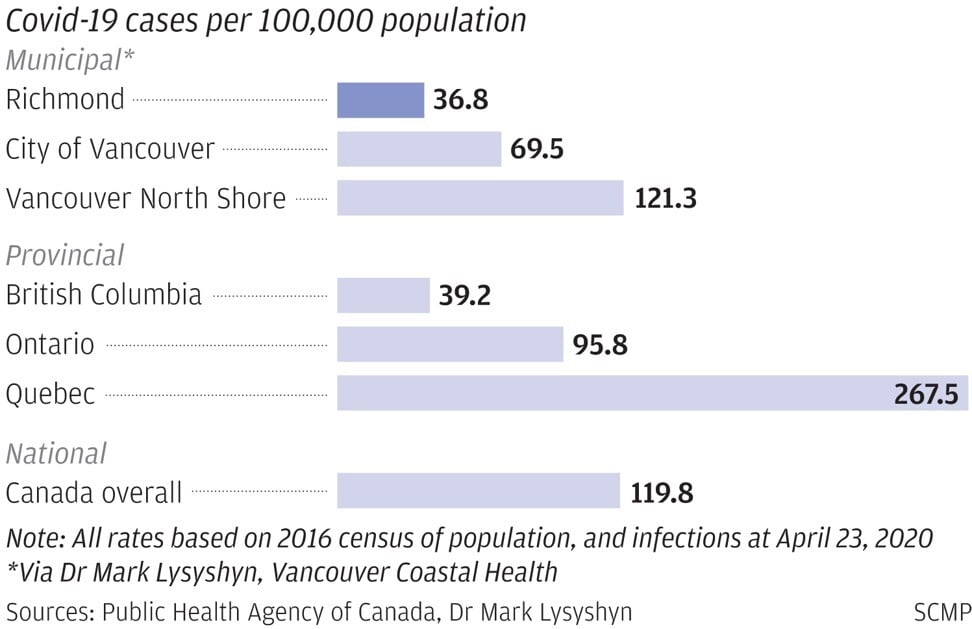
The secret Covid-19 rate in Richmond, Canada’s most Chinese city, isn’t what racists might expect. It’s dwarfed by the rest of the nation

Worth noting with the results likely reflecting greater awareness among Chinese Canadians and their networks:

Amid a spike in anti-Asian incidents in British Columbia during the coronavirus pandemic – from slurs to the assault of a 92-year-old man – Canada’s most Chinese city is defying racist stereotypes conflating ethnicity with the illness.

In Richmond, where 54 per cent of the population claims Chinese heritage, the rate of confirmed Covid-19 cases appears to be less than one-third the rate in the rest of Canada, and only about half that in neighbouring Vancouver.

BC health officials have tried to keep secret the Covid-19 prevalence in municipalities, citing the risk of stigmatisation in hard-hit places, or a false sense of security in others.

But in a Facebook Live appearance last Thursday, Dr Mark Lysyshyn of the Vancouver Coastal Health (VCH) authority revealed a partial breakdown of cases, saying that about 10 per cent of the 755 cases in the VCH catchment at that time had occurred in Richmond.

“The greatest number of cases are in the Vancouver area,” said Lysyshyn, deputy chief medical health officer with VCH, responding to a question from a viewer. “About 60 per cent of our cases are there. We’ve also seen a high number of cases on the North Shore, about 30 per cent of our cases there. And then about 10 per cent of our cases in Richmond.”

Photo: SCMP Graphics

He said a small number – about 3 per cent – were in rural locations outside the greater Vancouver area, although he did not explain this pushing the total above 100 per cent.

On a population basis, and taking that disparity into account, Lysyshyn’s assessment translates into a confirmed Covid-19 prevalence of about 37 per 100,000 people in Richmond (with a population of 198,000 according to the 2016 census).

By comparison, the city of Vancouver’s confirmed prevalence is about 70 per 100,000, while the Vancouver North Shore is by far the hardest hit area in the VCH catchment, with an estimated prevalence of 121 cases per 100,000. The North Shore, made up of three municipalities, has suffered the deadliest outbreak in BC, at the Lynn Valley Care Centre where at least 20 people died.

All of Canada, meanwhile, had a rate of 120 per 100,000, based on the 42,110 confirmed cases last Thursday. That rate has since risen to about 143, as of Wednesday.

British Columbia’s provincial health officer, Dr Bonnie Henry, has refused to give municipal figures for Covid-19 cases, instead providing breakdowns for BC’s large health regions.

The 2.5 million strong metro Vancouver area – which includes the city of Vancouver, Richmond and 21 other municipalities – is divided between two health regions, Vancouver Coastal Health and Fraser Health. Both health regions also encompass rural communities beyond Metro Vancouver.

Vancouver Coastal Health declined to elaborate on Lysyshyn’s assessment.

“Dr Lysyshyn was providing approximate numbers during his Q&A. To date, we have only provided case numbers for VCH as a whole, or in relation to specific declared outbreaks and have not released detailed statistics on a more local level, so we’re not able to clarify any further,” said Matt Kieltyka a public affairs officer with Vancouver Coastal Health.

Henry responded to persistent calls that she release municipal data on Covid-19 cases in an April 6 statement.

“Simply put, the risk is everywhere,” she said. “It would be irresponsible to mention only a few communities and give people outside those areas a false sense that they are not susceptible or at lower risk. Every health region in British Columbia has people with Covid-19. Every community and hometown – no matter how large or small – is at risk.

“As we notify the public about Covid-19 cases, we have been careful about how much we disclose [about] the specific location of confirmed cases … there is still very much of a stigma associated with infection.”

Richmond’s medical health officer Dr Meena Dawar has similarly declined to provide case counts since March 19, when she told city officials there were only 10 confirmed cases in the city, the Richmond News reported.

There were early fears that Richmond – the most ethnically Chinese city in the world outside Asia – could have been a potential hotspot for the disease because of a large population of frequent travellers to and from China. The city is also home to Vancouver International Airport.

But Richmond residents were also early to take Covid-19 seriously and adopted social distancing measures long before being advised by authorities to do so.

By late January, many residents were wearing face masks and many of Richmond’s Chinese shopping malls and restaurants were largely deserted, which even prompted a short-lived government campaign encouraging people to return. Some Lunar New Year events were cancelled and by February 11, Richmond’s Lingyen Mountain Buddhist Temple had closed its doors, citing coronavirus concerns.

It would not be until mid-March that BC authorities ordered residents to stay at home and socially distance themselves from others.

Virologist Dr Jason Kindrachuk, Canada research chair in new and re-emerging viruses at the University of Manitoba, said he “absolutely” believed the early adoption of social distancing by BC’s Chinese community could have helped suppress the disease in the province.

Such behaviour was “fantastic, it needs to be applauded and recognised”, he said.

About 27 per cent of people in the city of Vancouver have Chinese heritage, compared with about 11 per cent in BC and 4.6 per cent in all of Canada.

BC currently has 2,053 confirmed Covid-19 cases, at a rate of 44 per 100,000. That rate is far lower than the larger provinces of Ontario (117) and Quebec (315), while BC’s similar-sized neighbour Alberta has a rate of 119 per 100,000.

Vancouver police last week warned that a spate of hate crimes had been reported, including five anti-Asian incidents in March. In the only one involving violence, a 92-year-old man with dementia surnamed Kwong was thrown out of a convenience store by a much larger man shouting anti-Asian statements about Covid-19 on March 13.

“Xenophobia is on the rise and we hope that as a community we can stand together to help protect the next person this may happen to,” the Kwong family said in a statement. A suspect has been identified but no charges filed; police said they were still investigating.

Other incidents conflating Covid-19 with people of Asian appearance have involved abusive language, although the Vancouver Police Department declined to elaborate.

On Wednesday, Vancouver Mayor Kennedy Stewart said that “hate of any kind has no place in our city”.

According to a survey conducted on April 24 by Corbett Communications for a group called the Chinese Canadian National Council for Social Justice, 12 per cent of respondents in Vancouver agreed (4 per cent) or said they did not know (8 per cent) when asked whether “all Chinese or Asian people carry the Covid-19 virus”.

Canada’s chief public health officer Dr Theresa Tam said on Twitter on January 29 that she was “concerned about the growing number of reports of racism and stigmatising comments on social media directed to people of Chinese and Asian descent related to #2019nCOV #coronavirus.”

BC’s Bonnie Henry said on April 6 that the key to avoiding Covid-19 was not staying away from areas with high rates of infection but adopting personal practices like social distancing and good hand hygiene.

“So, while I understand the desire to know and understand what the Covid-19 situation is in your community, I need to emphasise that knowing where the positive cases are does not protect you, your family or your community,” said Henry. “The actions you take will do that.”

And the National Post analysis where travel-related COVID-19 cases came from: Canada’s early COVID-19 cases came from the U.S. not China

Contact tracing must not compound historical discrimination

Good discussion of some of the issues involved:

Governments seem likely to adopt tracing apps as a part of the new normal in the fight against infection during a pandemic. This week, Prime Minister Justin Trudeau said Ottawa had “a number of proposals and companies working on different models,” and that “there are possibilities around using voluntary measures.” Unfortunately, the use of these tracing aps will not be genuinely optional or voluntary for most users. Perhaps more importantly, the technical frameworks that are currently under development must be configured in such a way that the historical discrimination of minority groups is not compounded by governments’ implementation of tracing policy.

Research suggests that these apps will be installed on mobile phones and designed to work in concert with smartphone operating systems to alert the phone’s owner if they have been in close contact with someone diagnosed with COVID-19. The apps will probably rely on the opt-in COVID-19 tracing technical frameworks that were jointly announced by Apple and Google, and let individuals reveal their COVID-19 status as well as potentially inform them about people or places that carry higher risks of infections.

A significant amount of attention has been given to the privacy and security issues associated with these apps as well as whether the tracing apps will be sufficiently accurate to warrant using them in the first place. If governments approve their use, there may be strong legal or social pressures for individuals to use them and so it is critical for policymakers to start developing equitable policies and not justify the adoption of apps on the basis that individuals have opted-in to their use.

Opt-in mechanisms are intended to give individuals control over how their personal information is handled. Apple’s and Google’s operating systems already let individuals choose whether to share their information when they install a new game or productivity app on a device. These companies’ health surveillance functionalities will replicate this existing freedom of choice model. COVID-19 related proximity information will not be collected or shared without a smartphone user having first consented to the activity.

Meaningful consent to these companies’ health surveillance must involve giving individuals a certain level of understandable information about a tracing app’s data practices. However, policy-makers cannot be focused exclusively on a narrow understanding of consent. They must go further.

Government compulsions to opt in

Governments may decide that contact tracing apps can help to contain COVID-19’s spread once sufficient testing is available for both symptomatic and asymptomatic cases. If public safety officers are tasked with enforcing social distancing or self-quarantine orders they might demand that individuals reveal their COVID-19 status. The possibility of such an encounter with law enforcement officers, in particular, will implicitly encourage Canadians to use tracing apps. With an unlocked phone in hand, officers may go on fishing expeditions to search for potentially unlawful communications or activities.

Officers asking about individuals’ COVID-19 status may be particularly concerning to minority groups subjected to carding or to enhanced and often illegal searches. Members of over-policed groups may also feel particularly compelled to opt in to using COVID-19 apps due to concerns about how police will treat them if the apps are not installed.

Moreover, tracing apps may not be optional if individuals must reveal their COVID-19 status before entering government buildings or using public services or spaces. In such circumstances, it is conceivable that individuals would be compelled to use the apps to obtain licenses, use public transit or pass through public parks.

Private business and compulsions to opt in

Private organizations will likely have clients reveal their COVID-19 status before entering a store. If you must show your status to enter a grocery store, it is no longer optional. Sometimes clients may be unable to reveal their status – they may not own a phone or have lost it and be unable to purchase another – or they may not want to reveal their status on the basis of potentially negative consequences. For example, clients of food banks may be unwilling to reveal their COVID-19 status at all and be motivated to present fake information to avoid the chance that they will be prevented from accessing a food bank for food.

Employers may also want to know their employees’ COVID-19 status to protect or manage their workforce. Any employee who has been in contact with someone diagnosed with COVID-19 might be barred from the workplace until they undergo self-quarantine or receive negative test results. Where employers lack robust stay-at-home policies or if accessing a worksite is a condition of continuing to receive a salary, there is a risk that individuals will attempt to evade health surveillance.

Towards inclusive policy options

Canadians have demonstrated a relatively high-degree of trust in their political and health leaders throughout the pandemic. However, trust in law enforcement bodies and health bodies is considerably lower for some. The technological infrastructure being developed by Apple and Google will not resolve these historical tensions. If governments choose this path, then they must face these tensions directly.

First, governments should not empower police to view individuals’ COVID-19 status but, if they do, they must prevent officers from turning status checks into smartphone fishing expeditions. As well, public officials who review an individual’s tracing app should be required to record and publicly report the gender and ethnicity and provide an explicit rationale for assessing their COVID-19 status.

Second, policy-makers must work with organizations representing historically disenfranchised groups to develop policies which ensure members of the public can reliably access government buildings and services. Anti-poverty, homeless and addiction advocates should be consulted to determine how government services and infrastructure can continue being offered to persons who may lack access to smartphones or for cases when they may be COVID-19 positive or potentially infected.

Third, governments could subsidize the costs associated with an employee’s self-isolation or self-quarantine. Not all employees have paid sick leave that extends to self-isolation or benefits that cover the entirety of an employee’s sick leave over the course of recovering from COVID-19. Without generous sick leave policies, employees may be motivated to find ways to be at work even if their app indicates they are ill.

Fourth, any government-sanctioned tracing app must provide information for Canadians to meaningfully opt in to any health surveillance. Privacy commissioners and health officials could be tasked with ensuring that apps clearly and accurately explain an app’s anonymization measures, how COVID-19 risk assessments are generated and disclosed and the effectiveness of the app in tracing the spread of the disease.

It’s clear the apps that use Apple’s and Google’s technical frameworks are unlikely to be truly voluntary or opt-in. While neither company’s promised frameworks are presently available for developers to use, this does give policy-makers time to design ones that are inclusive. It is time they start their drafting and planning for this hypothetical tracing app future so that, if it does come to pass, any policies will avoid compounding historical discrimination.

Source: Contact tracing must not compound historical discrimination

UK: The Guardian view on immigration and Covid-19: old myths are exposed

Good editorial:

Covid-19 has accomplished in weeks something that UK governments spent a decade failing to do. It has drastically cut labour migration. Lockdown prevents the gathering of real-time data, but it is a reasonable assumption when international travel has stopped that net migration is currently happening at a rate well below 100,000 per year.

That was the target adopted by David Cameron in 2010 and pursued aggressively by Theresa May at the Home Office and in Downing Street. It was never met before being abandoned last year. What happens next is uncertain. This week would have seen the government’s post-Brexit immigration bill return to the Commons, but the timetable has been discarded, not least because parliament’s digital systems are not yet ready for remote voting.

There is no indication that ministers are reconsidering the new regime, which is based on a points system designed to select “skilled” workers over “unskilled” labour. The distinction is meant to favour what ministers call “the best and brightest” while deterring those whom decades of political rhetoric have cast as undesirable. The charges against that latter group are various: poaching jobs from British-born citizens, depressing wages, failing to observe cultural norms and generally upsetting people with conspicuous otherness.

The vilification reached its apogee in the campaign to take Britain out of the EU. The promise to “take back control” of borders had strong emotional appeal, but was never rooted in the reality of modern Britain, where migrants of all skill levels and income brackets keep the economic and social wheels turning. That awkward fact was always bound to emerge over time, but it has been revealed abruptly by the pandemic.

Farmers are already warning that fruit will rot in the fields without seasonal labour normally provided by EU citizens. Attempts to entice UK workers to fill the gap are failing. Immigrants have kept public transport running, delivered goods and, most poignantly, kept the NHS and social care services operational. They have put their lives at risk for a country that has been, at best, ambivalent about their entitlement to live here at all.

Source: The Guardian view on immigration and Covid-19: old myths are exposed

Turkish students increasingly resisting religion, study suggests

Perhaps as a reaction against Erdogan’s efforts?

Twenty-two-year old Esra, from Mersin, is even more bored than usual this Ramadan. Universities are shut and Turkey has taken the unusual step of placing under-20s, as well as over-65s, under a curfew, because many Turkish families live in intergenerational households.

As a result, Esra can’t see any of her friends. And a few days into the Muslim month of fasting, like many young people, she is now feeling even more suffocated by the religious restrictions imposed by her pious parents.

“They normally don’t know how I dress when I’m not there but even in the house now wearing tight jeans bothers them and they’re commenting on it,” she said. “They think I am fasting but I’m not. I have water in my room.”

Despite more than a decade of efforts by Recep Tayyip Erdoğan’s ruling Justice and Development party (AKP) to mould a generation of pious Turks, the country’s youth appears to be turning away from religion.

Source: Turkish students increasingly resisting religion, study suggests

Taxing Canadian expats not the silver bullet for generating post-COVID revenue

My latest, in response to Canada needs to start taxing Canadians who live abroad:

Chandra Arya, the Liberal MP for Nepean, Ont., recently argued for changing the current residency-based taxation approach to the U.S. citizenship-based taxation (CBT) approach, understating the complexity involved in making such a change and overstating the potential benefits.

(Similarly, Andrew Caddell argued in his April 22 Hill Times column that “the three million Canadians abroad should contribute, through a 10 per cent tax on income; that could bring in at least $30-billion per year.”)

Some of the arguments are, on the surface, convincing. Why should Canadian expatriates, after not paying Canadian taxes for their years working abroad, return to Canada to benefit from medicare and other benefits on their return as retirees? Ironically, Arya uses similar “Canadians of convenience” arguments as those used by the previous Conservative government under then-immigration minister Jason Kenney. He is part of a Liberal government that extended voting rights to virtually all expatriates, most of whom pay little or no Canadian taxes.

But we have to start with a better understanding of the numbers of Canadian expatriates, whether foreign or Canadian-born. He, like too many, uses the Asia Pacific Foundation estimate of three million, which includes all ages and permanent residents. A more accurate, albeit imperfect estimate, is closer to two million adult Canadian citizens.

But how many of these maintain strong connections to Canada or are likely to return to Canada to take advantage of Canada’s generally strong social safety net? The answer is we do not know and there is limited data available.

However, we have some proxy measures that give an order of magnitude to those keeping their close Canadian ties.

The average annual number of immigrants who left Canada between 1996 and 2011 is about 100,000, according to a Statistics Canada study, with between 25 and 40 per cent being temporary emigrants, depending on the census period. For 2006-11, 35.6 per cent of emigrants move to the USA. There is no data regarding their citizenship status or the length of time they spent in Canada prior to emigrating.

The number of adult Canadian passport holders abroad was about 725,000in 2015. The number of Canadians registered with Global Affairs Canada for consular services is about 346,200, as of April 26, the department said.

In 2017, the number of Canadian expatriates who file Canadian non-resident taxes was about 92,000.

And we also know that some immigrants return to their country of origin upon retirement, and that about 181,000 persons received CPP, according to December 2019 numbers, but there’s no data regarding their citizenship status.

So Arya’s arguments are based on “[a]necdotal evidence [that] suggests citizens are returning to Canada to enjoy these benefits after spending their productive lives elsewhere,” and his assertion “for a small but growing number, the objective is to acquire citizenship and leave again.”

Like all anecdotal evidence, there is some truth, but the extent of that truth, and whether it would warrant such a major and disruptive change in Canadian taxation, is questionable.

The other major flaw lies with citing the U.S. citizenship-based taxation approach as the model to emulate, without asking the necessary questions regarding why the U.S. is the outlier, compared to other Organisation for Economic Co-operation and Development (OECD) countries. Citizenship-based taxation is less appropriate for a world of increased mobility and dual citizenship. Moreover, residency-based taxation is intrinsically easier to administer, including with respect to double taxation issues.

The introduction of the Foreign Account Tax Compliance Act (FATCA) and its assorted implementation difficulties and inconsistencies highlights even more the complexities of CBT, leading a small, but not insignificant, number of Americans to renounce their U.S. citizenship.

This should serve as a major caution to advocating for a major change to our taxation system, one that is out of step with all OECD countries, save the U.S.

Would the alleged benefits of increased tax revenues materialize? If so, would they exceed the expected massive costs of completely revamping our tax system? How effective would expatriate tax compliance be, and what would be the costs of enforcement? And just as the U.S. approach resulted in modest income from “accidental Americans” (citizens of another country unaware of their U.S. citizenship) being caught by FATCA, how could we be sure that such a change might result in “accidental Canadians?”

Clearly, better data on the number of expatriates, permanent and temporary, and the degree to which they return as retirees and take advantage of Canadian medicare and other benefits would be useful. But like so many citizenship and immigration issues, any change aimed at a subset of the population, has to be weighed against the impact on the wider population.

Similarly, a fundamental shift from residency-based to citizenship-based taxation should take place in the context of a broader review of taxation policies, rather than a fundamental, but piecemeal, proposal. Any such review should aim at ensuring that taxation reflects current and anticipated societal needs.

A shift to citizenship-based taxation would have major impact and costs. The flawed U.S. example and anecdotal evidence fail to justify such a change or even a study, given that there are more important taxation and related policy questions.

Source: Taxing Canadian expats not the silver bullet for generating post-COVID revenue

Religious Freedom Watchdog Pitches Adding India to Blacklist

https://www.nytimes.com/aponline/2020/04/28/us/ap-rel-global-religious-freedom.html

Not unexpected:

The U.S. Commission on International Religious Freedom is urging that the State Department add India to its list of nations with uniquely poor records on protecting freedom to worship — while proposing to remove Sudan and Uzbekistan from that list.

The bipartisan commission, created in 1998 by Congress to make policy recommendations about global religious freedom, proposed designating India as a “country of particular concern” in the annual report it released Tuesday. That lower ranking for a long-running U.S. ally amounts to a stark show of disapproval of India’s divisive new citizenship law, which has sparked broad worries about disenfranchisement of Muslims.

President Donald Trump declined to criticize the citizenship measure during his February visit to India, where his meeting with Prime Minister Narendra Modi was punctuated by skirmishes between Hindus and Muslims.

The commission, by contrast, is empowered as an independent arbiter to look only at nations’ religious freedom records, apart from their relationship with the United States, vice chair Nadine Maenza said.

Beyond the citizenship law, Maenza said in an interview, India has a broader “move toward clamping down on religious minorities that’s really troublesome.”

A spokesman for India’s Ministry of External Affairs, Anurag Srivastava, responded to the report with a statement blasting the commission’s “biased and tendentious comments against” that nation. Noting that some members dissented from the commission’s decision to recommend India for the lowest ranking of religious freedom protections, Srivastava appeared to use the commission’s internal terminology as a dig.

“We regard (the commission) as an organization of particular concern and will treat it accordingly,” he said.

In the cases of Sudan and Uzbekistan, the Trump administration got out ahead of the commission in raising its ranking of religious freedom protections. The State Department decided in December to no longer rank Sudan as a nation “of particular concern” after having taken Uzbekistan off the list earlier.

Following last year’s military ouster of authoritarian leader, Omar al-Bashir, new Sudanese Prime Minister Abdalla Hamdok met with the commission and committed to improve religious freedom, Maenza said.

Among the other significant recommendations in Tuesday’s report was a call for the U.S. government to “exert significant pressure on Turkey to provide a timeline for its withdrawal from Syria.” Turkey’s incursion into northern Syria last fall sparked broad concern about resulting threats to religious minorities in the region.

The commission proposed four other nations join India in the ranks of most egregious religious freedom offenders; Nigeria, Russia, Syria and Vietnam. The State Department’s current list of “countries of particular concern” regarding religious freedom includes China, Saudi Arabia, North Korea and Iran.

Inclusion among the nations with the poorest religious freedom records can lead to new sanctions, although the executive branch is also empowered to rely on already-imposed sanctions or issue a waiver.

Sudan and Uzbekistan are currently on a State Department watch list for nations where religious freedom infringement is not as widespread, constant and significant as those in the lowest-ranked tier.

The commission’s latest annual report recommends the addition of 11 more nations that the State Department has not yet put on that watch list: Afghanistan, Algeria, Azerbaijan, Bahrain, the Central African Republic, Egypt, Indonesia, Iraq, Kazakhstan, Malaysia and Turkey.

Wealthy Move Their Money To Tax Havens

As always…:

Lockdown might impact peoples’ ability to move across borders, but it doesn’t stop money flowing into tax havens around the world.

The economic shocks of coronavirus have meant that offshore financial centres such as Switzerland are back to their old tricks: Banking peoples’ money away from their more risky homelands.

UBS, a Swiss bank and the world’s largest wealth manager, announced its profits were up by 40%. In the first three months of 2020, it saw $12 billion in net new money, nearly treble the amount banked in the previous quarter.

“We successfully managed March’s high volumes and activity across our trading and client platforms, including peaks of three times the normal levels,” Sergio Ermotti, the bank’s CEO, told investors on Tuesday (April 28).

This enabled the bank to gain a higher share of wallet from its clients, Ermotti added.

Pre-coronavirus, Switzerland’s popularity for offshore banking was fading as its banking sector could no longer guarantee client secrecy. However, the country’s notorious stability combined with low COVID-19 infection rates have renewed its appeal among the international wealthy who use its private banking services.

“There are some countries where the risk of your money and your wealth being more at risk than others does potentially also lead to inflows into safe and secure places like Switzerland,” says Anna Zakrzewski, who leads Boston Consulting Group’s Global Wealth Management division.

Source: Wealthy Move Their Money To Tax Havens

Mexico Deports Most of Its Detained Migrant Population

Of note, reflecting in part the effect of the Trump administration cutting off Central American access to the American asylum system:

On Sunday, Mexico’s National Institute of Migration (INM) announced the repatriation of 3,653 Central American migrants. The measure comes after growing concern over Covid-19 spreading in INM detention facilities throughout Mexico.

Mexico recently has faced issues attempting to deport Central American citizens back to their home countries. Guatemala, Honduras, and El Salvador closed their borders to citizens and aliens.

The INM said: “In the face of the health emergency caused by Covid-19, the Ministry of the Interior, the National Institute of Migration (INM), acts responsibly and safeguards the integrity of the population in the context of migration by seeking to fully guarantee their human rights.”

Guatemalan nationals were sent back by bus and Honduran and Salvadoran migrants were transported by aircraft to their countries of origin. The International Organization for Migrants administered the flight arrangements to Central America.

In March, the INM had 3,579 foreign nationals housed throughout its 65 detention facilities and shelters. As of Sunday, the number had decreased to 106 migrants — a 97 percent reduction in the detained migrant population.

The remaining aliens gave their consent to stay in Mexican custody. Religious organizations have assisted with shelter accommodations for migrants choosing to stay in Mexico.

The United Nations, the National Human Rights Commission of Mexico, and dozens of other activist organizations supported the mass release of foreign nationals from INM custody.

Additionally, the INM expressed its support of Mexican nationals being repatriated from the United States to prevent the spread of Covid-19 amongst their countrymen.

And Mexico’s Ministry of Foreign Relations announced that it had been able to repatriate more than 129 Mexican people from Honduras and 30 from El Salvador.

Source: Mexico Deports Most of Its Detained Migrant Population

Pandemic pretext: More delays in long-awaited access to information answers

ATIP is far too often late and, as the examples below indicate, sometimes very late, in responding, with COVID-19 providing further excuses for delay:

Federal departments that have stalled access to information requests for three years or more are now citing the pandemic as the reason for further delays.

Emails are going out to people who make access to information requests, notifying them the requests are now “on hold.”

“We cannot send consultations out because most third parties, other government departments (municipal, provincial, territorial and federal) are closed or reduced to minimum employee capacity,” the department now says.

“So until we are given the green light to start processing consultations again, we won’t be able to process any of the records for your request. But in the meantime, we would like to know if you still wish to proceed with your request or if you wish to abandon.”

Rubin says Health Canada owes him answers to about a dozen requests dating back for years — one from 2014 about adverse pharmaceutical reactions including some deaths, one on drug licensing from 2015, others from 2016 and 2017. They now warn him of “possible delays in treating your request,” due to the pandemic.

“Openness, transparency and accountability are guiding principles of the Government of Canada. However, our ability to respond to requests within the timelines mandated by the Access to Information Act and the Privacy Act may be affected” by the pandemic, the department says.

The Finance Department wrote him using the the exact same words.

National Defence says it has reduced staff in the access office and hasn’t enough secure lines to handle his requests remotely. They asked for Rubin’s consent to put the request on hold. Rubin said no.

“You have to push back,” he said. “A lot of people don’t consider this a human right. But it’s not just administrative.”

Public Service and Procurement Canada (PSPC) has several aging Rubin files, and he hadn’t heard about them either, until this month’s message that “PSPC’s network is currently limited to essential and critical services such as pay, pension and procurement. While we are committed to respecting your right of access and are actively looking for solutions to maintain operations, we have little to no capacity at this time.”

One department told him: “despite all our efforts, we will not be able to respond to your ATIP request within the legislated timelines.” The legislated timeline ended years ago.

“Our access to information legislation is so flawed that it’s possible for access to information requests to be delayed and delayed and delayed, which turns the whole purpose of the legislation into a joke,” said James Turk, director of the Centre for Free Expression at Ryerson University.

“The fact that people who haven’t heard for a year or two years are now getting a notice that it’s been delayed because of COVID reveals how badly flawed” it is.

“I like Ken’s remark that oh, it’s good to hear from you.”

He also noted that the lockdown shows the unevenness of government services, as some are cut off from paper documents while others shift to digital documents.

This newspaper asked Environment Canada more than a year ago for internal emails involved in sending out a single news release on climate change. This month, after our request passed its first anniversary, we asked how long it would take.
The answer: They were just about to send us the information, and then the lockdown hit.
The department promises a speedy answer once its office reopens.

Source: Pandemic pretext: More delays in long-awaited access to information answers