With Stephen Miller pouring poison into Trump’s ear, the uncivil war rages on

Strong but accurate portrayal:

Does the Trump administration’s face of evil have a point?

Stephen Miller, the white supremacist who steers United States President Donald Trump’s immigration policies, and also serves as his xenophobic speechwriter, claims it is hypocritical for Democrats and progressives to decry the President’s planned political rally in Tulsa, Okla., on Saturday as a coronavirus superspreader.

How can they do that, he asks, when they’re the same people who are encouraging and participating in massive protest rallies against racism and police brutality? Thousands of demonstrators milling together on streets, many of them without masks. It’s hypocrisy on stilts, Mr. Miller says.

He cited Washington Mayor Muriel Bowser, who extended her lockdown order at the same time as she was promoting mass street protests. And how about Florida congresswoman Val Demings, who is on presumptive Democratic presidential nominee Joe Biden’s shortlist for a running mate? She joined a major protest while blasting the President for his planned rally.

“There is almost assuredly going to be a spike in COVID cases and it will also almost assuredly be put on red-state governors and the President holding rallies,” Mr. Miller wrote in The Spectator this week. “But Democratic activists and politicians themselves created this situation.”

It’s too early to determine whether protests are contributing to a spike in COVID-19 cases. But progressives have to be careful about rhetoric and activities that play into the hands of the 34-year-old Mr. Miller and his Oval Office master. Campaigns to defund police departments, for example, are a godsend to Mr. Trump’s law-and-order campaign, as are protests that descend into violence.

Mr. Trump tweeted on Monday that the news media was “trying to Covid Shame us on our big Rallies.” Unconcerned about a new wave of the coronavirus plague, he will hold these rallies, no matter how dangerous they may be. Re-election, as he sees it, depends on the country getting out of its crouching, virus-defensive posture and back on its economic feet.

Despite U.S. Vice-President Mike Pence’s assertion that fears of a renewed virus outbreak are overblown, a dozen or so states, including Florida, Texas and Oklahoma – which is a heavily pro-Trump state – are still seeing a surge in cases.

While the anti-racism protests have been outdoors, where the virus is less contagious, the Trump team was planning on holding its rally in a packed indoor arena. But last-minute plans were being made to shift it to an outdoor venue. Mr. Pence said this was to accommodate huge crowds, but there was also pressure to do so for health reasons.

The Tulsa rally will be the President’s first in three months. The city was also the site of a massacre 99 years ago, when a white mob attacked Black residents of Tulsa’s Greenwood District, killing as many as 300 people. The Trump rally was originally planned to be held on Friday, June 19, which is known as Juneteenth, a holiday when many Black Americans celebrate their emancipation from slavery. But owing to the outrage the plan provoked, it was moved back a day.

Even so, the event is likely to heighten racial tensions. It will play to Mr. Trump’s base, as all his other measures do. The police reforms he announced this week were toothless. He has rejected calls to rename military bases honouring Confederate generals.

Mr. Miller has had Mr. Trump’s ear since day one, and is still pouring poison into it. Mr. Miller is a blank-faced, cold and uncompromising bigot. In most everything written about him, the word evil or something synonymous can be found.

He is architect of the ban limiting travel to the U.S. from many Muslim countries, harsh anti-refugee policies and Trump speeches berating immigrants. Last November, leaked e-mails between himself and a former Breitbart editor showed him promoting white nationalist propaganda and materials from white supremacist sites. A group of 27 senators sent a letter to the White House saying Mr. Miller was motivated by white supremacy, not national security, and demanded he be fired.

Firing Mr. Miller is the furthest thing from Mr. Trump’s mind. His campaign priority is hardly to attract Black voters. With the help of Mr. Miller, he has pretty much lost them all.

As many have noted in the wake of George Floyd’s death, the Civil War of the 1860s in the United States has never really ended. Mr. Trump and Mr. Miller are shamefully keen to extend it into this campaign.

Source: With Stephen Miller pouring poison into Trump’s ear, the uncivil war rages on: Lawrence Martin

‘It feels something was missing’: Pandemic forces new Canadians’ citizenship ceremonies onto Zoom

Hopefully we will be back to more regular in person ceremonies but with social distancing, no handshakes and likely masks, in the next few months:

It’s a moment that Haseena Hotaki and all immigrants long for: taking the oath, shaking hands with the citizenship judge, waving the Canadian flag and cheering with other new citizens.

Instead, on this big day, the 29-year-old Afghani immigrant found herself alone in the living room of her Toronto apartment, in front of her laptop awaiting the appearance of Judge Hardish Dhaliwal on her computer screen so she could be sworn in on Zoom.

“I have heard all these stories from others about what happened at these ceremonies. I pictured what my own ceremony would look like, holding a Canadian flag in a room with other new citizens,” said Hotaki, who came here in 2012 under a government sponsorship.

“Did it really just happen? I just had this over an online meeting through Zoom?” asked the Kandahar native after the 30-minute solo virtual event hosted recently by the judge and four immigration and citizenship officers. “It feels something was missing.”

It wasn’t the dream ceremony Hotaki envisioned when she passed her citizenship exam last September, but it’s still better than a further delay in becoming a full Canadian.

As a result of the coronavirus pandemic, Immigration, Refugees and Citizenship Canada had to cancel all citizenship ceremonies in mid-March because it’s impossible to enforce social-distancing at these functions attended by new citizens and their loved ones.

Immigration department spokesperson Beatrice Fenelon said officials began holding virtual ceremonies on April 1, beginning with individuals and families whose ceremonies had been cancelled and who had contacted IRCC with urgent reasons for needing citizenship, such as employment requirements.

Last year, an average of 20,000 immigrants became new citizens each month. To date since April, 96 ceremonies have been held.

“An important aspect of holding online group ceremonies is the verification of applicants’ identities, which is important to the integrity of the program, especially in an online environment,” said Fenelon.

A virtual ceremony is similar to an in-person one.

In Hotaki’s case, she was asked to show the immigration officers on the screen three pieces of picture ID before she took her oath in English and French with Dhaliwal and signed her citizenship certificate — with an e-signature.

There were no RCMP officers in Red Serge present or singing of the national anthem.

The process wasn’t without its hiccups. Hotaki said her ceremony was twice disrupted due to internet problems that forced her to log onto Zoom again.

“It made me nervous,” said Hotaki, who worked for international aid groups as an English translator in Afghanistan and in the not-for-profit sector after coming to Canada. She started her bachelor program in international development at the University of Toronto last fall.

Hotaki picked a traditional Afghan kochi dress, worn only for celebrations, for her citizenship ceremony to honour this special moment of her life. But she was disappointed there was no one around her to share her joy other than her two young daughters.

The whole experience was surreal, she said, until a citizenship officer asked her to cut and void her permanent residence card.

“The whole ceremony was like a dream. When I looked at my PR card in small pieces, that’s the only thing that seemed real,” said Hotaki, who has founded her own group, Humanity First for Peace, to provide education programs for girls and women in Afghanistan.

“I am grateful for the opportunities Canada has given me and I am extremely proud of who I am today. I have come a long way and feel I finally belong.”

Hotaki kissed and hugged her daughters after the ceremony, then called her parents in Afghanistan to share the news before ordering takeout from her favourite Thai restaurant to celebrate a new leaf of her life in Canada.

One million passports: Putin has weaponized citizenship in occupied eastern Ukraine

Of note:

Moscow plans to issue one million Russian passports to residents of Russian-occupied eastern Ukraine by the end of 2020, officials confirmed last week. By creating new demographic facts on the ground, the Kremlin hopes to alter the geopolitical balance in the region and derail efforts to end the six-year undeclared war between Russia and Ukraine. Despite these grave consequences, the international community has yet to impose any additional sanctions on Russia. Instead, Russian President Vladimir Putin is able to continue pursuing policies of passport imperialism in Ukraine with apparent impunity.

Speaking on June 9 in the southern Russian city of Rostov-on-Don, United Russia MP Viktor Vodolatsky confirmed that more than 180,000 Ukrainians had received Russian passports since the introduction of a new fast-track procedure a little over a year ago. According to Vodolatsky, a further 98,000 applications are currently being processed and up to 800,000 more passports are expected to be issued in the second half of the current year.

Plans for simplified passport distribution in Russian-occupied eastern Ukraine were first unveiled in April 2019, just days after Volodymyr Zelenskyy has won the Ukrainian presidency via a landslide victory. Throughout the spring 2019 Ukrainian presidential election campaign, Zelenskyy had been markedly less confrontational towards Russia than his rival, the incumbent Petro Poroshenko. This had led to widespread speculation that Zelenskyy’s election could serve to break the deadlock in a peace process that had witnessed little concrete progress since the end of large-scale hostilities in early 2015.

This initial optimism was soon tempered by the publication of Putin’s presidential decree granting Ukrainians from the occupied east of the country the right to apply for Russian passports via a special streamlined procedure. “These actions are yet more confirmation for the world community of Russia’s true role as an aggressor state, which is waging a war against Ukraine,” commented Zelenskyy at the time. “Unfortunately, this decree does not bring us closer to the ultimate goal of a ceasefire.”

Emboldened by the lack of a robust international response to his initial decree, Putin then escalated his passport imperialism against Ukraine. The Russian leader issued a second decree on July 17, 2019 that extended the citizenship offer to all Ukrainians living in Donetsk and Luhansk oblasts – the two eastern regions of Ukraine that are currently under partial Russian occupation.

This is far from the first time the Kremlin has employed passports as a foreign policy tool to project its influence across the former Soviet Union. The tactic was first seen in Moldova in the early 1990s. The distribution of Russian passports also helped cement Moscow’s grip on the two breakaway regions of Georgia prior to the 2008 Russo-Georgian War. Meanwhile, Russian passports have played an important role in the Kremlin’s Crimean policy, both before and after the 2014 seizure of the Ukrainian peninsula.

Putin’s passport ploy in eastern Ukraine is as clear an indication as you could possibly wish for that Russia has no intention of allowing Ukraine to regain full control over the occupied regions. If the Kremlin’s current forecasts are accurate, there will be one million Russian citizens living in occupied eastern Ukraine by the end of 2020, representing at least a quarter of the entire population. This will transform the so-called separatist republics of eastern Ukraine into Russian passport protectorates.

With Russian citizens representing a large percentage of the region’s overall population, Moscow will claim the legal right to intervene at will in Ukraine’s internal affairs. Such arguments bear little relation to the realities of international law. Nevertheless, they represent a far more convincing pretext for endless interference than the protestations about oppressed Russian-speakers that Moscow has relied upon since Russia’s military intervention began in 2014.

The war Russia unleashed six years ago is far from over and Moscow remains as committed as ever to limiting Ukraine’s independence. Putin’s passport imperialism is central to these ongoing efforts, offering the potential to entrench Russian influence in the country while fatally weakening Ukrainian sovereignty. If it is allowed to proceed unimpeded in occupied eastern Ukraine, the same strategy could then be expanded to additional regions throughout the country, allowing Russia to slowly but surely undermine the Ukrainian government’s ability to function. Sadly, there is nothing particularly far-fetched or fanciful about such nightmare scenarios. Indeed, the passport distribution phase is already underway in unoccupied parts of eastern Ukraine.

Moscow has framed its passport offensive as a purely humanitarian policy designed to ease the suffering of a population trapped in a conflict zone, but these claims are no more credible than the Kremlin’s attempts to portray its well-equipped proxy armies in eastern Ukraine as a ragtag collection of disgruntled miners and tractor drivers. In reality, the weaponization of Russian citizenship is a well-known element of the hybrid arsenal developed by the Kremlin since 1991 and deployed throughout the former USSR as Moscow has fought to retain its imperial influence.

Only an emphatic international response can now prevent the Kremlin from using the same passport tactics to consolidate control over occupied eastern Ukraine and destabilize the rest of the country indefinitely. The European Commission has already taken steps to prevent EU member states from recognizing passports issued via Putin’s April 24, 2019 decree. Further measures targeting the Kremlin are also necessary, including additional sanctions.

Russia is currently in the process of establishing passport protectorates in eastern Ukraine. It is doing so methodically and shamelessly, in front of the watching world. If such brazen aggression is allowed to go unpunished, it will lead to a further erosion of international security, with implications that will be felt far beyond the borders of Ukraine.

Source: One million passports: Putin has weaponized citizenship in occupied eastern Ukraine

Black MPs, senators call for immediate justice reforms to address systemic racism

Of note:

Black parliamentarians issued a call to all levels of government on Tuesday to urgently confront the consequences of systemic racism and improve the lives of Black Canadians.

A group of eight Black MPs and senators released more than 40 recommendations, including the collection of race-based data and the elimination of some mandatory minimum sentences, a reform that has been long-promised by the Liberal government.

Their letter is supported by 27 ministers of Prime Minister Justin Trudeau’s 36-member cabinet, including Deputy Prime Minister Chrystia Freeland and Justice Minister David Lametti. Dozens of other parliamentarians, who are not members of the caucus, also signed it.

The calls for reform also include the need to cut barriers to economic advancement of Black Canadians, including ensuring Black-led businesses have equitable access to federal procurement contracts, along with new measures directed at Black-owned businesses disproportionately affected by COVID-19.

In a statement Tuesday, the parliamentary Black caucus said brutal acts of racism that have propelled the issue into the spotlight represent “only a very thin slice of the racism that Black Canadians experience in their daily lives.”

“We urge all governments to act immediately,” they said. “This is not a time for further discussion.”

Liberal MP Greg Fergus, the chair of the parliamentary Black caucus, said in an interview on Tuesday that racism is not just an issue of inconvenience.

“We need to stop this cold,” he said. “It kills. Enough is enough.”

In addition to Mr. Fergus, the caucus includes Families Minister Ahmed Hussen, MPs Emmanuel Dubourg, Hedy Fry, Matthew Green, and senators Wanda Thomas Bernard, Marie-Françoise Mégie and Rosemary Moodie.

The goal of the recommendations is to push the country from a debate about whether there is systemic racism to a discussion about how to end it, according to Dr. Bernard, who is also a professor emeritus at Dalhousie University.

She said she hopes to see an initial response to the recommendations within a few weeks, but acknowledged that implementing some of the changes will take years.

The caucus’s statement pays particular attention to the justice and public safety systems where it says “the hard edge of systemic discrimination is perhaps felt most acutely.”

In addition to the reform of mandatory minimum sentences, the group calls on governments to review restrictions on conditional sentencing, establish community justice centres across the country and invest in restorative-justice programs.

In 2015, Mr. Trudeau promised to review sentencing laws and his government promised the following year to cut the widespread use of mandatory minimum sentences by giving judges back their discretion over punishment. However, those reforms never came and Mr. Trudeau’s 2019 mandate letter for Mr. Lametti did not mention the issue.

In the interim, courts have struck down some mandatory minimums, deeming them to be “cruel and unusual punishment,” resulting in a patchwork of penalties across the country.

The Prime Minister on Tuesday acknowledged the list of recommendations, but would not commit to the justice reforms.

“We are going to continue to look at that and other measures that we can move forward to make sure that our justice system does not continue to be unfair towards racialized Canadians and Indigenous Canadians,” he said.

On the economic reforms, he said the government will be “moving forward on a number of those recommendations.”

Jody Wilson-Raybould, a former Liberal justice minister turned independent MP, asked Mr. Lametti at a parliamentary committee on Monday if his government will “finally commit to the necessary work originally promised in 2015 and repeal, in the justice system, the vast majority of mandatory minimum penalties.”

Mr. Lametti replied, conceding that racial minorities have too often experienced prejudice and systemic discrimination in the justice system and that this needs to change.

Correctional Investigator Ivan Zinger said Tuesday that systemic racism plays out in the federal correction system in the overrepresentation of Black Canadians and Indigenous Peoples.

While the overall inmate population decreased by approximately 3 per cent between March, 2011, and March, 2020, Dr. Zinger’s office said that the Black inmate population increased by 4.5 per cent, bringing it to 9.6 per cent of the total inmate population.

In January, his office also issued a pointed report, which said that Indigenous offenders now represent more than 30 per cent of prisoners in federal custody – a new high.

Dr. Zinger said that while federal correctional institutions do not have the luxury of choosing who is admitted to the system through the courts, they do have control over measures such as programming, rehabilitation and how offenders are released to the community.

“What we see is that where they have control, the correctional outcomes are actually poor for both Indigenous and Black offenders,” he said.

Indigenous offenders in the Prairies have a recidivism rate of 70 per cent, he added.

“That is just unacceptable,” he said. “Not enough is done to provide programming that lowers their risk of reoffending and that’s a public safety issue and this is why we’ve made so many recommendations to say you [corrections] need so better with respect to Indigenous people, as well as Black offenders.”

Source: Black MPs, senators call for immediate justice reforms to address systemic racism

New Zealand: #Immigration “was never a sustainable source of growth”

Canadian immigration policy makers should also take note on the difference of overall GDP growth and the more important measure, per capita GDP growth:

ANZ economists believe there is a “slim” prospect of a population-driven recovery for the New Zealand economy given the weak outlook for migration. They also claimed that immigration “was never a sustainable source of growth”anyway:

This crisis has turned New Zealand’s recent model of migration-driven growth on its head… Once borders reopen, we expect net inflows to rebound, but to lower levels than before the crisis (figure 1)…

Migration-induced population growth has been one of the most dominant drivers of economic activity in recent years, with per capita GDP growth trailing well below the headline measure (figure 4). This was never a sustainable source of growth.

Overall, the weaker outlook for migration means that the prospect of a population-led recovery is slim. That will put the burden on domestic stimulus and productivity. So far, we’ve seen nothing on the policy front to convince us that productivity is about to take the reins, so expect a pretty ho-hum performance on the other side.

Meanwhile, a new report for the New Zealand Productivity Commission claims that mass immigration has distorted the economy and wrecked productivity:

The substantial net migration inflows that New Zealand has received over the past 25 years has been a strong source of support for headline GDP growth, but has created a series of distortions and pressures in the New Zealand economy: infrastructure and cost pressures, greater residential real estate demand (with implications for allocation of investment capital), downward wage pressure that deters business investment, as well as upward exchange rate pressure. An explicit immigration policy that was focused on quality and filling skills gaps, with lower gross inflows, would create a more supportive environment for higher levels of international engagement by New Zealand firms.

Given the similarities between the New Zealand and Australian economies and immigration systems, these findings can be equally applied to Australia.

Source: ANZ: Immigration “was never a sustainable source of growth”

The Impact of Disparities on Children’s Health

Significant:

You might not have noticed it (there’s a lot going on) but there was some good news last week in a study in JAMA that suggested that racial disparities in extremely premature infants were shrinking. The study looked at more than 20,000 extremely preterm infants (22 to 27 weeks gestation) born from 2002 to 2016. Mortality rates dropped over the course of the study, and though serious infections were more frequent in black and Hispanic infants early on, the rates converged with those of white infants as time went on.

This is striking because the racial disparities around maternal mortality, premature birth and infant mortality have been so persistent. Black women and American Indian and Alaskan Native women are two to three times more likely than white women to die of pregnancy-related causes — about a third of these deaths take place during pregnancy, a third are specifically related to delivery, and a third happen in the year after delivery, but from causes related to pregnancy.

This came up last week, when I wrote about late preterm infants, and Dr. Wanda Barfield, the director of the division of reproductive health at the Centers for Disease Control and Prevention, pointed to rising rates of premature birth, which disproportionately affect black and Hispanic women.

These stark disparities at the very beginning of life have received a fair amount of public health attention, as have the racial and ethnic disparities in infant mortality: In the United States in 2017, 5.8 of every 1,000 infants born alive died before reaching their first birthday. Black infants died at more than twice the rate of white infants (11.9 versus 4.9 per 1,000). And this in turn is tied closely to those issues of maternal health and length of gestation; two of the leading causes of deaths before the first birthday are prematurity and the complications of pregnancy.

Often the public discussion of health disparities then jumps to adult health, where we track inequities in chronic diseases, in heart disease, cancer, diabetes and, of course, in life expectancy.

But the disparities in how children grow, how they get sick and how they get taken care of may all play into those chronic diseases, and are essential to understand.

“We focus on these chronic diseases of older age as results of racism, continuing discrimination,” said Dr. Nia Heard-Garris, a pediatrician and researcher at Lurie Children’s Hospital in Chicago, and the chair of the American Academy of Pediatrics Section on Minority Health, Equity and Inclusion.

“We do see the impact of racism on health in childhood, though it’s harder to see physical health changes immediately.”

Eating habits and behavioral patterns, which contribute to the health disparities in adults, have roots in childhood, Dr. Heard-Garris said, as does distrust of the health care system that can lead to gaps in care.

Boris Johnson appoints aide who said institutional racism was a myth and railed against multiculturalism

Sigh….

Boris Johnson has appointed a Downing Street aide who railed against multiculturalism and said institutional racism was a myth to lead a commission on racial equality.

Munira Mirza, director of the Downing Street policy unit who also worked for Mr Johnson while he was Mayor of London, said it was not racism but “anti-racist lobby groups” to blame for some of the problems ethnic minorities faced.

She has also called for the government to “dismantle the countless diversity policies that encourage people to see everything through the prism of racial difference”.

The prime minister this week announced a “cross-governmental commission” to look at all aspects of racial inequality in the UK in the wake of global Black Lives Matter protests.

Mr Johnson said there was “much more that we need to do” to combat racism, though he also urged ethnic minorities to consider the progress that had been made.

But the commission will reportedly be led by Ms Mirza, who has written dozens of controversial articles for fringe right-wing website Spiked Online, in some of which she lays out her views on race.

In one piece from September 2017 the aide attacks the findings of a previous racial equality review by Labour MP David Lammy and argued that it was wrong to point the finger at institutional racism.

In the article she suggested that “the current accusations of institutional racism by lobbyists and activists” were “a perception more than a reality” and that the accusations of racism themselves led to worse outcomes for people from ethnic minorities, particularly in the justice system.

“When anti-racist lobby groups criticise the authorities for their racism, it is not surprising that BAME communities start to believe they cannot trust their own professional solicitors,” she argued. “They then make decisions that might harm their chances in the justice system.”

In another 2017 article, this time for the Spectator, she claimed that “anti-racism is becoming weaponised across the political spectrum”.

Source: Boris Johnson appoints aide who said institutional racism was a myth and railed against multiculturalism

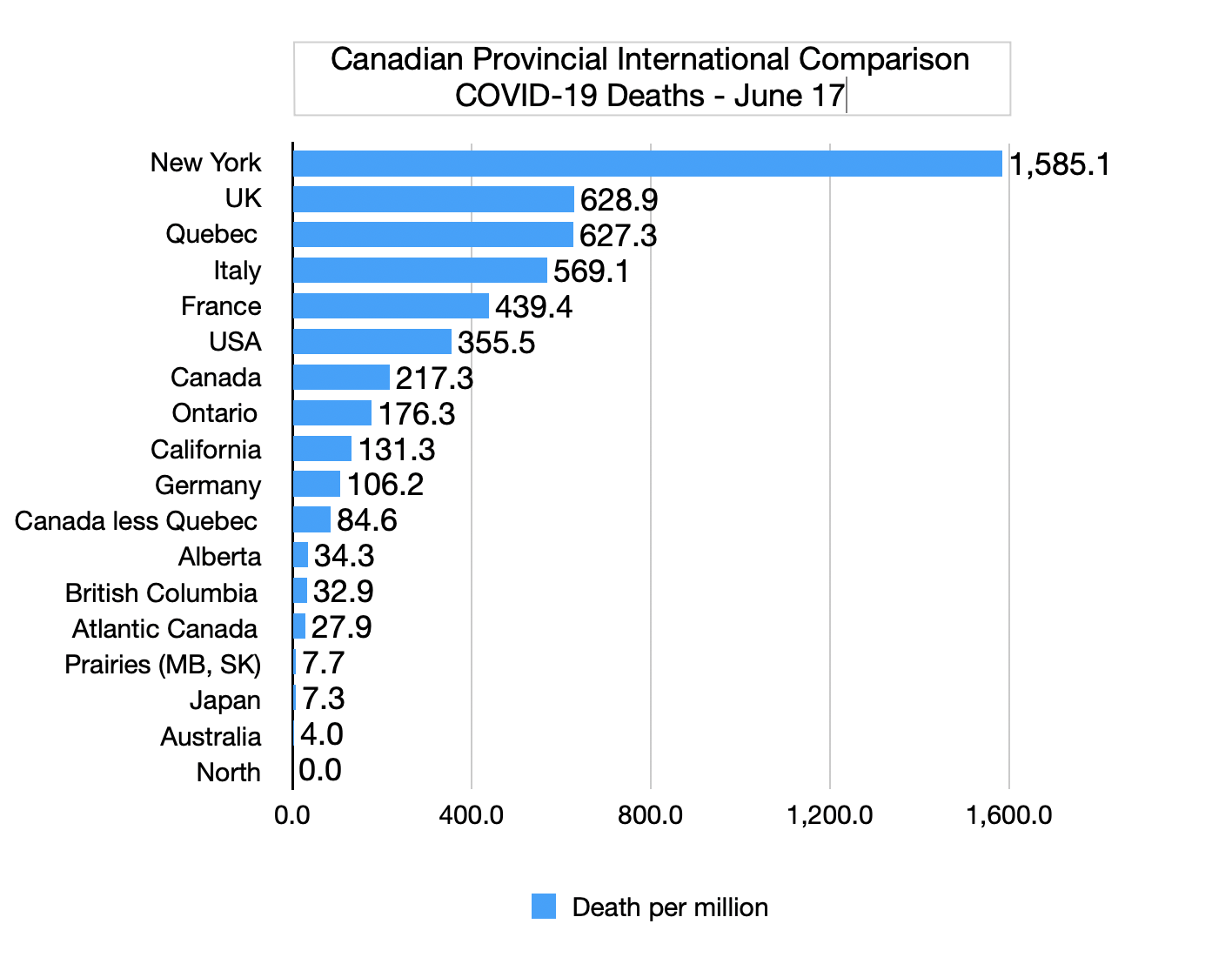
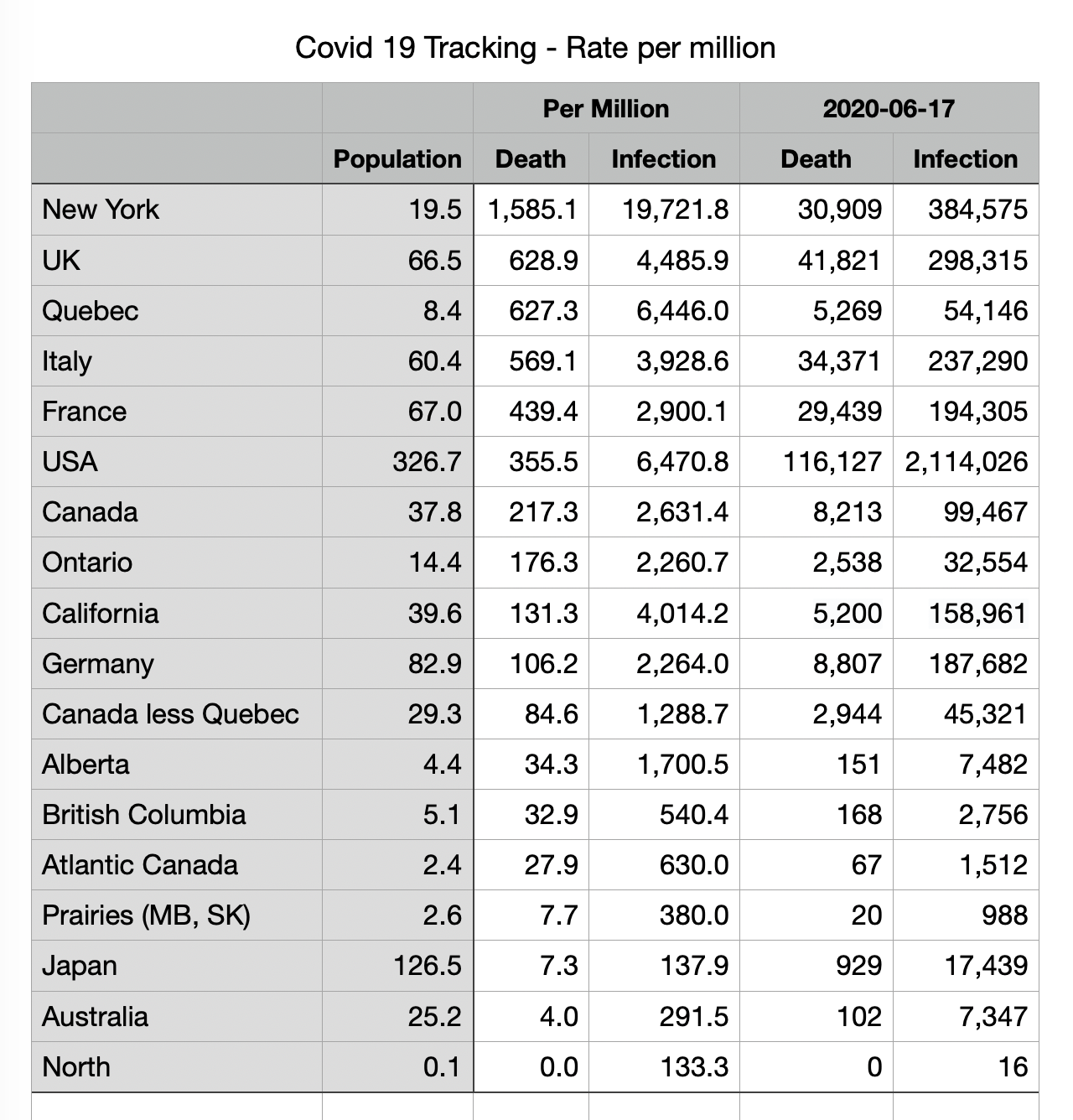
#COVID-19: Comparing provinces with other countries 17 June Update – No major change

Latest update:


Essential but expendable: How Canada failed migrant farm workers

Good investigative reporting on the policy and enforcement failures after the quarantine period:

When the novel coronavirus pandemic hit in March, the annual flow of farm labour into Canada hung in the balance.

Farmers feared that border closings and grounded planes would prevent agricultural workers, coming from countries such as Mexico, Guatemala and Jamaica, from reaching their fields and greenhouses in time for the seeding season. Knowing this, Ottawa allowed entry of temporary foreign workers critical to the food system.

Conditions – including a mandatory 14-day quarantine upon arrival – were put in place to protect Canadians. But advocates and health officials say not enough was done to protect the workers themselves.

In interviews, farm workers detailed the myriad reasons that COVID-19 has infiltrated farms with such success: a lack of personal protective equipment (PPE), an information vacuum and pressure to work, despite symptoms. In one instance, a feverish worker developed chest pains and a nosebleed that dripped on the vegetables he tended; he said his supervisors refused to take him home until the shift was over. Photos, videos and interviews portrayed overrun bunkhouses with broken toilets and stoves, cockroach and bed-bug infestations, and holes in the ceiling.

Rules were rolled out, but they weren’t adequately enforced and failed to consider what life on a farm is actually like for a migrant worker. Ottawa requires that farms, which generally provide housing under the Temporary Foreign Worker (TFW) program, ensure that accommodations allow physical distancing during the initial quarantine period.

But what happened after those 14 days was a massive blind spot. After isolating, workers often move into the bunkhouses, where they share bathrooms and kitchens and climb atop one another to get into bed. As former migrant worker Gabriel Allahdua put it, conditions in farm accommodations are a “recipe for COVID-19 to spread like wildfire.”

In Ontario alone, more than 600 foreign farm workers have tested positive for COVID-19, according to a Globe and Mail count; health officials have stressed that, for the most part, the workers came to Canada healthy and contracted the virus locally. British Columbia, Alberta and Quebec have also recorded outbreaks among migrant agri-food workers.

The situation is most dire in Southwestern Ontario, home to the continent’s highest concentration of greenhouses. Ontario’s largest outbreak is at Scotlynn Group, where at least 167 of 216 migrant workers have tested positive. Mexico has become so concerned by the outbreaks that Ambassador Juan Jose Gomez Camacho told The Globe that his country has “put a pause” on sending more workers – 5,000 more are still due to make the trip – until Canadian officials ramp up monitoring of health and safety rules, and ensure workers are paid while in isolation.

Two of Mr. Gomez Camacho’s countrymen have already died. Bonifacio Eugenio Romero, 31, and Rogelio Munoz Santos, 24, left their loved ones in Mexico to earn a better living. Their families are now planning the young men’s funerals. Mr. Eugenio Romero and Mr. Munoz Santos died – on May 30 and June 5, respectively – after testing positive for COVID-19. Their final days were spent mostly in hotel rooms, mostly alone.

“For a 24-year-old to die of this is beyond tragic,” said David Musyj, president and chief executive of Windsor Regional Hospital, where Mr. Munoz Santos died. “It should not happen. Just because he was from Mexico, I don’t give a damn. He was my son’s age. He was in Canada. And we should be taking care of him.” Mr. Munoz Santos is one of the youngest people in Canada to die from COVID-19-related causes. Ontario’s Office of the Chief Coroner is investigating both deaths and will decide whether to launch the province’s first inquest into a migrant worker fatality.

The federal government has the power to conduct pro-active inspections of farm accommodations, but during a six-week period at the height of the pandemic, these audits stopped. They are now being done virtually. The provinces are responsible for occupational health and safety, but in Ontario at least, the Ministry of Labour does not inspect employer-provided accommodations. Local public-health units in the province typically inspect farm bunkhouses once or twice a year, but this is done before workers arrive; an empty space looks markedly different from one with dozens of occupants.

In Canada, advocates and community health care workers for months warned federal and provincial politicians, as well as local public-health officials, that migrant workers were at a heightened risk. In letters, e-mails and conference calls, they asked for a number of measures, including increased funding for public-health units to ensure adequate housing inspections and limits on the number of people using each bathroom in bunkhouses. While some action was taken, many people say help came too little, too late. And advocates worry that unless enforcement and public-health outreach kick into high gear, there are lives and livelihoods at stake, along with the potential for disruption to the food system.

To understand what went so wrong, The Globe interviewed seven migrant workers across four farm operations, at times through a translator, as well as employers, advocates, academics, hospital executives, former migrant workers, doctors, lawyers and industry associations. The Globe reviewed four immigration files detailing allegations of employers who did little or nothing to protect workers. Migrant workers’ identities are being concealed because of privacy concerns and fears of reprisals.

The investigation revealed that problems in an already broken system have only been exacerbated by the pandemic. The experiences of workers varied, with some describing decent housing and respectful bosses who have worked hard to keep them healthy. Others spoke of racism and recounted threats of termination or deportation if they didn’t meet stringent productivity quotas.

Syed Hussan, executive director of Migrant Workers Alliance for Change (MWAC), said there is a massive disconnect at play. “Migrant workers,” he said, “have been treated as expendable and exploitable – and essential, all at the same time.”

….

The agriculture sector employs approximately 60,000 temporary foreign workers each year, with upward of 10,000 of them in Windsor-Essex county, which includes Leamington. Under the TFW program, foreign nationals are allowed to work for a particular employer for a set amount of time. Some stay for several months, others are here year-round. There are also foreigners who work in the country unauthorized; according to some estimates, Canada is home to hundreds of thousands of undocumented migrants.

Source: Investigation: Essential but expendable: How Canada failed migrant farm workers

Damning report points finger at Montreal city, police for failure to address systemic racism

Of note:

Montreal police operate with a culture of impunity fuelled by indifference in the city administration to complaints of racial profiling, violence and other forms of discrimination, according to a new report on systemic racism in the city.

The police force also works without data and concrete objectives for diversifying its work force, a vacuum that has made it unrepresentative of the community, much like other Montreal city departments, the report by the city’s independent public consultation office says.

Public consultations with a broad mandate to study systemic racism in the administration of the city of Montreal began two years ago. The Office de consultation publique de Montréal (OCPM) heard from 7,000 people who recounted stories of profiling, hiring and promotion roadblocks, and both overt and subtle discrimination.

The report landed as systemic racism and police discrimination have been pushed to the top of the public agenda. A series of violent incidents involving police in the United States and Canada have triggered protests and challenged leaders to act.

Long-standing denial that systemic racism is a problem is entrenched in Montreal’s city administration while the police hierarchy flip-flops on the existence of racial profiling and other forms of discrimination, said the report. It issued 38 recommendations including better data collection, enforcement of hiring targets, improved training and more responsive oversight mechanisms for the police and the city.

“How can you effectively and efficiently fight against racism if you don’t acknowledge it exists and don’t have data on what to change?” Dominique Ollivier, head of the OCPM, said in an interview. “There is no culture of evaluation in the city. They give themselves broad goals so any little thing can be called success.”

About 35 per cent of Montrealers identify as racialized or Indigenous people. About 19 per cent of the city’s work force are from those groups, an increase from 12.3 per cent 10 years earlier. For Montreal police, the figure was 7.7 per cent in 2019. Less than 2 per cent of city’s senior managers are racialized people. “They haven’t hired a single manager in three years from visible minorities or Indigenous groups,” Ms. Ollivier said.

Montreal Mayor Valérie Plante responded Monday by formally acknowledging at City Hall that systemic racism exists and vowing to appoint a commissioner to fight discrimination. However she offered no new steps to increase work-force or management diversity. “The city must be an exemplary employer,” she said. “We have to hit the accelerator to meet our targets. We can and must do better.”

A spokesman for the Montreal police said Chief Sylvain Caron would not comment on the report Monday. The police force sent out a statement Monday evening acknowledging the existence of systemic racism and vowing to fight it. In July, Chief Caron is set to release a new policy on street identification checks, known in some jurisdictions as carding.

Quebec Premier François Legault announced Monday he is creating a provincial task force to draft an anti-racism action plan by Christmas. Mr. Legault does not recognize systemic racism exists in Quebec but said the task force will address racism in public security, the justice system, the workplace, education and housing.

Mr. Legault said that, in order to expedite action on a long-studied issue, the task force will consist only of cabinet ministers and government MNAs. Mr. Legault put two Black ministers in charge of the task force: Nadine Girault, a former executive in the financial industry, and Lionel Carmant, a physician.

“I am not going to spend my time trying to find a definition of systemic racism that will be acceptable to everyone,” Ms. Girault said. “To recognize the problem is part of the solution, but we must go forward and create a clear obligation for results.”

Montreal’s racism report was the product of provisions in the city’s charter that allow citizens to petition for such consultations. Balarama Holness, one of the organizers who gathered 22,000 signatures to force the study, was pleased with its concrete recommendations but split on the political reaction.

“François Legault doesn’t recognize systemic racism but seems to be taking concrete steps to do something about it. Valérie Plante recognizes systemic racism on a symbolic level and is doing nothing about it,” said Mr. Holness, who is a McGill law student and founder of Montreal in Action, a human-rights advocacy group.

Mr. Holness, like Ms. Ollivier, expressed some optimism that protest and public attention might lead to action. “Let’s hope this is a step to creating a new legacy of equality,” he said, “even if we all know equality is a pursuit, not a destination.”

Source: Damning report points finger at Montreal city, police for failure to address systemic racism