Social Media Platforms Claim Moderation Will Reduce Harassment, Disinformation and Conspiracies. It Won’t

Harsh but accurate:

If the United States wants to protect democracy and public health, it must acknowledge that internet platforms are causing great harm and accept that executives like Mark Zuckerberg are not sincere in their promises to do better. The “solutions” Facebook and others have proposed will not work. They are meant to distract us.

The news in the last weeks highlighted both the good and bad of platforms like Facebook and Twitter. The good: Graphic videos of police brutality from multiple cities transformed public sentiment about race, creating a potential movement for addressing an issue that has plagued the country since its founding. Peaceful protesters leveraged social platforms to get their message across, outcompeting the minority that advocated for violent tactics. The bad: waves of disinformation from politicians, police departments, Fox News, and others denied the reality of police brutality, overstated the role of looters in protests, and warned of busloads of antifa radicals. Only a month ago, critics exposed the role of internet platforms in undermining the country’s response to the COVID-19 pandemic by amplifying health disinformation. That disinformation convinced millions that face masks and social distancing were culture war issues, rather than public health guidance that would enable the economy to reopen safely.

The internet platforms have worked hard to minimize the perception of harm from their business. When faced with a challenge that they cannot deny or deflect, their response is always an apology and a promise to do better. In the case of Facebook, University of North Carolina Scholar Zeynep Tufekci coined the term “Zuckerberg’s 14-year apology tour.” If challenged to offer a roadmap, tech CEOs leverage the opaque nature of their platforms to create the illusion of progress, while minimizing the impact of the proposed solution on business practices. Despite many disclosures of harm, beginning with their role in undermining the integrity of the 2016 election, these platforms continue to be successful at framing the issues in a favorable light.

When pressured to reduce targeted harassment, disinformation, and conspiracy theories, the platforms frame the solution in terms of content moderation, implying there are no other options. Despite several waves of loudly promoted investments in artificial intelligence and human moderators, no platform has been successful at limiting the harm from third party content. When faced with public pressure to remove harmful content, internet platforms refuse to address root causes, which means old problems never go away, even as new ones develop. For example, banning Alex Jones removed conspiracy theories from the major sites, but did nothing to stop the flood of similar content from other people.

The platforms respond to each new public relations challenge with an apology, another promise, and sometimes an increased investment in moderation. They have done it so many times I have lost track. And yet, policy makers and journalists continue to largely let them get away with it.

We need to recognize that internet platforms are experts in human attention. They know how to distract us. They know we will eventually get bored and move on.

Despite copious evidence to the contrary, too many policy makers and journalists behave as if internet platforms will eventually reduce the harm from targeted harassment, disinformation, and conspiracies through content moderation. There are three reasons why it will not do so: scale, latency, and intent. These platforms are huge. In the most recent quarter, Facebook reported that 1.7 billion people use its main platform every day and roughly 2.3 billion across its four large platforms. They do not disclose the numbers of messages posted each day, but it is likely to be in the hundreds of millions, if not a billion or more, just on Facebook. Substantial investments in artificial intelligence and human moderators cannot prevent millions of harmful messages from getting through.

The second hurdle is latency, which describes the time it takes for moderation to identify and remove a harmful message. AI works rapidly, but humans can take minutes or days. This means a large number of messages will circulate for some time before eventually being removed. Harm will occur in that interval. It is tempting to imagine that AI can solve everything, but that is a long way off. AI systems are built on data sets from older systems, and they are not yet capable of interpreting nuanced content like hate speech.

The final – and most important – obstacle for content moderation is intent. The sad truth is that the content we have asked internet platforms to remove is exceptionally valuable and they do not want to remove it. As a result, the rules for AI and human moderators are designed to approve as much content as possible. Alone among the three issues with moderation, intent can only be addressed with regulation.

A permissive approach to content has two huge benefits for platforms: profits and power. The business model of internet platforms like Facebook, Instagram, YouTube, and Twitter is based on advertising, the value of which depends on consumer attention. Where traditional media properties create content for mass audiences, internet platforms optimize content for each user individually, using surveillance to enable exceptionally precise targeting. Advertisers are addicted to the precision and convenience offered by internet platforms. Every year, they shift an ever larger percentage of their spending to them, from which platforms derive massive profits and wealth. Limiting the amplification of targeted harassment, disinformation, and conspiracy theories would lower engagement and revenues.

Power, in the form of political influence, is an essential component of success for the largest internet platforms. They are ubiquitous, which makes them vulnerable to politics. Tight alignment with the powerful ensures success in every country, which leads platforms to support authoritarians, including ones who violate human rights. For example, Facebook has enabled regime-aligned genocide in Myanmar and state-sponsored repression in Cambodia and the Philippines. In the United States, Facebook and other platforms have ignored or altered their terms of service to enable Trump and his allies to use the platform in ways that would normally be prohibited. For example, when journalists exposed Trump campaign ads that violated Facebook’s terms of service with falsehoods, Facebook changed its terms of service, rather than pulling the ads. In addition, Facebook chose not to follow Twitter’s lead in placing a public safety warning on a Trump post that promised violence in the event of looting.

Thanks to their exceptional targeting, platforms play an essential role in campaign fundraising and communications for candidates of both parties. While the dollars are not meaningful to the platforms, they derive power and influence from playing an essential role in electoral politics. This is particularly true for Facebook.

At present, platforms have no liability for the harms caused by their business model. Their algorithms will continue to amplify harmful content until there is an economic incentive to do otherwise. The solution is for Congress to change incentives by implementing an exception to the safe harbor of Section 230 of the Communications Decency Act for algorithm amplification of harmful content and guaranteeing a right to litigate against platforms for this harm. This solution does not impinge on first amendment rights, as platforms are free to continue their existing business practices, except with liability for harms.

Thanks to COVID-19 and the protest marches, consumers and policy makers are far more aware of the role that internet platforms play in amplifying disinformation. For the first time in a generation, there is support in both parties in Congress for revisions to Section 230. There is increasing public support for regulation.

We do not need to accept disinformation as the cost of access to internet platforms. Harmful amplification is the result of business choices that can be changed. It is up to us and to our elected representatives to make that happen. The pandemic and the social justice protests underscore the urgency of doing so.
Source: Social Media Platforms Claim Moderation Will Reduce Harassment, Disinformation and Conspiracies. It Won’t

Donald: Give us your wired masses, yearning to breathe free

Intriguing idea of Scott Gilmore (have seen similar suggestions from India and Europe):

Two historic developments have aligned to create a momentary and monumental opportunity for Canada.

First, we are weathering a global pandemic that has dramatically changed the way the world works. Suddenly, we are all discovering that the technology exists to allow many of us to work remotely, and to continue to be effective doing so. In fact, experts are predicting a sizeable portion of the workforce will choose not to return to the office when this is over.

At the same time, a tide of nationalism has risen in many western countries such as the United Kingdom and the United States. There, governments are making it increasingly difficult for immigrants to arrive or to stay.

For example, President Donald Trump signed an executive order that cancels the H-1B visa category, which permits highly skilled workers, who have already been offered a job by an American company, to live and work in the United States. American economists and CEOs are horrified at the decision. Without these well-trained immigrants, Silicon Valley would still be pastureland.

And here is Canada’s golden opportunity: we should immediately offer residency to all 85,000 holders of H-1B visas, permitting them to live in Canada while they work remotely for their current employers in the United States.

The benefits to Canada are numerous and obvious. To begin with, this would not take any existing jobs from Canadians. There are legitimate (albeit mostly misplaced) concerns that our current unemployment crisis would be exacerbated by increased immigration. Holders of this visa would be permitted to remain only if they have a full-time job in the United States (or another foreign country) that can be performed remotely.

It would give Canada an instant boost in revenue. These new arrivals might be working in the U.S., but they’d be paying their taxes and spending their paycheques here. Our services industry is in desperate need of a boost, and with international travel facing a long recovery, relying on foreign tourism will not be enough. We can replace that by effectively transplanting billions in household spending that is currently rooted south of the border.

This new visa class would be a tremendous boost to our pool of creative and productive talent. Canada has traditionally been a runner up when it comes to attracting the world’s best and brightest. This has gradually been changing, but this new visa could accelerate the shift. We would inject some of the world’s brightest minds into our cities, and if the visa provided a pathway for citizenship, we could hold on to that talent and all the benefits it would bring.

As many public policy experts, demographers, economists and others have pointed out, we need more Canadians. We have an ageing population that will produce relatively less tax revenue to support a growing number of elderly people. And if we want to achieve our full potential, we need a critical mass of talented citizens to do so. This is an argument that has been best made by Globe and Mail writer Doug Saunders in his recent book ‘Maximum Canada’. This visa class is one of the easiest paths towards that goal. The U.S. government has basically pre-screened all these immigrants, vetted them for security and health issues, confirmed they are employable, and socialized them to living in a western democracy. We should be paying Washington for the privilege of taking these people off their hands.

This visa would be an obvious blessing for the would-be immigrants. Unwelcome in the U.S. and facing unemployment, they will be greeted warmly here and allowed to continue to do their work and even remain in the same time zone. What’s more, they will benefit from Canada’s high quality of life, and excellent (but improvable) health-care system.

They will also discover that the American Dream has moved north. Compared to the United States, Canada now has higher rates of employment, education and homeownership. We even have longer lives and more vacation days. And while working from home is not ideal, all of our major cities now have ample shared workspace facilities.

This visa is even good for American employers. First and foremost, they get to keep their talent. And, they would no longer have to pay extravagant health insurance costs. Even Donald Trump would welcome this move. In his mind, out of sight is out of mind and these would be just one less class of immigrants to worry about.

We could call this an IWFC: an International Work From Canada visa and offer it to more than just H-1B candidates. If someone has a high paying job in Paris that they can do on their laptop from Montreal, why wouldn’t we want them to do so? It is a new world, and we need to look at it from a new angle. As the global workforce shifts to tele-commuting, the idea of living in Whistler while managing a marketing team in San Jose is not only possible, it is logical.

If Canada were to seize this opportunity, we would have to do it fast. Other countries are likely considering something similar. Who wouldn’t? And, the American election is just months away. The political landscape could shift, and this incredible pool of talent might be allowed to remain in the U.S. Let’s act before then, let’s bring them home to Canada, before someone else puts out their own welcome mat first.

Source: Donald: Give us your wired masses, yearning to breathe free

Trump’s Freeze On H-1B Work Visas Disproportionately Affects Indians

Given the number of articles I have been seeing in Indian media, not surprising:

The Trump administration’s latest freeze on certain types of work visas, designed to protect American jobs during the COVID-19 crisis, is having a disproportionate effect on workers in India.

The executive order, signed Monday by President Trump, extends a ban on green cards issued outside the United States and adds several types of work visas to the freeze, including the H-1B visa for skilled workers. Last year, 72% of those visas were granted to Indians.

The change means tens of thousands of Indians who planned to come to the U.S. this year will have to scrap or delay their plans.

On Tuesday, Sunny Kumar Hirpara awoke in India to news of a temporary ban on his exact type of visa.

“I woke up at like 5 o’clock in the morning, and I saw the messages. I almost started crying,” Hirpara says.

Hirpara, 26, earned a master’s degree in the U.S. and landed a job as an electrical engineer in Irvine, California. In March, he returned to India to visit his parents and to convert his student visa to an H-1B, sponsored by his company. Then the pandemic hit. His paperwork was delayed.

“I’m sad that I invested five years studying in the U.S. and preparing for a job there,” says Hirpara.

Last year, nearly 280,000 Indians were granted H-1B visas or renewed them. New ones are capped at 85,000 annually. The process is now frozen through Dec. 31, 2020.

In some cases, families separated by the pandemic now face more time apart. Social media is flooded with pleas to lawmakers from H-1B holders who temporarily left the U.S. and worry they won’t be allowed back.

Many have advanced degrees and work for U.S. tech giants. Google CEO Sundar Pichai tweeted that he’s “disappointed” by Trump’s order. He was once an H-1B recipient from India.

“We as a country have been such a vibrant economy and society because of our ability to draw talent from around the world,” Nisha Biswal, president of the U.S.-India Business Council, tells NPR. “If we stop, I think that will adversely impact our ability to be at the top.”

India’s IT industry association called the freeze “misguided & harmful” and urged the U.S. government to shorten restrictions to 90 days. Some Indian IT companies with employees in the U.S. will also be affected.

Others, though, suggest that the visa freeze could be a boon to Indian companies, and even to the government.

“This is a fantastic opportunity,” Vikram Ahuja, co-founder of Talent500, a recruitment firm in the southern Indian city of Bengaluru, told India’s NDTV channel. He said working from home — now common during the pandemic — could change how tech companies hire.

“The world is changing, and I think as long as great companies seek great talent, then location and physical proximity becomes irrelevant,” Ahuja said.

He said H-1B visa holders could even still work for U.S. companies, but from home in India — thus paying into Indian tax coffers instead of U.S. ones.

Source: Trump’s Freeze On H-1B Work Visas Disproportionately Affects Indians

‘The Computer Got It Wrong’: How Facial Recognition Led To False Arrest Of Black Man

A very concrete case of facial recognition getting it wrong and police incompetence or indifference in not examining evidence or circumstances:

Police in Detroit were trying to figure out who stole five watches from a Shinola retail store. Authorities say the thief took off with an estimated $3,800 worth of merchandise.

Investigators pulled a security video that had recorded the incident. Detectives zoomed in on the grainy footage and ran the person who appeared to be the suspect through facial recognition software.

A hit came back: Robert Julian-Borchak Williams, 42, of Farmington Hills, Mich., about 25 miles northwest of Detroit.

In January, police pulled up to Williams’ home and arrested him while he stood on his front lawn in front of his wife and two daughters, ages 2 and 5, who cried as they watched their father being placed in the patrol car.

His wife, Melissa Williams, wanted to know where police were taking her husband.

” ‘Google it,’ ” she recalls an officer telling her.

Robert Williams was led to an interrogation room, and police put three photos in front of him: Two photos taken from the surveillance camera in the store and a photo of Williams’ state-issued driver’s license.

“When I look at the picture of the guy, I just see a big Black guy. I don’t see a resemblance. I don’t think he looks like me at all,” Williams said in an interview with NPR.

“[The detective] flips the third page over and says, ‘So I guess the computer got it wrong, too.’ And I said, ‘Well, that’s me,’ pointing at a picture of my previous driver’s license,” Williams said of the interrogation with detectives. ” ‘But that guy’s not me,’ ” he said, referring to the other photographs.

“I picked it up and held it to my face and told him, ‘I hope you don’t think all Black people look alike,’ ” Williams said.

Williams was detained for 30 hours and then released on bail until a court hearing on the case, his lawyers say.

At the hearing, a Wayne County prosecutor announced that the charges against Williams were being dropped due to insufficient evidence.

Civil rights experts say Williams is the first documented example in the U.S. of someone being wrongfully arrested based on a false hit produced by facial recognition technology.

Lawyer: Artificial intelligence ‘framed and informed everything’

What makes Williams’ case extraordinary is that police admitted that facial recognition technology, conducted by Michigan State Police in a crime lab at the request of the Detroit Police Department, prompted the arrest, according to charging documents reviewed by NPR.

The pursuit of Williams as a possible suspect came despite repeated claims by him and his lawyers that the match generated by artificial intelligence was faulty.

The alleged suspect in the security camera image was wearing a red St. Louis Cardinals hat. Williams, a Detroit native, said he would under no circumstances be wearing that hat.

“They never even asked him any questions before arresting him. They never asked him if he had an alibi. They never asked if he had a red Cardinals hat. They never asked him where he was that day,” said lawyer Phil Mayor with the ACLU of Michigan.

On Wednesday, the ACLU of Michigan filed a complaint against the Detroit Police Department asking that police stop using the software in investigations.

In a statement to NPR, the Detroit Police Department said after the Williams case, the department enacted new rules. Now, only still photos, not security footage, can be used for facial recognition. And it is now used only in the case of violent crimes.

“Facial recognition software is an investigative tool that is used to generate leads only. Additional investigative work, corroborating evidence and probable cause are required before an arrest can be made,” Detroit Police Department Sgt. Nicole Kirkwood said in a statement.

In Williams’ case, police had asked the store security guard, who had not witnessed the robbery, to pick the suspect out of a photo lineup based on the footage, and the security guard selected Williams.

Victoria Burton-Harris, Williams’ lawyer, said in an interview that she is skeptical that investigators used the facial recognition software as only one of several possible leads.

“When that technology picked my client’s face out, from there, it framed and informed everything that officers did subsequently,” Burton-Harris said.

Academic and government studies have demonstrated that facial recognition systems misidentify people of color more often than white people.

One of the leading studies on bias in face recognition was conducted by Joy Buolamwini, an MIT researcher and founder of the Algorithmic Justice League.

“This egregious mismatch shows just one of the dangers of facial recognition technology which has already been shown in study after study to fail people of color, people with dark skin more than white counterparts generally speaking,” Buolamwini said.

“The threats to civil liberties posed by mass surveillance are too high a price,” she said. “You cannot erase the experience of 30 hours detained, the memories of children seeing their father arrested, or the stigma of being labeled criminal.”

Maria Miller, a spokeswoman for the prosecutor’s office, said the case was dismissed over insufficient evidence, including that the charges were filed without the support of any live witnesses.

Wayne County Prosecutor Kym Worthy said any case sent to her office that uses facial recognition technology cannot move forward without other supporting evidence.

“This case should not have been issued based on the DPD investigation, and for that we apologize,” Worthy said in a statement to NPR. “Thankfully, it was dismissed on our office’s own motion. This does not in any way make up for the hours that Mr. Williams spent in jail.”

Worthy said Williams is able to have the case expunged from his record.

Williams: “Let’s say that this case wasn’t retail fraud. What if it’s rape or murder?”

According to Georgetown Law’s Center on Privacy and Technology, at least a quarter of the nation’s law enforcement agencies have access to face recognition tools.

“Most of the time, people who are arrested using face recognition are not told face recognition was used to arrest them,” said Jameson Spivack, a researcher at the center.

While Amazon, Microsoft and IBM have announced a halt to sales of face recognition technology to law enforcement, Spivack said that will have little effect, since most major facial recognition software contracts with police are with smaller, more specialized companies, like South Carolina-based DataWorks Plus, which is the company that supplied the Detroit Police Department with its face-scanning software.

The company did not respond to an interview request.

DataWorks Plus has supplied the technology to government agencies in Santa Barbara, Calif., Chicago and Philadelphia.

Facial recognition technology is used by consumers every day to unlock their smartphones or to tag friends on social media. Some airports use the technology to scan passengers before they board flights.

Its deployment by governments, though, has drawn concern from privacy advocates and experts who study the machine learning tool and have highlighted its flaws.

“Some departments of motor vehicles will use facial recognition to detect license fraud, identity theft, but the most common use is law enforcement, whether it’s state, local or federal law enforcement,” Spivack said.

The government use of facial recognition technology has been banned in half a dozen cities.

In Michigan, Williams said he hopes his case is a wake-up call to lawmakers.

“Let’s say that this case wasn’t retail fraud. What if it’s rape or murder? Would I have gotten out of jail on a personal bond, or would I have ever come home?” Williams said.

Williams and his wife, Melissa, worry about the long-term effects the arrest will have on their two young daughters.

“Seeing their dad get arrested, that was their first interaction with the police. So it’s definitely going to shape how they perceive law enforcement,” Melissa Williams said.

In his complaint, Williams and his lawyers say if the police department won’t ban the technology outright, then at least his photo should be removed from the database, so this doesn’t happen again.

“If someone wants to pull my name and look me up,” Williams said, “who wants to be seen as a thief?”

Source: ‘The Computer Got It Wrong’: How Facial Recognition Led To False Arrest Of Black Man

How innovative news outlets are meeting the needs of immigrant communities

Ethnic media in the USA study:

At a time when all of journalism is in an existential crisis, the financial pressure on resource-deprived immigrant outlets is greater than ever. Yet the pandemic, and the protests over the killing of George Floyd, Breonna Taylor and dozens of others, have put innovative immigrant-serving digital outlets into overdrive, as reporters squelch rumors via WeChat and Facebook Live and beam interviews with local officials into living rooms via Roku and JadooTV boxes.

The most successful of these outlets – as measured by ballooning audience numbers – rely on tireless reporters and anchors with a direct line to listeners and viewers. Journalists like Mario Guevara with Mundo Hispánico in Atlanta have made it their business to maintain contact with immigrants using social media. Guevara listens to their questions, hears their complaints, and then gives them the critical information and support they need. That, rather than news flashes or push notifications, has become the lifeblood of immigrant media. Guevara, with nearly half a million Facebook followers on his personal account, recently livestreamed as he took a rubber bullet to his leg while interviewing Latino kids on why they were out protesting against the police.

For many immigrant communities, these outlets provide information they just can’t get from other sources. “The local media landscape is predominantly white,” said Mukhtar Ibrahim, the Somali-American editor of Sahan Journal in St. Paul. When he went to report on the protests and looting in Minneapolis, which occurred essentially in the backyard of many Somali residents, he was struck by how few journalists of color were covering the story. But he was not surprised. Most newsrooms in Minnesota, said Ibrahim, are “slow in making news coverage more inclusive, despite the increasing diversity and the rapid growth of Minnesota’s immigrant population.”

In contrast, immigrant outlets are vital sources of information for people from indigenous farmworkers to Chinese engineers to Somali Uber drivers. On the Chinese social media app WeChat, Houston Online documented empty Chinese-owned businesses well before most U.S. outlets were paying attention to the pandemic’s reach. Punjabi Radio USA in Northern California reported on dangerous rest stop conditions for truckers, one of their main listener groups. And as Queens emerged as an epicenter of coronavirus in the U.S., TBN24, a Bangladeshi digital television outlet with more than 2.7 million followers on Facebook alone, informed viewers about everything from how to get a stimulus check to how to connect with funeral homes.

The technology may be new, but today’s immigrant outlets build on a long history of serving their communities in crisis. During the 1992 Los Angeles civil unrest and riots, Radio Korea shut down all broadcasting operations and became a control center fielding hundreds of calls for help as businesses burned and police were nowhere to be found. These days, when the station does live programs, hosts will often collect comments and poll listeners via KakaoTalk, a social media popular in Korea, as well as run a YouTube live chat.

Radio Korea connects with listeners via KakaoTalk and live broadcasts on YouTube where there is active commentary.

Wielding new technologies can generate huge followings for immigrant media outlets, but these followers are not paying the bills. In coming months, while some immigrant outlets will surely go out of business, the nimble and the scrappy may yet show the way to survive and even thrive. They’ve embraced virtually cost-free digital platforms and delivery systems, so there’s not much room to slash expenses. On the revenue side, ads have plummeted dramatically. Still, glimmers of hope can be found in new models, from going the non-profit route to building auxiliary businesses that aren’t journalism, but fund it.

For the past year, the Center for Community Media has been studying news outlets serving immigrant communities for models of growth and innovation. The cross-currents that have battered community media outlets across the nation threaten their sustainability, and the Center for Community Media has responded by redirecting its mission to help outlets develop survival skills. This report is part of that effort. [A shorter “preview” version of this report was published by CCM in early April.]

We interviewed and surveyed more than 150 people in 30 states to identify outlets that are in the vanguard. The editors and reporters we spoke with come from around the world and have different strengths in radio, broadcast, print, and digital. Yet we found that the best of them have been successful at converging around multiplatform practices. In particular, we found that immigrant-serving news outlets are evolving in four key ways:

  • Wielding social media for community engagement. In recent years the internet decimated classified ads, shrinking revenues for many immigrant-serving newspapers, while social media that trafficked in rumors decimated their audiences. Now, successful immigrant-serving outlets are using social media as a way to offer verified information, cultivate community conversations, and respond to concerns. Live broadcasting is booming, with the unparalleled immediacy and shareability of bringing viewers to a news conference, community festival, or a drive-through coronavirus testing station. Some outlets are even operating primarily on social media platforms like WeChat, WhatsApp, YouTube, and Facebook.
  • Leveraging a small staff to reach big audiences. Media outlets serving immigrant communities have historically been relatively small operations, but with delivery technologies like livestreaming on Facebook or “micro-TV stations,” being small is no longer an impediment to being timely, and may even work in an outlet’s favor. One-person operations can report, produce and broadcast – and consequently boost audiences substantially at very low cost at a time when revenue models are challenged.
  • Globalizing both production and audiences. Increasingly, outlets are hiring staffers overseas to cut costs, while stateside reporters serve both the diaspora in the U.S. and home country audiences. The geolocation of audiences has shifted dramatically in recent years, as reverse migration, press restrictions overseas, and far-flung diasporas boost audiences for immigrant media based in the U.S. Dynamic outlets are becoming transnational enterprises. One Brazilian newspaper in Massachusetts reported it has 60% of its audience in the U.S. and 30% in Brazil while a Hmong outlet in Wisconsin reported 40% of its audience comes from outside of the U.S.
  • Diversifying business models and revenue streams. Even before the pandemic, immigrant media was feeling the pain of ad cuts. Now, though, a few are reporting that their funding sources are stable or even growing modestly. That’s thanks to a grab-bag of strategies, from operating as a non-profit to lining up grant funding to getting government advertising to targeting supplement funding sources. Our database shows 13 out of 50 outlets are non-profit, while a handful have put up e-commerce sites, developed a consulting business and even launched English-language classes to boost the bottom line.

You can read the Center For Community Media’s full report here, plus find case studies and a database.

Source: How innovative news outlets are meeting the needs of immigrant communities

The theory of immigrants and foreign investors driving Canada’s property market is about to be tested

Yes indeed although interestingly the article focusses almost exclusively on the high end of the market, not the middle class suburbs which are home to so many immigrants:

Christine Zhu, a Toronto-based realtor, has not facilitated a single purchase or sale on homes since the start of the COVID-19 pandemic. Her clientele are almost exclusively Chinese nationals whose kids are either already international students in Canadian universities and high schools in Ontario, or are looking to begin school this fall.

In a regular spring market, she would have processed at least eight sales every month, mostly condominium units that Chinese parents would purchase for their children, in addition to numerous rentals. This season she’s spending her days on the phone with landlords, negotiating on behalf of students who have gone back to China, and have no idea when they will return, leaving their leased apartments vacant.

“One of my clients went back to China for Chinese New Year, and didn’t come back because there were no flights. He’s been paying for so many months, so the mother asked me if I can help negotiate with the landlord,” Zhu said. “This landlord was nice, he gave a 30 per cent discount. That’s the best I could do.”

There are approximately 640,000 international students in Canada — over 50 per cent of them are Chinese and Indian nationals who make up a significant part of the rental market in Canada’s largest cities. In a typical summer season, tens of thousands of new foreign students, landed immigrants and non-permanent residents looking for work arrive in Canada, seeking some kind of housing, either to rent or buy.

But with international travel frozen, multiple realtors and housing experts the Financial Post spoke to over the course of the week say that the lack of the usual immigration and travel pattern is starting to have a noticeable impact on the housing markets of Toronto and Vancouver. In particular, vacancy rates are rising in downtown rental markets, pushing prices lower, while luxury homes that usually attract rich foreign investors are struggling to be sold leading to price drops or, in some cases, court-ordered sales.

“Net migration numbers have fallen off pretty sharply, and the vast majority of non-permanent resident newcomers fall into the rental market. We’re likely to see vacancy rates go back up, but more likely rents are going to flatten out even more,” said Robert Kavcic, senior economist at BMO Capital Markets.

In April, the numbers of permanent residents admitted to Canada declined by 80 per cent from the year prior — just 4,140 were processed and admitted compared to 26,900 in April 2019, according to Immigration, Refugees and Citizenship Canada.

In Toronto, condo rentals are on the decline, falling 2.2 per cent on average from April 2020 to May 2020, according to data from apartment hunting site PadMapper. In Vancouver, one-bedroom apartments decreased 5.6 per cent and two-bedroom units decreased 15.8 per cent, the largest decline across the country, May 2020 data from Rentals.ca showed.

Kavcic believes the decline is partly attributed to immigration, but it’s still too early to quantify.

Razia Husein, a Toronto realtor whose clients comprise mostly wealthy foreigners or permanent residents residing abroad, says that she’s had trouble selling downtown condo units that some investors would buy in bulk in a typical year.

“I sell 8 to 10 units, either pre-construction or newly built, to one buyer (in different properties). Some are from India, some are from the United Kingdom, some are from Trinidad. I tell my clients to not put all their eggs in one basket.”

This year, Husein says she’s trying to facilitate sales on the phone, but it’s proving to be difficult. “They need to get on a plane and come and see a unit, or see the area. So I’m just doing a lot of rentals right now, I usually manage these investors’ properties, and find them renters,” she added.

When home prices skyrocketed in Toronto and Vancouver in early 2017, the prevailing notion was that foreign money was driving price increases, prompting provincial governments of both cities to slap a 15 per cent foreign buyers’ tax on purchases.

But a January 2019 report released by Statistics Canada using data from the Canadian Housing Statistics Program found that changes in property prices could not really be associated with any specific socio-demographic or economic factor.

Immigrants, for example, owned proportionally fewer single-detached houses than Canadian-born owners in both cities, but in Vancouver, immigrant owners had larger homes in more expensive neighbourhoods. Just 4.95 per cent of single-detached properties were owned by immigrants in Vancouver, while in Toronto that number was 4.71 per cent. In both cities however, immigrants owned more condominium units than Canadian-born owners.

“This idea that foreigners are the reason for our housing prices going up, is going to be tested out right now. There are no flights, and so the rich investors that went away for the winter, they’ve not come back. Yet, I see the market for single-detached houses is roaring right now,” said a real estate agent in Toronto whose clients are mostly high networth Iranians.

But David Chen, a realtor with the Vancouver-based boutique real estate firm Stilhavn Real Estate Services, whose clients are primarily from mainland China, notes a different trend in the wealthy community of West Vancouver that he attributes to the travel freeze — mansions worth $5 million or more are struggling to be sold because rich foreign investors are not available to go house shopping at the moment.

“Local buying and selling has picked back up and is strong. But in West Vancouver, we’re seeing the biggest price drop in years. It’s not unusual to see court sales for some of the bigger homes — it used to be maybe one in 200 homes in West Vancouver were sold through the court system, but now that’s about one in 80,” Chen said.

Between April 2020 and May 2020, the average home price in West Vancouver fell from $2.8 million to approximately $1.7 million, although it seems to have picked back up recently. Six-bedroom homes, that were worth more than $4 million just six months ago, are now averaging at $2.2 million, according to data from MLS, crunched by the real estate site Zolo.ca.

Local builders, according to Chen, build huge mansions for foreign buyers who usually make their purchases in the spring or summer months, but demand has fallen this season.

There’s scant Canadian data available on foreign buyers recent purchasing habits, but information from the Chinese-based website Juwai.com, estimated that in the first quarter of 2020, Chinese nationals made 26.5 per cent fewer buyer enquiries on Canadian property than in the fourth quarter of 2019. In Toronto, Chinese buyers made 34 per cent fewer enquiries on real estate in the first quarter of 2019.

Whether or not the immigration effect on Canadian real estate — though still anecdotal — will last, is a question that Zhu believes relates in some part to how the Canadian government will deal with the pandemic going forward.

She operates a WeChat account with roughly 500 Chinese parents whose kids are international students in Canada and their primary concerns have been the way in which Canada has responded to the virus.

“The mothers are scared. For many of them, this is their only child studying abroad,” Zhu said. “In China, they feel COVID-19 is being handled well, and Canada is next to the United States which for some of them causes worry.”

In terms of death count, Canada has had roughly double the number of COVID-19 related deaths compared to China, according to official numbers from both countries’ governments. While there have been new surges of the virus in and around Beijing, the Chinese government, at least based on public information, appears to have effectively controlled the spread by rapidly boosting testing and contact tracing.

Chen says some of his clients from mainland China have held off on purchasing condos in Vancouver because of concerns that a shared building ventilation system could be a COVID-19 related risk. “They are just going to wait it out for now, at least until flights from China resume,” he said.

BMO’s Kavcic believes that ultimately the housing markets of Toronto and Vancouver, Canada’s two most expensive cities, will be driven less by the behaviour of foreign buyers, newcomers and international students and more by the tension between demand and availability.

“This is a very unique shock. It has pulled people out of the market. Listings have come down as quickly as sales have. So the question is how much pent-up demand versus pent-up listings will there be when things go back to normal?”

Source: The theory of immigrants and foreign investors driving Canada’s property market is about to be tested

Kerr: Renaming Dundas Street, or other landmarks, won’t help Black people

Agree. The symbolic is easier than the substantive, where the focus should be:

Would renaming COVID-19 make it less deadly? You know the answer.

But what about Dundas Street? Renaming it might “correct” a historical wrong – but would doing so make the underlying issue of systemic racism go away?

More than 14,000 people have signed a petition to rename the major arterial road named after Henry Dundas, a Scottish politician who obstructed the abolition of slavery in the late 18th century. The effort is serious enough that the city of Toronto will form a working group to examine the issue.

But the events that galvanized this movement to rename Dundas Street, along with other landmarks in Canada, are exactly why renaming efforts shouldn’t happen, at least not right away. We are still reckoning with racism and the many forms it takes, from workplace discrimination to police brutality, as seen in the deaths of George Floyd and Breonna Taylor. These killings have ignited protests and important conversations. Toronto’s board of health just declared anti-Black racism a public health crisis.

There are bold proposals in the zeitgeist to fix things: defund the police, give descendants of African slaves reparations, hire more Black people in leadership roles. Like them or not, these ideas would actually do something to change Black people’s lives. Renaming Dundas Street won’t.

Andrew Lochhead, who started the petition, argues that this is not an either-or situation. We can rename the street and implement policy to address systemic racism.

“I don’t want the issue of renaming streets to necessarily overtake that conversation, because I think they’re inextricably linked,” Mr. Lochhead told me over the phone.

“While I understand it’s a largely symbolic gesture … it’s not outside of investing in communities, it’s not disconnected from other causes like defunding the police.”

There is a connection, but until city councils can freeze time and print money, there is always a question of what to prioritize. With COVID-19 putting significant pressure on municipal budgets, the only option is to be pragmatic and focus on implementing policies that will have a tangible impact on Black lives. One way to do this is to give Black voices the authority to make change.

“Black people have been warning about police brutality for decades … it’s not the folks who were perpetuating the system who are going to lead,” Cheryll Case, an urban planner based in Toronto told me. Ms. Case wants to see the city hire a Black consultant to audit its planning process.

“The issue in planning is that it is not confronting privilege, nor is it confronting discrimination. And by ignoring those topics, you actually further deepen the wounds of discrimination and subjugation.”

In a city gasping for more affordable housing, Ms. Case suggests creating an incentive for developers that would defer certain costs if they build affordable units. According to Toronto’s 2016 census, Black people make up 9 per cent of the population, but account for 13 per cent of the residents of low-income neighbourhoods.

The Parliamentary Black Caucus made the need for better policy clear in a recent statement.

“This is not a time for further discussion – the Afro-Canadian community has spoken for many years and is no longer interested in continued consultation,” it read.

“Black Canadians are in a state of crisis: it is time to act. Words and symbolic gestures, while important, are not enough.”

The Caucus proposes that the government ban racial profiling from the RCMP, invest in Black heritage organizations and increase the number of government procurement contracts for Black-owned businesses.

These ideas look pretty on paper, but it might not be easy to turn them into laws, which is why political resources must be focused on policy, not symbolism. The true cost of renaming Dundas Street is all the time, effort and money that could have been spent helping Black communities in more tangible ways.

What about the financial costs? Mr. Lochhead told me he hasn’t “taken the time to look into” the price of renaming Dundas Street. I don’t know how much it will cost either, but last year, Toronto spent just under $2-million to change the names of two arts centres under its purview. In the city of Toronto, Dundas Street stretches from Etobicoke in the west end, all the way to the Beaches neighbourhood in the east end, and features some of the city’s busiest shopping districts. The cost of changing the street’s signage is going to add up, and those dollars are better spent elsewhere.

Every breath politicians waste on a renaming debate should be spent discussing how to combat racism in schools, or how to address discriminatory fare enforcement officers on the TTC. If Dundas Street or other roads in Toronto are renamed, but Black people are still being harassed on the streetcar routes that traverse them, what has really changed?

Source: https://www.theglobeandmail.com/opinion/article-renaming-dundas-street-or-other-landmarks-wont-help-black-people/

Ibbitson: Tens of thousands of Canadians won’t be born due to COVID-19

Some serious thinking needs to be done regarding alternatives to solely relying on immigration to address the aging demographics, as immigration alone, even at higher levels, won’t eliminate the trend.

One or two missed years won’t make much of a difference in the longer term, and a too quick return to the existing plan, at a time when large segments of our economy will likely take a number of years to recover, is setting up immigrants for failure.

Previous recessions have resulted in worse economic outcomes for immigrants that arrive during downturns:

One of the worst long-term consequences of the COVID-19 pandemic for Canada will be the tens of thousands who won’t be born, a loss to this country’s future.

To make up for that loss, and for the immigrants who were unable to come to Canada this year because of the lockdown, the federal government would need to increase its immigration target beyond 400,000 next year and in future years, which may be politically and logistically impossible.

The lost potential population – the work not done, goods not consumed, taxes not paid – will be felt for decades to come.

The Brookings Institution, a Washington think tank, released a report this month that concluded “the COVID-19 episode will likely lead to a large, lasting baby bust.”

Like most developed nations, the United States has a fertility rate well below the 2.1 children per woman needed to sustain the population. (The U.S. fertility rate is 1.7; Canada’s is 1.5.) Women are choosing to have fewer children, and to delay their first child until their late twenties or their thirties. (The mean age at which a woman has her first child in the U.S. is 27; in Canada, 29.)

Economic uncertainty can cause a woman to put off having her first child even longer, which may lead to her having fewer children than she originally intended. Examining past recessions and recoveries, the Brookings study found that “a one percentage point increase in the state unemployment rate led to a 0.9 per cent reduction in the birth rate.”

More than simple economic calculation is at work. “Economic pressures and uncertainty cause enormous pressure and stress within households and relationships,” said Judith Daniluk, professor emeritus at University of British Columbia, where she specializes in women’s sexuality and reproductive health.

“Surviving, much less rebounding from, this type of economic and existential crisis is challenging and takes time,” she told me, which can lead to “some women being unable to bear a child when they have regained their economic and relational footing, or in having fewer children than they had hoped.”

Based on projected unemployment levels resulting from the coronavirus lockdown, and a drop in fertility that accompanied the Spanish flu pandemic of 1918-19, the Brookings study concluded that “we could see a drop of perhaps 300,000 to 500,000 births in the U.S.” in 2021.

Since Canada has about one-tenth the population of the United States, and the unemployment rate is similar (13.3 per cent in May in the U.S.; 13.7 per cent in May in Canada), we can expect to lose on the order of 30,000 to 50,000 babies next year – the equivalent of West Vancouver (population 42,694) or Belleville, Ont. (population 50,720) in the number of babies not born.

The fewer babies that are born each year, the more immigrants who are needed to replace them. The alternative is a shrinking and aging population, with too few workers and taxpayers available to fill vacant jobs, to power the economy through consumption, and to support the pension and health-care needs of the elderly.

The Trudeau government had planned to welcome 341,000 permanent residents this year and 351,000 in 2021. But with the year half over, and immigration essentially frozen through border closings, Immigration Minister Marco Mendicino faces a difficult choice when he presents his immigration update this fall.

To prevent an overall drop in immigration, he will have to increase next year’s intake to compensate both for immigrants who didn’t arrive in 2020 and for babies not born.

But a target between, say, 400,000 and 500,000 would strain the resources of the department and of settlement services, and intensify protests from those who believe Canada is bringing in too many newcomers as it is.

Compensating for lost intake could be staggered over several years. Even so, we may be forced to accept that many thousands of people who should be with us in the years to come won’t be.

“That will be yet another cost of this terrible episode,” the Brookings report concludes.

To limit that cost, this Liberal government should do everything within its power to bring in as many new Canadians as it possibly can in the years ahead.

Source: https://www.theglobeandmail.com/politics/article-tens-of-thousands-of-canadians-wont-be-born-due-to-covid-19/

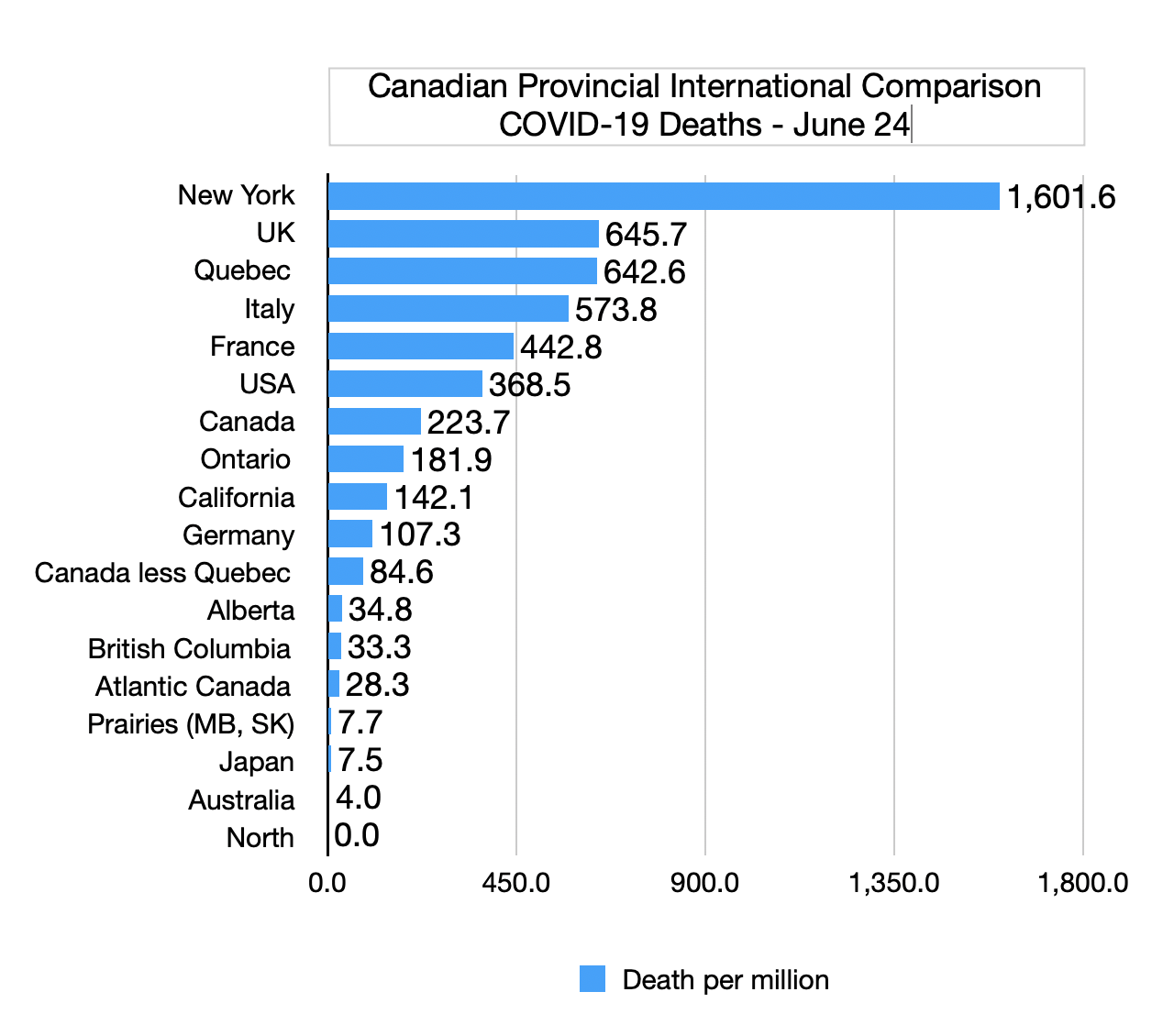
#COVID-19: Comparing provinces with other countries 24 June Update – Quebec deaths higher than UK

Latest update:


Online registrar threatens to drop anti-immigration website

Of note.

Brimelow, if I recall correctly, was mentioned by Paul Wells in his The Longer I’m Prime Minister as having an influence in his decision to replace the 2011 Census with the less accurate National Household Survey:

An internet registrar is threatening to delist a website that is a leading promoter of white nationalist and anti-immigration views, a move that could make the site accessible only to diehard users willing to use a special browser to find it on the dark web.

Network Solutions’ parent company, Web.com Group, notified a civil rights group on Friday that it has “taken steps” to terminate the company’s account for VDARE.com, which would make it unreachable on the public internet unless it can find another provider willing to register the domain name.

VDARE remained online Monday. The website has until Thursday to transfer the domain before Network Solutions may delete its services, a parent company lawyer said in a letter to a VDARE attorney last week.

In April and in May, the head of the Lawyers’ Committee for Civil Rights Under Law sent letters urging Network Solutions to drop VDARE. Kristen Clarke, the Washington, D.C.-based group’s president and executive director, wrote that VDARE peddles “anti-immigrant and anti-Black hate,” spreads misinformation about the coronavirus and encourages violence against migrants.

“This is part of our ongoing work to confront the ways in which hate activity festers online,” Clarke said Monday. “We know that many white supremacists and extremists are not organizing in basements. They are using these platforms and websites to spread their dangerous ideologies, target victims and incite violence.”

In Friday’s response to Clarke, a company attorney said VDARE’s content “does not represent the values of our organization” and violates its “Acceptable Use Policy.” The policy bars customers from using its domains “to display bigotry, racism, discrimination, or hatred in any manner whatsoever,” the same company attorney said in a letter to a VDARE lawyer last week.

VDARE founder and editor Peter Brimelow said his site’s content hasn’t changed in the 20 years that it has been a Network Solutions customer.

“Censorship is just intensifying,” he wrote in an email on Monday. “We’re still working on a replacement, but there is certainly a chance we’ll have to go dark for at least a couple of days. And anyway we have no confidence that any US-based site will stand up to the PC lynch mob for long.”

Many websites that publish white nationalist, white supremacist or anti-Semitic material have struggled to stay online or been booted off mainstream internet platforms, often after violent attacks by far-right extremists.

Google and GoDaddy yanked The Daily Stormer’s web address after the neo-Nazi website’s founder, Andrew Anglin, published a post mocking the woman killed when a man drove a car into a crowd of counterprotesters at a 2017 white nationalist rally in Charlottesville, Virginia.

Social media platform Gab, where the suspect in the Pittsburgh synagogue massacre spewed anti-Semitic messages before the 2018 shooting rampage, was briefly knocked offline after registrar GoDaddy and others dropped the site. Gab returned after a Seattle-based company, Epik, agreed to register it.

Users spewed anonymous hate on 8chan, an online message boar d, until a string of mass shootings by gunmen who posted manifestos on the site led to it getting forced offline in August 2019. The disruption ended when the imageboard relaunched in November under the new name 8kun.

This isn’t the first time VDARE has been dropped by a technology company. Facebook announced last month that it removed accounts linked to VDARE and other groups, including pages devoted to the QAnon far-right conspiracy theory.

Brimelow sued The New York Times Company in January, claiming the newspaper defamed him by referring to him as an “open white nationalist.” The suit seeks at least $5 million in damages.

Last Thursday, newspaper lawyers urged a federal court in New York to throw out the lawsuit, accusing Brimelow of playing “word games about how his fringe views should be characterized.”

“Brimelow has promoted theories at the heart of white nationalism and white supremacy, including that certain races are predisposed to commit crime and that IQ is linked to race,” they wrote.

Brimelow has denied that his website is white nationalist but acknowledged it publishes works by writers who fit that description “in the sense that they aim to defend the interests of American whites.”

Brimelow also operates a Connecticut-based nonprofit, VDARE Foundation, which raised more than $1.8 million in tax-exempt gifts, grants and contributions between 2014 and 2018, according to an IRS tax filing.

Source: Online registrar threatens to drop anti-immigration website