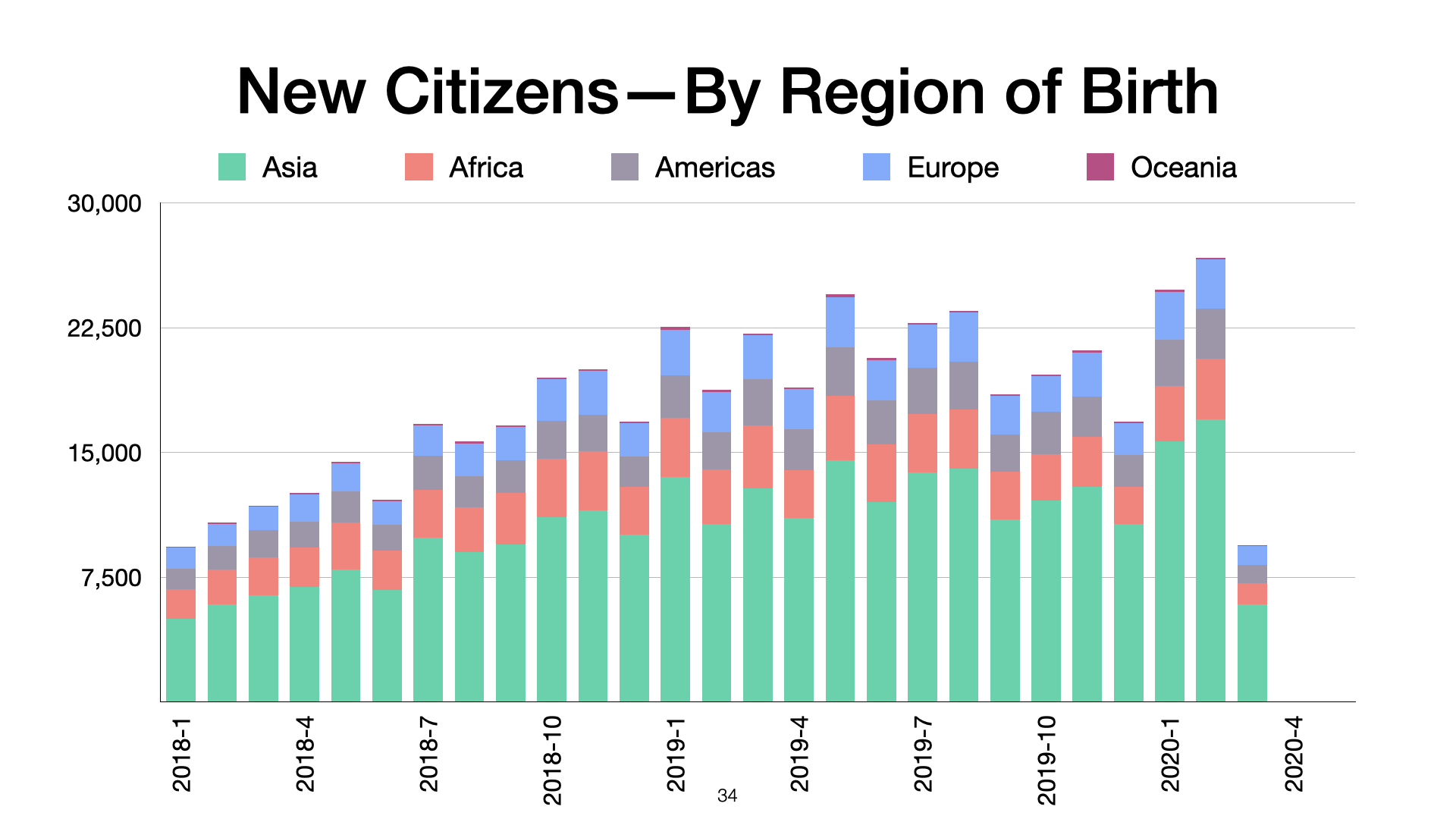
Citizenship statistics 2020: How the complete shutdown looks

With open data now having posted the 2020 numbers, we have comparable data across all IRCC programs regarding the impact of COVID-19. The data reflects the  complete shut down of citizenship ceremonies (save for a few online).

Having this baseline data will allow for analysis of how quickly the program recovers.

Unfortunately, open data does not publish citizenship applications (unlike virtually all other programs, so we only have a partial picture). Annoyingly, the IRCC country of birth listing is different from the other programs’ country of citizenship listing, making it harder to sort alphabetically across programs (i.e., citizenship country of birth Peoples Republic of China compared to other data tables, China, PRC, The Netherlands vs. Netherlands, The etc).

Multiracial Congregations May Not Bridge Racial Divide

Interesting study and findings:

Twenty years ago, a sociologist at Rice University, Michael Emerson, directed a study of efforts by white evangelical Christians to address racial inequality. His provocative conclusion, summarized in his book Divided By Faith, co-authored with Christian Smith, was that evangelicals “likely do more to perpetuate the racial divide than to tear it down,” largely because they tended to worship in racially segregated congregations and viewed racial prejudice as an individual, not a societal, problem.

The book, published in 2000, captured wide attention in evangelical circles and was featured on the cover of the magazine Christianity Today.

Emerson then proposed an answer to the problem he had highlighted: If Christians of different racial backgrounds began worshipping together, he suggested, racial reconciliation could follow. In a 2004 book, United By Faith, a sequel to his earlier book, Emerson and a team of collaborators called for a new church movement.

“The 21st century,” they argued, “must be the century of multiracial congregations.”

Emerson, who is white, became personally committed to the cause, moving his own family into a mostly African-American congregation. He soon became a godfather of sorts for the multiracial church movement, consulting with congregations around the country on how to promote diversity in worship. The key, Emerson argued, was to do it with deliberate purpose.

“You put it into your mission statement,” he said in a 2019 interview with NPR. “You think about who is up on the platform during worship and who is put into leadership and the ministry. You think about the artwork and the books you’re using and the music you’re playing. Does it reflect all people or only one culture?”

For many, the multiracial church movement appeared to be a good idea, attracting both whites and people of color.

In Columbus, Ohio, Korie Little Edwards, who was attending a Black church, was one of those intrigued by the promise of more diversity in her worship experience.

“I bumped into someone who said, ‘Hey, I go to this multiracial church, and it’s down here in the city. Why don’t you check it out?'” Little Edwards told NPR. “And I thought, ‘Yeah, well, why not?'”

Little Edwards teaches sociology at the Ohio State University, but at the time her interest in the church was personal.

“I had this idea that, ‘Yeah, this would be really great,'” she said. “I thought, ‘This will be a place governed by Christian ideals, a place where people can come and connect with one another and support one another.’ I was thinking that multiracial churches could be an answer to racial inequality.”

In the years that followed, Little Edward’s interest in the multiracial church movement became professional. As a sociologist of religion, she wanted to see whether diverse churches could help break down racism, and she began visiting congregations and interviewing members and church leaders with a team of research assistants, identifying the strategies they followed and the problems they encountered.

A church transformed

In Fort Worth, Texas, a white Southern Baptist pastor named Randal Lyle heard about Michael Emerson and his multiracial church movement and resolved to diversify his own nearly all white church, Meadowridge Baptist. The obstacles were quickly apparent.

Lyle’s youth minister organized a basketball league for African American youth from the neighborhood. When he learned some were devout Christians, he invited them to visit Meadowridge, Lyle says, only to be rebuffed.

“A young man told him, ‘I’m not going there. That’s a white church,'” Lyle says. He and his staff took the comment to heart.

“Our church was probably like most,” he told NPR. “We’d say we would welcome anybody who wants to come here, but what we meant was, as long as they do things exactly how we do them.”

After reviewing Michael Emerson’s books and videos on the subject, Lyle realized big changes at his church would be needed. He changed the sign out front to say, “All Races United In Christ.” The staff bought new toys for the children’s room, making sure they reflected racial diversity. They changed the artwork in the church, and Lyle organized a choir.

“When I first came here, I said, ‘We’re not going to do choir,'” Lyle said. “But then we began to think, ‘This community is primarily African American and Anglo. Choirs are huge in an African American church.’ So we realized we need to have a choir.”

The effort proved largely successful. The membership at Meadowridge Baptist is now about one-third African American, and the number of Latino members is growing.

“I needed a different experience,” says Myrtle Lee, 73, who left the Black church she had been attending and joined Meadowridge with her two sisters. “I wanted to worship with everybody that I worked with. I work with not just Black people. I wanted to go to church with those same people.”

One of her sisters, Cecilia Rhodes, says it took a while to get accustomed to worshiping in a predominantly white church.

“Sometimes, there was stares,” she says. “People looking at you kind of strangely. And then I just made it my mission to hug. So I started hugging people.”

Curtis Hudson, who is African American, joined Meadowridge with his wife Andrea, who is white, shortly after they moved to the Fort Worth area.

“We were looking for a church, and what we found were either all white or all Black,” Hudson says. “And then Andrea did a Google search for ‘mullticultural churches,’ and this church came up. So we said, ‘Let’s check it out.'”

Meadowridge remains today one of the few intentionally multicultural churches in the Dallas-Fort Worth area.

“I’d love to say it’s not rare,” says Myrtle Lee. “I’d love to say that. But I think it is.”

A one-way movement

The number of multiracial churches has actually been growing in the United States. A recently completed survey of congregations by Michael Emerson, now at the University of Illinois at Chicago, and Kevin Dougherty of Baylor University found that the share of churches defined as “multiracial,” with at least one out of five members from a minority background, grew from six percent in 1998 to 16 percent in 2019.

During that time, however, those multiracial churches did not themselves become significantly more diverse. The African American membership share in these churches grew only slightly, from 16 to 21 percent and actually declined between 2012 and 2019. The white membership share in multiracial churches from 1998 to 2019 remained nearly unchanged at about 50 percent.

“Integrated churches are tough things,” says Keith Moore, a Black pastor in Montgomery, Ala., who works closely with local white pastors. “When you see both African Americans and Caucasian Americans [in a church], it’s more than likely to have a Caucasian pastor,” he says. “I think it’s sometimes more difficult for whites to look at a black pastor and see him as their authority. That’s a tough call for many.”

As a result, Moore says, African Americans ready to worship in a multiracial church are often forced to accept white leadership and a different worship style.

“You have to abandon some of your ethnic culture and become more palatable to the majority white culture,” Moore says, “give up some of the old traditional African American experience to fit in. So there is a sacrifice.”

Moore’s impressions, in fact, are supported by the research of Emerson and Dougherty.

“All the growth [in multiracial churches] has been people of color moving into white churches,” Emerson says. “We have seen zero change in the percentage of whites moving into churches of color.” Once a multi-racial church becomes less than 50 percent white, Emerson says, the whites leave. Such findings have left Emerson discouraged.

“For the leaders of color who were trying to create the multiracial church movement,” Emerson says, “they’re basically saying, ‘It doesn’t work. The white brothers and sisters just won’t give up their privilege. And so we’ve been defeated, in a sense.'”

The continuing power of race

In Columbus, Ohio, Korie Little Edwards found a similar pattern in her own research. After her personal interest led her to join a multiracial church, her subsequent study left her skeptical that such churches were making the difference in promoting equality that she had hoped to see.

“I came to a point where I realized that, you know, these multiracial churches, just because they’re multiracial, doesn’t mean they have somehow escaped white supremacy,” she says. “Being diverse doesn’t mean that white people are not going to still be in charge and run things.”

In her book The Elusive Dream: The Power of Race in Interracial Churches, Little Edwards argued that people of color often lose out.

“The pain people experience is not feeling like they’re accepted for who they are,” she told NPR, “not being able to be themselves, not being able to worship how they want to worship, feeling like you have to fall in line with what white people expect you to do.”

In their own churches, Little Edwards says, African Americans often dress formally and expect worship services to last about two hours on average. When they join diverse churches, they generally find the white members insisting on shorter services and favoring more casual dress.

Beyond style differences, Little Edwards says, Black people in a multiracial congregation may be reluctant to push for a leadership role and feel pressure instead to settle for a visible or symbolic position, as a greeter or usher or musician.

“What’s at work here is the power of whiteness,” she says. “And what whiteness says is that people who are white are understood to be dominant and understood to be in charge.”

Little Edwards herself continues to attend a multiracial church, but that feature is not what binds her to the congregation, and her view of the value of integrated churches has shifted somewhat.

“I would argue that the goal shouldn’t be diversity,” she says. “Rather, all churches are called to be places of justice, uplifting the oppressed. That is what the Christian faith is. All churches, regardless of their racial and ethnic composition, should be like that. And then you can move toward integration.”
Source: Multiracial Congregations May Not Bridge Racial Divide

Lang: Missing – public servants who could warn Trudeau about WE conflict

Good commentary by Lang who worked under Herb Gray when he was deputy PM (I worked in PCO at the time and interacted with him time-to-time):

“Mandarin” is another word sometimes associated with such powerful bureaucrats, who were occasionally resented – but often valued – by politicians for their knowledge, wisdom and willingness to stand up to ministers to ensure the basic integrity of the ministry.

As the government has lurched from the SNC-Lavalin scandal of a year or so ago to the WE charity controversy of today – both of which centre on questions of prime ministerial and ministerial ethics and judgment – one question that isn’t asked enough is “Where are the mandarins in all this?”

When Justin Trudeau’s government came to office nearly five years ago, its chief hallmark was inexperience. The few ministers from previous Liberal administrations in its ranks at the beginning had little power. From its inception, power in the Trudeau government has been highly concentrated in the Prime Minister’s Office and among a few trusted ministers — notably Chrystia Freeland and Bill Morneau — none of whom had any prior government experience.

The feeling among some Ottawa watchers in the early days was that this inexperience would be managed and shaped by the mandarins. They would help ensure the government remained stable, competent and exhibited good judgment most of the time. This expectation was re-enforced by the prime minister himself, who stated early on that his government would rely much more heavily on the advice and counsel of the professional public service than his predecessor, Stephen Harper, had.

It doesn’t seem to have worked out that way. Or, perhaps there are no “old school” deputy ministers left in the government of Canada.

Take the SNC-Lavalin scandal. The issue boiled down to a big company allegedly threatening to cut jobs and investment in Canada if it was not given a specific legal concession from the government that would enable the firm to continue to bid on federal contracts.

Any decent mandarin should have known at the outset that corporations routinely tell the federal government job losses will result if they do not get X, Y or Z. This kind of thing used to be greeted with skepticism by the public service, justifiably so. But if the SNC threat was judged a serious risk, there was also a time when a few senior deputy ministers would have sprung into action and developed options for the government to manage its way of out of the issue, such that it might never even have come to public attention, much less have led to two ministerial resignations and threatened the viability of the government.

Today, we have the controversy surrounding WE, a charity that the prime minister and his wife have had a longstanding and very public association with, and to which the government intended to direct a contract worth some $19 million. The Clerk of the Privy Council, the prime minister’s deputy minister, must have known about Trudeau’s general relationship with WE.  He must have seen a conflict of interest here, or at least an appearance of conflict. An “old school” Clerk would have insisted on the prime minister recusing himself from any cabinet decision-making on this issue to protect the prime minister and the government. Instead, if we are to take Trudeau at his word, the public service more or less boxed him and his ministers in to an inevitable appearance of conflict of interest by recommending that only WE could do the job and offering no alternatives, something very rare in government.

None of this is to say that public servants are responsible for either the SNC-Lavalin scandal or the WE mess. Responsibility for both rests on the shoulders of the prime minister and his cabinet.  There is no legal, or even ethical, obligation on deputy ministers to stop ministers from exercising terrible judgment. Yet there was a time, not that long ago, when the expectation was that some wise, “old school” deputies had the government’s back.

Source: Lang: Missing – public servants who could warn Trudeau about WE conflict

Andrew MacDougall’s take is also worthy of note:

The thing you have to understand about the federal public service is that it isn’t geared toward excitement; it’s a “safety first” kind of place.

Pick a policy, any policy. If there’s a Flashy Option A and a Boring Option B, the public service opts for boring every day of the week and twice on Sunday. And that goes treble if Flashy Option A is, to pick a random example out of thin air, a sole-source contract worth nearly $1 billion to an organization with no track record of delivery of federal programming.

Put differently, the only way the public service recommended WE for the CSSG is if the political wing of the government gave it such narrow specifications that it could return only one answer. You can bet there exists, somewhere, an exquisitely crafted memo from the public service to cabinet saying, in effect: “If you really want to go forward with this completely brain-dead approach to federal programming, then you go right ahead, ministry.” The job of the opposition and the press is to now surface that memo.

Because thankfully for Trudeau, the federal bureaucracy is also rather polite, which explains why the prime minister is being allowed to hide behind his version of events. The public service is used to being human shields for politicians and will keep quiet.

Which isn’t to say the prime minister’s story is surviving contact with reality. Every day brings another WE tale of woe.

In this (still-surfacing) version of events, a charity with a long association with the prime minister, his family and his advisers, one that pays hundreds of thousands of dollars to Trudeau’s family members and puts together slick, campaign-style videos promoting the prime minister while simultaneously receiving millions of dollars of government grants and contributions and other sole-source contracts, is being laid low by the pernicious effects of the coronavirus. There is massive churn on the board of directors and large numbers of staff are being laid off as Canada enters lockdown. All looks lost. Until, that is, the Trudeau government comes to the rescue with an offer to administer a pandemic-related program.

According to the charity, the Prime Minister’s Office rang up the day after the program was announced in April to say it needed help from WE to deliver the program. All with the blessing of the federal public service of course, which already, by the way, runs the Canada Summer Jobs program targeted at much the same audience as the new Canada Student Service Grant. What are the odds?

Not that WE had ever delivered a similar program, mind you. Not that WE even have the staff to deliver the program (the charity had to hire back hundreds of laid-off staff in anticipation of getting the work before the program was formally announced in June). Not that WE even have any particularly good ideas to pull students into the program, other than throwing money at other groups to do it for them. And we’re meant to believe this group was the “only” one capable of delivering the program?

A sure sign Trudeau’s version of the story isn’t true is the fact he won’t release any evidence to support it. The government won’t even say which other groups were considered to deliver the grant.

In other words, this contract was friends, not safety, first.

Source: https://ottawacitizen.com/opinion/macdougall-trudeau-ducks-for-cover-behind-the-non-partisan-public-service/wcm/0748db2c-65e8-4ddd-999d-b5bb87c16067/

Officials: Pentagon eyes new way to bar Confederate flag

Clever move:

Defence leaders, who for weeks have been tied in knots over the incendiary issue of banning the Confederate flag, are weighing a new policy that would bar its display at department facilities without actually mentioning its name, several U.S. officials said Thursday.

No final decisions have been made, but officials said the new plan presents a creative way to ban the Confederate flag in a manner that may not raise the ire of President Donald Trump, who has defended people’s rights to display it. The officials spoke on condition of anonymity to discuss ongoing internal deliberations.

Secretary Mark Esper discussed the new plan with senior leaders this week, triggering some bewilderment over the lack of an appetite for a straight-forward ban on divisive symbols. The Marine Corp has already banned the Confederate flag saying it can inflame division and weaken unit cohesion. Military commands in South Korea and Japan quickly followed suit and the other three military services were all moving to do the same when they were stopped by Esper, who wanted a more uniform, consistent policy across the whole department.

An early version of the Department plan banned display of the Confederate flag, saying the prohibition would preserve “the morale of our personnel, good order and discipline within the military ranks and unit cohesion.”

That policy was never finalized, and a new version floating around the Pentagon this week takes a different tack, simply listing the types of flags that may be displayed at military installations. The Confederate flag is not among them – thus barring its display without singling it out in a “ban.”

Acceptable flags would include the U.S. and state banners and the widely displayed POW/MIA flag. Official military division and unit flags are also likely to be allowed.

The move is an attempt at finding compromise, as Esper tries to enact a ban that passes legal muster, gives military leaders what they want, but doesn’t infuriate the commander in chief. That delicate balance has proven difficult and officials said Thursday there was no guarantee that this latest version would make the final cut.

An apparent sticking point is whether the military services will be allowed to develop their own more stringent policies on what they consider to be divisive symbols, and whether the policy will state that or leave it unsaid.

Army Secretary Ryan McCarthy told reporters on Thursday that he is still working on a policy that would remove all divisive symbols from Army installations.

He specifically didn’t mention the flag, but said, “we would have any divisive symbols on a no-fly list.”

Confederate flags, monuments and military base names have become a national flashpoint in the weeks since the death of George Floyd. Protesters decrying racism have targeted Confederate monuments in multiple cities. Some state officials are considering taking them down, but they face vehement opposition in some areas.

Trump has flatly rejected any notion of changing base names, and has defended the flying of the Confederate flag, saying it’s a freedom of speech issue.

Source: Officials: Pentagon eyes new way to bar Confederate flag

Ottawa adding new census questions on gender, Indigenous people, linguistic and ethnic minorities

Not surprising. The 2021 Census will also include religion (done every 10 years):

The 2021 census will for the first time count transgender Canadians and include questions designed to get better data on Indigenous communities, linguistic minorities and ethnic groups.

According to federal officials, the new census questionnaires will address long-standing requests from groups who said the previous census questionnaire did not count everyone in their communities or that the numbers were imprecise.

In particular, the changes will affect the way Statistics Canada counts members of Indigenous communities, ethnic communities such as Jews, transgender Canadians and members of anglophone and francophone minorities. In the case of linguistic minorities, the new short-form and long-form census questionnaires are designed to improve their access to public schools, as guaranteed under the Charter of Rights and Freedoms.

The Globe and Mail is not identifying the federal officials because they were not authorized to speak about the matter before the new questionnaires are made public in the Canada Gazette on Friday afternoon.

While the 2016 census asked people to list their sex as male or female, the officials said the 2021 census will ask a question about the respondent’s sex at birth and another question about the person’s current gender, marking the first time the census has counted transgender Canadians.

It will also aim to provide more data on Indigenous groups, who will no longer be referred to in the document as Aboriginal. For example, the new questions will help identify the beneficiaries of Inuit land-claims agreements and determine the number of members of the Métis Nation.

Officials said the government will also address criticism from Jewish groups who said a change to the question about ethnic identity in the 2016 census left them drastically underrepresented. With the omission of “Jewish” as one of the listed examples of ethnic ancestry, the official count of Canada’s Jewish population fell from about 309,000 in 2011 to little more than 143,000 in 2016. As a result, the government will add a significant number of examples of ethnic origin to the 2021 census, which will once again include “Jewish” as a possible answer.

After coming to power in 2015, the Trudeau government made it mandatory for recipients of the long-form census to fill out the questionnaire, reversing a decision by the Harper government.

A new law adopted in 2017 gave Statistics Canada more independence, but the power to determine census questions remains in the hands of the government, with Innovation Minister Navdeep Bains acting as the lead minister on the file.

Federal officials said cabinet recently approved changes to both the short-form census questionnaire, which goes to 80 per cent of households, and the more detailed long-form questionnaire, which goes to the remaining 20 per cent. Statistics Canada had set this month as the deadline for the final versions to be approved in order to be ready for next year’s census.

Both will include new questions about education history as part of an effort to determine precisely how many Canadian children are eligible to go to an English-language school in Quebec or a French-language school in the rest of the country.

The proponents of the census changes have argued that provinces and school boards currently lack the necessary data to plan the construction of new schools, leading to a shortage of spaces in many parts of the country. They say the new questions will help them obtain an exact count of Canadians known as “rights-holders,” who have the right to send their children to either French- or English-language public schools.

By making all Canadians answer questions about language skills and schooling history, Ottawa will be providing linguistic minorities with another victory on the education front. Last month, the Supreme Court of Canada ruled that, even when their numbers are relatively small, linguistic minorities have a right to their own high-quality schools.

Source: Ottawa adding new census questions on gender, Indigenous people, linguistic and ethnic minorities

Graffiti on monument commemorating Nazi SS division being investigated as a hate crime by police

How is the original monument not considered a symbol reflecting hate, if not a hate crime in itself. That being said, a petition or activism to remove the monument is the appropriate response, not anonymous spray painting:

An incident involving graffiti spray painted on a monument to those who fought in Adolf Hitler’s SS is being investigated as a hate crime by an Ontario police force.

Someone painted “Nazi war monument” on a stone cenotaph commemorating those who served with the 14th SS Division. The monument is located in Oakville in the St. Volodymyr Ukrainian Cemetery.

In response to questions from this newspaper, Const. Steve Elms, spokesman for Halton-Regional Police, cited a section of the Criminal Code that noted those communicating statements in any public place inciting hatred against any identifiable group could face imprisonment not exceeding two years. “This incident occurred to a monument and the graffiti appeared to target an identifiable group,” he explained in an email to questions about how a hate crime could be perpetrated against members of the SS.The 14th SS Division, also known as the Galizien Division, was formed in 1943 when Nazi Germany needed to shore up its forces as allied troops, including those from the U.S., Canada, Britain and Russia, started to gain the upper hand and turn the tide of the war. In May 1944, SS leader Heinrich Himmler addressed the division with a speech that was greeted by cheers.  “Your homeland has become more beautiful since you have lost – on our initiative, I must say – the residents who were so often a dirty blemish on Galicia’s good name – namely the Jews,” Himmler said. “I know that if I ordered you to liquidate the Poles, I would be giving you permission to do what you are eager to do anyway.”

SS leader Heinrich Himmler greets members of the 14th SS Division during the Second World War. Police say graffiti left on an Oakville monument to the SS division is being investigated as a hate-motivated crime. (Photo courtesy US Holocaust Memorial Museum)
SS leader Heinrich Himmler greets members of the 14th SS Division during the Second World War. Police say graffiti left on an Oakville monument to the SS division is being investigated as a hate-motivated crime. (Photo courtesy US Holocaust Memorial Museum) /jpg

There are allegations members of the 14th SS Division took part in killing hundreds of Polish civilians in 1944 in the village of Huta Pieniacka. Some Ukrainians dispute that the SS division took part in the killings or they argue that only small elements from the unit – and under Nazi command – were involved. Others argue the SS members were heroes who fought against the Russians.

In 2017, a Polish judge issued an arrest warrant for then 98-year old Michael Karkoc, a 14th SS Division deputy company commander for war crimes. Karkoc, living in the U.S., died before he could be tried in court. He had been accused of coordinating the massacre of 44 civilians, including women and children, in the Polish village of Chłaniów in 1944.

Bernie Farber of the Canadian Anti-Hate Network said there is a need for Halton Regional Police to better educate themselves on what constitutes a hate-motivated crime. “Yes, it’s destruction of property for sure,” Farber said of the graffiti on the monument. “But a hate crime? Far from it.”

The monument to the 14th SS Division was also in the headlines in 2017 when the Russian Embassy in Ottawa posted images on its Twitter account pointing out the “Nazi monuments” in Canada.

Source: Graffiti on monument commemorating Nazi SS division being investigated as a hate crime by police

‘Invasion’ of ancient Egypt may have actually been immigrant uprising

Interesting and impressive work:

Ancient Egypt’s first “foreign” takeover may actually have been an inside job. About 3600 years ago, the pharaohs briefly lost control of northern Egypt to the Hyksos, rulers who looked and behaved like people from an area stretching from present-day Syria in the north to Israel in the south. The traditional explanation is that the Hyksos were an invading force. But a fresh analysis of skeletons from the ancient Hyksos capital suggests an alternative: The Hyksos were Egyptian-born members of an immigrant community that rose up and grabbed power.

The pharaohs ruled Egypt from about 3100 B.C.E. to 30 B.C.E., but they weren’t always in complete command of their territory. One period of vulnerability began around 1800 B.C.E., with a succession of ineffectual pharaohs who struggled to maintain order. The Hyksos took advantage of the power vacuum by seizing control of northern Egypt, according to ancient texts, leaving the pharaohs in charge of only a tiny strip of land to the south.

Archaeologists know the Hyksos were unlike typical Egyptians: They had names like those of people from the neighboring region of southwest Asia. Ancient artwork depicts them wearing long, multicolored clothes, unlike normal Egyptian white attire. But exactly who they were has been unclear.

Source: ‘Invasion’ of ancient Egypt may have actually been immigrant uprising

Canada will have to rely on immigration as global fertility rate plummets: study

More on demographic trends, without asking whether there are policy alternatives to increased immigration or accounting for the likely impact of increased automation and AI:

Canada’s current openness to immigration must continue if the country wants to maintain one of the world’s largest economies for the rest of the century, according to a new study projecting global population and economic trends between now and 2100.

The study, which was published Tuesday in The Lancet, primarily focuses on an anticipated decline in the world population as fertility rates fall in the second half of the 21st century.

It forecasts that the global population will peak in 2064 at 9.73 billion people. By 2100 – less than two generations later – that number will be nearly one billion lower, and nearly three-quarters of the 195 nations included in the study will not be producing enough children to maintain their workforces.

“Once global population decline begins, it will probably continue inexorably,” the researchers behind the study wrote.

The study predicts that Canada’s population will peak later in the century, at nearly 45.2 million in 2078, and fall slightly to 44.1 million by 2100.

According to the researchers, a declining population is “potentially good news” for the battle against climate change, but not enough on its own to save the planet from serious environmental effects.

Shrinking populations can also cause economic damage, as fewer people are available to work. One way to offset this is by accepting large numbers of immigrants to make up the difference, as Canada has been doing for decades.

The researchers expect Canada to become an even more prominent immigration hub over the next 80 years, forecasting us to have the world’s highest net migration rate – immigrants minus emigrants – by 2100, ahead of Turkey and Sweden. This would happen despite the current “steady stream” of migrants drying up somewhat, as developing nations improve their education systems and quality of life.

All that immigration would see Canada replacing Russia as the world 10th-largest economy by 2030 and remaining there for the rest of the century, even as Nigeria and Australia bump Brazil and Italy out of the top 10, according to the forecast.

“As long as these immigration policies continue, our reference scenario showed sustained population growth and workforce expansion … with concomitant economic growth,” the researchers wrote.

“The optimal strategy for economic growth, fiscal stability, and geopolitical security is liberal immigration with effective assimilation into these societies.”

In countries where immigration is not used to maintain the workforce and GDP, the researchers wrote, governments may instead look to create incentives for parents to have more children, such as baby bonuses and paid parental leave. They warned that there is also a “very real danger” that “some states might consider adopting policies that restrict female reproductive health rights.”

Not taking any action to maintain the size of the workforce could leave countries in a position where they have to significantly increase taxes or run the risk that health insurance and social security programs could collapse, the researchers said.

The study was funded by the Bill and Melinda Gates Foundation and carried out by researchers at the University of Washington.

NOT SET IN STONE

In addition to their overall projections, the researchers looked at what would happen if the worldsped up or slowed down its progress on meeting the United Nations’ sustainable development goals (SDG) regarding female educational attainment and contraceptive need. “Many countries are not on track” to achieve those goals, they said.

These factors make a significant difference in the forecasts. Slower movement toward those goals would result in a global population of 13.6 billion and still rising in 2100, the researchers found, while the pace required to fully meet the SDGs by 2100 would see the world’s population peak in 2046 and fall to 6.29 billion by the end of the century as fertility rates plummet.

The differences are less stark in Canada, where migration is expected to have a much larger impact than global fertility patterns on population trends. The study forecasts that with slower progress toward SDGs, Canada’s population would peak in 2086 at just over 46.1 million – less than one million more than the projection based on the current pace. Meeting the SDGs by 2100 would have a bigger impact, with the population peaking around 42 million in the mid-2050s and dropping to 37 million by 2100.

The researchers say these large variations show the effect political policies can have on long-term population and economic outcomes.

“Understanding potential patterns in future population levels is crucial for anticipating and planning for changing age structures, resource and health-care needs, and environmental and economic landscapes,” they wrote.

Other highlights from the study’s projections of the world in 2100 include:

  • The five largest countries, by population, will be India, Nigeria, China, the U.S. and Pakistan

  • China will have barely half of its current population, while India’s will be down by roughly 300 million and the American population will be relatively unchanged

  • Japan, Spain, Italy and 20 other nations will lose half or more of their 2017 population

  • Nearly half of the world’s population will be in Africa as the population of the sub-Saharan part of the continent triples

  • Life expectancies will continue to rise, albeit slowly, nearing 89 years in the most advanced countries

  • The mean age of a human, which was 32.6 in 2017, will be at 46.2

  • There will be more than six times as many people over the age of 80 as there were in 2017

  • The number of children under the age of five will be 41 per cent lower than it was in 2017

  • Although China will eclipse the U.S. as the world’s largest economic power by 2035, the U.S. will retake that title in 2098

Source: Canada will have to rely on immigration as global fertility rate plummets: study

US Military: Esper order aims to expand diversity, skirts major decisions

While avoiding the political questions, some practical initiatives (the US military has played a significant role in integration of African Americans):

Secretary Mark Esper took steps Wednesday to expand diversity within the military and reduce prejudice, but he skirted several major decisions, including whether to ban the Confederate flag at installations.

In a four-page memo, Esper ordered all military services to stop providing service members’ photos for promotion boards, directed a review of hairstyle and grooming policies, and called for improved training and data collection on diversity. Absent from the memo was any mention of the issues that have roiled the nation — efforts to ban the Confederate flag and a growing movement to remove Confederate statutes and rename military bases Confederate leaders.

Confederate flags, monuments and military base names have become a national flashpoint in the weeks since the death of George Floyd. Protesters decrying racism have targeted Confederate monuments in multiple cities. Some state officials are considering taking them down, but they face vehement opposition in some areas.

A draft policy circulated by Pentagon leaders more than a week ago would have banned the display of the Confederate flag in Department workplaces or public areas by service members and civilian personnel. It said a ban would preserve “the morale of our personnel, good order and discipline within the military ranks and unit cohesion.” That policy was never finalized or signed, and instead officials say it is now being revised.

President Donald Trump has flatly rejected any notion of changing base names, and has defended the flying of the Confederate flag, saying it’s a freedom of speech issue. Esper spent last Friday with Trump in Florida, but it’s unclear if they talked about the flag ban.

The Marine Corps and U.S. commands in Korea and Japan have already banned display of the Confederate flag, saying it can inflame division and weaken unit cohesion. The Navy, Air Force and Army were all ready to do the same, but their progress was halted when Esper made it known he wanted to develop one consistent policy.

Some of the orders in Esper’s memo released Wednesday are already in effect by the military services, but his directive is a move to also make those policies more consistent.

For example, he ordered the military to no longer include photos of service members when they are being considered by a promotion board. This would mark a change for the Navy and Marine Corps. But, the Air Force removed photos from promotion boards more than a decade ago, and Army Secretary Ryan McCarthy announced last month that beginning in August his service would no longer include them.

The Navy eliminated the photos in 2016, then added them back in 2018 after members of promotion boards complained. They said the photos aided their ability to assess a service member’s “ability to perform the duties of the next higher grade,” according to the 2018 memo. The Marines have always included photos.

Army officials last month said they were eliminating the photos because a study showed they could make a difference in some promotion boards. The study suggested that when the photo is not included, it took board members less time to vote, their scores were more closely aligned and “the outcomes for minorities and women improved.”

Esper’s memo, however, left other promotion board issues unresolved and subject to further review, including whether the services should redact the box on the form that identifies a person’s race or whether a person’s name — which in some cases could indicate race or gender — should also be removed.

He also ordered a review of hairstyle and grooming policies, which all the military services have done multiple times in recent years. They have all loosened restrictions, particularly on women’s hair, to allow for more ethnic hairstyles, including various braids and larger buns.

Esper also has asked that every time he receives a promotion list from one of the services, it includes a review that shows the racial make-up of the pool of candidates and also of the group getting promoted.

The services have historically compiled that data, and it is always provided to the secretary with promotion results for higher ranks — one star and above. For years, it was also provided for lower ranks, but in 2009, the department switched to an annual report, and stopped providing it to the chief for each promotion list.

A senior official said giving the secretary the review for every list is meant to identify any potential problems or lack of diversity and wasn’t expected to affect the promotion results. The official spoke on condition of anonymity to describe a personnel issue.

Esper also met Wednesday with his newly formed Board on Diversity and Inclusion, which is expected to identify potential policy changes over the coming months. It will deliver a final report in December, and then be replaced by a permanent commission.

Source: Esper order aims to expand diversity, skirts major decisions

Senator Omidvar: No longer business as usual [diversity and governance]

Good arguments by Senator Omidvar:

Over the last month Canadians have taken to the streets to protest against racism, calling for justice, truth and an appropriate reflection of diversity in all aspects of Canadian life, in particular in places of power and influence.

In this context, those who are appointed or elected to the nation’s public and private boards as directors deserve special attention.  They include the directors of publicly listed corporations, public agencies, boards and commissions at the federal, provincial and local levels, as well as those who govern Canada’s private foundations and charities.

For the most part, these corridors of power are a reflection of the old Canada and the privileges accrued to one demographic: mainly white and mainly male. There has been almost no real movement for visible minorities (including Black Canadians), Indigenous Peoples and the disabled as they stand on the bottom rungs of governance, even though their share of the population is 27.2 per cent for Indigenous and visible minorities and 22 per cent for the disabled.

If we are serious about going beyond mouthing platitudes on diversity, then we must become more intentional about it — first by grounding change based on evidence and next by charting a way forward.

Typically, change comes in one of two ways: either we are legislated by our governments to behave a certain way or we choose to do so willingly. Both can be propelled by events. The events and the mood of the day call for a combination of both, but with an underlining imperative of urgency.

Just as the corporate sector has been intentional about bringing more women on to their boards, they can and must turn their eyes now to both men and women who are Black and Indigenous. Business understands this. The Canadian technology sector has come together to launch a new effort to eliminate racism and bring diversity into its fold. Earlier, through the leadership of Wes Hall, and Bay Street influencers like Victor Dodig, Prem Watsa and Rola Dagher announced the launch of the Canadian Council of Business Leaders against Anti-Black Racism. If they are successful and demonstrate results, they will transform not just how they do business, but who they are.

In turn, the federal government should rethink its approach to corporate reporting on diversity. A few years ago, the government passed Bill C-25 which requires federally listed corporations to develop diversity plans, and to either “comply or explain” their progress on an annual basis. The first such reports are trickling in and if there is progress, it is in terms of gender.  The opposite is true of racial and ethnic minorities, the disabled and Indigenous peoples.

With the hindsight and wisdom of today, the government needs to make every effort to go beyond “diversity planning” to “governance equity.”  They should amend the law to include employment equity definitions (EE) since EE laws have changed the face of the workforce in this country. A similar approach is needed in governance.

Further, the search for truth should take us into the hazy world of public agencies, boards, commissions and crown corporations. These include big nation-building institutions at the federal level, like the CBC but also hundreds of provincial and municipal agencies boards and commissions. Data at the federal level is scarce, and what exists isn’t fulsome, aggregated amongst groups, nor is it regularly disclosed. This is a missed opportunity because as we know, what gets measured, gets reported and gets actioned. Statistics Canada should be given the mandate to gather and report this data on an annual basis.

The search for truth also includes Canada’s 175,000 charities, foundations and not for profits. They hold our country together —whether in small towns, or large urban centres. They touch every aspect of our society, from sport to religion, from seniors to youth. Philosophically, they are more likely to embrace values and principles of inclusion and voluntarily begin to gather data on governance through their large and powerful industry associations.  They should begin to do at the earliest possible opportunity, thus leading the way for other sectors to follow.

This voluntary resolve must be further strengthened by government action.  The CRA should amend the T3010 and the T1044 forms that charities and not for profits file annually to include a simple question on diversity representation on boards of directors based on existing EE guidelines.   In this way the country’s vast network of charities and not for profits may well be the first sector to have a fulsome picture of governance, inclusion and diversity.

It is easy to be aspirational, but it is imperative to move from aspiration to concrete action.   Gathering the evidence on governance in a thoughtful and sustained way will lead us from symbolic discussions about diversity to the real expression of inclusion.

The only option not on the governance table is simply governance as usual.

Source: ipolitics.ca/2020/07/15/no-…