Macron’s Islamic charter is an unprecedented attack on French secularism

The best analysis I have seen to date:

Adopted last month by the French Council of the Muslim Faith at the behest of President Emmanuel Macron, a new 10-point “Charter of Principles” of French Islam will please all those who have been calling for a “progressive,” “reformed” or “enlightened”Islam – one consistent with democratic, egalitarian and liberal western values.

It also represents a significant personal victory for Macron, who for months had pressured the council to craft a document committing to a “French Republican Islam”. Non-Muslim authorities, governments, media and public intellectuals have been demanding this for years as a way to combat “Islamism” and “extremism”.

It very clearly aims to turn Islam into a quietist, ‘pacified’ religion whose practitioners remain docile and obedient to the political powers-that-be

The unprecedented charter can thus be seen as a clear assertion that Islam is indeed compatible with secular democracies in general, and with the French republic in particular. In a nutshell, the charter aligns Islam with France’s republican principles, including gender equality; non-discrimination, including sexual orientation; and freedom of conscience, including the freedom to leave Islam.

It condemns “excessive proselytism” and attests to the superiority of and obligation for all Muslims to recognise France’s laws, constitution, republican principles and “public order”.

Article two proclaims an obligation for Muslims to “conform to the common rules” of France, which “must prevail over any other rules and convictions, including those of our own faith”. Article eight recognises the French principle of laicite, or secularism.

But article six, the longest, is also the most loaded. It proclaims that no mosques or other Islamic places can have “political agendas” or engage in political and ideological discourse or activity; these are described as “an instrumentalisation” and “perversion of Islam”, whose sole and “true purpose is prayers and the transmission of values”.

It condemns “the propagation of nationalist discourses defending foreign regimes and supporting foreign policies that are hostile to France, our country”. It dissociates Islam from “political Islam” and prohibits signatories from engaging in the latter, including “Salafism (Wahhabism), the Tabligh and the Muslim Brotherhood”. This amounts to an excommunication of those Islamic trends and movements from legitimate or “true” Islam.

Crafted by the executive

There is no doubt that this charter was essentially crafted by the French executive itself – especially Macron and Interior Minister Gerald Darmanin, who for years had been calling for the assimilation of Islam strictly within the limits, laws, principles and frameworks of France’s Fifth Republic. Darmanin even wrote a book about it.

The charter is not coming from Muslims. It is the brainchild of Macron’s campaign to force the French Muslim council to craft such a text, deploying against one religion a type of pressure, intimidation, threats, ultimatums and blackmail never before seen in French post-war history.

At the end of the signing ceremony, a close adviser to Macron explicitly threatened anyone who refuses to sign and live by the charter, saying: “Those who disagree will hear from us very quickly and see their operations inspected very, very closely by our services.” This, in a context where the interior ministry is banning Islamic NGOs, closing schools and shutting down mosques by the dozen.

This operation is an integral part of Macron’s crusade against “Islamist separatism”, for which he is using the French Council of the Muslim Faith as a facade, an alibi, a cover to circumvent a constitution that forbids state interference in religious doctrines. The charter is a word-for-word synthesis of all the injunctions and demands that Macron has addressed to Muslims over the past year.

Amazingly, article nine not only declares that state racism does not exist, but also that such an expression would constitute “defamation, and as such, a crime”. Its timing coincides with the introduction of Macron’s anti-separatism bill, and the Elysee Palace has stated that the charter was drafted within the framework of “technical workshops” presided over by the interior minister.

What are we to make of this operation? Firstly, it is an attempt, which some may find timely and even necessary, to align Islamic theology with the values, laws and principles of liberal, secular western states.

Secondly, it very clearly aims to turn Islam into a quietist, “pacified” religion whose practitioners remain docile and obedient to the political powers-that-be. Macron is trying to strip Muslims of their right to engage in oppositional and critical discourse and activism.

Thirdly, this hostile takeover is an attempt by the executive to assume control over the totality of Islam in France in order to “securitise” it from A to Z: its mosques, imams, institutions, NGOs, associations – even its theology. One should also expect that the repression and persecution of any Muslim deemed “Islamist” or “Salafist” will only get worse.

Fourthly, besides the extreme violations of freedom of religion and the brutalisation of Islam, the charter is also a glaring violation of French laicite – a principle the Macron government nonetheless claims to uphold. Based on the 1905 law on the separation of church and state, French laicite includes three sacred principles that are not open to interpretation: freedom of conscience and religion, the separation of church and state, and equal treatment by the state of all religions. Macron is trampling on all three pillars.

Uncertain fate

Only Muslims, and no other religions, are being summoned to craft a “charter” and implement principles such as gender equality, acceptance of homosexuality, and the prohibition of political discourse and activity. How about requiring the same from Catholics and Jews, some of whom oppose French laws on same-sex marriage or medically assisted procreation?

The attempt to delegitimise as “political Islam” and exclude from the religion several important Islamic trends under false pretexts, along with the persecution to which these Muslim groups are increasingly subjected, represents extreme violations of freedom of religion and human rights in general.

France has finally found its grand mufti: its (non-Muslim) president himself

The direct attempt by the executive to shape from above the organisation of Islam and its theology is by far the worst violation of the separation of church and state in the entire history of the Fifth Republic. It marks the end of French laicite and a regression to a crude form of quasi-medieval Gallicanism, when the state controlled, organised and narrowly defined religion.

The fate of the charter is more than a little uncertain. It will surely be weaponised, including as a divide-and-conquer tool. In the meantime, France has finally found its grand mufti: its (non-Muslim) president himself.

Source: Macron’s Islamic charter is an unprecedented attack on French secularism
To Understand This Era, You Need to Think in Systems

Good interview and insights by Tufekci that applies in so many areas, including racism and discrimination:

As a million media theorists have argued, in a few short decades (or, at most, centuries) we’ve moved from information scarcity, the problem that defined most of human history, to information abundance, the problem that defines our present. We know too much, and it’s paralyzing. The people worth following right now are those who seem able to find the signal in the noise. Few have a better track record of that in recent years than Zeynep Tufekci.

As my colleague Ben Smith wrote in an August profile, Tufekci has “made a habit of being right on the big things.” She saw the threat of the coronavirus early and clearly. She saw that the public health community was ignoring the evidence on masking, and raised the alarm persuasively enough that she tipped the Centers for Disease Control and Prevention toward new, lifesaving guidance. Before Tufekci was being prescient about the coronavirus, she was being prescient about disinformation online, about the way social media was changing political organizing, about the rising threat of authoritarianism in America.

So I asked Tufekci — who is a sociologist at the University of North Carolina, as well as a columnist at The Atlantic and a contributor to New York Times Opinion — to come on “The Ezra Klein Show” for a conversation about how she thinks, and what the rest of us can learn from it.

Tufekci describes herself as a “systems thinker.” She tries to learn about systems, and think about how they interact with one another. For instance, she studied authoritarian systems, and one rule for understanding them is that “you want to look at what they do and not what they say,” she said. So when China, after downplaying the severity of the virus early on, locked down Wuhan, she took it seriously.

“If a country like China is closing down a city of 11 million,” she told me, “this is a big deal. It is spreading, it is deadly, and we’re going to get hit.” Even then, many public health experts in the United States thought the Chinese were wrong, or lying, when they warned that the virus was spreading through asymptomatic transmission. But Tufekci knew that authoritarian systems tend to hide internal problems from the rest of the world. Only a true emergency would force them to change their public messaging. “There’s a principle called the principle of embarrassment,” she explained. “If a story is really embarrassing to the teller, they might be telling the truth.”

Here are a few other frameworks Tufekci told me she finds helpful:

  • Herding effects. Public health experts — including figures like Dr. Anthony Fauci who are lauded today — were slow to change guidance on disruptive measures like masking and travel bans. That led to a cascade of media failures that reflected what journalists were hearing from expert sources. One reason Tufekci was willing to challenge that consensus was she saw experts as reflecting social pressure, not just empirical data. “The players in the institution look at each other to decide what the norm is,” she said. The problem is social frameworks “have a lot of inertia to them,” because everyone is waiting for others to break the norm. That cost precious time in this crisis.
  • Thinking in exponents. The difficulty of exponential growth, as in the fable of the chessboard and the wheat, is that early phases of growth are modest and manageable, and then, seemingly all of a sudden, tip into numbers that are shocking in size — or, in this case, viral spread that is catastrophic in its scale. “My original area of study is social media,” Tufekci said, and that’s another area where the math tends to be exponential. This was, she said, a reason some in Silicon Valley were quick to see the danger of the virus. “A lot of venture capitalism, the VC world and the software people, they’re looking for that next exponential effect … so they had some intuition because of the field they were in.”
  • Population versus individual. In clinical medicine, Tufekci said, “we tend to really think about individual outcomes rather than public health and what we need at the population level.” But thinking at the population level changes the situation dramatically. For instance, a test with a high rate of false positives may be a terrible diagnostic tool for a doctor’s office. But if it could be done cheaply, and repeatedly, and at home, it could be a very useful tool for a population because it would give people a bit more information at a mass scale. Thinking in individual terms versus public health terms is, Tufekci said, why the Food and Drug Administration has been so resistant to approving rapid at-home antigen testing (though that is, at last, beginning to change).

There’s much more in our full conversation, of course, including Tufekci’s systems-level view of the Republican Party, why she thinks media coverage of the vaccines is too pessimistic, why Asian countries so decisively outperformed Western Europe and the United States in containing the coronavirus, and her favorite vegetarian Turkish food. You can listen by subscribing to “The Ezra Klein Show” wherever you get your podcasts, or pressing play at the top of this post.

Source: https://www.nytimes.com/2021/02/02/opinion/ezra-klein-podcast-zeynep-tufecki.html?showTranscript=1

Canadian Olympic Committee board member rejects calls for boycott of Beijing Olympics

Of course he would. Interest trumps values and principles. Laughable “We try and keep it as apolitical as possible” when we know for the Chinese regime it is political:

One of the Canadian Olympic Committee’s most prominent board members says Canada should resist calls to boycott the 2022 Beijing Olympics over allegations of genocide in China or the imprisonment of Michael Kovrig and Michael Spavor.

Richard Pound, who was president of the Canadian Olympic Committee in 1980, the last time Canada boycotted an Olympic games, said in an interview that refusing to participate in 2022 would achieve nothing and only hurt Canadian athletes.

He said “probably 70 per cent” of Olympic athletes make it to just one Olympic games.

“Young people gathering in troubled times to compete peacefully in sport — this is a message worth sending and a channel that is worth keeping open even when the government folks are mad at each other,” Mr. Pound said.

Critics of China’s human rights record in Canada and abroad have urged Western countries to pull their athletes from the 2022 Olympics. They cite China’s crackdown on civil rights and the rule of law in Hong Kong, and its internment camps and forced sterilization for Muslim Uyghurs. U.S. Secretary of State Antony Blinken has said China’s actions constitute genocide. A Canadian House of Commons committee condemned the treatment of Uyghurs as genocide, and Arif Virani, the parliamentary secretary to Canada’s Justice Minister and Attorney-General, last fall told the Commons that “it is genocide that appears to be taking place today in China.”

Nathan Law, one of Hong Kong’s most prominent dissidents, last fall urged Canada to organize a boycott of the 2022 Olympics with other liberal democracies to show China its oppression of Hong Kongers and Uyghurs has real consequences.

Mr. Pound said Canada tried a boycott already, when the U.S. led 65 countries to skip the Moscow Olympics over the Soviet Union’s invasion of Afghanistan. He said it was devastating for Canadian athletes — “we just ripped the guts out of our Olympians” — and was ineffective.

“They were so furious with what was then the Soviet Union that they were going to teach them a lesson,” Mr. Pound recalled. “And, of course, it didn’t get the Soviets out of Afghanistan at all.”

He noted that at the same time as the boycott, Canadian wheat sales to Russia soared. The Soviet Union and Eastern Bloc countries and allies in turn boycotted the 1984 Olympics in Los Angeles.

Mr. Pound said Canadians should understand that Beijing doesn’t own the 2022 Games. “They are not Chinese games. They are the International Olympic Committee’s games and they are being held in China.”

Conservative foreign affairs critic Michael Chong said if Canada truly believes genocide is taking place, it has to be prepared to match its condemnation with action. United Nations experts have said at least one million Uyghurs and other Muslims have been detained in China’s northwestern Xinjiang region in camps the Chinese government calls vocational and education training centres. Beijing says it’s trying to stamp out terrorism and extremism.

“I think it’s pretty difficult for democracies to act as if it’s business as usual when there is evidence of a genocide going on in China, amongst other gross human rights violations,” Mr. Chong said. “I don’t see how a country like Canada, and other democracies, can turn a blind eye to that.”

He said Canada must consider a boycott not only for the mistreatment of the Uyghurs, but also for conduct such as breaching an agreement with Britain to maintain civil rights and the rule of law in Hong Kong for 50 years after the 1997 handover of the former British colony.

NDP foreign affairs critic Jack Harris said his party would like Canada to work with allies to get the host country changed.

China, he said, “is not a place we want to see our athletes encouraged to go.” He said the dispute with China is not a political issue but a humanitarian issue.

Mr. Chong said if Canada sends teams to the Beijing Olympics, the athletes should consider wearing a symbol or patch to show solidarity with Mr. Kovrig and Mr. Spavor, who have been locked up for more than 785 days by China in what Prime Minister Justin Trudeau has called “retaliation” for the arrest in Canada of a Huawei Technologies Co. Ltd. executive on a U.S. extradition warrant.

Mr. Pound said patches are not a good idea. “That’s attractive, but what if another country thinks it’s nice to wear swastikas?” he said. “We try and keep it as apolitical as possible.”

Canada’s minority Liberal government has distanced itself from the discussion.

Camille Gagné-Raynauld, press secretary for Heritage Minister Steven Guilbeault, said in a statement that the decision lies with the Canadian Olympic and Paralympic Committees, which are independent of the federal government.

Mr. Pound said China could dismiss a Canadian boycott as a dispute over Mr. Kovrig and Mr. Spavor, whom it has accused of spying.

Beijing would tell its citizens Canada is angry because the Chinese “have two Canadian criminals in custody — and that is the way it would be perceived,” he said.

Source: https://www.theglobeandmail.com/politics/article-canadian-olympic-committee-director-rejects-calls-for-boycott-of/

Future of Holocaust research in Poland hinges on libel case

Of note, ongoing disturbing trend:

Two Polish historians are facing a libel trial for a scholarly examination of Polish during World War II, a case whose outcome is expected to determine the fate of independent Holocaust research under Poland’s nationalist government.

A verdict is expected in Warsaw’s district court on Feb. 9 in the case against Barbara Engelking, a historian with the Polish Center for Holocaust Research in Warsaw, and Jan Grabowski, a professor of history at the University of Ottawa.

It is the first major legal test in the wake of a 2018 law that makes it a crime to falsely accuse the Polish nation of crimes committed by Nazi Germany. The law caused a major diplomatic spat with Israel.

Since it won power in 2015, the conservative ruling party, Law and Justice, has sought to discourage investigations into Polish wrongdoing during the wartime German occupation, preferring instead to almost exclusively stress Polish heroism and suffering. The aim is to promote national pride — but critics say the government has been whitewashing the fact that some Poles also collaborated in the German murder of Jews.

The Israeli Holocaust museum Yad Vashem said the legal effort “constitutes a serious attack on free and open research.”

A number of other historical institutions have condemned the case as the verdict nears, with the Paris-based Foundation for the Memory of the Shoah describing it Tuesday as a “witch hunt” and a “pernicious invasion into the very heart of research.”

The case on a 1,600-page, two-volume historical work in Polish, “Night Without End: The Fate of Jews in Selected Counties of Occupied Poland,” which was co-edited by Grabowski and Engelking. An abridged English version is due to be published in a few months.

Grabowski and Engelking say they see the case as an attempt to discredit them personally and to discourage other researchers from investigating the truth about the extermination of Jews in Poland.

“This is a case of the Polish state against freedom of research,” Grabowski told The Associated Press on Monday.

Grabowski, a Polish-Canadian whose father was a Polish Holocaust survivor, has faced considerable anti-Semitic harassment by nationalists, both online and at lectures in Canada, France and elsewhere.

The niece of a man in the village of Malinowo, whose wartime is briefly mentioned, is suing Grabowski and Engelking, demanding 100,000 zlotys ($27,000) in damages and an apology in newspapers.

According to evidence presented in the book, Edward Malinowski, an elder in the village, allowed a Jewish woman to survive by helping her pass as a non-Jew. But the survivor is also quoted as saying that he was an accomplice in the deaths of several dozen Jews.

The niece, Filomena Leszczynska, has been backed by a group, the Polish League Against Defamation, which receives funding from the Polish government.

That organization argued that the two scholars are guilty of “defiling the good name” of a Polish hero, whom they claim had no role in harming Jews, and by extension harming the dignity and pride of all Poles. The lawsuit was filed in court free of charge as allowed under the 2018 law.

Mark Weitzman, director of government affairs for the Simon Wiesenthal Center, called “Night Without End” a “meticulously researched and sourced book … that details thousands of cases of complicity by Poles in the murder of Jews during the Holocaust.”

“The proceedings against these two scholars of international repute are nothing more than an attempt to use the legal system to muzzle and intimidate scholarship on the Holocaust in Poland,” Weitzman said.

Germany occupied Poland in 1939, annexing part of it to Germany and directly governing the rest. Unlike other countries occupied by Germany, there was no collaborationist government in Poland. The pre-war Polish government and military fled into exile, except for an underground resistance army that fought the Nazis inside the country.

Yet some people in Poland collaborated with the Germans in hunting down and killing Jews, in many cases people who had fled ghettos and sought to hide in the countryside.

Grabowski said “Night Without End” is “multi-faceted, and it talks about Polish virtue just as much. It paints a truthful picture.”

“The Holocaust is not here to help the Polish ego and morale, it’s a drama involving the death of 6 million people — which seems to be forgotten by the nationalists,” he said.

A deputy foreign minister, Pawel Jablonski, described the case as a private matter.

“It is everyone’s legal right to seek such a remedy before (a) court if they feel that their rights have been infringed by (another) person or entity,” Jablonski told the AP in an statement Monday. “The government is not involved in the proceedings, it is a private matter to be decided by the court.”

Yet those who fear that the case could stifle independent research take a different view.

“The involvement in this trial of an organization heavily subsidized with public funds can be easily construed as a form of censorship and an attempt to frighten scholars away from publishing the results of their research out of fear of a lawsuit and the ensuing costly litigation,” said Zygmunt Stepinski, director of the POLIN Museum of the History of Polish Jews in Warsaw.

Source: Future of Holocaust research in Poland hinges on libel case

The impact of COVID may make it difficult to attract immigrants compared to other G7 countries, making it difficult to meet the targets set for 2024.

Howard Ramos, Dan Hiebert and I have been looking at COVID-19 impact on immigration (my last monthly update can be found here: https://multiculturalmeanderings.com/wp-content/uploads/2021/01/covid-19-immigration-effects-key-slides-november-2020-draft-1.pdf).

One of the research questions we have is whether or not a country’s ability to manage or control COVID-19 will impact on its relative impact to potential immigrants. Out initial analysis is below, published in Policy Options (the updated slides can be found in the previous post):

Statistics tracking infections and deaths during the COVID pandemic show that Canada is faring better than all its G7 allies, save for Japan. Yet, it is doing far worse than the top five immigration source countries that it draws newcomers from. Canada cannot assume that it looks as attractive as it once did to newcomers, suggesting that it may be time to act proactively to meet ambitious immigration targets.

In October, Refugees and Citizenship Minister Marco Mendicino made an ambitious announcement to bring 1.2 million newcomers to the Canada over the next three years. If it the country has a shot at meeting those targets, it cannot not sit back and simply expect those numbers to happen.

Immigration is driven by a complex set of push and pull factors that incentivises migration. Put simply, source countries have attributes that make life look more attractive abroad and host countries have features that attract newcomers. For instance, a weak economy or poorer quality of life at home compared to good jobs and good health abroad.

The lingering impact of the COVID-induced downturn is flipping traditional push and pull factors on their head. In past economic downturns and recessions, for example, recent immigrants suffer the most and this means we need to consider the inequalities that might get triggered by returning to recent levels (340,000 in 2019) too quickly, which the federal government’s plan largely ignores. This is not to mention how Canada’s health care system looks compared to other countries in addressing the pandemic.

The statistics may weaken the perceptions of potential immigrants of Western public health, social welfare programs and quality of life advantages. Take for instance COVID-19 infections-per-million from July to January 2021 as an example. If you look at the top-five immigrant-source countries to Canada (India, China, Philippines, Nigeria and Pakistan) all have far lower rates of infection than the G7 which are among the countries that compete with Canada for newcomers.

Although there may be undercounting of COVID infections and deaths in non-Western countries, rates would have to be five or more times higher to change the trends we report here. We do not believe such issues are significant enough to change the overall picture that rates in G7 countries are among the highest in the world.

Rates of infection can be taken as a proxy of a number of factors. They reflect the strength of a country’s social welfare system, its healthcare system and the quality of life it can offer newcomers. Polling of immigrants to Canada time and time again show that quality of life is a reason people move to the country and it is also seen in polling on specific regions, such as Nova Scotia. Rates of infection put this all into question.

The situation is even more stark when looking at deaths-per-million over the same period in 2020. Again Canada’s top immigrant source countries all have lower rates of death compared to the G7. On this front, again, Canada tends to look better than its G7 allies. But when regions of the country are examined in more depth, Quebec has worse outcomes than other immigrant destinations and has some of the highest death rates in the world.

https://e.infogram.com/3bb049d7-ee59-4cde-b209-ed8f1edbacce?parent_url=https%3A%2F%2Fpolicyoptions.irpp.org%2Fmagazines%2Ffebruary-2021%2Fwill-the-pandemic-make-canada-less-attractive-to-newcomers-2%2F&src=embed#async_embed

The degree to which Canada is to vaccinate may also become a factor, given its sluggish start compared to the UK and U.S. but higher than immigration source countries. Such statistics put into question whether traditional immigration destinations can offer the quality-of-life immigrants seek and this may change mix of the push and pull factors that drove migration before the pandemic.

https://e.infogram.com/7176996e-d1b1-406e-b337-d32fd0bf9c85?parent_url=https%3A%2F%2Fpolicyoptions.irpp.org%2Fmagazines%2Ffebruary-2021%2Fwill-the-pandemic-make-canada-less-attractive-to-newcomers-2%2F&src=embed#async_embed

The statistics put into question the ability of the West to offer strong public health and social welfare safety nets. Dampened perceptions of the West’s advantage will likely impact the speed at which countries recover from the pandemic, the pace at which they can get their economies back to speed and thus their relative attractiveness to immigrants.

In this context, the federal and provincial governments may well need to revise immigration targets downward, at least in 2021. The mix may also need to be revisited given that the economic immigration streams prioritize the higher skilled where one lesson from the pandemic is the essential nature of lower-skilled service jobs. At the same time, Canada’s attractiveness compared to the U.S. will likely decline under the Biden administration, which is of particular importance to the tech sector.

The government cannot take for granted that the push and pull factors that drove migration before COVID will remain the same in the new normal. Instead, Canada needs to act boldly and proactively if it has a chance to returning to being a key player in attracting newcomers.

Source: https://policyoptions.irpp.org/magazines/february-2021/will-the-pandemic-make-canada-less-attractive-to-newcomers-2/

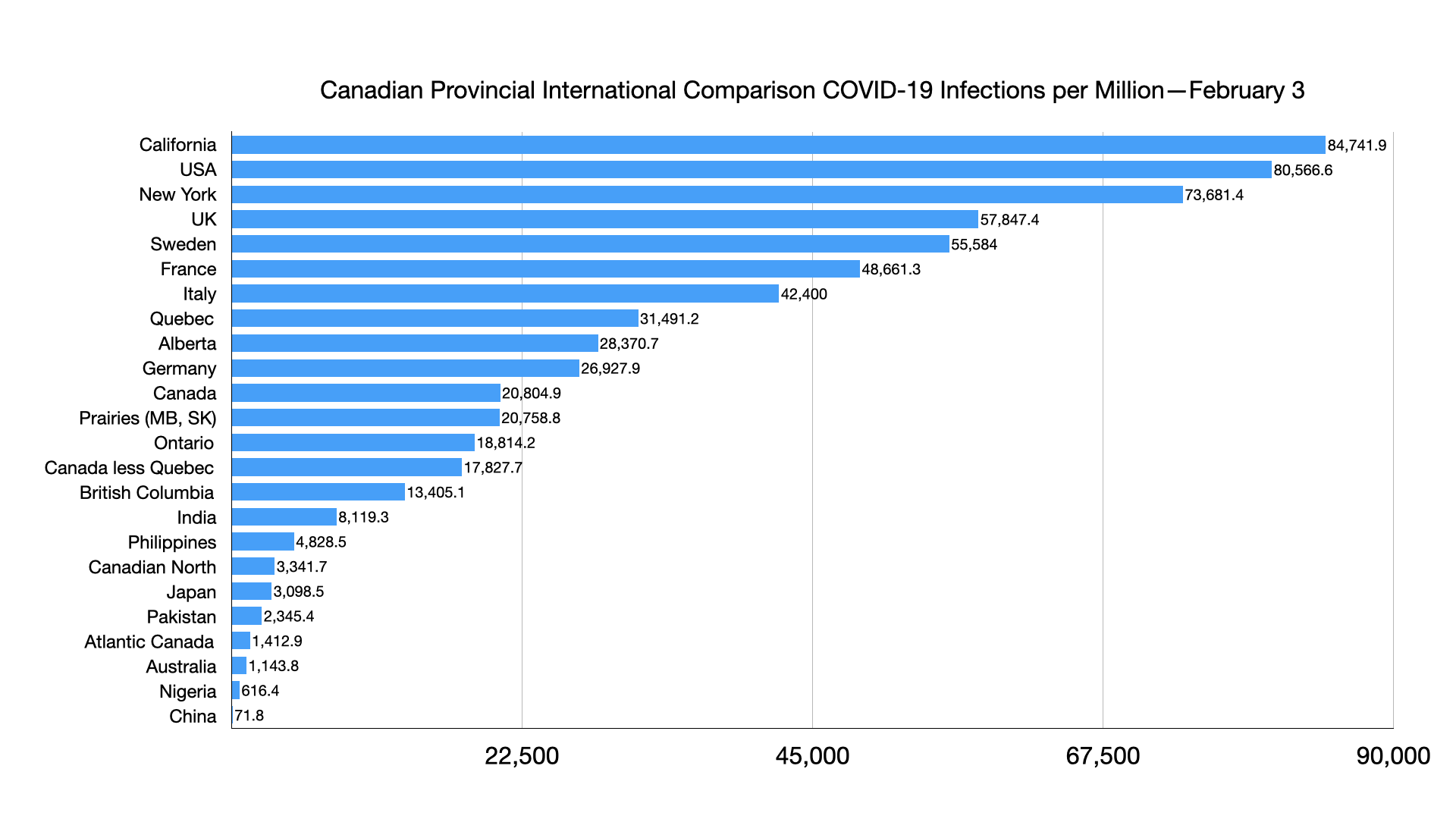
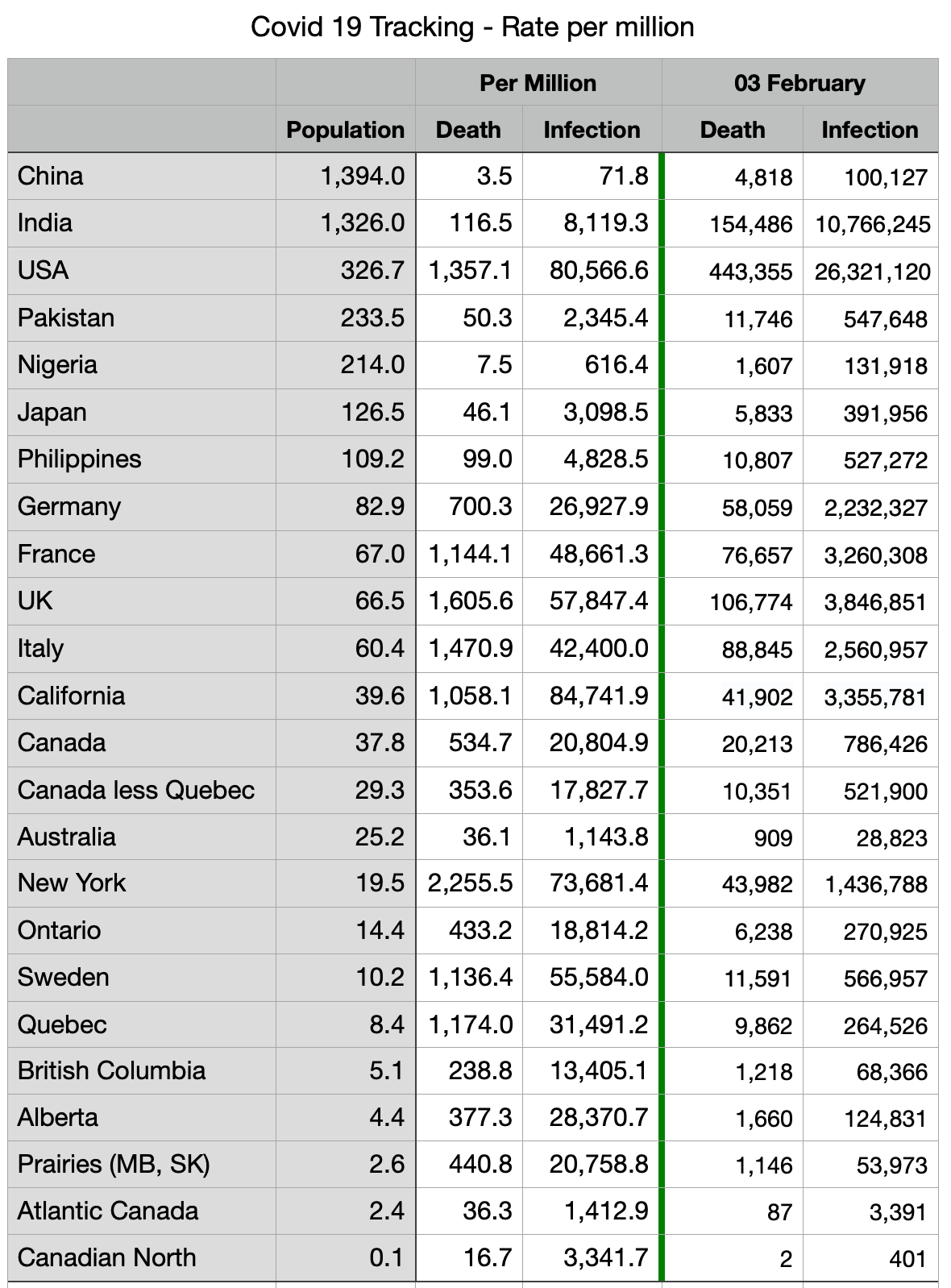
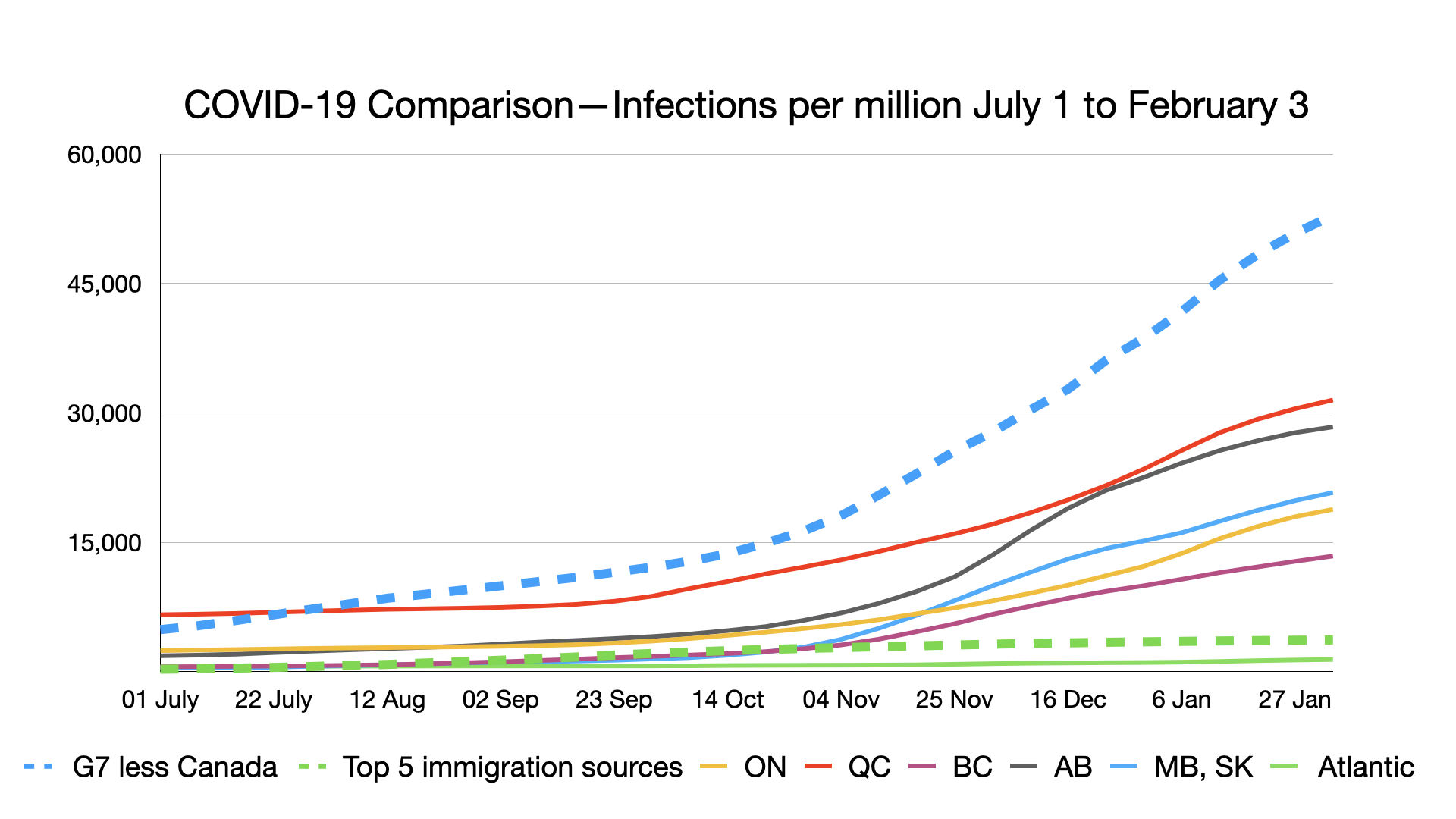
#COVID-19: Comparing provinces with other countries 3 February Update

The latest charts, compiled 3 February.

Vaccinations: The gap between the leading G7 countries (UK, USA) and other EU countries continues to grow given the pause in deliveries to Canada, with the exception of France and Sweden.

Trendline charts

Infections per million: Alberta appears too be controlling the virus better than Quebec.

Deaths per million: G7 continues to close in on Quebec, Prairies continue to have similar rates to Ontario.

Vaccinations per million: Gap between G7 and Canada, driven by UK and USA, continues to widen.

Weekly

Infections per million: No change in relative ranking from last week.

Deaths per million: Atlantic Canada now ahead of Australia.

The Mystery Of India’s Plummeting COVID-19 Cases

Of interest as had been wondering whether this reflected data issues. Appears not:

Last September, India was confirming nearly 100,000 new coronavirus cases a day. It was on track to overtake the United States to become the country with the highest reported COVID-19 caseload in the world. Hospitals were full. The Indian economy nosedived into an unprecedented recession.

But four months later, India’s coronavirus numbers have plummeted. Late last month, on Jan. 26, the country’s Health Ministry confirmed a record low of about 9,100 new daily cases — in a country of nearly 1.4 billion people. It was India’s lowest daily tally in eight months. On Monday, India confirmed about 11,000 cases.

“It’s not that India is testing less or things are going underreported,” says Jishnu Das, a health economist at Georgetown University. “It’s been rising, rising — and now suddenly, it’s vanished! I mean, hospital ICU utilization has gone down. Every indicator says the numbers are down.”

Scientists say it’s a mystery. They’re probing why India’s coronavirus numbers have declined so dramatically — and so suddenly, in September and October, months before any vaccinations began.

They’re trying to figure out what Indians may be doing right and how to mimic that in other countries that are still suffering.

“It’s the million-dollar question. Obviously, the classic public health measures are working: Testing has increased, people are going to hospitals earlier and deaths have dropped,” says Genevie Fernandes, a public health researcher with the Global Health Governance Programme at the University of Edinburgh. “But it’s really still a mystery. It’s very easy to get complacent, especially because many parts of the world are going through second and third waves. We need to be on our guard.”

Scholars are examining India’s mask mandates and public compliance, as well as its climate, its demographics and patterns of diseases that typically circulate in the country.

Mask and mandates

India is one of several countries — mostly in Asia, Africa and South America — that have mandated masks in public spaces. Prime Minister Narendra Modi appeared on TV wearing a mask very early in the coronavirus pandemic. The messaging was clear.

In many Indian municipalities, including the megacity Mumbai, police hand out tickets — fines of 200 rupees ($2.75) — to violators. Mumbai’s mask mandate even applies outdoors, to joggers on the beach and passengers in open-air rickshaws.

“Every time they fine a person 200 rupees, they also give them a mask to wear,” explains Fernandes, a Mumbai native. “Very stereotypically, we [Indians] are known to break rules! You see traffic rules being broken all the time,” she says, laughing.

But in the pandemic, when it comes to masks, “the police, the monitoring, enforcement — all that was ramped up,” she says.

Authorities reportedly collected the equivalent of $37,000 in mask fines in Mumbai on New Year’s Eve alone.

But the fines and mandates appear to have worked: In a survey published in July, 95% of respondents said they wore a mask the last time they went out. The survey was conducted by phone in June by the National Council of Applied Economic Research, India’s biggest independent economic policy group.

Awareness is widespread. Whenever you make a phone call in India — on landlines and mobiles — instead of a ring tone, you hear government-sponsored messages warning you to wash your hands and wear a mask. One message was recorded by Bollywood legend Amitabh Bachchan, 78, who battled and recovered from COVID-19 last summer.

The mask and hand-washing messages have now been replaced with new ones urging people to get vaccinated; India began vaccinations on Jan. 16.

Heat and humidity

Aside from mask compliance, there’s also India’s climate: Most of the country is hot and humid. That too has deepened the mystery. There’s some evidence that India’s climate may help reduce the spread of respiratory viruses. But there’s also some evidence to the contrary.

A review of hundreds of scientific articles, published in September in the journal PLOS One, found that warm and wet climates seem to reduce the spread of COVID-19. Heat and humidity combine to render coronaviruses less active — though the certainty of that conclusion, the review says, is low. Previous research has also found that droplets of the virus may stay afloat longer in air that’s cold and dry.

“When the air is humid and warm, [the droplets] fall to the ground more quickly, and it makes transmission harder,” Elizabeth McGraw, director of the Center for Infectious Disease Dynamics at Pennsylvania State University, told NPR last year. (However, the science of transmission is still evolving.)

In a survey of COVID-19 cases in India’s Punjab state, Das, the health economist at Georgetown, found that 76% of patients there did not infect a single other person — though it’s unclear why. He and his colleagues examined data collected from contact tracing and found that most patients who did infect others infected only a few other people, while a few patients infected many. Overall, 10% of cases accounted for 80% of infections. One implication, which Das says he’s investigating further, is the possibility of making contact tracing more efficient by first testing a patient’s immediate family members. If no one at all is infected, the process can end there.

“The temperature, of course, is in our favor. We do not have too cold of a climate,” says Dr. Daksha Shah, an epidemiologist and deputy executive health officer for the city of Mumbai. “So many viruses are known to multiply more in colder regions.”

But there’s also some scientific evidence to the contrary, that India might actually be more conducive to the coronavirus: Research published in December in the journal GeoHealth says that urban India’s severe air pollution might exacerbate COVID-19. Not only does pollution weaken the body’s immune system, but when air is thick with pollutants, those particles may help buoy the virus, allowing it to stay airborne longer.

A paper published in July in The Lancet says extreme heat may also force people indoors, into air-conditioned spaces — and thus might contribute to the virus’s spread. The Natural Resources Defense Council has warnedthat extreme heat can lead to a spike in other illnesses — dehydration, diarrhea — that might lead to overcrowding in hospitals and clinics already struggling to treat victims of COVID-19.

Prevalence of other diseases

Another point to consider about India is how many other diseases are already rampant: malaria, dengue fever, typhoid, hepatitis, cholera. Millions of Indians also lack access to clean drinking water, sanitation and hygienic food. Some experts speculate that people with robust immune systems may be more likely to survive in India in the first place.

“All of us have pretty good immunity! Look at the average Indian: He or she has probably had malaria at some point in his life or typhoid or dengue,” says Sayli Udas-Mankikar, an urban policy expert at the Observer Research Foundation in Mumbai. “You end up with basic immunity toward grave diseases.”

Two new scientific papers support that thesis, though they have yet to be peer-reviewed: One study by Indian scientists from Chennai and Pune, published in October, found that low- and lower-middle-income countries with less access to health care facilities, hygiene and sanitation actually have lower numbers of COVID-19 deaths per capita. Another study by scientists at India’s Dr. Rajendra Prasad Government Medical College, published in August, found that COVID-19 deaths per capita are lower in countries where people are exposed to a diverse range of microbes and bacteria.

But experts warn that these two studies are preliminary and should serve only as a springboard for more investigation.

“They’re not based on any biological data. So they’re good for generating a hypothesis, but now we really need to do the studies that will result in explanations,” says Dr. Gagandeep Kang, an infectious diseases researcher at the Christian Medical College in Vellore. “I hope scientists work more on this soon. We need deeper dives into India’s immune responses.”

According to Health Ministry figures, the coronavirus has killed 154,392 people in India as of Feb. 1. That’s a mortality rate of 1.44% — much lower than that of the United States or many European countries. (But Brazil’s death rate is higher than India’s, and Brazil and India are both lower-middle-income countries.)

Demographics

India is a very young country as well. Only 6% of Indians are older than 65. More than half the population is under 25. Those who are young are less likely to die of COVID-19 and are more likely to show no symptoms if infected.

A study of nearly 85,000 coronavirus cases in India, published in November in the journal Science, found that the COVID-19 mortality rate actually decreases there after age 65 — possibly because Indians who live past that age are such outliers. There are so few of them.

“Those Indians who do live that long tend to be more healthy than average or more wealthy — or both,” says health economist Das.

Serological surveys — random testing for antibodies — show that a majority of people in certain areas of India may have already been exposed to the coronavirus, without developing symptoms. Last week, preliminary findings from a fifth serological study of 28,000 people in India’s capital showed that 56% of residents already have antibodies, though a final report has not yet been published. The figures were higher in more crowded areas. Last summer, another survey by Mumbai’s health department and a government think tank found that 57% of Mumbai slum-dwellers and 16% of people living in other areas had antibodies suggesting prior exposure to the coronavirus.

But many experts caution that herd immunity — a controversial term, they say — would only begin to be achieved if at least 60% to 80% of the population had antibodies. It’s also unclear whether antibodies convey lasting immunity and, if so, for how long. More serological surveys are needed, they say.

Timing

India’s climate and demographics have not changed during the pandemic. And the drop in India’s COVID-19 caseload has been recent. It hit a peak in September and has declined inexplicably since then.

In fact, India’s numbers went down exactly when experts predicted they would spike: in October, when millions of people gathered for the Hindu festivals of Diwali and Durga Puja. It’s when air pollution is also worst, and experts feared that would exacerbate the pandemic too.

Cases have also declined despite what many thought would be a superspreader event: tens of thousands of Indian farmers camping out on the capital’s outskirts for months.

Shah, the epidemiologist, wonders if, just like more infectious variants of the coronavirus have been discovered in the U.K. and elsewhere, perhaps a milder variant may have started mutating in India.

“Some processes must have happened. This is an evolution of the virus itself. In some places there are mutations happening,” she says. “We need some more deeper evidence and deeper studies.”

The truth is, scientists just don’t know.

“Three options: One is that it’s gone because of the way people behaved, so we need to continue that behavior. Or it’s gone because it’s gone and it’s never going to come back — great!” says Das, from Georgetown. “Or it’s gone, but we don’t know why it’s gone — and it may come back.”

That last option is what keeps scientists and public health experts up at night.

So for now, Indians are kind of holding their breath — just doing what they’re doing — until they get vaccinated.

Source: The Mystery Of India’s Plummeting COVID-19 Cases

Canada urged to create dedicated asylum pathway for Hong Kongers fleeing political persecution

Expect pressure to grow. As Waldman notes, better to do so discretely:

Canada must create a dedicated asylum pathway for Hong Kongers fleeing Beijing’s clampdown on political opposition in the former British territory, Canadian MPs were told Monday.

“This is not a conventional humanitarian crisis, so conventional solutions are not effective for those who need our help,” Cherie Wong, executive director of Alliance Canada Hong Kong, an umbrella group that supported the Asian city’s pro-democracy movement, told the House of Commons immigration committee.

She told MPs that an immigration program unveiled last November to bring young Hong Kongers to Canada is only useful for upper-middle-class graduates and “fails to consider the realities of everyday people of Hong Kong.”

Reverend Brian Wong, a Canadian from Hong Kong with the Mustard Seeds Hong Kong Concern Group, concurred in his comments to MPs, saying dissidents come from many backgrounds. “Canada needs to come up with a inclusive policy to accommodate the needs of a broad spectrum of Hong Kong people at the risk of political persecution.”

Alliance Canada Hong Kong’s Ms. Wong described life for many of the Hong Kongers who marched in protests for a year before the national security law was enacted, noting they were targeted by “systematic surveillance operations, including having plainclothes officers stationed at the airports, loitering inside international terminals” and boarding areas.

“We have friends whose travel documents are confiscated, teammates monitored and followed who are scared for their lives, and fellow activists who are arrested while looking for options to leave. The Hong Kong government is even looking at legislation to impose exit bans and further suppress freedom of movement,” she said.

The Chinese government imposed a sweeping national security law on Hong Kong last June, ostensibly to target secession, subversion and terrorism, but with vaguely defined offences that critics say effectively criminalize dissent and opposition to the Chinese Communist Party’s rule.

More than 100 prominent Hong Kong political figures have already been arrested under this law, which carries penalties up to life imprisonment. Western countries, including Canada, have decried this crackdown as a violation of Beijing’s treaty pledge to maintain civil rights and the rule of law in the former British colony for 50 years after the 1997 handover.

The British government has offered a path to citizenship for many Hong Kongers, but this still leaves many stranded as authorities in Hong Kong arrest journalists, ban access to websites, seize cell phones and computers and fire teachers and union activists.

So far, Canada has accepted at least 15 asylum claimants as political refugees, according to Jane Lee of the New Hong Kong Cultural Club, a group of Canadian supporters of democracy in Hong Kong with branches in Toronto, Calgary and Vancouver that has helped 30 people from the former British colony to seek safe haven in Canada.

All these claimants, however, arrived before COVID-19 travel restrictions. The big problem facing persecuted Hong Kongers today is they cannot board a plane to reach countries such as Canada to claim asylum.

Toronto immigration lawyer Lorne Waldman said he’s been approached by Hong Kongers who want to leave but cannot because of flight restrictions. ”There definitely are people who need to get out and are at serious risk,” he said.

Advocates urged Canada to help funnel travel documents via non-governmental organizations to persecuted Hong Kongers in the Asian city, much like Ottawa once helped persecuted gay Iranians and Chechens reach Canada.

If Canada plans such action, Ottawa “shouldn’t and won’t make a big fanfare about this,” Mr. Waldman said.

NDP immigration critic Jenny Kwan suggested the federal Department of Immigration issue “minister’s permits” that would allow Hong Kongers to leave for Canada while applications are being processed.

Canada-Hong Kong ties run deep. There are several hundred thousand Canadians of Hong Kong origin living in Canada and 300,000 Canadian citizens living in Hong Kong now. More than 1,970 Canadians were deployed to defend Hong Kong from the Japanese in the Second World War and 554 lost their lives as a result.

Rev. Dominic Tse, senior pastor at North York Christian Community Church, told MPs that many Hong Kongers he knows would rather migrate to Canada than to Britain, based on existing ties and Canada’s reputation. He urged Canada to liberally grant work permits to Hong Kongers, giving them a chance to establish residency here. “Many Hong Kong people have either relatives or friends or classmates in Canada, and if they have a choice they actually would rather go to Canada than the U.K.”

Last November, Immigration Minister Marco Mendicino announced a three-year open work permit for recent Hong Kong graduates or those with a history of work experience in areas Canada might value, as well as a new pathway to permanent-resident status for Hong Kongers who end up coming here.

Source: Canada urged to create dedicated asylum pathway for Hong Kongers fleeing political persecution

Semotiuk: What Is The American Identity And How Should Immigrants Be Absorbed?

From Canadian immigration lawyer practicing in the USA, ending his commentary on a Canadian note:

It is no exaggeration to say that the United States always was, is now and always will be a nation of immigrants. From the first migrants who crossed the Bering Strait to Alaska and migrated down the West coast, possibly as early as around 20,000 years ago, to today’s immigrants coming from all the four corners of the earth, America was built by immigrants. In a sense, America is like a huge puzzle, completely finished on one end, but continually growing as new pieces are added to the other, representing newly arriving immigrants.

American Identity

These new immigrants are continually changing America’s identity. It is often said that America is a melting pot in which newly arrived immigrants merge with those already here to produce a new breed of Americans. To draw an analogy, the idea is that integrating new immigrants is like baking a cake. The ingredients of flour, shortening, eggs and sugar are mixed together to bake the American cake. Contrast that view, with say that of Canada’s, that sees itself as a cultural mosaic of brightly colored bits of ethnicity, culture, racial identity and language embedded side by side. These visual metaphors attempt to portray each country’s policies and how they incorporate new immigrants into their societies. Critics of these older formulations advance the notions of diversity and inclusion as better views on how immigration and cultural policies should deal immigrants to their societies.

Personal Identity

Just as immigrants are changing the identity of America, however, the country is also changing the identity of immigrants. Consider that on the first day of arrival on American soil, immigrants bring with them their identities forged back home. These identities may include a different language, culture, religion, dress and values – differences that are not ‘normal’ in North America. In time, many immigrants adapt and take on the ways of the majority in America. An example is that male Sikhs sometimes abandon their turbans and clothes and cut their hair. Externally they may look more like other typical Americans, but inside they may still identify with the Sikh faith and customs. By and large, such immigrants love America and are glad they were allowed to come here. Yet many also love their former homeland as well. There is nothing strange or wrong here: just as one can love her mother and father at the same time, she can also love America as well as Italy, for example, if that is where she is from.

What’s In A Name?

An interesting portrayal of how America influences personal identity is in former President Barack Obama’s book A Promised Land. While he was native born, as he grew up he was called Barry Obama. It was only later in life, as he came to grips with his identity that he changed his name to Barack Obama. This is a common identity experience – many Chinese immigrants adopt English first names to better cope with life in English-speaking America. I myself vacillate between Andy in everyday settings, and my native Andriy, related to my Ukrainian origins.

Being True To Yourself

The underlying question is can you live in America as your true self and still be an American? Or is America the kind of country that expects you to change your identity to ‘fit in?’ In other words, do you have to surrender your cultural identity to become an American? More importantly, is America welcoming when it comes to speaking other languages, or does America expect you to effectively forget your native tongue and just speak English? There are Americans with very different answers to these questions and different expectations related to newcomers to this country. This is what needs to be settled for America to find her way in these troubled times.

A Different View of America

Never was this difference in views about America more evident than in the presidency of Donald Trump. His evident hostility to Mexican and Muslim immigrants, and his apparent empathy, or at least tolerance, for those who want a White America, resulted in clashes on the streets of many cities and in Washington D.C. that seriously tarnished America’s image abroad. The efforts of historic figures like Abraham Lincoln and Ulysses Grant to eradicate white supremacists, not to mention the American civil war fought in part to put the legacy of slavery behind it, appeared to be forgotten. Even the efforts of more modern political leaders, like those of President Kennedy, Bobby Kennedy, President Johnson and Dr. Martin Luther King Jr. were all set back by the recent policies of the Trump administration. It may take years for America to heal and return to honoring its founding creed.

A Return To America’s Founding Creed

But return it must. The days of a country with a single race, single religion and a single culture are gone. They disappeared with the end of World War I and the collapse of the great empires that dominated world politics back then: Tsarist Russia, Austro-Hungary, and the Ottoman and German empires. Today America has no choice but to transform itself into the multi-ethnic, multiracial and diverse country it needs to be to play a leading role in the modern, multinational, multilingual and secular world. It is time for Americans to return to their founding principles in that regard.

Source: What Is The American Identity And How Should Immigrants Be Absorbed?

When Liberalism Grows Up

An interesting read, a bit similar in tone and approach to Adam Gopnik’s A Thousand Small Sanities in its praise of incrementalism and pragmatic approach:

The end of the history of music, at least in the Western classical tradition, can be dated to the warm, rainy evening in August of 1952 in Woodstock, New York, when a pianist first performed John Cage’s “4’33″”, a work consisting solely of four minutes and thirty-three seconds of silence. Cage’s composition was perhaps the natural conclusion of a cultural evolution that began in medieval abbeys and Renaissance courts, thrived in German churches and Italian opera houses, and flourished under Dvorak, Mahler, and Shostakovich.

Despite the uproar over “4’33″”, music did not die. Less than two years later, in July of 1954, Bill Haley and His Comets enjoyed rock and roll’s first major commercial success with “Rock Around the Clock.” Over the next seven decades, popular music exploded, evolved, and globalized: bebop, folk, bossa nova, blues rock, soul, country, glam, reggae, prog rock, disco, punk, metal, new wave, grunge, hip-hop, reggaeton, EDM, K-Pop, mumble rap. Classical music stayed popular, but further innovation in that genre was relegated to the ivory tower, subsidized performing arts centers, and the occasional film score.

Liberalism may be at a similar point today. A combination of social compacts, globalization, demographics, and technology have made evident some of liberalism’s limitations. But we could just as likely see not a reversion to a pre-liberal past, but an explosion of new diverse, experimental, chaotic, and rebellious liberal political traditions.

Liberalism may be at a similar point today. A combination of social compacts, globalization, demographics, and technology have made evident some of liberalism’s limitations. But we could just as likely see not a reversion to a pre-liberal past, but an explosion of new diverse, experimental, chaotic, and rebellious liberal political traditions.

Just as Bob Dylan, the Beatles, or Bob Marley would have sounded jarring to Bach or Brahms, future liberalism may appear almost unrecognizable to today’s observer.And yet, just as the functions and forms of classical music are foundational and familiar to any contemporary performer of popular music (there would be no Beyoncé without Beethoven, no Chance the Rapper without Tchaikovsky), liberalism could well remain the basis of all future politics. Contemporary life almost anywhere in the world is so pervasively imbued with liberalism that it will be impossible to fully escape its gravitational force.

Francis Fukuyama, in his essay “Liberalism and Its Discontents,” mourns the global “wave of discontent” with liberal democracy, a system of governance that ensures checks and balances by combining accountability with the rule of law. He says that liberalism, by ensuring human dignity through tolerance, equal rights, and individual choice, “tends toward a kind of universalism.” He laments the threats now faced by liberalism from within and without—from authoritarian regimes, the economic forces of neoliberalism run amok, and the cultural hollowness created by stoic individualism.

This account of liberalism and its present-day challenges may be zeitgeist-appropriate, but it is not entirely satisfying. One problem is that liberalism, without sufficient context, is frustratingly nebulous. As historian Adam Tooze notes, liberalism “means and has meant many different things:” After all, “John Maynard Keynes, Friedrich Hayek, John Rawls and Margaret Thatcher are all reasonably identified as liberals.”

In fact, depending on your vantage point, two very distinct strains of liberalism either briefly converged or split apart around the time of the French Revolution. There was the bourgeois liberalism of Hanseatic burghers, London coffeehouses, Scottish moral philosophers, and landed American colonists. Then there was proletarian liberalism, which recognized structural inequities and believed that politics was about righting social and economic wrongs in favor of the systemically disadvantaged. Both conceptions arose within the Third Estate; both required rebellion against the ancien régime of the European aristocracy. But they diverged to become the forerunners of the Western political traditions of the right (conservatism, libertarianism, Austrian economics, Christian democracy) and left (progressivism, socialism, Keynesianism, social democracy). In this sense, all modern democratic politics in advanced industrial societies has been a contest between two liberal traditions.

Additionally, liberalism, contrary to Fukuyama’s somewhat Whiggish account of its progress, stumbled from crisis to crisis for much of its history. Despite the 18th-century revolutions, the 19th century was in some ways decidedly illiberal, featuring a reactionary political elite in Europe, chattel slavery in the United States, and global wars of nationalism and colonialism. The first half of the 20th century forced the more liberal powers to contend with fascism and manifestations of competing imperialisms, including colonial competition, domestic oppression, and ideological compromises. In the second half of the century, liberals had to contend against Soviet communism, often prioritizing ends over means. The people of Algeria, Bangladesh, Cambodia, Chile, and South Africa may be forgiven for their lack of nostalgia for the post-World War II liberal international order. Fukuyama’s contention that postwar Europeans “saw the folly of organizing politics around an exclusive and aggressive understanding of nation” does not fully acknowledge Europe’s rigidity when it came to immigration, decolonization, and multiculturalism.

None of this means that liberalism should be jettisoned on grounds of hypocrisy, as its critics frequently conclude; but the case for liberalism is far stronger if made on concrete and material rather than moral grounds. It remains the case that liberalism, not any other ideology, created the conditions for the absence of large-scale conflict and the growth of unprecedented (albeit unevenly distributed) global prosperity over the past three decades.

There are also inconsistencies in Fukuyama’s portrayal of the universality of liberalism. As he observes, liberal individualism has always been at odds with the social proclivities of human beings, especially in “non-Western societies,” where “kin, caste, or ethnic ties are still facts of life.” Yet he subsequently argues that “liberalism properly understood is perfectly compatible with communitarian impulses and has been the basis for the flourishing of deep and diverse forms of civil society.”

There are also inconsistencies in Fukuyama’s portrayal of the universality of liberalism. As he observes, liberal individualism has always been at odds with the social proclivities of human beings, especially in “non-Western societies,” where “kin, caste, or ethnic ties are still facts of life.”

So, is liberalism then universal, or isn’t it? Is it compatible with identity politics—and, if so, to what extent? Those questions remain unresolved; and, being unresolved, they lie at the heart of many of liberalism’s problems today.

For liberalism, the equivalent of John Cage’s “4’33″” composition may have been the evening in August of 2008 when the opening ceremony of the Beijing Olympics served as an announcement of China’s global ambitions. On the same day, Russian forces entered Georgia. In the same month, Lehman Brothers laid off 1,500 employees, a precursor to its crash and the global financial crisis. In that year, the Chinese navy deployed to the Gulf of Aden in its first modern operations outside its claimed territorial waters. These developments, though obscured by Barack Obama’s historic election victory that November, heralded an end to Western liberal primacy.

Still, liberalism has not come crashing down in the years since. Liberal aspirations—human dignity, individualism, equal rights—remain achievable, desirable, and inherently unobjectionable. What the events of the last twelve years have done is to expose liberalism’s inherent weaknesses. Human beings are not just logical but emotional creatures. Free markets attain miraculous economic growth but undermine equality of opportunity. Access to abundant information does not guarantee enlightenment. Individuals exercising free choice may choose to be tribal. Elected officials exploit these conditions.

The way to perfect these imperfections is not simply to reaffirm liberalism’s moral superiority. It is to tinker continuously with liberalism, exploring the potentially infinite variations upon its themes.

Source: https://www.orfonline.org/research/when-liberalism-grows-up/