PMO scrambled to contain controversy over pandemic early-warning system, internal e-mails show

Makes pretty clear that failure was at the senior bureaucratic level:

Internal e-mails show the Prime Minister’s Office was scrambling last summer to contain the fallout over the silencing of Canada’s pandemic early-warning system after learning it was curtailed less than a year before COVID-19 struck.

The e-mails, which provide a rare look at exchanges between the Prime Minister’s top political aides, show the upper levels of government were caught off guard when details about the silencing of the Global Public Health Intelligence Network (GPHIN) were made public by a Globe and Mail investigation.

The internationally respected system was created to detect and monitor international health threats to help Canada and other countries respond faster and more effectively to a deadly outbreak. However, The Globe found that the operation’s alert system was silenced in early 2019 amid shifting government priorities.

During an exchange of early-morning e-mails on Aug. 13, advisers to the Prime Minister can be seen trying to figure out what went wrong with GPHIN, and whether the blame for its mishandling could be contained to the Public Health Agency of Canada (PHAC), and decision makers within that department, without political ramifications for the government.

“Can you confirm all the decision are internal to PHAC?” Samantha Khalil, the PMO’s deputy director of issues management, said to a colleague in an e-mail at 8:33 a.m. “I’ve got a hard deadline of 8:45 now to update my senior team.”

That morning, The Globe reported the pandemic alert system was suddenly restarted about two weeks after it published its investigation that showed GPHIN had gone silent in 2019. The shutdown of the alert system, and its reinstatement, appear to have blindsided the government.

At 7:15 a.m., the Prime Minister’s chief of staff, Katie Telford, sent an e-mail to PMO staff with the article attached, saying, “Front page of globe. How will we respond to this?” The replies to that e-mail paint a picture of the Prime Minister’s Office trying to find answers, and concerned with whether the blame will spread beyond the Public Health Agency.

Responding to Ms. Telford’s e-mail at 8:03 a.m., PMO senior adviser Ben Chin told colleagues: “The thing I’d like to understand better is whether all decisions on this are internal to PHAC. I understand there was no funding reduction.”

In another e-mail, Ms. Khalil asks a colleague: “Can you send me any background there is on why this was stopped and restarted? As well as your messaging on it.”

At 8:53 that morning, Cole Davidson, press secretary to the Minister of Health, responds to Ms. Khalil, “We’re working on getting specifics and answers to some questions. … When did this change happen? Why did this change happen? Who made the decision?”

The e-mails are among thousands of federal documents being disclosed in response to a production order for COVID-19 records that the House of Commons approved in October despite objections from the Liberal government.

Before it was curtailed, GPHIN was internationally renowned for tracking deadly outbreaks, and provided the World Health Organization with 20 per cent of its epidemiological intelligence that fed global advance warnings. The system was used effectively during H1N1 and Ebola, helping governments respond swiftly to contain those deadly outbreaks. However, in 2018, with no pandemic threats on the horizon, senior management reallocated some of GPHIN’s resources to domestic projects.

As PMO officials arranged a 10 a.m. briefing from Public Health Agency officials that morning, they also worked on the messages that would be delivered to Canadians on the matter.

At 11:16 a.m., after the briefing, Mr. Davidson e-mailed Ms. Khalil with an update. That e-mail confirmed several key details of The Globe’s investigation, which reported that, in late 2018, managers at Public Health began requiring GPHIN analysts to obtain senior-managers’ approval before issuing alerts. This effectively suffocated the early warning system. When approvals never came, the international alerts stopped. Meanwhile, GPHIN analysts were reassigned to tasks that did not involve international outbreak surveillance.

“A new process was put in place requiring approval of all alerts by a VP at PHAC in fall of 2018,” Mr. Davidson reported to the PMO. “This change was not supported by the GPHIN analysts.”

He also confirmed the silencing of the alert system, which Public Health had initially told The Globe last summer did not occur. “From May, 2019, until last week, no alerts were issued,” Mr. Davidson told the PMO.

“PHAC is getting us answers on these questions: Who made the decision to change the approvals? Why was this change necessary? Was MinO briefed on this change? (we don’t believe so),” Mr. Davidson wrote, referring to the Health Minister’s Office as MinO. “Why did the alerts nearly stop after the change?”

Three weeks later, Health Minister Patty Hajdu ordered an independent federal review of the way GPHIN was handled. The Auditor-General has also launched an investigation.

Department management has also been shuffled amid the GPHIN controversy. The president of the Public Health Agency stepped down in September, and was replaced by the head of the National Research Council, while the government appointed a new vice-president to oversee GPHIN.

Source: PMO scrambled to contain controversy over pandemic early-warning system, internal e-mails show

Dual citizenship: Zelensky enacts NSDC decision on threats to national security

Aimed at Russian citizenship, will likely impact some Ukrainian Canadians:
Ukrainian President Volodymyr Zelensky has put into effect the National Security and Defense Council’s decision to counter threats to national security in the field of citizenship, the President’s Office has reported.

“President of Ukraine Volodymyr Zelensky signed decree No. 85/2021, which puts into effect the National Security and Defense Council decision of February 26, 2021 ‘On urgent measures to counter threats to national security in the field of citizenship’,” the document reads.

According to the NSDC decision, the Cabinet of Ministers, together with the Central Election Commission and the Security Service of Ukraine, must conduct an inventory and analyze Ukrainian legislation on issues related to dual (multiple) citizenship within two months.

In particular, it is necessary to establish the presence or absence of legal certainty of the prohibition of citizens of Ukraine, who have the citizenship of a foreign state, to hold certain state and political positions or to perform the functions of state or local self-government.

Based on the results of such an analysis, the government must submit to the Verkhovna Rada within six months the draft laws that would prohibit Ukrainian citizens, who have the citizenship of a foreign state or have submitted documents (undergoing the procedure) for acquiring foreign citizenship, to apply for performing state or local government functions, to apply for holding senior positions at strategic state-owned facilities, to have access to state secrets, to be a member of an election commission, an official observer or to conduct election campaigning in national and local elections, and to be a member of a political party.

“It is also necessary to develop and submit to parliament a procedure for confirming the refusal and renunciation of the citizenship of a foreign state for citizens of Ukraine who apply for the above positions,” the statement said.

In addition, a procedure should be introduced at the legislative level for citizens of Ukraine to submit declarations on the acquisition of foreign citizenship. This procedure will be put into effect for residents of the temporarily occupied territories of Donetsk, Luhansk regions and Crimea only after the restoration of the territorial integrity of Ukraine.

Liability must be established for the submission of inaccurate information in declarations about the absence of foreign citizenship.

According to the NSDC decision, the government should also start an interstate dialogue on concluding bilateral agreements with interested states, except for the aggressor state, aimed at resolving issues related to dual (multiple) citizenship.

Source: Dual citizenship: Zelensky enacts NSDC decision on threats to national security

Women at risk of long-term work disruption as pandemic alters jobs market, RBC warns [also visible minorities and immigrants]

More on the “she-cession” and “imm-cession:”

Women in Canada are at risk of prolonged unemployment as the COVID-19 pandemic accelerates structural changes to the job market, RBC Economics warned Thursday.

The health crisis has dealt uneven blows to the labour market – and often, to the greater detriment of women. There’s been a substantial increase in the number of women who are jobless for six-plus months, while many have dropped out of the labour force entirely.

At the same time, the pandemic is forcing many companies to adopt new technologies sooner than planned, while some consumer spending habits may have shifted permanently, the RBC report said. That could spell trouble for jobs at risk of automation, and in particular, for the women who staff the service industries most affected by health restrictions.

“As we reopen, the economy is changing,” Dawn Desjardins, deputy chief economist at Royal Bank of Canada and one of the report’s authors, said in an interview. “We need all hands on deck … in trying to get people re-engaged” in the labour market.

Using data from Statistics Canada, RBC pointed to a handful of indicators where women are lagging, and where the recovery process could prove challenging.

For instance, employment for women earning less than $800 weekly was down nearly 30 per cent from February, 2020, while for men it fell 24 per cent. Women have also sustained roughly two-thirds of the job losses in the struggling hospitality sector.

As well, nearly 100,000 women aged 20-plus have dropped out of the labour force – meaning they aren’t working or searching for a job – while fewer than 10,000 men have done so. Young and racialized women, female immigrants and mothers are among those who have suffered outsized work disruptions.

“The longer these women are out of the labour force, the greater the risk of skills erosion, which could potentially hamper their ability to get rehired or to transition to different roles as the economy evolves,” the report said.

Ms. Desjardins and economist Carrie Freestone wrote that accessible and targeted training is needed to help displaced workers, and that digital skills are crucial.

Such efforts could be unveiled in the federal government’s spring budget. Ottawa has said it will spend up to $100-billion over three years in fiscal stimulus, to help with the recovery process. And in a mandate letter sent to Employment Minister Carla Qualtrough in January, Prime Minister Justin Trudeau called for “the largest investment in Canadian history in training for workers.”

Much like RBC, the Bank of Canada has flagged concerns over structural changes to the job market. In a recent speech, Governor Tiff Macklem said automation helps companies become more productive and creates new work opportunities. But the pandemic has sped up the transformation, and that comes with collateral damage.

“Some of the jobs that have been lost during the pandemic will not return,” Mr. Macklem said. “Many low-wage jobs have a high potential of being automated. And some jobs that are disproportionally held by women and youth, such as retail salesperson and cashier, are also the kinds of jobs where the pandemic has accelerated structural change.”

The RBC report also called for “more options” in affordable child care. “But it’s no solution if [low-earning mothers] don’t have jobs to return to.”

Ultimately, Ms. Desjardins said Canada should be working toward women participating in the labour force at the same rates as men. It’s a gap that predates the pandemic, but if closed would result in a much larger and dynamic economy.

“The idea of women participating at the same level as men in the labour market, and what that can add to our economy – it just makes that pie bigger,” she said.

Source: https://www.theglobeandmail.com/business/article-women-at-risk-of-prolonged-unemployment-rbc-warns/

USA: Immigration Bill Shows Need To End Employment-Based Immigrant Backlog

Good backgrounder:

Without a change in immigration law, it will be sometime in the year 2216—195 years from now—when the last person born in India waiting today in the employment-based immigrant backlog is expected to receive a green card. Barring advances in human longevity, businesses and high-skilled foreign nationals must rely on Congress to solve this problem and enact reasonable policies to welcome highly skilled people who want to become Americans.

The Scope of the Problem: H-1B and L-1 (intracompany transferee) are temporary statuses, meaning if someone wishes to remain in the United States, they must obtain an employment-based immigrant visa (or green card) that grants permanent residence. However, there is far greater demand for high-skilled individuals than the limited number of employment-based green cards allotted by Congress.

Since 1990, when Congress set the annual limit on employment-based immigrants at 140,000 (and 65,000 H-1B temporary visas), changes in technology have accelerated the demand for high-skilled technical labor. Congress established the current employment-based limits before the internet became a part of daily life. It also predates the iPhone, the iPad, YouTube, e-commerce, Netflix, Google, cloud computing and thousands of innovative companies and technologies that have come into existence and fueled the demand for high-skilled labor.

U.S. businesses would still need more scientists and engineers to grow and innovate even if the number of Americans earning degrees in science and engineering had exploded—and it hasn’t.

Between 1995 and 2015, full-time U.S. graduate students in electrical engineering decreased by 17%. The number of full-time U.S. graduate students in computer science increased by 45% from 1995 to 2015, while international graduate students increased by over 480%. (H-1B visa fees paid by employers have funded approximately 100,000 college scholarships for U.S. students in science and engineering.)

As of March 2020, the backlog in EB-1, EB-2 and EB-3—the employment-based first, second and third preferences—was 915,497, according to the Congressional Research Service (CRS).

Without Congressional action, notes CRS, the problem will grow worse: “The total backlog for all three categories would increase from an estimated 915,497 individuals currently to an estimated 2,195,795 individuals by FY 2030.”

Let that number sink in: Within a decade, more than 2 million people will be waiting in line, most for many years or even decades, for employment-based green cards. And there are indications this underestimates the problem.

Table 1 shows that in FY 2018 only about 4,500 Indians obtained permanent residence in the employment-based second preference and fewer than 6,000 received green cards in the employment-based third preference. (The National Foundation for American Policy obtained the data via a Freedom of Information Act request.)

CRS estimates the annual demand for employment-based green cards in the three preference categories is 262,376 (including dependents). This is based on petitions U.S. Citizenship and Immigration Services (USCIS) approved in FY 2018. CRS explains the backlog grew because there is a “current limit of 120,120 green cards for the three employment-based immigration categories.”

Another problem is that Congress established a per-country limit of 7% for each country that burdens mainly potential employment-based immigrants from India but also affects people born in China and the Philippines. The law, in effect, gives the same number of green cards for employment to India as it does Iceland.

In the employment-based second preference (EB-2): “Under current law, and owing to a limited number of green card issuances, the current backlog of 568,414 Indian nationals would require an estimated 195 years to disappear,” according to CRS. David Bier of the Cato Institute predicts “about 186,038 Indian immigrants will die . . . before they receive green cards even if they could remain in line forever.”

“By FY 2030, [the] estimated wait time would more than double,” according to CRS. “Under S. 386, the estimated wait time for newly approved EB-2 petition holders would shrink to 17 years, and in FY 2030, the wait time would be 37 years, the same as for all other foreign nationals.”

S. 386 was a bill in the last Congress sponsored by Sen. Mike Lee (R-UT) that would have eliminated the per-country limit for employment-based immigrants. Rep. Zoe Lofgren (D-CA) wrote H.R. 1044 with Rep. Ken Buck (R-CO) and it passed the House in July 2019. The companion bill, S. 386, was blocked in the Senate for more than a year. It became a Christmas tree for extraneous immigration provisions. The Senate finally approved S. 386 near the end of the session but the House found the provisions to be objectionable and it did not become law. The bill would not have increased the number of employment-based green cards but would have reduced the wait times for those waiting the longest for permanent residence, particularly professionals from India.

Without any change in the law, CRS predicts: “Currently, new Indian beneficiaries entering the EB-3 [employment-based third preference] backlog can expect to wait 27 years before receiving a green card.” (The wait time would be much longer in the EB-2 category.)

Scientists and engineers waiting for their green cards may see their children who have lived in the United States for years be forced to leave the country when they “age out” of their place on a mother or father’s immigration application when reaching 21 years old. USCIS policies during the Trump administration caused many spouses of H-1B visa holders waiting for green cards to lose their work authorization due to long processing delays.

New Immigration Bill Would End the Employment-Based Backlog: The U.S. Citizenship Act, developed by the Biden administration, would eliminate the employment-based backlog within 10 years through various provisions, according to a National Foundation for American Policy (NFAP) analysis.

First, the bill would no longer count spouses and children toward the annual limit, which would approximately double the annual number of employment-based green cards. Second, the legislation increases the annual limit for family-sponsored immigrants and allows unused numbers from the family categories to be used by the employment categories. That means once the family backlog is eliminated, which NFAP predicts could happen within 5 or 6 years, backlog reduction in the employment-based categories would accelerate.

Third, the bill eliminates the per-country limit. Fourth, the legislation allows unused green cards from earlier years to be redirected to reduce family and employment backlogs.

The bill also contains a provision, which NFAP has recommended, to allow any individuals who wait at least 10 years with an approved immigrant petition to receive permanent residence without numerical limit. If Congress passed only this reform, it would help many people and bring certainty to otherwise interminable waits for many employment-based immigrants.

Related to the backlog, in its final days, the Trump administration published a final rule designed to price employment-based immigrants and H-1B visa holders out of the U.S. labor market. The regulation would boost required wages 23% to 41% depending on the occupation, according to an NFAP study. The regulation could block people waiting for green cards if the new required salary is too high for an employer to retain them in H-1B status. (Individuals can be extended in H-1B status while waiting for an employment-based green card.)

If the Biden administration keeps the rule, it would be a significant victory for former White House adviser Stephen Miller and opponents of immigration.

Numerous studies and private wage surveys show that there is no evidence high-skilled foreign nationals are paid less than comparable U.S. professionals. If employers were forced to pay high-skilled immigrants 41% more than comparable U.S. workers, one would expect critics would still claim the immigrants were paid less because that is typically the only argument put forward against high-skilled foreign nationals who work in America. Members of Congress are repeatedly told to believe the only value someone born in another country offers a U.S. business or the U.S. economy is a willingness to work for less money.

If we have learned one thing from the pandemic, it is how valuable immigrants are to America. Immigrants play key roles in the two companies responsible for the Covid-19 vaccines Americans are receiving to protect their lives. Moderna’s leaders, two cofounders and critical scientific personnel are immigrants, as are the chief executive (and chief science officer) of Pfizer and a key scientist (Katalin Karikó) who made a crucial breakthrough on messenger RNA,” as noted in a December 2020 article. Even the founders of Pfizer were immigrants.

“We have blown the opportunity to maximize the incredible high-skilled immigrants in this country,” said Sen. Kevin Cramer (R-ND) at a recent hearing. “The backlog of green cards is immoral to me.” Will this be the year moral outrage and economic sense lead to a solution for employment-based immigrants?

Source: Immigration Bill Shows Need To End Employment-Based Immigrant Backlog

Canada kept doors open to temporary foreign workers during 2020’s pandemic lockdown, new numbers reveal

The project that Dan Hiebert, Howard Ramos and I have been working on:

Despite its pandemic lockdown, Canada managed to keep its doors open to temporary foreign workers last year, new numbers reveal.

Amid travel restrictions and vastly reduced immigration, 322,815 people were issued a work permit under various temporary foreign worker programs, according to a joint project that tracks the pandemic’s impacts on Canadian immigration. 

Although that represents a drop of 10 per cent from the year before, temporary foreign workers appear to have been substantially less interrupted by COVID-19 than those in other streams of immigration to this country.

Here are some of the highlights:

  • The number of permanent residents admitted to Canada last year nosedived by 45.7 per cent, to just 185,130, from 2019;
  • The number of study permit holders also dropped by 33 per cent to 277,720, with the enrolment in primary and secondary schools down 32.3 per cent and in post-secondary education down almost 32 per cent. Those in language programs fell by 54 per cent; and
  • A total of 23,845 people sought asylum in Canada, compared to 64,045 in 2019. Claims made at airports and land borders dropped by 77 per cent and 72 per cent, respectively, due primarily to border closures. 

“Canada has been pretty dedicated to bringing in the people that it needs on a temporary work side,” said University of British Columbia professor Daniel Hiebert, a co-founder of the COVID research project. “There’s a Canadian interest story to be told.”

According to the immigration data, 215,080 work permit holders were admitted under “Canadian interests,” which include athletes, scholars, those in culture and entertainment, youth in international exchange programs and international students who graduated from a designated Canadian college or university. The group fell by just eight per cent from 233,430.

Migrant farm workers made up the second largest group, accounting for 54,145 of the work permit holders, representing a 6.1 per cent decline from 2019.

Those temporary foreign workers who required a labour market assessment to prove they’re not taking a job from a Canadian dropped by almost 13 per cent to 30,890 from 35,365 in 2019.

The biggest losers were foreign caregivers and foreign workers under trades agreements such as intra-company transferees, down by 49 per cent and 31 per cent respectively.

Andrew Griffith, another co-founder of the COVID and Immigration research project, said it makes sense for Ottawa to prioritize processing temporary residents such as migrant workers and international students, who are of Canada’s short-term economic interest and a crucial group in the country’s permanent resident pipeline.

Just in February, with the border still closed to prospective immigrants overseas, Ottawa invited a record 27,332 people to apply for permanent residence, and 90 per cent of the invitees are already living in Canada, with at least one year of Canadian work experience. 

With the immigration shortfall in 2020, Ottawa plans to welcome more than 1.2 million permanent residents over the next three years.

“I’m worried about the impact of COVID on those already in Canada,” said Griffith, a former director general at the immigration department. “Is it fair and ethical to encourage a large number of immigrants at a time when their economic prospects are not that great?” 

The immigration data also showed the number of permanent resident applications plummeted in 2020 by a whopping 54.6 per cent to 186,000 from 409,500 in 2019.

Applications from the Americas fell by 64 per cent, followed by those from Europe (57 per cent), Asia (56 per cent), Africa and Oceania (both at 46 per cent).

“Everywhere around the world people are hunkering down a little bit more, just thinking, ‘Why do I want to move thousands of kilometres away during a crisis?’ What’s on people’s minds is, ‘Who’s going to let me in as an immigrant now anyway?’” said Hiebert.

“There’s a sense that this isn’t the right time to try to get into another country. People are just being realistic.”

While it’s hard to predict how global migration will transform as the world digs itself out of the pandemic, Western University professor Howard Ramos said the notion of emigration out of the traditional source countries such as China, India and the Philippines in 2021 and going forward is different than before COVID-19.

“In any of those countries, they are now wrestling for the first time an aging population and potentially shrinking populations as a result of lower child births. The level of development is higher and people are more urban and have more education and affluence at home. The appeal to going abroad is not as it once was,” said Ramos, who works with Hiebert and Griffith on the COVID immigration tracking project.

“North America and Europe look very different than what they once did before the pandemic, as you see some of the chaos experienced with the rollout of the vaccines or when you look at public attitudes. We’ve seen an ugly turn in Canada with anti-Asian hate crime that certainly gives a different lens of Canada as a welcoming country.”

Permanent residents eager to become Canadian citizens were another group that suffered during the pandemic. Only 108,159 immigrants were granted citizenship in 2020, down by 56.8 per cent from 250,083 the year before as officials struggled to transition to offer virtual citizenship tests and oath-taking ceremonies.

While the research project has so far been operating more in a record-keeping mode, Griffith said the data will provide a better sense of the Canadian government’s immigration policy responses to the pandemic and their impact down the road.

“In the end, the interesting question is not just what happened, but why it happened. Did the policy responses have an impact? Was it good impact, bad impact? Was there something that needs to be done differently with hindsight?” Griffith asked.

“Those are the deeper questions, but it’s too early to answer them. This has been the year that the world has gone to hell. Hopefully, starting sometime in late summer we’re getting out of that hole.”

Source: https://www.thestar.com/news/canada/2021/03/03/canada-kept-doors-open-to-temporary-foreign-workers-during-2020s-pandemic-lockdown-new-numbers-reveal.html

Would Canadian citizenship be a lifeline to this jailed Saudi blogger? Ottawa ‘not convinced’

Raises some broader citizenship policy issues (e.g., likely sets a precedent for other detained prisoners) and likelihood of impact on Saudi government incarceration of Badawi likely to me minimal at best, counter-productive at worst. That being said, yet another reminder of the false veneer of MBS’s modernization initiatives:

The federal government appears reluctant to grant Canadian citizenship to a jailed blogger in Saudi Arabia whose wife and children live in this country.

Weeks after the House of Commons passed a unanimous motion to ask the immigration minister to bestow citizenship on Saudi dissident Raif Badawi, a source told the Star on Wednesday that the federal government is “not convinced” such an act would help — and fears that a show of public support might in fact worsen his treatment.

As a result, the federal government prefers, for now, to stick with diplomatic “back channels” to advocate for his release, said the source, on the condition of anonymity as they were not authorized to speak publicly on the matter.

The case appears to be the latest to spotlight the fine line the Canadian government is trying to walk when it comes to using public pressure versus quiet diplomacy on the international stage.

Badawi, who has championed support for religious pluralism and respect for minorities, was arrested in 2012 and accused of using the internet to “infringe on religious values” in violation of a Saudi Arabian law against cybercrime, according to his international legal team. He was later found guilty of the charges and sentenced to 10 years in prison, 1,000 lashes and a steep fine.

“This new investigation is likely an act of intimidation, intended to silence Raif and his family as the Kingdom faces growing backlash for its human rights abuses,” said Brandon Silver, an international human rights lawyer and the centre’s director of policy and projects.

The centre says Badawi’s ongoing imprisonment is unjust and it has urged Saudi authorities to include Badawi among the list of prisoners who, as part of an annual tradition, will be granted royal pardons during Ramadan this year.

“Nine years have been long enough. My kids are growing up without their father, and we all miss him terribly,” Haidar said in a recent statement.

A written appeal previously sent to Saudi authorities by Irwin Cotler, Canada’s former justice minister and the centre’s founding chair, argued that Badawi’s “moderate and reasonable voice” did not defame Islam or personally attack authority figures, posed no threat to national security and reflected a “deep patriotism.”

The clemency appeal noted that Saudi Arabia’s “reputational crisis” following the 2018 murder of Washington Post columnist Jamal Khashoggi in the Saudi consulate in Turkey, as well as other events, could intensify if the kingdom doesn’t send a “clear signal” to the world it is committed to reforming.

A motion in late January calling on Immigration Minister Marco Mendicino to use his discretion under a section of the Citizenship Act, which allows granting of Canadian citizenship to a person facing “special and unusual hardship,” was put forward by Bloc Québécois leader Yves-François Blanchet and approved unanimously in the House. 

Thomas Juneau, an associate professor of international affairs at the University of Ottawa, said he sees both sides of the argument when it comes to conferring citizenship upon Badawi.

On the one hand, granting citizenship is the morally right thing to do and helps bring attention to the case. On the other hand, there’s a powerful counterargument that granting citizenship could make the Saudi government feel like it’s been backed into a corner and there’s a risk it could dig its heels in because it does not want to be seen as bending to outside pressure.

“It’s not a democracy, but it still has its own domestic considerations,” Juneau said. “It might be reluctant to be seen as responding to external pressure.”

Juneau says this sort of dilemma over whether Canada should exert public pressure on another country or use more discreet back-channel talks to get its way can be seen in this country’s handling of the ongoing detention of Canadians Michael Kovrig and Michael Spavor in China and terrorist kidnapping cases abroad.

“Is it better when these terrorist kidnappings are managed with as low profile as possible or when there’s attention brought to the case? We don’t know the answer to that. There’s still a very serious debate,” he said.

Juneau adds that going the quieter route can invite speculation whether the government is seeking to avoid political embarrassment.

Silver told the Star conferring Canadian citizenship upon Badawi would “give Canada greater standing in its interventions on Mr. Badawi’s behalf, including in requests for clemency and consular visits.”

“As well, (Badawi) is subject to a 10-year travel ban following the completion of his sentence, and Canadian citizenship may also help secure him a passport and safe passage to Canada despite the ban.”

There is precedent for this, Silver added, citing the federal government’s efforts under Pierre Elliott Trudeau to secure the release of Soviet dissident and human-rights advocate Anatoly Sharansky, who was sentenced to 13 years in prison in the late 1970s on espionage charges. According to a 1978 Canadian Press story, Trudeau told Soviet authorities “We would take him off their hands” and that the House had earlier given unanimous approval to grant Sharansky landed-immigrant status. (Sharansky was eventually released in 1986 and flew to Israel).

Asked Wednesday if the government planned to act on the motion regarding Badawi, Alexander Cohen, the minister’s press secretary said in a statement, “We continue to raise (Badawi’s) case at the highest levels and we have repeatedly called for clemency to be granted. We remain in contact with Ms. Haidar and we want to see Mr. Badawi reunited with his family. The recent motion demonstrates the concern of Parliament with regard to Mr. Badawi’s detention.”

Syrine Khoury, press secretary to Foreign Affairs Minister Marc Garneau, would not elaborate, saying, “We will continue to raise our concerns regarding (Badawi’s) situation in Riyadh and Ottawa.”

However the government source said Ottawa was “treading carefully” on the question of granting citizenship to Badawi.

“The idea it could confer benefits is tenuous,” the source said.

For one, the Saudis don’t recognize dual citizenship, so giving Badawi Canadian citizenship would basically amount to a symbolic gesture.

Secondly, the source said, there is concern the Saudis could perceive the act of granting citizenship as Canada unnecessarily “meddling” in their internal affairs and potentially hurt Badawi’s clemency bid and result in a deterioration of his conditions. (Badawi is allowed brief phone calls with his wife but is not allowed visitors, according to his international legal team).

Informed Wednesday of the government’s lukewarm position on granting citizenship to Badawi, Silver said public advocacy and private diplomacy are equally important and proved to be an effective combination in getting the recent release from detention of Loujain Alhathloul, the Saudi women’s rights activist and former UBC graduate.

The granting of citizenship to Badawi, Silver added, would give “great hope” to Badawi and to his family and potentially protect him from future reprisals.

“I don’t think symbolism is something that should be so quickly papered over.”
Source: https://www.thestar.com/news/canada/2021/03/03/would-canadian-citizenship-be-a-lifeline-to-this-jailed-saudi-blogger-ottawa-not-convinced.html

Ford government says it’s changing judicial appointments to promote diversity. Racialized lawyers accuse it of ‘power grab’

Of note. The annual reports by the Ontario Judicial Appointments Advisory Committee allow for assessment of these changes:

Organizations representing racialized lawyers have all come out against the Ontario government’s proposed changes to judicial appointments, which the attorney general says are partly needed to improve diversity on the bench. 

Major organizations representing Black, Asian, South Asian and Muslim lawyers told the Star they didn’t ask for these changes. They argue the new system will lead to the perception that the appointments of provincial court judges in Ontario is no longer an independent and impartial process and could allow for provincial governments to make patronage appointments. 

“We see this as a power grab dressed up in the very thin veneer of purported diversity,” said Nader Hasan, a member of the legal advocacy committee of the Canadian Muslim Lawyers Association. 

“Our view is that diversity and excellence are best preserved by maintaining the independence and integrity of the current process.” 

Added Raphael Tachie, president of the Canadian Association of Black Lawyers, “It’s challenging to read something that says, ‘We’re doing this to increase the diversity of the judiciary,’ when the equity-seeking groups didn’t ask for it.”

In an omnibus justice bill tabled at Queen’s Park last month, Attorney General Doug Downey proposed several changes to the way provincial court judges are appointed. 

It includes significant changes to Ontario’s Judicial Appointments Advisory Committee (JAAC), the independent panel of judges, lawyers and members of the public that vets judicial applicants and submits a ranked short list of at least two candidates to the attorney general. 

Under the proposed amendments, that shortlist would grow to at least six candidates. “It allows for a bigger look at what’s out there in terms of creating some diversity and creating more choice,” Downey told the Star when he tabled the bill. 

The attorney general could also reject the six-person shortlist and ask to see the names of the next six candidates, as he is currently permitted to do with the two-person shortlist. Downey says he has already asked the committee to provide shortlists with more than two names, and that this change merely formalizes that practice. 

Janani Shanmuganathan, a board member of the South Asian Bar Association, argues that allowing the attorney general more choice in who to appoint to the bench leaves room “for a partisan or patronage appointment — some sort of appointment based not on the selection criteria or on who is best fit for the job, but for other reasons.”

A spokesperson for Downey maintained that the proposed changes reflect feedback received from lawyers and “justice-sector partners” and will ensure the appointments process remains non-partisan. 

“We believe it is responsible to update the system to help Ontario’s bench better reflect the evolving diversity of the province’s communities,” Nicko Vavassis said in an email. 

Another proposed change would mean the three legal organizations with representatives on the committee — the Law Society of Ontario, the Ontario Bar Association and the Federation of Ontario Law Associations — would no longer pick their own representatives, but would submit a shortlist of candidates for the attorney general to choose from.

“That will allow us to manage balance and diversity on the committee itself as well,” Downey told the Star last month. 

The attorney general already picks the seven community members on the 13-person committee.

Legal groups representing racialized lawyers say improving diversity on the bench is a laudable goal, but say they struggle to see how the government’s more significant changes would accomplish that. 

“Is there a problem with diversity on the JAAC itself? I don’t think there is. No one has complained there is an issue,” said Emily Lam, chair of the advocacy and policy committee and board member at the Federation of Asian Canadian Lawyers. 

“The irony is Mr. Downey himself has described JAAC as the gold standard, so why does he need these changes?” Lam said. 

“The concern is that this is actually for partisan purposes, and I think that transparency and fairness call for a discussion to be had by Mr. Downey with stakeholders and the public before taking any further steps.” 

The Federation of Ontario Law Associations said it did not receive much of an explanation from Downey for the proposed change to selection of committee members. 

“It has been suggested that it might be to achieve some greater diversity; however, given that the (attorney general) appoints the majority of the committee and the fact that our bench is quite diverse, it does not appear that we have an issue in this regard,” federation chair Bill Woodward said in an email. 

“This change gives the appearance of allowing the (attorney general) to have even greater control over the composition of the JAAC.” 

The Law Society of Ontario and the Ontario Bar Association have not objected to the proposed changes, and told the Star that they support a system that produces diverse judges. 

Source: https://www.thestar.com/politics/provincial/2021/03/02/ford-government-says-its-changing-judicial-appointments-to-promote-diversity-racialized-lawyers-accuse-it-of-power-grab.html

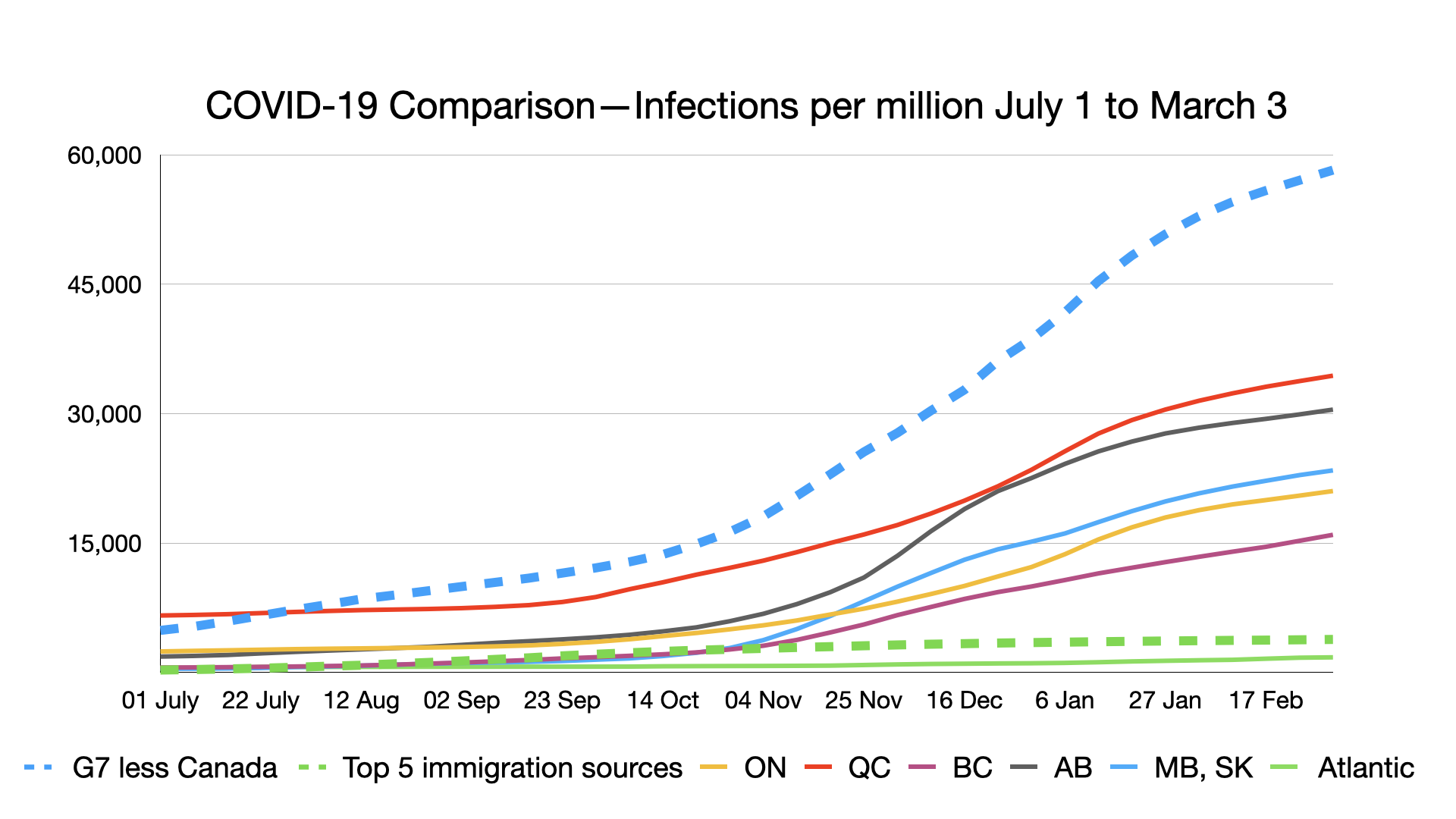
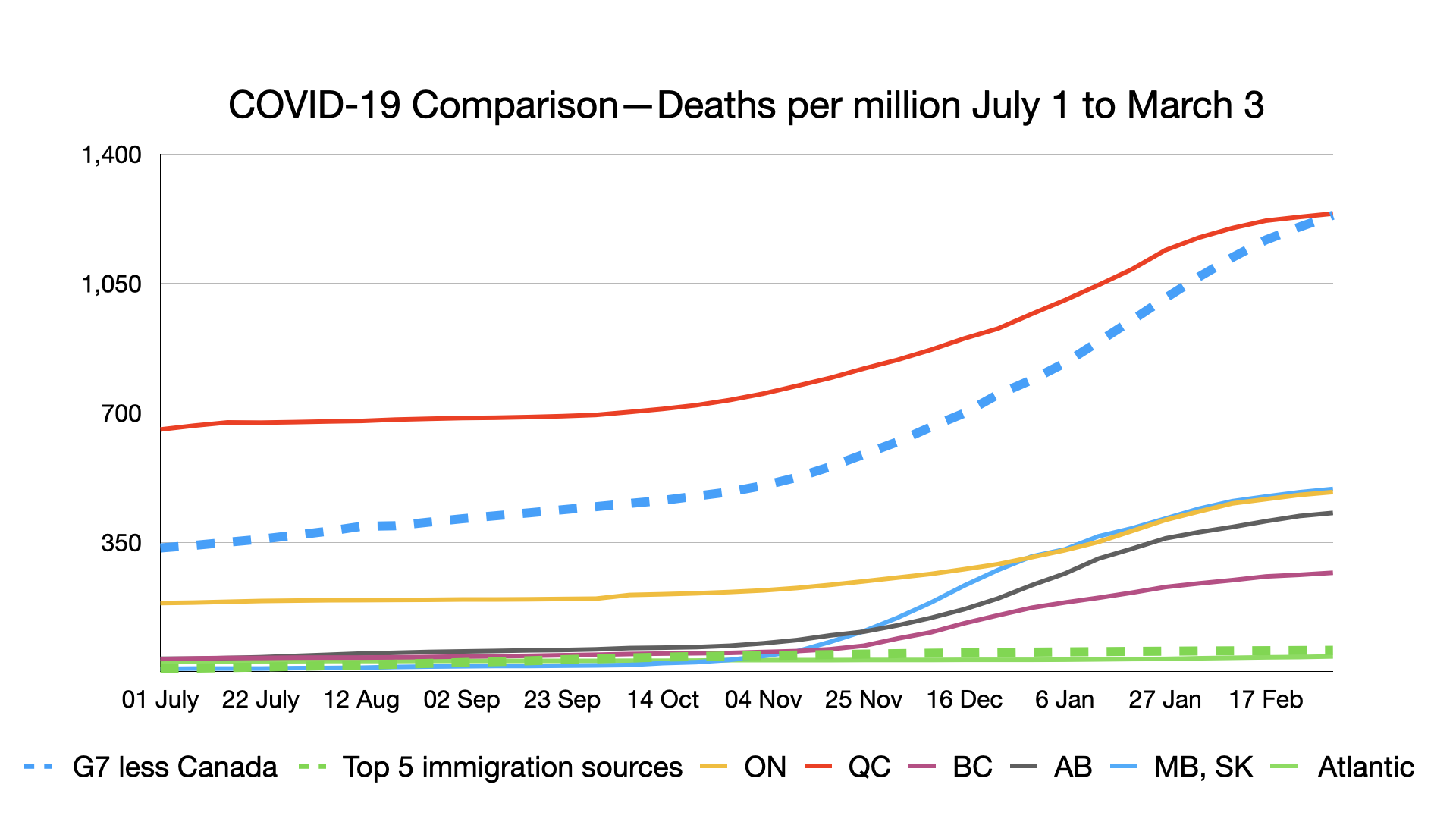
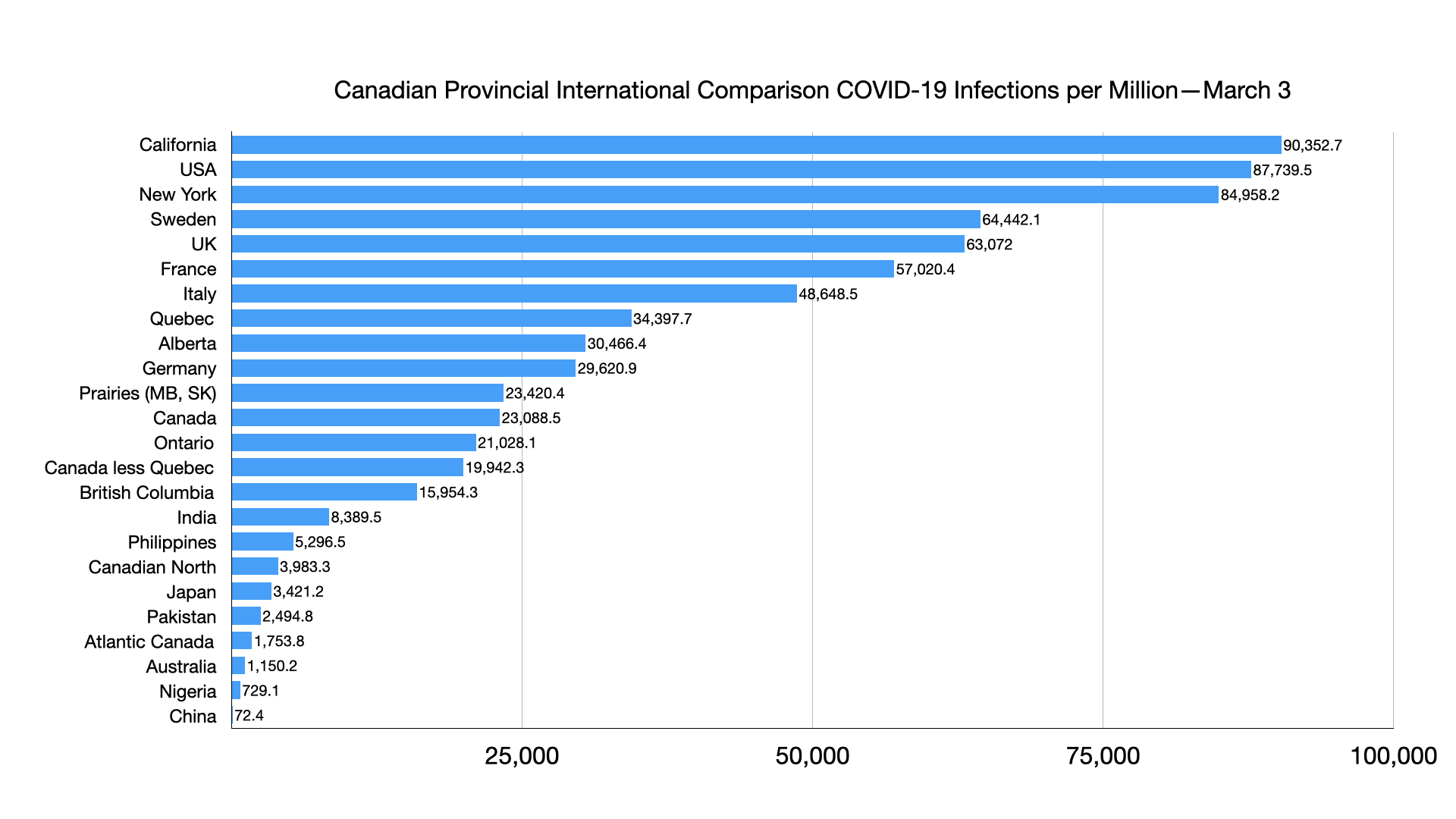
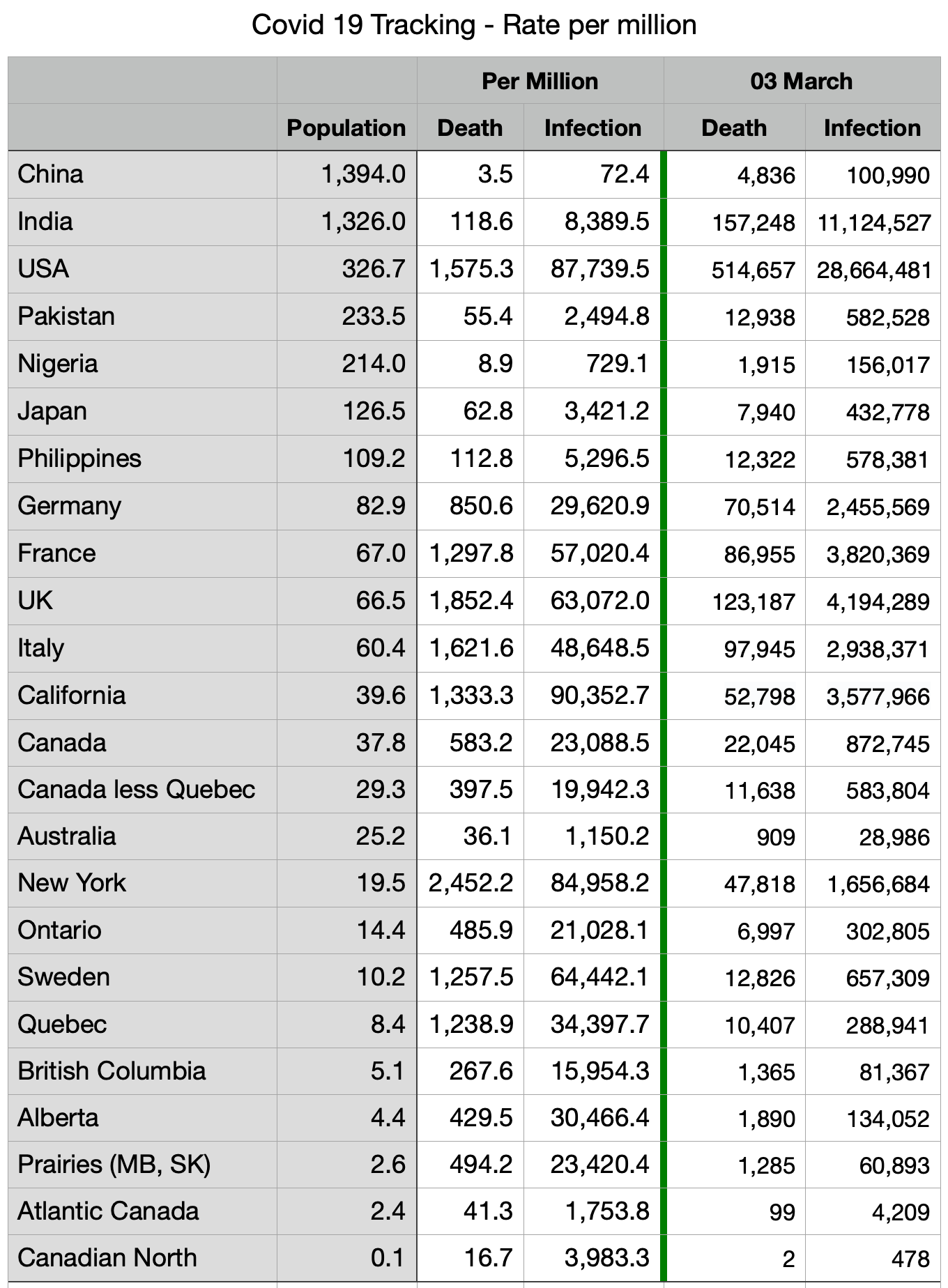
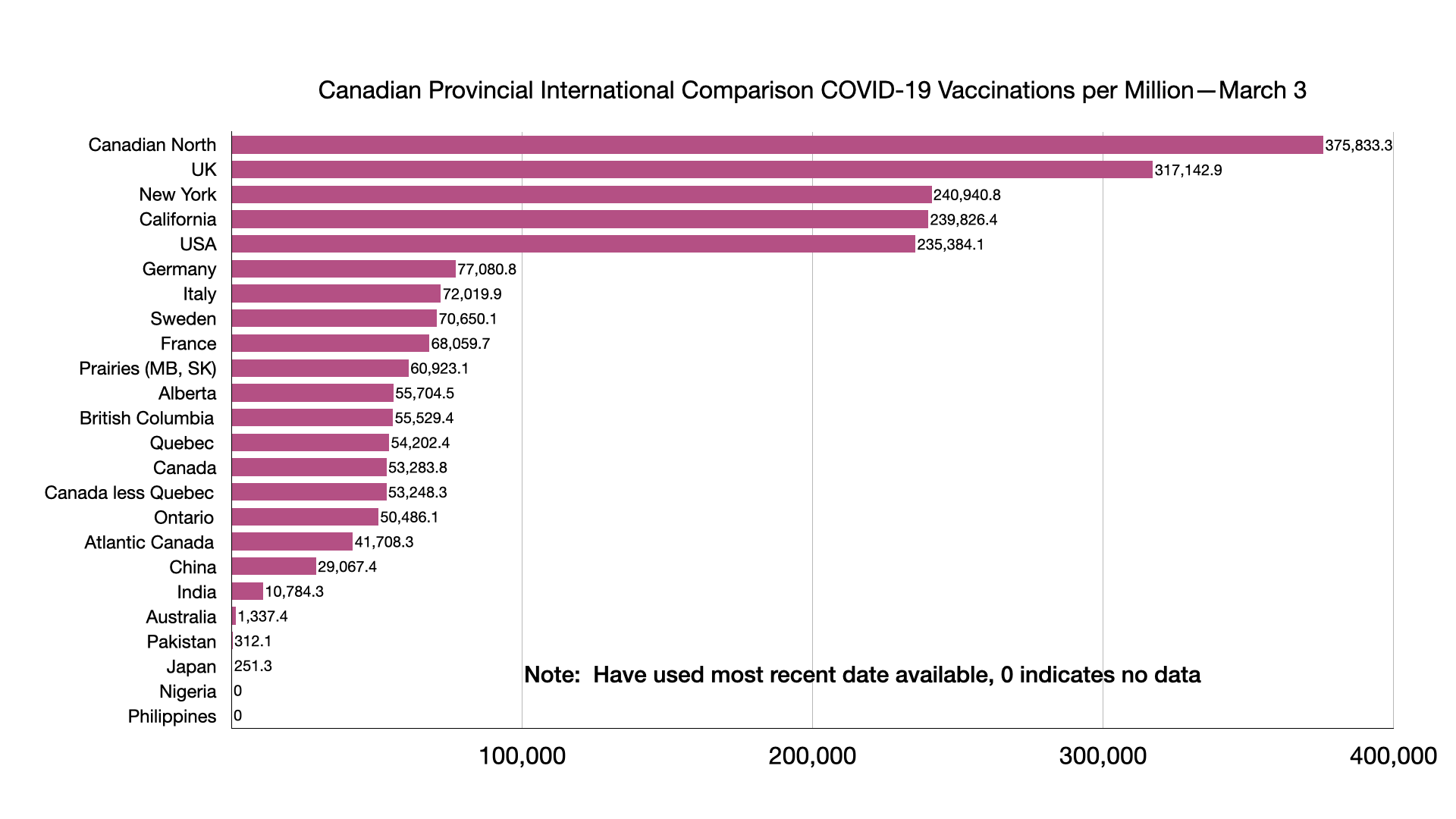
#COVID-19: Comparing provinces with other countries 3 March Update

The latest charts, compiled 3 March (not international vaccination data is latest available).

Vaccinations: The gap between all G7 countries save Japan continues to grow, all European countries slightly ahead of Canada.

Trendline charts

Infections per million: The overall trend of a flattening curve is seen in G7 countries and most provinces save for the Prairies and British Columbia.

Deaths per million: Most Canadian provinces continue to flatten the curve, Quebec most dramatically. Overall G7 death rate at point of surpassing Quebec.

Vaccinations per million: Gap between G7 and Canada, driven not only by the UK and USA, remains largely unchanged.

Weekly

Infections per million: No relative change.

Deaths per million: California ahead of Sweden and Quebec, Sweden ahead of Quebec 

Blogging break this week

Laptop repair

Public Service Disaggregated Data for Visible Minorities and Indigenous peoples, Citizenship status

Over the past few months, I have been analyzing the various datasets breaking down public service employment and employee survey data by the individual visible minority and Indigenous groups.

The three articles, What new disaggregated data tells us about federal public service diversity (Policy Options, October 2020), What the Public Service Employee Survey breakdowns of visible minority and other groups tell us about diversity and inclusion (The Hill Times, November 2020) and Diversity and Inclusion: Public Service Hirings, Promotions and Separations (The Hill Times, March 2021) allow for a more comprehensive view of visible minority and Indigenous groups in the federal public service. Moreover, recent Public Service Commission studies analyzing recruitment of employment equity groups add an important element to discussions on public service staffing and recruitment practices.

Much of the debate and discussions have understandably focussed on Blacks in the public service. Yet public service data indicates that their situation is not unique in terms of representation, hirings and promotions and the employee satisfaction, with many commonalities with the other groups. A more granular analysis within each occupational group (i.e., comparing representation at each level by occupational group, as some departments are conducting, may very well provide such evidence).

Key findings are:

  • Overall EE analysis shows considerable variation among the different visible minority and Indigenous groups
  • Visible minorities
    • Correlation between lower educational attainment and representation for most groups save Chinese
    • Overall under-representation common to most groups
    • Blacks, West Asian/Arab small over-representation
    • EX: All groups under-represented save Japanese with Filipino, Latin American and Blacks having the largest gaps
    • Hirings: Hirings of visible minorities have increased for all groups in most occupational groups save for technical and administrative support. Hirings at the EX level have increase for Black, Chinese, South Asian/East Indian and West Asian/Arab, with other groups showing no increase.
    • Promotions: While promotions have increased marginally for virtually all groups at the agregate level, promotions by occupational category provide a mixed picture, with most groups and most occupational categories experiencing a marginal decline in promotions.
  • Indigenous peoples
    • First Nations under-represented, Métis and Inuit over-represented
    • Hirings: While hirings at the EX level have increased slightly, this is less the case for the other occupational categories. Hirings of Métis have increased the most in the operational category, hirings of First Nations the most in the technical category, while hirings of Inuit the most at the EX level.
    • Promotions: A marginal decline across all Indigenous groups and occupational
  • Harassment/Discrimination experiences vary
    • Harassment: Japanese report the most as do First Nations and Métis, Chinese and Filipino least satisfied with resolution as is the case with Métis
    • Discrimination; Blacks report the most, but all groups encounter discrimination on the basis of race, ethnic origin or colour. Black, Japanese and Latin American least satisfied with resolution. All Indigenous groups report having been discriminated against, mainly based on race or ethnic origin, with Métis also least satisfied with resolution

The recent PSC Audit of Employment Equity Representation in Recruitment provides some interesting data and analysis of the staffing process and how the different employment equity groups, and visible minority largest sub-groups, fare at each of the five stages in the staffing process: job application, automated screening, organizational screening, assessment and appointment (FY 2016-17 data).

The most significant stages were organizational screening and assessment where most filtering took place as shown in the table below:

The next table breaks down visible minorities by the largest groups:

As noted in the audit, Blacks have the largest decrease in representation at all stages save for appointment, with a non-negligible being screened out by automatic screening. Chinese are screened out more by organizational screening whereas West Asian and South Asian are more likely to be screened in as the assessment stage.

The audit provides the following explanation for visible minority groups. Overall, visible minority women have higher success rates than visible minority men at the organizational screening and assessment stages. Visible minorities screened out at the organizational screening stage due to citizenship status (Canadian citizens are given preference over non-citizens) and experience qualifications. Those with public service work experience were more likely to be screened in at this stage but overall “experienced less success than their counterparts regardless of whether or not they had federal public service experience.”

At the assessment stage, visible minorities were less successful when written tests were used, particularly the case for Black candidates.

A separate PSC report addresses the Citizenship of applicants and external appointments. While Canadian citizens have a hiring preference, the share of non-citizen applicants has risen from 9.4 percent in 2015-16 to 14.5 percent in 2018-19, with the share of hires has increased to 2.5 percent from 1.5 percent over the same period

Non-citizen visible minority applicants account for 22.9 percent of all visible minority applicants, for non-visible minorities, the share is only 12.1 percent.

The table below contrasts applicants and appointments by citizenship status for the past four years. For Canadian citizens, the percentage of applicants and appointments are comparable, for Permanent Residents and others, appointments are significantly greater than applicants suggesting that citizenship may be less of a barrier than commonly believed.

Visible minority Canadian citizens represented 17.2 percent of all applicants and 19.5 percent of all hires (2018-19).