Remaking the public service: After a year of COVID, what has the federal government learned about how it operates?

Useful and informative overview:

Not since the Second World War has the federal government loomed so large over the affairs of Canadians. During the first ten months of the pandemic — from April 1, 2020 to January 31, 2021 — the government shelled out half a trillion dollars compared to $287 billion during the same period in 2019.

The vast majority of the increase was courtesy of emergency spending on an extraordinary range of anti-virus measures.

About $78 billion was taken up by programs to help individuals directly affected by COVID-19. Another $66 billion went towards subsidizing wages of employees who would otherwise be laid off. Billions more were directed at shoring up the weakening balance sheets of small business, and to secure vaccines, testing equipment and personal protective gear.

At times, it seems scarcely a segment of the economy has been left untouched by Liberal government largesse, which by the end of January had pushed the federal net debt to $1.1 trillion. This represented more than half the country’s gross domestic product, not a record by any means, but up from less than one-third practically overnight. This does not include the rapidly deteriorating balance sheets maintained by the provinces.

While the potential risks associated with this level of debt have been put off until the virus has been tamed, the impact of the sudden spending spree on government operations has been profound.

In the year of COVID, dozens of federal agencies and departments have been forced to behave in starkly uncharacteristic ways.

Deep-rooted policies were re-crafted on the fly, procurement moved at warp speed and multiple departments were tasked with building a health products industry nearly from scratch.

On top of this, key ministries are about to be tasked with managing an ambitious program, to be outlined in the April 19 federal budget, to refurbish the country’s infrastructure and help jumpstart the post-COVID economy.

Behind the scenes, government executives are ramping up plans for modernizing operations. They are also asking themselves what permanent lessons they should draw from the tumult of 2020.

These range from the profound: how to prepare for a new pandemic, to the practical: how should government better organize itself for the digital world?

The first lesson involves drilling into the overarching weakness of Canada’s response to the coronavirus — not just the egregious intelligence failure of the Public Health Agency of Canada, but also the relaxed oversight of a cabinet that could not bring itself to accept a worst-case scenario.

PHAC had assured Canadians the health risk to them was low early last year even as the coronavirus was circulating widely.

At heart, this was a failure of leadership culture, not a lack of early warning. The infection that became known as COVID-19 was in plain sight from the start. What PHAC missed, or at least declined to act upon, was the fact that COVID-19 was spreading asymptomatically, despite evidence that had been brought to its attention.

The result was a sharp, early rise in the number of infections, followed by a sub-par rollout of COVID-19 vaccines, which reflected a general lack of preparedness.

For other departments and agencies, the lessons of COVID are more straightforward.

The rapid spread of the coronavirus has demonstrated clearly the importance of the digital world. While the federal government has built one of the country’s largest communications networks, much of it is in need of refreshing and very little is easy to use.

The technology gaps were particularly shocking when it came to tracking stockpiles of personal protective equipment, conducting tests for the coronavirus and tracking the networks of people affected. This was both a provincial and federal government failure.

Anxious to avoid a repeat, federal departments in the past few weeks have developed ambitious plans for upgrading their infrastructure, and expediting new online services for Canadians. Whether these actually succeed will depend heavily on the government’s willingness to reverse its traditional antipathy for investing in operations. Encouraging executives to bear direct responsibility for projects will help.

“The path set out during the early days of the pandemic points to a new way of doing business,” the Canada Revenue Agency declared in its priorities report for the fiscal year ending March 31, 2022.

The agency, which spends half a billion dollars annually on information technology and was a key player in the delivery of the Canadian Emergency Response Benefit, is making permanent adjustments to its networks to give it more flexibility in the event of future crises. It is also developing a series of software applications to simplify tax returns, permit more tax verification information to go online and automate more of the tax filing process.

Employment and Social Development Canada is managing a massive, multi-billion dollar upgrade of the systems that deliver Canada Pension Plan, Old Age Security and other payments. While that was in train before the pandemic, the urgency has increased.

“Past decisions to defer maintenance and updates have increased the risk of systems failure,” the department noted bluntly in its most recent plan, “Modern applications need up-to-date technology.”

During the first few days of the economic lockdown a year ago, ESDC’s system for delivering employment insurance claims very nearly crashed. The department now has in place a program for accelerating its investments in information technology until 2026 to try to make up the gap in its capacity.

ESDC is hardly alone in playing catch-up.

Federal departments across government currently maintain some 14,000 software applications, ranging from weather forecasting to applications for business loans. Many are built on technology so old the original providers have simply stopped supporting it. In order to keep the entire apparatus humming, the government relies on thousands of software jocks familiar with products now past their prime. Many are employed by private sector specialist firms.

“We have to deal with the legacy stuff we inherited, fix it, replace it, modernize it,” Shared Services president Paul Glover acknowledged last fall before a House of Commons committee.

One way to look at it: older software programs need to be upgraded or replaced before they can be shifted from legacy locations to one of the pristine data centres now up and running. To date, just five per cent of the workloads associated with the software have migrated from old data centres to new ones, with another 40 per cent in various stages of planning.

What’s needed, in other words, is a concerted effort to modernize government faster than it’s aging. Departments and agencies will have to stretch.

Thanks to the experience of COVID-19 they now understood just how quickly they can move. Some of the more inspiring examples include:

  • Canada Revenue Agency and ESDC developed generous financial assistance programs for millions of Canadians in a matter of days.
  • Shared Services Canada boosted by 50 per cent the capacity of its networks serving Canadians online, and doubled to nearly 300,000 the number of secure connections used by government employees working from home.
  • Global Affairs seconded more than 600 employees to an emergency response centre at Lester B. Pearson headquarters. There they organized the repatriation of more than 60,000 Canadians from 100 plus countries in the largest post World War II exercise of its kind.
  • Public Services and Procurement Canada — the government’s contracting arm — arranged for the flights for repatriated nationals, and negotiated billions of dollars’ worth of medical supplies, testing equipment and other gear on behalf of the Public Health Agency of Canada. PSPC managed all this with a 3 per cent bump in the size of its procurement group.

So it was, across government. While Canadians in other parts of the country were suspicious that thousands of federal employees had simply booked time off for a COVID holiday, things actually got done.

Yes it was messy. Mistakes were inevitable in this environment, the prime minister acknowledged, but these would be corrected later, he promised. Indeed Canada Revenue Agency and ESDC are conducting audits of the billions of dollars of emergency payments, an exercise that will rely to some extent on artificial intelligence software.

Dealing quickly with the vast knock-on effects of COVID-19 was considered more important last year than upfront due diligence — an assessment with which Auditor General Karen Hogan agreed.

In some ways the government was lucky. Had COVID-19 struck a few years earlier, the response might have been an unholy mess. As recently as 2018, Shared Services Canada, the core supplier of data centres, Internet service and telephone networks, was working itself out of a deep hole created when Stephen Harper’s Conservatives cut its budget just as the department was launched.

The government only recently put in place a cloud services program with third parties, allowing departments to quickly expand network capacity in emergencies. It’s what saved the CERB program.

Just as fortunate, federal departments have been experimenting with pilot projects — such as work-from-home arrangements and automatic bank deposits — that allowed near instant responses to COVID developments.

These signs of flexibility and speed were the fruit of an extraordinary exercise in workplace consultation.

In June 2013, Wayne Wouters, the government’s top mandarin and clerk of the Privy Council asked federal workers what they thought of Blueprint 2020 — an analysis of global trends in technology and management. The document set out a series of principles that would govern how employees would do their jobs in light of these new realities.

The gist was that in order to properly serve Canadians by 2020, government workers would be equipped with state-of-the-art technology, and encouraged to be flexible, to experiment with ideas, and collaborate with other departments. They would also be given freedom to make mistakes and to learn from them.

More than 100,000 offered their views, most of them keen on the idea of making a difference. Others viewed the exercise with scepticism. They knew that as long as politicians felt they had to answer for errors in their departments, the business of running government would default to avoiding risk. Top-down management would prevail. In many ways, it still does.

Yet, fitfully, and somewhat improbably, the work culture began to shift. Here and there, departments and agencies set up those pilot projects. Government planners lost their enthusiasm for huge, all-encompassing programs following the botched rollouts of Phoenix Pay and email systems for federal employees. Both of these had been launched prior to the publication of Blueprint 2020.

Instead, the government has encouraged minimalism — the idea that new online services for Canadians or government employees should be developed in more manageable stages, with each one tested before moving to the next.

When responding to COVID, of course, there was little time for testing. But even there, the lessons of Phoenix Pay had been absorbed. In developing the Canadian Emergency Response Benefit for millions of people affected by the virus, the Canada Revenue Agency aimed for what it called a “minimum viable product” — a software application stripped to absolute essentials.

Along with making changes to the government’s electronic backbone, departments are wrestling with how to deploy their workers, post-COVID.

The Canada Revenue Agency — with 45,000 employees, including some 12,000 in the capital region — is also taking the lead on creating a permanently distributed workforce. In response to queries by this newspaper, the agency said it is looking to shift towards “a hybrid model” that will see a certain core work full-time from the office, while giving other employees the flexibility to work from home.

The collective decisions will have a profound effect locally. Not only do federal government employees make up more than 20 per cent of the Ottawa region’s total workforce, they work in buildings that account for nearly 30 per cent of the capital’s commercial real estate.

Managers and workers alike have learned much of their work can be done from anywhere, leading some to query why 42 per cent of the government’s 300,000 civilian employees need to be based in the national capital region. Departments with more than 80 per cent of their workforce located in Ottawa or Gatineau include: Finance, Statistics Canada, Treasury Board, Innovation and Global Affairs.

Real estate planners suggest the government’s future workforce will likely be split into three groups: small minorities who choose to work permanently from home or the office, and a majority who will work remotely for part of the week.

With thousands of work rules at play across dozens of union bargaining units, none of this will be easy to sort out.

“The work office will have to be re-thought,” says Stéphane Aubry, national vice-president of the Professional Institute of the Public Service of Canada, which represents 60,000 government workers. “Some of our members will prefer to keep working at home,” he adds. “We will not be going back to what was before.”

Before the pandemic struck, the government had been nearing the end of a multi-year program to reduce the amount of office space available for each employee. Almost certainly this strategy will be reversed to accommodate workers still concerned about working in close proximity with colleagues. This means fewer workers for the same amount of office space.

This won’t necessarily be a problem, at least in terms of logistics, assuming sufficient numbers of employees work from home. But it will likely increase overhead costs for government workers overall.

In coming years, as the government starts winding down its spending, the nearly $50 billion it spends annually on payroll for permanent staff will likely come under increasing scrutiny, not to mention the $11 billion it spends each year on professional services.

A strong counter-argument would be to point to a sprawling organization that, prompted by COVID, learned to serve Canadians with dispatch and efficiency. Will it actually happen?

Put it this way: the federal government over the past decade wasted billions of dollars of taxpayers’ money on failed information technology projects — and both government and private firms were at fault.

Departments now have another opportunity to get things right and rehabilitate their reputations. Many of the pieces are in in place but the big unknown is whether the flexible culture foreseen by Blueprint 2020 will actually be permitted to flourish.

Source: https://ottawacitizen.com/news/postpandemic/remaking-the-public-service-after-a-year-of-covid-what-has-the-federal-government-learned-about-how-it-operates

‘We want you to stay’: Canada opens door to permanent residence for 90,000 international graduates and temporary workers with one-time program

One-time or a pilot? Addressing some long-standing equity issues. Doing so during a downturn when some sectors are unlikely to recover soon (e.g.., hospitality, travel, in person retail) is risky. Will be interesting to follow the economic outcomes of Permanent Residents that are admitted under this policy:

Canada is rolling out a one-time special immigration program to grant permanent residence to 90,000 recent international graduates as well as temporary foreign workers with work experience in essential occupations.

International students will qualify for the new program if they have graduated from an eligible post-secondary program within the past four years, after January 2017, and if they are currently employed. They do not need to be in a specific occupation to meet the requirements.

The program is also open to temporary foreign workers with at least one year of work experience in one of the 40 health-care occupations, as well as 95 other essential jobs across a range of fields, such as caregiving and food production and distribution.

This time-limited immigration pathway will take effect on May 5 and remain open until Nov. 5 or until the target is reached.

“The pandemic has shone a bright light on the incredible contributions of newcomers. These new policies will help those with a temporary status to plan their future in Canada, play a key role in our economic recovery and help us build back better,” Immigration Minister Marco Mendicino said on Wednesday.

“Our message to them is simple: Your status may be temporary, but your contributions are lasting — and we want you to stay.”

The Liberal government has made immigration a critical part of Canada’s post-COVID-19 economic recovery with plans to welcome 401,000 permanent residents in 2021, after the annual intake of immigrants nosedived by 45.7 per cent last year to just 185,130.

The 90,000 intake under the new program will account for almost a quarter of this year’s overall immigration goal.

With the border remaining closed to non-essential travel, many would-be immigrants who have already been granted permanent residence have been unable to come to Canada. 

It has prompted officials to shift gears and focus more on prospective candidates who are already in Canada and normally would face a lengthier process to qualify.

In February, Ottawa raised eyebrows when it issued 27,332 invitations — five times more than its previous high of 5,000 people — to hopeful candidates already living in this country.

Mendicino said these are unprecedented steps taken to create “the fastest and broadest pathways” for permanent residency and toward achieving the 2021 immigration level plan through a series of “smart choices.”

“We need workers who possess a range of skills in a range of sectors within our economy to keep it going forward and accelerate our economic recovery,” he said.

“We value those who are highly educated, those who are highly skilled, but we also need people who work in the agriculture sector and in trades and construction sector who provide manual labour to build our communities. For too long, we haven’t been able to provide these pathways.”

Among the 90,000 spots of the program, 20,000 will be dedicated for temporary foreign workers in health care; 30,000 for those in other selected essential occupations; and the remaining 40,000 for international students who graduated from a Canadian institution.

All candidates must have proficiency in one of Canada’s official languages, meet general admissibility requirements; be authorized to work and be working in Canada at the time of their application to qualify. Migrants who are already out of legal status won’t be eligible.

To promote Canada’s official languages, three additional streams have also been created for French-speaking or bilingual candidates, with no intake caps.

The business community welcomed the new immigration pathways, saying the newcomers will strengthen Canada’s economy when they are needed most.

“They fill labour-market shortages, offset our aging population and broaden the tax base, thereby helping fund social and public services,” said Goldy Hyder, president and CEO of the Business Council of Canada, whose members represent all major industries in the country.

“COVID-19-related restrictions have hit Canada’s immigration system hard, significantly reducing the number of newcomers entering the country. The (immigration) minister’s plan addresses this challenge by welcoming urgently needed talent.”

Although the program opens up a short-term window for thousands of migrants who are able to meet restrictive criteria, advocates say it still maintains the fundamentals of the temporary immigration system that will continue to keep many migrants in limbo.

“This announcement is a start, but without fundamental change through granting full and permanent immigration status for all, it will simply not be enough,” said Syed Hussan, executive director of Migrant Workers Alliance for Change based in Ontario.

Mendicino said the immigration department has recently hired an additional 62 officers to boost its processing capacity and the new program will only accept applications online to allow remote processing by staff, most of whom are still working from home.

He said processing immigration applicants within and outside of the country are not mutually exclusive, and officials will continue to process applications of those who are abroad because Canada needs immigrants to fill labour market needs and replenish an aging population.

These special public policies, he said, will encourage essential temporary workers and international graduates to put down roots in Canada and help retain the talented workers in need in the country.

“Imagine you’ve been asked to bring in the greatest number of permanent residents in the history of the country. People could’ve said, ‘Put a pause on immigration.’ We said no, because we believed we need to continue to grow our economy through immigration,” said Mendicino.

“Newcomers create jobs. They create growth. They give back to their community. They are rolling up their sleeves and invested in Canada”

Source: https://www.thestar.com/news/canada/2021/04/14/we-want-you-to-stay-canada-opens-door-to-permanent-residence-for-90000-international-graduates-and-temporary-workers-with-one-time-program.html

IRCC requirements and eligible occupation list: https://www.canada.ca/en/immigration-refugees-citizenship/corporate/mandate/policies-operational-instructions-agreements/public-policies/trpr-canadian-work-experience.html#annex-b

‘Master,’ ‘Slave’ and the Fight Over Offensive Terms in Computing

Interesting with some useful alternatives: primary/secondary, source/replica:

Anyone who joined a video call during the pandemic probably has a global volunteer organization called the Internet Engineering Task Force to thank for making the technology work.

The group, which helped create the technical foundations of the internet, designed the language that allows most video to run smoothly online. It made it possible for someone with a Gmail account to communicate with a friend who uses Yahoo, and for shoppers to safely enter their credit card information on e-commerce sites.

Now the organization is tackling an even thornier issue: getting rid of computer engineering terms that evoke racist history, like “master” and “slave” and “whitelist” and “blacklist.”

But what started as an earnest proposal has stalled as members of the task force have debated the history of slavery and the prevalence of racism in tech. Some companies and tech organizations have forged ahead anyway, raising the possibility that important technical terms will have different meanings to different people — a troubling proposition for an engineering world that needs broad agreement so technologies work together.

While the fight over terminology reflects the intractability of racial issues in society, it is also indicative of a peculiar organizational culture that relies on informal consensus to get things done.

The Internet Engineering Task Force eschews voting, and it often measures consensus by asking opposing factions of engineers to hum during meetings. The hums are then assessed by volume and ferocity. Vigorous humming, even from only a few people, could indicate strong disagreement, a sign that consensus has not yet been reached.

The I.E.T.F. has created rigorous standards for the internet and for itself. Until 2016, it required the documents in which its standards are published to be precisely 72 characters wide and 58 lines long, a format adapted from the era when programmers punched their code into paper cards and fed them into early IBM computers.

“We have big fights with each other, but our intent is always to reach consensus,” said Vint Cerf, one of the founders of the task force and a vice president at Google. “I think that the spirit of the I.E.T.F. still is that, if we’re going to do anything, let’s try to do it one way so that we can have a uniform expectation that things will function.”

The group is made up of about 7,000 volunteers from around the world. It has two full-time employees, an executive director and a spokesman, whose work is primarily funded by meeting dues and the registration fees of dot-org internet domains. It cannot force giants like Amazon or Apple to follow its guidance, but tech companies often choose to do so because the I.E.T.F. has created elegant solutions for engineering problems.

Its standards are hashed out during fierce debates on email lists and at in-person meetings. The group encourages participants to fight for what they believe is the best approach to a technical problem.

While shouting matches are not uncommon, the Internet Engineering Task Force is also a place where young technologists break into the industry. Attending meetings is a rite of passage, and engineers sometimes leverage their task force proposals into job offers from tech giants.

In June, against the backdrop of the Black Lives Matter protests, engineers at social media platforms, coding groups and international standards bodies re-examined their code and asked themselves: Was it racist? Some of their databases were called “masters” and were surrounded by “slaves,” which received information from the masters and answered queries on their behalf, preventing them from being overwhelmed. Others used “whitelists” and “blacklists” to filter content.

Mallory Knodel, the chief technology officer at the Center for Democracy and Technology, a policy organization, wrote a proposal suggesting that the task force use more neutral language. Invoking slavery was alienating potential I.E.T.F. volunteers, and the terms should be replaced with ones that more clearly described what the technology was doing, argued Ms. Knodel and the co-author of her proposal, Niels ten Oever, a postdoctoral researcher at the University of Amsterdam. “Blocklist” would explain what a blacklist does, and “primary” could replace “master,” they wrote.

On an email list, responses trickled in. Some were supportive. Others proposed revisions. And some were vehemently opposed. One respondent wrote that Ms. Knodel’s draft tried to construct a new “Ministry of Truth.” Amid insults and accusations, many members announced that the battle had become too toxic and that they would abandon the discussion.

The pushback didn’t surprise Ms. Knodel, who had proposed similar changes in 2018 without gaining traction. The engineering community is “quite rigid and averse to these sorts of changes,” she said. “They are averse to conversations about community comportment, behavior — the human side of things.”

In July, the Internet Engineering Task Force’s steering group issued a rare statement about the draft from Ms. Knodel and Mr. ten Oever. “Exclusionary language is harmful,” it said.

A month later, two alternative proposals emerged. One came from Keith Moore, an I.E.T.F. contributor who initially backed Ms. Knodel’s draft before creating his own. His cautioned that fighting over language could bottleneck the group’s work and argued for minimizing disruption.

The other came from Bron Gondwana, the chief executive of the email company Fastmail, who said he had been motivated by the acid debate on the mailing list.

“I could see that there was no way we would reach a happy consensus,” he said. “So I tried to thread the needle.”

Mr. Gondwana suggested that the group should follow the tech industry’s example and avoid terms that would distract from technical advances.

Last month, the task force said it would create a new group to consider the three drafts and decide how to proceed, and members involved in the discussion appeared to favor Mr. Gondwana’s approach. Lars Eggert, the organization’s chair and the technical director for networking at the company NetApp, said he hoped guidance on terminology would be issued by the end of the year.

The rest of the industry isn’t waiting. The programming community that maintains MySQL, a type of database software, chose “source” and “replica” as replacements for “master” and “slave.” GitHub, the code repository owned by Microsoft, opted for “main” instead of “master.”

In July, Twitter also replaced a number of terms after Regynald Augustin, an engineer at the company, came across the word “slave” in Twitter’s code and advocated change.

But while the industry abandons objectionable terms, there is no consensus about which new words to use. Without guidance from the Internet Engineering Task Force or another standards body, engineers decide on their own. The World Wide Web Consortium, which sets guidelines for the web, updated its style guide last summer to “strongly encourage” members to avoid terms like “master” and “slave,” and the IEEE, an organization that sets standards for chips and other computing hardware, is weighing a similar change.

Other tech workers are trying to solve the problem by forming a clearinghouse for ideas about changing language. That effort, the Inclusive Naming Initiative, aims to provide guidance to standards bodies and companies that want to change their terminology but don’t know where to begin. The group got together while working on an open-source software project, Kubernetes, which like the I.E.T.F. accepts contributions from volunteers. Like many others in tech, it began the debate over terminology last summer.

“We saw this blank space,” said Priyanka Sharma, the general manager of the Cloud Native Computing Foundation, a nonprofit that manages Kubernetes. Ms. Sharma worked with several other Kubernetes contributors, including Stephen Augustus and Celeste Horgan, to create a rubric that suggests alternative words and guides people through the process of making changes without causing systems to break. Several major tech companies, including IBM and Cisco, have signed on to follow the guidance.

Although the Internet Engineering Task Force is moving more slowly, Mr. Eggert said it would eventually establish new guidelines. But the debate over the nature of racism — and whether the organization should weigh in on the matter — has continued on its mailing list.

In a subversion of an April Fools’ Day tradition within the group, several members submitted proposals mocking diversity efforts and the push to alter terminology in tech. Two prank proposals were removed hours later because they were “racist and deeply disrespectful,” Mr. Eggert wrote in an email to task force participants, while a third remained up.

“We build consensus the hard way, so to speak, but in the end the consensus is usually stronger because people feel their opinions were reflected,” Mr. Eggert said. “I wish we could be faster, but on topics like this one that are controversial, it’s better to be slower.”

Source: https://www.nytimes.com/2021/04/13/technology/racist-computer-engineering-terms-ietf.html

Doug Ford’s ‘stay home’ message is absurd. Workers in the hardest-hit areas can’t stay home — they’re essential

Seeing more of these kinds of articles, making the needed comparisons:

A retiree in Rosedale is vaccinated against a virus she’s highly unlikely to catch. Meanwhile, the 35-year-old warehouse worker from North Toronto who is boxing up the retiree’s water resistant throw pillows just in time for patio season is still awaiting his shot. 

Maybe the warehouse worker (who is far more likely than the retiree to catch COVID-19) isn’t eligible for a vaccine yet, or maybe he is eligible but he isn’t sure where or when to get jabbed because everything is so goddamned confusing.

He checked the provincial website but no luck. 

He heard something about vaccine pop-up clinics emerging in his area, but the details are vague. He lives in a so-called “hot spot” but he isn’t involved in community groups; he doesn’t belong to a church or a mosque that would advertise such a clinic. If one pops up, unless he’s lucky, he may miss it. 

The good news is that the Rosedale retiree’s pillows will arrive at her house ahead of schedule. Saturday’s physically distanced backyard tea party will be lovely. 

The above is not an excerpt from the “Hunger Games,” or some Toronto-themed dystopia novel. It’s the reality of the COVID-19 vaccine rollout in Canada’s most populous city, one that despite city officials’ efforts has produced the following uneven result: those least likely to get the virus are vaccinated in large numbers while those most likely to get it are not. 

According to recent reporting by Olivia Bowden and May Warren, affluent Moore Park is “the most vaccinated neighbourhood in Toronto” (22 per cent of residents have received one shot), while Jane and Finch “where more than half the residents do not speak English as a first language, and where thousands of essential workers live, had the lowest vaccination rate” (5.5 per cent of residents have received one shot).

But this disparity isn’t just glaring in terms of vaccination rates. It’s glaring in terms of mobility too: how much time Torontonians are spending at home vs. out of the house. 

According to data presented at a Toronto Board of Health meeting Monday morning, Torontonians who live in the city’s northwest end — where essential workers tend to live — are leaving their homes more often than those in neighbourhoods where infection rates are lower. 

What’s more, between late March and early April when Premier Doug Ford pulled the “emergency brake,” time spent at home for Torontonians who live in some essential worker enclaves appears to have actually decreased slightly.

Toronto’s top doctor, Dr. Eileen de Villa, presented a map highlighting the disparity at Monday’s meeting. “What we have seen recently is a reduced mobility overall in the city but not equally experienced in all parts of the city,” she said. “We’re seeing more mobility in the northwest of the city which we know has had disproportionate impact of COVID-19.” 

This isn’t a coincidence says Toronto Board of Health chair Joe Cressy. “What’s critical to understand here is that as the people who aren’t staying home, they’re not going out partying — they’re going to their essential jobs. Since the stay-at-home order was issued, people are staying home more often, but not in those hard-hit neighbourhoods.” 

People are staying home more often, but not in those hard-hit neighbourhoods.

If ever there was a statement that defined the urgency of vaccinating essential workers immediately, this is it. If ever there was a statement that defined the urgency of easy to access paid sick leave, this is it. And if ever there was a statement that defined the absurdity of politicians’ repeated directives to “stay home” this is it. 

“Stay-at-home orders only work for people who can stay at home,” says Cressy. And yet, leaders like Ford continue to hammer home the “stay home” message to people who are already complying, or who can’t comply because they have essential jobs. 

On April 7, Ford tweeted the following: “Stay home. Stay safe. Save lives.” On April 10 he tweeted: “Gardening is a great way to enjoy the outdoors while staying at home.” Earlier this year, the premier butchered about a dozen languages asking Ontarians to stay home. 

The problem is that when people have to go to work it doesn’t matter if you ask them nicely in their native tongue not to. 

It doesn’t matter how many empty directives our leaders give. Until vaccines pick up dramatically in Toronto’s inner suburbs and essential workers get paid sick leave that is effective immediately, the cycle will continue. 

The vaccinated will sit safe at home awaiting the contactless delivery of throw pillows. The people who make that life possible will get sick. Contactless delivery is not contactless for everyone. 

Source: https://www.thestar.com/opinion/star-columnists/2021/04/12/doug-fords-stay-home-message-is-absurd-workers-in-the-hardest-hit-areas-cant-stay-home-theyre-essential.html?li_source=LI&li_medium=thestar_recommended_for_you

Key facts about the changing U.S. unauthorized immigrant population

Useful information and context:

Border Patrol apprehensions of migrants at the U.S.-Mexico border are on the rise again. Although the majority of people attempting to enter the United States illegally are stopped, this trend could foreshadow an increase in the U.S. unauthorized immigrant population after years of relative stability. Yet the activity at the southwestern U.S. border is only one part of the overall story of unauthorized immigration, as a growing share of this population came from regions other than Mexico or Central America and entered the U.S. legally but overstayed their visas.

The unauthorized immigrant population is always changing and churning. The total number in the country can remain stable or decline even as new immigrants enter illegally or overstay a visa, because some voluntarily leave the country, are deported, die or become lawful residents. In short, the dynamic nature and pace of migration patterns has resulted in an unauthorized immigrant population whose size and composition has ebbed and flowed significantly over the past 30 years.

Here are key facts about this population and its dynamics.

How we did this
Number of unauthorized immigrants in the U.S. has declined since 2007

The U.S. unauthorized immigrant population rose rapidly from 1990 to 2007 before declining sharply for two years and stabilizing at 10.5 million in 2017.Pew Research Center’s most recent estimate is well below a peak of 12.2 million in 2007, but roughly triple the estimated 3.5 million in 1990. The estimate includes 1.5 million or more people who have temporary permission to stay in the U.S. through programs such as Deferred Action for Childhood Arrivals (DACA) and Temporary Protected Status (TPS), as well as people awaiting decisions on their asylum applications; most could be subject to deportation if government policy changed.

U.S. unauthorized immigrant populations declined or held steady for most regions of birth since 2007

Mexican unauthorized immigrants are no longer the majority of those living illegally in the U.S. As of 2017, 4.9 million unauthorized immigrants in the U.S. were born in Mexico, while 5.5 million were from other countries, the first time since at least 1990 that those from Mexico (47% in 2017) were not a majority of the total. In 2007, an estimated 6.9 million unauthorized immigrants were Mexican, and 5.3 million were born in other countries. The population of Mexican-born unauthorized immigrants declined after 2007 because the number of newly arrived unauthorized immigrants from Mexico fell dramatically – and as a result, more left the U.S. than arrived.

The number of unauthorized immigrants from nations other than Mexico ticked up between 2007 and 2017, from 5.3 million to 5.5 million. The population of unauthorized immigrants born in Central America and Asia increased during this time, while birth regions of South America and Europe saw declines. There was not a statistically significant change among other large regions, including the Caribbean, Middle East-North Africa and sub-Saharan Africa.

A rising share of U.S. unauthorized immigrants apparently arrived in the country legally but overstayed their visas. Nearly all people apprehended while attempting to enter the country illegally at the U.S.-Mexico border are from either Mexico or Central America. This stands in contrast to the origins of visa overstays.

In recent years, immigrants from countries outside of Mexico and Central America accounted for almost 90% of overstays, and in 2017, there were more than 30 overstays for every border apprehension for these countries. Although the Census Bureau data Pew Research Center uses to estimate the size of the unauthorized immigrant population does not indicate directly whether someone arrived with legal status, the origin countries of immigrants in these sources provide indirect evidence. From 2007 to 2017, the share of newly arrived unauthorized immigrants (those in the U.S. five years or less) from regions other than Central America and Mexico – the vast majority of whom are overstays – increased from 37% to 63%. At the same time, the share of new unauthorized immigrants from Mexico fell from 52% to 20%.

Short-term residents decline and long-term residents rise as share of U.S. unauthorized immigrants

The decline in the arrival of new unauthorized immigrants in recent years has resulted in a population that is increasingly settled in the U.S. About two-thirds of unauthorized immigrants (66%) had lived in the U.S. for more than 10 years as of 2017, up from 41% 10 years earlier. Conversely, newly arrived unauthorized immigrants (those in the U.S. five years or less) accounted for 20% of the unauthorized immigrant population in 2017 versus 30% in 2007. For Mexicans, the pattern is even more pronounced. The vast majority (83%) of unauthorized immigrants from Mexico have been in the country more than 10 years, while only 8% have lived in the U.S. for five years or less.

Source: Key facts about the changing U.S. unauthorized immigrant population

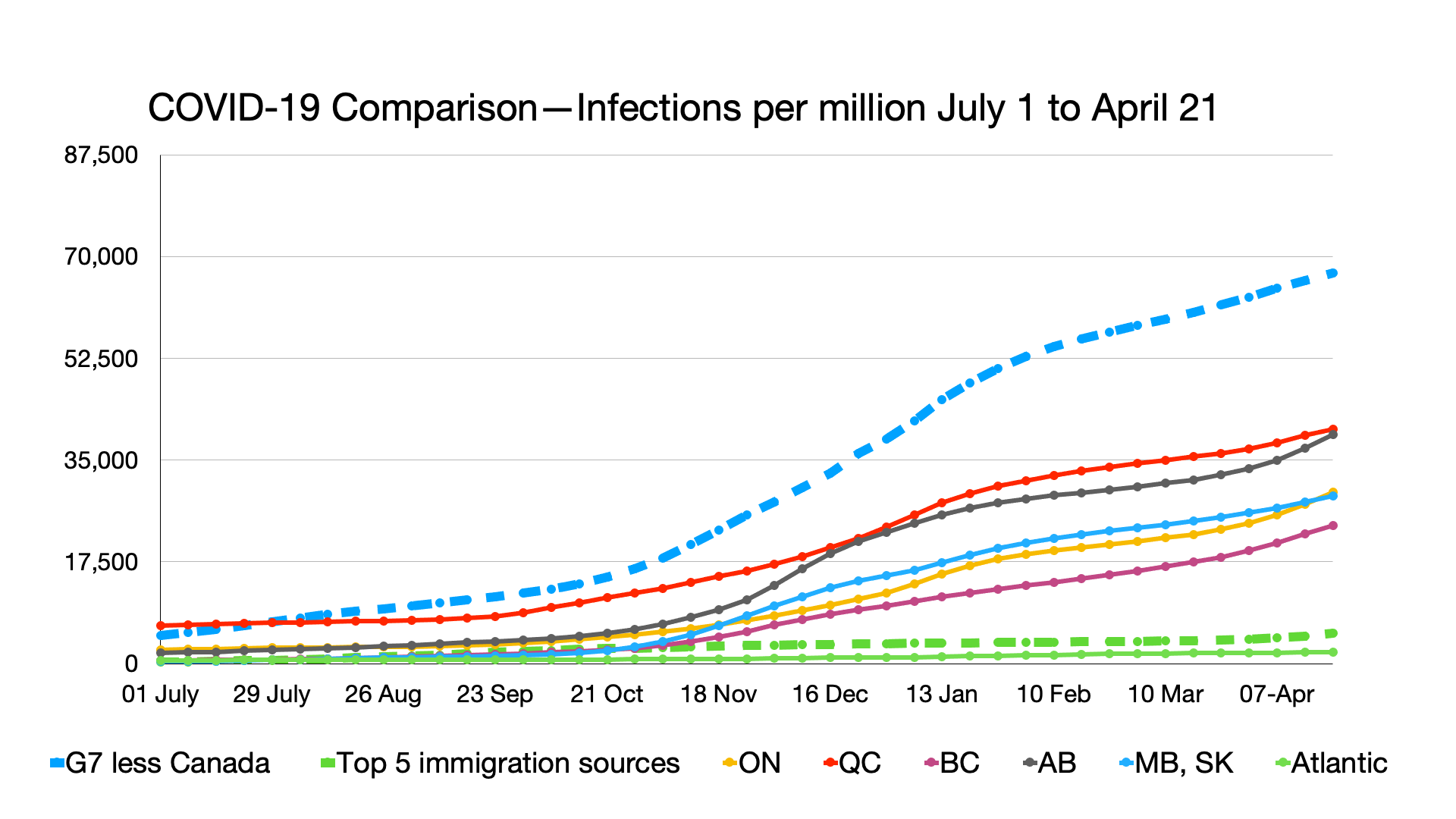
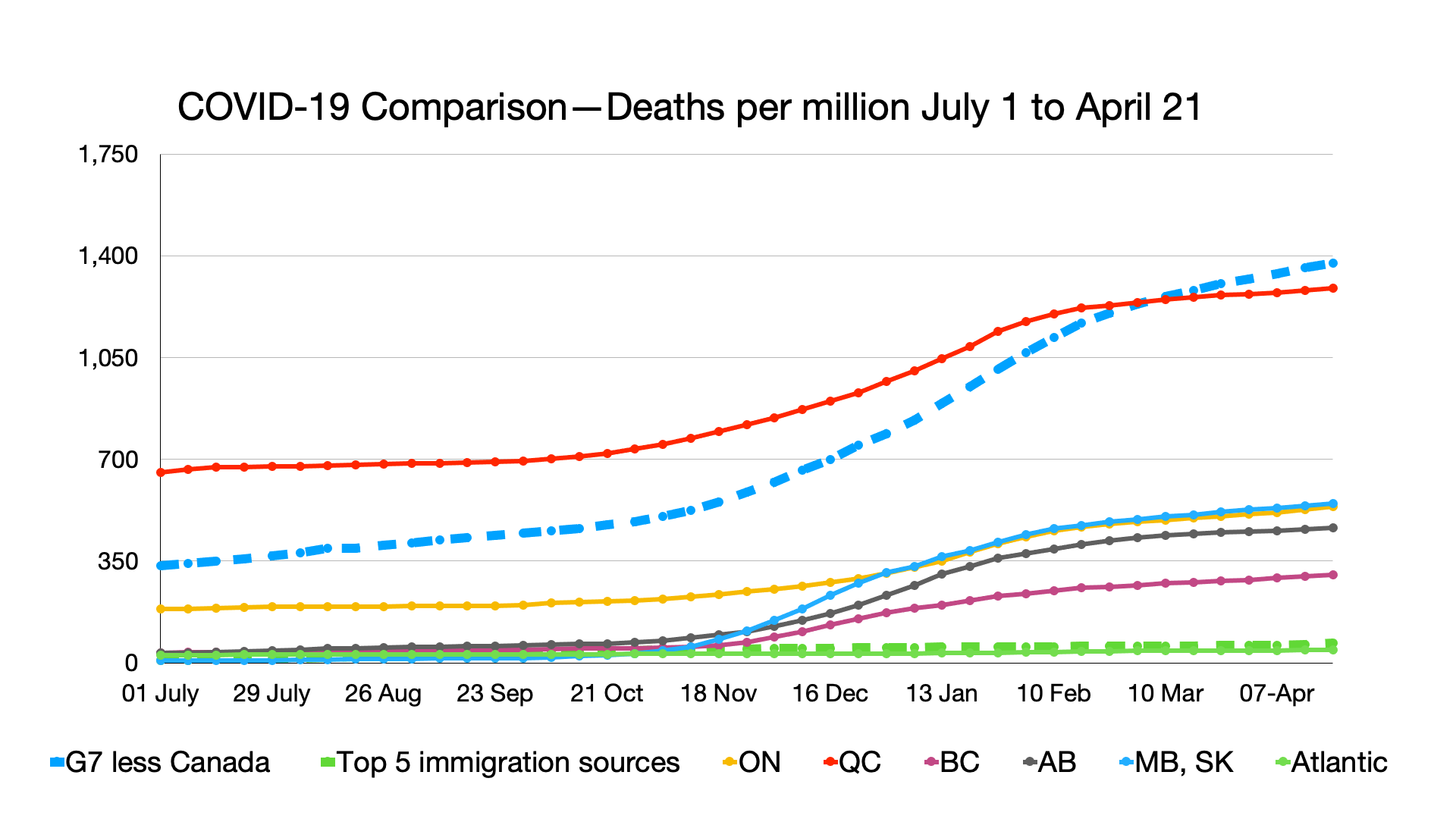
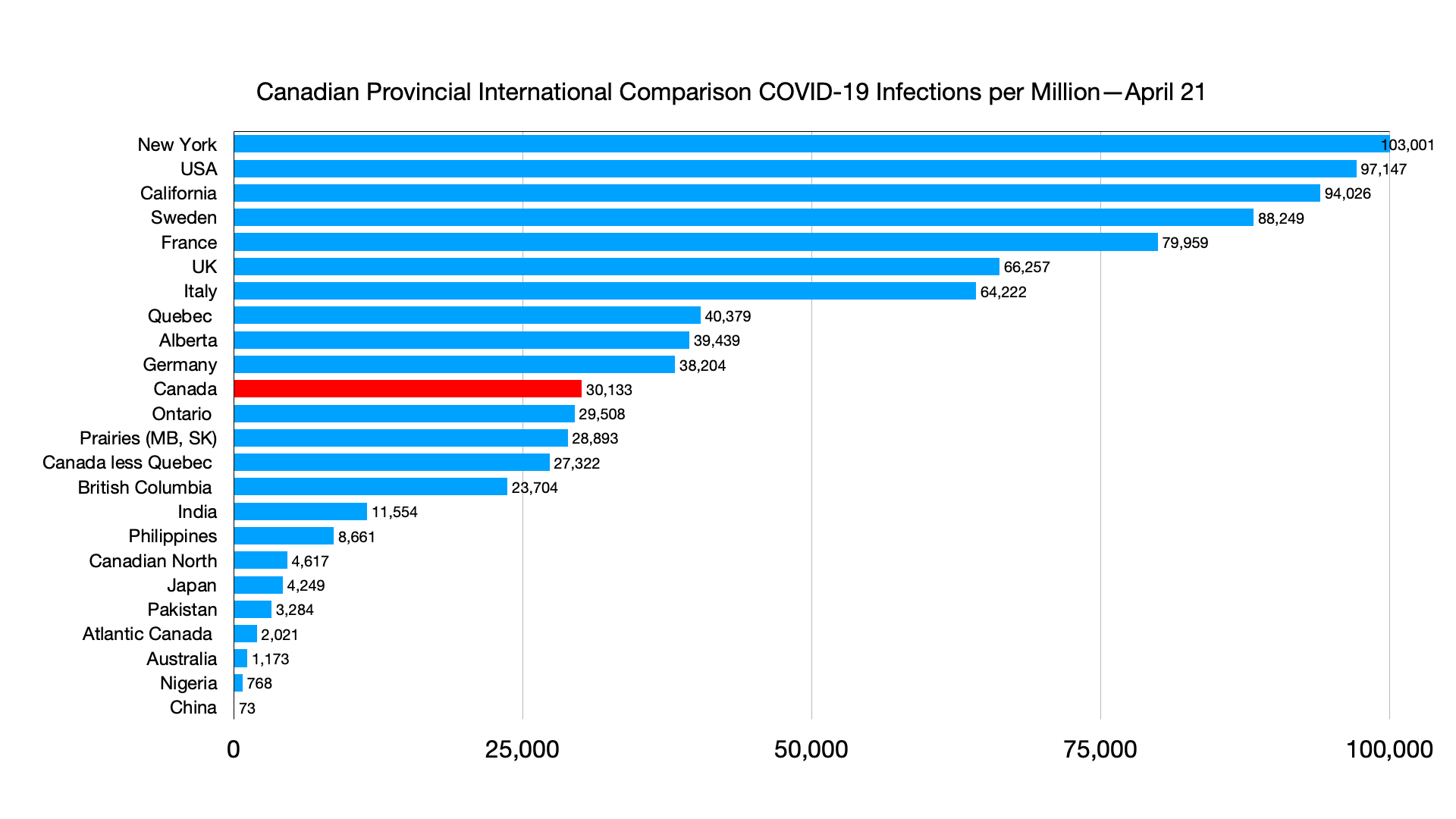
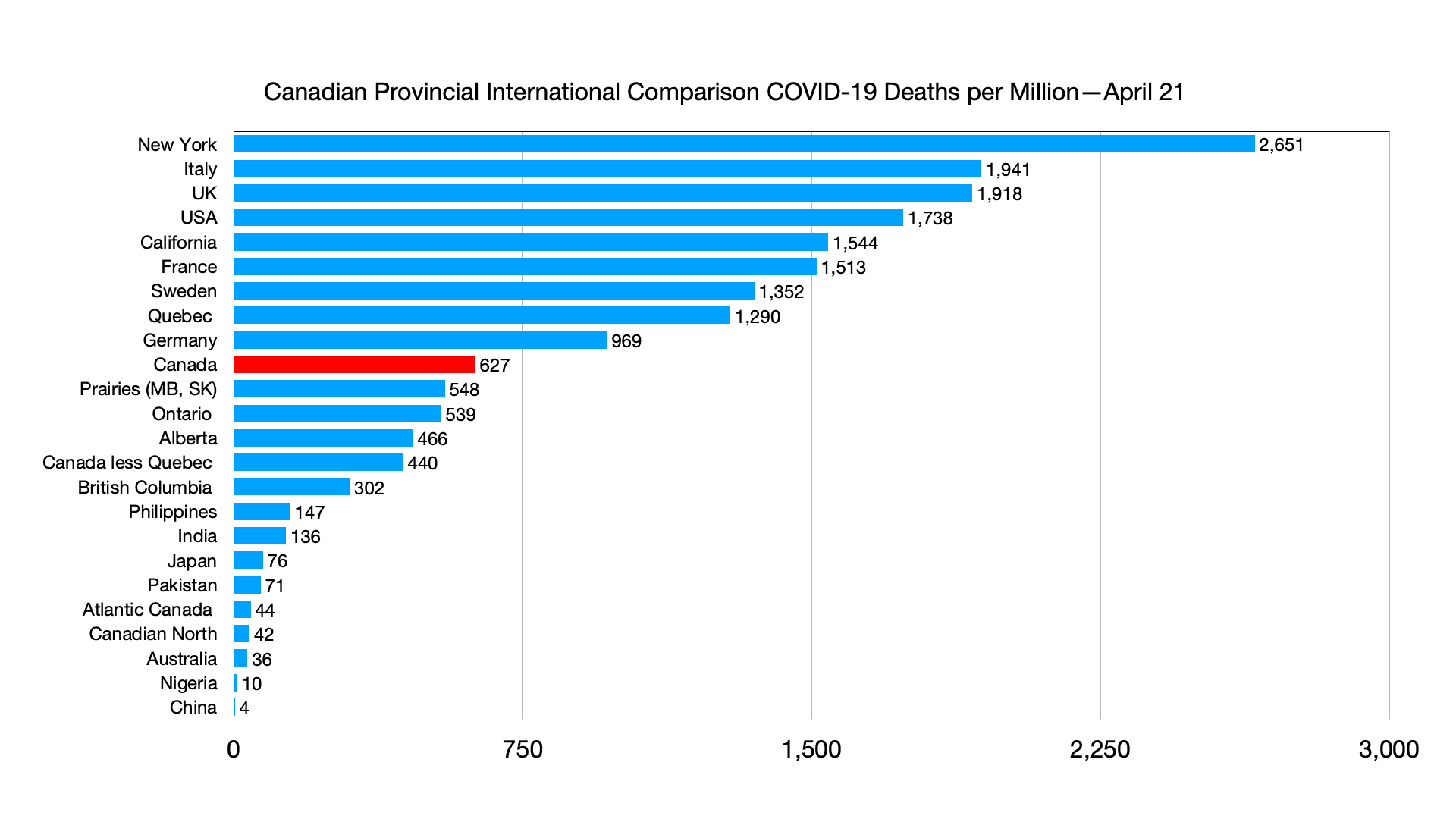
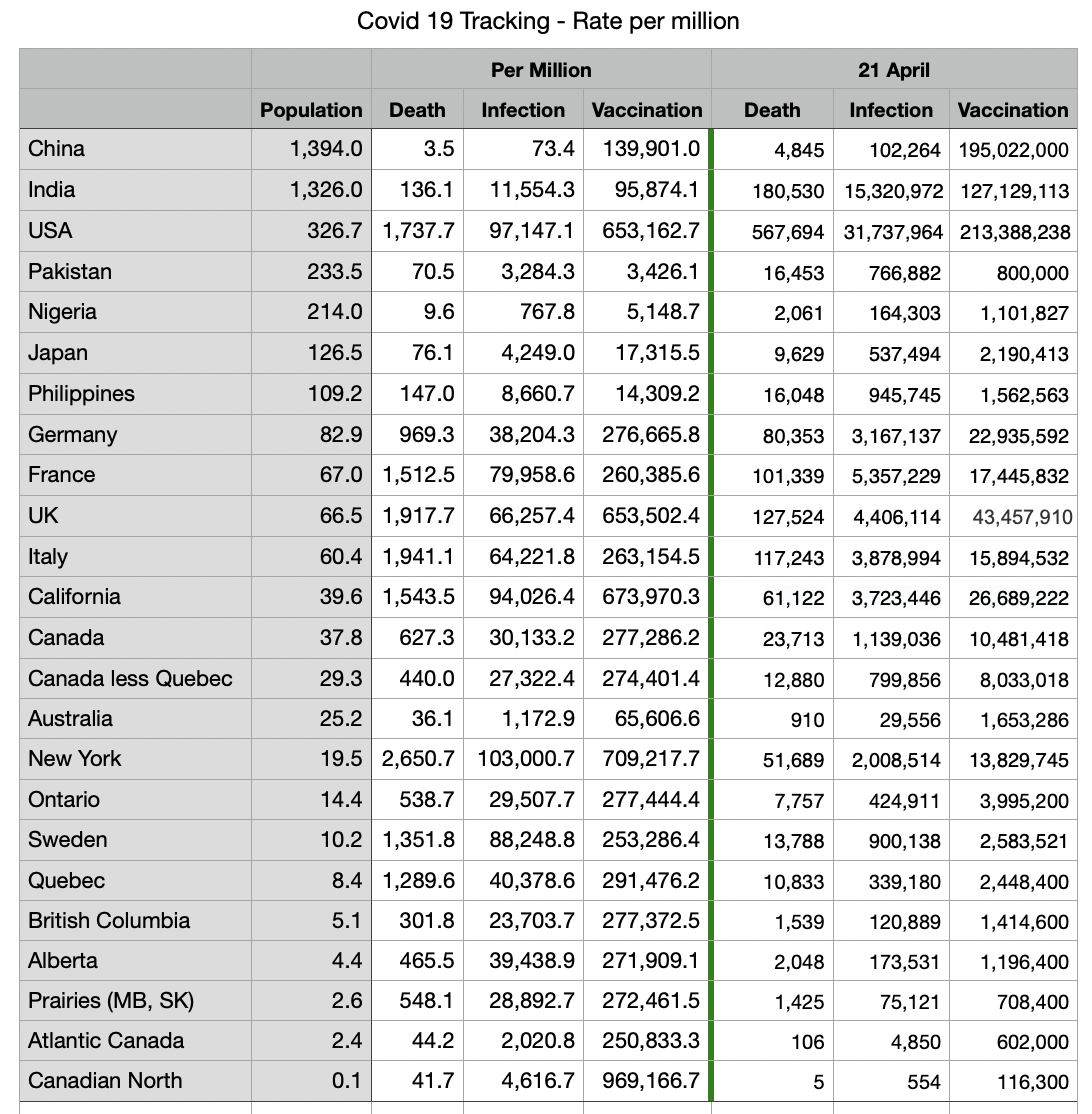
#COVID-19: Comparing provinces with other countries 14 April Update

The latest charts, compiled 14 April as the third wave has started.

Vaccinations: Overall, Canada and most provinces ahead of or comparable to EU countries.

Trendline charts

Infections per million: Overall steady increase of infections in most provinces with Alberta and Ontario showing steeper increases but still much better than G7 less Canada.

Deaths per million: No major changes.

Vaccinations per million: Significant shift with most Canadian provinces being slightly better than most EU countries.

Weekly

Infections per million: No relative changes.

Deaths per million: Philippines slightly ahead of India

Tucker Carlson and White Replacement: This racist theory is rooted in white supremacist panic.

Good commentary by Charles Blow:

On Thursday, Fox News host Tucker Carlson caused an uproar by promoting the racist, anti-Semitic, patriarchal and conspiratorial “white replacement theory.” Also known as the “great replacement theory,” it stands on the premise that nonwhite immigrants are being imported (sometimes the Jewish community is accused of orchestrating this) to replace white people and white voters. The theory is also an inherent chastisement of white women for having a lower birthrate than nonwhite women.

As Carlson put it:

“I know that the left and all the gatekeepers on Twitter become literally hysterical if you use the term ‘replacement,’ if you suggest that the Democratic Party is trying to replace the current electorate, the voters now casting ballots, with new people, more obedient voters, from the third world. But, they become hysterical because that’s what’s happening, actually. Let’s just say it: That’s true.”

Carlson continued, “Every time they import a new voter, I become disenfranchised as a current voter.”

The whole statement is problematic. First, what is the third world? This label originated as a way to categorize countries that didn’t align with Western countries or the former Soviet bloc. It’s now often used to describe poor countries, or developing countries, and by extension, mostly nonwhite majority countries.

When Carlson worries about immigrants from the third world, he is talking about Hispanic, Asian and Black people who he worries will outnumber “current” voters. Current voters, in this formulation, are the white people who make up the majority of the American electorate.

Second, and revealingly, he is admitting that Republicans do not and will not appeal to new citizens who are immigrants.

But although white replacement theory is a conspiracy theory, the fact that the percentage of voters who are white in America is shrinking as a percentage of all voters is not. Neither is the fact that white supremacists are panicked about this.

White supremacists in this country have long worried about being replaced by people, specifically voters, who are not white. In the post-Civil War era, before the current immigrant wave from predominantly nonwhite countries, most of that anxiety in America centered on Black people.

Judge Solomon Calhoon of Mississippi wrote in 1890 of the two decades of Black suffrage following the Civil War, “Negro suffrage is an evil.”

Calhoon worried that white voters had been replaced, or outnumbered, by Black ones, writing: “Shall the ballot remain as now adjusted, the whole country in the meantime taking the chances of the rapid increase of the blacks, and leaving, in the meantime, the whites as they now are in those localities where they are outnumbered?”

Calhoon would go on to become the president of the state’s constitutional convention that year, a convention called with the explicit intention of codifying white supremacy and suppressing the Black vote. States across the South would follow the Mississippi example, calling constitutional conventions of their own, until Jim Crow was the law of the South.

The combination of Jim Crow voter suppression laws and the migration of millions of Black people out of the South during the Great Migration diluted the Black vote, distributing it across more states, and virtually guaranteed that white voters would not be outnumbered by Black ones in any state. The fear of “Black domination” dissipated.

Indeed, as extension of the 1965 Voting Rights Act was being debated in 1969, The New York Times made note of the fact that Attorney General John Mitchell, a proponent of a competing bill, was well aware that even if all the unregistered Black people in the South were registered, their voting power still couldn’t overcome the “present white conservative tide” in the South. As The Times added, “In fact, Mr. Mitchell is known to believe that Negro registration benefits the Republicans because it drives the Southern whites out of the Democratic Party.”

A reporter at the time asked an aide of a Republican representative, “What has happened to the party of Lincoln?” The aide responded, “It has put on a Confederate uniform.”

But now, in addition to Black voters voting overwhelmingly Democratic, there is a wave of nonwhite immigrants who also lean Democratic. And tremendous energy is being exerted not only by white supremacists in the general population, but also Republican office holders, to attack immigrants, curtail immigration, disenfranchise Black and brown voters and assail abortion rights.

One of the surest ways of preventing a Black person from voting is to prevent them from living. As The Times reported in 1970, Leander Perez, a man who had been a judge and prosecutor and “led the last stand against integration” in Louisiana’s Plaquemines Parish, once famously linked Black birth control to racial dominance, stating: “The best way to hate a [expletive] is to hate him before he’s born.”

I would even argue that the bizarre obsession with trans people is also rooted in part in white anxiety over reproduction.

The architects of whiteness in America drew the definition so narrowly that it rendered it fragile, unsustainable, and in constant need of defense. Replacement of the white majority in this country by a more multiracial, multicultural majority is inevitable. So is white supremacist panic over it.

Source: https://www.nytimes.com/2021/04/11/opinion/tucker-carlson-white-replacement.html

Working from home is here to stay — and for some Canadians, that’s a big problem

Good highlighting of the inequalities between those able to work from home and those not, mainly younger, visible minority or immigrant workers with lower income. Working from home appears to be a good overall proxy for privilege and class:

Working from home has a bright side for a lot of us, and we really hope it will outlast the pandemic.

No morning commute, no mad scramble out the door with packed lunches and wet laundry left in the machine to grow mildew all day, no race at the end of the day to tie up all the loose ends before rushing home to make dinner.

But that’s not the case for everyone, and new research shows working from home over the long term is often far less than ideal for young workers, immigrants, racialized workers and people living with disabilities.

In other words, the very same people who have been at the sharp end of the stick during the pandemic now risk being thrust into a precarious situation yet again in a post-pandemic world where working from home becomes a norm.

We can decide right now not to do that.

The Environics Institute teamed up with the Future Skills Centre and Ryerson University’s Diversity Institute to figure out what the workforce of the future looks like and how COVID-19 has disrupted so much. They surveyed almost 5,400 people across the country on what their work-from-home experience has been like, and they also dug down into how age, race, immigrant history and income make a difference. 

And they do make a difference — both during the pandemic and, if the survey is a good indication, afterwards too.

Generally, those of us who are working from home are content with the way things are going, and hope to be able to continue spending at least a couple of days a week in our home offices when the pandemic winds down.

“There’s no going back,” says Andrew Parkin, executive director of the Environics Institute.

The stigma of working from home from time to time has dissipated now that so many people have shown it can be done without compromising quality, he added, and employers will need to figure out how to incorporate work-from-home arrangements over the long term.

Of course, not everyone has shared in that experience during the pandemic. As we know, it’s been mainly white-collar workers who have been able to set up shop at their kitchen tables. About half of us have been going into the workplace regularly throughout the pandemic, while 36 per cent of us have been able to work from home full time, according to a report published last week by the Canadian Chamber of Commerce and Abacus Data. 

Low-income workers, people of colour and young people have been more likely to have to keep going into their traditional workplaces. They’ve also been most likely to lose their jobs during the pandemic, according to employment data over the past few months. They’ve had a harder time getting back into the workforce. And they’ve also been more likely to be on the front lines of contagion, holding down essential jobs in taking care of the rest of us.

And now, because their jobs are more precarious, they face more uncertainty about how a work-from-home culture that outlasts the pandemic will benefit them. Doing without frequent face time with colleagues, bosses and networks does not sit well with those who have a fragile connection to their workplaces.

“While it’s reassuring to confirm that many workers in Canada have altered their work arrangement in order to minimize the risk of contracting and spreading COVID-19, these survey results serve as an important reminder that the ability to do so is closely tied to one’s socio-economic situation,” states the Environics report obtained by the Star.

Young people, for example, say they like working from home and can maintain the quality of their work there. But they’re also more worried than others that working from home will hurt their career prospects — which are already hurting because the pandemic has knocked their employment levels severely.

The same fear is expressed by first- or second-generation immigrants as well as racialized workers, and they, too, have seen more of their jobs disappear during the pandemic.

On top of that, immigrants and racialized workers also say, more than others, that they aren’t properly equipped to work from home, and they’re worried the quality of their work has deteriorated.

Workers with disabilities are also far more likely to say they don’t have the right equipment to work from home.

The implications for post-pandemic work are far-reaching. Business groups have emphasized the need to make sure workplaces are safe to return to, with whatever personal protective equipment and health measures are needed to assure employees aren’t going to get sick.

But the new research shows it’s a lot more complex than that. Some people won’t want to come back, but at the same time, a full embrace of a work-from-home culture will penalize those who are already facing intimidating barriers to their careers and futures.

“The key word is flexibility,” says Parkin, pointing to a need to rethink office space and work flow to make sure a range of needs are accommodated.

We have a few months left of lockdown, constraint and forced work-from-home conditions before we have more options open to us in the world of work. Let’s use them to ensure the reopening is done carefully, giving a fair opportunity to those workers who have already paid such a steep price.

Source: https://www.thestar.com/politics/political-opinion/2021/04/12/working-from-home-is-here-to-stay-and-for-some-canadians-thats-a-big-problem.html

Covid accelerates India’s millionaire exodus

Of note:

India’s wealthy have topped a list of people seeking to relocate abroad through visa programmes that offer citizenship or right of residence in other countries in return for investments.

There was very little Rahul (name changed) didn’t have going for him, when he made the tough call to leave India six years ago. He is the second generation scion of a well-heeled Delhi-based family. They have a flourishing exports business with a monopoly in what’s typically called a ‘sunrise sector’- an industry that has great future prospects.

But he left it all behind and moved to Dubai in 2015, to look after the company’s overseas expansion. He also got a citizenship by investment in one of the Caribbean nations. Harassment by tax authorities in India’s Enforcement Directorate was a key reason, he says.

“I could see it becoming a problem for someone who had businesses spread across the world,” he told the BBC. “With a foreign passport, the red-tape has reduced substantially. I am less worried about being slapped with a random tax demand.”

‘Tax terror’ has been a routine gripe among Indian corporate tycoons. When the founder and owner of India’s largest coffee chain, Cafe Coffee Day died in 2019, he accused a former director general of the income tax department of harassing him. But the government has continued to tighten its noose around business owners in recent years.

According to one report, tax searches by India’s income tax department have more than trebled in the last few years.

The government has argued this is being done to eradicate “black money – illegal cash, hidden from the tax authorities – and improve tax compliance. But critics say the overreach is also often on account of pressure on bureaucrats to meet revenue targets.

But hounding by the taxman was just one reason for his move, says Rahul. His decision was also prompted by a growing trend of “divide and rule politics” in India, he told us. He didn’t want his kids to grow up in India’s increasingly polarised environment.

Many others in his circle of wealthy friends were also renouncing their citizenship or resident status, he added.

These claims are borne out by figures from the wall-street investment bank Morgan Stanley. A 2018 bank report found that 23,000 Indian millionaires had left the country since 2014.

More recently, a Global Wealth Migration Review report revealed that nearly 5,000 millionaires, or 2% of the total number of high net-worth individuals in India left the country in 2020 alone. And Indians topped a list compiled by the London-headquartered global citizenship and residence advisory Henley & Partners (H&P), of those seeking citizenship or residency in other countries in return for monetary investments.

Covid-19 has been a big driver of what was an ongoing trend of wealthy Indians seeking to “globalise their lives and assets” according to H&P. So much so that the firm set up its office in India in the middle of the lockdown last year to cater to growing demand.

“I think they [clients] are realising they don’t want to wait for the second or third wave of the pandemic. They want to have their papers now that they are sitting at home. We refer to this as the insurance policy or Plan B,” Dominic Volek, Group Head of Private at Henley & Partners told the BBC on a video call from Dubai.

According to Mr Volek, the pandemic could be a game changer, because it is making the wealthy think about migration in a more holistic fashion. It is no longer just about visa-free travel, or ease of access to global markets, but about wealth diversification, better healthcare and education, to protect against the uncertainties brought about by the pandemic.

Countries like Portugal, which runs a ‘golden visa’ programme as well as countries like Malta and Cyprus are preferred destinations for India’s well heeled, according to H&P.

This exodus of big money is not necessarily permanent in nature – people merely invest money in another country as a fall-back option rather than take out all their money from their home country and cut business ties. But it doesn’t bode well for a developing nation like India, say experts.

“When this happens, they remove themselves, their entrepreneurial ability and their income and wealth from the tax base. This is likely to be detrimental in the long run. Their exit sends a poor signal about the ‘doing business climate’ in India,” says Rupa Subramanya, Distinguished Fellow at the Asia Pacific Foundation of Canada.

Andrew Amoils, Head of Research at New World Wealth, a Johannesburg-based wealth intelligence group, told the Business Standard newspaper: “It can be a sign of bad things to come as high-net-worth individuals are often the first people to leave – they have the means to leave unlike middle-class citizens.”

Source: Covid accelerates India’s millionaire exodus

Germany Is Expected To Centralize Its COVID-19 Response. Some Fear It May Be Too Late

Uncomfortable parallels with Canada? That being said, unclear whether stronger federal role would have avoided some of the provincial mistakes and/or denial about the risks of a third wave:

This week, German Chancellor Angela Merkel is making good on a veiled threat she issued two weeks ago to centralize pandemic management. Amid growing calls for Merkel to take control of the situation and bypass the country’s 16 state leaders, Germany’s parliament is expected to pass a measure this month that will allow her finally to take charge of the country’s COVID-19 response.

As the third wave of infection rages, some worry it may already be too late. Hospitals in Germany warn they’re about to run out of intensive care beds, even as state leaders continue to relax coronavirus restrictions.

Germany, with a population of 83 million, has lost nearly 79,000 lives to the pandemic. With the more contagious B.1.1.7 variant now dominant, the national seven-day incidence rate has risen in recent weeks from below 100 to 136.4 cases per 100,000 people. The country’s total number of infections has surpassed 3 million.

A year ago, Germany was weathering the pandemic relatively well and Merkel’s coronavirus response — attributed to her scientific understanding of the virus and a robust test, track and trace system — was praised far and wide. But exponential growth has long since overwhelmed virus trackers, and the slow start to vaccine rollout, combined with an increasingly confusing patchwork of regional lockdown regulations, has left the country in epidemiological disarray and sent Merkel’s party plummeting in the polls, losing 10 points in recent weeks.

“It’s been a bit of a rude awakening for us Germans to realize that we’re not the masters of organization,” says Melanie Amann, who heads the Berlin bureau of Der Spiegel.

While the pandemic has debunked the myth about German efficiency, the same cannot be said of another cliché — the nation’s love of red tape.

“Our ability to create complex systems and bureaucracy have pretty much stopped us from effectively fighting the pandemic,” Amann says. Nonfunctioning websites, unstaffed hotlines, excessive paperwork and authorizations are among the issues she cites — amid regulations that differ from state to state.

Severin Opel, a 23-year-old Berlin resident, had to wait several days to get an appointment for a recent rapid coronavirus test.

“Paperwork is getting in the way of this pandemic,” he laments. “There’s so much focus on minutiae and documenting every step to the nth degree, guidelines end up contradicting each other and nothing makes sense.”

Merkel is known for her careful, measured responses to crises, but even she admits there’s sometimes too much devil in the details.

Speaking in a rare television interview last month, Merkel conceded: “Perhaps we Germans are overly perfectionist sometimes. We always want to do everything right because whoever makes a mistake gets it in the neck publicly.” But “in a pandemic,” she went on to say, “there needs to be more flexibility. We Germans need to learn to let go.”

Janosch Dahmen, a front-line doctor and health spokesperson for the Green Party — which is close to rivaling Merkel’s conservatives in the polls — believes the government’s cautious approach is actually reckless.

“A strategy or intervention without risks doesn’t exist,” Dahmen says. “Waiting for the perfect, flawless game plan is a recipe for failure, especially in the face of this virus, which is mutating insanely fast.”

And yet Merkel’s crisis management style is only one factor. Germany’s system of federalism means she has little say in the country’s vaccination and lockdown strategies, of which there are no fewer than 16 — one for each German state.

Amann argues, though, it’s high time that Merkel — who leaves office this fall — used her considerable political capital to take charge, rather than simply advising and negotiating pandemic guidelines with the 16 state premiers.

“Because her term is ending, she theoretically has all the freedom and all the independence she wants to take bold steps in the corona management,” Amann says. “Nobody could run her out of office. And she’s not using this. She’s just working as if she were at the beginning of her first term.”

State leaders agreed in March on an “emergency brake” strategy to impose more rigorous measures as infections rose, but the agreement was only in principle, and few states have implemented the measures strictly.

After weeks of frustration, political commentators have observed, Merkel looks the way many Germans feel — namely mütend, a pandemic-era mashup that means both tired (müde) and angry (wütend).

And while there’s concern that parliament might take too long to pass a bill allowing Merkel to streamline and centralize pandemic crisis management, the chancellor and most of the state premiers agree the current situation is untenable.

Source: Germany Is Expected To Centralize Its COVID-19 Response. Some Fear It May Be Too Late