…There’s a compelling logic to choosing many permanent immigrants from the temporary resident pool. But with such a large pool, and so many more applicants than permanent residence spaces, Canada can afford to be choosy. For the sake of the economy, we must be choosy.
Unfortunately, that’s not what Ottawa and the provinces are doing. The Carney government gets a small gold star for a couple of quarters of right-sizing immigration quantity, but it gets a question mark, and even a black mark, when it comes to correcting the significant downgrade in immigration quality and selectivity that took place under the Trudeau government.
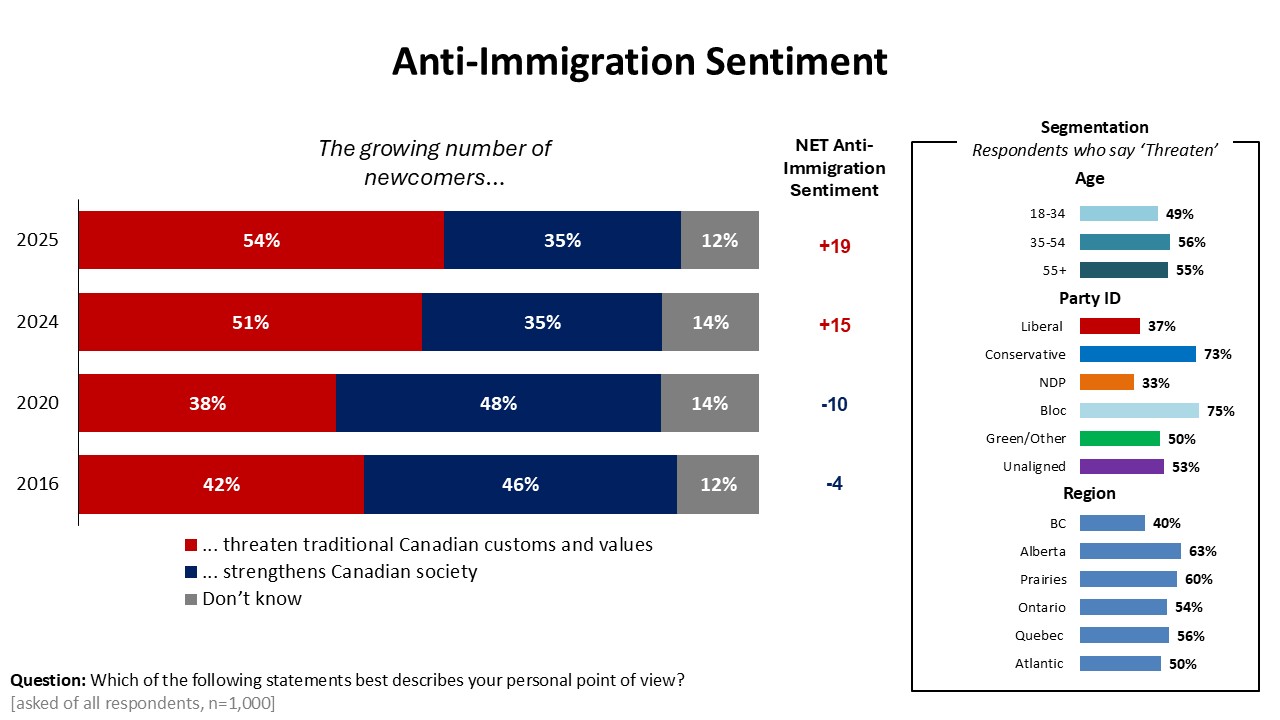
Another survey confirming a shift and partisan differences:
The data reveals a 16-point increase over the past 5 years in hostile views of immigrants.
A clear majority (54%) now believe that immigration threatens traditional Canadian customs and values, up from just 38% in 2020, with a small 4-point NET score increase occurring in the past year (from +15 to +19). This isn’t a blip, but a trend with momentum.
The partisan dimension is striking, with those who self-identify with Conservatives (73%) and Bloc (75%) leading this concern in contrast to Liberals (37%) and NDP (33%) Even more telling, attitudes toward legal immigration have soured considerably, with only 39% now viewing it positively, down a stunning 15 points since 2018. Meanwhile, 61% favour making immigration more difficult, up 16 points from 2018’s 45%.
Concern about illegal immigration remains statistically unchanged at 75% viewing it as serious since 2018, but the intensity has shifted. 42% now rate it “very serious,” up from 37% in 2018. Those who self-identify with Conservatives drive this at 88%, but half of the NDP identifiers and almost three-in-four (71%) Liberals also agree.
Canadians aren’t just worried; they are assigning blame. A striking 72% believe the federal government has failed to manage immigration, with 72% saying too many immigrants have been admitted, and 71% linking excessive immigration to housing pressures and declining services. Nearly 3-in-5 Canadians (58%) report that their views on immigration have changed over the past five years, with Conservatives (70%) and Bloc supporters (75%) most likely to acknowledge this shift….
Un an après leur admission, 91,5 % des immigrants permanents admis en 2022 qui prévoyaient s’établir au Québec y vivaient toujours. En Ontario, la proportion est de 91,3 %, selon des données publiées vendredi par Statistique Canada.
Ce résultat est d’autant plus surprenant qu’il s’inscrit dans un contexte de mobilité accrue.
En 2023, 13,5 % des immigrants admis un an plus tôt avaient déjà changé de province ou de territoire, en hausse marquée par rapport à 10,1 % en 2022. La pandémie a laissé des traces : la mobilité interprovinciale a bondi à ce moment, puis est restée élevée.
Autrement dit, les nouveaux arrivants bougent davantage. Dans ce contexte, réussir à en garder plus de neuf sur dix après un an n’a rien d’anodin.
Le Québec fait mieux que l’Ontario, mais aussi la Colombie-Britannique (88,5 %) et l’Alberta (87,3 %). Pour la cohorte admise en 2022, c’est le meilleur taux de rétention à un an au pays.
Une montée rapide
La montée du Québec est récente, mais rapide. Entre 2019 et 2022, le taux de rétention à un an est passé de 85,9 % à 91,5 %, après avoir atteint un sommet en 2021 (93,4 %). Malgré un léger recul en 2022, le niveau demeure élevé.
Pendant ce temps, l’Ontario faisait du surplace. Depuis 2019, son taux de rétention tourne autour de 93 %, sans progression marquée.
Résultat : le Québec a rattrapé, puis dépassé la province voisine.
À moyen terme, le tableau change. Cinq ans après leur arrivée, 79,6 % des immigrants permanents admis en 2018 résidaient toujours au Québec, contre 90,8 % en Ontario.
À l’échelle des grandes villes, Montréal est plus fragile. Son taux de rétention sur cinq ans a atteint 71,3 %, comparable à celui de Toronto, mais inférieur à ceux de Vancouver, Calgary et Edmonton.
Concrètement, Montréal perd encore des immigrants vers d’autres provinces. Sur cinq ans, la métropole enregistre une perte nette de 5725 immigrants permanents pour la cohorte admise en 2018, pendant que plusieurs villes de l’Ouest canadien continuent d’en gagner.
À court terme, le Québec dans son ensemble tire mieux son épingle du jeu. Pour la cohorte admise en 2022, la province affiche un solde migratoire interprovincial positif, avec un gain net de 2095 immigrants permanents.
Le Québec ne fait pas que retenir la majorité de ceux qui s’y installent : il attire aussi des immigrants initialement destinés à d’autres provinces, surtout l’Ontario.
…There are two sides of this question to consider: the degree to which Alberta wishes to control immigration and the degree to which Alberta wishes to limit immigration.
In her post last week and in an interview with Postmedia’s Rick Bell, Smith went out of her way to float the idea of limiting newcomers’ access to various social supports, based either on immigration status or number of years spent in Alberta.
This may not be hardline enough for the ardent separatists whose manifestofantasizes about deportations in the tens of thousands in their new utopia. But it’s a pretty clear signal that the Alberta government wishes to discourage any further influx of newcomers to this province.
This would seem to be a more recent and strategic pivot from this premier. It wasn’t that long ago that Smith was musing about the possibility of more than doubling Alberta’s population and drafting a letter to Prime Minister Trudeau criticizing federal immigration limits. The “Alberta is Calling” campaign may have originated under the previous premier, but it continued under the current one.
The Alberta government wanted population growth, but they didn’t seem prepared for the possibility that they might get it. The focus on the immigration issue provides a convenient scapegoat for the government’s mismanagement of that rapid population growth.
Pointing fingers at Ottawa doesn’t preclude the need to address these growth pressures. New figures from Statistics Canada show that while Canada’s population actually shrunk in the third quarter, Alberta’s population continued to grow.
But this is a volatile issue at the best of times. The political pressures that have thrust this issue to the forefront for the Alberta government, and their motivations for elevating this to a top priority — alongside a separation vote, no less — create the potential for a divisive and unhelpful debate.
…The Muslim community in Sydney has taken a clear stand: it will not receive the body of the deceased terrorist, nor perform funeral rites over it. Dr. Jamal Rifi, a prominent Muslim leader in the city, said: “We don’t see [the offenders] as inside the fold of Islam or as Muslims,” adding, “what they have done is not condoned by any of us and it is killing innocent civilians. We know it is a verse in our book, killing an innocent civilian is the same as killing all humanity.”
Australian authorities have yet to indicate if the attack was related to Israel’s violence against Palestinians. Nonetheless, this is an opportunity to clearly delineate the actions of a government from those of Jews worldwide. It is not antisemitic to criticize and oppose the Israeli government’s genocidal actions against the Palestinians in Gaza and its brutal military occupation of the West Bank. The war crime of Oct. 7, 2023 cannot justify war crimes in which tens of thousands of Palestinian women and children are killed and populations are starved. It is antisemitic, however, to blame all Jews for the actions of the Israeli government. It is antisemitic to vandalize Jewish institutions, businesses and communities in protest. It is antisemitic to instill fear in Jewish communities – and Muslims know all too well the danger of being blamed and targeted for the actions of a few.
After the terrorist attack at a Quebec City mosque during which six worshippers were gunned down in cold blood, and after the murder of three generations of the Afzal family in London, Ont., by an Islamophobe, Canadian Muslims understandably feared for their safety. And while government and law enforcement responded to assure a shaken community, it was grassroots support and love by ordinary Canadians that helped in the healing process.
Our Jewish friends, colleagues and neighbours are hurting and fearful. Let us all reach out with wings of mercy and compassion, to build stronger communities – and to build a stronger Canada.
…You almost got Mr. Chretien to let you get rid of the citizenship oath to the Queen. At the last minute, he intervened and told you to pull the plug. How come?
I said, “Boss, why are you asking me to do this? We’re almost there. You had supported this!” He said it was the middle of the 1995 Quebec referendum and he didn’t want to fight monarchists and separatists at the same time. I told him, “Let’s have our own citizenship oath, a simple, powerful oath to country, rather than to the monarchy.” And he said, “Trust me, we’ll get back to it later.” But one of the lessons I learned in politics is that when you pause something in politics, oftentimes you lose it, and that’s exactly what happened. I was very, very close, and it’s one of my regrets. …
Births in Canada to foreign visitors and other non-residents have risen in the past year, an expert in immigration statistics has found after analyzing hospital data.
The research, published in a report on Wednesday, shows a small increase in births at Canadian hospitals to temporary residents, such as international students and people here on work permits.
The proportion of births to people who are not settled in Canada is small compared with births in the country overall, but the number of temporary residents in Canada has been dropping as the federal government has reduced immigration.
According to the report, authored by Andrew Griffith, a former director-general at the federal immigration department, the data suggest an uptick in births to women here on visitor visas, otherwise known as birth tourism. …
Useful reminder of the integration dialectic, and how positive influences work in both directions:
…Ce choc de valeurs est au cœur de débats déchirants sur le vivre-ensemble. Certains y voient le signe d’une incompatibilité fondamentale, irrémédiable. Les immigrants issus de sociétés plus conservatrices seraient porteurs de valeurs si éloignées des nôtres, si dangereuses, qu’ils constitueraient une menace pour notre identité.
Et si c’était l’inverse ? Et si c’étaient eux qui se laissaient contaminer par nos coutumes ?
Plusieurs études ont mis en lumière un tel effet de contagion. Deux chercheurs de Statistique Canada, Kristyn Frank et Feng Hou, se sont par exemple intéressés à la répartition des tâches entre conjoints. En compilant les données de six recensements, ils ont constaté qu’au départ, les nouveaux arrivants continuent d’être influencés par les rapports femmes-hommes qui étaient la norme chez eux. Ainsi, les immigrantes nées dans des pays où les femmes sont moins présentes sur le marché de l’emploi ont tendance, une fois au Canada, à consacrer moins d’heures au travail rémunéré et plus de temps aux corvées ménagères, comparativement à celles qui ont grandi dans des sociétés plus égalitaires.
Mais au fil du temps, l’empreinte du pays natal s’estompe. Plus les années passent, plus le labeur est divisé équitablement, selon l’étudeparue en 2015.
Même les gens qui immigrent à l’âge adulte, donc, en viennent à épouser les normes de leur terre d’accueil, du moins en partie. Et il suffit d’une génération pour que la conversion s’achève.
C’est ce que révèle un sondage mené dans 27 pays européens et relayé en 2014 dans Social Forces. À leur arrivée, les immigrants adhèrent davantage que les non-immigrants au modèle de l’homme pourvoyeur et de la femme au foyer. Avec les années, cependant, leurs opinions se rapprochent de celles des natifs. Et les immigrants de la deuxième génération, nés au pays de parents étrangers, pensent comme la majorité.
…À écouter le portrait qu’en brossent certains leaders, on pourrait croire que le Québec est une société fragile dont les valeurs les plus chères risquent de s’effondrer au contact d’autres cultures.
Mais le Québec n’est pas un château de cartes. C’est un phare qui, malgré ses imperfections, brille suffisamment pour inciter des gens venus d’ailleurs à embrasser ses idéaux. Un lieu où l’égalité, comme la douceur de vivre, est contagieuse.
…A survey by the polling firm Ifop, marking the 120th anniversary of the 1905 law, found that while 67 per cent of French voters, and 85 per cent of those over 65, support banning religious symbols in the public sphere, this proportion falls to 46 per cent among 18- to 24-year-olds. While 52 per cent of those over 65 consider la laïcité to be an “essential” element of French identity, just 24 per cent of their younger counterparts agree. And the generational divide is growing.
Therein lies an irony: For a country that frowns on public manifestations of faith, French politics do seem to revolve an awful lot around religion. Fully 120 years after the official separation of church and state, France is still grappling with its meaning.
…How do officials count generations in applying the new rule?
According to the Immigration Department, the first generation is defined as the first person born or adopted outside Canada to a Canadian citizen.
Whether a Canadian parent was born in Canada or is a naturalized citizen, their children born abroad are counted as first generation and considered Canadian by descent. The children born outside Canada to a first-generation person are now Canadian provided their first-generation parents meet the three-year physical residency requirement before their births.
This is also how officials count generations for people who are adopted and apply for a direct grant of citizenship.
What if you were born or adopted on or after Dec. 15, 2025?
People born outside Canada in the second generation or later may be Canadian if their parent was also born or adopted outside Canada to a citizen and that same parent spent at least three years in Canada before the birth.
Adopted people are likely eligible to apply directly for Canadian citizenship if they were born and adopted outside Canada in the second generation or later, and if that same parent meets the residency requirement before the adoption.
How about those who were born or adopted before the new law?
In most cases they are automatically a Canadian citizen if they were born before Dec. 15, 2025, outside Canada to a Canadian parent. The new rule also applies to those who were born to someone who became Canadian by descent because of the rule changes.
Adopted people should be eligible to apply directly for citizenship if they were born and adopted outside Canada in the second generation or later before that date.
What if you have a pending citizenship application under an interim measure?
In December 2023, after the court ruled the two-generation citizenship cut-off rule unconstitutional, Ottawa put in a temporary initiative to offer discretionary grant of citizenship by descent to certain affected groups while it worked on new legislation to make the citizenship law Charter-compliant. It resulted in more than 4,200 applications.
Any pending application under this measure will be processed under the new rules, and no new citizenship certificate application is required.
How do you prove your Canadian citizenship?
Those who believe they are eligible for citizenship by descent under the new rules should apply for a citizenship certificate as proof of citizenship if they became a citizen automatically. They will be assessed accordingly.