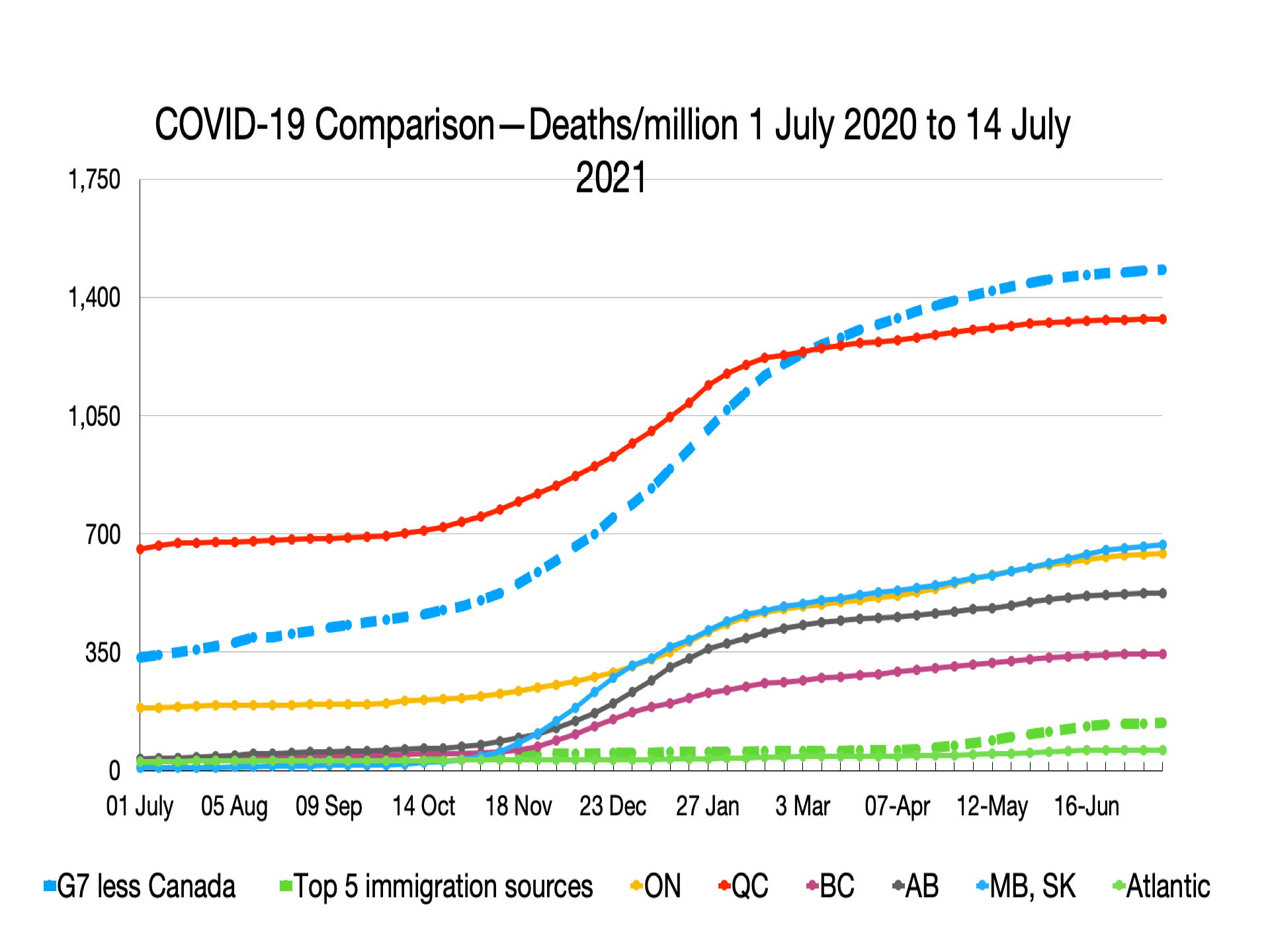
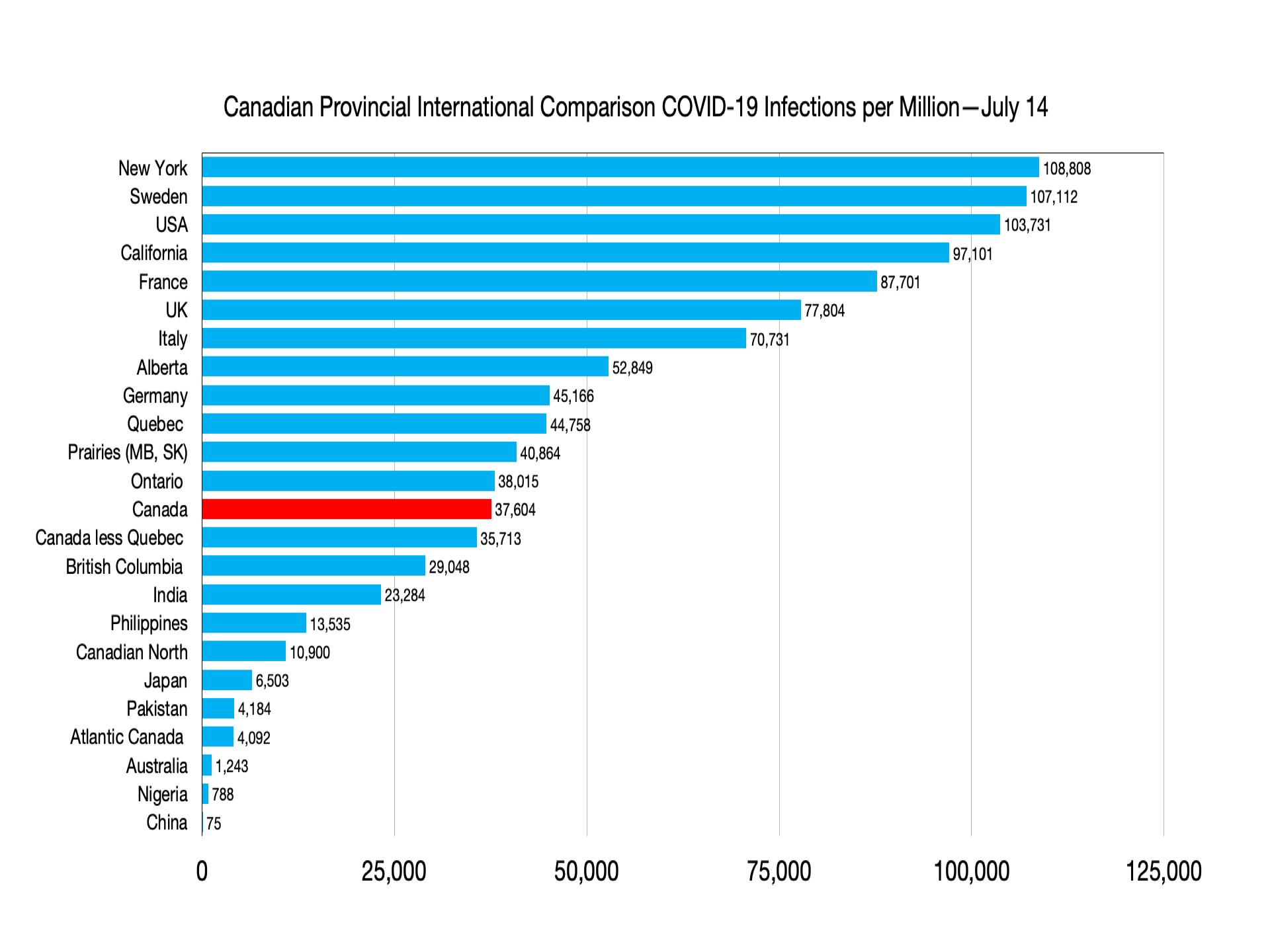
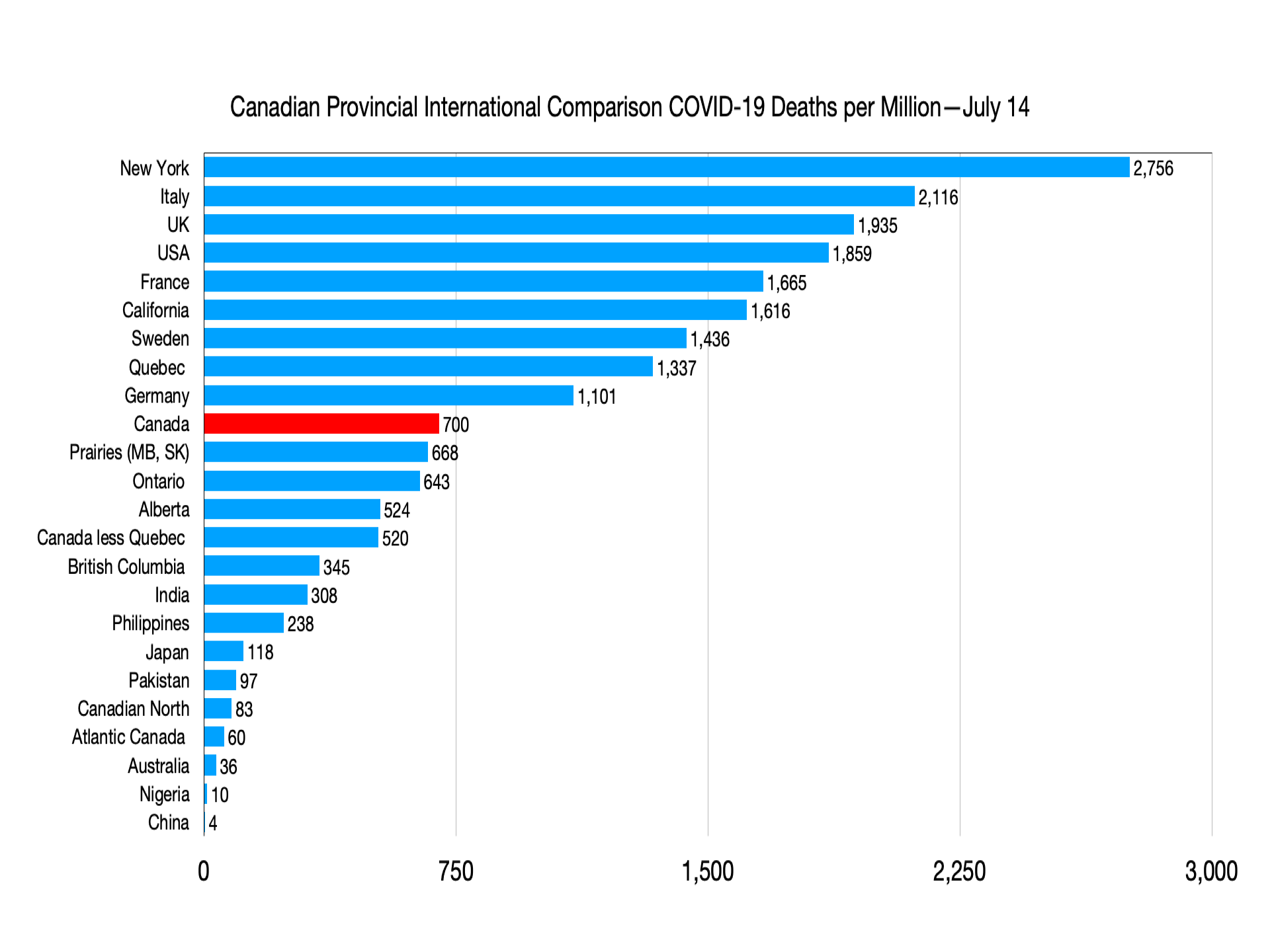
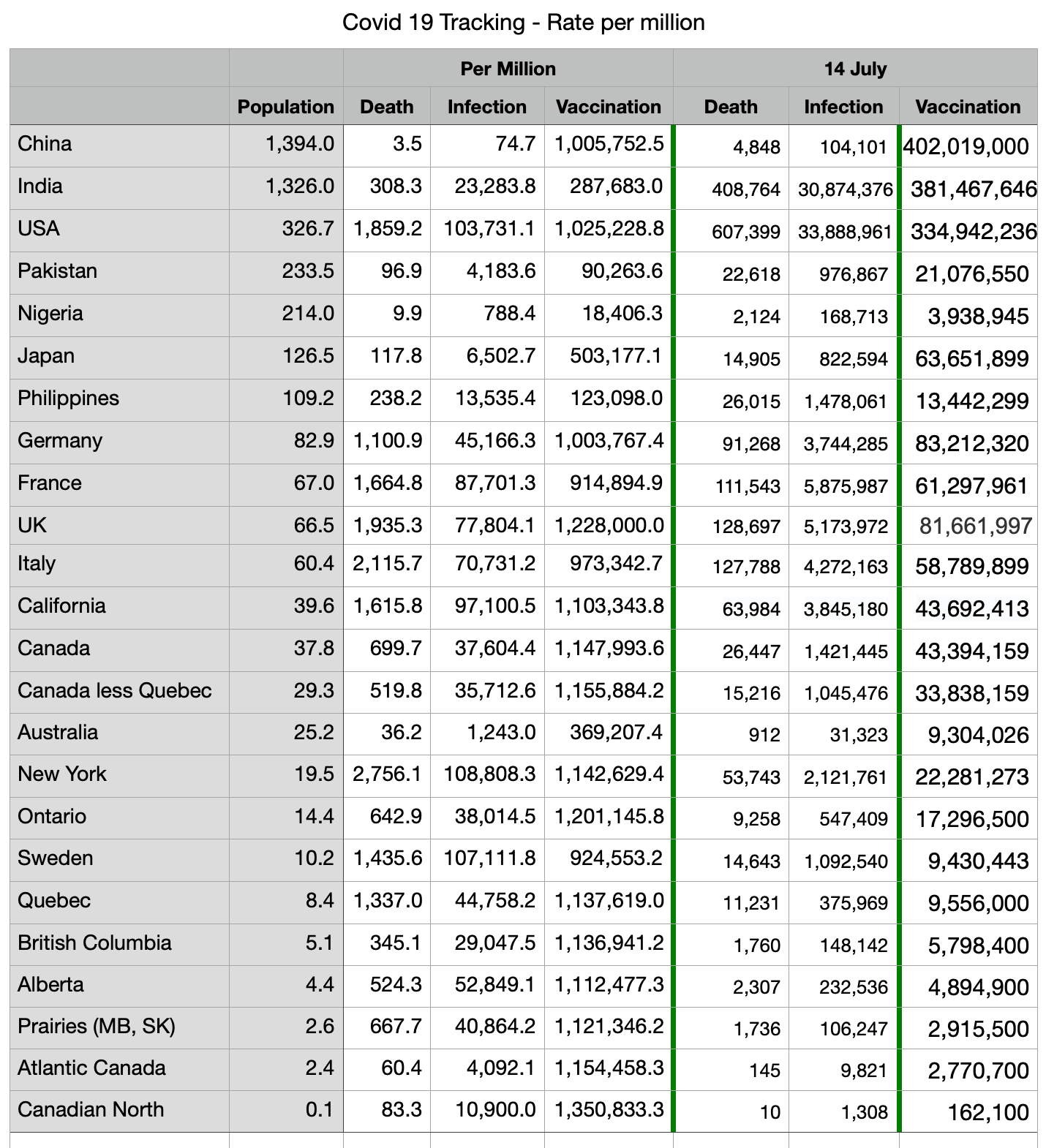
The latest charts, compiled 14 July as overall rates in Canada continue to decline along with increased vaccinations (Canadians fully vaccinated 45.6 percent, higher than EU countries, just slightly behind USA 48.6 percent and UK 52.4 percent).
Vaccinations: All Canadian provinces ahead of USA and EU countries.
Trendline charts
Infections: No significant change
Deaths: No significant change.
Vaccinations: Captured above, with increasing gap between Canadian provinces and G7.
Good questioning conservative “snowflake” discomfort:
By the end of June, 29 Republican-led state legislatures had considered and nine had enacted laws to penalize schools or teachers teaching critical race theory(CRT). Whether or not such laws would stifle anything taught in public schools today is uncertain because existing legislative control over curricula is already extensive. But the war against CRT is spilling into new arenas: Florida’s anti-CRT law forces colleges to survey how “competing ideas and perspectives” are presented, threatening funding cuts if a university is “indoctrinating.”
A paradox lies at this largely conservative campaign against CRT. If you slice through the rhetoric, it rests on a view of free speech that the political right, until now, stridently and correctly rejected: That speech can and should be curtailed because it makes some people feel uncomfortable or threatened. As a result, perhaps the most powerful argument against CRT’s critics is located on the political right, particularly in a recent opinion by Justice Samuel Alito, one of the most conservative members of the Supreme Court.
[time-brightcove not-tgx=”true”]
Consider first how varied and inconsistent the portrayals of CRT on offer are. The Republic Study Committee defines CRT as a belief in “racial essentialism.” In contrast, Ellie Krasne of the Heritage Foundation postulates that CRT is “rooted in Marxism,” and so defines race as “a social construct, enforced by those in power (white men).” Similarly, the Manhattan Institute’s Christopher Rufo talks of CRT as “identity-based Marxism.” He detects it whenever terms such as “social justice” and “diversity and inclusion” are used, and so sees it “permeat[ing] the collective intelligence and decision-making process of American government” in advance of a socialist uprising.
Turn to the newly-minted laws, and one finds yet other, quite different depictions. Florida’s, for example, defines it as any “theory that racism is not merely the product of prejudice.” Idaho’s characterizes CRT as teaching that treats people as “inherently responsible for actions committed in the past by other members of the same … race.”
These definitions of CRT can’t be reconciled. None offer clear guiderails to what precisely it means to ban CRT—No more talk of race as an identity? No discussion of laws or institutions that create racial stratification? Taken literally, some of the definitions also extend absurdly far. Florida’s could prohibit Nobel Prize-winning University of Chicago economist Gary Becker’s work on discrimination, because Becker identifies market concentration and education (not “merely” prejudice) as causal predicates of discrimination.
Perhaps it’s a mistake to look for a stable definition of CRT threading together the case against it. For at the core of the case against CRT is instead the simple idea that people shouldn’t be made to feel uncomfortable about their advantages or others’ disadvantages. This is a version of the “belief in a just world” that psychologists long ago identified. But here it has a partisan edge: it is about appealing to people—especially those in “swing districts” targeted by Republicans in 2022—who feel unease in their present relative advantage, but find it costly to dissect such discomfort.
Both the Idaho and the Florida laws target suggestions that someone should be responsible for disadvantages now faced by Blacks and other minorities, beyond a narrowly defined coterie of ‘bad’ discriminators. Similarly, Krasne centrally objects to being made to feel that she is “an enemy of all that is good.” Rufo complains in a similar vein about people having to write “letters of apology”—since whites have nothing to feel culpable about. As one (white) letter writer to the Laconia Daily Sunplaintively said, the problem with CRT is that it surfaces the possibility of “systems and rules that work in my favor, benefiting me every day, month and year, that are not available to anyone else in America.” Indeed.
The case against CRT, in short, is not about a fixed set of ideas. It is about wanting to avoid certain feelings of discomfort or even shame. But the right has encountered this idea before—and seemed not to like it. Until recently, commentators on the political right have claimed that universities are captured by “leftist” students who “don’t think much” about free speech, or who “don’t want to be bothered anymore by ideas that offend them.” A “jargon of safety” in universities, complained commentator Megan McCardle, is then used to “silence” those who don’t agree.
Conservatives disparage arguments made by “snowflake” college students. But the case against CRT is made of the same stuff. As such, it is subject to the same response. Hence, in a recent opinion concerning off-campus student speech, Justice Alito explained why a student’s crude rant about being excluded from a cheerleading squad could not be punished in simple terms: “Speech cannot be suppressed just because it expresses thoughts or sentiments that others find upsetting.” This is indeed the law: The Supreme Court has not allowed the state to prohibit or punish speech because it riles up an audience since 1951.
The idea that audience discomfort provides a justification for censorship, that is, is at profound odds with our free speech tradition. The case against CRT shows why: Because it turns on how an audience feels, this argument for speech bans has an indefinite, elastic quality, one that accommodates an endlessly voracious appetite for censoriousness. One of the lessons of the CRT debate, indeed, is that offense can and is taken at indubitably true facts. In many educational contexts, this would mean that either side of a hot-button issue would have the right to shut the other down.
Ironically then, if there is a lesson to be learned from the war on CRT, it has nothing to do with how to talk about race—and everything with how the Trumpian revolution continues to devour the principles of American conservatism.
Of note, the overall challenge facing governments with respect to longer-term planning and preparation.
Silent on some of the internal decision-making processes that led to the weakening of GPHIN as it is still not clear whether the decision to shutter GPHIN was bureaucratically or politically-driven. Suspect the former given the small resources involved.
Somewhat normal to have tensions between scientific/medical experts and public service generalists but more serious in this case.
Notable recommendation that touches on this: 2.8 There should be sufficient public health expertise in GPHIN’s management to fully understand event-based surveillance.
A new independent review of the mismanagement of Canada’s pandemic early warning system, which was effectively shuttered by the Trudeau government in the months before COVID-19 made itself known in Wuhan, China, says all the right things.
Released Monday, the report urges Ottawa to better fund the Global Public Health Intelligence Network (GPHIN), and to make better use of the invaluable intelligence on disease outbreaks around the world that it gathers by scanning medical reports, media and other markers on a constant basis.
That, of course, is very good advice. It’s a given that, in the future, there will be more outbreaks in our connected world; it’s not a question of if, but when. Maintaining a well-funded early warning system, and creating a risk assessment group inside Canada’s Public Health Agency to analyze its finding and directly advise decision-makers, is a no-brainer.
But here’s the thing: Coming up with good advice on how to prepare for the next pandemic, and getting politicians to act on it, isn’t hard when a disease that has killed more than four million people worldwide, including more than 26,000 in Canada, is still spreading.
As the report itself says, “The best time to discuss pandemic preparedness is when it is most present in the minds of Canadians and of the governments who serve them.”
Okay. But what happens in five or 10 years, if there’s been no outbreak in the interim, and those same governments start to lose interest in life-saving measures that don’t make headlines but which, if successful, prevent them?
The fate of GPHIN is just one of several glaring examples of what happens when Canadian governments decide that, since a disaster hasn’t happened recently, now must be a good time to cancel the insurance policy.
Created in the early 1990s, and eventually folded into the Public Health Agency of Canada, GPHIN was a world-leading scientific body that tracked outbreaks such as SARS, H1N1, MERS and Ebola, and shared its findings with the World Health Organization.
The Harper government indirectly weakened GPHIN in 2014, when it stripped PHAC of some of its independence. But the Trudeau government delivered the coup de grace in May of 2019, when it told GPHIN to stop its international monitoring and focus on domestic outbreaks.
It’s impossible to say for sure that turning off Canada’s early warning system contributed to Ottawa’s sluggish and confused response to the COVID-19 outbreak in early 2020. It certainly didn’t help.
What may be more important, though, is how the evisceration of GPHIN fits a pattern in Canadian politics.
For instance, after the scare of the SARS epidemic in Toronto in 2003, Ontario’s Ministry of Health and Long-Term Care prepared for a future outbreak by spending $45-million on 26,000 pallets of masks, face shields, needles, disinfectant wipes, disposable thermometers and other vital medical equipment.
But in 2017, the province’s Auditor-General found that more than 80 per cent of the supplies were no longer usable. The stuff had been left to rot, because the government never allocated money to manage and replenish the stocks.
In another example, this one from before the SARS crisis, the Ontario government in 2001 laid off a group of PhD-level scientists hired to watch for emerging diseases. “Do we want five people sitting around waiting for work to arrive?” a Health department spokesman asked at the time.
Yes. Yes we do.
This is going to be the real test of Canada’s postpandemic response: Can measures urgently agreed to while COVID-19 is still an omnipresent threat survive subsequent governments that start to chafe at the independence that GPHIN and PHAC need in order to do their jobs, or become annoyed at money being spent on what may at times look like just a bunch of scientists sitting around waiting for a crisis to arrive?
The GPHIN report is wrong: The best time to discuss pandemic preparedness is not when it is top of mind, but when it has receded to the background and there is no political gain to be had by talking about it.
That’s the critical moment. Canadians won’t automatically be at risk the next time a virus threatens to become a pandemic somewhere on the planet. The danger will come before that, when governments decide to cut back on the vital but unheralded work that could have kept them safe.
The previous conservative government largely cancelled the chaplain program with respect to non-Christian chaplains in 2012 (Non-Christian prison chaplains chopped by Ottawa). Not sure what the current situation is:
Abdul Muhaymin al-Salim converted to Islam during his incarceration on drug charges at a federal prison in South Carolina from 2004 to 2014. In his first year there, the 49-year-old remembers a Muslim volunteer coming to the prison a couple of times a month to lead religious services.
Then, in the second year, during Ramadan, a holy month for Muslims, the volunteer was no longer allowed in the prison. Al-Salim never found out why.
“There were instances where we could have been denied or not received the proper representation or resources that we needed,” he said.
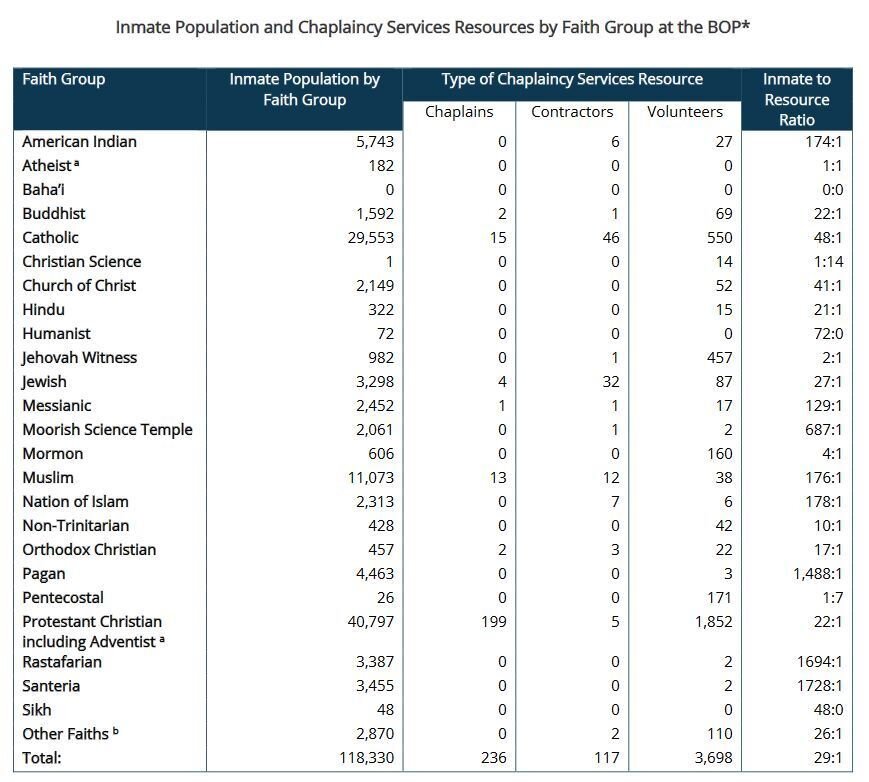
Muslims, the third-largest faith group in federal prisons, are significantly underrepresented among the chaplaincy, according to a Department of Justice inspector general report released last week. Currently, 6% of federal prison chaplains are Muslim, while 9.4% of inmates identified as Muslim.
As of March 2020, 199 of the 236 federal prison chaplains, or 84%, were Protestant Christian, even though that faith group makes up only 34% of inmates. There were no more than 13 Muslim chaplains in the past six years working at federal prisons — and that number remains today, even though the number of Muslim inmates has grown during that time, to 11,073.
The challenges in recruiting Muslim chaplains have persisted within the Federal Bureau of Prisons for years, the report says. In response to a 2004 inspector general report that highlighted a significant shortage in Muslim chaplains, the bureau said it tried to attract a greater number through an on-site program that allowed prison employees to acquire the necessary skills to become a chaplain. But those efforts were unsuccessful, resulting in only one Muslim chaplain trained since 2006. And the number of Muslim inmates has more than doubled since then.
“Oftentimes, this will have a negative effect because you’re left to the whims of whoever is in charge of the chaplain’s department,” said al-Salim, who now works at the Tayba Foundation, where he mentors incarcerated Muslims. “There’s nobody there to help them gain that grounding that they need.”
The needs of the federal prisons’ Muslim population are underserved without chaplains, Muslim leaders say. Because most religious services have to be led by a chaplain, not having Muslim clergy means the services get canceled. When Muslim chaplains are employed, they also make sure Muslim inmates have access to books, prayer rugs and halal meals and that they can freely practice their faith.
Why prospective prison chaplains have been discouraged from applying
“The Bureau of Prisons is committed to ensuring that inmates of all faiths can practice their religion and participate in religious services while also maintaining appropriate safety and security measures,” spokesperson Donald Murphy told NPR in a statement.
Based on recommendations from the inspector general’s office, the bureau is “making changes to improve management and oversight over its chaplaincy program,” Murphy added.
To recruit additional Muslim chaplains, the bureau said it is working with current prison chaplains and seminaries to find candidates.
The bureau is also considering waiving requirements that chaplains must be a certain age, have a graduate-level theological degree and have completed coursework in interfaith study. That would make it easier for religious leaders like Imam Sami Shamma. A chaplain at the Connecticut Department of Corrections for over eight years, Shamma said he hasn’t been eligible for a federal position because he is 65 — over the 37-year age limit for appointment. Neither could Imam Abu Qadir al-Amin, who wanted to be a chaplain at a federal prison in Dublin, Calif., where he volunteered. But he couldn’t qualify because he didn’t have access to higher education.
“Some of the more effective leaders are not necessarily people who went to school for what they’re doing now,” al-Amin said. “They’re more inspired leaders that can make a real contribution to people’s lives who are in that restricted environment and need someone who understands their lifestyle, what led them to be there in the first place, and then can more appropriately develop strategies that address the needs of them returning.”
There’s another reason it’s difficult to recruit Muslim chaplains: Ordination is required by the bureau, but Muslims do not formally ordain religious leaders. And often Muslim communities live far from the prisons, requiring the chaplains and their families to relocate. In addition, Muslim chaplains in correctional facilities often face criticism by people claiming that they are spreading an extremist interpretation of Islam to the prisoners, according to a Harvard University report.
In the meantime, the prisons are filling the gap through contracted religious services providers and trained chapel volunteers. But even with volunteers and contractors, who don’t work full time, there is only one Muslim chaplain per 176 inmates, according to the latest inspector general report.
“If they’re actively recruiting Muslim chaplains and they want to employ Muslim chaplains in the federal system, then they should maybe sit down with Muslim leaders in the community and discuss a strategy for filling that vacuum,” al-Amin said.
Despite the chaplain shortage, the bureau has made incremental progress in accommodating Muslims’ religious practices. In 2019, for instance, it changed its guidelines to allow Muslim inmates to pray in groups.
State prisons face a similar shortage of Muslim chaplains
There’s also a shortage of Muslim chaplains at state prisons, Shamma says. While he used to rely on volunteers to help, they have not been allowed to do so during the pandemic. That has sometimes meant canceled services for the almost 200 inmates he serves.
Some state prisons, with larger Muslim populations, have better resources.
Tariq MaQbool, a 44-year-old Muslim incarcerated at the New Jersey State Prison, told NPR through the Prison Journalism Project that the Muslim chaplain there is a “blessing.” He regularly attends Friday prayers and Islamic talks led by the chaplain.
But MaQbool is still advocating for other ways to practice his faith, including access to halal meals and Islamic literature.
Of note, given lower levels than the rest of Canada:
The Conseil du patronat du Québec (CPQ), the province’s largest employers group, is urging the Legault government to tackle the labour shortage by rethinking immigration levels and encouraging older employees to stay longer in the workforce.
The recommendations are among 10 made public by the CPQ as 181,000 jobs went unfilled in the first quarter of 2021. The labour shortage in the same period in 2020 was 150,000.
Quebec immigration levels must be “quickly raised” to meet the province’s labour needs, CPQ president Karl Blackburn told Presse Canadienne, noting that since 2015, the number of immigrants to the province has never been higher than 53,000 when “the need is for 64,000.”
Blackburn said employers are not looking for “cheap labour,” although there are worker shortages in agriculture and food processing, where salaries are low. But he added there is also a need for workers in the health, education and information technology sectors, where the pay levels are higher.
“We have to avoid categorizing good job and jobs that are less good,” he said.Quebec Premier François Legault has said if an immigrant is earning a minimum salary of $56,000, it’s to the province’s advantage to bring them here. The CPQ thinks “salary should not be a limit to entry.”
Blackburn said the province’s economic recovery will depend on all kinds of jobs, and Quebec limiting its interest to only positions with higher salaries will slow down that recovery.
Another suggestion from the CPQ is to encourage workers between the ages of 60 and 69 to stay longer in the workforce. Blackburn said Quebec is being outperformed by Ontario in this area, and if the policy was adopted “we’d have 75,000 more workers.”
That encouragement could include tax credits for older employees remaining on the job and a revision of the contribution levels to the Quebec pension plan for workers 60 and over.
The CPQ also thinks there’s room for improvement in the area of job training, with Blackburn saying that “30 per cent of employers are ready to train their workforce themselves if given financial support.”
Some interesting changes announced by the Treasury Board of Canada Secretariat.
I think the change that will have the earliest and largest impact will be Canadian citizens and Permanent Residents having the same preference in external advertised hiring processes.
We will see over the next few years the extent to which this has an impact through the annual EE reports and which groups, given disaggregated data, are impacted most:
Too many Canadians continue to face bias, barriers, and discrimination based on their race, national or ethnic origin, colour, religion, age, sex, sexual orientation, gender identity or expression, disability, or other factors.
The Government of Canada has amended the Public Service Employment Actto address systemic barriers for equity-seeking groups in public service staffing.
These amendments represent foundational work that will help departments take measures in their staffing actions to reduce barriers and encourage more inclusive recruitment practices.
Over the past several months, the Treasury Board Secretariat worked with employee networks, bargaining agents and senior officials for Employment Equity, Diversity and Inclusion to better understand the experiences of members of equity-seeking groups in public service staffing.
Amendments to the Public Service Employment Act reaffirm the importance of a diverse and inclusive workforce and strengthen provisions to address potential bias and barriers in staffing processes.
With these changes:
All new or revised qualification standards must be evaluated for bias and barriers for members of equity-seeking groups.
Permanent residents now have the same preference as Canadian Citizens when appointments are made through external advertised hiring processes.
The design and application of assessment methods must include an evaluation of bias and barriers, and reasonable efforts for mitigation.
The Public Service Commission now has explicit authority to audit for bias and barriers that disadvantage members of equity-seeking groups.
The Commission and deputy heads will have explicit authority to investigate bias and barriers for members of equity-seeking groups.
These Public Service Employment Act amendments form one part of a set of initiatives and activities to increase diversity and inclusion in the public service so that it is reflective of the Canadian population it serves and a place where all public servants feel a true sense of belonging.
The work of eradicating bias, barriers, and discrimination, which have taken root over generations, demands an ongoing, relentless effort. The Government of Canada is committed to this effort and will use all available levers to improve the experiences of public servants in their workplace and ensure that they are able to realize their full potential.
Newspapers that championed white supremacy throughout the pre-civil rights South paved the way for lynching by declaring African Americans nonpersons. They embraced the language once used at slave auctions by denying Black citizens the courtesy titles Mr. and Mrs. and referring to them in news stories as “the negro,” “the negress” or “the nigger.”
They depicted Black men as congenital rapists, setting the stage for them to be hanged, shot or burned alive in public squares all over the former Confederacy. These newspapers entered their bloodiest incarnations during the late 19th and early 20th centuries, inciting hellish episodes of violence during which white mobs murdered at will while sometimes destroying entire Black communities.
African Americans who fled these Southern horrors found the white Northern press only marginally less hostile. Yankee papers that congratulated themselves for opposing lynching in the abstract justified it in practice by depicting the victims as naturally disposed toward heinous crime.
As the historian Rayford Logan writes in his iconic study of this period, the white Northern press cemented the stereotype of the Negro barbarian by making Blackness synonymous with crime. Headlines included phrases like “Negro ruffian,” “colored cannibal,” “dissolute Negress” and “African Annie.” By portraying Black people as less than human, the white popular press justified the reign of terror that the South deployed, while stripping African Americans of the rights they had briefly enjoyed during the period just after the Civil War known as Reconstruction.
Since the early 2000s, historically white newspapers in Alabama, California, Florida, Kentucky, Mississippi, Missouri and North Carolina have apologized with varying degrees of candor for the roles they played in this history. When read end to end, these statements of confession attest to blatantly racist news coverage over a more than century-long period that encompasses the collapse of Reconstruction, the rise of Jim Crow, the two world wars, the civil rights movement, the urban riots of the 1960s, the Vietnam era and beyond.
The Raleigh News & Observer in North Carolina has admitted to engineering a landmark episode of racial terrorism — the 1898 white supremacist coup that overthrew the government of the majority-Black city of Wilmington. The Montgomery Advertiser in Alabama, once the voice of the Confederacy, acknowledges being complicit in racial terrorism through the 1950s. The Lexington Herald-Leader in Kentucky could well have spoken for hundreds of newspapers when it confessed that it had “neglected” to cover the civil rights movement at a time when that movement was changing the face of the country.
The Orlando Sentinel touched on a familiar theme of the struggle for racial justice when it repented for supporting the wrongful prosecution of Black defendants, known as the Groveland Four, who were charged with rape in 1949. The paper was known as The Orlando Morning Sentinel when its bloodthirsty coverage featured a front-page editorial cartoon that depicted four empty electric chairs under the headline “No Compromise!” A threatening editorial warned that “innocent Negroes” might suffer if civil rights lawyers sought to free the defendants based on “legal technicalities.”
The Los Angeles Times apologized for being “an institution deeply rooted in white supremacy” for most of its history and admitted to a record that included indifference and “outright hostility” toward the city’s nonwhite population.
The Kansas City Star confessed that it had “disenfranchised, ignored and scorned generations of Black Kansas Citians” and “robbed an entire community” of “dignity, justice and recognition.” While showing keen interest in military operations abroad, the paper noted, it remained silent when bombs exploded in the homes of Black people not far from its own offices.
The Star shut out even world-famous Black Kansas Citians like the saxophonist Charlie “Bird” Parker, who did not get a significant headline in The Star until he died, in 1955 — “and even then, his name was misspelled and his age was wrong.” When a flood devastated the city in 1977, The Star and its sister paper focused on businesses and suburbs, all but ignoring the fact that the flood had also swallowed homes of residents in Black areas. The newspapers showed more concern for missing pets than for Black citizens whose lives had been swept away in the torrent.
The apology movement is historically resonant on several counts. It offers a timely validation of the besieged academic discipline known as critical race theory — by showing that what news organizations once presented as “fair” and “objective” journalism was in fact freighted with the racist stereotypes that had been deployed to justify slavery. It lays out how the white press alienated generations of African Americans — many of whom still view the leading news outlets of the United States as part of a hostile “white media.”
The movement illustrates what President Lyndon Johnson’s National Advisory Commission on Civil Disorders — also known the Kerner Commission — was talking about in 1968 when it criticized the press for writing and reporting “from the standpoint of a white man’s world.” It also vindicates the hundreds of African American men and women who established anti-racist newspapersduring the late 19th and early 20th centuries and engaged in open combat with the white press over how Black life would be represented.
The ‘Threadbare’ Lie
The white press in the South dictated how anti-Black atrocities were viewed all over the country by portraying even the most grotesque exercises of violence as necessary to protect a besieged white community. White news organizations elsewhere rubber-stamped this lie. The editors of small, struggling Black publications often risked their lives to refute what they rightly saw as white supremacist propaganda masquerading as news.
Ida B. Wells of the fiery Memphis weekly known as The Free Speech was the best known of these Black press paladins. Her investigations showed that mobs regularly lynched innocent victims as part of a terror tactic that was intended to keep the Black community on its knees. Her most explosive finding was that the Black men who were charged with raping white women were often involved in consensual relationships with them.
Her editorial calling the common rape charge a “threadbare lie” conveyed more truth than the white aristocracy could bear. The white-owned Daily Commercial called for the writer of the editorial to be lynched without using the term. The Evening Scimitar presumed the editorial writer male and called for him to be tied to a stake at the intersection of Main and Madison Streets, his forehead branded with a hot iron and castrated “with a pair of tailor’s shears.” Ms. Wells was fortunately out of town when a mob destroyed the Free Speech office.
John Mitchell Jr. of The Richmond Planet, a Virginia weekly, had been born into slavery, as had Ms. Wells. He was known in his time as the “the fighting editor” — a posture that The Planet reflected with a logo depicting a muscular Black arm whose clenched fist radiated lightning bolts. During the late 19th century, Mr. Mitchell was acutely aware of the connection between the lynching fever that was sweeping the former Confederacy and the fact that Southern cities were filling their public squares with monuments to Confederate soldiers who had plunged the country into war with the goal of preserving slavery.
Speaking of a monument erected in Richmond to the Confederate general Robert E. Lee, Mr. Mitchell said that it would “ultimately result in handing down to generations unborn a legacy of treason and blood.” He foresaw more than a century ago that this and other monuments to white supremacy might not stand in perpetuity. Speaking of the African American labor used to erect monuments, he said of the Black man, “He put up the Lee Monument, and should the time come, he’ll be there to take it down.”
Mr. Mitchell and his Virginia contemporaries were no doubt watching when the white press in North Carolina began to campaign for the interracial government of Wilmington to be overthrown. On the eve of the coup, the majority-Black city was a stronghold of African American economic and political success and home to a thriving community of Black craftsmen and businesses owners, as well as African American public servants who included aldermen, magistrates and mail carriers.
The News & Observer rallied the white press beyond the carnage by relentlessly equating Black voting rights with corruption, anti-whiteness and, inevitably, the rape of white women. The paper ran infamous editorial cartoons like the ones depicting a giant Black foot crushing a white citizen and another showing a Black vampire bat labeled “Negro Rule” hovering over the state.
This toxic campaign yielded fruit on the morning of Nov. 10, 1898, when a mob marched into the city and burned the offices of The Wilmington Daily Record, widely thought to have been the only Black-owned daily newspaper in the United States at the time. The vigilantes swept through the streets shooting some African Americans and exiling others, along with their “white nigger” allies, from the city.
‘Horrible Butcheries’
The New York Times referred obliquely to the overthrow of the Wilmington government as necessary for restoring “law and order.” The Richmond Planet — under the headline “Horrible Butcheries at Wilmington” — made clear that the coup was aimed at removing Black officeholders and restoring white control of the city.
The Planet described unarmed Black people being shot dead in the streets or driven into the woods, making clear that the carnage had resulted from “a concerted conspiracy which has been underway for several weeks,” with the goal of securing “the reins of the city government by treasonable practices.” In his characteristically acid tone, Mr. Mitchell admonished President William McKinley for failing to restore the legally elected government of the city and observed that the “good white people” of the Wilmington vicinity had either acted as “aiders and abettors of murder” or fallen “painfully silent” in the face of a treasonous attack on democracy.
A similar scenario — complete with distorted news accounts — played out two decades later after the massacre of Black sharecroppers in Elaine, Ark. The sharecroppers had angered their white landlords by banding together to demand a fair price for the crop. After a shootout instigated by whites, as the historian David Levering Lewis has written, “enraged white planters and farmers chased down Black men and women in the high cotton of Phillips County in a frenzy lasting seven days, until the count of the dead approached 200.”
It was widely — and falsely — reported in the white press that the sharecroppers had intended to kill every white person they could and take control of the county. The African American press pointed out soon after the bloodletting that the sharecroppers had been slaughtered for contesting a form of slavery under which white overlords swindled them out of their earnings.
The white Southern press degraded African Americans in a variety of everyday ways. One of the humiliations that continued into the 1950s involved denying Black adults the courtesy titles Mr. and Mrs., and referring to them by first name only, at a time when African Americans could be beaten or even lynched for addressing white people in this fashion. By identifying married Black women by their first names, instead of as Mrs., white newspapers denied the legitimacy of African American marriage and reinforced a racist slander that labeled women of color morally “loose.” Jim Crow society used this defamation to justify the rapacious conduct of white men who targeted Black women for sexual assault.
Black newspapers like The Baltimore Afro-American, The Chicago Defender and The Pittsburgh Courier served as a haven against white press hostility, while incubating and advancing the early civil rights movement.
At a time when African Americans had to commit crimes to appear in the white press, The Defender and its sister papers filled their society pages with scenes of the Black middle class succeeding at business, convening civic organizations or taking their leisure at tony vacation spots. In other words, the Black press was a century ahead of the news media generally in discovering the African American middle class as a marketable subject of journalism.
Black news organizations started to wither as segregation eased and the white press became interested in the civil rights movement. Nevertheless, it would take decades for that interest to extend beyond stories about crime. The Kerner Commission underscored this problem when it admonished the news media to “publish newspapers and produce programs that recognize the existence and activities of the Negro, both as a Negro and as part of the community.”
News organizations that were not moved to address this problem when the business represented a license to print money have come to see things differently since the business model began its collapse. The apology movement represents a belated understanding that these organizations need every kind of reader to survive. The challenge is that the gap news providers are eager to close is vast and was generations in the making.
Don’t believe we have national stats in Canada but reader feedback welcome:
The Justice Department declined to prosecute 82% of hate crime suspects between 2005 and 2019, according to a department reportreleased this week.
State of play: Prosecutors declined to prosecute the 1,548 cases for different reasons, but more than 55% of the decisions came down to insufficient evidence, which means that a case could not be proven in court beyond a reasonable doubt.
The second most cited reason to decline cases was for the prioritization of federal resources.
Prosecutors conducted investigations into 1,878 suspects in potential hate crime cases, but only 17% were prosecuted. Another 1% of cases were dismissed by U.S. magistrates.
Yes, but: The report also said that of those crimes that were reported, the conviction rate increased from 83% between 2005 and 2009 to 94% between 2015 and 2019. About 85% of defendants convicted were sent to prison for an average term of 7.5 years.
The big picture: The report comes weeks after Attorney General Merrick Garland announced a six-step plan to combat hate crimes in the country. He said he would direct the Justice Department to increase resources and coordination to state, local and tribal partners.
The plan would also designate an officer to facilitate the expedited review of hate crimes, as well as increase the department’s language access capabilities to make it easier to report these types of crimes.
Worth noting: Reports of hate crimes against the Asian American and Pacific Islander community have increased during the pandemic. Stop AAPI Hate received more than 6,600 self-reported incidents from the beginning of the pandemic until March this year.
President Biden in May signed into law the COVID-19 Hate Crimes Act, which would direct the Justice Department to expedite the review of coronavirus-related hate crimes.
Not convinced that not providing training for truck drivers is at the same level as the other examples. And interviewing only 3 employees is hardly a representative sample:
Blue-collar workers employed by a Montreal borough say they’re seeking compensation from the city after a pair of reports earlier this spring revealed allegations of widespread discrimination against Black and other racialized employees.
Celeste, a longtime worker in the Montreal North borough who did not want to give his last name for fear of reprisals, says Black and other racialized employees of the district are passed over for opportunities because managers prefer hiring white people. He says he’s been left out of training sessions, asked to do menial work below his seniority level and subjected to racist comments on the job.
The constant rejection and humiliation over the years have affected his sleep, his marriage and especially his morale. “It was like something has been taken away from me that I had in me,” Celeste said in a recent interview. “This spirit I had to succeed, to go further.”
About 40 of Montreal North’s racialized employees have asked their union to file grievances for moral and other damages in connection with lost wages and benefits and for the attacks on their dignity, Fo Niemi of the Center for Research-Action on Race Relations said in a recent interview. Niemi’s group is supporting the workers in their quest for compensation from the city.
The union grievances follow the release of two reports commissioned earlier this year revealing Black and other racialized employees of the Montreal North borough said they faced unfair and discriminatory hiring practices that prevented them from accessing better jobs and pay.
Celeste and another longtime Montreal North borough employee told The Canadian Press they and their Black colleagues have been subjected to racist comments at work and denied the same opportunities that white colleagues are given.
The City of Montreal has acknowledged the existence of systemic racismwithin its civil service and says it’s working with the borough to improve diversity and inclusion. In a recent statement, the city said it would support the borough in implementing all the recommendations of the two reports, adding that a diversity and inclusion advisor had been hired to oversee the process.
But Niemi and the workers say Montreal needs to do more than change its culture: it needs to compensate the workers who suffered discrimination. “If you really are committed to systemic racism, it’s not about changing systems and policies but also supporting victims,” Niemi said.
Luc Bisson, president of the Montreal blue-collar workers’ union, confirmed there have been grievances filed as a result of the reports, but he could not confirm their nature.
Celeste said that on two occasions, he was discriminated against when applying for permanent jobs for which he was qualified at the Montreal North borough. The first time, he said, the posting was taken down and later reposted. In the second instance, the job was reposted to include qualifications he didn’t have. It went to a white employee who was less senior, he said.
The first report, commissioned by the city’s comptroller general and published in April, described a long-running climate of tension among blue-collar workers. Workers “almost unanimously report inequitable or discriminatory treatment,” read the report authored by Tania Sabia, an industrial relations expert with Université de Montréal.
The second report, produced by an expert hired by the union, documented the same problems as the first. Written by Université du Québec à Montréal professor Angelo Soares, the report concluded the workers’ allegations of discrimination were “founded” and urged the City of Montreal, the borough and the union to take “urgent” action to correct them.
Sabia’s report delved into the process of driving a heavy truck for the city — which is seen among workers as one of the better jobs at the borough and key to advancing within the administration. The borough, Sabia said, required employees who want to drive trucks to pass a test involving backing up a truck with a trailer — even if that skill is not part of the job description — a requirement that is seen by racialized employees as a barrier.
A Haitian employee of the Montreal North borough told The Canadian Press that many immigrants failed the course because they weren’t from a cultural background where driving a trailer is common. “We had to tell the trainer that immigrants don’t fish, don’t hunt,” the employee, who didn’t want to be identified because they feared reprisals, said in a recent interview. “When we have time off we do other things. It’s like expecting everyone to like hockey.”
The employee said the borough doesn’t offer to train employees how to drive a trailer. As a result, the employee said, some Haitian workers have had to scramble to find someone outside work to teach them or suffer the humiliation of failing the course and being permanently relegated to menial or physical jobs such as emptying trash cans.
A third borough employee, who is white, told The Canadian Press he was suspended by his employer after speaking out about the unequal treatment his colleagues experienced. He confirmed a group of employees are hoping for financial compensation.
Sabia issued a number of recommendations, including that the city conduct a wide examination of the internal relations in the borough. He also recommended the city clarify the hiring process and ensure all employees have equal chances to succeed at the courses offered to attain certain positions.
While Sabia’s report noted that the city had made improvements to its processes, none of the three Montreal North blue-collar workers interviewed by The Canadian Press said they had noticed any positive changes.
Celeste said that if he is successful in receiving compensation, he will consider quitting his job and leaving Montreal to find better working conditions.
Of interest. Some similar policy fallacies such as favouring GDP growth over per capita GDP growth as in Canada:
Nades and Priya Murugappan made a fundamental mistake when they separately fled to Australia from Sri Lanka almost a decade ago.
The pair, who met at the meatworks in Biloela on Queensland’s Capricorn Coast and now have two children, lived in the town for four years.
They were on temporary protection visas before they were detained and sent to Christmas Island awaiting deportation.
Since 2019, they’ve existed in a guarded compound under 24-hour surveillance with daughters Kopika and Tharnicaa in an operation that has cost taxpayers more than $6 million.
Rather than flee their home country by boat, they instead should have applied for a skilled worker or student visa. It’s a pretty certain bet they would have received one.
A quick flick through the Skilled Occupation List for workers from abroad shows everything from carpenters to chief executives, chefs and composers, clothing trade workers. And that’s just the Cs.
And even if your chosen occupation is removed, never fear.
“Pending nomination and/or visa applications will not be adversely impacted by the subsequent removal of any occupation from the skilled occupation list,” the Home Affairs department website says.
For decades, our politicians have batted up their tough border control credentials with threats to turn back boats and a promise of imprisonment.
In reality, the tough measures have been meted out to those with the least ability to defend themselves: a handful of the poorest and weakest, who now have become pawns in a macabre game of political brinkmanship.
At the same time as we’ve been tough on refugees, Australia has thrown open the doors, with one of the largest per capita immigration programs in the developed world.
It has enticed around 4,000 new arrivals a week, mostly into the two biggest cities, Sydney and Melbourne.
But even now, after decades of mass immigration, it appears we still are suffering critical “skills shortages”.
Fruit pickers, waiters and baristas are in short supply. Almost daily, there are calls to throw caution to the wind when it comes to COVID-19 and start importing workers again.
Low wages growth is hurting our economy
It has taken quite a while. But Reserve Bank governor Phil Lowe set himself on a collision course last week with big business and sections of the federal government by stating the bleeding obvious.
And that is, Australia has used immigration as a means for keeping the cost of labour subdued. Not that Dr Lowe put it so bluntly. But he made the point repeatedly that adding to the supply of workers keeps wages low.
It’s pretty basic economics, really.
For years now, one of the key factors undermining our economic performance has been low wages growth.
Economists love to call it anything but what it is. They’ll talk about underutilisation or excess capacity. But the graph below says it all.
In the past 12 months, there’s been almost universal agreement that stagnating wages pose one of the greatest dangers to derailing our recovery, particularly given our eye-watering levels of household debt.
But whenever wages start to rise, the calls to bring in more workers start immediately.
Interestingly, those making the most noise now are the ones who have benefitted the most from a constant influx of tourists, students and temporary workers.
The flood of overseas workers, particularly in hospitality, has left many with barely enough work upon which to survive. And it has opened the door to exploitation and wages theft on a grand scale.
Here is another graph, presented by Dr Lowe last week, showing data from the Reserve Bank of Australia and the Australian Bureau of Statistics.
GDP growth doesn’t mean our lives are better
Australia has prospered greatly from immigration, particularly in the post-war period. It has enriched the nation in ways far more than can be measured by money.
Somewhere along the way, however, canny politicians figured out the great immigration con job: that by adding ever greater numbers of people, you automatically get GDP growth.
That’s because GDP is a crude yardstick. It simply measures the amount of stuff you produce. The more people you’ve got, the more you consume, and the more you produce.
Big business loves it too.
Not only does the influx of workers keep wages low, but all those extra people also end up consumers of your products. You sell more, your profits rise and so do your bonuses.
What GDP doesn’t measure is whether or not we all are better off as individuals.
As it turns out, we haven’t performed anywhere near as well as we’ve been told. Once you divide GDP by the number of people — to get a like for like comparison — the picture looks very different.
Remember how we were the “miracle economy” with 30 years or so without a recession?
The green bars below point out at least three recessions and quite a number of near misses.
You’ve no doubt heard the grand visions: “This government will create a million new jobs over the next five years.”
And, bingo, just like that, it happens.
The thing is, when you are adding a million people over five years, you need to have a million extra jobs just to keep your head above water.
And the problem is that many of the new arrivals end up working part-time, in lower-paid jobs and in occupations that require far fewer skills than they possess. Doctors and engineers end up as Uber drivers.
Foreign workers are greatest victims of wage theft
The list is too long to compile. For years, revelations of wage theft within major Australian corporations became a blight on the nation.
But big, public organisations that are open to scrutiny are only a small part of the problem.
With such a huge influx, foreign workers, many of them desperate for employment and unaware of their rights, have been routinely exploited.
Students and temporary visa holders are the most vulnerable. But permanent arrivals share similar experiences.
Story after story of exploitation and sexual assault have littered newspapers, websites and current affairs programs.
Among other things, it concluded that temporary visa holders comprised around 10 per cent of the workforce and that the 457 visa program was impacting university graduates and depressing wages. But it was the title that said it all.
The Fair Work Ombudsman has conducted raids, issued fines and published reports on deliberate underpayment and exploitation, particularly within the hospitality industry.
But for months now, almost every day brings forth a new claim of “skills shortages” and the need to start importing workers because firms have to pay more.