Expat Canadians should pay income tax, argues reader

USA and Eritrea are the only countries that have citizenship-based, rather than residency-based taxation. Superficially attractive but as the US experience indicates, implementation not as simple as Auerbach presents.

Funny how advocates always have confidence that “we can do this in a way that is just as fair, but less complex, than the American system:”

By all means we should be encouraging expats to exercise their rights as citizens to vote in Canadian elections. This includes of course the well-off expats whom the Conservatives are reaching out to.  

However, with rights come responsibilities, including the responsibility to pay income taxes on one’s world-wide income. The U.S.A. recognizes this fact by imposing income tax on all its citizens, including expats who live abroad.  

The principle is simple: if you are a citizen you owe taxes on your income, no matter where you live. 

In practical terms, U.S. expats living in higher-tax countries get a credit for these foreign taxes and do not owe additional U.S. taxes, but those living in low-tax countries or tax havens do owe more. 

Needless to say, this means that thousands of American expats have given up their citizenship to avoid paying taxes to the country where they no longer live. However, they are no longer entitled to vote in American elections.  

Canada should do the same. It’s only fair. We Canadian citizens should be obligated to pay income taxes on our world-wide income (with a credit, of course, for taxes paid to other jurisdictions), no matter where we live. 

I am confident that we can do this in a way that is just as fair, but less complex, than the American system. 

It will be interesting to see what our political parties say about the fairness of linking the rights of citizenship to its responsibilities, and what the Parliamentary Budget Officer would estimate would be the amount of taxes that could be collected. 

Lewis Auerbach
Ottawa, Ont.

Source: https://www.hilltimes.com/2021/08/11/expat-canadians-should-pay-income-tax-argues-reader/310084

Italy’s citizenship law back in focus as multicultural stars triumph at Tokyo Olympics

Of note. Will see extent to which if influences the policy debates:

Italy’s enthusiasm over its Olympics success, driven in part by multicultural athletes, has once again reignited debate over its citizenship law and the bureaucratic hurdles faced by thousands of young people.

The debate comes on the heels of Italy’s best performance in history at the Olympic Games, with 40 gold medals from a diverse band of athletes from a variety of backgrounds, including the country’s new star, Texas-born sprinter Lamont Marcell Jacobs.

The debate was sparked anew after the head of Italy’s National Olympic Committee, Giovanni Malago, complained of the bureaucratic headaches confronting Italian-born athletes who want to compete for their country but lack citizenship.

Under its current path to citizenship, Italy is an outlier in Europe, providing rights based on blood ties rather than based on where children are born – an idea known as “ius soli”, or “right of the soil”.

Children born in Italy to foreign parents must await their 18th birthdays before applying for citizenship, beginning an arduous process that can take four years, one that Malago described as “a Dante-esque circle”.

After Interior Minister Luciana Lamorgese said Malago’s criticism was valid, far-right leader Matteo Salvini, head of the populist Lega party, retorted that the minister would be better served controlling the countries’ borders than rekindling “ius soli”.

In Italy, the far-right has linked the debate over citizenship with the ongoing migrant crisis, which this year has seen 31,777 migrants land on the country’s coasts, more than double that in the same period in 2020, according to interior ministry figures.

“I think the important thing is that for these kids we have to think of social inclusion,” Lamorgese told La Stampa daily on Tuesday, noting that the issue went beyond Italy’s young athletes.

“They have to feel an integral part of society,” she said.

‘Full-fledged Italian’

There are various paths to citizenship in Italy — Jacobs’ citizenship was accorded through his Italian mother despite being born in the United States to an American father — but that involving children of two foreign-born parents is the most complicated.

Case in point is 17-year-old pole vaulter Great Nnachi, who was born in Turin to Nigerian parents, and is already a champion. Having broken records throughout her teens, she most recently won a junior title with her personal best of 4,01 metres in February.

But her records are not recognised by the state, as she is not technically Italian, and she cannot compete for Italy in international competitions.

“Despite being a full-fledged Italian, I can’t represent my country in sports,” Nnachi told La Stampa Tuesday. “I’m an Italian champion but I can’t demonstrate it outside the border.”

Italy’s national statistics agency Istat calculates there are about 800,000 minors in Italy who would receive Italian nationality were “ius soli” adopted, while some 60,000 newborns a year would become automatically Italian.

According to Italy’s Olympic Committee, 46 of its athletes who competed in the Tokyo Olympics this year were foreign-born.

Source: Italy’s citizenship law back in focus as multicultural stars triumph at Tokyo Olympics

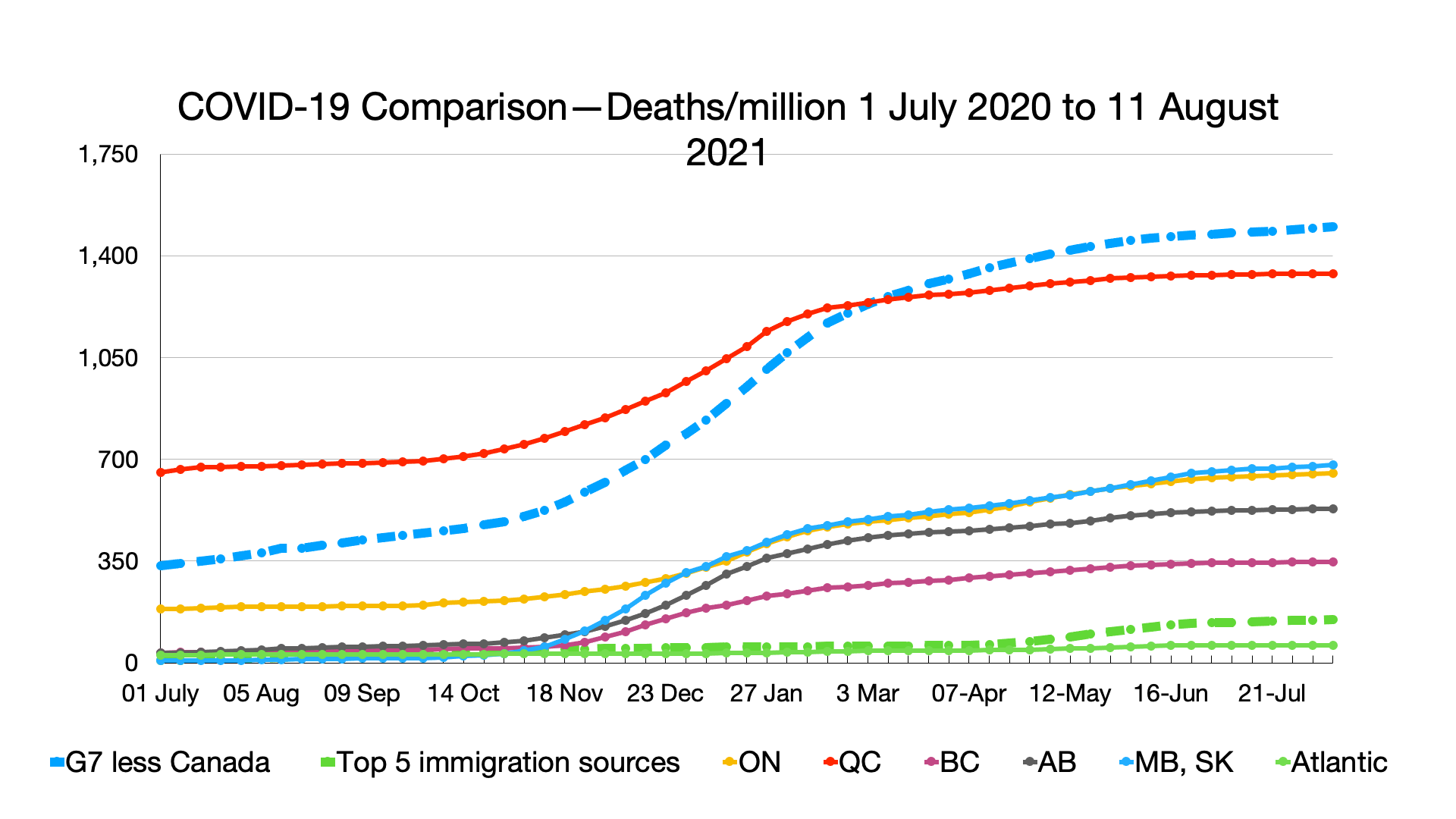
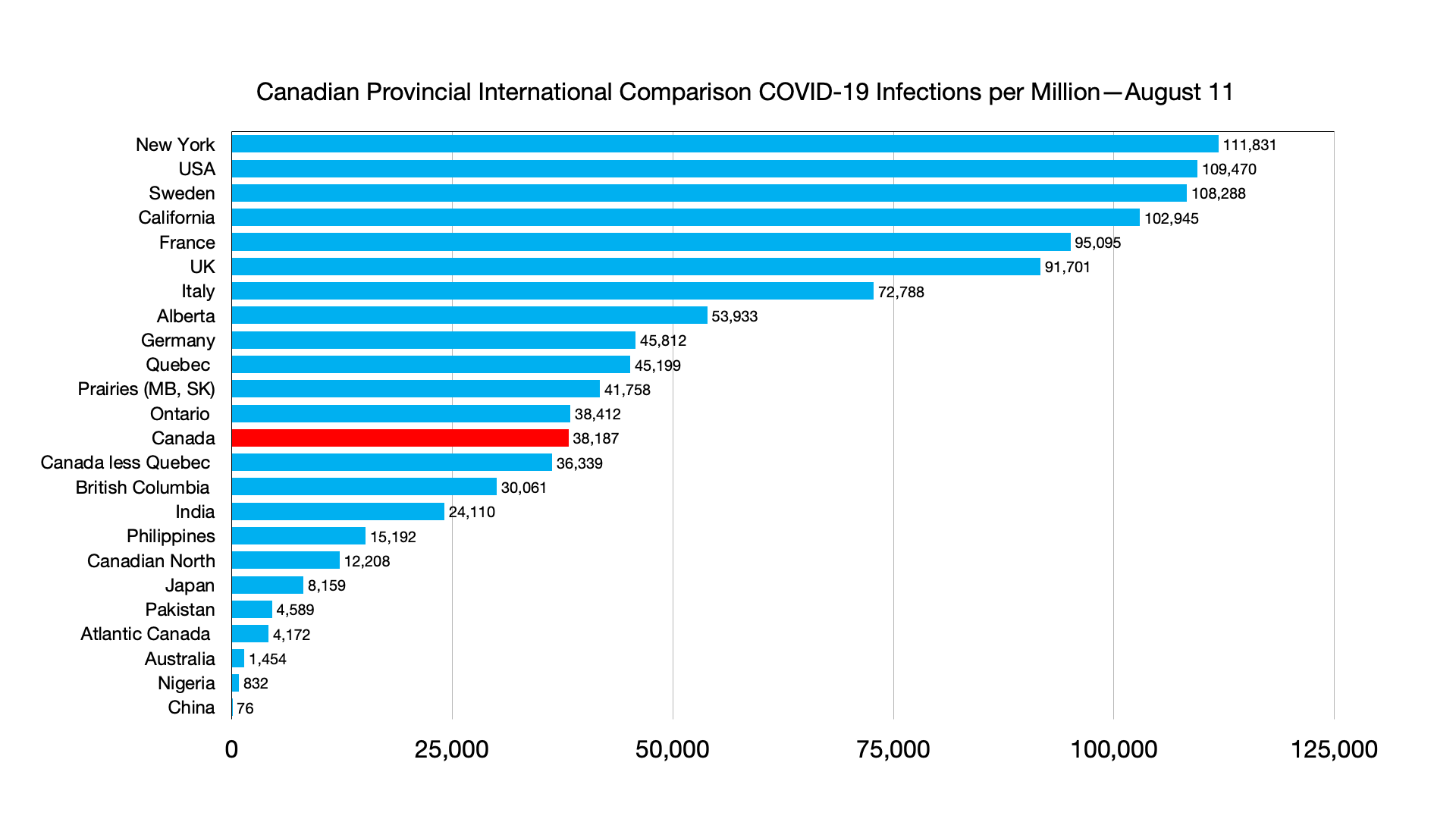
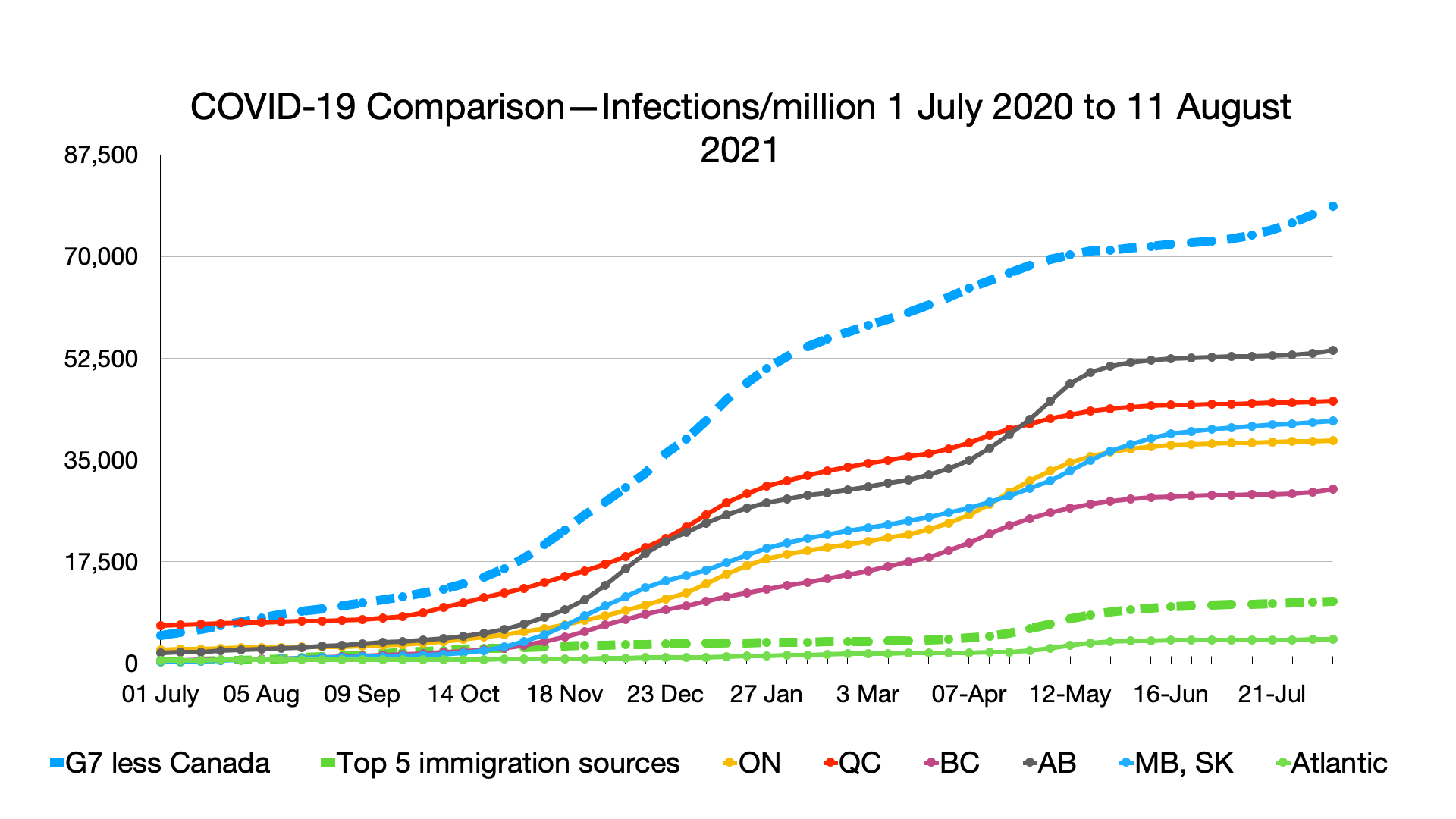
#COVID-19: Comparing provinces with other countries 11 August Update

The latest charts, compiled 11 July as overall rates in Canada remain relatively stable but with slight increases due to the variant. Canadians fully vaccinated now 62.7 percent, higher than USA 50.8 percent and the UK 59.4 percent).

Vaccinations: All Canadian provinces ahead of USA and EU countries, UK and China now ahead of Alberta and Prairies.

Trendline charts

Infections: More pronounced uptick in G7 less Canada (driven largely by USA). While all provinces showing increased infections, greater upticks in Alberta, British Columbia.

Deaths: No significant change.

Vaccinations: Ongoing steady gap between Canadian provinces and G7, immigration source country increase continues to be driven by China (fully vaccinated still at 16 percent) and India (fully vaccinated 8.5 percent). Flattening of Canadian vaccination rates as reported elsewhere.

Weekly

Infections: No relative change.

Deaths per million: No significant change.

It’s a system meant to help newcomers to Canada learn English. But critics say it prioritizes testing — at students’ expense

Hard balance to strike between the need for accountability through testing of progress and pedagogy:

After having his education stalled by war, Fahed Diab was thrilled to have a chance to return to school in Canada. But before he could apply to college, the Syrian refugee needed to enrol in adult English classes.

In those classes, the then 21-year-old worked to learn a foreign language from scratch while, more importantly, rebuilding his self-confidence and mingling with other newcomer students like him who were also trying to learn the history, values and cultures of their adopted homeland.

“I wanted to be able to communicate with people and learn how to ask for help, go to a doctor and book an appointment,” said Diab, who resettled in Canada with his family via Lebanon in 2015 under a refugee sponsorship.

“I went to classes and met friends in similar situations as me. I enjoyed interacting with people from different backgrounds and learning about this country. My self-confidence was getting better.”

However, when changes were made to the federal immigration department-funded Language Instruction for Newcomers (LINC) while he was about halfway into his one-year program, Diab, now studying engineering at Lakehead University, said he lost his drive as a result of the frequent in-class assessments required to prove the students’ progress.

“We had two or three tests a week, sometimes for writing and reading, or listening and speaking. We must pass all these tests to move up to the next level,” said the now 27-year-old Hamilton man.

“All the tests distracted me from the learning. I was obsessed with passing the tests rather than learning the language and culture.”

After about a year enrolled in the immigrant English classes, Diab quit and moved to an academic credit program for adults at a school board to finish his Canadian high school diploma as a bridge to the language requirement for post-secondary education.

He could’ve met college admission English requirement if he’d reached LINC level 7, which requires the learner to be able to communicate “comfortably and reasonably fluently” in most common daily situations.

Based on the Canadian Language Benchmarks, LINC goes from level 1 for low beginners to level 8 for high intermediate learners. While most Canadian colleges require minimum scores in standard language tests such as IELTS and TOEFL, they also accept adult immigrant students who have completed at least level 7 in LINC.

Adult immigrant students do drop out of English classes once their language proficiency reaches the level they need to navigate their day-to-day life; for many, it’s just a means to obtain the certificate to meet the bar of the language requirement for citizenship applications. Immigration data shows as many as half of all students discontinue after completing one level.

However, students and instructors say the portfolio-based language assessment or PBLA introduced in 2013 is taking the fun — and class time — out of learning for students such as Diab.

The language assessment system, which has been rolled out incrementally since then, is meant to provide a standardized tool to measure the program’s impact on participants’ language learning and track their progress at each English benchmark.

According to its practice guidelines, PBLA is a “comprehensive, systematic and collaborative approach to language assessment” based on the use of real world language tasks throughout the teaching and learning cycle.

Teachers and participants together are supposed to set learning goals, build a body of work to showcase the student’s language proficiency over the span of a school term and use it to make plans to advance the learner’s journey.

According to the immigration department’s most recent review of its language program, 87,140 or 16 per cent of adult newcomers admitted between 2015 and 2017 enrolled in formal language training. Women accounted for 62 per cent of the enrolment and three quarters of the students were between the ages of 25 and 54.

Students surveyed told researchers they were in classes to improve English for daily life (78 per cent), to help get a job (67 per cent), to better communicate at work (61 per cent), to learn about Canada (58 per cent) and to meet people (53 per cent).

About two-thirds said PBLA was helpful in encouraging them to learn more, that in-class assessments were useful in showing they are learning (64 per cent), and that the frequency of tests was just about right (67 per cent).

Instructors who did not find the assessment approach helpful complained the process took too much preparation (88 per cent) or classroom time (80 per cent), and that learners might not be comfortable with or understand the goal-setting (76 per cent).

“The PBLA may be useful ‘as a learning tool,’ but ‘not as an assessment tool,’” said the 75-page report, released in May. “PBLA is time consuming, and that training for PBLA is in high demand.”

Kelly Morrissey, who has taught English to immigrants and refugees in Toronto since 2010, says the tool looks good on paper but is so labour intensive when applied to a class of 20-plus adult students that it turns into sheer test-oriented learning and assessment rubrics.

PBLA requires students to collect what’s called artifacts — evidence of success in applying vocabulary, grammar and pronunciation in group activities — throughout the term. They need 32 artifacts in writing, reading, listening and speaking based on the instructor’s assessment to move up each ladder. There are eight LINC levels in total.

“Language needs a lot of repetition in different contexts. You need to give the brain as many ways to acquire the language skills as possible. You need to bring in all the senses,” said Morrissey.

“Language is one of the humanities. It’s not like a hard science. You can’t treat language students like laboratory rats.”

Morrissey tailors her curriculum to what her students’ needs are and those needs vary from cohort to cohort.

For a lesson about grocery shopping, she would go to a local store to take pictures of aisle signs, bring empty food packaging to the class and turn the classroom into a supermarket to allow students to do role-playing and learn English in that setting. Sometimes, that would also include a field trip to a store.

While the task-based learning approach that many instructors have already been doing is fantastic, says Morrissey, the paper work involved in PBLA has cut into the time students spend on those activities.

And it doesn’t help that instructors have to develop their own course content outside of the class based on rough PBLA guides. Those hours are unpaid.

“PBLA focuses on test, test, test, test. I had refugees from war-torn areas in my literacy class, experiencing post-traumatic stress disorder. I wanted more than anything to protect them from stress of these tests,” said Morrissey. “I think it’s unethical to be asked to do that to them.”

Ethiopian newcomer Ibsa Abdurzak, who was sponsored to come to Canada by a community group in 2017, spent six months in the language program in 2018 before quitting. While the assessment helps students get a sense of their English levels, he said he became hung up with making the grades.

“The best way to learn a language is through practice. But there’s too much assessment and it was too tedious for students,” said the 28-year-old, who had a degree in education back home and now studies business accounting at Mohawk College.

“We don’t like to be judged. It makes people nervous and stressed. It did take away the time to practise English.”

Yuliya Desyatova, a University of Toronto doctoral student, focuses her research on PBLA in adult language training in Canada. She says learners, often self-conscious and afraid to fail, could benefit more from engaging in activities than being assessed.

“They need the opportunity to interact in the language in a social environment. Many of my students are isolated at home. They don’t have interaction (in English) beyond classroom hours. They have so much responsibility,” said Desyatova, herself a LINC instructor since 2006.

“When this opportunity to interact with classmates and teachers is replaced by you filling out paper after paper after paper in the hope to pass, the interaction is pushed aside.”

While the assessment is supposed to offer a “better and reliable measurement” to gauge a learner’s progress, Desyatova says it’s still an inconsistent instrument because each teacher applies the standards differently, with some more heavy-handed than others — an issue the immigration department’s review recognized.

“A simple solution is to remove the mandatory nature of PBLA and let teachers decide how much and how frequently tests need to be done,” she said. “We don’t need to test our students 32 times to see this student is not learning anything more from my class and needs to move to the next.”

Settlement Assistance and Family Support Services, an immigrant agency in Toronto, provides adult language training to some 400 newcomers a year at three locations from literacy to level 7.

Its executive director Sudip Minhas said PBLA allows students to be the centre of the learning and give them ownership of the process, though she admits that the concept of evaluation scares people.

“The intent of PBLA is to take that anxiety out of testing. If I’m given the ownership of my own learning, the assessment is not about pointing out whether I fail or pass, but rather if this route didn’t help (my learning), can I take a different route?” said Minhas.

“But for all our instructors as well as administrators, we have not been able to translate that into practice because we’ve been conditioned by years of certain structured exams and of assessing people by failing or passing them.”

Although PBLA has been implemented for some years now, she says it takes time for instructors and learners to recondition their thinking about the assessment and apply it correctly.

The big setback was that the teachers were not given enough training and support at the onset, she’s glad to see the immigration department’s review recognizes that instructors can “benefit from many supports” and recommends more adaptable PBLA materials, limiting the amount of unpaid work and extra training.

Source: It’s a system meant to help newcomers to Canada learn English. But critics say it prioritizes testing — at students’ expense

Lawyer who called for elimination of citizenship tests named to bench

I thought the right-wing press might notice Avvy Go’s appointment. Will be interesting to see how she manages the transition from a very public activist to being a more discrete judge:

A Toronto legal activist who questioned the need for immigrants to take immigration citizenship tests and said the COVID-19 pandemic has created an increase in racism in Canada, has been appointed a federal judge.

Blacklock’s Reporter said Avvy Yao-Yao Go has also lamented the “shameful history” of Canada’s first Prime Minister, John A. Macdonald.

Go had been director of a Toronto law clinic that criticized Canadians for “anti-China sentiment and white supremacy.”

Go described herself in a 2020 commentary in the Globe & Mail as a lawyer “fighting for social justice” and cohesion.

“The past several years of turmoil both in the United States and Canada have taught us our democracy is fragile and that structured racism, if left unchecked, poses a serious risk to social cohesion,” wrote Go.

Attorney General David Lametti appointed Go to the bench on Friday saying he was confident she will “serve Canadians well.”

Go was director of the Chinese and Southeast Asian Legal Clinic of Toronto. The federally-funded group in a June 1, 2020 submission to the United Nations Office of the High Commissioner for Human Rights complained of widespread racism in Canada.

“In contrast to the image of Canada as multicultural and welcoming, many Canadians have been emboldened to use the pandemic as a license to exhibit hate and racism,” said the submission to the UN.

“Moreover, since the outbreak of the pandemic, anti-Asian hate speech has proliferated on social media platforms fueled by right-wing extremists who are using the pandemic as an opportunity to stir up racist ideologies.

“The collision of conspiracy theories, anti-China sentiment and white supremacy has rendered dangerous results, including the movement of racist theories and messaging from the fringe to the mainstream.”

The group earlier received a $301,904 grant from the Canadian Heritage department.

“While the Prime Minister has remarked that ‘hate, violence and discrimination have no place in Canada’ and his government stands with ‘Asian-Canadians across the country,’ his government has failed to take any concrete steps to address the surge of hateful violence and messaging that has arisen during the pandemic,” said the report.

Meanwhile, Go in numerous commentaries and letters to editors criticized Canadians’ treatment of racial issues and proposed abolishing the citizenship test as a “hollow screening” of immigrants.

“The moment I became a true Canadian was the very moment when I began to challenge the Canadian system,” the Hong Kong-born Go wrote in 1998.

In a 2014 commentary in the Toronto Star, Go lamented the “shameful history” of Macdonald, “architect of racist law” that saw Canadians “forced to live in nightmarish conditions while Macdonald pursued his dream to unite Canada.”

“Given the stark human rights record under his belt, why should Canadians celebrate John A. Macdonald’s birthday?” wrote Go.

In a 2013 letter to the Globe, the judge wrote: “The term ‘visible minority’ is fraught with issues, the key one being it uses ‘white’ as a standard against which everyone else is measured.”

“As we prepare to mark Canada Day, Ottawa must admit past wrongs particularly against Chinese-Canadians,” she wrote Toronto Star editors in 2003.

Go was one of thirteen new federal appointees named to the bench Friday.

Source: Lawyer who called for elimination of citizenship tests named to bench

The U.S. Attracts Fewer International Students, Loses Billions In Revenue. Here’s Why

Of note:

The Biden administration is hoping to attract tens of thousands of international students who stayed away from U.S. campuses during the pandemic. Foreign enrollment plummeted by 20% last year costing nearly $10 billion dollars in lost revenue. Though some students are starting to return, recovery might not be so easy. Even before the pandemic, international students were already turning away from the U.S.

In the 2018-2019 school year, foreign enrollment peaked at 1.1 million students and it’s been declining ever since as countries like Australia, Canada and the U.K gain more foreign students.

That’s a challenge for American colleges. But it also could be a blow to U.S. competitiveness. ​​​​Foreign students often go on to build their lives in the United States, filling our faculty offices, our laboratories, our boardrooms. One in five entrepreneurs who founded start-ups in the United States is an immigrant — and three-quarters of them first came to America as students.

International students are more likely than Americans to pay full freight. At public universities, the out-of-state tuition they pay has helped make up for a drop in state funding, especially after the Great Recession.

“They [colleges] need the tuition. They need full four-year out of state tuition payers,” says Robert Daly who directs the Kissinger Institute on China and the United States at the Wilson Center. Daly argues that colleges have become too reliant on students from one country: China. “They’ve become addicted to this money.”

Higher education is one the America’s largest service exports

When the pandemic sliced away a huge chunk of foreign students, the new administration took note. Higher education is one the nation’s largest service exports — bigger than agriculture exports like corn and soybeans.

Unlike the Trump administration’s hostility to foreigners, the Biden administration recently called it a “foreign policy imperative” that the U.S. remain the top study destination for international students. It’s putting students first in line for interviews and visa processing at U.S. consulates around the world.

But for many foreign students, the U.S. just isn’t as dominant. Emily Dobson calls it the “geoswerve.” Dobson, a college counselor in Brazil, has seen more diversity in where her students apply to colleges over the past few years. She says they’re finding options not just in traditional destinations like Australia and the U.K. but in Qatar, Japan, and the Czech Republic. “We’re not seeing the future we used to see here,” she says of the United States. “Still love you. A few of you are on our list. But you know, we’re going to go to other schools.”

“The American Dream idea,” she says, “is being questioned more.”

Dobson’s students are looking for more affordable options than the U.S. and for places where they can earn a degree in just three years. Safety is also a big concern — America’s gun violence scares many families.

New hesitancy by foreign student spells big trouble for U.S. colleges and economy

And 70% of international students on American campuses are from Asia. The recent rise in anti-Asian hate crimes have made some of them reconsider their futures in the U.S. Early in the pandemic, Lily Cao, a Chinese student at Mount Holyoke College, was confronted in a grocery store by a woman accusing her of spreading the coronavirus. “COVID has really been the trigger point where I felt like, Oh, I might get discriminated against,” Cao says. She plans to return to China to build her career in public health.

This new hesitancy spells big trouble for colleges — and for the larger U.S. economy, which is propelled by immigrant entrepreneurs, many of whom came here as college students. Competitor countries, such as Australia and Canada, make it easy for international graduates to stay and work and give them priority above other applicants for permanent residency. Britain last year introduced a global talent visa that fast-tracks people in in-demand fields for immigration. Universities in those countries frequently promote the ability to work after graduation when they recruit international students.

U.S. colleges are trying to regain their competitive edge and the pandemic may offer something of a blueprint. After more than a year of remote learning, both professors and students are more comfortable with online education. More hybrid and online programs could shorten the amount of time students would need to be in the U.S. And colleges hope a new commitment by the Biden administration to welcome international students can reignite the American Dream for students from abroad.

Source: The U.S. Attracts Fewer International Students, Loses Billions In Revenue. Here’s Why

Column: Is it time to let noncitizens vote in local elections? Some Americans think that’s just nutty

Even at the municipal level questionable, particularly in Canada with reasonable and not excessive requirements. And it still raises issues regarding minimum residency and other requirements:

Should noncitizens be allowed to vote?

That sounds a little crazy, doesn’t it? Weren’t we taught growing up that the right to vote belongs only to full-fledged, passport-eligible citizens of this country?

Nonetheless, the movement to expand immigrants’ voting rights is gaining ground.

We pay taxes, immigrants say. We run businesses. We send kids to public schools, drive the roads, ride the subways and fight in America’s wars. We are stakeholders in our communities and shouldn’t be excluded from the decision-making process that affects us.

There’s currently a bill before the New York City Council to let legal permanent residents vote in municipal elections — up to and including mayoral elections. Since 2018, San Francisco has allowed noncitizens to vote in school board elections, regardless of whether they’re in the country legally or not. Chicago allows it for school council elections.

Here in Los Angeles, the L.A. Unified school board authorized a study more than a year ago on how to extend voting rights in school board elections to noncitizen parents, grandparents and caregivers. The study — which would presumably lead to a ballot measure — was delayed by the pandemic but will be revived as school reopens.

There’s no question that noncitizen voting rights is a radical notion. It’s understandably worrisome to those who believe citizenship matters.

And you don’t have to be a xenophobe or a white nationalist or a Trump voter to feel that way.

A few years ago, then-Gov. Jerry Brown, whose liberal credentials are pretty impeccable, vetoed a bill passed by the California Legislature that would have allowed permanent legal residents to serve on juries, saying: “Jury service, like voting, is quintessentially a prerogative and responsibility of citizenship.”

Citizenship is a concept, a construct — but it’s a meaningful one. The idea is that there is a difference between merely living in the U.S. and being a full participant in its democratic self-government. Many people are stakeholders, but citizens are more like shareholders.

Becoming a citizen is a process (unless you’re born here, in which case it’s simple luck). At the end of it — after you’ve waited your time, lived in the U.S., taken a test, paid your fees, pledged your loyalty — you are rewarded for your formal commitment with both rights and responsibilities.

And there’s a value to waiting. The term “assimilation” is out of favor (perhaps because it implies that immigrants must check their differences at the door), but “incorporation” and “integration” are still important — learning the language, understanding the culture, making sure you buy into the rules and values laid out in the Constitution. Shared citizenship is a unifying force.

My mother, who came to America during World War II, went through this process, becoming a citizen seven years after she arrived.

Nevertheless, despite everything I’ve just said, I’ve come around to the idea that we should try noncitizen voting anyway, at least in a limited way on the most local level. The advantages outweigh the disadvantages.

After all, the United States was founded on the promise of “no taxation without representation” — yet there are some 25 million people living in the country, more than half of them legally, who are unable to participate in the elections that affect their lives and livelihoods. And yes, most of them pay taxes.

When a segment of the population is excluded from the political process, it can lead to discriminatory public policy and mistreatment.

Furthermore, noncitizen voting was widespread in the U.S. at the beginning of the nation’s history; it ended only in the 1920s. It is permitted in 45 countries around the world in local or regional elections, and in some cases, at the national level.

Noncitizen voting in federal elections was barred in 1996, but where it’s been allowed in the U.S. in recent years — in 11 towns in Maryland as well as San Francisco, two cities in Vermont and a few other jurisdictions — the sky hasn’t fallen. In many cases, it has led to greater political engagement and often to “improved outcomes,” says Ron Hayduk, a political science professor at San Francisco State.

Hayduk argues that noncitizen voting on the local level can be seen as part of the process of becoming a citizen, rather than a substitute for it. It undoubtedly fosters a sense of belonging and investment in the community.

It’s all well and good to tell immigrants to wait their turn to vote, but gaining citizenship is caught up in the U.S. immigration system, which is broken and irrational by all accounts, with no fix in sight.

In contrast, a limited experiment in noncitizen voting by the L.A. Unified School District makes sense. After all, the school board cited an estimate that 42% of Southern California’s children have at least one parent who is not a citizen, without a voice in the district’s leadership.

The expansion of the franchise should be narrow. It should be for school board elections only, and it could be restricted to legal permanent residents with children in the system. Let’s try it and see what happens.

Noncitizen voting raises fundamental questions about our country. Who is an American? Who gets to set the rules? What does it mean to run a country “with the consent of the governed”? What are the costs if millions of stakeholders are excluded from decision-making?

This experiment would challenge our assumptions but perhaps make us stronger in the long run.

Source: Column: Is it time to let noncitizens vote in local elections? Some Americans think that’s just nutty

The Gatekeepers: Where ATIP offices fell short during the pandemic

Of note. Would be a lot easier in some ways for the default to post more publicly on open Canada but changing government culture is difficult (which I remember all too well from my time within government and then my time outside filing ATIPs).

Some of the Information Commissioner’s recommendations are practical and should be doable:

Four months into the pandemic, anyone exercising their right to query the federal government would have received the following message from one of its largest departments, Public Services and Procurement Canada:

Due to the current and evolving COVID-19 pandemic, PSPC’s network is limited to essential and critical services such as pay, pension and procurement. While we are committed to respecting your right of access and are actively looking for solutions to maintain operations, we have little to no capacity at this time. Consequently, the Access to Information and Privacy Office has decided to put all access and privacy requests on hold until the situation returns to normal.

PSPC was hardly unique. When the federal government sent the vast majority of its 300,000 employees to work from home 17 months ago, the decrepit state of its electronic backbone was suddenly exposed, leaving more than 1,000 ATIP specialists in particular to grapple with some unsettling realities.

Most were unable to link securely from home to their offices. Even if the links had been in place, it often wouldn’t have mattered. In nine of the largest departments and agencies, more than one-quarter of the requests completed the previous year were in paper format. At the RCMP, the ratio was more than half.

Laying hands on those documents demands a physical presence. And the offices were mostly empty.

“The right of access, a quasi-constitutional right, cannot be suspended because of the pandemic,” Information Commissioner Caroline Maynard declared earlier this year.

As Maynard elaborated in an interview with this newspaper, she was not implying that ATIP workers should have been forced back to the office to do their duties. Her point was that the government had failed to provide the necessary tools. “Sadly, the pandemic opened our eyes to the issues,” she said. “We have a system that’s still archaic.”

Maynard also noted a disturbing tendency within government generally to give access requests lower priority — not necessarily within the ATIP units, but among employees elsewhere in government who locate and forward the necessary documents.

“It is very difficult to find people who want to work in access to information,” Maynard said before a House of Commons committee.

“You’re dealing with requesters who are eager to get the information, but you’re also dealing with a department that doesn’t want to respond, doesn’t have time to respond or has other more important things to do. It’s not an easy job.”

Eventually departments resumed ATIP operations last year, at least fitfully. But the end result for the fiscal year ended March 31, 2021, wasn’t pretty.

A Postmedia survey of 13 of the largest departments and agencies revealed 23 per cent fewer requests were closed during fiscal 2021 compared to the previous year, ranging from a drop of nearly 60 per cent for Global Affairs to just five per cent for Employment.

The number of requests also slipped, albeit a comparatively modest seven per cent overall. The range was even wider, however: from a decline of 48 per cent at Global Affairs to an increase of 62 per cent at the department of Innovation. There was also increased activity at PSPC and the Privy Council Office, two organizations that, like Innovation, were heavily involved in the government’s COVID-19 response. Year over year declines were slight at Employment and Canada Revenue Agency for the same reason.

(This discussion excludes the outsized influence of Immigration, Refugees and Citizenship Canada, which on its own accounted for three-quarters of access requests last year across government and belongs in a separate category. The vast majority of its access activity involves requests for updates on the progress of immigration or refugee applications. The department received nearly 108,000 access requests last year, down eight per cent, and completed nearly 105,000, down six per cent.)

With a few exceptions, the net result of the access activity within the other large government organizations was an increase in backlogs — dramatically so in the case of Innovation, the Privy Council Office, Public Services & Procurement Canada and Library & Archives. Collectively, the group of 13 received 26,400 access requests in fiscal 2021 and processed just 21,100. As a result, the backlog jumped 40 per cent.

Hypothetically, it would take the group of 12 more than seven months to clear their backlog, assuming processing took place at the pre-pandemic pace and no further requests come in.

Which is to say there is a big problem here.

Global Affairs blamed its egregious performance in matters of access on a classified server that can be used only by employees in the office. The department is developing an “IT infrastructure that will allow remote work on non-classified documents.”

Some departments — the RCMP, Defence and Immigration — have already been investigated by Maynard following complaints about lengthy delays and a lack of disclosure.

The RCMP acknowledges ongoing difficulties related to “insufficient resources” and “antiquated software systems” — compounded by the pandemic.

The number of access requests received by the RCMP in fiscal 2021 surged 18 per cent to 5,300-plus, while the police agency closed just 3,430 — nearly one-third fewer than the year before. This left the RCMP with a backlog representing a year’s worth of pre-pandemic activity.

“The RCMP recognizes that it must modernize its ATIP program,” the agency said in response to queries by this newspaper, “and has developed an ambitious plan and strategy to achieve this.”

Even agencies that have invested heavily in information technology over the years are re-visiting their methods.

Canada Revenue Agency, one of three government organizations (along with Employment and CSIS) that managed to trim the number of outstanding access requests during fiscal 2021, was prompted into action by its early experience during the pandemic.

While much of the agency’s work is already done electronically, its massive computer network wasn’t set up to handle having a majority of its 45,000 employees work from home. Indeed, during the spring of 2020, the only employees allowed to sign on to the network were those performing “critical services” for Canadians, such as the Canadian Emergency Response Benefit.

Processing access requests was not among those services considered essential, even though many of the requests were related to CERB and other COVID-19 response programs developed by the agency.

When CRA resumed answering access requests last summer, it committed to “a full-scale business transformation” aimed at expediting matters. The agency was vague on the details, but said this would involve changes to the CRA’s “processes, organizational structure and the use of technology.”

Translated into plain language, the agency is figuring out how to create and store documents so they are easier to retrieve. The question of exactly what should be disclosed is a more complicated one, but Maynard has some views on that as well.

The Information Commissioner reckons one of the best ways to cull large backlogs is for departments and agencies to automatically disclose information that is the focus of multiple requests. Training employees in the art of creating documents and records that are more easily searched is another way.

Nevertheless, Maynard recognizes that people seeking information from their government are also butting heads against an entrenched, longstanding culture of secrecy. That is why she is lobbying for changes to the access legislation that would remove some of the enormous discretion now exercised by those in control of the information.

“Where people have a discretionary exclusionary power, they will rarely decide to disclose the information,” she told MPs.

“Rather, they will attempt to redact the information for fear that it may be misinterpreted or cause embarrassment.”

That’s a longer-term war. In the meantime, fixing the ATIP regime’s technical shortcomings in the wake of COVID-19 will be challenge enough.

Source: The Gatekeepers: Where ATIP offices fell short during the pandemic

Return of ‘protected ridings’ sees N.S. riding with full slate of Black candidates

While in general not in favour of “protected riding” or deliberate drawing of borders based upon ethnic ancestry or visible minority or other groups, in some cases like this one can be justified to improve representation.

At the federal level, this largely happens more or less organically for the larger groups given settlement patterns:

In the provincial riding of Preston, just east of Halifax, a historic political race is underway.

“One of the things that’s really important, and I think so many people are talking about, is the fact that all three of us are local in particular and African Nova Scotian,” Liberal candidate Angela Simmonds said of the candidates facing off to represent the riding.

Simmonds, along with NDP candidate Colter Simmonds and Progressive Conservative candidate Archy Beals, make up the slate for the largely African Nova Scotian riding in the Aug. 17 general election. It’s believed to be the first time in the province’s history an electoral district has all Black candidates.

It’s thanks in part to the reinstatement two years ago of Preston, along with three largely Acadian ridings — Argyle, Clare and Richmond. In 2019, the Liberal government introduced legislation to bring back the so-called protected ridings after the previous NDP government did away with them in 2012, saying there were too few voters in them.

With the reinstatement, the province once again has 55 ridings, up from 51 in the last election.

Other provinces have ridings of varying sizes, typically to ensure rural voters are well represented. But Nova Scotia’s protected ridings are unique for the fact that they shield so-called “historical minorities” from redistribution, said James Bickerton, a political science professor at St. Francis Xavier University.

The ridings were initially formed in the 1990s to ensure effective representation of Acadian and African Nova Scotian voters and to protect them from electoral redistribution, “which would dilute the populations considerably to the point where minorities would no longer be the majority within the constituency,” Bickerton said.

He was on the electoral boundaries commission that concluded in 2012 that the ridings should remain. But he said the commission was threatened by then-attorney general Ross Landry, who claimed the recommendation did not respect the commission’s terms of reference.

The movement to reinstate the special districts followed a court victory by the Acadian Federation of Nova Scotia. The province’s Appeal Court ruled that the redrawn map violated democratic rights guaranteed in the Charter of Rights and Freedoms.

“Effective representation was at play … the argument being that Francophones and African Nova Scotians could only have effective representation if they had representatives in the legislature from their communities,” Bickerton said. “Protected ridings doesn’t guarantee it, but it certainly makes it much more likely.”

Andrew Griffith, a fellow at the Environics Institute, a public opinion and social research organization, said ridings with large minority populations tend to elect candidates with similar ethnic and cultural backgrounds. He gave the example of Indo-Canadians.

“If you look at a place that has a large Indo-Canadian population, whether immigrants or citizens, the candidates and the MPs tend to come from those communities,” Griffith said. “Having your electoral districts be aligned not only to the overall population balance, but to recognize that some communities may be relatively under-represented because they’re too dispersed across the province or across the country, I think it’s a valid rationale.”

Glenn Graham, a political science professor at St. Francis Xavier University, echoed the sentiment, adding that the goal of the ridings is effective representation, not necessarily absolute voter parity, which is the idea that each vote carries the same weight. Voter parity, however, could also limit the voices of minority voters, he said.

When the latest changes were made in 2019, the four protected ridings had voting populations ranging from 6,451 in Argyle to 10,781 in Preston, well below the provincial average of 14,356 electors per riding.

“With all the major political parties running an African Nova Scotian candidate, it’s a guarantee that there will be an African Nova Scotian representing the area,” Beals said in a recent interview. He added that the area comes with specific cultural issues, including education and business development, of which the candidates have an intimate understanding. “Who best to address them than someone in the community, from the community?” he said.

As for the Acadian ridings, Marie-Claude Rioux, the executive director of the Acadian Federation of Nova Scotia, said in an interview that the change “gives Acadians a better chance to elect someone that will know their needs,” such as French-language health services.

But while the community was glad to see the three Acadian ridings restored, Rioux said the federation plans on fighting for more representation, namely a riding for Cheticamp, an Acadian community in Cape Breton.

Moving toward effective representation, Graham said, is about “having someone that you feel may look like you in the legislature, or is a reflection of your lived experience in the legislature.”

And with the newly reinstated ridings, Angela Simmonds said she now has an opportunity to engage with the constituents of the riding at a more personal level.

“I think when you see someone who looks like you there is an appreciation for one’s lived experiences,” she said.

Source: Return of ‘protected ridings’ sees N.S. riding with full slate of Black candidates

Australia Census 2021 seeks to understand what it means to be Australian, but ignores the complexities of ancestry

Of note. Canadian parallel with 2016 census that no longer included Jewish under ethnic ancestry given not in top 50 (see Technical report on changes in response related to the census ethnic origin question: Focus on Jewish origins, 2016 Census integrated with 2011 National Household Survey):

According to tradition, in 16th century BC, Cecrops, the mythical first king of Athens, conducted a census of his subjects. Each Athenian was compelled to provide a single stone and when these were counted, it was determined that the city contained 20,000 inhabitants.

The 2021 Australian Census is much more complicated in that it asks questions about income, qualifications, education, hours worked, hours assisting those with a disability, hours expended looking after children and significantly, considering the purported multicultural nature of Australian society, questions as to ancestry and language.

It is these latter two questions that give rise to concern. Firstly, there appears to be no question as to ethnic and/or cultural identity on the Census. There is an apparent lack of understanding by those conducting or commissioning the Census that ethnic identity is an issue separate, though ancillary to that of ancestry. For instance, one can be of diverse ancestry and yet identify ethnically in a different manner altogether, according to religious, cultural, linguistic or political factors.

Even if one accepts this lack of appreciation as to the importance of ethnic identity in understanding the Australian population, and its incorrect conflation with ancestry, the ancestry question on the Census provides cause for grave disquiet. In scrolling down the various ancestries listed, ranging from the Anglo-Celtic, to Chinese, Italian and beyond, I was interested to note this time, the omission of Greek. While it is not expedient for a government to list every ancestral group on a census form, it would be interesting to know the reason for the omission of the Greeks, being one of the oldest, historically and numerically significant communities in this country. It may well be that demographic change has seen our numbers (as counted by a census which usually is conducted during a month when significant members of our community are traditionally holidaying in the motherland en masse) diminish. To diminish our prominence and importance is quite another matter altogether, a cursory tale about the use and misuse of statistics in interpreting our multifaceted nature.

There is something deeply disquieting about being compelled to participate in a Census in a multicultural country that involves scrolling down the prescribed list of ancestries and then having to choose a box labelled “Other.” Reinforcing to people of diverse ancestry that they are “Other,” tacitly conveys to them the message that they are considered to be not truly an organic part of this nation’s society, regardless of their citizenship status or place of birth. It would be infinitely more respectful then, if in future censuses, either all known ancestral groups were listed, or better still, that participants, rather than choose from government sanctioned ancestries, are permitted to merely record their ancestral affiliations themselves, instead of being officially termed outsiders and thus by implication, subversive.

Conversely, in permitting the free expression of ancestry under the option “Other,” the government is allowing for a Pandora’s Box of affiliations to emerge. With a debate raging in certain sections of our community with regards to expressing our ancestry as “Hellenic” rather than “Greek,” which is considered by some to be a western imposed term, a course of action that is not recommended given that it will mystify the statisticians of the Australian Bureau of Statistics, who presumably do not have training in cultural anthropology and hinder a true depiction of our numbers, the option “Other,” is also giving rise to a debate about the constituent parts of what it means to be Greek. Some people I have spoken to feel passionately about their Arvanite, Pontian or Vlach ancestry and wonder whether they should record this aspect of their “Greekness” in the census. How are we to interpret the ancestry of someone who claims that they are Cypriot? Do we not need to understand whether they interpret this as being part of the Turkish, Greek, Maronite or Armenian cultural world? Do we consider this as evidence of an emerging identity that contains all, or none of these components? This is precisely the reason why culture and ancestry must be addressed separately in the Census, and why not doing so is problematic, to say the least.

Scrolling down the Census

While I was scrolling down the Census form, seeking to record my Greek ancestry, I noted mentally, the entries for English, Scottish and Irish (but not Welsh), the main ancestries for the dominant group within Australian society. I also noted the term Aboriginal and found this too, disturbing, in that the dominant group appears to be attempting to pigeonhole and compartmentalise a vast and intricately diverse number of cultural and ethnic groups under one blanket term that does nothing to highlight their own uniqueness and if anything, serves to obfuscate their existence. Whether intentional or not, this is a form of racism that should not have any place in any sector of modern Australia, let alone its governing institutions.

To my utmost perplexity, below the entry for Torres Strait Islander, I discovered the term “Australian.” Given the previous entries for “Aboriginals” and “Torres Strait Islanders” what are we to understand from this term? Is it suggesting that our native peoples are not

“Australian?” Considering that all of us except for our native peoples draw their ancestry from outside the Australian continent, the inexplicable inclusion of this contentious term merely serves to highlight the dispossession of our native peoples and the appropriation of their sovereignty and affiliation to the land. Further, it again subtly reminds those who do not share the same ancestry as the members of the dominant group, that they are not “Australian.” The dysphoria and sense of alienation created by such a clumsy rendering of terms again reinforces the need for cultural identity to be distinguished from ancestry on future Census forms and raises questions about the manner in which our governments view our communities.

As was the case in the 2016 Census, in its current iteration, the Australian Bureau of Statistics has made no provision in the question regarding which languages other than English the population speaks, for the possibility that some Australian citizens are multilingual and use a number of languages on a daily basis. Instead, participants may only choose to list one language other than English. This obscures and restricts the gleaning of a true picture of the linguistic heterogeneity of this country. For example, on any given day, my children will be speaking to each other and to me, in Greek. As they move from the kitchen down the hallway towards my wife, they call to her in Assyrian. My wife, on the phone to her mother, will be speaking to her in Arabic, so that the children will not understand a conversation relating to their grandfather’s declining health. Through the telephone, my wife will hear my father-in-law address my mother-in-law in Kurdish, so that in turn, my wife won’t understand what he is saying. Back on the other side of the house, I will be speaking to a client in Mandarin Chinese. Linguistic polyphonies of this nature form part and parcel of the polyglot reality of Multiculturalism and the reason as to why there is an official attempt not to capture this statistically is at best, incomprehensible. Furthermore, there is no follow up question as to the level of one’s proficiency in the language claimed to be spoken or indeed, as to which language is the primary language in use. These are both important aspects in interpreting the linguistic demography in this country. For example, while someone may be fluent in English, which language do they use more often and when? How proficient is someone in the language they claim to speak, especially if this is the language of an important political or trading partner? Questions of these nature, vital for the creation of coherent language policy, are completely ignored, suggesting that despite the rhetoric, officials see themselves as presiding over a benign, monolingual monoculture.

Ultimately, the Census says just as much about those who fashion it, as those who participate in it. It is difficult not to conclude that the carefully calibrated narrowness of the questions referring to culture, ancestry and linguistic identity, seem calculated to reinforce a narrative imposed and perpetuated by the ruling echelons of the dominant class. As such, we can be justified in harbouring a lack of confidence in the 2021 Census’ ability to provide us with an accurate depiction of the intricate complexities of our social make up and in being concerned as to the use made of any such flawed statistics, by legislators.

Source: Census Censure: Census 2021 seeks to understand what it means to be Australian, but ignores the complexities of ancestry