The Chinese Exploitation Of Turkish Citizenship To More Easily Obtain US/EU Residency Permits — Greek

Would be nice to have more data rather than just examples of advertising by immigration consultants. That being said, not surprising that alternate and backdoor pathways emerge:

In order to circumvent strict norms put in place by the United States, rich Chinese people are on the lookout for easier alternatives to acquire the US citizenship.

They have recently discovered that obtaining Turkish citizenship first would make it easier for them to acquire US citizenship.

Chinese websites and social media platforms are flooded with advertisements for obtaining Turkish citizenship.

These advertisements underline that the alternate way to obtain US Citizenship is by first obtaining Turkish citizenship which can be acquired through an investment of at least USD$250,000 in property.

The advertisements emphasise that it is possible to go to America and other western countries easily after obtaining Turkish citizenship.

The tagline of ads reads, “if you buy real estate, all your family members get their passports as gifts.”

As a result of China’s strained relations with the USA and many European countries in recent years, it has become difficult for Chinese citizens to obtain a residence permit in Western countries.

One Chinese real estate consultancy firms that deals with real estate sales from Turkey, emphasises in one of its advertisements that for Turkish citizenship, “Britain is the best springboard for settling in developed countries, such as the USA.”

The expressions used in the advertisements for Turkish citizenship published in China are as follows: “AFTER YOU BUY THIS, YOU CAN GO TO THE USA.”

The advertisements highlight the features of the Turkish passport: It can only be earned by buying a house for USD$250,000.

• It is a cheap and simple process, and it has two great advantages: It is the best springboard to go as an immigrant to developed countries such as the UK and the USA. After obtaining a Turkish passport, you can go to the USA as an immigrant with an E2 investor ID.

• E2 is a visa issued by the USA only to countries with mutual trade partnerships. After you get Turkish Citizenship, you can commute to and from the USA, you can live in the USA. Your spouse can work in the USA. Your children can study in American schools.

• Turkey is a country that has a trade partnership with the US. The E2 visa is the country’s most issued visa. It can take 500-600 people every year.

• If you get a Turkish passport, you can go to England with a business visa. The UK government allows Turkish citizens to engage in business. A 1-year commercial visa can be obtained on the first application. After five years, the right to stay in the UK indefinitely can be earned. After getting a business visa from the UK, your children can study in the UK. They can study for free in public schools.

• You can earn a Turkish passport with very simple transactions, just by buying a house. You don’t need to go yourself. If you buy real estate for 1.600 million yuan (USD$250,000), all your family members will be given passports. It does not ask for any documents. You can complete the transactions without leaving home.

It is recalled that a Turkish passport guarantees visa free travel to over 100 countries. You can get an E2 visa to the US with it.

Turkey has provision vide, in which a foreigner can obtain Turkish nationality on the basis of certain amount of investment in real estate, capital investment, by way of business generating employment for Turkish nationals, or by investing in Treasury bonds or any type of government loan instrument.

In 2018, with a legal regulation, the lower limit of real estate investment, which is one of the options for citizens of other countries to obtain Turkish citizenship, had been reduced from USD$1 million to USD$250,000.

However on January 06, 2022, the regulation on the ‘Implementation of the Turkish Citizenship Law’ was amended and the investment values were enhanced.

The Turkish government facilitated the regulation for foreigners to acquire Turkish citizenship in a bid to support the Turkish lira.

However, China is exploiting this provision of Turkey, whereby Chinese citizens are purchasing real estate in Turkey or making a fixed capital investment to obtain Turkish citizenship.

This is in order to bypass the difficulty its citizens face in obtaining the residence permit in western countries.
Source: The Chinese Exploitation Of Turkish Citizenship To More Easily Obtain US/EU Residency Permits — Greek

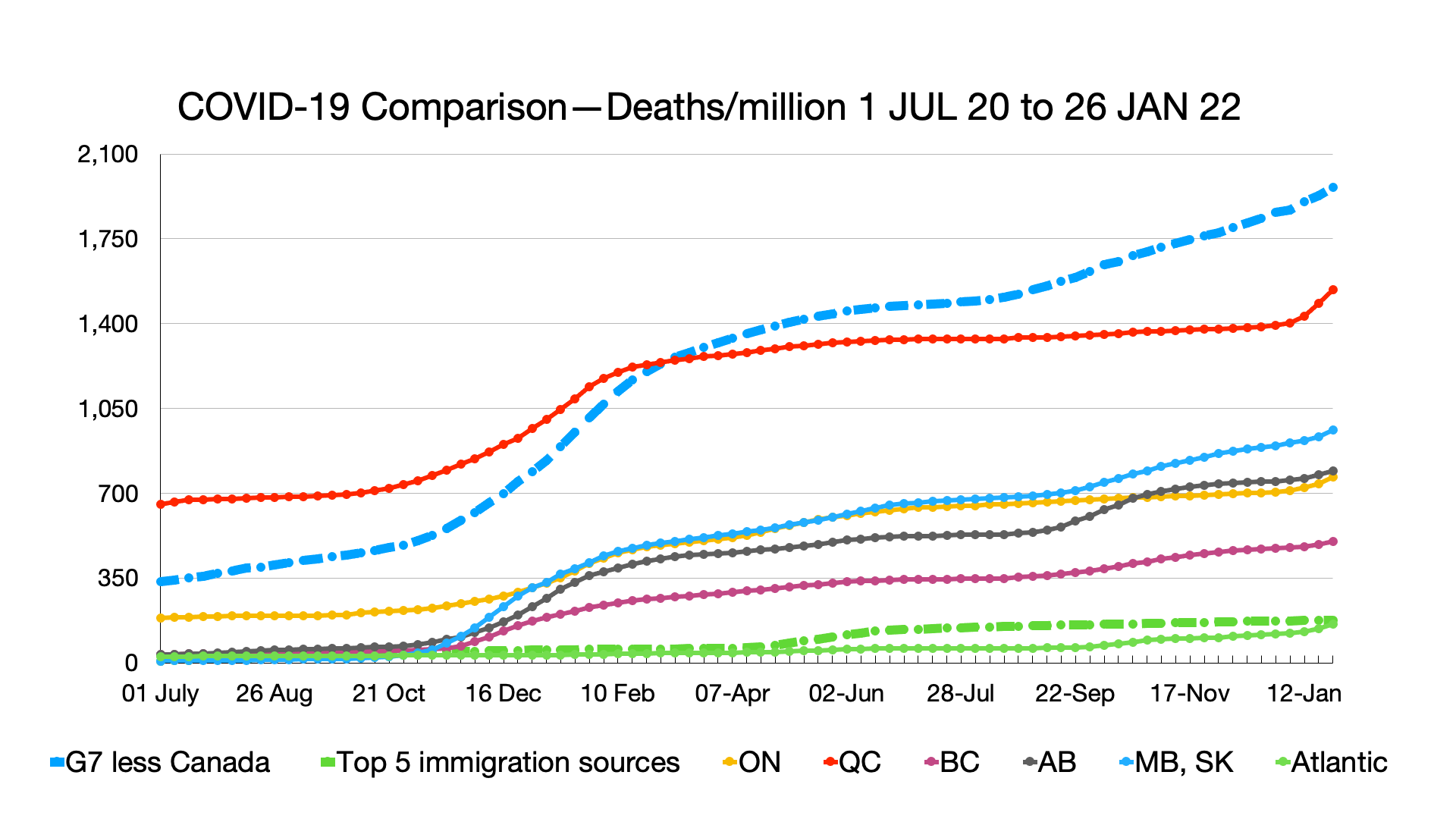
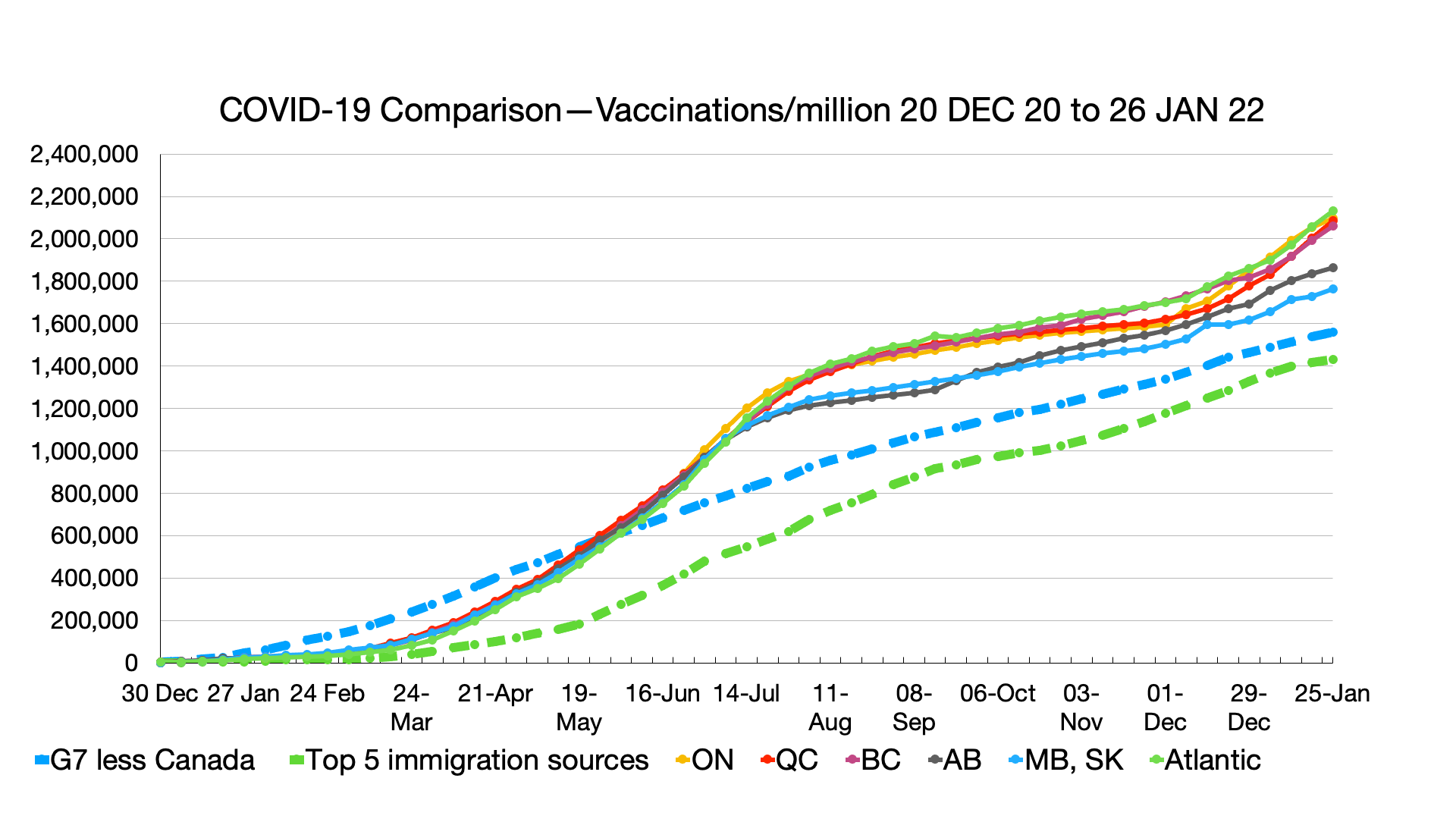
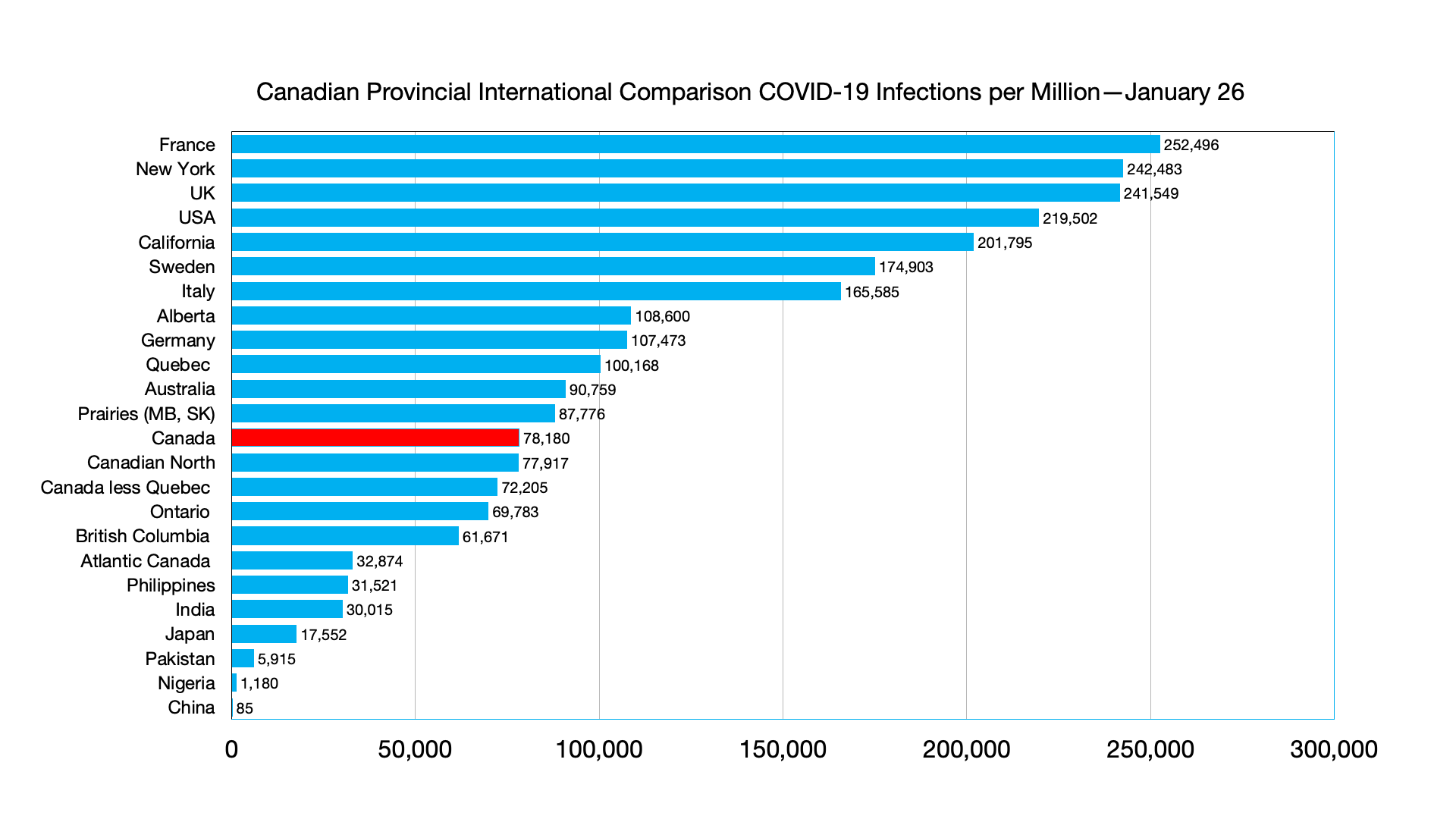
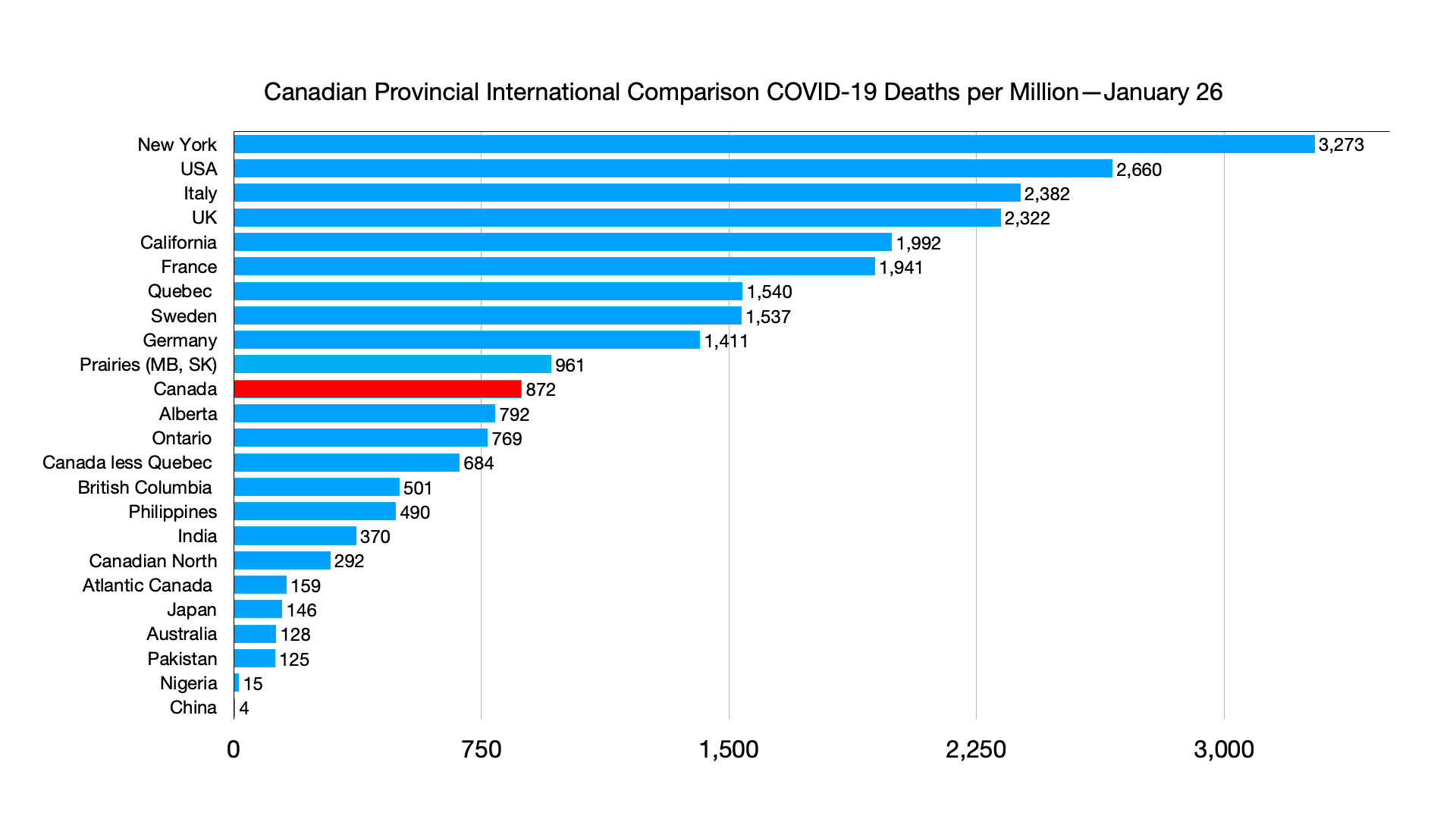
#COVID-19: Comparing provinces with other countries 26 January Update

Steep rise of infections remains the main story, along with resulting increases in hospitalizations and ICUs.

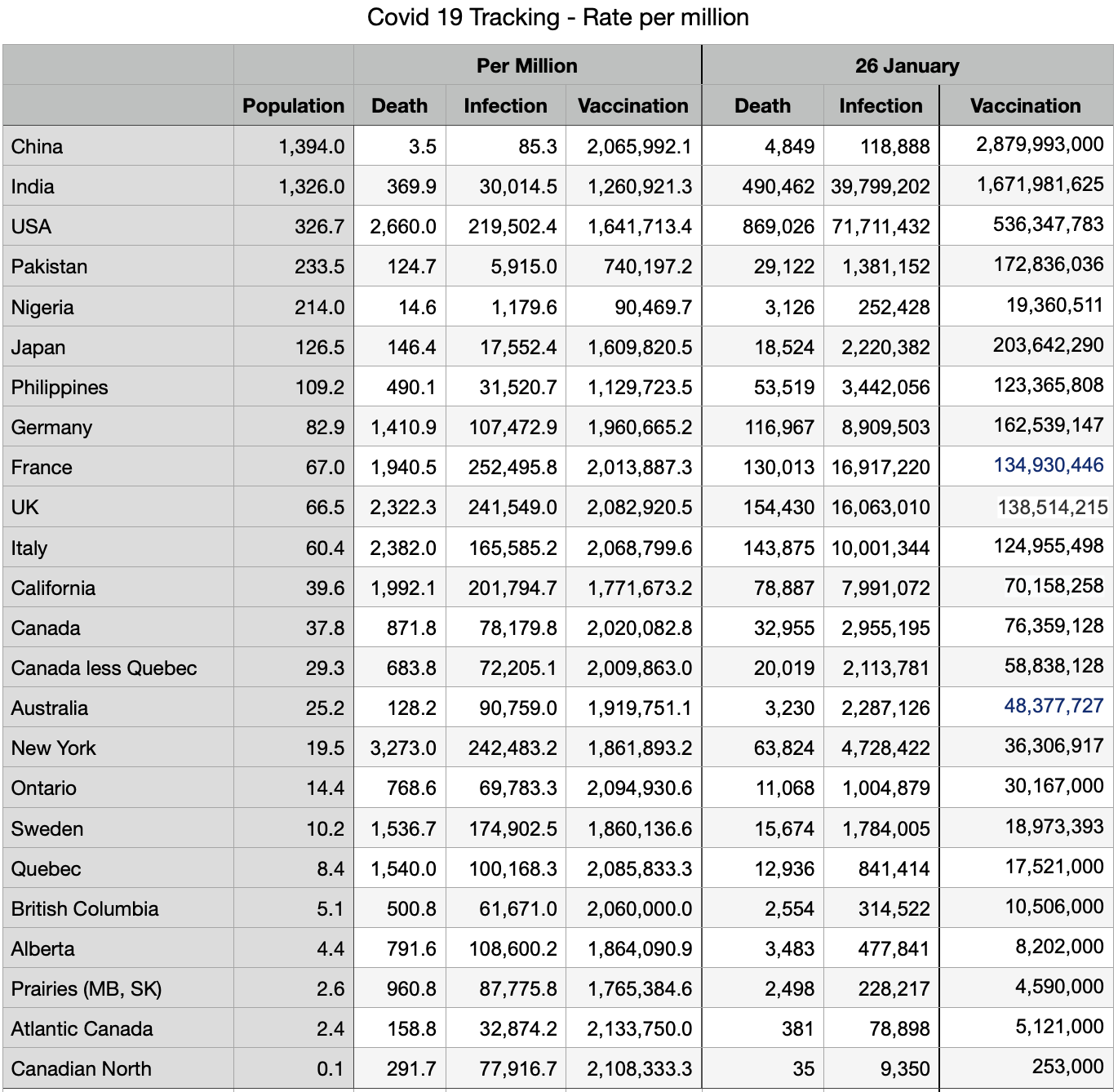
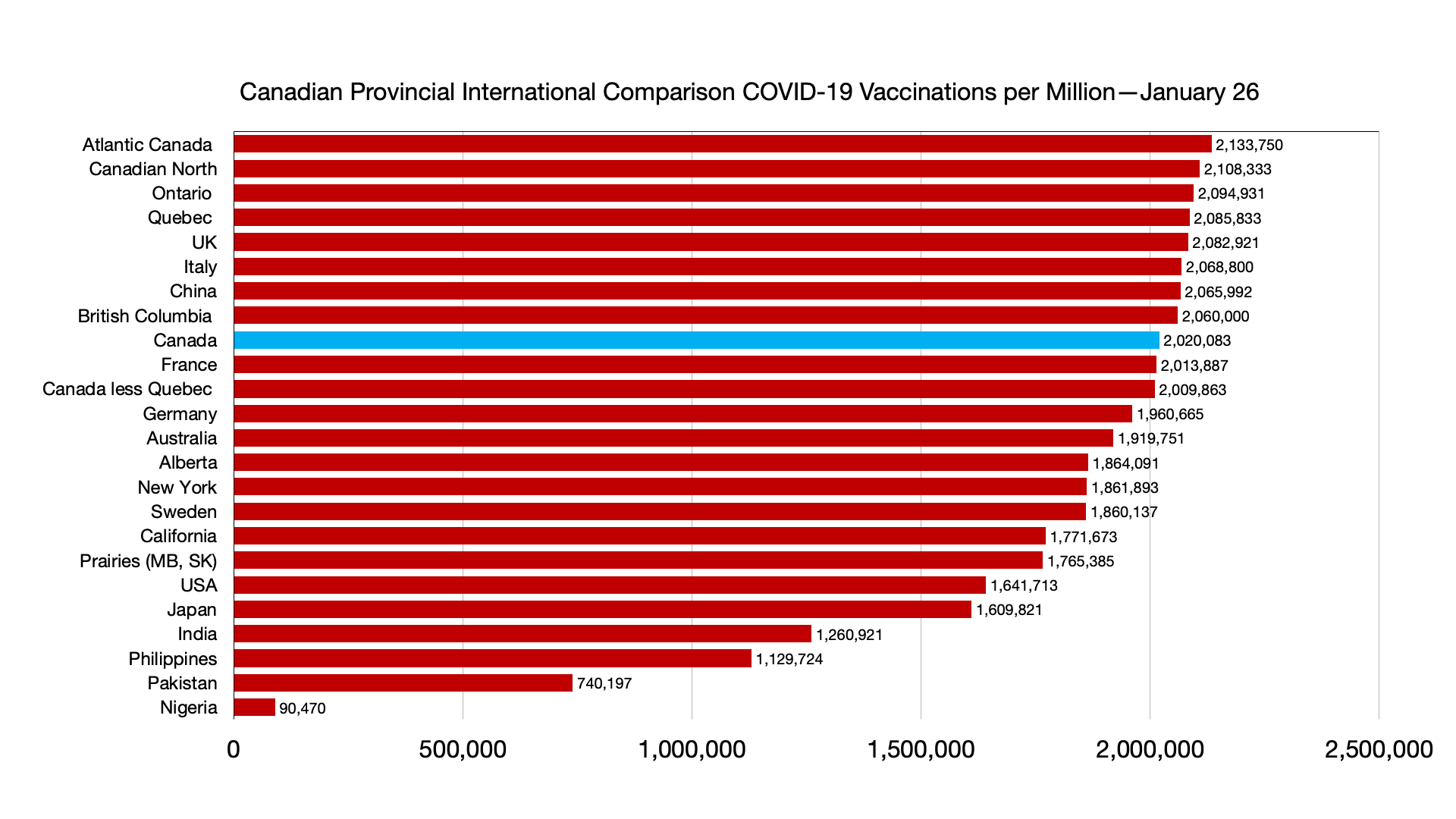
Vaccinations: Some minor shifts but general convergence among provinces and countries. Canadians fully vaccinated 79.5 percent, compared to Japan 78.9 percent, UK 72.2 percent and USA 64.2 percent.

Immigration source countries are also converging: China fully vaccinated 87.6 percent, India 50.4 percent, Nigeria 2.6 percent (the outlier), Pakistan 37 percent, Philippines 53 percent.

Trendline Charts:

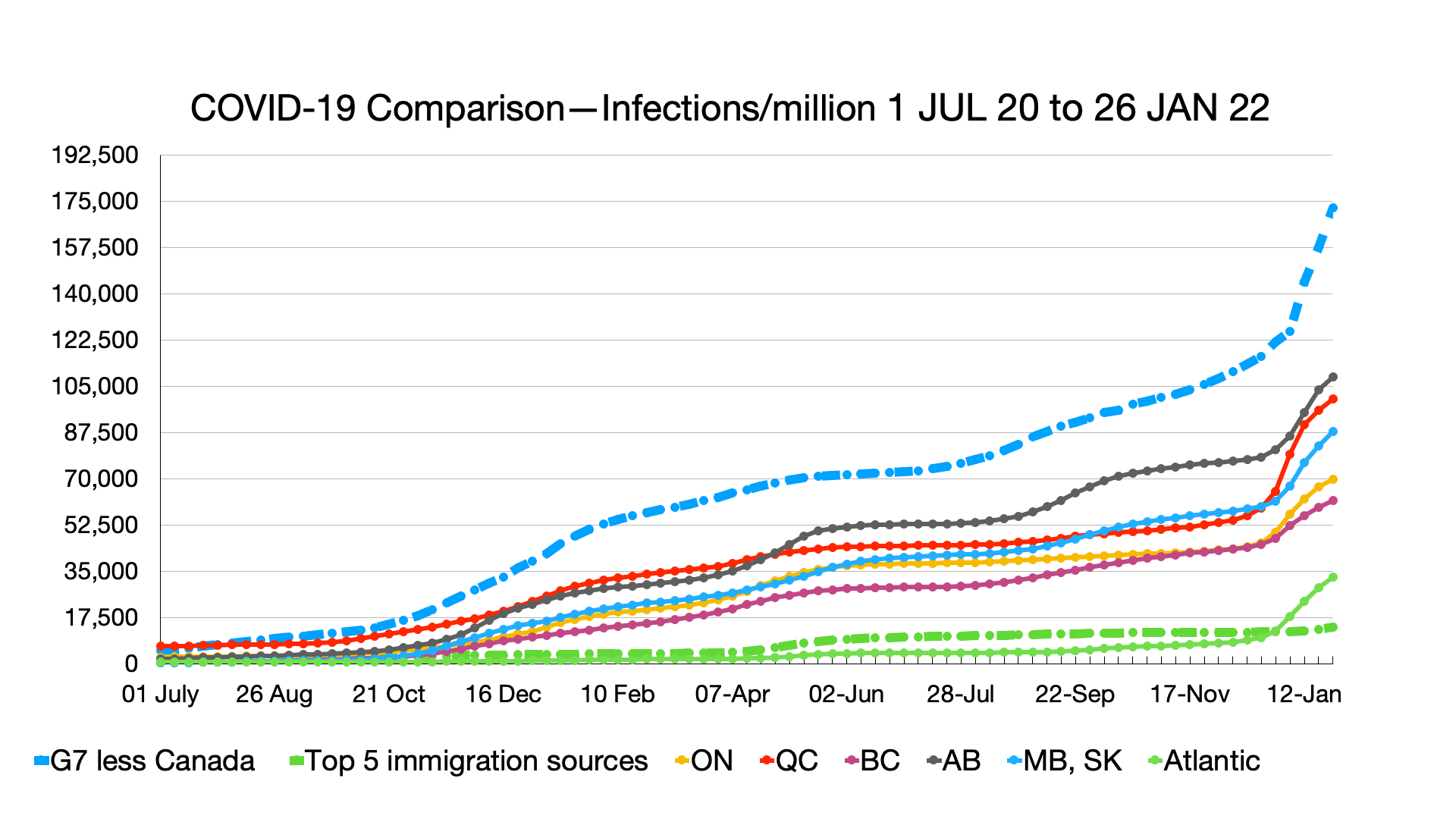
Infections: Effects of Omicron seen in steep curve in all G7 countries and provinces. No such effect in immigration source countries.

Deaths: No relative changes but Quebec uptick highly visible.

Vaccinations: Ongoing convergence among most provinces. Gap between G7 less Canada continues to grow despite overall convergence, with narrowing gap with immigration source countries save for Nigeria.

Weekly

Infections: France ahead of New York and UK, Australia ahead of Prairies, Atlantic Canada ahead of Philippines. 

Deaths: Quebec ahead of Sweden, Atlantic Canada ahead of Japan, Australia ahead of Pakistan.

Krugman: Attack of the Right-Wing Thought Police

Strong reminder of the greater danger to free speech. Money quote: “What’s really striking, however, is the idea that schools should be prohibited from teaching anything that causes “discomfort” among students and their parents.” Phrase applies to both left and right who argue against raising difficult or contentious issues:

Americans like to think of their nation as a beacon of freedom. And despite all the ways in which we have failed to live up to our self-image, above all the vast injustices that sprang from the original sin of slavery, freedom — not just free elections, but also freedom of speech and thought — has long been a key element of the American idea.

Now, however, freedom is under attack, on more fronts than many people realize. Everyone knows about the Big Lie, the refusal by a large majority of Republicans to accept the legitimacy of a lost election. But there are many other areas in which freedom is not just under assault but in retreat.

Let’s talk, in particular, about the attack on education, especially but not only in Florida, which has become one of America’s leading laboratories of democratic erosion.

Republicans have made considerable political hay by denouncing the teaching of critical race theory; this strategy has succeeded even though most voters have no idea what that theory is and it isn’t actually being taught in public schools. But the facts in this case don’t matter, because denunciations of C.R.T. are basically a cover for a much bigger agenda: an attempt to stop schools from teaching anything that makes right-wingers uncomfortable.

I use that last word advisedly: There’s a bill advancing in the Florida Senate declaring that an individual “should not be made to feel discomfort, guilt, anguish or any other form of psychological distress on account of his or her race.” That is, the criterion for what can be taught isn’t “Is it true? Is it supported by the scholarly consensus?” but rather “Does it make certain constituencies uncomfortable?”

Anyone tempted to place an innocuous interpretation on this provision — maybe it’s just about not assigning collective guilt? — should read the text of the bill. Among other things, it cites as its two prime examples of things that must not happen in schools “denial or minimization of the Holocaust, and the teaching of critical race theory” — because suggesting that “racism is embedded in American society” (the bill’s definition of the theory) is just the same as denying that Hitler killed six million Jews.

What’s really striking, however, is the idea that schools should be prohibited from teaching anything that causes “discomfort” among students and their parents. If you imagine that the effects of applying this principle would be limited to teaching about race relations, you’re being utterly naïve.

For one thing, racism is far from being the only disturbing topic in American history. I’m sure that some students will find that the story of how we came to invade Iraq — or for that matter how we got involved in Vietnam — makes them uncomfortable. Ban those topics from the curriculum!

Then there’s the teaching of science. Most high schools do teach the theory of evolution, but leading Republican politicians are either evasive or actively deny the scientific consensus, presumably reflecting the G.O.P. base’s discomfort with the concept. Once the Florida standard takes hold, how long will teaching of evolution survive?

Geology, by the way, has the same problem. I’ve been on nature tours where the guides refuse to talk about the origins of rock formations, saying that they’ve had problems with some religious guests.

Oh, and given the growing importance of anti-vaccination posturing as a badge of conservative allegiance, how long before basic epidemiology — maybe even the germ theory of disease — gets the critical race theory treatment?

And then there’s economics, which these days is widely taught at the high school level. (Full disclosure: Many high schools use an adapted version of the principles text I co-author.) Given the long history of politically driven attempts to prevent the teaching of Keynesian economics, what do you think the Florida standard would do to teaching in my home field?

The point is that the smear campaign against critical race theory is almost certainly the start of an attempt to subject education in general to rule by the right-wing thought police, which will have dire effects far beyond the specific topic of racism.

And who will enforce the rules? State-sponsored vigilantes! Last month Ron DeSantis, Florida’s governor, proposed a “Stop Woke Act” that would empower parents to sue school districts they claim teach critical race theory — and collect lawyer fees, a setup modeled on the bounties under Texas’ new anti-abortion law. Even the prospect of such lawsuits would have a chilling effect on teaching.

Did I mention that DeSantis also wants to create a special police force to investigate election fraud? Like the attacks on critical race theory, this is obviously an attempt to use a made-up issue — voter fraud is largely nonexistent — as an excuse for intimidation.

OK, I’m sure that some people will say that I’m making too much of these issues. But ask yourself: Has there been any point over, say, the past five years when warnings about right-wing extremism have proved overblown and those dismissing those warnings as “alarmist” have been right?

Source: https://www.nytimes.com/2022/01/24/opinion/florida-critical-race-theory-de-santis.html

John Ivison: Liberals thwart badly needed skilled immigrants with mendacious political meddling

Header overly strong but substance important:

In a recent article in Foreign Policy, Parag Khanna of globalization experts FutureMap predicted that the Great Lockdown will be followed by the Great Migration, as the best and brightest move to exploit opportunities and fill labour shortages.

It would seem an inopportune time for the government of Canada to stop accepting applications from highly skilled workers from overseas. Yet that is exactly what the Liberals have done.

As my colleague Ryan Tumilty reported on Saturday, the high-skilled worker stream is backlogged, so despite nationwide labour shortages, the government is pausing new invitations because the department can’t process them.

The reason why Immigration, Refugees and Citizenship Canada is so backed up are entirely political.

For a variety of reasons, not least of which is that more immigration means more economic growth, the Liberals have committed to bringing in more than 400,000 permanent residents a year for the next three years.

Canada’s growth rate has been tepid in recent years, even with high levels of immigration. Absent the new arrivals, we’d be going backwards, as is clear from real GDP per capita data (in 2015, it was $51,158 per person; in 2020, it was $50,510, in constant 2012 dollars).

High levels of immigration are integral to the Liberal economic plan.

Yet those targets looked untenable during the pandemic, as international travel was suspended. Ottawa worked around the problem by granting permanent residency to thousands of temporary residents who were already employed or studying in Canada – the so-called Canada Experience Class.

The subsequent torrent of applications from students and temporary workers in Canada, coupled with the commitment to double the number of refugees coming from Afghanistan to 40,000, has resulted in bureaucratic resources becoming swamped. IRCC now has around 1.8 million applicants in a queue which is growing by about 20,000 every couple of months.

Part of the solution, according to an internal memo, is to cut the 110,500 skilled workers in the government’s target for next year by about half. The government says that there are still 76,000 skilled workers in the queue, so 2022 numbers won’t be affected. “The pause is temporary,” said a spokesperson for new immigration minister, Sean Fraser, who added that the government provided $85 million in new money to increase processing capacity.

But with around half of all businesses claiming to be experiencing labour shortages, the government has decided to meet its numerical targets, rather than focus where the needs are most pressing.

This is political meddling at its most mendacious. The government was able to boast about breaking the all-time immigration record in 2021, yet a quarter of those people were already here.

On refugees, no-one disagrees that Canada owes a duty of care to many people in Afghanistan but doubling the number of refugees from 20,000 to 40,000 will take two years to honour.

Andrew Griffith, a former director general at IRCC and author of a book on citizenship and immigration policy, said that the political choice to meet numerical targets, by allowing temporary residents to become permanent residents, meant that all other classes of immigrants became a lower priority. “It was a trade-off and, personally, I’m not convinced it was the right trade-off to make,” he said.

Griffith said the department would have warned the minister about the consequences of “bringing in the bodies” on the capacity constraints of other immigration streams. That advice appears to have been ignored.

The Liberals have so far stuck within the bounds that have traditionally governed Canada’s immigration policy, and which have ensured it has support in virtually all parties.

Immigration programs that are fair and economically-driven will continue to have widespread public support. People appreciate that we need new taxpayers to spread the burden of paying for an aging population.

In 2021, 58 percent of new immigrants were drawn from economic class programs; 26 percent from family class; and 16 percent from refugee and humanitarian class.

But the 2023 numbers may look quite different, if the number of high-skilled workers drops off dramatically and the number of refugees rises.

It has been a hallmark of this government that it has not been very effective at implementing policies, often because it is too focused on communications, and not enough on making things happen after they’ve been announced. This reflects a prime minister, who, in the words of one of his own senior members of staff, it “much more about: ‘what’s new?’”.

“He’s good at getting people super-excited, setting bold visions. But it creates real challenges in execution,” the staffer said.

This is a classic example. The “1 percent of population” immigration target probably got the inner circle “super-excited”, as, no doubt, did the 40,000 Afghan refugee promise.

But it may well be that there are consequences to those decisions which will see Canada miss out on tens of thousands of the globe’s most able engineers, heavy duty mechanics, plumbers, computer programmers, carpenters and database analysts.

Source: John Ivison: Liberals thwart badly needed skilled immigrants with mendacious political meddling

And, slightly different take, from Matthew Claxton:

What with COVID-19, and winter storms bearing down, and two days left until Christmas, it’s fair to say that few of us were paying attention to Canadian immigration policy on Dec. 23.

Which is a shame, because an announcement from the Department of Immigration, Refugees, and Citizenship showed that we’ve had a quiet revolution in how Canada accepts new permanent residents.

The government announced that 2021 was a record year for the arrival of new permanent residents – in total, 401,000 people had “landed” as permanent residents. Permanent residency is a major step towards Canadian citizenship, and it’s a massive driver of our population growth.

But in that announcement was a confirmation of something that Immigration has mentioned a few times in passing during the pandemic.

More than half of the folks who officially “landed” as permanent residents were already here.

“As we continue to struggle with the pandemic, we made the most of the talent already within our borders,” the announcement said. “The majority of these new permanent residents were already in Canada on temporary status.”

Yep. We increased our population of permanent residents by moving a bunch of people from one column in a government ledger to the other!

A significant number of permanent residents have always come from the ranks of temporary residents. In 2019, 74,586 of the 341,180 new permanent residents were already here on temporary status. But that’s just 21 per cent of the total number of new permanent residents, not more than 50 per cent!

In 2020, massive disruptions in travel due to the pandemic caused immigration rates to plummet just as the federal Liberal pledge to ramp up immigration levels was supposed to be coming into effect.

In the first year of the pandemic Canada admitted just 184,500 new permanent residents barely more than half the number from the year before.

I don’t actually have any particular objection to this change as policy. Making it easier to transition from being a temporary resident to a permanent one seems only just and fair, to me. If you’re good enough to work here or go to school here, surely you’re good enough to stay.

But the federal government didn’t make this change because they wanted to change the mix of people coming to Canada and becoming permanent residents. It wasn’t based on the idea that allowing increasing temporary residents to become permanent would be good for them, or good for Canada’s economy or culture.

It was done to hit an arbitrary number. The government had pledged to bring in more than 400,000 new permanent residents. Never mind how many were already here, some of them for years.

It doesn’t speak well that the government would see people, most of whom are future Canadian citizens, as mere numbers, a target that needed to be hit to meet an arbitrary goal.

Source: Painful Truth: Liberals hit artificial milestone on immigration – Aldergrove Star

Middle-class Britons more likely to be biased about Islam, finds survey

Interesting, given that in most countries, the greater the education and income, the lower the level of prejudice and bias:

The middle and upper classes are more likely to hold prejudiced views about Islam than working-class groups, according to a survey from the University of Birmingham.

In one of the most detailed surveys conducted on Islamophobia and other forms of racism in modern Britain, data showed 23.2% of people from upper and lower middle-class social groups harbour prejudiced views about Islamic beliefs compared with 18.4% of people questioned from working-class groups.

The survey, carried out in conjunction with YouGov, found the British public is almost three times more likely to hold prejudiced views of Islam than they are of other religions, with 21.1% of British people wrongly believing Islam teaches its followers that the Qur’an must be read “totally literally”.

“It’s the people from an upper and middle class background, who presumably are university educated, who feel more confident in their judgments but [are] also more likely to make an incorrect judgment,” said Dr Stephen Jones, the report’s lead author. “It’s almost like because they’re more educated, they’re also more miseducated, because that’s the way Islam is presented in our society.”

The findings, presented in a report entitled The Dinner Table Prejudice: Islamophobia in Contemporary Britain, were based on interviews with a sample of 1,667 people between 20 and 21 July 2021.

The survey found more than one in four people, and nearly half of Conservative and Leave voters, hold conspiratorial views about Sharia “no-go areas”, while Muslims are the UK’s second “least liked” group, after Gypsy and Irish Travellers, with 25.9% of the British public feeling negatively towards Muslims.

The survey also found 18.1% of people support prohibiting all Muslim migration to the UK, a rate 4-6% higher than the same view for other ethnic and religious groups.

The report suggested a lack of public censure for Islamophobia, citing the example of Conservative MP Nadine Dorries supportively tweeting remarks made by anti-Islam activist Stephen Yaxley-Lennon (also known as Tommy Robinson), was one reason why prejudice was so widespread.

“There’s a lack of criticism that follows Islamophobia, and that seems to correspond to the way in which Islamophobia is dealt with in public life,” said Jones. “The survey shows quite clearly it’s a very widespread prejudice. But it’s just not given the same kind of seriousness as other forms of prejudice.

“People who work in public office, whether MPs or councillors, who have got away with saying things about Muslims that they simply would not get away with if they were talking about other kinds of minority. That’s not to say those other issues don’t need to be taken seriously as well, it’s simply to say that this particular form of prejudice doesn’t get due recognition.”

Researchers recommended the government and other public figures should publicly acknowledge the lack of criticism of Islamophobia, and how it stands out compared with other forms of racism and prejudice. The report also suggested civil society organisations and equality bodies should recognise how systemic miseducation about Islam is common in British society and is a key element of Islamophobia.

Jones said: “No one is calling for laws regulating criticism of religion, but we have to recognise that the British public has been systematically miseducated about Islamic tradition and take steps to remedy this.”

Source: Middle-class Britons more likely to be biased about Islam, finds survey

More migrants seek asylum through reopened Canadian border

Highest level ever since 2017. Will likely become political issue again:

Whenever a bus arrives at the Greyhound station in Plattsburgh, New York, a small band of taxi drivers waits to drive passengers on a half-hour trip to a snowy, dead-end dirt road.

There, at the border with Canada, refugees pile out of taxis or vans several times a day, and Royal Canadian Mounted Police officers warn that they will be arrested for illegal entry if they cross, which they do. Most are soon released to pursue asylum, living and working freely while awaiting a decision.

“We have the hopes of everyone — be successful and have a change of life,” Alejandro Cortez, a 25-year-old Colombian man, said as he exited a taxi last week at the end of Roxham Road in Champlain, New York. The town of about 6,000 is directly across the border from Saint-Bernard-de-Lacolle, Quebec.

Cortez joins a renewed stream of migrants seeking refuge in Canada after a 20-month ban on asylum requests designed to prevent the spread of COVID-19. Families are once again lugging suitcases and carrying children across a remote, snow-covered ditch to the border.

Canada’s decision to lift the ban on Nov. 21 stands in marked contrast to the approach in the United States, where the Centers for Disease Control and Prevention has extended indefinitely a similar restriction on the border with Mexico that will enter its third year in March.

On Wednesday, a Justice Department attorney vigorously defended the ban against sharp questioning from federal appeals court judges about the scientific basis for such a far-reaching move against asylum.

The U.S. expelled migrants nearly 1.5 million times from March 2020 through November under what is known as Title 42 authority, named for a 1944 public health law that the Trump and Biden administrations have used to deny migrants a chance to seek asylum on grounds that it will curb the spread of the coronavirus. That accounts for about two of three arrests or expulsions at the border, most involving single adults and some families. Unaccompanied children have been exempt under President Joe Biden.

Fully vaccinated travelers have been able to enter the U.S. and Canada since November, but Canada went a step farther by reinstating a path to asylum.

Cortez arrived in the United States on a tourist visa five months ago. He said he couldn’t go back to Colombia because of violence and the disappearance of thousands of young men.

“All of that hurts a lot,” he said. “We have to run from our country.”

Asylum-seekers on the Canadian border began appearing at Roxham Road around the time Trump became president. How it became the favored place to cross into Canada isn’t clear, but the migrants are taking advantage of a quirk in a 2002 agreement between the U.S. and Canada that says people seeking asylum must apply in the first country they arrive in.

Migrants who go to an official crossing — like the one where Interstate 87 ends just east of Roxham Road — are returned to the United States and told to apply there. But those who arrive in Canada at a location other than a port of entry, like Roxham Road, are allowed to stay and request protection.

Nearly 60,000 people sought asylum after illegally crossing the border into Canada from February 2017 through September, many at Roxham Road, about 30 miles (50 kilometers) south of Montreal, Canadian government statistics show.

Of those, more than 45,000 claims have been finalized, with almost 24,300 approved, or almost 54%. Another 17,000 claims were rejected while over 14,000 are still pending. Other claims were abandoned or withdrawn.

In December, the number of asylum-seekers at the border in Quebec jumped to nearly 2,800. That’s up from 832 in November and 96 in October, according to the statistics.

Canada lifted the asylum ban with little fanfare or public backlash, perhaps because the numbers are small compared with people crossing into the U.S. from Mexico.

Biden’s decision to keep the Trump-era ban in place has come under scathing criticism from the United Nations refugee agency, legal scholars and advocates.

Under the ban, people from Mexico, Guatemala, Honduras and El Salvador, are bounced back to Mexico before being afforded rights under U.S. and international law to seek asylum. People from other countries are flown home without a chance at asylum.

Scientific arguments for Title 42 have met with skepticism from the start.

The Associated Press reported in 2020 that Vice President Mike Pence called CDC Director Dr. Robert Redfield in March of that year and told him to use the agency’s special legal authority to slash the number of asylum-seekers allowed into the country.

Pence made the request after a top agency doctor who oversees such orders refused to comply with the directive, saying there was no valid public health reason to issue it.

Dr. Anne Schuchat, the second-highest CDC official when she departed in May, told a congressional panel last year that “the bulk of the evidence at that time did not support this policy proposal.”

On Wednesday, Justice Department attorney Sharon Swingle insisted the ban is based on scientific expertise and prevents disease at crowded Border Patrol holding facilities. Facing persistent questioning from judges on a three-member panel in Washington, she acknowledged there were no affidavits in court records to explain the order’s scientific foundation.

Within hours of the November change by the Canadian government, immigrants started arriving in large numbers at Roxham Road, said Janet McFetridge, of Plattsburg Cares, a group that provides hats, mittens and scarves to people crossing the border in the dead of winter. She said people are eager to cross while they can.

“There definitely is a fear that it’s going to close suddenly,” she said while waiting on Roxham Road for the next group of migrants.

A Canadian officer said in French to a woman and her traveling companion, who was carrying a baby, that it was illegal to enter Canada there.

“If you cross here, you will be arrested,” he said.

“Yes, it’s not a problem. It’s not a problem,” the woman said as her companion started to pull a suitcase across the border.

Source: More migrants seek asylum through reopened Canadian border

Regg Cohn: Ignoring antisemitism hasn’t made it go away

Good reminder:

We haven’t heard much about deep-seated antisemitism in Canada since the notorious Jim Keegstra. Infamous and unforgettable, he taught Holocaust denial in Alberta classrooms and testified to it in Alberta courtrooms.

Well that was decades ago, you think. Not in Ontario today, you say?

You’ve likely never heard of Joseph DiMarco, because you probably haven’t seen his story anywhere.

DiMarco is an Ontario teacher fired for preaching Holocaust denial and spouting antisemitism in a Timmins Catholic school. After earning his education certificate at Nipissing University 16 years ago, he taught his students to question the deaths of six million Jews in the Holocaust.

After a hearing last November, based on an agreed statement of facts (DiMarco did not attend or contest the charges), the provincial regulator revoked his licence to teach. In the weeks since, there’s been barely a ripple in the mainstream media — I’d not seen anything on this until someone passed on a recent story in the Canadian Jewish News online.

“When students tried to challenge or question the … assertions about the figure of six million deaths not being accurate, the (teacher) was dismissive, reminding the students how much research he had done,” a discipline committee of the Ontario College of Teachers concluded.

The regulator noted that DiMarco “provided students with learning material about the Holocaust from disreputable and unapproved sources which contradicted the facts.”

He tried to justify his conspiracy theories as merely anti-Israel and anti-Zionist, not antisemitic as such. But he knew what he was doing when he curated his own “Zionism slide show” as a teaching tool.

DiMarco ridiculed a school field trip to a Nazi concentration camp as evidence that the “powers that be” were spreading propaganda. He also taught his students that Israel was the evil force behind the 9/11 attacks that killed thousands in the U.S.

The regulator quoted from DiMarco’s email to the school chaplain explaining that “If some people actually understood who was pulling the strings, and the truth came out — antisemitism will return with a ferocity seldom seen throughout history.”

What’s noteworthy is that his teachings, and his firing, never seemed especially newsworthy. 

We read a great deal in the media about the rise of racism and white supremacy in society today. Yet when we come across someone who denies the genocide that claimed six million Jewish lives in pursuit of Nazi ideals of white supremacy — in the guise of Aryan purity — it barely rates a mention.

Is it because most Jews immigrated and integrated so long ago that they are deemed well entrenched, and hence less deserving of coverage? Does the old media credo to “comfort the afflicted and afflict the comfortable” diminish journalistic interest in Jews (or anyone else) who might be comfortably established?

If Jews have agency, is there less urgency?

Behold the risk of complacency: After the terror of a rabbi and Jewish worshippers being taken hostage in a Texas synagogue this month, by a gunman ranting online about the putative power of Jews, the FBI reassured Americans that this was not, actually, an antisemitic act. The media dutifully, uncritically, incredibly, reported that as fact — until, days later, the FBI reassessed and recanted.

And yet according to FBI statistics, 60 per cent of all victims of anti-religious hate crimes in 2019 were targeted because of anti-Jewish bias. About 13 per cent were victims of anti-Muslim bias.

Well that’s just America with its own peculiar blinkers, you think. Not in Canada, you say?

A recent headline proclaimed: “Toronto saw an ‘unprecedented’ spike in hate crime in 2020, including rise in anti-Asian and anti-Black incidents, police say.”

Yet the headline skipped over the reality — noted in the story — that antisemitic attacks were as high as ever, and disproportionately so: “Although Jewish people represent just 3.8 per cent of Toronto’s population, the community saw 30 per cent of reported hate crimes in 2020” — less newsworthy because they’ve always been historically high, and hence old news?

I first wondered about this phenomenon last year after writing a column about the continued Islamophobic attacks on two high-profile Toronto Muslims — Paramount Fine Foods founder Mohamad Fakih, and Walied Soliman, chair of the Norton Rose Fulbright Canada law firm. The unprecedented success of these two in counterattacking in court — effectively silencing and subduing their tormentors — received remarkably little coverage despite the recent proliferation of racism stories.

Antisemitism and Islamophobia are close cousins. Will journalistic indifference to the same old same old antisemitism translate, increasingly, into a similar kind of Islamophobia fatigue if the targets are prominent, or prosperous, or well-protected?

None of this is to diminish the impact of discrimination on other groups or individuals. But auspicious archetypes and hateful stereotypes have a way of blurring our vision and vigilance — Muslims aren’t all well-connected, just as all Jews aren’t well-established — and even if they were, would the hate be any less harmful? 

Intolerance strikes in all shapes and sizes — and all social classes of all societies. I got into journalism to “comfort the afflicted.” But not even the comfortable, of any race or religion, deserve the affliction of discrimination and persecution.

Source: https://www.thestar.com/politics/political-opinion/2022/01/24/ignoring-antisemitism-hasnt-made-it-go-away.html

Rich Countries Lure Health Workers From Low-Income Nations to Fight Shortages

The costs to source countries:

There are few nurses in the Zambian capital with the skills and experience of Alex Mulumba, who works in the operating room at a critical care hospital. But he has recently learned, through a barrage of social media posts and LinkedIn solicitations, that many faraway places are eager for his expertise, too — and will pay him far more than the $415 per month (including an $8 health risk bonus) he earns now.

Mr. Mulumba, 31, is considering those options, particularly Canada, where friends of his have immigrated and quickly found work. “You have to build something with your life,” he said.

Canada is among numerous wealthy nations, including the United States and United Kingdom, that are aggressively recruitingmedical workers from the developing world to replenish a health care work force drastically depleted by the Covid-19 pandemic. The urgency and strong pull from high-income nations — including countries like Germany and Finland, which had not previously recruited health workers from abroad — has upended migration patterns and raised new questions about the ethics of recruitment from countries with weak health systems during a pandemic.

“We have absolutely seen an increase in international migration,” said Howard Catton, the chief executive of the International Council of Nurses. But, he added, “The high, high risk is that you are recruiting nurses from countries that can least afford to lose their nurses.”

About 1,000 nurses are arriving in the United States each month from African nations, the Philippines and the Caribbean, said Sinead Carbery, president of O’Grady Peyton International, an international recruiting firm. While the United States has long drawn nurses from abroad, she said demand from American health care facilities is the highest she’s seen in three decades. There are an estimated 10,000 foreign nurses with U.S. job offers on waiting lists for interviews at American embassies around the world for the required visas.

Since the middle of 2020, the number of international nurses registering to practice in the United Kingdom has swelled, “pointing toward this year being the highest in the last 30 years in terms of numbers,” said James Buchan, a senior fellow with the Health Foundation, a British charity, who advises the World Health Organization and national governments on health worker mobility.

“There are 15 nurses in my unit and half have an application in process to work abroad,” said Mike Noveda, a senior neonatal nurse in the Philippines who has been temporarily reassigned to run Covid wards in a major hospital in Manila. “In six months, they will have left.”

As the pandemic enters its third year and infections from the Omicron variant surge around the world, the shortage of health workers is a growing concern just about everywhere. As many as 180,000 have died of Covid, according to the W.H.O. Others have burned out or quit in frustration over factors such as a lack of personal protective equipment. About 20 percent in the United States have left their jobs during the pandemic. The W.H.O. has recorded strikes and other labor action by health workers in more than 80 countries in the past year — the amount that would normally be seen in a decade. In both developing countries and wealthy ones, the depletion of the health work force has come at a cost to patient care.

European and North American countries have created dedicated immigration fast-tracks for health care workers, and have expedited processes to recognize foreign qualifications.

The British government introduced a “health and care visa”program in 2020, which targets and fast tracks foreign health care workers to fill staffing vacancies. The program includes benefits such as reduced visa costs and quicker processing.

Canada has eased language requirements for residency and has expedited the process of recognizing the qualifications of foreign-trained nurses. Japan is offering a pathway to residency for temporary aged-care workers. Germany is allowing foreign-trained doctors to move directly into assistant physician positions.

In 2010, the member states of the W.H.O. adopted a Global Code of Practice on the International Recruitment of Health Personnel, driven in part by an exodus of nurses and doctors from nations in sub-Saharan Africa ravaged by AIDS. African governments expressed frustration that their universities were producing doctors and nurses educated with public funds who were being lured away to the United States and Britain as soon as they were fully trained, for salaries their home countries could never hope to match.

The code recognizes the right of individuals to migrate but calls for wealthy nations to recruit through bilateral agreements, with the involvement of the health ministry in the country of origin.

In exchange for an organized recruitment of health workers, the destination country should supply support for health care initiatives designated by the source country. Destination countries are also supposed to offer “learn and return” in which health workers with new skills return home after a period of time.

But Mr. Catton, of the international nurses organization, said that was not the current pattern. “For nurses who are recruited, there is no intention for them to go back, often quite the opposite: They want to establish themselves in another country and bring their families to join them,” he said.

Zambia has an excess of nurses, on paper — thousands of graduates of nursing schools are unemployed, although a new government has pledged to hire 11,200 health workers this year. But it is veteran nurses such as Lillian Mwape, the director of nursing at the hospital where Mr. Mulumba works, who are most sought by recruiters.

“People are leaving constantly,” said Ms. Mwape, whose inbox is flooded with emails from recruiters letting her know how quickly she can get a visa to the United States.

The net effect, she said, “is that we are handicapped.”

“It is the most-skilled nurses that we lose and you can’t replace them,” Ms. Mwape said. “Now in the I.C.U. we might have four or five trained critical-care nurses, where we should have 20. The rest are general nurses, and they can’t handle the burden of Covid.”

Dr. Brian Sampa, a general practitioner in Lusaka, recently began the language testing that is the first step to emigrate to the United Kingdom. He is the head of a doctor’s union and vividly aware of how valuable physicians are in Zambia. There are fewer than 2,000 doctors working in the public sector — on which the vast majority of people are reliant — and 5,000 doctors in the entire country, he said. That works out to one doctor per 12,000 people; the W.H.O. recommends a minimum of one per 1,000.

Twenty Zambian doctors have died of Covid. In Dr. Sampa’s last job, he was the sole doctor in a district with 80,000 people, and he often spent close to 24 hours at a time in the operating theater doing emergency surgeries, he said.

The pandemic has left him dispirited about Zambia’s health system. He described days treating critically ill Covid patients when he searched a whole hospital to find only a single C-clamp needed to run oxygenation equipment. He earns slightly less than $1000 a month.

“Obviously, there are more pros to leaving than staying,” Dr. Sampa said. “So for those of us who are staying, it is just because there are things holding us, but not because we are comfortable where we are.”

The migration of health care workers — often from low-income nations to high-income ones — was growing well before the pandemic; it had increased 60 percent in the decade to 2016, said Dr. Giorgio Cometto, an expert on health work force issues who works with the W.H.O.

The Philippines and India have deliberately overproduced nurses for years with the intention of sending them abroad to earn and send remittances; nurses from these two countries make up almost the entire work force of some Persian Gulf States. But now the Philippines is reporting shortages domestically. Mr. Noveda, the nurse in Manila, said his colleagues, exhausted by pandemic demands that have required frequent 24-hour shifts, were applying to leave in record numbers.

Yet movement across borders has been more complicated during the pandemic, and immigration processes have slowed significantly, leaving many workers, and prospective employers, in limbo.

While some countries are sincere about bilateral agreements, that isn’t the only level at which recruitment happens. “What we hear time and time again is that recruitment agencies pitch up in-country and talk directly to the nurses offering very attractive packages,” Mr. Catton said.

The United Kingdom has a “red list” of countries with fragile health systems from which it won’t recruit for its National Health Service. But some health workers get around that by entering Britain first with a placement through an agency that staffs private nursing homes, for example. Then, once they are established in Britain, they move over to the N.H.S., which pays better.

Michael Clemens, an expert on international migration from developing countries at the Center for Global Development in Washington, said the growing alarm about outflows of health workers from developing countries risks ignoring the rights of individuals.

“Offering someone a life-changing career opportunity for themselves, something that can make a huge difference to their kids, is not an ethical crime,” he said. “It is an action with complex consequences.”

The United Kingdom went into the pandemic with one in 10 nurse jobs vacant. Mr. Catton said it some countries are making overseas recruitment a core part of their staffing strategies, and not just using it as a pandemic stopgap. If that’s the plan, he said, then recruiting countries must more assiduously monitor the impact on the source country and calculate the cost being borne by the country that trains those nurses.

Alex Mulumba, the Zambian operating room nurse, says that if he goes to Canada, he won’t stay permanently, just five or six years to save up some money. He won’t bring his family with him, because he wants to keep his ties to home.

“This is my country, and I have to try to do something about it,” he said.

Source: Rich Countries Lure Health Workers From Low-Income Nations to Fight Shortages

Journalists and News Orgs Including ESPN Snub Beijing Olympics of ‘Shame’

How is CBC and other Canadian media handling this ethical and moral quandary? CBC Sports seems to be a cheerleading mode, with little critical notes on issues related to China being the host and the restrictions it means:

For sports reporters, being sent to cover an Olympic Games has always been seen as a privilege, a career highlight, a chance to bathe in the reflected glory of the world’s top athletes while enjoying a couple of weeks in the sun or on the slopes, all expenses paid.

Now, not so much. Reporters assigned to next month’s Beijing Winter Olympics are being warned to leave their cellphones at home and pack “burner phones” and “clean” laptops to prevent Chinese spies hacking into their data. They have been sent a 36-page guide on how to navigate China’s ultra-strict COVID regulations just to get into the country, including a health-monitoring app and multiple PCR tests. Once inside the Olympic bubble, they could be served food by robots, prepared by robots, in order to limit unnecessary human contact. And if, after all that, they do test positive for the rampant Omicron variant, then it will all have been in vain; their Olympics will be over.

Not surprisingly, some editors are deciding it’s just not worth it and are keeping their staffs at home, including executives at ESPN, the U.S. cable sports giant that announced Thursday that the four reporters it had been due to send to China would be staying home and covering the Games from the U.S.

As a non-rights holder, ESPN was never going to be able to broadcast any actual sports coverage from Beijing. Its news reporters would normally be flitting between venues, catching up with American stars to generate stories off the field of play and filming video stand-ups before key venues. As part of their pandemic plan, however, Beijing Olympic organizers are treating all three Olympic clusters—in central Beijing and two mountain zones outside the capital—as Olympic venues in their own right, further limiting the activities of non-rights holders.

ESPN’s executive editor, Norby Williamson, displayed his frustration at those restrictions in a statement confirming the coverage plans. “With the pandemic continuing to be a global threat, and with the COVID-related on-site restrictions in place for the Olympics that would make coverage very challenging, we felt that keeping our people home was the best decision for us,” he said.

But even NBCUniversal, which has paid billions of dollars for the rights to broadcast successive Olympics, is cutting back on its team in China. Its anchors and announcers will cover the Games from the NBC sports hub in Stamford, Connecticut. They will be following the example of the BBC, which successfully covered last year’s Summer Olympics from a “greenscreen” studio in the suburbs of Manchester designed to fool viewers into thinking they were watching a live feed from downtown Tokyo.

With the U.S. leading a “diplomatic boycott” of the Beijing Games—which means Western political leaders snubbing the opening and closing ceremonies in the Bird’s Nest stadium—NBC has been stung by suggestions from human rights groups that its coverage could legitimize Chinese repression of Muslim minorities in the Xinjiang region. Molly Solomon, NBC’s Olympic production chief, told reporters this week that athletes would “remain the centerpiece of our coverage” but the “geopolitical context” would not be ignored.

That political pressure will remain, at least until American skiers, skaters, snowboarders, and hockey stars start showing off their medals. A bipartisan group led by Rep. Tom Malinowski, the New Jersey Democrat, called on Friday for the International Olympic Committee to explicitly guarantee athletes’ right to free speech in Beijing after a Chinese official warned that competitors who spoke about against human rights abuses could be sent home.

Some journalists have not even been allowed to go at all. Canadian reporter Devin Heroux tested positive for coronavirus late last year and has been told he cannot now cover the event. “Unfortunately my plans to cover the Olympics from Beijing have been derailed,” the CBC reporter wrote.

Reporters who are going admit they will not be allowed to report freely. “It’s naive to think the pandemic hasn’t played right into China’s hands,” Christine Brennan, a USA Today columnist told the Washington Post. “They would have wanted to control us, anyway. This just gives them another excuse. China will be China.”

Owen Slot, chief sportswriter at The Times of London, described his shock when he and other reporters assigned to the Beijing Games were invited to a security briefing at the Rupert Murdoch-owned newspaper in December: “Don’t use your phones over there, we were informed. Take a burner phone. Take a clean laptop. And even then, if do you phone home, your friendly hosts may be straight into your wife’s data instead.”

Fortunately, Slot wrote earlier this month, he already has a burner phone at home on which he can call home to his family. “Yet we are just scratching at the surface here. How did we get to a point where we granted hosting rights to a nation where you can’t use your phone?”

He added: “The truth is that we are entering the most extraordinarily appalling year for our global sporting feasts. We start 2022 with the Olympics in Beijing and finish it with the World Cup in Qatar. It is a double whammy of shame. We will hold our noses, award the medals and leave behind us the empty rhetoric of disapproval.”

Source: Journalists and News Orgs Including ESPN Snub Beijing Olympics of ‘Shame’

Sears: Canada is still admitting Afghan refugees at a glacial pace. Justin Trudeau must set a fire underneath our immigration officials

Overly harsh on IRCC staff and under-estimating the issues and processes involved but valid critique of the pace of bringing them to Canada in a more timely manner. Risks feeding the “over-promise, under-deliver” government narrative:

I suspect being a senior immigration official is only marginally less boring than being a night watchman, and that might sour their view of the world. Nonetheless, on three continents over several decades it has been my experience that those who control the visa stamps are all conditioned to find a way to say “No,” or “Later,” or “We’ll get back to you” — and then don’t. Ours are no different.

A young relative of mine was denied entry into Canada, after an especially obnoxious senior Canadian immigration official declared to her mother that they were not convinced that this was a “sincere adoption” — the staggering assumption being, I suppose, that the new mother would sell her beloved infant on arriving in Canada. Serious political pressure was required to reverse the insulting judgment. Plenty of Canadians have similarly awful stories to tell.

This is the reality that too many terrified Afghan refugees are facing today. The Taliban threaten their lives and their families constantly; Canadian NGOs desperately struggle to find paths out for them; and our senior immigration officials are unresponsive or unreachable. This too will require serious political pressure to fix, from the prime minister.

The parallel with Syria is quite plain. There, our immigration officials also tried their usual delaying devices until two very determined ministers, supported by PM Justin Trudeau, said, “Enough! Get this done.” Thousands of Syrians were quickly welcomed to Canada. Though the Syrians were fleeing a war zone, the risks the Afghans face are far more specific, urgent and life-threatening.

A favourite blocage used today is, of course, national security. As in “Yes Minister,” a Canadian Sir Humphrey might ooze, “Well, minister, that would be very courageous, questioning the advice of our national security advisers. Highly politically risky, but courageous, ma’am!” I was not aware that we have had a rash of terrorist attacks in the six years since thousands of Syrians built new lives for their families here.

We had little previous knowledge of many of the Syrians we admitted then. But many of the Afghans desperate to be rescued from tyranny now are men and women who put their lives at risk assisting Canadian soldiers, diplomats, journalists and NGOs. Hundreds of Canadians know these Afghan families personally.

It is especially embarrassing that we promised safe havens to 40,000 Afghans and have admitted fewer than 7,000. The United States, who have not outranked us in our welcome for immigrants and refugees for many, many years, have admitted over 10 times as many.

At this rate of foot-dragging — fewer than 50 refugees per day — we will be approaching the end of 2023 before we have kept our promise. By then, many of these desperate families will have been tortured and killed. Are we really willing to risk the humiliation and international opprobrium of having their blood on our hands?

Source: Canada is still admitting Afghan refugees at a glacial pace. Justin Trudeau must set a fire underneath our immigration officials