Most Canadians are fed up with online hatred and discrimination and want to see Parliament act, new survey says

Of note. As always, questions remain in terms of how Parliament should act, and what actions would be most effective:

Canadians seem to be on the same page when it comes to fighting discrimination issues and they want to see Parliament take action, according to a national survey released Tuesday.

The survey, conducted by Nanos Research for the Canadian Race Relations Foundation (CRRF), gauged how Canadians feel about online hatred, employment equity, reconciliation with Indigenous peoples and RCMP reform. The majority of Canadians surveyed showed support for action on all four priorities, and they also weighed in on seeing more diversity in arts and culture, and the impacts of climate change on racialized communities.

Among the strongest response was regarding fighting online hate, which doesn’t surprise Mohammed Hashim, executive director of the CRRF, a Crown corporation.

“They see it challenging their sense of identity, and increasing polarity in very negative ways. There’s real impact and harm that has been created,” he told the Star.

Nearly four in five Canadians support the government creating legislation to combat serious types of harmful online content, according to the survey. About three in four support strengthening the Canada Human Rights Act and the Criminal Code to more effectively combat online hate and close to the same number want to see social media platforms legally responsible for auditing extremist and hateful posts before they’re viewed widely.

And about 70 per cent showed concern with the rise of right-wing extremism and terrorism as well as growing polarization.

In its most recent Forum on Minority Issues at the end of last year, the UN noted minorities are more vulnerable to online hate speech, particularly minority women. They make up three-quarters of victims in many countries.

The responses also showed that two-thirds of Canadians want to see the calls to action by the Truth and Reconciliation Commission of Canada implemented soon on behalf of Indigenous peoples, and an overwhelming majority want safe drinking water for all Indigenous communities.

The survey also suggested that Canadians want to see employment equity addressed by the federal government, but there was less consistent a response regarding the actions behind it, like management being held accountable for equity goals or increasing funding for Employment Equity Act initiatives.

When it comes to RCMP oversight, 58 per cent support the creation of an independent civilian body, and about 53 per cent support the collection of race-based data regarding health, employment, and policing; the same share, 53 per cent, want the Mounties barred from using excessive force in crowd control.

The statements the survey sought responses about came from a combination of community groups, past surveys the CRRF has done and political party platforms.

Hashim said these action items aren’t at all far-fetched. There is movement in Parliament on some of these issues, he said: “Everything is within the realm of possibility.”

Nanos conducted an online representative survey of 2,018 Canadians, age 18 and older between Nov. 3 to 8, and weighed by age, gender and geography to be representative of the country. Nanos says no margin of error applies to this research.

Source: Most Canadians are fed up with online hatred and discrimination and want to see Parliament act, new survey says

Déficit de 75 000 immigrants francophones hors du Québec

Long standing challenge of meeting demographic targets for francophones outside Quebec. Haven’t seen much analysis on the various factors involved:

Le Canada aurait dû admettre au moins 75 839 immigrants francophones de plus hors du Québec depuis 2008, soit environ l’équivalent de la population de la ville de Saint-Jérôme, pour maintenir le poids démographique du français dans les provinces à majorité anglophone, calcule le commissaire aux langues officielles.

Dans son rapport déposé mardi, le commissaire Raymond Théberge estime que le gouvernement fédéral est en voie de rater de nouveau son objectif d’augmenter, ou au moins de maintenir, le poids démographique des francophones à l’extérieur du Québec à 4,4 %. Cette cible avait d’abord été fixée pour 2008, puis reportée à 2023.

49 853 immigrants francophones ont été admis hors du Québec entre 2008 et 2020, un nombre bien en deçà des ​125 692 requis pour maintenir la francophonie hors Québec à 4,4 % de la population.

« Si la cible avait été atteinte depuis 2008, elle aurait pu contribuer à réduire le déclin du poids démographique de cette population entre les recensements de 2001 et de 2016 », note le rapport.

Déclin

À l’extérieur du Québec, la population francophone du pays, définie selon la langue maternelle et la première langue officielle parlée, est en déclin. Elle représentait 4,4 % de la population en 2001 et 3,8 % en 2016.

Le nouveau ministre de l’Immigration, Sean Fraser, a promis la semaine dernière de s’assurer que les préjugés inconscients de ses fonctionnaires ne font pas en sorte de discriminer les Africains francophones souhaitant venir étudier au pays. Du même souffle, il a promis de travailler à atteindre la cible de nouveaux arrivants francophones au Canada, tant au Québec que dans les autres provinces.

Selon les données compilées par Le Devoir, les taux de refus des étudiants originaires de l’Afrique ne cessent de grimper, alors que le nombre d’étudiants étrangers anglophones augmente au Québec.

« On est en train de causer des torts irréparables à la francophonie », indique le titre du communiqué de la Fédération des communautés francophones et acadienne du Canada, qui a rapidement réagi au rapport du commissaire aux langues officielles.

Selon sa présidente, Liane Roy, les communautés francophones hors Québec « ont fait tout ce qu’elles ont pu pour développer l’immigration francophone de A à Z, et elles l’ont fait avec très peu d’appui du gouvernement fédéral sur les plans de la promotion à l’étranger et du recrutement ».

Elle note que, depuis plusieurs années, le taux de francophones parmi les immigrants qui s’installent hors du Québec stagne à 2 %, avec un creux historique de 1,5 % enregistré en 2015.

Source: Déficit de 75 000 immigrants francophones hors du Québec

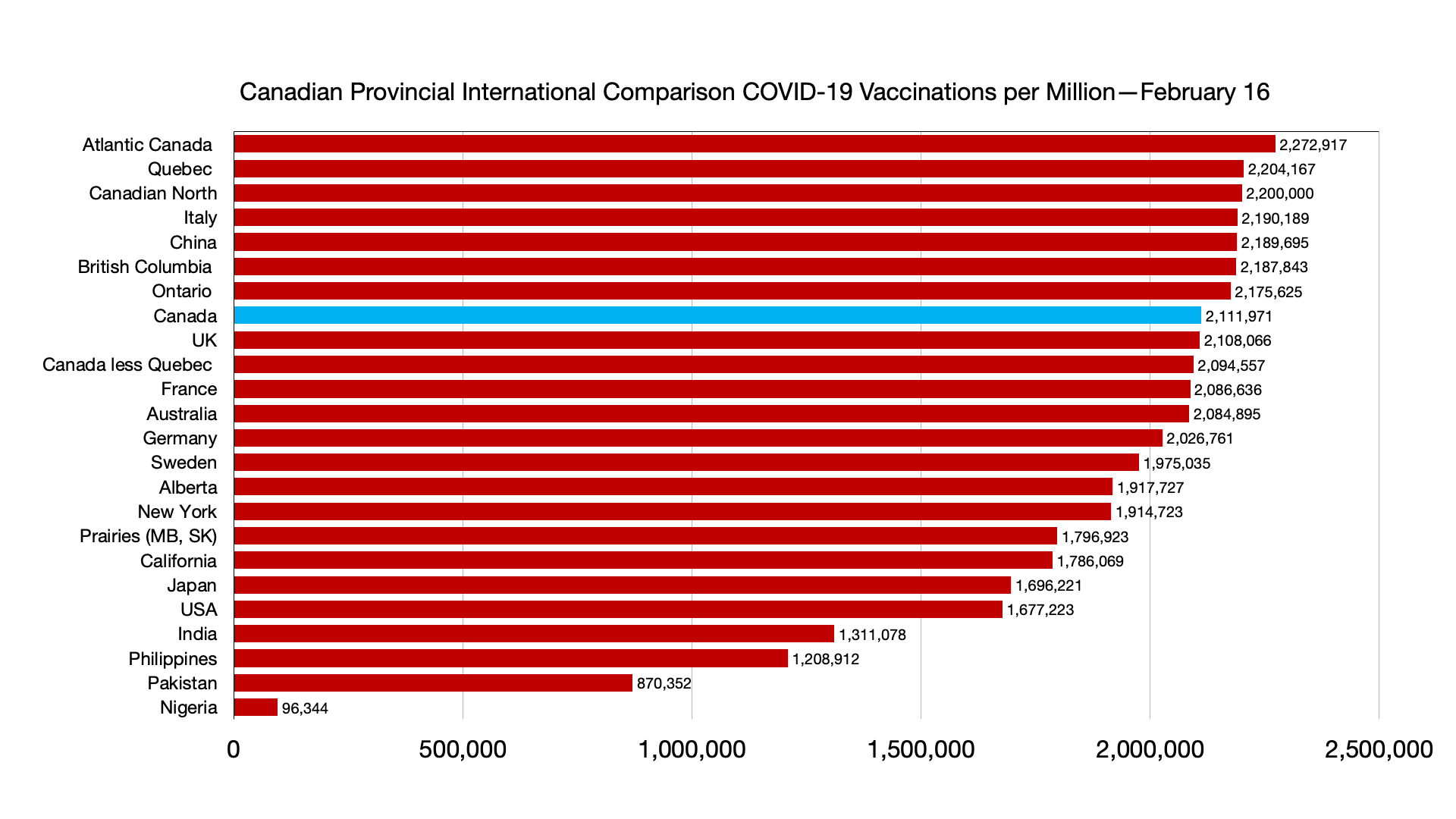
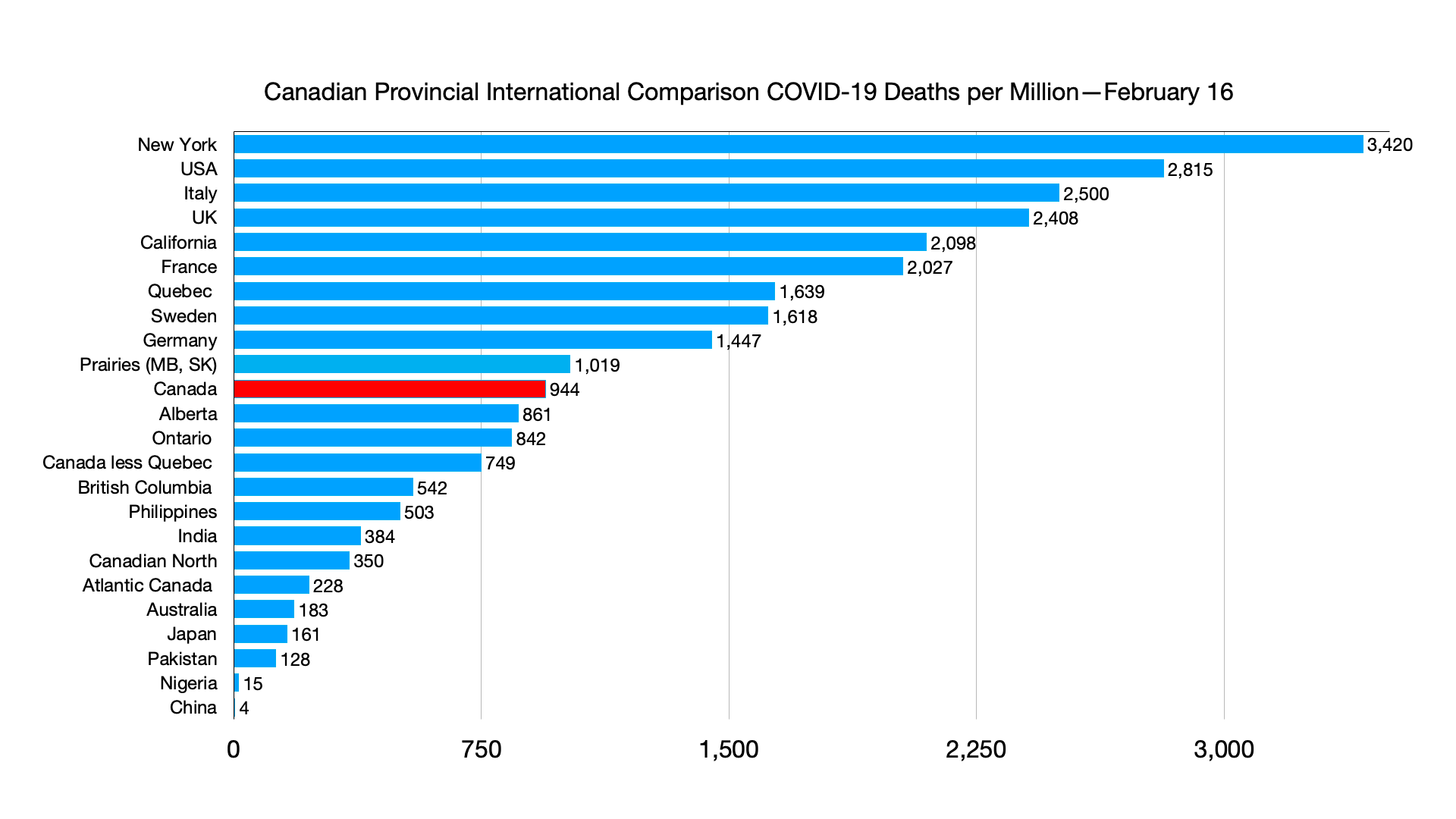
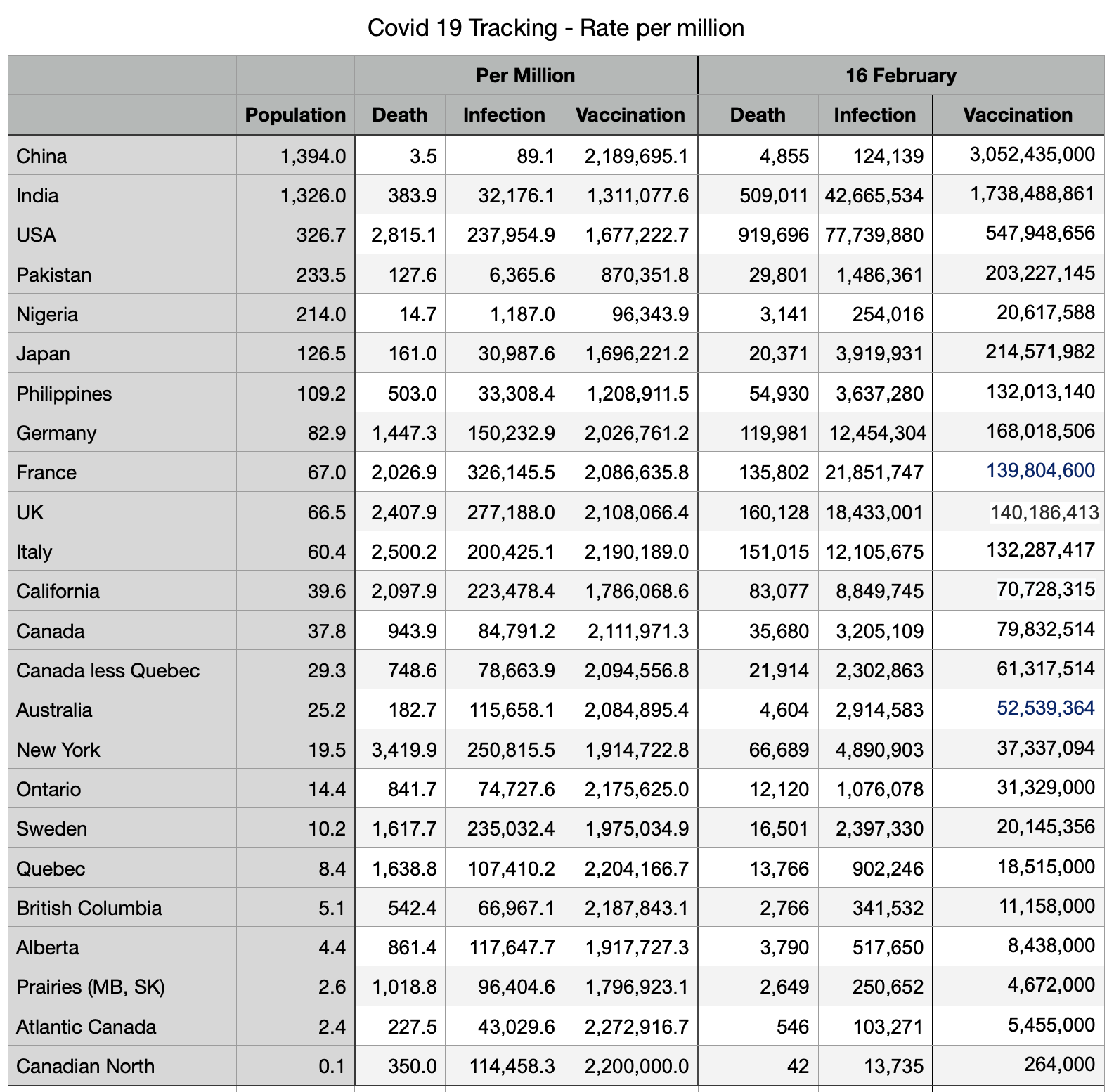
#COVID-19: Comparing provinces with other countries 1 December Update

The latest charts, compiled 1 December. Too early to assess the impact of omicron.

Canadians fully vaccinated 77.2 percent, compared to Japan 77.2 percent, UK 69.4 percent and USA 60 percent.

Vaccinations: Minor shifts: British Columbia ahead of Atlantic Canada, France ahead of Alberta and Japan, New York and California ahead of Prairies. China fully vaccinated 77 percent, India 32.8 percent, Nigeria 1.7 percent, Pakistan 23.2 percent, Philippines 33.6 percent.

Trendline Charts:

Infections: Recent trends of increased infections in Europe continues. Canadian provincial trends showing minimal change from last week, with some levelling off in West.

Deaths: G7 less Canada (driven mainly by USA) continue to increase, West still increasing more than other provinces.

Vaccinations: Ongoing convergence among provinces and G7 less Canada and narrowing gap with immigration source countries given China, and to a lessor extent, India, Pakistan and the Philippines continue to increase vaccinations. Nigeria remains a laggard.

Weekly

Infections: No relative change.

Deaths: No relative change

CILA: IRCC is disadvantaging its clients with its new citizenship application process

My understanding, based on articles as well as discussions with immigration lawyers, is that citizenship is a relatively small part of their practice, given that immigration is vastly more complex with many more pathways and requirements, than citizenship which is a relatively simple program with most applications being straightforward.

Do we have any data on how many citizenship applicants engage a lawyer? A client-centric perspective, as advocated by CILA, would essentially do that for all but the more complex cases.

Needless to say, the policy and program objective should be to eliminate the need for counsel through simplification, streamlining and technology:

Immigration, Refugees and Citizenship Canada (IRCC) has been beta testing a new Citizenship Portal which enables future new Canadians to submit their citizenship applications electronically. The ability to submit applications electronically should help reduce backlogs and speed up processing by removing the bottleneck caused by IRCC having to manually scan applications as they arrive in the mailroom. Electronically submitted applications can also more easily be resubmitted if found to be incomplete. For these reasons applications submitted through the Citizenship Portal are likely to be processed faster.

Under normal circumstances, the modernization of Canada’s immigration system at a time of historic backlogs should be celebrated. Regrettably, however, the creation of this portal is problematic since IRCC has once more made the deliberate choice to exclude those assisted by counsel. The beta version of the portal explicitly excluded all applicants who were represented by an authorized representative. Today, IRCC has amended the instructions on the Citizenship Portal, to permit applicants who are being assisted by a lawyer to use the portal, with one very large caveat.

Representatives are still not permitted to actually access the portal, input data, upload documents, or review applications for their client. IRCC’s expectation appears to be that representatives would screenshare while an applicant inputs the data and uploads the supporting documents themselves. The representative would have to rely on screenshots or what they are able to see via screensharing to ensure that the information is accurate. There is no way for a representative to ensure that the applicant has uploaded the correct supporting documents.

This latest iteration of the IRCC beta Citizenship Portal only does lip service to including counsel while still excluding them from actually being able to properly represent applicants and ensure that a complete and accurate application has been submitted. It also ensures that clients who need the most assistance, who do not have the language skills or technological savvy to use the portal on their own, are not able to benefit from this improved submission method. The courts understand the benefits representatives bring to their clients and the efficient operation of the justice system; why does IRCC not understand the benefits of including counsel?

From a representative’s perspective, the time involved in having to screenshare and talk an applicant through completing an application on their own, and the resulting additional expense to clients cannot be justified. Applicants share the most private details of their lives with their representatives, and so there is no reason that applicants should not be permitted to share their login credentials with their counsel provided there is a way that applicants can advise IRCC that they have used a representative, for example by including a Use of Representative Form (IMM5476), and requiring that clients confirm within the application that they and not the representative have reviewed and signed off on the information being submitted.

Authorized representatives had been promised that a representative portal for citizenship would be available early in 2022. However, it now appears that a representative portal will not be available any time soon. This means that applicants who are represented will either not be able to benefit from the new electronic portal, and will have to submit a paper application, or they will have to complete their applications largely on their own.

CILA also wishes to stress that Canadian citizenship applicants voluntarily choose to hire immigration lawyers. As anyone that has gone through the process before will tell you, applying for, and gaining Canadian citizenship is a defining life moment.

Due to the magnitude of this event, many citizenship applicants choose to hire an immigration lawyer for competent and professional representation. They hire a lawyer they can trust to submit a complete and accurate application to IRCC so that they can gain Canadian citizenship as quickly as possible. They understand fully that any error or omission in their application can delay the citizenship application process by months, or even worse, years. Hiring a lawyer that is familiar with the legal requirements, the forms and the documents needed not only offers peace of mind for an applicant but helps to ensure that the application is processed without delay and is ultimately successful. Using legal counsel conserves valuable department resources so that applications are not filed prematurely and are complete on submission.

At the end of the day, the exclusion of counsel is an access to justice issue. However, there is also a significant operational consideration at stake. Canada is currently grappling with a backlog of some 1.8 million applications, of which some 468,000 are Canadian citizenship applicants. It is in everyone’s best interests for IRCC to receive complete and accurate applications. As we all know too well, however, errors and omissions do occur during the application process which creates additional work and stress for all involved parties. In this vein, it is imperative for IRCC to see counsel as an ally in the shared pursuit of a fast and efficient immigration system. Enabling immigration lawyers to submit Canadian citizenship applications online increases the likelihood that IRCC will be able to render a decision at the first possible opportunity, and reduces the likelihood of unnecessary delays for clients and additional work for IRCC.

CILA expresses its disappointment that IRCC continues to exclude counsel despite a multitude of conversations and correspondence between the immigration bar and the department on this very issue throughout 2021. CILA has submitted letters to IRCC on this matter on August 5August 18, and October 27. Prior to that, the immigration bar has raised alarm on this matter, including in spring 2021 on how the exclusion of counsel would prejudice those looking to apply to the time-limited TR to PR pathways. The crux of the matter here is that IRCC continues to make the choice to disadvantage its own clients.

CILA wishes to offer two major recommendations to IRCC. First, keep your clients front-and-centre of all your modernization initiatives. Having a client-centric view will allow you to unveil modernizations which are inclusive to as many of your clients as possible at the outset, and avoids the creation of a two-tiered system, where some are disadvantaged. Second, consult with as many stakeholders as possible before going live with modernization initiatives; this includes beta testing portals with all stakeholders. Representatives are more effectively able to identify issues with new systems than applicants who only have experience with one application. Canada has a vibrant immigration ecosystem with plenty of stakeholders that can provide IRCC with beneficial guidance that will allow the department’s modernization efforts to be as successful as possible. Again, this will represent a win-win for both IRCC and its clients, including during life-defining events such as the Canadian citizenship uptake process.

Source: https://cila.co/ircc-is-disadvantaging-its-clients-with-its-new-citizenship-application-process/

Canada extends online study eligibility period for PGWP applicants

Hard to understand the logic of this beyond support for universities and helping to meet government immigration levels. Canadian experience was one of the selling points for PGWP, this change largely removes it:

Online study is not normally eligible for the Post-Graduation Work Permit (PGWP), but that has changed since the pandemic.

International students can now do 100% of their studies online from outside Canada, and still get a PGWP once the program is complete. Canada has extended the period that international students can study online until August 31, 2022, up from December 31, 2021. The measure was originally implemented in 2020, as part of a coronavirus-related measure to allow international students affected by the pandemic to still be eligible for the PGWP.

Study programs must be with an eligible Designated Learning Institution (DLI) and meet other PGWP requirements. The shortest length a program may be is eight months. The time spent studying outside Canada after August 31, 2022, and any time spent studying before you applied for a study permit does not count toward the length of a PGWP.

The length of your study period is important both for the PGWP eligibility, and also in determining how long your PGWP will be valid for. If your study program was more than eight months but less than two years, the PGWP’s validity matches the length of the study program. If it was more than two years, the PGWP may be up to three years in duration.

PGWP opens pathways to Canadian immigration

Having Canadian work and study experience can go a long way toward an immigration application. A Statistics Canada report says six in 10 international students (first-time study permit holders) who worked during or after their studies became permanent residents.

Certain economic-class immigration pathways like Express EntryQuebec Experience Program (PEQ), and the Provincial Nominee Program (PNP) all highly value Canadian work experience. Some programs even require it.

The Canadian Experience Class, for example, is an Express Entry-managed program that requires one year of Canadian work experience in a skilled occupation. The PEQ, is a popular pathway for French-speaking international student graduates in Quebec. Also, the PNP opens immigration pathways for people who are not eligible for Express Entry.

The PGWP is an open work permit, meaning you can use it to work for any employer, in any occupation in Canada. It is a one-time deal, and it cannot be renewed or extended.

However, if you do get it, you have the opportunity to work anywhere in Canada. Studies suggest that having both Canadian work and study experience can boost immigrants’ earning potential. For these reasons, the PGWP is a highly sought-after work permit, as it opens the doors to opportunities in Canada.

Source: Canada extends online study eligibility period for PGWP applicants

‘Almost unprecedented’ spike in number of Australians who see racism as a problem, survey finds

Of note:

Australians are increasingly aware that racism is a problem in their country, while positive sentiment about immigration and multiculturalism has also increased over the past 12 months, according to an authoritative survey on social cohesion.

The annual Mapping Social Cohesion Report from the Scanlon Foundation Research Institute, released on Tuesday, has charted a 20 percentage point increase in 12 months in response to the question “How big a problem is racism in Australia?”

Back in 2020, 40% of respondents thought racism in Australia was either a very big or fairly big problem. But in the 2021 survey of 3,572 respondents, 60% held that view.

The survey authors note “an increase of 20 percentage points in response to a general question of this nature is almost unprecedented in the Scanlon Foundation surveys”, which have been conducted annually since 2007. But they say there is no clear trigger or cultural catalyst explaining such a large shift.

The research suggests Australians were also more enthusiastic during the period of pandemic-induced international border closure about the contribution migrants make to the economy, with 86% of the sample agreeing with the proposition “immigrants are generally good for Australia’s economy” (compared with 76% in 2019, the year before Covid-19 hit).

Similarly, 86% of respondents agreed “multiculturalism has been good for Australia” compared with 80% agreeing with that proposition in 2019. A super-majority (90% – the highest affirmation in the survey) also endorsed the importance of the relationship between Aboriginal and Torres Strait Islanders and the wider Australian community.

Source: ‘Almost unprecedented’ spike in number of Australians who see racism as a problem, survey finds

LILLEY: Jihadi Jack’s parents ask Canada to bring the Brit here

Classic example of off-shoring citizenship revocation. One of the examples against the previous Conservative government’s C-24, ironically that Lilley supported at the time if memory serves me correct:

The parents of British-born terrorist Jihadi Jack are seeking the help of politicians in this country to get him sprung from a Syrian prison to live a life of freedom in Canada.

Emails obtained exclusively by the Toronto Sun show that John and Sally Letts have approached MPs and senators asking for meetings to assist their son Jack.

Nikita Bernardi, a public relations consultant working on behalf of the family, makes an empathetic pitch for a man who has admitted to being a member of ISIS and willing to detonate a suicide bomb.

“Jack, who is 23, has been held without charge, and therefore arbitrarily and illegally, since 2017 by the Kurdish forces in overcrowded and unsanitary prison conditions,” Bernardi wrote last week.

Jack Letts was born in Britain in 1995, and beyond some trips to Canada to visit relatives, has never lived here. He was raised in the U.K., educated in the U.K., converted to Islam as a teen in the U.K., and went to Syria in 2014 at the age of 19 because he rejected life in Britain.

He is able to claim Canadian citizenship because his father is a Canadian who moved to Britain decades ago. His connections to this country, beyond asking for consular assistance, are negligible at best, but since the British government stripped him of his citizenship there in 2019, Letts may only be recognized as a Canadian now.

That doesn’t mean we should take him or lift a finger to help him, despite claims by Bernardi that Letts is owed, “assistance and protection as is necessary.”

“Unfortunately, the Canadian government continues to take no action towards repatriating Jack,” Bernardi wrote.

You can’t repatriate someone who has never lived here.

He went to fight in Syria, something he and his family have denied for several years. But a 2019 interview with the BBC shows Letts discussing his work with ISIS and desire to be a suicide bomber — if needed — in battle.

“I used to want to at one point, believe it or not,” Letts told the BBC. “Not a vest. I wanted to do it in a car. I said if there’s a chance, I will do it.”

In 2019, when the Brits pulled citizenship from Letts, then-public safety minister Ralph Goodale said the government was disappointed with the British government’s “unilateral action to offload their responsibilities.”

Asked for comment Monday, Marco Mendicino, the current public safety minister, declined to comment on any specific case, but a spokesperson said criminal charges and prosecution could be in the future of any extremist traveller who comes to Canada.

“It is a Criminal Code offence to travel abroad to engage in terrorist activity. If an extremist traveller is seeking to enter Canada, federal departments work together to tailor an approach to address the threat that the individual may pose,” said spokesperson Craig MacBride.

He added that the government could use tools, including peace bonds, the no-fly list, and revocation of passports in dealing with such travellers.

The family has filed complaints against both the British and Canadian governments and with the United Nations. Bernardi wrote that Canada can be held responsible for anything that happens to Jack while he is in a Kurdish prison.

Did the Canadian government send him to Syria to fight with one of the most blood-thirsty groups the world has even seen? No, they did not — he did that on his own.

There are Canadians, actual Canadians born here or who have lived here at least, held in foreign prisons for various crimes. We don’t get them all back, and we don’t have to try.

If Letts gets out of that Kurdish prison, he is Britain’s problem, not ours.

Source: LILLEY: Jihadi Jack’s parents ask Canada to bring the Brit here

Ottawa, provinces must create agency to reform how health data is collected and used, report says

East to agree, hard to implement given provincial agreement needed. Even integration within a province is far from being implemented in a comprehensive manner:

The federal and provincial governments must create a national agency to set standards for the collection and sharing of health data to respond more quickly to threats such as pandemics and to improve patient care, a new report says.

The report, from a federal advisory group to be released on Tuesday, says governments across the country also need to change privacy laws to allow health records and data to be more easily shared – with patients, medical providers and public-health officials. That would require a significant culture shift away from a system that focuses solely on keeping data secure and private, and toward one that ensures health records and data can be used and shared safely.

The report says the systems across the country that aren’t standardized and can’t talk to each other have limited Canada’s ability to respond to COVID-19, including managing vaccines and tracking variants. More broadly, that reality is also hurting patient care, and could hamper the response to other health crises, the report says.

“We haven’t had this concept that people holding this data should be promoting its appropriate use, its timely use for the benefit of the individuals or for the entire population of Canada,” Vivek Goel, a public-health expert who chaired the review and is also president of the University of Waterloo, said in an interview.

The report is the second of three from the Pan-Canadian Health Data Strategy Expert Advisory Group, which the federal government launched last year to examine data problems exposed by COVID-19. While the group’s work was spurred by the pandemic, its recommendations are far broader, and call for dramatic changes to how Canadians’ health data are stored and managed.

The report says the systems for managing health records, and the privacy laws that oversee them, were designed and created for paper records and haven’t sufficiently been updated for a primarily digital system.

Most people can’t access their own health records, which also aren’t readily available to health care providers as patients move through the system, the report says. The document calls for a “person-centric approach” that would give patients control of their records and allow all of their health care providers to access them easily and securely.

“An integrated, person-centric health data structure ensures that all health data follows an individual through the course of their life-long care,” the report says.

It adds that creating a national system would require governments to agree on standards to ensure those records can be accessed regardless of where a patient is or which doctor they see.

While the report does not make detailed recommendations about managing such a system, Dr. Goel said it should be overseen by a body controlled by Ottawa, the provinces and the territories that would recognize – and address – the reality that health care falls under provincial and territorial jurisdiction.

“We need an entity that is co-owned, co-managed, co-supervised by the federal, provincial and territorial governments together in setting those standards,” he said.

It would also require changes to privacy laws. The report says current privacy laws turn health care providers into “custodians” of data, which, in turn, creates a “privacy chill” that prompts them to restrict access even if not required. Instead, the report proposes a model of “data stewardship” that “champions data sharing, access, use and protection.”

Dr. Goel said a system that standardizes health data and facilitates sharing with officials and experts in other jurisdictions would help governments identify and track public-health threats such as infectious diseases including COVID-19. He said the pandemic revealed how ill-equipped federal, provincial and local health agencies were to gather and share data.

For example, he said as new variants of COVID-19 emerge, such as the Omicron variant that is dominating headlines, it is crucial to track who is getting sick and how transmission and patient outcomes are affected.

To do that effectively, health officials need access to information not just from their own provincial or local health unit, but the entire country. That doesn’t require the same system for everyone, just systems designed to communicate.

He compared it to the Interac network, which allows transactions to be tracked between banks even if they are all using different systems. “There are models that we can learn from the private sector.”

Dr. Goel said governments would need the public’s buy-in to increase data sharing in this way, but he thinks they can be persuaded. He says patients may actually be surprised to learn how little information is shared for wider public-health surveillance, such as the details they provide to COVID-19 contact tracers.

Ewan Affleck, a doctor and an expert in health informatics who sits on the advisory group, said he routinely runs into problems accessing his patients’ records from other providers or jurisdictions.

He treats patients in the Northwest Territories, which sends many people to Alberta for surgery and other procedures, but he often can’t access their information easily – or at all.

“I have no means of getting it because of jurisdictional legislation laws, privacy concerns, and this impairs my capacity to provide care,” Dr. Affleck said in an interview.

“So we make mistakes, and those mistakes damage Canadians. This is happening all the time.”

Dr. Affleck said the same issues hamper Canada’s ability to track and respond to population-level health issues such as pandemics.

“Whether it is guiding our response to COVID or whether we’re treating a patient for a urinary tract infection, this is all based on our adjudication of information,” he said.

“Digital health in Canada is legislated to fail. We have to change that model, because it’s an antiquated model from the age of paper-based information, which worked well then, but it works terribly now. And it is actually damaging Canadians.”

Source: https://www.theglobeandmail.com/canada/article-ottawa-provinces-must-create-agency-to-reform-how-health-data-is/

Douglas Todd: Generous Canada now No. 1 country for foreign students

Of note, along with some of the factors, some justified, some more questionable that made Canada relatively more attractive than other destinations. Focus on increasing international students predates current government. Interesting comment by Chris Friesen regarding preference given to international students with respect to permanent residency. :

Canada has become the most popular country in the world for international students, says a survey conducted in more than 50 countries.

Two in five international students rate Canada as their first choice for higher education, according to IDP Connect’s fall poll of 3,600 study-visa holders. That’s more than double the proportion that picked the next highest-ranked nations — Britain, the U.S. or Australia.

A majority of students who choose Canada as their top option said a key reason was being allowed to work while studying, says IDP, as well as the relative affordability of tuition fees, given most of the country’s universities and colleges are subsidized by taxpayers.

The Canadian Bureau for International Education adds that 60 per cent of foreign students in Canada, more than half of whom come from India or China, want to apply to become permanent residents — an option not available in most countries.

Given the competition in the West for foreign students, some specialists are skeptical about Ottawa’s increasingly eye-catching efforts to appeal to the estimated six million students in the world who are going abroad for their educations.

Higher education experts question why Canada appears to be the only nation that has given foreign students social-assistance payments during COVID. They also ask about Canada’s unusual decision to allow students almost unlimited opportunities to work while ostensibly studying.

Canada’s foreign-student numbers have almost doubled since the Liberals were elected in 2015. Their numbers are returning to the 600,000 a year range despite COVID border restrictions. During the pandemic, many offshore students studied remotely, but most are physically back on Canadian campuses.

Foreign students make up about 20 per cent post-secondary students in Canada, which along with Australia and Britain, has the highest ratios in the world. In the U.S., foreign nationals on study visas account for only seven per cent of students. In the European Union, they’re just six per cent.

Ottawa, which now considers foreign students prime candidates for immigration, has gone the opposite direction of other countries during COVID and allowed study visa holders to apply for taxpayer-funded programs such as the Canadian Emergency Response Benefit.

Prime Minister Justin Trudeau’s government has also given international students almost unlimited access to full-time jobs, including for at least three years after graduation. And the Liberal government has made it possible for them to keep their long-term work opportunities even if they have not been in the country. In addition, unlike elsewhere, many provinces, such as B.C., offer almost-free medical coverage.

British Columbia, which normally has about 22 per cent of all of Canada’s foreign students, has the strongest concentration, focused mostly in Metro Vancouver where their presence affects the rental and housing markets. B.C. has four times as many foreign students per capita as Alberta.

The Vancouver campus of the University of B.C., similar to previous years, has almost 17,000 international students this fall, accounting for about one third of all graduate students and one quarter of undergrads. More than one third are from China and one fifth from India. The rest hail from scores of countries, particularly the U.S., Korea and Iran.

Simon Fraser University has almost 7,000 foreign students, 26 per cent of undergrads and 34 per cent of grad students. About two in five are from China and one in five from India, with smaller cohorts from Korea, Iran and Hong Kong. The proportion of foreign students at Capilano University and Vancouver Island University is lower.

In addition to the Liberal government boasting foreign students bring more than $21 billion a year into the economy, Canadian higher education specialist Alex Usher says the country’s post-secondary institutions now rely on foreign students for 45 per cent of fee revenue. That’s up from 15 per cent in the 2000s. Usher cautions against such a heavy reliance on foreign students.

When COVID first hit, both Australia and the U.S. brought in far more rules about foreign students than Canada; directing many back to their homelands.

The two English-language nations wanted to protect the health of residents and, unlike Canada, were not prepared to provide social-assistance, health benefits and jobs to foreign nationals while the domestic population struggled. As a result about 10 per cent of post-secondary staff and faculty in the U.S. and Australia was laid off.

Canada began allowing study-visa holders into the country in October 2020, despite the border being then shut to almost everyone except essential workers. But Australia only decided this week to welcome back more than 200,000 foreign students. There had been fears that many Asian students would opt to study in person in Canada and the U.S. rather than pay for online courses from Australia.

University of Sydney Prof. Salvatore Babones, who has studied international student policy in Canada and around the world, said this week: “I’m surprised Canada has extended welfare (CERB) benefits to international students. It’s a strange decision, since most such students must demonstrate the ability to support themselves financially before being granted a study visa.”

The international education specialist finds it “sad” that Canada has lifted the normal 20-hour-a-week cap on how much each foreign student is permitted to work. “The cap serves an important purpose: It ensures that students are in the country to study, not on an exploitive fake study program in order to get a work permit.”

While Canada’s unusually magnanimous benefits for foreign students might sound humane, Babones said, they in effect turn study visas into work visas, “that require recipients to pay ‘protection money’ to educational institutions in exchange for permission to work.”

Vancouver’s Chris Friesen, who chairs the umbrella body overseeing settlement services for immigrants and refugees in Canada, has said the Canadian public is in the dark about how policy has been changed to give preference to international students.

Ottawa, he said, should set up a royal commission to look into issues such as whether Canadians agree that foreign students, who tend to come from the “cream of the crop” in their homelands, should go to the front of the line for permanent residence status.

Source: Douglas Todd: Generous Canada now No. 1 country for foreign students

Saudi Arabia and China are accused of using sports to cover up human rights abuse

Duh!

What do China, Saudi Arabia and Qatar have in common? The answer might not be as obvious as you think. But all three countries are accused of human rights violations, and all three are also playing host to some of the largest and most lucrative sporting events in the world.

China is hosting the 2022 Beijing Winter Olympics, Qatar is putting on next year’s soccer World Cup and Saudi Arabia has invested heavily in staging high-profile, international sporting events.

But human rights organizations and others have been voicing concerns that behind this seemingly innocuous trend is a concerted effort by these and other nations to use sports as a way to cover up their poor human rights records.

“They are using and increasingly seeing sport as an opportunity to launder their image,” Felix Jakens, Amnesty International UK’s head of campaigns, told NPR.

The human rights group even uses a recent term to describe this practice: “sportswashing.”

“It’s the process whereby a country or regime with a particularly poor human rights record uses sport as a way of creating positive headlines, positive spin about their countries,” Jakens explained.

Saudi Arabia dabbles in English soccer and Formula One racing

Last month, the rights group criticized Saudi Arabia’s takeover of English Premier League club Newcastle United. According to news reports, the Saudi government-owned Public Investment Fund purchased an 80% stake in the English soccer club for 300 million pounds ($400 million).

“Ever since this deal was first talked about we said it represented a clear attempt by the Saudi authorities to sportswash their appalling human rights record with the glamour of top-flight football,” Amnesty International UK’s CEO Sacha Deshmukh said in a statement.

The Newcastle United buyout is just the latest sports-related investment by Saudi authorities. In recent years, the kingdom has spent more than $1.5 billion to stage elite sporting events, according to a report by Grant Liberty. This includes staging the annual Spanish Super Cup soccer match, international men’s and women’s golf tournaments and professional wrestling, among many others.

Next month, global racing series Formula One will host its race in Saudi Arabia for the first time. The Grand Prix event will take place on Dec. 5 at a brand-new racetrack in the port city of Jiddah. F1 — which is owned by U.S.-based Liberty Media Corp. — signed a 10-year deal with the kingdom worth a reported $650 million.

The Saudi F1 event will also feature a number of musical performances. Pop star Justin Bieber, who is headlining the off-track entertainment program, is facing growing calls to cancel his show.

In an open letter published by The Washington Post, Hatice Cengiz — the fiancée of slain Saudi journalist Jamal Khashoggi — urged the Canadian singer to “send a powerful message to the world that your name and talent will not be used to restore the reputation of a regime that kills its critics.”

The kingdom says it’s reforming

The Saudi government rejects all accusations of sportswashing. Fahad Nazer, the spokesperson for the Saudi Embassy in Washington, D.C., says that those investments are part of Crown Prince Mohammed bin Salman’s plans to diversify the country’s economy, which depends heavily on oil and gas.

“The notion that the transformative reforms currently underway in the kingdom are simply an attempt to improve the kingdom’s image are widely off the mark,” Nazer told NPR.

He said that the country aims to establish a sports industry under its Vision 2030 plan, which not only calls for a more diverse economy but also a vibrant society.

But the 2018 killing of the journalist Khashoggi, the imprisonment of rights activists and the ongoing bombing campaign in Yemen cast doubt over how transformational those reforms really are.

Despite ushering in some limited newfound freedoms for Saudi citizens, the crown prince has made the country more autocratic than before, says Daniel Byman, a senior fellow at the Brookings Institution.

“There are more freedoms for women, just to pick a very important example. But there is less tolerance even of limited political dissension,” he says.

A spokesperson for Formula One, which has been accused of enabling sportswashing in the past, did not directly respond to the question of whether the series considers a country’s human rights record in its decision to host a race there.

“We take our responsibilities on rights very seriously and set high ethical standards for counterparties and those in our supply chain, which are enshrined in contracts, and we pay close attention to their adherence,” the spokesperson said.

This past weekend, F1 made its debut in Qatar — another country with a less-than-stellar track record. Seven-time world champion and race winner Lewis Hamilton raised the issue of human rights and equality in a news conference ahead of Sunday’s Grand Prix.

“As sports go to these places, they are duty-bound to raise awareness for these issues. These places need scrutiny. Equal rights is a serious issue,” said the British driver, who wore a rainbow-colored race helmet in a show of solidarity with the LGBTQ+ community.

China faces an Olympics boycott

China has also been accused of using sports to polish its public image. With the 2022 Winter Olympics only a couple of months away, the Biden administration is considering a diplomatic boycott of the Games over the Chinese government’s treatment of Uyghur Muslims living in the country’s Xinjiang region.

The issue of sportswashing has even reached the halls of Congress. Last year, Republican Sen. Rick Scott of Florida introduced a resolution calling on the International Olympic Committee to strip China of its Olympic hosting rights.

“I don’t believe a country that is committing genocide against its own citizens, that’s building a military to dominate the world, that steals jobs and technology from all over the world, denies basic rights to its own citizens should be hosting an Olympics,” Scott told NPR in a recent interview.

China has repeatedly denied accusations of human rights abuses in Xinjiang.

He further criticized U.S. Olympic broadcast partner NBC and Olympic sponsors for not being more vocal about China’s alleged human rights violations.

His Democratic colleague, Sen. Ron Wyden of Oregon, argues that sports leagues need to take more responsibility when it comes to rights issues. He says they are “selling out their integrity for profits,” effectively helping to rehabilitate the reputations of human rights abusers.

Using sports for spin goes way back

The practice of countries using sports as a smoke screen is not new. Many nations, including Great Britain, saw sports as a way to distract from oppression during colonial times. Nazi Germany used the 1936 Berlin Olympics as an opportunity to show off its alleged racial superiority and, during the Cold War, the United States and the Soviet Union used sports as a soft power.

But the word sportswashing came into use later. By one account, according to British sports journalist Sam Cunningham, the term emerged in 2015 when Azerbaijan hosted the European Games, and Amnesty International brought it back to the spotlight a few years later.

Whatever the origins, whether sportswashing can have a lasting effect remains unclear. But according to Simon Chadwick, a sports industry expert at Emlyon Business School in France, it can provide temporary relief.

“If we look at the 2018 World Cup, there was widespread criticism of Russia,” he says. “But what we saw upon people’s return from the Russian World Cup is that now their view of Russia was much changed, they saw the country in a much more positive fashion.”

With Western democracies increasingly scrutinizing the value of hosting large-scale sporting events, he believes countries with questionable human rights records will continue to use sports to boost their public image.

“What we will see is the likes of Saudi Arabia, China and others continuing to bid for these events, being awarded the rights to stage them and then leaving those in the West to deal with the kind of moral and ideological fallout that we have as a result of their hosting,” Chadwick says.

Most sports organizations defend their decision to stage events in these countries by claiming to be a catalyst for change. But that change has yet to materialize.