Amal Attar-Guzman: If my parents came to Canada today, would they still be set up to succeed?

Interesting that The Hub has two articles questioning the government’s ongoing immigration increases given housing, infrastructure and social issues:

My first reaction to the federal government’s recently announced immigration plan aiming to boost the economy?

“Wow, that’s a really great initiative!” 

I was not alone. It received praise on the global stage, and, despite some decreases in refugee and humanitarian class targets, the United Nations High Commissioner for Refugees applauded “Canada’s leadership on refugee resettlement” and further welcomed its commitment to accept refugees “as part of its overall immigration growth plan.” 

The in-take targets are substantial: 465,000 permanent residents in 2023, 485,000 in 2024, and 500,000 in 2025. Further, as highlighted in the Fall Economic Statement, Canada will also welcome at least 40,000 Afghan refugees and create a new permanent residence stream for Ukrainians who wish to stay in the country. 

Canada is well-known as an immigrant-welcoming nation, and the numbers are backing that up. As of 2021, almost one-quarter (23 percent) of the population was, or had ever been, a landed immigrant or permanent resident in Canada.1

The federal immigration plan makes sense from an economic and labour perspective. Canada has been going through labour shortages in almost every sector, especially in health care, manufacturing, STEM, and the trades. And though the looming recession might ease labour shortages, this is hardly a long-term solution.

Additionally, our rapidly ageing population combined with our rapidly declining birth rates mean that labour shortages are sure to be common occurrences in the short- and long-term. Current immigration admission seems to be responding to these challenges since two-thirds of new immigrants are of working age. 

Not only does immigration maximize economic potential but it also maximizes innovation and growth potential, something sorely needed in Canada. So long as it continues on its path, Canada is set to be a demographic superpower where innovation and dynamism should benefit as a result. 

This is a story that hits close to home for me. Like so many others, both my parents arrived in Canada as refugees in the late ‘80s and were already citizens by the time I was born in the late ‘90s. 

Despite great challenges, fear, and the uncertainty of arriving in a country that is so different from their own, they were both able to have a new start, safe from war and conflict. 

However, just as quickly as that first sentimental thought came to mind, trepidation set in:

“Are we ready to accommodate these folks?” 

Keep in mind, the Canada that my parents settled in is a much different Canada than the one we see today. By the time my parents arrived, the early ‘80s recession was over. While inflation was high and unpredictableunemployment was low and GDP was steadily growing. Renting or buying a home back then was a common reality rather than a lofty dream. Things were relatively affordable. And while they lived through a recession in the early ‘90s, by then they had accumulated some economic capital to weather that storm. 

This is not the environment current immigrants are finding today. Canada is facing a high inflation rate, housing and renting issues, rising cost of living, and current infrastructure challenges. And these trends are especially present in cities that are major hubs for newcomers: Montreal, Toronto,and Vancouver

Now, while immigration itself does not spike housing costs, current trends from wage stagnation to lack of supply are exacerbating the housing crisis. Rising rental costs are another constant challenge that many Canadians have been feeling for quite some time—pressures that can be exacerbatedby immigration due to broad rental legislation.

If the supply is not proportionate to the higher numbers of immigrants coming into Canada, and if the issue of affordability is not managed, new immigrants will be placed at a greater disadvantage and in a much more tenuous position, especially since they are on average more economically vulnerable than the average Canadian. This state of affairs has been amplified by the pandemic. 

The lack of sustainable infrastructure in Canada is another challenge. Prior to the pandemic, Canada’s infrastructure deficit range was estimated from$110 billion to $270 billion, and our infrastructure is lagging behind other peer countries. Ontario’s population is set to increase by 30 percent—an amount of over 19 million residents—in just over 20 years. The province is simply not ready to accommodate that growth.

All in all, across Canada our infrastructure is not sustainable with the current population growth. We are not building enough to manage.

Now, to alleviate the burden on immigration hubs, the federal government does plan to increase focus on attracting newcomers to different regions of the country, including small towns and rural communities. This, however, comes with its own deeply entrenched challenges. 

These range from inadequate housing, public transportation, and infrastructure, limited employment opportunities, underemployment, and barriers to entry into established networks. 

More complications arise in the case of intergovernmental immigration agreements between the federal and provincial governments. While the federal government does have the jurisdiction to issue its immigration policy and set these national targets, it will be up to the provincial governments to accept specific amounts of new immigrants to their province. Quebec specifically has already pushed back on the matter.

Goals are one thing. Failure to provide adequate support once real people are really here has consequences. Consider the case of Aziza Abusirdana, a Palestinian refugee who stabbed herself in the stomach while meeting with an Immigration Refugees and Citizenship Canada official. She claimed it was in response to a lack of affordable housing, rising costs of living, and a lack of mental health services. She’s not the only refugee driven to self-harm or thoughts of suicide. Other underlying societal issues, such as racism, xenophobia, and/or intolerance, as well as our failure to recognize foreign credentials, are further impediments to those seeking a better life.

While these challenges are complex and multi-layered, that is not to say they are insurmountable. Integrating new immigrants is a difficult whole-of-society task, but it is both laudable and doable—if proper care and consideration are given to the effort. Indeed, it may be necessary to combat labour shortages. Unfortunately, the federal government’s habit of announcing grand goals and leaving the provinces and the rest of the country to sort out the logistics is not doing anybody any favours.

The new immigration plan can give Canada the economic boost it needs while expanding our multicultural fabric, but we must proactively fix the broader societal issues plaguing us now or we risk exhausting the goodwill of fellow Canadians and hindering immigrants themselves. And the sooner the better. 2023 is right around the corner.

Source: Amal Attar-Guzman: If my parents came to Canada today, would they still be set up to succeed?
Caddell: Is immigration the next Ottawa-Quebec battle?

Captures the demographic dilemma facing Quebec in relation to the rest of Canada, even if I question the “more is merrier” approach of the Canadian and provincial governments:

In 1960, Kamouraska was home to 2,000 people. The baby boom was at its peak, there were dozens of dairy farms, and tourism created summer jobs. Today, there are fewer than 600 permanent residents, and while a tourist mecca in summer, it is quiet in the winter. There are many elderly, few young families, and fewer farms. This summer, as everywhere in Canada, employers were desperate to find employees.  

In other provinces, the solution to declining birth rates and labour shortages is immigration. And as the 2021 census indicated, population growth has been due to immigration. Hence the announcement Ottawa would increase the threshold to 500,000 new arrivals annually. 

This number is double what the Harper government sought and is in line with analysts like Doug Saunders, author of Maximum Canada, who believe Canada can sustain a population of 100 million people. 

However, in Quebec, the announcement was greeted with caution. Premier François Legault has warned of the “threat to French” of immigration and refused to raise Quebec’s share from 50,000 to 25 per cent of the national total: 125,000. Last week, Legault said, “We have to find a way, in the 50,000, to have more of them who speak French.”

This is a rejection of the strategy of the Charter of the French Language, Bill 101. In the 1970s, Premier René Lévesque and the father of Bill 101, Camille Laurin, told me the language law’s obligation for immigrants to attend French schools was the solution to declining Francophone birthrates. 

Today, however, non-Francophone immigrants are perceived as a problem. While fluent in French, some speak their mother tongue at home, and many also speak English. This trilingualism, rather than a huge asset, is interpreted by nationalist demographers and pundits as a “decline” in French. Speaking the language is not good enough: immigrants now must be mother-tongue French.  

But much of the Francophonie is found in Muslim Africa. Under the secularism law, Bill 21, practicing Muslims can’t work as teachers, police officers, or in the courts. Two weeks ago, an African driver was handcuffed and detained by Montreal police, for no reason. These are not signs of a welcoming society; one commentator says Legault’s preferred immigrant is “a white millionaire from France.” 

Quebec’s chattering classes are predicting immigration will be the next confrontation between Ottawa and Quebec. Premier Legault wants immigration powers to create his Francophone “nation.” This would mean an expansion of Quebec’s presence abroad, and immigrants applying as if Quebec were a sovereign state.  

As it is, that is how Quebec interprets itself to aspiring immigrants, according to a booklet provided to them. 

The booklet, upon which an online assessment is based, declares “Québec is a French-speaking democratic nation that welcomes immigrants from around the world.” It points out: “Québec society has also made French the language of Government and the Law, as well as the everyday language of work, education … and business.”  

All of which is untrue, as English is constitutionally guaranteed in the courts, there are three English universities, and 1.25 million Anglophone Quebecers. The booklet goes on: “As a state, Québec differs from other provinces in Canada, notably with respect to the impetus of popular will.” Furthermore, the Crown does not exist: “The Lieutenant Governor does not have a seat in the National Assembly, but assents to bills the legislature passes.” The federal government is brushed off as running “military defence, foreign policy and criminal law.” A grade nine student would get an “F” for an essay like this booklet. 

Quebec’s population is 8.6 million people. With a huge influx of immigrants in the rest of the country and reductions in Quebec, it is bound to become a smaller proportion of Canada’s population. 

This offers a “Hobson’s choice” for Quebec nationalists: accept new immigrants as equal to “old stock Québécois,” or shrink to a tiny fraction of the continent. The business community desperately wants the population and the economy to grow, and they see trilingualism is an asset internationally, especially in cosmopolitan Montreal. 

By restricting immigration, Legault’s short-sighted vision is a Quebec “nation” that’s North America’s Finland: a tiny homogenous population in a massive territory. It is yet another example of how nationalism could be suicidal for Quebec and the French fact in Canada. 

Source: Is immigration the next Ottawa-Quebec battle?

Urback: Defending our elections from Chinese interference should be a nonpartisan cause

Agree:

At the ASEAN Summit in Cambodia this weekend, Prime Minister Justin Trudeau was asked by Global News reporter Mackenzie Gray if he plans to bring up allegations of China’s interference in Canadian elections with Chinese President Xi Jinping at the upcoming G20 summit.

Mr. Trudeau demurred.

“We created a special independent commission made up of top officials and security experts to ensure that our elections continue to be free and fair in Canada,” he said. “And in both the 2019 and 2021 elections, they reported that our elections unfolded with integrity.”

The Prime Minister’s response did not acknowledge that a week earlier, a top official at the Canadian Security Intelligence Service (CSIS) told a House of Commons committee that China was a “foremost aggressor” on foreign interference, while acknowledging that Canada lacks the tools to properly assess and respond to the threat posed by Beijing. Years of reports – from Rapid Response Mechanism Canada (a research unit based out of Global Affairs), from the Atlantic Council’s Digital Forensic Research Lab, from Canadian disinformation monitoring group DisinfoWatch, and from Canada’s own intelligence agency, as recently reported by Global News – have all suggested that Beijing or pro-Beijing actors meddled in recent Canadian elections.

So Mr. Trudeau was asked again: “Are you going to raise this specific issue with [Mr. Xi]?”

“As always I will raise issues of human rights, issues of matters that preoccupy Canadians, with any and all leaders that I engage,” he said.

It was a curious response to a straightforward question, a hedge that echoed the sort of defiance Americans would often hear from former president Donald Trump when he was asked about Russian meddling in American elections. Indeed, even when presented with evidence from his own intelligence agencies, Mr. Trump would often equivocate: “It could have been other people in other countries,” he said in 2017.

Mr. Trudeau’s sidestepping of the question wouldn’t have been unusual from this Prime Minister months or even weeks ago. Ottawa has maintained a sort of timid ambivalence toward Beijing for years, even in the face of human rights atrocitiesallegedly being carried out by the Xi regime, retaliatory trade bans, and of course, the more than 1,000 days during which two Canadian citizens were effectively held hostage in response to the RCMP’s arrest of Huawei CFO Meng Wanzhou to extradite her to the United States.

But just last week, Foreign Affairs Minister Mélanie Joly signalled that the days of Ottawa tiptoeing around the sleeping giant are over.

In a speech ahead of the release of the government’s new Indo-Pacific strategy expected later this month, Ms. Joly laid out a new approach to China that represents a significant departure from that of even the recent past. While pragmatic about the need to continue trade with the world’s second-largest economy, Ms. Joly called China an “increasingly disruptive global power” and indicated that Canada will increase investment in stationing diplomats abroad to better understand how China “thinks, operates and plans.” When asked specifically about the Global News report stating that CSIS had briefed Mr. Trudeau on Chinese interference in the 2019 election, Ms. Joly replied: “We won’t let any foreign actor meddle in our democracy, period.”

The Conservative Party has long insisted that Canada needs to get tougher on China, and it maintains that Beijing was behind the spread of misinformation on platforms like WeChat about Conservative candidates during the last election. One particular target was former B.C. MP Kenny Chiu, who put forward a private member’s bill in 2021 to create a foreign-agent registry in Canada, modelled after legislation enacted in Australia in 2018, which would have required individuals acting on behalf of a foreign power to be publicly registered. But the effort was misrepresented in diaspora communities as an effort to “suppress” all Chinese-Canadians, and Mr. Chiu’s bill died when the last election was called; similar legislation brought forward by Senator Leo Housakos has been hung up in the Senate for months.

That needs to change, now. Indeed, if Ottawa is really serious about taking a new, tougher approach to Beijing, it offers the Liberals and Conservatives an opportunity to work together on an issue that is of nonpartisan importance. The integrity of Canadian elections affects everyone – what good is democracy if citizens don’t believe we come by it honestly, after all? – and it should be a matter for which there is no equivocation. Mr. Trudeau should pledge to bring up election interference with Mr. Xi at the G20 not because it will deter Beijing’s clandestine operations to any means, but as a signal to all Canadians – not to mention to our allies – that on the matter of election interference, we are determined and united.

Source: Defending our elections from Chinese interference should be a nonpartisan cause

Dutrisac: Régulariser les sans-papiers

Of note:

En décembre 2021, le premier ministre Justin Trudeau demandait au ministre de l’Immigration, des Réfugiés et de la Citoyenneté, Sean Fraser, de « poursuivre l’exploration de moyens » afin de régulariser le statut des travailleurs migrants sans papiers. Dix mois plus tard, le ministre n’a toujours pas annoncé quoi que ce soit.

Il y a un peu plus d’une semaine, une centaine de personnes ont manifesté à Montréal pour réclamer un programme massif de régularisation de ces travailleurs.

Selon le Comité permanent de la citoyenneté et de l’immigration de la Chambre des communes, le Canada compte entre 20 000 et 500 000 migrants non documentés. Quand on voit de tels chiffres, et un tel écart dans les évaluations, c’est qu’on ne sait pas vraiment combien on dénombre de ces personnes qui subsistent dans cette clandestinité pitoyable mais tolérée.

Parmi ces travailleurs qui ont préféré prendre la clé des champs au lieu de retourner dans leurs pays d’origine, on trouve plusieurs cas d’espèce. Il y a des détenteurs de visa de touristes qui sont restés illégalement au pays, des travailleurs dont le permis de travail n’a pas été renouvelé, parfois à cause d’employeurs négligents ou de la complexité administrative des programmes d’Immigration, Réfugiés et Citoyenneté Canada (IRCC), des étudiants étrangers au terme de leurs études et des demandeurs d’asile qui se sont vu refuser le statut de réfugié et font l’objet d’un avis d’expulsion.

S’il est vrai que des centaines de milliers de travailleurs, voire un demi-million, comme certains l’estiment, travaillent au noir au Canada, on ne peut continuer à ignorer le problème. Ces travailleurs ne jouissent d’aucune protection sociale ; ils n’ont pas accès aux services de santé gratuits, ni à la protection contre les accidents du travail, à l’assurance-emploi évidemment et à l’aide de dernier recours. Leur quotidien est fait de petits boulots mal payés. Ils sont dépendants d’employeurs qui peuvent les exploiter. Parfois, ils ne parlent que leur langue natale et sont ainsi souvent confinés dans leur communauté ethnique, ce qui est cependant conforme au dogme multiculturaliste.

Dans la commande qu’il a passée à son ministre, Justin Trudeau lui demande de s’appuyer sur les programmes pilotes existants. Depuis deux ans à Toronto, il existe un tel projet pilote dans l’industrie de la construction. Il est très limité : le programme vise la régularisation de 500 travailleurs seulement, et il semble que ce modeste objectif n’ait même pas été atteint. L’an dernier, IRCC a aboli une des conditions qui faisait obstacle : avoir une connaissance des plus minimales d’une des langues officielles, en l’occurrence l’anglais évidemment. Ottawa octroie la résidence permanente à des immigrants qui ne parlent aucune des langues officielles. Ce n’est pas un empêchement.

Le phénomène des travailleurs sans papiers est une conséquence du régime d’immigration qui s’est imposé ces dernières années. La grande majorité des candidats à l’immigration ne font plus leur demande de l’étranger : ils sont déjà au pays à titre de travailleurs temporaires, d’étudiants et de demandeurs d’asile.

Ces étrangers sont confrontés au double langage des autorités fédérales : d’une part, on leur dit que la voie privilégiée pour être admis comme immigrant, c’est d’être déjà au Canada grâce à un statut temporaire, d’autre part, on exige d’eux qu’ils s’engagent à quitter le pays une fois leurs contrats ou leurs études terminés.

Dans le cas des demandeurs d’asile qui passent par le chemin Roxham, il peut s’écouler des années avant que leur sort ne soit tranché par les autorités. Entre-temps, nombre d’entre eux ont pu se trouver un emploi stable, apprendre la langue commune, voire fonder un foyer. Bref, ils se sont intégrés.

L’inconvénient de la régularisation, c’est qu’elle concède un avantage à des personnes qui enfreignent les règles au détriment de ceux qui s’y conforment. Mieux vaut mieux entrer par le chemin Roxham que d’emprunter la voie régulière et passer les postes-frontières.

L’autre enjeu, c’est l’état de dysfonctionnement d’IRCC qui n’arrive pas, à l’heure actuelle, à assumer correctement ses responsabilités. À titre d’exemple, les demandeurs d’asile qui arrivent au Québec attendent maintenant dix mois avant qu’Ottawa officialise leur requête pour leur statut de réfugié, une étape qui leur permet d’obtenir un permis de travail. Forcés à ne rien faire, ils en sont réduits à recevoir de l’aide de dernier recours.

Devant l’incurie fédérale, le gouvernement Legault a le devoir d’exercer tous les pouvoirs dont il dispose, notamment en matière de permis de travail et d’études, afin de remédier aux aberrations d’un système défaillant. Mais à terme, c’est l’ensemble de l’oeuvre qu’il lui faudra revoir.

Source: Régulariser les sans-papiers

DiManno: Halton school board’s failure to deal with prosthetic-breasts controversy makes a mockery of equity

Good test for reasonable accommodation. IMO, fails the test given health and safety concerns (they teach shop):

The biggest breasts on record belong to one Annie Hawkins-Turner, from Atlanta, measuring 70 inches across and weighing 65 pounds each. Size 102 ZZZ.

But an allegedly transgender Halton teacher is giving Hawkins-Turner a good run for her tatas.

Of course Hawkins-Turner’s bosom was a naturally occurring endowment. The medical condition is called gigantomastia — a rare phenomenon that causes breasts to grow excessively large. Kayla Lemieux, an industrial arts instructor who apparently began identifying as female last year, showed up at school this term with oversized knockers, prosthetics that sag below her waistline, with protruding nipples the size of your knuckles. These features have been accentuated by tight-clinging sweaters.

Students were shocked, although presumably they’ve since grown accustomed to their teacher’s dimensions. Parents, upon learning of the situation — from clandestinely recorded videos that exploded on social media in September, making headlines around the world — protested in front of Oakville Trafalgar High School and complained to the Halton District School Board. I doubt whether any, or many, would be objecting to Lemieux’s gender transition. Gender identity and gender expression are protected grounds under the Ontario Human Rights Code.

That’s not the point. And frankly I don’t know the point that Lemieux seems to be making, unless this is all a bollixed misreported story driven by right wing media and reactionary organizations. If this is how she wishes to present herself to the world, so be it. Although I do wonder if such large breasts are a safety hazard whilst teaching shop.

A reasonable conclusion would be that Lemieux, for reasons known only to her, is making an exhibitionistic and provocative spectacle of herself. That too might be entirely within her rights. You might recall that women in Ontario won the right to go topless way back in 1996, a legal fight that went all the way to the Court of Appeal. The appellant, who’d been convicted by a lower court judge of committing an indecent act — she’d removed her top on a sweltering summer day — had argued against the double-standard that permitted men to go topless but not women. At rallies across the province, women came out to decry the original charge, and part of that movement was aimed at desexualizing female breasts. They’re not always, certainly not exclusively, about sexual arousal — despite what you might think, walking into any strip club.

The Halton school board was singularly incapable of resolving the controversy and, in September, passed a motion asking director of education, Curtis Ennis, about the feasibility of introducing a dress code for teachers. Education Minister Stephen Lecce also asked the Ontario College of Teachers to review professional conduct for teachers, arising from Lemieux’s pendulous udders.

Last week, after a report was presented to trustees, the board claimed it couldn’t implement a teacher dress code, although students are routinely subjected to restrictions.

I’ve read the report, signed by Ennis and Sari Taha, superintendent of human resources at the board. It makes no direct reference to a specific teacher or concern, as if the whole tizzy sprang out of nowhere. Instead, it pivots on the broader issue of a non-discriminatory dress code, its permissibility. Since the parameters of the report don’t address the elephant in the classroom, it’s impossible to speculate whether any such dress code would prohibit exceedingly humongous prostheses.

Upshot: Any dress code for teachers — which clearly was a roundabout way of getting to Lemieux’s dramatically emphasized breasts/nipples — would purportedly expose the board to “considerable liability” for violating the human rights code. Read: lawsuit. Further — and this sounds very much like gilding the liability lily — new rules can’t even be considered at this moment because of ongoing collective bargaining with teacher unions.

The Ontario Labour Relations Act imposes a “statutory freeze” during periods when there is no governing collective agreement, prohibiting employers from altering working conditions during negotiations.

Saturated in diversity and inclusion buzz phrases, the report, abysmally written — bureaucracies are averse to plain-speak — leans heavily into the province’s human rights code. Did they not take a close read of the Commission’s policies on workplace dress codes? Workers in Ontario, and everywhere else, are commonly held to dress code provisos — from restaurant employees to lawyers appearing robed in court to airline crews to health care staff wearing scrubs.

Some places — Hooter’s for instance — compel female employees to wear skimpy butt-cheek exposing outfits and hosiery. It is this kind of wardrobe to which the OHRC draws disapproving attention. “Some Ontario employers require female employees to dress in a sexualized or gender-specific way at work, such as expecting women to wear high heels, short skirts, tight clothing or low-cut tops,” the Commission states on its webpage. “These kinds of dress codes reinforce stereotypical and sexist notions about how women should look and may violate Ontario’s Human Rights Code … They contribute to an unwelcome and discriminatory employment environment for women.”

On the issue of preventing discrimination because of gender identity and gender expression, specifically addressing the trans community: “Dress code policies should be inclusive and flexible. They should not prevent trans people and others from dressing according to their expressed gender.”

Which it seems the Halton board wasn’t pursuing. Lemieux is completely free to dress in a dress, to use the personal pronoun of her choice, and to have her dignity respected.

But this situation is the inverse of what the Commission is promoting by calling out “stereotypical and sexist” dress codes or in any way interfering with trans rights to dress according to their expressed gender. What the Commission doesn’t address, far as I can tell and probably because they never saw it coming, is whether that respect should extend to in-your-face breast prostheses, which wouldn’t necessarily apply only to trans individuals.

Now, I understand the Halton board’s leeriness in taking a dress code risk that could result in a costly human rights wrangle. I’m dubious, however, that directing a teacher to knock off the buxom exhibitionism violates anybody’s human rights.

From the report: “To the extent that workplace policies mandate that employees dress in a particular manner, it is important for those policies to be gender neutral in their application, and that they impose similar dress standards and requirements for all employees, regardless of gender.”

What, pray tell, would be the cisgender, gay, lesbian or trans yin to Lemieux’s extravagant prosthesis yang?

It makes no rational sense. It is folly.

But, it does makes a mockery of equity.

Source: Halton school board’s failure to deal with prosthetic-breasts controversy makes a mockery of equity

Switzerland migrant children demand immigration policy apology

Of note:

Children of migrants who came to work in Switzerland over decades are demanding an apology for a policy they say destroyed families and left many traumatised.

From the 1950s right up until the 1990s, hundreds of thousands of workers – first from Italy, then from Spain, Portugal, and what was then Yugoslavia – made the journey to Switzerland.

They worked in factories, on roads and building sites, in restaurants and hotels. Switzerland’s highly successful economy, its good infrastructure, is without doubt due in part to them.

But there were flaws in the system. The migrants were given nine- or 12-month permits; many lived in barracks, their only function in Switzerland was to work.

And family members – including young children – were not allowed. A husband and wife could work together in Switzerland, but, the work permits stipulated, their children had to stay at home.

Forbidden children

Egidio Stigliano, now in his 60s, remembers being taken at the age of three by his grandmother to wave to a train leaving Italy to Switzerland.

“I didn’t know my mother was on the train,” he remembers. “They thought I was too young to be told what was happening. But my mother wanted to see me one last time.”

The system might have worked if the migrant workers had really been temporary. But their permits were renewed year after year, and some spent their entire lives working in Switzerland.

Melinda Nadj Obonji was just a year old when she and her older brother were left with their grandmother in Vojvodina in Serbia. Despite their “no children” seasonal work permits, Melinda’s parents hoped that, once settled in Switzerland, they would be allowed to send for their children.

“They wrote letters to the immigration police, but they were rejected, [the police] were very strict. I think this traumatised them for life, and also us kids of course.” Melinda now believes the migrant worker laws “really destroyed our family”.

Many might ask why parents desperate to be reunited with their children did not simply go home. But, as is so often the case with migrant workers, the money they earned abroad kept poverty at bay at home.

In Italy, Portugal, or Kosovo, families and even entire villages came to be dependent on the money sent from Switzerland. Meanwhile Switzerland’s economy boomed on the back of foreign labour.

Kristina Schulz, a historian and specialist in migration at Neuchatel University, points out that, in the aftermath of World War Two, the Swiss system of recruiting workers from neighbouring countries was viewed very positively.

“Those other countries were war-torn… and Switzerland needed workers. Southern Italy was poor… it was thought it was practically a humanitarian act to have them work here.”

But many parents, among them Egidio Stigliano’s, could not bear to be parted from their children. They developed secret strategies for coping with the immigration restrictions. Instead of pleading with the authorities to let their children in, they smuggled them in anyway and kept them hidden.

Egidio arrived when he was seven. “From the first moment in Switzerland I hid,” he says. “My dad couldn’t explain the immigration policy to a child, so he just said, don’t let anyone see you, just stay hidden and play in the woods. So that’s what I did.”

Staying hidden meant not going to school. It meant, when Egidio broke his arm, having to find a doctor who would keep quiet rather than go straight to hospital. But one day, in the woods, Egidio came across another group of children, and could not resist joining in their games.

That evening the police were at the door, telling his parents the child would have to leave. Only the intervention of Egidio’s father’s boss, who agreed to sponsor him, allowed him to stay.

By the 1970s, it is estimated there were thousands of hidden children in Switzerland. Today, in the history museum of the Swiss watchmaking town La Chaux de Fonds, there is an exhibition showing what their lives were like.

Some mothers admit that they locked their children in their apartments during the day, in order to ensure no one saw them. The children were allowed out to play at night. Many families lived in tiny studios because, the exhibition explains, having a bigger apartment more suited to a family would have aroused suspicion.

“It’s hard to imagine children locked at home, living alone, no school,” says museum director Francesco Garufo. “And it’s recent history… it’s just yesterday.”

Historian Kristina Schulz finds the children’s stories all the more shocking given Switzerland’s devotion to family life after the war.

“This was the new ideology in Switzerland… the idea of the holy family that needed to be protected, women couldn’t vote in Switzerland until 1971, they weren’t meant to work, they were at home with the children. So the idea of systematically destroying the families of migrant workers is really astonishing.”

Family protests

Gradually, Switzerland’s strategy began to be undermined. Migrant workers protested, local police and teachers turned a blind eye to the “illegal” children in their communities, some villages even set up underground schools for migrant children.

The famous Swiss author Max Frisch joined the debate, writing “we wanted workers, but we got people instead”.

Children, among them Melinda and Egidio, began to join their parents. Melinda, who was reunited with her parents when she was five, is now a writer and musician in Zurich, Egidio a neuro educator in St Gallen.

In some ways, they count themselves among the luckier ones: after pressure from Rome, the children of Italian migrants were allowed in once their parents had worked more than five years in Switzerland. Melinda’s parents finally found a sympathetic Swiss bureaucrat and got permission to bring their children.

But while it was sometimes applied arbitrarily, the law banning children remained, and many families remained divided for decades.

The seasonal work permit was finally abolished in 2002, when Switzerland agreed to join the EU’s free movement of people policy. Today, the children of the migrant workers are adults, and many, including Melinda and Egidio, have formed a group demanding at least an acknowledgement of what they went through.

“First, I’d like an apology from the Swiss state,” says Melinda.

“I want the story of migrant workers to be in Swiss history books, because thousands of families suffered,” adds Egidio.

An honest reassessment of history, and an apology, could be likely. Switzerland has already done this over its World War Two policy of turning away Jewish refugees, and over the way it removed children from single mothers or socially “problematic” families and sent them to work on farms – where they were often abused.

Financial compensation has also been mentioned, but for Egidio recognition is more important. “The time I could have spent with my family, at school, I can’t get back. There’s no compensation for that.”

The reappraisal of history has already begun, in a research project by Kristina Schulz at Neuchatel University, and at the museum in La Chaux de Fonds.

But for museum director Francesco Garufo, it is about more than facing up to Switzerland’s past. He thinks, as Europe continues its often negative debate over immigration, that lessons could be learned for the future.

“In a rich country, having thousands of children hidden, without social rights, it’s not the model we want today in Europe. So we have to think about this kind of migration choice.

Source: Switzerland migrant children demand immigration policy apology

New data shows big boost in hiring at Canada’s immigration department. ‘What were they doing?’

My sense, given under attention to processing efficiencies, automation and AI, is that IRCC had little alternative but to hire more staff. Whether or not there IT modernization initiative, a longer term project, and other initiatives such as more online applications and tracking, will allow IRCC to wean itself from the “just throw bodies” remains to be seen.

And of course, the government is unwilling to revise its targets downwards to align with its capacity:

Only eight months into 2022, Canada already received almost as many permanent and temporary resident applications it did in 2019 before the pandemic.

After a two-year slump, the engine of the country’s immigration system is running above its capacity in 2019 by 45 per cent and the number of permanent and temporary residence applicants processed through the system is bound to exceed the 3.2 million recorded in the pre-COVID year.

According to never-before-published data, Immigration, Refugees and Citizenship Canada currently has 8,104 front-line operations staff, up from 5,583 in March 2019 — with the bulk of the extra work force added since the beginning of 2022. That is despite the number of staff on leave having crept up from 559 in March 2019 to 733 in October.

Those employees who continued to telework have also come down from almost 100 per cent at the beginning of the pandemic to 71.8 per cent last month.

“More people can do more files,” immigration lawyer and policy analyst Richard Kurland told the Star. “Combined with the artificial intelligence decision making system, it should result in greater volumes of decisions.

“You’re having the A.I. do the heavy lifting. You have more humans to take care of files that need that human touch now on track, and they’re on the right path.”

But there are also numbers that immigration officials would rather see in check:

  • Web forms, a main mechanism for applicants to communicate with the department, rose from 1.61 million in 2020 to 2.26 million in 2021 and 2.42 million as of September this year;
  • Access-to-information requests, another key tool for inquiries, spiked from 98,042 pre-pandemic to 204,549 in 2021, before declining to 122,016 to date this year;
  • The number of lawsuits against the immigration department for a court order to compel officials to process a file rocketed from 112 cases in 2019 to 963 in 2022.

Not all critics are convinced the immigration system is back on track.

“Why do we have 45 per cent more people processing applications yet still have these backlogs?” said Vancouver immigration lawyer Steven Meurrens. “I’m curious as to why it feels like processing times just keep getting worse in numerous programs and certain visa offices. I don’t understand.

“Is it glitches with new tech? Are there IT issues at certain visa posts? Are there tech issues with working from home? It’s hard just to know what’s going on from the data because the ‘why’ is missing and the department won’t say.”

Ravi Jain of the Canadian Immigration Lawyers Association says the ramped-up staffing levels at the department did not jive with the “massive slowdown” in people’s experience with the immigration system. He would like to see a royal commission report into the immigration delays and backlogs.

“What were they doing? I don’t think they were doing much,” said Jain. “They can’t get away with this. It just feels criminal to me because it’s affecting people in so many different ways.”

As of Aug. 31, Canada received more than 2.9 million new permanent and temporary resident applications through the major immigration programs. With four months remaining in 2022, those numbers are certain to push the total above the 3.2 million files in 2019.

Over the time period, immigration officials processed 2.25 million immigration applications — 207,590 permanent and 2.04 million temporary residents, compared to the total of 3,225,130 (235,257 permanent and 2.99 million temporary residents) recorded in 2019.

Source: New data shows big boost in hiring at Canada’s immigration department. ‘What were they doing?’

USA: Religious groups with immigrant members grew fastest over past decade

Similar as in Canada as Douglas Todd has reported on:

A decennial study of U.S. religious life shows what many demographers and others have long known: Participation in congregational services has not kept up with overall population growth. However, religious groups drawing large numbers of immigrants have seen steady growth.

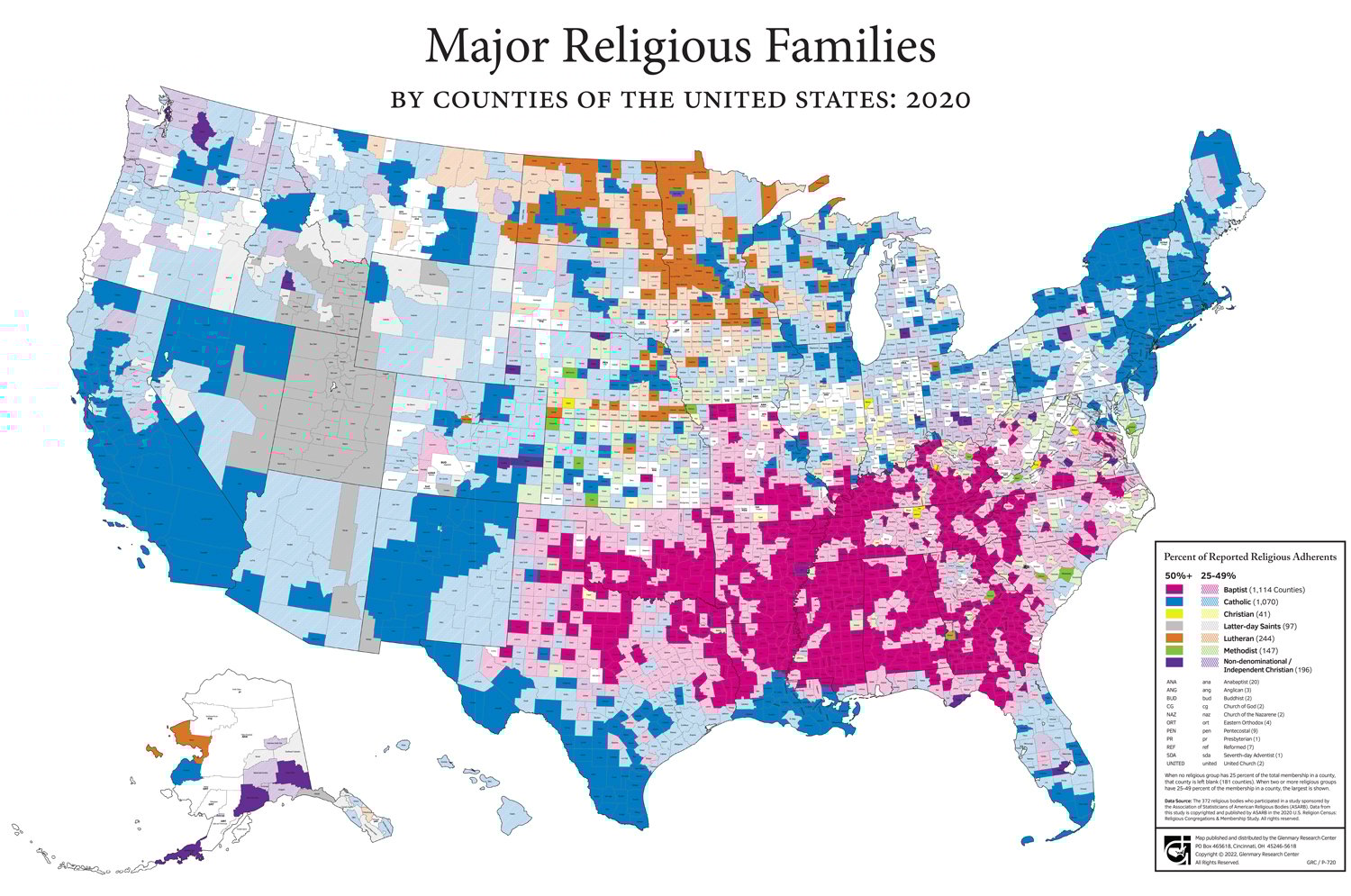
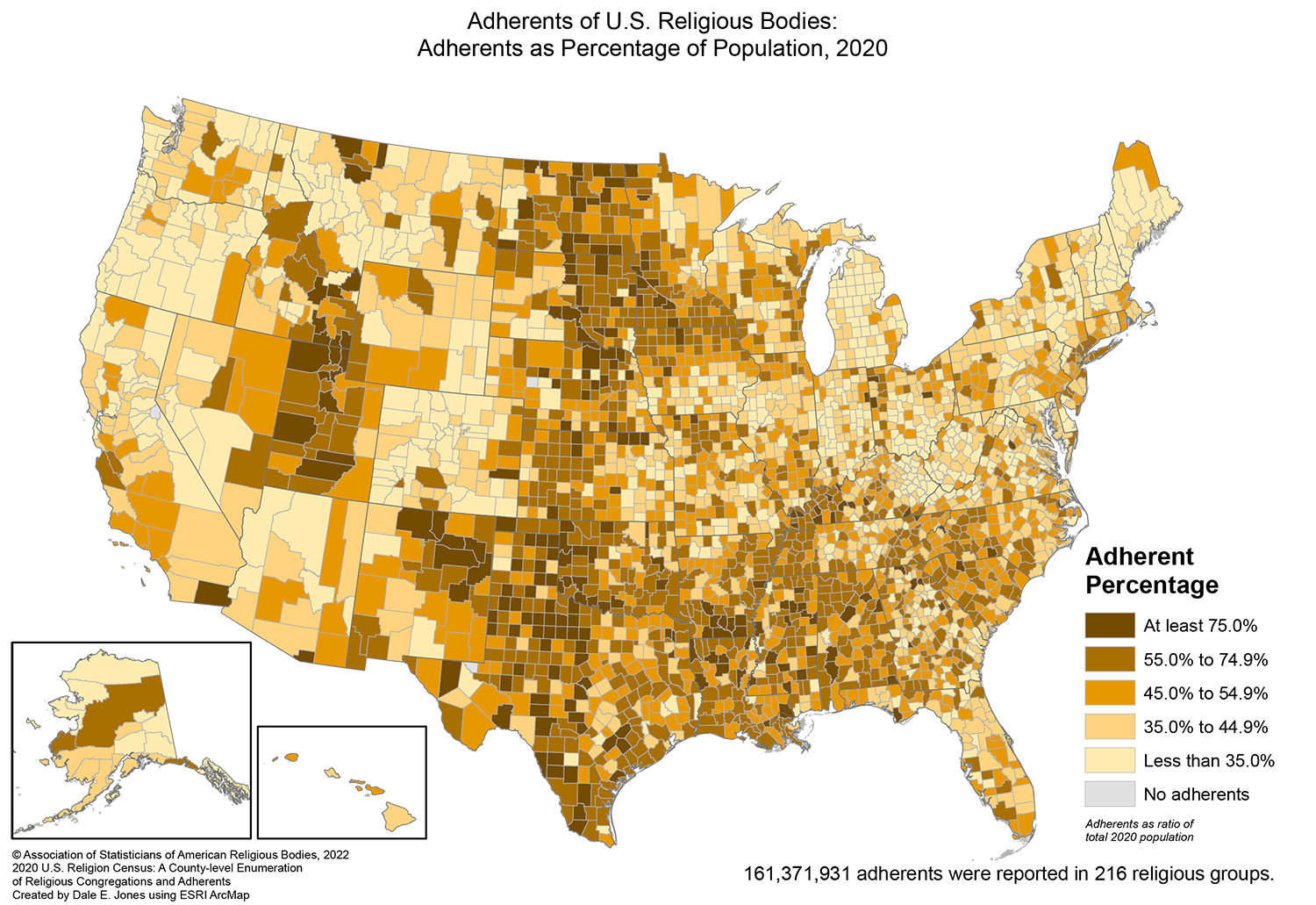
The U.S. Religion Census, conducted every 10 years by the Association of Statisticians of American Religious Bodies, concluded there were 356,739 religious congregations across the nation, and 161 million adherents, including children, in 2020. (Adherents is the formula researchers used to count those with an affiliation to a congregation, including children and people who attend but may not belong.)

Unlike polling, which asks questions from a small sample of the population and extrapolates to the general population, the religion census gathers information from denominations and other religious bodies and maps out the number of congregations and adherents on a county-wide basis. In the 2020 study, researchers collected data from 372 religious bodies, mostly denominations, but also 44,000 independent nondenominational churches. The count included synagogues, mosques and temples of Jewish, Muslim, Buddhist, Hindu, Sikh and Jain traditions

Courtesy Chart

Courtesy Chart

The study finds that the Catholic Church in the U.S. is the largest religious body, with 61 million adherents in more than 19,000 churches, comprising close to 19% of the U.S. population. That’s a modest growth of 2 million adherents from 2010, when the church had nearly 59 million adherents.

Sociologist who worked on the census said growth is almost entirely made up of Hispanic immigrants.

“If you took away the Hispanic population in the Catholic Church, it would look as bad as mainline denominations,” said Scott Thumma, director of the Hartford Institute for Religion Research, who counted independent churches for the census. (Mainline denominations, such as Episcopalian, Lutheran and Presbyterian, have been declining for more than 50 years.)

Perhaps the most striking growth was among Muslims. The number of Muslims who participate in mosque prayer increased from 2.6 million in 2010 to 4.5 million in 2020, a 75% increase. (Pew Research estimates there were 3.85 million Muslims in the U.S. in 2020, but those numbers do not include children.)

That growth is due mainly to immigration, said Ihsan Bagby, associate professor of Islamic Studies at the University of Kentucky, who collected the data for Muslims. Higher birth rates may be a secondary reason.

Bagby estimated the number of U.S. mosques at 2,771, a jump of 871 mosques in just a decade.

He suggested Muslims may be in a kind of golden age in the U.S. They are younger than the American population overall, and the Boomers among them are financially well off and able to contribute to the construction of new mosques. (First-generation mosques were often in retrofitted churches or warehouses.)

Mosques, Bagby said, “have mellowed and matured and become more moderate in their understanding of Islam and that has also been an attraction,” he said. “Many Muslims who had kept away feel more comfortable coming.”

Courtesy Chart

Courtesy Chart

U.S. mosques, like those overseas, do not typically keep memberships. Bagby said he arrived at his estimates by asking for information on weekly Jumah prayers as well as holiday or Eid prayers. (Muslims make up about 2.8% of all religious adherents and about 1.3% of the total population, the study estimates.)

Much of the value of the census is its county-level aggregation, which corresponds to how researchers in other fields, such as population studies and public health, collect and analyze data, said Rich Houseal, secretary-treasurer of the sociological group that conducted the study.

Houseal said the data is also useful to businesses, too. Walmart, he said, has contacted him to help determine what books to stock in their stores based on the dominant religious group in a county.

Among other interesting data points in the study:

  • Southern Baptists have the most churches of any religious group: 51,379.

  • There are some 44,319 nondenominational churches, a jump of nearly 9,000 over 10 years ago, and about 9 million adherents. Still, overall, they account for only 13% of the total number of religious adherents in the U.S.
  • Southern Baptists and United Methodists each lost 2 million members from 2010 to 2020.

“Denominational brands have weakened, and divisions have increased over issues such as female clergy or sexual orientation, Thumma said. “This likely led some adherents to seek or even start new nondenominational churches.”

Source: Religious groups with immigrant members grew fastest over past decade

Tensions rise in Toronto’s Persian community as activists try to expose regime links in Canada

Of note. More coverage on regime links and immigration:

As the uprisings continue in Iran, tensions between supporters of the regime and those who aspire to revolution are being felt in the Iranian diaspora.

In Toronto, anti-regime activists have moved to expose government insiders who they say live with impunity in Canada.

“This man sent me, along with many other students, to prison,” said Ardeshir Zarezadeh, an Iranian-born Toronto lawyer, pointing to his computer screen.

On the website of his organization, the International Center for Human Rights, the photo of Morteza Talaei, the former police chief of Tehran and officer of the Islamic Revolutionary Guard Corps (IRGC), seen on a treadmill, in a gymnasium in Richmond Hill, Ont., in January.

Since the beginning of the uprising in Iran, Zarezadeh has called on members of the Iranian diaspora in Canada to send him information concerning relatives of the Iranian regime who visit or live in Canada in order to expose them on his website.

There is an expression in Iran that Canada is the regime’s paradise.— Mohammad Tajdolati, Iranian journalist based in Toronto

“We all know that many people affiliated with the Iranian regime live in Canada. They come and go.”

“They take advantage of life in Canada,” maintains the lawyer who spent nearly six years in Iranian prisons for his involvement in student movements.

For Mohammad Tajdolati, there is no doubt that the presence of supporters of the Iranian regime in Canada has exacerbated tensions within the Iranian diaspora since the beginning of the uprising.

“There is an expression in Iran that Canada is the regime’s paradise,” says the Iranian journalist based in Toronto.

The activist claims to have contacted the federal government on several occasions in recent years to denounce the presence of relatives of the regime on Canadian territory, without concrete measures being taken by Ottawa.

“They tell us, ‘We know, we’re watching them,’ but that’s not enough. […] That is why we are taking matters into our own hands,” he said.

On Oct. 29, in a long-awaited speech by the diaspora, Prime Minister Justin Trudeau promised to maintain sanctions against the Iranian regime and its leaders. A promise received with skepticism by Zarezadeh.

You can’t do much legally, but by identifying them and exposing them, you can make people cut ties with them, or with their business.– Marjan

“We know that there are people today in Canada who have benefited from this horrible and corrupt regime and who are hiding in the middle of the community enjoying the opportunities that Canada offers. They are using the wealth they stole from the Iranians. We say: enough is enough,” Trudeau said.

He is not the only one. It was this same frustration that prompted Marjan* (her name has been changed) to begin investigating Iranian regime supporters in Canada. The young Torontonian left Iran to escape repression.

Radio-Canada granted her anonymity, because she fears reprisals against her or her family who still lives in Iran.

After arriving in Canada, she says she kept her distance from her home community. The uprising in Iran, however, ignited a new flame within her. On the opiran.toronto Instagram account, she now speaks out against government insiders whose families she says live freely in Canada.

“When I see these people here, it’s like post-traumatic stress disorder for me. I see them near my home, in the street, I see their children playing freely when I did not have this luxury in my country,” she said.

“You can’t do much legally, but by identifying them and exposing them, you can make people cut ties with them, or with their business.”

Even if he understands the anger of his compatriots, Tajdolti is worried about the abuses that some of their actions could cause, such as the denunciation of individuals online. “You have to be very careful because we live in a country of law. You can’t accuse someone very easily,” he warns.

Zarezadeh says he is aware of the risk of defamation. “We make sure that the information we publish is true,” he said, assuring that he will continue his fight.

Exacerbated tensions, broken wall of fear

Beyond online denunciations, tensions are also crystallizing in the community. In “Little Tehran,” a neighborhood located north of Toronto and which owes its name to its large population of Iranians, certain incidents have multiplied since the beginning of the uprising.

Opposite the famous Plaza Irania, in the heart of the Iranian quarter, a butcher shop has been the target of online vandalism and intimidation by netizens accusing it of having links with the Iranian regime.

Graffiti in Farsi saying “death to the mullahs,” for example, was painted on the walls of the Imam Mahdi Islamic Centre in Thornhill, north of Toronto. The mosque was quick to refute any political allegiance.

Both the butcher shop and the mosque declined our offer to comment on the matter.

In front of the same mosque, however, signs with the portrait of the young Mahsa Amini, whose death was the spark of the movement, have been removed, according to a video widely shared on the WhatsApp network. And still in the same place, a motorist tried to rush into anti-regime demonstrators before fleeing and being arrested by the police.

York Regional Police, which serves the territory, says it is not concerned about a possible increase in hateful acts related to the situation in Iran. However, the police say they are aware of the divisions that exist within the Iranian community in the Greater Toronto Area.

According to Tajdolati, tensions have always been underlying in the community, with supporters of the two ideologies living together. What changes this time is that fear has changed sides, according to the journalist.

“The people you see on the streets now, before, they didn’t come to demonstrations because they were afraid,” he said, explaining that being photographed at an event like this could make it difficult afterward to travel to Iran or could make things difficult for their families back home.

“Now, he continues, the situation is so atrocious in Iran, it is so brutal, so inhuman, that these people say to themselves, ‘No, that is enough. I want to participate, I want to do my duty as a human being, as an Iranian.”

“The wall of fear has broken down.”

Source: Tensions rise in Toronto’s Persian community as activists try to expose regime links in Canada

Akshay Kumar clarifies the status about his citizenship and Indian passport: “Having a Canadian passport does not mean I am not less of an Indian”

Instrumental citizenship. “Not less of an Indian” but his phrasing suggests he considers himself less of a Canadian:

Bollywood actor Akshay Kumar, who holds a Canadian passport and often gets trolled on social media for the same, recently clarified the status about his citizenship.

At the Hindustan Times Leadership Summit 2019, the actor addressed the trolling and shared an update on his Indian citizenship and said, “Having a Canadian passport does not mean I am not less of an Indian. I am very much Indian. I have been here since last nine years when I got the passport. And I don’t want to get into the reason of why, what happened, my films were not working, blah blah blah, chalo woh theek hai.”

“Yes, I had said it in 2019, I applied for it,” he added. “Then the pandemic happened and everything shut down for 2-2.5 years. My renounce letter is here and very soon my whole passport will be coming.” When said that he does intend to do it anyway, he said, “What do I do. I didn’t bring the pandemic.” Previously at the Hindustan Times Leadership Summit 2019, Akshay had shared that he is in the process of applying for an Indian passport.

The same year, Akshay also took to Twitter addressing the online fuss about his Canadian citizenship. “I really don’t understand the unwarranted interest and negativity about my citizenship,” he tweeted at the time. “I have never hidden or denied that I hold a Canadian passport. It is also equally true that I have not visited Canada in the last seven years.”

“I work in India, and pay all my taxes in India,” he further wrote. While all these years, I have never needed to prove my love for India to anyone, I find it disappointing that my citizenship issue is constantly dragged into needless controversy, a matter that is personal, legal, non-political, and of no consequence to others. I would like to continue contributing in my small way to the causes that I believe in and make India stronger and stronger.”