Decline in Chinese student mobility: It’s only temporary

Overly optimistic IMO, and discounts the impact of the Chinese government policies that have driven down travel and study. Study permits to Chinese nationals have declined more than most other countries 2021 compared to 2018. The view of recruiters:

Against some gloomy future predictions about Chinese students’ outbound mobility, we forecast that Chinese students’ drive to study overseas will stay strong due to strong ‘push’ factors in China, including economic factors, a competitive system, the value placed on intercultural learning and, more importantly, the Chinese educational culture. The current drop in numbers is temporary, mainly due to concerns over COVID.

One important reason behind the gloomy predictions for Chinese educational mobility is the forecasted slow growth in the Chinese economy over the next decade, if not the possibility of an immediate bust. 

Geopolitical tensions and the trade war with the United States do not help. However, Chinese doomsayers have been around for a long time and they have been proven wrong so far. The Chinese system has shown itself to be resilient and adaptable, perhaps more so than the Western system. 

Of course, no country can grow its GDP at an annual rate of 10% forever, not even the Chinese, but even a small positive growth every year would be very good news for international education. 

Given the large base of the Chinese economy today, an ever-increasing middle class, all equipped with the habit of saving (by a minimum of 30% of household income) and an extended family network of grandparents, uncles and aunts all willing to chip in, there is continued stability in the push for Chinese students’ outbound mobility.

Education: A quintessential value

There has been a vast increase in higher education provision in the past two decades in China, turning the Chinese higher education system from an elitist one to a mass one. The current enrolment rate is over 50%. 

The quality has also been immensely improved, with huge national investment in a select pool of universities. More Chinese universities enter top league tables year on year and the research output from China has outnumbered that from the US since 2019. 

However, Chinese higher education has stayed very competitive for Chinese students.

One of the quintessential values in China revolves around education. Every parent dreams of the best possible educational situations for their young people, no matter the personal or financial costs.

Stories of the extremes students and families will endure, endeavouring to score well on their Gaokao (university entrance exam), are ubiquitous in Chinese education conversations. The reason behind the continuing pressure is that the tiered post-secondary system is vastly overwhelmed by student demand. Yearly, many talented students are unable to gain entry into the top tier of Chinese universities, who then have to ‘settle’ or ‘look elsewhere’.

Furthermore, less talented students still hold the same motivation for a university education from a highly reputable institution but can’t hope to compete with their peers at the top. For those who are better off, there are much easier options abroad. 

The flattening of demographic growth in China is often seen as a negative push factor, but those who suffer most from that are more likely to be Chinese universities at the national bottom tier rather than universities overseas.

Intercultural acumen

Of course, not all Chinese international students land in an Ivy League school, but let us consider what other attractive forms of learning accompany an education abroad opportunity.

A trade-off in international ranking can, in some part, be assuaged by the experience and competencies of an intercultural education. Sound judgement is a deeply entrenched Chinese cultural pillar and, as the world shrinks and businesses expand in fast-moving world markets, even a less developed sense of judgement says international experience is beneficial. 

Since 2001, the Chinese economy has been brought firmly into the world trade system and, despite the Chinese government’s call to lighten students’ academic burden, English is still a school subject that is perceived to be as important as Chinese and maths, and after-school tutorials still continue. 

The idea of mastering English as a world language through English-medium instruction overseas remains very attractive, even if an overseas university is not in the same league as Oxford or Harvard.

A little historical perspective

Even without such educational motivation, the Chinese population has always been an extremely mobile group, contributing to the early building and development of much of North America, still evident in the Chinatowns in every major city on the American continent. 

Even the Chinese ‘Head Tax’ in Canada and the ‘Chinese Exclusion’ legislation in US history did not stop their interest in migration. 

Many in the diasporic communities have ties to their ancestral country and, in doing so, contribute to the flow of information home regarding current opportunities and potential spaces to develop.

After all, China holds close to a quarter of the world’s population crowded onto less than 8% of the world’s arable land. As the Chinese saying goes: “A good opportunity is not to be missed.” 

The Chinese have always looked for better living, learning and work opportunities elsewhere and everywhere. We would really be witnessing a sudden turn in this major historical trend if Chinese students really stopped looking abroad!

The pandemic

The current dip in Chinese student numbers is almost an exclusive result of the pandemic, or the success of the Chinese discourse in dealing with it. The zero case target with strict dynamic lockdown measures has indeed helped China to avoid a big loss of lives during the earlier and more serious waves. 

But the rationale of protecting lives at the price of all else, well propagated among the Chinese population, can create a psychological fear about countries that have adopted more relaxed policies. 

This is shown by the sharp increase of applications to Hong Kong and other nearby regions. The current pandemic might need to further settle before Chinese students return in larger numbers again. This setback, seen from a longer perspective, is likely to be very temporary.

A final note

Chinese mobility when it comes to international education has played a vital role in post-secondary institutions worldwide for decades. Though the number of students may wax and wane, we can expect Chinese students in our classrooms for generations to come. 

The Chinese education-first culture, pursuing the best possible opportunities anywhere in the world, will remain stable. A Western degree, and the accompanying benefits of language and intercultural competences, will be considered desirable by Chinese students for a long time to come.

Gavin Palmer works at University of Alberta International, in charge of international student programming. E-mail: gpalmer@ualberta.ca. Wei Liu also works at University of Alberta International, Canada, mainly responsible for the Global Academic Leadership Development Program. E-mail: weidavid@ualberta.ca. 

Source: Decline in Chinese student mobility: It’s only temporary
2022 Annual Report on Immigration, 2023-25 Levels Plan: “The More the Merrier”

The annual report, looking back, and the levels plan, looking forward, are narrowly focused on immigration and largely silent on the impacts of increased immigration, beyond generalities on demographics and filling labour market needs. No real surprises as the government’s intentions had either been announced or signalled in advance for both permanent and temporary migration.

There is no discussion of the impacts on housing, healthcare, infrastructure, the environment among others.

Some of the more interesting articles on the report and plan are below.

There is no discussion of the impacts on housing, healthcare, infrastructure, the environment among others.

In general, the government gets a pass on these omissions from the opposition, provincial governments (save Quebec), the Century Initiative, business and other stakeholders, settlement organization and media coverage. The report and plan came out the same day as the latest Focus Canada survey, showing ongoing and increasing support for immigration.

Media commentaries that exemplify this include John Ibbitson: Immigrants are the great insulators against the worst economic and political threats we face and Andrew Phillips’ Record immigration is a yawn in Canada, and that’s a good thing.

An odd analysis argued that How Canada’s new immigration targets will help housing recover — and push prices higher long-term. Is the objective to help housing recover or to make housing more affordable? High immigration hampers affordability.

Others were positive but former Liberal Minister from the Chrétien years, Canada bucks global trend on increasing immigration targets,  flagged the government’s poor record in delivery with high backlogs.

The Globe did a good deep dive into temporary workers, How Canada became a hotbed for low-wage foreign labour, highlighted the misplaced changes that made it easier for businesses to hire low-wage labour, including by expanding the amount of time international students could work rather than study, a mockery of the education objectives.

More negative commentaries included Annan Khan’s Increasing our population intake will not address the cynicism guiding Canada’s immigration policy. True, but self-interested immigration policy that priorizes economic immigration has greater public support than more altruistic alternatives favouring refugees.alternative of rebalancing in favour of refugees.

Rupa Subramanya’s Come One, Come All cites a number of statistics that highlight relatively poor outcomes for recent immigrants and posits that high levels are at least in part driven by political motives given that Liberals have traditionally done well with immigrant origin voters. IMO, largely obsolete as the Conservatives under Harper did the hard work of engaging new Canadians, only to blow it with citizenship revocation and the “barbaric cultural practices” tip line.

Colby Cosh’s High on Immigration similarly picks up on Subramanya’s points on economic outcomes and argues that the net effect on housing prices employers who are over-represented by “old-stock” Canadians.

Andrew MacDougall’s focus on the politics, Liberals’ immigration policy could set a trap for Pierre Poilievre, highlights the risks that the Liberals are making immigration a wedge issue, a likely reason that successive Conservative immigration critics have focused their critiques on administrative issues (backlogs etc) and Roxham Road irregular arrivals.

My sense is that the Conservatives are well aware of the need to engage immigrant-origin and visible minority voters, given the large number of ridings with large numbers of these voters, plus his personal biography (e.g., marriage to a Venezuelan immigrant) mean that it will be hard to paint him as anti-immigration unless he or high profile candidates misstep.

Even the generally “Trudeau derangement syndrome” outlet “True” North’s reporting on the immigration levels plan has been neutral and factual. The Toronto Sun was favourable to the plan, EDITORIAL: Rolling out a careful welcome mat, but flagged infrastructure needs to ensure successful integration.

2022 State Of New American Citizenship Report

The USA also has program delivery problems:

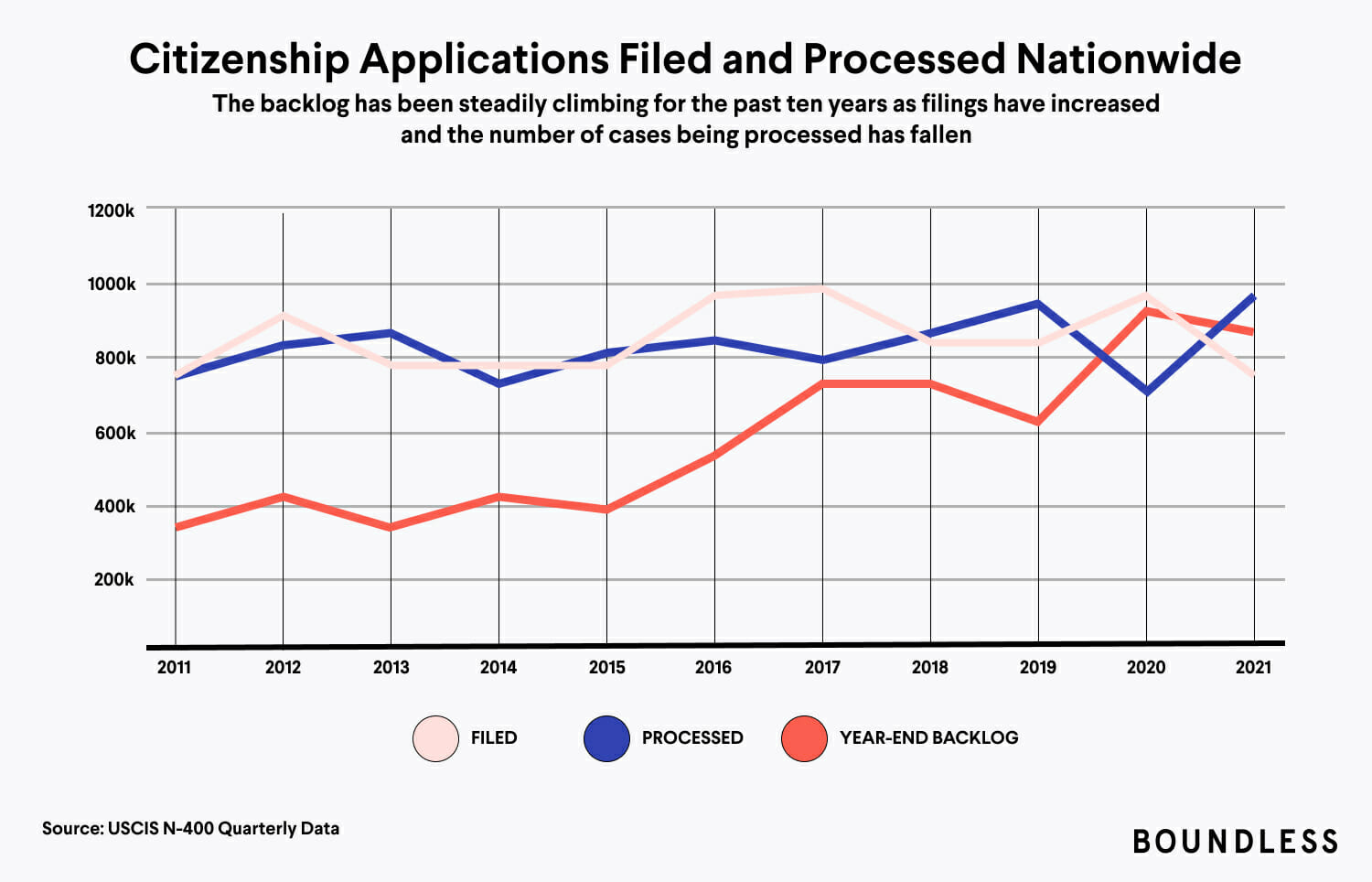
Surging BacklogCitizenship Application Filed Naationwide

A look at the past decade indicates a worrying trend.

Although application volume was expected to fall, the volume increased to almost 1.2 million applicants through the end of 2021, and although processing volume had begun to increase in 2019, the cessation of processing applications due to COVID-19 has led to a surge in the backlog of pending applications, with nearly 800,000 applications still pending by the end of 2021.

USCIS, the federal agency responsible for processing citizenship applications, has defended itself by noting that the backlog more than doubled during the Obama administration. This is true: the backlog rose from nearly 292,000 in September 2010 to over 636,000 by the time Donald Trump assumed office in January 2017.

But USCIS has also claimed that the surge in applications during 2016 and 2017 created a “record and unprecedented” workload. A look at the past 3 decades shows, however, that this is not true.

BACKLOGS IN CONTEXT

In 2007, citizenship applications surged to nearly 1.4 million, far higher than the recent uptick. This was driven in part by a looming 80% application fee hike that year, and an increase in newly eligible immigrants who had obtained their green cards 5 years earlier under the Legal Immigration Family Equity (LIFE) Act of 2000.

USCIS responded with a surge in processing volume the following year, and the backlog plunged to a 30-year low of about 257,000 in 2009.

In the mid-1990s, there was a truly “record and unprecedented” surge in citizenship applications, driven in part by a corresponding increase in newly eligible immigrants who had received green cards under the Immigration Reform and Control Act 1986 (IRCA, also known as the “Reagan Amnesty”). Between 1995 and 1998, application volume stayed well above 900,000, peaking at over 1.4 million in 1997. Although the backlog initially shot past 2 million in 1997-1998, USCIS responded with a comparable surge in processing volume that appears to have tamed the backlog by 1999-2000.

The data indicate that when USCIS devotes sufficient resources to a citizenship application surge, it is possible to dramatically reduce the backlog within one year. That’s what happened in 2000, 2007, and again in 2012.

On the other hand, when USCIS fails to devote sufficient resources, backlogs can get way out of hand. That’s what happened in the mid-1990s, and it appears to be happening again.

FALLING BEHIND

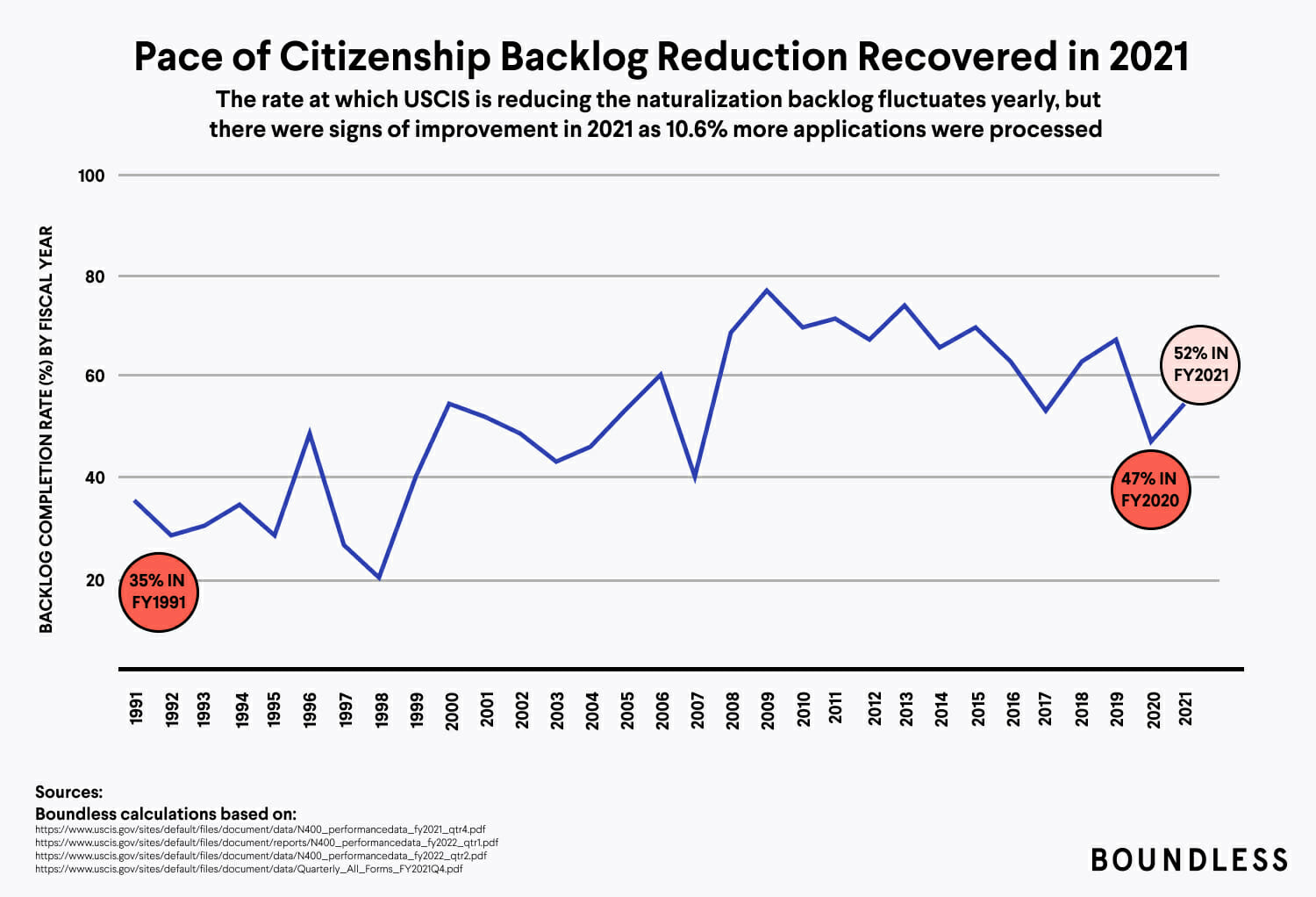
Pace of citizenship backlog reduction

Another way to evaluate this problem is to measure how efficiently USCIS beats back its backlogs. If USCIS processed every citizenship application it received in a given year, plus the applications that were pending from the previous year, that would yield a “backlog completion” rate of 100%.

In reality, USCIS achieved a backlog completion rate of 77% in 2009 — a 30-year high — and this number has been trending downward ever since. There was a 10-point drop in backlog completion between 2016 and 2017 (from 63% to 53%), but backlog completion crept back up to 67% in 2019 before falling drastically in 2020 to 47%, which was the lowest backlog completion rate since 2007 (39%).

By the end of fiscal year 2021, however, the rate at which USCIS was completing naturalization cases had recovered somewhat, to just under 52%. Unfortunately, comparing the fourth quarter of FY2021 with the first two quarters of FY2022, a trend is not immediately apparent: USCIS finished Q4 of 2021 with a backlog completion rate of 24%, but by the end of December 2021 it had dropped to 22% before recovering to 25% at the end of Q2 in March 2022. USCIS’s year-end data will reveal if the agency was able to maintain its improving overall pace of clearing the citizenship backlog.

SURGING WAIT TIMES

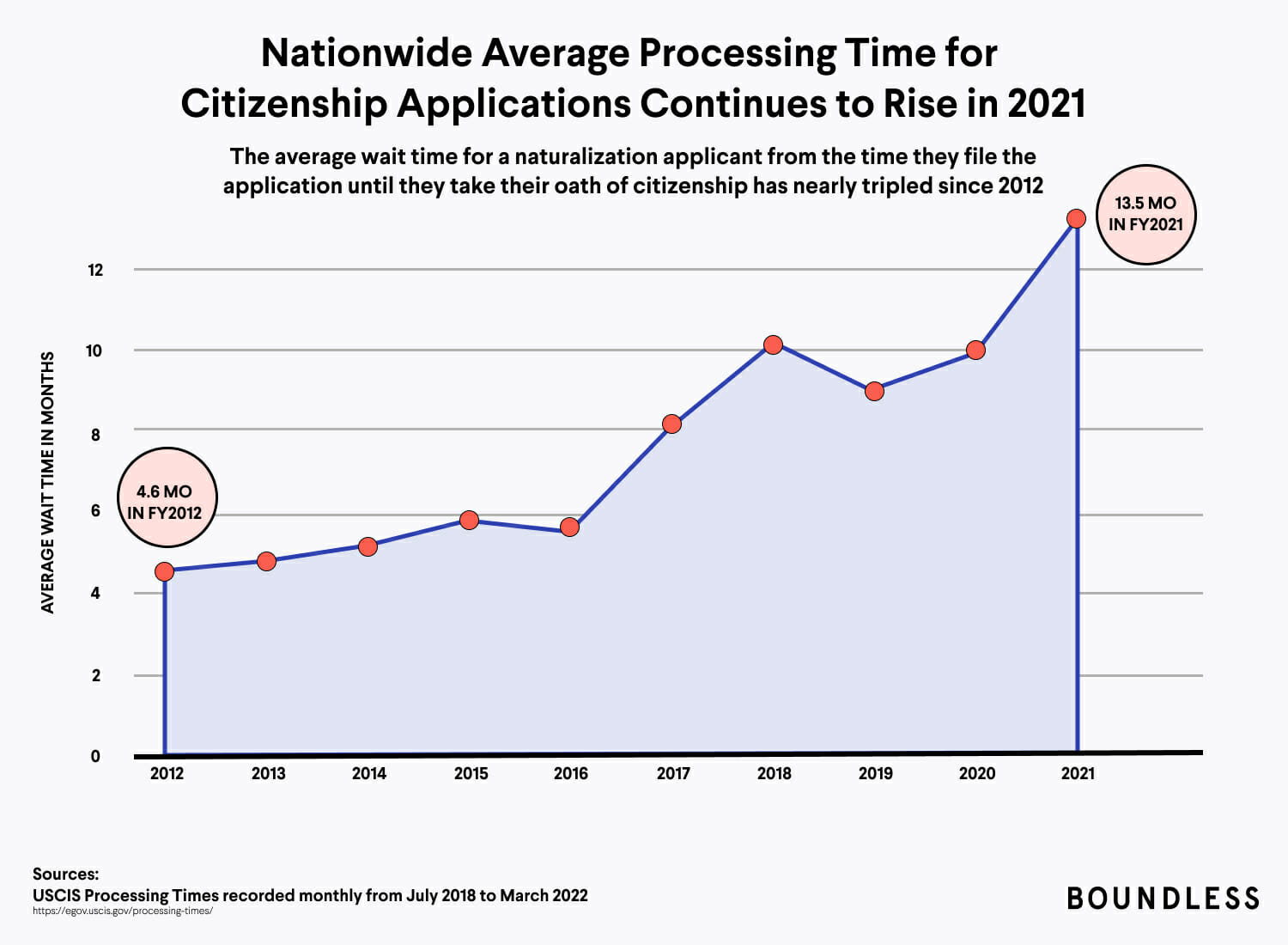
Processing times citizenship

Growing backlogs have direct and negative consequences for immigrants seeking to become U.S. citizens: They have to wait longer for their applications to be processed by the government.

Here the trend is unmistakable: Between 2012 and 2016, median application processing times hovered between about 4.5 to 6 months, before shooting past 8 months in 2017 and hovering at about 10 months in 2018 and 9 months in 2020. Compounding the worrisome trend, starting in March 2020 the coronavirus lockdown postponed the final steps for naturalization—interviews and oath ceremonies — until offices reopened in June 2020.

Source: 2022 State Of New American Citizenship Report

Wernick: Leaving the comfort zone: Difficult issues in public sector reform

Good diagnostique by former Clerk. If any of these were easy to resolve, they would have been addressed.

The one I am not sure of is the degree to which pay is an issue at senior levels. What does the data say about separations (departures) from the public service at the EX and DM levels? Is that really that much of an issue, particularly for the policy folks who are attracted by the influence they can have on policy? Do departures vary by level and department and, if so, what are the motivators? Money and/or others? I don’t believe it was money that attracted Barton or Sabia, to highlight two of the more prominent examples.

On classification, I remember the Universal Classification System attempt in the 1990s. A lot of work and effort that was abandoned and no doubt other former colleagues have similar scars or wasted time that went nowhere.

And yes, get rid of the bilingualism bonus although Francophone public servants will likely complain given their higher levels of effective bilingualism:

Much of the commentary on the public sector stays at the level of generalities. Exhortations to become more strategic, more inclusive, bolder in advice and better in delivery are impossible to contest. Too often, the discussion stops short of analyzing resistance or tradeoff among objectives. As in so many things, we are much better at diagnosis than agreeing on the remedies.

The list of issues in play these days for the federal public service is already daunting. As well, provincial, territorial and municipal governments have their own agendas. On top of the formal reviews of service delivery and spending launched earlier this year, an incomplete list would include: a new round of collective bargaining just as inflation has spiked; figuring out the post-pandemic workplace; replacing retirements and departures; fragile legacy IT systems; the reverberations of Black Lives Matter and Indigenous reconciliation; cybersecurity and foreign interference; and a trendline of eroding trust in public institutions.

What follows is a brief thought experiment. If the federal government took the advice – something that is unlikely in my view – to create some sort of royal commission or advisory panel on its public service, what are some of the more difficult or “wicked” questions – that would surface? We do not have to wait; we can start debating these issues now. There are more, but I set out just a few of the most uncomfortable ones here.

Insourcing, outsourcing and offloading 

The core question of what we should ask the public service to do for us usually comes up only in formal spending reviews, such as the Chretien government’s 1995 program review or the Harper government’s 2012 deficit reduction action plan. They sometimes provoke a re-examination of whether this area of responsibility should be done by public servants, rented from outside contractors, or offloaded to the private sector and civil society.

Sometimes, the federal government retreats from an area and leaves it to provincial and local governments. The mix has shifted and the federal public sector has waxed and waned. The truth is that there is no right answer and we will get an outcome heavily driven by the ideological and political preferences, and the view of federalism, of the government of the day. The point for public sector management is that you can drive for effectiveness or drive for spending cuts, but realistically you can’t do both well at the same time.

Dealing with poor performers 

An uncomfortable truth is that not every hire works out and not every employee or executive contributes as much as they should. Some are not effective and some actually drain energy and poison their workplaces. Many people are squeamish about discussing poor performers and toxic employees, and deny they exist in any significant numbers.

It is far too difficult to demote or terminate the small number of truly poor performers. An employee can use the multiple recourse processes to drag out proceedings for as much as two or three years. Instead of taking on the exhausting challenge, managers either do their best to work around them or sometimes try to fob them off on others with less than honest references. Colleagues see team members coast along as passengers without consequences and lose motivation.

The solution lies in changing the legal standard for dismissal to a lower bar than the current definition of “cause.” However, it is a wicked problem in practice because making it easier for managers to terminate employees may give some of them an instrument for bullying and harassment that may be wielded with bias. Striking the balance won’t be simple.

No longer letting middle managers do all the hiring

As long as I can remember people have lamented the slow pace of hiring, whether from outside the service or moving people within. The managers and the human resources community point fingers at each other. The uncomfortable truth is that not every middle manager or front-line supervisor is good at hiring – even the ones who struggle to find the time to wade through the huge pools of candidates. They default to looking for credentials and past experience because it is much more effort to assess future potential, but the tools for doing so aren’t very good.

The solution to slow staffing, and to recruiting more talent from outside, could lie in a more directive approach that gives much more authority to the human resource community or a central staffing agency to do the screening and proactively match candidates with vacancies. This is a really uncomfortable topic because the main bottleneck has been a cultural one – middle managers believe they should pick every person on their team, no matter how long it takes. Departments and agencies are culturally averse to shared hiring processes or relying on others. They are scared of false positives and believe they would do a better job. More leeway to remove poor performers could also be a key to faster hiring.

Which forms of inclusion matters more?

Bilingualism has been a cornerstone inclusion policy since 1968, a mindful strategy to ward off Quebec separatism by ensuring that the one-quarter of Canadians who are francophones see themselves in the federal government. The future of bilingualism is a wicked problem in the 2020s, not for externally facing services ­– which are now largely delivered on websites, apps and call centres – but for the workplace.

Requirements for a degree of proficiency in both of our official languages by supervisors and executives raise uncomfortable issues, including that they have come to be seen as a barrier for some racialized communities and for Indigenous peoples. Should the public service give in to pressure to loosen requirements for French-language proficiency in the pursuit of inclusion? Or would that marginalize francophones and harm recruitment, lead to a downward spiral in language capacity and erode national unity? The uncomfortable truth is that the subtle pressure to work in English is relentless unless the people convening and chairing meetings, asking for documents and performing basic supervision are mindful and proactive.

Even more baffling, why are we still paying bonuses to people who are bilingual instead of investing the same millions of dollars in language training for people who are not?

How flat can you go? How thin is too thin? 

One of the common criticisms of the federal public service is that there are too many managers in too many layers. It is contended that there has been a proliferation of new half-steps such as assistant directors, associate assistant deputy ministers and associate deputy ministers. The cumulative effect has been identified as a “clay layer” of management and it is widely believed that the leadership cadre could readily be made leaner, flatter and thinner.

It is an uncomfortable issue because many of the remedies that have been tried or suggested would make it more difficult for the most senior leaders to solve workload and personnel problems for which they are accountable and to keep their organizations up to date with evolving challenges. More constraints means less organizational agility. Any arbitrary reductions, caps or buyout schemes tend to land unevenly and unfairly. The larger organizations are always much more capable of coping than the more numerous smaller ones.

Little boxes 

The box-by-box model of jobs dates backs decades and is taken as a given. It is used to define in excruciating detail the duties and accountabilities of each individual position, which then is used to assess what it is worth and therefore what it should be paid.

That model and especially the job classification system used by the public service is well past its best-before date. It slows down staffing, falls behind the shifts in skills and competencies in the real-world labour market, adds enormous complexity to the pay system, and has long favoured policy-related jobs over operations and services. It creates a lot of unproductive busy work.

Past attempts to fix it or to negotiate change through collective bargaining always turned into a quagmire. There are no evident paths forward, but arguably we need a public service that is more nimble and able to shape shift – to move people more easily and to quickly create jobs around specific projects. The daunting and truly wicked challenge is to find a thoughtful approach to streamlining how jobs are classified and paid, and the courage and persistence to look at the core software of the employment model.

Are we serious about leadership or not? 

It is common to point to the crucial role of leadership but we don’t back up the rhetoric in practice. We need to find better tools for classifying and compensating executive positions than the ones that have caused us struggles for the past decades. We need to invest heavily in learning and development of the leadership cadre. Politicians are squeamish about what a serious review would tell them – that generally public service jobs are well-paid with attractive pension coverage and benefits, but the higher you go, the less compelling the comparisons with the private sector become. The uncomfortable truth is that compared to the private sector, the public sector underpays its leaders and underinvests in leadership development.

Part of it is ideological – some politicians are so averse to government that they don’t see what public sector leaders do as value-added. This is reinforced by a relentless flow of hostile punditry and media stories about executive “bonuses,” travel expenses and leadership programs. Some politicians are beholden to the public service unions who would balk at higher compensation for managers.

Is better possible? 

These are just some highlights of the challenges that would face serious public sector reform. My hope as a new academic is to provoke some research and dialogue that may create actionable options for a future government. As for a royal commission, why wait? Take up any of the issues or go even deeper into structural reforms and propose solutions, not just diagnosis. We can start by leaving the comfort zone.

Source: Leaving the comfort zone: Difficult issues in public sector reform

Phillips: Don’t brush off attempts to undermine our democracy. We should know which politicians got China’s money

Indeed:

Can we take a break from lecturing Americans about the state of their democracy and focus for a bit on problems with our own?

Canadians love to watch from a safe distance when all the horrors and glories of the American political system are on display, as they are this week as we comb through the results of their midterm elections.

We especially love to pat ourselves on the back for the fact that our system is, for the most part, mercifully free of the most extreme elements of U.S. politics. That’s mostly just good for our national self-regard, but it would be a shame if it distracts us from the disturbing possibility that a foreign power has been actively interfering in our own recent national elections, even changing the outcome in at least one case.

Put like that, it sounds far-fetched. But Global News reported this week that Canada’s intelligence service, CSIS, warned federal ministers in January that China has targeted this country with a “vast campaign of foreign interference.”

According to the report, CSIS told the government that Beijing funded a “clandestine network” of at least 11 federal candidates, including both Liberals and Conservatives, in the 2019 federal election. It also placed “agents” in the offices of MPs to influence policy and mounted “aggressive campaigns” to punish Canadian politicians it saw as threats to its interests.

Asked about this, Prime Minister Justin Trudeau didn’t deny it. Instead, he essentially confirmed the report by saying some “state actors,” including China, continue to “play aggressive games with our institutions, with our democracies.”

The government then went on, through a speech by Foreign Minister Mélanie Joly, to sketch out its long-awaited Indo-Pacific strategy. This is the famous “eyes wide open” approach, whereby Canada will take a more cautious stance toward China and try to deepen links with other Asian nations, in particular India.

But hang on a moment — let’s not change the channel quite so fast. Those CSIS briefings were pretty specific, according to Global’s Sam Cooper. They alleged that the Chinese government funnelled money through proxies to almost a dozen candidates in a federal election and worked to undermine others.

So many questions. Which candidates got the money? How many of them won, and how many lost? For those who did get money, did they know who was ultimately behind it or were they ignorant of what was going on? And which candidates did China work against? What happened to them?

Finally, was this activity limited to just the 2019 election, or was it happening before or after? A former Canadian ambassador to China, Guy Saint-Jacques, says he believes “several Conservative MPs” lost their seats in the 2019 and 2021 elections because China targeted them through social media networks in the Chinese community.

We know the name of at least one who was probably singled out. Conservative MP Kenny Chiu lost his Vancouver-area seat in 2021 after he introduced a bill to set up a registry of agents for foreign governments (something Canada should certainly have). He immediately found himself labelled as anti-Chinese in Chinese-language social media, and is convinced Beijing’s operatives were behind the campaign to defeat him.

Now it seems he wasn’t the only one, if the CSIS briefing to the government is to be believed. It’s in line with many warnings over the years from Canada’s top intelligence officials that China has been actively meddling in our domestic politics, partly by working through sympathetic politicians and partly by manipulating votes in Chinese communities.

Isn’t this something we should know more about? The government received that CSIS briefing in January, but as far as we know it did nothing. 

It’s important to look at the big picture by elaborating a new Indo-Pacific strategy. And judging by Joly’s speech this week, the government seems to be broadly on the right track. 

But in the meantime, we shouldn’t brush off a real attempt to undermine our democracy. Let’s start by asking where that Chinese money went, and to whom.

Source: Don’t brush off attempts to undermine our democracy. We should know which politicians got China’s money

StatCan: A portrait of citizenship in Canada from the 2021 Census

An informative and useful update from their earlier study based on previous censa (Trends in the Citizenship Rate Among New Immigrants to Canada).

Of particular interest to me were the following elements:

Numbers of Canadian citizens born abroad: 322,530. This number quantifies those who will be impacted by the first generation cut-off introduced by the Conservative government in 2009 and thus not able to pass on their Canadian citizenship to their children. This is currently being challenged in court with profiles of families affected. IMO, the previous retention provisions were virtually impossible to administer consistently and efficiently, and the first generation cut-off is preferable.

Naturalization rate:

“Among all eligible immigrants admitted to Canada at least four years before a census year, 83.1% or just over 6.0 million immigrants reported Canadian citizenship in the 2021 census, while a larger proportion of the immigrant population reported Canadian citizenship in 2016 (85.8%) and 2011 (87.8%).”

Yet IRCC continues to use, in its annual reporting, the percentage of all immigrants, no matter whether they arrived five or 50 years ago, as its benchmark. Totally irrelevant to measuring IRCC’s performance. As I continue to argue, IRCC needs to set performance standards with respect to recent immigrants, based on the previous census period (essentially the approach StatCan uses).

Improved data on dual citizenship: The change from a simple question regarding dual citizenship to a more complex two-step set of questions has resulted in an increase in the number reporting dual citizenship. The results of this change:

“In 2021, 11.2% or 3.7 million Canadian citizens reported more than one country of citizenship. This was over double the number reported in 2016, when 4.5% or 1.4 million of all Canadian citizens identified as having more than one citizenship.”

I will be doing a more comprehensive analysis of 2021 Census citizenship data over the coming months, updating my analysis of the 2016 Census (What the census tells us about citizenship):

Source: A portrait of citizenship in Canada from the 2021 Census

Blogging break

Back on the 14th.

Hong Kongers returning to Vancouver after years of population decline, census shows

Not surprising given Chinese government takeover:

Ken Tung says he recently helped a new arrival from Hong Kong find a basement unit in Metro Vancouver for only $500 rent per month, thanks to a discount by a sympathetic landlord.

“It’s a good price,” said Tung, who said he has helped at least 100 young people from Hong Kong settle in Canada over the past three years.

But Tung said he’s playing a relatively limited role resettling Hong Kongers compared to Vancouver-based groups, including churches, that have helped thousands.

“I know many churches and their people are helping Hong Kong newcomers .… People are donating furniture and lowering the rent to help them out,” said Tung.

Tung and others like him are facilitating a shift that shows up in new Canadian census figures.

The data released this week shows the Hong Kong-born population of Canada is on the rise, with a large majority settling in the Vancouver region, reversing a return-migration trend that had previously seen thousands of Hong Kongers leaving Canada.

Experts say the shift is being propelled by a political crackdown in Hong Kong, which came under a sweeping national security law in 2020 after anti-government protests.

The 2021 census shows a 6.1 per cent increase of Hong Kong-born people in Vancouver’s census metropolitan area in the past five years, bringing the total population to more than 76,000. It had previously been falling for decades.

The increase of 4,395 accounts for 90 per cent of the Canada-wide increase of Hong Kongers since 2016, when the previous census was conducted.

Many more are on the way, using new migration pathways that Canada opened up to Hong Kongers last year.

Tung said he wasn’t surprised by the census numbers.

He said Hong Kongers arriving in Metro Vancouver recently mainly fell into four categories — returnees who already hold Canadian citizenship, people arriving on new work permits, students and some asylum seekers.

He said their motivations were largely the same. “The answer is simple — they can’t see a future in Hong Kong,” Tung said

The national security law has been used to target protesters and political opponents of the Hong Kong government and the Chinese Communist Party.

Tung said those leaving Hong Kong did so after watching Hong Kong go from being “open, modernized” to “hardcore communism.”

Hong Kong was Canada’s biggest source of immigrants in the lead-up to the 1997 handover to China, but Hong Kongers’ presence in Canada had been shrinking steadily for years as thousands moved back to the former British colony.

The crackdown in Hong Kong was followed by the establishment of new Canadian migration pathways in response.

But while the census shows 2,385 recent Hong Kong immigrants to the Vancouver census metropolitan area in the preceding five years, that number is outstripped by the actual increase in the Hong Kong-born population, suggesting more than 45 per cent of newcomers already held Canadian citizenship or some other status.

One such newcomer, a financial analyst who declined to be named for safety reasons, said he was born in Hong Kong but immigrated to Canada with his parents and finished his studies here.

His parents brought the family to Canada in the wake of the 1989 Tiananmen Square crackdown in Beijing, which triggered an exodus from Hong Kong and Taiwan.

But in the mid-2000s, he went back to Hong Kong for work. It wasn’t until last year he decided to reverse direction again, returning to Vancouver with his wife and son.

“I used to have the freedom to speak my mind, have choices in reading different news media and discuss in public without any repercussion. This is really valuable to me .… And therefore when it’s gone, Hong Kong is no longer Hong Kong,” he said.

He said he was making a good living in Hong Kong and enjoying the low-tax environment there, but decided there is “something more important than the money.”

“I have a kid and it’s not only for myself but also for his future. I can’t stand living in that environment,” he said.

“It’s a very tough journey to go through. Seeing young people getting oppressed and intellectuals being jailed and detained. It’s definitely a saddening journey.”

Kennedy Chi-Pan Wong is a PhD candidate in sociology at the University of Southern California who has studied Hong Kong migration patterns.

Wong said his research showed many recent migrants were Hong Kong political prisoners’ relatives, friends or colleagues.

The U.S.-based Hong Kong Democracy Council says there are 1,163 political prisoners in Hong Kong as of September 2022.

“That actually creates a large pushing force, (as we call it) in migration studies, that really push people out of the country,” said Wong.

In addition to the political unrest, other factors have also come into play, such as Hong Kong and mainland China’s strict pandemic rules, said Wong.

He said the COVID rules that had inhibited mobility had created concern about doing business in Hong Kong, and the city’s future prosperity.

The influx looks set to accelerate, with more than 20,000 permits for study, permanent residency and work granted to Hong Kongers last year after Canada launched a new open work permit pathway last year for Hong Kong residents who are recent graduates of post-secondary institutions.

Some of those pathways only came into effect after the May 2021 census.

Wong agreed that the peak of newcomers from Hong Kong hasn’t arrived in Canada yet.

Meanwhile, the financial analyst who returned to Vancouver said he hoped the new arrivals would help capture some of Hong Kong’s previous spirit.

“(We) will connect with them and make sure the culture and values are preserved,” he said.

Source: Hong Kongers returning to Vancouver after years of population decline, census shows

Immigration Canada discrimine les étudiants d’Afrique francophone. Voici ce que Québec devrait faire pour y mettre fin

More concerns expressed, somewhat scattered rather than focussed:

La campagne électorale québécoise s’est terminée sur un verdict sans appel. La Coalition Avenir Québec (CAQ) a été reportée au pouvoir face à une opposition divisée et en retrait.

L’heure est au bilan et à l’élaboration des nouvelles orientations du gouvernement. Notamment en matière d’immigration.

Une campagne pénible sur le thème de l’immigration

Il a beaucoup été question d’immigration durant cette campagne. Rarement en des termes qui élevaient le débat, malheureusement. Le premier ministre François Legault a amalgamé l’immigration à des mœurs violentes pouvant heurter les « valeurs » des Québécois. L’ancien ministre de l’Immigration, Jean Boulet a démontré sa méconnaissance des chiffres de son propre ministère lors d’une sortie gênante. En voulant rectifier le tir, le premier ministre en a rajouté en qualifiant une hausse des seuils d’immigration au-delà de 50 000 immigrants par année de « suicidaire ».

Il est tout à fait légitime pour un État de mesurer les impacts de différents seuils d’immigration. Mais si le nouveau gouvernement veut se faire rassembleur, il devrait éviter d’avoir recours à des sifflets à chiens pour les amateurs de théories du déclin.

En tant que professeur dans le domaine de la sociologie politique, je m’intéresse aux dynamiques et transformations sociopolitiques au Québec et au Canada.

Discrimination systémique à Immigration Canada

Lors de son deuxième mandat, le gouvernement caquiste doit aborder les enjeux liés à l’immigration d’une façon moins frileuse et plus ambitieuse.

Paradoxalement, dans un contexte où plusieurs partis à l’Assemblée nationale adhèrent à une forme ou à une autre de nationalisme, aucune formation ne semble s’inquiéter de la diminution du poids démographique du Québec et de la francophonie au sein de la fédération canadienne, confirmée par les dernières données publiées par Statistique Canada.

Or, le développement de la francophonie canadienne et des institutions francophones au Québec devra passer, entre autres choses, par une immigration en provenance des pays d’Afrique francophone et par une plus grande ouverture à l’égard de celle-ci.

En lien avec ce premier enjeu, un deuxième doit être abordé et dénoncé de façon beaucoup plus frontale par l’Assemblée nationale à Québec, soit celui des obstacles posés par le gouvernement fédéral, par Immigration Canada pour être précis, aux étudiants·e·s de la francophonie noire africaine qui cherchent à étudier dans une institution francophone au Québec.

Ces étudiants·e·s subissent un taux de refus nettement supérieur aux étudiants·e·s appliquant dans les institutions anglophones : ce taux se situe autour de 60 % au Québec, 45 % en Ontario et 37 % en Colombie-Britannique. Les étudiants·e·s d’Afrique francophone sont surreprésentés parmi ces refus. En 2021, le gouvernement canadien a rejeté 72 % des candidatures provenant de pays africains ayant une forte population francophone, contre 35 % pour l’ensemble des autres régions du monde.

Cette situation est documentée et connue à Immigration Canada. Mais combattre cette forme de discrimination ne semble pas la priorité du ministère.

Ça ne semble pas être une priorité du Parti libéral du Canada non plus, en dépit de sa profession de foi antiraciste dans bien d’autres dossiers. Cette situation cause un préjudice d’abord aux étudiants·e·s en question, puis aux établissements d’enseignement supérieur au Québec. C’est pour cette raison que l’Assemblée nationale doit s’en saisir vigoureusement.

Racisme et francophobie

Durant les premiers mois où cette situation a été révélée, deux arguments ont été mis de l’avant par le fédéral pour la justifier : un problème algorithmique (ceux-ci ont le dos large) ; puis, la crainte que ces étudiants·e·s ne retournent pas dans leur pays.

Cette deuxième affirmation avait le mérite d’être claire. Pire, lorsqu’il s’agit de la francophonie noire africaine, le traitement discriminatoire des demandes va au-delà des seuls étudiants. C’est l’ensemble des dossiers qui semble faire l’objet de délais déraisonnables. De nombreux chercheurs africains devant participer à des congrès, comme celui sur sur le sida, qui se tenait cet été à Montréal, ont vu leur demande de visas refusée ou ne l’ont pas reçu à temps, une situation dénoncée par les organisateurs.

Encore là, le gouvernement libéral a l’indignation à géométrie variable.

Dernièrement, Immigration Canada a confessé du bout des lèvres qu’il y avait du racisme, jumelé à de la francophobie, à son ministère. Cela survient près d’un an après que ces pratiques aient été dénoncées par les institutions d’enseignement supérieur francophones.

L’Assemblée nationale du Québec doit dénoncer à l’unanimité cette discrimination.

Québec doit également rectifier le tir

Dans ce dossier, le gouvernement québécois doit lui aussi faire un examen de conscience.

Les signaux envoyés par Québec ces dernières années n’ont pas été attrayants pour les étudiants internationaux. Dans le cadre d’une mesure incompréhensible, le gouvernement a alourdi et allongé le temps de résidence nécessaire au Québec pour les étudiants internationaux souhaitant y demander la résidence permanente ou la citoyenneté.

Or, à la fin de leurs études ces étudiants·e·s bénéficient d’un réseau favorable à leur insertion professionnelle, sociale et culturelle. Pour reprendre une formule du premier ministre Legault, créer des embûches à ces étudiants·e·s est « suicidaire » pour l’attrait des universités québécoises face à leurs rivales des autres provinces.

Jouer les régions contre Montréal nuit aux institutions francophones à Montréal

Un troisième enjeu gagnerait à être réévalué par la nouvelle ministre de l’Éducation supérieure, Pascale Déry.

À la fin de son premier mandat, la CAQ a pris la décision de favoriser la régionalisation des étudiants internationaux dans certains domaines d’études au moyen d’incitatifs financiers s’ils étudient en région.

C’est, en soi, une excellente nouvelle. Les étudiants·e·s internationaux en région dynamisent le tissu social et culturel et ils revitalisent des institutions d’enseignement indispensables à la vitalité des régions. Cependant, on peut se demander s’il est pertinent de jouer les régions contre Montréal sur cet enjeu. Afin de freiner le déclin des institutions d’enseignement francophones à Montréal (toutes connaissent une baisse d’inscriptions cet automne), le gouvernement provincial peut aussi agir en les aidant à attirer des étudiants internationaux francophones à Montréal.

Jouer les régions contre Montréal est de bonne guerre en campagne électorale, mais si le gouvernement est sérieux à l’égard de la situation du français à Montréal, il doit se doter d’un plan pour contribuer au rayonnement de l’enseignement supérieur en français également dans la métropole.

Francophonie métropolitaine : le temps est à l’ambition

En 1967 et 1968, la création du réseau des Cégeps et de l’Université du Québec a favorisé la démocratisation de l’accès à l’éducation en français au Québec.

En 2022, l’objectif de la nouvelle ministre de l’Éducation supérieure pourrait être de faire de ce réseau d’éducation publique un pôle de référence pour la francophonie au Canada et dans le monde. Une première étape de ce programme devrait consister dans un appui systématique aux universités francophones dans leurs tentatives d’attirer des étudiants de la francophonie canadienne.

Dans un contexte où les campus francophones hors Québec subissent des compressions alarmantes et où règnent un climat de francophobie à l’Université d’Ottawa, qui a pourtant, sur papier, le mandat de célébrer la francophonie, le gouvernement québécois doit se montrer plus attrayant, plus agressif et plus ambitieux.

En somme, la CAQ doit se doter d’une stratégie cohérente, ambitieuse et moins frileuse en matière d’éducation publique supérieure et d’immigration durant ce deuxième mandat.

L’élaboration d’une telle stratégie pourrait faire l’objet d’une concertation impliquant la ministre Pascale Déry, la nouvelle ministre de l’Immigration, Christine Fréchette, ainsi que Pierre Fitzgibbon, ministre de l’Économie ainsi que de l’Innovation et du Développement économique de la région de Montréal. Il faut leur souhaiter de l’ambition dans l’appui au rayonnement des institutions d’éducation publique supérieures, que ce soit à Montréal ou en région.

Ces institutions devront être reconnues et appuyées comme des vecteurs au cœur de l’intégration sociale et culturelle au Québec. Cette stratégie devrait se montrer ambitieuse également en ce qui a trait au développement de collaborations avec les universités de la francophonie africaine, et elle devra envoyer un signal clair en condamnant de façon unanime les pratiques discriminatoires à Immigration Canada.

Source: Immigration Canada discrimine les étudiants d’Afrique francophone. Voici ce que Québec devrait faire pour y mettre fin

Rubin: Exposing Library and Archives Canada’s dismal transparency record

Another illustration of how broken ATIP is:

When I first came to Ottawa in the mid-1960s, I started going to the National Archives to access government records. I met Archives personnel who were trying to get the federal government to adopt better electronic record management to meet the growing demands for information.

But their efforts were largely ignored as more and more government record management came under the Treasury Board Secretariat (TBS) authority. There, record retrievals became more difficult and descended into a confusing and conflicted state of instability.

This was at a time when government department libraries were disappearing. My ability to freely wander the shelves and stacks and to get reference help ended when the access-to-information regime took over in the mid-1980s. Agency record collections became secret and inaccessible to the public.

By then, the Treasury Board Secretariat had firmly taken control of overall information management policy, with National Archives playing second fiddle. TBS sought to “standardize” and sanitize federal information holdings at a cost of many millions of dollars.

With the 2004 merger of the National Archives and the National Library, the new Library and Archives Canada (LAC) took on the attributes of a regular government agency under the Treasury Board’s tight control, driven by the latest software and ever-increasing secrecy practices.

Just another obedient agency

When Daniel Caron—neither a professional librarian, nor archivist—was put in charge at the LAC in 2009, he accelerated this deference to government powers, acting more like a TBS lieutenant.

He pressed for greater “modernization,” clumsily and at great expense transmitting LAC holdings into electronic file holdings. Caron didn’t fight the cuts imposed on LAC’s professional archivists and librarians, and seemed to relish reining in any staff’s independent actions to help the public. Nor did he fight the Public Works demand that LAC’s auditorium and meeting facilities be reserved only for federally sanctioned events and not for public use (Justice Paul Rouleau’s inquiry on the use of the Emergencies Act is currently taking place in the Library and Archives Canada building on Wellington Street).

Caron’s end came in 2013 after I obtained access to records that showed he was, at taxpayer expense, taking Spanish lessons. When he refused to end the language training, the heritage minister at the time fired him.

Eventually, LAC got a professional head and some of their former information reference service capacities were restored. But it was much too late for LAC to gain an influential central role under the Access to Information Act.

One example of how LAC had become just another obedient agency is how it took little interest in even housing or publicly listing and preserving past completed access-to-information requests.

That task, ignored for 20 years, was eventually done though the so-called open government portal, though the actual records received under access requests were never posted, just the titles of thousands of requests. The result is that much of the unofficial—at times very valuable and of historic record—of what the government did was destroyed without Canada’s retainer agency or historic records, LAC, giving one iota.

Not so well known was that for many years archive authorities had secret deals. One such arrangement that I have written about previously was that ministers’ “personal” and “political” past records deposited at LAC were allowed to remain secret for multiple years—even permanently—as demanded by ex-ministers and prime ministers.

LAC continues to make available public funds, office space, and staff to past prime ministers who assemble their so-called “personal” and “political” records. Such “private donations” get charitable income tax receipts. It’s not clear whether LAC has ever pushed back on prime ministers on ministerial claims made, Trump-style, about those records really being their personal property, a highly questionable practice in the first place.

Another long-standing deal is with the House Speaker, allowing in-camera parliamentary committee records to be hidden and housed at LAC for long periods of time.

A more recent 2018 secrecy arrangement with the Supreme Court of Canada favours many of the judges’ deliberation records remaining secret for a minimum of 50 years or more.

If that were not contentious enough, LAC has also turned its back on acquiring and preserving residential school records. Instead—and likely a better arrangement—many of those government records were sent to the University of Manitoba’s National Centre for Truth and Reconciliation in 2015. LAC, however, still has many residential school records in its possession and has been slow to get those and other federal records processed and out, especially those records held tightly by the federal Indigenous departments.

Which brings us to the 2018 Dagg case where LAC issued consultant Michael Dagg an 80-year wait-time, given the estimated 780,000 records dealing with the RCMP’s Project Anecdote, a 10-year investigation on secret commissions, money laundering and corruption, including in real estate, an investigation which ran out of steam and from which no charges were ever laid.

Dagg complained about the excessive delay to Information Commissioner Caroline Maynard, who then requested LAC take a mere 65 years to respond. The delay issue went to the Federal Court for appeal. Sadly, it was discontinued upon Dagg’s death this past September.

Faster info declassification a good first step to change

LAC, as Dagg, I, and others well-discovered, has become a typical unresponsive and obstinate bureaucratic agency quite willing to severely censor our tax-paid records under legislated secrecy claims.

Maynard’s scathing investigation report on LAC, released on April 26, 2022, readily confirms LAC’s unacceptable long wait-times to access requests, amounting to LAC regularly not meeting its legal obligation under access legislation.

The minister responsible for reporting on LAC activities, Heritage Minister Pablo Rodriguez, responded to Maynard’s report recommendations by refusing to take responsibility to correct LAC’s poor access-to-information services. He declined to put forward a strategic plan to quickly correct LAC’s laggard and disgraceful access-to-information record.

Maynard’s report scolded LAC and the Government of Canada (read the Treasury Board Secretariat, the Privy Council Office, and the Prime Minister’s Office) for not taking the lead to quickly declassify records it holds and receives from government agencies. Maynard recommended that the federal government establish a strong declassification directive as a crucial element to the functioning of access legislation.

However, LAC no longer seems up to the task of promptly declassifying those records it has in its possession. That’s even if agencies send any those records at all.

It would be helpful if the information commissioner could get tough on LAC for failing to declassify their records for public use on a timely basis, and if she, along with a rejuvenated LAC’s help, could penalize those government agencies that don’t bother to keep written records, that alter them, or that refuse to hand over records to LAC.

Another serious problem is that LAC quietly follows TBS’s 40-year practice of massive record destruction. Hundreds of thousands of draft records annually don’t make it at all to LAC as TBS orders agencies to regularly destroy draft transitory operational records.

One thing that LAC still does a relatively good job doing is collecting outside legally required deposited information from those publishing and that includes letting the public know about those published records.

Once seen as an arm’s-length agency keeping check on the PMO and the Treasury Board Secretariat’s all-powerful grip on federal records has simply wilted and been cast aside by the same cabal.

LAC has fallen in line with the centralized secrecy commands that rule Ottawa, and has even outdone many other government agencies in their dislike to giving Canadians access to their records on a timely and fuller basis.

Can LAC become more than a secrecy shill for the government? At the very least it would help if LAC, who holds the vast majority of government historical records, gets going in declassifying more records for release. That would be a start.

LAC badly needs to change course and become an independent record manager force with integrity, a pro-disclosure champion for the fulsome and quick release of federal information.

Respect and trust would follow.

Ken Rubin is a long-time observer of transparency and secrecy trends in Ottawa. He is reachable via kenrubin.ca

Source: Exposing Library and Archives Canada’s dismal transparency record