Poilievre veut miser sur l’immigration pour renflouer le système de santé

Of note, the general messaging (Chantal Hébert has a good analysis of CPC prospects Pierre Poilievre is unpopular in Canada’s second-largest province — and so are his policies):

Un gouvernement conservateur sous Pierre Poilievre reconnaîtrait les compétences des travailleurs étrangers en santé dans un délai de 60 jours, et ce, afin de désengorger le système de santé.

C’est ce qu’a affirmé le chef du Parti conservateur du Canada, lundi après-midi, dans le cadre d’un point de presse tenu à l’occasion d’une mini-tournée québécoise, où il a rencontré plus tôt dans la journée des familles dont un membre est touché par un trouble du spectre de l’autisme et des représentants de la Fédération des chambres de commerce du Québec.

Ces déclarations font écho à un engagement précédent formulé par M. Poilievre, qui souhaitait faciliter et accélérer la reconnaissance des compétences des travailleurs immigrants.

« Seulement 43 % des médecins immigrants et 37 % des infirmières immigrantes ont le droit de pratiquer leur métier, a déploré M. Poilievre. Pour ces candidats, les coûts de formation n’entrent même pas dans l’équation. Il suffirait d’attester de leurs compétences sur la foi de ce qu’ils sont en mesure d’accomplir, le tout dans 60 jours, plutôt que de se fier sur leur pays d’origine. »

Le député de Carleton, en Ontario, souhaiterait également que le programme de reconnaissance des acquis soit accessible aux candidats avant même leur arrivée au Canada, afin de raccourcir le processus le plus possible. Son gouvernement s’engagerait par ailleurs à soutenir 34 000 prêts pour tout autant d’immigrants établis au pays afin qu’ils puissent reprendre leurs études pour se mettre aux normes canadiennes.

Pour soulager le système de santé, le chef conservateur propose aussi de réduire les listes d’attente et d’accélérer l’approbation canadienne de traitements d’avant-garde éprouvés dans d’autres pays industrialisés.

Moins d’inflation et de paperasse

M. Poilievre a profité de sa brève allocution pour rappeler trois promesses que son parti s’engage à respecter s’il est porté au pouvoir.

Il propose d’abord une « loi du 1 $ pour 1 $», où son gouvernement retrancherait toute somme nouvellement investie d’un autre programme afin d’éviter d’endetter davantage les Canadiens, ce qu’il reproche à son homologue libéral.

« Les Canadiens sont en train de souffrir, nous sommes face à un taux d’inflation parmi les plus élevés des quarante dernières années », a déclaré M. Poilievre, qui plaide pour un meilleur contrôle des dépenses. « L’augmentation des coûts du gouvernement Trudeau, avec ses 500 millions de dollars de déficit inflationniste, a entraîné une augmentation du coût de la vie », a-t-il ajouté.

Le chef conservateur a par ailleurs promis de « rendre le travail payant » plutôt que de le punir, notamment en allégeant la fiscalité et les différents programmes gouvernementaux, le tout afin de remettre davantage d’argent dans les poches des travailleurs.

Enfin, le chef de l’opposition officielle à Ottawa s’est engagé à réduire la bureaucratie et la « paperasserie » imposées aux entreprises afin de les rendre plus productives, notamment dans les secteurs minier et hydroélectrique, pour planifier la transition écologique.

M. Poilievre sera de passage à Trois-Rivières et à Québec plus tard cette semaine pour « entendre le gros bon sens des Québécois et des Québécoises » dans l’optique de préparer le programme conservateur en vue de la rentrée parlementaire, plus tard ce mois-ci.

Source: Poilievre veut miser sur l’immigration pour renflouer le système de santé

Klassen: Canada, a superpower? Here’s how the country might one day fit the bill

I am always sceptical of such long-term forecasts, given that none of us will be around to see how accurate, or likely how inaccurate, they will prove to be, 100 years from now, let alone Klassen’s 200 years.

In comparison, Century Initiative’s goals of a large increase in population, are modest and more realistic (even if I have fundamental disagreements).

For the foreseeable future, the United States will probably remain the world’s most powerful nation. Yet, like any champion, it must watch for challengers and head them off. At present, China’s rise on the global stage troubles Washington. A few decades ago, it was the Soviet Union.

But will future contenders for superpower status be much closer — specifically, north of the U.S. border? The British Empire ended in the mid-20th century when it was outmanoeuvred not by one of its longtime rivals, France or Germany, but rather by its ally, the U.S. Could Canada do the same?

Canada’s population is just a fraction of its southern neighbour’s, but Prime Minister Justin Trudeau’s Liberal government has announced an ambitious plan to bring in 500,000 immigrants each year by 2025.

The vast majority will be young and selected via merit-based criteria that give priority to education and workplace skills. Canada’s population in relation to the U.S. has also been slowly increasing for decades and is growing at a faster pace.

Canada and the U.S. are roughly the same size, both accounting for 6.1 per cent of the world’s land mass. Much of Canada’s land at present is cold, barren and largely uninhabitable. But climate change has made Canada’s landscape more temperate and suitable for agriculture and other activities, a trend expected to continue in the decades to come.

Economic powerhouse

In some ways Canada is already a superpower. Its economic output is the eighth largest in the world. The seven countries with larger economies have bigger populations than Canada. Even with a short growing season and relatively small area devoted to agriculture, Canada is the fifth largest exporter of agri-food and seafood products.

But economic strength is only one measure of a global power. Another is having the resources that others need. In that regard, Canada is extraordinarily rich in natural resources, including clean water. Regardless of future economic, environmental and technological trends, the country will be an energy and natural resources superpower.

Two other elements are needed for superpower status: a political system that provides strong governance and a national culture that’s appealing to its own citizens and to people around the world.

Canadian politics prizes stability and moderation, both hallmarks of a superpower. Social change occurs with few ideological battles. For example, becoming the first developed country to legalize the use and sale of recreational cannabis happened with scant controversy or social division.

Even on expanding the scope of medical assistance in dying legislation, Canadians have remained civil, with all stakeholders willing to listen to each other.

Providing inspiration

Superpowers are not only countries that dominate in various spheres, but also countries that command the aspiration of — and provide inspiration for — people around the globe. For two centuries, the U.S. has made its national dream one that others around the world sought to attain. American-style democracy was the gold standard.

This is now less and less the case. The “city on a hill” acting as a beacon of hope for others has morphed in recent decades into a selfish “America-first” environment.

American citizens have grown disillusioned by their polarized politics, while outsiders question the excesses that drive U.S. capitalism. Donald Trump’s years in the White House have left many dismayed about the future of their country and widened the divisions between Republicans and Democrats.

As neighbours, Canadians shake their heads in wonder at the inequities, lack of public health care, lax gun control and debates over abortion and immigration that dominate and divide American politics.

Canadian culture, shaped by the country’s history of being a fragment of both the British and French empires, has aspired to promote equality, both between individuals and groups, although it’s failed in its abysmal treatment of Indigenous Peoples.

Nonetheless, in an age of globalization and demand for greater personal freedoms, Canada’s multicultural policies are a beacon of hope in a world often scarred by religious, ethnic and tribal battles.

Where will Canada be in 2223?

Much like when the U.S. steadily assumed the role of unchallenged superpower from Great Britain during the first half of the 20th century, it might be that Canada gradually becomes a great power this century — perhaps first as a partner to the United States, but then increasingly supplanting its neighbour.

For many around the world, such a transition would be preferable to other scenarios, such as China or Russia assuming more dominant roles in global affairs.

A shift in global power relations would occur at a leisurely pace and with minimal disruption.

In 1776, with a population of 2.5 million, few imagined that within two centuries, the U.S. would become the dominant superpower. It’s not inconceivable that Canada could perform the same feat by 2223.

Source: Canada, a superpower? Here’s how the country might one day fit the bill

Safe Third Country Agreement is ‘working’ despite surge in irregular crossings: minister

Of note (not sure its perceived as working by the public):

Public Safety Minister Marco Mendicino says the Canada-U.S. Safe Third Country Agreement (STCA) is “working,” despite the massive increase in migrants using unofficial border crossings last year compared to previous years.

Mendicino told CTV’s Question Period host Vassy Kapelos, in an interview airing Sunday, Canadian officials and their American counterparts continue to work together to modernize the agreement. Still, he insists the system is functioning.

“To be clear, that agreement remains in place and it is working,” he said. “The RCMP are doing the job of intercepting those who are coming into the country, which obviously underscores the integrity of our borders and the investments, which are backstopped by the federal government.”

The STCA was first signed 20 years ago, and there have been talks of modernizing it since 2018, with some changes made in 2019. Under the STCA, people seeking refugee status in either Canada or the U.S. must make their claim in the first country they enter.

The loophole that the agreement applies only to official land border crossings means asylum seekers who manage to enter a country via an unofficial crossing — such as Roxham Road along the Quebec-New York border — are not returned.

According to Immigration, Refugees and Citizenship Canada, the number of RCMP interceptions and asylum claims at unofficial border crossings between Canada and the U.S. hit a six-year high in 2022. There was a drastic drop in the numbers as of spring 2020 and throughout 2021 because of the COVID-19 pandemic and its impact on the border.

“I’m cautiously optimistic that we’re going to be able to land it,” he said. “In the meantime, we’ll continue to make historic investments and work with provincial and territorial partners, so that asylum seekers who have a basis on which to make those claims in Canada are able to do so, but do so in a safe and orderly way.”

“It’s important that we recognize that we have an immigration system that works, and that fosters safe and orderly flow both when it comes to asylum seekers, as well as economic immigrants,” he also said.

Conservative Leader Poilievre Poilievre said this week that the Liberal government should renegotiate the agreement “in order to close Roxham Road,” adding he understands why people try to use it, because the Canadian immigration system is “now so slow and so broken.” He blamed the Immigration, Refugees and Citizenship Canada application backlog, and said the prime minister should “renegotiate the deal with the Americans, and speed up the processing of immigration generally.”

Source: Safe Third Country Agreement is ‘working’ despite surge in irregular crossings: minister

Haitian migrant’s death reignites debate over Quebec’s Roxham Road border crossing

The death of a Haitian migrant near Quebec’s Roxham Road has reignited a debate in the province about how to respond to an increase in asylum seekers entering the country through the irregular border crossing.

The body of Fritznel Richard, 44, was found on Jan. 5 in a wooded area near the popular unofficial entry point, about an hour’s drive south of Montreal. Provincial police said he was trying to reach family in the United States, and that he likely died of hypothermia after becoming lost.

A migrant’s advocacy group that is helping the family said Mr. Richard was originally from Haiti, had entered Canada through Roxham Road at an unknown time, and had been struggling to obtain a work permit. “Unfortunately, he was in a precarious situation and was not able to make ends meet,” said Hady Anne, a spokesperson for Solidarity Across Borders.

Hélène Gravel, who lives next to the U.S. border on Roxham Road, said that in the past few months, she and her neighbours have seen more people crossing through the forest near her house to get to the U.S., including families.

“Even if there aren’t many of them, we’re not going to wait for them to die in the forest to do something,” she said.

Mr. Richard’s death has placed a renewed spotlight on Roxham Road’s unofficial border crossing, at which tens of thousands of migrants have entered Canada in recent years, largely because of the Safe Third Country Agreement between Canada and the U.S. The long-standing pact means that border agents from each country must turn away asylum seekers from the other if they present themselves at official land border crossings.

The unassuming cul-de-sac near the St-Bernard-de-Lacolle, Que., customs has become an “official nonofficial point of entry” as a result, said Christina Clark-Kazak, associate professor at the University of Ottawa’s graduate school of public and international affairs.

Concrete blocks and rocks block roads on both sides of the border in the sparsely populated area. A narrow gravel path and signs with information about the asylum-seeking process lead migrants from the U.S. into RCMP installations.

The RCMP intercepted 34,478 asylum seekers who did not use official ports of entry to enter Quebec between January and November of 2022, according to Immigration, Refugees and Citizenship Canada data, compared to just 316 in the rest of the country.

Federal opposition parties have repeatedly called for a review of the Safe Third Country Agreement, but anxiety about the situation has been sharpest in Quebec.

“The federal government must renegotiate the Safe Third Country Agreement with the United States as soon as possible,” said Ewan Sauves, spokesperson for Premier François Legault.

“There is an urgent need to act on Roxham Road,” said Mr. Sauves, adding that Prime Minister Justin Trudeau “must ensure that the other provinces take charge of the proportion of asylum seekers that is theirs. It is not fair that it is only Quebec that has to manage this.”

Quebec is “concerned” about the increase in asylum applications since 2017 and its “ability to welcome these people with dignity and provide them with adequate services,” said Quebec Ministry of Immigration spokesperson Arianne Méthot.

The Safe Third Country Agreement is “an important tool,” said Immigration, Refugees and Citizenship Canada spokesperson Jeffrey MacDonald, adding that modernizing the agreement “has been a priority for the government for several years.” He did not provide details “due to the sensitive nature of our bilateral discussions with the U.S.”

Mr. MacDonald also pointed out that, in 2021-22, Quebec received over $697-million in compensation from the federal government to “provide settlement and integration services in the province.”

Frédéric Bastien, a prominent nationalist author and former Parti Québécois leadership candidate, filed a private prosecution against the Prime Minister on Jan. 12 accusing Mr. Trudeau of violating Canadian law by encouraging “illegal” border crossings.

In his court filing, Mr. Bastien cites a tweet by Mr. Trudeau from 2017 welcoming refugees to Canada, which read, “To those fleeing persecution, terror & war, Canadians will welcome you, regardless of your faith.” The Prime Minister issued the message shortly after then-U.S. president Donald Trump banned travel to the U.S. from several majority-Muslim countries.

In an interview, Mr. Bastien also noted that the Trudeau government has erected facilities at Roxham Road that include instructions on how to apply for asylum.

“If this is not encouraging migrants to enter through Roxham Road I don’t know what is,” he said.

Public opinion appears to be on his side. Justice for Quebec, an organization led by Mr. Bastien, commissioned a poll late last year showing that 68 per cent of Quebeckers wanted to “close” the border crossing. A survey last spring by the respected polling firm Leger – commissioned by the Legault government and obtained by the Journal de Montréal newspaper – put the figure at 60 per cent.

But “stricter border enforcement policies correlate with increases in riskier crossings to evade authorities, and increases in tragic deaths” along borders globally, said Alison Mountz, professor at Wilfrid Laurier University and Canada Research Chair in Global Migration.

Ms. Gravel, who sees countless migrant buses and RCMP vehicles go by her property every day on Roxham Road, said that the flow is currently “very well-managed.” The RCMP “takes care of it,” she said.

And closing the passage “is not a solution,” said Mr. Anne, of Solidarity Across Borders. “Do you think that [the closing of] Roxham Road will stop migrants?” The group advocates for open borders and the termination of the Safe Third Country Agreement so that asylum seekers could go through regular customs to cross both ways.

He blames the agreement and the long wait for a work permit for Mr. Richard’s death, adding that he knows of several other people in the same situation. “Migrants are not looking for help, they want to work,” he said.

Source: Haitian migrant’s death reignites debate over Quebec’s Roxham Road border crossing

Why Canada’s plan to bring in 1.45 million permanent residents won’t fix the labour shortage

Of note, pretty hard hitting:

With a master’s degree in nursing and six years of experience teaching nursing students in the Philippines, Rodolfo Lastimosa Jr. figured he’d quickly get a licence to work as a registered nurse in Canada.

In September, he passed his RN exam in Ontario — 11 years after arriving in this country.

Upon coming here, his overseas credentials had been “downgraded.” He found he had to work as a live-in caregiver while qualifying to become a practical nurse (RPN), then return to school for yet another bachelor’s degree in nursing.

“There was just no other way for me but to go back to school,” says Lastimosa, a 43-year-old living in Toronto, who cared for a man with dementia and later worked for a home-care health agency while juggling his studies, costly upgrading courses and qualifying exams.

At one point, Lastimosa, living paycheque to paycheque while also financially supporting his family back home, didn’t have the money for transit fare. But he says his drive pushed him through all the necessary hoops to return to his practice.

“It was tough and I had to be strong,” says Lastimosa. “My goal was always to be an RN in Canada to help others. It took me a while, but I’m proud of myself.”

Lastimosa’s story may be extreme, but many newcomers in Canada today still struggle to get equivalent work in their fields of expertise, often due to credential-recognition issues.

That’s despite the fact that the country is facing a major shortage of workers.

The latest Statistics Canada data showed 991,000 Canadian jobs remained unfilled in the third quarter of 2022; workers were particularly lacking in construction, manufacturing, and accommodation and food services.

Of those vacancies, 177,780 were in managerial positions and professions that must have a university education; 288,750 in occupations that needed a college diploma or apprenticeship training; 319,350 in jobs that required a high-school education and job-specific training; and 202,456 were in jobs considered low-skill.

One of the solutions the federal government has put forward to deal with the shortage is to raise the immigration level. Over the next three years, Canada plans to make 1.45 million people new permanent residents of this country — on top of bringing in an unchecked number of temporary foreign workers.

But is simply increasing our intake going to do the job? What future awaits these new permanent residents? Will those arriving find meaningful work to let them succeed in their new lives? And is this country bringing in the people its labour market truly needs?

The answers to such questions are elusive, and wrapped in an at-times confusing immigration system that critics say is in serious need of an overhaul.

A smart, overqualified workforce

Canada has the most educated workforce in the G7, largely thanks to highly educated permanent residents.

In 2021, immigrants accounted for more than half of the working-age population with a doctorate and master’s degree, or a degree in medicine, dentistry, veterinary medicine or optometry, as well as 39.1 per cent of those with a bachelor’s degree.

Yet one in four immigrants with a university degree worked at a job that typically requires a high school education or less. That’s 2.5 times more than the “overqualification rate” of Canadian-born degree holders.

“How do we actually admit these people and ensure that not just they, but also the people who’ve come over the last 10 years, don’t completely become an underclass?” asks Toronto Metropolitan University professor Rupa Banerjee, Canada Research Chair of economic inclusion, employment and entrepreneurship of Canada’s immigrants. 

“That’s what I worry about.”

Over the past 20 years, Canadian governments have invested in credential assessments, career-bridge training and other programs to help skilled permanent residents integrate into the workforce.

Yet between 2001 and 2016, the percentage of university-educated immigrants in highly skilled jobs in Canada fell from 46 per cent to 38 per cent, statistics show.

“So where are we after 20 years? We used to say ‘Doctors are driving cabs,’ but now we say, sometimes jokingly, ‘Doctors are driving Ubers,’” says Shamira Madhany, a former assistant deputy minister in Ontario with extensive experience working with licensing bodies, settlement agencies and higher education sectors.

“You have a million jobs to fill and you need immigrants, but if their prior skills and experience is not recognized, you’re going to end up in the same situation.”

There are those for whom deskilling hasn’t been as much of an issue. Former international graduates of Canadian institutions and temporary foreign workers already have Canadian education and work experiences when they obtain permanent residence. Among the permanent residents who came for economic reasons who landed in 2020, about 67 per cent had worked in Canada before immigration, an increase from 12 per cent in 2000 and 33 per cent in 2010. 

Their prior Canadian experience helps boost first-year earnings of permanent residents, when and if they successfully transition from their status as temporary foreign workers. First-year earnings of permanent residents in the economic class have risen by 39 per cent.

The two halves of Canada’s immigration system

When it comes to selecting skilled immigrants, Canada relies on a points system based on age, language proficiency, education levels and work experience. Applicants must have a background in listed qualifying occupations to enter the talent pool. 

It’s a system that excludes those in lower-skilled and lower-wage jobs; that’s led to another part of the problem. Canada’s immigration system is divided, observers say — there are two halves that need to be aligned.

When employers want those low-skilled workers, the system turns messy.

“The federal economic immigration programs ignore anything below medium- and high-skill jobs,” says Naomi Alboim, a senior policy fellow at TMU, who served senior roles in both federal and Ontario governments for 25 years specializing in immigration and labour.

Some hire foreign workers through the temporary worker program. When it comes to permanent positions, some provinces and employers have used their limited authority to bypass federal rules and sponsor workers such as butchers, truck drivers and servers to become permanent residents.

Increasingly, employers are turning to temporary migrants already in Canada with an open work permit. In doing so, businesses avoid going through what’s known as a labour-market assessment, a measure that’s meant to ensure no Canadian is available to do the job. Those in Canada on open-work permits include youth in a working-holiday program and hundreds of thousands of international students.

While Ottawa sets an annual target for permanent residents, there’s no cap on migrant workers and international students. 

That makes for a Wild West of temporary workers in Canada, where policymakers in this country don’t have great data about who is working in this country, what credentials they have and if their skills are what we need.

“We are way too dependent on temporary entrants,” says Alboim. “We are not providing them with the support that they need, the information that they need, the pathways that they need to transition successfully to permanent residence. We have no plan for the number of temporary entrants that we receive.”

It sets the stage for exploitation, critics say.

If Canada is to keep counting on temporary foreign workers and transitioning them to be permanent residents, it needs to have a better handle of the skill sets of these temporary residents, experts say. Ottawa must set targets for foreign workers and international students — and figure out how they fit into the puzzle.

“If we are going to continue to have a two-stage immigration system, we cannot plan only for the second stage (permanent residence). We have to plan for the first, but we do no planning for the first. That’s the big issue. That’s the elephant in the room,” says Alboim.

Last year, Immigration Minister Sean Fraser relaxed the rules for employers in order to bring in more temporary foreign workers and made 16 new lower-skilled occupations in health care, construction and transportation eligible for the permanent residence talent pool. Fraser now also has the power to do targeted draws to hand-pick permanent residents with skills in demand in Canada.

“These changes will support Canadians in need of these services, and they will support employers by providing them with a more robust workforce who we can depend on to drive our economy,” Fraser said.

Connecting the public and private sectors

Meanwhile, some jurisdictions are making strides to help high-skill workers find success in Canada. Such success, where it’s been achieved, has seen collaboration with the private sector.

Several years ago, the Immigrant Employment Council of British Columbia developed the Facilitating Access to Skilled Talent (FAST) program. It brought together employers and industry groups to develop online tools to assess the competency of permanent residents in skilled trades in construction — newcomers are evaluated and steered to further training or get credentials certified by authorities. Through an online platform, employers are matched with job-ready immigrants.

The program has since expanded to biotechnology, life sciences, information technology and long-term care. Funded by the federal Future Skills Centre, FAST is now delivered through some 50 settlement service agencies across Canada.

“It’s really important that we play our part, that businesses play their part and the post-secondary institutions play their part,” says Patrick MacKenzie, the council’s CEO. “We have to own that responsibility.”

He says 67 per cent of the FAST clients find jobs in their field within four weeks of arrival and the rate goes up to 85 per cent in eight weeks.

Femi Ogunjji, an IT professional from Nigeria, enrolled in the FAST program when he was granted permanent residence in 2017 while still in Lagos.

He attended pre-arrival online workshops and orientation about resumé writing, Canadian workplace culture and the IT job market. He also participated in e-mentoring and learned to use the keywords in his CV to get past AI pre-screening to land interviews.

A week after settling in Vancouver, a headhunter offered him a six-week contract job that turned into a full-time job as a business systems and database co-ordinator.

FAST’s soft-skill training and labour-market orientation regarding his profession was particularly helpful, says Ogunji.

“I already had all the IT certifications,” says the 41-year-old father of two. “That’s the advantage of being in technology. You don’t need any recertification.”

Where’s Fort McMurray?

Egyptian engineer Ahmed Abdallah was cautioned by his friends to lower his expectations about getting a commensurate job in health and safety management when he came to Canada.

Before arriving in July 2020, one of them recommended he enrol in a program offered by ACCES Employment in Toronto to learn about the Canadian job market in his field, work on his resumé and build professional contacts.

Through networking, Abdallah got a job offer as a health and safety environment adviser from an oilsands company in Fort McMurray — a place he’d never heard of. 

Although he initially had to take several courses on Canadian laws, rules and regulations while on the job, he says he’s happy with his choice.

“In Canada, employers care a lot about soft skills and it’s fine if you have medium technical skills. They believe if you have the soft skills, they can teach you the technical skills. What immigration does is they just make sure immigrants coming in have strong technical skills,” says the 32-year-old.

“You need employers who are open-minded, like mine, who will take a chance on new immigrants.”

ACCES Employment CEO Allison Pond says employers have been involved in her agency’s programming by supporting newcomers with onboarding.

“Our sector needs to be very comfortable working with the business world. We have a corporate engagement team that has 15 people. These are individuals who are very comfortable in the business world and yet they’re working in a non-profit charity,” says Pond.

“Our funding is provincial. Our funding is federal. We’ve got private and regional funding. Governments need to recognize and support the settlement sector … We’re a great place for that collaboration.”

More regulations — and higher stakes

When it comes to newcomers looking to enter regulated professions — such as nursing and legal counselling — things are still trickier and more complicated. The stakes in these professions are often higher, given the need to protect the public.

Part of the problem is that newcomers find themselves having to navigate different licensing rules and regulations across federal and provincial jurisdictions. In contrast, Britain and Australia both have an overarching health regulator to oversee licensing processes, making it easier for newcomers to manoeuvre through the systems, says Wilfrid Laurier University professor Margaret Walton-Roberts, whose current research focuses on the global migration of nurses.

Foreign-trained nurses and doctors coming to Canada in recent years are getting better information beforehand, starting their credential clearance and receiving the counselling about their licensing pathways sooner, she says.

However, barriers have continued because assessments and bridge programs meant to fill knowledge and skills gaps require extensive government funding and resources.

The CARE Centre for Internationally Educated Nurses, for instance, offers one-on-one case management, exam preparation, mentoring and other supports. In 2021-22, the organization got $282,000 from the federal immigration department and $1.33 million from Ontario’s Ministry of Labour, Immigration, Training and Skills Development.

In the same fiscal year, 113 of its clients passed College of Nurses of Ontario exam to become RNs or RPNs while more than half of its program participants had been in Canada for over five years.

The province has some, limited medical residency spots available for internationally educated doctors to acquire field training experience. But they must compete against Canadians who study in medical schools abroad.

“It has to be almost bespoke, because you are talking about such a complex system and you have to match people who’ve come from a completely different country,” says Walton-Roberts, editor of “Global Migration, Gender, and Health Professional Credentials,” published by University of Toronto Press in 2022.

“You have to support the candidate as they find their way into professional practice. That all costs money.”

‘No one guided me’

The federal government has invested an extra $115 million over five years, with $30 million ongoing, to expand its foreign-credential recognition program with a focus on supporting those in health-care professions.

Ontario also passed a new law to eliminate Canadian work-experience requirements for professional registration and licensing, reduce overlapping language tests and compel regulators to sign up registrants faster in emergencies such as a pandemic. It funds 46 bridge training projects, totalling $68 million over three years, to serve 12,516 newcomers in various professions.

Although these changes help address some past challenges in effectively registering applicants, Ontario’s fairness commissioner says there still isn’t a routine “co-ordinated end-to-end system” for players in immigration, settlement, post-secondary education, regulator and employment to address and resolve licensing gaps.

Another challenge is how to assist qualified internationally trained licensing applicants who, for one reason or another, fail to meet all the registration requirements, says Fairness Commissioner Irwin Glasberg, who oversees licensing practices of 40 regulators.

“I am asking regulators and other stakeholders to find ways to move them across the finish line,” he says. “Our province cannot afford to have skilled immigrants remain on the sidelines when, with appropriate supports, they can apply their skills where they are needed most.”

In the Philippines, Lastimosa was a registered physical therapist before he studied to become a registered nurse and later a nursing instructor while working in hospital emergency. He even got himself a diploma in midwifery.

He says he felt demoralized when he was deemed ineligible to practise in Canada, after waiting a year to get his credential assessed, when competency gaps were identified. 

“Different applicants had different gaps. There’s no uniformity how to fill those gaps,” says Lastimosa, who delayed his studies at York University’s two-year nursing program until 2019, because he needed to save money while supporting his parents and relatives back home. “No one guided me what to do.”

He was a RPN for a private home-care agency and during the pandemic he worked five jobs at vaccination clinics and different hospitals before he passed his RN exam last summer.

Lastimosa says he believes some of the recent initiatives by provinces and regulators to fast-track foreign-trained health professionals into the workforce, through supervised practices and offering temporary conditional licences, certainly make sense and will help.

“It should all start with the immigration application process. If you qualify to migrate here as a nurse, it should only take you a few months or weeks to take the exam and practise, but it’s not the case,” Lastimosa says.

“The process is more streamlined now, but there’s still a lot of room for improvement.” 

Source: Why Canada’s plan to bring in 1.45 million permanent residents won’t fix the labour shortage
Crise des passeports: Jusqu’à deux fois moins d’employés en 2022

Of note. See my earlier op-ed Passport delays risk undermining our trust in government on the complexity of linkages between IRCC, responsible for passport policy, and Service Canada, responsible for delivery, and the failure of both to anticipate demand even if official planning documents expected a surge once travel restrictions lifted:

Ottawa a réduit considérablement les effectifs affectés au traitement des demandes de passeport entre 2018 et 2021. Résultat : ils étaient presque deux fois moins au début de 2022 pour répondre aux nombreuses demandes des Canadiens désireux de voyager après la levée des principales mesures de restriction pour les déplacements à l’étranger.

Selon des données obtenues par La Presse en vertu de la Loi sur l’accès à l’information auprès d’Immigration, Réfugiés et Citoyenneté Canada, 1512 fonctionnaires étaient chargés de répondre aux demandes de passeport au début de l’année 2018. On n’en comptait plus que 893 en 2021, un nombre qui est passé à 1161 au cours de l’année suivante.

Cette baisse substantielle des effectifs a nui considérablement à la capacité de Passeport Canada de traiter le flot de demandes au cours de l’été 2022, signale Yvon Barrière, vice-président exécutif régional Québec à l’Alliance de la fonction publique du Canada (AFPC). « On avait entre 40 et 50 % de personnel en moins », précise-t-il.

Où sont allés tous ces employés ? Un très grand nombre ont été affectés à d’autres services au plus fort de la pandémie, alors que des mesures de restriction limitaient de façon importante les voyages à l’étranger. De nombreux fonctionnaires de Passeport Canada ont notamment travaillé au traitement des demandes de prestation canadienne d’urgence (PCU) au moment où la COVID-19 forçait l’arrêt de nombreux secteurs d’activité économique.

« Chaque fois qu’il y avait un nouveau programme d’aide aux citoyens, le gouvernement avait tendance à aller chercher du personnel à l’Agence du revenu, à l’Immigration et aux passeports. »

– Yvon Barrière, vice-président exécutif régional Québec à l’Alliance de la fonction publique du Canada

UN AN ET DEMI DE RETARD

Mais selon M. Barrière, la diminution des effectifs n’est pas la seule cause de la crise des passeports qui a fait les manchettes au cours de l’été 2022. Un retard important dans le traitement des demandes au plus fort de la pandémie a aussi aggravé la situation.

« Les demandes de passeport, alors que les gens ne peuvent pas voyager, ils peuvent patienter. Laissez-les de côté, disaient les gestionnaires », indique M. Barrière, qui estime qu’on a ainsi cumulé jusqu’à un an et demi de retard dans le traitement des demandes.

« Tous les ingrédients étaient là pour ce qu’on a connu [à l’été 2022] », soutient-il. Au moment où il n’y avait plus de restrictions pour voyager à l’étranger, les employés se sont donc retrouvés à traiter une hausse considérable de demandes de nouveaux passeports ou de renouvellement. Tout cela avec un retard important cumulé dans les deux années précédentes.

« Ils n’ont pas vu venir la crise », plaide Yvon Barrière. Il estime pourtant que celle-ci était parfaitement prévisible. « Si les gestionnaires avaient prévu le coup, on n’aurait pas eu les files d’attente qu’on a connues », soutient-il.

Quand Ottawa a entrepris d’embaucher du personnel face au flot de demandes, la situation ne s’est pas nécessairement améliorée, du moins pas à court terme. « Il fallait former les employés et souvent, on prenait les meilleurs pour les former. Ils n’avaient pas le temps de traiter les demandes. »

Le représentant syndical rejette par ailleurs l’argument voulant que le grand nombre d’employés en télétravail au cours des trois dernières années ait pu ralentir le traitement des demandes de passeport.

Selon les données obtenues par La Presse, au moins 80 % du personnel traitant les demandes de passeport a travaillé à distance en 2020, 2021 et 2022. « Les gens ont des quotas, ils doivent traiter un certain nombre de demandes chaque jour, qu’ils soient à la maison ou au bureau », explique Yvon Barrière.

« ILS ONT EU LEUR LEÇON »

La majorité des employés prêtés à d’autres services ont été rapatriés, estime-t-il, jugeant que le retard dans le traitement des demandes a été comblé.

« Ils ont eu leur leçon. Ils sont en train de reprendre le contrôle. On ne devrait pas vivre de nouvelle crise », conclut-il.

Immigration, Réfugiés et Citoyenneté Canada n’a pas donné suite aux questions de La Presse, nous invitant à écrire à Emploi et Développement social Canada (EDSC). En réponse à notre courriel, EDSC a précisé ne pas être en mesure de répondre à nos questions vendredi.

Source: Crise des passeports: Jusqu’à deux fois moins d’employés en 2022

Federal Court judge slams Canadian immigration’s demand to see …

Of note:

A Federal Court judge has described as “unintelligible” a Canadian visa officer’s rejection of a B.C. study permit for an Iranian master’s student because she failed to produce her grades.

Saba Ahadi applied for a study permit in January 2022 after being accepted to the master of business administration program at the University of Canada West (UCW) in Vancouver, B.C.

Ahadi also applied for a temporary resident visa for her five-year-old daughter, whom she intended to bring with her while her husband remained in Iran.

Source: Federal Court judge slams Canadian immigration’s demand to see …

Dutch government backtracks on migrant family reunions

Of note:

The Dutch government on Wednesday backtracked on restrictions that it placed last year on family members joining asylum-seekers who are granted residency in the Netherlands, after courts ruled the move was unlawful.

State Secretary for Justice and Security Eric van der Burg said in a letter to parliament that he expects other courts to follow suit “as a result of which the useful effect of the measure is temporarily absent.”

Van der Burg said he is temporarily suspending the family reunion restrictions pending a definitive ruling by a Dutch administrative court.

The justice ministry introduced the restrictions last year as part of a raft of measures aimed at reining in the high numbers of migrants arriving in the Netherlands that led to a housing crisis and overcrowding at asylum-seeker centers.

The problems came to a head in the summer when hundreds of people were forced to sleep outdoors in unsanitary conditions outside the country’s main migrant reception center in the northern village of Ter Apel.

The conditions at the camp were so bad that the Dutch branch of humanitarian group Doctors Without Borders sent a team to tend to the migrants, the first time the agency had deployed in the Netherlands.

In an attempt to ease the overcrowding, the government in late August announced measures including a move to temporarily rein in family reunions until migrants are permanently housed, provide more housing for people whose asylum requests are honored and process and repatriate people quicker from countries that are considered safe.

But a number of courts have since ruled that such family reunions can go ahead.

The Dutch council for Refugees has been highly critical of the policy, calling for it to be scrapped and labeling it “politics at its most ugly.”

Source: Dutch government backtracks on migrant family reunions

CAIR Announces Official Position on Hamline University Controversy, Islamophobia Debate

Somewhat tortured language trying to appease everyone but ends up IMO largely in the right place.

Bu the qualification that “encouraged schools to consider the perspective of students who argue that displaying depictions of Prophet in the classroom is harmful and also unnecessary, given they represent a small and late-stage part of the vast Muslim art history” rather than encourage students to have a broader perspective:

The Council on American-Islamic Relations (CAIR), the nation’s largest Muslim civil rights and advocacy organization, today released an official, nationwide position statement in response to a controversy at Minnesota’s Hamline University involving visual representations of Prophet Muhammad (may peace be upon him) in the classroom.

“Although CAIR’s national headquarters normally does not comment on local issues that arise in states with one of our state chapters, we must sometimes speak up to clarify where our entire organization stands on issues of national concern,” said CAIR National Executive Director Nihad Awad. “This is one of those times.”

In its statement, CAIR reaffirmed its longstanding policy of discouraging the display of images of the Prophet while also noting that the academic study of ancient paintings depicting him does not, by itself, constitute Islamophobia. CAIR also said that it has seen “no evidence” that former Hamline University professor Erika Lopez Prater had bigoted intent or engaged in Islamophobic conduct in the classroom.

READ FULL STATEMENT HEREOfficial CAIR Statement on Islamophobia and Hamline University Controversy

In the statement, CAIR said in part:

“For almost thirty years, CAIR has been…exposing, countering, and preventing incidents of Islamophobia. This pervasive form of bigotry harms countless people here in America and around the world. We never hesitate to call out Islamophobia, but we never use the word Islamophobia lightly. It is not a catch-all term for anything that we find insensitive, offensive or immoral. To determine what constitutes an act of anti-Muslim bigotry or discrimination, we always consider intent, actions and circumstances…”

“Although we strongly discourage showing visual depictions of the Prophet, we recognize that professors who analyze ancient paintings for an academic purpose are not the same as Islamophobes who show such images to cause offense. Based on what we know up to this point, we see no evidence that Professor Erika López Prater acted with Islamophobic intent or engaged in conduct that meets our definition of Islamophobia… 

“Academics should not be condemned as bigots without evidence or lose their positions without justification.”

CAIR also expressed support for Muslim students at Hamline University and encouraged schools to consider the perspective of students who argue that displaying depictions of Prophet in the classroom is harmful and also unnecessary, given they represent a small and late-stage part of the vast Muslim art history.

CAIR encouraged school officials, academics, students and others involved in the situation at the local and national level to re-examine the controversy with open minds, and pledged to do what it can to help resolve the conflict.

[NOTE: CAIR noted that its statement today represents the sole official and authorized position of the organization. Any past comments which contradict the statement do not represent CAIR’s position.]

BACKGROUND

Islamic artwork and iconography dating back to early Muslim history center largely around calligraphy and geometric designs because of ancient teachings that limited, discouraged or outright forbade the drawing of living beings, especially Prophets and other figures whose images might be subjected to idolatry. No images of the Prophet were drawn during or anywhere near his lifetime.

Many Muslims therefore consider visual depictions of Prophet Muhammad (may peace be upon him) sacrilegious and offensive. However, Muslim artists in some regions of the world did draw paintings depicting the Prophet hundreds of years after his passing, and some Muslims use certain images as part of their religious practices.

Like many other American Muslim institutions, CAIR has condemned anti-Muslim extremists who create or display images of the Prophet to cause offense. CAIR and others have also respectfully discouraged mainstream institutions from showing images of him meant to be positive.

In 1997, sixteen major American Muslim groups, including CAIR, asked the U.S. Supreme Court to respect Islamic teachings and the sentiments of most Muslims by altering or removing a frieze that depicted the Prophet in an attempt to honor him as a “great lawgiver.”

However, Muslim groups did not describe the Court as Islamophobic because its intent was not bigoted.

Source: CAIR Announces Official Position on Hamline University Controversy, Islamophobia Debate

The Political Impact of Increased Diversity: What the Census Shows

The 2021 census highlights the growth in immigrants, visible and religious minorities. The political impact will continue to play out at the riding level, further reinforcing political party efforts to attract voters from these groups. This article provides a detailed analysis of diversity at the riding level, with the percentage of visible minorities and key demographic and socio-economic characteristics of these ridings.

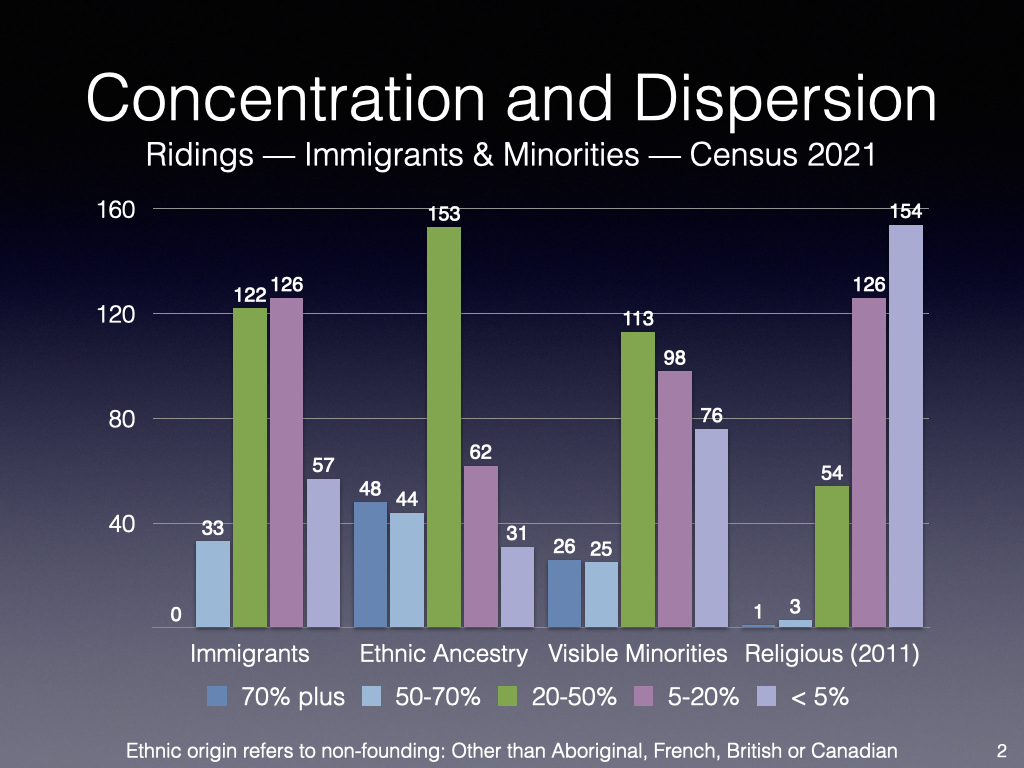
Figure 1 contrasts immigrants, non-founding ethnic ancestry or origin, visible and religious minorities by their percentage in ridings, highlighting the large number of ridings with significant population shares of each group.

Figure 2 highlights the growth of ridings where visible minorities form a significant share of the population. The number of ridings in which visible minorities form a majority of the population has increased from one in ten (33) in 2011 to close to one in six (51), reflecting high and increasing levels of immigration. Moreover, the number of ridings with significant numbers of visible minorities (20 to 50 percent) has also increased significantly, reflecting ongoing immigration to smaller urban and suburban centres.

While the number of ridings with between five and 20 percent visible minorities has stayed relatively constant, the percentage of visible minorities has increased by five percent or more in about half of these ridings.

In contrast, there are only four ridings in which religious minorities form the majority, an increase of two compared to 2011, with 54 ridings in which religious minorities are between 20 and 50 percent, an increase of 12 compared to 2011.

Figure 3 shows ridings with a majority of visible minorities by province, with Ontario, British Columbia and Alberta having the greatest share and increase compared to the 2016 census. These are all ridings where one can expect all parties to run visible minority candidates, most likely from the largest visible minority group in the riding.

However, virtually all provinces have an increased number of ridings with between 20 and 50 percent visible minorities, and thus ridings where visible minorities are a significant constituency.

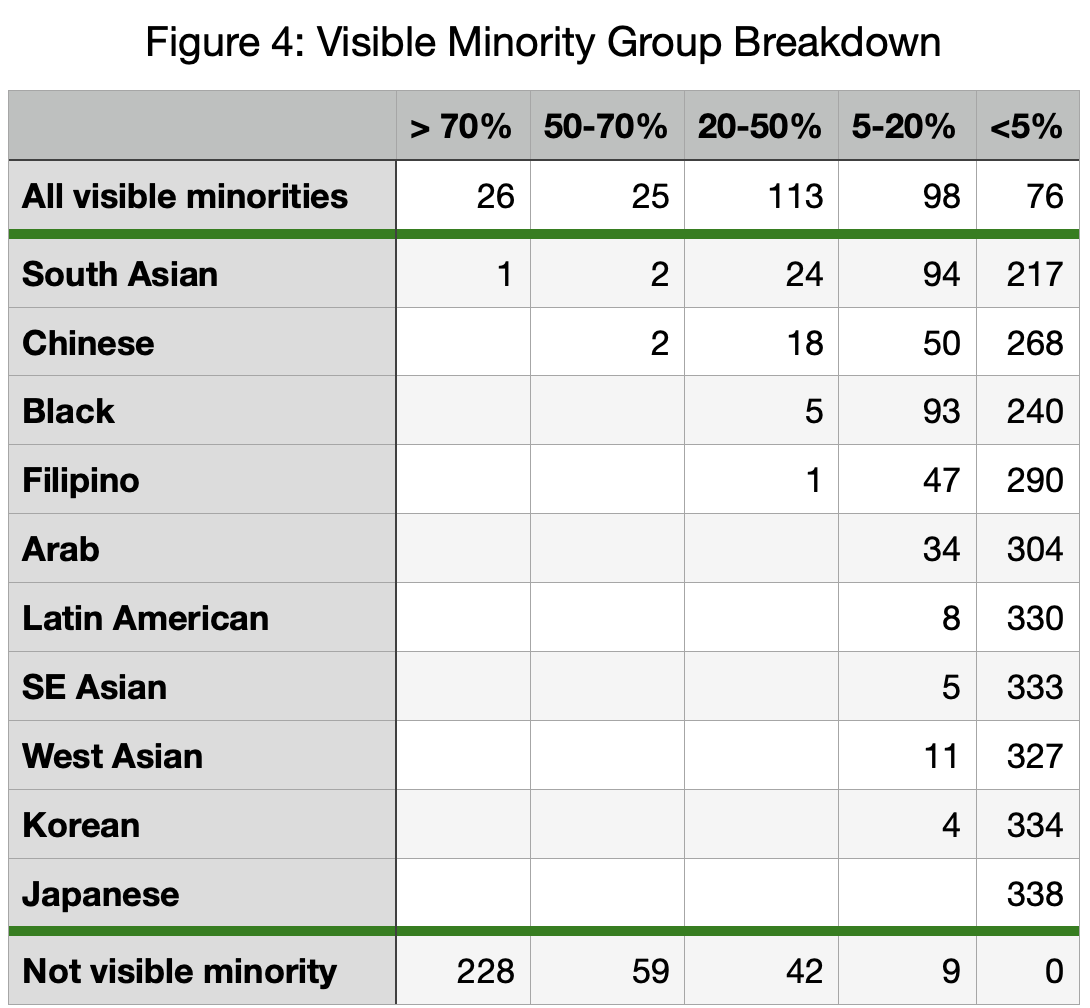
Figure 4 provides the breakdown by visible minority group, with only South Asians and Chinese being a majority of the population (five ridings out of 51 – Brampton East and West, Surrey-Newton for South Asians, Markham-Unionville and Richmond Centre for Chinese), highlighting that most visible minority majority ridings have a mix of visible minority groups. All visible minority groups are present in ridings with between 5 and 20 percent, save Japanese.

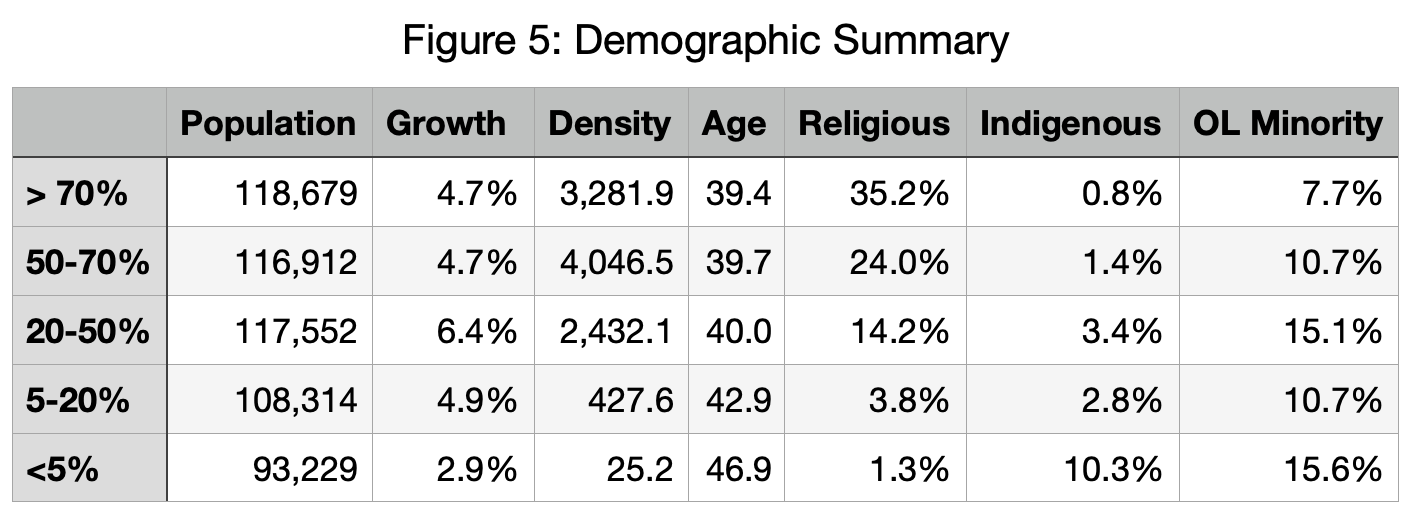
Demographic and socioeconomic characteristics vary by percentage of visible minorities as shown in Figure 5.

Visible minority majority ridings are characterized by larger populations, moderate growth, high densities, a younger population, a higher percentage of religious minorities and a low percentage of Indigenous peoples, with the reverse generally being the case for ridings with less than 20 percent visible minorities, highlighting the differences between rural and urban Canada. The highest growth occurs in ridings with 20 to 50 percent visible minorities, ridings that are increasingly diverse. The percentage of religious minorities correlates with the percentage of visible minorities. There is no overall pattern with respect to official language (OL) minorities.

As one would expect, the higher the percentage of visible minorities, the higher the percentage of immigrants and conversely, the lower the percentage of citizens given residency and other requirements as shown in Figure 6. The period of immigration highlights the contrast between earlier waves of immigration, largely European in origin and in low visible minority ridings, and later waves, largely visible minority, with an impact across all ridings, particularly in the last five years and in ridings with lower overall percentage of visible minorities.

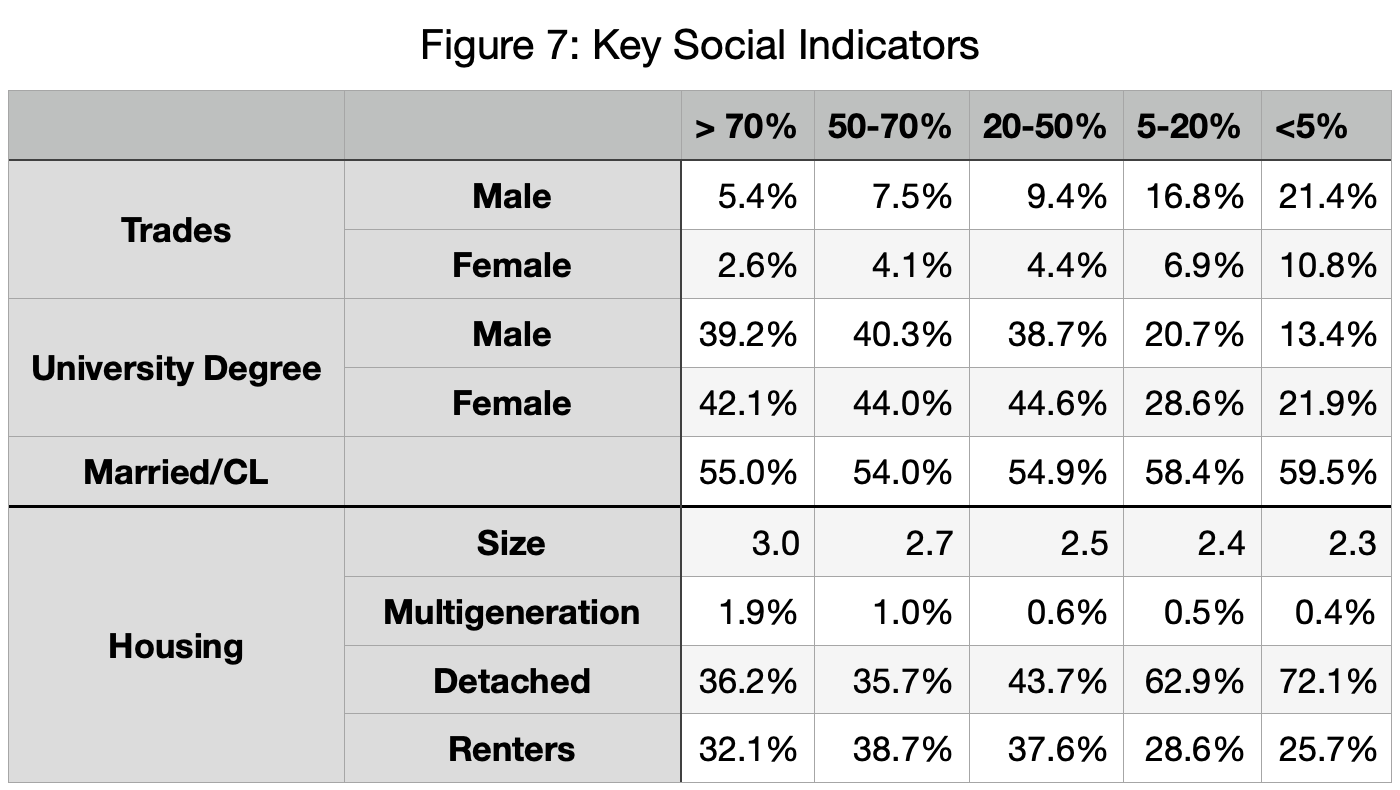
Figure 7 highlights educational attainment (trades and university degree, the percentage of married or common-law couples, household size, and whether residents form part of  multigenerational households, are in single-detached housing and the percentage of renters. Trades are more prevalent in ridings with fewer visible minorities and university diplomas more prevalent in ridings with more visible minorities. Women have higher rates of university degrees across all ridings.

Variations on marriage or common law between ridings are small. Household size directly relates to the percentage of visible minorities whereas the prevalence of single detached homes is inversely proportional. Renting is more prevalent in ridings with between 20 and 70 percent visible minorities.

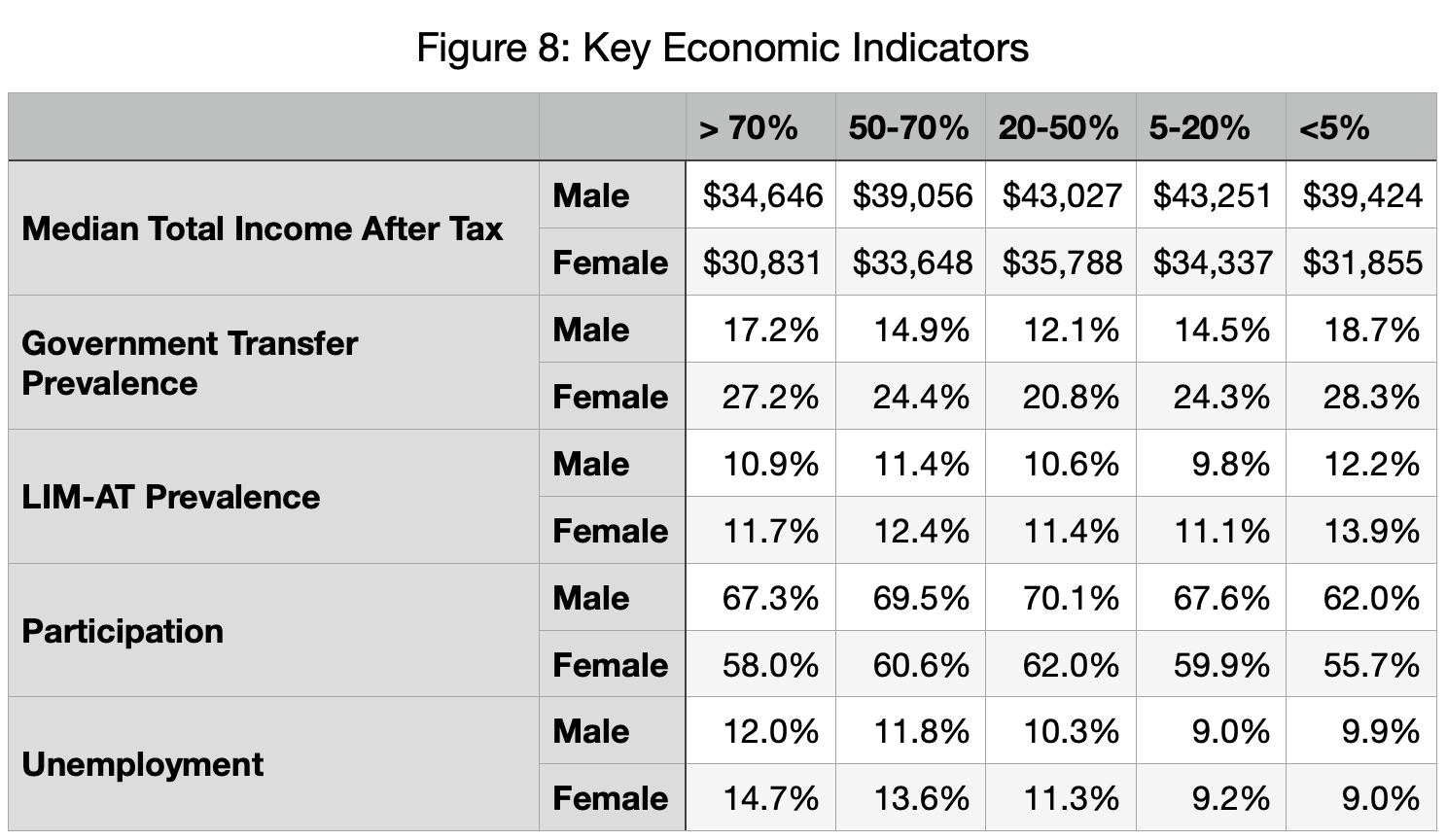
Figure 8 highlights median total after tax income, the percentage of government transfers and income along with participation and unemployment rates. In general, ridings with between 20 and 50 percent have the strongest economic outcomes save for unemployment rates which are lowest in ridings with fewer visible minorities. Outcomes for women are worse overall except with respect to unemployment in ridings with less than 20 percent visible minorities.

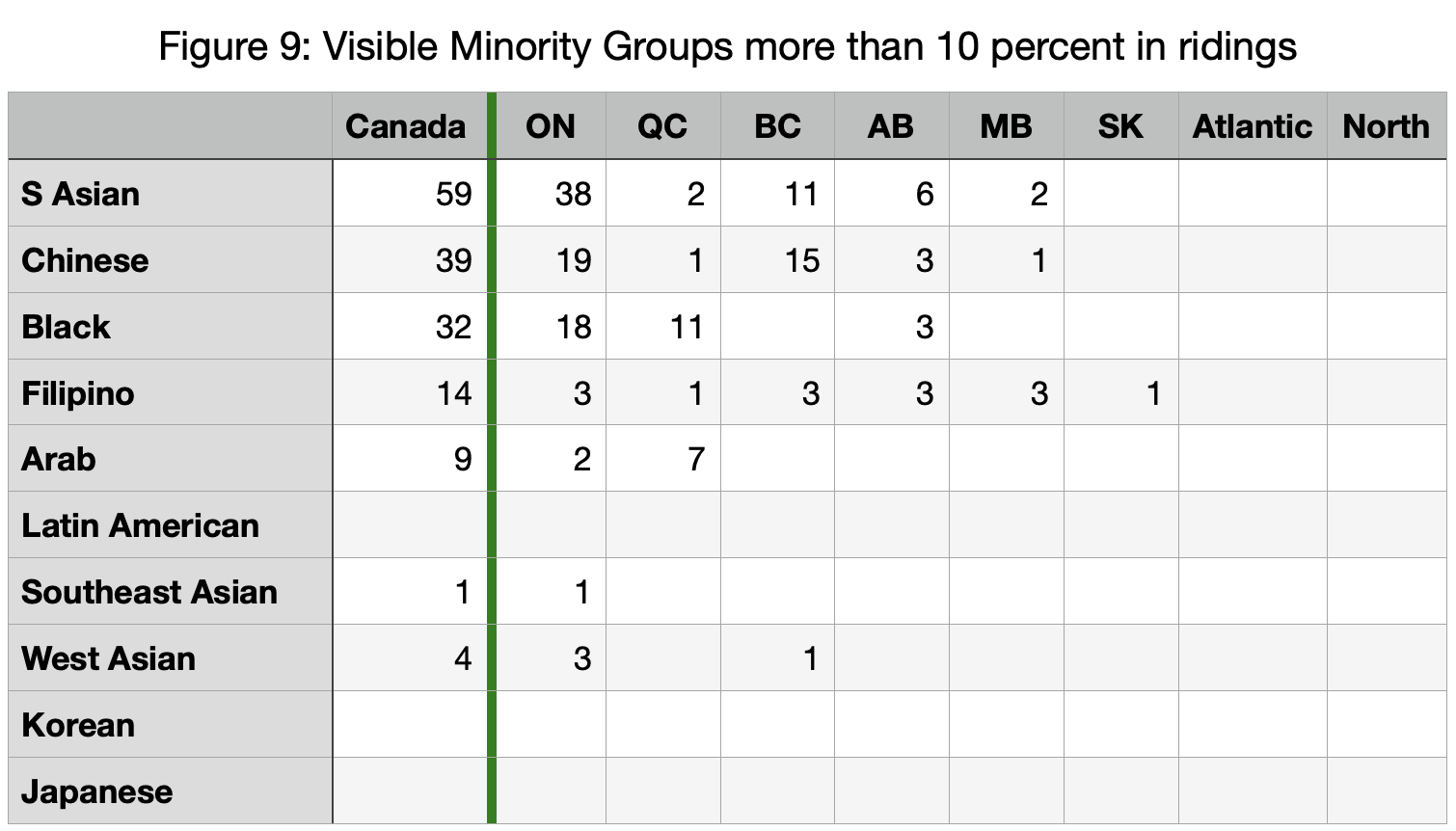
Turning to the political aspect and voter targeting, Figure 9 highlights the number of ridings where a visible minority group forms more than 10 percent of the population, broken down by province, again demonstrating the extent to which political parties need to address specific group concerns. Only Latin American, Korean and Japanese have no ridings with ten percent or more of the population; however, with a threshold of five percent, only Japanese have no ridings of significant concentration. Regionally, there are no ridings in Atlantic Canada and the North with one visible minority group forming 10 percent of the population but six ridings where one group forms more than five percent: three South Asian, two Black and one Chinese.

Figure 10 highlights the 190 ridings where a religious minority forms more than five percent of the population as a threshold of ten percent would exclude Buddhist and Indigenous spirituality. Most groups are concentrated in a number of ridings, with Muslims dispersed across the greatest number of ridings.

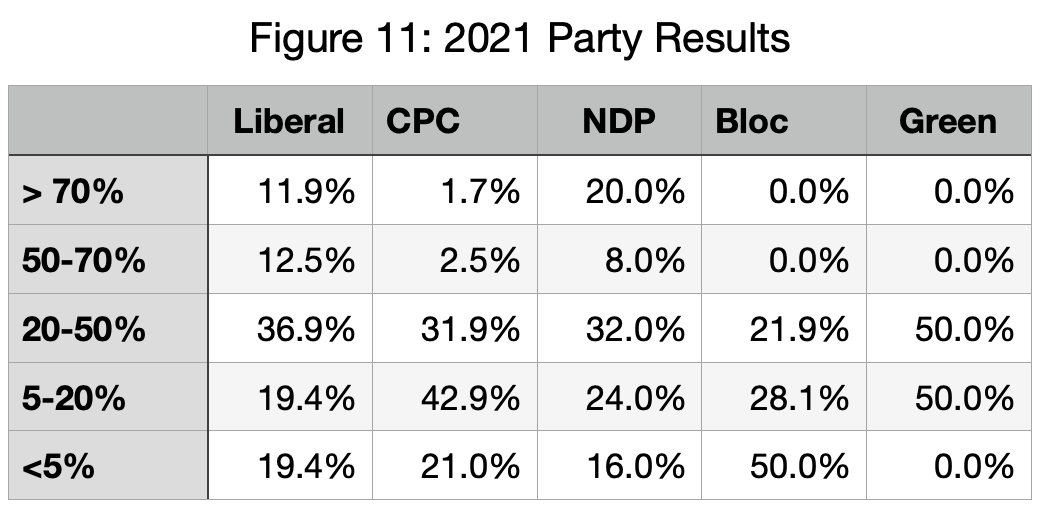
Figure 11 breaks down the 2021 election results, highlighting the relative strength of the Liberals and NDP in visible minority majority urban ridings and the relative strength of the Conservatives in ridings with between five and twenty percent visible minorities. Compared to the 2015 election, the biggest change was the increase in the relative share of NDP MPs in visible minority majority ridings and the Conservative and Bloc relative share increase in ridings with between 20 to 50 percent visible minorities. These ridings can flip; in 2011, the Conservatives won a majority of ridings with more than 50 percent visible minorities.

Concluding observations

All parties have candidate selection, policy and other electoral strategies to engage these communities and the ongoing increase in the number of visible minority candidates and MPs reflects these strategies. Substantively, there are no major differences in attitudes between immigrants and non-immigrants across a range of immigration-related issues.

While some visible minority groups have a tendency to vote for a particular political party, there is political diversity in all groups resulting in no party ignoring any group. Earlier waves of immigrants, mainly European origin, tend to lean Conservative compared to more recent waves, mainly visible minority, tend to lean Liberal.

Visible minority and immigrant groups are affected by perceived singling out or dog whistles, as the Conservatives learned to their cost in 2015, with the “barbaric cultural practices” tip line and the strength of the Liberal language “a Canadian is a Canadian is a Canadian” in response to the Conservative government’s citizenship revocation provision of C-24. Immigration-specific issues such as the ease of family reunification also play a role.

But in general, visible minority voters are more affected by overall campaign themes and issues, whether these be with respect to campaign tone, general concerns regarding the economy, housing, and healthcare, and largely follow the overall electoral trend at national and regional levels.

Riding characteristics impact upon voting patterns. Visible minority majority ridings have lower incomes and higher unemployment which generally play to left and left-of-centre parties. Similarly, larger family size and more multigenerational households in these ridings suggest that political parties target their messaging accordingly.

No major party is arguing against increased immigration, nor is any province except for Quebec. Public support is strong. Apart from administrative issues like backlogs and poor Immigration, Refugees and Citizenship Canada service, debates and discussion focus more on the practicalities and impact of immigration on housing affordability, healthcare stresses and infrastructure gaps. More recent commentaries are focussing on these negative impacts but in a non-xenophobic manner. After all, these issues affect immigrants and non-immigrants alike, helping to reduce polarization.

Methodology:

All data is from the Census profile given that it provides riding-level data. Indicators were chosen based on their pertinence. Non-founding ethnic ancestry includes all groups save for English, Scottish, Irish, Welsh, Canadian, French and Indigenous (Census allows for multiple responses). Electoral results data is from Elections Canada.

Andrew Griffith is the author of “Because it’s 2015…” Implementing Diversity and InclusionMulticulturalism in Canada: Evidence and Anecdote and Policy Arrogance or Innocent Bias: Resetting Citizenship and Multiculturalism and is a regular media commentator and blogger (Multiculturalism Meanderings). He is the former Director General for Citizenship and Multiculturalism and has worked for a variety of government departments in Canada and abroad and is a fellow of the Canadian Global Affairs Institute and Environics Institute. 

Source: The Political Impact of Increased Diversity: What the Census Shows