Canada needs 300,000 new rental units to avoid gap quadrupling by 2026: report [the Achilles heel of Canadian immigration policy]

Housing is the Achilles heel of Canadian immigration policy and levels:

Canada’s rental housing shortage will quadruple to 120,000 units by 2026 without a significant boost in stock, Royal Bank of Canada said in a report Wednesday.

In order to reach the optimal vacancy rate of three per cent, the report suggested Canada would need to add 332,000 rental units over the next three years, which would mark an annual increase of 20 per cent compared with the 70,000 units built last year.

The research analyzed vacancy rate data released in January by the Canada Mortgage and Housing Corporation (CMHC).

Canada’s vacancy rate fell to 1.9 per cent in 2022, its lowest point in 21 years, from 3.4 per cent in 2020 and 2021.

Competition for units also drove the highest annual increase in rent growth on record, by 5.6 per cent for a two-bedroom unit.

Canada’s rental housing stock grew by 2.4 per cent in 2022, led by Calgary at 7.4 per cent and Ottawa-Gatineau at 5.5 per cent, while Toronto and Montreal saw the smallest percentage increases at 2.1 per cent and 1.4 per cent, respectively.

“We haven’t seen that many additions to the purpose-built inventory in almost a decade, so you would think that added supply of units would ease some of the competition, but what the CMHC rental market data revealed to us was that it didn’t,” said RBC economist Rachel Battaglia.

Slow growth in Canada’s two most populous cities has been outpaced by rapidly increasing demand, partly fuelled by high immigration levels, she said. Annual federal immigration targets are set to grow eight per cent by 2025, meaning demand is unlikely to let up.

Battaglia also pointed to affordability and behavioural preferences for the influx of rentals sought. She said more Canadians are choosing to live alone, meaning fewer incomes per household.

“You have a lot of people being funnelled into the rental market who maybe would have liked to own something but it’s just not financially in the books for them right now,” said Battaglia.

The report estimated an existing deficit of 25,000 to 30,000 units of rental stock across Canada. In addition to building more supply, it recommended turning condo units into rentals, converting commercial buildings and adding rental suites to existing homes to help ease the pressure.

Without such measures, Battaglia said the market could “become infinitely more competitive.”

“Which is not something that we want to realize given the competition we’re already seeing,” she said.

“You’re already seeing rents increase dramatically.”

Source: Canada needs 300,000 new rental units to avoid gap quadrupling by 2026: report

Why Ontario needs to collect race-based health data

While written from the perspective of Black Canadians, applies to all visible minority groups:

Statistics Canada has published mortality data for the Black population for the first time. The findings highlight the urgent need for systematic collection, analysis and use of race based data if we are going to deliver equitable health care.

Statistics Canada merged census data and death certification and reported that Black people in Canada are more likely than white people to die from HIV/AIDS, diabetes, hypertension, stroke, kidney disease, endocrine disorders and prostate, stomach and uterine cancers. 

Black men and women are five and 22 times, respectively, more likely to die from HIV/AIDS than the white population. But there was also a 10 to 70 per cent increased death rate for the Black populations compared to the white populations for other illnesses. 

For Black men, the risks of prostate cancer death were increased 30 per cent, diabetes 35 per cent and cerebrovascular disease 10 per cent. For women, there were increased risks for dying from stomach cancer (76 per cent), uterine cancer (78 per cent), and diabetes mellitus (48 per cent). 

Socio-economic factors are part of the reason for differences in death rates. But even when these are taken into account, significant disparities persist. 

Our health-care system lacks the foresight to identify those who need the most help and building services that meet their needs. We are currently witnessing efforts to move on from COVID-19, though infections persist; we have a health-worker shortage that will exacerbate problems of access to care, and this could all be made worse by a focus on privatization.

These crises affect us all. But, some will be more impacted than others and we have no way of knowing the true extent of the harm because we do not routinely collect sociodemographic data in the health system.

As of Jan. 1, all Ontario school boards were required to collect race-based data. Our health-care system should commit to the same as there is evidence that collecting race-based data is an effective tool for improving health.

A 2019 study found that Black women were under-screened for cervical cancer, which increased their risk of worse outcomes. To address this, TAIBU Community Health Centre developed a highly effective Afrocentric cancer screening program. The rates of breast, colorectal, and cervical cancer screening increased from 17 per cent to 72 per cent, 18 per cent to 67 per cent, and 59 per cent to 70 per cent, respectively. 

Without the data from research on racial health disparities, the health concerns and needs of Black communities would have been ignored.

The Black population was at higher risk of getting COVID-19 during the first year of the pandemic. One third of employed Black women worked in health or social assistance jobs compared to 22 per cent of nonvisible minorities and because the Black population has the second highest poverty rates in Canada they were more likely to be using public transit and living in crowded housing.

Because Ontario public health units collected race-based data during contact tracing in the early pandemic, health officials were able to identify that Black populations had higher rates of infection. They used this information to develop community-based strategies to decrease infection, hospitalization and death.

Sadly, Ontario public health units no longer collect race-based data systematically. Contact tracing stopped as COVID-19 rates rose and no other system of race based data was put in its place. Further, Ontario did not mandate vaccination sociodemographic data collection.

Data collection by public health across Ontario was possible when the harms of anti-Black racism were on full display in 2020, and political will and public attention spotlighted community concerns. But this was short-lived, focused only on COVID -19 infection and ended mid 2021.

Without the collection, utilization and proper governance of race-based data, our disproportionate pain and deaths go unacknowledged, unaddressed and invisible.

We cannot afford to wait for another racial justice reckoning to reach popular discourse for change to happen.

Fiqir Worku, Paul Bailey and Kwame McKenzie are members of the Black Health Equity Working Group.

Source: Why Ontario needs to collect race-based health data

Le «Québec bashing» pour faire avancer l’agenda islamiste

Of note:

Je suis arrivée du Maroc en 2005 accompagnée de mes deux jeunes garçons de un et trois ans. Je ne me sauvais pas d’une situation de violence particulièrement grave, mais d’un état de dépendance et de soumission assez banal pour une femme dans une culture arabo-musulmane.

Cela n’a pas été facile de redémarrer une vie de mère de famille monoparentale dans un nouveau pays, mais le Québec a été pour moi une destination de rêve, et je suis reconnaissante de l’accueil dont j’ai bénéficié. J’ai toujours trouvé injustes les accusations de racisme et d’islamophobie dont les Québécois sont la cible. Je me sens plus respectée au Québec que je ne l’étais dans mon pays d’origine. C’est ici que je me suis sentie citoyenne à part entière, libre de mener ma vie comme je l’entendais, sans jugement, et j’ai le sentiment d’avoir bénéficié de l’égalité des chances.

On parle beaucoup d’islamophobie, mais on ne parle jamais de la pression communautaire qui pèse sur les ressortissants des pays arabes pour les forcer à se conformer à des normes culturelles et religieuses et les empêcher de s’intégrer dans leur pays d’accueil. Mon expérience récente dans le milieu associatif montre à quel point il est difficile de faire émerger un islam humaniste au Québec, et comment les accusations de racisme et d’islamophobie contre les Québécois sont utilisées pour faire avancer des objectifs islamistes.

J’avais envie de m’investir dans le milieu associatif pour aider d’autres ressortissants de pays musulmans, surtout les jeunes, à s’en sortir. Je voyais le danger de la radicalisation et l’influence que certains prédicateurs ont sur les jeunes ici même, à Montréal. Mon neveu de 25 ans habitant à Laval, plein de talent et de joie de vivre, artiste peintre, parolier, bon joueur de soccer, est soudain tombé entre les griffes du radicalisme. Du jour au lendemain, il a arrêté ses études, ses activités artistiques et le sport, pour se consacrer à la religion. J’avais tellement envie de crier fort : laissez les enfants vivre sans influence religieuse, arrêtez de les endoctriner.

Dès que j’en ai eu la possibilité, j’ai donc décidé de m’investir dans la société civile. Le passage à Montréal d’un penseur égyptien prônant une approche humaniste de l’islam m’en a donné l’occasion. Autour de ce penseur, la possibilité de créer une association de citoyens de culture arabo-musulmane favorables à la laïcité s’est présentée. Dans le cadre de cette nouvelle association, nous avons commencé à organiser des activités culturelles et des rencontres virtuelles avec des membres dans différentes villes du Canada et des États-Unis.

Arme aux mains des intégristes

Cependant, une personne très connue dans le milieu associatif et très influente dans une certaine communauté musulmane de Montréal prenait de plus en plus de place dans la direction de l’association. Le temps accordé aux personnes non pratiquantes, athées ou favorables à la laïcité diminuait au bénéfice de nouvelles personnes qu’il invitait, ayant des idées plus proches d’un islam radical. Lorsque je lui en parlais, il m’expliquait qu’il était important d’écouter ces personnes pour les amener un jour à changer d’idées.

Je n’étais pas convaincue par ses arguments, mais étant donné sa notoriété et son expérience associative de plus de trente ans, j’acceptais. Cependant, plus le temps passait, plus des personnes défendant l’islam politique se joignaient à l’association qui, rappelons-le, avait été créée justement pour faire face aux idées de l’islam politique.

À chaque occasion qui se présentait — rencontres en personne, virtuelles ou téléphoniques —, ce monsieur trouvait le moyen de décrire le Québec comme une province raciste et islamophobe. Il utilisait toutes les tribunes pour diaboliser le Québec. Lorsque j’intervenais pour parler de mon expérience positive au Québec, il ridiculisait mes propos et expliquait que si j’étais bien accueillie, c’était en raison de mes positions « anti-islam ».

Ma position en faveur de la loi 21 est ce qui m’a valu le plus de moqueries de sa part. Il insinuait que je voulais plaire aux Québécois et que je n’étais qu’un instrument entre leurs mains. Lors de la nomination d’Amira Elghawaby comme représentante canadienne à la lutte contre l’islamophobie, il fit des pressions sur moi pour que je ne puisse pas exprimer mon avis contre sa nomination.

C’est à la suite de la dernière rencontre que j’ai décidé de quitter l’association. Parmi les intervenants, il y avait une maman syrienne qui racontait son expérience douloureuse en nous montrant la photo de sa fille dans la vingtaine tuée par Daech [groupe État islamique]. Lorsque la réunion fut terminée, ce monsieur réagit violemment en interdisant la diffusion d’une vidéo présentant nos interventions et déclara que la maman n’aurait pas dû qualifier Daech d’organisation terroriste.

L’association dont j’avais été membre fondatrice n’avait plus rien d’humaniste ni de laïque.

Je ne sais pas quel sera le mandat de la représentante canadienne à la lutte contre l’islamophobie, mais je sais que ce concept est une arme aux mains des intégristes pour faire avancer leurs objectifs politico-religieux et pour creuser un fossé entre les musulmans et les autres. Il y a de quoi s’inquiéter.

Source: Le «Québec bashing» pour faire avancer l’agenda islamiste

Record jump in LGBTQ, religious hate crimes cases reported to police, with men and boys main targets

Previously reported but richer data:

A new report shows a record jump in hate crimes against the LGBTQ, Muslim and Jewish communities, prompting calls for more support for victims of the abuse.

The analysis based on police reports also showed around half of Canadians committing hate crimes had been accused of other crimes before and after those incidents.

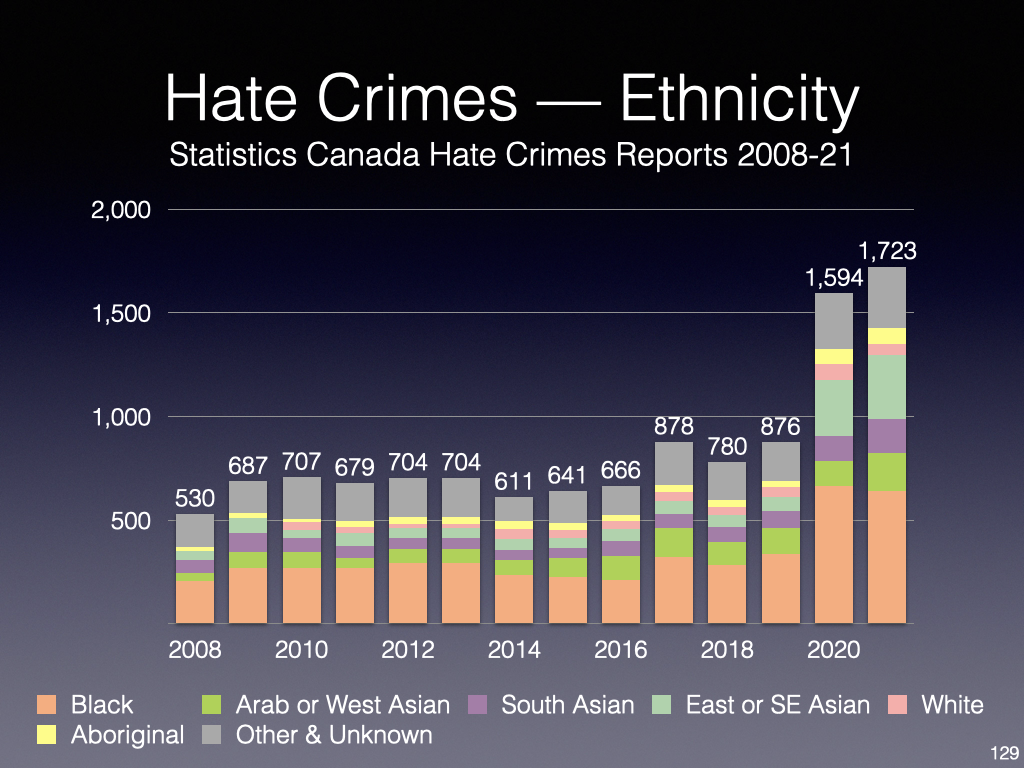
The Statistics Canada hate crimes report notes that in 2021 there was a 64-per-cent rise in crimes against members of the LGBTQ community and a 67-per-cent increase in incidents linked to a person’s religion.

A further analysis of these police cases from 2018 to 2021 showed investigators found that two-thirds of the victims were boys and men, most of whom didn’t know the suspect – unlike victims of other crimes.

Almost half of the hate crimes cases were “violent,” including assault, harassment and uttering threats.

The number of hate crimes reported by the police, including military police, rose by 27 per cent to 3,360 in 2021 from 2,646 incidents in 2020.

Mohammed Hashim, executive director of the Canadian Race Relations Foundation and chair of the RCMP’s hate crimes task force, said the numbers are “an underrepresentation of the actual problem of hate in Canada.”

“Most people do not report hate crimes to the police mainly because they don’t have faith that anything will come of it,” he said, adding the statistics for 2022 are likely to show an even greater increase.

The Statscan report says: “Police data on hate crimes reflect only the incidents that come to the attention of police, and are classified as hate crimes.”

Just over one in five of the incidents resulted in “the laying or recommendation of charges,” the Police-Reported Hate Crime report said.

The analysis delved into who was committing the crimes and found that a cohort of almost 3,000 people are committing repeated offences. Between 2012 and 2018, 2,872 people were accused of at least one hate crime.

Just under half of them had been accused of an incident reported to the police – which may not relate to hate crimes. Fifty-four per cent came into contact with police again within three years after their “initial hate crime violation.”

The Statscan findings, published Wednesday, said after three consecutive years of decline, there was a 67-per-cent increase in reports of hate crimes based on religion.

That included a 71-per-cent jump from 2020 of hate crimes targeting Muslims, a 47-per-cent increase in hate crimes targeting Jews and a 260-per-cent surge in attacks on Catholics.

There were 423 hate crimes reported because of sexual orientation, up from the previous peak in 2019 of 265.

Tyler Boyce, executive director of the Enchante network, which includes over more than LGBTQ organizations, said the statistics were an understatement of the amount of abuse gay and lesbian people experience, and more support was needed. He expressed concern that Statscan does not track abuse directed at transgender people.

Mr. Boyce blamed the far right for fuelling a record number of attacks on members of the LGBTQ community. 

“We are seeing a rise in online hate and people are feeling emboldened to take this from an online space to in-person,” Mr. Boyce said.

Ontario had just over half of all hate crimes directed at people on the basis of sexual orientation.

Unlike other crimes, a large proportion of violent hate attacks were committed by strangers. In 3 per cent of cases, victims were killed or very badly injured. 

Based on population, members of the Jewish community were the most targeted religious group with 145 incidents per 100,000 people, followed by Muslims who experienced eight hate crime incidents per 100,000. Catholics experienced one incident per 100,000 people in 2021.

Nicole Amiel, of the Centre for Israel and Jewish Affairs, said Canadian Jews were more than 10 times more likely than other religious minorities to report being the target of a hate crime.

Fatema Abdalla, of the National Council of Canadian Muslims, said many hate crimes directed at Muslims were not reported to the police, but the council has seen a rise in people calling them for support after being attacked or abused in public.

Source: Record jump in LGBTQ, religious hate crimes cases reported to police, with men and boys main targets

Carlaw: Declining naturalizations signal larger problems in Canada’s citizenship and immigration system

Left-wing perspective on problems with the citizenship program, with most of the issues pertaining more to immigration, particularly temporary residents, than citizenship save for perhaps fees and some of the language and learning requirements. Dual nationality prohibitions are more of an issue for Chinese nationals than Indian nationals.

And a bit silly to say the problem that the problem reflects that political and bureaucratic institutions are “disproportionately composed of men of primarily European descent discounting the earlier changes that were made by the same group and while political institutions continue becoming more diverse.

Surprising in his catalogue of issues, Carlaw failed to mention the long-promised revision of the citizenship study guide, Discover Canada, to a more contemporary and inclusion narrative:

recent press release from the Institute for Canadian Citizenship that cites Statistics Canada data has highlighted concerns over a 40 per cent reduction in Canada’s “naturalization rate” — the rate at which permanent residents are becoming citizens.

The release, headlined Newcomers falling out of love with Canadian citizenship generated a number of other media headlines.

Concerns over how and whether those living and working in Canada are attaining citizenship and important rights — including to vote and run for office — are of course well placed. But love of country by immigrants is not the primary problem.

Individual choices and sentiments are a relevant factor, but there are observable structural explanations. Beyond Canada’s control, not all countries permit dual citizenship. That includes major source countries China and India where many immigrants to Canada are from. It is understandable that some permanent residents prefer not to renounce the citizenship of their country of origin. 

But within Canada’s control, there are troubling shifts in our overall citizenship and immigration model. Inequalities connected to its colonial nature have left growing numbers of residents without citizenship or even a pathway to it.

Annual immigration levels, for example, only represent those accepted as permanent residents and obscure the number of those admitted to Canada under less secure conditions.

This has occurred thanks to under-discussed but at times controversial shifts from permanent to temporary or multi-step migration

These shifts can be obscured by focusing primarily on the naturalization process and the sentiments some attach to it rather than the larger settler colonial landscape of migration and immigration and its relationship to citizenship and belonging at each stage.

Unkept promises and unlearned lessons

In recent years, Canada has apologized for past discriminatory immigration measures and its treatment of Indigenous Peoples. And there have been recent symbolic advances recognizing First Nations, Inuit and Métis communities and Canadians’ treaty responsibilities in the citizenship oath

However, social exclusions in modern forms related to the project of Canadian nation-building, citizenship and belonging persist. They are even intensifying in important respects.

recent report from the Yellowhead Institute found that, despite an expressed commitment to fully implement the Truth and Reconciliation Commission’s 94 Calls to Action, the Federal government has only fulfilled 13, with those providing symbolic rather than structural remedies.

This example is indicative of why many Indigenous people — themselves denied the vote for much of Canada’s history — understandably view Canadian citizenship as, at best, a “kinder, gentler form of colonialism.”

These realities also remind us that the terms and hierarchies of citizenship and societal membership in Canada shift over time. They are subject to social struggle. And apologies and symbolic advancements do not relegate mistreatment to the past. 

Hierarchies of belonging persist

“White Canada” immigration policies that favoured European immigrants and largely excluded those from elsewhere were in place until the 1960s. 

These entrenched institutional and demographic dominance by white settlers. Europeans immigrating to Canada in earlier periods had ready access to permanent residence and eventual citizenship, unlike many of their contemporary racialized counterparts.

Institutional racism continues to be felt in the country’s immigration system and political life as tiers of citizenship and belonging continue to be practiced in old and new forms.

Canada adopted official multiculturalism in 1971, yet two years later it entrenched migrant worker programs, primarily for racialized workers from the Global South. As with past exclusions, these workers still have to navigate programs and realities that prevent or make it difficult for them to access permanent residence and citizenship.

This is particularly the case for those working in what are deemed to be “low skill” positions. Many such workers become “permanently temporary” despite ongoing demands for their labour.

Today, Canada’s political institutions are still disproportionately composed of men of primarily European descent. And they continue to set and enforce problematic terms of citizenship and societal membership. 

Today’s more difficult pathways to citizenship

Today’s immigrants — who mostly come from the Global South — face a system of complex chutes and ladders when it comes to their status in Canada. That system leads many migrants to remain stuck in an immigration purgatory, far away from pathways to permanent residence, let alone citizenship.

Even those often characterized as the perfect immigrants — international students who pay vast sums that subsidize our post-secondary education system — face limited and precarious pathways to permanent residence and citizenship. 

As economist Armine Yalnizyan recently noted, today for each person granted the security of permanent residence, there are two migrant workers or international students who have uncertain or no access to permanent status.

This could prove an obstacle to attracting and retaining workers. When it comes to citizenship and societal membership, it hinders inclusion by creating an exploitable class of workers who lack full political and social rights.

In the face of these realities, many migrants, students and workers are mobilizing to address these exclusions. This includes protests in several cities demanding “status for all” to mark the International Day for the Elimination of Racial Discrimination.

To return to the later stages of the process of becoming Canadian by adopting citizenship, under the former Conservative government, citizenship became harder to get and easier to lose by design.

Unfortunately, amidst the last decade’s battles between more exclusionary Conservative and rhetorically warmer Liberalvisions of citizenship, tougher and more expensive procedures than previously existed remain under both.

The costs of applying for citizenship increased significantlyunder the Conservatives, and have remained prohibitive for many. The Trudeau government has made some positive reforms, such as reversing changes that made it take longer to become a citizen. But it has failed to follow through on its election promises to eliminate citizenship fees.

One recent study argues that it is likely that fee hikes and tougher, often expensive language requirements negatively impact a significant number of applicants.

Even those who have managed to obtain permanent residency and fulfilled their residency requirements face further “boundaries related to management flaws, classed naturalization, and cultural biases.” That means many, particularly refugee claimants and family class immigrants, struggle with the citizenship process.

For those who can reach the end of the process, some find it distasteful to continue to have to declare an enforced oath to a colonial figure, a reminder of the structures and hierarchies discussed in this article. 

Given this context, the significant decline in Canada’s naturalization rate should be less surprising, though no less alarming as Canada continues to foster and even intensify inequalities of societal membership in its citizenship and immigration regime.

Source: Declining naturalizations signal larger problems in Canada’s citizenship and immigration system

Black Torontonians ‘significantly’ more likely to face discrimination on regular basis, study finds

Of note:

Black people in Toronto are “significantly” more likely to face discrimination on a regular basis than white residents, according to a recent in-depth report on Torontonians’ day-to-day experience with microaggression and discrimination.

A research brief entitled Everyday Racism: Experiences of Discrimination in Torontoreleased Tuesday highlighted findings on discrimination pulled from the Toronto Social Capital Study published in November.

The first-of-its-kind report, led by the non-profit Toronto Foundation and Environics Institute for Survey Research, found that roughly 76 per cent of Black Torontonians experience racial discrimination at least a few times a month.

Source: Black Torontonians ‘significantly’ more likely to face discrimination on regular basis, study finds

After months of backlogs, Canadians can now check their passport application status online

Progress. Presumably we will see in coming weeks if there are any glitches in the app or hopefully not:

Canadians waiting anxiously for their passports to arrive before a trip abroad now have a new option to check the status of their applications.

The federal government launched a new online portal on Tuesday that allows recent applicants to see where their applications stand.

Passport offices became overwhelmed with applications last year as the government began to ease pandemic-related travel restrictions. The result was a backlog that hobbled the application system.

Source: After months of backlogs, Canadians can now check their passport application status online

An Ottawa-Ontario turf war hobbled efforts to bring in skilled workers. Here’s what ended it

Of interest:

Around the world, ideology drives the politics of immigration by pushing people apart.

Across Canada, geography drives a deeper wedge between rival governments in Ottawa and at Queen’s Park.

Over the past decade, an undeclared turf war has hobbled Ontario’s attempt to recruit skilled workers. The federal government refused to give Canada’s biggest province a significant say in who came here.

Now, Ontario is finally getting a bigger role in selecting skilled immigrants. And Ottawa has belatedly declared peace in our time.

Just in time.

This month, a federal Liberal cabinet minister and his Progressive Conservative counterpart in Ontario agreed to double the skilled immigrants selected by the province for rapid resettlement, matching workers with work. By 2025, Ontario will get to select 18,000 skilled workers, primarily in the health-care, construction and hi-tech fields ― up from 9,000 in 2021 and just 1,000 a decade ago.

How did it happen?

The rise of inflation, the risk of recession, and the recurrence of labour shortages forced Canada’s two biggest governments, at Queen’s Park and on Parliament Hill, to work together after years of talking past each other.

But it’s not just the economic environment. The political climate has also brought the rival governments together to collaborate.

Two erstwhile enemies, Prime Minister Justin Trudeau and Premier Doug Ford, now meet almost monthly to cut cheques and cut ribbons for new factory investments. Against that backdrop of bonhomie, Monte McNaughton, one of Ontario’s most politically astute cabinet ministers, went one step further to bridge the partisan divide with his federal counterpart.

As the province’s minister of labour, McNaughton has long been a linchpin of Ford’s outreach strategy with union leaders. But he also has special responsibility for immigration and training, so when Sean Fraser was sworn in as the federal minister two years ago, McNaughton quickly texted an old pal to get his phone number.

That pal was Katie Telford, the PM’s chief of staff, with whom McNaughton has kept in touch since they served together as teenage pages in the legislature. Armed with Fraser’s number, McNaughton disarmed the new Liberal minister by dropping Telford’s name ― proof that he could work across ideological and geographical lines.

“I got his number from Katie and got ahold of him,” McNaughton told me this week. “I said to him, ‘This is not about politics whatsoever. We have a serious challenge in terms of the labour shortage … so let’s grow the numbers and actually do something that is going to make a meaningful difference on the ground.’”

They’ve been talking and texting ever since ― without political aides, without bureaucratic advisers, just the two of them. They started far apart, because the inherited challenge wasn’t just about bipartisanship but bilateralism.

Historically, the federal government was accustomed to unilateral action while Ontario contented itself with inaction. By contrast, Quebec had led the way decades ago, winning shared jurisdiction on immigration on the strength of its special French-language needs; meanwhile, Western provinces had quietly persuaded Ottawa to let them select thousands of immigrants to meet local labour market needs amid growing economies.

Ontario had never bothered to ask in the past. As the jobs went West, so did the talent.

A decade ago, seven out of 10 immigrants to Western provinces were in the “economic” class, compared to barely half of those coming to Ontario. By the time Queen’s Park woke up to that reality, Stephen Harper’s Conservatives in Ottawa were unwilling to help.

“We’re not interested in devolving services to the junior level of government,” then-immigration minister Jason Kenney told me at the time.

Now, with the roles reversed ― there’s a federal Liberal minister in Ottawa, while his Ontario counterpart is a PC ― the roadblocks have been removed and a back channel reopened.

“I give full credit to Fraser,” McNaughton said in our interview. “We were more desperate than other provinces from a labour shortage perspective. We were receiving, as a percentage, less (skilled nominees) than any other province in the country.”

For his part, Fraser says he never saw it as a turf battle. The economic stakes are too high for political grudges or bureaucratic games.

A mismatched labour market “is one of the challenges that keeps me up at night,” Fraser told me at a recent Democracy Forum at Toronto Metropolitan University (where he also talked about crossing party lines to get advice from ex-PM Brian Mulroney).

If workers end up in the wrong regions for the wrong jobs, while skilled jobs are going begging in businesses elsewhere, all Canadians will pay the price of a delayed recovery and missed opportunity, he argued.

“I think this was a unique opportunity for us to increase (Ontario’s) provincial nominee program levels,” Fraser said at the TMU event I co-hosted last week, adding coyly: “Before too long we’re going to show up in Ontario.”

Days later, both ministers did indeed show up in Toronto to announce their landmark agreement. Ontario’s biggest employers promptly hailed the deal as an economic breakthrough that ruptures previous roadblocks.

Despite the doubling of the program, the new numbers are still small and the progress largely symbolic. But it is a strategic first step.

Immigration always has the potential to drive people apart. Consider the continuing tumult in the U.S. and U.K.

Yet two Canadian cabinet ministers quietly came together, in a bipartisan and bilateral way. They tried to work it out, so that the economics would turn out better for workers and workplaces alike.

Small numbers, yes. But no small feat.

Source: An Ottawa-Ontario turf war hobbled efforts to bring in skilled workers. Here’s what ended it

Ladha: Save citizenship ceremonies – Red Deer Advocate

Yet another editorial against the change:

Citizenship ceremonies are emotional and personal experiences, especially for those of us New Canadians who had the privilege of participating in one. Now the Department of Citizenship and Immigration has given notice that they were contemplating an end in-person citizenship ceremonies in favour of a “secure online solution.” In-person ceremonies could still be arranged upon request, but subject to a delay.

I still remember the citizenship ceremony that I had to attend when I proudly became a Canadian citizen in 1975. Dressed in my Hugo Boss suit, I was with my wife and son, all of us dressed up in our finest, lined up with New Canadians of all backgrounds, happily showing off the Canadian flags.

When the time came to sing the newly memorized national anthem, I was so emotional that my eyes welled up with tears. Every Canada Day, I still have visions of my touching and heart-breaking citizenship ceremony experience, and thankful prayers to Canada for providing a happy, wonderful, and prosperous life. Yes, Canada, I haven’t been disappointed.

I am horrified the government is proposing to abolish this special welcoming in-person citizenship ceremonies with an administrative online box and do away with a group singing “O Canada.” The government brief also notes that the new system will prevent the inconvenience of new citizens having to book time off work to make the ceremony. What a concession!

The fact that Canada, the most friendly and welcoming nation in the world, would resort to a computer-oriented system to announce that immigrants are now citizens is appalling and upsetting. Ceremonies in everyone’s life, be it a birthday or a retirement party, play an important part, signifying a milestone in their lives.

A former minister of immigration under then Prime Minster jean Chretien, himself an Argentinian immigrant to Canada, was so upset that he wrote an op-ed in the Toronto Star, calling it “an insult.” “For years, my parents would recount how momentous and meaningful (the ceremony) was. Why would government want to rob future citizens of this feeling of attachment?”

Another prominent defender former Governor General Adrienne Clarkson who came to Canada as a refugee from Japanese-occupied Hong Kong and presided over a few citizenship ceremonies herself as an Officer of the Order of Canada, said she was “horrified” by the proposed change.

Tareq Hadhad, a Syrian refugee famous for founding the Nova Scotia-based chocolatier Peace by Chocolate, described Canadian citizenship ceremonies as “the magical rituals that bring together everyone (new and old citizens) to celebrate the true meaning of the Canadian dream.”

“We cannot afford to lose the significance of this celebration of belonging nor can we diminish the value of Canadian citizenship,” he added.

Credit should, however, be given to the government for moving a notch forward towards truth and reconciliation of indigenous peoples by officially recognizing First Nations, Inuit, and Métis, and the obligation of all citizens to respect the treaties between the Crown and Indigenous nations.

The new oath now includes “Indigenous, Inuit and Métis rights, and will help new Canadians better understand the role of Indigenous peoples, the ongoing impact of colonialism and residential schools and our collective obligation to uphold the treaties.”

“Canada’s Oath of Citizenship is a commitment to this country—and that includes the national project of reconciliation. This new Oath now includes Indigenous, Inuit and Métis rights, and will help new Canadians better understand the role of Indigenous peoples, the ongoing impact of colonialism and residential schools and our collective obligation to uphold the treaties. This is an important step on our shared journey of reconciliation,” said Carolyn Bennett, Minister of Crown-Indigenous Relations.

“The new language in Canada’s Oath of Citizenship is a concrete step forward on rebuilding relationships with Indigenous peoples as it responds to Call to Action 94 of the Truth and Reconciliation Commission. It is so important that new Canadians understand the rights and significant contributions of First Nations, Inuit, and Métis.”

The new language of the oath reads: “I swear (or affirm) that I will be faithful and bear true allegiance to Her Majesty Queen Elizabeth the Second, Queen of Canada, Her Heirs and Successors, and that I will faithfully observe the laws of Canada, including the Constitution, which recognizes and affirms the Aboriginal and treaty rights of First Nations, Inuit and Métis peoples, and fulfil my duties as a Canadian citizen.”

All Canadians and would be citizens should protest the proposal to replace citizenship ceremonies with something tantamount to “dial a citizen” method. Becoming a citizen by ticking the “Make Me A Canadian” box from anywhere is an impolite method of becoming a citizen of one’s country.

Mansoor Ladha is a Calgary-based journalist and author of three nonfiction books: Off the Cuff, Memoirs of a Muhindi: Fleeing East Africa for the West and A Portrait in Pluralism: Aga Khan’s Shia Ismaili Muslims.

Source: Editorial: Save citizenship ceremonies – Red Deer Advocate

Ukrainians who fled to Canada in ‘grey area’ of immigration system

Of note. Potential risk to absorptive capacity should they remain and should the two-thirds who have not used their visa arrive, in addition to the issues raised by stakeholders.

The increased numbers of temporary residents, students and temporary visas, all uncapped, makes a mockery of Canada’s claim to “manage” immigration, given that well over half are not part of the annual immigration plan and are demand driven as my quote below notes:

Ukrainians who have fled to Canada with an emergency visa find themselves in a “grey area” of the immigration system, and several settlement specialists are urging the government to make changes if the program is renewed.

Canada took a new approach to the crisis sparked by the Russian invasion last year, offering an unlimited number of temporary visas to Ukrainians to allow them to live, work and study in Canada while they figure out their next steps.

The idea was to offer refuge to people as quickly as possible, as millions of women, children and older adults fled the violence, without compromising the integrity of the immigration system.

But people who arrived in Canada under the emergency visa don’t qualify for the same supports as people who arrive with a refugee designation, even though most of them think of themselves as refugees, said Ihor Michalchyshyn, executive director of the Ukrainian Canadian Congress.

They also don’t qualify for certain government assistance, benefits and student loans, as permanent residents would.

“The usual programs and funding aren’t available to these Ukrainians, and it’s not organized,” Michalchyshyn said in an interview Monday.

Nova Scotia immigration program director Simone Le Gendre described the confusion the province faced at the outset of the program because its usual immigration settlement guidelines did not apply to Ukrainians with emergency visas.

“What we had was a grey area – a group of people who had experienced trauma were coming to our province and needed to be connected to support very quickly,” said Le Gendre, who spoke at the Metropolis Canada conference in Ottawa Friday.

The new arrivals had “refugee-like” needs, she explained, which prompted the province to set up special committees aimed at connecting people with housing, health care and income support top-ups.

Their task was made even more difficult by the fact that there was no central registry with arrival information, as there would be for permanent residents or refugees.

Provinces and agencies had no idea when Ukrainians would arrive, said Katie Crocker, the CEO of the Affiliation of Multicultural Societies and Service Agencies in British Columbia.

Instead, agencies like hers, the YMCA, the Ukrainian Canadian Congress and others stood up booths at airports to try to flag down Ukrainian newcomers as they arrived in Canada and let them know what kind of help was available.

The temporary visa program is set to stop taking new applicants on March 31, giving the government two weeks to decide whether to extend it.

So far, 603,681 people have been approved for a visa under the program as of March 9, 2023, though only 184,908 have actually come to Canada.

When asked about the next iteration of the program last week, Prime Minister Justin Trudeau said only that Canada would “continue to be there to support Ukrainian refugees in various ways, as necessary.”

Crocker said if the program continues, the government should consider a few key changes.

“If we’re not going to have them come as government-assisted refugees with a very clear pathway, then we do need to have some more concrete pre-arrival information (from) them about where they’re going, when they’re coming, who’s coming with them, what their English language levels are, what their credentials are,” said Crocker, who also spoke at the conference.

Those key details would allow settlement agencies to prepare for their arrival and connect them with jobs, housing and other resources they might need, she said.

She also suggested the government consider putting a cap on the number of applications it will approve.

The program was specifically designed without a cap as a way to bring people to Canada quickly, Immigration Minister Sean Fraser said last week at a press conference.

“We made the decision at the time to try something new, to offer temporary protection by leveraging the strength … of Canada’s tourism program, where we’re not required to set a capped number of people that we can support, but we can process whatever applications come in,” he said.

The immigration department says approximately 373 staff have been specifically dedicated to processing applications from Ukrainians, in addition to existing staff who work on the files as part of their regular duties.

Whatever “hiccups” associated with the emergency visas that may have affected immigration processing times are “well worth the value,” said Fraser, who spoke last week at a press conference in Bridgewater, N.S.

The assumption at the time was that Ukrainians would likely return to their home country when the war ended. But increasingly, Ukrainians who come to Canada are showing an interest in staying, said Sarosh Rizvi, the executive director of the Alberta Association of Immigrant Serving Agencies.

A post-arrival survey of Ukrainians who arrived under the program shows that 84 per cent would like to become permanent residents once their emergency visas expire, he said.

“What does that mean for our infrastructure sector?” he said. “What does that mean for immigration levels?”

It also leaves an open question about what kind of support will be available to people who decide to stay if they are denied permanent status in Canada, he said.

Andrew Griffith, Canada’s former director-general of citizenship and multiculturalism, said the government should consider creating targets for the number of temporary residents in the country each year, as it does for other kinds of immigration.

“There are those people that come on a temporary basis but then they transition to permanent resident, and because they’re here, they also need housing, and public services and everything like that,” Griffith said in an interview.

Michalchyshyn, who the government has consulted on the next phase of the emergency visa, said he is hopeful the government will announce more details of its plan this week.

Source: Ukrainians who fled to Canada in ‘grey area’ of immigration system