Arabic is not an extension of Islam

Good reminder:

While taking Arabic over four semesters here at Princeton, I have learned about the language as well as about the complexities of incorporating lessons about culture and religion into language instruction. Yet there’s one dynamic I’ve seen clearly:  Arabic courses at Princeton identify the language as representative of the people of a single culture and religion — Islam. This teaches Princeton students to consider the Arab and Islamic world as a monolith, excluding diverse groups such as Jewish, Christian, Baháʼí Arabs, as well as non-Arab Muslims. When presenting regional cultures, Princeton should seek to teach diversity rather than try to encourage a uniform perspective.

Throughout all of the introductory Arabic sequence courses, I’ve seen Arabic presented as an extension of Islam many times. For instance, the textbook teaches students traditional Islamic phrases at a disproportionate rate compared to those from other religions, and the lecturers have sometimes referred to Islamic law as “Arab law.” This sends the message that Islam is the only religion practiced by Arabic speakers, which is factually incorrect — there are prominent Jewish, Christian, and Baháʼí communities, not to mention Zoroastrianism and many others. Similarly, this tendency inaccurately represents Islam as a religion of only Arabic speakers, when in reality, less than 20 percent of Muslims are Arab.

However, the moment during which I felt the most unmistakable conflation of Arabic with the culture and religion of Islam was when the non-Muslim students in my Arabic class were asked by the lecturer to refrain from eating and drinking in class during Ramadan. This request made me realize a bias I had not previously observed: the only religious holidays that we had ever learned about in class were Muslim ones. This felt problematic to me as I felt uncomfortable by the demand for all students to change their behavior for the religious beliefs of some. After voicing my opinion to the class, the lecturer rescinded their request. In a subsequent conversation with the lecturer, they said that they didn’t think asking students to not eat and drink in class for Ramadan was requesting behavior from students for a religious reason but rather that it had to do with the culture of the Arab world. To me, this was curious, as I don’t subscribe to the narrative that a language has only one specific culture associated with it — especially not a language that has over 450 million speakers in 60 different countries. It is listed as an official language in about 30.

It is undeniable that the vast majority of the Arab world — 93% — is Muslim. This, however, does not mean that Islam should dominate religious and cultural lessons in Arabic classes. Minorities matter, and they should not be forgotten, especially because many religious minorities are persecuted in the Arab world. Further, these minorities demonstrate the wonderful diversity and complexity of the Arab world. Moreover, there is no single Islamic culture or version of the religion. For example, not all Muslim sects prohibit depictions of the Prophet Muhammad, nor do all Muslim women believe that wearing a hijab is a legitimate interpretation of Islam, so when only a single version of Islam is presented, some Muslims are misrepresented in their own culture and religion.

The Arab world is not monolithic; not only are there varied cultures throughout the Arabic-speaking world, but there is also no one uniform culture that exists in each Arabic-speaking country. Though in some parts of the Arab world, people do not eat or drink in public during Ramadan — indeed, in the United Arab Emirates, all individuals, including non-Muslims, are prohibited from publicly eating or drinking during fasting hours —  this is not a custom practiced in every Arab country. It is impossible to import the “Arab culture” into an Arabic class because no such culture exists. My father, who grew up in Lebanon, never once discussed a cultural custom of avoiding public food consumption during Ramadan, and when I’ve visited Lebanon, this “part” of the culture has never come up. But to reemphasize an important point, his experience is not an example of “Lebanese culture,” as there is not simply one Lebanese culture. The culture in my father’s home village is different from the culture of other Lebanese communities.

There will always be more than one culture and religion practiced by people who speak the same language. Presenting languages as only being spoken by practitioners of one religion or members of one culture excludes the many others that are just as important. There is no homogenous Spanish culture, Chinese culture, or Russian culture. Even languages that are seemingly spoken by a smaller population, such as Italian, are utilized by multicultural communities.

This does not mean that we must avoid discussing religion and culture altogether in language classes. Rather, language instructors ought to highlight as many religions and cultures as possible in their instruction. Muslim holidays are important for Muslims in the Arab world, just as Jewish holidays are important for Jewish people in the Arab world, Christian ones are important for Christians, and Baháʼí ones are important for the Baháʼí community. Educators should not discuss the cultural practices of only one culture in class, but touch on practices from many cultures. Instead of leaving students with a monolithic idea of the people who speak a language, language classes should highlight the diversity of culture and religion within a specific language-speaking population.

Anais Mobarak is a sophomore from Newton, Massachusetts studying chemistry.

Source: Arabic is not an extension of Islam

Why GDP per capita is becoming the indicator to watch

Indeed:

Canada has been the worst performing advanced economy in the Organization for Economic Co-operation and Development since 1976. Governments of all partisan stripes have tried and failed to reverse the trend. If nothing changes, the OECD projects, our economic growth per capita will continue to stagnate for decades to come. This article is part of an occasional series called Per Capita, which examines how and why policy interventions have come up short – and how fresh approaches to economic growth are urgently needed.

A growing cohort of analysts are tempering their enthusiasm for Canada’s recent economic performance for a simple reason: Strong population growth is bulking up the numbers.

Last week, the Bank of Canada projected that real gross domestic product would increase by 1.4 per cent this year, up from a previous forecast of 1 per cent, and by 1.3 per cent in 2024. The central bank said a key factor in its 2023 upgrade was the surge in population, which is expanding the pool of labour and consumers.

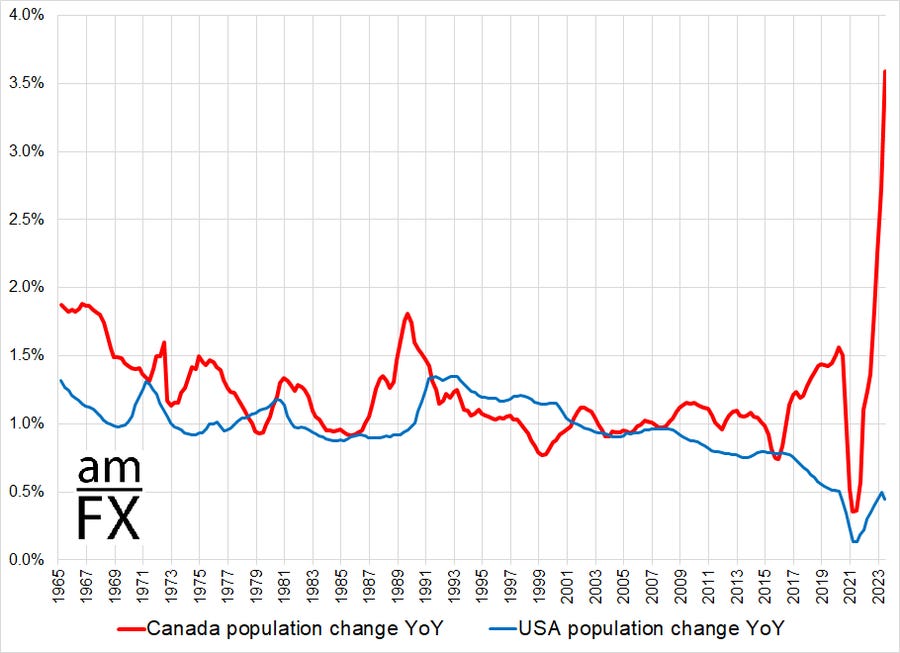
Canada’s population rose by just more than one million people in 2022, an annual increase of 2.7 per cent that was the largest since the late 1950s. This is part of a deliberate plan from the federal government to boost population through higher immigration.

For that reason, some economists say they’re paying more attention to growth in real GDP per capita – or economic output per person, adjusted for inflation – than they used to. And on that front, Canada’s economic performance is decidedly weaker: Per capita output in 2022 was roughly the same as in 2017.

The near-term outlook doesn’t show much upside. Even if population growth cooled to 2019 levels, per-capita GDP would still decline for the next two years, based on the Bank of Canada’s projections for output.

“I don’t see that the federal government is focused on per capita GDP, they’re just focused on GDP,” said David Williams, vice-president of policy at the Business Council of British Columbia.

“If you crank up population growth, sure, the economy gets bigger. But that doesn’t mean that we’re not facing stagnating living standards for the majority of Canadians.”

GDP per capita is often used as a proxy for living standards. The metric is positively correlated with life expectancy and well-being – residents of more productive countries tend to live longer and report being happier.

It is not a perfect measure of prosperity. Per capita output in Canada is around three-quarters of that in the U.S., according to data from the Organization for Economic Co-operation and Development, although Canada enjoys an average life expectancy at birth that is roughly five years longer. However, the U.S. is an outlier in life expectancy among wealthier countries.

Canada’s productivity struggles are hardly new and have been debated for decades. Benjamin Reitzes, a macro strategist at Bank of Montreal, recently noted that the average annual growth in real GDP over the past 10 years was 1.8 per cent, but only 0.6 per cent after adjustments were made for population gains.

Ottawa is aware of this issue – and the potential for decades of mediocrity. In the 2022 budget, the federal government mentioned an OECD forecast that predicts Canada will have the weakest per capita growth among its member countries from 2020 to 2060. “The stakes are high. Most Canadian businesses have not invested at the same rate as their U.S. counterparts,” read the budget.

While Ottawa has acknowledged this productivity issue, some economists are calling on governments to focus more on per capita growth and how to bolster it. (The 2023 federal budget did not repeat its mention of the OECD projection.)

“No per capita growth means Canadian living standards are stagnant,” Mr. Reitzes wrote in a recent note to clients. “Historically, policy makers haven’t paid much attention to the per capita metric. Hopefully, that changes soon.”

The federal government is ramping up immigration levels in the coming years, targeting the intake of 500,000 permanent residents annually by 2025. Most of Canada’s population growth last year was driven by temporary residents, including workers and international students.

Ottawa has frequently said that raising immigration levels is necessary to fill jobs and boost economic growth. However, some of its recent policy decisions have made it easier to fill low-wage roles in lower-productivity sectors with temporary foreign workers.

“We’ve normally tried to target the best and brightest,” said Mr. Williams. “But it seems that there’s been a shift in Ottawa toward saying, ‘Hey, let’s fill these very-low-wage, entry-level jobs.’ And that’s a concern.”

Source:Why GDP per capita is becoming the indicator to watch

Sean Speer: Canada’s ‘big sort’ is breaking down—and the political consequences could be monumental

Interesting analysis:

In 2009, American journalist Bill Bishop wrote the influential bookThe Big Sort, to describe the growing cultural and political bifurcation of American society based on a process of self-selection which, in broad terms, saw educated professionals with progressive political preferences increasingly concentrated in cities and those in non-professional jobs with more conservative politics disproportionately inhabited in rural and peripheral communities. 

As he explained

“What’s happened, however, is that ways of life now have a distinct politics and a distinct geography. Feminist synchronized swimmers belong to one political party and live over here, and calf ropers belong to another party and live over there. As people seek out the social settings they prefer—as they choose the group that makes them feel the most comfortable—the nation grows more politically segregated—and the benefit that ought to come with having a variety of opinions is lost to the righteousness that is the special entitlement of homogeneous groups. We all live with the results: balkanized communities whose inhabitants find other Americans to be culturally incomprehensible; a growing intolerance for political differences that has made national consensus impossible; and politics so polarized that Congress is stymied and elections are no longer just contests over policies, but bitter choices between ways of life.”

Bishop’s thesis had a powerful influence on academic and popular discussions about the cultural and political life of countries like Canada and the United States. It seemed to offer a conceptually and empirically-rooted explanation for contemporary sociological trends, including, for instance, the growing partisan divide rooted in place. 

A few years ago, American public intellectual Will Wilkinson took up the thesis in a must-read, think-tank paper entitled, “The density divide”, in which he elaborated on the “big sort” in the context of the rise of right-wing populism and Donald Trump’s surprise election. His basic argument was that “spatial sorting” based on a mix of ethnicity, cultural preferences, human capital, and even personality traits had driven a “polarizing wedge between dense diverse populations and white sparse populations.”

As Wilkinson elaborated: 

“By concentrating diversity, human capital, innovation and national economic output in enormous cities, the sorting logic of long-term urbanization has slowly converted the culturally liberalizing power of economic growth into a morally and politically polarizing wedge, driving town and country further apart and feeding the mutual contempt and vitriolic division of negative, affective partisanship.”

Although both Bishop and Wilkinson were writing primarily about the United States, there’s an argument that their thesis also broadly applies to Canada. In recent decades, our economy has similarly come to reflect the rise of so-called “superstar cities” and the growing concentration of economic output in a small number of major cities. 

Consider, for instance, that in the five years prior to the pandemic, Montreal, Toronto, and Vancouver were responsible for two-thirds of the country’s net new jobs. That share surpasses three-quarters if Ottawa-Gatineau, Calgary, and Edmonton are accounted for. In some rural and remote parts of the country, by contrast, communities still have not even fully recovered the jobs that were lost during the 2008-09 global recession. 

The economic dominance of these major cities has been matched by their political power. That the Conservative Party has won the national popular vote in successive federal elections but failed to ultimately win due to their lack of seats in the country’s major cities is itself an expression of the density divide. 

More than twenty years ago, University of Toronto political scientist David Cameron anticipated the manifestation of “the big sort” in Canadian life: 

“Without quite realizing it, we Canadians are in the process of building a new country within the old one. The new country is composed of the large cities, especially the great metropolitan centres of Montreal, Toronto and Vancouver; the old country is all the rest. Life in the former bears little resemblance to life in the latter, whether it is a question of cultural expression, crime, the sense of neighbourhood, price and income levels, traffic or the pace of life.”

The upshot here is that the prevailing narrative about the interplay between culture, politics, and place in Canada and the United States has tended to reflect a widening divide between the metropole and the hinterland. There’s been a powerful sense that sensibilities, priorities, and lived experiences across the density divide are diverging at an inexorable pace. 

Yet an alternative case has emerged in the past few years that “the big sort” is being undone. New economic and social forces are possibly breaking down the density divide by pushing back against the inexorability of urban agglomeration. The cultural and political consequences of these trends are too difficult to predict at this point. But there’s a strong argument that they could be as significant as the ones that they’re ostensibly replacing. 

Let’s start with the data. University of Ottawa economist Mike Moffatt has documented the growing flight of urban professionals from major cities like Toronto to peripheral communities. In 2022, for instance, although Toronto added 138,240 net residents relative to the previous year, it added 159,679 immigrants which means that approximately 78,000 people actually left over the course of the year.

These developments started in about 2015 as a response to high housing prices. City residents, particularly those with young families, have been forced to “drive until they qualify” to purchase homes that can accommodate their needs and expectations.  

The pandemic and its effects on workplace arrangements—including the rise of remote work (or at least hybrid work)—have reinforced these trends. Each year since the pandemic began, Toronto has lost population on a net outflow of residents—the most in a generation. 

These people are relocating to peripheral communities in the Greater Toronto Area as well as increasingly more broadly across the country. Moffatt has in fact argued that what makes these recent migration trends different than in the past is that new workplace arrangements are enabling individuals and households to relocate outside of the economic region of their employers. 

As he set out in a virtual event that I moderated for the Public Policy Forum in March 2023: 

“Before the pandemic, people were still somewhat constrained by commuting distance. So they might end up in a Brantford or a Woodstock or a Kitchener-Waterloo…The places that people moved out of Toronto to were within about 100 or 200 kilometres. That’s changed during the pandemic…As young families are able to work using home-type arrangements, instead of moving to Brantford, they’re moving to Calgary, Halifax, or Moncton. Over the last year, for instance, Ontario has lost more population to other provinces than it has in any time that we have recorded data. Work-from-home so far seems to be allowing people to still have jobs in Toronto, Montreal, or Vancouver but live in a completely different geography.”

His data and analysis resonate with my own experience. We had close friends move from Toronto to Cobourg during the pandemic, for instance, based on the hedged bet that they’ll never have to return to the office on a full-time basis. 

It prompts the question: If “the big sort” is indeed being undone, what are its consequences? They’re multi-faceted and fascinating to think about.

One potential consequence concerns basic politics. Keep in mind, based on Toronto’s voting patterns, that there’s a decent probability that those leaving the city for Cobourg or elsewhere are probably more progressive than the median voter in their new communities. The interplay between their political preferences and the politics of their adopted homes is therefore hard to predict. 

Do urban progressives export their preferences to their new homes? If so, it could possibly, depending on the scale of migration patterns, change the political character of these more conservative communities. The net result could be to put some Conservative ridings on the periphery of the country’s major cities into electoral play. 

Or does the opposite happen: do these communities come to imprint their own cultures and politics on their new inhabitants? If so, it could, in theory, deagglomerate the political power of our major cities and strengthen the relative voice of faster-growing mid-sized and peripheral communities. 

I asked Moffatt to speculate on these political implications at our Public Policy Forum event. Here’s his response: 

“Are the people who are coming into those areas changing the politics of those areas or are those areas changing the politics of the people who move in? Is Tillsonburg becoming more like Toronto or are the Torontonians who will move to Tillsonburg becoming more like the locals? 

I suspect it’s somewhere in between. But I actually do think it’s probably positive overall for society because I think it can develop a better understanding [across the divide]. There may be less polarization in a world in which  you could live in the Tillsonburg, but work in Toronto and you kind of have one foot in both worlds. You talk to your neighbour who might work at the CAMI plant or whatever…I think it can foster more understanding. So I’m cautiously optimistic.”

I put the same question to leading pollster Darrell Bricker in a recent episode of Hub Dialogues. His response was broadly similar: 

“That’s a really interesting question. If you look at the past as prologue, what tends to happen is that the downtown sensibilities tend to find a way to move out. We were talking about Mississauga before. Mississauga never used to vote Liberal. They now vote Liberal pretty overwhelmingly, or NDP where Jagmeet Singh is from. That never was the case before.

Yes, there’s going to be a push-out into the newer suburbs in which that’s the case, but then you see what also happens is when people leave downtown and they move to a place like say further car-commuting suburbs, what tends to happen is the people move there. What we’ve seen is that, actually, the place changes them. They develop the same values as the people who are living around them. This even is new Canadians who do the same kind of thing, which is what makes the 905, we’ll just use Toronto as the example, so volatile. They can vote one way or the other. It’s really in flux. 

Downtown is always going to be orange or red in most major cities, but those commuting suburbs, they’re the ones that tend to flip.”

Setting aside the particularities of feminist synchronized swimmers, rural calf ropers, or Tillsonburg CAMI workers, the main point here is that the neat and tidy geographic segregation reflected in “the big sort” seems to be breaking down. 

The cultural and political consequences may be hard to judge at this point. But the presumptive takeaway is far from nothing—in fact, quite the opposite. If Bishop, Wilkinson, and Cameron are right and “the big sort” has been a defining feature of the past few decades, then its undoing ought to have an oversized influence over the coming years. 

Source: Sean Speer: Canada’s ‘big sort’ is breaking down—and the political consequences could be monumental

USA: One reason the push for diversity in medicine is lagging

Of interest:

Sabina Spigner says she’s always known she wanted to be a doctor. But, as a premed student at the University of Pennsylvania, she found herself struggling to balance a heavy class load while also working as much as 20 hours a week.

“I was always working, because I didn’t have money and I was a work-study student,” says Spigner.

Her grades suffered as a result. In her junior year, she turned to her pre-med adviser for help. “She was like, well, you know, you’re just not going to get into med school with that GPA. so I think you should consider something else. And she didn’t really present me with many resources or options other than just giving up,” Spigner says.

That conversation happened nearly eight years ago. Spigner — who is Black and Southeast Asian-American — says when she recalled the experience on Twitter last month, “unfortunately, a lot of people shared similar stories.”

“You know, this is something that’s happening across the country and it’s very, very common, especially for students of color, to experience discouragement,” she says.

For decades, leading medical organizations have been trying to diversify the ranks of physicians, where Black and Hispanic doctors remain vastly underrepresented relative to their proportion of the U.S. population. That matters, because research has shown that people from underrepresented racial and ethnic groups can have better health outcomes when their doctors look like them.

But a recent study in the journal JAMA Health Forum highlights the factors, including financial pressures and discrimination, that can keep determined students of color from actually making it to medical school.

The study looked at responses from more than 81,000 students who took the Medical College Admission Test. The standardized exam is grueling: People study for it for months, if not years, says the study’s first author, Dr. Jessica Faiz of the University of California Los Angeles.

“You paid for the test. You took all that time to study. You are definitely quite committed to applying” to med school, says Faiz, an emergency physician and fellow with the National Clinician Scholars Program at UCLA.

Even so, Faiz and her colleagues found that Black and Hispanic test takers were significantly less likely to go on to apply and enroll in med school than white test takers. Not only that, but Black, Hispanic and Native American students were more likely to say they faced financial barriers, such as difficulty affording test prep materials and already having large student loans.

“Even further, they’re more likely to face discouragement from advisors when applying to medical school compared to their white counterparts,” says study co-author Dr. Utibe Essien, an assistant professor of medicine and health equity researcher at UCLA.

Another key finding: Black, Hispanic and Native American students were more likely to have parents without a college degree and more likely to go to a low-resourced college, which the researchers defined as a college with a less-selective admissions process and a majority of students living off campus.

Those factors “really trickle down to your social networks that are really integral in succeeding as a medical student,” Faiz says. For instance, the study found that students of color were less likely to have shadowed a physician – an experience that can burnish a med school application. Faiz says that likely reflects a lack of the kinds of connections that make it easier to set up that kind of experience.

Essien notes that decades of research have found that patients of color can benefit from having a doctor of their own racial or ethnic background. For example, studies have found they were more likely to have received preventative care in the prior year and more likely to be satisfied with the health care they receive.

For minorities, says Essien, “Having a doctor who looks like you makes you more likely to accept flu vaccination, to have a colonoscopy, to consider having a more invasive heart procedure.”

There’s even striking new evidence that Black people live longer if they reside in counties with more Black physicians. But that new study came with a sobering discovery: A little over half of U.S. counties were excluded from the national analysis because they didn’t have a single Black primary care physician. Faiz says that finding, which was published on the same day as the study she led, underscores why it’s so critical to better understand the factors that keep students of color from med school.

Adds Essien: “We’re not just advocating diversity out of the goodness of our hearts. It really, literally is saving lives.”

Dr. Jaya Aysola is executive director of Penn Medicine’s Center for Health Equity Advancement. She wrote a commentary that accompanied the study in JAMA Health Forum. Aysola says the study sheds much-needed light on the financial barriers and unconscious biases that can block the path to med school for students of color.

“From who advises you to submit an application to who then eventually helps select your application, to those who interview you, there’s bias all along those processes,” Aysola says.

As for Sabina Spigner? She didn’t let her premed adviser’s discouragement stop her from pursuing her med school dreams. She decided to pursue graduate school first. She ended up with two master’s degrees — in science and public health — before heading to the University of Pittsburgh School of Medicine. When she graduates next month, she’ll officially be Dr. Spigner at last.

She says she lives by the philosophy that “only you can tell you if you can succeed or not. It’s not somebody else’s job to say that.”

I’m proof that there’s a way,” she adds.

She’ll start her OB/GYN residency at Northwestern University in June.

Source: One reason the push for diversity in medicine is lagging

Standing committee votes to reconnect ‘lost Canadians’ with their #citizenship

In parallel with the court case.

The previous retention provisions (age 28) were complicated and difficult to administer consistently and many did not avail themselves of these provisions, whether due to not being aware or not important to them at the time.

Degree of connection tests, while possible, would likely prompt debate over the particular conditions.

And when I last did an analysis of Canadian expatriates using a variety of connection tests – paying non-resident taxes, maintaining a Canadian passport, etc – the number was significantly less than estimates of their overall numbers.

As always, practically impossible to reach all Canadians living abroad with messages regarding citizenship and other policies that may affect them.

When Emma Kenyon tried to file for her child’s Canadian citizenship after moving abroad for work, she was told to travel back to Canada to give birth in a hospital here.

Speaking at a press conference on Monday, Kenyon said this advice was offered at the height of Canada’s pandemic travel lockdown in 2020, and would have resulted in a significant salary loss and posed a health risk to her pregnancy.

Both Kenyon and her husband grew up in Canada, and wanted to pass down their Canadian citizenship to their expected child and the rest of their growing family. Their efforts have been met with lingering bureaucracy.

On Monday, April 17, the Standing Committee on Citizenship and Immigration voted to widen the scope of a new policy change to the Citizenship Act that aims to reconnect Canadians who were born abroad with their lost citizenship.

As it stands, Bill S-245 — which was introduced by Conservative Senator Yonah Martin in May 2022 — only gives some people their citizenship back, but not others.

The NDP’s amendments tabled on Monday will also include people like Kenyon, who fall outside of the bill’s scope — as it stood, the bill only allowed people born abroad between Feb. 15, 1977 and April 16, 1981 to reclaim citizenship.

The amendments were passed with 64 per cent of the committee in favour, while all votes against it came from CPC members.

CPC members opposed to Kwan’s amendment said they would use it as a bargaining chip for the party to push for their own agenda items like the reinstatement of in-person citizenship ceremonies.

“The NDP wants to seize this opportunity to fix ‘lost Canadian’ issues once and for all,” Kwan said in an announcement before the committee meeting.

She spoke alongside subject expert and author Don Chapman, Canadian Citizens Rights Councilexecutive director Randall Emery, immigration lawyer Sujit Choudhry, and people who would be affected by the policy change.

A history of the lost Canadians

In 2009, the then-Conservative government repealed parts of a 32-year-old section of the Citizenship Act that automatically revoked the citizenship of some Canadians when they turned 28, unless they re-applied for it.

But the arcane age 28 rule had not been clearly communicated to Canadians when it took effect in 1977. As a result second-generation kids awoke on their 28th birthday years later without their citizenship and the threat of deportation.

Last year, Opposition Deputy Leader, Conservative Senator Yonah Martin, expedited Bill S-245 through the Senate, to address “a small group of Canadians who have lost their Canadian citizenship or became stateless because of [these] changes to policy.”

It encompasses a specific cohort of lost Canadians that had already turned 28 before the rule was revoked, including only those born within a 50-month window.

On Monday, Kwan and those who spoke with her said the scope of the bill is still too narrow. The NDP’s amendments would include people, like Kenyon, who are currently told not to give birth abroad if they want to pass their Canadian citizenship on to their children.

At Monday’s announcement, Chapman noted the previous changes in citizenship policy reflected a UK-based model of identity laws that used to be popular in British colonies.

“Canada is the last country defending these laws,” he said.

Source: Standing committee votes to reconnect ‘lost Canadians’ with their …

‘Penalized for having been born abroad’: Foreign-born Canadians take government to court over second-generation cut-off rule

Will see what the court decides:

Should foreign-born Canadians who travel and give birth overseas automatically forfeit their right to pass on citizenship by descent?

That’s the question before the Ontario Superior Court of Justice, which has been asked to decide if Canada is violating the charter by restricting the passing of citizenship by descent to the first generation born abroad only.

The lawsuit was brought by 23 individuals from seven families that have been negatively affected by the loss of citizenship as a result of the so-called second generation cut-off rule introduced by former prime minister Stephen Harper’s Conservative government in 2009.

The multi-generational litigants claim the law discriminates against their families based on their place of birth, violates their mobility and liberty rights, and disproportionately puts women at a disadvantage when they have to give birth outside of Canada due to circumstances beyond their control.

The government argues that there’s no charter right to citizenship and Canada has never prevented any of the litigants from exiting or returning to the country, arguing that they made the “personal choices” to pursue international employment opportunities and have children abroad.

However, the families’ lawyers argued that government’s position oversimplifies the “complicated” reality of the many “moving parts” of those choices, such as access to health care, cost of health care, risks of travel, loss of job and income and jeopardy to career advancement.

“All of them are unable to pass on citizenship due to the circumstances of their birth. Their parents were Canadian citizens who went abroad temporarily for work or travel … That’s a circumstance beyond the control of the members of the first generation born abroad,” co-counsel Ira Parghi told Justice Jasmine Akbarali on Wednesday.

“Although they didn’t choose to be born abroad, they are nonetheless now being penalized for having been born abroad.”

The Canadian Citizenship Act has gone through numerous amendments since it came into effect in 1947. For years, it allowed Canadian parents to pass citizenship to their children born outside of Canada onto indefinite generations as long as the foreign-born descendants registered with the government by a certain age.

In 2009, the Harper government enacted and imposed a second generation cut-off for Canadians born abroad after Ottawa’s massive effort to evacuate 15,000 Lebanese Canadians stranded in Beirut during a month-long war between Israel and Lebanon in 2006.

Then immigration minister Diane Finley said the change was meant to discourage “Canadians of convenience” by ensuring citizens have a real connection to this country and not selling the Canadian citizenship short.

“Minister Finley justified the second generation cut-off by invoking concerns about Canadians of convenience, who would never set foot in Canada, had no real connection to Canada and simply sought citizenship to preserve the option of living here,” said Sujit Choudhry, co-counsel for the “lost Canadians.”

“The applicants are not Canadians of convenience. They returned as small children. They spent their formative years here. They are Canadian. Canada is their home.”

While Canadians born in Canada and naturalized Canadians could pass their citizenship to their children born abroad, Choudhry said Canadians born abroad by descent could not similarly do so.

“It’s an entirely arbitrary distinction and it’s the epitome of discrimination,” he contended.

Currently, one option for lost Canadians is to ask the immigration minister for a discretionary grant of citizenship “in exceptional cases” where a person is stateless or faces “special and unusual hardship” or proven to be “an exceptional value” to Canada.

Alternatively, Canadian parents can sponsor their foreign-born children to the country through family reunification if they are underage.

The families lawyers said both pathways are tortuous and unprincipled with little transparency, and decisions are rendered at the whim of a government bureaucrat.

Victoria Maruyama, who was born in Hong Kong and came to Canada in 1980 when she was one-year-old, has had an uphill battle trying to secure Canadian citizenship for her two children. They were both born in Japan, where she met her Japanese husband, an Air Force pilot, while she was teaching English there in 2002.

In 2017, she brought her children to Canada on visitors’ visas with the intent to raise them in her homeland. She made a plea to the immigration minister for Canadian citizenship for her kids’ while fighting to get them into public school and access to health care.

She subsequently applied for a discretionary citizenship grant by the minister and sponsored her young family for permanent residence.

“This concept of choice is very problematic when used in such a simple way,” Parghi told court.

Born in Libya, Patrick Chandler grew up in Mississauga and studied at the University of Toronto before teaching English in China, where he met his wife, Fiona. Both his children were born in Beijing.

In 2017, Chandler returned to Canada to start his family sponsorship but left his family behind because they wouldn’t be eligible for provincial health insurance or able to attend public schools.

“It is true that there is an alternative pathway which was to get permanent residency first and then citizenship. It is true that’s what the Chandler family did,” Parghi said. “But in order to get that permanent residency, they had to endure the yearlong separation whose effects were so devastating.”

The hearing resumes Thursday with arguments from the government.

Source: ‘Penalized for having been born abroad’: Foreign-born Canadians take government to court over second-generation cut-off rule

Theo Argitis: Why economists – not politicians – are raising alarms around immigration

More questioning of increasing levels of immigration and their impact on housing and productivity, along with legitimate worry regarding ongoing support for high levels:
One of the most encouraging national polls in recent weeks was a survey done by Nanos Research for Bloomberg News that showed large flows of international migration into Canada continue to be widely supported by the public.
This is a relief. I’ve been worried, and not because I’m an immigrant.

Source: Theo Argitis: Why economists – not politicians – are raising alarms around immigration

Caddell: Does Canadian citizenship mean anything?

More commentary opposing self-administered citizenship oaths among broader concerns:

There are few more endearing sights than a Canadian citizenship ceremony. As a reporter years ago, I witnessed a couple. They are memorable in the extreme: the judge intoning on the importance of being a good citizen, a chorus of new Canadians taking the oath together, and the smiles and tears of participants looking as if they won the lottery.

And in many cases, they have: for the chance to come to a country as wealthy, as open, as full of opportunity, is what drives that joy. And we benefit from the talented people who come here. When I worked in Bangladesh in 2000, my bank manager was applying to immigrate to Canada. When I asked why, he replied, “We consider Canada to be a kind of paradise.”

While we struggle with an influx of refugees and cope with the impact of discriminatory laws like Quebec’s Bill 21, immigration is a Canadian success story. Indeed, among the major federal parties, none is spouting an anti-immigrant bias, which is unusual compared to many western countries.

And so it was disappointing to read of a proposal in February’s Canada Gazette, innocuously titled “Regulations Amending the Citizenship Regulations (Oath of Citizenship).” It describes the backlog of citizenship applications due to the pandemic and offers a solution: “Technology offers the potential to vastly transform client service by helping to address long processing times and application inventories.”

In short, with the click of a mouse, you could become Canadian. No ceremony, no tears, no real effort. This simple act would reduce Canadian citizenship into a convenience, like online shopping.

Andrew Griffith, the former director general for citizenship and multiculturalism, doubts the idea came from the public service. “I find it hard to imagine anyone advocating for this,” despite the pressures of backlogs, he said. He thinks the deputy minister got a message from the minister’s office to “find a solution” to speed up processing and produced what Sir Humphrey of Yes, Minister would call a “courageous decision.”

Former Quebec premier Lucien Bouchard famously said: “Canada is not a real country.” The current prime minister once stated: “Canada is a post-national state with no core identity.” To assist that perception, it has been years since a new version of the Citizenship Study Guide was published.

At the same time, there is a decline in the number of permanent residents who become citizens: only half living here take the oath. We also have one of the world’s largest diasporas: three million Canadians live abroad, without plans to return. I recently met a Korean family living in Halifax for three years to obtain citizenship before heading home. While in Portugal, I met a couple from Hong Kong who blithely said they had Canadian citizenship, but had no intention of living here.

It has also become too easy to obtain citizenship. The Harper government tightened regulations by, among other things, moving the residency requirement to four years. The Trudeau Liberals put it back to three in 2017. In many other countries, five and even 10 years residency is common.

Many talented friends and relatives have moved to the U.S. over the decades, and are never coming back. They are among the 50,000 Canadians who leave for the U.S. and U.K. each year. One young friend who is moving called Canada “genocidal” and “communist,” while the U.S. was “the best country in the world.” Her opinion was evidently shaped by the self-flagellating commentary on our history from our leaders. Now, try to imagine Americans debating whether their capital should be renamed because George Washington owned hundreds of slaves.

The thought someone should obtain citizenship with the click of a button from this country, which has achieved so much, is an embarrassment. Have we become so low in our self-esteem that we have abandoned any pride in being a citizen, and its responsibilities?

The current government could easily cut the backlogs by renting arenas and stadiums to welcome new Canadians in mass citizenship ceremonies. It could renew the citizenship guide, offering a positive take on our history. And maybe more people would be attracted to live here. If it does not change the negative narrative it is sending Canadians and the world, it should get out of the way to allow others to lead.

Andrew Caddell is retired from Global Affairs Canada, where he was a senior policy adviser. He previously worked as an adviser to Liberal governments. He is a town councillor in Kamouraska, Que. He can be reached at pipson52@hotmail.com.

Source: Does Canadian citizenship mean anything?

Chris Selley: In Quebec, laïcité’s endless contradictions may be coming home to roost

Thanks to Premier Legault:

Quebec’s adventures in state secularism — laïcité — have always been full of contradictions, hypocrisies and flimsy explanations. Thankfully, if belatedly, in recent days, those have been coming to a head over two main issues: The role of the Catholic church as part of Quebec’s history and heritage — its patrimoine — and the provision of rooms in public schools for students (read: Muslim students) to pray.

Education Minister Bernard Drainville banned schools from providing prayer spaces the week before last, deeming them incompatible with laïcité. The National Assembly passed one of its famous unanimous motions: “The putting in place of prayer areas, regardless of confession, in public school rooms goes against the principle of secularism.”

But then came Easter, when  leading-light nationalist columnist Mathieu Bock-Côté took to the pages of Le Journal de Montréal with a surprising defence of the Catholic church. Catholicism provided “particular impetus” and “poetic breath” to the French adventure in North America, he argued, and a sense of “solidarity” that began under British oppression and remains to this day.

Premier François Legault tweeted out the column, quoting the bit about solidarity. It did not go well. A few hours later, digging out from an avalanche of negative responses both online and off, Legault added: “We must distinguish between laïcité and our heritage.” And that didn’t go well either — which is interesting, because until recently that was an entirely mainstream position.

In 2008, the National Assembly unanimously (of course) affirmed Quebecers’ “attachment to our religious and historic heritage represented by the crucifix” — i.e., the crucifix hanging over the Speaker’s chair in the legislature. “The crucifix is about 350 years of history in Quebec that none of us are ever going to erase,” then-premier Jean Charest averred. (Minor clarification: Then-premier Maurice Duplessis had the crucifix installed in 1936. According to University of Montreal historian Jacques Rouillard, Duplessis “wanted to distinguish himself from previous Liberal governments by showing he would be more receptive to Catholic principles.”) Liberal Premier Philippe Couillard left office in 2018 still defending said crucifix, and he defended crucifixes in hospitals as well. “To be open and tolerant, that doesn’t mean we have to erase our history,” he argued.

Legault seems to be getting far more pushback than his predecessors did. Liberal education critic Marwah Rizqy accused him of violating his duty of neutrality “as premier of all Quebecers in our secular state.” Liberal MNA Monsef Derraji accused the premier of a “lack of judgment.” Other provincial and federal Liberals and New Democrats chimed in disapprovingly, along with businessman Mitch Garber and comedian Sugar Sammy.

Some of Bock-Côté’s colleagues at Le Journal weren’t much impressed either. “If the Church allowed the French-Canadian people to survive in America, this influence was also unhealthy,” wrote staunch secularist Elsie Lefebvre. This went for women and homosexuals in particular, she argued, but also for the whole population, which was deliberately kept poorly educated and backward.

“Far from cultivating solidarity, the Church favored charity for the deserving poor, that is, for people who complied with its precepts,” Réjean Parent argued. “It has not contributed to our evolution; on the contrary, it has delayed it.”

In a very interesting column, Philippe Léger argued that Legault revealed himself as simply not very interested in laïcité. Indeed, Legault hasn’t worked very hard to hide that, often framing Bill 21 — the restrictions on public servants’ religious attire — as a sort of social consensus under which Quebec could draw a line and move on. (Lotsa luck!)

Léger made a critical observation, as well: Younger Quebecers, few of them religious but none having lived under the Pope’s thumb, are far more likely to see all these contradictions as simply irreconcilable, just as many in the Rest of Canada do now. They (and we) are asked to believe a ban on religious symbols in the public service was an inevitable offshoot of the Quiet Revolution, but one whose necessity only became clear half a century later —mysteriously enough, at a time of increased Muslim immigration. They (and we) can’t help but see “the inconsistency of prohibiting a prayer room for Muslim students during the week, and celebrating … Catholic heritage on weekends,” as Léger put it.

Indeed, the prayer-room issue is a great litmus test for exactly what people mean by secularism: Is it a matter of the government privileging certain ways of life over others, or a matter of the government simply recusing itself from matters of religion?

There was controversy here in Toronto a few years ago when a public middle school essentially brought congregational Muslim prayers in-house on Fridays, for the dubious sake of convenience. I felt it was an unnecessary and unfortunate mash-up of an important secular place with organized religion — whereas allowing students room to pray individually and privately strikes me as a simple matter of hands-off personal liberty. Drainville arrived at the peculiar position that silent prayer in public schools where others can see you is OK, but not quiet prayer in a dedicated room.

That’s a very difficult position to defend, and in the past, Drainville and Legault might not have had to bother. Unanimous vote in the National Assembly aside, there has been healthy and fearless pushback against the prayer-room decision as well. It almost seems like Legault’s government might accidentally have triggered the honest secularism debate Quebec so desperately needs, and which Legault so hoped to avoid. It’s excellent news, if true.

Source: Chris Selley: In Quebec, laïcité’s endless contradictions may be coming home to roost

Immigrant families’ babies are healthier in poor neighbourhoods: study

Interesting findings, on the “healthy immigrant” effect and how that declines over time (a perverse form of integration):

In Ontario’s poorest neighbourhoods, newborns of non-refugee immigrant mothers face a lower risk of serious illness and death than those born to Canadian-born mothers, according to a study published in the Canadian Medical Association Journal on Monday.

Both immigration status and living in a low-income neighbourhood are associated with worse outcomes for newborns, write researchers from the University of Toronto, two Toronto hospitals, the Institute for Clinical Evaluative Sciences and the University of North Carolina-Chapel Hill.

However, while previous research has looked at the risk of adverse outcomes for newborns in low- versus high-income neighbourhoods, the study’s authors said it has overlooked the comparative risks for babies born to immigrant and non-immigrant parents living in similar low-income neighbourhoods.

“Efforts should be aimed at improving the overall health and well-being of all females residing in low-income areas, and at determining if the risk of adverse birth outcomes can be equitably reduced among immigrant and non-immigrant groups,” wrote co-author Jennifer Jairam.

To compare the risk of severe neonatal illness and death in immigrant- and non-immigrant-born infants, researchers looked at data on all live, in-hospital births of single babies from 20 to 42 weeks’ gestation between 2002 and 2019 in Ontario.

Ontario, they wrote, is the landing place for about 53 per cent of all female immigrants who enter Canada.

They measured severe neonatal illness or disease by looking at breathing support, intravenous fluid use, birth before 32 weeks’ gestation, very low birth weight and respiratory distress.

During the study period, there were 414,241 single babies born to 312,124 mothers aged 15 years and older living in low-income urban neighbourhoods. Of all the live births during this period, 148,050 were to mothers who had immigrated to Canada, and 266,191 to Canadian-born mothers. Most of the mothers who immigrated to Canada came from South Asia and the East Asia and Pacific regions and had lived in Ontario for less than 10 years.

Jairam and her team found the risk of severe neonatal illness and death for newborns of mothers who had immigrated to Canada was significantly lower than for newborns of Canadian-born mothers, at 49.7 per 1,000 live births compared with 65.6 per 1,000 live births.

However, they said that risk varied depending on the country of origin, with a higher risk of severe neonatal illness and death in newborns of immigrants from Jamaica and Ghana, and in those who had lived for a greater length of time in Ontario.

THE ‘HEALTHY IMMIGRANT EFFECT’

Rather than suggesting immigrant mothers and their newborns receive better care in Ontario than Canadian-born mothers and babies, the authors believe their findings might be explained by the “healthy immigrant” effect.

“Immigrant females who are healthier and more resilient may be most capable of migration; the immigration policy of a host country may preferentially select healthy immigrants,” wrote Dr. Joel Ray, a physician at St. Michael’s Hospital and one of the study’s co-authors, adding that, paradoxically, immigrants face greater barriers to health care access.

According to the researchers, the “healthy immigrant” effect wanes relative to the length of time an immigrant spends living in a new country.

Another explanation the researchers suggested is some immigrants have greater net income, educational achievement and health literacy than the average for a low-income neighbourhood.

Either way, Jairam, Ray and their co-authors said the study underscores the importance of paying attention to trends at the neighbourhood level so pregnant parents and babies in low-income communities can hope for better health outcomes.

Source: Immigrant families’ babies are healthier in poor neighbourhoods: study