Do you know what Canadians think about immigration? 

Nice breakdown on relative immigration category priorities and related analysis:

If you follow the news, you’ll have seen coverage of our new report on attitudes toward immigration in Canada. Our Focus Canada survey (in partnership with Century Initiative) included a wider range of questions than most – not all of which could fit into the initial coverage. Here’s one that should not get overlooked.

For the first time,* this year’s survey asked about six different categories of immigration as follows:

Each year, Canada accepts immigrants under different categories. Please tell me whether you personally believe the government should place a high priority, a medium priority or a low priority on accepting each of the following categories of immigrants?

Here are the overall results:
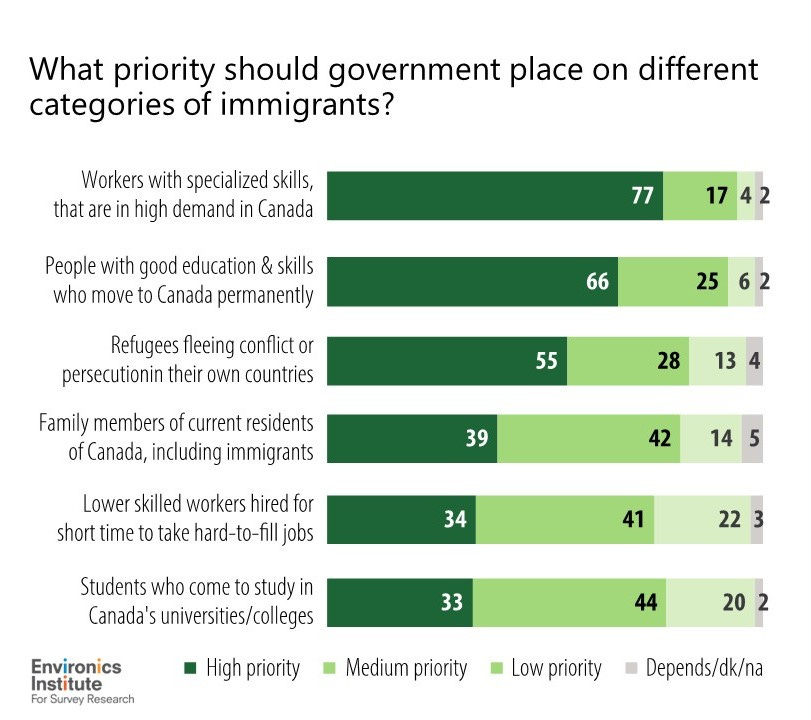
The public is most likely to prioritize skilled workers (whether those with specialized skills in high demand, or new permanent residents arriving with a good education). This may not seem surprising, but that’s precisely the point: it’s now widely accepted that our economy needs more skilled workers than we can produce at home. Theoretically, it would have been possible for people to see highly skilled immigrants as rivals who threaten to take away the best jobs from Canadian-born workers. But this is not the case. This type of immigration is seen as a win-win and not a zero-sum scenario.

Read the full survey report

The next striking finding is that refugees are fairly high up on the list of top priorities (while not quite as popular as skilled immigrants, a majority of Canadians say that accepting refugees should be a high priority). It remains the case that many Canadians continue to value the humanitarian goals of our immigration system, and not just the economic ones.

Next comes family reunification. It’s worth noting that there is a significant gender gap on both this item and the previous one about refugees. Women are significantly more likely than men to say that the government should place a high priority on bringing in family members of current residents, and accepting refugees.
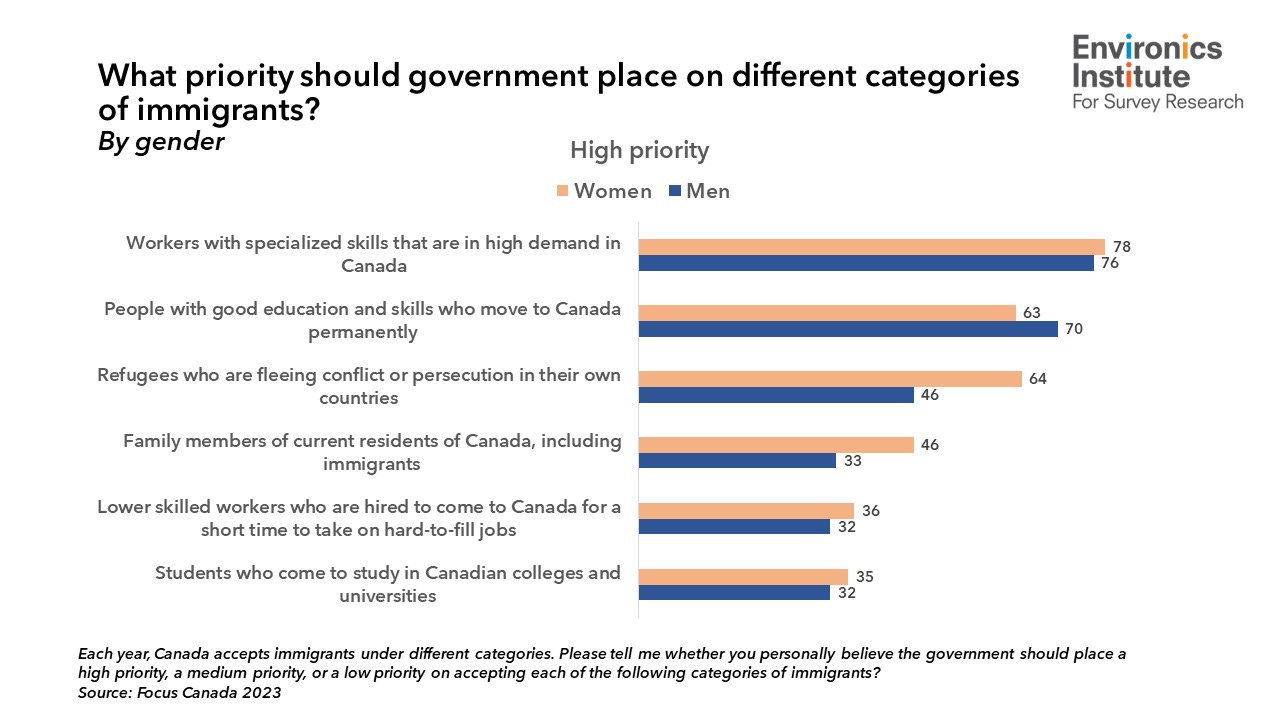
Last on the list of high priorities are two types of temporary immigrants: lower-skilled workers and students – something that’s notable at a time when these categories are the ones that have seen the most unexpected increases. Personally, I was surprised to see international students at the bottom of the list; I wonder if the heads of universities and colleges are too.

So much for the high priorities; it’s just as interesting the look at the results the other way around. Relatively few Canadians think any of these six types of immigrants should actually be a low priority. The highest figures come in the cases of lower skilled temporary workers (22%) and students (20%) – but even here, only about one in five say the government should place a low priority on accepting these categories of immigrants.

The continuing openness of Canadians to immigration becomes even more apparent if we count up how many of each of the six categories mentioned in the survey are seen as high or low priorities. The count of high priorities has a nice normal distribution: most people are in the middle (66% name two, three or four high priority types of immigrant) and relatively few people are at either end of the spectrum (16% name zero or one high priorities, and 17% name five or six).
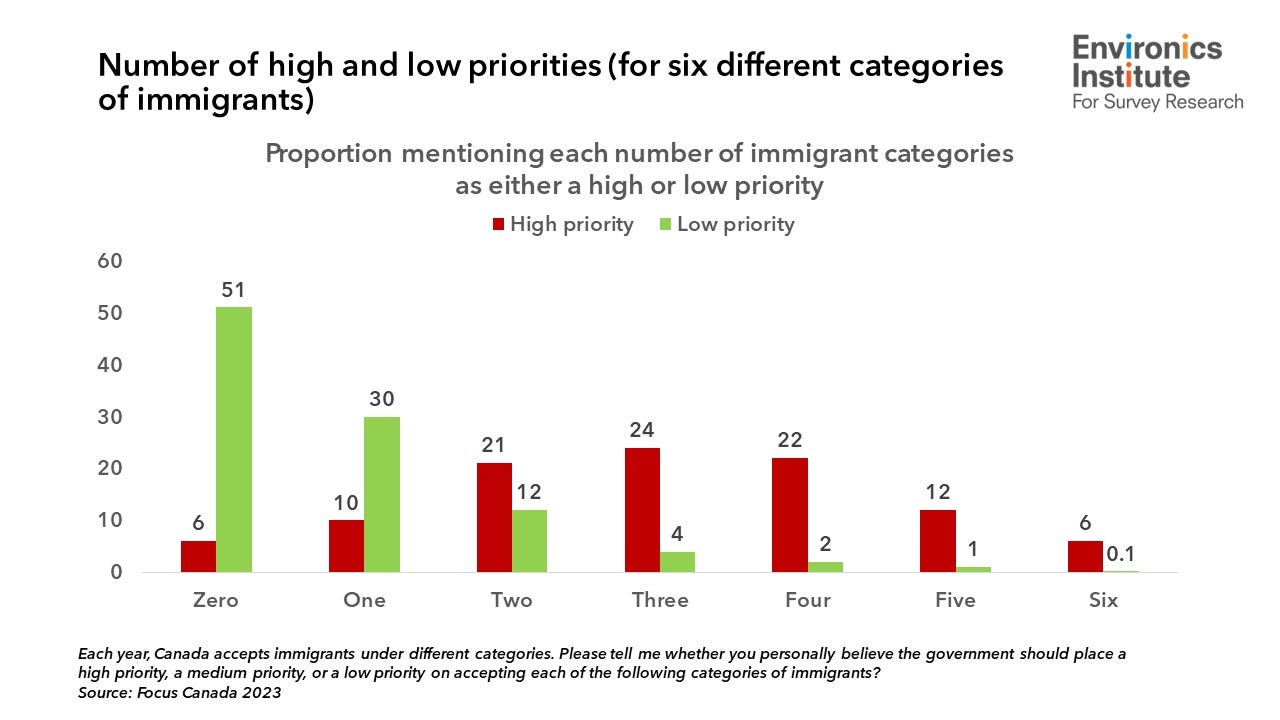
The picture is very different when we count low priorities. One in two Canadians do not answer “low priority” for any of the six categories of immigrant. Four in five (81%) name no more than one. Only three percent list at least four of the six categories as low priorities. In a survey of 2,002 Canadians, a grand total of three people (0.1%) think all six categories should be a low priority for the government.

This is important context for interpreting the main headline from the survey, which is that there has been a big jump in the past year in the proportion of Canadians who agree there is currently too much immigration (from 27% in 2022 to 44% in 2023). This is certainly an expression of anxiety about the current state of the economy in general, and housing availability and affordability in particular. But it’s not an expression of growing opposition to the idea of Canada as a country that welcomes immigrants.

To back up this interpretation, consider the following additional findings:

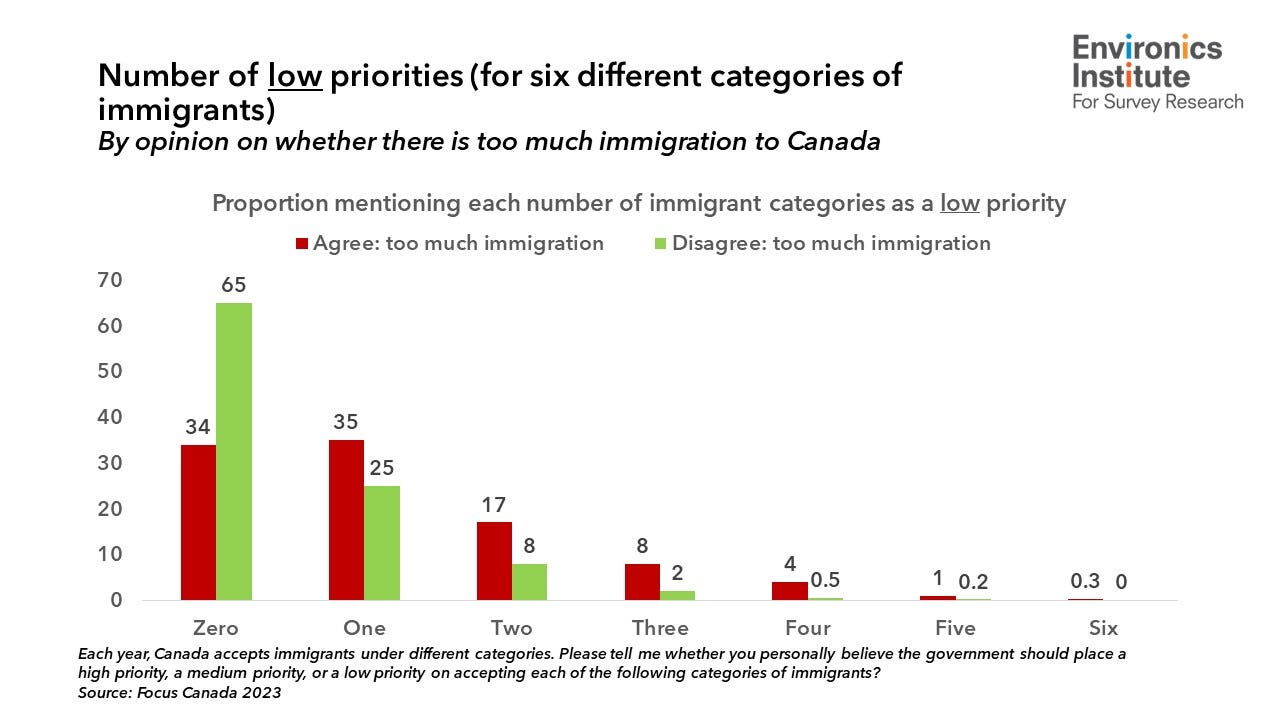
  • First, a majority of those who agree that there is too much immigration to Canada nonetheless say that the government should place a highpriority on accepting each of the two categories of skilled immigrants mentioned in the survey. 
  • Second, and more generally, 91 percent of those who agree that there is too much immigration to Canada nonetheless say that the government should place a high priority on accepting at least one of the six categories of immigrants mentioned in the survey. 
  • Finally, only 14 percent of those who agree that there is too much immigration to Canada say that the government should place a lowpriority on accepting at least three of the six categories of immigrants mentioned in the survey. 

In other words, while a lot of Canadians have concerns about the details of current immigrant policy, very few think it’s time to raise the drawbridge.

Source: Do you know what Canadians think about immigration?
Un premier observatoire sur l’immigration francophone au Canada

Small change compared to the CERC grant of close to $100 million…

Le premier observatoire en immigration francophone au Canada a été inauguré mercredi. Examinant un sujet souvent politisé, l’organisme cherchera à favoriser le développement de connaissances et à « avoir une portée sur le milieu gouvernemental, communautaire et universitaire ».

L’observatoire « contribuera aux efforts menés par le Canada pour favoriser l’accueil et l’intégration des immigrants francophones », a déclaré par voie de communiqué le ministre canadien de l’Immigration, Marc Miller, soulignant que « l’immigration francophone joue un rôle clé pour soutenir la vitalité et la croissance des communautés francophones hors Québec ».

M. Miller a également annoncé un investissement de près de 85 000 $ auprès de l’Université de l’Ontario français (UOF) pour la « mise en place » de cet observatoire, dont la cérémonie d’inauguration a eu lieu en fin d’après-midi au Centre francophone de Toronto.

« Là, on a un financement d’Immigration, Réfugiés et Citoyenneté Canada [IRCC] pour le démarrage. On espère que le financement va se poursuivre au fil des ans pour pouvoir assurer la viabilité de cette initiative », indiquait plus tôt au Devoir la professeure de l’UOF qui a mené le projet, Linda Cardinal.

Dans les 20 dernières années, plusieurs initiatives de recherche s’intéressant à l’immigration francophone se sont essoufflées par manque de financement ou de structure institutionnelle, explique-t-elle.

Les membres de l’Observatoire en immigration francophone sont encore en train d’en « confirmer » les objectifs, mais l’organisme compte notamment organiser des ateliers éducatifs, ainsi que produire et « mettre en valeur » des données, explique Mme Cardinal.

Une première activité aura lieu dès jeudi, se réjouit-elle. Il s’agit d’une « école d’automne », au cours de laquelle 25 doctorants, professeurs, représentants de groupes communautaires et fonctionnaires seront « initiés à la statistique linguistique, en particulier en matière d’immigration ». Des recherches porteront également sur la perception qu’ont les immigrants de la francophonie au Canada, ainsi que sur la « notion d’accueil ».

« Politisation » de l’immigration

L’observatoire espère aussi participer aux discussions sur la mise en oeuvre de la nouvelle politique en immigration francophone d’Ottawa. Depuis la réforme de la Loi sur les langues officielles, IRCC doit « adopter une politique en matière d’immigration francophone visant à favoriser l’épanouissement des minorités francophones au Canada, notamment en assurant le rétablissement et l’accroissement de leur poids démographique ».

C’est dans cette lignée qu’ont été présentées les nouvelles cibles d’immigration francophone hors Québec, qui passeront de 4,4 % actuellement à 6 % en 2024, 7 % en 2025, puis 8 % en 2026. Des taux « ambitieux », selon le ministre Miller, mais qui ne suffiront pas à « renverser le déclin de la francophonie », si l’on écoute la Fédération des communautés francophones et acadienne, qui réclame une hausse progressive commençant à 12 % en 2024 et allant jusqu’à 20 % en 2036.

Un sondage publié fin octobre indique toutefois que l’appui aux cibles d’immigration actuelles est en chute libre : 44 % des Canadiens affirment que « le Canada accueille trop d’immigrants », soit une croissance record de 17 points par rapport à 2022.

« Ces statistiques, c’est un portrait du moment. […] Ce qu’on entend, c’est des gens qui politisent la question de l’immigration parce qu’il y a des élections qui s’en viennent. Il y a des enjeux réels dans les services sociaux, en matière de logement, mais ces enjeux existaient avant les débats sur l’immigration », explique-t-elle.

Mais il n’y a « personne au Canada qui dit qu’il est contre l’immigration », ajoute-t-elle. « Un observatoire comme le nôtre pourrait contribuer [au débat] de façon à mieux faire comprendre la situation […] à distance de la politisation. »

Plusieurs consultations

Celle qui est aussi vice-rectrice adjointe à la recherche de l’établissement inauguré en 2021 affirme que, depuis sa création, l’UOF souhaitait faire de la question de l’immigration l’« un de ses créneaux d’excellence ».

Pour mener à bien le projet, Mme Cardinal a consulté des chercheurs afin de « connaître leurs priorités ». « L’idée, c’était d’héberger cette initiative à l’UOF, mais avec une portée pancanadienne », ajoute-t-elle. L’Université d’Ottawa, l’Université Simon Fraser, l’Université de Moncton et la Chaire d’excellence en recherche du Canada sur la migration et l’intégration, à l’Université métropolitaine de Toronto, sont ainsi des partenaires de l’observatoire.

« En recherche, il faut toujours travailler en collaboration pour avoir un impact et pour susciter l’adhésion — et aussi pour s’assurer qu’en francophonie canadienne, notamment, on crée une relève, soutient-elle. On responsabilise nos universités à l’importance du thème de l’immigration. Depuis les années 2000, l’immigration fait partie de la redéfinition même de ce qu’est la francophonie en contexte minoritaire. »

Les travaux de l’observatoire porteront surtout sur l’immigration francophone en contexte minoritaire. Or, le Québec sera « une base de comparaison très intéressante », indique Mme Cardinal. Et l’Ontario a aussi « des choses à dire au Québec, notamment sur la notion d’accueil. […] On espère que le Québec va s’intéresser à nous ».

Source: Un premier observatoire sur l’immigration francophone au Canada

Globe editorial: Canada’s prosperity problem points to a lower-wage future

Money quote:

In 1993, Canada’s real GDP per capita was 106 per cent of the OECD average. The C.D. Howe Institute forecasts that in 2024 Canada will be just 89 per cent of the average of advanced economies. Canada has also fallen compared with the United States: In 2023, this country’s GDP per capita is forecast to be less than three-quarters that of the U.S. (Those statistics are relatively generous to Canada, since the institute has adjusted them for domestic purchasing power.)

Source: Canada’s prosperity problem points to a lower-wage future

Tasha Kheiriddin: Canada’s multicultural utopia now a balkanized grievance factory – National Post

More of a rant over the current excesses than balanced and diaspora politics and grievances also apply to many communities, including those of European origen.

But yes, more messaging on what we have in common would be helpful, rather than what divides us. Finding that elusive balance between recognizing the identities of specific groups and heritages, needed for integration, and the common values that bring us together, is part of the ongoing challenge of Canada:

Canada has become a nation of diasporas. Rather than wrapping ourselves in a common flag, we huddle in our enclaves: Muslim, Sikh, Hindu, Jewish, Chinese, Black and the list goes on. Faith, color and country of origin divide the nation. Everyone is the “other,” and increasingly, the enemy. Violence and acts of hatred are multiplying in our streets.

In a country built by immigration, this is sadly not a new phenomenon. In 1878, Toronto banned the St. Patrick’s Day parade for 110 years after feuding Catholic and Protestant Irishmen turned the event into “one of the wildest nights in the city’s history.” In 1914, violent demonstrations prevented the docking in Vancouver of the Komagata Maru, a ship carrying South Asian migrants considered a threat by the local population. In 1970, Front de libération du Quebec terrorists murdered provincial cabinet minister Pierre Laporte in their fight against Anglophone dominance in Quebec.

In 2023, however, there is a new wrinkle: the importing of larger geopolitical conflicts to Canada. Pro-Palestinian protestors openly demand the boycott of Jewish businesses and call for the eradication of Israel. Ideologically-captured Canadian elites parrot propaganda of the Chinese Communist Party (CCP), while it intimidates its diaspora on our soil. Sikh separatists in British Columbia hold referendums on Khalistani independence, and India stands accused of assassinating one of the organizers in the parking lot of his gurdwara.

Canada has become a balkanized grievance factory, and all of us are paying the price. You don’t have to be a Jew terrified to put a mezuzah on their door, a Chinese Canadian being intimidated at the ballot box or a Hindu child bullied by Sikh kids on the playground. Instead of uniting around human rights and standing against hate speech, Canadian society is allowing all manner of aggression in the name of fighting “privilege,” and is tearing itself apart in the process.

How did we get here? First, the state-sanctioned multiculturalism policies of Pierre Elliott Trudeau in the 1970s encouraged newcomers to keep their culture of origin, rather than build a common one. Politicians loved it: for decades they handily exploited the so-called “ethnic vote” to court communities who could swing a riding or two in their favour. At the same time, they turned a blind eye to the exploitation of these communities by foreign powers, notably China, as we have learned in the last year.

After 2000, another factor fueled further division: the global rise of identity politics. It was no longer sufficient to call yourself Canadian, or even a hyphenated Canadian; you were encouraged to categorize yourself by privileged/non-privileged, white/non-white, gendered/genderfluid, settler-colonizer/indigenous and a host of other personal characteristics dreamed up in the halls of academia. Experts armed with advanced degrees encouraged this practice in the name of equity in the workplace, school and political arena — and out of fear of cancellation, job loss and social ostracism, most citizens meekly complied.

Then came 2015, and the current federal government’s attempt at Indigenous reconciliation. Rather than focusing on building economic opportunities for the future, it dwells on shaming Canadians for the wrongs of the past, even though the bulk of today’s population have nothing to do with the colonization of Canada hundreds of years ago. Worse yet, newcomers are encouraged to “other” themselves along these lines: white immigrants are lumped in with colonizers, while immigrants of color are considered oppressed and thus allies of Canada’s Indigenous peoples, regardless of whether they may have, ironically, oppressed other groups in their own country of origin.

The result is a nation balkanized along a thousand fault lines. We have not only lost our national identity but are actively repudiating the very things that attracted people to our shores in the first place: respect for peace and good government, human rights, democracy, equal opportunity and personal freedom. We are also eroding our international stature: a country so unsure of itself commands no respect and is even more vulnerable to the whims of great powers.

In an increasingly hostile world, that’s a risk Canada cannot afford to take. United, we thrive; divided, we fall. And the landing threatens to be brutal.

Source: Tasha Kheiriddin: Canada’s multicultural utopia now a balkanized grievance factory – National Post

Douglas Todd: The Wild West in B.C. housing is mostly over, but the devastation goes on

The naïveté of political leaders at all levels of government. Fortunately, Canada shut down its immigrant investor program but inexplicably, Quebec maintains its program despite it largely being a backdoor entry to elsewhere in Canada. David Ley’s latest book and analysis featured:

The New York Times told the world about B.C.’s unusually grim housing crisis last decade when it ran articles with headlines such as the “Housing Frenzy that Even Owners Want to End” and “The Wild West of Canadian Political Cash,” which looked at developers’ outsized influence on governments.

Those years of out-of-control, largely unregulated property investments, which caused drastic unaffordability in Metro Vancouver, are captured in bold, and sometimes painful, detail in a new book by David Ley, a University of B.C. geography professor emeritus.

His immaculately researched book, Housing Booms in Gateway Cities, looks into how the unparalleled movement of transnational capital and people into cosmopolitan Vancouver, Sydney, Hong Kong, Singapore and London led to skyrocketing housing prices and rents.

Ley’s extensive sections on the Vancouver region add up to a cautionary tale. He outlines the dark consequences of the blind faith that Canadian and B.C. governments put in libertarian, growth-at-any-cost ideology.

The book comes with three propositions: That financial deregulation has made housing a bigger investment than ever, that “gateway” cities are especially attractive to foreign capital and exaggerated prices, and that local wage earners are being left behind.

“Conventional housing market explanations are no longer adequate in gateway cities where ‘fundamentals’ must be rescaled to include immigration, offshore investors and the role of the global real estate industry,” Ley says

While the geographer looks at how times have changed in recent years, with housing becoming more regulated, at least in B.C., it’s crucial to follow Ley’s analysis of the political decisions that contributed to Metro Vancouver (and Victoria) ending up in this sorry mess. A recent Angus Reid poll found “three quarters of Vancouver tenants could not afford to buy, or never expected to be able to buy, a home.”

A significant part of the problem goes back at least a decade, to when the federal and B.C. governments were desperate to attract foreign capital. Politicians of all stripes were jetting off on Asia-Pacific trade missions, while Ottawa ramped up an immigration scheme that eagerly welcomed rich people — in a way that especially affected Metro Vancouver.

The business immigration program, by which the wealthiest could gain entry by “investing” in Canada, brought 200,000 people to Vancouver alone, says Ley. They had tens of billions of dollars to pump into the economy, with the heftiest portion channelled into the “asset” of housing.

Large Vancouver property developers, along with those in London and Sydney, opened scores of sales offices in East Asia to serve business-class immigrants and other affluent transnationals. The director of marketing at Vancouver-based Westbank said, “China is now a big part of this business … right now I have a rule when we talk about projects, if the Chinese market doesn’t want it, I have no interest in it.”

Royal Pacific Realty, specializing in China and Asia-Pacific investors, grew to 1,200 staff, notes Ley. And Macdonald Realty acknowledged 21 per cent of sales of Vancouver properties worth $1 to $3 million went to purchasers from mainland China. In 2016, the B.C. dwellings of investor-immigrants from China were valued on average at $3.3 million, over twice the value of Canadian-born residents.

While the federal Conservatives shut down the investor-class immigration program in 2014, the doggedly free-market B.C. Liberals, especially the minister responsible for housing, Rich Coleman, remained gung-ho on funnelling more offshore cash to the housing industry.

Coleman, Ley writes, went so far as to make “the remarkable claim” that Vancouver prices were “pretty reasonable,” even though they were far more unaffordable than even pricey London and Singapore. Coleman also refused to publish figures on foreign investment, adding he had no control over it.

Meanwhile, the B.C. Liberals chose condo marketer Bob Rennie as their chief fundraiser, welcoming tens of millions of dollars in donations from the development industry, far more than from any other sector.

According to Ley, when the NDP defeated the economically libertarian B.C. Liberals in 2016, it was largely because of housing.

The trouble is, the damage from that era carries on to this day.

As Ron Butler, the Vancouver-raised president of one of Canada’s largest mortgage companies, says: “The most important thing to understand about foreign capital is it never goes back.” No matter if the money comes from China, Iran or the Middle East, Butler says, once here “it just sloshes around,” mostly in real estate.

Seven years ago the NDP began bringing in regulations, such as the speculation and vacancy tax, to restrict housing demand, foreign and domestic. The NDP also drastically reduced the ability of developers, including from offshore, to donate to political parties.

For a few years after 2017, the NDP’s regulations helped to cool prices, says Ley, whose earlier book was titled Millionaire Migrants.

But then, in 2020, with almost bizarre effect, COVID-19 hit. With interest rates hitting rock bottom and Ottawa printing new stimulus money, Ley says house prices again heated up. The NDP’s relatively mild tax interventions to reduce investor demand weren’t strong enough. Prices are again stratospheric.

Still, in recent years, federal, provincial and municipal governments are at least starting to share some common ideas, Ley says.

They’re recognizing investors are overwhelming wage earners in the housing market. They are recognizing that “in major cities, real-estate investment has become global” and that a “freewheeling” market is vulnerable to tax fraud and money laundering. They also recognize that new housing and rental “supply” must be affordable, and that “taxation is one appropriate vehicle to manage speculative demand.”

As a result, in some ways, the libertarian Wild West housing days are over, at least in B.C., which has been more proactive in regulating housing than the Liberals in Ottawa.

Even though higher interest rates are slowing down the market, Demographia continues to rank Vancouver the most unaffordable city in North America. And with all that transnational cash still sloshing around, investors have come to own almost half of the condos in Vancouver.

Metro Vancouver’s housing market is so abnormal, so unequal, that a recent Angus Reid poll found two-thirds of regional respondents defying conventional consumer thinking and not wanting house prices to rise.

Those respondents included many homeowners who actually want prices to fall, even though it goes against their own financial self-interest. Such homeowners don’t want to see a younger generation unfairly locked out of decent shelter.

Source: Douglas Todd: The Wild West in B.C. housing is mostly over, but the devastation goes on

Ifill: Bureaucratic efforts are just ‘diversity’ icing on a white cake

The overall data, of course, shows marked improvement in the past six years in which desegregated data by equity group, particularly for visible minorities and within visible minorities, for Black public servants including executives.

Somewhat unserious to ignore this data…

Calling for DMs to be replaced may feel good but is unrealistic, and she clearly has little understanding about how government and the public service work and that change, albeit too slow for some, occurs within a bureaucratic context.

As for the call for action, I also tend to be somewhat cynical as it appears to be adding yet another reporting requirement and it is too early to assess whether it has moved the needle beyond process:

In the months following the murder of George Floyd in 2020, and the global protests against police brutality and anti-Black racism that lasted the summer of that year, every corporation and government agency vowed to improve the economic lot of Black people by introducing watered-down diversity, equity, and inclusion (DEI) practices. Naturally, I was skeptical, considering my own experiences in the public service with anti-Black racism. I knew that nothing but transformative change led by Black and Indigenous people would suffice. As I wrote in this paper in February 2021, the Privy Council Office clerk’s effort was “a diversity and inclusion endeavour, dressed up as anti-racism. Devoid of an accountability framework, it makes no tangible effort to interrogate the systems that perpetuate racism.”

Two-and-a-half years later, the anti-Black racism measures the Liberals introduced for the public service are as good as six feet under. In the 2021 mandate letter to then-Treasury Board president Mona Fortier, the prime minister directed her to establish “a mental health fund for Black public servants and supporting career advancement, training, sponsorship and educational opportunities.” A year later, Black public servants involved in the fund blew the whistle on the racism they experienced while working on an anti-racism measure. As the Canadian Press reported last December, “The Federal Black Employee Caucus [FBEC] sent a letter to the Treasury Board’s chief human resources officer this month saying the workers supported efforts to address racism within the public service, only to be ‘continuously faced with the crushing weight of it.’”

I feel for those who worked so hard to make these initiatives happen. Countless hours and emotional labour have been added to the workload of many racialized employees for free, only for them to experience more racism. The CBC reported on the treatment of Black employees as outlined in FBEC’s letter to the Treasury Board Secretariat: “The email alleges that senior Treasury Board Secretariat officials created a toxic workplace culture. When the Federal Employee Black Caucus members pushed back, the email states, they were met with micro-aggressions and ‘character assassinations.’”

And those experiences bear out in evidence provided by the auditor general.

On Oct. 19, Auditor General Karen Hogan tabled the semi-annual report on performance audits of the public service—and government writ large—to the House of Commons in a series of nine parts. Report 5 looked at Inclusion in the Workplace of Racialized Employees, and it is not kind. It determined that “Canada’s efforts to combat racism and discrimination in major departments and agencies are falling short,” as reported by the Canadian Press. The AG selected a sample of six organizations“responsible in whole or in part for providing safety, the administration of justice, or policing services in Canada. Together, they employ about 21 per cent of workers in the federal core public administration.” Note that 20 per cent of the public service is racialized.

Let’s look at the highlights from the report:

  • Racialized employees reported rates of discrimination at least 30 per cent higher than non‑racialized respondents;
  • The organizations all established DEI plans to correct the conditions of disadvantage experienced by racialized employees, but failed to develop and institute accountability measures (I called this: “A system without accountability is a corrupt one, and in this system there is no justice”);
  • They failed to collect or use data to assess progress on their plans, and failed to create, assess and implement key performance indicators; and
  • No specific initiatives in action plans to address concerns and complaints related to barriers to raising instances of racism.

So basically, the public service wasted everyone’s time with this theatrical performance of DEI icing on a white cake, as I said they would. But it’s no surprise considering that we’re led by a performative government.

Furthermore, if the public service has discriminated against you, the institutions set up to “help” you only double down on that discrimination. As the Canadian Press reported in March, “The Treasury Board Secretariat found last week that the Canadian Human Rights Commission [CHRC], whose mandate is to protect the core principle of equal opportunity, discriminated against Black and racialized employees.”

Remember the Black Class Action lawsuit? The Trudeau government is still trying to ignore the problem by refusing to negotiate while attempting to get the case dismissed. In response to the CHRC discriminating against Black employees, the Class Action Secretariat said, “It also raises concerns about the CHRC’s capacity to offer justice to the broader experiences of Black workers across the entirety of the federal public service who share similar stories and experiences for over 50 years.”

This is how racism is systemic, systematic, and institutional. I have written about how racism within institutions carries over into public policy. Remember the three words: “the dirty 30.”

There is no reason to trust these corrupt systems that are intended to keep Black and racialized employees in subservient positions to white, male, heterosexual power. Deputy ministers have shown us, through action, that they are unserious “leaders” who are comfortable with overseeing abusive, toxic environments that increase the burden of performance on their employees, according to race. Seems discriminatory in itself.

Those who do not follow the directives from mandate letters and budget direction are committing insubordination, and are undermining political decisions. They should be removed from their positions. Deputy ministers are only supposed to oversee the implementation of policy; they are unelected administrators, not representatives elected by the people. Therefore, their decisions cannot supersede those political directives. Do we really want deputy ministers quietly subverting democracy just because they don’t like particular groups of people?

Source: Bureaucratic efforts are just ‘diversity’ icing on a white cake

First group of Canadians departs Gaza as Israel ramps up offensive

Some of these personal stories may raise questions about “Canadians of convenience” as in the case of the Lebanese Canadian evacuation in 2006 (same might apply to Israeli Canadians evacuated):

Shortly before 9 a.m. on Tuesday, Mansour Shouman met with his family to say goodbye.

An e-mail from Global Affairs Canada had arrived early in the morning. After a month of being trapped in the Gaza Strip, Mr. Shouman’s wife and five children had been included on a list of 80 Canadians permitted to escape the besieged enclave through the Rafah border crossing to Egypt. His name was also on the list, but he didn’t intend to leave.

By day’s end, Ottawa said that 75 Canadian citizens, permanent residents and their eligible family members had managed to flee the strip – the first group of Canadians to make the passage since the outbreak of war a month ago, when the militant group Hamas, which controls Gaza, launched attacks that killed more than 1,400 people in Israel.

While the total number of Canadians trying to escape Gaza has fluctuated, Global Affairs says it is in contact with more than 600 people there, as Israel escalates its assault on Hamas in the Palestinian territory.

Mr. Shouman’s family was among the group that left, after a bittersweet farewell.

The family, all Canadian citizens, had discussed what they would do if this moment ever came. The children would leave for Egypt with their mother, Suzan Harb, and Mr. Shouman would remain behind. He feels an obligation to help Gazans struggling to survive Israeli air strikes and a scarcity of food and water. “I have obvious feelings for my family, but as a human I also feel an obligation to alleviate the challenges people are going through here,” he said in a phone interview from Khan Younis, just north of the border crossing.

When the moment came to part ways, his two youngest children, aged four and six, objected. “They asked why we couldn’t go together, telling me to come with them,” Mr. Shouman said.

Mr. Shouman knew they wouldn’t comprehend his need to stay behind. He searched his mind for terms they would understand and settled on the family cat, who had gone missing shortly after Israel began its retaliation for Hamas’s attack.

“I said I had to find our little cat Milo,” Mr. Shouman said. “And they laughed and said, ‘You’re right, dad.’ “

They hugged, parted ways and, a few hours later, Ms. Harb let him know the family had crossed safely.

Canadian officials are facilitating bus travel to Cairo, roughly six hours away. Global Affairs said it will provide accommodation, food and basic necessities in Egypt. The Egyptian government has given border-crossers just 72 hours to leave once they arrive in the country.

Defence Minister Bill Blair told reporters in Ottawa he doesn’t anticipate military assistance being required to transport Canadians out of Egypt, because there are commercial flights available. When asked who would pay for the flights, Mr. Blair said the responsibility will fall to individuals. But he added that “if they’re unable to afford that, then there are some provisions that Global Affairs can draw upon to assist them.”

As dozens of Canadians made the crossing, hundreds of others were left to endure at least one more day of the month-long war.

“The most frustrating thing is to be going through hell while the Canadian government is in LALA land!” Asia Manthkour, a Canadian living in Gaza, wrote in an Instagram post. She added that she had contacted Canadian officials to ask if she should show up at the Rafah crossing with her two children even if their names didn’t appear on the Tuesday list, only to be told she could do so at her own risk.

Speaking on Parliament Hill, Prime Minister Justin Trudeau said the government will work to ensure “all Canadians and their families are out of Gaza.”

Canada is one of many countries that has been working to facilitate departures from the Palestinian territory. The situation on the ground there is dire. Access to food and water is restricted, and the risks to personal safety are grave. The Palestinian Ministry of Health in Gaza says more than 10,300 people in the territory have been killed in the war. The Rafah border crossing, which is controlled by Egypt, is the one way out.

Late last week, the crossing was open for limited evacuations. It closed again over the weekend with little explanation, exasperating Canadians in Gaza and their loved ones.

“It’s been torture, absolute torture,” Mohanad Shurrab said of the many false starts at the border. Mr. Shurrab lives in Brampton, Ont., and has been working to secure passage to Canada for his wife and two youngest children, aged eight and 11, who were stuck in Gaza. When Canadian officials called on Tuesday to tell him they had been cleared to cross at Rafah he at first refused to believe it.

But by Tuesday afternoon he had received confirmation that they were on their way to Cairo.

“Today I am grateful,” he said. “I thank God. I thank everyone who played a part in this.”

A new father in Brantford, Ont., had a similar reaction. Ahmad Abualjedian’s wife, Yara, was eight months pregnant when the war began, trapping her in Gaza. She gave birth to the couple’s daughter Sila on Oct. 23, still stuck in the territory.

On Tuesday, Mr. Abualjedian learned that his wife and the daughter he has never met were among those authorized to leave.

“I know they are safe now,” he said. “But I still won’t sleep until they are here.”

Source: First group of Canadians departs Gaza as Israel ramps up offensive

Why are so many new immigrants leaving Canada? – CTV News

Some of the personal stories behind those leaving:

Immigrants to Canada are increasingly leaving this country for opportunities elsewhere, according to a study conducted by the Institute for Canadian Citizenship and the Conference Board of Canada.

In fact, the number of immigrants who left Canada rose by 31 per cent above the national average in 2017 and 2019.

According to the study, factors that influence onward migration include economic integration, a sense of belonging, racism, homeownership, or a lack thereof, and economic opportunities in other countries, the report revealed.

Amid a crunch on affordable housing and other services, Immigration Minister Marc Miller announced on Nov. 1 that the federal government intends to maintain its target of admitting 500,000 new permanent residents in 2026.

In the days since the announcement, dozens of people who came to Canada as immigrants have reached out to CTVNews.ca to explain why they’ve abandoned their efforts to build a life here, or are close to doing so.

Most respondents said the high cost of living and competition for jobs and affordable housing have driven them to look beyond Canada’s borders for better prospects.

Julian Cristancho immigrated to Canada from Colombia in 2019, after briefly considering the U.S., and started an entry-level human resources job after completing a human resources degree in Ontario. The job paid $17 per hour – not a living wage in most Ontario cities at the time, according to the Ontario Living Wage Network – and he quit after two years to apply for something better.

“It took around 50 applications and countless hours tailoring resumes and cover letters just to get three initial interviews and not hearing back from those companies,” he wrote in an email to CTVNews.ca. In Cristancho’s experience, Canada’s immigration system works well at getting people into the country, but not at setting them up for success after they’ve invested some time here, he said.

Emilson Jose, from India, has lived in Canada for 10 years and has learned that many Canadians can’t afford to live close to where their jobs are located, meaning they spend dozens of hours commuting each month.

“So literally you will spend the majority of your time on roads which could be otherwise spent with your family,” he told CTVNews.ca in an email. From daycare to housing to daily household expenses, Jose has found that the cost of living in Canada can easily exceed a family’s income. He said he worries how much harder it will be for his children to attain homeownership decades from now.

“No matter how much you make, your take home pay is not even keeping up the expense. Families barely keep their head above water,” he said.

“After 10 years of hardship, I am now a proud Canadian citizen who doesn’t want to live in Canada anymore.”

Saikiran Yellavula came to Ontario with his family to study in 2019 after having practised dentistry in India for two years. Yellavula got a job in retail while studying health-care administration at Conestoga College, and in 2021, he and his family became permanent residents. For the past 16 months, Yellavula has worked fervently to land a job more suitable to his education and training, with no luck.

“I have applied for approximately 2,000 jobs in Toronto, but have received only one interview,” he told CTVNews.ca in an email. “The high cost of living, particularly the soaring grocery prices, combined with the current inflation…has made it incredibly difficult to make ends meet.”

On top of struggling to get by in a city known for having some of the highest living expenses in Canada, Yellavula and his family have found Canada’s cold climate hard on their physical and mental well-being.

“The combination of these factors has led to a deeply disheartening and depressing experience, not just for us but for many other immigrants facing similar circumstances,” Yellavula said. “Regrettably, these challenges have driven us, as well as several others we know, to contemplate leaving Canada for good. It pains us to consider leaving a country that we initially chose with hope and optimism for a better future.”

Shahrukh Al Islam, originally from Bangladesh, has been in Canada since 2011, when he moved here for school at 18 years old. He excelled at the University of Alberta and received several academic scholarships. Upon graduating, he landed a job with Amazon in Vancouver. However, Canada no longer holds the same appeal it once did for Al Islam, and he’s preparing to move south, where he believes he will earn more, and enjoy more spending power.

“(I) will be leaving Vancouver for Seattle soon,” he told CTVNews.ca in an email. “Tech salaries are higher, taxes are lower, houses are cheaper and USD is stronger.”

Bernard De Vaal and his wife moved to Canada from South Africa in 2018 and tried for five years to build a life here. De Vaal completed a post-graduate program in journalism and the couple had a baby. In 2019, the small family moved from Windsor, Ont. to Vancouver to try and settle into life in Canada.

For another four years, they struggled with social isolation, the high cost of living and the prospect of reaching old age without a sufficient retirement fund. They settled for an apartment that didn’t meet their needs, but which was all they could afford. Eventually, they gave up on Canada.

“My wife and daughter have since moved back to South Africa with me having to stay and work in Vancouver to pay off the debt we accumulated over the course of the last five years,” De Vaal told CTVNews.ca in an email.

“We feel extremely let down by the ‘Canadian’ dream. What we found is a withering, uncertain and anti-working class government, happy to sell promises it never intended on keeping.”

Other readers who contacted CTVNews.ca cited health-care woes and a hostile political landscape among their reasons for leaving Canada, though affordability was still a common thread.

Bianca Mtz and her partner moved to Canada from Europe when she was 29 and both secured well-paying jobs in Vancouver. Mtz came armed with a master’s degree and a PhD in engineering.

Despite their professional success, the two found it hard to cover the expenses of their small family.

“We found ourselves merely scraping by, unable to afford a home to raise our child,” Mtz said in an email to CTVNews.ca

Meanwhile, although they had chosen Canada over the United States for its health-care system, they were unable to secure a family doctor.

Compounding these issues, Mtz said, were daily headlines about political scandals, policy failures and pervasive social inequality. It was enough to convince Mtz and her partner to return to Europe.

“Confronted with a society where hard work did not seem to correlate with fair rewards, where health care and educational systems were compromised, and where government corruption was not an anomaly but a recurrent headline, our longing for Europe’s more accountable and equitable social systems intensified,” Mtz said.

“We are thus compelled to return to a society where taxes lead to tangible public services, healthcare is a given right, not a privilege and where schools are havens of learning, unmarred by the pervasive reach of politics.”

Source: Why are so many new immigrants leaving Canada? – CTV News

Liberals have forgotten what free speech means – UnHerd

Of note:

Away from the horror unfolding in Israel, the past month has provided one long acid test for the West’s commitment to liberal values. What are we to make of middle-class bien pensants asserting that mass murder requires “context”, of the overt antisemitism, and of a police force that makes excusesfor theocrats calling for “jihad” on the streets of London? For some, this is proof of the failure of multiculturalism. For others, it is the final straw that broke the back of liberalism. Hate speech laws must now be strengthened, certain protests ought to be banned, and we must no longer tolerate the intolerant.

Republican senator Tom Cotton has called for those who express support for Hamas to be deported, and Donald Trump has promised to do so if re-elected. In France, Emmanuel Macron has outlawed pro-Palestine rallies on the grounds of maintaining public order, although his decree has been largely ignored. Closer to home, a pro-Palestinian protest has been scheduled in London for Armistice Day, a tactic surely intended to generate as much outrage and attention as possible.

In that respect, it has already succeeded. Rishi Sunak has stopped short of a ban, but has called on the Met Police to make “robust use” of its powers to prevent the Remembrance events being disrupted. In this, he is out of kilter with the majority of the country: only 18% believe it “should be allowed to go ahead”.

Liberalism has always been a tricky prospect, cherishing personal autonomy and freedom of speech up to the point where our behaviour encroaches on the rights of others. To ideologues, it is a poison, because it rejects their insistence that we ought to follow a preordained set of rules. Some even claim that liberalism is itself an ideology, though I see it as the precise opposite: it is the repudiation of ideological thinking — because it refuses to accept oversimplified interpretations of reality, or to outsource our decision-making capacities to an already established creed. This is why there are liberals on the Left, the Right, and everywhere in between

Yet it has been dispiriting to see our commitment to Enlightenment values being assaulted on multiple fronts. There are theocratic extremists who oppose free speech and would happily see blasphemers and apostates executed. There are Western activists intoxicated by the moonshine of intersectional identity politics calling for censorship and other restrictions. And now, we have those who once considered themselves to be “liberal” pronouncing that there should be limitations to freedom of speech and assembly.

Even those who have previously decried “cancel culture” appear to be relishing its impact on their opponents. A lecture at Liverpool Hope University by Professor Avi Shlaim, a critic of Israel, was cancelled out of concern for the “safety and wellbeing” of students; Michael Eisen, a geneticist at UC Berkeley, was fired as editor-in-chief of eLife magazine for sharing a satirical article from The Onion which took a pro-Palestine stance. Eisen, some have pointed out, had previously questioned whether cancellation really exists. But while a degree of schadenfreude is understandable, it is hardly helpful.

That there are no rulebooks to consult is liberalism’s major appeal to those of a free-thinking disposition, but it is also the source of its instability. The authoritarian has no need to engage with his detractors; he can simply have them eliminated. By contrast, the liberal must find a way to coexist with those who yearn to see his freedoms quashed, to somehow reconcile himself to the multiplicity of human outlooks and their inherent incommensurability. But how can you run a marketplace of ideas while there are hooligans trying to overturn the tables?

This essential vulnerability is always tested in moments of crisis. Governments enact “emergency powers” when at war because short-term authoritarianism seems preferable to the alternative. So when protesters at pro-Palestine marches in London are holding signs that openly celebrate the slaughter, rape and kidnapping of civilians, and an official advisor to the Met police is filmed leading a chant of “from the river to the sea”, there will always be pressure from a justifiably incensed public to resort to authoritarian remedies.

Even in peacetime, liberalism is susceptible to changing trends within the nation state. What happens, for instance, when the majority of any given population rejects the liberal values upon which their society is based? What if a government has implemented reckless migration policies that grant citizenship to those who do not recognise the value of individual freedoms? In such circumstances, the principle of democracy could be its own undoing.

Sweden is often considered to be a case in point. According to its national police chief, the rapid surge in migration over the past decade has led to an “unprecedented” rise in gang warfare between those who do not respect the rule of law. On a recent trip to Stockholm, I found myself discussing the implications with a group of residents. One woman expressed the view that Swedish people tended to take liberalism for granted, and that they had assumed newcomers would be eager to adopt the values of the nation that had welcomed them. Now many fear that this was warm-hearted naivety, and that the government had not done enough to ensure widespread integration.

Liberal countries acknowledge their moral responsibility to offer asylum for those in need, and typically take a compassionate view towards foreigners seeking a more prosperous life. At the same time, there must be a degree of societal consensus for the ethos of these nations to survive at all. For where such a consensus is jeopardised, either through mass immigration or radical domestic political movements, the temptation to dispense with liberal values is inevitable. But to call for the deportation of citizens who actively seek the demolition of our culture is to surrender our principles to the very people who oppose them. It is to resign oneself to authoritarianism in a perverse effort to defeat it.

Inevitably, one thinks of Karl Popper’s famous paradox that “in the name of tolerance” we should claim “the right not to tolerate the intolerant”. This is often invoked by activists to defend censorship of their opponents, typically in the form of a well-known cartoon meme that decontextualises and misreads Popper’s formulation:

“Unlimited tolerance must lead to the disappearance of tolerance. If we extend unlimited tolerance even to those who are intolerant, if we are not prepared to defend a tolerant society against the onslaught of the intolerant, then the tolerant will be destroyed, and tolerance with them.”

Popper’s next sentence is often omitted, in which he emphasises that so long as public opinion and rational argument can “keep them in check”, suppression of intolerant views would be “most unwise”. Protesters who take to the streets to celebrate murder fall into this category because they are self-discrediting. They are impervious to reason, but their sentiments are so essentially rebarbative that there is no risk of public opinion shifting in their favour.

But, some might respond, if liberalism is so delicate and continually under threat, why bother with it at all? In short: because it works. For all the claims by identitarian activists that the Western world is a racist hellhole, few living in the era of Jim Crow could have conceived of the advances we have made since then. The triumph of social liberalism is evident in multiple studies that show how Western societies are the most tolerant and diverse to have ever existed. It is no coincidence that all of the major civil rights movements — for black emancipation, feminism and gay rights — have traditionally been underpinned by a commitment to free speech and liberal ideals.

Of course, it is only natural that our patience is wearing thin. Having already witnessed pro-Palestine protesters in London throwing fireworks at police, and chanting in support of “Intifada” on the Tube, there can be no guarantees that such behaviour won’t be repeated on Saturday. The timing seems not only calculated to maximise publicity, but also as a declaration of contempt for British values and history.

But even if unruly and disrespectful, it would be self-defeating to ban the protest, or to insist on deportations for the worst offenders. Taking action against direct incitement to violence is one thing, but compromising on our key values is another. If we renege on our principles at the very moment when they are most imperilled, we risk undermining the very foundations upon which our civilisation is built. The authoritarian instinct may be a human constant but, with vigilance, it can be forestalled.

Source: Liberals have forgotten what free speech means – UnHerd

Anti-Zionism Is Not Anti-Semitism – The Atlantic

Important distinctions:

On October 7, the Islamist militant group Hamas, which governs the Gaza Strip, killed more than 1,400 people in Israel. Israel responded with military operations that have killed several times that number of Palestinians in Gaza, a territory described by Human Rights Watch as an “open-air prison” as a result of an Israeli and Egyptian blockade. In both cases, most of the casualties are civilians. The conflict has reverberated into other areas of the world, including the United States, where anti-Semitic and anti-Muslim incidents have included the killing of a 6-year-old Palestinian American boy. The bloodshed has revived the perennial debates about anti-Zionism and anti-Semitism.

“Look, it’s clear that the hardened anti-Zionists from the far left are the photo inverse of the white supremacists from the far right,” Anti-Defamation League CEO Jonathan Greenblatt told CNN’s Dana Bash earlier this week. “There is no argument anymore that anti-Zionism is anti-Semitism, that is as plain as day. And to think that extremism only comes from one side of the spectrum is a joke.” Greenblatt’s sentiments were echoed among supporters of Israel, including in publications such as The Wall Street Journal and The Jerusalem Post, which editorialized that “to deny the Jewish people, and only the Jewish people, a right afforded to all nations—is to discriminate against Jews.”

The claim that “there is no argument anymore” is curious. Even within the ADL, staffers have objected to the argument that anti-Zionism is necessarily anti-Semitism, as Jewish Currents reported last year.

Political Zionism, defined concisely, is the belief that the Jews should have a Jewish state in their ancestral homeland. Anti-Zionism, in similarly brief terms, is the opposition to that belief. It should be no surprise that most Palestinians and those who sympathize with their plight are anti-Zionist. “The Arab has been on the receiving end not of benign Zionism—which has been restricted to Jews,” Edward Said wrote in The Question of Palestine, “but of an essentially discriminatory and powerful culture, of which, in Palestine, Zionism has been the agent.”

There are certainly forms of anti-Zionism that are anti-Semitic, such as the belief that Jewish Israelis should all be expelled or killed or that they should be forced to live as second-class citizens under an Islamist government. Storming the tarmac at an airport in Dagestan in the hopes of participating in a mob lynching of passengers arriving from Tel Aviv, or vandalizing synagogues in Madrid and New York in response to the Israeli government’s actions, or threatening Jewish students with rape and murder, are clear expressions of hatred toward Jews. Americans, both Jewish and not, can underestimate how common anti-Semitism remains in the rest of the world.

But there is nothing anti-Semitic about anti-Zionists who believe that the existence of a religious or ethnically defined state is inherently racist, and that the only real solution to the conflict is, as the Palestinian American advocate Youssef Munayyer writes, “equal rights for Israelis and Palestinians in a single shared state,” with a constitution that would “recognize that the country would be home to both peoples and that, despite national narratives and voices on either side that claim otherwise, both peoples have historical ties to the land.” Perhaps you think this idea naive or unrealistic; that is not an expression of prejudice toward Jews.

For one thing, there were prominent Jewish advocates for this idea before the founding of Israel, such as Hannah Arendt and Martin Buber. In 1921, the Jewish philosopher Ahad Ha’am wrote that Arab Palestinians “have a genuine right to the land due to generations of residence and work upon it. For them too this country is a national home and they have the right to develop their national potentialities to the utmost.” There are also some prominent Jewish supporters of a single binational state today, such as the former Knesset speaker Avraham Burg. The Jewish American writers Tony Judt and Peter Beinart have also made the case for a one-state solution.

I should say here that I do not have an answer to this question. Two states or one, my preference is for both Israelis and Palestinians to be able to live freely and in peace and equality, in whatever arrangement allows them to do so.

Nevertheless, it is a cruel absurdity to demand of Palestinians that they not only acquiesce to Israel’s existence, but also actively support the idea of an ethnically defined state that excludes them from equal citizenship, one that was made possible only by the flight and expulsion of 700,000 of their forebears in the Nakba of 1948. It is not anti-Semitic to want equal rights in the land you share with others, and to oppose a political arrangement that has resulted in what Israeli human-rights groups justifiably describe as a form of apartheid. While Jewish Israelis retain their rights wherever they go within Israel’s borders, Palestinians are subject to draconian restrictions on their lives and freedoms depending on their location.

“My mom was born and raised a mere 10-minute walk from my childhood home, but my father’s family is from Tulkarem, a small city in the West Bank. And so my dad, my siblings, and I have West Bank IDs while my mom, a Jerusalemite, has a Jerusalem ID,” the journalist Abdallah Fayyad wrote in The Boston Globe in 2021, describing life in his childhood neighborhood of Sheikh Jarrah. “That meant that while my mother had a right to live in Jerusalem, the rest of us were only guests in our own home, living there because we renewed travel permits that technically allowed us only entry into Jerusalem, not a permanent stay.”

Palestinians in the West Bank who have been displaced at gunpoint by Israeli settlers, Palestinians in Gaza who have watched their children die in Israeli missile strikes, Palestinians who have been evicted from their homes in Jerusalem as part of an effort to Judaize the city—are none of these people allowed to question whether a Jewish state is an optimal arrangement for them? Are none of their relatives, friends, and loved ones abroad allowed to do so?

Nor is the question of national self-determination as straightforward as the Post would have it. Since the beginning of the occupation in 1967, maintaining the Jewish character of the state of Israel has required an extraordinary amount of violence, because Jews are not a clear majority in Israel, Gaza, and the West Bank put together. Even if they were, however, it is not as though Palestinian demands for equal rights would cease. Opposing that violence, or believing that it stems from the state having a specific ethnic character, is not a form of bigotry. It is not “self-determination” if you are determining the fate of your neighbors because they lack the same rights as you.

In the United States, the ADL itself has highlighted those on the far right who believe “they are fighting against demographic and cultural changes that are destroying the ‘true America’—a white, Christian nation,” and who want Jews to “either leave the country or be converted.” Sadly, this is a racist chauvinism that echoes sentiments expressed by politicians in the current Israeli government.

Few Americans who are not themselves white nationalists would think it prejudiced for those who are not white Christians to oppose such an arrangement in the U.S., least of all Jews.

Obviously, there are factors in Israel that make a commitment to one state with equal rights for all more complicated than in the United States, where the concept is foundational even if the execution is not. For generations, Palestinians have borne the brunt of the violence of war, occupation, and discrimination. The near-destruction of European Jewry is less than a century old, and the flight (both voluntary and involuntary) of the Mizrahim, who make up the largest portion of Israel’s Jewish population, from other Middle Eastern and North African countries is younger than that. Fears and grudges build up over years of conflict and separation, making the personal and emotional connections necessary for such reconciliation difficult, although brave souls on both sides of the divide are trying.

The ideal version of the one-state solution also remains unpopular for now among both Israelis and Palestinians (except for Arab citizens of Israel). You may think it impossible. You may prefer a different outcome. You may think it is dangerous. But the vision itself is not an expression of anti-Jewish hatred and should not be treated as such.

The effect of equating anti-Zionism with anti-Semitism is to silence the criticism of the Israeli government by Palestinians and their advocates. Characterizing all such criticism as an inherent form of bigotry is used to justify the exclusion of such critics from mainstream society, to suspend them from their schools, or to fire them from their jobs. But it is not anti-Semitic to want equal rights for all in Jerusalem, in Tel Aviv, in Gaza, in Ramallah. That is, after all, what generations of Americans have sought in their own home.

Adam Serwer is a staff writer at The Atlantic.

Source: Anti-Zionism Is Not Anti-Semitism – The Atlantic