Articles I found interesting during the holidays

As always, lots of articles on immigration with a continuing stream of voices raising concern regarding current levels of permanent and temporary migration. The National Bank flagged an economic contraction, per capita GDP basis also noted by TD, driven partly by an immigration-fuelled populations increase (Canada’s high immigration is driving down per-capita GDP: report). 

Tristin Hopper correctly noted that the immigration surge cancels out every Liberal housing promise and then some: Canada’s biggest immigration surge in 70 years, while Konrad Yakabuski, citing the Bank of Nova Scotia (« L’immigration est excessive. Point à la ligne ») argues that L’immigration [est] le talon d’Achille de Justin Trudeau. Brian Lilley notes that  Canada has added more than 1 million people and counting in 2023, it’s unsustainable. Meanwhile, while Canada has massive growth, South of the border it is only an uptick, Immigration fuels uptick in US population growth.

Tony Keller continues his series of critiques on immigration, arguing for drastic cutbacks in the number of low-skilled temporary workers, sharp cuts in the number of international students and ending the right of students to work while in school, Can we talk about immigration?

Cam Clark notes that the “failure to control the unplanned boom in temporary residents … is already undermining one of Canada’s great strengths: public support for immigration,” Liberals risk aiding Trump-style politics with temporary-resident failures. Julia Malott observes that the  International student influx exposes the selfish greed of universities, although she fails to note provincial policies failures, particularly in Ontario, that have driven universities in this direction.

Minister Miller continues his tendency of being much more frank than any of his predecessors (“I’m trying to target the effect of a system that’s run a bit rampant for far too long…), signalling that he will ‘rein in’ number of temporary foreign workers.

Le Devoir had a good explainer on current policies and debates in Quebec, Comment parler d’immigration en famille sans se fâcher, along with flagging ongoing IRCC operational issues, Délais à IRCC: Des milliers de réfugiés privés de voyager, même dans l’urgence.

The Star also had a good comparative explainer, Canada, the U.K. and Australia all face immigration challenges. Why Canada’s going a different way. The question is, of course, should Canada go a different way!

Immigration advocates Naomi Alboim, Audrey Macklin and Anna Triandafyllidou argue that Canada’s program to legalize undocumented migrants should be simple and comprehensive forgetting that simple and comprehensive are oxymorons in immigration policies given the practicalities and politics.

Rita Trichur wrote an interesting article on the strengths and weaknesses of TD’s racial equity audits, noting that auditors with racial expertise, comprehensive coverage of all business aspects and be public.  TD Bank’s racial equity audit offers lessons for other public companies

On citizenship, the first generation cut-off for transmission of citizenship was struck down by the courts (‘Lost Canadians’ win in Ontario court as judge ends 2 classes of citizenship – CBC.ca), with Chris Selley: ‘Lost Canadians’ beat Ottawa in court over Charter violations that never should have happened. Not as straightforward a change. Most of the plaintiffs had a route to citizenship for their children, albeit not as convenient as an automatic one. Will see if the government appeals (it should IMO as the decision opens the door to automatic transmission across multiple generations).

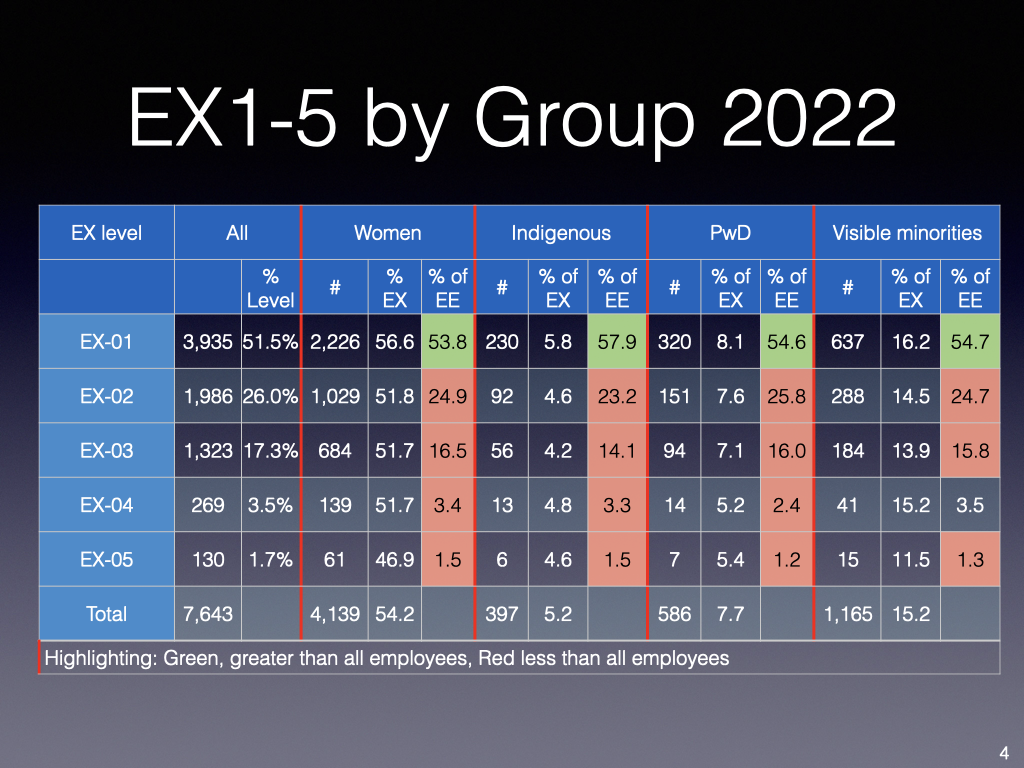
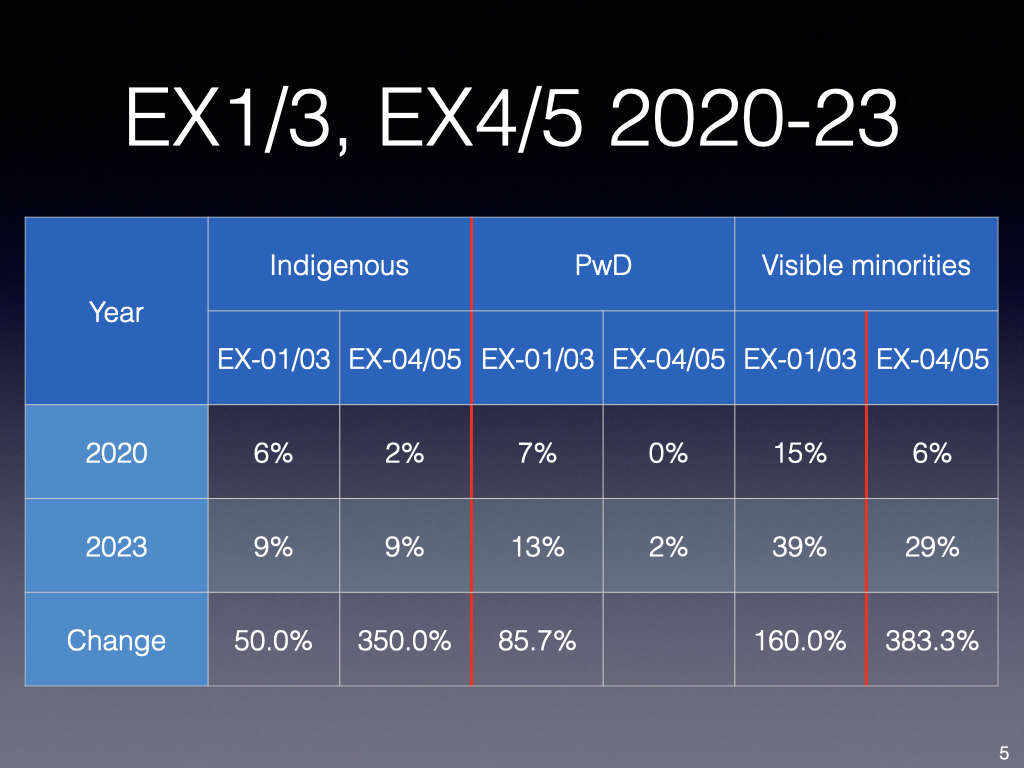
The release of the government’s Employment Equity Act Review Task Force late 2023 provides insights into the government’s thinking given that it set the terms of reference for the review and related consultations. The government has already signalled its support for the terminology changes of Indigenous peoples and racialized people, along with creation of a new designated group for 2SLGBTQI+ and the separation for Blacks from the overall racialized people group. While the former addresses a long-standing gap, the latter appears driven more by political considerations given the paucity of evidence presented in the Task Force Report in contrast to other groups, as my earlier analysis of hiring, promotion and separation rates demonstrate.

Meanwhile, from the right, Peter Shawn Taylor argues that It’s Time to Abolish the Absurd (and Slightly Racist) Concept of “Visible Minorities”

Interesting article by Pamela Paul on how social media disadvantages Blacks and Hispanics, who spend more time on social media than whites, Does Social Media Perpetuate Inequality?

Looking back on 2023 and forward to 2024

Best wishes to all for 2024.

The major development this year has been a sharp reversal in attitudes towards immigration, given the ongoing increases until 2025 of permanent residents and the much larger increases in temporary workers and international students and the consequent impact on housing avilability/affordability, healthcare and infrastructure. 

When I first started raising these and other concerns some five years ago (reviewing Doug Saunders Maximum Canada) and subsequent articles), I was largely a voice in the wilderness. But now, it seems that every week there is another article pointing out the fallacies and problems with the current approach, with virtually all polls showing a significant drop in public support.

Federal and provincial governments, business stakeholders, organizations like Century Initiative and other immigration advocates have largely been caught flat footed by this change given their almost ideological fixation an aging population, their particular interests, and a blindness to broader implications.

While the federal government scrambles to adapt to public concerns on housing, none of the overdue changes to increase housing will have a material impact before the next election. 

The one area I expect to see a meaningful rethink in 2024 is with respect to international students and the “puppy mills” of private colleges to use Minister Miller’s words. Whether the government will similarly restrain or cap temporary foreign workers will be another test of whether it is more attuned to general public and productivity concerns or to business interests in having a larger labour pool for lower skilled workers, along with other special immigration interests.

Most of my time this year was spent on citizenship issues, analyzing citizenship operational data to better understand the declining naturalization rate, opposing the proposed self-affirmation of the citizenship oath and my annual update on birth tourism (non-resident self-pay). 

The petition I launched to oppose the change to the oath and for a return to more in-person ceremonies along with related commentary by others received largely a non-response by the government although it remains to be seen whether they will implement the proposed regulatory change (Minister Miller appears more aware of the importance of citizenship meaningfulness than his predecessor).

Other areas included analysis of employment equity hiring, promotion and separation data, indicating that the government continues to make progress in increasing the representativeness of the public service, annual update of Order of Canada diversity, and a census-driven analysis of riding level demographic, economic and social characteristic.

Next year will likely be more of the same given some of the annual data that I follow. While I will continue my monthly statistical updates, will trim some of the data that has proven less significant (e.g., web traffic) or overtaken by events (e.g., RCMP interceptions given expansion of the STCA).

Top 10 Posts on www.multiculturalmeanderings.com

Articles and citations

Citizenship 

Citations

Immigration 

Citations

Multiculturalism, Diversity and Employment Equity

Citations

Political Representation 

Citations

Best wishes for the holidays and the New Year

See you in 2024

Douglas Todd: Canadian taboo against debating migration policy is basically over

Yes, having been another of the earlier questioners:

Seven years ago, Simon Fraser University political scientist Sanjay Jeram perceptively said that Canada was one of the last countries in the world where it is not permitted to discuss migration policy.

“The hidden consensus in Canada is that we don’t talk critically about immigration. The taboo against discussing it is very real,” said Jeram, who has a PhD from the University of Toronto, the city in which he was born and raised.

“Prime Minister Justin Trudeau campaigned on openness to immigration without limits,” Jeram said at the time. “I have never heard him talk about the potential consequences that immigration has for overcrowding, housing, opportunities for domestic-born workers, or the welfare state.”

The Canadian housing squeeze was on the top of Jeram’s must-be-discussed list in 2017, since many in Metro Vancouver, Toronto, Victoria and other cities were enduring an escalating affordability crisis. They still are.

The difference is that in the past six months the unspoken taboo against openly talking about migration issues has been mostly broken in Canada.

That is judging by what’s coming from prominent housing analysts, mainstream media coverage, and new polls by Leger, Environics and Abacus. We’re starting to become like most other nations.

Canada’s population grew by almost three per cent in the one-year period ending July 1, 2023 — bringing in 1.2 million, causing catapulting population growth that far exceeds earlier projections.

Many of the newcomers are among this year’s batch of almost 500,000 permanent residents, but most are temporary students and guest workers. The number of such non-permanent residents in Canada now totals 2.2 million.

Even Trudeau’s Liberal government, which was always quick to silence migration skeptics with often-unfounded accusations of xenophobia, is showing hints it might reduce its record-high migration rates, at least in regard to study visas.

Polls confirm most Canadians believe new arrivals offer advantages to the country, which shows they are not concerned about immigrants themselves. The issue, instead, is Ottawa politicians’ actions on migration, which are unilaterally decided without debate in the House of Commons, and which lack any sort of coherent plan.

A new Abacus poll is among those showing the number of Canadians who believe immigration rates are too high has jumped to 67 per cent, up seven percentage points from July.

This negative view is shared by 62 per cent of residents born outside Canada.

Overall, women were most worried. And even 61 per cent of Liberal voters said rates were too high. Just two per cent of Canadians believed migration levels were “too low.”

One issue stood out. Abacus found seven in 10 respondents felt the number of immigrants was having a negative effect on “the cost and availability of housing.”

A smaller cohort, 53 per cent, believe the high volume was having a negative affect on “access to health care,” and 51 per cent felt that way in regard to “congestion and traffic.”

In most countries, there is little migration debate, but not for the reasons many Canadians may think. The relative silence is because most countries take virtually no immigrants — including Japan, China, Turkey and Brazil.

Shelter costs are the main concern behind rising migration concerns in Australia, New Zealand, Britain and even France, with all these governments instituting major policy changes recently.

This week, Australia’s ruling Labor Party said the country’s immigration system is “broken” — contributing to a growing housing crisis and soaring rents. Prime Minister Anthony Albanese will slash record intake levels to 250,000. Visa rules for international students and low-skilled workers will be tightened, and fees on foreign investors in housing will triple.

New Zealand Prime Minister Christopher Luxon has also said his country’s migration totals are “unsustainable.” And British Prime Minister Rishi Sunak this month took to social media to announce cutting future intake by 300,000 people a year, saying, “Immigration is too high. Today we’re taking radical action to bring it down. These steps will make sure that immigration always benefits the U.K.” The French government of Emmanuel Macron, in addition, is engaged in a high-profile legislative attempt to better integrate newcomers.

What of Canada? The nation’s new immigration minister, Marc Miller, was talking tough last week against a backdrop of nationally soaring rents.

He promised to require foreigners applying to study in Canada to have double the amount of funds currently required. He also threatened to shut down “unscrupulous” educational institutions. We can only wait to see if anything comes of Miller’s pledge.

Despite all this political action on the migration file, however, some observers say the taboo against criticism might not have completely vanished.

Their example is the way Conservative party leader Pierre Poilievre this month launched a 15-minute video titled “Housing Hell,” which has been viewed by more than four million people. It lambastes the Liberals on housing unaffordability, but doesn’t mention the demand pressure caused by population growth.

Why dodge the obvious? Riding high in the polls, it’s possible Poilievre didn’t feel it necessary to directly cite what observers in the past called Canada’s “third rail” of migration. When ahead, why would Poilievre take even the increasingly small risk of handing opponents a wedge issue?

Poilievre’s reluctance, however, has definitely not stopped the country’s most listened-to housing analysts — such as Ben Rabidoux, Steve Saretsky, John Pasalis, Ron Butler, Stephen Punwasi, Mike Moffat and others — from leading the way on scrutinizing the evidence on the impact of migration.

And even though bank economists are among the most cautious in the world, in the past year many have had said affordability will not return without big changes. “Unless Ottawa revises its immigration quotas downward, we don’t expect much relief for the 37 per cent of Canadian households that rent,” said economist Stefane Marion of the National Bank.

Every week, responsible economists, scholars, pundits and even some politicians are now making similar statements. If that doesn’t turn migration policy into a valid issue for respectful discussion in Canada, what will?

Source: Douglas Todd: Canadian taboo against debating migration policy is basically over

Deadline should be set to clear Canada’s immigration backlogs: committee

Perhaps members also need to consider the impact of their recommendations on increased complexity and workload (not to excuse completely IRCC!):

Members of the House of Commons immigration committee say the government should set a deadline to clear immigration application backlogs and appoint an ombudsperson to hold the department accountable.

The committee has released a substantial report on immigration backlogs that includes 40 recommendations to ease the waits for potential newcomers.

As of the end of October, the Immigration Department had more than 963,000 applications in the backlog, which represents 43 per cent of all applications in the system.

The committee says the government should set a deadline to clear the backlog and allow people to see the status of their case online.

The committee is also echoing decades-long calls for an ombudsperson to oversee the department, supervise processing times and order changes as needed.

A majority of MPs on the committee is asking for more resources to be put toward processing applications and answering questions from applicants, though Conservatives said in an addendum to the report that more money would not solve the backlog problem.

Source: Deadline should be set to clear Canada’s immigration backlogs: committee

Link to report: https://www.ourcommons.ca/DocumentViewer/en/44-1/CIMM/report-18/

Ottawa’s delayed strategy on foreign students

Even the Star is critical:

Foreign students didn’t create the country’s current housing shortage. Blame should also not fall on the shoulders of temporary foreign workers, refugee claimants or new immigrants to this country.

Blame rightly falls to governments that failed to see the flashing warning signs of a housing shortage for years and a federal government that has put out the welcome mat to new arrivals and essentially had them sleep on the floor.

But the mushrooming number of international students pouring into this country has been a contributing factor to our housing woes and from a political perspective, they had become a problem for the federal Liberals. If potential voters saw them as a problem, the Liberal had to act. But they had to act carefully so as not to appear to be scapegoating others for their policy failures.

So first steps to curb their numbers are welcome. If the Liberals can sell the changes as a way to protect the well-being of future students, so much the better from a political standpoint. Still, it falls into the category of a move that was long overdue, a tiny fix to a problem long ignored.

Immigration Minister Marc Miller is vowing to crack down on the exploitative practice of luring students here with promises of backdoor permanent resident status. But he cannot move too aggressively, mindful of the fact that international students are a rich vein of revenue for Canadian universities. Here, there must be pressure on universities and colleges to properly support the students who contribute so much to their bottom line.

International students contribute $22 billion annually to this country’s economy and supporting an estimated 200,000 Canadian jobs. He also cannot price a post-secondary education out of reach of students of limited means and make a Canadian degree attainable only to the elite.

Under his revised measures, students will need to show they have at least $20,635 to cover living expenses in this country, in addition to what they need to cover a year’s tuition and travel costs. That’s a significant hike from the current threshold of $10,000, a figure untethered to reality which has not been revised upward for two decades. Miller also plans to reduce the number of hours international students can spend doing paid work, allowing the 40-hour limit to continue only until the end of April, 2024 at which time it is likely to be cut to 30 hours or less. The minister quite rightly argues that working 40 hours per week while studying here is “untenable.”

He also says he will crack down on a system which he likened to the diploma equivalent of “puppy mills” in which diplomas are churned out without providing a legitimate student experience and profit is made on selling “backdoor” entry points to permanent Canadian residence. He’s right. But it must be noted that this has been allowed to fester under the Liberal watch.

Immigration levels hit record highs under the Liberals. Miller has recently announced a freeze on that level beginning in 2026, but his government will welcome 485,000 permanent residents in 2024 and 500,000 in 2025. When the Liberals were elected in 2015, the immigration intake was set at 265,000 per year. Canada’s population hit 40 million last summer, part of the largest year-over-year percentage increase in population in 66 years, with the country on a path to double its population in 25 years. The 2.2 million non-permanent residents living in this country on July 1, 2023, comprised largely of temporary workers and international students, was up 46 per cent over the previous year.

According to documents cited by the Globe and Mail, the government anticipated 949,000 foreign student applicants this year, a number expected to rise to about 1.4 million by 2027.

Freezing immigration levels and limiting the number of international students will help ease the pressure on housing, although those who are struggling with soaring rents or are unable to buy a home are unlikely to see the benefits before the next election. The only solution is to expedite the construction of housing and the Liberals have – again belatedly – begun to act on that. Other measures, while welcome, are really just tinkering on the edges.

Source: Ottawa’s delayed strategy on foreign students

Phillips: How Muslim voters are exerting their growing political influence

Another number: Canadian Jews from more than 5 percent of the population in 13 ridings compared to Canadian Muslims forming more that 5 percent in 114 ridings:

But the Trudeau government surely didn’t need much encouragement to move in that direction, and it didn’t necessarily have to do with geopolitical calculations. You only have to look at changing demographics in this country and their far-reaching political implications.

This can be touchy territory, so let’s specify a couple of things upfront.

There’s nothing wrong with any community, including Muslims, organizing to maximize their political impact. That’s as Canadian as butter tarts. Virtually every group has done it — from the English and Irish to francophone Quebecers, Ukrainians, Italians, Sikhs, you name it.

And ethnic voting doesn’t explain everything about this or any issue. You don’t have to be Muslim to be appalled at the death toll in Gaza, no more than you have to be Jewish to be sickened by the massacre of Israeli civilians on Oct. 7.

But in this case, there’s no ignoring the increase in Muslim voters. A few numbers: the 2001 census showed there were 579,000 Muslims in this country (or 1.95 per cent of the population). The most recent census, in 2021, put that number at 1.77 million (4.9 per cent).

That’s a dramatic rise. By contrast, Muslims are only an estimated 1.1 per cent of the U.S. population, meaning their relative demographic weight in Canada is almost five times as large.

Another relevant comparison: in 2001, Canada’s Jewish population was put at 330,000. The 2021 census measured it at 335,000 — virtually the same. So while the country’s Jewish population flatlined, its Muslim population tripled….

But no party can ignore the new reality. Demographics, they say, are destiny. And right now they’re showing Muslim voters must be taken seriously.

Andrew Phillips is a Toronto-based staff columnist for the Star’s Opinion page. Reach him via email: aphillips@thestar.ca

Source: How Muslim voters are exerting their growing political influence

Rioux: La sainte alliance

French debates, but parallels here with some more religiously conservative communities:

Diane a toujours été un sujet de prédilection des peintres. On retrouve la déesse de l’Aventin sous les couleurs de Rembrandt, du Titien ou de Vermeer. L’une des scènes les plus courantes est celle où le jeune chasseur Actéon, perdu dans les bois, surprend par hasard la vierge sortant de son bain en compagnie de ses nymphes. Toutes sont évidemment dans le plus simple appareil.

Ce jour-là, c’est une toile du peintre italien Guiseppe Cesari illustrant un passage des Métamorphoses d’Ovide que les élèves étudiaient. Nous sommes au collège Jacques-Cartier, à 50 kilomètres de Paris. En première année du secondaire, les mythes de l’Antiquité sont au programme. Rien de plus normal, donc, que l’enseignante soumette cette toile à ses élèves. Jusqu’à ce que certains s’offusquent et détournent les yeux ! Comme les ligues de vertu d’une autre époque.

À leur professeur principal, ils diront avoir été heurtés dans leurs convictions religieuses. Certains iront jusqu’à accuser l’enseignante de provocation raciste. Une accusation fausse sur laquelle ils reviendront rapidement. L’affaire aurait pu en rester là. Mais nous sommes en France, où 83 % des musulmans de moins de 25 ans adhèrent à une conception rigoriste selon laquelle l’islam est « la seule vraie religion », nous révélait un sondage récent.

La panique s’est aussitôt répandue chez les enseignants. Comment ne pas songer à Samuel Paty, égorgé à 25 kilomètres à peine pour avoir montré à ses élèves deux caricatures du prophète ? Ou à Dominique Bernard, exécuté par un islamiste le 13 octobre dernier. Un attentat dont 31 % des jeunes scolarisés disent ne « pas condamner totalement » l’auteur ou « partager certaines de ses motivations ».

Heureusement, le ministre Gabriel Attal s’est rendu sur place. Il s’est donc trouvé une voix pour affirmer qu’« à l’école française, on ne détourne pas le regard devant un tableau, on ne se bouche pas les oreilles en cours de musique, on ne porte pas de tenue religieuse, bref, à l’école française on ne négocie ni l’autorité de l’enseignant ni l’autorité de nos règles et de nos valeurs » !

Habitués d’être lâchés par leur administration, les 860 000 enseignants de France ont poussé un soupir de soulagement. Mais pour combien de temps ? Car ce régime de la peur fait dorénavant partie de la vie quotidienne des professeurs. Tous se demandent qui sera le prochain. Il suffit d’évoquer Israël, la Shoah, la guerre d’Algérie, l’apostasie, les droits des femmes, l’homosexualité ou même l’ombre d’un sein sur une toile de maître.

Ce n’est pas un hasard si le dernier livre de l’ancien inspecteur général de l’Éducation nationale Jean-Pierre Obin s’intitule Les profs ont peur (L’Observatoire). Il s’ouvre sur l’histoire de ce professeur qui donnait un cours sur le nazisme… sans parler des Juifs ! « Je n’ai pas envie de retrouver ma voiture vandalisée comme la dernière fois, disait-il. […] J’ai une femme et des enfants. » Au début des années 2000, ces cas ne concernaient qu’une petite soixantaine d’établissements. On n’en est plus là. Quatre enseignants sur cinq disent avoir eu maille à partir avec des élèves concernant leurs convictions religieuses. Plus de la moitié reconnaissent s’être autocensurés.

Car, si nos gouvernements se préoccupent trop souvent de l’éducation comme d’une guigne, ce n’est pas le cas des islamistes, qui ont depuis longtemps ciblé l’école publique, considérée comme un lieu de perdition.

Aussi étrange que cela puisse paraître, les meilleurs alliés de cette autocensure ne vivent pas dans les banlieues. Ils vivent dans ces quartiers boboïsés des grandes villes. Comme cette Marie G. qui a lancé une pétition pour qu’on retire le nom de Serge Gainsbourg à une nouvelle station de la ligne de métro des Lilas. L’auteur du génial Poinçonneur des Lilas aurait, dit-elle, fait l’éloge des « féminicides » et des « viols incestueux ». À l’appui, des paroles de chansons légèrement provocantes. Dans Titicaca, un homme veut noyer une princesse inca dans le lac du même nom. Lemon Incest, plus suggestive et interprétée avec sa fille, évoque l’inceste dans des mots pourtant sans ambiguïté : « L’amour que nous ne ferons jamais ensemble est le plus beau le plus violent le plus pur le plus enivrant ». Bref, pas de quoi fouetter un chat.

De Diane chasseresse à Gainsbarre, ces féministes comme les islamistes ne peuvent concevoir l’art qu’à travers le petit bout de lorgnette de leur morale obtuse. L’art n’est plus cette vaste entreprise d’exploration touchant aux confins de l’âme humaine. Il n’est plus que la vertueuse confirmation de nos passions tristes. On découvre ici la sainte alliance de l’islamisme et du wokisme contre un ennemi commun : l’art et la culture.

L’histoire de Diane, cette féministe avant l’heure, est terriblement actuelle. Pour l’avoir surprise dans son intimité, Actéon fut transformé en cerf. Cela lui fut fatal puisqu’il fut dévoré par ses chiens incapables de le reconnaître. Ainsi en va-t-il des libertés scolaires et artistiques qui, à force d’être grignotées toujours un peu plus par nos nouveaux mormons, pourraient nous manquer cruellement. Nous serons bientôt semblables à cette meute qui, devenue orpheline, dit-on, après avoir sacrifié son maître, le chercha ensuite éperdument.

Source: La sainte alliance

Mahboubi and Skuterud: Canada must stem the surge in temporary foreign workers and international students

More needed analysis and commentary:

Recent years have seen an unprecedented increase in Canada’s non-permanent resident population, far surpassing increases in annual admissions of new permanent residents. The unbalanced growth in Canada’s temporary and permanent migration inflows will inevitably result in a growing undocumented population and forced deportations. Both developments risk inflaming Canada’s immigration politics and undermining public confidence in the immigration system.

It is imperative that the government take immediate steps to stem the continuing growth in foreign student and temporary foreign worker entries.

Several factors have contributed to the non-permanent resident (NPR) population surge, including ad-hoc programs aimed at expanding eligibility for permanent resident (PR) status, increasing postsecondary reliance on international student tuition revenue and eased employer access to temporary foreign workers, most notably those in low-wage occupations.

Statistics Canada estimates that by the third quarter of 2023 Canada’s NPR population had reached 2.2 million, while entries of new permanent residents remained below 500,000 and which the government has announced will stabilize in 2025. The tightening bottleneck in temporary-to-permanent residency flows is, in fact, worse, because most PR slots continue to be filled by applicants residing abroad, not from Canada’s NPR population.

A key factor driving the growth in NPR inflows is the government’s repeated announcements of ad-hoc programs aimed at easing the pathway to PR status for lower-skilled migrants who would otherwise struggle to clear the hurdle of the Express Entry skills-based points system. Allocation of PR slots has increasingly become a lottery incentivizing large numbers of migrants to try their luck at obtaining Canadian PR status.

But given the limited number of PR admissions, large numbers of justifiably hopeful NPRs will be unable to realize their dreams. As their study and work permits expire, many will be unable or unwilling to return to their home countries. These migrants will become increasingly vulnerable to workplace exploitation, distorting wage outcomes in lower-skilled labour markets, and poverty, which government supports are unable to address because of their ineligibility.

Canada urgently requires a multipronged strategy to stem the continuing growth of the NPR population and restore the stability and integrity of the immigration system. In our view, policies should be aimed at augmenting migrants’ own incentives to seek NPR status in Canada.

On the international student front, we recommend reintroducing the cap on foreign students’ off-campus work hours at 20 a week; it was waived in October, 2022, and recently extended to April 30, 2024. The punting of this issue down the road is unhelpful in restoring predictability for prospective foreign students. Study permits have become de facto work permits incentivizing migrants whose primary objective is accessing Canadian jobs, not human capital investments.

We also recommend restricting study permits to institutions of a certain standard. Too many private colleges are essentially used as stepping stones to residency. Designated learning institutionswhose students are currently ineligible for postgraduation work permits should also be ineligible for study permits. The government should also seek to undesignate institutions based on the measured immigration and labour market outcomes of their graduates. Moreover, these metrics should be regularly published by Immigration, Refugees and Citizenship Canada (IRCC) to help prospective migrants make informed decisions and to combat false dreams pushed by education recruiters.

On the temporary foreign worker front, the government must reconsider extended measures allowing, for example, 30 per cent of the work forces of employers in specific industries to be composed of low-wage temporary foreign workers. Stemming the growth in the low-wage stream of the Temporary Foreign Worker Program and restoring the pre-2020 hiring regulations would recognize recent evidence of the adverse effects of this program on wages and local unemployment rates.

Most important, the government needs to bring back predictability in its system for allocating PR admissions in the economic-class applicant pool. Though well-intentioned, ad-hoc programs aimed at easing the pathway to PR status are contributing to growth in TR inflow. IRCC needs to return to relying on the Comprehensive Ranking System (CRS) for allocating PR admissions, as it did before 2020. Given the transparency of the CRS “points system” and a stable CRS cutoff over time, unsuccessful applicants can see what human capital investments they need to be successful, thereby advancing the objectives of our skilled immigration program.

If these policy levers are collectively applied, they can stem growth in Canada’s NPR population, restore fairness and transparency in the PR system and secure the immigration system’s integrity and sustainability. In doing so, we can ensure that Canada continues to be a welcoming and prosperous country for all.

Parisa Mahboubi is a senior policy analyst at the C.D. Howe Institute. Mikal Skuterud is a professor of economics at the University of Waterloo, director of the Canadian Labour Economics Forum and a fellow-in-residence of the C.D. Howe Institute.

Source: Canada must stem the surge in temporary foreign workers and international students

Immigration Minister planning ‘broad’ program to create citizenship path for undocumented in Canada 

We will see. However, Minister Miller appears more thoughtful and aware than his predecessors in discussing the issues:

Ottawa is preparing to create a path to citizenship for hundreds of thousands of people who have lived and worked in Canada illegally for years, starting with construction workers, Immigration Minister Marc Miller says.

In an interview, Mr. Miller said he is preparing to create a “broad and comprehensive program” that would allow many without valid documents to apply for permanent residency. Among those included would be people who entered the country legally, as temporary workers or international students, and then remained here after their visas expired.

The minister said he plans to present a proposal to cabinet in the spring on allowing undocumented immigrants to “regularize their status.” But he acknowledged the policy may face opposition.

“The conversation on regularizing people that are here, and by my estimation – my belief – should be Canadian, is not one that’s unanimous in the country,” he said. “We have to have a greater conversation as a country about that.”

There are an estimated 300,000 to 600,000 people living in the country without valid documents, he added. Many have been working here for decades and have children, but risk deportation because they lack formal status.

Immigration, Refugees and Citizenship Canada has been considering creating a program for undocumented workers since shortly after the last election. Prime Minister Justin Trudeau’s mandate letter to former immigration minister Sean Fraser in 2021 asked him to “further explore ways of regularizing status for undocumented workers who are contributing to Canadian communities.”

Mr. Miller suggested that not all those without valid documents would be allowed to apply for permanent residency, including those who have arrived recently in Canada.

But he said he is planning in the near future to roll out a program that would allow construction workers living in Canada without legal status to apply for residency, to help address Canada’s shortage of skilled workers able to build homes.

Creating a path for undocumented construction workers to settle in Canada would be a “good way to test the narrative” of the wider program he is planning to present to cabinet, Mr. Miller said.

But he said he understands how some immigrants who came to Canada legally may feel about people they think “got a pass.”

“These are people that are already here, already contributing and have kids,“ he said of undocumented workers. “People do get worked up about numbers, but the reality is that they are already here.”

He said it “makes absolutely no sense” that people who have been here for decades and have children have not been able to obtain legal status. He added that Canada’s immigration policy needs refining and “tailoring to the reality on the ground.”

Mr. Miller said he is planning further reforms to Canada’s immigration system to bolster its integrity, including changes to temporary foreign worker and international student programs.

The federal government has raised its immigration targets in recent years. It announced last month that it would freeze the number of new permanent residents it hopes to admit each year at 500,000 in 2026. Recent polls have shown public support waning for the scale of new arrivals, and some of those polls have linked the issue to a shortage of affordable housing. But Mr. Miller said the underlying figures suggest there is still broad support for immigration.

“Of all the countries in the world, Canada is seen, in a vast consensus, as having gotten it right,” he said.

“But when we get things wrong, and we get policies wrong, you create fertile ground for people to weaponize the issue.”

A number of countries, including France, Hungary and Germany, have seen an upsurge of support in recent years for hard-right politicians pursuing anti-immigrant policies. Mr. Miller said he does not want to see this repeated in Canada. He noted “the headwinds we’re seeing across the world with countries that have a significant influx of immigrants – a tendency and an ability to weaponize it.”

“I think the last thing we need as a country is a prominent leader to say something idiotic, or weaponize the issue of immigrants and make it into a campaign slogan,” he said. “We see in countries where it happens what it leads to.”

He said he plans to look at “adjusting our public policies to make sure we’re being we’re being smart about the type of people coming to this country, and what they can contribute.”

He added that there was “robust discussion on both ends of the spectrum” in cabinet about whether to freeze the federal immigration targets, reduce them or raise them further.

“The general consensus was to stabilize it and to have a look over the next year as to what that looks like and the pressures that we continue to face,” he said.

Mr. Miller said in areas such as construction and health care, immigrants are indispensable. “But again, we just have to be a little more careful in how we are in our tailoring these policies to the reality on the ground,” he said.

Last week, he doubled the amount of money international students need to prove they have in order to qualify for study permits. The reform is expected to significantly cut the number arriving here.

Mr. Miller said he is concerned about exploitation of international students by agents, who charge thousands of dollars to help them apply to schools, in some cases sub-standard colleges that he has said churn out graduates like “puppy mills.”

Some students have faced deportation after it emerged that they had entered Canada with forged college acceptance letters provided by agents. Mr. Miller said fraud is only one aspect of the abuse that occurs, but is widespread. “It occurs in source countries, it occurs in Canada. And it’s one where it’s gone unchecked for way too long.”

Source: Immigration Minister planning ‘broad’ program to create citizenship path for undocumented in Canada