Clark: When will Doug Ford rein in Ontario’s foreign-student industry?

Nails it:

So what will happen if Mr. Ford continues to do nothing, and Mr. Miller caps the number of student visas? It will likely affect Ontario the most.

The feds won’t dramatically cut the number of study visas, instead probably capping the total at or around current levels. But they would have to divide the quota between provinces, and that might mean Ontario will no longer receive a disproportionate share. After all, it would be unfair to restrict foreign students in Manitoba or Quebec to deal with Ontario’s excesses.

That would compel Mr. Ford’s government to squeeze a federal cap onto the motley list of hundreds of postsecondary institutions in Ontario, when it should have fixed its own broken policies long ago.

Source: When will Doug Ford rein in Ontario’s foreign-student industry?

Invasive or not enough? Lawyers raise concerns over screening of Gaza visa applicants

Understandable that the government is being extremely cautious, both for domestic reasons and possibly coordination reasons with Egypt and Israel given their role in authorizing travel out of Gaza, but likely first time social media posts have been part of the formal vetting process (let me know if any other cases):
The security screening the federal government has brought in for people applying to flee the Gaza Strip is facing criticism from both lawyers who feel its questions are too invasive and others who think it should dig even deeper.
A special program that would allow up to 1,000 people in Gaza with relatives in Canada to apply for visas opened for applications last week, with the federal government seeking an extraordinary level of detail.
People are being asked to supply their social media accounts, details about scars and other marks on their bodies, information on everyone they are related to — including through marriage — and every passport they have ever hadThe questions are creating anxiety for families who worry their loved ones might have trouble answering after three months largely without internet access, electricity, or even adequate food or drinking water, said Calgary immigration lawyer Yameena Ansari. She lobbied for the program as a member of the Gaza Family Reunification Project.

“It’s almost impossible to get these answers when you’re talking about people that are running away from their homes,” she said in an interview.The questions are also extremely painful because they suggest that families desperate to flee the violence in Gaza are suspected terrorists, she said.

“This is not a list that we would ask somebody who was coming to Canada on a humanitarian basis,” Ansari said.

“To me, these are the questions I would ask somebody if I thought that they were terrorists or a combatant.”

Meanwhile, Lawyers for Secure Immigration, a group that formed at the outset of the latest Israel-Hamas war, urged the government in a letter last week to ask more pointed questions related to Hamas and terrorist activities to ensure none of the armed militant group’s supporters are allowed into Canada.

Richard Kurland, a Vancouver-based immigration lawyer and member of the newly formed group, called the background questions “grossly insufficient” because they don’t probe for possible connections with Hamas and the events of Oct. 7.Kurland said he understands it’s important for Palestinian Canadians to get their family to Canada safely, but said it’s not something that can be done “blindly.”

Once a bad actor gets into Canada, it is a very long and difficult process to remove them, he said.

This past weekend marked the 100th day of the war, which broke out on Oct. 7 when Hamas launched a surprise attack on southern Israel, killing 1,200 people and taking 240 others as hostages.

The military response from Israel was almost immediate as it lay siege to the territory, restricting access to clean water, food, internet and electricity, and subjecting the strip to a near-constant barrage of bombs in its pursuit of Hamas.

The humanitarian catastrophe has displaced most of Gaza’s population of 2.3 million people. The Health Ministry in the Hamas-run territory says 23,000 Palestinians have been killed, though it does not differentiate between civilians and combatants.Immigration, Refugees and Citizenship Canada said Palestinians are not considered a greater threat to Canada’s security than people from elsewhere in the world, but the “enhanced biographic information” is part of a standard practice in cases where IRCC is not able to do initial screening on the ground.

The background questions are similar to the ones asked of Afghans who were still in Afghanistan when they applied to come to Canada after the fall of Kabul in 2021, the department said.

“As we did with Afghanistan, we will collect enhanced biographic information and conduct security screening while the applicant is still in Gaza. Provided no inadmissibility concerns are flagged, people who are able to leave Gaza will have their biometrics collected in a third country,” the Immigration Department said in a statement.

Shortly after the Gaza family reunification program was first announced, Liberal Mental Health Minister Ya’ara Saks said members of the Israeli community in Canada had expressed concerns about the program.The conflict in Gaza has coincided with a massive rise in antisemitism across Canada, and police have reported an increase in hate crimes directed at the Jewish community.

“This is a limited program, the security concerns are well understood and the security requirements are strict and follow reviews from Israeli authorities,” Saks assured her constituents in an Instagram post on Dec. 22, the day after the immigration program was first announced.“I understand the concerns I’ve heard from community members. Security is always the number one priority and we will be vigilant.”

Saks declined to elaborate on her comments when contacted by The Canadian Press last week.

The background questions are only the first of a multi-step screening process.

If no concerns are flagged, basic personal details like name, date of birth, sex, and passport information of the applicant will be passed on to Israeli and Egyptian governments, which will do their own vetting and determine whether or not the individual can leave Gaza. After that, applicants will still have to undergo fingerprinting and other biometrics before they can board a plane to Canada.

The Immigration Department has promised to be flexible if applicants don’t have access to all the background information that has been asked of them, but Jewish Toronto immigration lawyer Debbie Rachlis said that flexibility is not enshrined in the policy.“That’s not written down anywhere and to me it’s not worth anything,” said Rachlis, who is also a member of the Gaza Family Reunification Project.

The penalties for putting incomplete or inaccurate information in the application can be significant, she said, including getting banned from Canada for up to five years.

Rachlis said she wouldn’t be able to answer some of the questions about herself, especially without written records. She said there is no real recourse for people who get refused because they can’t remember details, like all of their past work supervisors’ names.

The government is still accepting applications, and hasn’t given any estimate of when visas could be issued. The department said the application process could take longer than it otherwise would if IRCC has to wait for additional information to complete background checks.

Source: Invasive or not enough? Lawyers raise concerns over screening of Gaza visa applicants

Keller: An immigration system that’s lowering national wealth? Yes, the Liberals did that

Along with the recent Canada stuck in ‘population trap,’ needs to reduce immigration, bank economists say, another piece by Keller noting the perverse impact on productivity of current policies:

The Trudeau government has the power to fix all of this, but as problems have grown and grown some more, it has chosen its usual course: inaction. It has run its mouth and its Twitter, while doing nothing. This past weekend, Mr. Miller did a round of TV interviews, threatening to do some undefined something, “in the first quarter or first half” of this year. Maybe.

Let’s get serious already. How do we get Canada back on track, with a pro-immigration, pro-economic-growth policy? That’s my next column.

Source: An immigration system that’s lowering national wealth? Yes, the Liberals did that

Vastel: Les prévisibles répercussions d’une volte-face irréfléchie [removal Mexican visa requirement]

Indeed:

Le résultat était prévisible. Le gouvernement de Justin Trudeau en avait été prévenu. Le premier ministre s’est néanmoins entêté, dès son arrivée au pouvoir, à lever l’obligation de visas imposée par son prédécesseur aux ressortissants mexicains. Et le Canada peine aujourd’hui, inéluctablement, à gérer l’explosion de leurs arrivées et des demandes d’asile, qui aurait pu être évitée, n’eût été l’acharnement politique du premier ministre au détriment de la bonne politique publique.

Le mois dernier, Radio-Canada nous apprenait qu’Ottawa ouvre désormais la porte à un retour sur cette décision mal avisée. Une sage volte-face, si elle se confirme. Car rien ne justifiait d’éliminer en 2016 l’imposition de visas aux voyageurs du Mexique, hormis la volonté de Justin Trudeau d’honorer une promesse électorale, de démanteler du même coup l’héritage de son prédécesseur conservateur et de tenter, sitôt élu, de se forger une réputation sur la scène internationale.

Les fonctionnaires fédéraux avaient même averti les troupes de Justin Trudeau des risques d’un tel amendement à sa politique d’immigration : que des ressortissants d’autres pays se munissent de faux passeports du Mexique pour pouvoir entrer librement au Canada, que des membres du crime organisé se faufilent pour s’installer au pays et que les demandes d’asile injustifiées se multiplient. Sept ans plus tard, voilà précisément ce que constatent les autorités canadiennes, ont révélé une série de reportages de Radio-Canada l’automne dernier. C’est à croire que M. Trudeau aurait mieux fait de se fier à l’expertise de la fonction publique fédérale plutôt qu’à sa simple volonté politique. Quelle idée saugrenue.

L’ancien premier ministre Stephen Harper avait imposé en 2009, au grand mécontentement du Mexique, l’obligation pour ses ressortissants d’obtenir un visa pour voyager au Canada. Le nombre de demandes d’asile présentées par des Mexicains à leur arrivée en sol canadien atteignait alors des records (9500 pour la seule année 2009), après avoir presque triplé au cours des trois années précédentes. L’effet a été immédiat, et ces demandes ont chuté pour ne se chiffrer cinq ans plus tard qu’à 90.

Mais aussitôt le visa remplacé par une simple autorisation de voyage électronique, la tendance s’est inéluctablement inversée. En 2022, à la suite de la réouverture complète post-pandémie des frontières, près de 8000 ressortissants mexicains ont demandé le statut de réfugié aux douanes aéroportuaires canadiennes entre les mois de janvier et octobre — dont 82 % à l’aéroport international de Montréal. Malgré tout, le gouvernement Trudeau — qui avait laissé entendre en 2016, pour apaiser les craintes soulevées par ses propres fonctionnaires, qu’il plafonnerait l’arrivée de migrants mexicains à 3500 par année — refusait alors toujours d’adapter sa politique d’accueil.

Au cours des neuf premiers mois de 2023, ce chiffre aurait atteint 17 500 demandes. Or, à peine 30 % de celles-ci sont acceptées en moyenne. L’arrivée d’un visa, en 2009, avait fait chuter de 85 % le nombre de fausses demandes présentées.

Le Québec s’inquiète depuis l’an dernier de ce nouveau flux d’arrivées par avion, qui ne sont pas équivalentes au nombre d’entrées irrégulières du chemin Roxham, fermé en mars dernier, mais qui se font encore de façon disproportionnée à Montréal. Les États-Unis sont venus ajouter leur voix, constatant que l’entrée irrégulière de Mexicains sur leur territoire, bien que bien moindre par leur frontière nord, avait plus que quadruplé entre 2015 et 2023 (plus de 4800 arrestations l’an dernier).

Pendant que le gouvernement de François Legault attend toujours qu’Ottawa acquiesce à sa demande de remboursement pour l’accueil quasi exclusif de migrants sur son territoire, les doléances des Américains, elles, ont visiblement davantage convaincu le gouvernement canadien que le statu quo était intenable. La sourde oreille réservée au Québec s’est avérée tout ouïe pour Washington.

Il est désormais à souhaiter que le gouvernement Trudeau mûrisse rapidement sa réflexion et admette enfin son erreur. La précarité économique et l’instabilité sécuritaire qui sévissent au Mexique ne permettent pas — et n’ont malheureusement jamais permis depuis 10 ans — une porte ouverte et sans contrôle à ses ressortissants. La liaison aérienne Mexico-Montréal ne peut devenir une passoire, aux répercussions largement documentées ces derniers mois.

Le Québec, d’abord, s’en trouve à accueillir un nombre de demandeurs d’asile de plus en plus difficile à gérer pour ses services publics. Et c’est l’intégrité du système d’immigration canadien qui risque d’être fragilisée. Cette volte-face arbitraire, qui n’a jamais eu lieu d’être, doit maintenant une fois pour toutes être à son tour renversée.

Source: Les prévisibles répercussions d’une volte-face irréfléchie

David: L’implacable loi du nombre [#cdnimm and declining demographic weight of Quebec]

Noting the impact on population-based transfer payments:

Selon des documents du ministère fédéral des Finances obtenus par La Presse en vertu de la Loi sur l’accès à l’information, une somme de 87,3 millions sera soustraite des sommes versées au Québec dans le cadre du Transfert canadien en santé, déjà jugé très insuffisant par le gouvernement Legault, et du Transfert canadien en matière de services sociaux, qui sont calculés au prorata de la population. Inversement, l’Ontario, qui accueille une proportion beaucoup plus forte d’immigrants, aura droit à des versements additionnels de 91 millions.

Même si on a fait tout un plat des 5 à 7 millions versés aux Kings de Los Angeles, une baisse de 87 millions peut sembler peu de chose, dans la mesure où les transferts fédéraux au Québec vont totaliser 31,5 milliards en 2023-2024, mais elle risque de devenir de plus en plus importante au fur et à mesure que l’écart entre le nombre d’immigrants accueillis au Québec et dans le reste du Canada continuera d’augmenter.

S’il est vrai que de plus en plus de Canadiens, d’un océan à l’autre, s’inquiètent des conséquences économiques de seuils d’immigration trop élevés, notamment l’aggravation de la crise du logement, le gouvernement Trudeau maintient toujours un objectif annuel de 500 000 nouveaux arrivants permanents au cours des prochaines années, alors que le Québec a fixé le seuil à 56 000. À ce rythme, le pourcentage d’environ 22 % de la population canadienne qu’il représente aujourd’hui chutera rapidement.
* * * * * 
Les formules qui déterminent les transferts fédéraux aux provinces sont basées sur des calculs qui ne tiennent pas compte de considérations comme la capacité d’intégration, d’ailleurs très difficile à évaluer de façon précise, ou encore la protection de l’identité.

Il ne faut sans doute pas voir dans la baisse des sommes versées au Québec une stratégie machiavélique pour le forcer à aligner ses politiques d’immigration sur celles d’Ottawa, sous peine d’être pénalisé, mais l’effet est le même.

La loi du nombre est implacable. Il était déjà manifeste que la volonté du Québec de maintenir les seuils d’immigration à des niveaux compatibles avec sa capacité d’accueil entraînait une diminution de son poids démographique et politique au sein de la fédération. Il apparaît maintenant qu’elle a aussi un coût financier.

Il est nettement plus difficile d’intégrer un nouvel arrivant à une société dont la langue est aussi marginale que le français l’est en Amérique du Nord, et le gouvernement fédéral verse au Québec des sommes substantielles à cet effet, mais on ne peut pas lui demander de le dédommager pour les immigrants qu’il refuse d’accueillir ni d’adapter ses objectifs en fonction des intérêts du Québec. Il appartient plutôt aux Québécois de juger si tous ces aspects sont compatibles.

Source: L’implacable loi du nombre

Workplace Wellness Programs Have Little Benefit, Study Finds

Of note, similar to some of the questions pertaining to some DEI training:

Employee mental health services have become a billion-dollar industry. New hires, once they have found the restrooms and enrolled in 401(k) plans, are presented with a panoply of digital wellness solutions, mindfulness seminars, massage classes, resilience workshops, coaching sessions and sleep apps.

These programs are a point of pride for forward-thinking human resource departments, evidence that employers care about their workers. But a British researcher who analyzed survey responses from 46,336 workers at companies that offered such programs found that people who participated in them were no better off than colleagues who did not.

The study, published this month in Industrial Relations Journal, considered the outcomes of 90 different interventions and found a single notable exception: Workers who were given the opportunity to do charity or volunteer work did seem to have improved well-being.

Across the study’s large population, none of the other offerings — apps, coaching, relaxation classes, courses in time management or financial health — had any positive effect. Trainings on resilience and stress management actually appeared to have a negative effect.

Source: Workplace Wellness Programs Have Little Benefit, Study Finds

LOP: Immigration Policy Primer

Useful primer:

This document provides an overview of the various factors and players that shape Canada’s immigration policy, sheds light on the legislative framework and the roles and responsibilities of the various levels of government, and presents a few of the essential components and instruments in this field.

In 2021, Canada welcomed 406,000 permanent residents, and the country plans to gradually increase its intake levels to 500,000 new admissions per year by 2025. These new levels will then be maintained into 2026. The increase aims to support various national priorities, such as solving the labour shortage, meeting humanitarian commitments in response to global crises and family reunification. These priorities reflect the objectives in Canada’s immigration policy as set out in the Immigration and Refugee Protection Act (IRPA). Those include, but are not limited to, economic development, granting refugee status to persecuted people and promoting the integration of permanent residents.

Canada’s immigration policy is implemented by the federal government in partnership with the provinces and territories, with which it shares jurisdiction in the area of immigration. However, that sharing is not equal because the roles and responsibilities differ from one province or territory to another; however, it still enables all of them to play a more active role in selecting immigrants from the economic immigration category in order to better meet the specific needs of their labour market.

As for federal jurisdiction, the IRPA is the main statute governing immigration, while the Immigration and Refugee Protection Regulations are an important policy instrument that specify immigration procedures and processes. The federal government can also issue ministerial instructions to more flexibly and effectively manage the processing of immigration applications and to introduce pilot programs. In addition, it can establish operational guidelines that help ensure that the immigration policy is consistently applied, even though they don’t have the force and effect of law. Those guidelines are distributed in the form of instructions, operational bulletins or manuals for guidance.

The Immigration and Refugee Board of Canada also performs an essential function. It is an administrative tribunal divided into four divisions with various mandates, such as processing claims for refugee protection made in Canada and detention reviews. Regarding those, the courts of justice regularly issue decisions that affect implementation of the immigration policy.

Source: Immigration Policy Primer

Ibbitson: Liberals trying to play both sides in Gaza conflict

Definition of middle of the road: road kill!

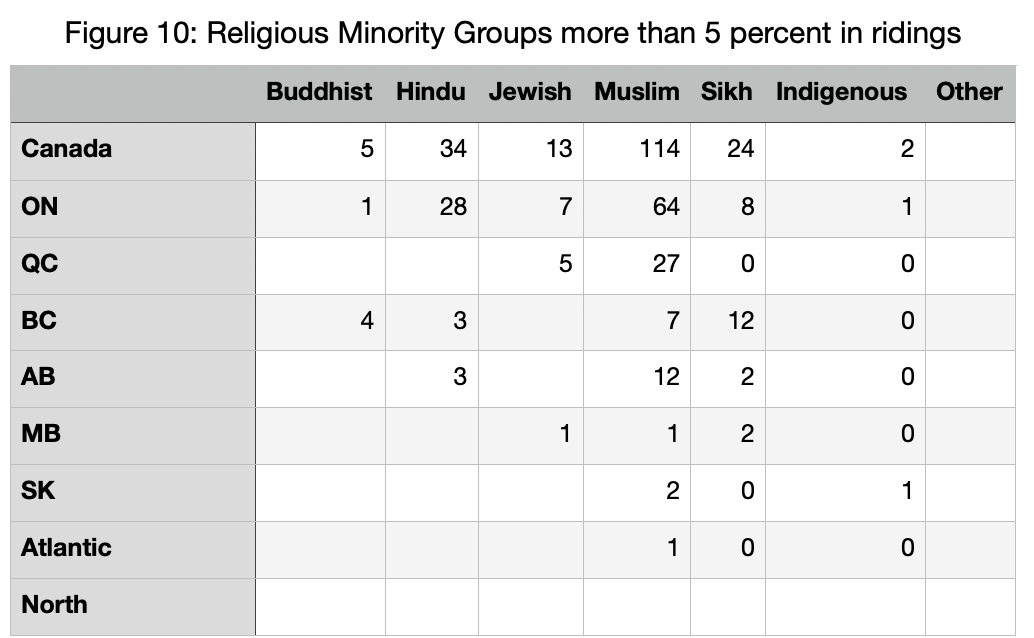
The table below highlights the number of ridings with more than 5 percent religious minorities, highlighting just how many more ridings have significant Muslim populations compared to Jewish populations.

The Liberals find themselves caught between an Israel/Conservative rock and a NDP/Palestinian hard place. And they don’t seem to have a solution, other than to placate both sides, which is no solution at all.

Source: Liberals trying to play both sides in Gaza conflict

Inside the crisis at TMU’s law school: It started with a letter of support for Palestinians. Now students and staff feel betrayed and donors are pulling out

Not really surprising that a school “branded as “a different kind of law school focused on equity and inclusion” would find itself in this mess. Kind of fitting for a university that changed its name from Ryerson to TMU, because of overly simplistic interpretations of history, activist pressure, and hurt to some students and groups, finds itself underlining its blind spot regarding anti-Jewish attitudes and anti-semitism.

Words matter, as advocates and activists rightly maintain. But now many of the activist law students are discovering this in a real personal sense with real consequences. A teaching moment:

…Public reaction was vicious. On social media, signatories were mocked and insulted in posts featuring their LinkedIn profiles, with photos of their faces. The Jewish advocacy group B’nai Brith put out a press release, calling on the school to “expel terrorist apologist students.” Some members of the legal community advocated for blacklisting all TMU students from the profession.

“I certainly wouldn’t hire any of these students,” one Toronto lawyer posted on X, “and the fact that some choose to ‘show’ their solidarity by keeping their names hidden means I’d have to write off hiring anyone from … the current crop at @LincAlexLawTMU.”

Under intense pressure from all sides, the institution waded in. What school leaders did would only further fan the flames.

The law school issued a statement that “unequivocally” condemned the “sentiments of Antisemitism and intolerance” the petition expressed, but made no mention of any possible action to address the conduct of signatories. That fell short in the eyes of two Jewish criminal defence lawyers. They penned a letter urging the school to impose consequences to “illustrate in no uncertain terms that hate speech and incitements to violence are utterly unacceptable.”

One of several non-Jewish signatories was former Ontario Court of Appeal Justice Harry LaForme, who is an Anishinabe from the Mississaugas of the New Credit First Nation. LaForme read the aspiring lawyers’ petition as a justification for what happened on Oct. 7, which, he said, disregards the rule of law, and is “completely anathema to Indigenous Peoples.”

LaForme hoped the school would create a safe space internally for signatories to distance themselves from the petition. “They (the students) have to be able to change their minds,” he said.

‘New McCarthyism’ decried by lawyers

In November, TMU hired a retired judge to conduct an external review. Former Chief Justice of Nova Scotia J. Michael MacDonald will meet signatories this month to determine whether their words breached the student code of conduct, which sets expectations for how students interact and communicate.

The school’s decision to outsource the job stoked acrimony, both from those who had been pushing administrators to quickly confront what seemed to them to be clear policy violations, as well as those who believed students were now being subjected to a witch hunt.

“A new McCarthyism” is how the response to the student petition was characterized in an open letter, signed by hundreds of members of the legal community, including Sealy-Harrington, Gadea Hawkins and other TMU professors.

Dania Majid, a Palestinian activist and head of the Arab Canadian Lawyers Association, signed that open letter. Majid, who faced intense Islamophobia as a young lawyer in the aftermath of 9/11, said the school’s characterization of the petition as antisemitic is “textbook anti-Palestinian racism.”

Majid said the students are being treated “as criminals.”

The fallout also highlighted divisions within the Jewish community, including at TMU. Shiri Pasternak, an assistant professor in criminology, is part of a group of Jewish instructors who don’t believe the petition was antisemitic and are concerned about the implications of the external review on academic freedom on campus.

“We didn’t necessarily all endorse the letter that the law students wrote,” Pasternak said. “But … we strongly believe that students should have a right to express, even imperfectly, their sense of injustice, and raise their collective voices to intervene when they see injustices.”

A campus turned tense

On campus, the atmosphere turned tense, students say. For the rest of the term, fewer classmates showed up for lectures; when they did, people who used to intermingle seemed to be sitting apart. Sam and Taylor said they felt ostracized by some of their peers, and uncomfortable coming to class.

One law school instructor, who is Jewish, moved her classes online after reading the petition. In a complaint to the university, she alleged the petition violated school policies, and had caused her to “worry for my physical safety as a result of my faith.”

Some of the law school’s roughly 450 students were upset by the timing of the petition, which dropped the week before on-campus interviews for placements at law firms.

At least one Bay Street firm asked TMU students whether they signed the petition, and refused to grant interviews to those who did. Ontario’s Ministry of the Attorney General also required law students working for the province to sign an attestation confirming they weren’t among the signatories, according to a memo from the deputy minister.

Noah Lister-Stevens, a second-year student who participated in interviews that week, was “disappointed” with his classmates for not better contemplating how their words would land. But he said the response of some law firms that seemed to be waging “a scorched-earth campaign,” was “disturbing.”

“None of the students in my school that I’ve ever spoken to are hateful people,” he said. “Everyone that I know who signed that letter is a kind person who deserves to be in that school.”

Sealy-Harrington shared with the Star several statements that he said had been provided to him by anonymous signatories. The statements accuse the administration of defaming the signatories by wrongly characterizing their petition as antisemitic, and of ignoring their pleas for help as they endured Islamophobia and racism from students, staff and the public.

“Nobody condemned the people calling us terrorists, or telling us to die, or describing in extreme detail the vile ways they would harm us or our families,” one statement said. “The school, named for an incredible justice-seeking Black man, acts only when white students complain, not when people of colour are tormented.”

The law school was renamed in 2021 for Lincoln Alexander, who was a lawyer and champion of racial equity. As Ontario’s lieutenant governor, he became the first Black Canadian to serve as a representative of the British monarchy in Canada.

A TMU spokesperson said “we respectfully disagree” with the claims of the signatories.

Administrators and staff have had nearly 200 meetings with students “to listen to their concerns and help them navigate the many available supports,” Karen Benner said in an email. “The university and law school categorically condemn any and all discrimination and harassment directed at our students and faculty, and have taken steps to address them.”

Donors cancel TMU law school scholarships

But the administration’s conversations with donors have been strained.

Criminal defence lawyer Brian Greenspan suspended a $50,000 scholarship. Greenspan said in a letter to the law school’s dean and the TMU president that the school’s namesake would be “appalled” by the petition.

The failure of administrators to categorically denounce the petitioners, Greenspan said, is “a derogation of the responsibility of those who support a civil society and a blemish on the legacy of Lincoln Alexander,” who believed in finding common ground.

The pulling of funding is an inappropriate response, according to Jim Turk, who is the director of TMU’s Centre for Free Expression, and says it takes away opportunities from future students.

Source: Inside the crisis at TMU’s law school: It started with a letter of support for Palestinians. Now students and staff feel betrayed and donors are pulling out
Lisée: Exagérer avec Bock-Côté

Useful review, as much for Lisée’s views as MBC’s:

Je veux rassurer tout de suite ceux de mes lecteurs qui souffrent de mathieu-bock-côté-phobie — oui, oui, je sais que vous êtes là : je ne suis pas un admirateur inconditionnel de celui qu’on appelle MBC. Mais voilà, je dois maintenant vous peiner en ajoutant que j’en suis un admirateur conditionnel. En plus, c’est un ami.

Je suis social-démocrate, il est conservateur. J’exècre l’avant-dernier pape, il le vénère. Je suis critique de toutes les religions, il fait l’apologie de la chrétienté. J’applaudis les programmes d’accès à l’égalité, il en rejette le principe même. Je suis inquiet du réchauffement, cela ne lui fait ni chaud ni froid. Je juge essentiel de faire reculer la pauvreté, le sujet l’ennuie. Il m’arrive même de défendre les droits des Anglo-Québécois, s’il l’a fait, cela m’a échappé. Je suis indépendantiste, lui aussi.

Je viens de terminer son dernier livre, Le totalitarisme sans le goulag (La Cité). Il exagère. C’est bien écrit. Il manie le verbe avec talent, mène sa charge avec élan. On le soupçonne content d’avoir trouvé une habile formule pour trucider tel aspect du régime diversitaire dont il a fait son ennemi personnel, puis en imaginer une seconde, puis une troisième, plus mordante encore, qu’il ne peut s’empêcher de nous proposer. On voit bien qu’il se répète, mais on pardonne, car c’est goûteux. Mais qu’est-ce qu’il exagère !

Si on suit son raisonnement, nous vivrons bientôt, nous, Occidentaux, dans un monde où une banque fermera notre compte simplement par désaccord avec notre opinion politique pourtant légale. Un monde où des manifestations seront interdites préventivement, par crainte qu’y soient prononcés des propos haineux. Un monde où utiliser le mauvais pronom pour désigner le genre d’une personne sera un acte criminel. Où on pourrait être déclaré hors-la-loi pour avoir mis en doute le récit victimaire d’une minorité. Un monde où des policiers pourront nous arrêter simplement parce que nous avons chez nous un livre qui peut être jugé offensant envers une minorité et que nous aurions dû savoir que quelqu’un pourrait l’utiliser pour le montrer à une partie du public et ainsi l’inciter à la haine (Mein Kampf ? L’Ancien Testament ? Le Coran ? Relations des Jésuites ?). 

Un monde où nous pourrons être accusés d’inciter à la haine pour des propos tenus en privé, dans notre salon. Un monde où des employés de l’État ou de grandes entreprises seront soumis à des formations les instruisant sur ce qu’ils doivent absolument penser de l’histoire de leur pays. Et où exprimer un désaccord envers une opinion bizarre — que le racisme serait bien pire au Canada qu’aux États-Unis, par exemple — peut vous valoir des accusations de suprémacisme, vous plonger dans une dépression, vous conduire au suicide.

Quand je vous disais qu’il exagérait. On serait dans Orwell, qu’il cite d’ailleurs abondamment. Bon, c’est vrai, une banque a fermé son compte au politicien britannique Nigel Farage pour raisons politiques ; devant le tollé, ils l’ont rouvert. Bon, c’est vrai, des préfets français ont interdit à l’avance des manifestations, parfois de gauche, parfois anti-laïques, parfois de l’ultradroite, parfois aussi pour interdire de taper sur des casseroles sur la trajectoire du convoi présidentiel. Est-ce si grave ?

Penser que le mégenrage soit criminalisé, c’est du délire. Quoique ce soit souhaité par une pluralité de millénariaux aux États-Unis. Idem pour la remise en question du génocide culturel autochtone canadien. Ce n’est qu’une recommandation officielle, appuyée par le ministre canadien de la Justice, pourquoi s’énerver ? Et ce livre odieux que vous avez chez vous, ce n’est qu’en Irlande qu’une loi pourrait vous entraîner en tôle pour le posséder, pas ici. Et les propos haineux tenus en privé, ce n’est qu’en Écosse qu’on pourrait vous les reprocher devant un juge. C’est loin, l’Écosse.

Quant aux formations obligatoires nous contraignant à croire que nous sommes pires que les Américains, elles ne sont imposées qu’aux employés fédéraux, à ceux des grandes entreprises, pas aux PME. Et, oui, aux directeurs d’école de l’Ontario, dont un a osé dire que c’était inexact, fut accusé d’être un suprémaciste blanc, puis s’est suicidé. Mais n’était-il pas un peu fragile ?

Sérieusement, Bock-Côté trace le portrait de ce qui pourrait nous arriver de pire, si la totalité des assauts recensés contre la liberté d’expression et de conscience devaient s’arrimer et se généraliser. S’avisant qu’il existe un médicament qui semble réduire les opinions racistes, notant que des implants cybernétiques sont en développement, il nous avertit de ne pas écarter la perspective d’utilisation de ces innovations pour contrôler nos élans et nos pensées. Je voudrais lui rétorquer que le pire n’est pas toujours sûr. Je me retiens, car ses ouvrages précédents nous avaient souvent prévenus de dérives dont on ne pouvait croire qu’on les vivrait près de chez nous, mais qui, pourtant, sont arrivées.

Évidemment, s’il s’inquiète énormément des outrances issues de la mouvance woke (un mot qu’il n’utilise pas, préférant parler de régime diversitaire), il est moins disert sur les mouvements de droite qui interdisent des lectures, réforment les programmes pour qu’on ne parle plus d’esclavage aux États-Unis, matent la liberté de la presse en Europe de l’Est. Une partie du livre est destinée à prouver que l’extrême droite politique n’existe pas en soi (il ne nie pas l’existence de groupuscules néofascistes). Qu’il ne s’agit que d’une étiquette servant à marginaliser les porteurs d’un discours dérangeant. 

La démonstration va pour la France,où les thèmes du contrôle de l’immigration et de la lutte contre la délinquance, naguère portée par le clan Le Pen, sont désormais au centre de l’action d’un gouvernement qui se dit d’extrême centre. Mathieu n’en parle pas, mais l’utilisation par les conservateurs nord-américains du mot « woke » pour étiqueter la totalité des positions progressistes et écologistes, même modérées, relève du même phénomène et mérite la même réprobation. 

Et lorsqu’il défend sans la nommer la thèse du « Grand Remplacement » des peuples historiques par les minorités, on cherche en vain dans ses pages les chiffres, l’échéancier, le moment du point de bascule, même si la transformation est visible en France et en Europe dans des cités et des quartiers.

Il y a donc à prendre et à laisser — et beaucoup à ajouter — à l’oeuvre que construit énergiquement l’ami Bock-Côté. Je conçois que les avertissements qu’il nous lance peuvent agacer, déranger. J’estime toutefois qu’il est un combattant de la liberté d’expression. Et que c’est à nos risques et périls qu’on refuserait de l’entendre.

Source: Exagérer avec Bock-Côté