Eric Kaufmann: Canadians aren’t actually ‘woke’

Pretty flawed methodology as the polling questions focus on contemporary controversies rather than probing for more underlying perspectives, where many other polls and research highlight significant differences. The classic analysis of how polling can be misleading is from Yes, Prime Minister, https://www.youtube.com/watch?v=ahgjEjJkZks. Poll questions appear designed to generate these responses and advance Kaufmann’s viewpoint rather than being more objective:

Canadians have nearly identical views on culture war issues to Americans and Britons. Across some fifty questions concerning free speech, national heritage, and transgender issues, Canadians, like Britons and Americans, lean around two-to-one against the “woke” cultural socialist option and in favour of cultural liberalism or conservatism. This is the story that emerges from my new report for the Macdonald-Laurier Institute, “The Politics of the Culture Wars in Canada.”

Woke refers to the sacralization of historically marginalized race, gender, and sexual identity groups. This belief system elevates equal outcomes and emotional harm protection for such groups as its highest value. As a result, woke activists seek to cancel speakers or historical figures deemed to be offending the sensibilities of the most hypothetically sensitive member of a minority group. In this clash of values, cultural socialism trumps expressive freedom and symbolic attachment.

Prime Minister Justin Trudeau has distinguished himself on the world stage as the paragon of this belief system, and many outside Canada assume he reflects an equally woke Canadian public. But is this truly the case? To better understand Canadian views, The Macdonald-Laurier Institute asked Maru Public Opinion Polls to conduct a nationally representative survey of 1,500 adults, in which I fielded numerous questions previously put to American and British samples. 

What did I find? Surprisingly, despite their reputation, Canadians largely reject the woke ideology. For instance, they oppose the idea of separating pupils in class by race—assigning whites as privileged and minorities as oppressed—by a whopping 92 to 8. By 85-15, they reject the idea of teaching children that “There is no such thing as biological sex, only gender preference.” Excluding those with no opinion, 80 percent of respondents were against the idea of J.K. Rowling being dropped by her publisher. By a similar slant, Canadians say “political correctness has gone too far.”

In most cases, respondents came out strongly against established practices found in Canadian institutions. For example, when Toronto teacher Richard Bilkszto pushed back against diversity trainer Kike Ojo-Thompson’s characterization of Canada as more racist than the United States, none of his colleagues defended him and his travails eventually drove him to suicide. Yet, by a stunning 95-5 margin, Canadians overwhelmingly reject the idea that their country is more racist than other countries. Among those with an opinion, just 30 percent say that Canada is a racist country while 70 percent disagree. A similar share says they do not want schoolchildren taught that the country is racist.

Or consider the fact that almost all statues of Sir John A. Macdonald have been removed from major Canadian cities. Yet, Canadians oppose removing statues of Canada’s Father of Confederation by a two-to-one ratio. Among those with an opinion, a mere 8 percent say activists should be allowed to remove statues without government approval, with 92 percent against. Almost 45 percent of Tory and PPC voters strongly disagree with removing Macdonald. In addition, only 5 percent of Liberal, NDP, and Green voters strongly agree that his statues should be removed. The majority of left-wing voters oppose rather than support Macdonald’s removal.

Canada has been one of the most trans-affirming societies on earth. Only in the past year have conservative premiers in New Brunswick, Saskatchewan, and Alberta begun to curb trans activism in education by requiring schools to inform parents of their children’s change of pronouns. And only recentlyhas Pierre Poillievre been willing to oppose puberty blockers for minors. In Premier Doug Ford’s Ontario, not to mention in provinces run by the NDP or Liberals, the writ of trans activism runs through government and the schools. 

But when we look at public opinion on the trans question, an entirely different picture emerges. By a four-to-one ratio, Canadians oppose gender reassignment surgery for those under 16. By two-to-one, they want parents informed of pronoun changes at school and don’t want transgender women (i.e. biological males) to enter women’s sports competitions. Three in four Canadians say we talk too much about transgenderism. Even when it comes to people displaying their pronouns in work emails or social media profiles, more Canadians disapprove of this practice than support it, placing them even to the right of the British public.

It is striking how similar Canadian public opinion is to that of supposedly more conservative America or Britain. Across 30 questions I asked in Britain in 2022 and Canada in 2023, the average difference in opinion between the two countries is just 0.3 of a percentage point. Furthermore, of the 13 questions asked in the U.S. in 2021, the average gap with this Canadian survey was just one point! There is essentially no appreciable difference—especially if we take variation in date and sample (as well as random error) into account. Canadians are somewhat more likely than Britons or Americans to say biological males who identify as women should be allowed in women’s sports, and somewhat more supportive of Black Lives Matter. But they are considerably less likely than Britons or Americans to say their country is racist. Canadians under 35, in particular, stand out as being far less likely than their American or British youth counterparts to call their respective country racist.

French-English differences are also much smaller than the stereotype of woke English Canada versus plain-speaking traditional French Canada would lead us to expect. Francophones are somewhat less woke than Anglos on many transgender questions and more inclined to colourblindness rather than race and gender-conscious Diversity, Equity, and Inclusion (DEI) policies. However, Anglophones are more critical of Black Lives Matter than Francophones, more likely to say political correctness has gone too far, and more opposed to removing statues and renaming buildings—though the examples tested involve Anglophone figures such as Macdonald or Ryerson, to whom Francophones have weaker historical attachments.

English Canada’s culturally-left political and media elite contrasts with that of red-state America, and, to a lesser degree, with Britain and Quebec. If English-Canadian public opinion is largely aligned with the others, why have its policies and politicians diverged from their British, American, and Quebecois equivalents? 

One possible answer is Canadians’ relatively high trust in elites and institutions. More than half of Canadians trust journalists while fewer than 20 percent of Britons and barely a third of Americans do. Even 30 percent of conservative Canadians trust journalists compared to 11-15 percent of conservative Americans and Britons. A somewhat similar pattern holds with respect to academics and teachers. Canadians’ elevated trust in their largely progressive-dominated institutions gives the Canadian elite more leeway to deviate from public opinion.

The key takeaway is that culture war issues are far less settled than a lot of mainstream commentary would have Canadians believe. Polling irrefutably shows that Canadians are as inclined as Americans or Britons to disagree with a lot of the woke shibboleths that are present in the media, universities, and other major institutions. As for the political implications, these findings may represent a glaring opportunity for conservatives and a glaring risk for progressives. 
Source: Eric Kaufmann: Canadians aren’t actually ‘woke’

Campaign to crack down on fake immigration lawyers aims to protect newcomers from ‘scam artists’

Perennial problem:

Newcomers to Canada often turn to lawyers to help them navigate the ins and outs of the immigration system. But increasingly, in Montreal, people posing as immigration lawyers are taking advantage of immigrants and refugees, which can cause serious problems.

The Montreal Bar is investigating a growing number of allegations of people posing as immigration lawyers, leading it to warn newcomers to be vigilant.

“The impact and the consequences are quite significant,” said David Ettedgui, president of the Montreal Bar. That’s why the bar has launched an awareness campaign to “prevent people from falling victim to these scam artists,” he said.

In 2022, nearly 40 per cent of the bar’s investigations into the illegal practice of the profession of law were related to immigration, up from 13 per cent in 2018, Ettedgui said.

The fake lawyers often approach their victims on social media and can end up costing victims hundreds or thousands of dollars.

“They’ll go to their victims, say that they are lawyers, take on their files and if they do it at all, most often it’ll be poorly done,” Ettedgui said.

The bar’s campaign will reach people online and through community groups with links to new immigrants and refugees. It aims to raise awareness about the risks and help prevent newcomers from falling into a trap. It includes links to verify a lawyer’s credentials and information about where to file complaints…

Source: Campaign to crack down on fake immigration lawyers aims to protect newcomers from ‘scam artists’

Court ruling OK’s Amnesty Canada intervention in Black Class Action lawsuit

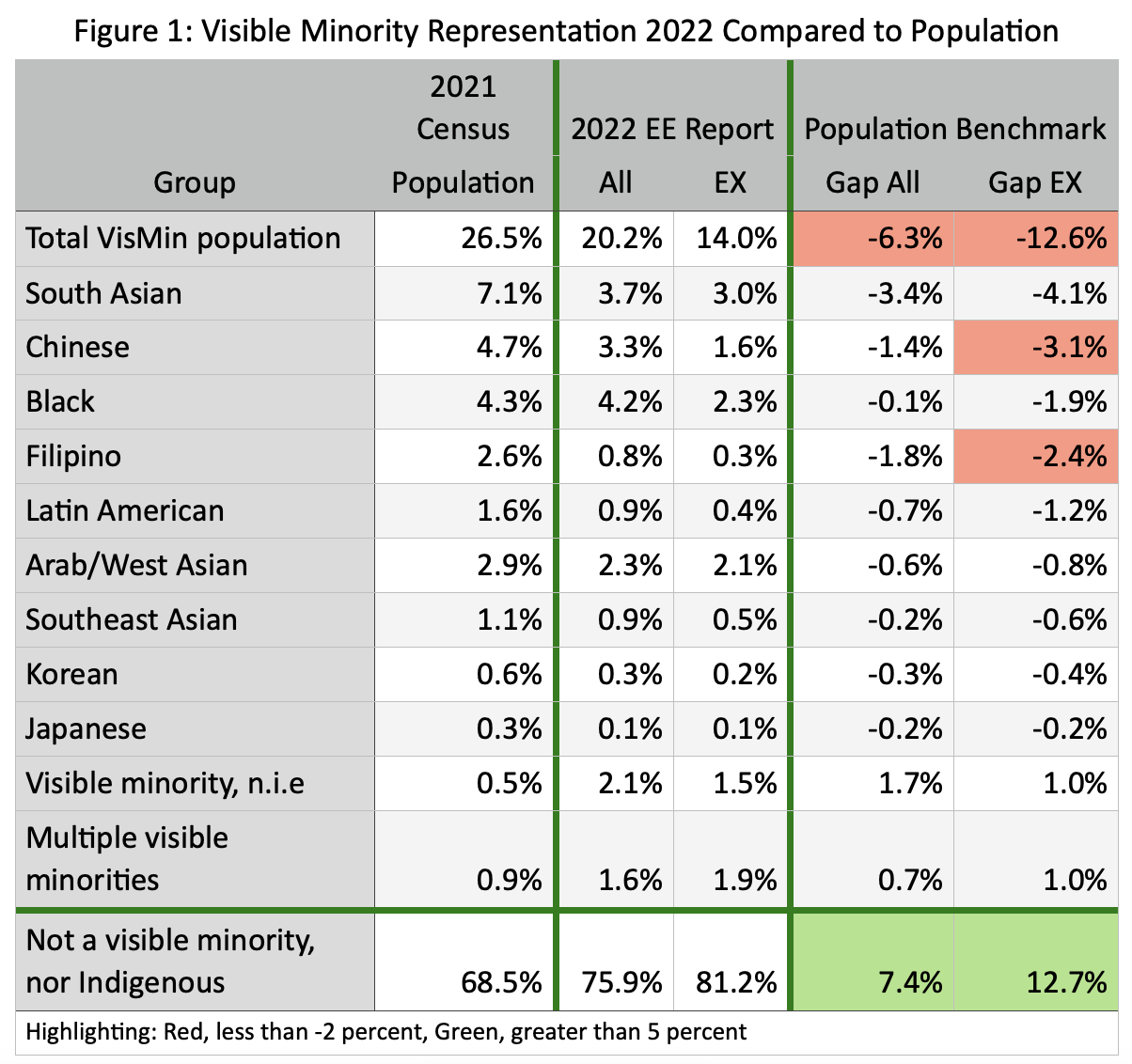
Fair enough but would have thought higher priorities, particularly given overall representation number of Black public servants compared to other visible minority groups:

….In October 2022, the federal government called for a Federal Court judge to dismiss the uncertified class action seeking $2.5 billion in compensation, arguing workers should pursue other avenues for redress, including filing complaints with the Canadian Human Rights Commission.

Amnesty Canada applied to the court to intervene last summer, with the organization’s counsel noting in a cross-examination a few months later that its participation would be “limited to making legal arguments regarding the defendant’s obligations under international law.”

“Canada’s duty to uphold federal workers’ rights goes beyond the Charter and domestic employment equity legislation,” Ketty Nivyabandi, Secretary General of Amnesty International Canada’s English-speaking section, said in a news release about the decision. “As we will stress to the court, Canada also has clear obligations under international law to promote equity, counter racism and provide an effective remedy when people are subjected to systemic discrimination.”

The court decision stated that the government was the only opponent to the motion, “largely on the basis that the proposed submissions are substantive in nature and not relevant to the procedural issues raised in the certification motion and motion to strike, and on the basis that, in any event, these issues are not governed by international law.”

In a news release, the Black Class Action Secretariat said it welcomed the court’s decision to allow Amnesty International Canada’s intervention in the lawsuit despite the government’s efforts to “vehemently oppose it.”

“This pivotal ruling underscores the necessity of incorporating international human rights perspectives in the fight against systemic discrimination within the federal public service,” a BCAS statement read. “This intervention highlights the national and international importance of our cause and the urgent need to address these injustices.”

The certification hearing is expected to take place after May 3, but BCAS said it called on the government to consent to the certification of the class action instead of “forcing workers to relive decades of trauma.”

“This step is crucial in moving forward toward a fair and just resolution for the affected Black workers,” its statement read. “We urge the government to commit to meaningful actions that address and rectify the discrimination within the public service, thereby restoring trust and integrity in Canada’s federal public service.”

Source: Court ruling OK’s Amnesty Canada intervention in Black Class Action lawsuit

La langue ne peut pas être le critère principal dans la répartition des demandeurs d’asile, dit Québec

A noter. Quick rebuke to proposal from the French Language Commissioner:

Le critère de la langue ne peut pas être le facteur principal dans la répartition des demandeurs d’asile à travers le Canada, selon le gouvernement caquiste. Si ce dernier souhaite toujours voir davantage de ces immigrants se diriger vers d’autres provinces, cela doit d’abord se faire « sur une base volontaire », a indiqué jeudi la ministre de l’Immigration, Christine Fréchette.

L’élue du gouvernement de François Legault réagissait ainsi au plus récent rapport du commissaire à la langue française, Benoît Dubreuil, qui recommandait mercredi que la maîtrise de la langue française devienne un critère dans la répartition des demandeurs d’asile. Dans ce scénario, les demandeurs qui ne parlent pas français seraient redirigés vers le reste du Canada.

« Il y a exactement une année, le fédéral avait mis en place un système pour faire en sorte de donner de l’oxygène au Québec, pour faire en sorte de répartir l’ensemble des demandeurs d’asile davantage en Ontario et dans les provinces atlantiques », a rappelé jeudi la ministre Fréchette en mêlée de presse avec son collègue à la Langue française, Jean-François Roberge. « Nous, on demande de reprendre cette approche-là et de faire en sorte que, sur une base volontaire, les demandeurs d’asile soient [redirigés]. »

Interrogée sur le critère de la langue française, Mme Fréchette a répété qu’elle demandait « au fédéral d’agir sur une base volontaire pour la répartition des demandeurs d’asile ». « Les moyens qu’il utilisera pour le faire, c’est à sa discrétion », a-t-elle ajouté.

À Ottawa, le ministre fédéral de l’Immigration, Marc Miller, n’a pas attendu pour rejeter les propositions du commissaire à la langue française. En réponse à une question du député de Lac-Saint-Jean, le bloquiste Alexis Brunelle-Duceppe, il a soutenu que « déporter des gens qui ne parlent pas le français au [reste du] Canada » serait « un geste illégal, immoral, qui manquerait d’humanité ».

La langue parlée « ne devrait pas être le critère principal », a-t-il poursuivi lorsqu’interrogé directement sur la recommandation du commissaire Dubreuil.

Ottawa doit « sortir de sa bulle »

Au début de l’année, le premier ministre François Legault avait envoyé une lettre à son homologue fédéral, Justin Trudeau, pour exiger que les demandeurs d’asile, qui arrivent en grande partie par l’aéroport Montréal-Trudeau, soient mieux répartis à travers le Canada. « On a une situation qui est critique au Québec », a dit jeudi Mme Fréchette, tout en demandant à Ottawa de « sortir de sa bulle ».

Or, depuis, rien. Bien que le ministre Miller ait assuré jeudi travailler pour « répartir le fardeau que porte le Québec ».

Au Salon bleu, jeudi, le chef du Parti québécois, Paul St-Pierre Plamondon, a accusé le gouvernement caquiste d’être « responsable du pire déclin linguistique de notre histoire ». Son collègue député Pascal Bérubé a accusé la ministre Fréchette de ne pas vouloir « froisser son homologue fédéral ». Comme le commissaire à la langue française, la formation souverainiste appuie l’idée d’une répartition basée sur la langue. « C’est une bonne proposition », a dit M. Bérubé, porte-parole péquiste en matière d’immigration.

En réponse à M. St-Pierre Plamondon, le ministre Roberge a rappelé que son gouvernement travaillait à un « réveil national » sur la langue française. « Ça prend du culot pour […] demander un réveil national quand on dort à ce point-là sur cet enjeu-là », a répliqué le chef péquiste, avant d’être rappelé à l’ordre par la présidente de l’Assemblée nationale pour l’utilisation du mot non parlementaire « culot ».

S’il appuie le commissaire à la langue française sur la nécessité d’une meilleure répartition des demandeurs d’asile, Québec solidaire souhaite, comme la Coalition avenir Québec, que ces transferts se fassent de manière « volontaire ». « On ne mettra pas du monde qui ne veut pas aller ailleurs dans un autobus. De toute façon, on ne peut pas faire ça », a soutenu le porte-parole solidaire en matière d’immigration, Guillaume Cliche-Rivard.

« Du moment où ça va être volontaire, ça ne sera pas inhumain. Du moment où les gens vont être consentants », a-t-il ajouté.

Le Parti libéral du Québec, lui, ne voit pas les choses du même oeil que le commissaire Dubreuil. « Si les immigrants veulent rester de façon permanente, on doit mettre en place des programmes qui leur permettront d’apprendre le français. On ne peut pas se mettre à la porte et dire : “Vous ne parlez pas français, on vous refuse l’accès” », a soutenu le chef intérimaire du parti, Marc Tanguay.

Source: La langue ne peut pas être le critère principal dans la répartition des demandeurs d’asile, dit Québec

UK: Shadow minister says Labour will investigate allegations as antisemitism row deepens

Of note:

The shadow defence secretary has said Labour will “follow the hard evidence” to ensure anyone who does not meet the standards of the party will be investigated.

His remarks come as Keir Starmer’s party was plunged into a damaging row about the handling of antisemitism allegations, with parliamentary candidate Graham Jones suspended on Tuesday, only a day after Labour was forced to suspend and withdraw its backing for Rochdale by-election candidate Azhar Ali.

Mr Starmer was forced to act after audio, obtained by website Guido Fawkes, appeared to capture Mr Jones using the words “f****** Israel” at the same meeting Mr Ali attended, while also allegedly suggesting that British people who volunteer to fight with the Israel Defence Forces should be “locked up”.

John Healey today urged anyone else at the meeting who witnessed antisemitism or unacceptable comments to report it to the party.

Speaking to Sky News, the shadow minister said: “Anyone at that meeting, if there is evidence that they have, that people acted or spoke in a way that doesn’t meet the standards, or is incompatible with the values of our Labour Party, they need to report it, provide it and the Labour Party will take it seriously and investigate it.

He added: “It’s what we do with every case.”

Pushed on whether Mr Ali was properly vetted, Mr Healey said the Rochdale candidate was “widely respected” and “widely supported across communities, including the Jewish community in the North West”.

He also said that there are “strong checks” and “due diligence” in the process. “But you can’t see everything everywhere. What’s important is that if new information comes to light, as in this case, we will act to investigate, we will act to block those who are not fit to serve as MPs,” he added.

It is too late now to replace Mr Ali as the Labour candidate so he will still appear on the ballot paper as the party’s choice.

On Tuesday the Labour leader Sir Keir Starmer addressed the controversy for the first time since the allegations broke.

“Information came to light over the weekend in relation to the candidate [and] there was a fulsome apology. Further information came to light yesterday calling for decisive action, so I took decisive action,” he said.

The Labour leader added: “It is a huge thing to withdraw support for a Labour candidate during the course of a byelection. It’s a tough decision, a necessary decision, but when I say the Labour party has changed under my leadership I mean it.”

Labour has been criticised for not taking tougher action sooner, with some suggesting Mr Ali was given favourable treatment because he was an ally of the leadership.

Source: Shadow minister says Labour will investigate allegations as antisemitism row deepens

Yakabuski: Australia’s centre-left Labor government points the way for Canada’s Liberals on immigration

Lots more to Australian changes but this is one of the major ones, with lessons for the current Canadian government:

…In December, the current Labor government headed by Prime Minister Anthony Albanese slammed on the brakes. It unveiled a plan to “reform Australia’s broken migration system” and “bring migration back to sustainable levels.” Net migration will be reduced to 375,000 this year and to 250,000 in 2024-25.

“People my age in my city and anyone younger right now think that owning their own home is a pipe dream. They can’t get into a rental,” said Clare O’Neil, Australia’s 43-year-old Home Affairs Minister and a Melbourne MP. “[W]e’ve got a housing crisis in our country that is not being helped by what is a very large migration intake.”

While Australia’s centre-left federal government has finally moved – however reluctantly – to fix a “broken” immigration system, Canada’s is still in denial. Liberal Immigration Minister Marc Miller last month announced a 35-per-cent reduction in student visas this year. But that timid move was typical of a government that still refuses to admit its immigration-policy mistakes.

Mr. Miller has not taken any action to reduce the number of temporary foreign worker visas Ottawa hands out. Prime Minister Justin Trudeau has insisted his government has no intention of scrapping its plan to increase the number of new permanent residents Canada accepts to 500,000 in 2025, from 485,000 this year, 341,000 in 2019 and 272,000 in 2015.

In short, the Liberals still seem wedded to Big Canada, despite its increasingly obvious pitfalls.

Source: Australia’s centre-left Labor government points the way for Canada’s Liberals on immigration

Jesse Kline: Amira Elghawaby defends antisemitic protest in front of Toronto hospital

Not a great look:

…Not that the protesters themselves would ever admit this, as doing so would expose them to hate crime charges. The group Toronto4Palestine said that Mount Sinai “just happens to be along our regular rally route.” How were they supposed to know it’s the one hospital in that area with strong ties to the Jewish community?

It’s not hard to see through their thinly veiled excuses, but that hasn’t stopped their fellow travellers from putting on blinders and coming to their defence — including Elghawaby, Canada’s “special representative on combating Islamophobia.” Taking to the social media platform formally known as Twitter on Tuesday, Elghawaby noted that blocking the entrance to a public hospital was “troubling,” but also criticized “the rush to label protesters as antisemitic and/or terrorist sympathizers.”

Never mind that they deliberately targeted an institution with Jewish roots. Never mind that signs could clearly be seen portraying terrorists as freedom fighters. And never mind that they were loudly chanting, “Long live the intefadeh,” a reference to the two Palestinian uprisings, in which hundreds of Israeli civilians were killed in suicide bombings and other terrorist attacks, many of which were committed by Hamas, the perpetrator of the Oct. 7 massacre.

You’d think that someone whose job is to combat hatred would be the first to denounce a hate-filled rally such as this, even if it was antisemitism being espoused, rather than Islamophobia. But according to Elghawaby, such displays should only be condemned “if police determine any action was motivated by hate.” (Which is a little hard to do since we can’t read minds, and highlights the folly of creating a separate class of crimes that are dependant on the thought processes of the perpetrators.)

source: Jesse Kline: Amira Elghawaby defends antisemitic protest in front of Toronto hospital

Mahboubi: The other immigration problem: Too much talent is leaving Canada

More commentary on emigration and the apparent churn we have between arrivals and departures:

The Statistics Canada paper also draws attention to the challenges immigrants encounter, extending beyond economic integration to encompass factors such as family dynamics and considerations, cultural adaptation, and the political, economic, or cultural conditions of their country of origin. Furthermore, the study highlights the phenomenon of transnationalism, where immigrants maintain ties in multiple countries. Some immigrants may plan to emigrate from Canada as part of a strategic migration approach. Not all these circumstances are easy for Canadian policy makers to address.

Other circumstances, however, are well within Canadian policy makers’ scope. Canadian living standards are stagnating. Weak capital investment is hurting productivity and incomes. Canadian businesses tend to stay small. Canadian governments rely relatively heavily on personal income taxes, with high rates that apply at relatively low income levels – not an approach that signals to talented people that Canada is the place for them. Tax reform and other changes that mitigated these problems would make Canada more attractive to everyone – immigrants and Canadian-born alike.

Paying attention to which immigrants are likeliest to leave, and why, can help Canada improve its ability to attract and retain talent. We may be able to refine our selection criteria to raise the proportion of talented, entrepreneurial immigrants who stay in Canada. We can make it easier for immigrants with specialized skills, in health care for example, to work in their professions. Moreover, addressing factors such as high taxes and regulations that stifle entrepreneurship can help Canada retain more immigrants and retain more Canadian-born talent – a win for everyone.

Parisa Mahboubi is a senior policy analyst at the C.D. Howe Institute, where William Robson serves as CEO.

Source: The other immigration problem: Too much talent is leaving Canada

California’s Push for Ethnic Studies Runs Into the Israel-Hamas War

Not surprisingly, as would any history program:

California has grand ambitions for ethnic studies. By 2025, the state’s public high schools — about 1,600 of them — must teach the subject. By 2030, students won’t be able to graduate high school without it.

For policymakers, a goal is to give California students, 80 percent of whom are nonwhite, the opportunity to study a diverse array of cultures. Research has shown that ethnic studies classes can raise grades and attendance for teenagers at risk of dropping out.

But even in a liberal state like California, scholars, parents and educators have found themselves at odds over how to adapt the college-level academic discipline for high school students, especially because of its strong views on race and the Israeli-Palestinian conflict.

While the name “ethnic studies” might bring to mind a broad exploration of how ethnicity and race shape the human experience, the discipline, as taught in universities, is narrower — and more ideological.

Ethnic studies focuses on four groups: Black Americans, Latinos, Native Americans and Asian Americans. It aims to critique various forms of oppression and spur students to take action, often drawing analogies across disparate expanses of time and geography. The Palestinian experience of displacement is central to that exercise, and has been compared by some scholars to the Native American experience.

In reworking ethnic studies for high school, California came up with a 700-page model curriculum that captures much of the discipline’s leftist, activist spirit. But it added the stories of other ethnic groups, including Jewish Americans, while eliminating discussions of the Israeli-Palestinian conflict. It said lessons should include “multiple perspectives” on political issues.

The state’s model ethnic studies curriculum does not directly address the Israeli-Palestinian conflict, but does include an optional sample lesson that emphasizes Jewish roots on the land that is now Israel.Credit…California Department of Education
The state’s model ethnic studies curriculum does not directly address the Israeli-Palestinian conflict, but does include an optional sample lesson that emphasizes Jewish roots on the land that is now Israel.

Now some prominent ethnic studies scholars and educators say the state has bowed to political critics and censored their field. They are promoting a competing vision, which they call “liberated ethnic studies.” It is truer to how the subject is taught in colleges, but more politically fraught. It largely excludes the histories of ethnic groups, including Jews, who are typically understood as white within the discipline’s context. (Arab American studies is defined as fitting into Asian American studies.) And it offers lessons that are critical of Israel — and, some argue, antisemitic.

A number of California school districts are working with curriculum consultants who embrace liberated ethnic studies, while other districts are drawing upon these materials in creating their own classes.

The dueling approaches have prompted several lawsuits and sparked a heated debate: How should millions of California teenagers engage with these explicitly activist concepts in the classroom?

Resolutions to this question may shape education across the country. States including Oregon, Vermont and Minnesota plan to introduce K-12 ethnic studies in the coming years.

Source: California’s Push for Ethnic Studies Runs Into the Israel-Hamas War

Non-binding Commons vote calls for feds to revise immigration quota

Interesting that the NDP didn’t vote with the Liberals:

A call from the Bloc Quebecois to revise current immigration quotas within 100 days was approved in a non-binding vote in the House of Commons, reported Blacklock’s Reporter.

MPs voted 173 -150 in favour of the Bloc’s motion, with only the Liberals standing against the idea.

“Canadians basically strongly disagree with the immigration policies of what is left of this government,” said Bloc Leader Yves-Francois Blanchet.

The motion asked that cabinet meet with premiers “to consult them on their respective integration capacities” and “table in the House within 100 days a plan for revising federal immigration targets in 2024 based on the integration capacity.”

Canada currently has an annual quota of 500,000 immigrants.

“This used to be a Quebec thing,” said Blanchet. “People used to say Quebeckers were against immigration because they were racists. Now people in Toronto are saying they are having problems managing the volume of immigrants.”

The quota is in addition to 227,000 annual permits for temporary foreign workers and 983,000 foreign students.

“We are so focused on numbers and so keen to open everything up that people who came here as asylum seekers are sleeping in the streets of Montreal without housing,” said Blanchet. “This is the most obvious example of the government’s heartless failure.”

Immigration Minister Marc Miller countered there’s no choice but to maintain current quotas.

“The main reason is we need newcomers as much as they need us,” he said. “Immigration is crucial to expand our labour force, to ensure our economy prospers and to guarantee the quality of the social services Canadians depend on. Faced with an aging population, we need qualified and talented newcomers to ensure our future economic prosperity.”

Source: Non-binding Commons vote calls for feds to revise immigration quota