Globe editorial: Immigration is more than a numbers game

Indeed:

…The Liberal government needs to learn from its mistakes and think through its next steps, so that it doesn’t overcorrect or undercorrect.

That means sharpening the points-based ranking system to ensure newcomers are best suited to the country’s needs, and setting caps that match the state of the economy and the nation’s housing infrastructure.

It means basing immigration levels on data, not on what looks good in a press release. It means remembering that the proper role of immigration is to ensure that Canada, and the people who come here, can prosper.

Above all, it means no more winging it.

Source: Immigration is more than a numbers game

Des experts se sentent ignorés par le ministère de l’Immigration

More on this sorry episode although unclear how widespread these perceptions shared among IRCC staff (but not unique…):

Une personne employée au sein d’IRCC, n’était pas surprise de ce développement. Elle voit le travail de fonctionnaires ignoré depuis des années quand leurs conclusions ne vont pas dans le sens des plans du gouvernement.

Nous donnerons à cette personne le nom fictif de Marie. Francopresse a accepté de protéger son identité, parce qu’elle craint des répercussions au travail.

Un travail qui dérange

Selon elle, la plupart des fonctionnaires n’oseraient jamais aller contre le courant : «Dès que tu dis un peu la vérité, fearless advice, dis ce que tu penses, c’est fini.»

Elle voit donc peu de gens qui osent présenter des points de vue divergents dans la fonction publique. «Il n’y a rien de pire dans une démocratie.»

Elle doute d’ailleurs que même les avertissements émanant de fonctionnaires se rendent toujours au bureau du ministre de l’Immigration.

«Je pense que plusieurs sous-ministres et sous-ministres adjoints croient que leur mission est de protéger [le ministre]. Ils empêchent que des choses soient écrites ou s’assurent que ça ne monte pas pour pouvoir dire “le ministre n’était pas au courant, donc il a continué sa mauvaise idée, mais il ne le savait pas”.»

La vérité étouffée

Selon Andrew Griffith, directeur général à IRCC de 2009 à 2011, un certain degré de tension est normal, même bénéfique.

«La bureaucratie est censée offrir des conseils sans peur en fonction de son analyse et de son expertise et le niveau politique doit apporter sa perspective», explique-t-il.

Mais la transmission des conseils à travers l’échelle bureaucratique est floue, prévient-il. La parole est habituellement plus franche chez les directeurs, mais «plus haut, les sous-ministres adjoints et les sous-ministres sont moins directs en fonction de leurs efforts à répondre aux besoins politiques».

«C’est probablement là que réside la majeure partie de la frustration liée à l’ignorance de l’expertise», précise M. Griffith.

C’est au sein même de la fonction publique que l’information semble bloquer, corrobore Marie. «Les politiciens préfèreraient éviter de faire des erreurs, mais ils se sont entourés de hauts fonctionnaires opportunistes, ambitieux, peu compétents qui étouffent la vérité.»

«Les hauts fonctionnaires qui pensent seulement à leur carrière sont le pire problème, la pire plaie. Les ministres peuvent influencer leur carrière, alors ils s’autocensurent, censurent les autres et s’entourent de gens peu compétents ou qui leur ressemblent», poursuit-elle.

Manque d’expertise chez les cadres supérieurs

Dans le rapport d’un examen effectué par l’ancien sous-ministre d’IRCC, Neil Yeates, ce dernier parle de tensions à IRCC qui seraient «exacerbées par la forte baisse d’expertise en matière d’immigration parmi les [sous-ministres adjoints] et les [directeurs généraux]».

Selon lui, cette baisse d’expertise est relativement nouvelle et crée un «manque de crédibilité vis-à-vis des employés de première ligne et des gestionnaires» qui connaissent bien la Loi sur l’immigration et la protection des réfugiés.

«Qui voudrait d’une douche froide?»

L’immigration a toujours été très politisée, fait remarquer Andrew Griffith. «Là où les choses se sont gâtées, c’est dans l’encouragement de l’immigration à grande échelle qu’a défendu l’Initiative du siècle, diverses organisations commerciales [et d’autres] sans qu’aucun d’entre eux, jusqu’à trop tard, ne commence à dire : “Attendez une minute, il va y avoir des implications à cela. Avons-nous les capacités d’absorption pour tous ces immigrants?”»

Il ne croit pas que l’argument selon lequel il faut hausser les seuils d’immigration afin de remédier au vieillissement de la population ait été assez remis en question. Surtout lorsque l’on considère le nombre de démographes qui ne partageaient pas cette analyse.

Plusieurs économistes ont aussi critiqué cette approche, dont Mikal Skuterud, professeur d’économie à l’Université de Waterloo, en Ontario. Il a l’impression que parmi tous les experts en immigration, ce sont surtout les économistes qui sont ignorés.

«Qui voudrait d’une douche froide? Pourquoi voudraient-ils nous parler si on ne leur donne pas les réponses qu’ils veulent?», demande-t-il.

Le gouvernement avance que l’augmentation de l’immigration permet la croissance économique, «mais pour l’économiste, ce n’est pas vraiment honnête».

«Pour l’économiste, la croissance économique vient de l’augmentation du PIB par habitant, explique-t-il. Et rien ne prouve que l’augmentation de l’immigration fasse croitre le PIB par habitant.»

En fait, dans les dernières années, celui-ci a chuté. «Les économistes avaient donc raison, mais ils ont été complètement ignorés sur cette question», déplore Mikal Skuterud.

«Je ne pense pas que l’identité de la personne qui transmet le message soit importante, tant que le message est conforme aux objectifs du gouvernement», ajoute-t-il.

Étant lui-même immigrant, le professeur aimerait pouvoir dire qu’une hausse de l’immigration améliorera le sort économique de tous. «C’est une très belle histoire à vendre, mais c’est juste faux, martèle-t-il. Ce n’est pas si simple.»

Les affaires, ce n’est pas l’économie

Christopher Ragan, professeur en économie à l’Université McGill, à Montréal, était membre du Conseil consultatif en matière de croissance économique mis sur pied par le gouvernement libéral en 2016 et présidé par Dominic Barton, ex-directeur de la firme McKinsey et cofondateur de l’Initiative du siècle.

«Je ne voyais aucune raison à l’époque, et je n’en vois aucune aujourd’hui, de penser que l’augmentation de l’immigration puisse être le pivot d’une stratégie de croissance. Du moins, pas le type de croissance qui devrait nous intéresser. J’ai mené ce combat au sein du Conseil et j’ai perdu», a déclaré l’économiste sur X en janvier 2024.

Sa position n’a pas été retenue dans les rapports du Conseil, probablement parce qu’«un consensus entre 12 personnes n’arrivera jamais», déclare-t-il en entrevue avec Francopresse.

«Le gouvernement perçoit mal l’immigration et son rôle dans la croissance générale et je crois que le Conseil y est pour quelque chose», assure-t-il.

Christopher Ragan était l’un des seuls économistes au sein de ce conseil : «La plupart étaient des gens d’affaires, ce qui est problématique pour un conseil sur la croissance. […] Leur point de vue est important, mais ils n’ont généralement pas beaucoup de compétences en termes de politiques.»

«Je pense que le gouvernement a aussi écouté le lobby des affaires qui a demandé plus d’immigration, en particulier d’immigration temporaire, pour remplir des pénuries de main-d’œuvre, parce qu’ils préfèrent embaucher des immigrants que d’augmenter les salaires», se désole-t-il.
Source: Des experts se sentent ignorés par le ministère de l’Immigration

Statistics on social inclusion for ethnocultural groups in Canada: New products and selected results on the evolution of education among racialized groups, 2006 to 2021

Of note, hard to keep up with all the useful studies:

The 2021 Census of Population results showed that most racialized groups generally have higher levels of education than the total population in Canada. This gap in educational attainment between the racialized population and the total population widened from 2006 to 2021. In 2021, racialized women and recent racialized immigrants—who landed in Canada in the 10 years leading up to the 2021 Census—were among the most educated in Canada.

Source: Statistics on social inclusion for ethnocultural groups in Canada: New products and selected results on the evolution of education among racialized groups, 2006 to 2021

Quebec: Stress et colère pour des infirmières recrutées à l’étranger

A noter:

Difficultés d’intégration, stress et anxiété, échecs. Un an et demi après l’arrivée des premières cohortes, le programme québécois visant à recruter 1000 infirmières et infirmiers à l’international connaît des ratés, selon ce qu’a constaté Le Devoir.

Alors qu’environ 300 de ses étudiants ont passé l’examen de l’Ordre des infirmières et infirmiers mardi — les résultats seront connus d’ici quelques mois —, 737 sont toujours en formation ou sur le point de la commencer et une cinquantaine ont échoué ou abandonné en cours de route, selon les données du ministère de l’Immigration, de la Francisation et de l’Intégration (MIFI).

Démarré à l’automne 2022, le programme, au coût de 65 millions, n’a pas eu pour seul effet d’amener de la main-d’oeuvre partout dans la province : il a également généré beaucoup de stress et de déception chez ces futurs soignants de notre réseau, dont plusieurs disent avoir été « trompés » par le Québec.

« Ce n’est pas du tout ce à quoi je m’attendais. Il y a eu beaucoup de non-dits », a déploré Katia, une infirmière africaine toujours dans le programme qui veut taire son identité pour ne pas nuire à ses chances. « Ça n’a pas été facile du tout. »

Il y a environ un an, cette mère de famille est arrivée dans une région québécoise seule avec quatre enfants, dont un bébé de quelques mois. L’organisme d’aide local lui avait trouvé un appartement, mais il lui a fallu le meubler, inscrire ses enfants à l’école et trouver une garderie pour son nourrisson. Tout ça dans les 10 jours avant que ne commence le cours. « C’est un programme intense. Tu dois étudier, tu dois t’occuper des enfants… Il y a beaucoup de paramètres à prendre en compte », raconte-t-elle.

Une intervenante, qui garde l’anonymat pour ne pas nuire à son organisme d’aide aux immigrants, lequel est financé par le MIFI, a dit au Devoir avoir participé à un atelier avec des étudiants qui étaient « au bord des larmes » et « très en colère ». « Ce que j’ai vu, c’était de la réelle détresse psychologique. Pas un simple choc culturel », a-t-elle confié.

La marche est trop haute, croit-elle. « Les étudiants pensaient qu’ils viendraient faire une mise à niveau. Mais ils se retrouvent à faire une technique de trois ans en à peine un an. Ils se sentent incompétents, trompés. »

Problèmes d’argent… et de logement

Chapeauté par le MIFI, en collaboration avec les ministères de la Santé et de l’Enseignement supérieur, le programme des infirmières diplômées hors Canada paye notamment pour les équivalences, le coût de la formation allant de 9 à 12 mois, et fournit une allocation de 500 $ par semaine aux participants recrutés en Afrique francophone. « Ce n’est pas assez. Avec les 500 $, tu payes ton loyer et c’est tout », a dit Katia.

Nourriture, vêtements d’hiver, transports, garderie… Ces dépenses mettent une pression supplémentaire sur le portefeuille. Certains étudiants ont même eu recours aux banques alimentaires.

« Dans notre deuxième cohorte, à Amos, Ville-Marie et La Sarre, ils les ont tous utilisées », a confirmé Manon Richard, conseillère pédagogique au cégep de l’Abitibi-Témiscamingue.

Les participants ont été accompagnés, avant et pendant leur séjour, par des agents d’accueil et d’intégration et des organismes partenaires locaux de sorte qu’ils soient sensibilisés aux défis du programme, a indiqué le ministère. Des comités régionaux ont également été mis sur pied.

« Même si on les informe du coût de la vie, ça n’empêche pas que c’est un choc énorme quand ils arrivent », a soutenu Mme Richard.

Comme ils sont autorisés à le faire un maximum de 20 h par semaine, la quasi-totalité des étudiants — 860 sur 1000, selon le ministère — ont travaillé soir et week-ends comme préposés aux bénéficiaires pour joindre les deux bouts.

Selon Mme Richard, le premier défi, c’est la rareté et le coût exorbitant des logements. « Les familles arrivent nombreuses. Ce n’est pas facile de trouver un appartement pour des familles de quatre, cinq, six enfants. »

Mame Moussa Sy, directeur général de la Maison internationale de la Rive-Sud, ajoute que les propriétaires ne veulent pas louer leurs logements à des personnes qui n’ont pas d’historique de crédit. « Certains ont dit qu’ils ne voulaient pas louer à des personnes d’Afrique noire », a ajouté l’homme, dont l’organisme a accompagné près de 40 candidats l’automne dernier.

« Une chose colossale »

Arrivée au Québec seule avec ses cinq enfants, Emelda Tabot a fait partie de la première cohorte du cégep de Valleyfield, qui a commencé en janvier 2023. « C’était une chose colossale. S’adapter au climat, à tous les changements qu’on vivait. C’était disons… un challenge », a expliqué la Camerounaise, en entrevue au Devoir.

Si son installation s’est « très bien passée », c’est pendant sa formation qu’elle a vécu les plus grands défis.

D’abord, comme elle est plus à l’aise en anglais, étudier en français lui a donné du fil à retordre. L’autre défi de taille : devoir apprendre en cinquième vitesse un tas de nouvelles choses qui n’ont rien à voir avec les maladies tropicales traitées dans son hôpital rural. « On n’a pas ça, chez nous, des lits [mécaniques] qui se lèvent lorsqu’on appuie sur un bouton. »

Malgré sa grande motivation, elle dit avoir vécu des moments de découragement. « C’était stressant. Je me sentais parfois abandonnée, mais ma coordonnatrice me disait : “Ne lâche pas, on est là” », raconte Mme Tabot, qui a fini par obtenir une bourse pour sa persévérance.

Le Devoir a obtenu un document colligeant toutes les difficultés rencontrées et les solutions préconisées par les cégeps qui ont accueilli les premières cohortes. Les problèmes sont nombreux : difficulté d’organisation, surcharge de travail, problème de gestion du stress, difficulté avec la technologie, retards.

Les cégeps ont répondu par une panoplie de mesures. Ils ont notamment donné plus de temps pour les examens, offert des ateliers sur la gestion du stress ou encore embauché plus d’enseignants. Cela ne semble pas suffisant. « Même s’ils ont de l’expérience dans leur pays, les étudiants sont très surpris. C’est un cours excessivement exigeant pour eux », explique Philippe Beauchemin, agent de mobilisation à Haute-Gaspésie me voici !.

Il cite en exemple un étudiant installé dans sa région qui peine à tout concilier. « Quand il revient de sa journée d’étude au cégep, il donne un coup de main à sa conjointe pour les enfants et il se réveille la nuit pour étudier. Cet homme-là, il ne dort jamais. »

La peur de l’échec

Katia a quant à elle dit être stressée par la possibilité d’échouer et d’être exclue du programme. C’est déjà arrivé à trois de ses camarades de classe. « Personnellement, je n’avais pas compris que c’était éliminatoire en cours de route, a-t-elle confié. Si tu as un échec, tu perds vraiment tout. Avoir su, j’aurais sécurisé mes arrières. J’avais une carrière chez moi, un certain statut. »

Étant soumis aux règles du visa d’études, les participants doivent quitter le pays s’ils échouent à la formation ou l’abandonnent. À moins qu’ils obtiennent un contrat de travail auprès d’un CISSS ou d’un CIUSSS pour se faire embaucher comme préposé aux bénéficiaires et qu’ils fassent « ensuite les démarches nécessaires dans le cadre du Programme des travailleurs étrangers temporaires », a indiqué le ministère de l’Immigration. Cela nécessite parfois une attente de plusieurs mois sans revenu.

Pour Philippe Beauchemin, le programme devrait revoir les perspectives d’échec. « Il faut enlever aux étudiants cette pression-là, dit-il. Comme ils sont en précarité financière, ça les amène à travailler plus et ça fait qu’ils étudient moins. Il y a quelque chose qui ne marche pas. »

Source: Stress et colère pour des infirmières recrutées à l’étranger

Lisée | Indépendance migratoire

Hope (or dread) springs eternal. And sovereignty is today’s world in practice means some form of institutions or agreements that address practical realities.

But agree with Meggs on the importance of citizenship ” Il n’y a aucun symbole plus fort d’adhésion et d’appartenance d’une personne immigrante à sa nouvelle société que la naturalisation ou la citoyenneté, mais ce sont des États-nations qui déterminent les conditions de citoyenneté.” If only the federal government would have the same appreciation rather proposing to eliminate the oath attestation (in person or virtual), move back to in-person ceremonies (between 80-90 percent are virtual), issue the updated study guide and above all, consider citizenship as meaningful and contributing to belonging and identify, not just client service.

It always bothered me when responsible for citizenship over a decade or so, that we under-invested in citizenship in Quebec, despite it being one of the few federal programs that touch Quebec residents directly, a significant touchpoint:

Les tensions entre Québec et Ottawa au sujet de l’immigration constituent une publicité ambulante pour l’indépendance du Québec. Parce qu’elles illustrent mieux que toutes autres le prix de la dépendance. Car voilà un dossier qui a une incidence directe sur l’ensemble de notre vie collective.

Sans être la cause de nos maux, l’augmentation fulgurante des nouveaux venus depuis cinq ans est le facteur super aggravant qui pousse au point de rupture nos hôpitaux, nos écoles et nos garderies. Ainsi que notre marché du logement, ce qui provoque une augmentation marquée de l’itinérance, même en région. De surcroît, selon les calculs du commissaire à la langue française, depuis 2011, l’afflux de temporaires a fait bondir de 40 % le nombre d’habitants du Québec qui ont l’anglais comme langue de travail et de 50 % le nombre de ceux qui ne connaissent pas le français.

Les membres du gouvernement québécois parlent, justement, de « point de rupture », de « louisianisation » et d’enjeux essentiels pour la nation. Alors que des actions résolues sont nécessaires, ils sont réduits à tenir des conférences de presse, à écrire des lettres et à convoquer des rencontres où ils doivent plaider leur cause devant plus puissants qu’eux. Comme les kremlinologues qui scrutaient les photos pour déterminer quel personnage était apparu ou disparu dans l’entourage du tyran, nous devons comparer les versions française et anglaise des points de presse de Justin Trudeau et de son ministre et ami d’enfance Marc Miller pour déterminer si l’ouverture affichée par l’un est partiellement ou complètement contredite par l’autre.

Autrement dit : nous ne sommes pas souverains. Sur ce point essentiel, nous sommes des sujets.

Il importe de souligner qu’aucun migrant ne peut être tenu pour responsable de ce qui se produit. Le nouvel arrivant n’a fait qu’emprunter les pistes ouvertes par nos gouvernements pour trouver ici, pour lui et sa famille, un avenir meilleur. Le migrant a fait un bon calcul de risques ; nos gouvernements, non.

François Legault ne peut invoquer sa propre turpitude, lui qui a été élu deux fois sur la promesse de maîtriser l’immigration, mais qui a présidé à la plus forte augmentation de l’histoire du Québec du nombre de travailleurs temporaires. Rien de ce qu’il a annoncé à leur sujet n’en réduit le nombre. Reste que l’ensemble des doléances exprimées à Ottawa pour que ce dernier refrène ses ardeurs immigrationnistes exprime combien le Québec est à la merci des humeurs fédérales.

On pourrait croire que, comme le Québec indépendant serait lié par les mêmes traités internationaux et ferait face aux mêmes flux migratoires, la situation changerait peu. On aurait tort.

D’abord, l’arrivée sur la carte mondiale d’un nouveau pays clairement désigné comme francophone provoquerait chez les candidats à la migration un changement de comportement. Ceux qui chérissent le rêve canadien — et anglophone — se dirigeraient vers les portes d’à côté.

Ensuite, un Québec souverain aurait le pouvoir de traiter beaucoup plus rapidement les demandes d’asile. La Cour suprême du Canada a un jour décidé que les migrants avaient les mêmes droits que les citoyens de faire appel des décisions judiciaires, ce qui ajoute des années au processus. La Constitution d’un Québec souverain pourrait faire une distinction entre migrants et citoyens et limiter à quelques mois le processus d’acceptation ou de refus.

Québec pourrait aussi décider de limiter la réunification familiale aux seuls conjoints et enfants, et non à la famille étendue. Comme le Royaume-Uni, il pourrait demander qu’un conjoint en âge de travailler démontre une connaissance de la langue du pays d’accueil au point d’entrée afin de mieux assurer son intégration.

Les Canadiens s’établissant au Québec seraient aussi des migrants. Alors qu’on observe une augmentation du nombre d’unilingues anglophones déménageant en Outaouais, il leur faudrait, dans un Québec souverain, satisfaire aux mêmes conditions de connaissance du français que ceux venus de Londres ou de Singapour.

Dans son excellent ouvrage L’immigration au Québec. Comment on peut faire mieux, Anne Michèle Meggs place en haut de la liste des avantages la création d’une citoyenneté québécoise. « Il n’y a aucun symbole plus fort d’adhésion et d’appartenance d’une personne immigrante à sa nouvelle société que la naturalisation ou la citoyenneté, mais ce sont des États-nations qui déterminent les conditions de citoyenneté. Il y a la question de droit de sol (est citoyen celui qui est né au pays) ou de droit de sang (est citoyen celui qui est né d’un parent-citoyen), des conditions de statut et de durée de séjour pour l’obtention du statut de citoyen, des conditions linguistiques, mais il y a aussi des conditions liées aux connaissances sur le nouveau pays (histoire, géographie, système démocratique, lois, valeurs, etc.). »

Le serment que prêteraient les néo-Québécois serait différent de l’actuel, que voici : « J’affirme solennellement que je serai fidèle et porterai sincère allégeance à Sa Majesté le roi Charles III, roi du Canada, à ses héritiers et successeurs, que j’observerai fidèlement les lois du Canada, y compris la Constitution, qui reconnaît et confirme les droits ancestraux ou issus de traités des Premières Nations, des Inuits et des Métis, et que je remplirai loyalement mes obligations de citoyen canadien. »

L’indépendance, note Meggs, libérerait les Québécois d’un débat cornélien : ne pas suivre la courbe démographique du voisin canadien équivaut-il à une perte de pouvoir dans la fédération ? Si on y reste, oui. Le Québec deviendra politiquement de plus en plus insignifiant. Si on la quitte, cela n’a plus la moindre importance politique. Qu’ils soient 8, 9 ou 12 millions, les Québécois pèseront toujours 100 % dans leurs institutions politiques. Et on pourrait, enfin, biffer de notre vocabulaire l’expression « C’est la faute du fédéral. ».

Source: Chronique | Indépendance migratoire

Germany set to add citizenship test questions about Jews and Israel

Of note (similar in a sense to ensuring new Canadians know about Indigenous peoples and the various harmful actions of Canadian governments):

Those seeking German citizenship could soon have to answer test questions about antisemitism, Germany’s commitment to Israel and Jewish life in Germany.

The catalogue of more than 300 questions from which citizenship test questions can be selected is to be amended shortly, the interior ministry said in a statement, pending final approval. New questions, German magazine Der Spiegel reported, are to include: What is a Jewish house of prayer called? When was the State of Israel founded? What is the reason for Germany’s special responsibility for Israel? How is Holocaust denial punished in Germany? And, somewhat mysteriously: Who can become a member of the approximately 40 Jewish Maccabi sports clubs in Germany? (Anyone, according to the organization’s FAQ.)

The move comes months after the eastern state of Saxony-Anhalt made a written commitment for the “right of the State of Israel to exist” a requirement for naturalization.

Germany has cracked down on pro-Palestinian voices and on antisemitism amid Israel’s war in Gaza in response to the Oct. 7 Hamas attack on Israel. Germany and German institutions have come under criticism in recent months for enforcing strict speech policies affecting pro-Palestinian protests. Museum shows, book talks and other art events have been canceled.

“One thing is particularly important to me,” Interior Minister Nancy Faeser told Der Spiegel. “As a result of the German crime against humanity of the Holocaust comes our special responsibility for the protection of Jews and for the protection of the State of Israel. This responsibility is part of our identity today.”

“Anyone who doesn’t share our values can’t get a German passport. We have drawn a crystal clear red line here,” Faeser said. “Antisemitism, racism and other forms of contempt for humanity rule out naturalization.”

The 33-question citizenship test is one of several prerequisites to becoming a German citizen. To pass, applicants must correctly answer at least 17 multiple-choice questions within an hour.

A wave of more than 2,000 antisemitic incidents logged by authorities since Oct. 7 has prompted German leaders to call for better enforcement of the country’s antisemitism laws in recent months.

“Antisemitism has no place in Germany,” Chancellor Olaf Scholz said in an address to German parliament in late October. “We will do everything to oppose it. We will do this as citizens, and as bearers of political responsibility.”

This includes enforcing existing laws, Scholz said.

While antisemitism itself is not a crime in Germany, antisemitic motivation for a crime can be considered in sentencing. In April 2023, the government announced that it would increase annual payments to the Central Council of Jews in Germany to almost $24 million, in part “to further strengthen the safety and security of Jewish communities.”

Holocaust denial is illegal in Germany, and punishable by prison time.

Source: Germany set to add citizenship test questions about Jews and Israel

Employment Equity in the Public Service of Canada for Fiscal Year 2022 to 2023

The latest report, with a range of additional information compared to previous reports: EX1-5 level breakdowns, more longer-term data sets, summary salary distribution, seven-year hiring, promotion and separation datasets, top five/bottom five occupational group etc. Overwhelming amount of data than needed for more general audiences but wonderful for nerds like myself.

In addition, TBS has implemented, on a provisory basis pending the revision to the EE Act, in this report separate equity group for Black public servants, as recommended by the EE Task Force. However, likely reflecting data issues, it has not done so for LGBTQ as also recommended by the Task Force, giving the impression of being a secondary priority and likely reflecting greater advocacy (Black Class Action class action etc).

Needless to say, representation by EX level will likely provoke the most interest.

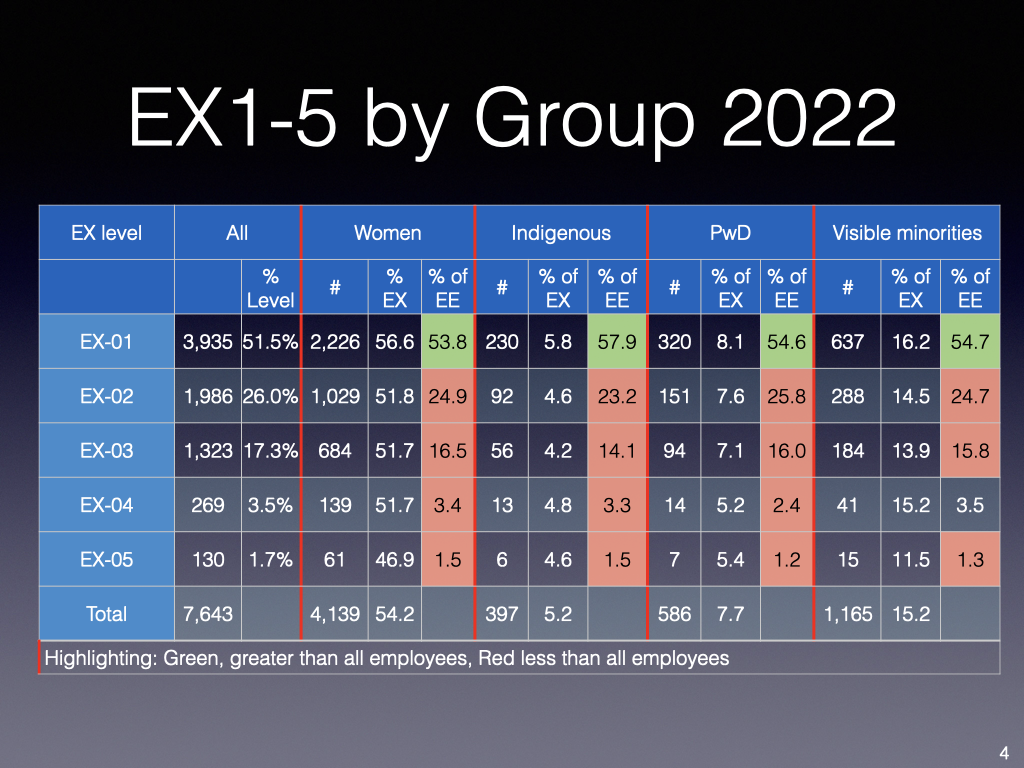
Figure 1 provides the overview numbers, with relatively small variations between the equity groups, with the expected pattern of greater representation at the EX-1 level with the exception of visible minorities at the EX4 level which match the general EX4 population.:

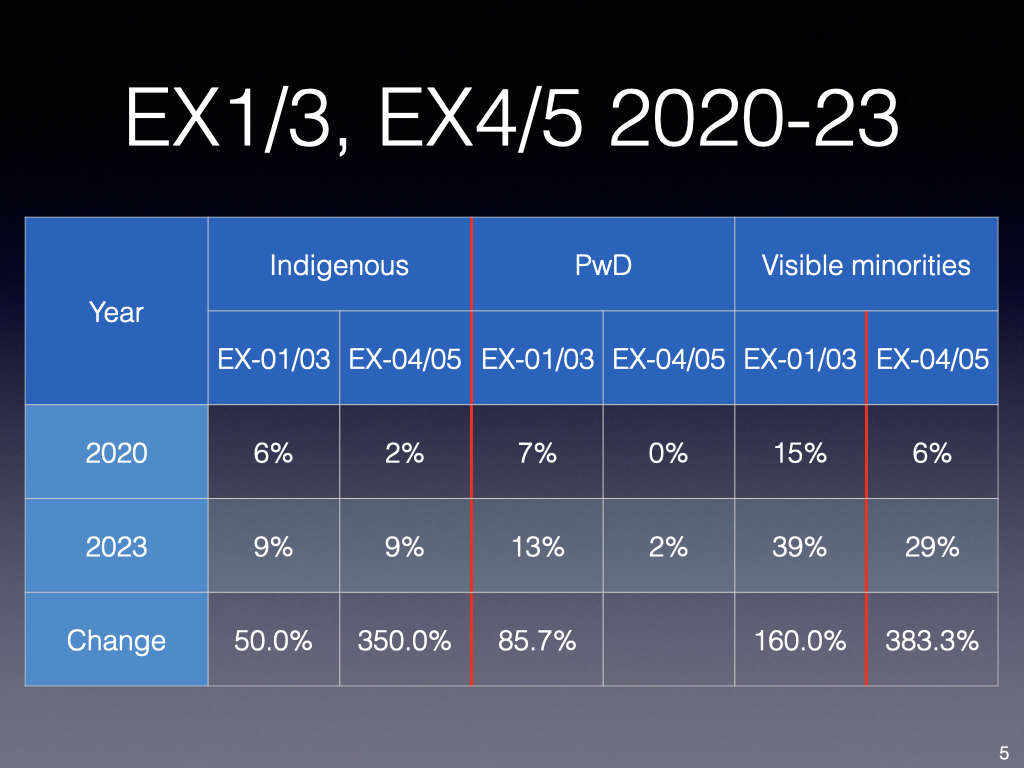
Figure 2 highlights the 2023-2020 comparison between junior and medium level EX (directors and DGs) and senior EX (ADMs), and the percentage increase during this period. The steep increase can likely be interpreted in part to the public service’s overall diversity efforts and the Clerk’s Action call:

Figure 3 compares all employees, all visible minorities, not Black employees, Black employees only and their respective distribution among EX categories, taking advantage of the new section on Black employees. To address the “less than 5” issue, I have collapsed the EX4 and EX5.

Only at the junior EX-01 level, do all three groups exceed the overall distribution. Non-Black visible minorities are more strongly represented than Black employees at all levels save for the EX-01 level, relatively minor but not insignificant.

By including this separate analysis of Black public servants, the report only highlights the limitations of such a carve-out.

My previous analyses of the past 6 years of disaggregated data highlighted the importance of comparisons among all visible minority groups with respect to Black public servants, given than their representation, hiring, promotion and separations are stronger than a number of other groups (How well is the government meeting its diversity targets? An intersectionality analysis). By being selective, this presents the situation of Black public servants as being worse than such comparative data demonstrates. I will be updating this hiring, promotion and separation analysis but do not expect the trend to differ.

On a general level, I was struck by the rapid year-over-year growth of the public service, from 236,133 to 253,411, or 7.3 percent.

Hardly sustainable and should the Conservatives win, as appears likely, the cuts will be deep and painful for the public service. Given that employment equity is unlikely to be a priority for such a government, this may be one of the last extensive and comprehensive reports (they were particularly lean during the Harper years). Should the Liberal government not pass new EE legislation during its mandate, unlikely that a Conservative government would given general ideological aversion, financial pressures and higher priorities.

Source: Employment Equity in the Public Service of Canada for Fiscal Year 2022 to 2023

Regg Cohn: Justin Trudeau’s point man says he’s ‘not naive’ as he tackles Canada’s surging immigration numbers

Good profile and assessment:

Marc Miller is doing what no other immigration minister has done in recent history.

He’s letting fewer temporary residents come to Canada in the short term. While planning for more immigrants in future.

Barely a year after taking over the immigration and refugee portfolio, Miller is steering a controversial course correction to avert an unplanned and unmanageable surge in temporary residents. By capping overseas student visas, and dialing down foreign work permits, he is reasserting control over uncontrolled trend lines.

Miller says Ottawa will set temporary resident targets

Immigration Minister Marc Miller announces that for the first time, Canada will set targets for the number of new temporary resident arrivals to the country. The federal government plans to decrease the number of temporary residents to five per cent of the population over the next three years, down from the current 6.2 per cent. (March 21, 2024)

Inaction is no solution, Miller told the Democracy Forum at Toronto Metropolitan University.

If he hadn’t stepped in, the country faced “exponential” growth and “exploitative” conditions for vulnerable foreigners, while exacerbating the affordability fallout from a crowded housing market.

“It’s undeniable that the volume has caused an impact on affordability,” he told me and our co-host, Anna Triandafyllidou, the Canada Excellence Research Chair in Migration and Integration at TMU (Disclosure: I’m also a senior fellow at TMU’s Dais, which sponsors the Democracy Forum).

Miller is mindful of business becoming “addicted” to the “pitfalls” of cheap foreign labour. He is also wary of post-secondary campuses becoming addled and distorted by foreign students who pay extortionary tuitions for substandard educations in partnership with private “puppy mills” — his preferred ministerial malapropism for so-called diploma mills.

The minister is unusually candid for a politician caught in the middle of competing interests and conflicting impulses, navigating the recent ups and downs of immigration policy. In his previous portfolio, Miller served as the prime minister’s point person on Indigenous issues; now as before, he helms a ministry of complexity that requires humanity — from the campuses of Ontario to the refugee camps of the world, while navigating rival political camps in Ottawa.

If he hadn’t acted, “uncapped, we were seeing potential increases of the student numbers … to 1.4 million next year.”

But these distortions didn’t come out of nowhere. He blames “systemic underfunding, particularly in Ontario, of post-secondary education.”

The fallout isn’t just affordability but asylum problems. When foreign students are squeezed for high tuition, living in cramped quarters and getting sometimes “crappy” degrees, they increasingly resort to refugee claims — 10,000 over the last three years.

“We were in the process of creating our own home-generated asylum crisis, largely within the responsibility of the provinces,” Miller argued. It was time, “after a number of warnings, for provinces to act, to take responsibility over their education system.”

Why did it take so long?

Ottawa will “step in if the provinces don’t assume that jurisdiction and clean up some of the mess in their own kitchen,” he warned.

The federal minister is clearly frustrated by Ontario’s inattention and inaction. And he is irritated by “garbage” suggestions from Ontario that it was blindsided by his two-year cap on new international permits.

“It simply isn’t accurate,” he shot back. “There were a number of warnings that were issued quite publicly by me, but also … privately through our officials.”

While balancing federal-provincial jurisdictions on student visas, Miller must juggle the demands of business interests to tackle labour shortages, while also navigating the roadblocks to resettlement of foreign refugees. Refugee and immigration policy, like Canada’s foreign policy, is often driven by domestic and diaspora interests.

Miller acknowledges a program to help Palestinians fleeing the fighting in Gaza has been a “failure” by numbers — barely 14 have made it out, compared to fully 300,000 Ukrainian refugees now in Canada. But he says it’s unfair to compare the barriers erected at a border crossing — controlled by both Israel and Egypt — with the open channel from Ukraine’s western borders.

He’s not surprised that some are “pissed off” by the program’s “very limited success.” Yet no other country has gone as far as Canada in trying to help Gazans relocate.

“I don’t think there’s any just middle in any of those debates — there’s a lot of trauma, there’s a lot of hurt.”

But he remains optimistic that Canadians can strike a balance between competing interests at home and abroad, without falling into the polarized politics that now plague the U.S. and Europe. Canada’s major political parties, like most voters, understand that an aging population benefits from regular immigration targets rising to 500,000 people a year.

“I can’t deny the winds that are blowing against immigration,” he mused. “But we’ve generally been good as parties in avoiding a huge xenophobic debate on immigration.

“Frustration can be whipped up in many ways. Politicians do have responsibilities, and it would be terrible to have an election on the backs of some of the most vulnerable people in the world, but also some of the most vulnerable people in Canada. But I’m not naive to think that it can’t happen.”

Source: Justin Trudeau’s point man says he’s ‘not naive’ as he tackles Canada’s surging immigration numbers

Keller: The Liberals broke the immigration system at high speed. They’re repairing it by baby steps

Hard not to agree:

…In all of this, the Trudeau government is caught in a bind of its own making. It found, to its evident delight, that sharply ramping up the number of people arriving on notionally temporary permits was easy. To govern is to choose, but the government discovered that the less choosing it did – and the more rubber-stamping of visas it encouraged – the easier governing appeared to be.

It is now discovering that unwinding things, even a little, is more difficult. It will be lobbied heavily to eviscerate its modest promises, and to quietly reverse this course reversal.

That is also where Liberal predilections reside. They didn’t just break the immigration system. They broke it with great enthusiasm. And their repair job is still mostly blueprints, drawn up haltingly and under the duress of public opinion.

Compared with Europe and the United States, Canada has long had a wider immigration door, but also far more control – an aspect of the “order” in peace, order and good government – over who enters. That is what underpinned public support for immigration.

And controlling the door was important because once somebody gets into Canada, whether as a temporary worker, student or even tourist, it isn’t easy to get them to leave. Not if they don’t want to. Ottawa decides who gets in but has much less control over, or information about, how many people whose visas have expired, and who are no longer legally allowed to reside in Canada, nevertheless remain.

In the months and years to come, that is likely to be the final aftershock of Liberal immigration policy.

Restoring sense and sanity to the system won’t be easy. Breaking is easier than repairing.

Source: The Liberals broke the immigration system at high speed. They’re repairing it by baby steps

Opinion: Jack Letts and other Canadians held in Syria deserve proper justice

Not convinced, given the difficulty, if not impossibility, of successful prosecution in Canada. And Letts never had a meaningful connection to Canada and his parents, understandably, only approached when his UK citizenship, where he had lived virtually his entire life, revoked his UK citizenship, effectively dumping him on Canada:

When we met Canadian citizen Jack Letts in a prison in Northeast Syria last August, he asked if we thought he would still be there in 10 years. At that point he had been locked up in harrowing conditions without charge or trial for more than six years.

The letters, photos and books we were able to bring to him from his mother, who lives in Ottawa, were Jack’s first news of his family in years. Our visit was the first confirmation for his family in two years that he was even alive. He has no access to a lawyer. And he is not receiving any support from Canadian officials, as the Canadian government refuses to carry out consular visits in the region.

We paused before answering, not wanting to crush his sprits or give false hope. We told him it was unlikely he would still be in detention in 10 years, but that there was no prospect of short-term release. We told him we hoped he might be back in Canada in a year.

“Back in Canada,” of course, does not necessarily mean out of detention. If there is credible evidence that Jack has committed terrorism-related or other crimes, he would rightly be charged under Canadian law. Jack told us that he would willingly face any such allegation, as long as it involved a fair procedure. That, clearly, is not on offer in Northeast Syria.

We were cautiously optimistic because of a pending appeal application before the Supreme Court of Canada in a legal challenge brought by Jack and three other Canadian men unlawfully detained in Northeast Syria. Little did we know, however, that three months later the Supreme Court would inexplicably deny leave to hear that appeal, a deep disappointment. The court does not give reasons for leave decisions.

We have now passed the halfway point in what we hope will not prove to be misguided optimism of justice within a year. However, six months on, there is no sign that the Canadian government is readying to repatriate Jack.

Jack Letts is not alone. There are at least eight other Canadian men unlawfully imprisoned in Northeast Syria. We also know of one Canadian woman, 13 Canadian children and three non-Canadian women who are mothers of some of those children, who are held in a dangerous and overcrowded detention camp in the region, also with no end in sight.

And those Canadians are not alone. There are more than 50,000 prisoners, more than half of them children, unlawfully detained across Northeast Syria. Most are Syrian or Iraqi, but in all there are 60 different nationalities in the camps and prisons. Some have very likely been responsible for terrible abuses during the years that ISIL controlled that region, while others were themselves victims of or opponents to ISIL. All are denied any justice.

We met with one other Canadian male prisoner, all of the women, and six of the children while we were on the ground in August. The human rights violations they are enduring are extensive, and the Canadian government’s failure to take steps to protect them is a disgrace.

Last week, an exceptional application was filed with the Supreme Court, asking for reconsideration of the decision not to hear an appeal. Given the ongoing intransigence of the government, turning to the court, no matter how extraordinary the request, seems the only option. Past progress with repatriation has generally only happened under threat of possible court action.

That application has been brought because the situation on the ground continues to deteriorate, and the risks to these Canadians grow even more alarming. That is due in part to shifting political and military circumstances in the Middle East since the Oct. 7th Hamas attack in Israel and the humanitarian catastrophe unleashed by more than five months of unrelenting bombardment of Gaza by the Israeli military.

No doubt taking advantage of international focus being diverted to the Gaza crisis, the Turkish military has ramped up its deadly drone attacks in Northeast Syria. ISIL activity also appears to be increasing. And now there is talk that the U.S. military, whose presence in Northeast Syria has provided a minimal degree of stability, may be preparing to withdraw its troops. Notably, the U.S. government repeatedly calls on Canada and other countries to repatriate their nationals.

Things were bad enough when we were in Northeast Syria in August. The situation has only worsened since and seems slated to become more dire. What is needed is not protracted litigation. What is needed is a political decision to bring all Canadians home from there, to hold them accountable in our legal system if warranted. It is time for human rights to prevail.

Kim Pate is an Independent Senator for Ontario. Alex Neve is a Senior Fellow at the University of Ottawa’s Graduate School of Public and International Affairs. Scott Heatherington is a retired Canadian ambassador and diplomat. Hadayt Nazami is an immigration and human rights lawyer in Toronto. They travelled to Northeast Syria as a civil society humanitarian delegation last August.

Source: Opinion: Jack Letts and other Canadians held in Syria deserve proper justice