Sunstein: The Nobel Prize-Winning Professor Who Liked to Collaborate With His Adversaries

More on Kahneman and his all too rare enthusiasm for collaborating with intellectual adversaries.

One of the lessons I drew from my experience in working under the former Conservative government was the dangers and limitations of living in an intellectual and ideological bubble. Ironically, the process repeated itself while writing Policy Arrogance or Innocent Bias) working with Gilles Paquet and Robin Higham, as they tended to ascribe most if not all of the blame to public servants, rather than the more nuanced view of respective political and bureaucratic dynamics and responsibilities (in the end, I self-published given they wanted their perspective to prevail).

A similar effort took place with respect to birth tourism, where academics Jamie Chai Yun Liew, Megan Gaucher and I submitted a research proposal to further study the practice, which was rejected by the funding council with Megan subsequently successfully obtaining funding on her own for a separate proposal focussing on the discourse around birth tourism.

So, from personal experience, much easier to work with the like-minded but I learned from these efforts to work with others. But I do try to ensure that my networks and readings include those who I do not necessarily agree with, recognizing I need to be challenged and can always learn from others:

Our all-American belief that money really does buy happiness is roughly correct for about 85 percent of us. We know this thanks to the latest and perhaps final work of Daniel Kahneman, the Nobel Prize winner who insisted on the value of working with those with whom we disagree.

Professor Kahneman, who died last week at the age of 90, is best known for his pathbreaking explorations of human judgment and decision-making, and of how people deviate from perfect rationality. He should also be remembered for a living and working philosophy that has never been more relevant: his enthusiasm for collaborating with his intellectual adversaries. This enthusiasm was deeply personal. He experienced real joy working with others to discover the truth, even if he learned that he was wrong (something that often delighted him).

Back to that finding, published last year, that for a strong majority of us, more is better when it comes to money. In 2010, Professor Kahneman and the Princeton economist Angus Deaton (also a Nobel Prize winner) published a highly influential essay that found that on average higher-income groups show higher levels of happiness — but only to a point. Beyond a threshold at or below $90,000, Professor Kahneman and Professor Deaton found, there is no further progress in average happiness as income increases.

Eleven years later, Matthew Killingsworth, a senior fellow at the Wharton School of the University of Pennsylvania, found exactly the opposite: People with higher income reported higher levels of average happiness. Period. The more money people have, the happier they are likely to be.

What gives? You could imagine some furious exchange in which Professor Kahneman and Professor Deaton made sharp objections to Dr. Killingsworth’s paper, to which Dr. Killingsworth answered equally sharply, leaving readers confused and exhausted.

Professor Kahneman saw such a dynamic as “angry science,” which he described as a “nasty world of critiques, replies and rejoinders,” and “as a contest, where the aim is to embarrass.” As Professor Kahneman put it, those who live in that nasty world offer “a summary caricature of the target position, refute the weakest argument in that caricature, and declare the total destruction of the adversary’s position.” In his account, angry science is “a demeaning experience.” That dynamic might sound familiar, particularly in our politics.

Instead, Professor Kahneman favored an alternative that he termed “adversarial collaboration.” When people who disagree work together to test a hypothesis, they are involved in a common endeavor. They are trying not to win, but to figure out what’s true. They might even become friends.

In that spirit, Professor Kahneman, well into his 80s, asked Dr. Killingsworth to collaborate, with the help of a friendly arbiter, Professor Barbara Mellers, an influential and widely admired psychologist. Their task was to look closely at Dr. Killingsworth’s data to see whether he had analyzed it properly, and also to understand what, if anything, had been missed by Professor Kahneman and Professor Deaton.

Their central conclusion was simple. Dr. Killingsworth missed a threshold effect in his data that affected only one group: the least happy 15 percent. For these largely unhappy people, average happiness does grow with rising income, up to a level of around $100,000; but it stops growing after that. For a majority of us, by contrast, average happiness keeps growing with increases in income.

Both sides were partly right and partly wrong. Their adversarial collaboration showed that the real story is more interesting and more complicated than anyone saw individually.

Professor Kahneman engaged in a number of adversarial collaborations, with varying degrees of success. His first (and funniest) try was with his wife, the distinguished psychologist Anne Treisman. Their disagreement never did get resolved (Dr. Treisman passed away in 2018). Each of them was able to explain away the results of their experiments — a tribute to what Professor Kahneman called “the stubborn persistence of challenged beliefs.” Still, adversarial collaborations sometimes do produce both agreement and truth, and Professor Kahneman added that “a common feature of all my experiences has been that the adversaries ended up on friendlier terms than they started.”

Professor Kahneman meant both to encourage better science and to strengthen the better angels of our nature. In academic life, adversarial collaborations hold great value. We could easily imagine a situation in which adversaries routinely collaborated to see if they could resolve disputes about the health effects of air pollutants, the consequences of increases in the minimum wage, the harms of climate change or the deterrent effects of the death penalty.

And the idea can be understood more broadly. In fact, the United States Constitution should be seen as an effort to create the conditions for adversarial collaboration. Before the founding, it was often thought that republics could work only if people were relatively homogeneous — if they were broadly in agreement with one another. Objecting to the proposed Constitution, the pseudonymous antifederalist Brutus emphasized this point: “In a republic, the manners, sentiments and interests of the people should be similar. If this be not the case, there will be a constant clashing of opinions; and the representatives of one part will be continually striving against those of the other.”

Those who favored the Constitution thought that Brutus had it exactly backward. In their view, the constant clashing of opinions was something not to fear but to welcome, at least if people collaborate — if they act as if they are engaged in a common endeavor. Sounding a lot like Professor Kahneman, Alexander Hamilton put it this way: “The differences of opinion, and the jarrings of parties” in the legislative department of the government “often promote deliberation and circumspection, and serve to check excesses in the majority.”

Angry science is paralleled by angry democracy, a “nasty world of critiques, replies and rejoinders,” whose “aim is to embarrass.” That’s especially true, of course, in the midst of political campaigns, when the whole point is to win.

Still, the idea of adversarial collaboration has never been more important. Within organizations of all kinds — including corporations, nonprofits, think tanks and government agencies — sustained efforts should be made to lower the volume by isolating the points of disagreement and specifying tests to establish what’s right. Asking how a disagreement might actually be resolved tends to turn enemies, focused on winning and losing, into teammates, focused on truth.

As usual, Professor Kahneman was right. We could use a lot more of that. 

Source: The Nobel Prize-Winning Professor Who Liked to Collaborate With His Adversaries
‘We won’t forget’: How Muslims view Pierre Poilievre’s stance on Israel-Hamas war

We shall see, look forwards to any comments on my analysis of the possible impact:

….The National Council of Canadian Muslims and dozens of Muslim organizations, mosques and groups signed an open letter to MPs ahead of Ramadan, asking them to stay away from events during the holy month if they couldn’t commit to taking several stances, including support for an immediate ceasefire and condemning some of the actions of Israeli forces.

When asked about Polievre’s outreach this year, Conservative spokesman Sebastian Skamski said Poilievre has articulated a clear position that Israel has a right to defend itself and that Palestinians need humanitarian relief “as a result of the war that Hamas has started.”

Andrew Griffith, a former director of multiculturalism policy for the federal government, said while Muslims are not a monolithic group, it’s likely Poilievre’s loud pro-Israel stance will cause some people to turn from the party, including in key ridings around Toronto.

However, he said, given the current polling numbers, it would be unlikely to do much damage to Conservative fortunes when the next election rolls around.

Skamski also pointed to a speech Poilievre delivered Tuesday in Montreal to the Beth Israel Beth Aaron Jewish congregation, where he addressed the matter head-on.

“I want you to know,” Poilievre the crowd, “I say all of these things in mosques. I do go to mosques. I love meeting with the Muslim people, they are wonderful people.”

He went on to say that when the issue of Israel is raised, “I say, ‘I’m going to be honest with you — I’m a friend of the state of Israel and I will be a friend of the state of Israel everywhere I go.'”

That runs counter to the approach taken by Justin Trudeau, continued Poilievre, accusing the prime minister of muddying the government’s position.

“While it might make for good politics to have one individual MP who says the right thing in order to get a seat back and keep Justin Trudeau in power, it does not solve the problem of having Canada take a right and principled position,” he said.

Skamski said Poilievre has met with thousands of Muslim Canadians during his team as leader and has connected on their shared values of “faith, family and freedom.”

“You can’t talk to Muslim Canadians about faith, about family values, all of those things, while at the same time turning a blind eye to 30,000 dead,” Tahir said, referring to the number of people killed in Gaza since Israel began bombarding the territory in October.

Tahir said many were disappointed in Poilievre’s opposition to funding the UN aid agency UNRWA….

Source: ‘We won’t forget’: How Muslims view Pierre Poilievre’s stance on Israel-Hamas war

How African Immigrants Have Revived a Remote Corner of Quebec

Nice story from rural Quebec, undermining some of the common narratives:

Not long ago, the handful of African immigrants in Rouyn-Noranda, a remote city in northern Quebec, all knew one another.

There was the Nigerian woman long married to a Québécois man. The odd researchers from Cameroon or the Ivory Coast. And, of course, the doyen, a Congolese chemist who first made a name for himself driving a Zamboni at hockey games.

Today, newcomers from Africa are everywhere — in the streets, supermarkets, factories, hotels, even at the church-basement boxing club.

A couple from Benin has taken over Chez Morasse, a city institution that introduced a greasy spoon favorite, poutine, to this region. And women from several corners of West and Central Africa were chatting at the city’s new African grocery store, Épicerie Interculturelle.

“Since last year, it’s like the gate of hell or the gate of heaven, something opened, and everybody just kept trooping in — I’ve never seen so many Africans in my life,” Folake Lawanson Savard, 51, the Nigerian whose husband is Québécois, said to loud laughter in the store.

Rouyn-Noranda’s transformation followed a surge of immigrants Canada has allowed in as temporary workers in recent years to address widespread labor shortages. Many have been able to eventually turn their temporary status into permanent residency, the final step before citizenship.

The influx of immigrants has also raised concerns, contributing to the nation’s housing crisis and straining public services in some areas, leading the government of Prime Minister Justin Trudeau to announce plans to rein in their numbers.

The increase has created African communities in the unlikeliest places in the French-speaking province of Quebec. Some are working in logging in boreal forests. Others, after becoming permanent residents or citizens, are government workers in Indigenous towns accessible only by boat or small propeller planes.

While African immigrants have long lived in the province’s large cities, the newcomers are a recent phenomenon in rural areas.

Driven by a graying population and declining birthrates, the labor shortage has drawn many from Francophone Africa to Quebec, including to Rouyn-Noranda, a mining city of 42,000 people about 90 minutes north of Montreal — by plane.

Across Canada, the number of temporary residents, a category that includes foreign workers but also foreign students and asylum seekers, has soared in recent years. It has doubled in the past two years alone to 2.7 million, out of Canada’s total population of 41 million.

Canada’s immigration policy has traditionally focused on attracting highly educated and skilled immigrants.

But many temporary foreign workers are now being hired by companies for less skilled jobs in manufacturing and the service industry, fueling debates about whether they will contribute as much to Canada’s economy as past immigrants did.

Rouyn-Noranda’s once tiny African population was made up of individuals who were hired for technical positions in the mining industry or as researchers at the local university.

“We had professors and engineers,” said Valentin Brin, the director of La Mosaïque, a private organization that helps new immigrants. “And then there was a shift.”

The shift occurred partly because of the city government’s decision in 2021 to increase efforts to help local companies recruit foreign workers, said Mariève Migneault, the director of the Local Development Center, the city’s economic development arm.

“Our companies were suffering from such a shortage of workers that it was slowing down Rouyn-Noranda’s economic development,” Ms. Migneault said.

For G5, a family-owned company that owns and operates hotels and restaurants in the city, the pool of local workers had been shrinking for years, said Tatiana Gabrysz, who oversees the company’s two hotels. Young people were more drawn to highly paid mining jobs.

Immigrants, most from Colombia, are soon expected to make up about 10 percent of the company’s 200-person work force, Ms. Gabrysz said, adding that they allowed the company to operate without constantly worrying about staff shortages.

“It’s changed my life,” Ms. Gabrysz said.

Precise numbers are difficult to find, but Africans are believed to make up the largest group of temporary foreign workers in the city. About 4,000 to 4,500 temporary foreign workers are now in the Rouyn-Noranda region, following a sharp increase since 2021, according to the Local Development Center.

When Aimé Pingi arrived in the region from the Democratic Republic of the Congo in 2008, Africans were so few that they all were able to know one another….

Source: How African Immigrants Have Revived a Remote Corner of Quebec

Coyne: On foreign interference, Canada has been a sitting duck

Sadly true:

..Representatives of the various diaspora communities most affected – Chinese, Russian, Iranian, Indian – testified of the threats, violence and other coercive tactics to which they have been subjected by agents of their respective countries of origin, including threats against family members still there.

More to the point, they testified of the indifference and inaction that greeted them when they sought the protection of Canadian authorities: the police officers who told them there was nothing they could do, the political parties who refused to take up their cause, the governments that appeared to actively collude in their repression – from the City of Ottawa banning protests outside the Chinese embassy to the federal Immigration department granting residency permits to former high-ranking officials in the Iranian regime….

Source: On foreign interference, Canada has been a sitting duck

Next U.S. census will have new boxes for ‘Middle Eastern or North African,’ ‘Latino’

Overdue. Good discussion of some of the issues involved:

On the next U.S. census and future federal government forms, the list of checkboxes for a person’s race and ethnicity is officially getting longer.

The Biden administration has approved proposals for a new response option for “Middle Eastern or North African” and a “Hispanic or Latino” box that appears under a reformatted question that asks: “What is your race and/or ethnicity?”

Going forward, participants in federal surveys will be presented with at least seven “race and/or ethnicity” categories, along with instructions that say: “Select all that apply.”

After years of research and discussion by federal officials for a complicated review process that goes back to 2014, the decision was announced Thursday in a Federal Register notice, which was made available for public inspection before its official publication.

Officials at the White House’s Office of Management and Budget revived these Obama-era proposals after they were shelved by the Trump administration. Supporters of these changes say they could help the racial and ethnic data used to redraw maps of voting districts, enforce civil rights protections and guide policymaking and research better reflect people’s identities today.

“These revisions will enhance our ability to compare information and data across federal agencies, and also to understand how well federal programs serve a diverse America,” Karin Orvis, U.S. chief statistician within OMB, said in a blog post.

Most people living in the U.S. are not expected to see the changes on the census until forms for the next once-a-decade head count of the country’s residents are distributed in 2030.

But a sea change is coming as federal agencies — plus many state and local governments and private institutions participating in federal programs — figure out how to update their forms and databases in order to meet the U.S. government’s new statistical standards.

Federal agencies that release data about race and ethnicity are required to each turn in a public action plan to OMB by late September 2025 and get all of their surveys and statistics in line with the new requirements by late March 2029.

The “White” definition has changed, and “Latino” is now a “race and/or ethnicity”

OMB’s decision to change its statistical standards on race and ethnicity for the first time in more than a quarter-century also marks a major shift in the U.S. government’s definition of “White,” which no longer includes people who identify with Middle Eastern or North African groups such as Egyptian, Iranian, Iraqi, Israeli, Jordanian, Kurdish, Lebanese, Moroccan, Palestinian, Syrian and Yemeni.

That move sets up “Middle Eastern or North African” as the first completely new racial or ethnic category to be required on federal government forms since officials first issued in 1977 standards on racial and ethnic data that the Census Bureau and other federal agencies must follow.

For more than three decades, advocates for Arab Americans and other MENA groups have campaigned for their own checkbox on the U.S. census and other government forms, and recent research suggests that many people of MENA descent do not see themselves as white, a category that the federal government previously considered to include people with “origins in any of the original peoples of Europe, the Middle East, or North Africa.”

Studies by the bureau show that the government’s previous standards have also been out of step with many Latinos. Those standards required asking about a person’s Hispanic or Latino identity — which the federal government considers to be an ethnicity that can be any race — before asking about their racial identity.

Combining a question about Hispanic origins with a question about race into one question, while allowing people to check as many boxes as they want, is likely to lower the share of Latinos who mark the “Some other race” categoryon census forms, the bureau’s research from 2015 suggests.

Recent research, however, suggests it’s not clear how someone who identifies as Afro Latino is likely to respond to a combined race-ethnicity question. According to the Federal Register notice, about half of participants in a recent study for OMB selected only the “Hispanic or Latino” box when presented with a combined question after previously selecting both the Latino and Black categories.

This new question format, along with the addition of a “Middle Eastern or North African” box, could also decrease the number of people who mark the “White” box.

Other changes coming to federal forms

Among the other proposals OMB has greenlit is a general requirement for federal agencies to ask for detailed responses about people’s identities beyond the seven minimum racial and ethnic categories. This change, advocates say, will produce more insightful statistics about differences in health care outcomes and socioeconomic disparities within the minimum categories.

OMB has also approved removing from its standards outdated language about allowing “Negro” as a term to describe the “Black” category and “Far East” to describe a geographic region of origin for people of Asian descent, which, according to the U.S. government’s revised definition, now includes individuals “with origins in any of the original peoples of Central or East Asia, Southeast Asia, or South Asia.”

The federal government’s new definitions of the seven minimum racial and ethnic categories list the six largest groups, based on 2020 census results, that the government considers to be part of that category. For example, its definition of “Black or African American” now reads: “Individuals with origins in any of the Black racial groups of Africa, including, for example, African American, Jamaican, Haitian, Nigerian, Ethiopian, and Somali.”

For the standards’ official description for “American Indian or Alaska Native,” OMB is removing a phrase about maintaining “tribal affiliation or community attachment.” The revised definition says: “Individuals with origins in any of the original peoples of North, Central, and South America, including, for example, Navajo Nation, Blackfeet Tribe of the Blackfeet Indian Reservation of Montana, Native Village of Barrow Inupiat Traditional Government, Nome Eskimo Community, Aztec, and Maya.”

OMB decided not to move forward with calls to require agencies to gather data to better understand the descendants of enslaved people originally from Africa, which included suggestions to use “American Descendants of Slavery” or “American Freedman” to describe the group. OMB said in the Federal Register notice that “further research is needed,” adding that there was opposition to this proposal from civil rights groups and others because of concerns over “the difficulty of verifying that identification is accurate, the usefulness or necessity of the data, the exclusion of other groups of historically enslaved people, and the creation of confusion that could make the Black or African American community harder to count.”

A changing conversation about race and ethnicity

OMB says it plans to create a standing committee to formally review these standards at least once a decade going forward. Among the key questions OMB says the committee may review is how to encourage people to select multiple categories when appropriate so that there are complete and accurate estimates about groups such as Afro Latinos.

While the revised standards go into many minute details about how surveys and data tables should be presented, there are many unanswered questions.

It’s not clear, for example, how the federal government will consider people who identify as MENA when monitoring and enforcing civil rights. OMB’s previous guidance, which was rescinded Thursday, used the earlier “White” definition, which included people with roots in the Middle East or North Africa and was not categorized as a “minority race” that would face “disparate impact or discriminatory patterns.” The new standards offer no new guidance about which specific groups the government considers to be a “minority race.”

Still, changes to how the government asks about people’s identities could also reset the national conversation about race and ethnicity.

Some critics of using one question to ask about both a person’s race and ethnicity, including researchers behind a campaign called “Latino Is Not A Race,” have raised concerns about blurring the distinctions between the two concepts.

In response to OMB’s decision, the AfroLatino Coalition called for the Census Bureau to do more research about how these changes will affect how Afro Latinos report their identities, including those in Puerto Rico.

“By listing Latino ethnicity as co-equal with racial categories, Latinos are inaccurately portrayed as a population without racial differences despite all the research showing how Black Latinos are treated differently from other Latinos,” the coalition said in a statement. “Separating ethnicity from race is essential for making visible the actual and intersectional racial disparities that exist within a racially diverse ethnic group like Latinos in access to important public goods such as access to education, employment, housing, medical services, etc. Without it, systemic racism, especially when discussing Latino populations, is rendered invisible.”

The introduction of a “Middle Eastern or North African” category may reopen unresolved questions and tensions over the fact that the Middle East and North Africa are regions with no universally agreed-upon borders and with transnational groups.

OMB received public feedback in support of including Armenian, Somali and Sudanese among MENA groups, but it said in its Federal Register notice that the Census Bureau’s research has found that most people who identify with those groups did not select a MENA checkbox when presented with one. “Additional research is needed on these groups to monitor their preferred identification,” OMB added in the notice. Many advocates of a MENA category, including the Arab American Institute, have criticized the bureau’s previous research for not specifically testing “Middle Eastern or North African” as an ethnic category whose members can be of any race.

Maya Berry, the Arab American Institute’s executive director, says after decades of campaigning for a MENA checkbox on federal forms, OMB’s announcement made Thursday “a pretty significant and big day.”

“The fact that Arab-Americans have been rendered invisible and other populations from MENA have been rendered invisible without that checkbox has really been harmful to communities,” Berry says.

But at the same time, Berry says she is concerned that the example groups representing the MENA category in OMB’s new definition for “Middle Eastern or North African” do not represent the full racial and geographic diversity of MENA communities in the U.S., including those from Black diaspora communities. That, in turn, could discourage some people with roots in the Middle East or North Africa from selecting the MENA box, Berry worries.

“I didn’t want to go from being rendered invisible to being undercounted,” she adds.

How OMB decided which groups have to be represented in the checkboxes under the racial and ethnic categories on forms has also drawn criticism from Meeta Anand, senior director of the census and data equity program at The Leadership Conference on Civil and Human Rights.

“We are concerned that the Office of Management and Budget has already specified the required detailed categories prior to engaging in the due diligence, research, and testing as to what would elicit inclusive and accurate responses for those who identify with more than one racial or ethnic category,” Anand said in a statement.

More work is needed, says Arturo Vargas, a longtime census watcher, who is the CEO of the National Association of Latino Elected and Appointed Officials Educational Fund.

“There is going to be a significant need for a public education effort going forward by the Census Bureau and all federal agencies that collect data on race and ethnicity so that all respondents to surveys understand what is being asked,” Vargas adds. “The Census Bureau needs to continue testing to see how people are interpreting this question so that the question can be improved over the short term, so that we have the best ideal question possible when we get to the 2030 decennial.”

OMB announced the last major changes to its standards in 1997, when it approved allowing survey participants to report more than one race and splitting the “Asian or Pacific Islander” category into “Asian” and “Native Hawaiian or Other Pacific Islander,” which OMB has now shortened by removing the word “Other.”

Source: Next U.S. census will have new boxes for ‘Middle Eastern or North African,’ ‘Latino’

Chait: Does the Left Think Young Left-Wing Protesters Matter or Not?

This week, The Atlantic published an account of how the war between Israel and Hamas has convulsed a campus (in this case, that of the author, Stanford sophomore Theo Baker). The most explosive details in the story showed activists endorsing violence or anti-Semitism, which has fed directly into the cycle of anger and fear felt by both Jewish and Muslim students.

This has predictably set off the same progressive eye-rolling that occurs any time the mainstream media reports on crazy things happening on the left. “Incredibly brave for the son of the NYT White House correspondent to put out a piece narcing on his fellow students and teachers,” snarked Daniel Boguslaw, a reporter at the Intercept, a staunchly anti-Israel publication. (Baker is the son of two successful journalists, though he made his reputation breaking a scandal that toppled Stanford’s president.) Numerous complaints described Baker as a “snitchpicking on unimportant targets.

The argument that nobody should pay attention to what left-wing radicals are saying on campus is totally at odds with the message that progressives have been frantically sending since almost immediately after October 7. A slew of stories has covered the anger felt by the young progressive left at the Biden administration. Those stories have been filled with pleas from organizers that Biden heed the protesters’ demands. “Don’t blame us. [Biden] needs votes from Arab Americans, from people of color, from progressive Jews, and from young people. He only won Michigan by 150,000 votes in 2020, so politically we have a moment where we can raise our voices,” said Andy Levin, a leader of the push to get Democrats to vote “uncommitted” in the Michigan primary. Waleed Shaid warned that Biden is “not representing the 80 percent of Democrats who want a cease-fire, or the Muslims and Arabs and young people whose votes put him in office and are now out protesting his policies in the streets.”

There are two popular notions on the progressive left that seem intellectually irreconcilable. The first is that the media should stop scrutinizing radical left-wing ideas by progressive college students and political activists. The second is that the Democratic Party must heed the demands of progressive college students and political activists.

The first idea has a longer pedigree. When I wrote about the rise of illiberal left-wing thought in progressive spaces nine years ago, a common response from progressives who didn’t wish to defend the ideas I criticized was that it was not worth attention or concern because it was just youthful high jinksfrom “college teens.” This dismissive response has aged poorly. It was not even true at the time: Many of the incidents in my story concerns adult professionals, not college students. In any case, it was obvious that the driving force was not age but ideology.

But the exasperated pose of dismissing criticism of young radical activists has not gone away. It is irresistible as a way to smooth over tensions within the progressive coalition, or any coalition. When your allies say or do something you can’t defend, but you don’t want to cause a rupture, the path of least resistance is to insist their actions are unimportant and don’t require scrutiny. This has been the method mainstream Republicans have used to ignore just about every one of Donald Trump’s offenses.

Of course, the fact that the allies won’t denounce the behavior of their allies is the biggest giveaway that the behavior isn’t marginal. If it was limited to a handful of powerless kooks, they’d be free to call it out.

On the left, progressive-coalition managers spent years denying the campus left was worthy of attention before declaring its anger an emergency that Joe Biden had to attend to. The left went from too powerless to merit scrutiny to too powerful to be ignored overnight, without even a day in between when it was fair game for criticism.

Obviously, young people deserve more grace than middle-aged adults, and shouldn’t be permanently defined by thoughtless positions they took at the outset of their intellectual formation. But you can grant them some forbearance and also have confidence that their wildest impulses will likely mellow at least somewhat over time, while still taking seriously the ideas they are absorbing and spreading.

Taking the activist left seriously on Gaza does not mean defining the whole movement by its most extreme manifestations. Many of the progressive activists angry with Biden are motivated purely by humanitarian sympathy with the Palestinian people. (Indeed, we ought to distrust anybody who isn’ttroubled by the death and suffering that Israel and Hamas have inflicted on innocent Palestinians.)

But those extreme manifestations are an important and hardly marginal element of the movement. The eliminationist rhetoric and heckler’s-veto tactics described in Baker’s story are standard features in the movement.

This week, Salma Hamamy, president of the main pro-Palestinian student group at the University of Michigan, shared (and then deleted) a social-media message stating, “Until my last breath, I will utter death to every single individual who supports the Zionist state. Death and more. Death and worse.” (The University sent an email denouncing the message.)

While she may be an undergrad, Hamamy is hardly anonymous. She was one of four undergraduates to receive the University of Michigan’s Dr. Martin Luther King Jr. Spirit Award honoring students “who best exemplify the leadership and extraordinary vision of the Rev. Dr. Martin Luther King Jr.” The Michigan Daily endorsed her campaign for student-council president. State, national, and international newspapers have quoted her warning Biden to change course and citing her as an example of the kind of progressive Democrats have to placate.

Last month, the New York Times jointly profiled her and a pro-Israel activist in a story presenting both as searching for common humanity. “As dusk neared, they walked alone to a nearby campus building and sat together on a bench. Maybe this would be a chance to recognize one another’s humanity,” the Times reported. “He needed to know why anti-Israel protesters had not forcefully condemned the deaths of Israeli civilians.”

I think that mystery has been cleared up.

No serious person is proposing that Biden go all the way to denouncing Israel as an illegitimate settler-colonist entity. There is room to debate degrees of movement within his stance. The point is that the amount of attention that’s been devoted to presenting left-wing pro-Palestinian activists as a powerful and even potentially decisive faction in national politics implies the need for a proportionate level of scrutiny of their ideas. To insist these activists only matter when you are touting their influence, and then to deny their power when they receive scrutiny, is a tactic posing as an ideal.

Source: Does the Left Think Young Left-Wing Protesters Matter or Not?

ICYMI: Ibbitson: Canada’s foreign policy and its domestic politics on Israel’s war against Hamas are shifting

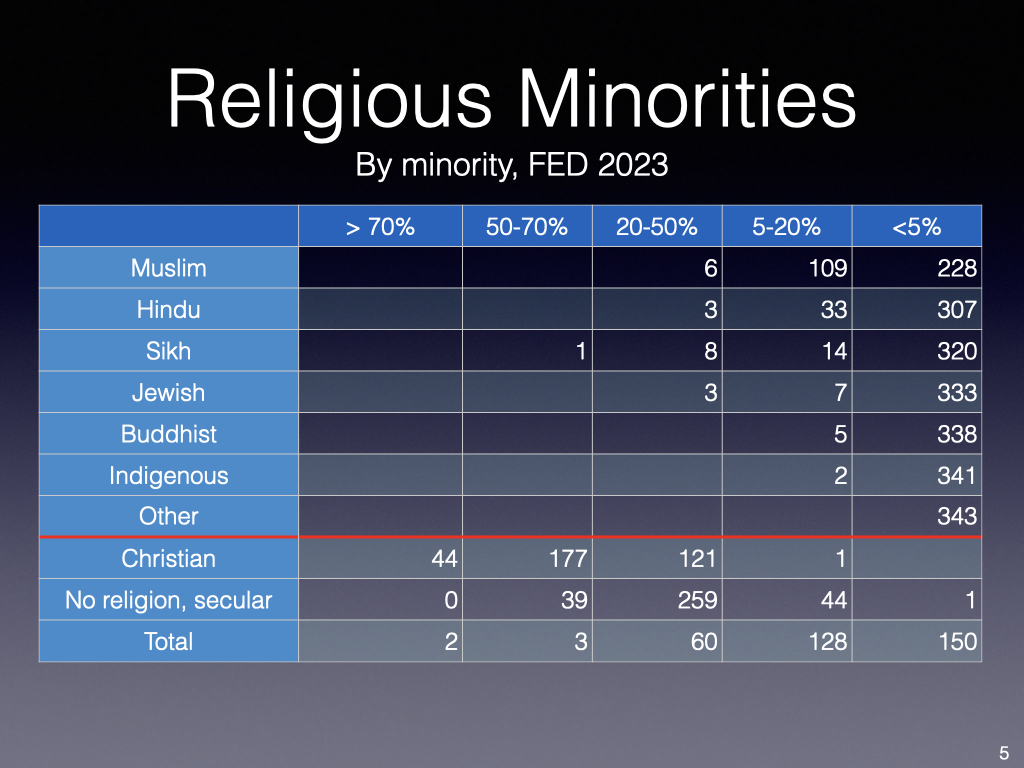
Indeed. Riding demographics highlight the relative importance of religious minorities, particularly the contrast between Canadian Jews and Canadian Muslims:

….The Liberals have tried to keep both Jewish and Muslim constituencies onside. But as last week’s vote suggests, they increasingly accord a high priority to the rights of Palestinians and to the Muslim community in Canada.

As with other religious communities, Muslims are hardly monolithic. Someone who comes to Canada from Senegal may have different values and priorities than a Canadian who comes from Syria or Pakistan or Indonesia.

And the plight of Palestinians in Gaza may not be the only issue influencing Muslims, who struggle with inflationinterest rates and housing affordability as much as other voters.

Many new Canadians come from societies that are socially conservative. Some Muslim voters may be uncomfortable with the Liberal Party’s strong support for the rights of LGBTQ Canadians.

Finally, Muslim voters for whom supporting the rights of Palestinians is the ballot question may be drawn more to the NDP than the Liberals.

Regardless, the days of Liberal/Conservative bipartisan consensus in support of Israel are over. This is the new lay of the land.

Source: Canada’s foreign policy and its domestic politics on Israel’s war against Hamas are shifting

McWhorter: On Broadway, ‘Centering’ Antiracism Is Delightful

Refreshing take and approach, compared to the dry, humourless and ultimately limiting approach of many academics and activists:

My 12-year-old daughter practically had to drag me into the musical “Six,” currently raging on Broadway, in which Henry VIII’s six wives all have their say about what happened to them. I wanted to see “Kimberly Akimbo.” I’m afraid I have lost touch with modern pop, and from a distance the whole “Six” premise sounded kind of unpromising to me (a singing Anne of Cleves?).

But after 15 minutes I was already itching to give it a standing ovation. Each wife comes out, in her way, as a proud, self-directed figure. For one, I love that my daughters will get this slice of history from the point of view (even if stylized) of the women, and even more that the women are cast as people of color(s), fostering a view of them as humans rather than racial types. In this, the whole show is a kind of lesson in antiracism, regardless of whether a viewer is consciously aware of it. In that way, it is a quintessentially modern work of musical theater. My daughters can sit through “A Man for All Seasons” some other time.

Beyond the lessons “Six” teaches, the performers manage some of the deftest work on Broadway I’ve ever seen. All six sing, act and move during almost the whole show at top-rate levels — I don’t even know how they remember all they have to do during the hour and a half — and the score does its job and then some: Every song in “Six” pops even if the genre isn’t your everyday soundscape.

So, “Six” can change your lens in an antiracist (and antisexist) way — while also turning you on to art, wonder, curiosity and excitement.

And this got me thinking about how much less vibrant, or even constructive, the antiracist mission feels at universities. Remember when, in 2020, the new idea was for them to “center” antiracism as their focal mission? One may have thought this was more trend than game plan, but it remains very much entrenched nationwide. According to the Wisconsin Institute for Law & Liberty, a conservative law firm, first-year law students at the University of Wisconsin-Madison just this semester were required to attend a “re-orientation,” learning that explained that white people have a “fear of people of color and what would happen if they gained ‘control’” and will never be free of “racist conditioning.” A University of Notre Dame “inclusive teaching” resource from last year notes that “anti-racist teaching is important because it positions both instructors and students as agents of change towards a more just society,” emphasis theirs, with the implication that this mission has unquestionable primacy in a moral society. Statements that antiracism (and battling differentials in power more generally) are central to university departments’ missions are now almost common coin. I just participated in a discussion of antiracism as universities’ central focus at the University of Texas at Austin and am regularly asked to do so elsewhere.

And I think the persistence of this centering of antiracism at universities is kind of scary.

It may understandably seem, after these four years as well as the ones preceding, that for universities to maintain antiracism as the guiding star of their endeavors is as ordinary as steak and potatoes.

But in the spirit of John Stuart Mill advising us to revisit even assumptions that feel settled, imagine a nationwide call for all universities to “center” climate change as the singular focus of their mission. Or STEM subjects, historical awareness or civic awareness, each of these positioned as the key to serious engagement with the challenges of the future. We might imagine the university is to “center” artistic vision or skill in public expression, or even physical culture.

Note that all of these centerings would be about things most consider good, and even crucial, but the question would be why the university, as a general rule, should make any of those things the essence of what an education should consist of. Any university that did so would openly acknowledge that its choice was an unusual, and perhaps experimental, one.

One might propose that antiracism deserves pride of place as a kind of atonement for the sins of slavery and Jim Crow. But while getting beyond evils requires being aware of them, redressing past injustices — in fact, redressing just one past injustice — is not the basic mission of a university. The Scholastics of the Middle Ages “centered” education on Christianity, with the idea that education must explore or at least be ever consonant with the essences of natural law and eternal grace. Today we may view this focus as antique or unintentionally parochial. But it’s not just Christianity: We should question the idea that that any one issue, even one that feels urgent at this particular moment, must be regarded as the heart of education.

I found Bradley Cooper’s biopic of Leonard Bernstein, “Maestro,” incurious in a related way. To build an entire film around Bernstein’s being gay or bisexual — with “West Side Story,” his masterful teaching on television and even the radical politics that led to the famous Black Panthers fund-raiser in his home left out or barely perceptible — is an almost boorish reduction of a life, soul and talent. Cooper’s focus reflects neither how life felt to Bernstein (which I have heard about from friends of his) nor how he should be presented to those new to him.

Imagine if Cooper was directing “Oppenheimer” and J. Robert Oppenheimer happened to be gay, and the film had focused on how he and his wife dealt with that rather than, well, what actually made his life significant. This is what it looks like to me for universities to make antiracism their core mission. Antiracism is important, but for a whole world to revolve around it yields a distortion of what America is, and what actual humanity, be it Black or white, is or can be.

I am especially dismayed by the utter static joylessness of the endeavor. The primum mobile is glum accusation, with observations considered most important (to the extent that they lend themselves to this mission). A curiosity focused mainly on condemnation is not truly curiosity.

A long time ago at a university function, a Black scholar was telling me about his dissertation. It described how in the 19th century in one state, Black people with a certain disability were offered fewer resources than white ones with the same disability. It isn’t that such injustice should not be chronicled, but for one, it would be hard to say that what he had discovered was exactly surprising. And I couldn’t help noticing the guy’s gloom. He talked about this dissertation, the product of years’ work, in the tone one would harbor to talk about bedbugs having been discovered in his house.

But near me, another Black scholar was talking about her study of a (very white) operetta composer of roughly the same period, whose work indeed contains richnesses often overlooked. This scholar was elated, intrigued, driven — and although I was polite and made sure to hear the gloomy guy out, I couldn’t help feeling that the woman studying operetta was expanding her mind more, not to mention getting more out of life. (I should mention that her work also involved issues related to Black people.)

In the foisting of an antiracist agenda upon the life of the mind, I see increasingly constricted space for what knowledge truly is. Our universities are becoming temples of a kind of dutiful score-settling, where the motto is less something about truth in Latin than “j’accuse.” It’s a narrow, soul-crushing abbreviation of what education is supposed to be.

Source: On Broadway, ‘Centering’ Antiracism Is Delightful

Lederman: Israeli-Palestinian groups bring their hopeful fights for peace to Canada

On a more optimistic note:

….Unlike some in the pro-Palestinian space, Standing Together in no way downplays, denies or justifies the atrocities of Oct. 7. But it also says the occupation cannot continue and is strongly opposed to Benjamin Netanyahu. It is calling for an end to the war and the return of the hostages.

“There is a very big difference between being in favour of the people living in Israel and the Israeli government,” says Ms. Daood.

“We need to build a society that understands that the benefit of having real peace and real agreement is for both sides. Having peace does not just benefit the Palestinians. It also benefits the people in Israel. Because then you don’t have to be in a place where you’re scared of your neighbours, where we’re at constant wars.”

Two days after the Oct. 7 attacks, I wrote that your Jewish and Palestinian friends are not doing okay. I can tell you with great certainty that we are doing much, much worse now. In this ceaseless and dark panorama of death, despair and polarization, groups like Women Wage Peace and Standing Together offer a different path, bringing in a bit of light and something that feels impossible now: hope, for peace, in spite of it all.

Source: Israeli-Palestinian groups bring their hopeful fights for peace to Canada

Daniel Kahneman, Who Plumbed the Psychology of Economics, Dies at 90

Great fan of his work, and was instrumental in my framing and writing Policy Arrogance or Innocent Bias:

…Much of Professor Kahneman’s work is grounded in the notion — which he did not originate but organized and advanced — that the mind operates in two modes: fast and intuitive (mental activities that we’re more or less born with, called System One), or slow and analytical, a more complex mode involving experience and requiring effort (System Two).

Others have personified these mental modes as Econs (rational, analytical people) and Humans (emotional, impulsive and prone to exhibit unconscious mental biases and an unwise reliance on dubious rules of thumb). Professor Kahneman and Professor Tversky used the word “heuristics” to describe these rules of thumb. One is the “halo effect,” where in observing a positive attribute of another person one perceives other strengths that aren’t really there.

“Before Kahneman and Tversky, people who thought about social problems and human behavior tended to assume that we are mostly rational agents,” the Times columnist David Brooks wrote in 2011. “They assumed that people have control over the most important parts of their own thinking. They assumed that people are basically sensible utility-maximizers, and that when they depart from reason it’s because some passion like fear or love has distorted their judgment.”

But Professors Kahneman and Tversky, he went on, “yielded a different vision of human nature.”

As Mr. Brooks described it: “We are players in a game we don’t understand. Most of our own thinking is below awareness.” He added: “Our biases frequently cause us to want the wrong things. Our perceptions and memories are slippery, especially about our own mental states. Our free will is bounded. We have much less control over ourselves than we thought.”

The work of Professor Kahneman and Professor Tversky, he concluded, “will be remembered hundreds of years from now.”

Source: Daniel Kahneman, Who Plumbed the Psychology of Economics, Dies at 90