Black Canadians’ economic disadvantage is worsening – here’s how to fix it

Not convinced by the recommendations of the EE Task Force with respect to the public service given the overall representation is largely comparable and in some cases, better than other equity groups as recent disaggregated data indicates (How well is the government meeting its diversity targets? An intersectionality analysis), private sector case may be stronger:

….The roots of Black inequality may be different in Canada than those seen elsewhere. Nonetheless, no country escapes the legacy of centuries of slavery endured by Africans. Slavery existed in colonial Canada, and after it was abolished in 1834, Black people who fled American slavery by seeking freedom in Canada experienced racism here, such that the majority of them returned after the Civil War. Historical policies and practices actively put Black communities in Canada at a disadvantage.

After Caribbean immigration to Canada increased throughout the 1960s, governments refocused immigrant recruitment on Asia. This had the effect of slowing growth in the Black community. Excessive and discriminatory policing practices in the Black community produced alienation and demoralization. Recent historical research reveals that government security agencies made covert efforts to discredit Black activism, further destabilizing community life. Black men were subjected to heightened scrutiny and exclusion. This environment exacerbated Black Canadians’ employment problems.

The worsening trend of Black disadvantage must be addressed. Reversing it will require new thinking and action at all levels of government and society. The federal government only recently started to move beyond traditional approaches of addressing the challenges faced by racialized minorities to recognize the extraordinary disadvantage facing Black Canadians.

Recently, the federal government promised to include Black workers as a distinct employment equity group. This is a positive step, but it is only a step, and so far, only a promise. In 2020, a Black class-action lawsuit against the federal government alleging systemic employment discrimination in the Public Service of Canada not only proposed the creation of a separate Black employment equity category, it also recommended establishing a Black Equity Commission to develop measures and co-ordinate efforts, and setting up an external reporting mechanism for discrimination complaints. These and many other sensible measures were contained in the report of the federal Employment Equity Act Review Task Force released in December. They are needed to counter Black employment exclusion, and the government should not resist the changes that the report recommends.

Provincial authorities must also act. In Ontario, employment equity was scrapped amid concerns of “race quotas,” but federal experience shows this fear is baseless. Meanwhile, opportunities have been lost.

Support for Black communities must extend beyond tokenism to include meaningful investments in education, job skills training, and community development. By acknowledging and rectifying historical injustices, we can uphold the ideals of multiculturalism and ensure the Canadian dream is achievable for all.

Rupa Banerjee is Canada Research Chair and associate professor of human resource management and organizational behaviour at Toronto Metropolitan University.

Wendell Nii Laryea Adjetey is William Dawson Chair and assistant professor of post-Reconstruction U.S. and African Diaspora history at McGill University.

Jeffrey G. Reitz is professor emeritus of sociology, and R.F. Harney Professor Emeritus of Ethnic, Immigration and Pluralism Studies, at the Munk School of Global Affairs and Public Policy at the University of Toronto.

Source: Black Canadians’ economic disadvantage is worsening – here’s how to fix it

Five Key Facts About Black Immigrants’ Experiences in the United States

Interesting analysis. Would be interesting to compare Black immigrants with native African Americans (others may have done):

Black immigrants are a growing share of the country’s population and make up 8% of all immigrants. Nearly half (47%) of Black immigrants in the U.S. are from the Caribbean, while about four in ten (43%) are from sub-Saharan Africa, with smaller shares coming from South America and Europe (3% from both regions). Most Black immigrants are U.S. citizens (68%), while one in five (21%) has a valid visa or green card and about one in ten (8%) is likely undocumented. Like immigrants overall, Black immigrants come to the U.S. seeking more opportunities for themselves and their children, and most report improved educational opportunities, employment, and financial situations as a result of moving to the U.S. However, Black immigrants report disproportionate levels of unfair treatment and discrimination in their workplaces, communities, and when seeking health care, reflecting the intersectional impacts of racism and anti-immigrant sentiment. Below are five key facts about their experiences, drawing on the 2023 KFF/LA Times Survey of Immigrants, with its sample size of 3,358 immigrant adults (18 and older), including 274 Black immigrant adults.

Three in four (76%) Black immigrants are working, and most say their situations are improved as a result of coming to the U.S.

Like immigrants overall, the primary reasons Black immigrants say they came to the U.S. are for better economic and job opportunities (87%), better educational opportunities (81%), and a better future for their children (80%), and most say that moving to the U.S. has made them better off in terms of educational opportunities for themselves and their children (85%), their financial situation (74%), and their employment situation (74%). About two thirds (65%) also say they are better off in terms of their safety (Figure 1).

Black immigrants face disproportionate financial challenges, including in paying for health care.

About four in ten (44%) Black immigrants have lower incomes (household income less than $40,000 per year), reflecting that most employed Black immigrants are working for hourly pay (69%). Reflecting these lower incomes, half (50%) of Black immigrants say they or someone in their household had trouble paying for at least one basic necessity in the past 12 months, including rent/mortgage, food, health, health care, or utilities or other bills, about twice the share of White (27%) and Asian immigrants (20%) who say the same (Figure 2). Specifically, three in ten (30%) Black immigrants report that their household had problems paying for health care in the past 12 months compared to about one in six White immigrants (17%) and about one in eight Asian immigrants (12%).

Most (56%) employed Black immigrants say they have faced at least one form of discrimination or unfair treatment at work asked about in the survey.

A majority of employed Black immigrants (56%) report experiencing at least one type of discrimination or form of unfair treatment at work, similar to the share of employed Hispanic immigrants who report this (55%), and higher than the shares of employed Asian (44%) and White immigrants (31%) who report the same. Among employed Black immigrants, about half (47%) say they were given fewer opportunities for promotions or raises than people born in the U.S., three in ten (31%) say they were paid less than people born in the U.S. for doing the same job, a quarter (25%) say that they had worse shifts or less control over their work hours or than people born in the U.S., and about one in five say they were not paid for all of the hours that they worked or not given overtime pay (22%) or were harassed or threatened by someone at their place of work because they were an immigrant (22%) (Figure 3). Beyond experiences with mistreatment, about one in three (34%) Black immigrants with less than a college education say they are overqualified for their job, saying that they have more skills and education than the job requires, with this share rising to about half (53%) of those with a college degree or higher.

Black immigrants report disproportionate levels of unfair treatment in social and police interactions.

Most (55%) Black immigrants say they have experienced worse treatment than people born in the U.S. in at least one of the following places: a store or restaurant, in interactions with the police, or when buying or renting a home, higher than the shares who report this among Hispanic (42%), Asian (36%), or White immigrants (22%). Specifically, about four in ten (38%) Black immigrants report experiencing worse treatment in police interactions, about a third (35%) report this in a store or restaurant, and about a quarter (26%) report worse treatment when buying or renting a home (Figure 4). Moreover, roughly one in three (34%) Black immigrants say they have been criticized for speaking a language other than English, and about four in ten (45%) say they have been told they should “go back to where you came from,” higher than the share of Hispanic (34%), Asian (32%), or White (25%) immigrants who report this experience.

Among those who have received health care in the U.S., Black immigrants are more likely than other immigrant groups to report being treated unfairly by a health care provider.

About four in ten (38%) Black immigrants who have received or tried to receive health care in the U.S. report being treated differently or unfairly by a health care provider, higher than the shares of Hispanic (28%), Asian (21%), and White immigrants (18%) who say this. The share of Black immigrants who report unfair treatment by a health care provider includes about a quarter (25%) who say they were treated unfairly because of their race, ethnic background, or skin color, 23% who say they were mistreated because of their health insurance or ability to pay, and about one in six (16%) who say that they were treated differently due to their accent or ability to speak English (Figure 5).

Source: Five Key Facts About Black Immigrants’ Experiences in the United States

The impact of immigration settings, affordability, and job opportunities on international students’ study abroad decisions

Interesting comparative study:

New research underlines the extent to which international students look closely at work opportunities and immigration policy in general when comparing potential destinations for study abroad. By extension, the research suggests:

  • How important it is that education institutions clearly communicate to students the most current information available about visa, work permits, and immigration opportunities in their country;
  • That a lag between government announcements about policies and governments communicating in a timely way with educators affected by these policies can greatly hamper institutions’ ability to communicate as well as they would like to with students and agents;
  • That new immigration settings in Australia, Canada, and the UK are affecting international students’ motivation to study in these countries.

AECC survey goes out to students in top student markets around the world

Overseas education consultancy AECC conducted a survey in March 2024 of more than 8,300 prospective students in 124 countries (but was not widely distributed in China). The most represented nationalities were:

  • India
  • Philippines
  • Nigeria
  • Nepal
  • Sri Lanka
  • Bangladesh
  • Indonesia
  • Malaysia
  • Vietnam
  • Singapore

The survey found that more than half of surveyed students were interested in working in their host country after studying (56%), while a smaller proportion (28%) hoped to emigrate to that country. Only 16% wanted to leave immediately after completing their studies.

Not surprising – given the high demand for work experience abroad – is that 79% of students said post-study work rights were extremely important to them when considering study abroad. Another 19% said they were moderately important and less than 3% said they were not important.

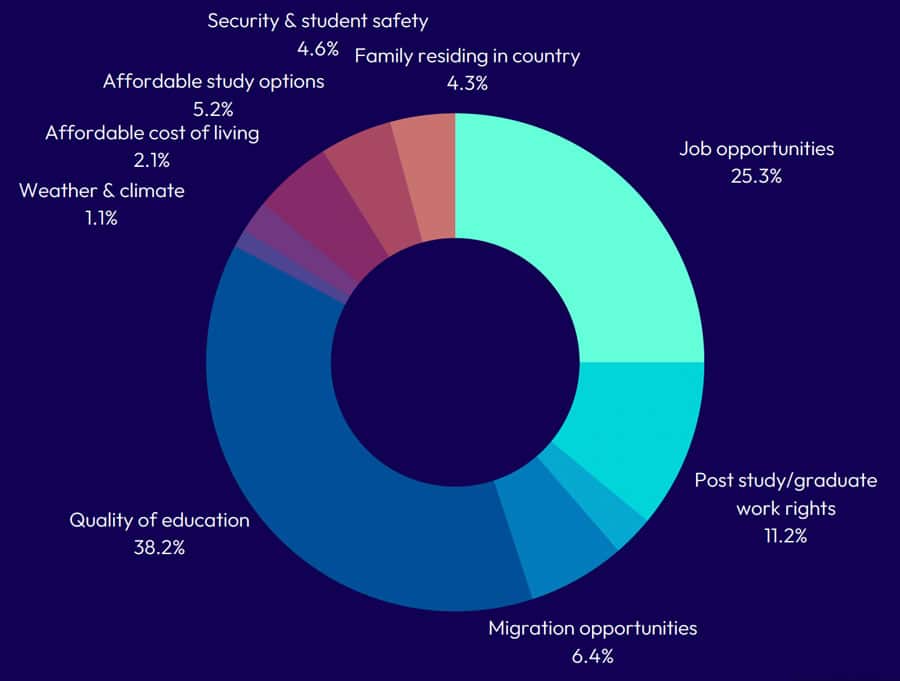
The next screenshot from the AECC slide deck underlines that job opportunities and work rights are about as influential as quality of education for international students making choices about study abroad. Much lower on the list of priorities are migration opportunities.

Top motivations for choosing a study abroad destination. Source: AECC

Demand is decreasing for Australia, Canada, and the UK

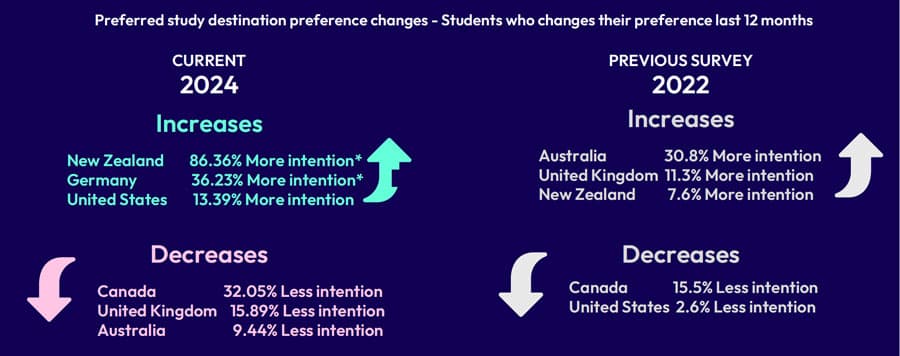
About 1 in 6 surveyed students said that they had changed their destination preference in the past 12 months. Among those students, interest had increased for New Zealand (+86%), Germany (+36%), and the US (+13%). It had decreased markedly for Canada (-32%) and had also weakened for the UK (-16%) and Australia (-9%).

When looking at the screen shot below, it’s important to note (1) the asterisks signalling that the increases for New Zealand and Germany are in a context of relatively smaller volumes choosing those destinations overall, and that 2022 data findings were in a context of the first “post-COVID” era (e.g., Australia had just opened its borders).

Trends in students’ preferences for select destinations. Source: AECC

Of those students who had changed their destination preference, most were motivated to do so because of the high fees in their original country of choice (24%), but significant proportions were also influenced by “negative policy changes for international students” (14%) and “better job opportunities in my [new] preferred country.”

Students who changed preferred destinations were most likely to have done so because of affordability and work opportunities. Source: AECC

Ascent One survey highlights need for clear communications to students and agents

Ascent One – a platform for higher education providers to manage agent networks, admissions, and marketing – also published findings this month of its own survey of just over 1,000 current, former, and prospective international students from China, India, Philippines, and Colombia. These students were asked specifically about their experience relating to studying in Australia. China, India, Philippines, and Colombia are four of Australia’s top 5 student source countries (Vietnam is the other – #3 currently after China and India).

From this survey, an important and potentially worrisome finding emerged: 41% of prospective and current students were not aware of current migration settings in Australia. Of those who did know, over three-quarters (77%) had to find out on their own. Another 15% learned about Australian visa and work policies through their agent.

More than a quarter (27%) of prospective students who had found about tighter immigration controls (which dovetail with soaring visa rejection rates said they are less likely to pursue plans to study in Australia. (The trend of affected student demand has emerged in IDP and Studyportals research as well this year – and for Canada and the UK as well as Australia.)

The study also found that:

  • The main reason surveyed international students choose to study in Australia is “better career opportunities post-study” (63%);
  • Only 23% of current students are working in a job that is related to their studies;
  • 44% of former students are working in a job that is not related to their studies.

Of those who said they were not working in a job related to their studies, more than a third (37%) said they were ineligible to apply for a job – or had been rejected for a job – because they did not have an Australian permanent resident visa or full-time work rights.

Markets like certainty, and student markets are no exception

Confusion about immigration policies, visas, and work rights is all the more likely this year in Australia – as well as Canada – given a lag between announcements of new settings and institutions being fully briefed on what this meant for their operations and students. This has, in turn, made it difficult for institutions to provide the kind of clarity and communications they would ideally like provide their students and agents.

Despite the more challenging environment for international students in Australia, however, the Ascent One survey found that 85% of current and former students enrolled in Australian institutions would recommend Australia as a place to study to their friends and family in their home country,

Of the survey findings, Naresh Gulati, founder and CEO of Ascent One said:

“Our survey reveals a big problem right now – the country is sacrificing future Australians at our own cost. The government’s decision to target international student visas to cut migration numbers is already having an impact. Our survey found that of the students who knew about the recent migration policy changes, over three-quarters (77%) found out about the changes themselves and only 15% via their agent, revealing a big communication gap between the government, education providers, agents and students that needs to be fixed. While the majority of students still recommend Australia as a place to study, our reputation as a world-class destination for study is shaky at best and needs urgent attention.”

Source: The impact of immigration settings, affordability, and job opportunities on international students’ study abroad decisions

Sam Routley: Canada’s hard-fought immigration consensus is crumbling before our eyes

Too much emphasis on the cultural dimension when the concerns and issues have overwhelmingly focussed on the practicalities of housing, healthcare and infrastructure. These practicalities cut across immigrants and non-immigrants alike and reduce the risk of concerns over immigration being driven by cultural issues. And the shift in more consistent long-term polling like Focus Canada over immigration levels have not demonstrated an increase in concern over immigrant values:

One doesn’t have to look too hard to notice how easy it is for immigration to cause persistent political problems across social and economic lines. In Canada, this is most manifest in Quebec where policymakers have sought to strike a balance between the province’s economic needs with their Francophone cultural concerns. Remarkably, though, and nearly uniquely in the developed world, over the past several decades there has been a well-established consensus in English Canada around the value of immigration amongst policymakers and the public alike. 

Where it was to be found, contestation remained relatively plain and technocratic. Most Anglophone political elites appear to agree that mass immigration is necessary for Canada to meet its economic needs. A common—if often quite chauvinistic—narrative around the country’s history of tolerance, diversity, and multiculturalism seems to have made explicit anti-immigration stances taboo. Public attitudes have maintained a pattern of modest increase towards ever-increasing support over the last few decades, reaching an all-time high as late as 2022.

But things are changing.

Immigration unhappiness is growing

Since late last year, recent survey findings continue to demonstrate that, while most respondents claim to remain broadly supportive of the contemporary immigration regime, overall support is declining. For instance, a 2023 Nanos poll found that 53 percent of Canadians want to accept fewer immigrants into Canada and 55 percent believe there are too many international students. A growing number of Canadians, it seems, now believe we have reached a tipping point where there is too much immigration for the population to properly integrate. 

This increasing mood of uneasiness among the public has also been echoed by commentators. Many, for example, have argued that—despite the federal government’s plan to increase annual intake levels to 500,000 in 2025—existing numbers are already exacerbating economic pressures and overburdening public infrastructure, most noticeably when it comes to access to housing. Canada’s drastic increase and growing reliance on temporary workers and foreign student visas have also drawn particular criticism: while the latter struggle to find economic security, the former continues to be used as a substitute for Canadian labour. The numbers here are stark. Immigration is now responsible for 90 percent of Canada’s labour force growth, according to Immigration Refugees and Citizenship Canada’s (IRCC) 2022 Report on Immigration to Parliament.

While most Canadians focus on the economic consequences of the immigration status quo, many conservatives have also linked these discontents to a deeper state of cultural malaise: the breakdown of a deeper or binding sense of Canadian national identity alongside a delegitimization of history. This is not only responsible for the import of foreign political controversies into domestic politics, but also a lack of confidence in answering the question of exactly what it is that newcomers are becoming a part of. 

Reform is needed

This much is clear: Canada’s contemporary immigration regime needs reform and, sensing the concerned public mood, the Liberal federal government has promised a range of new policies, including caps on foreign student visas and an eventual decline in intake numbers. 

But it is yet to be determined whether Canada’s prior immigration consensus can survive these challenges intact. From one perspective, there are good reasons to believe that the decrease in public support of immigration is a short-term fluctuation of an otherwise steady secular trend. Comparative research into immigration attitudes demonstrates that support for immigration will often drop in response to two main factors: a spike in the number of immigrant intake, and a sociographic assessment of economic precarity and competition. 

Seen this way, Canada follows a relatively conventional pattern, shaped by an initial backlash to a rising immigration rate that, assuming material conditions improve, will be eventually absorbed. This seems to have occurred in the midst of the 2008 financial crisis. While many Canadians believe that current immigration rates are too high, they still believe that mass immigration is an overall economic good.1 Similarly, while economic concerns are frequently cited, the number of Canadians that express a more rigid cultural discontent—that immigrants are “failing to culturally integrate”, for example—remains much smaller

However, this overlooks the fact that, outside of Canada, the general challenges associated with cultural diversity, specifically but not entirely due to immigration, have themselves come to characterize political competition in most other Western democracies. It has more commonly emerged as a salient expression of both deep-seated cultural and material differences among the population, pitting well-educated, wealthy, urban cosmopolitans who support mass immigration against large segments of the working class who don’t. 

What makes Canada any different? Many would claim that an aspect of the Canadian national identity, as determined by its historical challenges with diversity, makes the country uniquely supportive of immigration and multiculturalism. This is certainly echoed in elite-level discourse, as these challenges are always presented as a matter of means rather than ends. Other than marginal voices like the People’s Party of Canada, no one person or political movement in the country really challenges the overall value or principle of mass immigration.

But, while likely informing the cultural elite’s conception of the national identity, the claim that this then conditions Canadian public attitudes in any unique way has been repeatedly proven false. The portion of the population that consistently supports immigration and multiculturalism as a matter of principle is actually quite small and has not grown much in recent decades: no more than around a third of the population, and generally confined to those who are well-educated, wealthy, working in knowledge or cultural industries, and—increasingly—those who vote for the Liberal or New Democratic parties.

Instead, the remaining two-thirds of the population are what academics Randy Besco and Erin Tolley have aptly called “conditional multiculturalists.” They support immigration—and may even put their more cultural reservations aside—because they believe it to be in the country’s economic interest. Over the last few decades, support for immigration increased because more Canadians came to support current, but not increased, intake levels, indicating not so much an embrace of multiculturalism as a toleration of the status quo. 

This widespread utilitarian support of multiculturalism is perhaps best supported by the fact that refugee policy, a far more altruistic expression of supposed Canadian values, has always been contentious. Unlike economic immigrants, Canadians commonly overestimate refugee intake numbers and express far more cultural anxieties about them. 

Canadian immigration’s past and future

Just as important is the fact that the contemporary popular Canadian immigration consensus is incredibly recent. Despite the official declaration of multiculturalism in 1971 under Prime Minister Pierre Trudeau, the majority of Canadians opposed the government’s immigration intake levels until the mid-1990s. And rather than a gradual expansion of Canadian pluralism to include non-European newcomers, contemporary support emerged only after a very dramatic shift at the time. 

The Canadian immigration consensus is no more than thirty years old; and, short of expressing a quasi-universal attitude, this abrupt shift shows that it was first and foremost the contingent product of elite persuasion. While it was the Liberal administration of Trudeau the elder that ushered in the fifth and contemporary wave of Canadian immigration, what mattered was the fact that their conservative opponents—as seen in both the Mulroney and Harper administrations—embraced that system, implementing further increases through a convincing case of its economic utility. 

This was then maintained through the careful, but limited, management of a successful policy equilibrium. To put it another way, the Canadian immigration system actually worked and avoided many of the challenges faced by similar states. Given the emphasis on permanent residency, the very selective nature of the point system was successful in not only integrating newcomers but also promoting mutual economic benefits. Common reservations against immigration did not disappear but were instead undercut as a legitimate popular policy movement. 

Today this equilibrium has unraveled, undermining the conventional orthodoxy that the economic utility of the program overrides cultural reservations. It has opened up a hole in which anti-immigration attitudes, long dormant, not only have room to express themselves but to grow as a politically feasible alternative. As we have seen in other advanced democracies, this is set to be driven by two broader developments that will allow it to grow, despite any economic recovery. 

The first is that, even amid rising aggregate support for immigration, Canadian attitudes have become more polarized along partisan, regional, and class-based divides. While support is confined to the wealthy and well-educated, other groups of Canadians are becoming more skeptical. They are also being drawn to different parties: while the latter are much more likely to support the Liberals or New Democrats, those with more resistant attitudes are almost exclusively expressing support for the Conservative Party. 

The second is the changing attitudes of new or minority Canadians. Historically, they have been among the most enthusiastic beneficiaries and supporters of high immigration, which, given their concentration within important vote-rich suburban ridings, has disincentivized parties from challenging immigration in the past. But new citizens also risk following broader public opinion and becoming more skeptical as they integrate. This is likely because while most Canadian immigrants once found quick and lasting economic security they are now much more likely to live in economic precarity and poverty.

All this is not to say that Canada’s more long-standing practice of immigration and multiculturalism will end. It will one day again find its footing, and it is likely to continue to expand with the support of a plurality, but not the majority, of Canadians. The fact, however, is that the widespread, three-decade consensus it has enjoyed is over.

While an insurgent right-wing party—an increase in PPC support, perhaps—is certainly possible, what matters now is the way in which the Conservative Party, as the existing repository of this sentiment, proceeds. Not only will immigration and multiculturalism increase as salient sources of intra-party contention, but the salience of the issue—due in part to Quebec’s continued insistence on cultural preservation—will make it impossible to avoid a clear stance. For the Conservatives that support continued (and possibly expanded) immigration, efforts need to be made to articulate and legitimize the value of the policy in its full economic and cultural dimensions. If the New Right has demonstrated anything, it is that a mere focus on economic utility is no longer enough for a compelling policy agenda. 

Source: Sam Routley: Canada’s hard-fought immigration consensus is crumbling before our eyes
Devant les annonces prébudgétaires d’Ottawa, Legault rebrandit le référendum en immigration 

Sigh although his concern regarding the excessive increases in temporary workers is legitimate and likely more political positioning. But a referendum on immigration, even if narrowly focused, will likely not be conducive to reasoned discussion:

Le premier ministre François Legault n’en peut plus d’entendre son homologue à Ottawa, Justin Trudeau, faire un « feu d’artifice d’annonces » prébudgétaires à l’intérieur des champs de compétence du Québec. Il invite le fédéral à se concentrer plutôt sur la hausse du nombre d’immigrants temporaires et ravive l’idée d’un référendum sectoriel en immigration.

« Au lieu de faire des annonces dans les champs de compétence du Québec, occupez-vous de vos propres responsabilités, en particulier l’immigration », a lancé l’élu caquiste, mardi, lors d’un point de presse tenu quelques minutes avant la période des questions, à l’hôtel du Parlement.

M. Legault réagissait à une série d’annonces effectuées dans les dernières semaines par lesquelles le gouvernement de Justin Trudeau a fait connaître ses intentions de débourser des milliards de dollars pour le logement. Il y a deux semaines, l’annonce de la création d’une Charte canadienne des locataires et de l’équivalent d’un bail uniforme pour tout le Canada avait fait fulminer les ministres du gouvernement Legault.

« Ce que je dis à M. Trudeau, c’est : écoutez les Québécois. Puis, au lieu de […] dire “on va vous donner de l’argent en santé, on va vous donner de l’argent pour le logement”, allez donc à la racine du problème. Il y a trop d’immigrants temporaires », a soutenu le premier ministre caquiste.

M. Legault reproche à son homologue au fédéral d’avoir « laissé exploser leur nombre à 560 000 », selon le dernier décompte. Après l’avoir écartée en février, le premier ministre revient donc avec l’idée d’un référendum sectoriel en immigration, en fonction du « résultat des discussions » avec son homologue, qui aboutiront à une rencontre au sommet sur le sujet d’ici la fin juin.

« On va rentrer dans le détail. Est-ce que les immigrants temporaires devraient être préapprouvés par le Québec ? Si c’était le cas, ça voudrait dire qu’un, on contrôlerait le nombre, et deux, on contrôlerait les exigences en français », a-t-il dit mardi. « Est-ce qu’on fait un référendum là-dessus éventuellement ? Est-ce qu’on fait un référendum plus large sur d’autres sujets ? »

Exclu, puis considéré

En février, pourtant, François Legault avait écarté un éventuel référendum sectoriel en immigration. « Je ne pense pas qu’on a besoin de faire un référendum pour demander aux Québécois s’ils souhaiteraient qu’on rapatrie les pouvoirs à Québec », avait-il dit.

Or, Justin Trudeau a une « obligation de résultat » en vue de sa réunion de juin, a fait valoir M. Legault mardi. Après une rencontre le mois dernier, le premier ministre québécois avait affirmé ressentir chez M. Trudeau une ouverture à ce que le Québec puisse décider du nombre de travailleurs temporaires admis sur son territoire et qu’une « partie » d’entre eux se voient refuser le renouvellement de leur permis de travail.

Sans quoi, « il faut voir, là, est-ce qu’on a besoin de faire un référendum pour s’assurer que la majorité des Québécois appuient », s’est interrogé M. Legault à voix haute.

À Ottawa, mardi, le ministre fédéral de l’Immigration, Marc Miller, a assuré que les discussions avec Québec allaient bon train. « J’ai vraiment senti dans les dernières semaines de la ministre [québécoise de l’Immigration Christine] Fréchette une ardeur au travail, une volonté de vraiment trouver des solutions à nos défis », a-t-il dit.

S’il convient avoir des « points de divergence » avec le gouvernement Legault, l’élu libéral entend oeuvrer sur « la langue commune du Québec » et sur le désir de Québec « de réduire les gens qui sont ici de façon temporaire ». L’idée de confier tous les pouvoirs en immigration au Québec comme l’avait demandé le gouvernement caquiste le mois dernier n’est toutefois pas sur la table.

« Un pays qui donne tous ses pouvoirs à quelqu’un d’autre n’est plus un pays », a-t-il maintenu.

Québec demandera des compensations sans conditions pour l’ensemble des programmes fédéraux s’immisçant dans les pouvoirs du Québec, a indiqué M. Legault mardi. « Il n’est pas question d’accepter ça. » Le dépôt du budget fédéral est prévu le 16 avril.

Source: Devant les annonces prébudgétaires d’Ottawa, Legault rebrandit le référendum en immigration

English version:

Premier François Legault on Tuesday threatened to hold a referendum on immigration if he doesn’t get what he wants from Prime Minister Justin Trudeau.

Legault is pressing Ottawa for more power over immigration. Trudeau slammed the door on giving the province full control last month. “Will we hold a referendum on (getting full power over immigration) eventually? Will we do it more broadly, on other subjects?” Legault said. “It will depend on the results of discussions” with the federal government. “Don’t forget, Mr. Trudeau promised me a meeting by June 30 at the latest. So, I expect results there.”

Speaking to reporters in Quebec City, Legault complained the province has received more than 500,000 temporary foreign workers and asylum seekers over the past eight years.

“The federal government has allowed the number of temporary immigrants to explode to 560,000,” he said.

“This causes enormous problems for Quebecers. We lack teachers, nurses, housing, and (immigrants and asylum seekers) pose a real challenge for the future of French, particularly in Montreal.”

Legault said a referendum is “not in our plan, short term.”

However, he added: “Do we need to hold a referendum so that Mr. Trudeau is convinced that a majority of Quebecers are saying that it doesn’t make sense (to allow) 560,000 immigrants” to come to Quebec.

He said Quebecers “have always been welcoming, will always be welcoming” toward immigrants. “But now we can’t do it anymore. Our capacity to receive has been exceeded.”

He said Trudeau recently admitted Canada has welcomed too many immigrants.

“It’s the first time he’s said that,” Legault noted.

Last week, Trudeau said temporary immigration has to be brought “under control.” He said the number of temporary foreign workers and international students has ”grown at a rate far beyond what Canada has been able to absorb.”

Legault said the problem could be solved if Ottawa granted Quebec the power to pre-approve all temporary immigrants. That way, Quebec could control the number of arrivals and set French language requirements, he said.

After a March 15 meeting with Legault, Trudeau said: “No, we are not going to give more power (to Quebec) on immigration. Quebec already has more powers over immigration than any other province because it’s very important to protect the French language.”

At the time, Legault said Trudeau has privately expressed openness to discussing the idea of giving Quebec a say on the admission of temporary workers and would consider new rules ensuring more workers speak French.

The Coalition Avenir Québec government is under pressure to crack down on immigration. The party’s most significant rival is the poll-leading Parti Québécois.

After last month’s Legault-Trudeau meeting, PQ Leader Paul St-Pierre Plamondon said Trudeau’s response proves Legault is unable to win more powers for Quebec.

“This resounding No is evidence of a completely absent level of bargaining power,” the leader of the pro-sovereignty party said at the time. “It’s embarrassing for Quebec. We deserve more than this perpetual humiliation.”

Source: Legault threatens immigration referendum if Trudeau doesn’t relent

Armstrong: A Likely Story: The “Diversity” Myth Consumes the Canadian Literary Scene

Of note:

….I am not calling for contracts, publicity and awards to be given out on a demographically proportional basis. Women buy more books than men, so it’s no surprise if more women want to write and there’s no injustice in the industry catering to women’s interests when it comes to signing and promoting authors. The experience of being in a racial or cultural minority might be more likely to inspire people to become writers – witness the flowering of American Jewish literature in the 20th century. The desire to write and the talent to do it very well make for a rare combination and we can’t expect that combination to show up by quota. Maybe the “disproportionate” results I see are purely innocent, based on the merit of authors and the demands of the marketplace.

Except that they are accompanied by countless indicators of a literary culture that is working to create much more disproportionate results in the future, once all those current beneficiaries of race-based emerging writer awards and mentorships are ready to move into positions of literary leadership. If literary gatekeepers – the publishers, editors, conference organizers and the like behind those exclusionary measures I referred to above – are going to use race-based criteria to bar the majority of the nation’s population from many of their programs and publications, there had better be compelling evidence to justify those measures.

But the success of BIPOC writers over the last two or three decades, and especially in the last five years, suggests that these extraordinary measures are not justified. Remember, books promoted between 2018 and 2020 were written and landed publishing deals before the affirmative action initiatives I listed above, and yet BIPOC writers already managed to be moderately over-represented in Canadian literary circles. (And that some of these measures target women generally because they’ve been excluded from Canadian literature is so preposterous as to be laughable.)

If you look up Canadian writers online, increasingly you find that they define themselves immediately in racial terms, whether they are black or white, Asian or Indigenous or any combination. Often, the writer will include a health diagnosis of some sort, especially in cases where there’s no other potential affirmative action hook.

But far from easing off the affirmative action, the people piloting the good ship CanLit are pushing the throttle harder. Jesse Wente, “chairperson” of the Canada Council, in an interview with the Toronto Star called the institution he headed a “colonial” organization and described his mission as reducing the harm it causes to Indigenous, black and other communities. Given that this is the man who campaigned to destroy the career of author Hal Niedzviecki over an awkwardly worded call for writers to bridge cultures (the so-called Appropriation Prize kerfuffle of 2017), we can guess what this might mean.

In my own province of Manitoba, the government-funded arts council recently announced a new set of “strategic priorities” focused on equity, diversity, reconciliation and projects that “build communities.” The money quote in this document: “Refine program assessment criteria that favour a Eurocentric concept of excellence to instead focus on impact.”

What could possibly be done when so many publishers, agents, editors, academics, prominent authors and funding bodies are pushing harder than ever for identity-based affirmative action? A change in the federal government, which seems likely, might bring in new leadership at Canadian Heritage and the Canada Council that is less sympathetic to race-based program criteria. So the next federal election may put the brakes on some of these measures.

Perhaps more significantly, though, we may be able to count on boredom and frustration among readers and writers who are tiring of literature becoming a mere subsidiary branch of the greater social justice movement. How many Canadian Percival Everetts are there who are just as tired of trauma narratives as the protagonist of American Fiction? And how many book buyers have grown tired of being told again and again that equity and diversity are good and racism is bad?

It will be, admittedly, a steep and long mountain to climb. If you look up Canadian writers online, increasingly you find that they define themselves immediately in racial terms, whether they are black or white, Asian or Indigenous or any combination. Often, the writer will include a health diagnosis of some sort, especially in cases where there’s no other potential affirmative action hook: “Jane Smith is a settler of mixed Finnish and Irish ancestry living with long Covid and bipolar disorder on the unceded lands of the Anishinaabe.” Perhaps a culture that encourages writers to view themselves as individuals first and group members second would be more likely to produce the kind of exciting, unpredictable literature that encourages readers to shell out cash and turn the page.

Bob Armstrong is a Winnipeg-based novelist. His last novel, Prodigies, was published in the United States by Five Star/Gale after Canadian publishers and agents turned it down, going on to win the 2021 Margaret Laurence Award for Fiction. Armstrong previously wrote a weekly book news column for the Winnipeg Free Press for 12 years.

Source: A Likely Story: The “Diversity” Myth Consumes the Canadian Literary Scene

What Researchers Discovered When They Sent 80,000 Fake Résumés to U.S. Jobs

Not that surprising and mirrors earlier Canadian studies (Can we avoid bias in hiring practices?):

A group of economists recently performed an experiment on around 100 of the largest companies in the country, applying for jobs using made-up résumés with equivalent qualifications but different personal characteristics. They changed applicants’ names to suggest that they were white or Black, and male or female — Latisha or Amy, Lamar or Adam.

On Monday, they released the names of the companies. On average, they found, employers contacted the presumed white applicants 9.5 percent more often than the presumed Black applicants.

Yet this practice varied significantly by firm and industry. One-fifth of the companies — many of them retailers or car dealers — were responsible for nearly half of the gap in callbacks to white and Black applicants.

Two companies favored white applicants over Black applicants significantly more than others. They were AutoNation, a used car retailer, which contacted presumed white applicants 43 percent more often, and Genuine Parts Company, which sells auto parts including under the NAPA brand, and called presumed white candidates 33 percent more often.

In a statement, Heather Ross, a spokeswoman for Genuine Parts, said, “We are always evaluating our practices to ensure inclusivity and break down barriers, and we will continue to do so.” AutoNation did not respond to a request for comment.

Known as an audit study, the experiment was the largest of its kind in the United States: The researchers sent 80,000 résumés to 10,000 jobs from 2019 to 2021. The results demonstrate how entrenched employment discrimination is in parts of the U.S. labor market — and the extent to which Black workers start behind in certain industries.

“I am not in the least bit surprised,” said Daiquiri Steele, an assistant professor at the University of Alabama School of Law who previously worked for the Department of Labor on employment discrimination. “If you’re having trouble breaking in, the biggest issue is the ripple effect it has. It affects your wages and the economy of your community going forward.”

Some companies showed no difference in how they treated applications from people assumed to be white or Black. Their human resources practices — and one policy in particular (more on that later) — offer guidance for how companies can avoid biased decisions in the hiring process.

A lack of racial bias was more common in certain industries: food stores, including Kroger; food products, including Mondelez; freight and transport, including FedEx and Ryder; and wholesale, including Sysco and McLane Company.

“We want to bring people’s attention not only to the fact that racism is real, sexism is real, some are discriminating, but also that it’s possible to do better, and there’s something to be learned from those that have been doing a good job,” said Patrick Kline, an economist at the University of California, Berkeley, who conducted the study with Evan K. Rose at the University of Chicago and Christopher R. Walters at Berkeley.

The researchers first published details of their experiment in 2021, but without naming the companies. The new paper, which is set to run in the American Economic Review, names the companies and explains the methodology developed to group them by their performance, while accounting for statistical noise.

Source: What Researchers Discovered When They Sent 80,000 Fake Résumés to U.S. Jobs

NZ tightens visa rules amid ‘unsustainable’ migration

Common trend among a number of countries:

New Zealand has tightened work visa rules in response to “unsustainable” migration levels, say authorities. 

Low-skilled applicants now have to fulfil English-language requirements and are allowed to stay for three years – down from five previously.

“Getting our immigration settings right is critical to this government’s plan to rebuild the economy,” said Immigration Minister Erica Stanford.

A near-record 173,000 people migrated to New Zealand last year.

Under the tightened rules, applicants for most work visas now have to fulfill requirements for skills and work experience. 

Employers are responsible for ensuring that migrants meet the specified requirements before offering them a job.

Authorities have also decided to axe earlier plans to add 11 roles, such as welders, fitters and turners, to the list of occupations that would qualify for a fast track to residency.

These rules mark “the start of a more comprehensive work programme to create a smarter immigration system,” Ms Stanford said, adding that more stringent visa rules also help prevent the exploitation of migrant workers. 

New Zealand, which has a population of 5.3 million, has been experiencing a surge in migration since end 2022.

“The government is focused on attracting and retaining the highly skilled migrants such as secondary teachers, where there is a skill shortage.

“At the same time we need to ensure that New Zealanders are put to the front of the line for jobs where there are no skills shortages,” Ms Stanford said.

New Zealand’s Prime Minister Christopher Luxon had said last year that the country’s high net migration rates did not “feel sustainable at all”. 

New Zealand’s immigration system had been closed “at a time when employers were looking for workers [during the pandemic]… and then Labour opened the floodgates just as the economy was starting to slow,” Mr Luxon, who leads the conservative National Party, told Radio New Zealand in December.

“We’re inheriting a system that’s been a complete hash,” he had said.

Some policymakers have warned that the new arrivals may further drive up rents and house prices.

On Monday, New Zealand’s Employers and Manufacturers Association raised concerns that the new visa rules could have “unintended” consequences.

“We are supportive of ensuring we are bringing in the right workers, and that they are not exploited, but we do need to make sure we get the balance right,” said Alan McDonald, the association’s Head of Advocacy.

“Making it harder for motivated workers to come into New Zealand means they will go somewhere else, that hurts business and means our economy misses out,” he said.

At the same time, New Zealanders have been moving out of the country – often to its more prosperous neighbour, Australia. Last year, for example, New Zealand saw a record loss of 47,000 citizens. 

Australia, which has also seen an influx of immigrants, announced in December that it will halve its migration intake by tightening visa rules for international students and low-skilled workers.

The Australian government has been under pressure from some quarters to temporarily reduce migration to help ease Australia’s housing crisis and infrastructure woes.

Source: NZ tightens visa rules amid ‘unsustainable’ migration

Taube: Why Justin Trudeau is turning against immigration

From a conservative and largely partisan perspective:

Canadian Prime Minister Justin Trudeau is in a state of desperation. His minority Liberal government has been polling behind Pierre Poilievre’s Conservatives for the better part of two years. They’re down in most opinion polls by 15 to 18 points, and only have the support of 23 to 26 per cent of the Canadian electorate. His left-leaning policies have turned off many Canadians, including fellow Liberals. His standing in the international community barely has a pulse. His personal popularity numbers continue to plummet.

How is Trudeau still in power? Because he signed a three-year work-and-supply agreement with Jagmeet Singh’s New Democrats – who are also struggling mightily in the polls – that doesn’t expire until June 2025. Without this, his goose would have been cooked.

The PM obviously wants to remain in power, as most political leaders do. He and his senior advisors have been throwing imaginary darts in every conceivable direction to gain an advantage. Nothing has worked to date.

Trudeau and the Liberals, who realise the clock is ticking rapidly, are now taking the most desperate step of them all: abandoning long-held political narratives with a flick of the wrist.

Here’s a recent example. Trudeau told reporters at an April housing announcement in Dartmouth, Nova Scotia that Canada’s level of temporary immigration needs to be controlled. 

‘Whether it’s temporary foreign workers or whether it’s international students in particular,’ he said, these groups ‘have grown at a rate far beyond what Canada has been able to absorb…To give an example, in 2017, 2 per cent of Canada’s population was made up of temporary immigrants. Now we’re at 7.5 per cent of our population comprised of temporary immigrants. That’s something we need to get back under control.’

There’s nothing illogical with this assessment. Except for one critical point – the reason why temporary immigration has turned into a significant economic problem in Canada is specifically because of the policies of Trudeau and the Liberals. 

The ex-drama teacher seemingly forgot that little nugget of information during his announcement. Perhaps he was caught up in the moment. But let’s provide him with a few gentle reminders. 

The Trudeau Liberals took power in 2015. In 2017, they announced that Canada would take in one million immigrants over a three-year period. In 2018, Immigration Minister Ahmed Hussen announced a further hike of 40,000 immigrants for 2021, bringing the yearly total to 350,000, or roughly 1 per cent of Canada’s population.   

No one denies that hard-working immigrants, who arrive by legal means, have played a vital role in building and shaping Canada and other western democracies. Generosity of spirit is a good thing, too.

Nevertheless, how did Trudeau plan to pay for this massive wave of immigration? How would he deal with issues related to housing, jobs, taxes and ensuring Canada’s economic engine could handle this influx of new immigrants? 

Sunshine and lollipops, it seems.

Trudeau’s Canada also let in refugees at a fairly rapid pace compared to the country’s total population. This included 25,000 Syrian refugees in a short two-month window in 2015, a time frame which was correctly described as ‘problematic’ by the president of the Canadian Immigrant Settlement Sector Alliance. There were also issues with Haitians coming illegally across the US-Canada border in 2017. It turned into a huge political controversy. The right-leaning Conservatives and left-leaning NDP both questioned this surge, albeit for different reasons. 

As for temporary foreign workers, Trudeau’s narrative has been all over the map. The Hub noted in a January piece that Trudeau criticised then-prime minister Stephen Harper and the Conservatives for growing the Temporary Foreign Workers Program (TFWP). As Trudeau wrote in a 2014 op-ed for the Toronto Star, ‘by 2015, temporary worker entries will outnumber permanent resident entries. This has all happened under the Conservatives’ watch, despite repeated warnings from the Liberal Party and from Canadians across the country about its impact on middle-class Canadians: it drives down wages and displaces Canadian workers.’ In his view, the Conservatives needed to ‘scale it back dramatically.’

What did Trudeau do to correct this as Prime Minister? The exact opposite. Temporary work permits increased from slightly over 310,000 in 2015 to almost 800,000 in 2022. Both of Canada’s temporary labour migration streams, the TFWP and International Mobility Program, have gone up since 2017 – with an enormous spike in 2022. Early data for 2023 shows another increase is forthcoming.    

Trudeau could have prevented all of this from happening if he had actually paid attention to Canada’s rising immigration levels and refugee claims. He didn’t. And this has been a defining feature of his mediocre and ineffective leadership. 

Source: Why Justin Trudeau is turning against immigration

Speer: Justin Trudeau critiques Justin Trudeau’s immigration policies

More on the PM’s non-mea culpa:

The strangest story this week was Prime Minister Justin Trudeau’s acknowledgement that his government has overseen an uncontrolled increase of temporary immigration into the country “far beyond what Canada has been able to absorb.” 

It’s an extraordinary admission for various reasons including the seeming detachment from his government’s ultimate responsibility for the massive spike in non-permanent residents. His comments sounded like those of an incoming prime minister condemning the policy failures of his or her predecessor. 

Yet these developments are neither inadvertent nor the fault of a past government. A combination of the Trudeau government’s untightening of its predecessor’s 2014 reforms to the Temporary Foreign Worker program and its own expansion of the international student visas are what’s ultimately behind the 93 percent increase in non-permanent residents since 2021 alone. 

Another way to put it is: Canada’s population grew faster in 2023 than any year since 1957 and of that year-over-year growth, 63 percent came from non-permanent residents. It was the second consecutive year in which temporary immigration has driven the country’s population growth. These are unprecedented numbers.  

Their demand-side implications for housing and shelter and other basic infrastructure had up until recently gone essentially unrecognized by the Trudeau government. It has now only recently started to shift its messaging and policies in light of growing public concerns and plummeting poll numbers. 

Immigration Minister Marc Miller has described the spike in temporary resident permits as a “byproduct of a lack of integrity in the system.” He recently announced plans to cut them in order to restore a more “sustainable level.” Prime Minister Trudeau’s uncharacteristically pointed comments this week must be understood in this evolving political context in which his government is effectively running against itself.  

There’s a strong case however that the prime minister shouldn’t have been surprised by the rise of temporary immigration or its negative effects. He actually forewarned about them as the then-third-party leader in a prescient Toronto Star op-ed ten years ago next month.

Trudeau called the (relatively moderate) growth of temporary residents under the Harper government a case of “mismanagement” that represented “serious damage” to the public’s ongoing support for high levels of permanent immigration. 

In particular, he warned that temporary immigration depresses wages and displaces Canadian workers. He effectively argued for eliminating the Temporary Foreign Workers program altogether (“I believe it is wrong for Canada to follow the path of countries who exploit large number of guest workers”) and instead putting a priority on permanent immigrants who have a path to citizenship. He argued that this approach was rooted in the principle of fairness for Canadians who need work and temporary immigrants themselves. 

It seems somewhat unfair to hold his near-decade-old arguments against him today. Opposition politicians understandably tend to get a bit of leeway for such policy adjustments. A lot has also happened in the intervening time. 

But the difference here is that the prime minister knew what would happen if we continued to steadily increase temporary immigrants. We know because he persuasively wrote about it. Trudeau anticipated the political economy risks and yet upon getting elected he opted to do nothing about it—or more precisely rather than “dramatically scale back” the country’s temporary resident population, he inexplicably chose to dramatically scale it up. 

If the Trudeau government loses the next federal election, which at the moment seems quite likely, it may be in large part because when it came to temporary immigration, the prime minister failed to heed his own well-considered advice. 

Source: Justin Trudeau critiques Justin Trudeau’s immigration policies