Human-rights groups outraged at plan to detain immigrants in federal prison

Expected:

Human-rights groups are expressing outrage at government plans to lock up immigrants who have not been convicted of a crime in federal prisons.

Tuesday’s federal budget proposes changes to the law to allow people facing deportation deemed to be high risk – including posing a potential flight risk or a threat to public safety – to be incarcerated in federal prison.

The move follows the decision by provinces to end immigration-detention agreements with the Canada Border Services Agency (CBSA) to house immigrants in their jails this year…

Source: Human-rights groups outraged at plan to detain immigrants in federal prison

And the Minister’s response:

Immigration Minister Marc Miller confirmed to Radio-Canada that the federal government will be using its penitentiaries to hold some foreign nationals for immigration purposes.

He said those detainees will be separated from the prison population, but that both groups could be sharing services.

“It would be separate housing and it would not be in the general population, because they are not criminals,” Miller said, following Radio-Canada’s story on the government’s proposal buried at the bottom of the federal budget tabled Tuesday.

The Trudeau government wrote it wants to “enable the use of federal correctional facilities for the purpose of high-risk immigration detention.”

The statement has angered human rights organizations, some calling the plan “completely unacceptable,” as reported by Radio-Canada Wednesday.

Source: Immigration minister responds to critics over plan to detain migrants in penitentiaries

Budget 2024: Statement on Gender, Diversity, and Inclusion, varia

Definitely worth a look, for the richness of the data as well the insights into the government’s diversity and inclusion priorities and how it stitches the narrative together with political and Canadian public priorities.

Intro has the key messages:

  • “Early Learning and Child Care, which is supporting better economic outcomes for women, by making it possible for more women to participate in the workforce, while securing access to quality child care and learning, thus contributing to positive childhood development and the future well-being of children.
  • The interim Canada Dental Benefit has helped hundreds of thousands of children get the oral health care they need, and once fully implemented in 2025, the new Canadian Dental Care Plan will improve the long-term health of 9 million Canadians, who may have previously been unable to visit an oral health professional due to the cost.
  • The National Action Plan to End Gender-Based Violence provides targeted action to protect Canadians who experience or are at risk of experiencing violence because of their sex, gender, gender identity, gender expression, or perceived gender.
  • The Federal 2SLGBTQI+ Action Plan advances the rights and equality for Two-Spirit, lesbian, gay, bisexual, transgender, queer, intersex, and other sexually and gender diverse people in Canada.
  • The Implementation of the National Action Plan to End the Tragedy of Missing and Murdered Indigenous Women and Girls is providing targeted, culturally-appropriate supports to Indigenous women, girls, and 2SLGBTQQIA people, while working to address the root causes of the violence they face.

In Budget 2024, the government is making investments to close the divide between generations. For younger Canadians, the government is taking new action to reduce tax advantages that benefit the wealthy, is investing to build more homes, faster, is strengthening Canada’s social safety net, and is boosting productivity and innovation to grow an economy with better-paying opportunities.

These efforts will improve the lives of all younger Canadians, and their impacts will be greatest for lower-income and marginalized younger Canadians, who will benefit from new pathways to unlock a fair chance at building a good middle class life.

This starts with a focus on housing. Resolving Canada’s housing crisis is critical for every generation and the most vulnerable Canadians. The government is building more community housing to make rent more affordable for lower-income Canadians, including through:

  • The $618.2 million Federal Community Housing Initiative;
  • The $15 billion Affordable Housing Fund, including a $1 billion top-up in Budget 2024;
  • The $1.5 billion Co-Operative Housing Development Program; and,
  • The $4.4 billion Housing Accelerator Fund, including a $400 million top-up in

These investments provide Canadians and younger generations with opportunity ––finding an affordable home to buy or rent; having access to recreational spaces, amenities, and schools to raise families.

Having a place to call home creates a broad range of benefits. When survivors of domestic partner violence can find affordable housing, this creates a safe home base for their children to break cycles of violence and poverty. When Indigenous people can find affordable housing that meets their specific needs that means they can access culturalsupports to help heal from the legacy of colonialism. When persons with disabilities are able to find low-barrier or barrier-free housing, this enables them to utilize the entirety of their homes.

To ensure that young people and future generations benefit from continued actions for sustained and equitable prosperity for all, this budget makes key investments to guarantee access to safe and affordable housing, help Canadians have a good quality of life while dealing with rising costs, and  provide economic stability through good-paying jobs and opportunities for upskilling.”

Interestingly, no mention of the employment equity task force and its recommendations, although it is mentioned in the Budget.

Immigration aspects are limited to “continued funding for immigration and refugee legal aid” (but the Budget has significant funding for immigration and reflects the government’s pivot away from unlimited temporary workers and international students and post 2015 ending annual increases).

The Budget also has a reference to “Permit the Financial Transactions and Reports Analysis Centre of Canada (FINTRAC) to disclose financial intelligence to provincial and territorial civil forfeiture offices to support efforts to seize property linked to unlawful activity; and, Immigration, Refugees and Citizenship Canada to strengthen the integrity of Canada’s citizenship process (with little to no detail).”

No surprise, but the 2019 and 2021 election platform commitments to eliminate citizenship fees remain unmet.

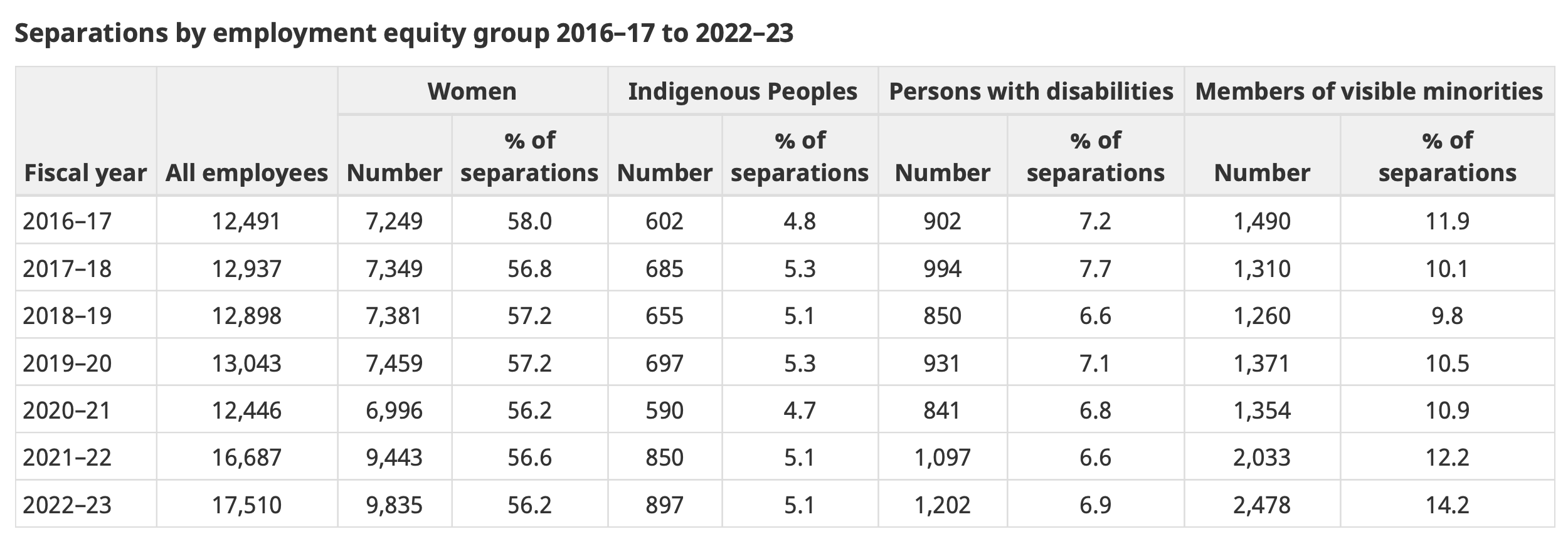
The Government’s proposed reduction in the public service by 5,000 public servants over four years (1,250 per year) is meaningless as the 2022-22 EE report shows annual separations more than 10 times that:

One thought that crossed my mind while browsing this close to 40 page document is whether this level of detail and effort would survive a change in government. Unlikely IMO, given the pressure to reduce spending and the CPC general aversion to excessive employment equity reporting and measures.

Source: Budget 2024, Statement on Gender Equality, Diversity, and Inclusion

Century Initiative:Great budget, Ottawa, but how to execute it when Canada fails to retain talent?

The latest from CI, still maintaining their focus on population growth but more attentive to other issues. But arguably some of the failings of immigration policy and integration have resulted in retention issues, with churn as immigrants pursue opportunities elsewhere.

On foreign credential recognition, count me cynical but this is a perennial issue that neither the previous or current government have made significant progress on beyond consultations and process. At the provincial level, however, where professions and trades are regulated, there has been some significant progress to temper my cynicism.

And of course, like the budget itself, the belated recognition of the links between housing and immigration:

…As one example, there have been positive steps in building the Indigenous economy, including higher rates of new business creation among Indigenous peoples compared with the population over all. We need to build on this progress with government, business and labour exploring further opportunities for partnership and Indigenous-led development.

The need to expand work-force participation and economic opportunity extends across demographics and can be addressed in three specific areas.

First, skills development. In a destabilizing year for the postsecondary institutions, work with provinces and territories to support expanded program delivery, particularly in health care, technology and skilled trades, is urgently needed. Employers, who share an interest in investing in their work force’s development, should also be given incentives for work-integrated training programs.

Second, retention. We have enormous untapped potential among Canadians who are already here. And the plain truth is the longer it goes untapped, the greater the risk that talent leaves. Indeed, 0.7 per cent of our population leaves for the United States every year, with independent research showing tech workers are paid more than 46 per cent more in the U.S.

Clearly, we need policies that encourage growth and scale for our own innovators, expanding their ability to offer competitive pay. Additionally, pathways should be created for temporary foreign workers to secure permanent positions and residency. These measures must be coupled with investments that enhance quality of life, such as affordable housing, health care and child-care capacity.

Third, fixing the credential mismatch. More than 25 per cent of immigrants with foreign degrees end up in jobs that they are overqualified for, with an RBC studysuggesting that credential inefficiencies cost the Canadian economy as high as $50-billion annually. We must do far more to ensure that immigrants find employment that matches their skills and qualifications, including exploration of mutual credential recognition agreements with prominent source countries.

Budget 2024 lays out a vision for Canadian housing, affordability and job creation, with a wide-ranging slate of new programs and investments. If we want them to succeed, they must be coupled with a vision for a skilled, resilient and adaptive work force.

A made-in-Canada pathway to prosperity begins and ends with talent – let’s ignite that talent with the vital boost it needs.

Lisa Lalande is chief executive officer of Century Initiative.

Source: Great budget, Ottawa, but how to execute it when Canada fails to retain talent?

Minister preemptively shuts down Calgary proposal to let permanent residents vote

Right call, given that Canadian citizenship has reasonable requirements (high fees perhaps excepted) and that backlogs largely eliminated:

A Calgary city council motion to extend municipal voting rights to permanent residents has been stopped in its tracks by Alberta’s municipal affairs minister.

The motion is set to be introduced by councillors Walcott, Wong, Dhaliwal, Mian, and Penner on Tuesday.

However, in a post to X on Saturday, Minister Ric McIver said he’ll “save us all some time.”

“Only citizens of Canada can vote in municipal elections. That will not be changing,” he said.

The motion calls for an amendment to the Local Authorities Election Act, which determines who has the right to vote in municipal elections. 

Because municipalities exist due to provincial legislation, the Alberta government would have to decide to amend the Local Authorities Election Act.

The councillors argued in their motion that all levels of government make decisions that affect residents’ daily lives, regardless of their citizenship status. 

“Municipalities are unique, as the only order of government that is not constitutionally defined. The opportunity to extend voting rights to more members of our local communities would represent a significant shift to ensure our local communities are representative of the people who call them home,” reads the motion.

The procedure on Tuesday is to ensure that the motion is written properly, Wong told True North in an interview. The motion will not be debated until the next regular council meeting on Apr. 30.

Wong said he is eager to hear more about the pros and cons of the motion, including its virtues and benefits, and how it aligns with federal and provincial criteria for voting eligibility

“Our responsibility as municipalities extends to all… who call our communities home, who contribute to civic life, who work here, raise families here, and use city services, should have a democratic right to vote in our municipalities,” reads the motion.

Wong said that councillors have been canvassing their constituents, both citizens and permanent residents.  

The perspectives presented have been varying. Some have said that citizenship is a vital voting criterion.

“We’ve also heard people saying, ‘We’re newcomers. We want to be able to be a citizen.’ There are reasons why it’s been delayed, whether it’s in their control or not. But they also feel that they’d like to have a voice in municipal governance because they are users of our services as well as people who pay taxes,” said Wong.

He added that one of the most pressing questions is the many different types of permanent residents there are and what would determine voting eligibility.

“The nuance of that has to be discovered by the province, and the province needs to make the system fair across the province because this is not just a Calgary-based request,” said Wong.

The Calgary councillor was not surprised at McIver’s response, he said. He added that McIver is very involved and understands Alberta and Calgary’s multiculturalism. 

“I know that he wouldn’t dismiss it just because of personal feelings about us. He would weigh the arguments presented by all municipalities,” said Wong.

“All members of council are always amenable to persuasion, and therefore nobody’s cast a vote as of yet. And I think Calgarians need to understand that.”.

True North reached out to McIver for additional comment. His office said he has nothing more to add to his previous post to X. 

Source: Minister preemptively shuts down Calgary proposal to let permanent residents vote

Keller: Is the Trudeau government overselling how much housing it can build? Yes

Indeed, particularly in the next few years if not more. Likely will not help their electoral prospects given time required to build new housing:

…When CIBC economist Benjamin Tal updated the CMHC estimate earlier this year, to account for recent unprecedented population growth because of immigration, he pegged the shortfall at closer to seven million homes.

If that’s true, then getting to housing affordability doesn’t just mean a doubling of the pace of home building. It would take a quadrupling.

The Trudeau government’s sudden burst of furious housing announcements – plus the suggestion that the resistance of some provinces is all that stands between Canada and sweet affordability – may deliver political dividends in the run-up to a 2025 election.

However, the overnight erection of a glittering skyline of new housing policies comes after the government spent years ignoring the growing stresses caused by its immigration choices. That’s partly what got us here.

The Liberals are now saying a lot of the right things on both housing and immigration. It’s a start. But to quote a handwritten note from the PM’s chief of staff, Katie Telford, which was entered into evidence last week at the foreign interference inquiry: “Bragging is not doing.”

Source: Is the Trudeau government overselling how much housing it can build? Yes

Gurski: Trudeau government shows it’s not serious about foreign election-meddling

Of note:

There is much to take away from all the recent analysis and counter-analysis of foreign interference in Canada’s elections — and none of it is good.

In summary, our government minimized the threat to our electoral process, admitting that while there “may” have been “some minor” efforts to sway voter intention, when all was said and done the results were not affected. (I am waiting for someone to explain how this conclusion was drawn: does the government know the reasons individual Canadians voted and the reasons for their choice of party/candidate?)

From an intelligence angle, while not much new was introduced at the Foreign Interference Commission last week, a few takeaways need re-emphasis.

1. Canada’s “intelligence culture” is worse than I feared. Politicians and senior bureaucrats do not understand, appreciate or know how to use the information provided by The Canadian Security Intelligence Service (CSIS) and others to help them identify threats to our national security and counteract them.

2. The prime minister does not read intelligence reports (or does he? There were mixed messages on that front) but prefers to be “orally briefed.” In theory there is nothing wrong with that as long as those doing the briefing have a background, preferably a strong operational background, in intelligence. Relying on “advisers” with no experience at the spy coalface to tell you about the nature of intelligence and its meaning is akin to asking your cousin Clem about your lung cancer rather than going to a qualified medical source. Not a great strategy.

3. Our leader arrogantly dismissed CSIS intelligence — which was provided on at least 34 (34!) occasions over the past few years — on People’s Republic of China shenanigans as “inadequate” and uninteresting. Accusations such as “it was not evidence” expose a significant ignorance of what intelligence is and is not.

No, it is not collected to an evidentiary standard (and is not normally used in court cases) but what is eventually provided to the prime minister and his team has been very carefully analyzed, corroborated, debated, checked and double-checked and is subject to intense scrutiny before it leaves the building. Is it perfect? No, nothing is.  But based on what I saw over 32 years at the Communications Security Establishment (CSE) and CSIS, the product is damn good. It is as accurate as can be given the sources and the fact that investigations leading to useful intelligence are in constant motion.

Where do we go from here, then? While the inquiry did provide the average Canadian with a peek into the shadows of espionage and counter espionage, under the guise of what foreign powers are doing on our soil to harm our democracy, this commission report will be relegated to the usual filing cabinet, like the results of other inquiries. In other words, thanks for coming and testifying but there is nothing to see here, so please move along.

The other sad fact is that national security issues are rarely, if ever, important on the campaign trail. Voters care more about inflation, interest rates, the housing crisis and what can be done to help a Canadian team win the Stanley Cup (31 years and counting). What the PRC and others are doing to threaten diasporas, steal votes and seek a government that will do its bidding simply does not register. Yes, these other challenges resonate more, but if you cannot ensure a free and fair election, what does your democracy stand on?

My normally optimistic self notes that we have seen this movie before and will see it again, unless we take major steps to prevent it. We need a national security adviser with real intelligence experience, not a part-time bureaucrat. We need the prime minister to meet regularly with the heads of CSIS, CSE and the RCMP.

We need a government to take intelligence and threats seriously.

Source: Gurski: Trudeau government shows it’s not serious about foreign election-meddling

Link to Canada’s security needed to bar suspected spies under immigration law: court

Of interest, await some commentary from the security researchers:

People can be barred from Canada under espionage-related provisions of the immigration law only when their activities have a clear link to Canadian security, the Federal Court of Appeal has ruled.

The finding came in a pair of decisions involving men from Ethiopia who were deemed inadmissible to Canada for being members of an organization that had engaged in spying.

The Immigration and Refugee Protection Act bars permanent residents and foreign nationals who engage in espionage that is directed against Canada or contrary to Canada’s interests.

The prohibition also applies to members of organizations involved in these activities.

At issue in the two cases was how to define the phrase “contrary to Canada’s interests.”

Medhanie Aregawi Weldemariam and Abel Nahusenay Yihdego are Ethiopian citizens and former employees of the African country’s Information Network Security Agency, a state security and intelligence organization.

Weldemariam says his work at the agency involved developing air defence simulation software for training military members. He left in mid-2014 to pursue graduate studies in Sweden, returning to Ethiopia two years later.

Weldemariam came to Canada in 2017 and made a refugee claim, alleging he was at risk of persecution by Ethiopian security forces that had targeted him after his return from Sweden.

Yihdego worked at the intelligence agency as a protocol analyst and network engineer. He claims he was pressured to join the agency’s decryption unit, facing threats and harassment when he refused to do so.

Yihdego resigned in 2014, enrolling in graduate studies outside of Ethiopia. He claims that on his return to Ethiopia in 2017, he was detained by security services because of his political activities.

He came to Canada on a temporary resident visa, later seeking refugee protection.

The men’s refugee claims were put on hold while the immigration division of the Immigration and Refugee Board weighed their admissibility to Canada.

The division found the Ethiopian intelligence agency gathered information using offensive cybercapabilities and surveillance malware, targeting journalists and political dissidents.

There was no evidence that either Weldemariam or Yihdego were personally involved in the agency’s espionage activities, only that they were members of the organization.

In each case, the immigration division found that the espionage at issue was “contrary to Canada’s interests,” even though it lacked a nexus to Canada’s national security or security interests.

In 2020, the Federal Court concluded the division’s interpretation of the law was unreasonable on the basis a connection to Canada’s security interests was indeed required.

The court quashed the decisions and sent the cases back to the immigration division for reconsideration.

The federal government appealed the court rulings.

In both cases, the Court of Appeal sided with the men, saying there was no suggestion any of the journalists targeted by the Ethiopian intelligence agency lived in Canada.

The court also found no evidence the agency’s acts were directed at Ottawa or Canadian companies, institutions or individuals, including members of the Ethiopian diaspora.

As a result, the court saw no need to send the cases back to the immigration division for redetermination.

Source: Link to Canada’s security needed to bar suspected spies under immigration law: court

Conservative government’s immigration formula could result in lower immigration, Tory MP says

Some insights into their thinking, including comments wanting “real, reasonable objective metrics” related to housing, healthcare and jobs and “I don’t want my government determining which values it supports and which it doesn’t.” But of course, the previous conservative government didn’t move the needle either on foreign credential recognition:

The Conservative party’s plan to tie immigration numbers to available jobs and homes could result in a lower immigration target, an MP says.

Conservative immigration critic Tom Kmiec said a Conservative government wouldn’t set an arbitrary number, but rather one that takes into account what the country can sustainably accommodate. This could end up lowering immigration, he said.

“Whatever it comes out to, that will be the number,” Kmiec said on The Andrew Lawton Show. “If it’s lower, it’s lower. If it’s higher, it’s higher.”

Conservative Leader Pierre Poilievre previously said in an interview that immigration had to be tied to key economic numbers reflecting the labour and housing markets.

Kmiec said that under a Conservative government, those calculations wouldn’t just involve permanent immigration but also temporary resident immigration.

“The problem isn’t the permanent residency ones, those PR numbers are often quoted by individuals. In Canada, about 45% to 55% of those, depending on the year, are people who are actually physically in Canada already,” said Kmiec.

“They are just changing their status from studying, from working here on a temporary work permit and they’re becoming permanent residents of Canada, hopefully, on the pathway to becoming citizens and joining the Canadian family.”

Kmiec said it’s “ridiculous” that Prime Minister Justin Trudeau has only recently concluded that Canada’s immigration levels have far outpaced what the country can absorb.

“I guess he doesn’t read any of the briefing notes or documents that come up his way,” Kmiec said.

The Calgary MP pointed out how it was Trudeau himself who appointed the various immigration ministers responsible for the country’s explosive population growth. 

“When he reshuffled his own cabinet, you had this bizarre situation where the previous immigration minister could not let go of his department. He was saying that ‘things are a mess,’ that’s a direct quote and the new minister said ‘things are out of control.’ They’ve been fighting it out in public between the senior immigration minister and the junior immigration minister,” said Kmiec.

“Now the prime minister has weighed in and accused his government of basically failing on the job and that they’re not competent obviously, except he’s the one who appointed everybody. He’s been in charge for almost nine years now and they broke the immigration system. It’s nice of him to recognize that he broke it,” he added. 

When asked if the immigration calculation should be restricted to just economic indicators, instead of factoring in things like Canadian values as well, Kmiec said he was wary of introducing new things that “are not fixed.”

“I don’t want my government determining which values it supports and which it doesn’t and the reason I don’t like it is that for the last nine years, that’s been the Liberal government of Canada,” said Kmiec. 

“I believe things like healthcare, housing jobs, all Canadians can get behind that and be like, ‘yeah, those are real, reasonable objective metrics.’ There’s no subjectivity to them, you either have those services or you don’t.”

According to Kmiec, the immigration debate should be about whether the inputs are correct or not, instead of the number itself, saying, “if you want more immigration, build more housing.” 

It’s a question of changing policies to get more houses built and for cheaper. The same logic should apply to Canada’s healthcare system. 

Kmiec feels policies that don’t allow skilled workers like doctors and nurses who come to work in Canada are the reason for our strained healthcare system. 

“We have over 20,000 internationally trained doctors who cannot practice their profession,” he said. “Same thing for nurses. The country of origin lost a nurse and we didn’t gain a nurse.”

Source: Conservative government’s immigration formula could result in lower immigration, Tory MP says
Ottawa focuses on French-speaking economic immigrants – and often bypasses stronger candidates

The federal government is prioritizing French-speaking economic immigrants, a shift that has often seen higher-ranking applicants bypassed in the selection process, according to a Globe and Mail analysis of figures published by the Immigration Department.

Since it overhauled the Express Entry system for skilled immigration last year, Ottawa has invited 19,700 people to apply for permanent residency based on their French skills, easily more than in other new categories for selection. The government has also extended 36,150 invites to the broad pool of candidates, whose selection is based solely on points rather than specific attributes.

To pick these French speakers, the government is effectively reaching deeper into the pool of immigration candidates, which means the cutoff score for entry is frequently much lower in this category than in others. These individuals have lower expected earnings in Canada than people with higher scores.

“What’s the objective here? If it’s about economic growth, then this is not a smart policy,” said Mikal Skuterud, an economics professor at the University of Waterloo. “But clearly, that’s not what this is about. They’re using economic-class programs to achieve different objectives.”

…“It is definitely going to affect our ability to select the top talent,” said Parisa Mahboubi, a senior policy analyst at the C.D. Howe Institute….

….Anne Michèle Meggs, a former director of planning and accountability at Quebec’s Immigration Ministry, said it was unlikely Ottawa was selecting French speakers to curry favour with certain communities ahead of the next federal election. “There are not a lot of votes to find among francophones outside Quebec,” she said….

Source: Ottawa focuses on French-speaking economic immigrants – and often bypasses stronger candidates

Why is this nurse working at a Toronto insurance firm? Ontario’s battle to get foreign-trained nurses into the field

Useful analysis and report:

…The report by World Education Services (WES) Canada, a non-profit organization that assesses foreign credentials, surveyed 758 internationally educated nurses not currently working as nurses in Ontario, and found that half had not begun the province’s registration process to practise, even if they wanted to. 

The respondents cited financial barriers as the top factor affecting their ability to become registered. (Registration costs, exams and testing fees can total $3,000 at the low end.) The need to show evidence of recent nursing practice, a lack of clarity around the registration process and the time it takes to get registered also played a role.

The report also said data gaps make it “nearly impossible” to track how many internationally educated nurses are in Canada, how many intend to or are trying to qualify, and how many are practising. 

“No one can tell us how many internationally educated nurses are actually out there who could potentially be working,” said Joan Atlin, strategy, policy and research director at WES Canada. “There’s still a significantly underutilized population of nurses in the province who are still falling outside of the supports.”

The pandemic has forced health officials to confront the underutilization of skills brought by immigrants meant to fill labour needs, said Atlin, who has been engaged in foreign credential issues for two decades.

The province is well aware of the issues in the report and has worked with the College of Nurses of Ontario, which regulates the profession, to help internationally educated nurses become registered. 

In 2022, the Health Ministry introduced changes, including covering the cost of exams and registration with the college, and made it easier to meet language proficiency requirements. 

Just last month, the province made permanent a program that places these nurses under an employer’s supervision to gain work experience. The college says that as of the end of March 2024, it had matched 4,230 applicants with employers, enabling 3,324 nurses to register. 

“It has created that opportunity for health-care employers to hire those who have already applied for licensure and allow nurses to meet the practice and language proficiency requirement, by actually working and having their employer attest to their ability to work in English,” said Atlin.

In total, the college says as of April 1, it had registered more than 7,500 international applicants, with 5,215 new internationally educated nurses registered in 2022 alone. …

Source: Why is this nurse working at a Toronto insurance firm? Ontario’s battle to get foreign-trained nurses into the field