Posts linking crime to immigration in Canada are unfounded

Of note and unhelpful misrepresentation of the data:
Crime rates in Canada have been on a slight rise over the last decade, but there is no evidence linking this to immigration encouraged by Prime Minister Justin Trudeau’s government. Research shows Canadian immigrants commit fewer offenses overall than native-born citizens.

“The rise in violent crime in Canada coincides with Trudeau’s record breaking immigration levels every year since he was elected much of which is from the islamic world,” says a June 22, 2024 Facebook post.

The post includes a graph from the data-gathering site Statista that shows the violent crime rate in Canada fell between 2001 and 2014 before climbing again after 2015 — the year Trudeau assumed office. The same graph has circulated in multiple Canadian Facebook groups.

Image

Screenshot of a Facebook post taken July 9, 2024

Image

Screenshot of a Facebook post taken July 9, 2024

The Liberal prime minister’s term has been marked by a push to increase immigration, triggering debates about the availability of housing, food and jobs — as well as misinformation.

The Statista chart cited in the posts roughly matches data on violent, police-reported crime from Statistics Canada (archived here and here). However, government data do not indicate a relationship with immigration, which has steadily risen since the 1950s (archived here).

Image

This screenshot taken July 9, 2024 shows a Statistics Canada graph depicting police-reported crime between 1962 and 2022

Image

This screenshot taken July 9, 2024 shows a Statistics Canada graph depicting immigration rates from 1871 to 2021, as well as future projections

Anyone can find a correlation between any two things,” said Frank Cormier, a criminologist at the University of Manitoba (archived here). “In-correlation most certainly does not always — actually very rarely — indicates causation.”

He added that research shows “areas that have higher rates of immigration actually tend to see lower crime rates.”

“So, there is absolutely zero evidence that links higher rates of immigration with higher rates of crime,” he said July 4, 2024.

Examining crime, immigration

Researchers have for decades found an inverse relationship between immigration and crime in Canada.

A 2009 study from the University of Toronto found any trends towards youthful criminal activity among immigrants in the city decreased between two generations growing up in the 1970s and 1990s (archived here).

More recently, a 2020 paper from Toronto Metropolitan University examining crime rates between 1976 and 2011 also found the proportion of foreign-born residents was “either not significantly associated or negatively associated with changes in crime rates within Canadian cities” (archived here).

Cormier said one possible explanation is that immigrants must abide by the law to preserve their sometimes tenuous status within the country.

“Adults who are immigrants know that if they commit a crime that is serious enough, they face deportation,” he said. “So, the average immigrant has far more to lose than the average non-immigrant in Canada.”

Cormier said new arrivals also tend to place a higher emphasis on familial bonds and education, which generally lead people away from criminal activity.

Nicolas Ajzenman, an assistant professor in the economics department at McGill University (archived here), agreed that in Europe and the Americas, the effect of immigration on crime is practically non-existent.

However, he emphasized that immigrants are a heterogeneous demographic and that no trend applies globally.

“There are also a few papers documenting a positive effect, especially when the regulations to work legally are tougher,” he said in a July 4, 2024 email, noting that some research has found evidence of increased property crime rates.

A 2013 study found this trend in the United Kingdom, for example (archived here).

But property crime is not the same as violent crime, the category mentioned in the social media posts — and Ajzenman said immigrants who can fully integrate into local labor markets are usually associated with a reduction in delinquency.

Comparing crime statistics

Cormier said data alone do not paint a complete picture of crime, since they only measure incidents recorded by law enforcement.

“If police concentrate their efforts looking at certain types of crime or against certain parts of a city, then crime rates in those areas or on those certain crimes will tend to go up quite significantly,” he said.

Cormier said the Statista graph shared online also shows a relatively small date range, implying that crime has jumped dramatically in the past 10 years.

However, more complete data from Statistics Canada indicate crime reports are still below the level seen in 1990s.

We’re still not anywhere close to where things were before,” Cormier said.

Statistics Canada reported in 2018 that while there was not one single cause for decreasing crime near the end of the 20th century, the dip could be related to an aging population, changing police strategies and shifting attitudes toward illegal behavior (archived here).

Researchers and news reports say Canada’s violent crime rate has risen since 2015 due to a combination of factors, including waning social safety nets — especially following the Covid-19 pandemic — over-reliance on police and firearms entering from the United States.

Read more of AFP’s reporting on misinformation in Canada here.

Source: Posts linking crime to immigration in Canada are unfounded

Steven Vertovec in conversation with Dan Hiebert

Nice short and informative interview:

Our Founding Director Prof. Steven Vertovec in conversation with Dan Hiebert, Professor Emeritus of Geography at the University of British Columbia, on the world of migration from a policy perspective.

Source: Steven Vertovec in conversation with Dan Hiebert

Oreopoulous and Skuterud: Once the envy of the world, Canada’s immigration system now lies dismantled

Another good sophisticated critique of current immigration policy:

…Labour market earnings are our best indicator of the value of workers’ skills to the economy. Studies of earnings reveal that not all skills are valued equally and not all schools are equally good at attracting and producing skills. Yet in screening applicants, our current immigrant selection system ignores the schools, fields of study and academic grades of applicants.

We’re completely ignoring the lessons of history. 2001 saw the introduction of a new Immigration Act that doubled down on the human capital model of economic immigration. Canada’s annual immigration rate was kept at a steady and predictable 0.8 per cent of the population, mandatory premigration language testing and credential assessment were introduced, and a new selection system regularly selected applicants with the highest predicted future earnings.

The result? After decades of deteriorating immigrant earnings, research from Statistics Canada and a separate study by the Parliamentary Budget Officer shows unambiguous improvement in the average earnings of new immigrants up to 2019.

Why are we now undoing everything we learned?

Philip Oreopoulous is Distinguished Professor in Economics of Education Policy at the University of Toronto and a research associate at the National Bureau of Economic Research.

Mikal Skuterud is a professor in economics at University of Waterloo, director of Canadian Labour Economics Forum and the Rogers Phillips Scholar of Social Policy at the C.D. Howe Institute.

Source: Once the envy of the world, Canada’s immigration system now lies dismantled

Keller: What Liberals and Conservatives can learn from the French and British elections

Keller continues his legitimate critique:

…Housing unaffordability is partly the result of an unprecedented and unplanned jump in non-permanent immigration, far above anything Canada has ever seen, and far above Liberal immigration plans. It was a case of severe government incompetence, and it’s still unclear to what extent the Trudeau administration is actually addressing the mess, as opposed to crafting a comms strategy to fuzzy it. Statistics Canada’s latest estimate of the non-permanent population is 2.8 million, up from less than two million a year ago.

Closing the gap between housing supply and housing demand, by greatly increasing housing supply, will take a long time. It calls for hundreds of thousands more construction workers and hundreds of billions more dollars. It risks bringing other economic distortions. In contrast, closing the gap by reducing population growth can be done quickly.

The Liberals may or may not need a new leader. They won’t win on fear. They can’t win by pitching more of the same. They definitely need a better record to run on.

Source: What Liberals and Conservatives can learn from the French and British elections

Quebec premier’s multiculturalism comments ‘painful’: World Sikh Organization

Premier Legault seems to have a habit of poor phrasing when discussing immigration and multiculturalism/interculturalism:

When Quebec Premier François Legault said bluntly this week that he and his party “oppose multiculturalism,” he tried to add some qualifiers to that argument.

Quebec has a different model from the rest of Canada, Legault explained — “interculturalism” rather than multiculturalism, where different cultures don’t just co-exist but blend into a dominant, French-speaking culture.

He added that he’s against putting “all cultures on the same level.”(opens in a new tab)

He prefers a “culture of integration” first and foremost, he also said.

But some of those who know this debate most intimately said there’s little nuance to be found in the premier’s comments, and that his words aren’t surprising but are still deeply unwelcome.

“Every time it’s as painful as it is the first time,” said Harginder Kaur, the Quebec spokesperson for the World Sikh Organization of Canada.

“You don’t expect such comments from the government [of the place] you live in.”

Kaur, 22, said immigrants to Quebec are more aware than anyone of the emphasis on “francization,” or learning to live in French and blending into Quebec culture.

“I speak fluent French, I have implemented all Quebecois values — my family as well, my friends as well,” said Kaur….

Source: Quebec premier’s multiculturalism comments ‘painful’: World Sikh Organization

As the war in Gaza rages, social cohesion in Australia is under strain — how to ensure it doesn’t break?

Good discussion of the perils of too much emphasis on intra-group dimensions compared to inter-cultural dimensions and Canada has also neglected inter-cultural dimensions and the civic integration focus of multiculturalism:

Australian multiculturalism is being shaken to its core by deepening community tensions and rising levels of hate speech and intimidation, triggered by the humanitarian catastrophes associated with the conflict in Gaza. The response to these traumas in this country, to date, has been characterised by a misplaced focus on the part of some political leaders on protests, a reluctance to build inter-cultural community relations, and the long-held but shallow emphasis on celebratory harmony, rather than meaningful collaboration and genuine community engagement.

It is worth reflecting, then, on the way sociological concepts and scholarly collaboration might help facilitate such engagement, as well as deepen mutual understanding and calm some of the trigger-point anger that government admonishment has yet to ameliorate. Perhaps more urgently, we wonder whether and under what conditions the universalist ethos expressed in multiculturalism can safeguard us against destructive forms of tribalism that do not see the humanity of others.

There has already been a great deal of public commentary about the way support for both “sides” of the Gaza conflict is threatening social cohesion and destabilising existing political allegiances. The decision of Senator Fatima Payman to defy her own party and vote instead with the Greens in their demand for immediate recognition of Palestinian statehood — a decision which led, ultimately, to Senator Payman’s defection from the Labor Party — is a particularly vivid example of this phenomenon.

We believe that social divisions such as these are, in part, a consequence of the emphasis being placed on the intra-groupdimensions of multicultural policy, however poorly enacted. This comes at the expense of cultivating and enhancing the inter-culturalpriorities and skills that are necessary for social cohesion. Too often governments have seen emotional engagement on ethno-religious issues as detrimental to building a common purpose, condemning such perspectives and haranguing their exponents.

Solidarity under threat

Against this background, we write as Australian scholars with Arab/Muslim and Jewish heritages, respectively, who have dedicated our academic careers to the study of multiculturalism, diversity governance, interfaith dialogue, and inter-cultural relations. We have pursued these academic studies from a principled commitment to universal human rights, social justice, and deep equality. We have been following with great moral concern the catastrophic war unfolding in Gaza and its serious implications for community relations and social cohesion in Australia.

As perceived representatives of the main sides in this conflict — particularly in the context of diaspora communities — Jewish and Arab Australians have faced undeniable bigotries in the form of antisemitism and Islamophobia, and have often responded to such bigotries by publicly calling out these and other forms of systemic racism. Although there is an understandable sensitivity on both sides to hate speech, it is all the more disappointing that advocacy can degenerate into their own punitive strategies and inflammatory language.

It is bitterly ironic, then, to watch certain members of these two Australian communities engage in forms of “cancel culture” through the intimidation and public shaming of those deemed adversaries in the daily commentary on the Gaza war. As some have put it, the war in Gaza may be “tearing us apart” and threatening transcultural social solidarity and the viability of respectful pluralism.

One of the more worrying effects of the local mobilisation of communities on the critical social infrastructure of our multicultural society — which has been forged with such difficulty over the past fifty years — has been the rapid decay in engagement between Jewish and Muslim/Arab community organisations. We have also witnessed a widening divide among some Australian scholars of Arab/Muslim heritage and Jewish backgrounds. Pre-existing apprehensions have been exacerbated and long-held certitudes undermined, undermining public declarations of respect for Australia’s multicultural achievement.

Principles of multiculturalism

In light of the way these tragic events overseas have revealed key weaknesses in Australia’s approach to multiculturalism over the past two decades, it is important to remind ourselves of some of the key principles of multiculturalism as a nation-building and inclusive strategy — one which respects diversity and difference, but which seeks to encourage inter-cultural collaboration and creativity.

Multiculturalism represents far more than the demographic recognition of the origins and persistence of transported diasporic cultural mores. From the very beginning, multiculturalism in Australia was understood to be a political ideal that can harness principles of equality and social justice strategies during times of upheaval, heightened social tensions, and severe emotional distress.

Importantly, the liberal ideal of the person as a free subject able to pursue their values and beliefs — upon which the normative ideal of multiculturalism is based — has also been shaped by the social justice concerns for rights and well-being. For according to this ideal, in order for anyone to have these opportunities and rights, everyone has to have them. This points to the existence of constraints on those opportunities that might impinge upon the well-being of others. Hence, when competing truths vie for dominance in a shared society, pathways to engagement must remain open and be socially facilitated.

Social scientists understand society to be constituted by overlapping realms of social capital strengthened by trust. In multicultural societies, during conflicts with outer others the social capital built within communities may be hardened, while that between groups is diluted if not almost totally dissolved. Moreover, the settlement and social integration experiences of diverse diaspora communities are likely to be affected by an absence of multigenerational social networks that would otherwise facilitate social integration, national attachment, and political affiliation — which may then lead to a sense of social marginalisation and disempowerment, in many cases breeding resentment and outright hostility. These are significant signals of a fragile trust.

In institutions like universities, it is therefore vital that we rebuild and model trust among colleagues of different intellectual persuasions and ethno-religious affiliations, using the space afforded by scholarly interaction to explore in what ways and to what end such a dialogue can be extended.

Diversity comes with obligations

Australia has not always had a great record of trying to resolve inter-ethnic conflicts and build a rights-based social sphere. But since multiculturalism was first launched fifty years ago, the recognition of diversity and opposition to racism have been widely accepted as core multicultural values — albeit not always without resistance, contestation, and even scepticism, particularly in relation to First Nations people.

Furthermore, a key concept in multiculturalism and other pro-diversity approaches relates to inter-cultural engagement. By committing to, rather than withdrawing from, dialogue premised on mutual respect and support for justice and human rights, we are committing to recognise cultural and religious differences and uphold shared values within the multicultural ethos. Only then can we hope to minimise the risk of reaching a tipping point for multiculturalism that will significantly deepen community tensions and further weaken social cohesion.

There needs now to be serious engagement between people who are committed to keeping Australia’s multicultural project on track. To this end, the federal government must no longer procrastinate over two important initiatives — the Multicultural Framework Reviewand the Anti-Racism Framework. After all, one of the keys to Labor’s victory at the last federal election was the number of culturally diverse candidates the ALP placed on the ballot in order to reflect the diverse reality of contemporary Australian society.

Yet, as Senator Payman pointed out in the wake of her resignation from the Labor Party, embracing diversity comes with obligations. Indeed, the superdiversity of our multicultural society should be reflected in the way our key institutions — including political parties and universities — operate. Senator Payman is one of those new faces who reflect the aspiration of many communities to have an equal place at the national table.

There must be space for a diversity of perspectives and positions that reflect the multilayered identities of modern Australians. This is how we ensure that multiculturalism works for everyone.

Distinguished Professor Fethi Mansouri is the founding Director of the Alfred Deakin Institute for Citizenship and Globalisation at Deakin University.

Andrew Jakubowicz is Emeritus Professor of Sociology at the University of Technology Sydney.

Source: As the war in Gaza rages, social cohesion in Australia is under strain — how to ensure it doesn’t break?

Rioux | Victoires à la Pyrrhus

One pessimistic longer term take on the French election results:

« Il faut que tout change pour que rien ne change », dit le dicton attribué à Tancrède, le jeune noble interprété par Alain Delon dans Le guépard de Visconti. Rarement une phrase aura mieux décrit le psychodrame qui s’est joué en France depuis trois semaines.

Tel est en effet le bilan de ces élections législatives déclenchées sur un coup de tête par Emmanuel Macron dans des délais qui ignorent toute exigence démocratique. Comment qualifier autrement des élections qui auront tout au plus permis à un président narcissique de revenir au centre du jeu, pour un temps du moins, et enfoncé le pays dans une forme de paralysie durable dont il ne pourra pas sortir avant un an, une nouvelle dissolution n’étant pas possible plus tôt ? À moins que le cauchemar ne dure jusqu’à la prochaine présidentielle, dans un peu moins de trois ans.

Car les « barrages » ne font ni un programme ni une majorité. On aura beau tourner les résultats dans tous les sens, personne ne sort victorieux de cette inutile saga électorale. Quel qu’il soit, le prochain gouvernement devra gouverner par ordonnances et faire passer ses lois à coups de procédures d’exception.

À tout seigneur tout honneur, commençons par la gauche, qui est la seule à crier victoire dans la cacophonie ambiante. Avec 182 députés, le bloc de gauche du Nouveau Front populaire arrive miraculeusement en tête, mais à des kilomètres de la majorité absolue (289). Cette pseudo-victoire n’a été possible qu’avec une alliance contre nature, qui a même vu l’ancien premier ministre Édouard Philippe voter communiste pour la première fois de sa vie ! La gauche a d’autant moins raison de crier victoire que sa propre union ressemble à un panier de crabes, où l’on trouve indifféremment un ancien président discrédité comme François Hollande, un « antifa » fiché par les services de police comme Raphaël Arnault, ainsi que des sociaux-démocrates ragaillardis, mais dont le leader Raphaël Glucksmann n’a cessé de traiter d’antisémite celui qui demeure le seul véritable patron de la gauche, Jean-Luc Mélenchon.

Sans oublier que son programme économique, avec ses 230 milliards d’euros de dépenses supplémentaires d’ici 2027, plongerait dans un chaos indescriptible un pays déjà considéré comme l’homme malade de l’Europe et déclassé par les agences de notation. L’arrivée d’un premier ministre comme Jean-Luc Mélenchon apparaîtrait comme un coup fatal. D’autant que le pays devra justifier dès l’automne des compressions de 20 milliards d’euros dans ses budgets.

Avec 168 élus, l’ancienne majorité présidentielle évite la déroute, mais à quel prix ? Le président a peut-être démontré son habileté tactique, mais, dans son camp, son autorité est plus qu’émoussée. Même son premier ministre, Gabriel Attal, a pris ses distances, affirmant n’avoir pas choisi cette dissolution et avoir « refusé de la subir ». Les électeurs n’auront finalement accordé à Emmanuel Macron qu’une forme de sursis, alors qu’il s’apprête à présider un pays qui ressemble plus à la IVe République qu’à celle voulue par le général de Gaulle en 1958. De triste mémoire, cette IVe République avait connu 22 gouvernements en 12 ans, dont 9 avaient duré moins de 41 jours.

Au fond, le portrait qu’offre cette nouvelle Assemblée est à l’opposé de celui que dessinent les suffrages exprimés. À cause du front dit « républicain » contre une « extrême droite » à laquelle les Français croient de moins en moins, le parti le moins représenté à l’Assemblée se trouve être celui qui a recueilli le plus de voix. Avec ses 8,7 millions de voix (contre 7,4 millions à l’alliance de gauche et 6,5 millions à celle du centre), le RN est le champion toutes catégories du vote populaire. Sa progression depuis 2022 est historique. C’est de plus le seul parti qui progresse avec l’apport de voix propres et non d’alliances circonstancielles.

Force est pourtant de constater que le « cordon sanitaire » — que l’ancien premier ministre Lionel Jospin avait lui-même qualifié de « théâtre antifasciste » — fonctionne toujours. Avec pour conséquence que la France se retrouve dans la situation absurde d’un pays qui n’a jamais été aussi à droite, alors même que le résultat de dimanche pourrait entraîner logiquement un tour de vis à gauche et la nomination d’un premier ministre de gauche.

Plus grave encore, les Français ne cessent de répéter qu’après le « pouvoir d’achat », l’immigration et l’insécurité sont leurs principales préoccupations. Deux mots qui figurent à peine dans les programmes du centre et de la gauche. Les idées du RN n’ont jamais été aussi populaires — et sa représentation, si élevée — , mais le parti n’a toujours pas le droit de s’approcher du pouvoir. Lundi, l’ancien conseiller de François Mitterrand Jacques Attali faisait le parallèle avec les élections législatives de 1978, où le Parti socialiste avait lui aussi remporté le premier tour, mais perdu le second. Trois ans plus tard, il entrait à l’Élysée.

Tout cela n’est peut-être que partie remise. En attendant, ces élections ne pourront qu’accentuer le ressentiment. Un ressentiment qui, contrairement aux scrutins précédents, risque de s’exprimer dans une forme de chaos non plus seulement dans la rue, mais aussi à l’Assemblée.

Nous n’avons encore rien vu.

Source: Chronique | Victoires à la Pyrrhus

Bill C-71 opens up a possible never-ending chain of citizenship

My latest:

Bill C-71 sets out to allow Canadians to pass on their citizenship to any of their children born abroad past the first generation and expands “Lost Canadians” to cover a much larger number than before.

It is fraught with potential unintended consequences.

The bill is in response to a ruling by the Ontario Superior Court of Justice in 2023, which declared previous limitations for citizenship transmission unconstitutional. Essentially, the court objected to a limitation inherent in previous citizenship laws that prevented Canadian citizens born outside Canada from passing on citizenship to a child also born abroad, or for an adopted child born outside Canada.

To remedy the issue, Bill C-71 uses residency as the “substantial connection test.”

However, the new standard in Bill C-71, which requires a foreign-born Canadian parent to have spent a total of 1,095 days in Canada prior to the birth or adoption, differs significantly from what is required of new Canadians.

Specifically, while in both cases the parent must have spent 1,095 days (the equivalent of three years) in Canada, new Canadians must have done so within a five-year time limit.

Bill C-71 places no such time limit to accumulate 1,095 days of residency in Canada for foreign-born Canadian citizens in the same circumstance.

This lack of a timeframe for meeting the critical requirement for passing on citizenship to descendants suggests the government has failed to fully consider the implications of such an open-ended condition.

The number of people potentially affected is significant.

There are an estimated four million Canadians living outside Canada. About half of them were born abroad.

As of 2017, two-thirds of them lived in the U.S., with another 15 per cent in the U.K., Australia, France and Italy – the total living in all other countries has unsurprisingly risen from 14 per cent in 1990 to 20 per cent in 2017.

This trend is significant in the context of Bill C-71: for second- and subsequent-generation expatriates in the U.S., EU and other politically stable places, seeking Canadian citizenship may not be a priority. It is likely a higher priority for those in other countries with less secure conditions.

Fueling the issue triggered by Bill C-71, expatriates as a whole are older than Canadians living in Canada – 45.3 years old compared to 41.7. Citizens by descent are much younger, at an average age of 31.7.

Without an established timeframe, it will be challenging or impossible for the federal government to accurately predict citizenship acquisition year over year.

Same rights, divergent pathways

Consider these scenarios:

My grandson was born in Europe. He cannot pass down Canadian citizenship to any future child. Under C-71, he would have that right, but only after first spending 1,095 cumulative days in Canada. One strategy would be to attend a Canadian university and accumulate most or all of the 1,095 days while getting a degree.

Consider a Canadian born abroad who maintains a cottage in Canada and spends summers there. Spending eight weeks a year in Canada, it would take nearly 20 years to acquire the right to give their descendants Canadian citizenship.

For second-generation Canadians who spend most of their life abroad, the road is even longer. Perhaps they make occasional trips to Canada, accumulating days to meet the 1,095-day requirement. But they would not likely meet the threshold unless they choose to return permanently in retirement.

Many descendants who are temporary residents either through a job transfer or as spouses of skilled workers or students would likely meet the physical-presence requirement. Temporary foreign workers on seasonal or short-terms contracts, on the other hand, would likely not meet the requirement.

The first two scenarios are manageable given that the physical-presence requirement for most would be met within a defined time period. In the latter situations, it is impossible to forecast if or when descendant citizenship rights would eventually be required.

Immigration Refugees and Citizenship Canada (IRCC) needs to determine and share estimates for the approximate number of new citizens expected under the change, along with the incremental workload and resources that are required before the bill goes before committee.

Media in India are characterizing Bill C-71 as legislation that “will open up the chain of citizenship without end as long as the parents have spent at least 1,095 cumulative days.”

Arguably, this change moves Canada closer to a hybrid jus sanguinis/jus soli regime, as it will make it possible for families to maintain intergenerational Canadian citizenship through different scenarios, which currently is not possible.

It may also provide opportunities for longer-term sophisticated foreign-interference efforts by countries like China and India by exploiting descendants who can acquire Canadian citizenship in their recruitment strategies.

Another question that remains unanswered is how many “Lost Canadians” want to be found. As seen in previous efforts to respond to public pressures, the actual number of those who request citizenship proofs is relatively small, at an average of just 1,500 per year between 2009 and 2022. (Similarly, the low number of expatriates who register and vote is another indicator that interest may be limited.)

However, the potential impact of Bil C-71 could be potentially large. So, before the government enshrines a new pathway to citizenship for some, all of the facts need to be properly considered.

Canadian citizenship is a precious gift. At the committee stage, members of Parliament must be able to fulsomely examine the implications of an open-ended residency requirement and consider establishing a specific time frame of five or 10 years.

Source: Bill C-71 opens up a possible never-ending chain of citizenship

Meggs: Changing Course on Immigration

Good long assessment by Meggs:

…So what can we expect as a result of these multiple announcements designed to convince us that the Liberals can bring order to the immigration system and get numbers under control?

I tend to agree with Tony Keller, who pointed out in an opinion piece in the Globe and Mail following the March 21 press conference that the target of 5 per cent of the population for temporary residents, if accomplished, would bring us back, in three years, to where we were in July 2023. Keller concluded, “What Miller served up should not be consumed without first adding many large grains of extra-coarse salt.” Henry Lotin, a research economist in this field, agrees that “given our immigration and entry laws, these targets will be almost impossible to achieve, certainly not by 2027.”

If we don’t notice much of a change by election time in 2025, whose fault will it be?

Miller provided the government’s answer in his March statement, identifying the culprits as well as the circumstances which were beyond the government’s control. Of course, there’s the pandemic: “Provinces and businesses needed us to bring more workers.” Also, “The chronic underfunding of post-secondary education and unscrupulous actors looking to profit off of vulnerable individuals – among others – led to exponential growth.” Not to be ignored, international conflicts are responsible: “Unprecedented levels of conflicts, economic and political upheaval, human rights abuses and climate change” left the government with no choice but to use temporary public policies to respond to these crises.

This government started out blindly inspired by Century Initiative siren calls that a bigger population is better for the economy and will set Canada up on the international scene, confident that Canadians would embrace the idea. Ignoring its own Advisory Council recommendations regarding highly skilled immigration, it responded willingly to “needs” expressed by the business community by providing cheap labour from foreign students and low-wage foreign workers and families. It has encouraged and accepted more applications than it can process for all types of visas and permits.

Instead of optimizing its permanent immigration system to respond more effectively to a rapidly evolving context, the government used temporary permits to entice people to the country, creating a vast class of residents who live here for years in precarious situations leading to exploitation and abuse by criminals, recruitment agencies, employers and landlords.

Had they known what was happening, Canadians would never have agreed to this kind of immigration structure. Have we really gotten to the point where our political system precludes, on issues as critical as how we welcome people into our society, a common political will to engage in a serious social dialogue for the benefit of all?

Source: Changing Course on Immigration

Yukonomist: The future of the Yukon’s low-wage immigration program

Good analysis of how one jurisdiction is focussing its Provincial Nominee Program on the lower skilled and paid:

Last month’s pause in the Yukon Nominee Program highlights a classic trade-off.

On one hand, the Yukon government wants to help Yukon businesses import workers to fill labour shortages. Without fresh workers, businesses would have to jack up wages — digging sharply into profits — to lure workers away from government or other employers. Some businesses would have to shrink or close.

On the other hand, the government also wants to help Yukon workers get higher wages as housing and food prices spiral.

The Yukon Nominee Program brings fresh labour to the Yukon as follows. The feds tell the Yukon they will give us so many spots for foreign workers to come to the Yukon under certain conditions. The Yukon government then takes applications from local employers.

This year we get 430 spots. Remarkably, that’s about seven times more than Ontario on a per-resident basis.

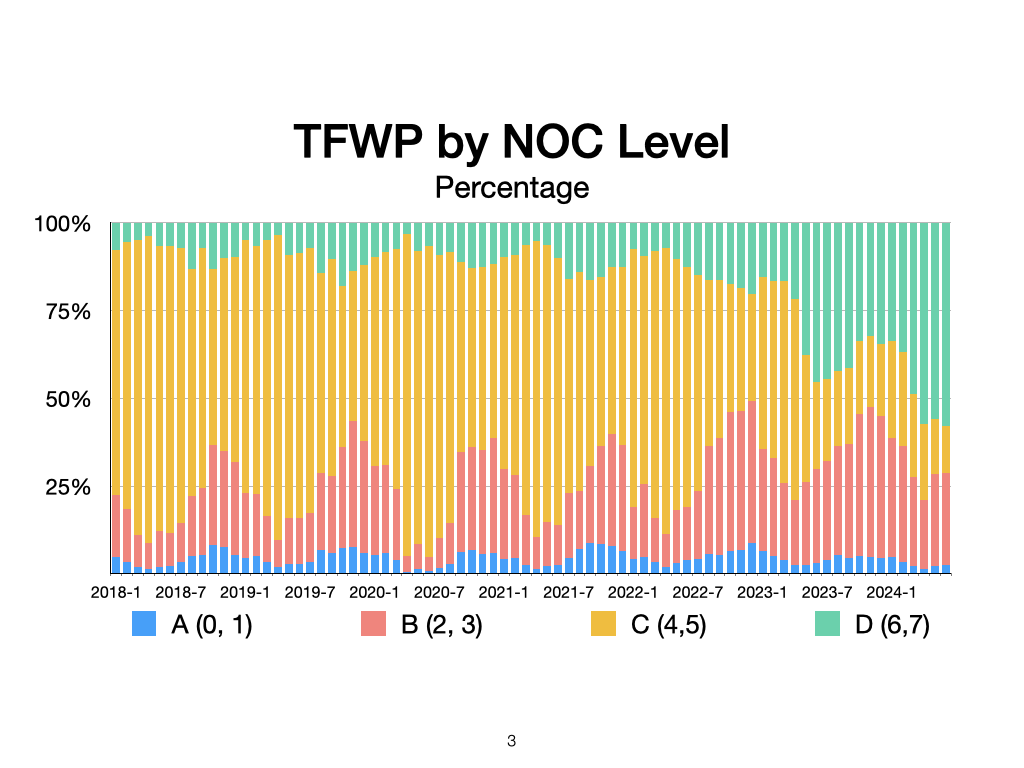
There are four streams: critical impact workers, skilled workers, Express Entry and Yukon Community Program. There are complicated rules categorizing workers and eligibility. For example, “skilled workers” requires the job to be in National Occupation Classification category TEER 0-3; bakers are an example. “Critical impact workers” are in categories TEER 4-5, such as landscapers and retail sales people.

There are also wage restrictions, but they are limited. Employers must pay at least the Yukon minimum wage, and the job’s annual income must exceed Statistics Canada’s Low Income Cut Off. For a single person in 2022, this was $20,333 per year.

The program hit the news recently when the premier put a pause on accepting new applications from employers in Whitehorse, since the territory has already received 590 applications for this year’s 430 spots.

The Yukon government will prioritize existing applications in four waves: work permit holders with approaching expirations, visitor visa holders already in Canada, work permit holders with expirations within a year and workers outside Canada.

An economist would note that these criteria have nothing to do with economic value. A skilled mining engineer in India who would make big bucks and pay lots of taxes would be at the bottom of the list.

Where you stand on all this depends, as the cliché says, on where you sit.

Suppose you own a labour-intensive small business. In this case, the nominee program is critical to keeping wage costs down and finding staff to keep the operation humming. Otherwise, with our labour shortage, wages might have to rise dramatically to attract Canadians already working to leave other jobs and come work for you.

This would eat into profits, and probably require closing some unprofitable locations.

At the other end of the spectrum, workers do not want to be competing with imported labour in the job market.

If you are neither an owner nor a low-wage worker, you probably enjoy the lower prices that low-wage workers enable at shops and restaurants.

In the old days, before left-versus-right economic issues were overshadowed in our politics by culture war conflicts, you might have expected all of this to be a big political issue pitting unions and social justice groups against chambers of commerce.

However, we have a centre-left government in the Yukon, backed by the NDP, running the nominee program. It seems strange to write this, but if a Martian political economist beamed down they would say there appears to be a broad political consensus in the Yukon behind importing hundreds of low-wage workers each year to keep wages at the bottom end of the wage spectrum lower than they would be otherwise, even during a housing shortage.

One reason for this is that the nominee program was overshadowed for many years by Canada’s traditional immigration program. This “points-based” system has broad support and has served the country well. In this system, foreign applicants earn points based on their youth, education, job experience and language skills. It serves to admit immigrants who can contribute quickly and substantially to the economy, even though there are ongoing issues with immigrants getting their skills recognized here.

The use of the nominee program for workers at or just above the minimum-wage level contradicts this logic. People used to talk about it as a temporary fix for episodic labour shortages, but now it is an ongoing feature of our labour market.

Some economists debating Canada’s poor productivity performance have hypothesized that such programs — by boosting the supply of low-wage workers — have disincentivized business investment in labour-saving technology.

I have seen this framed best by Harald Eia, the Norwegian equivalent of comedian-pundit John Oliver. In his segment “Rich and Equal,” Eia compares car washes in Norway and the United States. In Florida, he says, your car is washed by a team of people who are not paid very much. In Norway, you don’t see a human as you tap your card and drive through an automated car wash.

Union agreements cover much more of the economy in Norway than in Canada. Eia says these tend to have high minimum-wage floors, and have for years been pushing Norwegian employers to invest in automation.

Despite this, Norway currently has a lower unemployment rate than the Yukon.

Meanwhile, Germany has made a major revamp of its immigration policy to attract more skilled workers. If your job pays at least $60,300 (Canadian), then a wide range of occupations such as nurses, tech workers, teachers and engineers can be fast tracked. This also applies to recent university graduates who have a job offer above that amount.

If the Yukon Nominee Program switched to this system, the impact would be dramatic. Tax revenues would go up as higher-paid immigrants paid more income tax. Wages would rise at the lower end of the scale, forcing business owners to raise their prices and close some locations.

That kind of change would be too shocking to do all at once. But the Yukon government could raise the floor wages for the program and prioritize applications by economic contribution rather than freezing out nurses and engineers stuck in the government’s low-priority bucket for the rest of the year.

Keith Halliday is a Yukon economist and the winner of the 2022 Canadian Community Newspaper Award for Outstanding Columnist. His most recent book Moonshadows, a Yukon-noir thriller, is available in Yukon bookstores.

Souùrce: Yukonomist: The future of the Yukon’s low-wage immigration program