Proposed Toronto police reforms to ‘carding’ don’t go far enough

An illustration of racial profiling by the Toronto Police, using “contact cards” (no charges were laid) which disproportionately included young black males. And like all monitoring systems, officers who fill out more cards are rewarded more than others who do not, without any analysis of potential bias.

Proposed Toronto police reforms to ‘carding’ don’t go far enough: Editorial | Toronto Star.
Charte des valeurs: Québec songe à exclure la santé

Behind all the official reasons cited, there must be fear of losing qualified personnel. But if an exception for healthcare, why not for daycare or education?

Charte des valeurs: Québec songe à exclure la santé | Denis Lessard | Politique québécoise.

‘Exceedingly political’ libel case pits free speech advocate Ezra Levant against ‘master of lawfare’

Yet another libel case against Ezra Levant for comments he made against a Muslim Canadian lawyer. While I am not a fan of much of Ezra’s commentary (he has a tendency towards “jihad” against anyone who he disagrees with), these kinds of debates and controversies are best handled in the court of public opinion rather than be the courts.

‘Exceedingly political’ libel case pits free speech advocate Ezra Levant against ‘master of lawfare’ | National Post.

Longtime resident seeking citizenship hits bureaucratic wall

Another illustration of just how broken the citizenship program is. Common sense should have prevailed. And why officials don’t think things through and require people to go public. After all, when once they do, the bureaucracy has to move in any case.

Longtime resident seeking citizenship hits bureaucratic wall – British Columbia – CBC News.

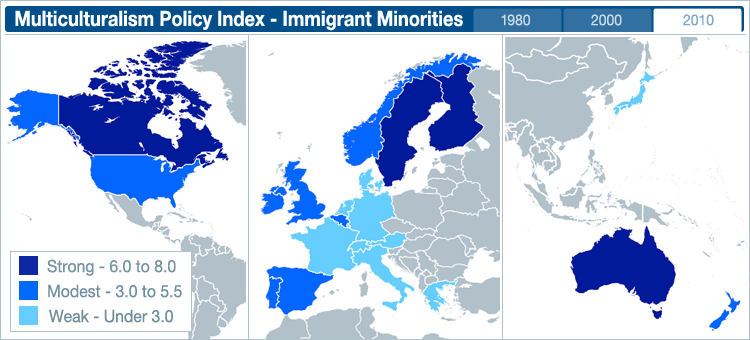
Multiculturalism Policies in Contemporary Democracies

Map2010The comparative work by Keith Banting and Will Kymlicka of Queen’s University. A wealth of detailed and general information in this site.

Expect that Australia’s score will change following the change in government.

Multiculturalism Policies in Contemporary Democracies – Home.

Canadian Muslims encounter increasing hostility

Haroon Siddiqui of The Star on polls showing different levels of distrust for different ethnic and religious communities, similar to the earlier poll posted on BC attitudes (British Columbians grow more wary of other religions, interfaith marriages).

While some of this is normal (negative attitudes tend to prevail regarding more recent communities), the gaps are still startling.

We didn’t have such polls 50 years ago when the minorities that were likely viewed with suspicion included Jewish Canadians, Italian Canadians and the like.

Canadian Muslims encounter increasing hostility: Siddiqui | Toronto Star.

Slow the flow of immigrants into Canada

Martin Collacott on immigrant selection and quantity. Collacott has a point in that there never has been, to my knowledge, an analysis of what should be the appropriate level of immigration to Canada; the government just sticks with the current levels.

The temptation to select immigrants on the basis of their ability to integrate, once one gets beyond the basics of language and professional competencies, becomes subjective all too quickly, and subject to potential abuse, as a history of previous immigration restrictions illustrates.

Guest column: Slow the flow of immigrants into Canada

Embassy Magazine List of Top Reads – Policy Arrogance or Innocent Bias

Made the list (under books for Policy Wonks)!

Policy Arrogance or Innocent Bias: Resetting Citizenship and Multiculturalism

Andrew Griffith

Anar Press

Sept. 8, 2013

This former director general responsible for the federal government’s multiculturalism portfolio gives readers a glimpse into the sometimes uncomfortable gap between public service expertise and ministerial direction. Mr. Griffith says he witnessed a fundamental reset of multiculturalism policies and programs between 2007 and 2011 under Jason Kenney’s direction (who was first secretary of state and then minister responsible for the file). “Given the sharp nature of the policy reset, and the entrenched views of many public servants, this book aims to provide a small case study of how public servants adjusted to the new reality—one in which their expertise was fundamentally challenged, discounted, and at times ignored,” he writes. Mr. Griffith’s book is making waves in the Ottawa bubble.

http://www.embassynews.ca/top-foreign-policy-books/2013/10/09/insightful–international-reads-of-2013/44604?page_requested=1

Sondage Léger – L’appui à la Charte se solidifie

The latest poll. While the numbers are up for the Charter, not clear whether this will translate into a majority PQ government. And on real issues – economy, healthcare, and education – the government is not doing well.

Sondage Léger – L’appui à la Charte se solidifie | Le Devoir.

Identité ou citoyenneté? – Transmettre le sentiment d’appartenance | Le Devoir

Some good reflections on the teaching of history and national narratives, and the risks of being both too critical and not critical enough. Citizenship guides like Discover Canada tend to focus on the positive (but not exclusively); high school history texts may have a more balanced picture:

Trop verser dans l’histoire « glorifiée », afin qu’elle forge ce sentiment identitaire, est aussi risqué. « Il y a aussi un danger de tomber dans une vision nationaliste et de faire dire à l’histoire certaines choses. On peut intéresser les jeunes à l’histoire, et elle aura toujours une part de politique, mais on devrait laisser aux historiens le soin de transmettre l’histoire. Au final, je trouve que c’est aussi grave d’avoir une visée politique que d’avoir une visée cachée dans l’enseignement de l’histoire, qui est celle d’inculquer l’ouverture à l’autre. Pas parce que c’est une mauvaise chose, mais parce que ça peut être fait ailleurs et que l’histoire de l’humanité, c’est l’histoire du bien ET du mal. »

Identité ou citoyenneté? – Transmettre le sentiment d’appartenance | Le Devoir.