Quebec Liberals vow their charter will be based on ‘consensus’

Will be interesting to see the Liberal version of the Charter and how the debate plays out but the fundamental premise, of ensuring this is consensus-based and does not discriminate against religious minorities in government, is welcome. While one can argue regarding the need for such a charter or not, likely necessary to help close the debate given the currents and fears in Quebec regarding accommodation:

“We will legislate on the issue, with the elements that form a consensus and on which we could have already acted,” Mr. Couillard said on Tuesday.

The Liberal charter would include measures to fight religious extremism, force Quebeckers to offer and receive government services with their faces uncovered, and propose a framework to settle demands for religious accommodation.

Liberals vow their charter will be based on ‘consensus’ – The Globe and Mail.

Oath to the Queen ‘repugnant’ to some, appeal court told

Yet another court case on the citizenship oath. I do not expect the plaintiffs to win given that the Crown is more in the institutional sense rather than literal sense (see Philippe Legacé’s The Citizenship Oath and the Nature of the Crown in Canada):

Oath to the Queen ‘repugnant’ to some, appeal court told – Toronto – CBC News.

While a case can be made for changing the oath, as Australia did, better this be done through the political process rather than by the courts.

German cabinet gives go-ahead to dual citizenship | GlobalPost

A significant change for Germany, recognizing the complex realities of people’s lives:

The draft law approved by the government allows young people to opt for two passports if, at the age of 21, they can prove they have lived in Germany for at least eight years, gone to school in the country for six years, gained school-leaving qualifications here or completed vocational training in Germany.

“That’s a great signal for many young people in our country. Hundreds of thousands of them can breathe a sigh of relief,” said Aydan Oezoguz, Germany’s federal commissioner for migration, refugees and integration.

German cabinet gives go-ahead to dual citizenship | GlobalPost.

More commentary on Quebec elections

Starting with Gilles Duceppe, former leader of the Bloq québécois, the sovereignist party that imploded in the 2011 federal election:

Plusieurs parlent déjà de course au leadership, mais cela serait une grave erreur de tenter de choisir un sauveur sans se poser d’importantes questions sur les objectifs du parti, sans définir une stratégie claire et sans se demander si un changement de garde ne s’impose pas en considérant que le PQ a perdu beaucoup d’attrait auprès des jeunes.

Quelques observations au lendemain d’une défaite | Gilles Duceppe.

Justin Trudeau stating the obvious but what some pundits overlook:

En point de presse ce matin à Ottawa, M. Trudeau a soutenu qu’il y aura toujours des Québécois qui prôneront l’option souverainiste. Les fédéralistes feraient donc une erreur de croire que ce mouvement est à l’agonie.

« Il ne faut pas dire cela (que le mouvement souverainiste est mort). Il faut reconnaître qu’il y a des gens qui vont demeurer passionnément souverainistes.  Mais les Québécois se sont exprimés. Même une partie des Québécois souverainistes ont dit qu’ils veulent de la stabilité, qu’ils veulent une économie en santé d’abord et avant tout. J’ai confiance que c’est ce que nous allons avoir pour les prochaines années », a dit M. Trudeau.

Le mouvement souverainiste n’est pas mort, prévient Trudeau

Barbara Kay on the five lessons. Not sure that this is a “triumph” for PM Harper although he, along with other federal leaders, handled it well be staying out and letting the PQ implode on its own. But it is a relief to be spared national unity debates for 4 years, although some issues will continue to arise:

Could it be sweeter that Marois lost her own riding, and that she had to wait to the very last moment to know if she had won or lost, it was that close? Could it be more appropriate that Péladeau should have won his riding, so he has no excuse to walk away from the mess he created, and now must serve his four years with no power and no honour? He hasn’t a hope in hell of being awarded the leadership of the PQ. Gives new depth of meaning to the old saying, “hoist by his own petard.”

Five takeaways from a brutal Parti Québécois defeat

Another “takeaways” piece by Tu Thanh Ha in the Globe:

And in the quasi-referendum campaign that just ended, Quebeckers again sent a clear signal that they didn’t want to hear about the PQ’s raison d’être.

The PQ’s leadership is now open for contest but the problem of such contests is that they start with an audience of the converted, especially in an ideological party like the PQ.

The three pretenders’ eagerness to profess their sovereigntist credentials was necessary, but it struck outsiders as awkward – a reminder of the very reason why some voters are turned off by the PQ.

“The body wasn’t even cold,” veteran TV commentator Jean Lapierre quipped.

 Three reasons the PQ lost, and Couillard’s biggest challenge 

And an interesting eloge on Pauline Marois by Jean-François Lisée, former PQ Minister responsible for Montreal (where the PQ also had disastrous results) which may be tactical as he is one of the contenders to replace Marois:

Alors tu peux prendre tes quartiers de printemps avec le sentiment — non, pas le sentiment, la certitude — du devoir accompli. De la fidélité à tes convictions. Tu laisses derrière toi une équipe formidable. Trente députés que tu as choisis et qui t’ont choisie. Une base militante que tu as reformée et ressoudée. Malgré la défaite: le plus grand parti au Québec avec 90 000 membres et un financement populaire inégalé.

Il y a du ressort, dans cette défaite. Le ressort que tu as mis en nous. Il y aura beaucoup d’introspection à faire, dans les semaines et les mois qui viennent. Il y aura du découragement, des débats, des mauvaises humeurs. Puis le sens des recommencements, des consensus, des choix, de l’action.

Ce ne sera pas facile. Mais si nous avons le centième de ta sagesse et de ton courage, nous franchirons ces étapes en nous nourrissant de l’exemple que tu nous as donné toute ta vie durant.

Repose-toi, Pauline. Très chère Pauline. Tu l’as bien mérité. Nous t’emportons avec nous, tu fais partie de nous, dès maintenant et pour très longtemps.

Perhaps the necessary kind words before the PQ undertakes the serious reflection needed following its lowest share of the popular vote since 1970. And possible self-serving given his role in the campaign and related strategy.

Très chère Pauline

What Tessanne Chin teaches us about diversity

Nice story about the Chinese-Jamaican diaspora in Canada and the richness of identities:

The Chinese diaspora isn’t limited to Jamaica, of course. My cousins come from Trinidad and Dutch Guyana. And anyone who has eaten at a Hakka Indian restaurant in Toronto knows there is a thriving Chinese community in India.

The bottom line is that diversity is a complex, beautiful thing, and you could do worse to have an ambassador like Chin who shrinks cultural boundaries just by opening her mouth.

“My mom always said if you have a gift it is absolutely not about you. So I don’t get twisted and think for one second it’s all about me,” said Chin, nursing a drink in Chang’s expansive kitchen.

What Tessanne Chin teaches us about diversity | Toronto Star.

How politics makes us stupid – Vox

Interesting research on how we make decisions based on our pre-conceptions and our group identity/ideology:

[Yale Law professor Dan] Kahan doesn’t find it strange that we react to threatening information by mobilizing our intellectual artillery to destroy it. He thinks it’s strange that we would expect rational people to do anything else. “Nothing any ordinary member of the public personally believes about the existence, causes, or likely consequences of global warming will affect the risk that climate changes poses to her, or to anyone or anything she cares about,” Kahan writes. “However, if she forms the wrong position on climate change relative to the one that people with whom she has a close affinity — and on whose high regard and support she depends on in myriad ways in her daily life — she could suffer extremely unpleasant consequences, from shunning to the loss of employment.”

Kahan’s research tells us we can’t trust our own reason. How do we reason our way out of that?

Kahan calls this theory Identity-Protective Cognition: “As a way of avoiding dissonance and estrangement from valued groups, individuals subconsciously resist factual information that threatens their defining values.” Elsewhere, he puts it even more pithily: “What we believe about the facts,” he writes, “tells us who we are.” And the most important psychological imperative most of us have in a given day is protecting our idea of who we are, and our relationships with the people we trust and love.

How politics makes us stupid – Vox.

Quebec Election – Initial Reactions

Quite an evening last night, watching the QC election results. Apart from the famous Peladeau raised fist for independence miscalculation, this election hopefully marks the end of divisive identity politics as exemplified in the QC Charter of Values. The gambit clearly did not work in combination with the referendum uncertainty and even Premier Marois’ overall gracious concession speech still played to les Québécois de souche, rather than the more inclusive messages of Couillard and Legault.

Clearly, the PQ needs a period of serious internal reflection and introspection. The leading candidates to replace former Premier Marois will need to get over their Kubler-Ross denial phase quickly (Drainville, Lisée and Peladeau were awful last night preaching to the shrunken PQ base) and it will be interesting to see the how the relative positions of the PQ and the CAQ evolved over the next few years.

I would not go so far as Andrew Coyne or Chantal Hébert as saying the PQ’s raison d’être of independence is completely dead, but it certainly would appear to be on life support.

From Le Devoir, a few articles on the magnitude of the PQ defeat:

À son premier test électoral, le chef libéral a fait des gains dans presque toutes les régions du Québec. Il a peint en rouge toute la ville de Laval et a arraché deux circonscriptions au PQ sur l’île de Montréal, en plus de remporter des sièges dans le Centre-du-Québec et dans la région de Québec, notamment. Le Dr Gaétan Barrette, candidat vedette parachuté contre l’indépendante Fatima Houda-Pepin, a facilement remporté la circonscription de La Pinière, sur la Rive-Sud.

Philippe Couillard met le PQ K.-O.

Avant même que ne commence le dévoilement des votes dans les circonscriptions, plusieurs membres du personnel péquiste concédaient la victoire au Parti libéral. Un consensus se dégageait : la campagne menée par Pauline Marois avait été désastreuse et on se promettait un bilan aussi exhaustif que sévère. Une majorité d’entre eux espéraient à tout le moins une défaite honorable, mais jamais les stratèges, appuyés par des sondages quotidiens faits selon les règles de l’art, n’avaient prévu pareille dégelée.

Catastrophe au Parti québécois

More commentary on the significance of the elections will come in the next few days but for some of the initial commentary:

Au Parti québécois, cette défaite provoquera de douloureux questionnements. La formation fondée par René Lévesque devra remettre en question le virage identitaire pris au cours des dernières années, virage qui, pour des raisons strictement partisanes, a fait un tort considérable au Québec.

Encore plus difficile sera la réflexion sur la raison d’être du PQ, l’indépendance. Quel que soit l’aboutissement de cette introspection, les résultats d’hier devraient inciter les péquistes à abandonner la stratégie de l’équivoque au profit de celle de la clarté.

Les Québécois ont dit NON (André Pratte, La Presse)

And finally, who leads this decimated party? Because the knives are already out. Drainville, Lisée and Péladeau prefixed Marois’s farewell speech with what amounted to stump speeches. This pack of restless egos all come with their own baggage: Péladeau is a capitalist boogeyman who derailed the whole campaign by declaring his sovereignist credentials. Drainville designed and executed the whole charter gambit, then thoroughly bellyflopped. Lisée went along with both, because he thought Péladeau and the charter was the one-two punch that, to paraphrase the title of his own book, would deliver a K.O. to the opposition.

Macleans. (Martin Patriquin)

It is impossible to overstate what a watershed this is. For thirty years after the Quiet Revolution, Quebecers were told the choice before them was either special status, under whatever name, or separation. At times the two were so blurred in definition that each could be made out to be the other. But what was clear was that they weren’t the status quo. They were better, in all sorts of fantastic ways….

But in the years since then, and in particular since the Secession Reference and the Clarity Act, it has slowly been dawning on Quebecers: neither of these choices is actually available. The choice is the status quo or the status quo. The rest of Canada is simply unwilling to make any more constitutional concessions, and wouldn’t be able to deliver them if it did, so tied up in knots has the constitutional amending formula become. Ditto separation: even if the rest of Canada tried to be helpful, the negotiations would go nowhere.

And as that realization has begun to sunk in, another, equally startling, has begun to take hold: The status quo is not so bad. We are not oppressed. We are not impoverished. We are not miserable. As Mr. Couillard said during the campaign, “we are happy in Canada.” What a revelation!

Quebecers have not only just said no to separation, but yes to the 1982 Constitution (Andrew Coyne)

Over the past month, that self-imposed tone-deafness has led to a campaign of false notes, from the second-coming atmosphere that attended the recruitment of media mogul Pierre Karl Péladeau as a star candidate, to Marois’s end-of-campaign mea culpa that she spent too much time entertaining the twin notions of sovereignty and a winning referendum.

One of the PQ’s worst fears has long been that it would turn out to be the party of a single generation.

Over their short time in office, Marois and her team have done much to turn that fear into a self-fulfilling prophecy.

It has long been apparent that the so-called secularism charter that has been the signature initiative of the outgoing government repelled more young Quebecers than it attracted to the secessionist cause.

For the first time in its history, the PQ is more popular among older voters aged 55 and over than among any other age group.

Parti Québécois could be party of a single generation:  Chantal Hébert
Should Toronto’s schools speak one cultural language, or many? | Toronto Star

The usual debate over targeted vs general programming. It starts with having information regarding which communities are struggling, and then developing appropriate supports. When such programs complement regular school programming, these can address the problems while not “ghettoizing”. Separate schools for ethnic and other groups, on the other hand, do not foster integration.

Canada’s award-winning mentoring program Pathways to Education has helped wrestle dropout rates to the ground in 15 of the country’s poorest communities by offering scholarships, tutoring and mentoring to entire neighborhoods — not the ethnic groups within them, said Vivian Prokop, president of Pathways Canada. Still, she noted there are different challenges when working with new immigrants, with aboriginal students and with home-grown “generational poverty.”

“The barriers to education vary based on a child’s postal code, and we don’t want to label or segregate students into ethnic groups,” said Prokop. “We offer wraparound supports — deep intervention — to the whole community.”

Jo-Ann Davis, the chair of Toronto’s Catholic board, believes you can serve specific groups without fuelling stereotypes. “We want kids to do well, and I believe cultural background is very important and has to be honoured. “We’re trying to bring those voices to the centre of the conversation, even though the practices will be different.”

Professor Carl James, who teaches urban diversity at York University’s faculty of education, said he’s not worried about giving extra help to certain ethnic groups as long as they don’t forget they’re part of a larger society.

“It might build the confidence and knowledge needed to feel more comfortable going into the larger community,” he said. “Whatever we are as a country is a combination of all of us.”

Should Toronto’s schools speak one cultural language, or many? | Toronto Star.

Bruce Springsteen, Trevor Phillips and when a cluster becomes a ghetto | UK news | The Guardian

Hugh Muir on the distinction between “benign clustering”, part of the normal lives we lead, and ghettoization:

Relating his experience as part of Mapping Integration, a new project by the think tank Demos, Phillips called it “benign clustering”. We tend to look askance at events or spaces that exhibit monoculture – because many people still embrace multiculturalism, and even those who don’t insist they crave a culture shared by all. But, through background, tradition, we occasionally make choices that draw those of a similar background together in one place. That’s no bad thing, Phillips says, so long as there is no barrier or prescription to integration. “We can survive this kind of benign clustering,” he writes. “What we do with our own time, and who we do it with should have no impact on public policy.”

And yet he is also right to differentiate, for when the clustering occurs in other spheres, people get nervous. When monocultural clustering newly impacts on a neighbourhood or a school, we talk of segregation, of ghettoisation and feel we are losing one of the elements that make community relations less fraught than they are in countries such as the US. We readily accept that the motives for clustering around Springsteen at Wembley are harmless, whereas those that drive others towards residential clusters in Bradford or religious free schools in Tower Hamlets are troubling. One presents as celebration, the other as rejection. I fall into this trap myself; but then I was raised in a mixed London suburb. That’s my default position. There’s more to this than logic.

Bruce Springsteen, Trevor Phillips and when a cluster becomes a ghetto | UK news | The Guardian.

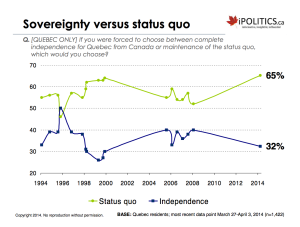
Quebec Liberals holding lead as Quebecers turn their backs on sovereignty — and on Canada | iPolitics

EkosFrank Graves of Ekos on the Quebec election and attitudes towards Canada and independence:

More interesting, however, is the surprising triumph of the status quo. In a forced-choice exercise, respondents were asked whether they would prefer to pursue complete political independence or leave things the way they are now. By a two-to-one margin, Quebec residents said they prefer the status quo.

In emotional and symbolic terms, Quebec has already left the building. Quebecers seem content with this achievement and they have little appetite for taking on the risks associated with complete independence.

Quebec Liberals holding lead as Quebecers turn their backs on sovereignty — and on Canada | iPolitics.

Suggests that while “independence is dead” in the short-to-medium term, the lack of attachment to Canada remains an issue. While the PQ will have to undergo a fundamental rethink should it be defeated today, as appears likely, I would be more cautious than some of the pundits who are saying that the PQ’s project is gone forever.