The case of the disappearing Statistics Canada data

Good piece on Statistics Canada and the impact of some of the changes made to reduce long-standing data series:

Last year, Stephen Gordon railed against StatsCan’s attention deficit disorder, and its habit of arbitrarily terminating long-standing series and replacing them with new data that are not easily comparable.

For what appears to be no reason whatsover, StatsCan has taken a data table that went back to 1991 and split it up into two tables that span 1991-2001 and 2001-present. Even worse, the older data have been tossed into the vast and rapidly expanding swamp of terminated data tables that threatens to swallow the entire CANSIM site. A few months ago, someone looking for SEPH wage data would get the whole series. Now, you’ll get data going back to 2001 and have to already know StatsCan won’t tell you that there are older data hidden behind the “Beware of the Leopard” sign.…

Statistics Canada must be the only statistical agency in the world where the average length of a data series gets shorter with the passage of time. Its habit of killing off time series, replacing them with new, “improved” definitions and not revising the old numbers is a continual source of frustration to Canadian macroeconomists.

Others are keeping tabs on the vanishing data. The Canadian Social Research Newsletter for March 2 referred to the cuts as the CANSIM Crash Diet and tallied some of the terminations:

  • For the category “Aboriginal peoples” : 4 tables terminated out of a total of 7
  • For the category “Children and youth” : 89 tables terminated out of a total of 130
  • For the category “Families, households and housing” : 67 tables terminated out of a total of 112
  • For the category “Government” : 62 tables terminated out of a total of 141
  • For the category “Income, pensions, spending and wealth” : 41 tables terminated out of a total of 167
  • For the category “Seniors” : 13 tables terminated out of a total of 30

As far as Statistics Canada’s troubles go, this will never get the same level of attention as the mystery of the 200 jobs. But, as it relates to the long-term reliability of Canadian data, it’s just as serious.

Given my work using NHS data, particularly ethnic origin, visible minority and religions, linked to social and economic outcomes, still in the exploration stage of what data and linkages are available – or not.
The case of the disappearing Statistics Canada data

Quebec Jewish community disturbed by lack of outrage over columnist’s ‘anti-Semitic’ radio rant

Pretty outrageous and crossing the boundary line between criticism and antisemitism:

Gilles Proulx was invited onto Montreal’s Radio X last Friday after writing a column in the Journal de Montréal on the Israel-Hamas conflict. “No need to be an expert to say that Israel could make Washington, Paris or Ottawa bend, knowing in advance that its diaspora, well established, will make any government submit!” he wrote in the Journal.

Speaking to Radio X, he elaborated on his thinking, suggesting Jews historically provoke hate and persecution. “The diaspora is scattered around the world, where they take economic control, provoke the hatred of local nations, whether it is in Spain, for example, with the Inquisition, or again later with Adolf Hitler,” he said.

Later he added: “The diasporas are so powerful in Paris, New York, Toronto or in Ottawa or Montreal, that they can manipulate the government through their opinions, their threats, their pressure, making it a marionette.” The show’s host never challenged Mr. Proulx’s remarks.

Mr. Proulx has a long history of incendiary comments, going back as far as the 1990 Oka crisis when his anti-aboriginal rants were blamed for drawing a mob that hurled rocks at a convoy of Mohawk women, children and elderly leaving the Kahnawake reserve.

….Neither Mr. Proulx nor Radio X responded to a request for comment. CBC  [error should be RDI] spokesman Marc Pichette denied that the July 14 phone-in show identified by the CIJA was intolerant.

“RDI managers do not consider that it could be deemed anti-Semitic, even if some of the numerous comments expressed in the show were highly critical of Israel’s bombing of the Gaza strip, drawing a parallel with Nazi Germany,” he said. “Other callers were in agreement with the Canadian government’s unequivocal support of Israel’s right to defend itself.”

Quebec Jewish community disturbed by lack of outrage over columnist’s ‘anti-Semitic’ radio rant

The oath to the Queen is constitutional – as is changing it – Globe Editorial

Globe Editorial on the recent court ruling on the citizenship oath (ruling itself not surprising):

The oath – which is a constitutional requirement for MPs, and a legal obligation for new citizens and many officials within our system of government and justice – is a pledge to respect the deepest and highest principles of Canada’s Constitution. And those principles include the right to freedom of belief and conscience, democratic participation and the working of change by peaceful and democratic means. The constitutional order is strong and supple enough that, from 1993 to 1997, Her Majesty’s Loyal Opposition was a party dedicated to dismembering the country. Yet Bloc Québécois MPs could take the oath to the Queen and, simultaneously and in good conscience, call for the removal of Quebec from Canada. In taking their oath, they were pledging allegiance to the democratic and legal processes of our constitutional order – not to the person or beliefs of the sovereign.

Want a constitutional monarchy with, say, the governor-general as the head of state? An elected head of state? No head of state? Want to write the Queen out of the oath, or get rid of all oaths? You can take the oath to the Queen, and then work for that. To do so will not offend the Queen, the law or the Constitution. Working through violent or illegal means would be a failure to bear true allegiance, as promised in the oath. But to advocate legally, non-violently and democratically for a change in Canada’s laws or system of government, including even the abolition of the monarchy? To do so would respect the Constitution that the monarchy represents.

Having spent years pushing their case against the monarchy through the courts, the complainants have become the embodiment of our Constitution’s inherent reasonableness. In Canada, it is not just possible to take an oath to the Queen and oppose the existence of the monarchy. Being able to do so is a fundamental right. It is the whole point of our constitutional order.

Should the oath to the Queen be rewritten? The Constitution, like the oath itself, neither demands nor forbids it. It leaves that question to the only people qualified to decide: Canadians and their democratically elected governments.

The oath to the Queen is constitutional – as is changing it – The Globe and Mail.

The related news story:

The three longtime permanent residents had argued before the Ontario Court of Appeal that they oppose the oath on religious or conscientious grounds, arguing the requirement was discriminatory and unjust.

“The purpose of the oath is not to compel expression,” wrote Justice Karen Weiler. “But to obtain a commitment to our form of government from those writing to become Canadian citizens. If there is a violation of the appellants rights to freedom of expression, it is justified.”

Oath to the Queen upheld by Ontario Court of Appeal – Toronto – CBC News.

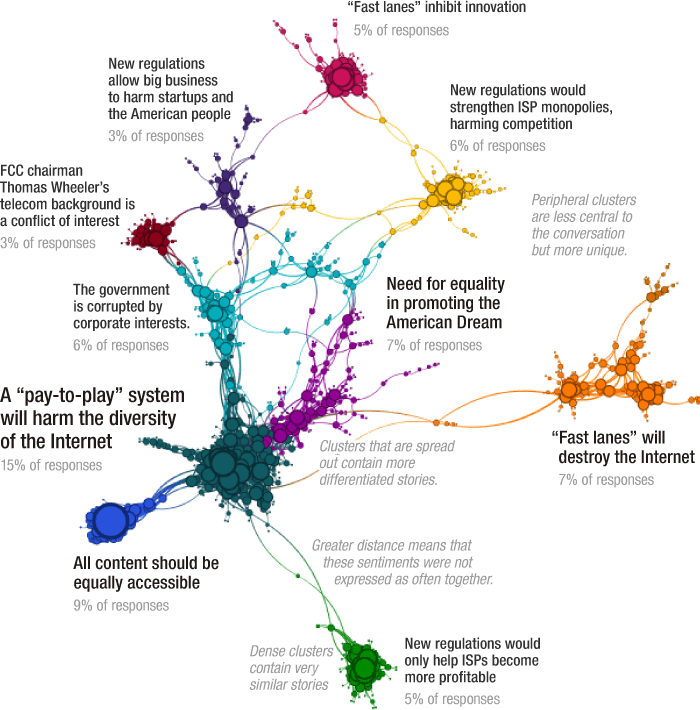
Neat Data Visualization: Net Neutrality

gr-neutrality-comments-624A good visualization that helps one understand relationships and relative weight of comments.

A Fascinating Look Inside Those 1.1 Million Open-Internet Comments 

Sponsored travel helping Israel win over Canadian MPs

Good piece in iPolitics on the influence of sponsored travel, focussing on Israel but not unique (i.e., Taiwan):

Independent MP Brent Rathgeber says he enthusiastically accepted the chance to visit Israel when he was invited in 2010.

“It was a fascinating trip. It was a great trip. I learned a great deal on all aspects of it. I grew up in a Christian home and it was fascinating to visit the holy sites.”

Rathgeber says the trips deliver value for the CIJA and could be having an effect on the reaction of Canada’s MPs to the current conflict.

“The sponsors of these trips, although in fairness they try to provide some balance on the conflict, obviously have a goal in mind in the education that they provide by taking you there. So, I am not surprised that all of the major parties seem to have a certain perspective with respect to this ongoing conflict in Gaza.”

Norman Spector, a former Canadian ambassador to Israel, is among those who have met with MPs on trips sponsored at the time by the Canada Israel Committee.

Spector said he also set up meetings and tours for MPs when he was ambassador but his tours included elements he suspects the CIJA tours are lacking – like a wide range of Palestinian views including members of Hamas before it was declared a terrorist organization and some of the far right voices in Israel.

“I doubt that many MPs have been taken on these missions to a refugee camp in Nablus or if any has seen raw sewage flowing at Jabalya camp in Gaza.”

Sponsored travel helping Israel win over Canadian MPs. (pay wall)

Apple Is Mostly White and Male, According to Its First Diversity Report

Hitech diversityNo surprise and in line with its competitors as above graphic shows (although its ads generally portray diversity well):

Apple, the latest tech company to reveal its workforce demographics, said Tuesday that its U.S. staff is 55% white, 15% Asian, 11% Hispanic and 7% black. Two percent of workers are multiracial, and another 9% did not declare their race.

In regards to gender, Apple’s global workforce is 70% male and 30% female. Within tech-related jobs specifically, the disparity is 80% male and 20% female.

Apple’s employee demographic trends are similar to those of other major tech companies, several of whom, like Google, Facebook and Twitter, have also recently released diversity reports. Like the other firms, Apple included in its report a public commitment to increase the diversity of its workforce.

“As CEO, I’m not satisfied with the numbers on this page,” Apple head Tim Cook said in a letter accompanying the figures. “We are making progress, and we’re committed to being as innovative in advancing diversity as we are in developing our products.”

In addition to race and gender, Cook said that Apple celebrates other types of diversity, such as people with disabilities as well as varying sexual orientations.

Time Magazine.

Statistics Canada rushing to redo July job numbers

More bad news re StatsCan regarding its having to redo job numbers:

The incident will add fuel to a continuing debate over the quality of the federal government’s labour market data, which, economists contend, has generally been more volatile in recent years.

Peter Buchanan, senior economist with CIBC World Markets, said the error reinforces the fact that markets and policy makers need reliable information.

“Obviously, this does add to concerns on that front,” he said. “Good data is essential to steer the economic ship in the right direction.”

Federal departments – including Finance Canada – have recently used alternative private sector surveys based on Internet job postings to produce job vacancy statistics. That approach led to criticism after the Parliamentary Budget Officer pointed out that the government’s claim of rising job vacancies was almost entirely due to methodological problems associated with using job postings on the classified site Kijiji.

Partly as a response to that criticism, the government announced in June that it would give Statistics Canada an additional $14-million a year starting next year to produce a new job vacancy survey and a new survey on wages.

One of my doctors commented, regarding the cancellation of the Census, that  “there is nothing more costly than ignorance.” The government is paying the price for not having valued good quality data and statistics.

Statistics Canada rushing to redo July job numbers – The Globe and Mail.

Kuwait citizenship row a risk for business, too

Vignette from the Gulf and the Kuwaiti approach to citizenship and revocation. Given the large number of expatriate workers, both lower and higher skilled in the region, all states there have restrictive citizenship rights and depend largely on guest workers.

The Canadian government did not cite Kuwait as one of its models for revocation (Canada does, unlike recent UK measures, have an exception for those who would be left stateless):

Nationality has long been a fraught subject in Kuwait, home to an estimated 100,000 stateless individuals. The country’s so-called bidoon from the Arabic word for without, or stateless persons are unable to find legal work or access social services; some find odd jobs on the black market but most live in abject poverty. Many were born in Kuwait and claim that their parents – bedouins or members of other nomadic communities – were not able or aware that they needed to register to obtain citizenship when Kuwait became independent. While the government admits some of these residents deserve citizenship, it says others have arrived from third countries in hopes of accessing the country’s generous welfare system.

The creation of a new stateless class could complicate things further. None of the individuals who have lost their passports so far have other nationalities, meaning they have effectively joined the ranks for the bidoon.

Kuwait citizenship row a risk for business, too / 08 / 2014 / Insights / Home – Monitor Global Outlook | A Premium Service of The Christian Science Monitor.

New Canadian Media Crowdfunding Campaign

As regular readers of this blog know, I contribute regularly to New Canadian Media.

Given the financial realities of publishing and being a start-up, NCM has launched a crowd funding campaign with FundRazr, with the following message:

New Canadian Media is Canada’s premier website dedicated to bringing news and views from an immigrant perspective – bringing you original content from an immigrant perspective.

Established as a non-profit in 2012, we are proudly pioneering a new pan-Canadian form of immigrant journalism founded on the premise that all Canadians need to know what’s on the minds of immigrants … so we can all have a better conversation. If you haven’t already, take a look at our site, and see how we are changing the national conversation

At this time, we need your help to continue producing great multimedia content. Every dollar you donate will go towards content: great content that makes a difference to our national conversation and the digital technology that enables this great content to be accessible, responsive, and easy-to-view.

Help champion NCM’s pioneering journalism.

While I have no financial interest, it is somewhat self-interested of me to support this campaign.

Please take a look at their site and stories and, if you like what you see, please consider making a contribution.

Andrew

Retirement home a tribute to a generation of Vietnamese

An increasingly common trend, retirement homes for specific communities, given language and food issues, among others:

Almost four decades ago, the first Vietnamese refugees began arriving in Toronto, traumatized and penniless, following the Communist takeover of South Vietnam.

Today, many of those refugees are aging, including about 100 living in nursing homes scattered across the GTA.

As a community volunteer, Thanhnha Nguyen often visits elderly Vietnamese in those homes. She will never forget one woman — the only Vietnamese resident in one of the largest nursing homes in the GTA.

Like many Vietnamese of that generation, the tiny woman spoke no English. Unable to eat the pasta and meat-based meals that the home provided, she weighed only about 90 pounds. “She was just bones and skin,” recalls Thanhnha.

Many Vietnamese seniors feel like outsiders in these retirement homes, says Thanhnha, but for this particular woman the sense of isolation was so devastating that she had tried to end her life.

Thanhnha recalls asking the elderly woman why her face was so pale and blue. “She told me she had tried to bang her head against the wall to try to kill herself,” says Thanhnha.

For Thanhnha, it was a turning point. “That’s when I said, we have to do something for our community — for our parents.”

Retirement home a tribute to a generation of Vietnamese – Toronto – CBC News.