Roger Cohen Sees Hitler In The Desert « The Dish

The debate between Andrew Sullivan and Roger Cohen, starting with Sullivan:

Well, we all see mirages, I guess. But it says something about the hysteria about the latest incarnation of the Sunni insurgency in Iraq that we’re suddenly comparing them to Nazis and to non-humans. Even as Cohen himself acknowledges that “the Nazi death machine was unique. Facile invocation of it is too frequent, belittling the phenomenon and its victims.

”So why break Godwin’s Law so egregiously? Cohen wants us to believe, channeling Martin Amis and Primo Levi, that there was no “why” in the unconscionable unique act of the Holocaust.

And yet, mountains of evidence explain exactly why: it was a function of a vile racism that regarded the Jewish people as vermin that needed to be exterminated in order to allow the master race to flourish. It was not some random act of mass murder; it had a grotesque but clear and constantly trumpeted rationale. Then Cohen seems to endorse the idea that the Nazis were somehow unhumans or “counter-humans”, in Levi’s words. But that too, it seems to me, lets them off the hook. The Holocaust was a deeply human act – a function of humankind’s capacity, revealed throughout history, of extraordinary levels of hatred and violence, brought to new and unfathomable evil in the age of the industrialized state.

And equally, it is absurd to argue that “there is no why to the barbarism of ISIS.”This is after Cohen actually produces a long litany of reasons for ISIS’s brutality and evil, mind you, none of which he deems sufficient to explain the ISIS propaganda beheadings he watched on video. But why should we not take the Islamists’ word for it? They are committing slaughter and rape and attempted genocide for one core reason: because God demands that they slaughter infidels. Their mandate is beyond any human one but results in so-very-human evil.

Roger Cohen Sees Hitler In The Desert « The Dish.

From Cohen:

It is human to seek for reasons. Perhaps the rise of ISIS may be seen as the culmination of decades of Arab resentment at perceived Western domination, drawing support from the same anger as the Muslim Brotherhood and al-Qaeda before it; or as an expression of the abject failure of Arab societies; or as an armed Sunni response to the Shia-bolstering American invasion of Iraq; or as brutal payback for Abu Ghraib and Guantánamo (where, it must be said, there was scant “why” for prisoners detained for years and guilty of no crime); or as a well-funded offshoot of Saudi Wahhabism interpreted in its most literal form; or as a heady alternative for disaffected young Muslims to the moral void of Western civilization; or as evidence of the crisis of Islam and the inevitable Thirty Years War of its Sunni and Shia branches; or simply as a call to arms to drive out the United States the way the infidel Crusaders were ousted from the Levant.

Yet, in the end, there is no why to the barbarism of ISIS. There is no why in Raqqa. Evil may adduce reasons; they fall short. The Nazi death machine was unique. Facile invocation of it is too frequent, belittling the phenomenon and its victims. But I was given pause by Martin Amis’ afterword to his powerful new novel, The Zone of Interest, where he probes the “why” of Hitler and quotes both the icicle passage and another from Levi:

“Perhaps one cannot, what is more one must not, understand what happened, because to understand is almost to justify. Let me explain: ‘Understanding’ a proposal or human behavior means to ‘contain’ it, contain its author, put oneself in his place, identify with him.” Levi, referring to Hitler, Himmler and the rest, goes on: “Perhaps it is desirable that their words (and also, unfortunately, their deeds) cannot be comprehensible to us. They are non-human words and deeds, really counter-human.”

Roger Cohen: For ISIS, slaughter is an end in itself

New Chinese centre to encourage multiculturalism, AsiaOne Singapore News

From Singapore which has traditionally, if memory serves me correctly, had a fairly active approach to managing relations among the various communities, including parallel institutions and where people live.

Appreciate any comments either confirming or correcting.

But some signs of more integration as we would understand it:

Performances at the upcoming Singapore Chinese Cultural Centre in Shenton Way will include collaborations with non-Chinese arts groups, said its chief executive Choo Thiam Siew.

For instance, non-Chinese musicians could be invited to play for say, a Chinese dance, he said, adding: “Chinese flautists already play together with Indian tabla musicians.”

Mr Choo was elaborating on the vision that the centres chairman Chua Thian Poh outlined at the buildings ground-breaking ceremony yesterday. The event was officiated by Prime Minister Lee Hsien Loong, who is the centres patron.

The 11-storey centre, Mr Chua said, will “encourage integration among all races in Singapore”.

New Chinese centre to encourage multiculturalism, AsiaOne Singapore News.

Extremist ‘foreign fighters’ may threaten Canada: U.S. top official | Ottawa Citizen

Short reference to outreach programs during the visit of the head of Homeland Secruity,  Jeh Johnson:

Johnson said that in addition to a military mission to crush ISIL in the Middle East, and an intelligence strategy to track foreign fighters, the U.S. is conducting an “outreach” program in U.S. Islamic communities. That program is designed to prevent people from being fooled into recruitment by ISIL’s “slick” propaganda.

“ISIL is a stateless group of depraved criminals —rapists, kidnappers, killers and terrorists who control a territory,” he said. “There is no religion, including Islam and there is no God, including Allah, that would condone ISIL’s violent tactics.”

Extremist ‘foreign fighters’ may threaten Canada: U.S. top official | Ottawa Citizen.

Lorne Gunter, true to form in the Toronto Sun, rails against political correctness in describing ISIS as not Islamic, and implicitly casting a slur on all Muslims as well as political leaders:

Western civilization won’t be defeated by economic collapse or government debt, by an external military force or even its own internal decadence. But it could well be done in by political correctness.

It’s bad enough that U.S. President Barack Obama could stand bare-faced in front of his nation two weeks ago and insist the Islamic State terror group “is not Islamic.”

Huh!? Islam is in their name and behind every murderous, brutal, barbarous act ISIS commits.

There are imams and Muslim scholars who would argue that ISIS is, in fact, the very epitome of Islamic faith put into action. It is possible to debate that those Muslim leaders and ISIS itself are wrong in their interpretation of Islam.

But to insist to the world that ISIS “is not Islamic” is the equivalent of standing in front of a red wall and insisting it is green. It is contrary to what is plainly, clearly, obviously true.

Not sure what I am missing but there seems to be a lot, understandably, talk about Islam-inspired extremism and fanaticism these days.

Why can’t we talk about Muslim fanatics?

Cancer survivors income falls $5K a year, StatsCan finds

Not surprising, and mirrors my experience, although I benefitted from good government employee benefits that helped those with catastrophic illness (the government planning to roll these back).

While in the end, my particularly aggressive form of cancer made returning to work a non-starter, most people following cancer diagnosis and treatment of any kind also tend to shift their priorities towards family and friends, with career advancement becoming secondary.

While I wouldn’t go so far as the Canadian Cancer Society – we often make choices between income and other priorities – there is need to examine whether we have the right balance between benefits for those with catastrophic illness and the overall cost to governments and employers:

On average, cancer survivors earned $5,079, or 12.1 per cent, less one year after diagnosis than their counterparts who were never diagnosed with the disease. Cancer lowered the probability of working in the first year after diagnosis by three percentage points on average compared with the other group in the sample.

The effects continued but lessened in the second and third years after diagnosis.

Employees may work fewer hours after cancer treatment as they recover. Others may switch jobs to something less stressful and perhaps lower paying.

“We find cancer patients are forced into situations where they have to choose between their treatment or their income, and thats not acceptable,” said Lauren Dobson-Hughes of the Canadian Cancer Society.

The society would like to see an increase in sickness benefits beyond 15 weeks and an increase in the amount thats provided beyond 55 per cent of salary. Theres also currently a two-week waiting period for EI, which Dobson-Hughes said isnt sustainable for many patients.

Cancer survivors income falls $5K a year, StatsCan finds – Health – CBC News.

Mo3 and the risky idealism of youth: Salutin | Toronto Star

Rick Salutin on the one-sided language and focus on revocation and similar measures, rather than helping families and communities on prevention:

But ensuring decent options isn’t a task that parents can take on alone. It’s for all of society, especially its leaders. And believe me, pious denunciations of evil at the UN, by leaders with their own hideous, ongoing records to be ashamed of, won’t cut it with the young. I have that on vivid recall.

This week an Alberta leader of Somali Canadians asked the Harper government to expand outreach programs for youth. Their only response was a promise to protect “law-abiding Canadian families” by stripping citizenship under their new law for “dual-nationals who engage in terrorism.”

Well, these are law-abiding Canadian families whose kids are at risk and any criminal acts, including treason, can be dealt with already. All revoking citizenship does is dehumanize its targets, since citizenship is a human right. Do we really want Stephen Harper or Chris Alexander to decide who counts as human and who to exclude as monsters? This is sheer incitement of more anger and alienation. I’m against revoking anyone’s citizenship but if you were going to do it for encouraging radical, violent behaviour, you’d start with these official, elected provocateurs.

Mo3 and the risky idealism of youth: Salutin | Toronto Star.

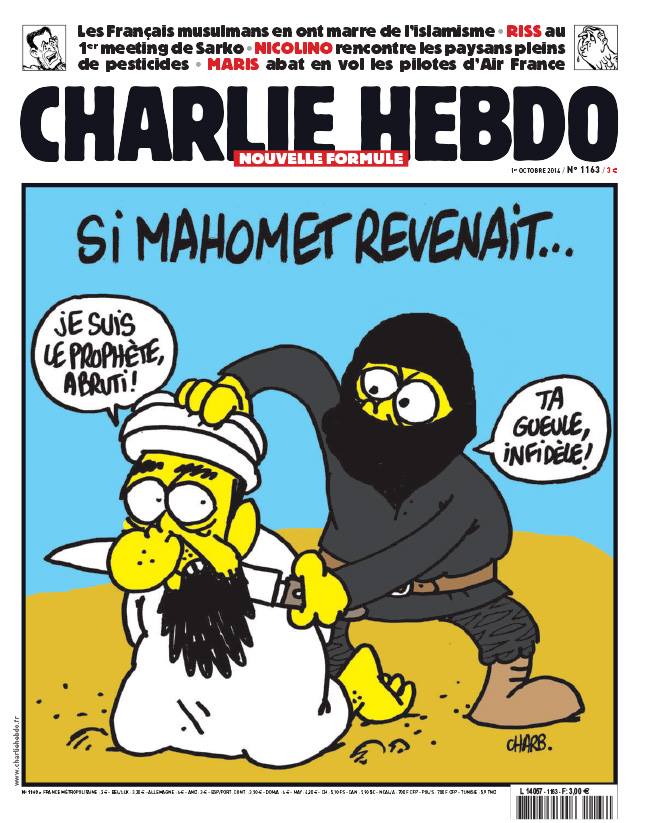
Charlie Hebdo on ISIS

Wonderful cartoon.

Arun's avatarArun with a View

charlie hebdo no1163 011014

Voilà the cover of the latest issue of Charlie Hebdo, which will hit the newsstands tomorrow (October 1st). For those whose French is not up to par, it reads:

IF MOHAMMED WERE TO RETURN…

“I’m the Prophet, idiot!”

“STFU, infidel!”

Charlie Hebdo nails it. Totally.

Somehow I think security will be reinforced outside Charlie Hebdo’s office in the 11th arrondissement.

ADDENDUM: For other irreverent CH covers I’ve posted on, go here, here, here, and here.

View original post

Adrienne Clarkson on the anguish of not belonging

Adrienne Clarkson on citizenship in her Massey Lectures this fall. Worth reading and reflecting upon:

It was in attending public school that I truly felt a sense of place in this country. Still today I believe that a public education is the single most valuable institution that our society provides to help people belong. If we are going to continue to accommodate newcomers into society, we must continue to have well-funded public education—education paid for by the state, free for all citizens. This has been key to our success ever since our humble beginnings. Without public education, we cannot have a cohesive society, a society with shared values. Without public education, we cannot continue to fulfill the public good—that is, the internationalization and the continuation of our key notions and values from one generation to the next. We can do all of this only in a democratic structure, where all children are treated as equal, regardless of income. That is how people really learn to belong. That is what public education does. We want people who will take their place in our society, but that means we must make sure there are no barriers to inclusion for people who come here.

So belonging is essential to us in Canada. We select our immigrants with the idea that they will become citizens. Immigrants are future citizens, and we recognize them as citizens in the making. As Aristotle said in Physics, “With respect to what is eternal, there is no difference between being possible and being.” New citizens take on the same responsibilities as existing citizens: obeying laws, paying taxes, voting. And once a new citizen is adopted into the family of fellow citizens, he must accept the good with the bad, both past and present, in order to contribute to and help shape the future. Canada is the land of our ancestors, as it says in our national anthem, and we are each and every one of us adopted by those ancestors. Newcomers are not invited to this country to spend a few years working, only to depart like migrants. Migrant is a very ugly word, and it should have no place in the Canadian vocabulary. Immigrant is the Canadian word. And citizenship is central to our immigration policy.

I truly believe that you can find a place to belong, as long as there is a negligible amount of force against you. I was lucky to come to this country, where we operate in an atmosphere of benevolent neglect: We are left alone to get on with our lives. This is where perseverance and generosity come in. Canadians are generous, even when they don’t know it. To me, this flexibility is the generosity that leads to gross national happiness, because it allows people to persevere through hard times and come out on the other side.

Refreshing recognition and advocacy of the efficacy and value of the more flexible, accommodative approach than the desire for more narrow and prescriptive Cartesian clarity.

Adrienne Clarkson on the anguish of not belonging.

Robert Cushman: No, the feminists didn’t ruin English

For those interested in language, writing and debates over feminism, good piece, if a bit meandering, by Robert Cushman, taking down the arguments of David Gelernter on the use of he or she and equivalents, starting with yet another good Orwell quote:

George Orwell, another model author, once compiled his own list of rules for good clear writing; it culminated in the admonition to break any of his preceding instructions “rather than write something outright barbarous.” Which means that these things have to be approached case by case, to be judged by the eye and especially the ear.

I can’t understand, for example, why Gelernter should object to “firefighter” replacing “fireman”; it may have an extra syllable, but it’s still a more active and descriptive word.

Well, no, I can understand; he thinks that the change is the result of caving in to those New Feminists. For him, as for others, feminism is a word applied to anything that its employer dislikes or feels threatened by, a sort of all-purpose Bogeyman. (Or should that be Bogeywoman? The professor certainly wouldn’t countenance Bogeyperson; and neither, for the record, would I.) I can’t see why a female member of a fire brigade should put up with being referred to as a fire man. And neither side would welcome ”firewoman,” which just sounds silly (though “policewoman,” for whatever reason, doesn’t).

…. It’s likely true that students today enter university less equipped to write well than were their predecessors. But that isn’t the fault of feminism. It’s because both English language and English literature are taught less, and possibly less well, than they used to be; and because of the pervasive sloppiness of communication that underlies the abuses I noted in my opening paragraphs, none of which have anything to do with gender.

Gelernter puts it all down to “ideology,” another of those words that merely means something that its user disagrees with. It’s like “elite,” a term that the Left used to hurl at the Right, that the Right now throws at the Left, and that is equally meaningless either way. He begins his article by inveighing against the words “chairperson” and “humankind.” I think that the first is an abomination and the second quite unobjectionable, and my reasons in both cases are aesthetic, not ideological.

It’s true, as Gelernter says, that what any writer agonizes over while actually writing is where the next word is coming from. But those words aren’t chosen in a vacuum; they’re the expression of whatever idea the writer is trying to convey: of, if you insist, his ideology.

Yes, I said his ideology. Because, judging from this article, Professor Gelernter is quite the ideologue himself.

Robert Cushman: No, the feminists didn’t ruin English

Newcomers settling in smaller Sask. communities

Not many articles about the increased diversification of settlement patterns, although the numbers are still small in an absolute sense:

Counterbalancing the drawbacks, though, are benefits of small towns and rural areas – outside of employment – that are keeping their immigrant retention rates high.

Largely, it comes down to the idea of small-town, friendly Saskatchewan, said McLean. She mentioned how church groups in Prince Albert have been overwhelmingly welcoming of newcomers.

Employers have also gone out of their way to encourage retention by helping their employees settle in and integrate, said Kapeller. She spoke of employers driving car-less workers to appointments, helping out with grocery shopping, and lending a hand in registering children for school.

Palmer added that in smaller areas, immigrants tend to get more immersed in the community as a whole instead of getting swallowed by the already established, nationality based newcomer communities in larger cities

The results of the two-day summit, the first of a series of provincial events across the country, will inform regional and national priorities for the CIC going forward.

Newcomers settling in smaller Sask. communities.