U.S. Is Trying to Counter ISIS’ Efforts to Lure Alienated Young Muslims – NYTimes.com

Good piece in the NY Times about US Government efforts to engage American Muslims in countering extremism, with some of the same issues that likely arise in Canada. The last line captures the conundrum:

American officials have been able to identify Americans fighting for the Islamic State or other Syrian rebel groups based on intelligence gathered from travel records, family members, intercepted electronic communications, social media postings and surveillance of Americans overseas who had expressed interest in going to Syria, counterterrorism officials said.

But efforts at countering violent extremism, especially at home, “have lagged badly behind other counterterrorism pillars,” said Michael Leiter, a former director of the National Counterterrorism Center. “It is heartening to see the administration attempt to invigorate those efforts, but it is unfortunate that it has, despite the efforts of many, been so long in coming.”

Government supporters question whether funds will be available to sustain these programs. “The administration has the right framework for doing this, but long-term success will depend on sustainable resourcing to help local government, communities and law enforcement build initiatives that can have impact,” said Quintan Wiktorowicz, a former senior White House aide who was one of the principal architects of the current strategy.

That strategy here at home, called countering violent extremism, has proved much more difficult for American officials to master than the ability of the Pentagon and spy agencies to identify, track, capture and, if necessary, kill terrorists overseas.

Among its efforts, the Department of Homeland Security provides training to help state and local law enforcement officials in identifying and countering the threat, including indicators of violent extremism and “lone wolf” attacks.

The department awarded the International Association of Chiefs of Police a $700,000 grant last year to develop training on how to prevent, respond to and recover from acts of terrorism.

The department has also sponsored exercises in seven cities, including Houston, Seattle, and Durham, N.C., to improve communication between local law enforcement and communities and to share ideas on how best to build community resilience against violent extremism. “We’re raising awareness,” said David Gersten, who was recently named the department’s coordinator for the overall effort.

Carter M. Stewart, the United States attorney in the Columbus area, said he and his staff meet regularly with Somali-American and other community leaders.

But Muslim advocates say there is deep suspicion that, despite all the meetings and the talk of outreach, the government’s main goal is to recruit informants to root out suspected terrorists.

“I don’t know how we can have a partnership with the same government that spies on you,” said Linda Sarsour, advocacy director for the National Network for Arab American Communities.

Indeed, those who met with Mr. Johnson were conflicted, some saying they were pleasantly surprised he had traveled here to put a face on the federal effort, but clearly embittered by their past experiences with the government.

Dr. Iyad Azrak, 37, a Syrian-American ophthalmologist, recounted how he and his family had been forced on numerous trips to Canada to wait for hours at border crossings while inspectors reviewed his records.

“Not once when we’re coming home do they say to me, ‘Welcome home,’ ” said Dr. Azrak, who said he has been a naturalized citizen for six years.

U.S. Is Trying to Counter ISIS’ Efforts to Lure Alienated Young Muslims – NYTimes.com.
Winnipeg man could be test case for Canada’s latest tool in fight against terrorism: revoking citizenship

A likely test case given Hiva Mohammad Alizadeh, a dual Iranian-Canadian national, pleaded guilty in Canadian courts (Hiva Alizadeh — arrested in Project Samosa — pleads guilty to terror plot):

Both the NDP and Liberals oppose the legislation, known as C-24. In a June 25 letter to Prime Minister Stephen Harper, NDP leader Thomas Mulcair wrote that the case of Mohamed Fahmy, a Canadian-Egyptian Al Jazeera journalist imprisoned in Egypt, illustrated the dangers of the law’s reliance on the decisions of foreign courts.

John McCallum, the Liberal immigration critic, said he was also concerned that the judgments of foreign courts could influence Canada’s decision to revoke citizenship, arguing the term terrorism was used “extremely loosely” against government opponents in countries like Sri Lanka.

The safeguards built into the law are also weak, he said, and it creates two classes of Canadians — those who hold dual nationality and those who don’t. “We think a Canadian is a Canadian and we should not have two classes of Canadians, some of whom could be deported and have their citizenship taken away.”

Neither was he convinced that deporting terrorists was a sound national security strategy. “If you’re serious about stopping them from killing people, you want to put them in jail, you don’t want to deport them to a place where they could go on killing.”

In a recent interview, Chris Alexander, the Minister of Citizenship and Immigration, said the law “sends a very clear message already to those who have grown up here or immigrated here who think it’s just natural that they should be able to go as Canadian citizens with their Canadian passport off to a theatre of war like Syria and join a barbaric group like Daesh,” another name for ISIS.

“No one, however misguided, can be in any doubt now about whether that kind of move should be taken lightly. It shouldn’t be. It’s a serious crime,” he said. “Where there is a conviction and it’s a dual national, you will lose your citizenship.”

He would not comment on which or how many cases were under consideration, saying it was “early days” and procedures were still being put into place. “I hope there’s early action under this provision, but I can’t give you firm timelines,” he said.

But during a meeting Tuesday with U.S. Homeland Security Secretary Jeh Johnson, Public Safety Minister Stephen Blaney “highlighted the Government of Canada’s determination to revoke citizenship from dual nationals found guilty of terrorism,” according to the Prime Minister’s Office.

Winnipeg man could be test case for Canada’s latest tool in fight against terrorism: revoking citizenship  

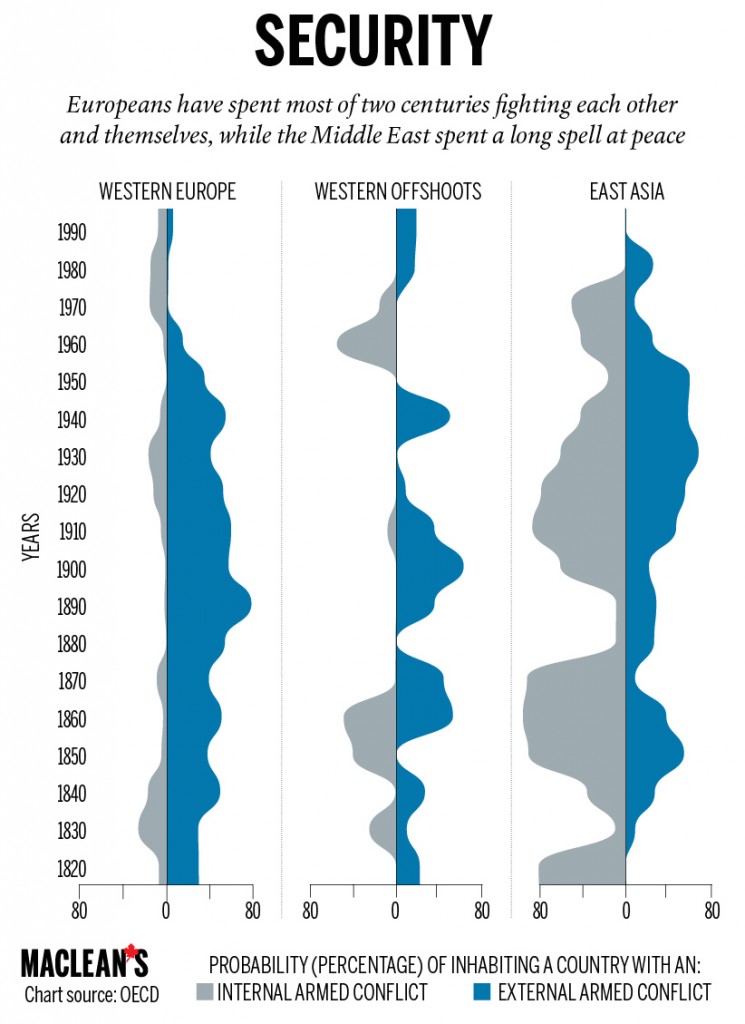
Richer, smarter, taller: A measure of Canada from the OECD

OECD-11-745x1024 - ConflictsInteresting long-term study by the OECD on the last 200 years. Not quite as captivating as the Rosling videos (200-years-that-changed-the-world-bbc), but some of the graphics are clever and well-done:

In 1820, the OECD says, Canada’s GDP per capita stood at $904—behind Western European nations, but not bad for a colonial backwater that was governed from an ocean away. That mark doubled to $1,816 by 1880, doubled again by 1920, and surpassed the colonial powers by mid-century. Meanwhile, Canadians always stood taller than even the richest nations. We averaged heights of more than 170 cm in 1820, a mark the OECD attributes to the “abundant food supply” afforded to settlers in our corner of the New World. That’s 11 cm taller than the average Mexican. The Swedes and Dutch have since surpassed Canada, but we’re still taller, on average, than Americans and every non-European country. We’ve also steadily grown older. Fifty-eight years might seem like a short life now, but in the 1920s that average Canadian life expectancy was among the world’s longest. These days, our 80-year average is only slightly behind the Japanese at 82.

It’s not all good news for Canadians. We’re among the highest per-capita emissions belchers in the world, trailing only the United States and Australia. No one else comes close. Most European countries are reducing their emissions per capita, and Russia’s world-leading numbers plummeted after the Soviet Union’s collapse.

The OECD report also tells magnificent and tragic stories about the rest of the world. It charts a massive global spike in education levels. It explains how much longer human beings live now than just a few decades ago, even if war- and disease-ravaged African nations are the glaring exception. It maps the spread of women’s suffrage, a basic political right almost unheard of in 1913 but now the global rule—except in Saudi Arabia. As the world fights for a better lot in life, the OECD makes one thing clear: the average Canadian has always had more money in their pocket, a better view in a crowd, and more schooling than most of humanity.

Richer, smarter, taller: A measure of Canada from the OECD.

Jason Kenney heads to enemy territory and touts plans to wed job creation programs to the private sector

Minister Kenney doing what he does best, articulating the rationale for his policy choices, and not just preaching to the converted:

“I stand up in front of business audiences and say: you guys have been, to some extent, freeloading on the public training system,” Mr. Kenney told reporters after his talk.

But given that the crowd actually appeared to join in Mr. Kenney’s enthusiasm, it’s not clear that they’ve come to that realization yet.

It’s all part of the broader Conservative plan to downsize the federal government by eliminating its ability to run a surplus, and thus start up big flashy new programs, and to outsource its programs at every possible turn.

In that vein, Mr. Kenney once again reiterated that his government would be sticking to the low-tax commitments made in its platform. Chiefly, the commitment to, when the budget is balanced — as it very nearly is — to implement income splitting for families.

Asked whether these types of commitments — between lessening government revenue and devolving job training authority away from the federal government — would hobble future government’s ability to launch their own initiatives, the minister laughed, then coyly agreed.

“I would ask the question a different way, which is: If you massively increase spending, how can you give Canadians a tax break?” Mr. Kenney said.“The answer is, you can’t. That’s going to be the choice in the next election.”

Jason Kenney heads to enemy territory and touts plans to wed job creation programs to the private sector | National Post.

Saudi overhaul reshapes Islam’s holiest city Mecca – Business – The Boston Globe

A rather polite article on how the history of Mecca and Muslims is being re-written by the Saudi government:

Overseeing Mecca is also a key source of prestige for Saudi Arabia’s monarchy. The past two kings — the current one, Abdullah, and his predecessor, Fahd — have adopted the further title of ‘‘custodian of the two holy mosques’’ to boost their status, referring to Mecca’s Grand Mosque and Muhammad’s mosque in nearby Medina.

Now Mecca is being molded to a particularly Saudi vision that bolsters the rule of the Saud royal family.

Two forces shape that vision. One is raw, petrodollar-fueled capitalism. Mecca’s planners are largely catering to wealthier pilgrims by constructing five-star hotels, surrounding the Kaaba in marble-sheathed luxury. Nearby, pilgrims can shop at international chains, including a Paris Hilton store and a gender-segregated Starbucks.

The other force is Wahhabism, the strict, puritanical interpretation of Islam that the Saud rulers elevated to the country’s official doctrine. Saudi kings, for example, have given Wahhabi clerics a monopoly over preaching at the Grand Mosque. In return, the clerics staunchly back the monarchy.

One tenet of Wahhabism is that Muslim tombs or sites connected to revered figures — even the Prophet Muhammad, his family, and companions — should be destroyed to avoid veneration of anything other than God. It is the same iconoclastic zeal that has prompted militants from the Islamic State group to blow up Muslim shrines in Iraq and Syria.

In Mecca, few sites associated with Muhammad remain. Many were destroyed in previous expansions of the Grand Mosque in the 1980s and 1990s, and the new development is finishing off much of what remains. In 2008, the house of Abu Bakr, Muhammad’s successor as leader of the Muslim community, was razed to make way for a Hilton.

Saudi overhaul reshapes Islam’s holiest city Mecca – Business – The Boston Globe.

Who Votes in Toronto Municipal Elections? – Maytree Study

Summary of the results of the Maytree study by Ryerson University Professor Myer Siemiatycki on Toronto municipal voting:

Toronto has a poor record of voter participation in civic elections. In 42 of Toronto’s 44 wards less than half of all eligible voters cast a ballot in recent city elections. The turnout improves only when elections are hotly contested. While areas with lower voter turnout typically have high concentrations of immigrant and visible minority populations, there is minimal correlation between voting and an area’s average income, and no correlation to an area’s proportion of tenants and homeowners.

These are some of the key findings of Who Votes in Toronto Municipal Elections?, the first such study on voter turnout over the past three municipal elections in 2003, 2006 and 2010. Conducted for Maytree by Ryerson University Professor Myer Siemiatycki and geographic analyst Sean Marshall, the study explored the connection between municipal voting behaviour and some of Toronto’s prime demographic characteristics like immigrant status, visible minority identity, income and home ownership.

There is some good news

While the poor turnout is cause for concern, the study shows there is nothing inevitable or pre-determined about who votes in municipal elections. Thorncliffe Park is a prime example of what can be achieved if a more diverse political leadership results in deeper community engagement. With a large concentration of immigrants and visible minorities, this inner city area is one of Toronto’s highest voting neighbourhoods.

Why voter turnout matters

There are many reasons to take the democratic deficit arising out of poor voter turnout seriously. It threatens the legitimacy and confidence of local government and risks local officials being out of touch with public needs and concerns. It can lead to areas or communities within the city being marginalized from public decision-making.

Who Votes in Toronto Municipal Elections?

France And Jews, Then And Now « The Dish

French journalist Ann Sinclair on the situation of French Jews and how the explanation for why more of them are leaving may also have economic reasons, like other French citizens, not just fears of increased antisemitism:

[M]ore French Jews are making aliyah to Israel in 2014 than ever before. The reasons for their departure, of course, are complex, and not easily explained by the desire to escape an anti-Semitic environment. But the fact remains that more than 2,000 Jews have left France, compared with only 580 from the same period last year. “There’s been a lot of fuss everywhere about that,” says Sinclair, “and it’s not always accurate. … I’m concerned, of course, by the anti-Semitic revival. There is one. Not only in France, in Europe, everywhere.”

“And,” she adds, “there’s a new anti-Semitism, which is not one of the ’30s or the ’40s, which is more related to the conflict in the Middle East. In some suburbs in France you have people coming even in the third generation from the Maghreb, who are living in very bad conditions, and they feel they are rejected, well, by the whole community. … This sense of being rejected is a social despair, which can mutate into anti-Semitism when they want to protest for something.”

“But don’t believe that the French Jews are fleeing—it’s absolutely untrue,” she said, emphasizing the complicated nature of the statistics often used in the reports. French Jews may be leaving France in greater numbers than before, but so have many other French citizens, seeking friendlier business climates and lower tax rates overseas.

France And Jews, Then And Now « The Dish.

Why its time for Canada to grow up – Increasing immigration

Pretty shallow argumentation, with no evidence apart from asserting it will be so.

No mention of inequality issues and that some communities are struggling more than others that the NHS and various studies make clear.

While overall Canada’s success at integration is almost unique in the world, simply assuming we could scale up immigration, integration, citizenship and multiculturalism by 50 percent a year is naive at best.

It would not be hard. Now at 34 million people, we would only need an annual growth rate of 1.3 per cent to reach that target. Assuming our fertility rates remain low, this means an additional 186,000 migrants annually, bringing our total immigration numbers to 444,000 per year. This may sound like a lot, but we could absorb them easily. By comparison to most cities around the world, Canadian urban areas are sprawling and empty. Even if we doubled our immigration numbers, the lineup at Tim Hortons would stay the same. It would only increase our workforce by one per cent per year, a number that our economy could easily engage, especially if we continue to recruit and favour skilled and educated migrants.

More immigrants mean more minds, more hands and more tax dollars. There is a misconception that new arrivals are a net drain on our economy. In fact, they are more entrepreneurial and work longer hours than average Canadians. The added muscle would make us smarter, stronger and louder.

While my bias is towards more pro-immigration rhetoric than the anti-immigration crowd, this has to be grounded in reality, and recognition that our absorptive capacity cannot be increasing by wishing it was so.

Why its time for Canada to grow up – Macleans.ca.

Refugee health-cuts ruling appealed by Ottawa – Politics – CBC News

No surprise on the appeal and request for a stay. Will see how it turns out:

Immigration Minister Chris Alexander also filed a motion to stay the judgment of Judge Anne Mactavish, whose ruling meant refugee applicants would once again have access to Canadian health care while they wait for a decision on their cases in Canada.

The government claims 13 grounds for its appeal, including the argument that the judge made several errors of fact. It also says the judge “applied different standards of reliability to the evidence of the applicants and the respondents.”

In an interview with CBC News, the lead lawyer who won the case said the governments months-long delay in filing the appeal, and the motion for a stay of judgment, means his team will have to scramble to prevent serious health problems among refugees from going untreated.

“If the matter is stayed there will be a delay and so there will be thousands of  persons who should be getting coverage as a result of that order who will be denied that coverage for a longer period of time,” said Lorne Waldman, who represents the group Canadian Doctors for Refugee Care.

Refugee health-cuts ruling appealed by Ottawa – Politics – CBC News.

And Erna Paris in a Globe op-ed on a series of related refugee issues:

We did this because we remembered that a meaner Canada had refused entry to a shipload of desperate Jewish refugees from Nazism 40 years before.

That prewar mean-mindedness is back. Canada’s refugee determination system needed updating, but the Harper government has gone much too far. It has been accused of breaching international law, breaching the Constitution, and – just as important – breaching the values Canadians have defined themselves by.

Canadian mean-mindedness is back 

Jonathan Kay: On El Al’s planes, a case study in appalling sexism

Jon Kay, continuing on an earlier theme against the Haredim (Jonathan Kay: Shariah with a Jewish face | National Post):

Of course, stories of Haredi sexual segregation of have been coming out of Israel for years now. In a move that would make Saudi Arabia proud, some Israeli communities even have sex-segregated busses. And some ultraorthodox communities practice a disgusting mouth-to-penis circumcision practice called Metzitza B’peh, which would be the subject of child-sex abuse charges here in North America if Muslims were doing it. Israeli society shouldn’t stand for such deplorable practices, but ultimately that is Israel’s business.

El Al, on the other hand, is a company that uses Canadian airports and flies hundreds of Canadian passengers to and from Israel every day. Putting aside the question of whether the episodes described above violate Canadian human-rights law, how does it look for Israel’s national flagship carrier to put on display, in front of rows of horrified passengers, the poisonous prejudices of the most narrow-minded constituency in Israeli society?

We are always told (by Stephen Harper and Benjamin Netanyahu alike) that Israel is a beacon of progressive thought, democracy and pluralism in a Middle East brimming with repressive, retrograde attitudes. And in general, that is true. But it seems to me like Elana Sztokman can be forgiven for feeling otherwise.

Jonathan Kay: On El Al’s planes, a case study in appalling sexism