Ottawa to cap number of foreign caregivers in Canada

Whenever the Government makes a Friday afternoon announcement, it suggests that does not believe that it has broad popular support for the policy of program change.

And when it delays announcing part of the package (in this case, pathway to permanent residency), it further suggests that they want to test the waters:

“Caregivers matter to Canada and have made enormous contributions to Canada’s economy, to our economic success, to the success of the Canadian families,” Alexander told a new conference about Canada’s 2015 immigration plan.

“What do these improvements mean to caregivers? They mean, first and foremost, faster processing, faster family reunification, less time away from loved ones . . . . Caregivers will have more pathways toward permanent residency and better tools to achieve success in Canadian labour market.”

According to a press release, the removal of the live-in requirement is expected to result in greater opportunities for Canadians in caregiver occupations and an increase in wages for caregivers hired from abroad if employers demonstrate that there are no Canadians available for the job.

Liza Draman of the Caregivers Action Centre said the Toronto advocacy group’s 1,000-plus members are concerned about what is to come on Nov. 30 when Alexander is scheduled to announce further changes affecting the path to permanent residency for foreign caregivers.

“The only thing that is good about Friday’s announcement is the end to the live-in requirement,” said Draman, a former live-in caregiver from the Philippines. “If the minister is serious about improving the condition for the caregivers, he should grant them status upon arrival.”

Alexander said the department will issue permanent resident status to 30,000 eligible caregivers in 2015 in an attempt to reduce the backlog.

The old live-in caregiver program will be replaced by two new streams — child-care providers and caregivers for those with high medical needs. Both new programs will each take in 2,750 applications a year.

Ethel Tungohan, a postdoctoral fellow at the University of Alberta who studies temporary foreign workers, said she is anxious to find out the government’s plan for the nannies’ access to permanent residency.

“What’s going to happen after the 30,000 caregivers are granted permanent status next year?” Tungohan asked. “That’s a big question.”

Will be interesting to watch how commentary in the broader and the Filipino community develops following this phase 1 announcement.

Ottawa to cap number of foreign caregivers in Canada | Toronto Star.
Ex-citizenship judge jailed for illegally revealing citizenship exams

Another bad political appointee but fortunately caught out:

A retired citizenship judge has become the first in Canada to be imprisoned for breach of trust after illegally providing copies of citizenship exams.

Family members wept as Philip Gaynor, 71, was led away in handcuffs Wednesday following Ontario Court Justice Harvey Brownstone’s sentence of three years. He said Gaynor’s “reprehensible” and “appalling” actions went “straight to the heart of the integrity of Canada’s immigration system” and potentially tarnished new Canadians’ perception of the judiciary.

“In my 20 years on the bench, I have never had the misfortune to deal with something like this,” he said.

While still a citizenship judge in February 2012, Gaynor began stealing exam papers and providing them to Scarborough immigration consultant Li Ling, 49, whom he had meet in 2007, and her assistant Mo Sui Zhun, 58. Brownstone said this continued even after Gaynor’s retirement in September 2012, lasting until about April 2013. Li and Mo were charged with possession of stolen property last year. The status of those charges is unclear.

The papers were then given to citizenship applicants who went through Li’s consulting business. The court heard that Gaynor had engaged in a “social” and later “personal” relationship with Li — inappropriate given his position, said Brownstone — and was paid in cash for the papers. It is unclear how many applicants benefitted from this arrangement.

… A longtime resident of Durham Region, Gaynor was appointed a citizenship judge in 2006 by the Conservative government and reappointed to another three-year term in 2009.

The court heard he had been a volunteer on the election campaign of late federal finance minister Jim Flaherty and was a Toronto auxiliary police officer for 18 years. A Citizenship and Immigration Canada biography listed him as a former executive at the T. Eaton Co., Gordon Brothers and Premier Brand Foods.

Ex-citizenship judge jailed for illegally revealing citizenship exams | Toronto Star.

Was it ‘terrorism’? We need answers, not labels – Globe Editorial

Good editorial in the Globe on the need to avoid simplistic labels:

The debate – terrorism or not? – isn’t particularly useful. It takes a complex issue and tries to reduce it to a label. It short-circuits an honest inquiry into questions that demand answers: Why did these men do what they did? And what can be done to reduce the likelihood of future attacks? Invoking the threat of terrorism may also lower public resistance to new security measures that wouldn’t otherwise be acceptable, such as making it easier for police to detain people suspected of being sympathetic to terrorist groups or ideas. Or, as Justice Minister Peter MacKay mused publicly this week, making it a criminal offence to “glorify” terrorist groups or activities, a law adopted by the British that has been highly controversial and almost never used.

Everyone can agree that the Ottawa attack was criminal. And leaving it at that leaves the door open to deeper thought: How do we monitor people before they suddenly commit a crime? Should we monitor some people more closely? How much evidence should be required to monitor or detain? And was Mr. Zehaf-Bibeau’s attack driven above all by long-standing mental health issues rather than a long-held ideology? If so, why wasn’t he able to get help? How did he get his hands on a rifle? Are guns properly secured in Canada?

Canadians need to ask every imaginable question about what happened in Ottawa. A fight over labels gets in the way of an honest search for answers and solutions.

Was it ‘terrorism’? We need answers, not labels – The Globe and Mail.

Hamilton racism social experiment ends with a punch | Toronto Star

More dramatic than polling on attitudes:

One man immediately pushes back:

“You know, you can’t stereotype and judge people by their clothes, or their nationality or anything else, you know what I mean? What happened there, it was incident of fanatics.”

A woman pipes up, too:“It was awful and tragic, but I don’t think that’s any reason to persecute someone just because what they’re wearing.”

But Giamou keeps making his case, eventually trying to physically remove his fellow actor. At that point, someone jumps to the Muslim man’s defence and slugs Giamou in the face.

After a brief clip that shows him talking to a police officer, Giamou, who has a bloody face, offers this conclusion:

“So the social experiment had a negative ending to it, but its positive because he stood up for him and I appreciate that, that’s good, that’s good.”

Hamilton racism social experiment ends with a punch | Toronto Star.

Peter MacKay suggests anti-terror laws don’t need major overhaul – Politics – CBC News

As the Government continues to consider what further changes, if any, are required to current legislation, some mixed signals:

… former public safety minister Stockwell Day warned hes hearing the government may try to eliminate the requirement that a judge sign off on such orders, giving discretion solely to the minister of public safety.

“One of the provisions Im hearing about, I don’t know if its accurate yet, is there may be a provision for a minister like myself to sign for [preventive] arrest, and not having it countersigned by a judge,” he said in an interview on CBC Radio’s The Current.

“I’ r always appreciated the balance [of both judge and minister signing] for preventive arrest and wiretaps … I would take a close look at that if a judge’s [signature] is no longer required,” Day added.

Without getting into specifics, MacKay seemed to dismiss that idea, “We’re not going to upset that balance that requires police to make that very important evidentiary determination.”

“I always would come down on the side of judicial oversight before you would make any interventions,” MacKay added.

MacKay also said the government is looking for ways to crack down on those who encourage terrorist acts online. “There’s no question that the type of material that is used often to recruit, to incite, and the word I don’t particularly like … but, glorification,” he said, adding he’s looking closely at legislation in the United Kingdom on this topic.

Day believes the legislation will “talk about things like, those who support calls on terrorists to attack Canadians or to kill Canadians, those who support groups who are calling for attacks on Canadians.’”

Peter MacKay suggests anti-terror laws dont need major overhaul – Politics – CBC News.

And the information and privacy czars pick up on the point that any increased powers should be matched by increased review and oversight.

If you step up police powers to fight terrorism, make watchdogs more powerful, privacy czar tells Tories

Similarly, a note of caution not to rush things from former judges, Frank Iacobucci, John Major and Dennis O’Connor:

Panel of judges urges caution in passing new anti-terror laws

Adam Chapnick has a thoughtful piece on the challenge of managing our reactions to terror:

As a professor of defence studies, I know all too well that it’s impossible to stop every ‘lone wolf’ with a gun or a bomb. No measure enacted by any government can guarantee our safety.

It follows that the national conversation led by our parliamentarians over the next few weeks cannot be about terrorism. It must be about managing the terror that Canadians feel.

We need calm reassurance, not more calls to be fearful. We need to see unity of effort and purpose among all of our MPs — not the divisive, fearmongering partisanship to which we have grown far too accustomed.

The debate must last as long as is necessary to enable all interested Canadians — not just supporters of the government — to understand what new measures are being exacted, and why.

It must shape a degree of consensus over the extent to which we are willing to surrender the freedoms we hold so dear in order to feel more comfortable on our streets and in our homes.

Terrorism is a state-level problem — but terror itself is personal. Let us hope that our elected representatives understand the difference as we move forward.

The real problem isn’t terrorism. It’s terror (pay wall)


The evolving acceptance of dual citizenship – LA Times

Peter Spiro on dual citizenship and the question of potential dual loyalties in the US context. Agree with him mostly, and reflects the Canadian approach, but no discussion of where some of the dual loyalty issues lie (e.g, violent extremism, foreign military service):

Recent efforts to enforce the renunciation oath have gone nowhere because the advantages of dual citizenship cut across a variety of politically powerful constituencies. Our new citizens deserve a revised oath reflecting contemporary realities. In the meantime, the archaic phraseology wont stop many from holding on to their original nationality.

And shouldnt they? Citizenship is an important part of individual identity. Theres no reason it needs to be exclusive. Those of us who are U.S. citizens also have other associations: religions, civic institutions, advocacy groups. That some of us belong to other nations doesnt undermine our capacity to be good Americans.

The evolving acceptance of dual citizenship – LA Times.

The EKOS poll: Fear fades — values endure

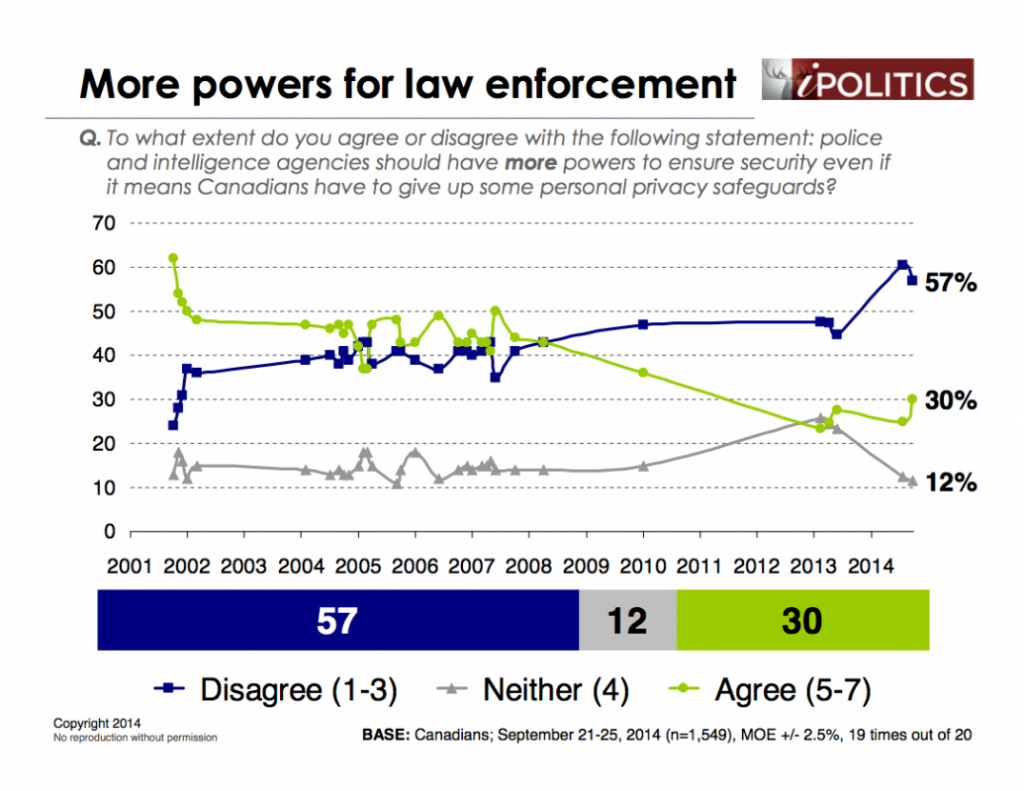
Ekos - Law Enforcement and TerrorismFrank Graves of Ekos on public opinion regarding the threat of terrorism:

  • Virtually all responses made by Western governments to the threat of terrorism in the 21st century have been deemed failures in hindsight. Almost universally, the public sees these past interventions as having yielded nothing but a more dangerous world.
  • Overwhelmingly, Canadians want to see their leaders re-think their reliance on military and security-oriented approaches to the terrorist threat, in favour of approaches more in keeping with our core values as a nation.
  • Canadians have lost faith in the security agenda which says the problem can solved by restricting civil liberties even further, and want to see our leaders place more emphasis on the traditional tools of diplomacy and development.

The EKOS poll: Fear fades — values endure (pay wall)

Strengthening Canadian Citizenship Act: Revocation – Coming into Force

No surprise. We shall see what the current court challenge rules (Rocco Galati launches lawsuit over Citizenship Act changes):

The Strengthening Canadian Citizenship Act which received Royal Assent on June 19, 2014, included new grounds to revoke Canadian citizenship from dual citizens who are convicted of terrorism, high treason, treason or spying offences, depending on the sentence received. The changes also enable the government to revoke Canadian citizenship from dual citizens for membership in an armed force or organized armed group engaged in armed conflict with Canada.

The technical amendments to the Strengthening Canadian Citizenship Act under the Protection of Canada from Terrorists Act will allow the revocation and related provisions to come into force earlier than anticipated. These changes will help protect the safety and security of Canadians, and honour the contributions and sacrifices of those who serve Canada by ensuring those who are convicted of such crimes against Canada do not benefit from Canadian citizenship. Revocation is an important tool to safeguard the value of Canadian citizenship and to protect the integrity of the citizenship program.

Strengthening Canadian Citizenship Act: Revocation Provisions – Canada News Centre.

Kent Roach and Craig Forcese: Putting CSIS surveillance on a firmer legal footing

Hard to disagree:

A smarter bill would link the enlargement of CSIS’s powers with better Parliamentary review. It also would address more integrated review of how CSIS’s actions affect terrorism policing and investigations. The Air India commission proposed that this difficult task be handled by a National Security Co-ordinator, but the government rejected this fix.

In sum: The government deserves credit for a legal initiative that will put CSIS extraterritorial surveillance on a more clear legal footing, clearly acknowledges a judge may violate international and foreign law in authorizing this surveillance, and that will protect CSIS sources, subject to an innocence-at-stake exception (in criminal proceedings, at least).

In so doing, it squarely puts on the table important policy issues that should be debated in full. But along the way, it will be useful to add more to the “accountability” side of the “reform of CSIS” ledger.

Kent Roach and Craig Forcese: Putting CSIS surveillance on a firmer legal footing

Australians support immigration and multiculturalism

CIC Tracking - Support for ImmigrationComparable to Canadian levels of support (see chart above):

The study titled 2014s Mapping Social Cohesion report by Scanlon Foundation which surveyed over 24,000 people reported strong public support for immigration intake and the benefits of multiculturalism. ”

Australia’s public sentiment toward immigration intake is possibly the most positive in the western world. In 2014, 58 per cent of people agree that the immigration intake is about right or too low. Just 35 per cent of people consider that the immigration intake is too high,” the Foundation said in a statement.

“This level of public support is somewhat surprising in the context of rising unemployment and other economic concerns, as well as international comparisons,” said report author Andrew Markus of Monash University.

“In 2014, American and European surveys have found disapproval of immigration in the range of 60 to 75 per cent,” he said.

Support for multiculturalism was also high at 85 percent (“been good for Australia”) but discrimination remains an issue with some 18 percent of respondents reporting experience of discrimination.

Australians support immigration and multiculturalism: Study – The Economic Times.