How Minority Job Seekers Battle Bias in the Hiring Process

More evidence (USA) on the impact of bias and prejudice in the hiring process:

For example, research has shown that white job applicants receive 50% more callbacks for interviews than equally qualified African American applicants. And, in the low-wage labor market, scholars have found that African American men without criminal records receive similar callback rates for interviews as white men just released from prison. Researchers have also documented discrimination in hiring against women, with particularly strong penalties against mothers.

But how does this reality affect these groups – African Americans and women – as they hunt for jobs? Do they tailor their searches narrowly to help them avoid discrimination, sticking to job opportunities deemed “appropriate” for them? Or do they cast a wider net with the hopes of maximizing their chances of finding a job that does not discriminate?

Until now, we have known little about this issue, largely because no existing data source has closely followed individuals through their job search.

New research that we recently published in the American Journal of Sociology attempts to address this limitation by drawing on two original datasets that track job seekers and the positions to which they apply.

The results of our study point to three general conclusions about the job search process:

  1. African Americans cast a wider net than whites while searching for work.
  2. Women tend to apply to a narrower set of job types than men, often targeting roles that have historically been dominated by women.
  3. Past experiences of discrimination appear to drive, at least in part, the broader job search patterns of African Americans.

On an important side note, these racial differences exist for both men and women and these gender differences exist for both whites and African Americans.

The study’s conclusion:

Together, the findings from our study suggest that the job search process plays an important role in shaping, reinforcing and sometimes counteracting inequality in the labor market.

At the same time, discrimination and other barriers to employment must be considered to fully understand how labor market inequality is generated.

And, as the comparison of race and gender suggests, how individuals adapt to workplace barriers can take different forms and have distinct consequences.

Our research points to the importance of systematically examining both job search processes as well as discriminatory behavior and other constraints in the workplace if we hope to fully understand and rectify persistent racial and gender inequalities in the labor market.

How Minority Job Seekers Battle Bias in the Hiring Process | TIME.
Court strikes down Ottawa’s ‘safe country’ list for refugees | Toronto Star

Another major defeat for the Government in the Courts:

In a major blow to the Harper government, the Federal Court has struck down its so-called safe country list for refugees as unconstitutional.

In a ruling Thursday, the court said Ottawa’s designation by country of origin or DCO discriminates against asylum seekers who come from countries on this list by denying them access to appeals.

“The distinction drawn between the procedural advantage now accorded to non-DCO refugee claimants and the disadvantage suffered by DCO refugee claimants . . . is discriminatory on its face,” wrote Justice Keith M. Boswell in a 118-page decision.

“It also serves to further marginalize, prejudice, and stereotype refugee claimants from DCO countries which are generally considered safe and ‘non-refugee producing.’

“Moreover, it perpetuates a stereotype that refugee claimants from DCO countries are somehow queue-jumpers or ‘bogus’ claimants who only come here to take advantage of Canada’s refugee system and its generosity.”

It is yet another devastating hit to the Conservative government which recently also lost two cases on constitutional grounds over the ban of the niqab at citizenship ceremonies and on health cuts for refugees.

“This is another Charter loss for the (Stephen) Harper government,” noted Lorne Waldman, president of the Canadian Association of Refugee Lawyers, a party to the legal challenge against the DCO regime.

The government said it will appeal the decision and ask the court to set it aside while it is under appeal.

“Reforms to our asylum system have been successful resulting in faster decisions and greater protection for those who need it most,” said a spokesperson for Immigration Minister Chris Alexander.

“We remain committed to putting the interests of Canadians and the most vulnerable refugees first. Asylum seekers from developed countries such as the European Union or the United States should not benefit from endless appeal processes.”

The latest court decision means all failed refugee claimants — whether from the government’s safe country list or not — are entitled to appeal negative asylum decisions at the Immigration and Refugee Board’s refugee appeal division or better known as the RAD.

Court strikes down Ottawa’s ‘safe country’ list for refugees | Toronto Star.

Salman Rushdie on Islam: ‘We have learned the wrong lessons’

Unfortunately, I think he is right:

Salman Rushdie believes that if The Satanic Verses had been published today, the members of the literary elite who rounded on Charlie Hebdo in the wake of the French satirical magazine winning a PEN prize for courage would not have defended him.

In an interview with the French magazine L’Express, the novelist said that “it seems we have learned the wrong lessons” from the experience of The Satanic Verses, which saw a fatwa issued against him by Iranian leader Ayatollah Khomeini in 1989, sending him into hiding. “Instead of realising that we need to oppose these attacks on freedom of expression, we thought that we need to placate them with compromise and renunciation,” he said.

Speaking about the decision by PEN’s American branch to award Charlie Hebdo with a freedom of expression courage award in May, which led to more than 200 writers putting their names to a letter protesting the decision for valorising “material that intensifies the anti-Islamic, anti-Maghreb, anti-Arab sentiments already prevalent in the western world”, Rushdie said the conflict had left “deep divisions” in the literary world. He would never have imagined that writers such as Michael Ondaatje, Peter Carey and Junot Díaz “would have taken this attitude”, and he had written to one of the key dissenters, Teju Cole, about the situation, he revealed.

“[Cole] replied with a bizarre letter: ‘My dear Salman, dear big brother, everything I know I learned it at your feet,’” Rushdie said. “But his reply was mostly full of false claims: Teju assured me that he would never have taken this part against The Satanic Verses because, in my case, it was to do with an accusation of blasphemy, but in the case of Charlie Hebdo, it was about the alleged racism of the magazine against the Muslim minority.”

Rushdie told L’Express that he disagreed, saying that the 12 people murdered at Charlie Hebdo’s offices were killed because their words were seen as blasphemous. “It’s exactly the same thing,” he said. “I’ve since had the feeling that, if the attacks against The Satanic Verses had taken place today, these people would not have defended me, and would have used the same arguments against me, accusing me of insulting an ethnic and cultural minority.”

The novelist told the French magazine that he believes “we are living in the darkest time I have ever known”, with the rise of Islamic State of “colossal importance for the future of the world”. He argued that the taboo surrounding “supposed ‘Islamophobia’” must be brought to an end.

“Why can’t we debate Islam?” he said. “It is possible to respect individuals, to protect them from intolerance, while being sceptical about their ideas, even criticising them ferociously.”

Salman Rushdie on Islam: ‘We have learned the wrong lessons’ | Books | The Guardian.

After 600 Days of ‘With Flowers,’ Ai Weiwei Has His Passport Back

As a fan of Ai Weiwei’s work, enjoyed this profile and the news that he has his passport back:

On Wednesday morning, as he has every day for the past year and a half, Ai Weiwei placed a bouquet of flowers in the basket of a bicycle that stands outside his studio in Beijing. The selection included carnations and baby’s breath. The day before, he’d picked sunflowers. He started the week with lilies.

For more than a year and a half, China’s infamous dissident artist has arranged his blooms in a daily demonstration against the confiscation of his passport. Titled With Flowers, the work is part-protest, part-performance art. But no longer: After four years, the artist announced via Instagram on Wednesday that the Chinese government had returned his passport. Since 2011, after Ai was arrested on charges of tax evasion, jailed for 81 days, and then released, the government had kept it confiscated, and refused him any other travel papers.

With Flowers endured for about 600 days. Ai started the performance on November 13, 2013, more than two years into his confinement. The demonstration serves as an extraordinary record of his confinement: He placed the flowers outside the aquamarine door at 258 Caochangdi, home to his art studio as well as his design and architecture firm, FAKE Design. They were mighty arrangements, rarely modest, all formally documented on Flickr. Ai is both active and savvy on social media (which is part of what prompted his trouble with the authorities), and his flowers traveled far beyond the plastic basket on his black Giant bike via posts on Flickr, Instagram, and Twitter.

After 600 Days of ‘With Flowers,’ Ai Weiwei Has His Passport Back – The Atlantic.

Planning guru Larry Beasley on a monumental controversy

Good and interesting interview on how the Government’s political politicization of the memorial differed from the normal practice, fuelling the controversy:

Q: So what changed? What went wrong in the case of the victims of communism memorial?

Two things happened. One is that, several years ago, the responsibility for managing the conceptualization, as well as the implementation of monuments, moved away from the National Capital Commission, which is one step removed from government, and shifted over to [the Department of Canadian Heritage].

Second, in more recent times, the governments of the day have been more interested in using monuments and memorials to communicate themes. In the past, memorialization was not so much a part of the government’s communications strategy. Some of the more recent memorials have been sponsored by the government and have been communication vehicles for government.

Q: Such as?

The 1812 memorial on Parliament Hill, for example, is a good indication. That was a part of a whole communications program the government has. I’m not trying to interpret the politics of why that was the case, but it was the case.

Q: The process was less political in the past?

In the past, what tended to happen is that organizations would come to the NCC. The NCC has a very well-articulated policy on the location of monuments according to their stature, saving certain sites for the primary monuments of the country, identifying sites where monuments were appropriate. That was managed through the NCC, at arm’s length from government, working with the sponsoring organizations.

In recent years, there have always been competitions, truly independent panels, the advice of our committee, and other kinds of advice. The projects then move forward.

Q: And that didn’t happen in the case of the victims of communism memorial?

As I understand it, the monument is basically sponsored by the government and has been implemented through a department of the government. The NCC is put in the position of an approval authority, but it’s much more constrained than if it was managing the project from the beginning.

Planning guru Larry Beasley on a monumental controversy.

UAE, concerned about militant Islam, passes law against race, faith hate | Reuters

Expect application will be broader than cracking down on militant Islam given that it also outlaws “insults against religions”:

The United Arab Emirates has outlawed religious or racial discrimination, the state news agency WAM said on Monday, citing a royal decree by President Sheikh Khalifa bin Zayed Al Nahyan.

The law is aimed in part at countering Islamist militancy, particularly the practice known as takfir, whereby hardline Muslims label followers of other schools of Islam unbelievers, but it also outlaws insults against religions.

“The new law No. 02 of 2015 criminalizes any acts that stoke religious hatred and/or which insult religion through any form of expression, be it speech or the written word, books, pamphlets or via online media,” WAM reported.

The UAE, an oil-exporting confederation of seven Muslim emirates ruled by hereditary dynasties and bordering Saudi Arabia and Oman, is worried about political Islam, which appeals to religious conservatives while challenging its lack of democratic rule.

UAE, concerned about militant Islam, passes law against race, faith hate | Reuters.

Reframing the debate over expat voting: Russell and Sevi, Globe editorial

Reframing_the_debate_over_expat_voting_-_Macleans_caTwo contrasting views on expatriate voting.

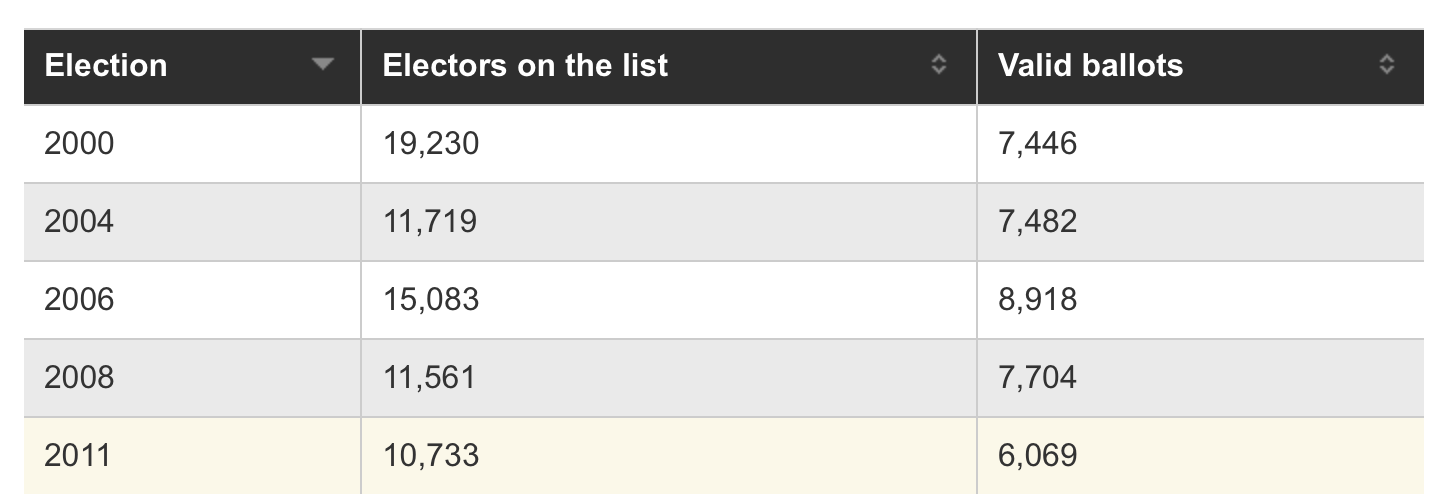
The first, by Peter Russell (a former excellent and insightful professor of mine) and Semra Sevi (who has written before Canadian expatriates should never lose the right to vote), provides useful data on the number of expatriates who actually vote.

The number, as shown above, is minuscule compared to the estimated almost three million Canadian expatriates. The article also has the following international comparisons:

The five-year limitation, as opposed to some other limit, is overly drastic and Canada’s provision is not comparable with similar democracies around the world.

Americans living outside of the country have the right to vote no matter how long they have been abroad providing they pay taxes. The right to vote expires in the United Kingdom after 15 years abroad. To put this into perspective, this is three times longer than what Canada permits even though Canada is part of the Commonwealth.

Australian citizens abroad are allowed to vote so long as they intend to return to Australia within six years. After six years, citizens can renew their status by making an annual declaration of their intention to return “at some point” thereby voting for an indefinite period. In New Zealand, there is a three-year limit but the clock restarts every time citizens visit the country. Moreover, New Zealand extends the right to vote to non-citizen residents from other Commonwealth countries.

The United Kingdom extends similar voting rights to citizens of Commonwealth countries and citizens of the Republic of Ireland. The five-year limit in Canada is an arbitrary number and is unnecessarily onerous. On the surface, it is a year less generous than Australia, but Australians can renew their status by expressing a mere intent to return to the country “at some point” in the future. Canadians, on the other hand, need to resume residency to regain their right to vote abroad.

The right to vote is a fundamental right of citizenship that is protected by the Charter and does not depend on place of residence. The five-year limitation does not conform to the 21st-century demands of globalization. While there is currently an NDP-sponsored bill to repeal the provision that limits voting rights for Canadians abroad as unconstitutional, it is possible that the unconvincing judgment of two Ontario appellate judges could be overturned on appeal to the Supreme Court of Canada—but, alas, not in time to restore democratic rights to the close to a million and a half Canadians living abroad for the fall election.

Reframing the debate over expat voting – Macleans.ca.

Expatriate Voter TurnoutThe Globe editorial takes, correctly in my view, takes the opposite view:

We think the decision is the right one, for three reasons.

First, because our electoral system, based as it is on residence in a particular electoral district, assumes a connection between residence and voting, governors and the governed.

Second, because we live in a world of national borders and laws that do not apply extraterritorially, which means the lives of non-resident Canadians are largely not governed by Canadian law. As Ontario Chief Justice George Strathy put it, “permitting all non-resident citizens to vote would allow them to participate in making laws that affect Canadian residents on a daily basis, but have little to no practical consequence for their own daily lives.”

And third, because reasonable people can disagree, reasonably, over how long a citizen should reside outside of Canada before having her vote suspended. Should the limit be five years? Ten? Two generations? Never? The practical question of setting reasonable limits is best left where the Ontario Court of Appeal left it, in the hands of Parliament.

The Canada Elections Act says that Canadian citizens are entitled to vote in the riding in which they typically reside. However, the Act also says that Canadian citizens living abroad for more than five years cannot vote. There are exceptions for people sent overseas in service to the country, such as members of the Armed Forces.

All of which is not unreasonable. Justice Strathy noted that “residence is a determinant of voter eligibility in all provinces and territories.” If you move from Nova Scotia to Alberta, you can’t continue voting in Nova Scotia in perpetuity.

He also pointed out that “residence is a requirement of the electoral laws of the other Westminster democracies. The U.K., Australia and New Zealand limit the voting rights of non-resident citizens to those temporarily resident abroad.” The maximum time overseas before one loses the vote is 15 years in Britain, six years in Australia and three years in New Zealand. Canada’s current law is fair.

 No, Canadians living abroad shouldn’t get to vote 

10 chiffres qui vont vous surprendre sur l’immigration en France

Apologies for the capitalization but the original site had these all in caps and I couldn’t find an easy way to reformat.

Good and interesting data:

  1. CHAQUE ANNÉE EN MOYENNE, ENTRE 2004 ET 2012, 200 000 IMMIGRÉS SONT ENTRÉS EN FRANCE, SOIT MOINS QUE LA MOYENNE DES PAYS DE L’OCDE.
  2. 226 FILIÈRES D’IMMIGRATION CLANDESTINE ONT ÉTÉ DÉMANTELÉES EN 2014
  3. 63 % DES IMMIGRÉS ENTRÉS EN FRANCE EN 2012 SONT AU MOINS TITULAIRES D’UN DIPLÔME DE NIVEAU BACCALAURÉAT
  4. 40% DES IMMIGRÉS DE PLUS DE 16 ANS, NON ÉTUDIANTS, ENTRÉS EN FRANCE EN 2012, DÉCLARAIENT AVOIR UN EMPLOI L’ANNÉE DE LEUR ARRIVÉE.
  5. DANS L’ENSEIGNEMENT SUPÉRIEUR FRANÇAIS, 289 274 ÉTUDIANTS SONT DE NATIONALITÉ ÉTRANGÈRE (⅛)
  6. LE “PASSEPORT TALENTS” OUVRIRA UN DROIT AU SÉJOUR VALABLE JUSQU’À 4 ANS
  7. LA FRANCE A ENREGISTRÉ 64 310 DEMANDES D’ASILE EN 2014 (Germany 202,815).
  8. LA RÉFORME DE L’ASILE PERMETTRA DE RÉDUIRE LE DÉLAI D’EXAMEN DES DEMANDES À 9 MOIS (reduction from current 2 years)
  9. EN 2014, 105 613 PERSONNES ONT ACQUIS LA NATIONALITÉ FRANÇAISE.
  10. PRÈS D’UN IMMIGRÉ SUR DEUX ENTRÉ EN FRANCE EN 2012 EST NÉ DANS UN PAYS EUROPÉEN, contre trois sur dix dans un pays africain.

10 chiffres qui vont vous surprendre sur l’immigration en France | Gouvernement.fr.

“Reclaim Australia” – How racists are co-opting multiculturalism

Commentary by Ruby Hamad:

Even the name “Reclaim Australia” is a dead giveaway. Reclaim it for whom and from whom? Despite the nod to the “traditional owners”, they clearly they do no want to reclaim it for them. It’s about the ideals of whiteness.

As experts are now warning, we are going to see a lot more of this sort of thing in the future as our understanding of race and racism evolves.

When the dominance of the white race was indisputable and seemingly insurmountable, racism was simply about skin colour. Now, decades after the abolition of the White Australia policy, the civil rights movement in the US and the end of apartheid in South Africa, it’s about assimilation. Who is willing to play by the rules, to show us they are really “one of us”?

Islam is the primary target of Reclaim Australia not because of any real threat it represents to our country but because many Muslims visibly and defiantly hold onto their traditions and clothing. Islam and its traditions – be it the hijab, halal food, or praying at the mosque – is regarded as an explicit rejection of Australian (and more broadly Western) ideals, and for that reason, Muslims are seen as a threat that must be extinguished.

Never mind that “tolerance” is one of those values we supposedly do better than anyone else.

Racist statements and ideologies do not magically become non-racist when a non-white person espouses them. Nor does racism have to take the form of neo-Nazism (although there appears to be plenty of that lately), but simply the persistent insistence that non-white people fall into line, that we know our place and that we acknowledge that white culture is the best one.

How racists are co-opting multiculturalism.

Foreign caregivers face lengthy wait for permanent status

More challenges for CIC:

It’s taking twice as long for foreign caregivers to get permanent resident status in Canada as it did a year ago despite Ottawa’s promise to expedite the process.

According to an immigration department internal memo titled “advice to minister,” the processing time for caregivers’ permanent residency reached a record 50 months in January, up from 26 months a year ago. That’s on top of having to work two years alone in Canada — separated from family — in order to meet the residency requirement.

Immigration officials are still wrestling with a huge backlog. As of February, more than 17,600 caregivers who had met the work requirement — down from a peak of 24,600 last year — were still waiting in the queue to be reunited with their spouses and children living abroad.

Delays in granting permanent status and reuniting families often lead to family breakups and cause other adjustment problems for caregivers’ children, including high school dropout rates, said immigration lawyer Richard Kurland, who obtained the government memo.

“Caregivers waiting for PR (permanent residency) are unfortunately subject to longer processing,” said Kurland. “In the long term, it’s going to have expensive consequences.”

Ottawa introduced two new caregivers programs in November to replace the decades-old live-in caregivers program. The two programs — designed to bring in caregivers for children and people with high medical needs — remove the live-in conditions but are limited to a combined 5,500 applications a year.

“We have improved the program to make it faster, safer and provide better career opportunities for caregivers across Canada,” Kevin Menard, spokesperson for Immigration Minister Chris Alexander, told the Star.

“We have taken aggressive action to reduce backlogs by planning 30,000 caregiver admissions this year alone, an all-time record, and we will completely eliminate it by the end of 2016.”

Foreign caregivers face lengthy wait for permanent status | Toronto Star.