Asians will be largest immigrant group in U.S. in 50 years: Pew study

Pew_Immigration_ProjectionsInteresting demographic shift and may, over time, shift immigration debate in USA:

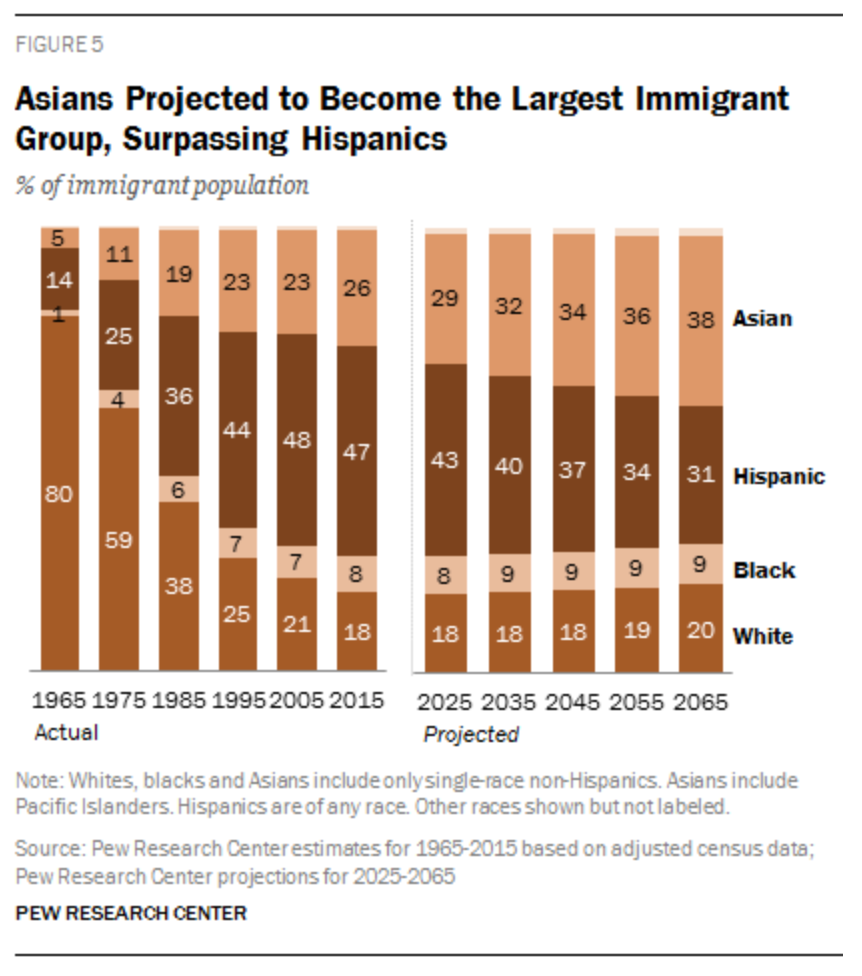
In a major shift in immigration patterns over the next 50 years, Asians will have surged past Hispanics to become the largest group of immigrants heading to the United States, according to estimates in a new immigration study.

The study looks in detail at what will happen by 2065, but the actual tipping point comes in 2055.

An increase in Asian and Hispanic immigration also will drive U.S. population growth, with foreign-born residents expected to make up 18 per cent of the country’s projected 441 million people in 50 years, the Pew Research Center said in a report being released Monday. This will be a record, higher than the nearly 15 per cent during the late 19th century and early 20th century wave of immigration from Europe.

Today, immigrants make up 14 per cent of the population, an increase from five per cent in 1965.

The actual change is expected to come in 2055, when Asians will become the largest immigrant group at 36 per cent, compared with Hispanics at 34 per cent. White immigrants to America, 80 per cent back in 1965, will hover somewhere between 18 and 20 per cent with black immigrants in the eight per cent to nine per cent range, the study said.

Without any post-1965 immigration, the U.S. would be 75 per cent white, 14 per cent black, eight per cent Hispanic and less than one per cent Asian, Pew said.

Currently, 47 per cent of immigrants living in the United States are Hispanic, but by 2065 that number will have dropped to 31 per cent. Asians currently make up 26 per cent of the immigrant population but in 50 years that percentage is expected to increase to 38 per cent.

Pew researchers analyzed a combination of Census Bureau information and its own data to develop its projections.

Part of the reason for the shift is that the fertility rate of women in Latin America and especially Mexico has decreased, said Mark Hugo Lopez, Pew’s director of Hispanic research. In Mexico, Lopez said, women are now having around two children, when back in the 1960s and 1970s, they were having about seven children per woman.

“There are relatively fewer people who would choose to migrate from Mexico so demographic changes in Mexico have led to a somewhat smaller pool of potential migrants,” he said. “At the same time we’ve seen a growing number of immigrants particularly from China or India who are coming for reasons such as pursuing a college degree or coming here to work temporarily in the high-tech sector.”

Source: Asians will be largest immigrant group in U.S. in 50 years: Pew study – World – CBC News

Link to study: Modern Immigration Wave Brings 59 Million to US, Driving Population Growth and Change Through 2065

The niqab debate, let’s not forget, is about individual rights: Neil MacDonald

A further reminder, no matter how much we may dislike the niqab and how much we feel that wearing it is inappropriate (at a citizenship ceremony or elsewhere):

In too many instances, the niqab is clearly an instrument of inequality; using it to indoctrinate young girls is, on the face of it, probably a human rights issue.

But then, indoctrinating children is how religions ensure their continuity. Society has accepted that religious parents have the right to impose religious practices on their children. The children have little say in the matter.

And the decision of a grown woman, like Zunera Ishaq, to cover her face at a public ceremony is, well, the decision of a grown woman.

Sure, Stephen Harper, and a lot of other people, think the niqab is rooted in an anti-woman culture, but where does that argument end once the heavy hand of government becomes involved?

Harper’s own immigration minister, Chris Alexander, has already conflated the niqab and the burqa, which cover a woman almost entirely, with the hijab, which can simply be a headscarf, and which millions of Muslim women wear.

And if a government can base public policy on a belief that one monotheistic religion has misogynistic doctrine, might not some future government turn its attention to the treatment of women by orthodox streams of the two other monotheistic religions?

A niqab can appear sinister to someone who hasn’t lived in the Middle East. It has clearly become a distillation of Canadians’ unease about fundamentalist Islam.

But there is no law against wearing it, and any eventual law will need to scale the impassive walls of the Supreme Court and the Charter of Rights.

Former Liberal prime minister Jean Chretien, in his awkward fashion, nailed it last week.

“It’s not am I comfortable or not” with women covering their faces, he said. “Makes no difference at all. It’s a question of rights and it will be for the court to decide.”

Makes no difference at all. Precisely.

Source: The niqab debate, let’s not forget, is about individual rights – Politics – CBC News

Harper says only bogus refugees are denied health care. He’s wrong.

Good piece in Macleans:

Prime Minister Harper was indignant: “We have not taken away health care from immigrants and refugees. On the contrary, the only time we’ve removed it is where we had clearly bogus refugees who have been refused and turned down. We do not offer them a better health care plan than the ordinary Canadian can receive. That is not something that new and existing and old-stock Canadians agree with.”

Harper’s reference to “old-stock Canadians” got lots of attention. But what’s far more shocking, say refugee experts, is his stony denial of the truth: that the Conservative government has diminished the medical insurance provided to most refugees in Canada—tens of thousands of them, in fact.

As Maclean’s recently reported, the Conservative government made cuts to the Interim Federal Health (IFH) program in 2012 that drastically reduced the medical insurance provided to refugees who are privately sponsored or who make a refugee claim upon arriving in Canada. The two groups represent 59,285 of the refugees who came to Canada between 2012 and 2014, show the latest data from Citizenship and Immigration Canada and the Immigration and Refugee Board of Canada (IRB). The cuts also affect more than 7,000 “legacy claimants” who arrived before December 2012 and are awaiting their claim hearing, according to the Canadian Council for Refugees.

These groups of refugees no longer have health insurance for prescription medications, and “supplemental” coverage for services such as prosthetics, physiotherapy and counselling, as well as emergency dental and vision care. (Pregnant women and children have been granted temporary coverage for medications, until the federal Court of Appeal decides later this year whether the cuts should be reversed. Children also receive supplemental coverage.)

The only group not affected by the IFH cuts is government-assisted refugees, of which 18,646 were resettled in Canada between 2012 and 2014. They receive the same health insurance as the lowest-income Canadians.

“They’ve repeatedly tried to sell the cuts to the public by saying they are only taking away gold-plated health care from bogus refugees,” says Dr. Hasan Sheikh, an Ottawa physician and member of Canadian Doctors for Refugee Care, of the Conservative government. “That is absolutely not true.”
Harper’s reference to “bogus claimants” during the debate is particularly noteworthy—and cringe-worthy, say refugee advocates. It’s a term that’s been used by Harper, as well as Minister of Citizenship and Immigration Chris Alexander, and his predecessor Jason Kenney, many times since 2012, as well as by other Conservative MPs during debates in the House of Commons.

Source: Harper says only bogus refugees are denied health care. He’s wrong.

Russell Smith: Asylum seekers are the stars of this Canadian arts initiative

MamalianInteresting initiative to encourage understanding and integration, using the arts:

A couple of weeks ago, I wrote about how art has been interpreting the European refugee crisis. I was reminded after that of a Canadian artistic initiative currently happening in Germany that has direct contact with recent migrants. It is the work of the Toronto-originating theatre/social planning group called Mammalian Diving Reflex, directed by its creator, Darren O’Donnell.

The goal of this company is not to write plays and to put them on a stage, but to create social events that bring people together. They claim they aim to “trigger generosity and equity.” They do wacky things like getting children to give adults haircuts, but also deeply serious things like their current work in a small town in Germany, Hemsbach, near Mannheim.

There they have just finished a lengthy project centred around a reception centre for recent immigrants, designed to bring the newcomers and the German-born townspeople together, in an effort to find jobs for the immigrants.

O’Donnell himself stayed in the immigrant dormitory, with his co-worker Chozin Tenzin (also from Toronto), in a couple of beds that had been left vacant when some of the inmates were taken away by police. The town has about 80 recent asylum seekers staying in the holding centre, from everywhere from the Balkans to India. He then organized goofy events such as a cooking contest, for the refugees and for the German-born, in which participants were forced to use difficult ingredients from all over the world in their dishes.

The short-term goal was to facilitate interaction and understanding; the long-term goal is to leave a system of similar events in place, to continue after O’Donnell’s company leaves. (He calls this system the Hemsbach Protocol.)

O’Donnell likes in particular to work with teenagers, which he has been doing in the Ruhr region of Germany since 2013. It is only coincidentally that his work there became entangled with the refugee influx to Germany. His last project there, part of the Ruhrtriennale festival, near Dusseldorf, was called “Millionen! Millionen!” – a line from the Romantic poet Schiller’s Ode to Joy. (Yes, the one Beethoven used in his Ninth Symphony.) That poem is the European Union’s anthem and mantra, particularly for its now painfully relevant line, “Be embraced, you millions.”

The project was, like most of Mammalian Diving Reflex’s things, hard to define – social outing, urban planning, performance. In collaboration with a German theatre collective called Mit Ohne Alles, they got a bunch of teenagers of diverse immigrant backgrounds to go camping for a weekend, then take careful note of each interaction. Some talked deeply, some fell in love.

The performance, crafted afterwards, was a kind of barely-scripted play in which the teenagers recreated, for an audience, some of the interactions that had taken place over the weekend, with large images projected and everyone who had participated on the stage at once. The theme was “embracing.” Now that newer immigrants from the war-torn Middle East and Africa are showing up, such forced embracings will have a different edge and a different echo.

In theatre terms, this kind of practice is a kind of experimentalism called “post-dramatic,” an idea of the German critic Hans-Thies Lehmann. The primary intellectual influence on O’Donnell is the work of Nicolas Bourriaud, the art curator who wrote about “relational aesthetics,” the theory that stresses an artist’s role as catalyst for social interaction rather than centre of attention.

Source: Russell Smith: Asylum seekers are the stars of this Canadian arts initiative – The Globe and Mail

Changing the temporary mindset of refugees: Saunders

A reminder that while much can be done to foster integration, this also depends on immigrant attitudes and mindset:

There is a scholarly concept known as “myth of return:” the belief widely held among many new immigrants, and most refugees, that they will just stay a while and then move back. I know immigrants who have held this myth for decades. But their success depends on seeing their new location as home, and that home seeing them as fellow citizens.

Ending that “temporary” mindset is the refugee’s job, but there are a number of things that host countries need to do to make it happen. In a research paper examining the obstacles to refugee integration, three Canadian scholars found a number of factors were key.

Employment, housing and schools make a big difference: The sooner they can get a job suited to their skills (and refugees tend to be middle-class), secure tenure in an affordable living space and a school for their children, the sooner they become “here.” Cultural integration tends to follow naturally from economic and educational integration.

Equally important is the ability to be around refugees and immigrants from the same place. “One of the few resources available to most refugees is social capital in the form of social support networks,” two Canadian scholars wrote in a paper on refugee integration. “These many formal and informal social networks are extremely valuable, providing much-needed support and assistance when refugees are faced with financial, employment, personal, or health problems.”

Which means refugees should be allowed to relocate to join clusters of other refugees. A study by Citizenship and Immigration Canada found that 80 per cent of refugees who settled in Ontario, Alberta or British Columbia ended up staying there, whereas half the refugees settled in the Atlantic provinces or Saskatchewan ended up moving, presumably to the big cities.

The success of earlier, larger waves of even more foreign refugees shows that their integration tends to succeed. We just need to help them change their minds.

Source: Changing the temporary mindset of refugees – The Globe and Mail

The niqab election: Commentary by Wherry and Hébert, past controversies

Aaron Wherry has the rights argument nailed down:

At the outset, it should be understood that the niqab debate, or at least this particular niqab debate, is not about the niqab. Whether you like or agree with the niqab is irrelevant. How you would feel about your daughter wearing the niqab is besides the point. You are entitled to your opinion and, given the fraught politics and cultural curiosity that surround the garment, there is a discussion worth having about the niqab, preferably including the voices of the women who wear it. But for the purposes of whether or not the niqab should be banned during the swearing of the citizenship oath by new Canadian citizens your opinion is of no applicability. Proponents of a ban might want to note that, according to public opinion surveys, a large majority of Canadians do indeed oppose the wearing of the niqab during the oath, but this is irrelevant unless you believe that the rights of individuals should be determined by majority rule, that the extent of minority rights are at the whim of the majority.

One’s rights are what is at issue here. And on that note it is fun to note that on Thursday morning, about nine hours before Stephen Harper made his declaration about a women’s sartorial freedom, the Conservatives announced that, if they continue to govern long enough to do so, they will have the federal government purchase John Diefenbaker’s childhood home and declare it a national historic site. Among the accomplishments the Conservatives recognized in explaining the reason for such an honour was Diefenbaker’s Bill of Rights, which acknowledged, among other rights, the freedom of religion. “It will give to Canadians the realization that wherever a Canadian may live, whatever his race, his religion or his colour,” Diefenbaker said in 1960, “the Parliament of Canada will be jealous of his rights and will not infringe upon those rights.”

Diefenbaker’s Bill of Rights was ultimately overtaken by Pierre Trudeau’s Charter of Rights and Freedoms and it is those Charter rights that are relevant (even if a Federal Court judge actually overturned the government’s policy on the niqab because he found it contradicted the Citizenship Act). As Zunera Ishaq‘s lawyers argue in their factum for the Federal Court of Appeal, “The impugned Policy forces the Respondent into an impossible choice: violate a sincerely held religious belief in a significant and material manner, or give up obtaining the Canadian citizenship that she is otherwise entitled to. And it forces this choice on her for no good reason.”

There are no practical justifications for the ban. Confirming an individual’s identity can be done privately before the oath ceremony. Confirming that an individual has said the oath—the practical consideration that Jason Kenney first claimed when he introduced his ban—can be done by having an official stand within earshot.

Jason Kenney has asserted that, based on his consultations, the wearing of a niqab is not properly grounded in religious theology. But we should surely not wish for a country in which ministers of the crown are the arbiters of what constitutes a proper expression of faith. The Supreme Court has set out parameters for legally recognized religious belief (in Syndicat Northcrest v. Anselem and R. v. N.S), and if the case of the niqab ban ever has to be adjudicated on Charter grounds the sincerity of Ishaq’s belief could be tested, but I might suggest that a decent and confident country should give the benefit of the doubt to the claimant unless the welfare of others or the country is somehow threatened.

In Alberta v. Hutterian Brethren of Wilson Colony, the Supreme Court upheld a law that was being challenged on the grounds of religious freedom, but in that case the Court found a “pressing and substantial” goal—specifically, minimizing the potential for identity theft associated with driver’s licences. There is no such goal here. There is only symbolism.

Source: The niqab election – Macleans.ca

A timely reminder of Sikhs wearing turbans in the RCMP. Those who forget history …

The rhetoric over the niqab in the federal election campaign is proving reminiscent of another furor, more than 20 years ago, around the turban and its compatibility with Canadian values and the country’s dearest institutions.

What was allegedly at stake in that debate in the 1990s was the very fabric of the nation, and the sanctity and perhaps survival of an important historic symbol of the country — the Stetson of the Royal Canadian Mounted Police.

Baltej Singh Dhillon, a young practising Sikh, wanted to become a Mountie. But his application to the force led to a kind of turban turmoil and an eventual intervention in Parliament by the Progressive Conservative government of the day.

The debate was featured on newscasts and dominated the public conversation. Political parties took positions on it, including the Reform Party, which deemed allowing the right to wear a turban unnecessary, and went so far as to pass a resolution at its 1989 convention banning such religious attire for the RCMP. At the time, Stephen Harper was a defeated Reform candidate and the party’s policy chief.

Dhillon is now a staff sergeant in the RCMP. The force refused to allow him to speak to CBC News about the turban debate. But in a video story produced by Telus Optik in B.C. and posted online, Dhillon recalled the tone of the debate.

“It was vicious. It was angry. It was emotional. It had all the elements of racism in there. It was a disappointment is what it was,” he said in the video.

“The fear was that we would lose the symbols that defined Canadians and defined our culture and defined who we were and our branding with the rest of the world.”

“And that was the greatest irony: That on one hand, we need to protect our symbols, and in the same breath, we need you to not protect your faith or your religion or your roots.”

Source: Niqab debate recalls RCMP turban furor of the ’90s – Politics – CBC News

Lastly, Chantal Hébert on some of the debates that diverse societies will continue to have and the struggle for balance.

While her conclusion is right, the question is how to have such a discussion in an open and respectful fashion, not used as wedge politics but the Conservatives and Bloc:

And yet, under the guise of this discussion, voters are getting a taste of one of the fundamental debates of the 21st century. It revolves around how the increasingly diverse communities that make up pluralistic societies accommodate their cultural and religious differences and it is not going away after Oct. 19.

Source: Niqab debate leading to wider discussion on religious, cultural accommodation: Hébert | Toronto Star
Kevin Page delivers a warning to the public service

Excerpt from Kevin Page’s book, Unaccountable: Truth and Lies on Parliament Hill. Some uncomfortable observations that merit reflection:

The ethical values section of the code speaks to a public service reflecting the need to act at all times in such a way as to uphold the public trust. It says that public servants shall act at all times in a manner that will bear the closest public scrutiny, an obligation that is not fully discharged by simply acting within the law.

This does not happen when deputy ministers refuse to provide spending plans to Parliament and the PBO that outline where Budget 2012 cuts will take place, along with an explanation of how those cuts will affect services to the public. Shame on all of us for sticking our collective heads in the sand.

Finally, under the code, the people values stipulate that public servants should demonstrate respect, fairness, and courtesy in their dealings with both citizens and fellow public servants. It says that appointment decisions in the public service shall be based on merit and that public service values should play a key role in recruitment, evaluation, and promotion. This did not happen with the recruitment of the new PBO.

What I learned from my PBO experience is that our public service has become good at avoiding accountability and transparency. The result is that public trust in the public service declines. Jane Jacobs, the famous American-Canadian urban activist, said “the absence of trust is inimical to a well-run society.” If only we could institutionalize trust, but alas, that is impossible.

Our public service leaders are going to have to step up and earn trust! To my friends and colleagues in the public service, I say this: Blueprint 2020, more than anything else it espouses, must be about restoring trust to the public service in Canada.

Source: Kevin Page delivers a warning to the public service | Ottawa Citizen

Sign up today! CRRF Directions: Webinar – ‘The Power of Words’ 6 October

Join David Matas and myself in a discussion of the ‘power of words’ to shape discourse around citizenship, immigration and multiculturalism.

Sign-up: CRRF Directions: Webinar – The ‘Power of Words’ Tuesday, 6 October 11 am

The Two Solitudes come to the fore after the French-language election debate (#361)

Worth reading as it captures the different media reactions.

Baloney Meter: How meaningful is the Bloc’s promise to ban veiled voting, oath taking?

Notwithstanding public opinion and wedge politics, likely that the experts have it right:

Constitutional law experts believe banning women from wearing veils while taking the citizenship oath or providing public services would almost certainly be struck down by the courts as a violation of religious freedom and equality rights.

“A ban during (the) citizenship oath ceremony is unquestionably unconstitutional,” says University of Waterloo political scientist Emmett Macfarlane, who has written extensively on Supreme Court constitutional rulings.

“I think a ban on front-line public service workers would also be constitutionally problematic, for similar reasons, although a court may entertain arguments relating to job requirements a little more seriously than it would the purely symbolic arguments concerning the oath.”

Ottawa University constitutional law professor Errol Mendes concurs: “If they didn’t use the notwithstanding clause, it would almost certainly be struck down.”

But here’s the tricky bit: the notwithstanding clause can be used to override only some provisions in the Charter of Rights, including religious freedom and equality rights. It cannot be used to override democratic rights, including the right to vote. Since Duceppe’s promised bill would include a ban on veiled voting, he could find the notwithstanding clause would be of no use to him.

“If the adverse effect was on voting rights, which is not covered by sect. 33 (the notwithstanding clause), it would fall,” says Mendes.

Carissima Mathen, another University of Ottawa law professor, agrees: “I think you absolutely could make a separate (democratic rights) argument because the citizen is being deprived of her right to vote.”

If the bill was limited to removal of face coverings for identification purposes before allowing a person to vote, Macfarlane said the courts might find that to be a justified limit on democratic rights.

However, it might be hard to justify requiring citizens voting in Canada to show their faces for identification purposes when Canadians abroad can vote by mail-in ballots – with no way to verify the identities of those who actually mark the ballots.

The Harper government twice flirted with the idea of banning veiled voting but did not ultimately pursue the matter, perhaps due to the constitutional hurdles.

It introduced a government bill in 2007 which was allowed to languish on the order paper. Conservative MP Steven Blaney introduced a private members’ bill on the same subject in 2011, which then-immigration minister Jason Kenney – the same minister who subsequently issued the directive against face coverings at citizenship ceremonies – called “entirely reasonable.” It went nowhere.

Even if the notwithstanding clause did apply to Duceppe’s promised bill, Mathen points out that its use would have to be approved by both the Commons and the Senate, so it’s “not necessarily a slam dunk.”

The Verdict

Strictly speaking, Duceppe’s promise to introduce a bill banning face coverings during voting, citizenship ceremonies and the provision of public services is accurate. He didn’t explicitly say it would be passed or enacted, although that was the obvious implication.

Given the procedural hurdles facing private members’ bills, it’s debatable whether such a bill would ever see the light of day. Were it to be passed, it’s equally debatable whether it would stand up to a charter challenge or whether the government could invoke the notwithstanding clause to get around the charter.

But of course none of this matters as the intent behind both the Conservatives and the Bloc lies more within identity politics than winning legal arguments.

With respect to the public servant issue (where a ban, as Macfarlane indicates, could be justified on the basis of job requirements), the following table, taken from the National Household Survey, shows the representation of religious minorities in all three levels of government:

Public_Administration_-_Religious_Minorities_-_Core_Public_Admin

This table of course only measures religious faith, not the religiosity of followers and the degree to which they request accommodation and/or they wear visible symbols of their faith (e.g., hijab, kippa, turban etc).

Source: Baloney Meter: How meaningful is the Bloc’s promise to ban veiled voting, oath taking? – The Globe and Mail