Mandy Patinkin: The Real Politics in The Princess Bride | TIME

One of our favourite family films, with its underlying strong message contrasted with the meanness in US largely Republican political discourse:

It was near the end of the movie when the Man in Black is standing at the window with Inigo, and Robin Wright, who played the princess, jumps out the window into Andre the Giant’s arms. Inigo says to the Man in Black: “You know, it’s very strange. I have been in the revenge business so long, now that it’s over, I don’t know what to do with the rest of my life.”

And that line just sung to me that night. I heard it in a way that the 34-year-old Mandy never heard those words. But the 55-year-old Mandy heard them loud and clear. I find it ironic that everyone who quotes the movie never quotes that line. It’s the most important line that William Goldman wrote in the whole film.

I love the idea of giving up the vengeful nature that so many of us have. Too often we think that when we have a problem with our lives or our country that the way to fix it is to take an eye for an eye. That doesn’t help anything or anyone. Violence only perpetrates more violence, and it becomes a vicious cycle. There are political situations all over the world where there are untold acts of revenge for incidences, and thousands and thousands of lives are lost because of them. Not acting in a vengeful manner is a much brighter road to a peaceful existence.

Inigo Montoya spent his life trying to avenge the murder of his father. He found the six-fingered man, and he killed him. But he realized that did not bring his father back. It didn’t do any good. Inigo realized that he might have made a different choice to do something else with his life. If they ever did a sequel, you would see all the good he has done for the world.

Ted Cruz, who uses phrases like “carpet-bombing” the people of ISIS and who said, after the incidents in Paris, that we need a war president, is using fear mongering and hate speech. As a citizen of the world, I’m very concerned that this kind of behavior is being cheered on by anyone. It only brings more pain and suffering.

My wife, Kathryn Grody, has taught the men of our family—my two sons, Isaac and Gideon, and me—a phrase that has become one of the mantras of our family: “Hurt people hurt people.” In my opinion, someone who thinks like Ted Cruz does has been hurt some time in his life, and believes that the only way to heal that hurt is to hurt others. And I’m certain that that is not the way to heal a wound.

We need to learn to accept and certainly mourn any harm that comes to any human being on this earth. But we also need to not be vengeful. We need to find ways to be hopeful and welcoming and caring toward our fellow man, not to shut the doors, as certain governors have done, to refugees who are fleeing horrific violence, who have spent years trying to save their children’s lives, risking them by putting them in rafts to get to safety. You would never put your child in a boat like that if you had an alternative.

Refugees come to us seeking asylum, seeking freedom, justice and dignity—seeking a chance just to breathe. And people in our country are saying close the doors and don’t let them in?

When I visited Greece in November, I met this extraordinary couple who had lived through hell during the Syrian war. Fleeing ISIS for the Turkish border with their two children, the wife said she saw death behind her and life in front of her. I know those same words have been spoken in Yiddish and Hebrew and Italian and German and Irish and by many in America—other than those who were brought here by slavery. America is a country that has opened its arms to humanity.

I asked the couple: “Are you afraid of anything?” And they said to me: “We’re afraid of nothing.” If they can live without fear, we, who haven’t experienced that hell, can be a little less afraid and a little more courageous. We must help the refugees that come to this country, listen to their stories, and welcome them.

I’m not saying for a second that we don’t need to keep our defenses up. But we must also keep our humanity up. People forget to keep their humanity up to an equal degree as their defenses. If you have no humanity, there is nothing to defend.

Playing CIA agent Saul Berenson on Homeland, I’ve had the privilege of meeting many people who work to ensure our security. They are very good at what they do, and they’re going to get better. They’re doing the best that they can, but they’re human beings, and there are going to be mistakes.

People are scared—of course they are. No one wants anyone they know in the world to suffer. But we can’t be naïve. If you don’t think dangerous people are already here, you need to think again. Since 9/11 there hasn’t been a single act of terrorism committed by a refugee in the U.S. Instead we have homegrown terrorists infected by the Internet, which is a whole new playing ground for revenge and war and insane acts by human beings. Those acts are not going to go away.

When Saul in the Fourth Season of Homeland is ready to kill himself instead of be traded for a group of terrorists who were going to get out of prison and do more terrible things, he learns that he’s seen the enemy, and it’s himself. We are the enemy if we think that violence and hate is our only way, and if we don’t have compassion and empathy for what is pushing people to commit such horrific acts of violence. I decided Saul would keep a reminder on his desk wherever he is: “Take one life and it’s as though you’ve destroyed the entire world. Save one life and it’s as though you’ve saved the entire world.”

We have to look at facts. We have to realize some of the things candidates are saying are based on falsehoods. This is a terrible, terrible misuse of a presidential election. All for the sake of politics, many are revving up a selling tool to get themselves elected, a tool that has been tried and true over the years: fear. It’s not the way for us to be.

Rob Reiner once summed up The Princess Bride: “It’s about a little boy who is sick in Evanston, Illinois, and his grandfather comes over to read him a story to tell him the most important thing in life is true love.”

Every character in that movie is looking to be loved. I’m sure Ted Cruz wants to be loved. I know Donald Trump does. Everyone wants it. But we mustn’t look for love by spreading hate.

I encourage us to remember that line at the end of the film and say it as often as we say the other lines in the movie. We must learn from this day forward what to do with the rest of our lives. Let it be an act of humanity, not revenge.

Source: Mandy Patinkin: The Real Politics in The Princess Bride | TIME
The Ugly Fight Over Arabic in Augusta County – The Atlantic

One of the better pieces on the Virginia county controversy over the content of a world religions module of geography classes, and the choice of the shahada as the example of Islamic calligraphy:

Of all the phrases to choose, though, why this one? Using the profession of faith, an essential part of converting to Islam, feels strange, especially when there are so many other possibilities that could achieve the same task. (The phrase is also on the flags of Saudi Arabia and ISIS, among other places.) Why not bismillah al-rahman al-rahim (in the name of God, the most gracious the most merciful), a far less charged phrase? There’s no reason to believe that LaPorte was trying to indoctrinate her students into Islam, but the choice of phrase just feeds paranoia about it. It may be just another case of conservative political correctness run amok, but there’s also something uncomfortable about using someone’s expression of faith in this impersonal way. It’s hard to imagine a case in which students would be asked to recite the Apostle’s Creed as part of an academic lesson on Christian liturgy.

Not that the new compromise seems great either. “Although students will continue to learn about world religions as required by the state Board of Education and the Commonwealth’s Standards of Learning, a different, non-religious sample of Arabic calligraphy will be used in the future,” the district said in a statement. That’s throwing the baby out with the bathwater. Arabic calligraphy is of world-religion interest specifically because it is Islamic. Because Arabic is the language of the Qur’an, it has attained an exalted place in Islam throughout the world, well beyond Arabic-speaking countries. And because many forms of Islam prohibit or discourage figurative imagery, elaborate, beautiful, and highly stylized calligraphic artwork using Qur’anic phrases is a staple wherever Muslims are, around the world. Islamic art is a major chunk of world art, and while it’s inextricable from religion, it’s also a larger, civilizational thing than mere devotion. Using a secular Arabic phrase glosses over all that context.

Think about it this way: Would someone try to teach a class on Western art while excising Christian art as indoctrination? Of course not—in part because they’d have very little to work with in the centuries between Constantine’s conversion and the Renaissance. But Islam is something different, something that many Americans still view as a threat. My colleague Emma Green reported earlier this week on how schools in Tennessee and around the nation are facing intense efforts to roll back even the most academic, detached lessons on Islam. In many of these cases, too, the fight is being led by a small but vocal band of parents who find the act of educating about Islam, a religion with 1.6 billion followers around the world, itself objectionable and dangerous. It’s no coincidence that these battles almost always occur in heavily white, Christian school districts.

The Augusta County assignment was more vulnerable to outcry because of the unwise step of including the shahada. But there’s little question this is about fear of Islam, and not about objections to religion in the public schools. After all, Augusta County schools also offer students the chance to leave school once a week to attend Bible study.

Source: The Ugly Fight Over Arabic in Augusta County – The Atlantic

Congress Just Put Iranian-Americans and Others At Risk for Becoming Second-Class Citizens

Under-reported, given the potential impact on the large number of Canadians (according to the 2011 NHS, about 170,000 Iranian Canadians, 50,000 Iraqi Canadians, 41,000 Syrian Canadians and 17,000 Sudanese Canadians):

TODAY BOTH HOUSES OF CONGRESS approved a $1.1 trillion spending bill intended to keep government services funded through September 2016. Tucked into this omnibus legislation are provisions that could undermine, on the basis of personal heritage, the ability of many American citizens to travel visa-free to countries in Europe and east Asia.

For more than 25 years, the Visa Waiver Program has allowed people from a select list of countries, currently 38 nations long, to travel to the U.S. without a visa. Those countries, in turn, must reciprocate, allowing Americans the same privilege on their own soil. Today, Congress voted to change the deal: People coming from countries covered under the Visa Waiver Program, including people who are citizens of those countries, will now need to get a visa if they are determined to be nationals of Iran, Iraq, Sudan, and Syria, or if they have visited those countries since 2011.

This is worse than it sounds, because at least two of those countries, Iran and Syria, deem people to be nationals, regardless of where they were born or live, if their fathers are citizens. So it’s possible that someone who is a citizen of one of the countries on the visa-free travel list — the United Kingdom, say — and who lives there and grew up there and has never visited another country, could end up denied entry to the U.S. because of a parent born in Iran or Syria.

It gets even worse still, because there is a strong likelihood that countries party to the newly altered Visa Waiver Program, including European Union member states, will institute reciprocal restrictions on Americans, meaning that many Iranian-Americans, Syrian-Americans, and others in the U.S. would see their ability to travel the world seriously degraded based on ancestry or dual citizenship. Potentially facing similar reciprocal restrictions are any aid workers, journalists, or other Americans who simply visited at some point since 2011 the countries targeted in the new legislation.

An open letter published by the European Union’s ambassador to the United States has already said that passage of the bill “could trigger legally mandated reciprocal measures” against American citizens, in this case, specifically those whose national origin is from Iran, Sudan, Syria, or Iraq, effectively placing them into a lower category of citizenship when attempting to travel abroad.

The new restrictions have alarmed civil rights groups in the United States, including the American Civil Liberties Union, which in a letter to the House of Representatives earlier this month called the changes arbitrary, discriminatory, and “un-American,” since they would punish individuals solely based on their nationality or ethnic origin. Despite this harsh criticism, at least some of the provisions were approved by the House of Representatives in a 407-19 vote on December 8, paving the way for today’s vote.

Jamal Abdi, a spokesperson for the National Iranian American Council, believes the legislation will eventually prompt other countries to deny Iranian-Americans the same rights of free travel enjoyed by other Americans.

“Targeting people who are dual nationals is particularly discriminatory and unjust, since dual nationality is not something you choose,” Abdi said. “Under this legislation, if you’re a European of Iranian origin or your father is an Iranian citizen, you wouldn’t be able to travel without a visa to the United States. As we’ve already heard from the EU, this would trigger reciprocal measures that would result in the passports of Iranian-Americans being treated as inferior, essentially putting them in a category of second-class citizenship.”

The bill approved by the House earlier this month, HR-158, which is related to the legislation approved today, was initially written for the narrow and reasonable purpose of blocking or restricting from U.S. entry individuals who traveled to Islamic State-controlled territory in Syria or Iraq. But provisions later added by Republican lawmakers made the legislation more draconian, including by imposing restrictions involving entire countries — official “state sponsors of terrorism” like Iran and Sudan. (In those two countries, at least, the Islamic State is nonexistent.)

Some parts of the newly passed legislation could even violate the recently negotiated deal between the U.S. and Iran to curb Iranian nuclear activity.

For example, under the new rules, a European or Japanese business owner who traveled to Iran to take advantage of recently lifted economic sanctions would thereafter find themselves denied visa-free entry to the United States — a restriction that would inevitably act as a deterrent to doing business in Iran. But the provisions of the U.S.-Iran nuclear deal prohibit policies that undermine “the normalization of trade and economic relations with Iran.”

Thirty-three Democratic members of Congress signed an open letter published last week criticizing some of the new Visa Waiver Program restrictions. The letter said the restrictions “would result in discrimination against people simply because they are dual citizens based on ancestry” and asserted that national origin should not be a factor when determining visa requirements. People entering the United States, the letter said, should be evaluated on an individual level, not based on “where their parents are from.”

In the end, those objections were not enough to stop the new rules. Abdi said that politicians have stoked fears of immigration and helped increase public support for harsh laws that target en masse individuals from Muslim-majority countries.

“This bill is a direct response to the rhetoric of GOP leaders like Donald Trump and others who have called for restricting people coming to the United States based on national origin,” Abdi said. “There has been a lot of outcry about his outrageous comments and proposals from the public and in the media, but now as a consequence of the environment he’s helped create, we’re actually seeing Congress take steps to turn such xenophobic ideas into law.”

Source: Congress Just Put Iranian-Americans and Others At Risk for Becoming Second-Class Citizens

Improving public access to information will make government better, Trudeau says

Something to watch:

During the election campaign, the Liberals said government data and information should be open by default, in formats that are modern and easy to use.

Trudeau has asked Treasury Board President Scott Brison to work with Justice Minister Jody Wilson-Raybould on a review of the access law to ensure the information commissioner is empowered to order government files to be released — something she cannot do now.

He also wants Canadians to have easier access to their own personal information and says the law should be extended to ministerial offices — including his own — as well as to the administrative institutions that support Parliament and the courts.

In addition, Trudeau has directed Brison to accelerate and expand open-data initiatives and make government data available digitally.

In the interview, the prime minister made it clear he was not wedded to those changes alone.

“Access to information is about better governance, and it’s about ensuring that the decisions we take are thoroughly justifiable on a broad level,” he said. “And that’s not always easy, but it is certainly what’s going to lead to better outcomes.”

In a broad sense, the federal government must dispense with the notion that secrecy is necessary for decision-making behind the doors of cabinet, caucus and the bureaucracy, said Sean Holman, an assistant professor of journalism at Mount Royal University in Calgary.

“That’s really the test of openness for any kind of access-to-information reform in this country.”

Certain classes of records, such as audits and ministerial calendars, should be released as a matter of course so “we get used to the idea that government should be operating in the sunlight, not in these darkened, private spaces,” he said.

Legault tabled a report earlier this year recommending dozens of changes to the access law — the latest in a long line of calls for reform. She welcomes the prospect of a federal review, but hopes it happens “in a timely manner.”

Holman said history suggests the Trudeau government’s planned study will lead nowhere.

“The fact that this isn’t something the government appears to be doing immediately is concerning in and of itself,” he said.

“The longer governments stay in power the more seductive secrecy becomes.”

Source: Improving public access to information will make government better, Trudeau says

Canadians turned off by Donald Trump’s inflammatory policies: poll

Canadians_turned_off_by_Donald_Trump’s_inflammatory_policies__poll___National_PostInteresting but not terribly surprising result that largely correlates with the Conservative Party base, providing a possible explanation for the wedge politics of the previous Conservative government and its election strategy:

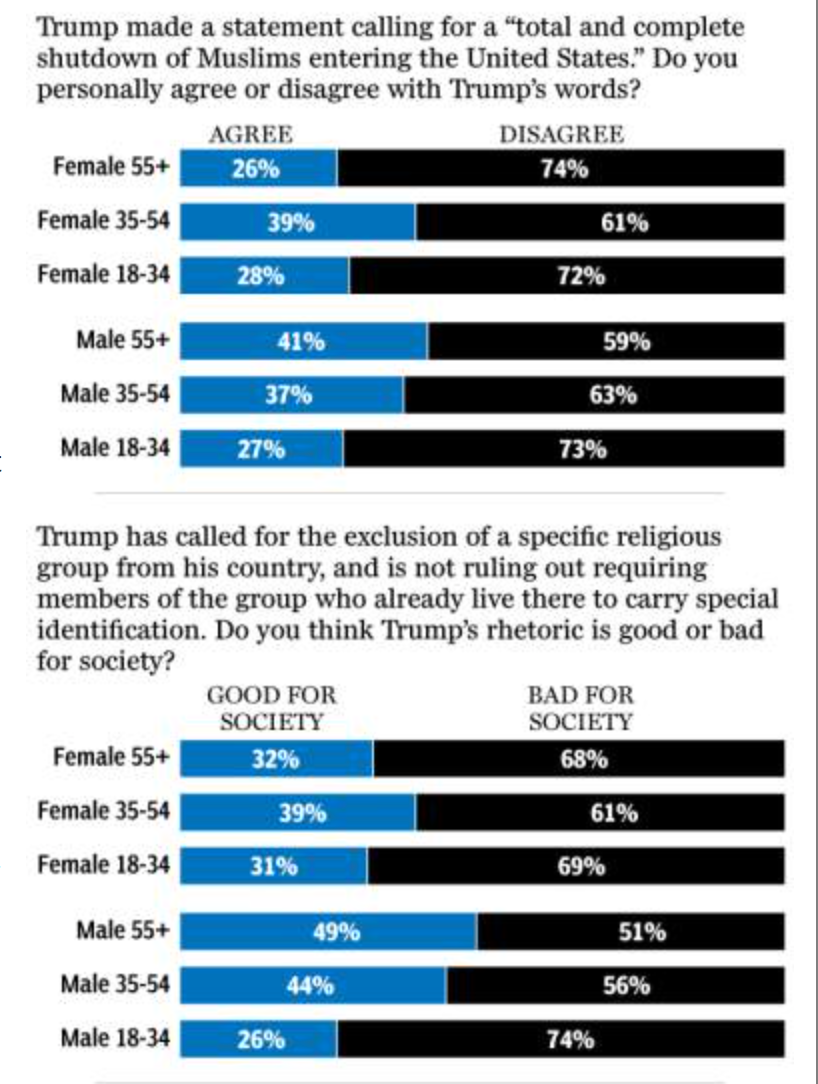
Respondents were also questioned about Trump’s call for a ban on all Muslims entering the United State: 67 per cent said they personally disagree, while about 50 per cent “strongly” disagree.

However, the poll notes that still leaves a sizeable minority — a full one in three — who agrees with Trump, 13 per cent “strongly” so.

Women aged 35-54 and men 55 or older were mostly likely to agree with Trump — by 39 per cent and 41 per cent respectively.

Responses varied across the country.

In every case, support for Trump was more apparent in rural settings, and at its lowest in urban centres like Toronto, Montreal and Vancouver.

Residents of central Canada and the west coast were most likely to dislike Trump, compared with 46 per cent of Saskatchewan residents who said they agreed with him.

Responses were also dictated by politics: people who voted Conservative in the last federal election were far more likely to support Trump, 55 per cent,

Respondents were also divided on whether or not Trump’s remarks are good or bad for society.

Unsurprisingly, the same minority that agrees with Trump’s police is also likely to say his rhetoric is good for society because it brings to light “timely issues without fear of political correctness, ” while 63 per cent disagreed, saying it “encourages fear and hatred towards Muslims.”

Kurl said that while the poll was clear a majority of Canadians do not support Trump, it is important to note the minority results, too.

“There is a significant number of Canadians who agree with Trump’s statements calling for a complete shutdown of Muslims entering the United States,” she said.

“Two in three disagree. The majority disagree. But one in three agree and that is a significant segment of Canadians.”

The poll has a margin of error of 2.5 percentage points, 19 times out of 20.

Source: Canadians turned off by Donald Trump’s inflammatory policies: poll | National Post

British chief rabbi supports teaching Islam in Jewish schools

Welcome contrast to so much of the US Christian right inveighing against any teaching of Islam in US schools. Greater religious literacy in an interfaith context helpful to integration:

Britain’s chief rabbi has called on the country’s Jewish schools to amend their curricula to include Islamic studies in order to be able to comply with new educational guidelines being put in place by the government.

In an interview with the Jewish Chronicle published on Wednesday, Rabbi Ephraim Mirvis took a radically different position than he had expressed in the past, when he and representatives of other Orthodox organizations advocated against the push for British schools to include a second faith in their religious studies curriculum.

The new rules would cut down the amount of time Jewish schools that follow the state curriculum could dedicate to Jewish schools by a quarter.

“Losing 25 percent of the time allotted for teaching Jewish studies as part of the religious studies GCSE (General Certificate of Secondary Education) was a serious loss for Jewish education in our schools,” a spokesman for Mirvis told the Chronicle.

“It is more important than ever that our children have a better understanding of Islam and that we build strong relationships with British Muslims. As such, the chief rabbi has recommended that schools take this opportunity to teach students Islam, a faith which is widely discussed but often poorly understood in public discourse,” he said.

“Although the chief rabbi has not issued any formal guidance on this issue – since, ultimately, it is for the schools themselves to judge how best to tailor their curriculum – we have had a series of positive discussions with a number of our schools and made recommendations to them,” the spokesman added, calling the chance to include Islamic studies a “valuable opportunity.”

The Reform Movement in Britain praised Mirvis on Thursday, with the movement’s senior rabbi, Laura Janner-Klausner, telling The Jerusalem Post that she felt that teaching about Islam was both “an excellent idea” and “long overdue.”

“We are stronger as a faith group, and as a community, when we better understand others in our society,” she said.

The London-based JFS secondary school remained concerned that adequate time be given to the study of Judaism, but welcomed the guidance of the chief rabbi in helping to decide that Islam will be the second religion taught at GCSE.

“Our students will relish this addition to our curriculum and we welcome the opportunity to enhance our students’ understanding of their own religion alongside an increased understanding of others,” said head teacher Jonathan Miller.

Rabbi Marc Schneier, the founder of the New York based Foundation for Ethnic Understanding, which works on Muslim-Jewish dialogue both in the United States and Europe, also approved of the decision.

“Given that Jewish communities live alongside Muslim communities not only in the UK, but around the world, it is very important for Jewish youth to be exposed to the guiding principles of Islam,” he said.

Source: British chief rabbi supports teaching Islam in Jewish schools – Diaspora – Jerusalem Post

Top 10 of 2015 – Issue #5: Governments Increasingly Restrict Citizenship

One of the top international trends in immigration and citizenship policy by the Migration Policy Institute:

The question of who belongs in a nation strikes at the heart of a country’s identity. It is no surprise therefore that governments typically set high requirements governing who can acquire citizenship—and reserve the right to strip it from those who would do the nation harm. In 2015, both citizenship acquisition and revocation came under fire in new ways. Politicians in a number of countries—including the United States—have attempted to restrict who is eligible to become a citizen, while others have expanded the definition of who can be deprived of citizenship. 

Those restricting eligibility have largely been driven by the aim of excluding descendants of unauthorized immigrants or contested minority groups from citizenship—drawing a bright line around “desired” citizens. The second trend has mainly been driven by fears of international terrorism. Canada, Australia, and a handful of European countries have passed or proposed legislation making it easier to strip suspected terrorists—almost all of whom are Muslim and male—of what should be a nation’s most secure and permanent right. Both trends come with a high penalty: potentially marginalizing immigrant or minority communities, and in some cases rendering individuals stateless (for more on the political rhetoric driving these trends, see Issue #6: Refugee Crisis Deepens Political Polarization in the West).

Source: Top 10 of 2015 – Issue #5: Governments Increasingly Restrict Citizenship | migrationpolicy.org

Muslim Teacher Fired After Showing Malala Video – The Daily Beast

If as recounted, another alarming sign of intolerance and discrimination:

“[Principal] Suzanne Cooley received a complaint from the parent of a student about Plaintiff’s use of the Malala Yusufzai video during a lesson,” Hashem’s suit reads. Her supervisor allegedly “told Plaintiff that she could not teach current events in the same manner as her non-Arab, non-Palestinian and non-Muslim colleagues.”

During a later meeting with the district’s superintendent, Cristina Steffner, Hashem says she pointed out that her colleague had played “the same video and it was not a problem,” the suit reads. “Defendant Steffner slammed her hand on the table and said, ‘You are not Lindsay.’ Unlike Plaintiff, Lindsay Wagner is not Arab, not Palestinian and not Muslim.”

Parental complaints apparently started to stack up against Hashem. Some allegedly objected to Hashem’s involvement in a class discussion on a book called Lemon Tree, which tells of an unlikely friendship between Israeli and Palestinian men. A coworker had allegedly asked Hashem to translate a Skype conversation between the students and the Palestinian man featured in the book.

Other parents allegedly complained that Hashem had used a common document-based question that asked students to “compare the actions of John Brown at Harper’s Ferry to the actions of Osama bin Laden on September 11, 2001.” The question is frequently shared on blogs and online databases for U.S. History teachers, according to the lawsuit.

Students allegedly began targeting Hashem online. The lawsuit claims that one student, whose parents had previously complained about Hashem, wrote a Facebook post accusing her of being anti-Israel. Hashem’s brother was a terrorist, the student allegedly claimed in the Facebook post, adding that Hashem was attempting to indoctrinate students with anti-Semitic views.

The Facebook post prompted another meeting with school administrators, according to the lawsuit, in which they allegedly “accused her of discriminating against Jewish students, and also questioned her about her place of birth, her family, and her personal life.”

Hashem was allegedly asked not to reference her cultural or religious background into the classroom, and to refrain from referencing Islam or the Middle East.

But it wasn’t apparently enough for a growing contingent of parents.

“A local Rabbi and several parents contacted the high school administration, including Defendants Cooley and Steffner, and Defendant Board of Education in an attempt to have Plaintiff removed from her teaching position, solely because of her heritage and religion,” Hashem claims.

By April 2015, the school district laid the groundwork for Hashem’s removal. The lawsuit claims that the principal and superintendent “wanted her gone,” and says that Hashem’s supervisor allegedly gave her a poor performance review, indicating that her contract would not be renewed for the following school year. (Hashem has a 3.47/4 rating on the website RateMyTeachers.com, which allows students to anonymously grade their teachers. Her five ratings are generally positive, except for one negative review uploaded after Hashem filed her lawsuit.)

Hashem appealed her contract’s non-renewal in a May 2015 meeting. But while approximately 60 students and parents arrived to support Hashem, according to the lawsuit, the school district’s attorney allegedly turned them away at the door, opting to hold the meeting in private except for five supporters who were allowed in one at a time to speak in Hashem’s defense. Hashem was only given 30 minutes to present her case, she says.

Source: Muslim Teacher Fired After Showing Malala Video – The Daily Beast

Black rights groups call for changes to Ontario’s ‘carding’ rules

The ongoing debate about police carding in Ontario:

The chorus of voices calling for revisions to the province’s carding regulations grew louder Monday as a coalition of black community groups spoke out about the “the deeply problematic gaps” in proposed legislation aimed at halting discriminatory policing in Ontario.

“Ultimately, when it comes to eliminating racial profiling or preventing racial profiling and anti-black racism, the regulation does not go far enough,” said Anthony Morgan, a lawyer with the African Canadian Legal Clinic.

Among the groups speaking out is the Association of Black Law Enforcers (ABLE), which expressed doubt about the effectiveness of carding in a letter to the province this fall.

Carding, also known as street checks, “has yet to be reasonably demonstrated an effective or scientific tool to achieve the intended purpose of public safety,” ABLE president Kenton Chance wrote in a submission to the Ministry of Community Safety earlier this year. The Star recently obtained the submission.

On behalf of membership that includes black police officers across Ontario, Chance told the province that police now have other ways to solve crimes, such as video surveillance, that could be “exponentially more valuable and dependable” than the “hit or miss” information obtained through carding.

ABLE spokesperson Terrence Murray stressed the group does not speak for all black and racialized officers.

But in a statement to the Star, he reiterated that the group could not find any reliable information to prove the effectiveness of carding.

“As black police and peace officers, we live and work in two worlds that have allowed us to develop unique perspectives,” Murray wrote.

In October, Minister of Community Safety Yasir Naqvi unveiled draft regulations aimed at eliminating random and arbitrary police stops. Written after months of public consultation, the proposed regulations would place new limits on how and when police stop, question and document members of the public who are not suspected of a crime.

While many are applauding the sentiment behind the regulation, several dozen rights groups and community leaders have sounded the alarm in recent weeks about problems with the regulations.

Among the major concerns is that the proposed legislation includes too many exceptions that allow police to circumvent the safeguards.

Source: Black rights groups call for changes to Ontario’s ‘carding’ rules | Toronto Star

Immigrant students fare best heading quickly into classroom, OECD study shows

No surprise. Canada has always done well, both absolutely and in relation to other OECD countries, in immigrant education outcomes:

A sweeping new study of immigrant students around the world shows they do best in countries that bring them into regular classrooms as quickly as possible, where teachers feel comfortable working with children of different backgrounds and where extra help is offered to immigrant families — all hallmarks of GTA schools.

The 124-page report by the Organization for Economic Co-operation and Development (OECD), to be released Thursday, looks at how immigrant students in some 30 countries, including Canada, performed on a standardized test in the “3 Rs” in 2012, and concludes their success depends largely on how the host country helps them integrate in school.

“Immigrant students perform better and report feeling more accepted in some countries than others, which suggests education policy has an impact on integration,” said the report, “Immigrant Students at School: Easing the Journey towards Integration.”

It suggests the countries that best help immigrant students succeed move them into regular classrooms while giving them a crash course in their new language, rather than segregate them until they have mastered the language, as happens in some countries.

In Ontario, schools must place newcomers in a regular classroom for at least part of each day, noted Paula Markus, the Toronto District School Board’s co-ordinator of English as a Second Language (ESL).

“We don’t want to segregate children, even from the first days, because while we’re giving them English language support we know it’s important for them to get to know English-speaking peers and make friends and that helps their adjustment,” she said.

Nor should teachers in the diverse GTA be intimidated by the wave of refugees Canada is expecting, she said, “because we have the most amazing, diverse classrooms in the world here. “As Justin Trudeau said, this is 2015.”

Source: Immigrant students fare best heading quickly into classroom, study shows | Toronto Star