Behind the sunglasses: Harjit Sajjan’s rise to cabinet

Good profile on Harjit Sajjan (Canada’s new defence minister for foreign readers) – extract on immigration but long-piece worth reading:

In his early weeks as Trudeau’s defence minister, immigration figured prominently for Sajjan. His first pressing assignment was making sure the Canadian Forces contributed to the new government’s signature goal of bringing thousands of Syrian refugees to Canada quickly. Others might wonder how those Syrians will adjust, but Sajjan professes to have no doubts. “They’re going to be up and on their feet so fast—that’s how I remember it,” he says. “It’s not just about skills. It’s about the kind of people you bring in.” He sees the Syrian refugees as certain to be hard working, and their children as “the real immigration strategy.”

To hear him enthuse about the benefits of immigration for Canada, and the near certainty of newcomers achieving the Canadian dream, it’s possible to imagine that his own path might have been—those early berry-picking mornings notwithstanding—a smooth rise to success. That hasn’t been the case. Sajjan is a turban-wearing member of British Columbia’s Sikh minority, a community that has often attracted more than its share of bigotry from outside and been riven by more than its share of strife from within.

Sajjan talks of facing overt racism, particularly when he was training as a reservist in the Canadian military. As well, his entry into politics in 2014 as Liberal candidate in the Vancouver South riding revealed fault lines between Sikhs, although he says those tensions eased in 2015. He is one of four Sikhs in Trudeau’s cabinet—a remarkable contingent for a minority that represents only about 1.4 per cent of the country’s population. The others are Innovation, Science and Economic Development Minister Navdeep Bains, Infrastructure and Communities Minister Amarjeet Sohi and Small Business and Tourism Minister Bardish Chagger.

In his early weeks as Trudeau’s defence minister, immigration figured prominently for Sajjan. His first pressing assignment was making sure the Canadian Forces contributed to the new government’s signature goal of bringing thousands of Syrian refugees to Canada quickly. Others might wonder how those Syrians will adjust, but Sajjan professes to have no doubts. “They’re going to be up and on their feet so fast—that’s how I remember it,” he says. “It’s not just about skills. It’s about the kind of people you bring in.” He sees the Syrian refugees as certain to be hard working, and their children as “the real immigration strategy.”To hear him enthuse about the benefits of immigration for Canada, and the near certainty of newcomers achieving the Canadian dream, it’s possible to imagine that his own path might have been—those early berry-picking mornings notwithstanding—a smooth rise to success. That hasn’t been the case. Sajjan is a turban-wearing member of British Columbia’s Sikh minority, a community that has often attracted more than its share of bigotry from outside and been riven by more than its share of strife from within.Sajjan talks of facing overt racism, particularly when he was training as a reservist in the Canadian military. As well, his entry into politics in 2014 as Liberal candidate in the Vancouver South riding revealed fault lines between Sikhs, although he says those tensions eased in 2015. He is one of four Sikhs in Trudeau’s cabinet—a remarkable contingent for a minority that represents only about 1.4 per cent of the country’s population. The others are Innovation, Science and Economic Development Minister Navdeep Bains, Infrastructure and Communities Minister Amarjeet Sohi and Small Business and Tourism Minister Bardish Chagger.

….But given his background—from berry picking, to overcoming bigotry, to battling criminals and insurgents—Sajjan’s perspective is unique in many ways. If that first glimpse of him in a snapshot piqued our interest, it’s the layers behind the sunglasses and beneath the camouflage that make Sajjan a figure to watch as the Trudeau era unfolds.

Source: Behind the sunglasses: Harjit Sajjan’s rise to cabinet
Why a coin celebrating female suffrage glosses over uncomfortable truths

Like all such debates, the value lies in the educational and learning value about history. But the coin is a welcome change from the previous government’s removal of any women (save the Queen) on paper money:

This week, a minor fracas erupted over perceived delays in the approval of new 2016 $1 coin celebrating a landmark in female suffrage in Canada: the 100th anniversary of Manitoba women being granted the right to vote in provincial elections. Approval of the Canadian Mint’s plans were apparently stalled in Cabinet in July under the Harper government before the federal election and were finally rubber-stamped by the new Trudeau cabinet in early December. Ignored in the ado is a bigger point: that, as wonderful as a coin celebrating female suffrage is, this new shiny token can’t help but gloss over the uncomfortable truth of just how racist, sexist and hard-won that achievement was.

A more accurate “historically commemorative” recognition of female suffrage in Canada would require the Mint to issue a boxed set of at least a dozen coins reflecting vast discrepancies, provincially and federally, in who received the vote and when. That, one would hope, would finally dispel the myth that Canadian women won the right to vote federally in 1918, which is both true and false. Inuit women weren’t given the federal vote until 1950. And wasn’t until 1960 that Ottawa extended the franchise to First Nations men and women. That means any coin properly commemorating all Canadian women being able to vote federally couldn’t be issued until 2060—hardly a shining beacon of a progressive Western democracy (by comparison, Australia was the first country in the world to give women both the right to vote in federal elections and the right to be elected to parliament on a national basis in 1902; New Zealand granted women the right to vote in 1893; the United States gave all female citizens the right to vote federally and in state elections in 1920).

Far more consoling is the feel-good takeaway from a coin that will boast “WOMEN’S RIGHT TO VOTE”, in both official languages, and “1916-2016.”  Celebrations have been twinned to the release of five million commemorative coins in a few months’ time, Canadian Mint spokesperson Alexandre Reeves told Maclean’s: “Themes we choose often coincide with special commemoration plans of the government, which is certainly the case with women’s right to vote.”

Nancy Peckford, national spokesperson for Equal Voice, an Ottawa-based national multi-partisan organization dedicated to electing more women, welcomes the coin as an symbolic gesture that could usher in what she calls “an important and revealing conversation about women in this country.” The journey of women’s franchise in Canada in the provincial and territorial level is quite complex, says Peckford. “There is no one single anniversary, but 1916 was a watershed.”

In true provincial Canadian fashion, the right to vote reflects regional politics and values. That women in the Prairies were first to break provincial voting barriers (Manitoba was quickly followed by Saskatchewan and Alberta) is seen to reflect recognition of their equal involvement in settlement and homesteading. However, women in Quebec wouldn’t vote provincially until 1940—24 years later—the result of enduring opposition by legislators and prominent Catholic clergy.

Female suffrage federally provides another history lesson in perceived female status. The Wartimes Election Act of 1917 extended  the vote to women close to World War I front lines—nurses, women in the armed forces, and female relatives of military men. (Simultaneously, thousands of citizens naturalized after 1902 were disenfranchised.) The next year, all female “citizens” aged 21 and over became eligible to vote (whether or not they could vote provincially), provided they adhered to conditions set by Elections Canada: “age 21 or older, not alien-born and meet property requirements in provinces where they exist.” That firmly excluded Aboriginal peoples. (According to Elections Canada: “With the exception of veterans, The Dominion Franchise Act of 1934 explicitly disqualified First Nations persons living on reserves and Inuit people from voting in federal elections.”)

Source: Why a coin celebrating female suffrage glosses over uncomfortable truths

Labour Market Participation of Immigrant and Canadian-born Wives, 2006 to 2014 (StatsCan study)

A good detailed StatsCan study comparing labour market participation of immigrant and non-immigrant women with an abundance of detailed data and breakdowns.

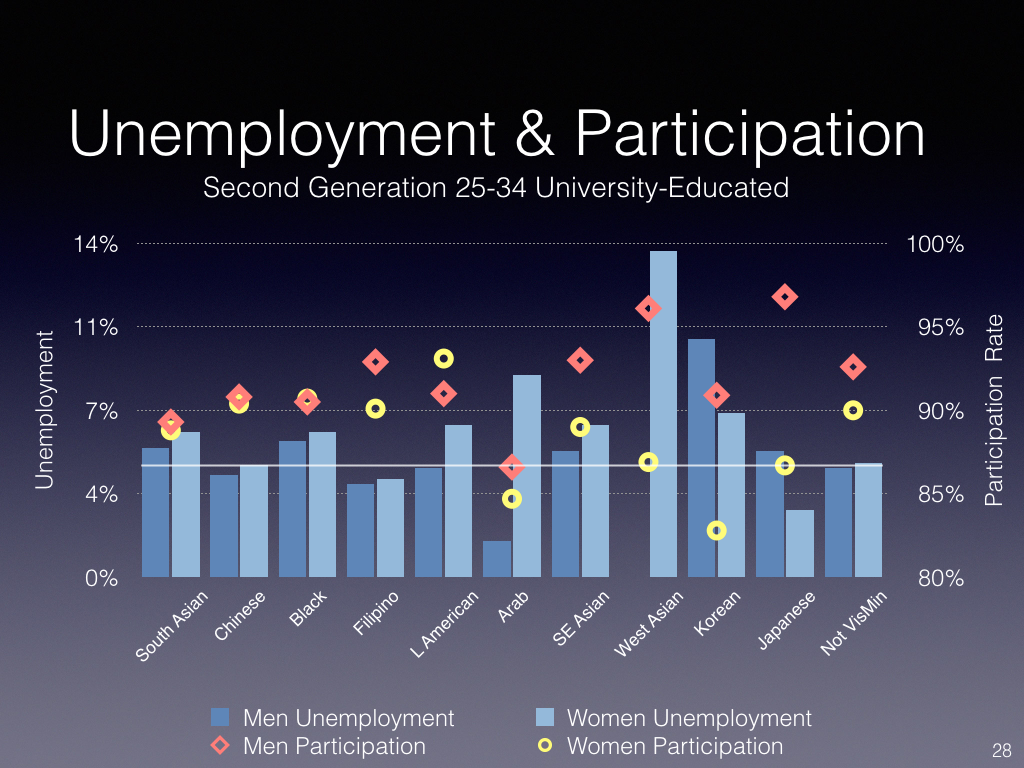
MiC Deck - Dec 2015.028The chart above compares 2011 NHS unemployment and participation rates for visible minority groups with non-visible minorities for second-generation, aged 25-34, university-educated, which shows some interesting gender differences between groups.

Summary of the StatsCan study:

Immigrant wives participate in the Canadian labour market less than do Canadian-born wives. Because this lower participation has implications for the income and living standards of immigrant families, understanding the sources of the difference is important.

This study shows that differences in socioeconomic characteristics account for about half of the difference in labour market participation between immigrant wives and their Canadian-born counterparts observed for the 2006-to-2014 period. The results indicate that female-to-male labour market participation ratios in the source country and, to a lesser extent, family size are key drivers of the difference in participation observed between the two groups of women. The lower wages received by immigrant women in the Canadian labour market appear to play a role, but their contribution is difficult to quantify.

The results raise the question of which factors country-level female-to-male labour market participation ratios capture. Frank and Hou (2015) show that these ratios remain statistically significant in models of the labour market participation of immigrant women even after source-country gender-role attitudes are controlled for. This finding suggests that these ratios capture, at least partly, other influences that affect the participation of immigrant women.

Overall, the study shows that a thorough understanding of differences in family income between immigrants and the Canadian-born requires an understanding not only of wage differences―as most Canadian studies have achieved so far―but also of differences in the labour market participation of wives.

Source: Labour Market Participation of Immigrant and Canadian-born Wives, 2006 to 2014

New airline passenger vetting could amount to racial profiling: [privacy] watchdog

Always a thorny issue, how to use big data and other tools to focus on where the risk is the greatest. Our family joke whenever I was subjected to enhanced screening (always politely) was that I was the token white person to demonstrate no profiling.

While some of the big data used includes this kind of racial or ethnic data, some likely also includes information regarding travel patterns and other behavioural data (e.g., paying for tickets with cash):

The federal border agency’s new system for scrutinizing incoming air passengers could open the door to profiling based on race or other personal factors, warns Canada’s privacy czar.

Privacy Commissioner Daniel Therrien is pressing the Canada Border Services Agency to explain the program’s rationale and build in safeguards to protect civil liberties.

Canadian law requires commercial airlines to provide the border agency with specific information about passengers flying to Canada, including name, birthdate, citizenship, seat number and other data.

For years the border agency has used the information to try to zero in on terrorists or other serious international criminals. Travellers are assessed for risk, allowing the agency to single out those with high-risk scores for closer examination at the airport.

The border agency is moving to a system known as scenario-based targeting, already used by the United States, as part of Canada’s commitment to work closely with Washington under a perimeter security pact forged in 2011.

The border agency says the new scheme will be more efficient, effective and accurate, directing the focus to a smaller segment of the travelling population who represent a potential high risk.

The new scenario-based method uses Big Data analytics — extensive number-crunching to identify patterns — to evaluate all data collected from air carriers, says Therrien’s office, which reviewed the border agency’s privacy impact assessment of the project.

“Designed to harmonize with the system used by the U.S., it could allow the operator to, for example, search for all males aged between the ages of 18-20 who are Egyptian nationals and who have visited both Paris and New York,” Therrien says in his recently released annual report.

The privacy commissioner is concerned travellers may now be targeted for increased scrutiny if they fit the general attributes of a group — “subjected to recurring and unnecessary attention at the border because of characteristics they cannot change,” such as age, gender, nationality, birthplace, or racial or ethnic origin.

Therrien’s office recommended the border agency:

— Demonstrate the necessity of scenario-based targeting, beyond the general purpose of aligning Canada’s system with that of the U.S.;

— Be more transparent by fleshing out the privacy impact assessment with general descriptions of the types of scenarios that might be used to identify potentially high-risk travellers;

— Conduct regular reviews of the “effectiveness and proportionality of scenarios,” including an examination of impacts on civil liberties and human rights;

— Prepare a broader privacy assessment of the overall program used to collect passenger information from airlines.

The border agency “responded positively” to all of the recommendations, Therrien’s office says in the annual report.

Source: New airline passenger vetting could amount to racial profiling: watchdog – The Globe and Mail

Muslim men must learn to treat women as equals: Sheema Khan

One of the more interesting sessions we held on multiculturalism and faith was a small multi-faith roundtable, with the most interesting exchange being between Sheema Khan and Alia Hogben (Canadian Council of Muslim Women) who challenged some of the more conservative or traditional male Imams present on gender issues.

Both have continued to be outspoken as seen in this latest piece by Sheema:

From 2000 to 2005, I served as the chair of CAIR-CAN, a grassroots advocacy organization that fought discrimination against Muslims. Whether it was a Muslim woman denied employment because of her hijab, or the rendition of Maher Arar, we fought for basic human rights based on the Canadian Charter of Rights and Freedoms. This journey opened my eyes to my own double standards: I fought for Muslims to be treated with basic human dignity by the wider society, yet looked the other way when such treatment was denied to women within my own community.

Toward the end of my CAIR-CAN tenure, I could no longer stand the hypocrisy, and decided to tackle a fundamental problem that our community has been content to ignore: the treatment of women as second-class human beings. As chair, I came across incidents against Muslim women that would never have been tolerated had these been perpetrated by a non-Muslim. But if a Muslim did it, well, we would let it go, hoping that attitudes would one day change.

It was, and continues to be, the denial of the fact that many Muslim cultures have a bias against women. Consider the past few years of the Gender Gap Index, published by the World Economic Forum. It continually lists predominantly Muslim countries in the bottom rung of societies that equitably distribute resources between men and women. From the super rich (such as Saudi Arabia and other Gulf States) to the impoverished, a large chunk of Muslims live in societies where women are shortchanged in terms of development, opportunity and participation.

The bulk of Muslims in Canada are immigrants who naturally bring to this country the attitudes and norms shaped by their culture of birth. These will be transformed by Canadian norms; the transformation varies from person to person. Suffice it to say that many traditional Muslim institutions continue to operate on a patriarchal model, in which women are either unwelcomed or merely tolerated, but are always expected to keep the status quo. Those who demand basic rights are labelled with the “f” word – feminist.

….Some will be critical of the airing of “dirty laundry” during difficult times for Muslims. Yet meaningful discussions about the treatment of women have been avoided for far too long. To what end? What we don’t need is another lecture about the dress and behaviour of the “ideal” Muslim woman. Instead, we need to hear more about men taking responsibility for their actions, and treating women as equal human beings.

Source: Muslim men must learn to treat women as equals – The Globe and Mail

Immigrants value education – so we should value them

MiC Deck - Dec 2015.030More evidence that immigrants and their children tend to be more well-educated than “old stock” Canadians. The above chart shows the same results using the 2011 NHS by visible minority group from my book:

In the past month, Canadians have witnessed the arrival of the first of 25,000 Syrian refugees expected to make a new home here by the end of February. More may be arriving after that.

The main theme in the news media so far has been the debate about the short-term costs and challenges of bringing such a substantial number of immigrants from a war-torn region, as well as longer-term concerns about the possibility of raising future generations of “home-grown” terrorists.

In our recent research on this subject, we take a different longer-term perspective in addressing how the children of immigrants perform in terms of postsecondary education (PSE) in Canada. This is important because PSE is critical, not only to an individual’s economic and social success, but also to the country’s prosperity.

Our analysis shows that first- and second-generation children of immigrants access PSE at much higher rates than non-immigrant youth. By the age of 21, 86 per cent of first-generation children of immigrants (that is, those who themselves immigrated to Canada along with their parents) obtained postsecondary education, with 84 per cent of second-generation immigrants (those born in Canada to immigrant parents) doing the same.

This record on the part of the children of immigrants compares favourably to the 72-per-cent PSE participation rate among non-immigrant youth. For those from the region that includes Syria, 93 per cent and 96 per cent of first- and second-generation children of immigrants, respectively, had moved into postsecondary education by the age of 21, with most having attended university rather than college or trade school.

Source: Immigrants value education – so we should value them – The Globe and Mail

StatsCan to unveil new ‘efficient’ long-form census for 2016

Good example of the public service doing its job and preparing for a possible change:

When the Liberals were sworn into office in November, one of their first orders of business was to announce the reinstatement of the long-form census.

The timeline seemed very tight — the first forms are to go out to residents in the North in February.

But Marc Hamel, the census program director general, says the agency had planned for risks associated with the 2016 census. One of those risks was if a new government decided to bring back the long questionnaire.

“It had already been in the public sphere that opposition parties last year were saying, if they were elected, they would bring back the mandatory long-form census, so we had started to look at how that would be possible,” Hamel said in an interview.

The agency decided to design the questionnaire in a more adaptable format.

Rather than sending selected households separate pieces of mail with the short form and then the National Household Survey, the questionnaires were integrated into one document.

“That design was going to be efficient and it was going to work for both approaches,” said Hamel. “From that perspective, no redesign was required. We were simply able to move ahead with the same questionnaires that we had already designed for 2016.”

Also, because most Canadians fill out the census online — 64 per cent in 2011 — changing details in a computer system was not a major overhaul.

The letter that accompanies the questionnaires will allow the agency to underline that the long part is mandatory again. Census staff will also drive home the message.

Fewer people will have to fill out the long form than last time, one in four households rather than one in three with the NHS. Statistics Canada has had to print more short-form questionnaires as a result of the change.

The agency doesn’t think it will save money with fewer people getting the bigger package. It expects it will have more responses to process because of the return to the mandatory format.

The main challenge will come from adjusting to the data logistics of bringing back the long-form census. Bar codes help the agency keep track of where they drop off which forms and some of that work will have to be rejigged.

There will also be a public awareness campaign to make sure that people realize they need to fill out the forms. Hamel says the agency never really emphasizes the penalties associated with not filling out the forms — a $500 fine or up to three months in jail, or both.

“Census information is really important, and that’s where we put the focus,” said Hamel.

“What do we use the census information for, why is it important for communities, and why is it important for people to participate.”

Source: StatsCan to unveil new ‘efficient’ long-form census for 2016 – The Globe and Mail

And one of the new challenges:

Quinn Nelson wants to be counted in the 2016 long-form census, but when it comes to the question of gender identity there’s a problem: Nelson is transgender and identifies as neither male nor female.

“As a non-binary person, often when I fill out forms there’s only two options given to me and that’s not enough for me,” Nelson said in an interview on CBC’s Power & Politics.

In November, Nelson wrote an email to Navdeep Bains, the minister responsible for Statistics Canada and the census. Nelson didn’t want to violate the law by not filling out the questionnaire.

The University of Calgary sociology student also wanted to make sure Statistics Canada was going to provide an accurate reflection of the country.

The census assumes that 100 per cent of the respondents can answer that they are either male or female, “and that’s not accurate,” Nelson said.

“The census is used by a lot of policy makers, sociologists and government officials to make decisions. They really need to know what their population is. That’s the point of the census.”

….Bains hasn’t responded to Nelson, but Statistics Canada did. Deputy chief statistician Connie Graziadei said the 2016 census questionnaire had already been approved and published, but there is an option for Nelson.

“I was told to answer neither, to leave the question blank; also to answer in the comments why I found the question inadequate.”

Transgender student says some Canadians need 3rd option for gender on census

Sensitivity key for Canadian foreign service, says religious freedom envoy

Encouraging that the promised spirit of openness by the Liberal government allowed this interview. Agree with Bennett’s fundamental thesis that diplomats would benefit from greater understanding of the role that religious faith plays.

Arguably, the same could be said for public servants more generally, given that many if not most reasonable accommodation issues involve religions:

Canada’s ambassador for religious freedom says the explosive rift between Saudi Arabia and Iran highlights religion’s growing influence on global affairs — and a potential “blind spot” for Canadian diplomats.

In an exclusive interview, Andrew Bennett said Canadian foreign service officers and other government officials need more training on the role that religious faith often plays in an individual country’s domestic policies and international relations.

“We need to ensure that if we want to be really nuanced and winsome in how we engage countries that are deeply religious, that we can actually employ language that enables us to have a deeper engagement,” he said. “If we can’t do that, then we risk developing or having a serious diplomatic blind spot.”

….On the broader question of religious reconciliation, Bennett said Canada and its western allies “are not going to solve the Sunni-Shia divide. But we need to understand it.” Key to that, he says, is making sure Canadian diplomats and government officials can understand, appreciate and speak the “language” of religion.

“When we engage, we can at least be somewhat conversant in the language that is used in Iran,” Bennett said. “I don’t mean Farsi. I mean what are the cultural, religious reference points that we need to be aware of and need to sort of integrate into that dialogue.”

The Pew Centre, a U.S.-based think tank, has estimated that 84 per cent of the world population has some type of religious affiliation, Bennett said. Religion has also played a role in the conflict between Russia and Ukraine, he said, as well as in Nigeria and other places.

“Religion is becoming more of a geopolitical fact. It’s informing geopolitics,” said the ambassador.

“In Canada, because we live in a fairly secularized society where religious faith is not a strong component in shaping political, economic (or) social discourse, we’re not formed through our education and other things in a way that allows us to engage necessarily in that discussion around faith,” he added.

“So I think we need to increase our knowledge and increase our ability to engage in questions of religion.”

Bennett said his office, which was established under the previous Conservative government three years ago, has been working to expand such understanding in Canada’s foreign service. Several courses were offered and quickly filled up. His hope is that such work will be increased under the new government.

“At a more foundational level, in Canada and in the United States and in many Western countries, really since the Enlightenment, religion and religious faith has increasingly become absent from public discourse and from the public space, and it’s been viewed as something purely of the private sphere,” he said.

“When it comes to foreign affairs and international relations, when we leave a very secularized country such as Canada and go to a country that is not at all secular such as Saudi Arabia, Indonesia, Iran, Nigeria, there’s a bit of a disconnect. And we need to address that.”

Source: Sensitivity key for Canadian foreign service, says religious freedom envoy | Ottawa Citizen

South Africa’s ruling party calls for tougher anti-racism law

Sad to see these types of remarks in this day and age, irrespective of whether one thinks new anti-hate speech legislation needed or not:

After a national uproar over racist comments on social media, South Africa’s ruling party is calling for a new law to prohibit the “glorification of apartheid,” based on German laws that criminalize the denial of the Holocaust.

The latest outrage over racism is a sign of the rising tensions in South Africa, once lauded as a “rainbow nation” and a moral beacon for the world after apartheid ended in 1994.

In today’s South Africa, with its stagnating economy and growing frustration among unemployed youth, there is mounting anger over racial remarks by the affluent white minority. Many white people, for their part, are openly resentful of their diminished status.

The latest furor erupted on social media when a realtor, Penny Sparrow, complained that black people with “no education” were leaving garbage on public beaches. “From now I shall address the blacks of South Africa as monkeys,” she said in a Facebook post.

Ms. Sparrow was denounced by thousands of outraged South Africans after her post emerged on Sunday. On the same day, a prominent South African banker, Chris Hart, went on Twitter to accuse the black majority of having “a sense of entitlement” and “hatred toward minorities.” He, too, was widely criticized, and within a day he was suspended from his job at Standard Bank, which said his tweet was “incorrect” and had “racist undertones that do not reflect our values.”

There are already laws against hate speech in South Africa, and there is even a court, the Equality Court, to deal with cases of racial discrimination. But the ruling party, the African National Congress, says this is not enough.

“We can no longer as a nation tolerate such dehumanizing violations, where the black majority are treated as subhumans and are referred to as monkeys, baboons and other derogatory racist epithets in the land of their birth,” said a statement on Tuesday by the ANC’s parliamentary office.

“As the nation is justifiably seething with anger and disappointment at yet another blatant act of racial bigotry, we know too well that there is little that can be done in terms of our legislative provisions to sufficiently punish the perpetrators.”

The political party to which Ms. Sparrow belonged, the opposition Democratic Alliance, went to the police on Monday to file criminal charges of “crimen injuria” against her. This is a provision in South African common law that prohibits a serious attack on the dignity of another person.

But the ANC wants a tougher law, modelled on the European laws that prohibit the denial of the Holocaust. Any action against Ms. Sparrow and Mr. Hart is likely to be “whitewashed” under the existing system, it said. “The current legislative provisions are not sufficient to punish and dissuade racists,” it said.

“As the majority party in Parliament, we will soon investigate creating a specific law or amending the existing legislation to ensure that acts of racism and promotion of apartheid are criminalized and punishable by imprisonment.”

Anyone who “glorifies” the apartheid system “essentially promotes and celebrates acts of criminality committed against black people,” the ANC added. “Such a person represents a serious danger to our society and our national reconciliation efforts, and must be dealt with through our criminal justice system.”

Source: South Africa’s ruling party calls for tougher anti-racism law – The Globe and Mail

Canada: Please don’t stop empowering Afghan girls

Well-argued piece by Maryam Naquibullah:

But a woman with an education has a voice, and a woman with a job has influence. She supports her family – her uncles, her brothers, maybe even her father. And slowly, things start to change. The neighbours who think that educating a woman is about as valuable as educating a dog start to change their minds when they see a house with a car and a garden. All because a woman is working.

Since 2006, the ACCC and its sister organization, the Kandahar Institute of Modern Studies, have offered professional education to more than 4,000 women in Kandahar, and enabled more than 2,500 employed graduates to support more than 12,500 family members. All for a total investment of less than $600,000 from the Canadian government. These schools have been a beacon for the women in Kandahar for almost a decade, educating most of the women now working in professional jobs. But that beacon is about to go out.

I urge you, as Minister of International Development, and your fellow members of Parliament to please support our recent proposal – the Women’s Skills for Rights and Empowerment Program – submitted to Global Affairs Canada. This multiyear program would reach more than 4,500 women in Kandahar, Helmand and Zabul provinces, and create lasting partnerships between Afghan civil-society organizations and international non-profit organizations.

I understand that there are many important priorities for the Canadian government at the moment, and that there is a huge need to help the refugees who are fleeing conflict and extremism. And I also hope you will spare a thought for those organizations that are standing up against the roots of extremism, and that are preventing people from fleeing their homes in the first place.

Source: Canada: Please don’t stop empowering Afghan girls – The Globe and Mail