Charities push back against Liberals on political audits

Interesting given that the mandate letter of National Revenue Minister Diane Lebouthillier includes the following commitment:

Allow charities to do their work on behalf of Canadians free from political harassment, and modernize the rules governing the charitable and not-for-profit sectors, working with the Minister of Finance.  This will include clarifying the rules governing “political activity,” with an understanding that charities make an important contribution to public debate and public policy.  A new legislative framework to strengthen the sector will emerge from this process. –

Apparently, this will only be on a go-forward basis:

Some Canadian charities are reviving a campaign to get tax auditors off their backs after the Liberal government delivered what the charities say is a half-measure in ending “political harassment,” a promise from the 2015 election campaign.

At least 14 charities, including the Sierra Club Foundation and the World Wildlife Fund, launched a letter-writing campaign and petition this week calling on the Liberal government to stop all political-activity audits started by the Harper Conservatives in 2012.

“Charities under audit for political activities from the previous government are still under audit,” says a statement on a website, created by a charities coalition last year.

“These audits need to end immediately. Reform of the rules that allowed these audits must begin.”

Some 54 charities were caught by CRA’s political-activities audits, and five were given notice they would lose their charitable registrations, meaning they could not offer tax receipts to donors.

Critics have said the rules restricting political activities are unclear, and that the audits effectively gagged some groups, a phenomenon dubbed “advocacy chill.”

Optimism dampened

The charities sector had been heartened by the Liberals’ platform, which promised to “allow charities to do their work on behalf of Canadians free from political harassment.”

But the optimism was soon dampened. On Jan. 20, National Revenue Minister Diane Lebouthillier said 24 political-activity audits currently underway will continue their course, and the five groups under notice of deregistration will not be spared, though they can appeal.

The only change was that auditors would be stood down in six cases of charities scheduled for political-activity audits that had not yet begun, and the $13.4-million program would eventually be wound up.

Tim Gray, executive director of Environmental Defence, which is facing deregistration, said in an interview: “Let’s recognize what actually happened with the previous government and put an end to this.

“We are trying to escalate the importance of action on this issue. So we’re going to relaunch and encourage people to contact the minister and the prime minister to get them to act on their commitments.”

Source: Charities push back against Liberals on political audits – Politics – CBC News
CMHC hits roadblocks in review of foreign owners

Suggests legislation might be needed given resistance of the realtors (too good a business line for them to be forthcoming on a voluntary basis?):

Canada’s national housing agency is focusing efforts to collect data on foreign real estate investors by studying temporary residents, including international students studying in Canada, as well as Canadian citizens who live abroad. But it has run into resistance in its attempt to ask real estate agents, developers and lawyers to voluntarily provide information on international clients.

Canada Mortgage and Housing Corp.’s struggle to collect reliable data about foreign real estate investors is detailed in hundreds of pages of documents originally released to Bloomberg under Access to Information and subsequently provided to The Globe and Mail.

The agency’s first challenge was to settle on a definition of foreign investor. Its “final definition,” according to minutes of a January meeting, includes Canadian citizens whose permanent residence is in another country, along with what it calls “non-permanent residents.” They include temporary foreign workers, visitors to Canada and those with no legal ties to the country. They also include the more than 200,000 international students who are in Canada on study visas.

The inclusion of students as foreign investors was controversial even within the federal agency, with minutes of the meeting noting that “there was no unanimous agreement on whether foreign student buyers should be counted as foreign buyers or not.” CMHC is proposing to flag international students separately from other non-permanent residents.

The number of international students in Canada increased 36 per cent between 2010 and 2014, to nearly 212,000, according to Citizenship and Immigration data included in the CMHC documents. While the number who eventually apply for postgraduate work permits has risen from 10.9 per cent in 2010 to 17.6 per cent in 2014, “the large majority of students actually do not become permanent residents,” CMHC wrote. “This would justify classifying ‘student buyers’ as foreign buyers.”

There is no hard data on how many international students buy housing while studying in Canada, but real estate agents in Vancouver and Toronto often point to the fact that many foreign buyers, particularly those from China, buy housing here so that their children can go to school. “We feel some people, like students, are buying properties instead of renting with money mainly coming from outside Canada,” a CMHC analyst wrote in an internal exchange from early December.

The federal housing agency also drafted a proposal for a separate research project that would measure “the effects of non-permanent residents on housing demand.” It held discussions with HSBC Bank late last year about ways to collect data that would “allow identification of foreign mortgage applications,” along with Canada Revenue Agency, which requires non-resident homeowners to pay withholding taxes on rent and real estate sales.

One of the ways CMHC is proposing to collect data on foreign investors is a pilot project to survey real estate agents and developers about clients who might be considered foreign buyers, starting with Vancouver. The federal agency is also looking to include questions about the residency status of buyers and owners to its survey on condo owners and housing starts and hopes to work with provincial land registries to add data about foreign owners, starting in Ontario.

But it has run up against resistance from the real estate industry, with internal documents laying out that meetings with developers to discuss adding foreign residency questions to CMHC regular surveys of condo sales yielded “mixed results.”

“Some [condo] developers are willing to provide the information while others are not willing to provide it,” the agency wrote.

One real estate industry organization in B.C., the name of which was redacted in the CMHC documents, told the housing agency that it didn’t think its “members would be forthcoming with the information requested, despite knowing the background of their buyers.”

Source: CMHC hits roadblocks in review of foreign owners – The Globe and Mail

Canadians support visa-free travel between some [largely white] countries: poll

Apart from the practicalities (more complicated than portrayed by the advocates), this is a throwback to imperial preferences and has a xenophobic tinge given that all four are majority white countries.

Echoes of ‘old-stock’ vs new stock, and hard to see how it would be a winner given the underlying message:

A majority of Canadians support the right – along with Australians, New Zealanders and Britons – of residents to have unrestricted travel between the countries without the need for visas, a new poll has found.

According to the poll commissioned by the Britain-based Royal Commonwealth Society, 75 per cent of Canadians believe that residents of the four Commonwealth countries should have an arrangement similar to the European Union, which allows citizens to travel freely to live and work in member countries. The poll, conducted by Nanos Research, is part of the group’s ongoing efforts to promote greater mobility between the countries.

The results showed 82 per cent of New Zealanders, 70 per cent of Australians and 58 per cent of Britons also support the idea. The survey of 1,000 Canadians was conducted in late January.

Tim Hewish, the society’s policy director, said the group plans to lobby politicians in Ottawa in the coming months. “It’s the responsibility of elected governments to respond to these types of responses from their citizens,” he said.

Currently, Canadians require a visa for all travel to New Zealand and Australia. Canadians visiting Britain for work or study, or on trips longer than six months, also require a visa.

The four countries were selected out of the 53 Commonwealth nations because they share similar socioeconomic characteristics, Mr. Hewish said. “It is intended that this could apply to other Commonwealth countries with comparable economic characteristics over time,” his statement said.

But Emily Gilbert, a University of Toronto geography professor who studies citizenship and migration, voiced concern about which countries were included – and excluded – from the proposal, and pointed to anti-immigration sentiments being played out around the world.

“Given the context of us really being really antagonistic against people coming from places who we think are not like us, I find it highly problematic that this proposal – ‘These are people like us, they’re okay’ – that this proposal is getting this kind of groundswell of enthusiasm,” she said.

She added that arriving at such an arrangement between the four countries would be far from simple. Even if their leaders agreed to it, the implementation would require the involvement of countless departments and ministries at multiples levels of government. “I’m skeptical that it could actually be put into place,” she said.

Mr. Hewish said specific details, such as whether residents would have the right to vote, could be worked out between the individual countries. Mr. Hewish attributed the slightly lower level of support in Britain, at 58 per cent, to recent debate over a possible British exit from the EU. In fact, the survey found that only 46 per cent of respondents in Britain expressed support for continued free movement within the EU.

The poll, released Sunday, is just the latest in an ongoing effort by groups lobbying for such an arrangement. Last year, the Commonwealth Exchange – the policy arm of the RCS – released a report floating the idea. That received support from London Mayor Boris Johnson, who has spoken publicly about creating a “bilateral free labour mobility zone” between Australia, New Zealand and Britain.

Around the same time, an online petition created by a Vancouver-based group called the Commonwealth Freedom of Movement Organization received more than 100,000 signatures.

“The U.K., Australia, Canada and New Zealand share the same head of state, the same common-law legal system, the same Western culture, the same respect for democracy and even the same language,” the petition states. “It is therefore unreasonable for each to not share the same economic, political and cultural benefits that a free-movement policy would bring.”

Source: Canadians support visa-free travel between some countries: poll – The Globe and Mail

Immigrants help drive Metro Vancouver’s housing market: study

Dan Hiebert and David Ley continue their insightful work in assessing ethnic concentration and impacts on housing:

Immigrants have a major impact on fast-rising house prices in Metro Vancouver and Toronto, according to the author of a new study.

In a unique research project, UBC geographer Daniel Hiebert discovered that ethnic Chinese and South Asians become homeowners at a much higher rate than other immigrants and the general population.

“There is definitely an impact on the housing market,” said Hiebert, who believes a key factor behind the phenomenon is many new immigrants arrive in Canada’s major cities with a great deal of money.

The veteran researcher’s exclusive cross-tabulation of housing and immigration data, including between 2006 and 2011, found on average that 53 per cent of immigrants to Metro Vancouver during those five years became homeowners in that period.

They bought roughly 100,000 homes in Metro Vancouver during the five years, ranging from suburban condos to ritzy mansions.

“New Chinese immigrants were at the top of all this. Kind of incredibly, their rate of home ownership was 73 per cent,” said Hiebert.

Roughly 52 per cent of newly arrived South Asians, the second largest immigrant group in Metro Vancouver, bought homes in that same five-year period.

Rounding out the five largest recent newcomer groups during that period, the rate of home buying among South Koreans was 51 per cent and among white and Filipino immigrants it was each about 44 per cent.

Hiebert, who has published major studies on immigration, housing and ethnic enclaves, believes immigrants are seriously affecting housing affordability at both the high and low ends of the market.

Prices of Metro Vancouver’s expensive properties, those in the $4-million-plus range, are being dramatically affected by immigrants, Hiebert said. But, at the low end, so are costs for new Syrian refugee families, who need government subsidies to afford a basic place to live.

While some of the new immigrants who end up classified as homeowners might be among the relatively few who arrive on a family reunification program and join an existing household, Hiebert believes most would be buying homes by transferring large financial resources into Canada.

“I think it would be a pretty big stretch for someone to arrive tabula rasa (without a lot of money) in a housing market like Vancouver and within five years be able to purchase a home in this place. That would be really difficult to expect.”

Hiebert’s findings support the conclusions of UBC’s David Ley, holder of the Canada Research Chair in geography and author of Millionaire Migrants. The Oxford-educated professor has found an “unusually decisive” correlation between high immigration to Metro Vancouver and high home prices.

The overall rate of home ownership among all residents in Metro Vancouver is almost 70 per cent — out of a total 1.5 million households, according to Hiebert’s work.

Based solely on visible-minority status, and disregarding immigrant status, ethnic “Chinese have the highest ratio of home ownership, followed by South Asians,” Hiebert said.

“The percentage of home ownership among Chinese is 81 per cent,” accounting for 290,000 Metro households, Hiebert said. “And South Asians are second at 75 per cent,” or roughly 160,000 households.

“Between these two largest groups, you’ve got much of the immigrant picture, which is why the immigrant picture looks better than the other picture (for non-immigrants),” said Hiebert.

Among smaller ethnic groups in Metro Vancouver, 62 per cent of Filipinos own homes, as do 59 per cent of West Asians (mostly Iranians).

Hiebert, who frequently advises the federal government, said his research did not include studying the rate of home ownership among non-immigrants, long-standing residents of Canada, or whites.

Nor does it delve into the specific effects of foreign ownership on Metro Vancouver housing costs.

And even though Hiebert said the high rate of home ownership among immigrants has a “definite” impact on housing, he said more careful analysis of sales is needed to measure it precisely.

He speculated the roughly 100,000 homes bought quickly by immigrants who arrived in Metro Vancouver between 2006 and 2011 would represent a “reasonable fraction” of all houses sold in that period, adding that proportion could be calculated after learning how many homes sell each year in the region.

Craig Munn, spokesman for the Real Estate Board of Greater Vancouver, said in an interview the average number of houses sold between 2006 and 2011 across the region of Metro Vancouver (which contains 21 municipalities from West Vancouver to Langley) was about 44,000 annually.

That adds up 220,000 home sales over that five-year period, which means the proportion bought by immigrants who arrived in that time alone would be about 45 per cent.

Hiebert, basing his work on novel cross-tabulations of the National Household Survey, found “stark differences” in new immigrants’ home ownership rates between Canada’s three largest cities.

While the home ownership rate in Metro Vancouver was 53 per cent and in Toronto 50 per cent among those who arrived between 2006 and 2011, it was just 23 per cent in Montreal.

“The much lower rate of home ownership in Montreal is ironic, because of course housing can be had for (roughly) 40 per cent of the price of Toronto or Vancouver,” he said.

“When housing prices escalate quickly, people feel they have to dive into home ownership. But there’s no sense of urgency in Montreal.”

Source: Immigrants help drive Metro Vancouver’s housing market: study

Citizenship must be about more than a genetic link

This issue was already subject of some analysis and study during my time at CIC/IRCC a number of years ago.

The previous government, which addressed adoption issues, was not prepared to move on this one.

We will see whether the current government will respond (it was not in the party platform, ministerial mandate letter or the proposed changes to citizenship in Bill C-6, so I expect not in the short-term):

The Canadian government is playing fast and loose with the definition of “Canadian.” In March 2014, the Federal Court of Appeal decided Nanakmeet Kandola, a young girl born abroad to a Canadian parent, was not a citizen because there was no genetic link between them. Nanakmeet’s mother carried and gave birth to her but she was the product of anonymously donated sperm and ova. Think of it as adoption in utero.

Yet, a child adopted by Canadian parents who fills out the same application for a Citizenship Certificate as Nanakmeet’s father did will be approved. No genetic link required.

Perversely, ex-Nazi war criminal Helmut Oberlander maintains his right to Canadian citizenship until yet another government review is completed. And shocking to some, children born to Canadian Daesh brides are considered citizens.

Where has Canada gone wrong?

The Citizenship Act dictates who is Canadian. There are three main roads to “become” Canadian — be born in Canada, immigrate and then apply when you meet all the requirements, or inherit citizenship through your parent or grandparent if born abroad. So why was Nanakmeet’s request for citizenship refused when others using the same route were approved?

The law is behind the times.

Sex and adoption were once the only ways a person was able to become a parent but times have changed. These options are now mere fence posts in the world of conception. As early as 1983, the first “test tube” birth occurred in Canada. In 2004, the Assisted Human Reproduction Act officially sanctioned fertility relationships with surrogates, where a woman carries a child for someone else, and ova and sperm donations. Today, assisted human reproduction is a full-fledged, albeit small, industry in Canada with fertility doctors, counsellors, clinics, lawyers and even agents.

Is it hypocritical for Canada to condone the birth of children through assisted fertility procedures but then deny some children citizenship because they were born through these same procedures?

The court decided Nanakmeet’s case two years ago. The majority of the court wrote, “Several important policy issues also arise because of the novelty which this case presents … These questions are worthy of further consideration and risk being answered by the Courts unless Parliament exercises its prerogative to deal with them by way of legislation.”

What changes do we need?

Canada must expand the definition of parent in the Citizenship Act to include those who use assisted fertility to become parents. Grant these children citizenship the same way naturally born and adopted children receive it. As long as a parent is legally recognized as the parent of their child, that child deserves citizenship.

As the Federal Court of Appeal warned, the government risks a host of policy issues if changes aren’t made to the law. Such issues include confusion if judges reach different conclusions with each case they decide. If genetics is the test, ova and sperm donors could pass their citizenship to children even if they aren’t parents to them. Surrogates could claim genetic links and the right to pass on citizenship to children they birth when the surrogate never parents the child. Being Canadian must mean more than having the right genetic link.

The new Liberal government and the Minister of Citizenship and Immigration, John McCallum, have shown they are sympathetic to the realities of the times by admitting Syrian refugees, shortening processing times for certain immigration applications, and proposing changes to the Citizenship Act to make it easier to become a citizen.

Source: Citizenship must be about more than a genetic link | Toronto Star

Public servants flock to PCO’s first-ever behavioural economics briefing

I am a fan of nudges and Kirkman captures the reality that current politics already incorporate nudges, and so the question is more what kind of nudge is more effective as part of policy and program design, rather than more existential questioning.

As readers already know, I am also a fan of behavioural economics, and found the insights in Kahneman’s Thinking Fast and Slow particularly relevant to policy makers who may not be as aware of their thinking processes as needed:

Elspeth Kirkman, North American head of the Behavioural Insights Team’s head of North American operations, was asked during a presentation how she responds to criticism that she’s involved in “social engineering.” She said governments cannot get away from the fact they have to encourage certain kinds of behaviour from people, so it might as well be done effectively.

“Departments and governments are already nudging people in terms of how they present information to them, how they ask them to do things, how they structure their defaults, and all we’re doing really is being mindful about that,” she said. “We’re saying, actually, let’s just understand what the implication in the way that we’re structuring that choice is.”

Eldar Shafir, a professor of psychology and public affairs at Princeton University, told the audience that sometimes more than a “nudge” is needed when it comes to public policy.

“I’m a big fan of nudges … but nudges are a very modest attempt to interfere minimally, often at a very low cost, when you’re politically somewhat helpless, in ways that that help people,” he said.

“But there’s a lot more than that. And if you think about what policy does throughout, whether it’s the design of emergency rooms or what it takes to make a nation healthy and happy, there are profound psychological questions that lie at the core of what we do.”

When asked to elaborate in what qualifies as a nudge and what’s seen as more, Mr. Shafir noted how buildings are often designed—in terms of where stairs, elevators, and parking lots are placed—to promote physical activity, and he feels buildings that are constructed in ways to encourage certain behaviours represent the kind of policy that goes beyond nudges.

Ms. Kirkman talked about an EAST model—which stands for easy, attractive, social, and timely—for creating conditions for public compliance with government policies.

She talked about using plain language and less “legalese” to make it easier for people to understand government communications. She used an example of a U.S. city that had an unfortunate practice of sending out very technically worded letters to homeowners whose properties did not meet municipal standards.

“The letter actually starts with: ‘According to Chapter 156 and/or Chapter 155 and/or Chapter 37 in the [municipal] ordinances process, we have found your property to be in violation of inspection.’ And it kind of just goes on and on and on like this, and it doesn’t actually say, ‘Hey, you need to fix your property and here’s what’s wrong with it.’ ”

In terms of making things attractive, Ms. Kirkman used an example how different styles of texting unemployed people from a job centre in the Britain to inform them about a new supermarket that was holding a job fair. She said 10 per cent of the people notified would typically attend such a non-mandatory event. However, when people’s individual names were used in the message, that increased to 15 per cent. When the message appeared to come from the unemployed people’s employment advisers, it increased to 17 per cent. Finally, that rate increased to 26 per cent when the individuals were told their advisers had booked them a time-slot at this event.

The social aspect of encouraging certain actions is shown by Mr. Treusch’s example of publicizing how most people pay their taxes, Ms. Kirkman said.

Another factor is who conveys the message, she said. She recalled how the British government once sent letters signed by the chief medical officer that advised certain physicians to prescribe antibiotics less often, and the campaign was a success. She said the message would have been less effective with this particular audience if it came from the health minister. These physicians were also told how the majority of their peers were prescribing fewer antibiotics, she added.

An example of timeliness focused on a police force Britain that was found to be much less ethnically diverse than the community it serves. Research ultimately uncovered that most applicants of minority ethnicities were failing an online test in which they were asked how they would react, as a police officer, to certain situations.

Ms. Kirkman said it’s believed the effect of “stereotype threat” was at work, where people who are part of groups that have negative stereotypes tend to perform worse in certain instances if reminded of those stereotypes just before the task.

She said when the wording of the email asking applicants to take this test was changed to be “warmer” and contain a preamble asking them to think about what it would mean to their community if they became a police officer, the gap in success in the test between white applicants and others was closed.

Source: Public servants flock to PCO’s first-ever behavioural economics briefing |

Religious institutions [temple and mosque] form unlikely partnership to aid Syrian refugees

Good to see initiatives like this:

For years, the Temple Har Zion and the Imam Mahdi Islamic Centre (IMIC) have been neighbours, even sharing a parking lot, in Thornhill, Ont. Now, the unlikely partners are about to share a major responsibility – sponsoring a group of Syrian refugees.

The religious institutions have united to privately sponsor Syrian refugees to resettle in Canada. Together, they are pooling their resources to raise a target of $60,000 in the next couple of months.

Temple Har Zion Rabbi Cory Weiss says the co-operation is “groundbreaking” for both organizations.

“It brought us together in a way that nothing else has,” Mr. Weiss told The Globe. “The more we learn about each other’s religion, the more we realize we have in common.”

Alireza Torabian, who is leading the sponsorship efforts at the mosque, says the partnership sets a good example for other Canadians.

“We are very proud that we can start a project and show Canadians that different cultural groups and religions can work together in Canada on the same common cause,” he said.

Given their proximity to one another, there has always been a relationship between the synagogue and the mosque, but last fall, Mr. Weiss and the imam of the IMIC, Seyed Reza Hosseini-Nasab, met to get to know one another better.

In December, the synagogue decided it wanted to sponsor Syrian refugees and reached out to the mosque, which happened to be considering refugee sponsorship too.

The organizations teamed up and are now working with their refugee sponsorship agreement holder, Jewish Immigrant Aid Services (JIAS) in Toronto, which will help with the process once enough money is raised.

JIAS language and settlement director Lia Kisel said this is the first time she has worked with two religious institutions on refugee sponsorship.

“It makes you feel very proud because bridges are being built,” Ms. Kisel said.

Source: Religious institutions form unlikely partnership to aid Syrian refugees – The Globe and Mail

Wells: Justin Trudeau takes Ottawa’s debates to Washington

Interesting snippet from Paul Wells’ account of Trudeau in Washington:

The other striking moment came when Trudeau raised, by himself, his decision to repeal the provisions in the Conservatives’ “Strengthening Canadian Citizenship Act,” C-24, that stripped some convicted terrorists of their Canadian citizenships.

“One of the things the right-wing had done was put forward a bill that took away the citizenship of convicted terrorists,” he said. “A number of countries have done that around the world. It seems like a fairly obvious thing to try and do. If someone’s gonna commit an act of war, an act of terrorism against the country, they probably shouldn’t deserve to keep Canadian citizenship if they’re doing that.”

This is indeed a decent paraphrase of the arguments Conservatives made in support of C-24. Trudeau said his opponents “felt they were on very, very safe ground” with their policy.

“The problem is, as you scratch into that a little deeper, you realize it only really applies to citizens who have, or could have, a dual nationality. So a kid who was born in Canada, and only has a Canadian citizenship — but whose parents were born, for example, in Pakistan — could lose his citizenship if he committed an act of terror, [whereas] a kid who was tenth-generation Canadian home-grown terrorist could never lose his citizenship. And suddenly we’d made citizenship conditional on good behaviour. Or on non-heinous behaviour, which comes down to the same thing. And that devalues the citizenship — made two classes of citizen.”

Trudeau’s tone suggested he knew this was not, on the face of it, a winning issue for him. “And it came to the point where, in one of our largest debates, I was standing on stage against the former prime minister. And he was telling people that I was willing to stand up and restore the citizenship of the one Canadian who, under this law, had had his citizenship taken away.

“He knew he had me on that one. I’m actually standing there defending the right of a Canadian — stripped of his citizenship for terrorism — to become, once again, a Canadian citizen. And I stood there, and I defended that principle, that you should not be able to take away citizenship from anyone. And our government would be, because we’d reverse that law, restoring the citizenship of someone who was convicted of terrorism in Canada.

“And that’s a perfect narrative for the politics of fear and aggression. And yet it’s me sitting here as Prime Minister of Canada, not Stephen Harper.”

Source: Macleans

Refugees and anti-Semitism: is it a problem? | Germany

More about antisemitism and refugees in Germany:

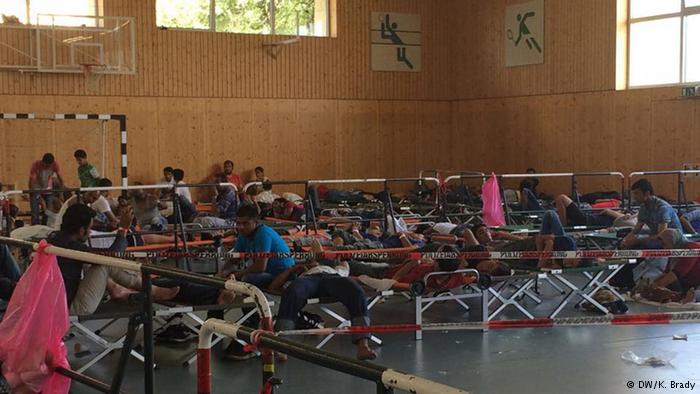
First, there were the images on TV of desperate, scared people climbing out of tiny boats and marching slowly along motorways and through woods. Then, not long after, the refugee crisis arrived on Shaked Spier’s doorstep in Berlin: overcrowded gyms, people waiting for weeks to be registered, overwhelmed officials.

“I knew immediately: If refugees are now in the country that my grandparents had to flee, and if they need help and protection, then I have to do my part,” Spier said. For him, there was absolutely no doubt. Since then, Spier, a Jew whose grandparents once fled the Nazis, has been volunteering at a refugee shelter in Friedrichshain, a hip district of Berlin filled with bars and cafes. Spier, 30, is a well-spoken man who works as a project manager at an IT company, and gives long, reflective answers when asked questions. At the refugee shelter, he helps to serve meals, plays with the kids and talks to the parents about the trauma they’ve experienced.

He is one of many Jews who’ve been helping refugees by donating clothes, working in shelters, or taking refugees into their homes. Spier says he hasn’t had any negative experiences. He says his identity, background and sexual orientation – Spier is openly gay – have never played a big role in his encounters with refugees. If someone notices the Hebrew tattoo on his arm or his accent, the reaction is typically one of, “Oh, you’re from Israel? Cool, I’m from Afghanistan.” He laughs.

Deutschland Rosenheim Grenze Österreich Turnhalle Lager Asylbewerber More than 1 million refugees came to Germany in 2015

No research to support the claims

But then he grows serious. It makes him angry, he says, when other people accuse refugees of being anti-Semites or harboring hate towards Israel simply because they come from countries whose governments espouse such sentiments. The head of Germany’s Central Council of Jews, Josef Schuster, has frequently spoken about the danger of importing anti-Semitism along with refugees. In a recent newspaper interview, he said that “a considerable proportion of Arabs have grown up with anti-Jewish, anti-Israeli stereotypes. These people cannot simply leave their prejudice behind at the border.”

Spier says he has experienced no hostility while working with refugees

Dervis Hizarci, a history and political science teacher in Berlin, also finds such generalizations problematic. There is no research on the extent to which refugees may be bringing anti-Semitism with them to Germany, he said. Hizarci is the head of KIGA, an initiative against anti-Semitism based in the Berlin neighborhood of Kreuzberg. The initiative has launched a project about anti-Semitism among refugees; he expects to have the initial results by the end of the year. Until then, Hizarci says people shouldn’t make generalizations about the issue, as that would only stir up anti-Islam and anti-foreigner sentiment. However, he points to research showing that between 15 and 20 percent of the German population harbor latently anti-Semitic views. “Of course there are Muslims among these people, even in the second and third generation, but they’re by far not all Muslims!”

Hizarci doesn’t deny that young German Muslims are susceptible to anti-Semitic views, fueled by the horrors of the Middle East conflict they see on their smartphones and televisions. Hizarci and his colleagues give workshops and lead debates about anti-Semitism, but also about hatred of Islam. He says his work requires a lot of time and resources. “Just like when it comes to fighting homophobia or right-wing extremism, you can’t change such views with a single workshop; it doesn’t happen overnight.” After the Easter holidays, the initiative wants to start a model project that, among other things, will offer welcome workshops on the topic.

Mosques are overwhelmed

But often, it’s individual people engaged in such efforts to promote tolerance: German mosques are often overwhelmed with the problem, in part because they are led by volunteers who also have to commit their time and energy to other problems facing members of their community, such as exclusion, anti-Islam sentiment and joblessness. There are barely any resources left for confronting the problem of anti-Semitism, said an insider who asked to remain anonymous due to the contentious nature of the topic. The source added that many young Muslims are not an integrative part of the mosque community: “When that’s the case, there’s no way to reach them.”

Source: Refugees and anti-Semitism: is it a problem? | Germany | DW.COM | 12.03.2016

Obama to Turnbull on Indonesia, Islam and the Saudis: ‘It’s complicated’

Always interesting to have a more inside account of these discussions, highlighting awareness in this case:

A revealing series of interviews with US President Barack Obama has given insight into a private discussion he had with Australian Prime Minister Malcolm Turnbull.

The 20,000-word feature published in The Atlantic magazine also relies on interviews with Mr Obama’s former Secretary of State Hillary Clinton, her successor John Kerry, Israeli Prime Minister Benjamin Netanyahu, other world leaders and key White House insiders.

It details part of a meeting between Mr Obama and Mr Turnbull during November’s APEC summit in Manila.

The president, according to The Atlantic, described to Mr Turnbull how he had watched Indonesia gradually move from a relaxed, multi-faceted Islam to a more fundamentalist, unforgiving interpretation with large numbers of Indonesian women adopting the hijab Muslim head covering.

“Why, Turnbull asked, was this happening?” the author of the feature, Jeffrey Goldberg, wrote.

Mr Obama told the prime minister the Saudis and other Gulf Arabs have funnelled money and large numbers of imams and teachers into Indonesia and in the 1990s the Saudis heavily funded Wahhabist madrassas, seminaries that teach the fundamentalist version of Islam favoured by the Saudi ruling family, according to The Atlantic.

Mr Obama also told Mr Turnbull Islam in Indonesia was much more Arab in orientation than it was when he lived there.

“Aren’t the Saudis your friends?,” Mr Turnbull reportedly asked Mr Obama.

Mr Obama smiled and said: “It’s complicated”.

Source: Obama to Turnbull on Indonesia, Islam and the Saudis: ‘It’s complicated’