My ‘Oriental’ Father: On The Words We Use To Describe Ourselves : NPR

Further to my earlier post on the US retiring obsolete ethnic group descriptions (Minorités: des mots offensants retirés des lois américaines | États-Unis), interesting reflections on the generational shift in language from Oriental to Asian American:

Chink as a racial moniker was always meant to cut, but there was a time — my dad’s — when “Oriental” was the status quo. To some degree, these things come down to the words available to us in the first place. Between the late ’60s, when my dad immigrated here from British colonial Hong Kong, and 1990, when I was born, there was an eruption in the way Americans talked and thought about all sorts of identities. While my dad’s English vocabulary was equipped with “Oriental”, scholars and activists alike turned away from words like it and “Negro” in favor of self-appointed terms like “Asian,” “Asian-American,” “black” and “African-American.” And recently, President Obama signed a bill striking the term “Oriental” — one of many other outdated terms — from federal laws.

I came of age in a generation that benefited from these wind shifts. My dad, like many people his age, didn’t really pay them much mind. When it came to describing himself, the words he had when he came to this country were all he ended up needing. I get that he uses it as a matter of fact. He gets that I have my reasons for not using it. And when it comes to us talking to each other, that’s fine.

Source: My ‘Oriental’ Father: On The Words We Use To Describe Ourselves : Code Switch : NPR

Trudeau chooses two women to fill top diplomatic positions – and broader diversity emphasis

Telling and consistent with overall diversity and inclusion agenda:

The Prime Minister has told Global Affairs that its list of career candidates has too many white males and promised better representation in terms of gender and ethnicity.

Overall numbers for all Global Affairs employees: 54.8 percent women, 14.4 percent visible minorities (TBS EE report 2014-15).

Source: Trudeau chooses two women to fill top diplomatic positions – The Globe and Mail

Obama’s Hiroshima visit: A compromise with history – Paris

Erna Paris on the Obama Hiroshima visit and the lack of apologies:

In Japan, the debate continues. Although the country has dedicated itself to “universal peace” by eschewing armed conflict and promoting nuclear disarmament, the historical narrative is darker with regard to war crimes.

While the United States account excuses the nuclear attacks in the name of a purported greater good, some prominent Japanese conservatives have denied that the well-evidenced crimes committed by their military even happened. Like his predecessors, Mr. Abe (whose party has been in power almost continuously since war’s end) has also visited a controversial Tokyo shrine where the souls of convicted war criminals are said to reside.

There are cultural differences, too. Mr. Obama embodies the American propensity to ignore the past and look to the future, while in Japan the bombings are commonly transformed into abstractions about universal peace with little historic specificity. These tendencies will doubtless facilitate the leaders’ desired focus on current geopolitical issues, such as North Korea, territorial disputes in the South China Sea and nuclear disarmament.

Earlier this month, Mr. Obama delivered the convocation address at Howard University in Washington in which he spoke about the political necessity of compromise. On Friday, he and Mr. Abe will exhibit a compromise with history itself.

Had either country followed the example of postwar Germany, whose leaders fully apologized for the Holocaust, there would be more substance to this historic visit.

Apologies and acknowledgments matter. Truth brings solace. It also reforms national memory, as Canadians discovered with the Indian Residential Schools Truth and Reconciliation Commission.

Nonetheless, by virtue of making this symbolic trip to Hiroshima more than 70 years after the event, Mr. Obama has begun a long-overdue process of reconciliation. For this, we must be grateful.

In addition to the TRC, the apologies to Japanese, Chinese and Indo-Canadians for wartime internment and immigration restrictions such as the head tax and the ‘continuous journey’ requirement are part of that healing and recognition process.

Source: Obama’s Hiroshima visit: A compromise with history – The Globe and Mail

Ontario students falling through the cracks, TDSB enrolment plunges over sex-ed curriculum

Starting to get the numbers of those who have dropped out from the public school system (headline ‘plunges’ is an over statement). Remains to be seen whether this is a one-time shift (my guess) or longer-term trend.

Also needs to be seen in context of Thorncliffe Park, whose principle engaged with parents with considerable success, with most students returning (see Toronto school [Thorncliffe Park] offers sanitized sex-ed amid parent concern, where enrolment dropped by 40 out of a projected 1,350 – about 3 percent):

Last April, thousands of parents were marching at Queen’s Park in protest against the curriculum. But it took months for public schools to take stock of the ensuing enrolment drop.

… The Ministry of Education said parents have the right to change their children’s schooling if they can’t abide by the update to the old sex-ed curriculum, which it called “dangerously out of date.”

“We respect that many parents choose to home-school their children or enroll them in private schools,” the ministry said in a statement.

Just as it’s unclear how those children are now being taught, it’s unclear how many in total have dropped out of the public system because of sex ed.

In the fall, the idea that the Toronto District School Board had lost students over sex ed was met with skepticism, with some suggesting the board was using that as an excuse for its job cuts. The TDSB’s enrolment has consistently declined for years.

But what happened this year was unusual. The TDSB, with a quarter-million students, normally uses demographic and immigration data to project enrolment within 1-per-cent accuracy, meaning its staff are off by no more than 1,700 students in the elementary grades, spokesman Ryan Bird said.

For the current school year, staff projected an increase of about 300 elementary students, in keeping with recent patterns. Instead, the TDSB elementary head count went down by 2,083, or 2,373 fewer than projected. Staff had been off by an unheard-of 1.4 per cent.

At the TDSB, the five schools that lost the most students were in neighbourhoods at the centre of the sex-ed protests: Thorncliffe Park, Manahil’s old school, lost two full Grade 1 classes.

It’s less clear how much sex ed was to blame for an unprecedented enrolment drop at the Peel District School Board, which covers Toronto’s western suburbs.

Unlike the shrinking TDSB, Peel has grown steadily for years. The fall of 2015 was the first time in many years that the student population declined overall, spokeswoman Carla Pereira said.

The number of elementary students decreased by only 728 from October, 2014. But staff had projected an increase of 900. Like the TDSB, they were off by 1.4 per cent.

Ms. Pereira said the board has since gained about 1,000 students and doesn’t believe sex ed was a significant factor in the dip in numbers. Many South Asian families took fall vacations, she said.

The second-highest drop in the Peel system was at James Potter Public School in Brampton, which has many students from the Sikh community, which was vocal in the sex-ed protests.

Last September, two new Sikh private schools opened in Brampton, adding to two existing ones. The parents who flocked to them were likely swayed at least in part by qualms over the curriculum, said one man who volunteers at newly opened Gobind Sarvar School.

“It’s hard to put a number on it,” said the man, who didn’t want to be identified. “I think [sex ed] was probably something that tilted it.”

Source: Ontario students falling through the cracks, TDSB enrolment plunges over sex-ed curriculum – The Globe and Mail

Chinese K-12 students a booming demographic for B.C. schools

While from an integration perspective, earlier arrival generally means better results, it is telling how strategic some Chinese parents are, and how market-oriented some private schools are:

The average age of Chinese students arriving in B.C. and Canada is dropping dramatically as growing numbers of international K-12 pupils, not just college students, are enrolling in local schools.

According to a monthly report published by Canadian immigration lawyer Richard Kurland, there is a demographic shift occurring in the kind of student visas being processed by Canada’s embassy in Beijing. Kindergarten-to-Grade 12 students made up 37 per cent of all study permits issued in China last year, a sharp rise from 18 per cent just six years ago. In B.C., there were 1,094 Chinese students enrolled in K-12 in 2009; by 2014, that figure had quadrupled to 4,306.

Kurland says the statistics suggest a shift in the thinking of Chinese families about how to get their children — and perhaps themselves — Canadian residency. He pointed to recent changes in Canadian immigration law that make “Express Entry” a lottery system for international college students, causing Chinese families to seek ways to improve their chances.

“It used to be, if you are from China, and you are in Canada on a college study permit, you had an excellent chance of gaining residency,” Kurland said. “They may have had to wait, but students could say, ‘I know I’m in.’

“The new system threw all of that predictability and transparency out the window. It didn’t make sense to gamble $30,000 to $40,000 a year (on college) if the goal was permanent residence.”

Experts say sending students to Canada at a younger age speeds integration into Canadian society and improves their chances for residency in a number of ways. Kurland speculates that Ottawa may already be looking at changes to give residency preference to students who graduated from Canadian elementary and secondary schools. But there are other reasons why parents are sending their children to B.C. earlier.

Huichen Li, 26, has first-hand experience.

“I have asthma, so my parents thought coming here would be better for my health,” said Li, who is currently president of the Chinese Students and Scholars Association at Kwantlen Polytechnic University’s campus in Richmond. “We thought we could get adjusted earlier by coming earlier.”

Li arrived in Canada as a Grade 10 student and attended North Vancouver’s Bodwell High School, a private international boarding school. He lived in a dorm for a year before his parents followed him.

Randall Martin, executive director of the B.C. Council for International Education, said China’s previous “One-Child Policy” put a lot of pressure on many families’ only child. If a child has the responsibility of possibly supporting all family members as they age, going abroad early can be very important, he said.

“Basically, a child has six guardians: two parents and four grandparents,” Martin said. “Ultimately, the sense from the families is that — if the state can’t support those six people — that one child has to. … And if you’ve got one child, you want the best for his or her health, and that’s not going to be in a major city in China. With the ability of all these relatives to support a student going abroad, it’s almost a no-brainer.”

The enormous market also means many B.C. schools actively court Chinese K-12 students, which concerns some in the industry.

Paul Romani, founder of Vancouver’s Pear Tree Elementary, said his school accepts very few international students, and charges all students similar fees. But many other institutions charge significantly higher fees for international students, giving administrators an incentive to go after more Chinese students, he noted.

“There are some private schools in B.C. that are increasingly exploiting the higher fees charged for international students, as well as the unbelievably generous ‘donations’ … which few B.C. families could ever compete with,” Romani said.
Source: Chinese K-12 students a booming demographic for B.C. schools | Vancouver Sun

No Community Should Have To Publicly Denounce Extremism | Jack Jedwab

Good piece by Jack Jedwab, quoting Rima Elkouri:

When I was employed by the Jewish community, I would occasionally be asked by the media to disassociate myself from individuals or groups that identified with the community. There is a need for greater empathy with members of communities for whom such disassociation is commonplace.

In September 2014, La Presse‘s Rima Elkouri decided to disassociate herself from barbaric acts taking place in Syria. In a climate where the failure on the part of individuals of the Muslim faith to denounce such action is deemed a tacit endorsement, Elkouri chose to respond to such a request on the part of an obnoxious reader of the newspaper.

Paradoxically, Ms. Elkouri is not Muslim. In her response, she noted that it’s never enough for the broader population when large Muslim organizations denounce the Islamic State. Hence, she pointed out that “sometimes it’s our citizens of the Muslim faith that feel compelled to denounce barbaric acts with greater vigour than the rest of us so as not to be seen as guilty by association.”

Elkouri added: “… Muslims, we tend to forget, are the principal victims of jihadists. They are no more likely to have ties with the Islamic State than do Christians with the Ku Klux Klan. Why this persistent societal demand for Muslims to break ranks with a group with which they do not associate? Why this hunting that regards silence with suspicion.” (Editor’s note: blogger’s translation.)

Elkouri concludes by disassociating herself publicly from this absurd logic.

As a solution to the real problem of terrorism in our society, it is counterproductive to collectively accuse persons of being complicit because they happen to share the same faith as a perpetrator of a heinous act. For the time being we can be thankful that in Canada when it comes to such forms of collective stigmatization, it’s the cooler heads that continue to prevail.

Source: No Community Should Have To Publicly Denounce Extremism | Jack Jedwab

Don’t Blame Diversity for Distrust – NYTimes.com

Good piece by Maria Abascal and Delia Baldassarri on disadvantage and unequal opportunities being more important to trust than diversity:

For his own part, Professor Putnam filed an amicus brief in the Fisher case objecting to the use of his findings in arguments against affirmative action. In the brief, he states his belief that diversity can be beneficial in the long term, despite its short-term drawbacks.

Our research reveals that even in the short term, diversity is not to blame. We independently analyzed the same data set Professor Putnam used, and we demonstrate that disadvantage, not diversity, is responsible for distrust.

At first glance, our results resemble those of previous studies: People in more diverse communities report lower levels of trust. Scholars and columnists alike have taken this to mean that diversity reduces trust, but we argue that this interpretation is flawed.

A thought experiment sheds light on what is going on. Imagine two schools: a homogeneous school with all Dutch students and a diverse school with half Dutch students and half Bolivian students. If we are studying student height, we would most likely find that students in the diverse school are shorter, on average, than students in the homogeneous school. Hardly anyone would then argue that attending a diverse school makes students shorter. Dutch people are taller than Bolivians, on average, and this explains the difference between the schools. Substitute trust for height and communities for schools, and, based on a similar association between diversity and trust, scholars have concluded that living in a diverse community makes people less trusting.

The analogy isn’t perfect, but it draws attention to an important possibility: Trust, like height, might be determined by pre-existing differences between groups, rather than exposure to diversity. In the United States, blacks and Latinos report lower levels of trust than whites, regardless of the communities where they live. The average homogeneous community (defined as a census tract) in the United States is 84 percent white, whereas the average diverse community is 54 percent white. Together, these patterns indicate that diverse communities do not make people less trusting. Rather, distrust is higher in diverse communities because blacks and Latinos, who are more likely than whites to live in one, are less trusting to begin with.

If diversity doesn’t reduce trust, what does? According to our analysis, disadvantage accounts for lower levels of trust. If you have a low income, or less schooling, or are unemployed or experiencing housing instability, you are likely to report lower trust. To make matters worse, if your neighbors experience similar disadvantages, this compounds your distrust. Taken together, this suggests that it is not the diversity of a community that undermines trust, but rather the disadvantages that people in diverse communities face.

This is why blacks and Latinos report lower trust than whites: Socioeconomic and neighborhood disadvantages are more common among these groups. We suspect that blacks and Latinos also report lower trust for other reasons, including continuing discrimination, victimization by the police and hostile political rhetoric.

Finally, our only finding related to diversity confirms a familiar story about white intolerance toward minorities. Whites who live among more blacks and Latinos report slightly lower trust than those who live in predominately white communities. This is a far cry from the claim that the minorities who are diversifying the nation are responsible for declining levels of trust.

This distinction has important implications for the affirmative action debate and social policy in general: If diversity is the problem, then policies should aim to protect or even promote homogeneity. If, instead, whites’ bias against blacks and Latinos is partly to blame, then policies should aim to allay these biases and their consequences for targeted groups. This was part of President John F. Kennedy’s original rationale for affirmative action: to address unequal opportunities across “race, creed, color.” Many of the conditions that motivated Kennedy’s directive persist today. Blacks, Latinos and members of other disadvantaged groups still face unequal treatment across a range of arenas, from the labor market to housing to education.

The current debate on affirmative action is playing out in the context of widespread anxieties about the changing face of the nation. Research that links diversity to negative outcomes legitimizes these anxieties. And it doesn’t help that this research has found its way into arguments against affirmative action. But disadvantage and unequal opportunities, rather than diversity, present the biggest obstacles to our getting along. By doing away with affirmative action and limiting access to higher education for blacks and Latinos, we will aggravate the disadvantages these groups face, while accommodating the intolerance of whites toward minorities.

Source: Don’t Blame Diversity for Distrust – NYTimes.com

With civil service shakeup, Trudeau brings youth, diversity to top jobs

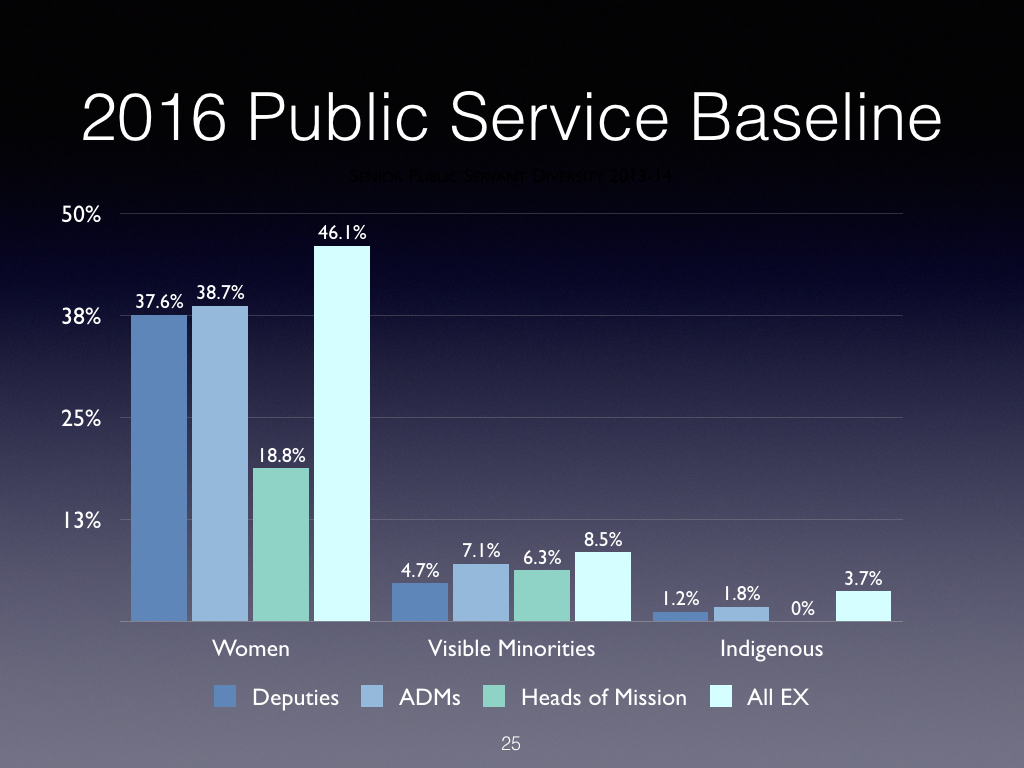
Election 2015 and Beyond- Implementation Diversity and Inclusion.001Simon Doyle on changes to Deputy ranks but more anecdotal than evidence-based.

My count of the 19 Deputy appointments to date by PM Trudeau: 10 men, 9 women, 1 visible minority, no Indigenous people. Gender parity but weak visible minority and Indigenous peoples representation, reflecting in part weaknesses in ADM diversity as shown in the above chart:

Retirements of Ottawa’s highest-ranked bureaucrats have accelerated under the Justin Trudeau government as the Liberals shuffle the leadership of the public service after years of management under Stephen Harper.

The government has made a series of moves with its highest-ranked bureaucrats since coming into office last fall, most recently promoting senior officials who had worked on the Environment and Foreign Affairs portfolios.

…..David Zussman, a former senior government official and a professor of public-sector management at the University of Ottawa, said the number of appointments are high, with more than 20 changes in the senior ranks of the public service since late December, including retirements.

“I’m sure word would have gone out that: ‘We’re in a process of renewal, and any of you guys thinking of leaving, do me a favour and tell me now,’ ” Dr. Zussman said.

“A lot of them are really long-standing public servants who I think hung around for the election to help out [former clerk] Janice Charette, and now, six months into it, they decided to trigger their retirements. They’ve all got their 35 years,” he said, indicating they can collect pensions.

…“Some ministers may want a new deputy, and it’s their prerogative to say they would like someone new. The clerk may decide that he feels someone should move, or sometimes deputies will go and say they would like to move,” said C. Scott Clark, former deputy minister of finance and a senior adviser to the prime minister under the Jean Chrétien government.

“It takes time for a minister and a deputy to form what I would call a good relationship, a professional, working relationship. Sometimes they do, sometimes they don’t,” Mr. Clark said.

…The new deputies also reflect efforts by Mr. Trudeau and the clerk to renew the public service and, as with the makeup of the Prime Minister’s cabinet, introduce some youth and diversity into the government’s leadership.

“He’s been very clear about the importance he attaches to having a professional, non-partisan, responsive, agile, creative public service,” Mr. Wernick told The Globe and Mail in an interview earlier this year. “It’s the only way he’s going to accomplish the goals he put in front of Canadians.”

One senior government official said Mr. Trudeau, in late January, made a rare appearance at the Deputy Ministers’ Breakfast, a gathering of all the public service’s most senior mandarins who meet in Langevin Block. Prime ministers typically address the breakfast once or twice per year.

While it’s unclear what was said, the PM has been emphasizing with senior officials a program for getting results and revitalizing the public service. Mr. Trudeau attended the meeting shortly after he appointed Mr. Wernick as Clerk.

….Mr. Scott expects more changes in the fall after the government takes the summer to regroup. “I would expect there will probably be more moves coming,” he said. As Mr. Wernick said in a recent letter to the PM: “It is clear to me that we are entering a period of dramatic generational change in the Public Service.”

Source: With civil service shakeup, Trudeau brings youth, diversity to top jobs – The Globe and Mail

ICYMI: The Choice Explosion – The New York Times

Interesting insights on decision-making in the book, Decisive, by  Chip and Dan Heath:

It’s becoming incredibly important to learn to decide well, to develop the techniques of self-distancing to counteract the flaws in our own mental machinery. The Heath book is a very good compilation of those techniques.

For example, they mention the maxim, assume positive intent. When in the midst of some conflict, start with the belief that others are well-intentioned. It makes it easier to absorb information from people you’d rather not listen to.

They highlight Suzy Welch’s 10-10-10 rule. When you’re about to make a decision, ask yourself how you will feel about it 10 minutes from now, 10 months from now and 10 years from now. People are overly biased by the immediate pain of some choice, but they can put the short-term pain in long-term perspective by asking these questions.

The Heaths recommend making deliberate mistakes. A survey of new brides found that 20 percent were not initially attracted to the man they ended up marrying. Sometimes it’s useful to make a deliberate “mistake” — agreeing to dinner with a guy who is not your normal type. Sometimes you don’t really know what you want and the filters you apply are hurting you.

They mention our tendency to narrow-frame, to see every decision as a binary “whether or not” alternative. Whenever you find yourself asking “whether or not,” it’s best to step back and ask, “How can I widen my options?” In other words, before you ask, “Should I fire this person?” Ask, “Is there any way I can shift this employee’s role to take advantage of his strengths and avoid his weaknesses?”

The explosion of choice means we all need more help understanding the anatomy of decision-making. It makes you think that we should have explicit decision-making curriculums in all schools. Maybe there should be a common course publicizing the work of Daniel Kahneman, Cass Sunstein, Dan Ariely and others who study the way we mess up and the techniques we can adopt to prevent error.

Source: The Choice Explosion – The New York Times

Minorités: des mots offensants retirés des lois américaines | États-Unis

Updating to reflect language and culture changes. Curious to know if anyone has examples of Canadian laws that need similar updating:

Les lois fédérales américaines ne comporteront plus de termes désuets et offensants utilisés autrefois pour désigner les minorités.

Le président Barack Obama a signé un projet de loi proposant de supprimer plusieurs de ces mots, dont «Nègre» et «Oriental», vendredi, a indiqué la Maison-Blanche.

Ces deux expressions seront remplacées par «Afro-Américain» et «Asio-Américain».

Le projet de loi a été adopté en février par la Chambre des représentants et la semaine dernière par le Sénat. Aucun représentant ou sénateur ne s’y est opposé.

Les termes visés par la législation apparaissent dans des lois des années 1970 tentant de décrire les minorités.

Dans la Loi sur l’organisation du département de l’Énergie, la phrase «un Nègre, un Portoricain, un Indien d’Amérique, un Esquimau, un Oriental ou un Aléoute ou un hispanophone d’origine espagnole» sera remplacée par «Asio-Américain, natif d’Hawaï, natif des îles Pacifiques, Afro-Américain, Hispanique, Portoricain, Amérindien ou natif d’Alaska».

Les mêmes mots seront aussi remplacés dans la Loi sur le développement et les investissements dans les travaux publics locaux, qui remonte à 1976.

Source: Minorités: des mots offensants retirés des lois américaines | États-Unis