Opinion: Mass immigration cause of demand for housing

Herbert Grubel on the impact of immigration on the Vancouver housing market (overall immigration not just the wealthy).

While I agree with his characterization of many of the interest groups supporting continued high levels of immigration, his reference to the “silent majority” is left undefined: is it code for ‘old-stock’ Canadians or a more inclusive concept that includes many second generation new Canadians who face similar affordability issues (see Chinese real estate investors are reshaping the market):

The other alternative is curtailing mass immigration, which is the responsibility of the federal government. Such curtailment will not take place since federal politicians are pressured to maintain present policies by the many beneficiaries of mass immigration: the construction industry, real estate agents, employers hiring immigrants to keep labour costs low and increase profits, retailers benefiting from increased sales, the owners of land and homes whose capital gains depend on high demand by immigrants, the members of the immigration industry (lawyers, consultants, providers of adjustment assistance, teachers of English as a second language and others who are paid by government to serve immigrants), members of immigrant communities wanting to increase their economic and political influence, and immigrants who want to have their parents and grand-parents join them.

There are also Canadians who enjoy more abstract benefits from mass immigration: socially conscious people who want to do good and get satisfaction from seeing immigrants escape poverty in their home countries, and making Canada a globally admired multicultural society. Politicians whose re-election chances are increased by catering to these do-gooders and who, ironically, gain status and self-esteem by designing and financing at taxpayers’ expense policies for the assistance of those suffering from the high costs of housing.

Because of the politics surrounding building rules and immigration policies, Vancouver’s young will continue to suffer from the high and increasing costs of housing. Many will leave Vancouver. Some will live in the basement of their parents’ home or share accommodations with others, postponing and often forgoing marriage and having children.

However, eventually the silent majority of Vancouverites who do not benefit from mass immigration may vote for changes in federal policies. This will happen once this silent majority becomes aware of the negative effects on their own well being caused by mass immigration: fiscal deficits resulting in higher taxes; lower wages and incomes per person; traffic congestion, pollution, scarcity of family physicians, hospital beds and university places and diminishing returns from multiculturalism.

Source: Opinion: Mass immigration cause of demand for housing | Vancouver Sun
Germany’s AfD Party and Its Anti-Islam Platform – The Atlantic

Good analysis of the demographics of the right-wing vote:

The party’s beginnings weren’t quite so dramatic. The AfD started out in 2013 with a Ph.D.-riddled member list and a wonky Euroskeptic manifesto that could have lulled a caffeinated squirrel into a midday nap. It called for empowering national governments to ditch the euro, limiting state bailouts, and mandating national referenda for certain EU policies, alongside scintillating stipulationsabout European Central Bank maneuvers and alternative funding for renewable-energy subsidies. Yet the huge influx of predominantly Muslim refugees in the past year, along with incidents such as the infamous New Year’s Eve assaults on women by men seeming mostly to be of North African descent, has helped radicalize group. Last month’s manifesto not only declared Islam incompatible with German legal and cultural values, but also endorsed a ban on burqas and the call to prayer.

The AfD’s founder Bernd Lucke, an economics professor, left the party last summer, condemning rising xenophobia. Many other founding members have likewise defected. So who are the new supporters that helped the party to its best-ever election performance a few months ago? Which people, specifically, want to kick Islam out of Germany?

Demographically, surveys show, AfD supporters fit a certain loose profile. First, despite having a woman at the helm in the figure of Frauke Petry (as well as trigger-happy aristocrat Beatrix von Storch, who has advocated using deadly force illegal migrants at the border, as deputy party chief), AfD supporters are predominantly male. In January, one poll found 17 percent of male respondents nationwide would vote for AfD in a hypothetical immediate election, while only 2 percent of women would. In the March regional elections in the state of Sachsen-Anhalt, 27 percent of male voters chose AfD, as compared to 18 percent of female voters. As the German daily Die Zeit pointed out, that means AfD support follows roughly the same pattern as support for the intensely anti-Islamic pan-European movement PEGIDA (“Patriotic Europeans Against the Islamization of the West”).

Theories abound as to why and to what extent men are more likely to vote for far-right or xenophobic platforms than women—a pattern that holds with Trump supporters in the United States, as well as voters for Austria’s far-right presidential candidate Norbert Hofer, who just barely lost that country’s election this week. But few political scientists doubt that the trend exists in some form. “That’s one finding that we all agree on,” said David Art, a political-science professor at Tufts University who studies comparative politics and right-wing extremism.

A second trend in AfD demographics involves class. Originally, professors, journalists, and business leaders dominated the party, with over half the founding members in 2013 sporting a “Dr.” in front of their names. Surveys around the March 2016 elections in three German states, however, showed the AfD drawing about a third of its support from laborers, and another third from individuals currently unemployed. Those with “higher education” were in the minority. That’s not to say that AfD supporters are entirely uneducated, or that no one with a university degree continues to support the once doctorate-led party. But in general, said Kai Arzheimer, a political-science professor at the University of Mainz who has become the go-to expert on voter behavior in the AfD, “it’s people who have done Realschule, which doesn’t qualify you for entering a university, but is still quite a respectable degree.”

Third comes age. “[AfD supporters] are youngish to middle-aged,” said Arzheimer. “Interestingly, voters over 60 seem to shy from voting for the AfD because they’re still tied to the Christian Democrats,” Merkel’s center-right party.

… What all these voters seem to share, say the experts studying them, is intense concern about immigration and Islam—issues with extraordinary capabilities for generating strange bedfellows. “Suddenly the far-right is pro-Jewish because it’s anti-Muslim,” said Lenka Bustikova, a political scientist at Arizona State University who has studied far-right movements further east in Europe. “Suddenly with the [influx] of refugees you have this new twist: You are for Western gender rights because you think the Muslims are cavemen. It’s going to be interesting to watch.”

Source: Germany’s AfD Party and Its Anti-Islam Platform – The Atlantic

Tories unfairly targeted Muslims during election, supporter tells convention

Jenni Byrne still in denial mode?

A Muslim Conservative supporter took to the floor of the federal Tory convention in Vancouver to accuse her party of unfairly targeting Muslims during the failed 2015 election campaign.

Urz Heer, who hails from the riding of Brampton South in the Toronto area, told Conservative Party executive director Dustin van Vugt that the party made her feel like an outsider.

The Tories came under fire during the 2015 campaign for vowing to ban people from wearing the niqab head covering during citizenship swearing-in ceremonies and for pledging to consider barring public servants from donning the same garb at work.

 “This party worked actively and aggressively against my people,” Ms. Heer said as some fellow Conservatives disputed what she was saying.

“It did,” she said. “It didn’t differentiate who Muslims were versus the enemy.”

She said Conservative tactics spurred Muslims to vote against the Tories in the election, Ms. Heer said.

“For the first time I felt like I didn’t belong here and this was my country,” the Conservative delegate said.

Former Conservative campaign manager Jenni Byrne, also attending the Vancouver party convention, defended the campaign’s conduct. The Tories also promised late in the campaign to set up a tip line so Canadians could report allegations of “barbaric cultural practices.”

Ms. Byrne noted that Mr. Harper’s announcement in early October last year that his government would consider a ban on niqabs in the public service followed a court decision on the headgear.

A day before the Conservative Leader’s statement, the Federal Court of Appeal had rejected the Tory government’s request that its ruling on the unlawfulness of barring the garb from citizenship ceremonies be put on hold while it sought leave to take the matter to the Supreme Court.

“In terms of the barbaric cultural practices or the niqab debate, the campaign had absolutely no choice but to speak on it, the [former] prime minister had choice but to speak because there was a court ruling midway through the campaign. It wasn’t that it was a campaign choice. It was: we had to react to a court case,” Ms. Byrne said.

Source: Tories unfairly targeted Muslims during election, supporter tells convention – The Globe and Mail

Quebecers can thank comics for the demise of ‘hate speech’ measures: Macpherson

Don Macpherson on the reasons for the demise of the hate speech provisions of Bill 59:

To begin with, the hate-speech provisions were unnecessary. “Hate propaganda” is already an offence under the federal Criminal Code.

Nevertheless, legislating for the sake of legislating, Bill 59 would have created a new offence of hate speech. And it would have turned the Quebec human-rights commission, which is supposed to protect fundamental freedoms, into a “speech police.”

Anyone it charged with hate speech would have been liable, if found guilty by the province’s human-rights tribunal, to a fine of up to $10,000 for a first offence.

But while a conviction under the Criminal Code requires proof beyond a reasonable doubt, Bill 59 contained no such standard.

And while much has been said about how Bill 59 could have had a chilling effect on criticism of religions in Quebec, what has received less attention is that it could have had a similar effect on political debate.

For unlike the Criminal Code, Bill 59 would have specifically defended political groups against so-called hate speech.

This would have been a boon to the Quebec nationalists who have complained that any but the mildest criticism of them and their movement, especially by English-language commentators, amounts to “francophobia.”

Bill 59 would have armed them with a weapon with which to harass their critics by constantly filing new complaints, the way Bill 101 hobbyists do for petty violations of obscure rules on the language of restaurant menus.

Not much public attention was paid to Bill 59, however, until the comics’ protest on a televised comedy awards show two weeks ago.

The protesters didn’t mention Bill 59. And while they pretended to be court jesters using humour to speak truth to power, their actual, somewhat less noble cause was their own freedom to continue to cruelly mock a physically deformed adolescent.

But the protest did make freedom of expression suddenly fashionable in Quebec.

Amid the uproar over the protest, a timely oped article in Quebec newspapers on the more serious issue of Bill 59 led to a re-discovery of it by editorialists and columnists. An editorial in Le Devoir expressed fear that “religious and minority groups” could use the legislation to “muzzle” journalists as well as comics.

A consensus against the bill quickly emerged, isolating the Liberal government. The PQ, citing the “censorship” of the comics, called for the bill’s withdrawal.

Unwilling to use closure to cut off debate and force the adoption of what had suddenly become an unpopular bill, the justice minister withdrew the provisions on hate speech, in a tacit admission that they were unnecessary in the first place.

The PQ claimed a victory. But it really belonged to the comics.

Source: Quebecers can thank comics for the demise of ‘hate speech’ measures | Montreal Gazette

What Is German? – The New York Times

Good piece by Anna Sauerbrey on German identity political debates:

IN Germany, a big question is back on the table: What is German — and how German do you have to be to belong to Germany? With the arrival in 2015 of 1.1 million refugees and migrants, it’s an important issue. But rather than having a reasoned debate, the extremists have already taken control. For a disturbing number of Germans, the answer is culture, including religion.

That’s the message coming out of the Alternative for Germany, an upstart right-wing party that has drawn double-digit support in recent state-level elections. At a convention earlier this month, the party adopted the sentence “Islam does not belong to Germany” into its official platform.

The sentence is a direct rebuke to a famous 2010 statement by a former German president, Christian Wulff, who proclaimed the opposite, earning praise from migrants, liberals and the left. At the time, it was an uncontroversial position, one supported by Chancellor Angela Merkel and most political polls. Today, about 60 percent agree with the Alternative for Germany’s position, pollsters found in May.

Anti-Muslim sentiment is just one element in the party’s fairly coherent, nativist concept of national culture. The preamble to its program promises to preserve “our occidental and Christian culture, our nation’s historical and cultural identity, and an independent German nation of the German people.” The party refers to German culture as the “einheimische Kultur” — native culture — and describes the German nation as “a cultural unit” under threat from immigrant cultures. Its program for the state election in Baden-Württemberg in March stated: “Germany’s cultural foundation is being smashed by immigration.”

Photo

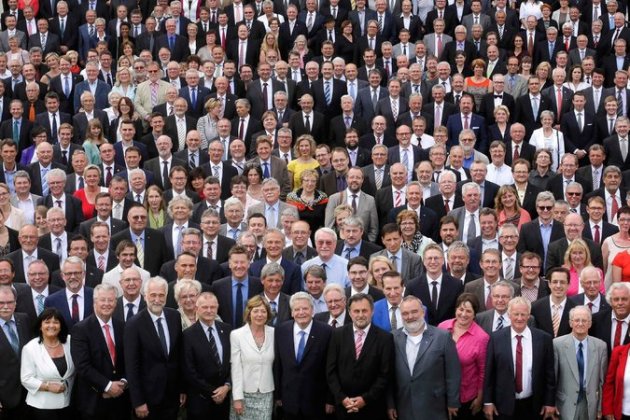
President Joachim Gauck of Germany, center, with local politicians from around the country on Monday. CreditMarkus Schreiber/Pool, via Reuters 

For many liberals and centrist conservatives, culture is defined as the ways a person or group does things. For the Alternative for Germany, it is much more — a natural fact, the core of a person or group’s essence, a thing, not a set of practices. And that thing must be kept homogeneous and pure.

It follows, at least for the new German right, that cultures can be compared and ranked — some are worth preserving, while others are invasive and inferior. German culture is under constant risk of losing its purity, and its defense is a core role of the state. It is a thinly veiled update of the old racist ideologies: culturism as the new racism.

In March, the Alternative for Germany made it into three state parliaments. Pollsters currently see the party at 10 to 15 percent of the electorate. That could be enough to force Ms. Merkel’s Christian Democratic Party further to the right. Progressive and conservative Christian Democrats are still debating the correct way to deal with the new far right, but the party has already trotted out its own answer to the “What is German” question: the concept of “Leitkultur,” or a guiding national culture.

Leitkultur is not new per se; it was introduced to the German debate on immigration in 2000 by Friedrich Merz, then head of the federal Parliament’s Christian Democratic caucus. The German government was planning an immigration reform to attract more engineers. Mr. Merz demanded that immigrants adapt to the dominant German culture: secular, German-speaking, rule-of-law abiding. The ensuing criticism was fierce, and although the Christian Democrats did include the term in their official immigration position, they more or less dropped it as an issue.

But with the Alternative for Germany sucking voters from Ms. Merkel’s party, conservatives are pushing the party to attribute a more central role to Germany’s cultural identity. Leitkultur has reappeared in Christian Democratic speeches and working papers. Ms. Merkel used the term approvingly while campaigning in March.

There’s a difference between Leitkultur and the Alternative for Germany’s einheimische Kultur — in the Christian Democratic version, the nativist element is weak; Islam is not a target, at least explicitly. Still, the reintroduction of the concept at a time when the Alternative for Germany is promoting its cultural version of the Aryan nation is as strategically clever as it is dangerous: The Christian Democrats are whitewashing the far-right version of the Cultural German.

While the political cost is high, the concept of Leitkultur is useless. Attempts at legally defining and protecting “German culture” often verge on the absurd. In April, after reports that some public cafeterias no longer served pork out of respect for the dietary restrictions of their Muslim customers, the Christian Democrats in the state of Schleswig-Holstein introduced a proposal to preserve pork dishes in public canteens. “We must not allow for a minority to determine what the majority eats,” a local Christian Democrat said. Some of the reports proved false. The “schnitzel law” caused snickering — and was rejected.

Asked in 2000 what he thought went into German Leitkultur, Mr. Merz pointed to the Constitution and to women’s rights. But it’s no use making refugees swear an oath on women’s rights. Germans won’t control what they think. But Germany can help them understand the laws protecting women’s rights — and reinforce them.

A modern nation state cannot be built on an ontological notion of who belongs and who does not, whether it’s outright ethnic or pseudo-cultural. It needs to build on the notion of the nation as a community — a community including those who were born here, those who came to stay and those who will stay for a while and then return to their homes. The rights and duties of the members of this community should be defined by their achievements, and by the rule of law — not by whether they eat schnitzel or wear a head scarf.

Source: What Is German? – The New York Times

The Asian force behind Vancouver’s housing boom

More on immigration and the over-heated Vancouver housing market and the related analysis by David Ley:

If he wanted to, geographer David Ley could consider himself a data point in his own research. It was back in 1996 that he was named UBC director of the Metropolis Project, an international inquiry into immigration and diversity. By that time, he’d seen his own Kerrisdale neighbourhood being remade by rich immigrants from Hong Kong and Taiwan who’d sent house prices soaring.

Ley’s 2010 book, Millionaire Migrants: Trans-Pacific Life Lines, displayed empathy for the immigrants while also identifying problems that their mass arrival wrought. By the time it was published, a new wave, this time from mainland China, had begun turbocharging Vancouver property markets yet again. For concerned officials and researchers, Ley’s book was one of the few resources available, even though it described an earlier time and a different group.

Today, a continuing lack of research and official data about the role of Chinese immigrants and investors in Vancouver’s housing insanity* remains, for some in government and the real estate industry, a rationale for doing nothing. “The interesting question is why there are deniers,” Ley says. “Often you find a vested interest.”

Ley’s latest research describes an influx of foreign capital turning Vancouver’s housing market into a Wild West land rush. He pins much of the blame on governments for whom rich Asian immigrants have become an easy fiscal fix.

In the early 1980s, Canada and especially British Columbia were in deep recession. One cure, governments in Ottawa and Victoria hoped, would be programs encouraging high-net-worth individuals from Asia and elsewhere to immigrate.**

While the immigrants did come, the economic benefits did not. It hardly mattered that Canada’s visas had less demanding standards than most other countries’, Ley says, because we didn’t uphold them anyway. Originally, aspiring business-class immigrants could choose from two main streams. In the investor stream, Canada required a lower net worth and minimum investment than did the United States – and, in the end, while banks and governments definitely got a take, there was never much in the way of actual investment.

Meanwhile, “with the entrepreneur stream, after two years you had to have hired one Canadian,” says Ley. “In the equivalent American scheme, you had to hire 10 Americans.” But in B.C. – where more than half of all business immigrants eventually landed*** – evaluations were minimal or were waived. “And this was because there was half a dozen people in the Vancouver office tasked with following up on the thousands of cases, which simply wasn’t possible.”

The Canada Revenue Agency has been similarly ineffective. The declared income of business immigrants is lower than any other category of immigrants, including refugees, Ley points out. Nor did we bother tracking property markets. The B.C. government did keep records of home buyers’ nationalities but stopped during the 1990s. “The reason I’ve heard is that there was a storage issue,” he says. “I’m passing that along while raising my eyebrows.”

Then there is the federal agency Fintrac, which is supposed to stop money laundering. Anecdotal information suggests that a large portion of Chinese buyers pay in cash (in the U.S., there is data).****  “The property market is one of the easiest ways to dispose of hot money,” Ley notes.

Ottawa abruptly eliminated both the investor and entrepreneur streams in 2014, but many of the 50,000 Chinese lined up at the time opted instead to use a new 10-year come-and-go visitor visa that does not lead to citizenship. Of the more than 300,000 Chinese come-and-gos that year, most were tourists, but a significant number employed it as an inexpensive, low-hassle mobility tool, in many cases to buy a second home occupied by student children.

In 2014 China had more than one million people with liquid assets of over $2-million. Up to 60 per cent were weighing or pursuing emigration, with Vancouver among the three top intended destinations. It’s hardly surprising that several surveys and estimates (none of them officially sanctioned, of course) place the proportion of Chinese buyers of detached homes on Vancouver’s west side at about 70 per cent and growing. “The top end of the market is not being supported by local conditions,” says Ley. “We’ve got a housing market that is totally out of whack with the labour market.” That is, people who actually hold jobs in Vancouver increasingly cannot afford to live there.

Some of the additional machinations that are throwing that market out of whack have only recently come to light. New Coast Realty stands accused of both shadow flipping and predatory pricing, following a Globe and Mail investigation.

Of course, there are beneficiaries besides the real-estate industry: namely, Vancouver homeowners. But not Ley. “My wife and I are steadfast stayers. But the craziness of the last six months has shifted a lot of people.”

Source: The Asian force behind Vancouver’s housing boom – The Globe and Mail

The complicated task of getting more women involved in politics

The debate over how to get more women involved in politics, contrasting the NDP’s Kennedy Stewart’s private members bill linking election expense reimbursement with female candidate share with Michelle Rempel’s encouragement and education approach:

Mr. Stewart’s academic research has shown that the party selection processes are biased, and that men are five times more likely to win nominations just because the selectors are biased against women.

So, the problem is with the political parties, and their old-boy networks and structures.

Equal Voice, a non-partisan group that advocates for more elected women, notes that only 32 per cent of candidates in last year’s federal election were women.

Based on the formula in his bill, Mr. Stewart says $1.25-million would be deducted from the Conservatives’ reimbursement for the 2015 election, because 20 per cent of their candidates were female; the Liberals, with 31 per cent female candidates, would lose about $900,000, and the NDP, which ran 43 per cent female candidates, would have lost about $200,000.

Mr. Stewart’s bill was debated earlier this month in the Commons; it comes back for a vote in September.

Some note that, even if it passes, the desired change might not come. Equal Voice says that in France, for example, the major parties will simply take the financial hit.

For Ms. Rempel, the bill would not make “real change.” She says women need to be educated on how to win nominations – raising money, dealing with the media, and building networks – to prepare them for the “fiery furnace” of a federal election. She believes going through rigorous internal party vetting is a positive exercise for women.

“The propensity is – and frankly you see it in all political parties in Canada – I don’t want to see women that are thrown into non-winnable ridings just to be a token so that [the party] is not financially penalized,” she says. “I think that actually takes women a step back.”

She fears a bill such as Mr. Stewart’s will change the calibre of women in the Commons: “There are women in our House of Commons across party lines that have really strong CVs or really strong life experiences. All of the women that are in the House of Commons are there because they won elections, full stop. They are not there because of tokenism.”

The NDP has the strongest female representation in caucus (41 percent), the Conservatives the weakest (17 percent, identical to 2011 election), the Liberals 27 percent.

Source: The complicated task of getting more women involved in politics – The Globe and Mail

Contrasting Liberal and Conservative Themes for 150th Anniversary of Confederation in 2017

Quite a change – close to 180 degrees –  from the previous government:

Canadians throughout the country, as well as those living abroad, will proudly take part in the celebrations marking the 150th anniversary of Confederation. This is a wonderful opportunity to celebrate all that it means to be Canadian. The Government of Canada is proud to be part of this anniversary of national and historic importance. It plans to:

  • promote and celebrate our Canadian identity; our ethnic, linguistic, cultural and regional diversity; and our rich history and heritage;
  • encourage Canadians to invest in our country’s future by bringing about significant changes and leaving a lasting legacy for coming generations;
  • create opportunities for Canadians to participate and celebrate together our shared values, our Canadian identity, our achievements, our majestic environment and our place in the world; and
  • maximize government investments and generate economic benefits for the country’s communities.

The main themes of the Government of Canada’s vision for the 150th anniversary of Confederation are:

Diversity and inclusion – We want to continue building a welcoming Canada where there is a place for everyone, a Canada where everyone can reach his or her full potential.


Reconciliation with Indigenous peoples – We want to support the vital work of reconciliation ‎with Indigenous peoples as outlined in the recommendations of the Truth and Reconciliation Commission. Reconciliation is a journey for all Canadians as we move forward into Canada’s next 150 years.


Youth – We want to continue to engage young people and give them the means to contribute to our society, because they are the ones who will shape tomorrow’s Canada.


Environment – We want to be the custodians of our environment, because it is a source of our country’s wealth and pride. We want to bring Canadians closer to nature in order to strengthen their environmental awareness.

The previous Conservative government’s theme and vision

The Government of Canada will bring Canadians together with a common purpose. The Canada 150 overarching theme is “Strong. Proud. Free.”—words that define and characterize present-day Canada. A Canada that is a strong leader in the world, with one of the most robust economies. A Canada that is proud of its identity and achievements, as well as its natural beauty and resources. A Canada that is free with an open, diverse and pluralistic society. This theme connects us with our past, embraces the present, and builds towards the future.

The Canada 150 vision includes three elements:

Giving Back to Canada: Canadians will be challenged to dream about what the future holds for the next 150 years, and to give back to our country, providing meaningful change and lasting legacies for future generations.

Honouring the Exceptional: Exceptional Canadian people, places, achievements and events will be showcased to help shape Canada’s leaders of tomorrow.

Celebrating and Bringing Canadians Together: Canadians and their communities will have opportunities to celebrate together and build a deeper understanding of Canada, its people and what it means to be Canadian.

Canada 150 programming will support and promote activities that align with this vision.

Source: Backgrounder: The 150th Anniversary of Confederation in 2017 – Canada News Centre

Archived – Backgrounder – Strong. Proud. Free.: Get Ready to Celebrate Canada 150! – 2015

Terry Glavin: The real story of the Komagata Maru

Terry Glavin provides additional historical and broader context:

It’s true that many, if not most, of the passengers later disavowed any seditious intent, but telling the story the way Trudeau told it does a grave disservice to the memory of the brave radicals who organized the Komagata Maru enterprise, from the outset, in the cause of India’s freedom.

A quixotic propaganda-of-the-deed collaboration between the Socialist Party of Canada and the revolutionary Ghadar Movement, the explicit purpose of the effort was to mount a legal challenge to the “continuous passage” immigration regulations that India’s British overlords had persuaded Ottawa to adopt to stem the flight of pro-independence Indian militants to Canada. The larger aim was to bolster the ranks of insurrectionists plotting India’s emancipation from the relative safety of North America or, failing that, to expose the cruel hoax of equal citizenship in the British Empire, first asserted by the Empress of India, Queen Victoria herself, more than a half-century earlier.

The slogan of the Komagata Maru campaign’s organizers was not: “We choose Canada, please be nice to us.” It was: “What is our name? Mutiny. What is our work? Mutiny.” This was a specific reference to the 1857 Indian insurrection known as the Sepoy Rebellion, named after the British Empire’s native soldiers in India, known as sepoys. In the Urdu language, “mutiny” is “ghadar.”

Ghadar Movement leaders saw to the organization of the ship’s voyage, led the “shore committee” activities while the ship was waylaid in Burrard Inlet, and eventually provided arms to Komagata Maru’s passengers during their stopover in Yokohama on the return journey to Kolkata. In the days after its forced departure from Vancouver Harbour, Ghadarite propaganda aimed at Vancouver’s Indian expatriates was explicit: “Go to your country and set up a rebellion at once.” Even before the ship weighed anchor and headed out to sea, the Socialist Party’s H.M. Fitzgerald was exhorting Vancouver’s Sikhs to heed the Ghadarite call and return to India to take up the fight. Within two years, half of British Columbia’s roughly 2,000 Sikhs had done just that.

The Socialist Party provided the Komagata Maru’s legal defence in Vancouver, which was no small affront to “progressive” thinking at the time. British Columbia’s labour movement and left-wing leadership had been rife with racist hooliganism ever since B.C.’s assortment of socialist leagues and union councils coalesced into the Provincial Progressive Party in 1902. Fractious and comically sectarian, the one thing the party delegates firmly agreed on at their founding convention was that Asian immigrants should be barred from Canada.

All this is not to say that the Komagata Maru passengers were not treated abysmally, or that none of the passengers intended to settle peacefully in Canada, or that they were not subjected to racist immigration rules, or that Canada has nothing to apologize for, or that the passengers were not unjustly denied permission to disembark in Vancouver. But to cast them all in the role of “victims,” as Trudeau put it, commits an indignity against the truth and dishonours the cause of Indian freedom to which the Ghadarites and their eccentric, ahead-of-their-time socialist friends were so passionately committed. Parliamentary apologies are all well and good, but a formal House of Commons’ acknowledgment of their bravery would have been a more worthy tribute.

During his apology for Canada’s role in the Komagata Maru affair last week, Trudeau said this: “When we make mistakes, we must apologize, and recommit ourselves to doing better.”

This is a fine sentiment. We might also hope that committing ourselves to being a bit more honest about Canada’s past, rather than just putting history to the purpose of making ourselves appear so much better than our forebears, should be something to strive for, too.

Source: Terry Glavin: The real story of the Komagata Maru | National Post

Discours haineux: Québec abandonne l’élément principal de son projet de loi

Appropriate response to concerns, especially given need for this specific provision unclear given existing Criminal and Civil code legislation:

Dans l’espoir d’obtenir l’adoption de son projet de loi sur le discours haineux, le gouvernement Couillard accepte de mettre de côté son élément le plus controversé, perçu comme une menace à la liberté d’expression.

La ministre de la Justice, Stéphanie Vallée, va donc décapiter son projet de loi 59 en laissant tomber les dispositions sur le « discours haineux » qui avaient soulevé des critiques dans les médias et dans l’opposition.

« On lit tous les journaux ici. On sait que, malgré la bonne volonté, malgré les efforts de vulgarisation, l’information qui s’est faite, il n’y a pas d’appétit pour l’encadrement du discours haineux au Québec », a convenu Mme Vallée au terme de la période de questions, mercredi.

Le projet de loi progresse à pas de tortue depuis près d’un an. Il était bloqué en commission parlementaire depuis des semaines et semblait destiné à mourir au feuilleton.

La députée péquiste Agnès Maltais est revenue à la charge pour réclamer que le gouvernement renonce à ces dispositions sur les propos haineux, l’élément central du projet de loi.

« Est-ce que je vais m’entêter ? Non, je ne vais pas m’entêter, a indiqué Mme Vallée. C’est un projet de loi qui apportait des modifications à la Charte des droits et libertés et il n’est pas question de passer ça sous bâillon.»

Les adversaires du projet de loi soulignaient que cette définition supplémentaire des propos haineux était une menace à la liberté d’expression. Surtout, ce nouveau cadre était inutile: les propos haineux sont déjà balisés par le Code criminel, quand ils visent une personne ou un groupe, et par le Code civil s’ils visent une personne identifiable.

Mme Vallée refuse d’y voir un échec de son gouvernement. Elle conservera les dispositions du projet de loi qui touchent le mariage forcé.

La ministre a dit souhaiter désormais obtenir une adoption rapide du projet de loi maintenant que l’élément le plus contentieux est mis de côté.

Source: Discours haineux: Québec abandonne l’élément principal de son projet de loi | Denis Lessard | Politique québécoise